浙江农业学报 ›› 2026, Vol. 38 ›› Issue (8): 1551-1562.DOI: 10.3969/j.issn.1004-1524.20250483
宁海白枇杷叶水提物通过抗炎和调控肠道菌群缓解小鼠急性肺炎
陈沁楠1,2( ), 陶文扬2, 周万怡2, 王梦竹2, 邢建荣2, 王建成3, 杨颖2,*(), 邓尚贵1,*()
- 1
浙江海洋大学 食品与药学学院 浙江 舟山 316022
2浙江省农业科学院 食品科学研究所 浙江 杭州 310021
3海通食品(宁海)有限公司 浙江 宁波 315601
-
收稿日期:2025-07-14出版日期:2026-08-25发布日期:2026-09-14 -
作者简介:陈沁楠,研究方向为天然活性物质对急性肺炎的保护作用。E-mail:15157672779@163.com -
通讯作者:*邓尚贵,E-mail:dengshanggui@163.com;杨颖,E-mail:yangying_sps@163.com -
基金资助:“科技甬江2035”关键技术(2024Z281)
Aqueous extract of Ninghai Bai loquat leaf mitigates LPS-induced acute pneumonia in mice via anti-inflammatory and gut microbiota modulation
CHEN Qinnan1,2(), TAO Wenyang2, ZHOU Wanyi2, WANG Mengzhu2, XING Jianrong2, WANG Jiancheng3, YANG Ying2,*(), DENG Shanggui1,*()
- 1
College of Food and Medicine ,Zhejiang Ocean University Zhoushan 316022, Zhejiang, China
2Institute of Food Science ,Zhejiang Academy of Agricultural Sciences Hangzhou 310021, China
3Haitong Food (Ninghai) Co. ,Ltd. Ningbo 315601, Zhejiang, China
-
Received:2025-07-14Published:2026-08-25Online:2026-09-14

摘要:
为探究宁海白枇杷叶水提物对急性肺炎的保护作用及其机制,采用脂多糖(lipopolysaccharide, LPS)诱导小鼠急性肺炎模型,进行细胞活力检测、肺组织病理学观察、湿/干重比(W/D)测定、氧化应激和炎症因子水平检测,并通过16S rRNA测序分析肠道菌群变化。结果表明,枇杷叶水提物以剂量依赖性方式缓解LPS诱导的肺泡上皮细胞损伤;枇杷叶水提物(200、400 mg·kg-1)预处理对LPS诱导的小鼠脏器系数无显著影响,可显著(p<0.01)降低小鼠肺组织W/D,减轻肺泡壁增厚、炎症细胞浸润等病理损伤,肺组织中丙二醛(malondialdehyde, MDA)含量和超氧化物歧化酶(superoxide dismutase, SOD)活性无显著变化,降低髓过氧化物酶(myeloperoxidase, MPO)活性和促炎因子IL-1β、IL-6、TNF-α水平,提高谷胱甘肽过氧化物酶(glutathione peroxidase, GPx)活性。肠道菌群分析显示,枇杷叶水提物可改善LPS引起的菌群紊乱,提高芽孢杆菌门相对丰度,降低拟杆菌门相对丰度,并增加有益菌异杆菌属(Allobaculum)、回肠杆状菌属(Ileibacterium)和安德克氏菌属(Adlercreutzia)的相对丰度。综上,宁海白枇杷叶水提物对LPS诱导的小鼠急性肺炎具有保护作用,其机制可能与抑制氧化应激和炎症反应、调节肠道菌群平衡有关。
中图分类号:
引用本文
陈沁楠, 陶文扬, 周万怡, 王梦竹, 邢建荣, 王建成, 杨颖, 邓尚贵. 宁海白枇杷叶水提物通过抗炎和调控肠道菌群缓解小鼠急性肺炎[J]. 浙江农业学报, 2026, 38(8): 1551-1562.
CHEN Qinnan, TAO Wenyang, ZHOU Wanyi, WANG Mengzhu, XING Jianrong, WANG Jiancheng, YANG Ying, DENG Shanggui. Aqueous extract of Ninghai Bai loquat leaf mitigates LPS-induced acute pneumonia in mice via anti-inflammatory and gut microbiota modulation[J]. Acta Agriculturae Zhejiangensis, 2026, 38(8): 1551-1562.
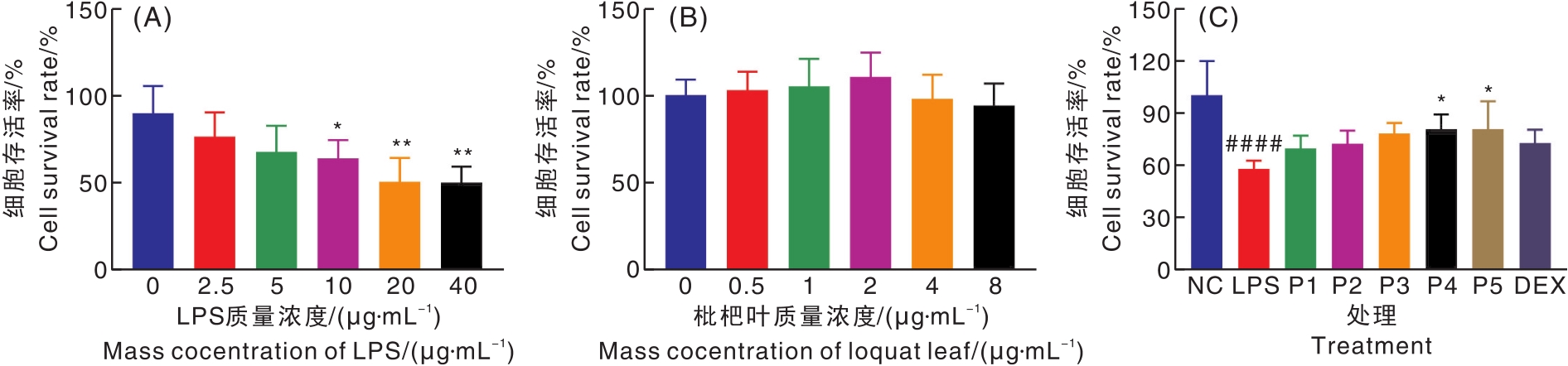
图1 枇杷叶水提物对LPS诱导的A549细胞损伤的保护作用 A,A549细胞经不同浓度LPS处理24 h;B, A549细胞经不同浓度枇杷叶水提物孵育24 h;C,不同浓度枇杷叶水提物和LPS处理A549细胞24 h后用CCK-8法检测细胞活力。图A中,*和**分别表示与0 μg·mL-1处理相比,在p<0.05和p<0.01水平上差异显著。图C中,####表示与空白组(NC)相比,在p<0.000 1水平上差异显著;*和**分别表示与模型组(LPS)相比,在p<0.05、p<0.01水平上差异显著。
Fig.1 Protective effects of loquat leaf aqueous extract on LPS-induced injury in A549 cells A, A549 cells were incubated with LPS at different mass concentrations for 24 h; B, A549 cells were incubated with aqueous extract of loquat leaf at different mass concentrations for 24 h; C, A549 cells were incubated with loquat leaf aqueous extract and/or LPS at different mass concentrations for 24 h and the cell viability was measured using the CCK-8 assay. In panel A, * and ** indicate significant differences at the p<0.05 and p<0.01 levels, respectively, compared with the 0 μg·mL-1 treatment. In panel C, #### indicates significant differences at the p<0.000 1 level compared with the blank control(NC) group; * and ** indicate significant differences at the p<0.05 and p<0.01 levels, respectively, compared with the model (LPS) group.
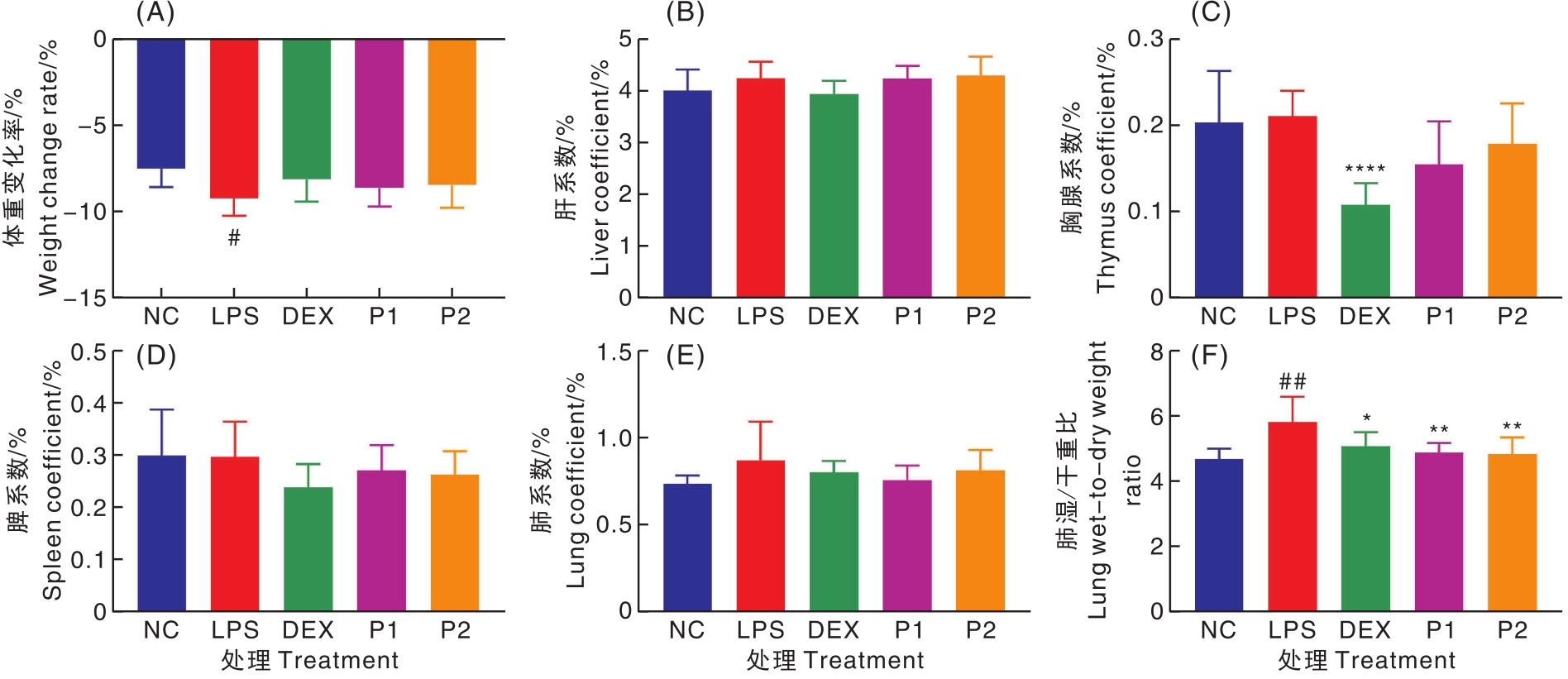
图2 枇杷叶水提物对急性肺炎小鼠体重、脏器系数和肺温/干重比的影响 #、##分别表示与空白组(NC)相比p<0.05、p<0.01;*、**和****分别表示与模型组(LPS)相比p<0.05、p<0.01和p<0.000 1。
Fig.2 Effects of loquat leaf aqueous extract on body weight, organ coefficient and lung wet-to-dry weight ratio in mice with acute pneumonia # and ## indicate p<0.05 and p<0.01, respectively, compared with the blank control (NC) group; *, ** and **** indicate p<0.05, p<0.01 and p<0.000 1, respectively, compared with the model (LPS) group.
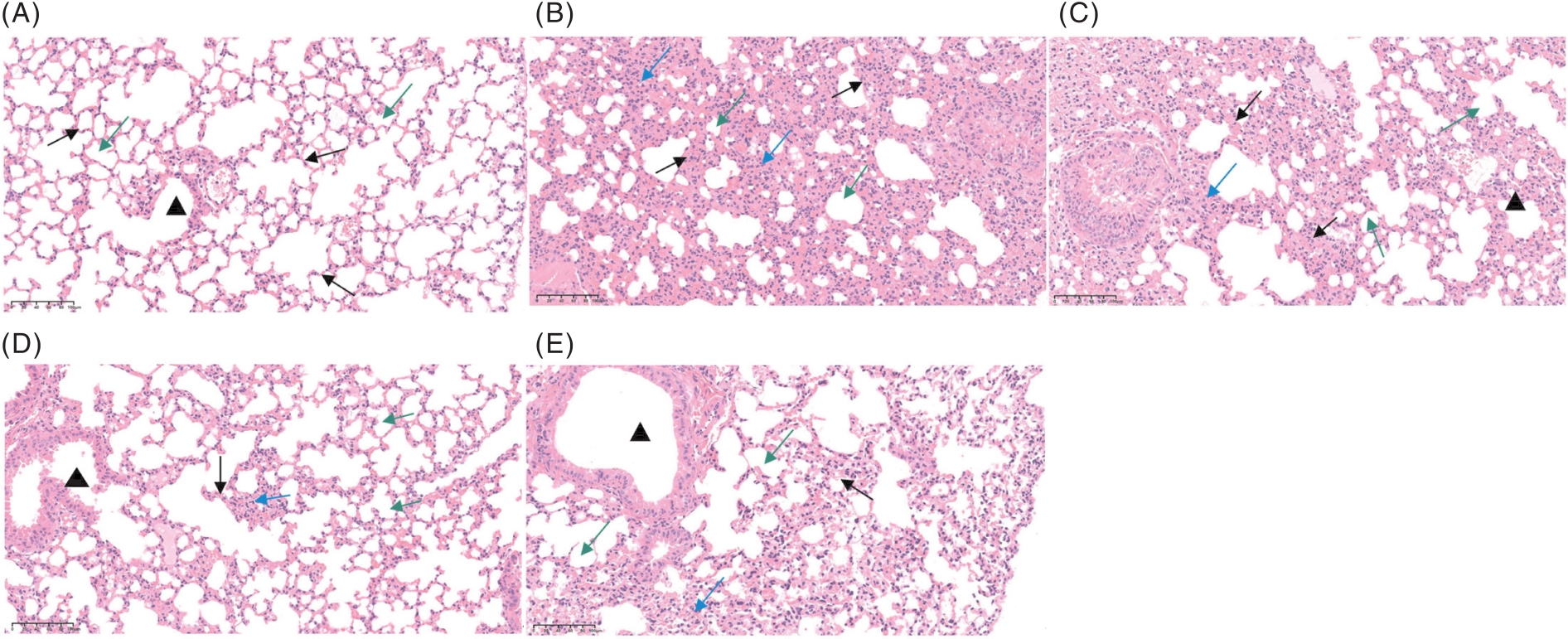
图3 HE染色观察各组小鼠肺组织的病理学改变 A,健康对照(NC)组;B,LPS组;C,5 mg·kg-1地塞米松组;D,200 mg·kg-1枇杷叶水提物组;E,400 mg·kg-1枇杷叶水提物组。黑色三角形指示细支气管;蓝色箭头指示炎症细胞浸润;绿色箭头指示肺泡腔扩张或融合;黑色箭头指示肺泡间隔增厚或透明膜形成;比例尺:50 μm(物镜放大倍数为20×)。
Fig.3 Histopathological assessment of pulmonary lesions by HE staining across experimental groups A, Healthy control (NC) group; B, LPS-induced pneumonia model group; C, 5 mg·kg-1 dexamethasone treatment group; D, 200 mg·kg-1 aqueous extract of loquat leaf treatment group; E, 400 mg·kg-1 aqueous extract of loquat leaf treatment group. Key morphological indicators: ▲, Bronchiolar epithelium; Blue, Inflammatory cell infiltration (predominantly neutrophils); Green, Alveolar space dilation with septal fusion; Black, Hyaline membrane formation and interstitial thickening. Scale bar: 50 μm (20× objective magnification).
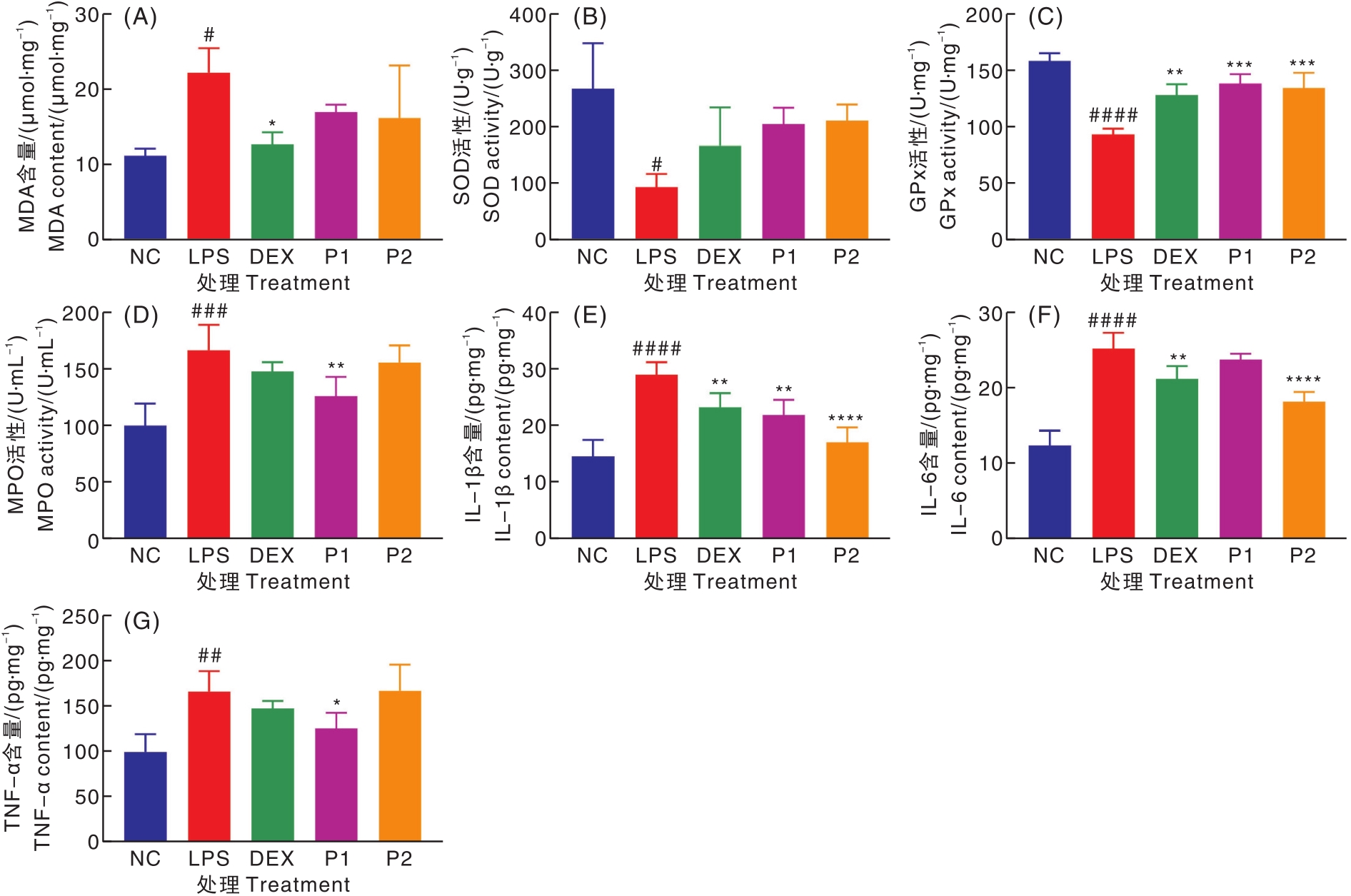
图4 枇杷叶水提物对LPS诱导的急性肺炎小鼠的保护作用 #、##、###和####分别表示与空白(NC)组相比p<0.05、p<0.01、p<0.001、p<0.000 1;*、**、***和****表示与模型组(LPS)相比p<0.05、p<0.01、p<0.001、p<0.000 1。
Fig.4 Protective effects of loquat leaf aqueous extract on LPS-induced acute pneumonia in mice #, ##, ### and #### indicate p<0.05, p<0.01, p< 0.001 and p<0.000 1, respectively, compared with the blank(NC) group; *, **, *** and **** indicate p<0.05, p<0.01, p<0.001, and p<0.000 1, respectively, compared with the model(LPS) group.
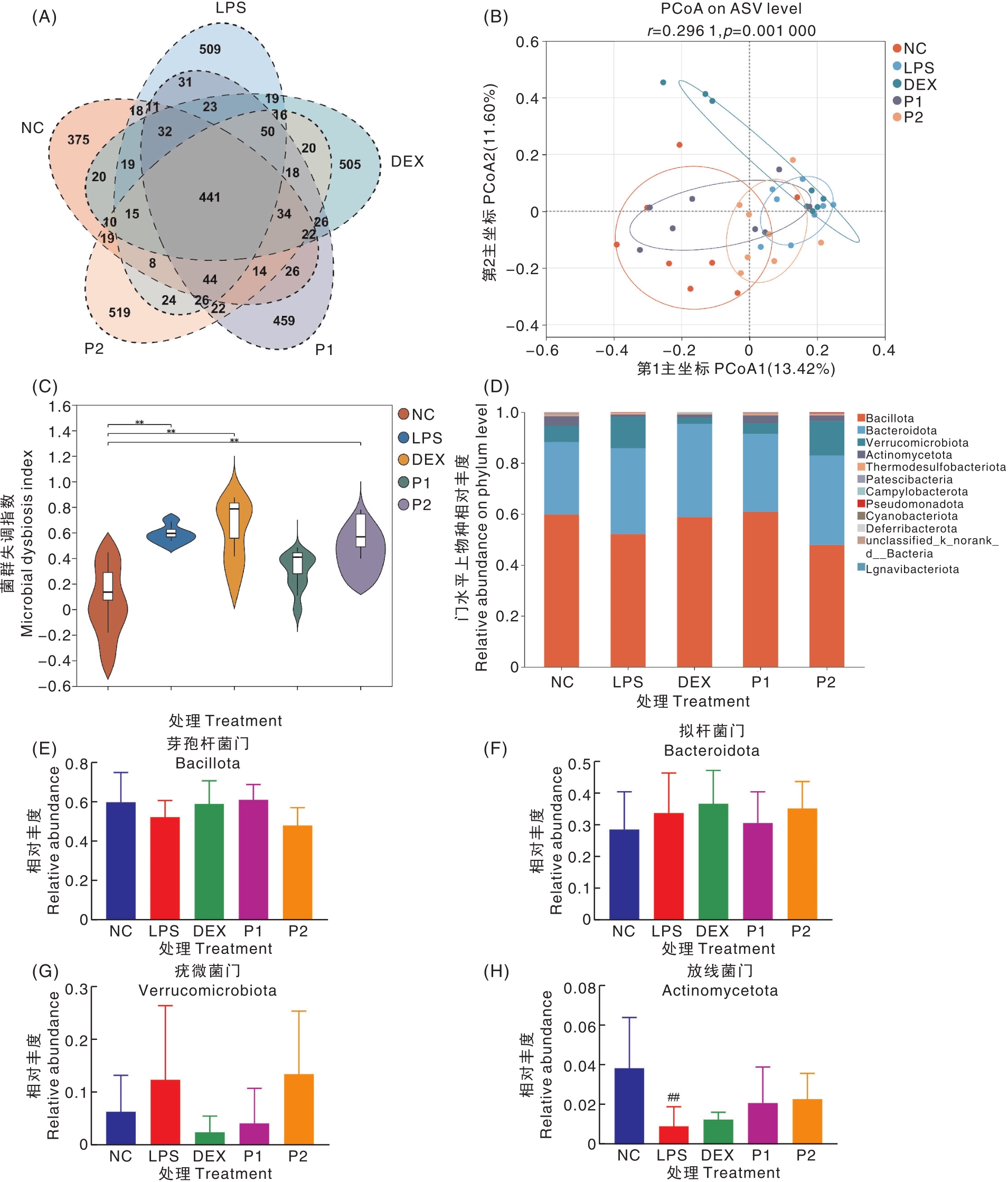
图5 枇杷叶水提物对LPS诱导的急性肺炎小鼠肠道菌群的影响(门水平) A,Venn图(97%相似性截断值);B,基于PCoA的β多样性分析(Bray-Curtis距离);C,肠道菌群失调指数(取常用对数);D,门水平上物种注释条形图;E,芽孢杆菌门的相对丰度;F,拟杆菌门的相对丰度;G,疣微菌门的相对丰度;H,放线菌门的相对丰度。##,与NC组相比p<0.01。图B采用PERMANOVA检验;图C~图H采用Kruskal-Wallis检验。
Fig.5 Effects of loquat leaf aqueous extract on the gut microbiota in mice with LPS-induced acute pneumonia (phylum level) A, Venn diagram (97% similarity cut-off); B, β-diversity analysis by PCoA (Bray-Curtis distance); C, Microbial dysbiosis index (MDI, converted by common logarithm); D, Phylum-level taxonomic composition; E, Relative abundance of Bacillota; F, Relative abundance of Bacteroidota; G, Relative abundance of Verrucomicrobiota; H, Relative abundance of Actinomycetota. ##, p<0.01 compared with the NC group. Figure B was analyzed using PERMANOVA; Figures C to H were analyzed using the Kruskal-Wallis test.
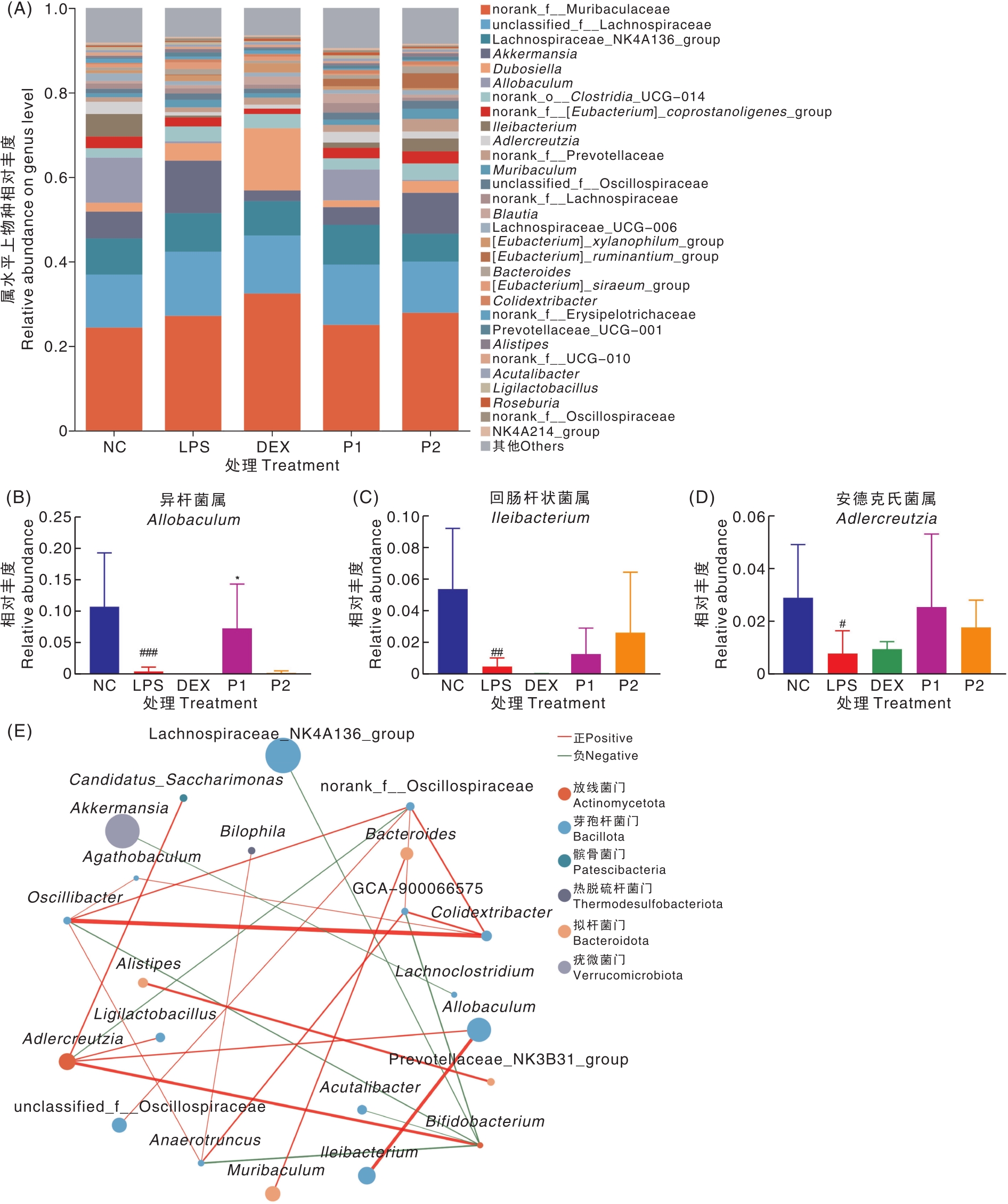
图6 枇杷叶水提物对LPS诱导的急性肺炎小鼠肠道菌群的影响(属水平) A,属水平物种注释条形图;B,异杆菌属的相对丰度;C,回肠杆状菌属的相对丰度;D,安德克氏菌属的相对丰度;E,单因素相关性网络图。
Fig.6 Effects of loquat leaf aqueous extract on the gut microbiota in mice with LPS-induced acute pneumonia(genus level) A, Genus composition; B, Relative abundance of Allobaculum; C, Relative abundance of Ileibacterium; D, Relative abundance of Adlercreutzia; E, Univariate correlation network diagram.
| [1] | Corrales-Medina V F, Musher D M, Shachkina S, et al. Acute pneumonia and the cardiovascular system[J]. The Lancet, 2013, 381(9865): 496-505. |
| [2] | 唐洁, 吕云瑶, 龙之浩, 等. 筋骨草水煎液对急性肺炎的保护作用研究[J]. 川北医学院学报, 2017, 32(3): 329-331. |
| Tang J, Lv Y Y, Long Z H, et al. Study on protective effect of water decotion of Ajuga decumbens on acute lung inflammation in mice[J]. Journal of North Sichuan Medical College, 2017, 32(3): 329-331. | |
| [3] | Lee Y R, Houngue C, Hall R G. Treatment of community-acquired pneumonia[J]. Expert Review of Anti-Infective Therapy, 2015, 13(9): 1109-1121. |
| [4] | 徐伟, 李佳美, 马智宇, 等. 微波耦合漆酶法水提枇杷叶浸膏工艺的响应面优化[J]. 食品工业科技, 2021, 42(6): 208-213. |
| Xu W, Li J M, Ma Z Y, et al. Response surface optimization of water extraction technology of loquat leaves extract by microwave-coupled laccase[J]. Science and Technology of Food Industry, 2021, 42(6): 208-213. | |
| [5] | 陈宝磊, 高映春, 吴磊. 枇杷叶提取物通过激活磷脂酰肌醇3激酶/蛋白激酶B信号通路减轻脂多糖诱导的肺细胞损伤[J]. 安徽医药, 2022, 26(3): 453-457. |
| Chen B L, Gao Y C, Wu L. Extract of loquat [Eriobotrya japonica(Thunb) Lindl] leaves reduces LPS-induced cell damage in a lung injury model by activating PI3K/Akt signaling pathway[J]. Anhui Medical and Pharmaceutical Journal, 2022, 26(3): 453-457. | |
| [6] | 王俊男, 杨亚萍, 张靖. 枇杷叶提取物干预博莱霉素诱导肺纤维化大鼠MH-S细胞炎症反应及机制研究[J]. 特产研究, 2023, 45(5): 121-125. |
| Wang J N, Yang Y P, Zhang J. Effect of loquat leaf extract on inflammation of MH-S cells induced by bleomycin in rats with pulmonary fibrosis and its mechanism[J]. Special Wild Economic Animal and Plant Research, 2023, 45(5): 121-125. | |
| [7] | 王翰华, 陈仲益, 陈云, 等. 宁波产宁海白枇杷叶的药材品质分析[J]. 安徽农业科学, 2016, 44(28): 139-140. |
| Wang H H, Chen Z Y, Chen Y, et al. Analysis of medicinal quality of Ninghaibai folium eriobotryae produced in Ningbo[J]. Journal of Anhui Agricultural Sciences, 2016, 44(28): 139-140. | |
| [8] | Wei S, Bahl M I, Baunwall S M D, et al. Determining gut microbial dysbiosis: a review of applied indexes for assessment of intestinal microbiota imbalances[J]. Applied and Environmental Microbiology, 2021, 87: e00395-21. |
| [9] | 李玉丽, 刘娅薇, 谭周进. 基于肠道菌群功能探究泄泻肠道湿热证和泄泻寒湿困脾证的“同病异治”[J]. 中国实验方剂学杂志, 2022, 28(16): 140-149. |
| Li Y L, Liu Y W, Tan Z J. Discussion on treatment of diarrhea of intestinal dampness-heat syndrome and of cold-dampness disturbing spleen syndrome with different methods:based on intestinal microbiota function[J]. Chinese Journal of Experimental Traditional Medical Formulae, 2022, 28(16): 140-149. | |
| [10] | 曾赛丽, 游晓星, 张秀峰, 等. 苦参碱减轻博来霉素致大鼠肺纤维化[J]. 基础医学与临床, 2014, 34(4): 504-508. |
| Zeng S L, You X X, Zhang X F, et al. Matrine alleviates blemycin-induced pulmonary fibrosis in rats[J]. Basic & Clinical Medicine, 2014, 34(4): 504-508. | |
| [11] | 钱建刚, 马云宝, 张晓懿. 支气管肺炎患儿血清6种细胞因子测定[J]. 放射免疫学杂志, 2005, 18(5): 333-335. |
| Qian J G, Ma Y B, Zhang X Y. Measurement of serum levels of six cytokines (IL-2, IL-5, IL-6, IL-10, TNF-α, IGF-Ⅱ) in pediatric patients with bronchopneumonia[J]. Journal of Radioimmunology, 2005, 18(5): 333-335. | |
| [12] | 李国保, 李沛. 动态监测重症肺炎患者血液和支气管肺泡灌洗液中IL-6、IL-8、IL-10的含量及其意义[J]. 中国实用医药, 2009, 4(16): 6-8. |
| Li G B, Li P. The dynamic monitor critically ill pneumonia patient blood and the bronchial tube pulmonary alveolus fill in the cleaning solution IL-6, IL-8, the IL-10 content and significance[J]. China Practical Medicine, 2009, 4(16): 6-8. | |
| [13] | 刘英丽, 徐梅佳, 吕伟, 等. 孟鲁司特钠联合布地奈德对哮喘患儿肺功能、炎症因子及免疫球蛋白水平的影响[J]. 海南医学院学报, 2017, 23(24): 3404-3407. |
| Liu Y L, Xu M J, Lv W, et al. Effects of montelukast sodium combined with budesonide on lung function, inflammatory factors and immunoglobulin levels in children with asthma[J]. Journal of Hainan Medical University, 2017, 23(24): 3404-3407. | |
| [14] | Han S, Gao H W, Chen S R, et al. Procyanidin A1 alleviates inflammatory response induced by LPS through NF-κB, MAPK, and Nrf2/HO-1 pathways in RAW264.7 cells[J]. Scientific Reports, 2019, 9: 15087. |
| [15] | Beutler B, Krochin N, Milsark I W, et al. Control of cachectin (tumor necrosis factor) synthesis: mechanisms of endotoxin resistance[J]. Science, 1986, 232(4753): 977-980. |
| [16] | Aratani Y. Myeloperoxidase: its role for host defense, inflammation, and neutrophil function[J]. Archives of Biochemistry and Biophysics, 2018, 640: 47-52. |
| [17] | 周怡菲, 刘锐, 黄健华, 等. 从脾胃论治呼吸系统疾病研究进展: 基于中医药调节肠道菌群[J]. 亚太传统医药, 2023, 19(6): 231-235. |
| Zhou Y F, Liu R, Huang J H, et al. Research progress of traditional Chinese medicine based on intestinal flora in the treatment of respiratory diseases from the spleen and stomach[J]. Asia-Pacific Traditional Medicine, 2023, 19(6): 231-235. | |
| [18] | 刘畅, 刘雄伟, 李嘉欣, 等. 基于16S rRNA基因测序研究金银花和山银花对急性肺损伤大鼠肠道菌群的影响[J]. 中国微生态学杂志, 2021, 33(2): 130-137. |
| Liu C, Liu X W, Li J X, et al. Effect of Lonicera japonica Thunb and Lonicera hypoglauca on gut microbiota in rats with acute lung injury based on 16S rRNA gene sequencing[J]. Chinese Journal of Microecology, 2021, 33(2): 130-137. | |
| [19] | Rice T A, Bielecka A A, Nguyen M T, et al. Interspecies commensal interactions have nonlinear impacts on host immunity[J]. Cell Host & Microbe, 2022, 30(7): 988-1002. |
| [20] | Liu Y R, Duan H, Chen Y, et al. Intraspecific difference of Latilactobacillus sakei in inflammatory bowel diseases: insights into potential mechanisms through comparative genomics and metabolomics analyses[J]. iMeta, 2023, 2(4): e136. |
| [21] | Wu R Y, Zhou L N, Chen Y, et al. Sesquiterpene glycoside isolated from loquat leaf targets gut microbiota to prevent type 2 diabetes mellitus in db/db mice[J]. Food & Function, 2022, 13(3): 1519-1534. |
| [22] | Le Roy T, Moens de Hase E, Van Hul M, et al. Dysosmobacter welbionis is a newly isolated human commensal bacterium preventing diet-induced obesity and metabolic disorders in mice[J]. Gut, 2022, 71(3): 534-543. |
| [23] | Bingula R, Filaire M, Radosevic-Robin N, et al. Desired turbulence gut-lung axis, immunity, and lung cancer[J]. Journal of Oncology, 2017, 2017: 5035371. |
| [24] | Cai J, Sun L L, Gonzalez F J. Gut microbiota-derived bile acids in intestinal immunity, inflammation, and tumorigenesis[J]. Cell Host & Microbe, 2022, 30(3): 289-300. |
| [25] | Li X P, Shang S J, Wu M, et al. Gut microbial metabolites in lung cancer development and immunotherapy: Novel insights into gut-lung axis[J]. Cancer Letters, 2024, 598: 217096. |
| [26] | Dong Y W, He L L, Zhu Z B, et al. The mechanism of gut-lung axis in pulmonary fibrosis[J]. Frontiers in Cellular and Infection Microbiology, 2024, 14: 1258246. |
| [27] | 彭韶, 杜天华, 张曼. 反复肺炎患儿的肠道菌群与血清D-乳酸变化及相关性研究[J]. 中国当代儿科杂志, 2016, 18(2): 113-116. |
| Peng S, Du T H, Zhang M. Changes in gut microbiota and serum D-lactate level and correlation analysis in children with recurrent pneumonia[J]. Chinese Journal of Contemporary Pediatrics, 2016, 18(2): 113-116. |
| [1] | 覃海桑, 李建强, 刘钊君, 吴宇航, 顾杰, 张戈, 姜元荣, 李进军, 王欣, 匡建, 边祥雨, 史芳舒, 陈荫, 闻正顺, 李小琼. 纯化米糠对D-半乳糖诱导的亚急性衰老小鼠抗氧化能力和肠道菌群的影响[J]. 浙江农业学报, 2026, 38(5): 845-856. |
| [2] | 江豪, 周万怡, 陶文扬, 王梦竹, 邢建荣, 杨颖, 曾垂省. 山茱萸提取物缓解小鼠急性肾损伤的功能活性评价[J]. 浙江农业学报, 2026, 38(5): 876-885. |
| [3] | 吴兴凤, 肖英平, 吕文涛, 马灵燕, 陈渠, 温洋, 徐娥. 丁酸梭菌通过调节结肠微生物结构和短链脂肪酸含量影响小鼠肌纤维类型[J]. 浙江农业学报, 2025, 37(3): 568-578. |
| [4] | 齐天鹏, 刘莉, 夏美文, 吕孙建, 徐海圣. 乳酸菌和噬菌体对中华鳖生理生化与肠道菌群的影响[J]. 浙江农业学报, 2025, 37(1): 39-48. |
| [5] | 张妮, 陶文扬, 罗梦帆, 周万怡, 郑晓杰, 李彦坡, 金火喜, 杨颖. 酶解辅助提取对铁皮石斛多糖结构和菌群调节功能的影响[J]. 浙江农业学报, 2024, 36(9): 2099-2109. |
| [6] | 张红芳, 钱涛, 金婷, 谢小玲, 吴酬飞, 肖英平, 马灵燕. 草鱼肠道微生物谱及其发育性变化[J]. 浙江农业学报, 2024, 36(4): 780-789. |
| [7] | 温婉宁, 王晨, 胡连花, 房志家, 邓旗, 孙力军. 海蛾水提取物对小鼠系统低度炎症的干预作用[J]. 浙江农业学报, 2024, 36(12): 2784-2793. |
| [8] | 吴兴凤, 章啸君, 朱江, 余敏洁, 徐娥, 马灵燕, 肖英平. 腹泻仔猪肠道菌群结构特征及肠道炎症因子、腺苷酸环化酶和鸟苷酸环化酶mRNA表达变化研究[J]. 浙江农业学报, 2024, 36(11): 2465-2475. |
| [9] | 陈诗雨, 徐美余, 邓征宇, 王峰, 张麒麟, 邓先余, 林连兵. 志贺氏菌噬菌体ΦDS8对患病肉鸡的治疗及其肠道菌群的影响[J]. 浙江农业学报, 2022, 34(7): 1386-1395. |
| [10] | 刘红露,范磊,戴茜茜, 张飞燕,潘康成*. 面包酵母硒与酪酸梭菌制剂对肉鸡生长、抗氧化和肠道菌群的影响[J]. 浙江农业学报, 2015, 27(9): 1529-. |
| [11] | 朱凝瑜,贝亦江,郑天伦,孔蕾,陈健舜. 中华鳖肠道及其养殖水体菌群比较 [J]. 浙江农业学报, 2014, 26(5): 1176-. |
| [12] | 杨会玲;柳永;许少春;李艳丽;许尧兴;* . PCRDGGE技术分析合生素对肉仔鸡盲肠菌群结构的影响[J]. , 2012, 24(1): 0-31. |
| [13] | 蔡丽萍;徐海圣*;何琳;舒妙安. PCR-DGGE技术分析不同地区野生锯缘青蟹肠道菌群多样性[J]. , 2011, 23(2): 0-282. |
| [14] | 陈晓明;李肖梁;汤丽萍;尹兆正;余东游;方维焕. 中草药渣对断奶仔猪生长、肠道菌群和免疫的影响[J]. , 2007, 19(1): 0-54. |
| [15] | 樊海平;曾占壮;林煜;钟全福;余培建;翁祖桐. 养殖欧洲鳗鲡肠道菌群组成的研究[J]. , 2006, 18(3): 0-178. |
| 阅读次数 | ||||||
|
全文 |
|
|||||
|
摘要 |
|
|||||

