浙江农业学报 ›› 2026, Vol. 38 ›› Issue (5): 1008-1023.DOI: 10.3969/j.issn.1004-1524.20250562
基于分布式控制的连栋温室多能互补节能系统构建
罗冬1( ), 宋大平1, 康大磊2, 刘继凯2, 王冰雪3, 左强1,*()
- 1
北京市农林科学院 北京 100097
2北京众博熙泰农业科技有限公司 北京 102200
3北京南郊农业生产经营管理有限公司 北京 100163
-
收稿日期:2025-09-03出版日期:2026-05-25发布日期:2026-06-02 -
作者简介:罗冬,研究方向为电力工程及其自动化。E-mail:dongluo1972@163.com -
通讯作者:*左强,E-mail:ZQ18189@163.com -
基金资助:北京市乡村振兴农业科技项目(NY2502220025);北京市农林科学院科普项目(KPXM202501)
Construction of a multi-energy complementary energy-saving system for multi-span greenhouses based on distributed control
LUO Dong1(), SONG Daping1, KANG Dalei2, LIU Jikai2, WANG Bingxue3, ZUO Qiang1,*()
- 1
Beijing Academy of Agriculture and Forestry Sciences Beijing 100097, China
2Beijing Zhongboxitai Agricultural Technology Co. ,Ltd. Beijing 102200, China
3Beijing Nanjiao Agricultural Production and Management Co. ,Ltd. Beijing 100163, China
-
Received:2025-09-03Published:2026-05-25Online:2026-06-02

摘要:
针对北方地区连栋温室能耗高、多能协同调控响应滞后、能源供给与作物生长需求匹配度低等问题,以北京某11 000 m2文洛式连栋温室为研究对象,构建基于“云-边-端”分布式架构的光伏-水源热泵-相变储能墙体多能互补节能系统,通过农业场景定制化控制算法、能源-环境-作物耦合模型与动态协同调度策略,实现能源生产、存储、消费与作物生长需求的精准匹配。2024年全年实测结果表明:系统多能协同响应时间不超过15 s,较传统集中式控制缩短87.5%;年节电量32.45×10⁴ kW·h,综合节能率31.9%;光伏子系统年发电量147.84×10⁴ kW·h,满足温室97.3%的用电需求,光合有效辐射(PAR)透过率大于85%,番茄单季产量78.5 t·hm-2,叶用莴苣单季产量32.8 t·hm-2,与传统种植模式无显著差异。水源热泵的平均制热性能系数(COP)为4.2、制冷能效比(EER)为5.0,相变储能墙体降低空调负荷10.2%,系统年碳减排约1 415 t CO2。本研究形成可复制、可推广的连栋温室节能低碳技术方案,核心创新为农业场景定制化分布式控制优化与多能系统-作物生长需求协同耦合机制,可为设施农业绿色低碳转型提供理论支撑与技术范式。
中图分类号:
引用本文
罗冬, 宋大平, 康大磊, 刘继凯, 王冰雪, 左强. 基于分布式控制的连栋温室多能互补节能系统构建[J]. 浙江农业学报, 2026, 38(5): 1008-1023.
LUO Dong, SONG Daping, KANG Dalei, LIU Jikai, WANG Bingxue, ZUO Qiang. Construction of a multi-energy complementary energy-saving system for multi-span greenhouses based on distributed control[J]. Acta Agriculturae Zhejiangensis, 2026, 38(5): 1008-1023.
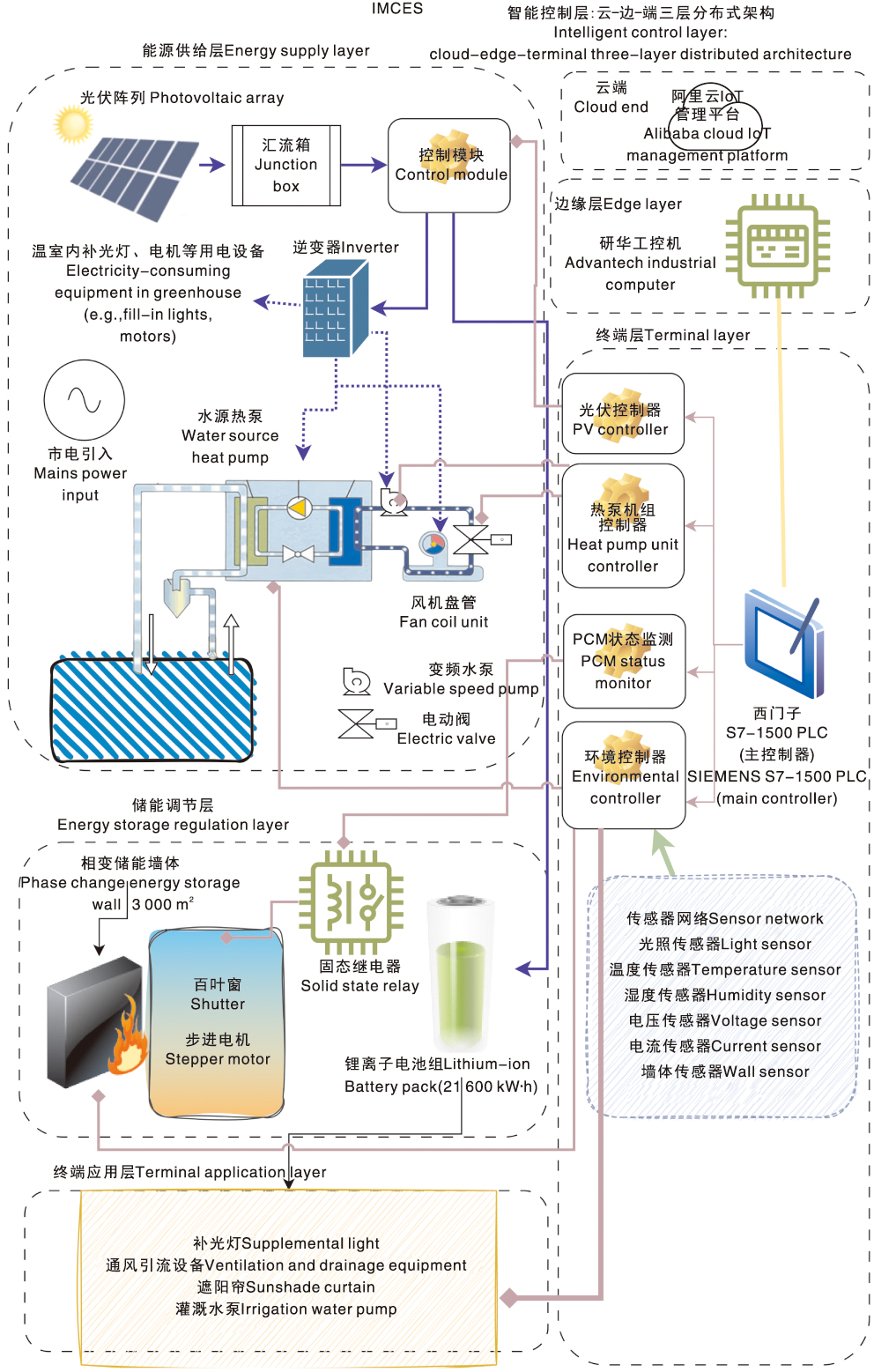
图1 连栋温室多能互补节能系统(IMCES)架构
Fig.1 Architecture of integrated multi-energy complementary energy-saving system (IMCES) for multi-span greenhouses
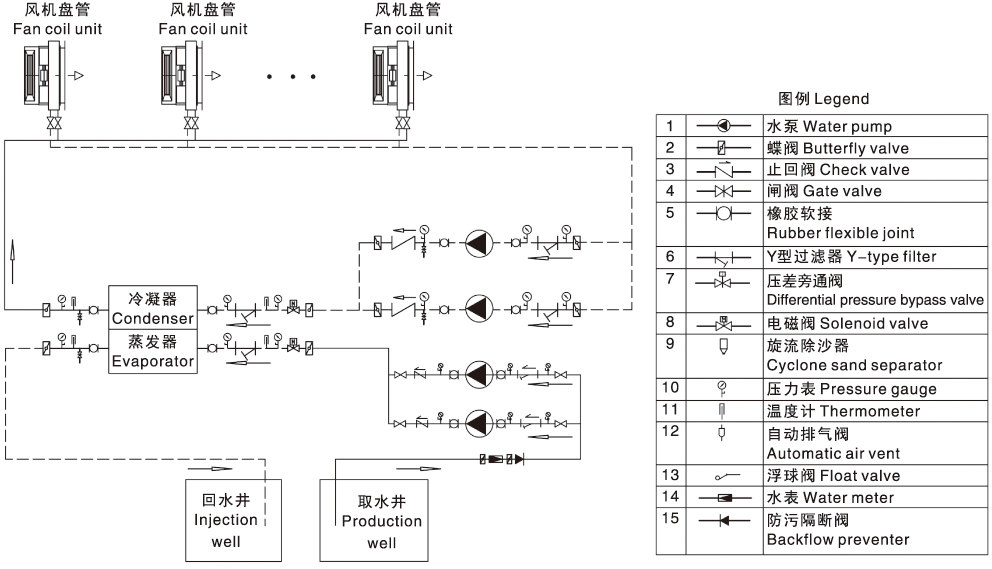
图2 水源热泵水系统连接示意图
Fig.2 Water source system connection diagram for water source heat pum
| 参数类别 Parameter category | 参数名称 Parameter name | 取值/型号 Value/model | 应用场景 Application scene |
|---|---|---|---|
| 光伏子系统 | 装机容量Installed capacity | 1 200 kWp | 能源供给层 Energy supply layer |
| Photovoltaic | PAR透过率 PAR transmittance | >85% | 作物光照保障Crop light supply |
| subsystem | 组件型号Module model | JA Solar JAM72S30-540/MR | 光伏发电Photovoltaic power generation |
| 逆变器效率Inverter efficiency | >98.5% | 电能转换Power conversion | |
| 水源热泵子系统 | 额定制热量Rated heating capacity | 380 kW | 供暖Heating |
| Water source heat | 平均 COP(制热) Average COP (heating) | 4.2 | 能效评估Energy efficiency evaluation |
| pump subsystem | 平均 EER(制冷) Average EER (cooling) | 5.0 | 能效评估Energy efficiency evaluation |
| 机组型号Unit model | 麦克维尔WPS080.2 McQuay WPS080.2 | 供暖/制冷Heating/cooling | |
| 相变储能墙体子系统 | 相变焓Phase change enthalpy | 182.5 kJ·kg-1 | 蓄放热计算Heat storage/release calculation |
| Phase change | 墙体面积Wall area | 3 000 m2 | 负荷削减Load reduction |
| energy storage wall subsystem | 材料类型Material type | 石蜡基复合相变材料 Paraffin-based composite PCM | 蓄热介质 Heat storage medium |
| 控制系统 Control system | 主控制器型号Main controller model | 西门子 S7-1500 PLC SIEMENS S7-1500 PLC | 控制中枢Control center |
| 边缘层迭代周期Edge layer iteration cycle | 10 s | 动态调度Dynamic scheduling | |
| 温度控制精度Temperature control precision | ±0.5 ℃ | 环境调控Environmental regulation | |
| 测量参数 Measurement | 温度传感器精度 Temperature sensor precision | ±0.1 ℃ | 数据采集Data acquisition |
| parameters | 湿度传感器精度Humidity sensor precision | ±1.0%(RH) | 数据采集Data acquisition |
| 采样频率Sampling frequency | 0.016 7 Hz | 数据采集Data acquisition |
表1 系统关键参数总表
Table 1 Critical parameters summary table for the system
| 参数类别 Parameter category | 参数名称 Parameter name | 取值/型号 Value/model | 应用场景 Application scene |
|---|---|---|---|
| 光伏子系统 | 装机容量Installed capacity | 1 200 kWp | 能源供给层 Energy supply layer |
| Photovoltaic | PAR透过率 PAR transmittance | >85% | 作物光照保障Crop light supply |
| subsystem | 组件型号Module model | JA Solar JAM72S30-540/MR | 光伏发电Photovoltaic power generation |
| 逆变器效率Inverter efficiency | >98.5% | 电能转换Power conversion | |
| 水源热泵子系统 | 额定制热量Rated heating capacity | 380 kW | 供暖Heating |
| Water source heat | 平均 COP(制热) Average COP (heating) | 4.2 | 能效评估Energy efficiency evaluation |
| pump subsystem | 平均 EER(制冷) Average EER (cooling) | 5.0 | 能效评估Energy efficiency evaluation |
| 机组型号Unit model | 麦克维尔WPS080.2 McQuay WPS080.2 | 供暖/制冷Heating/cooling | |
| 相变储能墙体子系统 | 相变焓Phase change enthalpy | 182.5 kJ·kg-1 | 蓄放热计算Heat storage/release calculation |
| Phase change | 墙体面积Wall area | 3 000 m2 | 负荷削减Load reduction |
| energy storage wall subsystem | 材料类型Material type | 石蜡基复合相变材料 Paraffin-based composite PCM | 蓄热介质 Heat storage medium |
| 控制系统 Control system | 主控制器型号Main controller model | 西门子 S7-1500 PLC SIEMENS S7-1500 PLC | 控制中枢Control center |
| 边缘层迭代周期Edge layer iteration cycle | 10 s | 动态调度Dynamic scheduling | |
| 温度控制精度Temperature control precision | ±0.5 ℃ | 环境调控Environmental regulation | |
| 测量参数 Measurement | 温度传感器精度 Temperature sensor precision | ±0.1 ℃ | 数据采集Data acquisition |
| parameters | 湿度传感器精度Humidity sensor precision | ±1.0%(RH) | 数据采集Data acquisition |
| 采样频率Sampling frequency | 0.016 7 Hz | 数据采集Data acquisition |
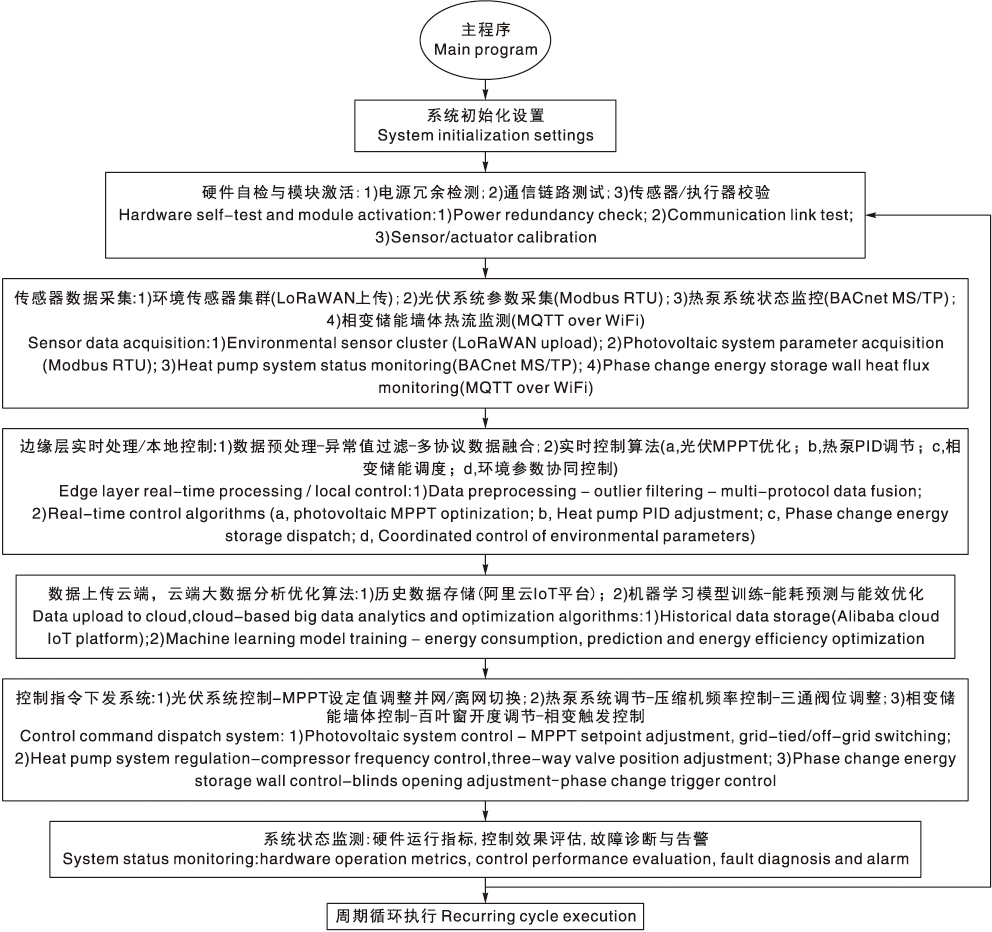
图3 系统主程序流程图 MPPT,最大功率点跟踪;PID,比例-积分-微分。
Fig.3 Main system program flow diagram MPPT, Maximum power point tracking; PID, Proportional-integral-derivative.
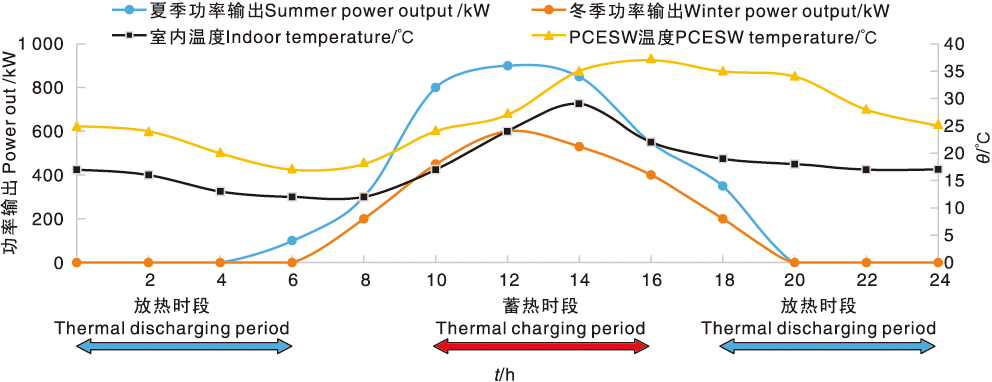
图4 能源供需与温度动态曲线图 PCESW,相变储能墙体。下同。
Fig.4 Energy supply/demand and temperature dynamics PCESW, Phase change energy storage wall. The same as below.
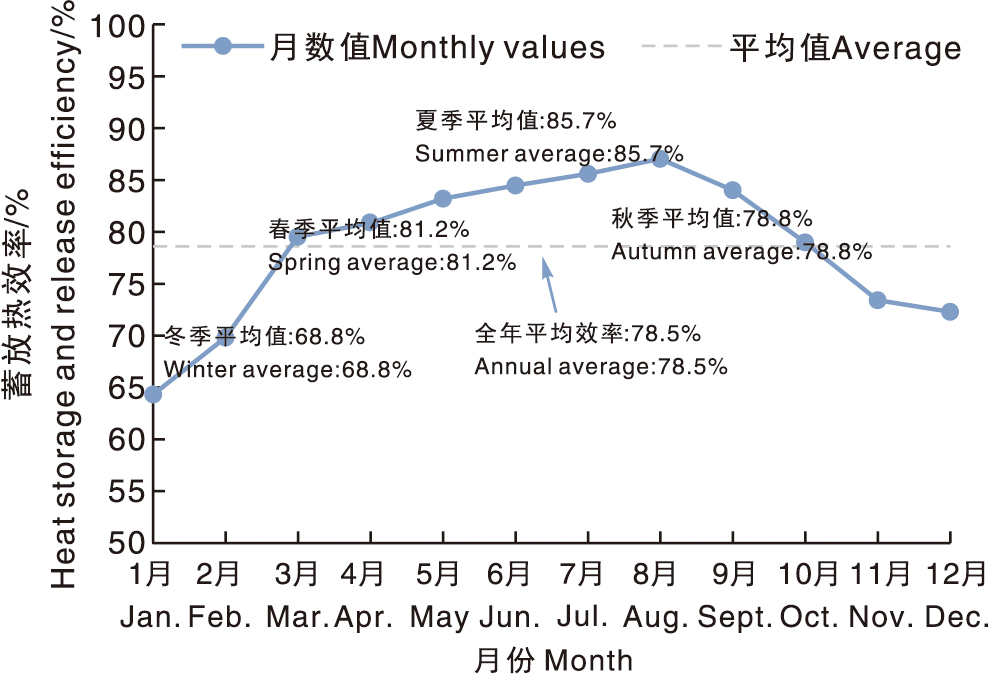
图5 相变储能墙体全年蓄放热效率的动态变化
Fig.5 Dynamic variation characteristics of annual heat storage and release efficiency for phase change energy storage walls
| 系统类型 System type | 工况 Operating condition | 负荷/kW Load/kW | 能效参数 Energy efficiency parameter | 运行时间/h Operating time/h | 能耗/(kW·h) Energy consumption/(kW·h) |
|---|---|---|---|---|---|
| 传统系统Traditional system | 冬季Winter | 500 | COP=2.5 | 1 200 | 240 000 |
| 夏季Summer | 600 | EER=3.0 | 1 000 | 200 000 | |
| 水源热泵WSHP | 冬季Winter | 500 | COP=4.2 | 1 200 | 164 500 |
| 夏季Summer | 600 | EER=5.0 | 1 000 | 135 000 |
表2 水源热泵系统与传统系统的能耗对比
Table 2 Energy consumption comparison between the water source heat pump (WSHP) system and conventional system
| 系统类型 System type | 工况 Operating condition | 负荷/kW Load/kW | 能效参数 Energy efficiency parameter | 运行时间/h Operating time/h | 能耗/(kW·h) Energy consumption/(kW·h) |
|---|---|---|---|---|---|
| 传统系统Traditional system | 冬季Winter | 500 | COP=2.5 | 1 200 | 240 000 |
| 夏季Summer | 600 | EER=3.0 | 1 000 | 200 000 | |
| 水源热泵WSHP | 冬季Winter | 500 | COP=4.2 | 1 200 | 164 500 |
| 夏季Summer | 600 | EER=5.0 | 1 000 | 135 000 |
| 处理 Treatment | 单株结果数 Number of fruits per plant | 单果重/g Average fruit weight/g | 产量/(t·hm-2) Yield/(t·hm-2) | 可溶性糖含量/% Soluble sugar content/% |
|---|---|---|---|---|
| T | 18.2±1.5 | 152±8 | 78.5+3.1 | 4.2±0.3 |
| CK | 18.8±1.3 | 155±7 | 80.2+3.3 | 4.3±0.2 |
表3 不同处理对番茄产量和品质的影响
Table 3 Effect of different treatments on tomato quality and yield
| 处理 Treatment | 单株结果数 Number of fruits per plant | 单果重/g Average fruit weight/g | 产量/(t·hm-2) Yield/(t·hm-2) | 可溶性糖含量/% Soluble sugar content/% |
|---|---|---|---|---|
| T | 18.2±1.5 | 152±8 | 78.5+3.1 | 4.2±0.3 |
| CK | 18.8±1.3 | 155±7 | 80.2+3.3 | 4.3±0.2 |
| 处理 Treatment | 株高/cm Plant height/cm | 单株鲜重/g Fruit weight per plant/g | 产量/(t·hm-2) Yield/ (t·hm-2) |
|---|---|---|---|
| T | 28.5±1.2 | 35.2±2.1 | 32.8±15 |
| CK | 29.0±1.0 | 36.0±1.8 | 33.5±16 |
表4 不同处理对叶用莴苣生长和产量的影响
Table 4 Effect of different treatments on growth and yield of leaf lettuce
| 处理 Treatment | 株高/cm Plant height/cm | 单株鲜重/g Fruit weight per plant/g | 产量/(t·hm-2) Yield/ (t·hm-2) |
|---|---|---|---|
| T | 28.5±1.2 | 35.2±2.1 | 32.8±15 |
| CK | 29.0±1.0 | 36.0±1.8 | 33.5±16 |
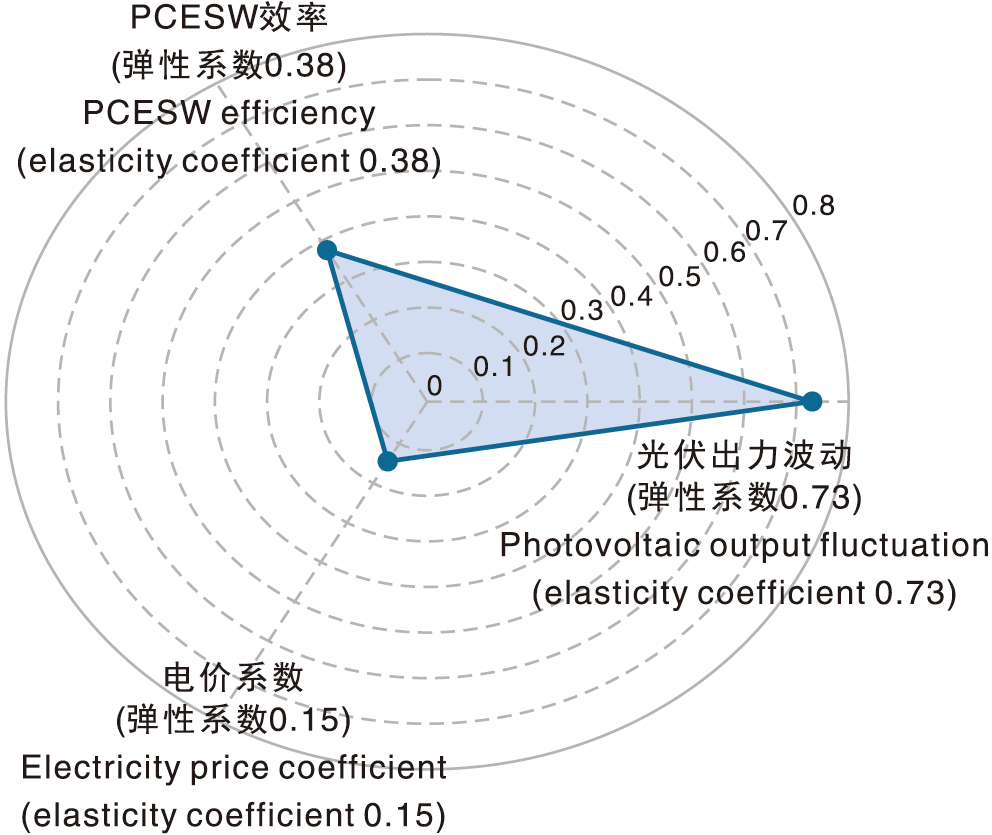
图6 连栋温室节能率敏感性分析图
Fig.6 Sensitivity analysis diagram of energy saving rate for multi-span greenhouse
| [1] | 李雄彦, 徐航, 徐开亮, 等. Venlo型温室柱脚螺栓节点力学性能[J]. 农业工程学报, 2024, 40(3): 240-250. |
| LI X Y, XU H, XU K L, et al. Mechanical properties of column foot bolt joints in Venlo greenhouse[J]. Transactions of the Chinese Society of Agricultural Engineering, 2024, 40(3): 240-250. | |
| [2] | 张东, 姜钰湛, 李浩然, 等. 设施农业可再生能源综合供能系统运行策略[J]. 农业工程学报, 2023, 39(24): 264-277. |
| ZHANG D, JIANG Y Z, LI H R, et al. Operational strategy of integrated renewable energy supply system for facility agriculture[J]. Transactions of the Chinese Society of Agricultural Engineering, 2023, 39(24): 264-277. | |
| [3] | 李天华, 董广胜, 施国英, 等. 文洛型温室棚顶清洗机的研制与试验[J]. 农业工程学报, 2023, 39(12): 180-188. |
| LI T H, DONG G S, SHI G Y, et al. Development and test of Venlo greenhouse roof cleaning machine[J]. Transactions of the Chinese Society of Agricultural Engineering, 2023, 39(12): 180-188. | |
| [4] | 曾小春, 李随成, 史官清, 等. “双碳” 目标背景下基于熵权TOPSIS法的区域农业高质量发展水平综合评价: 基于变化速度特征视角[J]. 浙江农业学报, 2023, 35(4): 962-972. |
| ZENG X C, LI S C, SHI G Q, et al. Comprehensive evaluation of China’s regional agricultural quality development level based on entropy weight TOPSIS under background of carbon peaking and carbon neutrality goals: from perspective of change speed[J]. Acta Agriculturae Zhejiangensis, 2023, 35(4): 962-972. | |
| [5] | YANG Y, LI D, ZHANG S J, et al. Optimal design of distributed energy resource systems under large-scale uncertainties in energy demands based on decision-making theory[J]. Thermal Science, 2019, 23(2 Part B): 873-882. |
| [6] | JIANG W, JIN Y, LIU G L, et al. Net-zero energy optimization of solar greenhouses in severe cold climate using passive insulation and photovoltaic[J]. Journal of Cleaner Production, 2023, 402: 136770. |
| [7] | 徐明磊, 孙亚楠. 河南地区农业温室光伏化升级设计[J]. 北方园艺, 2020(21): 45-49. |
| XU M L, SUN Y N. Photovoltaic upgrading design of agricultural greenhouse in Henan Province[J]. Northern Horticulture, 2020(21): 45-49. | |
| [8] | 赵梦菲. 日光温室墙体用复合相变材料的研制与应用[D]. 长春: 吉林农业大学, 2023. |
| ZHAO M F. Development and application of composite phase change materials for solar greenhouse walls[D]. Changchun: Jilin Agricultural University, 2023. | |
| [9] | 杨绪飞, 李飞, 孙东亮, 等. 温室太阳能跨季节蓄热-土壤源热泵耦合供暖运行特性[J]. 农业工程学报, 2024, 40(19): 186-196. |
| YANG X F, LI F, SUN D L, et al. Operational characteristics of ground source heat pump coupled with seasonal solar thermal energy storage for greenhouse heating[J]. Transactions of the Chinese Society of Agricultural Engineering, 2024, 40(19): 186-196. | |
| [10] | 张露心, 颜加龙, 何秋喜, 等. 精细控制智能化光伏大棚的设计[J]. 太阳能, 2024(5): 83-88. |
| ZHANG L X, YAN J L, HE Q X, et al. Design of fine control and intelligent PV greenhouse[J]. Solar Energy, 2024(5): 83-88. | |
| [11] | 汤俊超, 吴宜文, 张姚, 等. 浅谈 “光伏+农业” 产业的发展模式[J]. 中国农学通报, 2022, 38(11): 144-152. |
| TANG J C, WU Y W, ZHANG Y, et al. A brief introduction on the industrial development mode of photovoltaic agriculture[J]. Chinese Agricultural Science Bulletin, 2022, 38(11): 144-152. | |
| [12] | 李拓. 光伏联农现状及发展分析[J]. 大众用电, 2025, 40(1): 15-16. |
| LI T. Analysis on current situation and development of photovoltaic joint agriculture[J]. Popular Utilization of Electricity, 2025, 40(1): 15-16. | |
| [13] | 张龙, 吴翠南, 鲍恩财, 等. 光伏组件遮阴对光伏农业系统光环境及无花果产量影响分析[J]. 农业工程学报, 2024, 40(23): 294-302. |
| ZHANG L, WU C N, BAO E C, et al. Effects of photovoltaic module shading on internal light environment and fig (Ficus carica L.) yield in agrivoltaic systems[J]. Transactions of the Chinese Society of Agricultural Engineering, 2024, 40(23): 294-302. | |
| [14] | 马明月. 光伏发电系统最大功率点跟踪设计研究[J]. 光源与照明, 2024(9): 122-124. |
| MA M Y. Research on maximum power point tracking design of photovoltaic power generation system[J]. Lamps & Lighting, 2024(9): 122-124. | |
| [15] | 陈同强, 徐凤娇, 周宝昌, 等. 天然气锅炉和地源热泵协同加热连栋玻璃温室的可行性分析[J]. 浙江农业学报, 2025, 37(7): 1533-1544. |
| CHEN T Q, XU F J, ZHOU B C, et al. Feasibility of ground-source heat pump heating system assisted by natural gas boiler in large-scale terraced glass greenhouse[J]. Acta Agriculturae Zhejiangensis, 2025, 37(7): 1533-1544. | |
| [16] | 石惠娴, 田沁雨, 孟祥真, 等. 地源热泵水蓄能型植物工厂降温系统夏季运行特性[J]. 农业工程学报, 2019, 35(21): 202-209. |
| SHI H X, TIAN Q Y, MENG X Z, et al. Operating characteristics of energy storage ground source heat pump cooling system in plant factory in summer[J]. Transactions of the Chinese Society of Agricultural Engineering, 2019, 35(21): 202-209. | |
| [17] | 闫喜龙, 陈雁, 戴诗渝, 等. 粮食平房仓太阳能光伏-地源热泵供冷系统仿真研究与试验[J]. 农业工程学报, 2024, 40(18): 42-50. |
| YAN X L, CHEN Y, DAI S Y, et al. Simulation study and test on the solar photovoltaic-ground source heat pump cooling system for grain warehouse[J]. Transactions of the Chinese Society of Agricultural Engineering, 2024, 40(18): 42-50. | |
| [18] | 孟凡康, 姜治鑫. 外挂型相变储能装置在日光温室中的蓄放热试验[J]. 农业工程学报, 2022, 38(20): 180-190. |
| MENG F K, JIANG Z X. Heat storage and release test of external hanging phase change energy storage device in greenhouses[J]. Transactions of the Chinese Society of Agricultural Engineering, 2022, 38(20): 180-190. | |
| [19] | 樊智轩, 赵运超, 丁云飞, 等. 相变储能材料用于建筑墙体的研究进展[J]. 化工新型材料, 2022, 50(7): 225-228. |
| FAN Z X, ZHAO Y C, DING Y F, et al. Development of PCM applied in building walls[J]. New Chemical Materials, 2022, 50(7): 225-228. | |
| [20] | 胡瑾, 杨永霞, 李远方, 等. 温室环境控制方法研究现状分析与展望[J]. 农业工程学报, 2024, 40(1): 112-128. |
| HU J, YANG Y X, LI Y F, et al. Analysis and prospect of the environmental control systems for greenhouse[J]. Transactions of the Chinese Society of Agricultural Engineering, 2024, 40(1): 112-128. | |
| [21] | 王喜军, 王伟, 李寅松, 等. 考虑源-荷-储可调度资源的新能源配电网负荷频率控制策略[J]. 可再生能源, 2025, 43(11): 1537-1546. |
| WANG X J, WANG W, LI Y S, et al. Load frequency control strategy for new energy distribution network considering dispatchable resources of source load storage[J]. Renewable Energy Resources, 2025, 43(11): 1537-1546. | |
| [22] | 朱德兰, 涂泓滨, 王瑞心, 等. 基于分段多区间的温室夏季温湿度智能控制策略[J]. 农业机械学报, 2022, 53(9): 334-341. |
| ZHU D L, TU H B, WANG R X, et al. Intelligent control strategy of temperature and humidity in greenhouse in summer based on subsection and multi-interval[J]. Transactions of the Chinese Society for Agricultural Machinery, 2022, 53(9): 334-341. | |
| [23] | 贾家欢, 杨培宏, 时习之, 等. 计及富氧燃烧电厂的综合能源系统低碳经济调度[J]. 太阳能学报, 2025, 46(11): 470-480. |
| JIA J H, YANG P H, SHI X Z, et al. Low-carbon economic dispatch of integrated energy system considering oxy-fuel combustion power plant[J]. Acta Energiae Solaris Sinica, 2025, 46(11): 470-480. | |
| [24] | 赵利鹏, 刘牧阳, 陈俊儒, 等. 计及外部气象环境不确定性的农业园区综合能源系统双层优化调度策略研究[J/OL]. 电网技术,2025-09-19. https://doi.org/10.13335/j.1000-3673.pst.2025.0483. |
| ZHAO L P, LIU M Y, CHEN J R, et al. Bi-level optimal scheduling strategy for integrated energy system in agricultural parks considering external meteorological environment uncertainties[J/OL]. Power System Technology, 2025-09-19. https://doi.org/10.13335/j.1000-3673.pst.2025.0483. | |
| [25] | 马超, 刘璐, 练继建, 等. 基于综合评价的混合抽蓄-风-光多能互补系统容量优化配置研究[J]. 水利学报, 2025, 56(6): 726-738. |
| MA C, LIU L, LIAN J J, et al. Research on capacity design for hybrid pumped storage-wind-PV power system based on comprehensive evaluation[J]. Journal of Hydraulic Engineering, 2025, 56(6): 726-738. | |
| [26] | 李祯, 庄卓. 基于BIM的智慧农业温室大棚建模分析[J]. 农机化研究, 2025, 47(3): 217-221. |
| LI Z, ZHUANG Z. Modeling and analysis of smart agriculture greenhouse based on BIM[J]. Journal of Agricultural Mechanization Research, 2025, 47(3): 217-221. | |
| [27] | 郑静逸. 新能源融合产业中水电站与光伏协同运行机制研究[J]. 产业科技创新, 2025, 7(1): 83-87. |
| ZHENG J Y. Research on the coordinated operation mechanism of hydropower stations and photovoltaics in the new energy integration industry[J]. Industrial Technology Innovation, 2025, 7(1): 83-87. | |
| [28] | 杨帆. 分布式温室智能控制系统设计与实现[J]. 电子制作, 2024, 32(12): 55-59. |
| YANG F. Design and implementation of distributed greenhouse intelligent control system[J]. Practical Electronics, 2024, 32(12): 55-59. | |
| [29] | 薛飞跃, 周玉玲, 李俊凯, 等. 智慧养殖农业物联网与边缘计算中大模型技术应用综述[J]. 农业机械学报, 2025, 56(9): 291-311. |
| XUE F Y, ZHOU Y L, LI J K, et al. Application of foundation model technology for smart farming in edge computing and agricultural Internet of Things (agri-IoT)[J]. Transactions of the Chinese Society for Agricultural Machinery, 2025, 56(9): 291-311. | |
| [30] | 冯国会, 殷传智, 张磊, 等. 基于TRNSYS的多能互补耦合系统性能对比分析[J]. 沈阳建筑大学学报(自然科学版), 2025, 41(2): 249-254. |
| FENG G H, YIN C Z, ZHANG L, et al. Performance comparison of multi-energy complementary coupling systems based on TRNSYS[J]. Journal of Shenyang Jianzhu University Natural Science, 2025, 41(2): 249-254. | |
| [31] | 刘红霞, 吴炎平, 黄高明, 等. 相变储能墙体热工性能评价方法及节能效果试验研究[J]. 江西建材, 2023(5): 84-86. |
| LIU H X, WU Y P, HUANG G M, et al. Study on thermal performance evaluation method and energy-saving effect of phase change energy storage wall[J]. Jiangxi Building Materials, 2023(5): 84-86. |
| [1] | 王聪, 芦佳蕊, 林玉飞, 潘兴家, 王杰, 朱隆静. 塑料大棚的风振响应与风振系数[J]. 浙江农业学报, 2025, 37(9): 1981-1990. |
| [2] | 毛尔晔, 张潇丹, 颉建明, 马宁, 常有麟, 胡世莲. 日光温室主动蓄放热系统热过程模拟与参数优化研究[J]. 浙江农业学报, 2024, 36(3): 671-680. |
| [3] | 鲍玲玲, 朱淑静, 耿杰雯. 地源热泵空调系统在温室中跨季节蓄热运行的性能[J]. 浙江农业学报, 2020, 32(3): 534-542. |
| [4] | 邵文奇, 钟平, 董玉兵, 孙春梅, 纪力, 庄春, 陈川, 章安康. 托盘育苗中光温资源差异及其对水稻秧苗素质的影响[J]. 浙江农业学报, 2020, 32(2): 191-199. |
| [5] | 张芳, 王佩欣, 何勇, 骆慧枫, 寿国忠. 基于物联网的阳台微型温室作物生长环境因子探究[J]. 浙江农业学报, 2020, 32(2): 234-242. |
| [6] | 于明月, 王立地, 栗庆吉, 李亚迪, 吕亭辉. 基于ZigBee的日光温室智能调控系统的研究与设计[J]. 浙江农业学报, 2017, 29(6): 1026-1036. |
| [7] | 祁娟霞, 曹丽华, 李建设, 叶林, 刘馨, 张雪艳. 宁夏不同光伏温室和大棚冬季内环境比较研究[J]. 浙江农业学报, 2017, 29(3): 414-420. |
| 阅读次数 | ||||||
|
全文 |
|
|||||
|
摘要 |
|
|||||

