浙江农业学报 ›› 2026, Vol. 38 ›› Issue (6): 1087-1098.DOI: 10.3969/j.issn.1004-1524.20250552
基于土壤特性因素的不同区域西湖龙井茶品质研究
孙达1( ), 毛斌瑀1, 黄旦益1, 崔宏春2, 夏兵3, 郑旭霞2,*()
- 1
浙江经贸职业技术学院 浙江 杭州 310018
2杭州市农业科学研究院 浙江 杭州 310024
3浙江省茶叶集团股份有限公司 浙江 杭州 310065
-
收稿日期:2025-08-20出版日期:2026-06-25发布日期:2026-07-14 -
作者简介:孙达,主要从事茶叶生物化学与茶文化方面的研究。E-mail:sunda1987@163.com -
通讯作者:*郑旭霞,E-mail:549510245@qq.com -
基金资助:浙江省教育厅科研项目(Y202250627);杭州市农科院科技创新与示范推广项目(2022HNCT-04)
Study on the quality of West Lake Longjing tea in different regions based on soil properties
SUN Da1(), MAO Binyu1, HUANG Danyi1, CUI Hongchun2, XIA Bing3, ZHENG Xuxia2,*()
- 1
Zhejiang Institute of Economics and Trade Hangzhou 310018, China
2Hangzhou Academy of Agricultural Sciences Hangzhou 310024, China
3Zhejiang Tea Group Co. ,Ltd. Hangzhou 310065, China
-
Received:2025-08-20Published:2026-06-25Online:2026-07-14

摘要:
为探究西湖龙井茶品质形成的土壤驱动机制,本研究选取西湖龙井茶不同保护区内6个典型产地的龙井43与群体种茶树为对象,分析其土壤理化性状与茶叶品质成分。结果表明,不同产区土壤养分特征差异明显,可划分为高磷锌型、高钾镁型和中等肥力异质型3大类型。基于土壤有机质、有效磷、汞、镉、铬、锌、全镁含量这7个关键指标建立的逐步线性判别分析(SLDA)模型对产区的判别准确率达90.5%。茶叶品质与土壤类型高度相关,高钾镁型土壤茶园的龙井茶水浸出物含量较高。与群体种相比,龙井43在外形和品质稳定性上表现更佳,但群体种在香气馥郁度上更具潜力。产区、品种及其交互作用对茶叶的水浸出物、游离氨基酸含量和含水量均有极显著(p<0.01)影响。本研究明确了土壤养分是导致不同产区西湖龙井茶风味差异的关键驱动因素,可为产地溯源、精准施肥和品种优化提供理论依据。
中图分类号:
引用本文
孙达, 毛斌瑀, 黄旦益, 崔宏春, 夏兵, 郑旭霞. 基于土壤特性因素的不同区域西湖龙井茶品质研究[J]. 浙江农业学报, 2026, 38(6): 1087-1098.
SUN Da, MAO Binyu, HUANG Danyi, CUI Hongchun, XIA Bing, ZHENG Xuxia. Study on the quality of West Lake Longjing tea in different regions based on soil properties[J]. Acta Agriculturae Zhejiangensis, 2026, 38(6): 1087-1098.
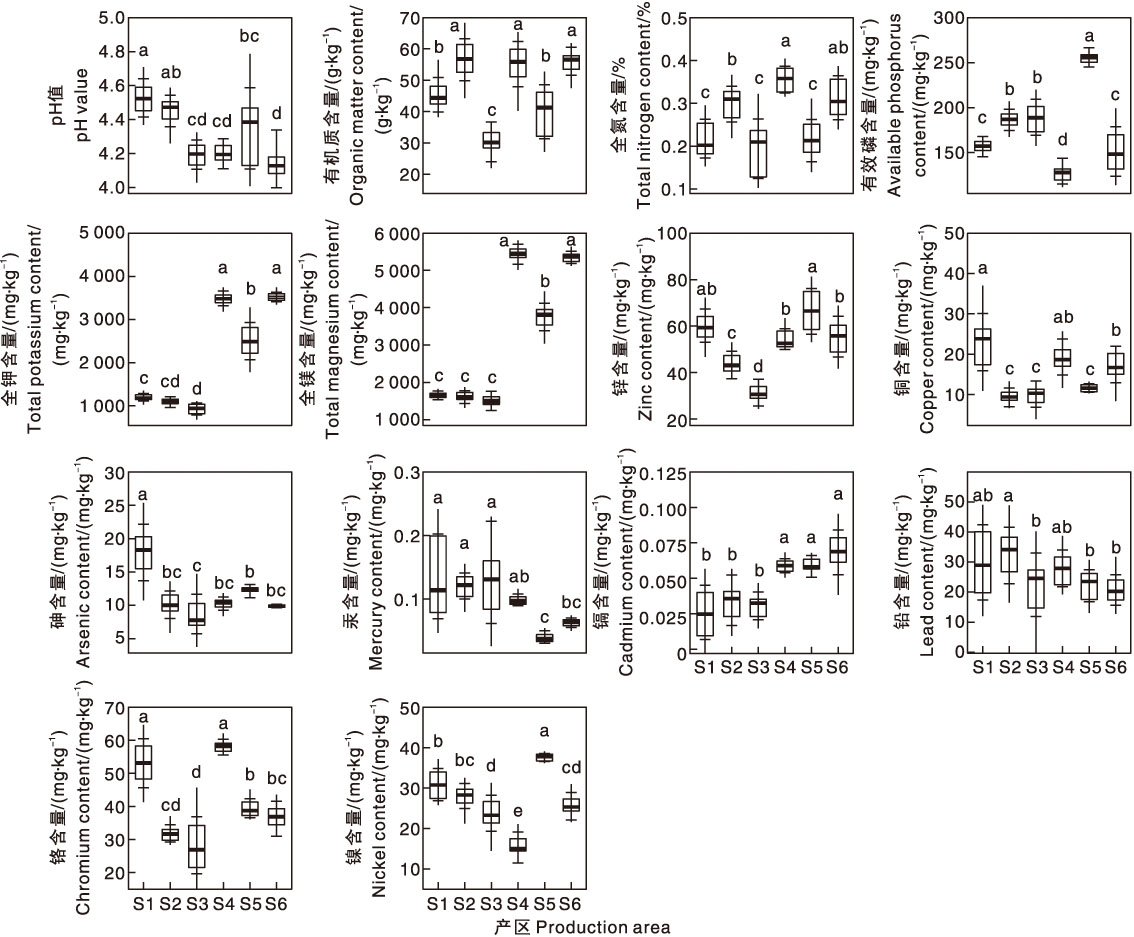
图1 不同产区的土壤理化性状 S1,龙井村;S2,梅家坞;S3,上城埭;S4,龙门坎;S5,叶埠桥;S6,横桥。下同。箱上无相同字母的表示差异显著(p<0.05)。
Fig.1 Soil physical and chemical properties in different production areas S1, Longjing Village; S2, Meijiawu; S3, Shangchengdai; S4, Longmenkan; S5, Yebuqiao; S6, Hengqiao. The same as below. Boxes marked without the same letters indicate significant difference at p<0.05.
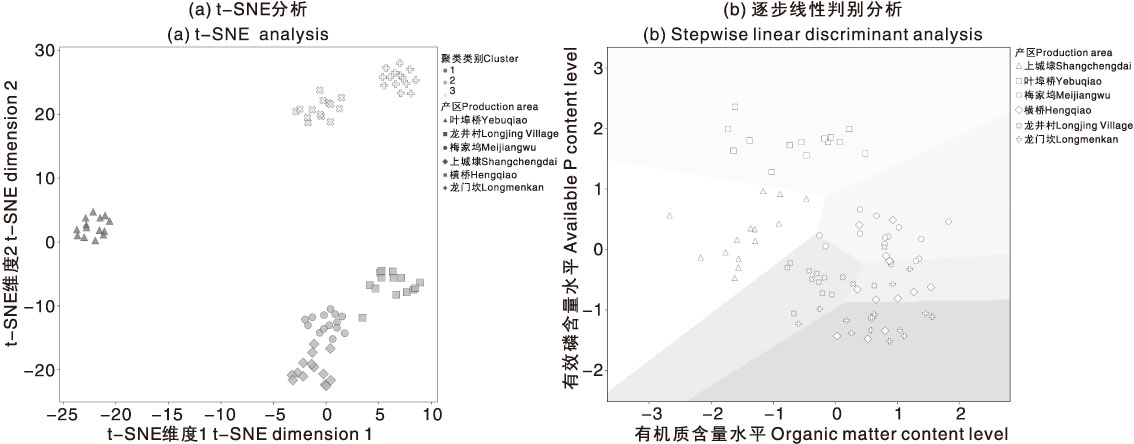
图2 产区土壤养分的k-means聚类与分类分析结果
Fig.2 Analysis results of k-means clustering and classification of soil nutrients in production areas
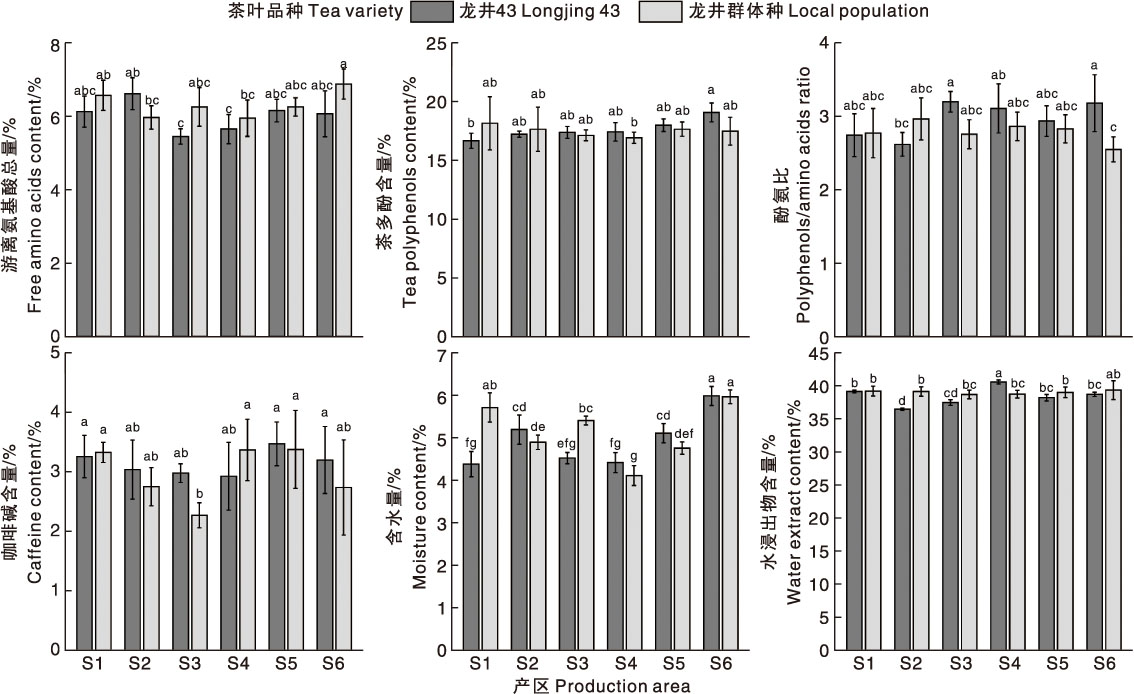
图3 不同产区龙井43和群体种西湖龙井的主要理化成分 柱上无相同字母的表示差异显著(p<0.05)。
Fig.3 Main physicochemical components of West Lake Longjing Tea (Longjing 43 and local population) from different production areas Bars marked without the same letters indicate significant difference at p<0.05.
| 产区 Production area | 品种 Variety | 外形(25%) Appearance(25%) | 汤色(10%) Liquor color(10%) | 香气(25%) Aroma(25%) | 滋味(30%) Taste(30%) | 叶底(10%) Leaf base(10%) | 总分 Total score | |||||
|---|---|---|---|---|---|---|---|---|---|---|---|---|
| 评语 Comment | 评分 Score | 评语 Comment | 评分 Score | 评语 Comment | 评分 Score | 评语 Comment | 评分 Score | 评语 Comment | 评分 Score | |||
| 龙井村 Longjing Village | 群体种 Local population | 扁平,较光滑,挺 直,稍花杂,尚嫩 绿泛红 Flat, relatively smooth, straight, slightly variegated, tender green with a reddish tint | 87.0 | 嫩绿明亮 Bright tender green | 93.0 | 清高,鲜爽,略 有花香,微青 Elegant and fresh, slight floral note, lightly grassy | 92.0 | 尚浓醇,甘鲜, 微青涩 Fairly mellow and thick, sweet and fresh, lightly astringent and grassy | 91.5 | 嫩较匀,成朵, 嫩绿较明亮 Tender, relatively uniform, whole leaves, relatively bright tender green | 90.0 | 90.5 |
| 龙井43 Longjing 43 | 较扁平,较光滑, 挺直,较绿带 糙米黄 Relatively flat and smooth, straight, relatively green with a brownish-yellow (unpolished rice) hue | 89.0 | 嫩绿明亮 Bright tender green | 93.0 | 高鲜,微青,略 有花香 Highly fresh, lightly grassy, slight floral note | 92.0 | 甘醇,鲜爽 (微青涩) Sweet and mellow, fresh (lightly astringent and grassy) | 92.0 | 嫩较匀,成朵, 嫩绿明亮 Tender, relatively uniform, whole leaves, bright tender green | 91.0 | 91.3 | |
| 家坞 Meijiawu | 群体种 Local population | 较扁平,较光滑, 较挺直,黄稍 花稍暗 Relatively flat and smooth, relatively straight, yellowish, slightly variegated and dull | 88.0 | 尚嫩绿明亮 Fairly bright tender green | 90.5 | 较高爽,略有栗 香,略有花香 (馥郁) Relatively high and fresh, slight chestnut note, slight floral (fragrant) | 92.5 | 尚浓醇,甘爽 Fairly mellow and thick, sweet and smooth | 92.5 | 嫩较匀,成朵, 嫩黄较明亮 Tender, relatively uniform, whole leaves, relatively bright tender yellow-green | 89.0 | 90.8 |
| 龙井43 Longjing 43 | 扁平,较光滑, 较挺直,较嫩 绿带糙米黄 Flat, relatively smooth, relatively straight, relatively tender green with a brownish- yellow hue | 91.0 | 较嫩绿明亮 Relatively bright tender green | 91.5 | 较高爽,略有花 香,略有火工 (微闷) Relatively high and fresh, slight floral note, slight roasted note (slightly stuffy) | 92.5 | 甘醇,鲜爽 Sweet and mellow, fresh | 93.0 | 嫩匀成朵, 嫩黄明亮 Uniform and tender, whole leaves, bright tender yellow-green | 90.5 | 92.0 | |
| 上城埭 Shang- chengdai | 群体种 Local population | 扁平,较光滑, 较挺直,较嫩 绿带糙米色 Flat, relatively smooth, relatively straight, relatively tender green with a brownish- yellow color | 90.0 | 较嫩绿(偏黄) 明亮 Relatively bright tender green (yellowish) | 91.0 | 清高,鲜爽, 花香显(微青) Elegant and fresh, pronounced floral note (lightly grassy) | 91.0 | 尚浓醇,鲜爽, 微青涩 Fairly mellow and thick, fresh, lightly astringent and grassy | 91.0 | 嫩厚成朵,嫩绿 较明亮 Tender and plump, whole leaves, relatively bright tender green | 91.0 | 90.8 |
| 龙井43 Longjing 43 | 扁平,光滑,挺 直,糙米色 Flat, smooth, straight, brownish- yellow color | 92.0 | 嫩绿明亮 Bright tender green | 93.0 | 较高鲜,微青, 略有花香 Relatively high freshness, lightly grassy, slight floral note | 91.5 | 尚浓醇,较甘 鲜,微涩 Fairly mellow and thick, relatively sweet and fresh, lightly astringent | 90.0 | 嫩厚成朵, 嫩绿明亮 Tender and plump, whole leaves, bright tender green | 91.5 | 91.3 | |
| 龙门坎 Long- menkan | 群体种 Local population | 扁平,尚光,较 挺直,稍宽大, 黄稍花 Flat, fairly smooth, relatively straight, slightly broad, yellowish with some variegation | 88.0 | 尚嫩绿偏黄 (嫩黄)明亮 Fairly bright, tender green with a yellowish (tender yellow) tint | 90.0 | 较高爽,略有 栗香,火工足 Relatively high and fresh, slight chestnut note, full roasted note | 90.5 | 较甘醇,尚鲜 爽,有火工 Relatively sweet and mellow, fairly fresh, roasted note present | 91.5 | 嫩较匀,成朵, 黄绿尚明亮 Tender, relatively uniform, whole leaves, fairly bright yellow- green | 89.0 | 90.0 |
| 龙井43 Longjing 43 | 扁平,较光滑, 较挺直,糙米色 Flat, relatively smooth, relatively straight, brownish- yellow color | 91.0 | 较嫩绿明亮 Relatively bright tender green | 91.5 | 较高爽,略有 火工(微闷) Relatively high and fresh, slight roasted note (slightly stuffy) | 90.5 | 甘醇,鲜爽 Sweet and mellow, fresh | 93.0 | 嫩匀成朵,嫩绿 较明亮 Uniform and tender, whole leaves, relatively bright tender green | 91.0 | 91.5 | |
| 叶埠桥 Yebuqiao | 群体种 Local population | 扁平,尚光滑, 较挺直,宽大, 有爆点,黄绿 Flat, fairly smooth, relatively straight, broad, with scorch spots, yellow-green | 89.0 | 绿明亮 Bright green | 90.0 | 清香,略闷, 微青 Clean aroma, slightly stuffy, lightly grassy | 89.0 | 较浓醇,略青 涩,尚鲜爽 Relatively thick and mellow, slightly astringent and grassy, fairly fresh | 89.5 | 嫩较匀,成朵, 嫩绿较明亮 Tender, relatively uniform, whole leaves, relatively bright tender green | 90.0 | 89.4 |
| 龙井43 Longjing 43 | 扁平,光滑,挺 直,糙米色 Flat, smooth, straight, brownish- yellow color | 92.0 | 较嫩绿明亮 Relatively bright tender green | 91.5 | 较清高,微闷 Relatively elegant, slightly stuffy | 90.5 | 尚浓醇,鲜爽, 微涩(微苦) Fairly mellow and thick, fresh, lightly astringent (slightly bitter) | 91.0 | 嫩匀成朵,嫩 绿较明亮 Uniform and tender, whole leaves, relatively bright tender green | 91.0 | 91.2 | |
| 横桥 Hengqiao | 群体种 Local population | 扁平,较光滑, 较挺直,黄绿 稍花 Flat, relatively smooth, relatively straight, yellow- green with slight variegation | 89.0 | 黄明 Bright yellow | 89.0 | 尚高爽,略有 嫩栗香 Fairly high and fresh, slight tender chestnut note | 90.0 | 尚浓,略涩, 尚甘爽 Fairly thick, slightly astringent, fairly sweet and smooth | 88.0 | 嫩匀较成朵, 黄绿稍暗 Relatively uniform and tender, fairly whole leaves, slightly dull yellow-green | 88.0 | 88.9 |
| 龙井43 Longjing 43 | 扁平,较光滑, 较挺直,稍小, 糙米色稍深 Flat, relatively smooth, relatively straight, slightly small, slightly darker brownish- yellow | 89.0 | 尚嫩绿(偏黄) 明亮 Fairly bright, tender green (yellowish) | 90.5 | 尚高爽,微闷 Fairly high and fresh, slightly stuffy | 89.5 | 尚浓醇,尚甘 鲜,略涩(苦) Fairly mellow and thick, fairly sweet and fresh, lightly astringent (bitter) | 88.5 | 嫩匀成朵,较 嫩绿较明亮 Uniform and tender, whole leaves, relatively bright tender green | 89.0 | 89.1 | |
表1 不同产区龙井43和群体种西湖龙井茶的感官审评结果
Table 1 Sensory evaluation results of West Lake Longjing Tea (Longjing 43 and local population) from different production areas
| 产区 Production area | 品种 Variety | 外形(25%) Appearance(25%) | 汤色(10%) Liquor color(10%) | 香气(25%) Aroma(25%) | 滋味(30%) Taste(30%) | 叶底(10%) Leaf base(10%) | 总分 Total score | |||||
|---|---|---|---|---|---|---|---|---|---|---|---|---|
| 评语 Comment | 评分 Score | 评语 Comment | 评分 Score | 评语 Comment | 评分 Score | 评语 Comment | 评分 Score | 评语 Comment | 评分 Score | |||
| 龙井村 Longjing Village | 群体种 Local population | 扁平,较光滑,挺 直,稍花杂,尚嫩 绿泛红 Flat, relatively smooth, straight, slightly variegated, tender green with a reddish tint | 87.0 | 嫩绿明亮 Bright tender green | 93.0 | 清高,鲜爽,略 有花香,微青 Elegant and fresh, slight floral note, lightly grassy | 92.0 | 尚浓醇,甘鲜, 微青涩 Fairly mellow and thick, sweet and fresh, lightly astringent and grassy | 91.5 | 嫩较匀,成朵, 嫩绿较明亮 Tender, relatively uniform, whole leaves, relatively bright tender green | 90.0 | 90.5 |
| 龙井43 Longjing 43 | 较扁平,较光滑, 挺直,较绿带 糙米黄 Relatively flat and smooth, straight, relatively green with a brownish-yellow (unpolished rice) hue | 89.0 | 嫩绿明亮 Bright tender green | 93.0 | 高鲜,微青,略 有花香 Highly fresh, lightly grassy, slight floral note | 92.0 | 甘醇,鲜爽 (微青涩) Sweet and mellow, fresh (lightly astringent and grassy) | 92.0 | 嫩较匀,成朵, 嫩绿明亮 Tender, relatively uniform, whole leaves, bright tender green | 91.0 | 91.3 | |
| 家坞 Meijiawu | 群体种 Local population | 较扁平,较光滑, 较挺直,黄稍 花稍暗 Relatively flat and smooth, relatively straight, yellowish, slightly variegated and dull | 88.0 | 尚嫩绿明亮 Fairly bright tender green | 90.5 | 较高爽,略有栗 香,略有花香 (馥郁) Relatively high and fresh, slight chestnut note, slight floral (fragrant) | 92.5 | 尚浓醇,甘爽 Fairly mellow and thick, sweet and smooth | 92.5 | 嫩较匀,成朵, 嫩黄较明亮 Tender, relatively uniform, whole leaves, relatively bright tender yellow-green | 89.0 | 90.8 |
| 龙井43 Longjing 43 | 扁平,较光滑, 较挺直,较嫩 绿带糙米黄 Flat, relatively smooth, relatively straight, relatively tender green with a brownish- yellow hue | 91.0 | 较嫩绿明亮 Relatively bright tender green | 91.5 | 较高爽,略有花 香,略有火工 (微闷) Relatively high and fresh, slight floral note, slight roasted note (slightly stuffy) | 92.5 | 甘醇,鲜爽 Sweet and mellow, fresh | 93.0 | 嫩匀成朵, 嫩黄明亮 Uniform and tender, whole leaves, bright tender yellow-green | 90.5 | 92.0 | |
| 上城埭 Shang- chengdai | 群体种 Local population | 扁平,较光滑, 较挺直,较嫩 绿带糙米色 Flat, relatively smooth, relatively straight, relatively tender green with a brownish- yellow color | 90.0 | 较嫩绿(偏黄) 明亮 Relatively bright tender green (yellowish) | 91.0 | 清高,鲜爽, 花香显(微青) Elegant and fresh, pronounced floral note (lightly grassy) | 91.0 | 尚浓醇,鲜爽, 微青涩 Fairly mellow and thick, fresh, lightly astringent and grassy | 91.0 | 嫩厚成朵,嫩绿 较明亮 Tender and plump, whole leaves, relatively bright tender green | 91.0 | 90.8 |
| 龙井43 Longjing 43 | 扁平,光滑,挺 直,糙米色 Flat, smooth, straight, brownish- yellow color | 92.0 | 嫩绿明亮 Bright tender green | 93.0 | 较高鲜,微青, 略有花香 Relatively high freshness, lightly grassy, slight floral note | 91.5 | 尚浓醇,较甘 鲜,微涩 Fairly mellow and thick, relatively sweet and fresh, lightly astringent | 90.0 | 嫩厚成朵, 嫩绿明亮 Tender and plump, whole leaves, bright tender green | 91.5 | 91.3 | |
| 龙门坎 Long- menkan | 群体种 Local population | 扁平,尚光,较 挺直,稍宽大, 黄稍花 Flat, fairly smooth, relatively straight, slightly broad, yellowish with some variegation | 88.0 | 尚嫩绿偏黄 (嫩黄)明亮 Fairly bright, tender green with a yellowish (tender yellow) tint | 90.0 | 较高爽,略有 栗香,火工足 Relatively high and fresh, slight chestnut note, full roasted note | 90.5 | 较甘醇,尚鲜 爽,有火工 Relatively sweet and mellow, fairly fresh, roasted note present | 91.5 | 嫩较匀,成朵, 黄绿尚明亮 Tender, relatively uniform, whole leaves, fairly bright yellow- green | 89.0 | 90.0 |
| 龙井43 Longjing 43 | 扁平,较光滑, 较挺直,糙米色 Flat, relatively smooth, relatively straight, brownish- yellow color | 91.0 | 较嫩绿明亮 Relatively bright tender green | 91.5 | 较高爽,略有 火工(微闷) Relatively high and fresh, slight roasted note (slightly stuffy) | 90.5 | 甘醇,鲜爽 Sweet and mellow, fresh | 93.0 | 嫩匀成朵,嫩绿 较明亮 Uniform and tender, whole leaves, relatively bright tender green | 91.0 | 91.5 | |
| 叶埠桥 Yebuqiao | 群体种 Local population | 扁平,尚光滑, 较挺直,宽大, 有爆点,黄绿 Flat, fairly smooth, relatively straight, broad, with scorch spots, yellow-green | 89.0 | 绿明亮 Bright green | 90.0 | 清香,略闷, 微青 Clean aroma, slightly stuffy, lightly grassy | 89.0 | 较浓醇,略青 涩,尚鲜爽 Relatively thick and mellow, slightly astringent and grassy, fairly fresh | 89.5 | 嫩较匀,成朵, 嫩绿较明亮 Tender, relatively uniform, whole leaves, relatively bright tender green | 90.0 | 89.4 |
| 龙井43 Longjing 43 | 扁平,光滑,挺 直,糙米色 Flat, smooth, straight, brownish- yellow color | 92.0 | 较嫩绿明亮 Relatively bright tender green | 91.5 | 较清高,微闷 Relatively elegant, slightly stuffy | 90.5 | 尚浓醇,鲜爽, 微涩(微苦) Fairly mellow and thick, fresh, lightly astringent (slightly bitter) | 91.0 | 嫩匀成朵,嫩 绿较明亮 Uniform and tender, whole leaves, relatively bright tender green | 91.0 | 91.2 | |
| 横桥 Hengqiao | 群体种 Local population | 扁平,较光滑, 较挺直,黄绿 稍花 Flat, relatively smooth, relatively straight, yellow- green with slight variegation | 89.0 | 黄明 Bright yellow | 89.0 | 尚高爽,略有 嫩栗香 Fairly high and fresh, slight tender chestnut note | 90.0 | 尚浓,略涩, 尚甘爽 Fairly thick, slightly astringent, fairly sweet and smooth | 88.0 | 嫩匀较成朵, 黄绿稍暗 Relatively uniform and tender, fairly whole leaves, slightly dull yellow-green | 88.0 | 88.9 |
| 龙井43 Longjing 43 | 扁平,较光滑, 较挺直,稍小, 糙米色稍深 Flat, relatively smooth, relatively straight, slightly small, slightly darker brownish- yellow | 89.0 | 尚嫩绿(偏黄) 明亮 Fairly bright, tender green (yellowish) | 90.5 | 尚高爽,微闷 Fairly high and fresh, slightly stuffy | 89.5 | 尚浓醇,尚甘 鲜,略涩(苦) Fairly mellow and thick, fairly sweet and fresh, lightly astringent (bitter) | 88.5 | 嫩匀成朵,较 嫩绿较明亮 Uniform and tender, whole leaves, relatively bright tender green | 89.0 | 89.1 | |
| [1] | LIU W W, CHEN Y, LIAO R X, et al. Authentication of the geographical origin of Guizhou green tea using stable isotope and mineral element signatures combined with chemometric analysis[J]. Food Control, 2021, 125: 107954. |
| [2] | LIN X Y, YIN C L, HU L Q, et al. Tracing the geographical origin of Chinese green tea based on fluorescent sensor array combined with multi-way chemometrics analyses[J]. Food Research International, 2025, 203: 115838. |
| [3] | 徐敏. 基于电子鼻、电子舌和电子眼的多源信息融合技术对龙井茶品质的检测[D]. 杭州: 浙江大学, 2020. |
| XU M. Quality detection of Longjing tea based on the multi-source information fusion of E-nose, E-tongue and E-eye[D]. Hangzhou: Zhejiang University, 2020. | |
| [4] | JIN G, ZHU Y Y, CUI C J, et al. Tracing the origin of Taiping Houkui green tea using 1H NMR and HS-SPME-GC-MS chemical fingerprints, data fusion and chemometrics[J]. Food Chemistry, 2023, 425: 136538. |
| [5] | JAHAN I, SHOPAN J, RAHMAN M M, et al. Long-term traditional fertilization alters tea garden soil properties and tea leaf quality in Bangladesh[J]. Agronomy, 2022, 12(9): 2128. |
| [6] | ZHANG M K, FANG L P. Tea plantation-induced activation of soil heavy metals[J]. Communications in Soil Science and Plant Analysis, 2007, 38(11/12): 1467-1478. |
| [7] | JI L F, WANG N, LI G F, et al. From soil health to tea flavour: organic fertilisation enhances microbial communities and aroma compounds[J]. Agriculture, Ecosystems & Environment, 2026, 396: 110028. |
| [8] | XIN W, ZHANG J M, YU Y D, et al. Root microbiota of tea plants regulate nitrogen homeostasis and theanine synthesis to influence tea quality[J]. Current Biology, 2024, 34(4): 868-880. |
| [9] | HU Y L, LI P P, YAO X Z, et al. Zinc treatment of tea plants improves the synthesis of trihydroxylated catechins via regulation of the zinc-sensitive protein CsHIPP3[J]. Journal of Agricultural and Food Chemistry, 2024, 72(26): 14887-14898. |
| [10] | 赵晓楠, 李玉红, 芦阿虔, 等. 浉河区茶园土壤性状与茶叶品质相关性研究[J]. 土壤科学, 2016(3): 27-35. |
| ZHAO X N, LI Y H, LU A Q, et al. The research on correlation between soil properties and tea quality of tea plantation in Shihe District[J]. Hans Journal of Soil Science, 2016(3): 27-35. | |
| [11] | 江永成, 胡家琴, 张琼, 等. 云贵高原茶园土壤养分状况及其对茶叶品质的影响[J]. 环境工程技术学报, 2024, 14(5): 1451-1458. |
| JIANG Y C, HU J Q, ZHANG Q, et al. Soil nutrient status in tea gardens on the Yunnan-Guizhou Plateau and their effects on tea quality[J]. Journal of Environmental Engineering Technology, 2024, 14(5): 1451-1458. | |
| [12] | 李昌娟, 杨文浩, 周碧青, 等. 生物炭基肥对酸化茶园土壤养分及茶叶产质量的影响[J]. 土壤通报, 2021, 52(2): 387-397. |
| LI C J, YANG W H, ZHOU B Q, et al. Effects of biochar based fertilizer on soil nutrients, tea output and quality in an acidified tea field[J]. Chinese Journal of Soil Science, 2021, 52(2): 387-397. | |
| [13] | 代依涵. 氮肥运筹对茶叶产量和品质及茶园土壤肥力的影响[D]. 贵阳: 贵州大学, 2023. |
| DAI Y H. Effects of nitrogen fertilizer management on tea yield, quality and soil fertility in tea plantations[D]. Guiyang: Guizhou University, 2023. | |
| [14] | 田甜, 赵德恩, 梁登雲, 等. 氮磷钾配施对茶叶产量及品质的影响[J]. 江苏农业科学, 2018, 46(14): 131-136. |
| TIAN T, ZHAO D E, LIANG D Y, et al. Influences of combined application of N, P and K on yield and quality of tea[J]. Jiangsu Agricultural Sciences, 2018, 46(14): 131-136. | |
| [15] | 王瑜, 刘扬, 卓座品, 等. 高氮低磷中钾配比对武夷岩茶产量及品质的影响[J]. 南方农业学报, 2022, 53(2): 391-400. |
| WANG Y, LIU Y, ZHUO Z P, et al. Effects of high nitrogen and low phosphorus medium potassium ratios on the yield and quality of Wuyi Rock tea[J]. Journal of Southern Agriculture, 2022, 53(2): 391-400. | |
| [16] | 阮建云, 吴洵. 钾、镁营养供应对茶叶品质和产量的影响[J]. 茶叶科学, 2003, 23(S1): 21-26. |
| RUAN J Y, WU X. Productivity and quality response of tea to balanced nutrient management including K and Mg[J]. Journal of Tea Science, 2003, 23(S1): 21-26. | |
| [17] | 聂榕, 叶宏萌, 梁玉婷, 等. 茶园土壤重金属含量及特定源风险解析[J]. 环境化学, 2025, 44(7): 2459-2471. |
| NIE R, YE H M, LIANG Y T, et al. Analysis of heavy metal content in tea garden soil and risk from specific sources[J]. Environmental Chemistry, 2025, 44(7): 2459-2471. | |
| [18] | 张永瑞, 尹杰, 覃超, 等. 钾镁肥配施对幼龄茶树夏秋季新梢生长的影响[J]. 山地农业生物学报, 2010, 29(4): 300-303. |
| ZHANG Y R, YIN J, QIN C, et al. Effects of co-application of potassium and magnesium fertilizers on the growth of young-tea shoots in summer and autumn[J]. Journal of Mountain Agriculture and Biology, 2010, 29(4): 300-303. | |
| [19] | 张海棠, 赵德英, 闫帅, 等. 不同钾镁配比对‘早酥’梨果实品质的影响[J]. 果树学报, 2020, 37(11): 1667-1675. |
| ZHANG H T, ZHAO D Y, YAN S, et al. Effect of potassium-magnesium ratio on ‘Zaosu’ pear fruit quality[J]. Journal of Fruit Science, 2020, 37(11): 1667-1675. | |
| [20] | RUAN J Y, WU X, HÄRDTER R. Effects of potassium and magnesium nutrition on the quality components of different types of tea[J]. Journal of the Science of Food and Agriculture, 1999, 79(1): 47-52. |
| [21] | 任海龙, 陈非凡, 谭启玲, 等. 有机肥替代化肥对我国茶叶产量、品质的影响[J]. 茶叶科学, 2024, 44(4): 598-608. |
| REN H L, CHEN F F, TAN Q L, et al. The impact of organic fertilizer replacement of chemical fertilizers on yield and quality of tea gardens in China[J]. Journal of Tea Science, 2024, 44(4): 598-608. | |
| [22] | 耿赛攀, 马立锋. 施肥对茶园土壤质量及茶叶产量、品质的影响研究进展[J]. 茶叶学报, 2021, 62(1): 22-29. |
| GENG S P, MA L F. On soil quality and tea yield/quality affected by fertilizer application[J]. Acta Tea Sinica, 2021, 62(1): 22-29. | |
| [23] | DAI C T, XIANG F, LIU H Y, et al. The prolonged application of organic fertilizers increases the quality and yield of tea crops[J]. Plants, 2025, 14(9): 1317. |
| [1] | 朱为静, 吴佳, 洪春来, 朱凤香, 洪磊东, 张涛, 张硕, 诸惠芬. 秸秆覆盖对土壤水热肥及蟠桃产量和品质的影响[J]. 浙江农业学报, 2025, 37(9): 1924-1932. |
| [2] | 吴小清, 周菲菲, 叶影, 黄艳梅, 杨蕾玉, 黄海涛, 吴媛媛. 不同茶树品种制龙井茶的香气特征研究[J]. 浙江农业学报, 2022, 34(3): 437-446. |
| [3] | 张统帅, 闫丽娟, 李广, 陈国鹏, 罗永忠. 免耕和秸秆覆盖对旱作区土壤氮素、水分和春小麦产量的影响[J]. 浙江农业学报, 2020, 32(8): 1329-1341. |
| [4] | 白羽祥, 杨焕文, 徐照丽, 吴涛, 易建华, 王戈. 连作植烟土壤中酚酸物质与土壤因子的关系分析[J]. 浙江农业学报, 2018, 30(11): 1907-1914. |
| [5] | 何建斌;梁威;李晓明. 基于K均值聚类和数学形态学的小麦彩色图像分割[J]. , 2011, 23(4): 0-832. |
| [6] | 陆德彪;毛祖法. 基于地理标志(GI)的龙井茶产业实证分析[J]. , 2011, 23(1): 41-45. |
| 阅读次数 | ||||||
|
全文 |
|
|||||
|
摘要 |
|
|||||

