Acta Agriculturae Zhejiangensis ›› 2026, Vol. 38 ›› Issue (8): 1648-1659.DOI: 10.3969/j.issn.1004-1524.20250418
• Environmental Science • Previous Articles Next Articles
Characteristics of bacterial communities in saline-alkali soil of Lycium barbarum fields in Ningxia of China and screening of culturable halotolerant/haloalkaliphilic bacteria
ZHANG Siyi1,2( ), LU Li2, CHEN Zhaoliang2, LYU Weiguang2,3,4, ZHANG Hanlin2,3,4, LI Shuangxi2,3,4, ZHANG Tinglin5, SUN Lijuan2, BAI Naling2,3,4,*()
- 1
College of Fisheries and Life Science ,Shanghai Ocean University Shanghai 201306, China
2Eco-Environmental Protection Research Institute ,Shanghai Academy of Agricultural Sciences Shanghai 201403, China
3Key Laboratory of Low-Carbon Green Agriculture in Southeastern China ,Ministry of Agriculture and Rural Affairs Shanghai 201403, China
4Shanghai Monitoring Station of Agricultural Environment Shanghai 201403, China
5Agricultural Technology Extension Service Center of Qingpu District ,Shanghai City Shanghai 201799, China
-
Received:2025-06-02Online:2026-08-25Published:2026-09-14

CLC Number:
Cite this article
ZHANG Siyi, LU Li, CHEN Zhaoliang, LYU Weiguang, ZHANG Hanlin, LI Shuangxi, ZHANG Tinglin, SUN Lijuan, BAI Naling. Characteristics of bacterial communities in saline-alkali soil of Lycium barbarum fields in Ningxia of China and screening of culturable halotolerant/haloalkaliphilic bacteria[J]. Acta Agriculturae Zhejiangensis, 2026, 38(8): 1648-1659.
share this article
Add to citation manager EndNote|Ris|BibTeX
URL: http://www.zjnyxb.cn/EN/10.3969/j.issn.1004-1524.20250418
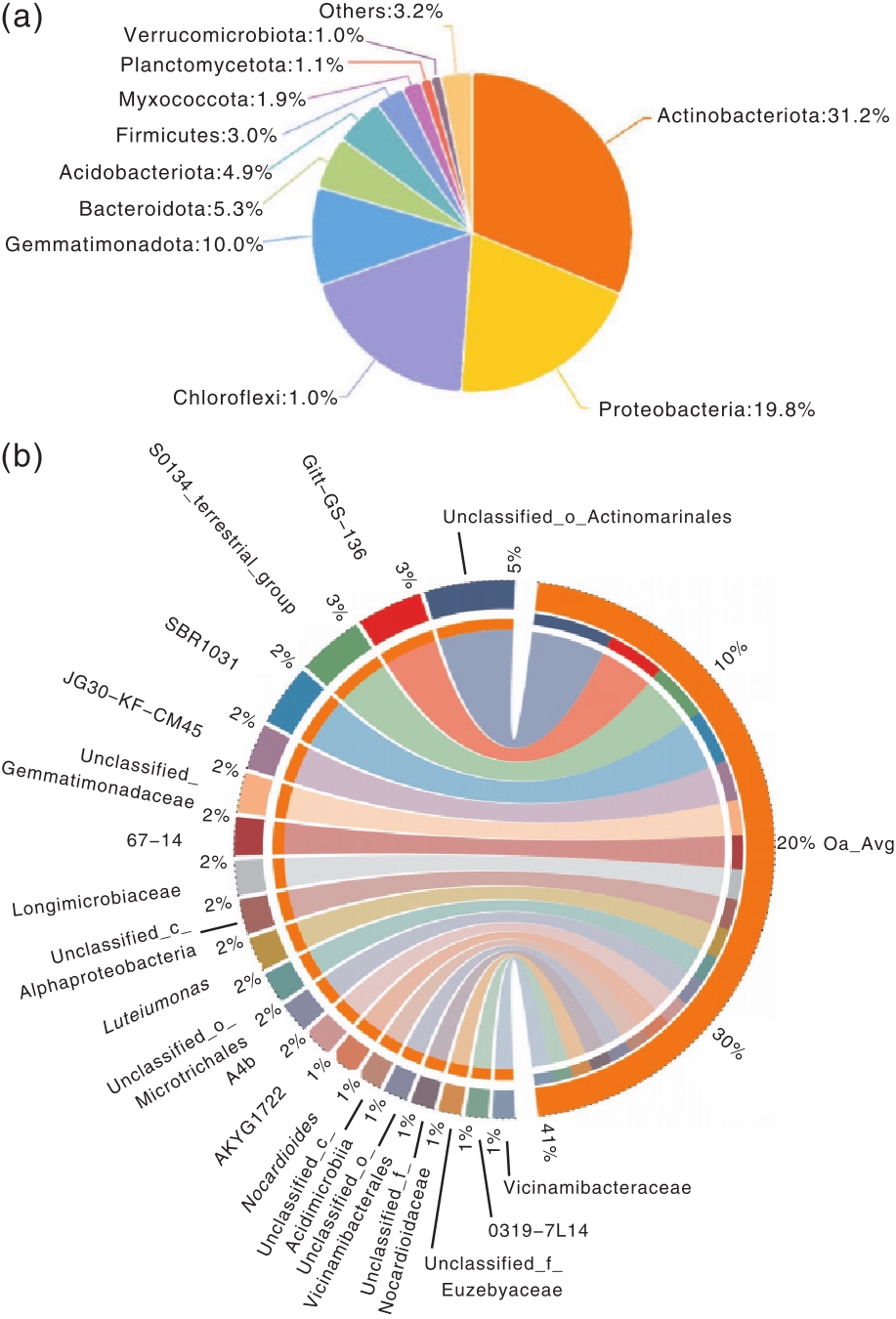
Fig.1 The top 10 dominant species at phylum level (a) and top 20 dominant species at genus level (b) in terms of relative abundance
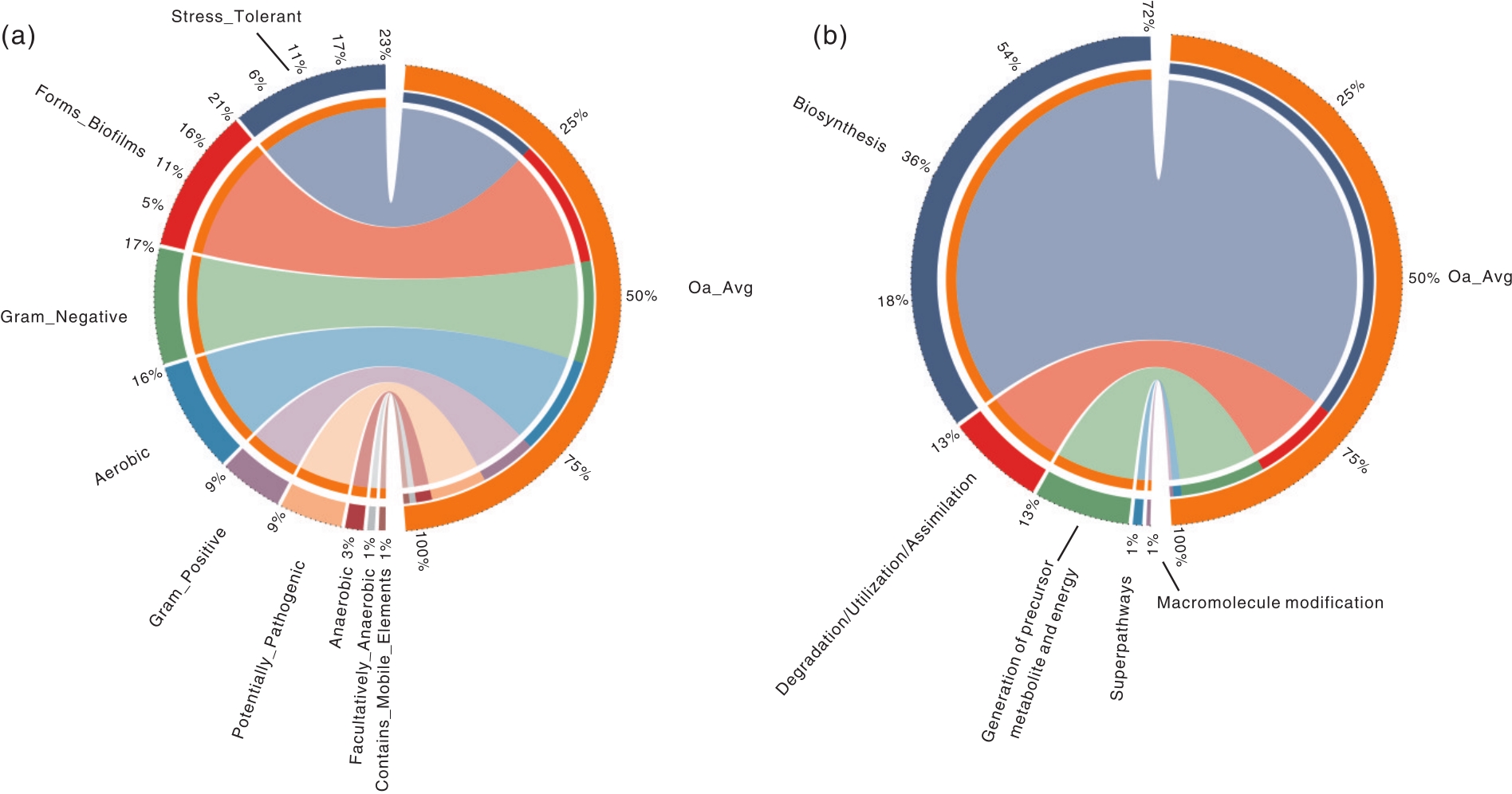
Fig.2 Functional prediction analysis by Bugbase (a) and PICRUSt2 (b)
| 菌株 Strain | 不同NaCl质量分数下菌液的D600值 D600 values of bacterial suspensions under different mass fractions of NaCl | ||||||
|---|---|---|---|---|---|---|---|
| 8% | 10% | 12% | 14% | 16% | 18% | 20% | |
| nx-1 | 1.046 | 0.723 | 0.728 | 0.654 | 0.518 | — | — |
| nx-2 | 0.812 | 0.604 | — | — | — | — | — |
| nx-3 | 0.752 | 0.842 | 0.532 | 0.233 | — | — | — |
| nx-4 | 0.501 | — | — | — | — | — | — |
| nx-5 | 0.334 | 0.719 | 0.574 | 0.364 | — | — | — |
| nx-6 | 0.872 | 0.765 | 0.835 | 0.505 | — | — | — |
| nx-7 | 0.791 | 0.729 | 0.641 | 0.512 | — | — | — |
| nx-8 | 0.808 | 0.753 | 0.587 | 0.412 | — | — | — |
| nx-9 | 1.068 | 1.037 | 1.083 | 0.872 | 0.524 | 0.378 | — |
| nx-10 | 1.079 | 1.192 | 0.848 | 0.500 | — | — | — |
| nx-11 | 1.054 | 0.747 | 0.641 | 0.659 | 0.524 | 0.215 | — |
| nx-12 | 0.823 | 0.581 | 0.771 | 0.616 | 0.663 | — | — |
Table1 Salt tolerance capacity of different strains
| 菌株 Strain | 不同NaCl质量分数下菌液的D600值 D600 values of bacterial suspensions under different mass fractions of NaCl | ||||||
|---|---|---|---|---|---|---|---|
| 8% | 10% | 12% | 14% | 16% | 18% | 20% | |
| nx-1 | 1.046 | 0.723 | 0.728 | 0.654 | 0.518 | — | — |
| nx-2 | 0.812 | 0.604 | — | — | — | — | — |
| nx-3 | 0.752 | 0.842 | 0.532 | 0.233 | — | — | — |
| nx-4 | 0.501 | — | — | — | — | — | — |
| nx-5 | 0.334 | 0.719 | 0.574 | 0.364 | — | — | — |
| nx-6 | 0.872 | 0.765 | 0.835 | 0.505 | — | — | — |
| nx-7 | 0.791 | 0.729 | 0.641 | 0.512 | — | — | — |
| nx-8 | 0.808 | 0.753 | 0.587 | 0.412 | — | — | — |
| nx-9 | 1.068 | 1.037 | 1.083 | 0.872 | 0.524 | 0.378 | — |
| nx-10 | 1.079 | 1.192 | 0.848 | 0.500 | — | — | — |
| nx-11 | 1.054 | 0.747 | 0.641 | 0.659 | 0.524 | 0.215 | — |
| nx-12 | 0.823 | 0.581 | 0.771 | 0.616 | 0.663 | — | — |
| 菌株 Strain | 不同pH值条件下菌液的D600值 D600 values of bacterial suspensions under different pH value | |||||
|---|---|---|---|---|---|---|
| 7.0 | 9.0 | 10.0 | 11.0 | 12.0 | 13.0 | |
| nx-1 | 0.627 | 0.749 | 0.935 | 0.978 | 0.553 | — |
| nx-2 | 0.701 | 0.679 | 0.824 | 1.023 | 0.907 | — |
| nx-3 | — | 0.789 | 0.815 | 0.765 | 0.323 | — |
| nx-4 | 0.501 | 0.245 | — | — | — | — |
| nx-5 | — | 0.652 | 0.822 | 0.881 | 0.312 | — |
| nx-6 | 0.612 | 0.744 | 1.021 | 0.915 | 0.739 | — |
| nx-7 | 0.703 | 0.779 | 0.801 | 0.448 | — | — |
| nx-8 | 0.673 | 0.546 | 0.531 | 0.537 | — | — |
| nx-9 | — | 0.929 | 0.789 | 0.683 | 0.657 | — |
| nx-10 | 0.738 | 0.816 | 1.034 | 0.976 | 0.904 | — |
| nx-11 | 0.766 | 0.785 | 1.116 | 1.037 | 0.908 | — |
| nx-12 | 0.516 | 0.608 | 0.804 | — | — | — |
Table 2 Alkali tolerance capacity of different strains
| 菌株 Strain | 不同pH值条件下菌液的D600值 D600 values of bacterial suspensions under different pH value | |||||
|---|---|---|---|---|---|---|
| 7.0 | 9.0 | 10.0 | 11.0 | 12.0 | 13.0 | |
| nx-1 | 0.627 | 0.749 | 0.935 | 0.978 | 0.553 | — |
| nx-2 | 0.701 | 0.679 | 0.824 | 1.023 | 0.907 | — |
| nx-3 | — | 0.789 | 0.815 | 0.765 | 0.323 | — |
| nx-4 | 0.501 | 0.245 | — | — | — | — |
| nx-5 | — | 0.652 | 0.822 | 0.881 | 0.312 | — |
| nx-6 | 0.612 | 0.744 | 1.021 | 0.915 | 0.739 | — |
| nx-7 | 0.703 | 0.779 | 0.801 | 0.448 | — | — |
| nx-8 | 0.673 | 0.546 | 0.531 | 0.537 | — | — |
| nx-9 | — | 0.929 | 0.789 | 0.683 | 0.657 | — |
| nx-10 | 0.738 | 0.816 | 1.034 | 0.976 | 0.904 | — |
| nx-11 | 0.766 | 0.785 | 1.116 | 1.037 | 0.908 | — |
| nx-12 | 0.516 | 0.608 | 0.804 | — | — | — |
| 菌株 Strain | 不同条件下菌液的D600值D600 values of bacterial suspensions under different conditions | |||||||
|---|---|---|---|---|---|---|---|---|
| 8%+8.5 | 8%+9.5 | 10%+8.5 | 10%+9.5 | 14%+9.0 | 14%+10.0 | 16%+9.0 | 16%+10.0 | |
| nx-1 | 0.589 | 0.956 | 0.833 | 0.674 | — | — | — | — |
| nx-2 | 0.791 | 0.848 | 0.912 | 0.876 | — | — | — | — |
| nx-3 | 0.639 | 0.871 | 0.536 | 0.805 | — | — | — | — |
| nx-4 | 0.227 | 0.541 | 0.369 | — | — | — | — | — |
| nx-5 | 0.696 | 0.927 | 0.701 | 0.848 | — | — | — | — |
| nx-6 | 0.766 | 0.804 | 0.523 | — | — | — | — | — |
| nx-7 | 0.703 | 0.812 | 0.659 | 0.663 | — | — | — | — |
| nx-8 | 0.645 | 0.859 | 0.812 | 0.708 | — | — | — | — |
| nx-9 | 1.085 | 0.947 | 1.143 | 0.806 | 0.541 | 0.607 | 0.235 | 0.209 |
| nx-10 | 0.717 | 0.831 | 0.824 | 0.809 | — | — | — | — |
| nx-11 | 0.589 | 1.006 | 0.823 | 0.605 | — | — | — | — |
| nx-12 | 0.518 | 0.391 | 0.216 | — | — | — | — | — |
Table 3 Salt and alkali tolerance capacity of different strains
| 菌株 Strain | 不同条件下菌液的D600值D600 values of bacterial suspensions under different conditions | |||||||
|---|---|---|---|---|---|---|---|---|
| 8%+8.5 | 8%+9.5 | 10%+8.5 | 10%+9.5 | 14%+9.0 | 14%+10.0 | 16%+9.0 | 16%+10.0 | |
| nx-1 | 0.589 | 0.956 | 0.833 | 0.674 | — | — | — | — |
| nx-2 | 0.791 | 0.848 | 0.912 | 0.876 | — | — | — | — |
| nx-3 | 0.639 | 0.871 | 0.536 | 0.805 | — | — | — | — |
| nx-4 | 0.227 | 0.541 | 0.369 | — | — | — | — | — |
| nx-5 | 0.696 | 0.927 | 0.701 | 0.848 | — | — | — | — |
| nx-6 | 0.766 | 0.804 | 0.523 | — | — | — | — | — |
| nx-7 | 0.703 | 0.812 | 0.659 | 0.663 | — | — | — | — |
| nx-8 | 0.645 | 0.859 | 0.812 | 0.708 | — | — | — | — |
| nx-9 | 1.085 | 0.947 | 1.143 | 0.806 | 0.541 | 0.607 | 0.235 | 0.209 |
| nx-10 | 0.717 | 0.831 | 0.824 | 0.809 | — | — | — | — |
| nx-11 | 0.589 | 1.006 | 0.823 | 0.605 | — | — | — | — |
| nx-12 | 0.518 | 0.391 | 0.216 | — | — | — | — | — |
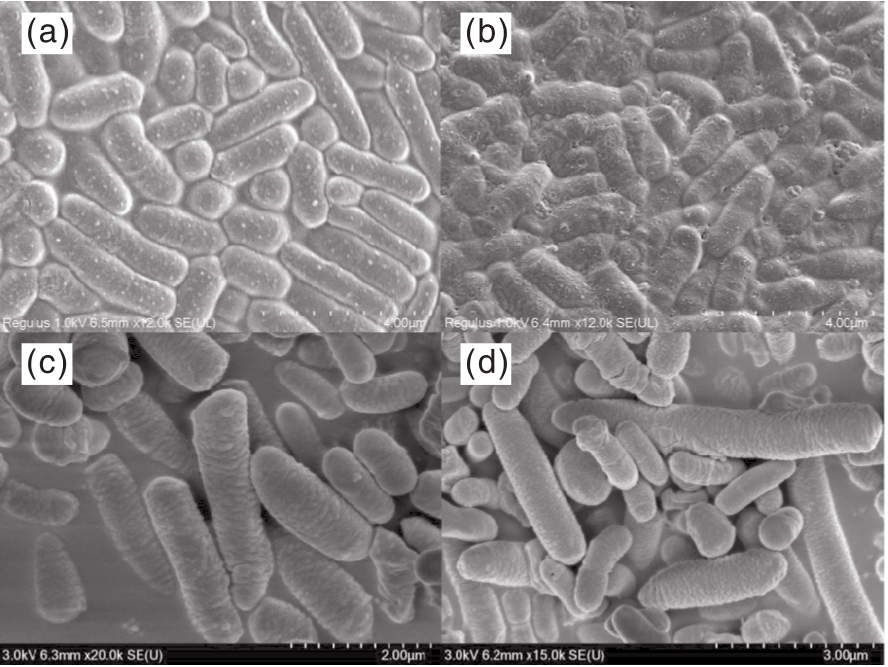
Fig.3 Cell morphology of strain nx-9 under medium (NaCl mass fraction of 8%, pH value of 8.5) and high (NaCl mass fraction of 16%, pH value of 10.0) saline-alkaline conditions Panels a and b represent cryo-field-emission scanning electron microscopy (Cryo-FE-SEM) images under moderate and high saline-alkaline condition, respectively. Panels c and d show field-emission scanning electron microscopy (FE-SEM) images under moderate and high saline-alkaline conditions, respectively.
| 酶Enzyme | 结果Results | 酶Enzyme | 结果Results |
|---|---|---|---|
| 碱性磷酸酶Alkaline phosphatase | + | 酸性磷酸酶Acid phosphatase | - |
| 酯酶(C4)Esterase (C4) | weak | 萘酚-AS-BI-磷酸水解酶Naphthol-AS-BI-phosphohydrolase | weak |
| 类脂酯酶(C8)Lipase (C8) | weak | α-半乳糖苷酶α-Galactosidase | - |
| 类脂酯酶(C14)Lipase (C14) | - | β-半乳糖苷酶β-Galactosidase | + |
| 亮氨酸芳胺酶Leucine arylamidase | - | β-葡萄糖醛酸苷酶β-Glucuronidase | - |
| 缬氨酸芳胺酶Valine arylamidase | - | α-葡萄糖苷酶α-Glucosidase | + |
| 胱氨酸芳胺酶Cystine arylamidase | - | β-葡萄糖苷酶β-Glucosidase | - |
| 胰蛋白酶Trypsin | - | N-乙酰-葡萄糖胺酶N-Acetylglucosaminidase | - |
| α-胰凝乳蛋白酶α-Chymotrypsin | - | α-岩藻糖苷酶α-Fucosidase | - |
Table 4 Enzymatic characteristics of strain nx-9
| 酶Enzyme | 结果Results | 酶Enzyme | 结果Results |
|---|---|---|---|
| 碱性磷酸酶Alkaline phosphatase | + | 酸性磷酸酶Acid phosphatase | - |
| 酯酶(C4)Esterase (C4) | weak | 萘酚-AS-BI-磷酸水解酶Naphthol-AS-BI-phosphohydrolase | weak |
| 类脂酯酶(C8)Lipase (C8) | weak | α-半乳糖苷酶α-Galactosidase | - |
| 类脂酯酶(C14)Lipase (C14) | - | β-半乳糖苷酶β-Galactosidase | + |
| 亮氨酸芳胺酶Leucine arylamidase | - | β-葡萄糖醛酸苷酶β-Glucuronidase | - |
| 缬氨酸芳胺酶Valine arylamidase | - | α-葡萄糖苷酶α-Glucosidase | + |
| 胱氨酸芳胺酶Cystine arylamidase | - | β-葡萄糖苷酶β-Glucosidase | - |
| 胰蛋白酶Trypsin | - | N-乙酰-葡萄糖胺酶N-Acetylglucosaminidase | - |
| α-胰凝乳蛋白酶α-Chymotrypsin | - | α-岩藻糖苷酶α-Fucosidase | - |
| 底物 Substrate | 结果 Results | 底物 Substrate | 结果 Results | 底物 Substrate | 结果 Results |
|---|---|---|---|---|---|
| 甘油Glycerol | weak | 甘露醇Mannitol | weak | D-蜜三糖D-Melitriose | + |
| 赤藓醇Erythritol | - | 山梨醇Sorbitol | - | 棉子糖Raffinose | + |
| D-阿拉伯糖D-Arabinose | - | α-甲基-D-甘露糖苷α-Methyl-D-mannoside | - | 糖原Glycogen | + |
| L-阿拉伯糖L-Arabinose | - | α-甲基-D-葡萄糖苷α-Methyl-D-glucoside | - | 木糖醇Xylitol | - |
| 核糖Ribose | - | N-乙酰葡糖胺N-Acetylglucosamine | + | β-龙胆二糖β-Gentiobiose | - |
| D-木糖D-Xylose | weak | 苦杏仁苷Amygdalin | - | D-松二糖D-Panose | - |
| L-木糖L-Xylose | - | 熊果苷Arbutin | - | D-来苏糖D-Lyxose | - |
| 核糖醇Adonitol | - | 七叶苷Esculin | + | D-塔格糖D-Tagatose | - |
| β-甲基-木糖苷β-Methyl-xyloside | - | 水杨苷Salicin | - | D-岩藻糖D-Fucose | - |
| 半乳糖Galactose | + | 纤维二糖Cellobiose | - | L-岩藻糖L-Fucose | - |
| D-葡萄糖D-Glucose | + | 麦芽糖Maltose | + | D-阿拉伯醇D-Arabitol | - |
| D-果糖D-Fructose | + | 乳糖Lactose | - | L-阿拉伯醇L-Arabitol | - |
| D-甘露糖D-Mannose | + | 蜜二糖Melibiose | + | 葡萄糖酸Gluconic acid | - |
| L-山梨糖L-Sorbose | - | 蔗糖Sucrose | + | 2-酮基-葡萄糖酸2-Ketogluconic acid | - |
| 鼠李糖Rhamnose | - | 海藻糖Trehalose | + | 5-酮基-葡萄糖酸5-Ketogluconic acid | - |
| 半乳糖醇Galactitol | - | 菊糖Inulin | + | ||
| 肌醇Myo-inositol | - | 松三糖Melezitose | + |
Table 5 Substrate utilization characteristics of strain nx-9
| 底物 Substrate | 结果 Results | 底物 Substrate | 结果 Results | 底物 Substrate | 结果 Results |
|---|---|---|---|---|---|
| 甘油Glycerol | weak | 甘露醇Mannitol | weak | D-蜜三糖D-Melitriose | + |
| 赤藓醇Erythritol | - | 山梨醇Sorbitol | - | 棉子糖Raffinose | + |
| D-阿拉伯糖D-Arabinose | - | α-甲基-D-甘露糖苷α-Methyl-D-mannoside | - | 糖原Glycogen | + |
| L-阿拉伯糖L-Arabinose | - | α-甲基-D-葡萄糖苷α-Methyl-D-glucoside | - | 木糖醇Xylitol | - |
| 核糖Ribose | - | N-乙酰葡糖胺N-Acetylglucosamine | + | β-龙胆二糖β-Gentiobiose | - |
| D-木糖D-Xylose | weak | 苦杏仁苷Amygdalin | - | D-松二糖D-Panose | - |
| L-木糖L-Xylose | - | 熊果苷Arbutin | - | D-来苏糖D-Lyxose | - |
| 核糖醇Adonitol | - | 七叶苷Esculin | + | D-塔格糖D-Tagatose | - |
| β-甲基-木糖苷β-Methyl-xyloside | - | 水杨苷Salicin | - | D-岩藻糖D-Fucose | - |
| 半乳糖Galactose | + | 纤维二糖Cellobiose | - | L-岩藻糖L-Fucose | - |
| D-葡萄糖D-Glucose | + | 麦芽糖Maltose | + | D-阿拉伯醇D-Arabitol | - |
| D-果糖D-Fructose | + | 乳糖Lactose | - | L-阿拉伯醇L-Arabitol | - |
| D-甘露糖D-Mannose | + | 蜜二糖Melibiose | + | 葡萄糖酸Gluconic acid | - |
| L-山梨糖L-Sorbose | - | 蔗糖Sucrose | + | 2-酮基-葡萄糖酸2-Ketogluconic acid | - |
| 鼠李糖Rhamnose | - | 海藻糖Trehalose | + | 5-酮基-葡萄糖酸5-Ketogluconic acid | - |
| 半乳糖醇Galactitol | - | 菊糖Inulin | + | ||
| 肌醇Myo-inositol | - | 松三糖Melezitose | + |
| [1] | Perri S, Molini A, Hedin L O, et al. Contrasting effects of aridity and seasonality on global salinization[J]. Nature Geoscience, 2022, 15(5): 375-381. |
| [2] | Wang G Z, Ni G, Feng G, et al. Saline-alkali soil reclamation and utilization in China: progress and prospects[J]. Frontiers of Agricultural Science and Engineering, 2024, 11(2): 216-228. |
| [3] | Xu Y, Kong F S, Zhang M, et al. Effects of initial water and salt content on permeability and microstructure of sodic-saline loessal soils[J]. Bulletin of Engineering Geology and the Environment, 2024, 83(12): 496. |
| [4] | Xie W P, Yang J S, Gao S, et al. The effect and influence mechanism of soil salinity on phosphorus availability in coastal salt-affected soils[J]. Water, 2022, 14(18): 2804. |
| [5] | Zhang Y M, Wang H, Zhang X H, et al. Effects of salt stress on the rhizosphere soil microbial communities of Suaeda salsa(L.) Pall. in the Yellow River Delta[J]. Ecology and Evolution, 2024, 14(9): e70315. |
| [6] | Fricke W, Bijanzadeh E, Emam Y, et al. Root hydraulics in salt-stressed wheat[J]. Functional Plant Biology, 2014, 41(4): 366-378. |
| [7] | Niu Z L, Song C L, Wang L, et al. Spatial variability of soil salinization and alkalization in the northern plain irrigation area of Yinchuan, Ningxia[J]. Journal of Resources and Ecology, 2025, 16(1): 148-158. |
| [8] | 王世平, 陈月, 潘大伟, 等. 盐碱地治理研究综述: 现状、问题与对策[J]. 化工矿物与加工, 2023, 52(11): 59-68. |
| Wang S P, Chen Y, Pan D W, et al. Review on salt marshes management: status, problems and countermeasures[J]. Industrial Minerals & Processing, 2023, 52(11): 59-68. | |
| [9] | 吕航, 赵月, 龚绪龙, 等. 我国滨海盐碱地改良技术综述及案例研究[J]. 水文地质工程地质, 2025, 52(2): 25-43. |
| Lyu H, Zhao Y, Gong X L, et al. Review of techniques and case studies for saline-alkali land amelioration in the coastal regions of China[J]. Hydrogeology & Engineering Geology, 2025, 52(2): 25-43. | |
| [10] | Akimbekov N, Digel I, Kamenov B, et al. Screening halotolerant bacteria for their potential as plant growth-promoting and coal-solubilizing agents[J]. Scientific Reports, 2025, 15: 13138. |
| [11] | 王艳霞, 解志红, 张蕾, 等. 田菁根际促生菌的筛选及其促生耐盐效果[J]. 微生物学报, 2020, 60(5): 1023-1035. |
| Wang Y X, Xie Z H, Zhang L, et al. Screening of plant growth promoting and salt tolerant rhizobacteria in Sesbania cannabina[J]. Acta Microbiologica Sinica, 2020, 60(5): 1023-1035. | |
| [12] | Yin Z Q, Wang X, Hu Y J, et al. Metabacillus dongyingensis sp. nov. is represented by the plant growth-promoting bacterium BY2G20 isolated from saline-alkaline soil and enhances the growth of Zea mays L. under salt stress[J]. mSystems, 2022, 7(2): e0142621. |
| [13] | 潘媛媛. 松嫩平原盐碱地中可培养耐(嗜)盐菌的多样性分析及两株中度嗜盐菌的多相分类鉴定[D]. 哈尔滨: 东北农业大学, 2013: 52-54. |
| Pan Y Y. Diversity of culturable halotolerant and halophilic bacteria isolated from saline-alkaline soils in Songnen Plain and polyphasic taxonomy of two moderately halophilic bacteria[D]. Harbin: Northeast Agricultural University, 2013: 52-54. | |
| [14] | 赵廷伟, 彭轶楠, 梁燕, 等. 耐盐碱微生物菌种的筛选鉴定及其功能性与促生性[J]. 微生物学通报, 2022, 49(10): 4033-4047. |
| Zhao T W, Peng Y N, Liang Y, et al. Screening and identification of saline-alkali-resistant microbial strains and research on their functions and growth-promoting properties[J]. Microbiology China, 2022, 49(10): 4033-4047. | |
| [15] | Khoso M A, Wang M Y, Zhou Z Z, et al. Bacillus altitudinis AD13-4 enhances saline-alkali stress tolerance of alfalfa and affects composition of rhizosphere soil microbial community[J]. International Journal of Molecular Sciences, 2024, 25(11): 5785. |
| [16] | Bi W L, Sun Y X, Yao Z P, et al. Bacillus halophilus BH-8 combined with coal gangue as a composite microbial agent for the rehabilitation of saline-alkali land[J]. Microorganisms, 2025, 13(3): 532. |
| [17] | 王生博, 纪立东, 李龙. 有机肥替代化肥氮对不同盐碱程度土壤有机碳矿化的影响[J]. 西南农业学报, 2025, 38(7): 1357-1366. |
| Wang S B, Ji L D, Li L. Effects of organic fertilizer replacing chemical fertilizer nitrogen on soil organic carbon mineralization in different saline-alkali soils[J]. Southwest China Journal of Agricultural Sciences, 2025, 38(7): 1357-1366. | |
| [18] | 李冰, 黄浦江, 马煦晗, 等. 宁夏北部轻度盐碱地紫花苜蓿产量与品质的影响因素[J]. 应用生态学报, 2025, 36(6): 1770-1780. |
| Li B, Huang P J, Ma X H, et al. Factors influencing the yield and quality of Medicago sativa in a slight saline-alkali land in northern Ningxia, China[J]. Chinese Journal of Applied Ecology, 2025, 36(6): 1770-1780. | |
| [19] | 赵媛, 何彩霞, 杨国柱, 等. 青海湖耐盐微生物分离及对盐碱降解率的研究[J]. 黑龙江畜牧兽医(上半月), 2018(7): 16-19. |
| Zhao Y, He C X, Yang G Z, et al. Isolation of salt-tolerant microorganisms from Qinghai lake and the effect of degradation rate on salt-alkali[J]. Heilongjiang Animal Science and Veterinary Medicine, 2018(7): 16-19. | |
| [20] | Kushner D J. Microbial life in extreme environments[M]. London: Academic Press, 1978: 317-368. |
| [21] | Pikuta E V, Hoover R B, Tang J. Microbial extremophiles at the limits of life[J]. Critical Reviews in Microbiology, 2007, 33(3): 183-209. |
| [22] | Yao H, He Z, Wilson M J, et al. Microbial biomass and community structure in a sequence of soils with increasing fertility and changing land use[J]. Microbial Ecology, 2000, 40(3): 223-237. |
| [23] | Yang X D, Leng Y, Zhou Z Y, et al. Ecological management model for the improvement of soil fertility through the regulation of rare microbial taxa in tea (Camellia sinensis L.) plantation soils[J]. Journal of Environmental Management, 2022, 308: 114595. |
| [24] | Wang M, Qu L Y, Ma K M, et al. Soil microbial properties under different vegetation types on Mountain Han[J]. Science China Life Sciences, 2013, 56(6): 561-570. |
| [25] | Diamond S, Andeer P F, Li Z, et al. Mediterranean grassland soil C-N compound turnover is dependent on rainfall and depth, and is mediated by genomically divergent microorganisms[J]. Nature Microbiology, 2019, 4(8): 1356-1367. |
| [26] | Kaushal M, Wani S P. Rhizobacterial-plant interactions: strategies ensuring plant growth promotion under drought and salinity stress[J]. Agriculture, Ecosystems & Environment, 2016, 231: 68-78. |
| [27] | 姜怡, 李文均, 徐平, 等. 盐碱环境放线菌多样性研究[J]. 微生物学报, 2006, 46(2): 191-195. |
| Jiang Y, Li W J, Xu P, et al. Study on diversity of actinomycetes under salt and alkaline environments[J]. Acta Microbiologica Sinica, 2006, 46(2): 191-195. | |
| [28] | Wu J Y, Guan T W, Jiang H C, et al. Diversity of Actinobacterial community in saline sediments from Yunnan and Xinjiang, China[J]. Extremophiles, 2009, 13(4): 623-632. |
| [29] | Liang X L, Wang X Y, Zhang N, et al. Biogeographical patterns and assembly of bacterial communities in saline soils of Northeast China[J]. Microorganisms, 2022, 10(9): 1787. |
| [30] | Zhang Z Z, Wang Z J, Zhang T, et al. Variations in soil microbial communities in different saline soils under typical Populus spp. vegetation in alpine region of the Qaidam Basin, NW China[J]. Ecotoxicology and Environmental Safety, 2024, 282: 116747. |
| [31] | Zhao X Y, Gao J L, Yu X F, et al. Evaluation of the microbial community in various saline alkaline-soils driven by soil factors of the Hetao Plain, Inner Mongolia[J]. Scientific Reports, 2024, 14: 28931. |
| [32] | Liu D, Gao P P, Niu J H, et al. Assessment of microbial diversity in various saline soils driven by salt content[J]. Pedobiologia, 2024, 107: 150997. |
| [33] | 罗优, 肖洋, 周庭宇, 等. 盐碱土壤放线菌的资源分布、新物种资源及分离方法研究概况[J]. 中国农学通报, 2022, 38(25): 79-84. |
| Luo Y, Xiao Y, Zhou T Y, et al. Resource distribution, new species and isolation methods of Actinobacteria in saline-alkali soil[J]. Chinese Agricultural Science Bulletin, 2022, 38(25): 79-84. | |
| [34] | Ishida T A, Nara K, Ma S R, et al. Ectomycorrhizal fungal community in alkaline-saline soil in northeastern China[J]. Mycorrhiza, 2009, 19(5): 329-335. |
| [35] | 鲜文东, 张潇橦, 李文均. 绿弯菌的研究现状及展望[J]. 微生物学报, 2020, 60(9): 1801-1820. |
| Xian W D, Zhang X T, Li W J. Research status and prospect on bacterial phylum Chloroflexi[J]. Acta Microbiologica Sinica, 2020, 60(9): 1801-1820. | |
| [36] | Zheng R K, Cai R N, Wang C, et al. Characterization of the first cultured representative of “Candidatus Thermofonsia” clade 2 within Chloroflexi reveals its phototrophic lifestyle[J]. mBio, 2022, 13(2): e0028722. |
| [37] | Liu N, Li G, Su Y, et al. Environmental drivers and interaction mechanisms of heavy metal and antibiotic resistome exposed to amoxicillin during aerobic composting[J]. Frontiers in Microbiology, 2022, 13: 1079114. |
| [38] | 王晓慧. 禽畜粪便堆肥过程中耐药基因变化的研究[D]. 上海: 华东师范大学, 2017: 59-60. |
| Wang X H. Study on the change of ARGs in composting of livestock and poultry manure[D]. Shanghai: East China Normal University, 2017: 59-60. | |
| [39] | Yin Z Y, Yuan Y C, Zhang R, et al. Understanding Bacillus response to salt stress: growth inhibition, enhanced EPS secretion, and molecular adaptation mechanisms[J]. Process Biochemistry, 2024, 146: 412-422. |
| [40] | Han S E, Kim K Y, Maung C E H. Bacillus subtilis PE7-mediated alleviation of phosphate starvation and growth promotion of netted melon (Cucumis melo L. var. reticulatus naud.)[J]. Microorganisms, 2024, 12(12): 2384. |
| [41] | Remonsellez F, Castro-Severyn J, Pardo-Esté C, et al. Characterization and salt response in recurrent halotolerant Exiguobacterium sp. SH 31 isolated from sediments of Salar de Huasco, Chilean Altiplano[J]. Frontiers in Microbiology, 2018, 9: 2228. |
| [42] | Wang Q H, Han H M, Xue Y F, et al. Exploring membrane and cytoplasm proteomic responses of Alkalimonas amylolytica N10 to different external pHs with combination strategy of de novo peptide sequencing[J]. Proteomics, 2009, 9(5): 1254-1273. |
| [43] | 茆璇, 郭江峰. 极端微生物及其相关功能蛋白研究进展[J]. 生命科学, 2018, 30(1): 107-112. |
| Mao X, Guo J F. Functional protein research progression in extremophiles[J]. Chinese Bulletin of Life Sciences, 2018, 30(1): 107-112. | |
| [44] | Liu W X, Hou J Y, Wang Q L, et al. Isolation and characterization of plant growth-promoting rhizobacteria and their effects on phytoremediation of petroleum-contaminated saline-alkali soil[J]. Chemosphere, 2014, 117: 303-308. |
| [45] | Ventosa A, Nieto J J, Oren A. Biology of moderately halophilic aerobic bacteria[J]. Microbiology and Molecular Biology Reviews, 1998, 62(2): 504-544. |
| [46] | Spring S, Ludwig W, Marquez M C, et al. Halobacillus gen. nov., with descriptions of Halobacillus litoralis sp. nov. and Halobacillus trueperi sp. nov., and transfer of Sporosarcina halophila to Halobacillus halophilus comb. nov[J]. International Journal of Systematic Bacteriology, 1996, 46(2): 492-496. |
| [47] | Galinski E A. Osmoadaptation in bacteria[M]//Advances in microbial physiology. Amsterdam: Elsevier, 1995: 273-328. |
| [48] | 董平. UPF0118家族中一个具有钠/氢逆向转运活性的未知功能蛋白基因的克隆与功能分析[D]. 哈尔滨: 东北农业大学, 2017: 42-44. |
| Dong P. Cloning and identification of a UPF0118 family protein with uncharacterized function exhibiting Na+/H+ antiport activity[D]. Harbin: Northeast Agricultural University, 2017: 42-44. |
| [1] | WANG Feng, CHAI Weigang, ZHU Shijun, LIU Jian, YAO Hongyan, JIN Shuquan. Effect of different organic materials and application depth on soil improvement and crop growth in coastal farmland [J]. Acta Agriculturae Zhejiangensis, 2026, 38(6): 1246-1257. |
| [2] | WEI Xinhang, ZHOU Quan, LI Yani, CHEN Weiliang, MAO Bizeng. Effect of bio-organic fertilizer on microbial community structure in rhizosphere of Curcuma wenyujin [J]. Acta Agriculturae Zhejiangensis, 2025, 37(4): 892-900. |
| [3] | XU Weidong, LU Qiang, YAO Zhangliang, WANG Hui, WANG Ruisen, LANG Shuping. Response of diversity characteristics of summer weeds in rice fields to different rotation patterns [J]. Acta Agriculturae Zhejiangensis, 2025, 37(10): 2138-2149. |
| [4] | TANG Jinyu, HUANG Fuyong, DAI Yangxin, LOU Bao, GUO Shuirong. The temporal characteristic of plankton community and their relationship with shrimp growth in the co-cultural farming of rice and redclaw crayfish (Cherax quadricarinatus) [J]. Acta Agriculturae Zhejiangensis, 2024, 36(7): 1537-1547. |
| [5] | HUANG Rong, MENG Qingxin, WU Xiaoman, XUN Lijie, ZHANG Junli, DONG Xia, DONG Kun, GONG Xueyang. Diversity analysis of endophytic fungi in the pedicels of two tree-age Camellia reticulate [J]. Acta Agriculturae Zhejiangensis, 2024, 36(5): 1076-1085. |
| [6] | LYU Qian, LUO Qiao, LUO Xue, CHEN Jiubing, MA Li, LUO Zhengzhong, YAO Xueping, YU Shumin, SHEN Liuhong, CAO Suizhong. Analysis of microbial community difference between sand and rubber bedding in dairy farm by high throughput sequencing technology [J]. Acta Agriculturae Zhejiangensis, 2022, 34(7): 1377-1385. |
| [7] | ZHOU Wenzhi, LI Suyan, SUN Xiangyang, LI Xiaochong, ZHA Guichao, WEI Ningxian. Effects of different materials on leaching characteristics of salinity in coastal saline-alkali soil [J]. Acta Agriculturae Zhejiangensis, 2022, 34(7): 1485-1492. |
| [8] | SUI Xiran, WANG Yan, LIU Yungen, ZHANG Yajie, WU Lifang. Responses of soil nutrients and microbial community to altitude in typical Pinus yunnanensis forest at rocky desertification region [J]. Acta Agriculturae Zhejiangensis, 2021, 33(12): 2348-2357. |
| [9] | YANG Yibin, AI Xiaohui, SONG Yi, DONG Jing, XU Ning, JIANG Lan. Preliminary study on hemolytic ascites disease of Pelteobagrus fulvidraco [J]. , 2019, 31(8): 1239-1248. |
| [10] | ZHOU Wenzhi, SUN Xiangyang, LI Suyan, ZHANG Le. Ameliorative effect of bioorganic material on coastal saline soil [J]. , 2019, 31(4): 607-615. |
| [11] | ZHANG Bowei, WANG Haijing, SONG Maoyong, XIE Huijun, ZHANG Jian. Effect of tetrabromobisphenol A on inorganic nitrogen transformation in soil and its possible microbiological mechanism [J]. , 2019, 31(4): 639-645. |
| [12] | WANG Weike, SONG Jiling, WU Youliang, YAN Jing, LU Na, YUAN Weidong, CHEN Guanping. Molecular identification and genetic diversity of a traditional Chinese medicinal fungus Sanghuang [J]. , 2019, 31(2): 307-314. |
| [13] | XU Xiaofeng, GUO Cheng. Changes of rumen bacterial flora after starch induced milk fat depression in dairy cows [J]. , 2019, 31(10): 1591-1598. |
| [14] | GUI Guohong, YANG Hua, ZHU Jiangqun, ZHU Jianfeng, XIAO Yingping, XU E. Study on microbial community structure in chilled chicken during cold storage [J]. , 2019, 31(1): 47-55. |
| [15] | LIU Zongnan, WANG Xin, WU Yifei, YAO Xiaohong, SUN Hong, SHEN Qi, LI Weilin, TANG Jiangwu. Microbial ecological process of polluted urban river purified by Iris tectorum combined with immobilized bacteria [J]. , 2019, 31(1): 121-129. |
| Viewed | ||||||
|
Full text |
|
|||||
|
Abstract |
|
|||||

