浙江农业学报 ›› 2026, Vol. 38 ›› Issue (7): 1507-1516.DOI: 10.3969/j.issn.1004-1524.20250397
• 综述 • 上一篇
芽孢杆菌生物膜形成中群体感应信号分子的动态调控
李雯冰a( ), 李世豪b, 李欣逸a, 曹悦a, 刘冰茜a, 王梦a, 李晓岩a,*()
- a 东北林业大学 生命科学学院,黑龙江 哈尔滨 150040
b 东北林业大学 园林学院,黑龙江 哈尔滨 150040
-
收稿日期:2025-05-23出版日期:2026-07-25发布日期:2026-08-20 -
作者简介:李雯冰,研究方向为植物保护。E-mail:sisyphusocean@163.com -
通讯作者:*李晓岩,E-mail: xyli821187@163.com -
基金资助:国家级大学生创新训练计划项目(202410225032);黑龙江省自然科学基金(LH2022C003)
Dynamic regulation of quorum sensing signaling molecules in Bacillus spp. biofilm formation
LI Wenbinga(), LI Shihaob, LI Xinyia, CAO Yuea, LIU Bingqiana, WANG Menga, LI Xiaoyana,*()
- a College of Life Science,Northeast Forestry University,Harbin 150040,China
b College of Landscape Architecture,Northeast Forestry University,Harbin 150040,China
-
Received:2025-05-23Published:2026-07-25Online:2026-08-20

摘要:
芽孢杆菌(Bacillus spp.)是一类重要的生防菌,能够通过竞争生态位、分泌抗菌代谢物(如脂肽、聚酮类化合物)和诱导植物系统抗性等方式抑制植物病原菌。芽孢杆菌的生防效能与其生物膜形成能力密切相关。生物膜是由细菌群体分泌的胞外聚合物(extracellular polymeric substances,EPS)等构成的复杂结构,能够增强细菌在植物根际或叶面的附着能力,提高其对环境胁迫的抗性,从而延长生防作用时间。近年研究发现,芽孢杆菌生物膜的形成受群体感应(quorum sensing, QS)系统调控。QS系统通过感知细胞密度依赖的信号分子,如脂肽、自诱导物-2(autoinducer-2, AI-2)或酰基高丝氨酸内酯类,来协调群体行为。此外,QS不仅可通过调控degU、sinR等关键转录因子影响胞外聚合物的合成,进而影响生物膜的结构与稳定性,还能协调菌群分泌相关物质,促进植物生长、增强环境胁迫应答及拮抗病原菌。目前,关于芽孢杆菌QS系统的研究在遗传操作和微生态方面仍面临诸多挑战与局限性。未来研究可以继续开发适配的染色体整合表达系统,解析其原位代谢与互作网络;同时挖掘关键调控基因,为优化芽孢杆菌定殖能力、提高其生防效率提供理论基础。
中图分类号:
引用本文
李雯冰, 李世豪, 李欣逸, 曹悦, 刘冰茜, 王梦, 李晓岩. 芽孢杆菌生物膜形成中群体感应信号分子的动态调控[J]. 浙江农业学报, 2026, 38(7): 1507-1516.
LI Wenbing, LI Shihao, LI Xinyi, CAO Yue, LIU Bingqian, WANG Meng, LI Xiaoyan. Dynamic regulation of quorum sensing signaling molecules in Bacillus spp. biofilm formation[J]. Acta Agriculturae Zhejiangensis, 2026, 38(7): 1507-1516.
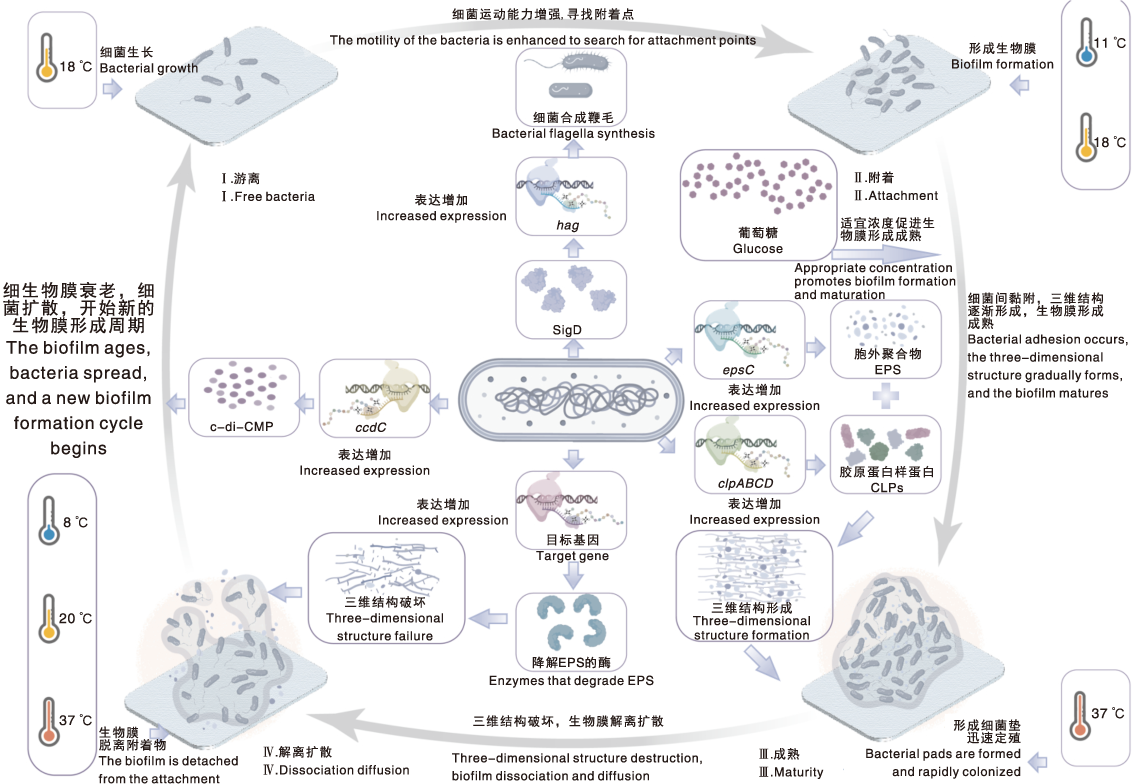
图1 基因与环境因素对芽孢杆菌生物膜形成的影响
Fig.1 Influence of genes and environment on the biofilm formation of Bacillus spp.
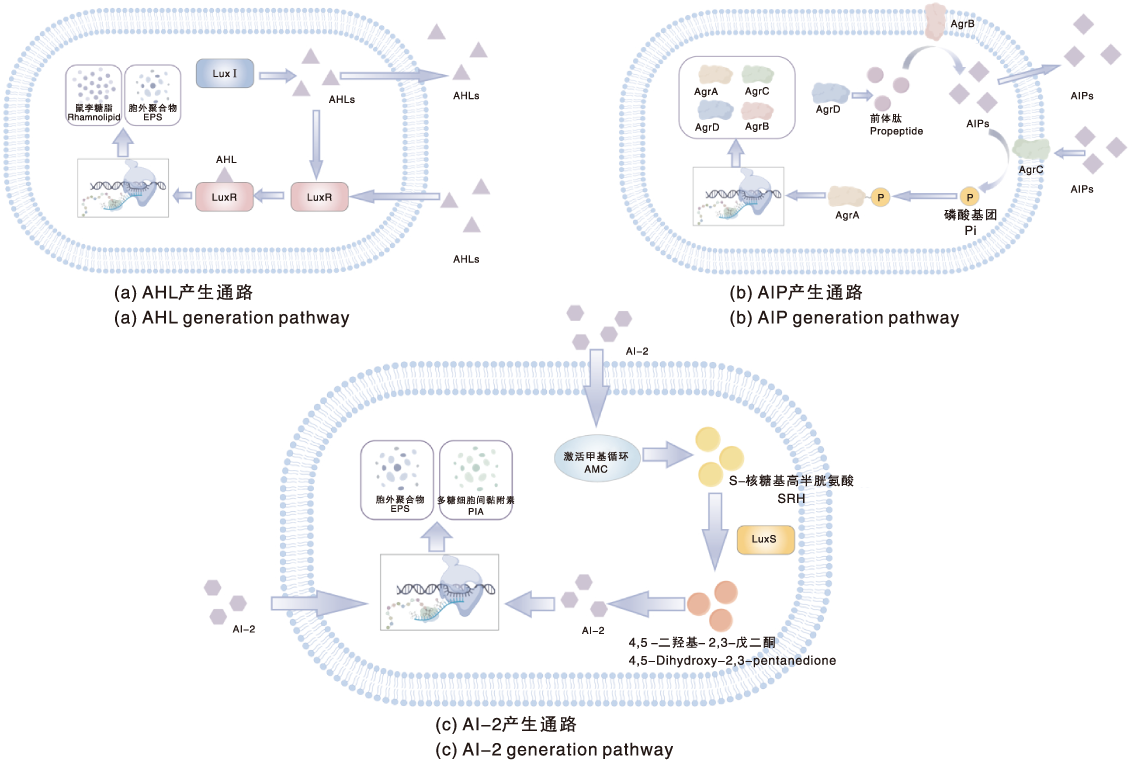
图2 群体感应信号分子的产生通路 AHL, 酰基高丝氨酸内酯;AIP,自诱导肽;AI-2,自诱导物-2。
Fig.2 The generation pathway of quorum sensing signal molecules AHL, Acyl homoserine lactone; AIP, Autoinducing peptide; AI-2,Autoinducer-2.
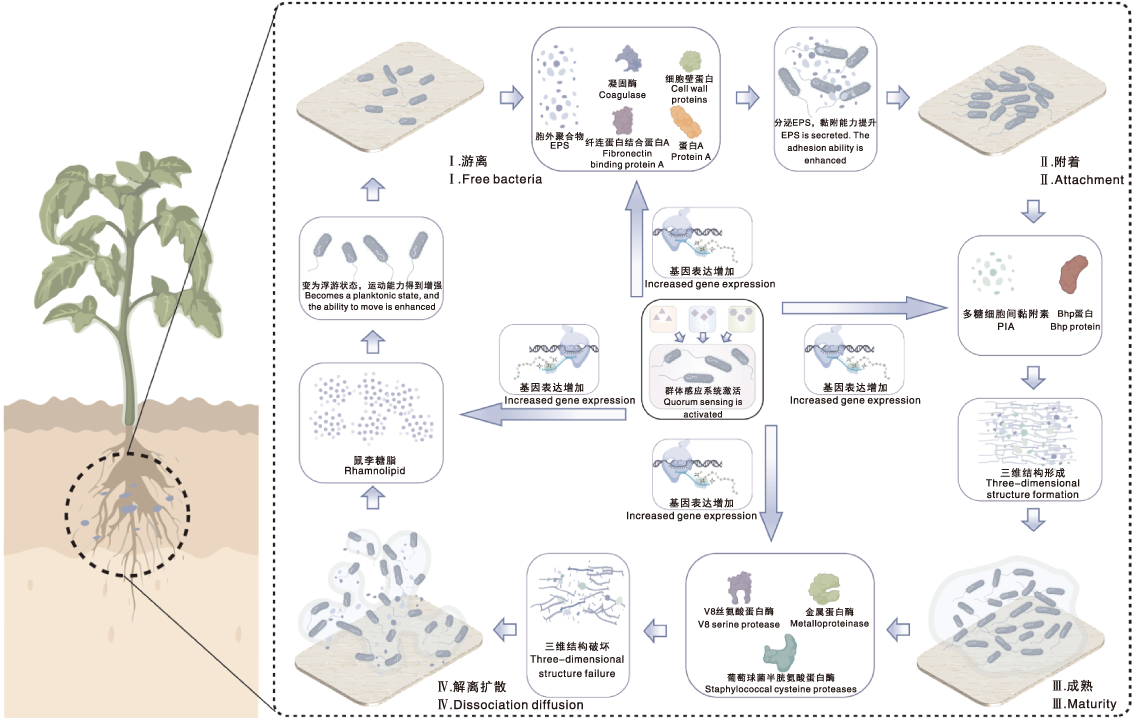
图3 群体感应系统调控细菌在植物根际的定殖
Fig.3 The quorum sensing system regulates the colonization of bacteria in the plant rhizosphere
| [1] | FAN B, WANG C, SONG X F, et al. Bacillus velezensis FZB42 in 2018: the Gram-positive model strain for plant growth promotion and biocontrol[J]. Frontiers in Microbiology, 2018, 9: 2491. |
| [2] | XU Z H, ZHANG H H, SUN X L, et al. Bacillus velezensis wall teichoic acids are required for biofilm formation and root colonization[J]. Applied and Environmental Microbiology, 2019, 85(5): e02116. |
| [3] | KALAMARA M, SPACAPAN M, MANDIC-MULEC I, et al. Social behaviours by Bacillus subtilis: quorum sensing, kin discrimination and beyond[J]. Molecular Microbiology, 2018, 110(6): 863-878. |
| [4] | SINGH A, CHAUHAN P S. N-acyl homoserine lactone mediated quorum sensing exhibiting plant growth-promoting and abiotic stress tolerant bacteria demonstrates drought stress amelioration[J]. Journal of Pure and Applied Microbiology, 2022, 16(1): 669-684. |
| [5] | WILLIAMS P. Quorum sensing, communication and cross-kingdom signalling in the bacterial world[J]. Microbiology, 2007, 153(12): 3923-3938. |
| [6] | HALL-STOODLEY L, COSTERTON J W, STOODLEY P. Bacterial biofilms: from the natural environment to infectious diseases[J]. Nature Reviews Microbiology, 2004, 2(2): 95-108. |
| [7] | SHAO L, SHEN Z Z, LI M J, et al. ccdC regulates biofilm dispersal in Bacillus velezensis FZB42[J]. International Journal of Molecular Sciences, 2024, 25(10): 5201. |
| [8] | ZHAO X, WANG Y, SHANG Q H, et al. Collagen-like proteins (ClpA, ClpB, ClpC, and ClpD) are required for biofilm formation and adhesion to plant roots by Bacillus amyloliquefaciens FZB42[J]. PLoS One, 2015, 10(2): e0117414. |
| [9] | FAN B, LI Y L, MARIAPPAN A, et al. New SigD-regulated genes identified in the rhizobacterium Bacillus amyloliquefaciens FZB42[J]. Biology Open, 2016, 5(12): 1776-1783. |
| [10] | LU X, LIU S F, YUE L, et al. Epsc involved in the encoding of exopolysaccharides produced by Bacillus amyloliquefaciens FZB42 act to boost the drought tolerance of Arabidopsis thaliana[J]. International Journal of Molecular Sciences, 2018, 19(12): 3795. |
| [11] | CÁMARA-ALMIRÓN J, DOMÍNGUEZ-GARCÍA L, EL MAMMERI N, et al. Molecular characterization of the N-terminal half of TasA during amyloid-like assembly and its contribution to Bacillus subtilis biofilm formation[J]. npj Biofilms and Microbiomes, 2023, 9: 68. |
| [12] | XIONG Q, LIU D, ZHANG H H, et al. Quorum sensing signal autoinducer-2 promotes root colonization of Bacillus velezensis SQR9 by affecting biofilm formation and motility[J]. Applied Microbiology and Biotechnology, 2020, 104(16): 7177-7185. |
| [13] | CHAVANT P, MARTINIE B, MEYLHEUC T, et al. Listeria monocytogenes LO28: surface physicochemical properties and ability to form biofilms at different temperatures and growth phases[J]. Applied and Environmental Microbiology, 2002, 68(2): 728-737. |
| [14] | BURMAN E, BENGTSSON-PALME J. Microbial community interactions are sensitive to small changes in temperature[J]. Frontiers in Microbiology, 2021, 12: 672910. |
| [15] | RAMLI N S K, ENG GUAN C, NATHAN S, et al. The effect of environmental conditions on biofilm formation of Burkholderia pseudomallei clinical isolates[J]. PLoS One, 2012, 7(9): e44104. |
| [16] | ZHU X J, XIANG Q Y, CHEN L, et al. Engineered Bacillus subtilis biofilm@biochar living materials for in-situ sensing and bioremediation of heavy metal ions pollution[J]. Journal of Hazardous Materials, 2024, 465: 133119. |
| [17] | PAN X, LIU J, ZHANG D, et al. A comparison of five extraction methods for extracellular polymeric substances (EPS) from biofilm by using three-dimensional excitation-emission matrix (3DEEM) fluorescence spectroscopy[J]. Water SA, 2010, 36(1): 111-116. |
| [18] | FAN B, CHEN X H, BUDIHARJO A, et al. Efficient colonization of plant roots by the plant growth promoting bacterium Bacillus amyloliquefaciens FZB42, engineered to express green fluorescent protein[J]. Journal of Biotechnology, 2011, 151(4): 303-311. |
| [19] | WATERS C M, BASSLER B L. Quorum sensing: cell-to-cell communication in bacteria[J]. Annual Review of Cell and Developmental Biology, 2005, 21: 319-346. |
| [20] | SAHREEN S, MUKHTAR H, IMRE K, et al. Exploring the function of quorum sensing regulated biofilms in biological wastewater treatment: a review[J]. International Journal of Molecular Sciences, 2022, 23(17): 9751. |
| [21] | LIU Y P, XU Z H, CHEN L, et al. Root colonization by beneficial rhizobacteria[J]. FEMS Microbiology Reviews, 2024, 48(1): fuad066. |
| [22] | XU Z H, LIU Y P, ZHANG N, et al. Chemical communication in plant-microbe beneficial interactions: a toolbox for precise management of beneficial microbes[J]. Current Opinion in Microbiology, 2023, 72: 102269. |
| [23] | WATSON W T, MINOGUE T D, VAL D L, et al. Structural basis and specificity of acyl-homoserine lactone signal production in bacterial quorum sensing[J]. Molecular Cell, 2002, 9(3): 685-694. |
| [24] | WILLIAMS P, WINZER K, CHAN W C, et al. Look who’s talking: communication and quorum sensing in the bacterial world[J]. Philosophical Transactions of the Royal Society of London Series B, Biological Sciences, 2007, 362(1483): 1119-1134. |
| [25] | WANG J F, LIU Q J, WU B, et al. Quorum sensing signaling distribution during the development of full-scale municipal wastewater treatment biofilms[J]. Science of the Total Environment, 2019, 685: 28-36. |
| [26] | BLUS-KADOSH I, ZILKA A, YERUSHALMI G, et al. The effect of pstS and phoB on quorum sensing and swarming motility in Pseudomonas aeruginosa[J]. PLoS One, 2013, 8(9): e74444. |
| [27] | NOVICK R P. Autoinduction and signal transduction in the regulation of staphylococcal virulence[J]. Molecular Microbiology, 2003, 48(6): 1429-1449. |
| [28] | BOLES B R, HORSWILL A R. agr-mediated dispersal of Staphylococcus aureus biofilms[J]. PLoS Pathogens, 2008, 4(4): e1000052. |
| [29] | WILLIAMS P, HILL P, BONEV B, et al. Quorum-sensing, intra- and inter-species competition in the staphylococci[J]. Microbiology, 2023, 169(8): 001381. |
| [30] | BARRAZA I, PAJON C, DIAZ-TANG G, et al. Disturbing the spatial organization of biofilm communities affects expression of agr-regulated virulence factors in Staphylococcus aureus[J]. Applied and Environmental Microbiology, 2023, 89(2): e01932. |
| [31] | TUON F F, SUSS P H, TELLES J P, et al. Antimicrobial treatment of Staphylococcus aureus biofilms[J]. Antibiotics, 2023, 12(1): 87. |
| [32] | LISTER J L, HORSWILL A R. Staphylococcus aureus biofilms: recent developments in biofilm dispersal[J]. Frontiers in Cellular and Infection Microbiology, 2014, 4: 178. |
| [33] | HAN H, ZHANG K J, LI G X, et al. Autoinducer-2: its role in biofilm formation and L-threonine production in Escherichia coli[J]. Fermentation, 2023, 9(10): 916. |
| [34] | GU Y, TIAN J J, ZHANG Y, et al. Dissecting signal molecule AI-2 mediated biofilm formation and environmental tolerance in Lactobacillus plantarum[J]. Journal of Bioscience and Bioengineering, 2021, 131(2): 153-160. |
| [35] | XUE T, NI J T, SHANG F, et al. Autoinducer-2 increases biofilm formation via an Ica- and bhp-dependent manner in Staphylococcus epidermidis RP62A[J]. Microbes and Infection, 2015, 17(5): 345-352. |
| [36] | LI H D, LI X Y, WANG Z L, et al. Autoinducer-2 regulates Pseudomonas aeruginosa PAO1 biofilm formation and virulence production in a dose-dependent manner[J]. BMC Microbiology, 2015, 15(1): 192. |
| [37] | AUGER S, KRIN E, AYMERICH S, et al. Autoinducer 2 affects biofilm formation by Bacillus cereus[J]. Applied and Environmental Microbiology, 2006, 72(1): 937-941. |
| [38] | TSOTETSI T, NEPHALI L, MALEBE M, et al. Bacillus for plant growth promotion and stress resilience: what have we learned[J]. Plants, 2022, 11(19): 2482. |
| [39] | JUNG B K, IBAL J C, PHAM H Q, et al. Quorum sensing system affects the plant growth promotion traits of Serratia fonticola GS2[J]. Frontiers in Microbiology, 2020, 11: 536865. |
| [40] | ZÚÑIGA A, DE LA FUENTE F, FEDERICI F, et al. An engineered device for indoleacetic acid production under quorum sensing signals enables Cupriavidus pinatubonensis JMP134 to stimulate plant growth[J]. ACS Synthetic Biology, 2018, 7(6): 1519-1527. |
| [41] | KALIA V C, GONG C J, PATEL S K S, et al. Regulation of plant mineral nutrition by signal molecules[J]. Microorganisms, 2021, 9(4): 774. |
| [42] | WEN J H, ZHAO X Y, SI F M, et al. Surfactin, a quorum sensing signal molecule, globally affects the carbon metabolism in Bacillus amyloliquefaciens[J]. Metabolic Engineering Communications, 2021, 12: e00174. |
| [43] | HARTMANN A, KLINK S, ROTHBALLER M. Plant growth promotion and induction of systemic tolerance to drought and salt stress of plants by quorum sensing auto-inducers of the N-acyl-homoserine lactone type: recent developments[J]. Frontiers in Plant Science, 2021, 12: 683546. |
| [44] | NAWAZ M S, ARSHAD A, RAJPUT L, et al. Growth-stimulatory effect of quorum sensing signal molecule N-acyl-homoserine lactone-producing multi-trait Aeromonas spp. on wheat genotypes under salt stress[J]. Frontiers in Microbiology, 2020, 11: 553621. |
| [45] | RABBEE M F, ALI M S, CHOI J, et al. Bacillus velezensis: a valuable member of bioactive molecules within plant microbiomes[J]. Molecules, 2019, 24(6): 1046. |
| [46] | CHOWDHURY S P, UHL J, GROSCH R, et al. Cyclic lipopeptides of Bacillus amyloliquefaciens subsp. plantarum colonizing the lettuce rhizosphere enhance plant defense responses toward the bottom rot pathogen Rhizoctonia solani[J]. Molecular Plant-Microbe Interactions, 2015, 28(9): 984-995. |
| [47] | CHEN Y, YAN F, CHAI Y R, et al. Biocontrol of tomato wilt disease by Bacillus subtilis isolates from natural environments depends on conserved genes mediating biofilm formation[J]. Environmental Microbiology, 2013, 15(3): 848-864. |
| [48] | ZERIOUH H, DE VICENTE A, PÉREZ-GARCÍA A, et al. Surfactin triggers biofilm formation of Bacillus subtilis in melon phylloplane and contributes to the biocontrol activity[J]. Environmental Microbiology, 2014, 16(7): 2196-2211. |
| [49] | JIN P F, CHU L L, XUAN Z, et al. Bacillus velezensis, a new valuable source of bioactive molecules within plant microbiomes and natural weapons for the biocontrol of plant pathogens[J]. Tropical Plants, 2025, 4(1): e001. |
| [50] | ORTIZ A, VACA J, SANSINENEA E, et al. Bacillus subtilis species complex: secondary metabolites, genomic insights, and metabolite-driven strategies for sustainable agriculture[J]. Journal of Environmental Chemical Engineering, 2026, 14(1): 120631. |
| [51] | VASQUES N C, NOGUEIRA M A, HUNGRIA M. Increasing application of multifunctional Bacillus for biocontrol of pests and diseases and plant growth promotion: lessons from Brazil[J]. Agronomy, 2024, 14(8): 1654. |
| [52] | KESHMIRSHEKAN A, DE SOUZA MESQUITA L M, VENTURA S P M. Biocontrol manufacturing and agricultural applications of Bacillus velezensis[J]. Trends in Biotechnology, 2024, 42(8): 986-1001. |
| [53] | CAO X, WANG X, CHEN R, et al. Improving Bacillus subtilis as biological chassis performance by the CRISPR genetic toolkit[J]. ACS Synthetic Biology, 2025, 14(3): 677-688. |
| [54] | CHEN Y, LI M, YAN M, et al. Bacillus subtilis: current and future modification strategies as a protein secreting factory[J]. World Journal of Microbiology and Biotechnology, 2024, 40(6). |
| [55] | LIU Z Y, YU X Z. Engineering Bacillus subtilis for high-value bioproduction: recent advances and applications[J]. Microbial Cell Factories, 2025, 24(1). |
| [56] | ZHAO N, HUANG X, LIU Z, et al. Probiotic characterization of Bacillus smithii: research advances, concerns, and prospective trends[J]. Comprehensive Reviews in Food Science and Food Safety, 2024, 23(2). |
| [57] | CHELLIAH R, KIM N H, RUBAB M, et al. Robust and safe: unveiling Bacillus clausii OHRC1’s potential as a versatile probiotic for enhanced food quality and safety[J]. LWT-Food Science and Technology, 2024, 203(1): 116291. |
| [58] | ARSOV A, ARMENOVA N, GERGOV E, et al. Cloning systems in Bacillus: bioengineering of metabolic pathways for valuable recombinant products[J]. Fermentation, 2024, 10(1): 50. |
| [59] | HU Y, CHEN Y, XIE Z X, et al. Research and development progress and application challenges of bacterial biocontrol agents[J]. Frontiers in Agriculture, 2025, 2(1): 1-8. |
| [60] | WANG J W, PENG Y L, XIE S S, et al. Biocontrol and molecular characterization of Bacillus velezensis D against tobacco bacterial wilt[J]. Phytopathology Research, 2023, 5(1): 50. |
| [1] | 王婷, 范宇鑫, 王惠, 杜荆山, 石秋环, 王玉洁, 申洪涛, 王艳芳, 奚家勤, 刘领. 甲基营养型芽孢杆菌对初烤微带青烟叶化学成分含量及协调性的影响[J]. 浙江农业学报, 2025, 37(9): 1969-1980. |
| [2] | 黄贤克, 黄晓林, 张翔, 李敏, 蔡逸龙, 陈然. 牡蛎壳对凡纳对虾生长性能和水质的作用效果及其表面菌群特征[J]. 浙江农业学报, 2025, 37(7): 1441-1450. |
| [3] | 周航, 贾涛, 方蒋平, 杨永锋, 余洋洋, 裘垚, 陈思原, 冯魏, 张静远, 陈红丽. 烟叶霉变病拮抗菌的筛选、鉴定、培养条件优化及其防治效果研究[J]. 浙江农业学报, 2025, 37(7): 1481-1491. |
| [4] | 吴佳奇, 朱学明, 鲍坚东, 王操屹, 周肖瑜, 李琳, 林福呈. 稻瘟病生物防治研究进展[J]. 浙江农业学报, 2025, 37(3): 736-744. |
| [5] | 高强, 王丽丽, 张渐隆, 杨波, 李峰, 朱先志, 刘爱新, 韩超, 田雷. 高地芽孢杆菌CY1的分离鉴定及其对烟草黑胫病的防治作用[J]. 浙江农业学报, 2025, 37(2): 405-416. |
| [6] | 杨学宇, 牛丽, 谭琳, 邓玉莲, 包强, 胡秋龙. 枯草芽孢杆菌沙漠亚种kc-16培养条件的优化[J]. 浙江农业学报, 2025, 37(12): 2563-2573. |
| [7] | 宋鹏, 李理想, 江厚龙, 王茹, 李慧, 赵鹏宇, 张均, 秦平伟, 任江波, 陈庆明. 施用侧孢短芽孢杆菌对烤后烟叶钾含量及烟株生理特征的影响[J]. 浙江农业学报, 2024, 36(3): 494-502. |
| [8] | 吴筱萌, 徐悦, 程鸿浩, 陈诗燕, 周夏芝, 邹运鼎, 毕守东. 六种茶园茶尺蠖与其蜘蛛类天敌的空间和数量关系[J]. 浙江农业学报, 2023, 35(6): 1349-1359. |
| [9] | 杨凯, 陈凯, 李红梅, 赵忠娟, 扈进冬, 李纪顺, 杨合同. 哈茨木霉LTR-2与产脲节杆菌DnL1-1协同对小麦茎基腐病的防治效果与机理[J]. 浙江农业学报, 2023, 35(6): 1385-1395. |
| [10] | 黄婉媛, 李彩斌, 彭宇, 李章海, 黄衍章, 丁婷. 烟草根黑腐病拮抗菌的分离鉴定和生防作用特性研究[J]. 浙江农业学报, 2023, 35(4): 873-883. |
| [11] | 何宇, 吕卫光, 李双喜, 郑宪清, 张翰林, 张娟琴, 张海韵, 白娜玲, 刘善良. γ-聚谷氨酸发酵液对小白菜生长及氮磷肥料利用率的影响[J]. 浙江农业学报, 2023, 35(2): 329-337. |
| [12] | 张喜闻, 郭晓农, 王泽兴, 王亚玲. 不同复合益生菌对藜麦秸秆发酵饲料的发酵工艺优化[J]. 浙江农业学报, 2023, 35(12): 2818-2829. |
| [13] | 王晓楠, 冯晓晓, 施斌, 陈恩磊, 陈梦丽, 郑永利, 吴慧明. 内生细菌ZN-S10的鉴定及其对番茄青枯病菌的抑菌作用[J]. 浙江农业学报, 2023, 35(11): 2636-2644. |
| [14] | 黄东慧, 钟鹏, 王建丽, 胡云龙, 王志刚. 环境条件对Bacillus altitudinis LZP02生物膜形成的影响[J]. 浙江农业学报, 2022, 34(7): 1466-1473. |
| [15] | 李丽艳, 谭海霞, 李婧, 王连龙, 杜迎辉, 徐志文. 耐盐促生芽孢杆菌的筛选及其对盐胁迫下燕麦生长的影响[J]. 浙江农业学报, 2022, 34(6): 1268-1276. |
| 阅读次数 | ||||||
|
全文 |
|
|||||
|
摘要 |
|
|||||

