浙江农业学报 ›› 2025, Vol. 37 ›› Issue (12): 2494-2503.DOI: 10.3969/j.issn.1004-1524.20250359

• 动物科学 • 上一篇    下一篇

浙江省5株H9N2亚型禽流感病毒的血凝素基因分子特征与遗传进化分析

刘士哲1,2(), 华炯钢2, 陈柳2, 谢荣辉3, 叶伟成2, 张传亮3, 朱寅初2, 冯肖肖3, 付媛2, 倪征2, 张存2, 屈勇刚1,*(), 云涛2,*()   

  1. 1.石河子大学 动物科技学院,新疆 石河子 832003
    2.浙江省农业科学院 畜牧兽医研究所,全省畜禽生物育种重点实验室,农业农村部畜禽资源(家禽)评价利用重点实验室,家禽种业与绿色养殖技术浙江省工程研究中心,浙江 杭州 310021
    3.浙江省动物疫病预防控制中心,浙江 杭州 311199
  • 收稿日期:2025-05-06 出版日期:2025-12-25 发布日期:2026-01-09
  • 作者简介:刘士哲(2000—),男,湖北荆门人,硕士研究生,主要从事畜禽疾病防控研究。E-mail:zheshiliu@163.com
  • 通讯作者: *云涛,E-mail:yunt116@zaas.ac.cn;屈勇刚,E-mail:quyonggang@shzu.edu
  • 基金资助:
    浙江省“三农九方”科技协作计划(2023SNJF059);浙江省农业重大技术协同推广计划(2025ZDXT17-04);新疆维吾尔自治区家禽产业技术体系项目(XJARS-12-07);新疆维吾尔自治区家禽产业技术体系项目(2025xjjq-z-03)

Molecular characterization and genetic evolutionary analysis of hemagglutinin gene of five H9N2 subtype avian influenza viruses in Zhejiang Province, China

LIU Shizhe1,2(), HUA Jionggang2, CHEN Liu2, XIE Ronghui3, YE Weicheng2, ZHANG Chuanliang3, ZHU Yinchu2, FENG Xiaoxiao3, FU Yuan2, NI Zheng2, ZHANG Cun2, QU Yonggang1,*(), YUN Tao2,*()   

  1. 1. College of Animal Science and Technology, Shihezi University, Shihezi 832003, Xinjiang, China
    2. Zhejiang Key Laboratory of Livestock and Poultry Biotech Breeding, Key Laboratory of Livestock and Poultry Resources (Poultry) Evaluation and Utilization, Ministry of Agriculture and Rural Affairs, Zhejiang Engineering Research Center for Poultry Breeding Industry and Green Farming Technology, Institute of Animal Husbandry and Veterinary Sciences, Zhejiang Academy of Agricultural Sciences, Hangzhou 310021, China
    3. Zhejiang Center of Animal Disease Control and Prevention, Hangzhou 311199, China
  • Received:2025-05-06 Online:2025-12-25 Published:2026-01-09

摘要:

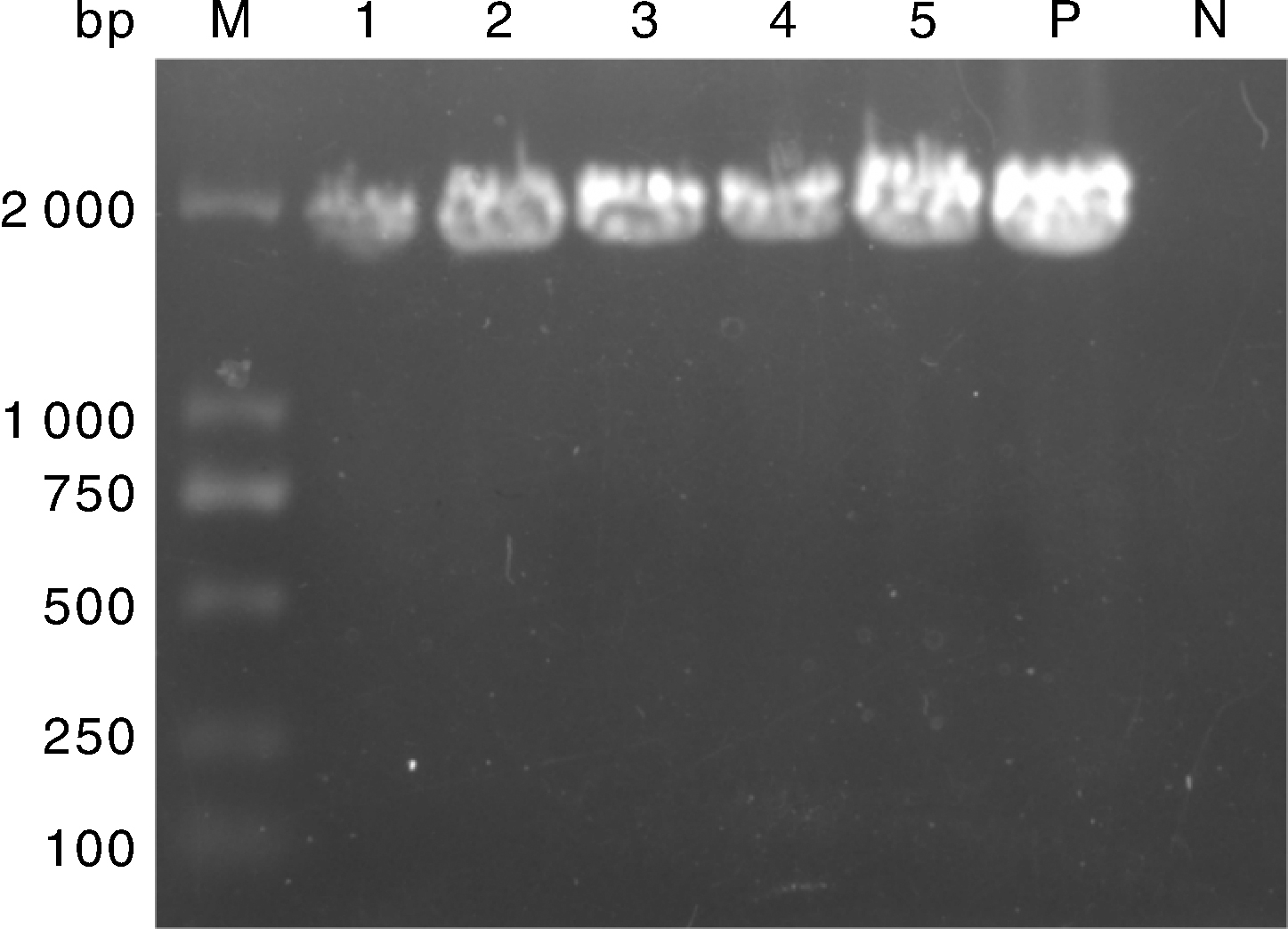
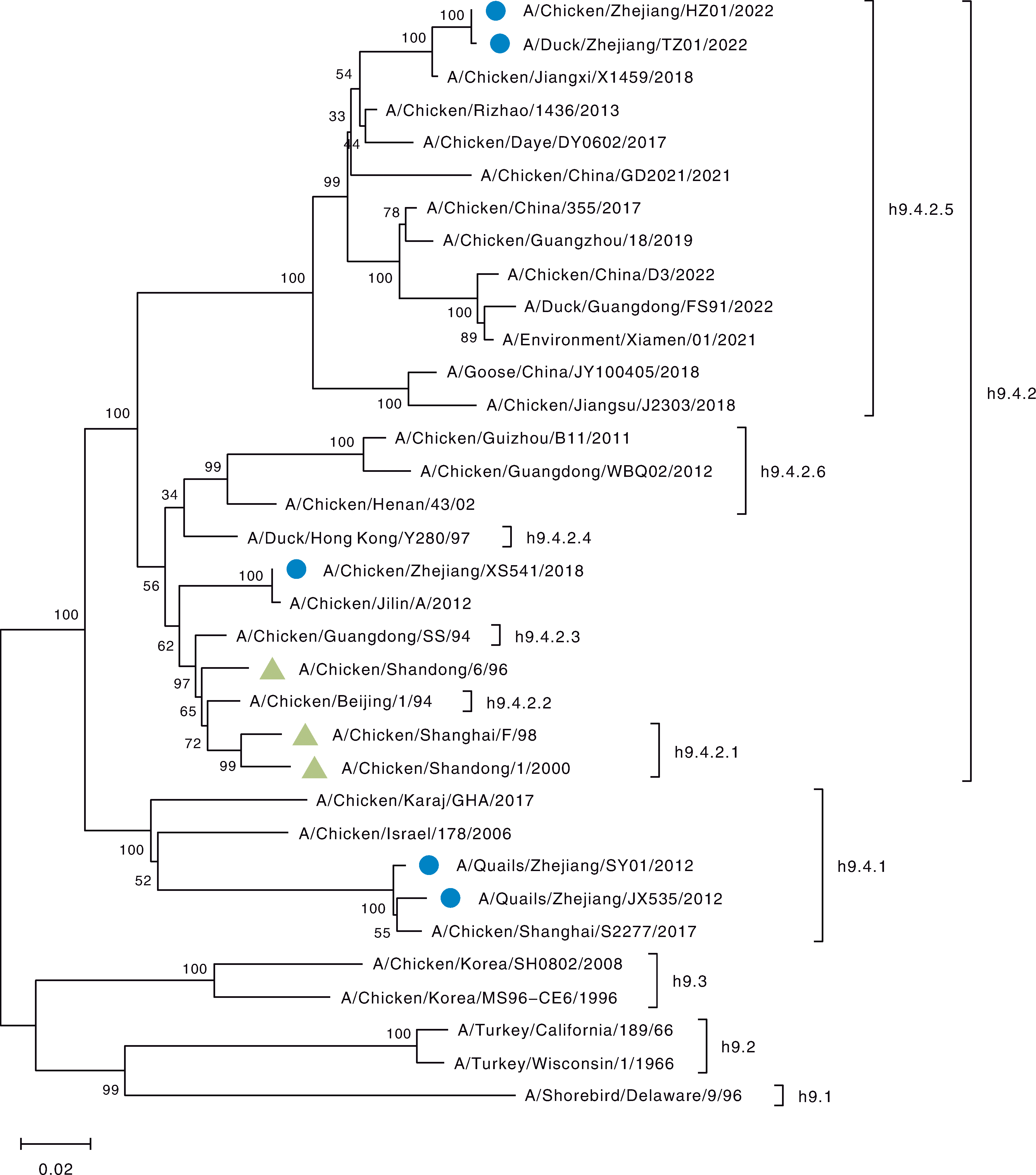
H9N2亚型禽流感病毒(avian influenza virus, AIV)是我国禽类中最流行的低致病性禽流感(LPAIV),因其持续的抗原漂移与跨物种传播风险对养殖业和公共卫生安全构成严重威胁。为了解浙江省流行的H9N2亚型AIV的遗传进化特征,本研究对当地分离到的5株H9N2亚型AIV毒株的血凝素(HA)基因进行测序与分子特征分析。结果显示,5株分离株分属于欧亚谱系的h9.4.2.1和h9.4.2.5分支,HA基因的核苷酸和氨基酸同源性分别为83.51%~99.88%和86.33%~99.83%。值得注意的是,分离株A/Chicken/Zhejiang/HZ01/2022和A/Duck/Zhejiang/TZ01/2022与疫苗株CK/SS/94的HA基因核苷酸同源性仅为88.24%~88.35%,氨基酸同源性为89.43%~90.82%。所有分离株的HA裂解位点均呈单碱性氨基酸特征,符合低致病性病毒特性。受体结合位点分析发现存在I163T、H191N、A198T/V、Q234L和Q235M突变,这些突变可能增强病毒与人源唾液酸α-2,6-半乳糖受体的结合能力。糖基化位点分析显示,分离株存在7~8个潜在糖基化位点,其中218和551位点缺失,206和313位点增加,这些变异可能增强病毒对哺乳动物宿主的适应性。此外,HA蛋白抗原位点存在234、285和334位点突变,而181、280、281与296位点高度保守。研究表明,浙江省H9N2亚型AIV通过关键位点突变和糖基化模式改变持续进化,可能导致病毒毒力增强、疫苗保护效力下降,并增加跨物种传播风险。亟须加强本地流行毒株的分子监测,优化疫苗株匹配性,以提升防控效能并降低公共卫生威胁。

关键词: 禽流感病毒, H9N2亚型, HA基因, 遗传进化, 基因分析

Abstract:

Avian influenza virus (AIV) subtype H9N2 is the most prevalent low pathogenic avian influenza (LPAIV) in avian species in China, posing a serious threat to the farming industry and public health safety due to its persistent antigenic drift and the risk of cross-species transmission. In order to understand the genetic evolutionary characteristics of H9N2 subtype AIV prevalent in Zhejiang Province, the present study was conducted to determine the gene sequence and molecular characterization of the hemagglutinin (HA) gene of five locally isolated H9N2 subtype AIV strains. The results showed that the five isolates belonged to the h9.4.2.1 and h9.4.2.5 branches of the Eurasian lineage, and the nucleotide and amino acid homologies of the HA gene ranged from 83.51% to 99.88% and 86.33% to 99.83%, respectively. Notably, the isolates A/Chicken/Zhejiang/HZ01/2022 and A/Duck/Zhejiang/TZ01/2022 showed only 88.24%-88.35% nucleotide homology and 89.43%-90.82% amino acid homology of HA gene with the vaccine strain CK/SS/94. The HA cleavage sites of all isolates were characterized by single basic amino acid, which was consistent with the characteristics of low pathogenicity virus. Receptor binding site analysis revealed mutations I163T, H191N, A198T/V, Q234L, and Q235M, which might enhance the binding ability of the virus to the human sialic acid α-2,6-galactose receptor. Glycosylation site analysis revealed the presence of 7-8 potential glycosylation sites in the isolates, with deletions at sites 218 and 551 and additions at sites 206 and 313, and these mutations may enhance viral adaptation to mammalian hosts. In addition, HA protein antigenic sites were present with mutations at 234, 285 and 334, while sites 181, 280, 281 and 296 were highly conserved. The study suggests that Zhejiang Province H9N2 subtype AIV continues to evolve through mutations at key sites and altered glycosylation patterns, which may lead to enhanced virulence, decreased vaccine protection efficacy, and increased risk of cross-species transmission. There is an urgent need to strengthen the molecular surveillance of local endemic strains and optimize the vaccine strain match to enhance the control efficacy and reduce the public health threat.

Key words: Avian influenza virus, H9N2 subtype, HA gene, genetic evolution, genetic analysis

中图分类号: