Acta Agriculturae Zhejiangensis ›› 2026, Vol. 38 ›› Issue (4): 755-768.DOI: 10.3969/j.issn.1004-1524.20250325
• Food Science • Previous Articles Next Articles
Geographic origin variation of blueberry raw materials and their processing suitability
YE Shenyi1,2( ), SHEN Chaoyi2, NIU Ben2, LIU Ruiling2, FANG Xiangjun2, CHEN Huizhi2, CHEN Hangjun2, WU Weijie3,*(), GAO Haiyan2,*()
- 1
College of Life Sciences ,Zhejiang Normal University Jinhua 321004, China
2Key Laboratory of Post-harvest Handling of Fruits, Ministry of Agriculture and Rural Affairs, Key Laboratory of Postharvest Preservation and Processing of Vegetables, Ministry of Agriculture and Rural Affairs (Jointly Built by Ministry and Province, Key Laboratory of Postharvest Preservation and Processing of Fruits and Vegetables, China National Light Industry, Institute of Food Science, Zhejiang Academy of Agricultural Sciences Hangzhou 310021, China
3State Key Laboratory for Quality and Safety of Agro-Products Hangzhou 310021, China
-
Received:2025-04-22Online:2026-04-25Published:2026-05-08 -
Contact:WU Weijie,GAO Haiyan

CLC Number:
Cite this article
YE Shenyi, SHEN Chaoyi, NIU Ben, LIU Ruiling, FANG Xiangjun, CHEN Huizhi, CHEN Hangjun, WU Weijie, GAO Haiyan. Geographic origin variation of blueberry raw materials and their processing suitability[J]. Acta Agriculturae Zhejiangensis, 2026, 38(4): 755-768.
share this article
Add to citation manager EndNote|Ris|BibTeX
URL: http://www.zjnyxb.cn/EN/10.3969/j.issn.1004-1524.20250325
| 项目 Items | 评分依据 Scoring basis | 评分标准 Scoring criteria |
|---|---|---|
| 组织形态(25分) Texture (25 score) | 果脯形态完整,皱缩程度适中;果酱黏稠不流散,不析水且无杂质;果汁液体均匀无沉淀 Preserved fruit: intact shape, moderate shrinkage; jam: thick, no separation or impurities; juice: uniform, no sediment | 15~25 |
| 果脯形态较完整,略有皱缩;果酱黏稠程度中等,析水程度及杂质较少;果汁液体均匀, 有少许沉淀 Preserved fruit: mostly intact, slight shrinkage; jam: moderately thick, slight separation or impurities; juice: mostly uniform, slight sediment | 5~14 | |
| 果脯形态不完整或残缺,皱缩严重;果酱分层且析水较多;果汁液体有分层或沉淀情况产生 Preserved fruit: broken/severe shrinkage; jam: watery, noticeable separation; juice: layered or significant sediment | 0~4 | |
| 色泽(25分) Color(25 score) | 果脯色泽深蓝紫色,表面鲜亮有光泽感;果酱呈深蓝紫色,鲜亮光泽;果汁类深红色,色泽鲜亮 Preserved fruit: deep blue-purple color, bright and glossy surface; jam: deep blue-purple, vivid and shiny; juice: deep red, bright color | 15~25 |
| 果脯色泽较深,光泽中等;果酱色泽和光泽中等;果汁亮红色,色泽较亮 Preserved fruit: relatively dark color, moderate gloss; jam: medium color and gloss; juice: bright red, relatively vivid color | 5~14 | |
| 果脯色泽浅且暗淡,无光泽;果酱色泽发暗或发灰,无光泽;果汁红色,色泽暗淡 Preserved fruit: pale and dull color, no gloss; jam: dark or grayish color, no gloss; juice: red, dull color | 0~4 | |
| 气味(25分) | 有明显蓝莓特有香味,且气味纯正Distinct pure blueberry aroma | 15~25 |
| Aroma(25 score) | 蓝莓特有香气较明显Moderate blueberry aroma | 5~14 |
| 蓝莓特有气味不明显或有明显怪味Faint blueberry aroma or noticeable off-flavor | 0~4 | |
| 口感(25分) Taste(25 score) | 果脯和果酱酸甜可口,有果肉感;果汁口感顺滑细腻,酸甜适中 Preserved fruit and jam: balanced sweet-sour taste with good fruit pulp texture; juice: smooth, fine texture with well-balanced sweetness and acidity | 15~25 |
| 口感中等,稍偏酸或偏甜Slightly skewed sweetness or sourness | 5~14 | |
| 口味过淡或不适,较明显偏酸或偏甜Bland or unpleasant taste; pronounced imbalance | 0~4 |
Table 1 Sensory evaluation criteria for blueberry products
| 项目 Items | 评分依据 Scoring basis | 评分标准 Scoring criteria |
|---|---|---|
| 组织形态(25分) Texture (25 score) | 果脯形态完整,皱缩程度适中;果酱黏稠不流散,不析水且无杂质;果汁液体均匀无沉淀 Preserved fruit: intact shape, moderate shrinkage; jam: thick, no separation or impurities; juice: uniform, no sediment | 15~25 |
| 果脯形态较完整,略有皱缩;果酱黏稠程度中等,析水程度及杂质较少;果汁液体均匀, 有少许沉淀 Preserved fruit: mostly intact, slight shrinkage; jam: moderately thick, slight separation or impurities; juice: mostly uniform, slight sediment | 5~14 | |
| 果脯形态不完整或残缺,皱缩严重;果酱分层且析水较多;果汁液体有分层或沉淀情况产生 Preserved fruit: broken/severe shrinkage; jam: watery, noticeable separation; juice: layered or significant sediment | 0~4 | |
| 色泽(25分) Color(25 score) | 果脯色泽深蓝紫色,表面鲜亮有光泽感;果酱呈深蓝紫色,鲜亮光泽;果汁类深红色,色泽鲜亮 Preserved fruit: deep blue-purple color, bright and glossy surface; jam: deep blue-purple, vivid and shiny; juice: deep red, bright color | 15~25 |
| 果脯色泽较深,光泽中等;果酱色泽和光泽中等;果汁亮红色,色泽较亮 Preserved fruit: relatively dark color, moderate gloss; jam: medium color and gloss; juice: bright red, relatively vivid color | 5~14 | |
| 果脯色泽浅且暗淡,无光泽;果酱色泽发暗或发灰,无光泽;果汁红色,色泽暗淡 Preserved fruit: pale and dull color, no gloss; jam: dark or grayish color, no gloss; juice: red, dull color | 0~4 | |
| 气味(25分) | 有明显蓝莓特有香味,且气味纯正Distinct pure blueberry aroma | 15~25 |
| Aroma(25 score) | 蓝莓特有香气较明显Moderate blueberry aroma | 5~14 |
| 蓝莓特有气味不明显或有明显怪味Faint blueberry aroma or noticeable off-flavor | 0~4 | |
| 口感(25分) Taste(25 score) | 果脯和果酱酸甜可口,有果肉感;果汁口感顺滑细腻,酸甜适中 Preserved fruit and jam: balanced sweet-sour taste with good fruit pulp texture; juice: smooth, fine texture with well-balanced sweetness and acidity | 15~25 |
| 口感中等,稍偏酸或偏甜Slightly skewed sweetness or sourness | 5~14 | |
| 口味过淡或不适,较明显偏酸或偏甜Bland or unpleasant taste; pronounced imbalance | 0~4 |
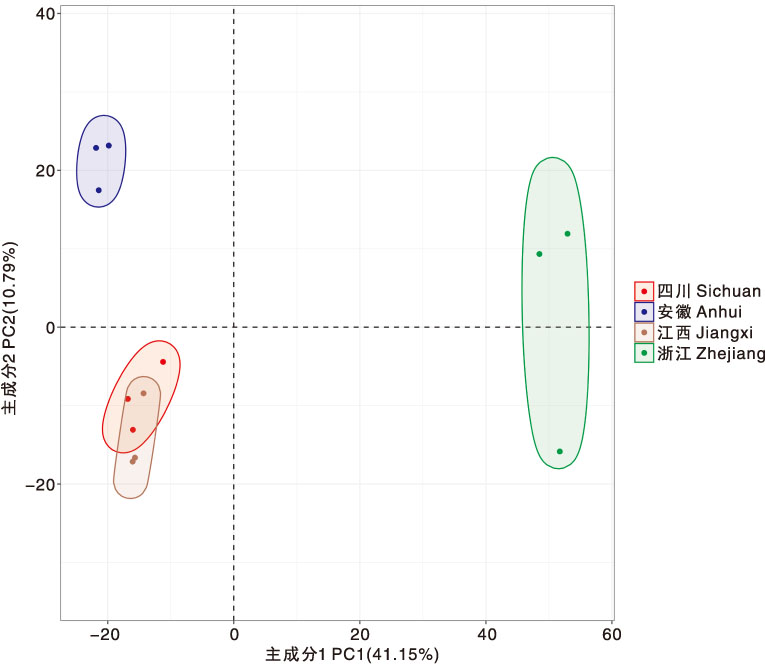
Fig.1 Principal component analysis results of metabolites among blueberry fruits from different production areas
| 代谢物分类 Metabolite classification | 各产地的代谢物数量 Quantity of metabolites from different production areas | |||
|---|---|---|---|---|
| 浙江 Zhejiang | 四川 Sichuan | 江西 Jiangxi | 安徽 Anhui | |
| 脂质和类脂分子Lipids and lipid molecules | 249 | 226 | 216 | 210 |
| 有机杂环化合物Organic heterocyclic compounds | 78 | 72 | 71 | 69 |
| 有机氧化合物Organic oxygen compound | 146 | 139 | 135 | 134 |
| 有机酸及其衍生物Organic acids and their derivatives | 128 | 121 | 119 | 118 |
| 有机卤素化合物Organic halogen compounds | 1 | 1 | 1 | 1 |
| 有机硫化合物Organic sulfur compounds | 2 | 2 | 2 | 2 |
| 有机氮化合物Organic nitrogen compounds | 20 | 20 | 20 | 20 |
| 碳氢衍生物Hydrocarbon derivatives | 1 | 1 | 1 | 1 |
| 碳氢化合物Hydrocarbon | 2 | 2 | 2 | 2 |
| 生物碱及其衍生物Alkaloids and their derivatives | 4 | 4 | 4 | 4 |
| 木脂素、新木脂素及其相关化合物Lignans, neolignans and related compounds | 19 | 18 | 16 | 17 |
| 核苷、核苷酸和类似物Nucleosides, nucleotides and analogues | 20 | 19 | 18 | 16 |
| 苯类化合物Benzene compounds | 99 | 97 | 99 | 95 |
| 苯丙类和聚酮类Phenylpropenes and polyketones | 210 | 191 | 186 | 181 |
| 其他Other | 1 067 | 1 051 | 1 037 | 1 007 |
Table 2 Quantity statistics of metabolites in blueberry fruits from four production areas
| 代谢物分类 Metabolite classification | 各产地的代谢物数量 Quantity of metabolites from different production areas | |||
|---|---|---|---|---|
| 浙江 Zhejiang | 四川 Sichuan | 江西 Jiangxi | 安徽 Anhui | |
| 脂质和类脂分子Lipids and lipid molecules | 249 | 226 | 216 | 210 |
| 有机杂环化合物Organic heterocyclic compounds | 78 | 72 | 71 | 69 |
| 有机氧化合物Organic oxygen compound | 146 | 139 | 135 | 134 |
| 有机酸及其衍生物Organic acids and their derivatives | 128 | 121 | 119 | 118 |
| 有机卤素化合物Organic halogen compounds | 1 | 1 | 1 | 1 |
| 有机硫化合物Organic sulfur compounds | 2 | 2 | 2 | 2 |
| 有机氮化合物Organic nitrogen compounds | 20 | 20 | 20 | 20 |
| 碳氢衍生物Hydrocarbon derivatives | 1 | 1 | 1 | 1 |
| 碳氢化合物Hydrocarbon | 2 | 2 | 2 | 2 |
| 生物碱及其衍生物Alkaloids and their derivatives | 4 | 4 | 4 | 4 |
| 木脂素、新木脂素及其相关化合物Lignans, neolignans and related compounds | 19 | 18 | 16 | 17 |
| 核苷、核苷酸和类似物Nucleosides, nucleotides and analogues | 20 | 19 | 18 | 16 |
| 苯类化合物Benzene compounds | 99 | 97 | 99 | 95 |
| 苯丙类和聚酮类Phenylpropenes and polyketones | 210 | 191 | 186 | 181 |
| 其他Other | 1 067 | 1 051 | 1 037 | 1 007 |
| 代谢物分类 Metabolite type | 各产地的特征差异代谢物数量(代谢物) Quantity of characteristic differental metabolites from different production areas(metabolites) | |||||||
|---|---|---|---|---|---|---|---|---|
| 浙江Zhejiang | 四川Sichuan | 江西Jiangxi | 安徽Anhui | |||||
| 有机酸 Organic acid | 5(3-硫酸咖啡酸**、3-脱氧-D-甘露糖醛酸酯**、枝孢内酯B**、3,5-二叔丁基-4-羟基苯甲酸钠**、青霉酸**) 5(3-Sulfo-caffeic acid; 3-deoxy-D-mannuronate; cladosporin B; sodium 3,5-di-tert-butyl-4-hydroxybenzoate; penicillic acid) | 6(柠檬酸、反式阿头酸) 6(Citric acid; trans-aconitic acid) | 6(柠檬酸、反式阿头酸) 6(Citric acid; trans-aconitic acid) | 8(柠檬酸、反式阿头酸) 8(Citric acid; trans-aconitic acid) | ||||
| 脂类化合物 Lipid compounds | 7[(24E)-3a-乙酰氧基-15a-羟基-23-氧代-7,9(11),24-羊毛抑菌烯-26-脱醛酸**、柑橘素F**] 7[(24E)-3a-Acetoxy-15a-hydroxy-23-oxo-7,9(11),24-lanostadien-26-oic acid**; citrusin F**] | 8 | 12(6β-羟基杨酸** 6β-Hydroxymellein) | 10 | ||||
| 类黄酮及其衍生物 Flavonoids and their derivatives | 21{2',3,4,4',6'-五羟基查尔酮**、L-表儿茶素**、黄芪素**、木犀草苷A**、5,7-二羟基-2-(3-羟基-4,5-二甲氧基苯基)-3-[(2S,3R,4R,5R,6S)-3,4,5-三羟基-6-甲基氧杂-2-基]氧基铬基-4-酮**、顺式二氢槲皮素**、(2S,3S)-紫杉醇-3-葡萄糖苷**、天竺葵素-3-O-β-D-葡萄糖苷**、芍药素-3-O-α-阿拉伯吡喃糖苷**} 21{2',3,4,4',6'-Pentahydroxychalcone**; L-epicatechin**; astragalin**; luteolinoside A**; 5,7-dihydroxy-2-(3-hydroxy-4,5-dimethoxyphenyl)-3-[(2S,3R,4R,5R,6S)-3,4,5-trihydroxy-6-methyloxan-2-yl]oxychromen-4-one**; cis-dihydroquercetin**; (2S,3S)-taxifolin-3-glucoside**; pelargonidin-3-O-β-D-glucoside**; peonidin-3-O-α-arabinopyranoside**} | 25[槲皮素、槲皮素3-(6'-乙酰葡糖苷)、槲皮素3-(6'-丙二酰半乳糖苷)、异槲皮糖苷、槲皮素-7-O-硫酸盐] 25[Quercetin; quercetin 3-(6'-acetylglucoside); quercetin 3-(6'-malonylgalactoside); isoquercitrin; quercetin-7-O-sulfate] | 6[槲皮素、槲皮素3-(6'-乙酰葡糖苷)、槲皮素3-(6'-丙二酰半乳糖苷)、异槲皮糖苷、槲皮素-7-O-硫酸盐] 6[Quercetin; quercetin 3-(6'-acetylglucoside); quercetin 3-(6'-malonylgalactoside); isoquercitrin; quercetin-7-O-sulfate] | 26[槲皮素、槲皮素3-(6’-乙酰葡糖苷)、槲皮素3-(6'-丙二酰半乳糖苷)、异槲皮糖苷、槲皮素-7-O-硫酸盐] 26[Quercetin; quercetin 3-(6'-acetylglucoside); quercetin 3-(6'-malonylgalactoside); isoquercitrin; quercetin-7-O-sulfate] | ||||
| 有机氧化合物 Organic oxygen compound | 12(洋蓟素**、苯乙基芸香糖苷**、阿苏莫苷**、L-鼠李糖呋喃糖**) 12(Cynaropicrin**; phenethyl rutinoside**; azumoside**; L-rhamnofuranose**) | 14{L-二氯酸酯、(2S)-2-[[(2R)-2-[(2-乙基-6-氧代-5-丙-2-基-1H-吡嗪-3-羰基)氨基]-4-甲基戊酰基]氨基]丙酸、黄榄糖苷E} 14{L-Dichloramate; (2S)-2-[[(2R)-2-[(2-ethyl-6-oxo-5-propan-2-yl-1H-pyrazine-3-carbonyl)amino]-4-methylpentanoyl]amino]propanoic acid; huanglansu E} | 16{L-二氯酸酯、(2S)-2-[[(2R)-2-[(2-乙基-6-氧代-5-丙-2-基-1H-吡嗪-3-羰基)氨基]-4-甲基戊酰基]氨基]丙酸、黄榄糖苷E} 16{L-Dichloramate; (2S)-2-[[(2R)-2-[(2-ethyl-6-oxo-5-propan-2-yl-1H-pyrazine-3-carbonyl)amino]-4-methylpentanoyl]amino]propanoic acid; huanglansu E} | 12{L-二氯酸酯、(2S)-2-[[(2R)-2-[(2-乙基-6-氧代-5-丙-2-基-1H-吡嗪-3-羰基)氨基]-4-甲基戊酰基]氨基]丙酸、黄榄糖苷E} 12{L-Dichloramate; (2S)-2-[[(2R)-2-[(2-ethyl-6-oxo-5-propan-2-yl-1H-pyrazine-3-carbonyl)amino]-4-methylpentanoyl]amino]propanoic acid; huanglansu E} | ||||
| 有机杂环化合物 Organic heterocyclic compounds | 6(Artonin Q**、4-羟基维替蒽酮**、大蒜硫胺**、硫酸盐9**、曼苏拉霉素B**) 6(Artonin Q**; 4-hydroxyverticillone**; allithiamine**; sulfate 9**; mansouramycin B**) | 5[4-(3-氯苯基)-α-(二苯基甲基)-1-哌嗪乙醇、9-羟基-4-甲氧基补骨脂素9-葡萄糖苷] 5[4-(3-Chlorophenyl)-α-(diphenylmethyl)-1-piperazineethanol; 9-hydroxy-4-methoxypsoralen 9-glucoside] | 6[4-(3-氯苯基)-α-(二苯基甲基)-1-哌嗪乙醇、9-羟基-4-甲氧基补骨脂素9-葡萄糖苷] 6[4-(3-Chlorophenyl)-α-(diphenylmethyl)-1-piperazineethanol; 9-hydroxy-4-methoxypsoralen 9-glucoside] | 6[4-(3-氯苯基)-α-(二苯基甲基)-1-哌嗪乙醇、9-羟基-4-甲氧基补骨脂素9-葡萄糖苷] 6[4-(3-Chlorophenyl)-α-(diphenylmethyl)-1-piperazineethanol; 9-hydroxy-4-methoxypsoralen 9-glucoside] | ||||
| 萜类 Terpenoids | 2(哈氏罗汉松内酯B** Harziandione B) | 3[(-)-紫苏醇** (-)-Perillyl alcohol] | 3 | 6 | ||||
| 有机氨基化合物 Organic amino compound | 3 | 6(L-脯氨酸**、脯氨酰羟脯氨酸、苯丙氨酸) 6(L-Proline**; prolylhydroxyproline; phenylalanine) | 4(脯氨酰羟脯氨酸、 苯丙氨酸) 4(Prolylhydroxyproline; phenylalanine) | 8(脯氨酰羟脯氨酸、苯丙氨酸) 8(Prolylhyd- roxyproline; phenylalanine) | ||||
| 酯类化合物 Ester compounds | 3(硫酸十二烷基**、康瓦洛糖苷**、葡萄糖酸内酯**) 3(Dodecyl sulfate**; convallatoxin**; gluconolactone**) | 1(蕨甾酮Pterosterone) | 1[(10E,12Z)-9-氢过氧十八烷-10,12-二烯酸(10E,12Z)-9-Hydroperoxyoctadeca-10,12-dienoic acid] | 1[(9S,10E,12Z,15Z)-9-氢过氧十八烷-10,12,15-三烯酸(9S,10E,12Z,15Z)-9-Hydroperoxyoctadeca-10,12,15-trienoic acid] | ||||
| 环多醇 Cyclic polyol | — | — | — | 1(纤维醇** Inositol) | ||||
| 核苷酸及其衍生物 Nucleotides and their derivatives | — | — | 1(1-甲基肌苷** 1-Methylinosine) | — | ||||
| 单宁 Tannin | 1(3-O-甲基鞣花酸** 3-O-Methylellagic acid) | 1(3-O-甲基鞣花酸** 3-O-Methylellagic acid) | — | — | ||||
| 芳香族化合物 Aromatic compounds | 7[1,3,6-三羟基-7-甲氧基-2,5-双(3-甲基-2-丁烯基)氧杂蒽酮**、2D-5-O-甲基-2,3,5/4,6-五羟基环己酮**、芦荟苷B**、棘柱泊苷B**、叶酸菌胆苷B2**] 7[1,3,6-Trihydroxy-7-methoxy-2,5-bis(3-methyl-2-butenyl)xanthen-9-one**; 2D-5-O-methyl-2,3,5/4,6-pentahydroxycyclohexanone**; aloesin B**; echinacoside B**; phyllanthussin B2**] | 3 | 2 | 1 | ||||
| 聚酮类Polyketones | — | 1(罗林霉素A** Roritoxin A) | — | — | ||||
| 总计Total | 67 | 73 | 58 | 78 | ||||
Table 3 Statistics on the quantity of characteristic differential metabolites in fruits from four production areas
| 代谢物分类 Metabolite type | 各产地的特征差异代谢物数量(代谢物) Quantity of characteristic differental metabolites from different production areas(metabolites) | |||||||
|---|---|---|---|---|---|---|---|---|
| 浙江Zhejiang | 四川Sichuan | 江西Jiangxi | 安徽Anhui | |||||
| 有机酸 Organic acid | 5(3-硫酸咖啡酸**、3-脱氧-D-甘露糖醛酸酯**、枝孢内酯B**、3,5-二叔丁基-4-羟基苯甲酸钠**、青霉酸**) 5(3-Sulfo-caffeic acid; 3-deoxy-D-mannuronate; cladosporin B; sodium 3,5-di-tert-butyl-4-hydroxybenzoate; penicillic acid) | 6(柠檬酸、反式阿头酸) 6(Citric acid; trans-aconitic acid) | 6(柠檬酸、反式阿头酸) 6(Citric acid; trans-aconitic acid) | 8(柠檬酸、反式阿头酸) 8(Citric acid; trans-aconitic acid) | ||||
| 脂类化合物 Lipid compounds | 7[(24E)-3a-乙酰氧基-15a-羟基-23-氧代-7,9(11),24-羊毛抑菌烯-26-脱醛酸**、柑橘素F**] 7[(24E)-3a-Acetoxy-15a-hydroxy-23-oxo-7,9(11),24-lanostadien-26-oic acid**; citrusin F**] | 8 | 12(6β-羟基杨酸** 6β-Hydroxymellein) | 10 | ||||
| 类黄酮及其衍生物 Flavonoids and their derivatives | 21{2',3,4,4',6'-五羟基查尔酮**、L-表儿茶素**、黄芪素**、木犀草苷A**、5,7-二羟基-2-(3-羟基-4,5-二甲氧基苯基)-3-[(2S,3R,4R,5R,6S)-3,4,5-三羟基-6-甲基氧杂-2-基]氧基铬基-4-酮**、顺式二氢槲皮素**、(2S,3S)-紫杉醇-3-葡萄糖苷**、天竺葵素-3-O-β-D-葡萄糖苷**、芍药素-3-O-α-阿拉伯吡喃糖苷**} 21{2',3,4,4',6'-Pentahydroxychalcone**; L-epicatechin**; astragalin**; luteolinoside A**; 5,7-dihydroxy-2-(3-hydroxy-4,5-dimethoxyphenyl)-3-[(2S,3R,4R,5R,6S)-3,4,5-trihydroxy-6-methyloxan-2-yl]oxychromen-4-one**; cis-dihydroquercetin**; (2S,3S)-taxifolin-3-glucoside**; pelargonidin-3-O-β-D-glucoside**; peonidin-3-O-α-arabinopyranoside**} | 25[槲皮素、槲皮素3-(6'-乙酰葡糖苷)、槲皮素3-(6'-丙二酰半乳糖苷)、异槲皮糖苷、槲皮素-7-O-硫酸盐] 25[Quercetin; quercetin 3-(6'-acetylglucoside); quercetin 3-(6'-malonylgalactoside); isoquercitrin; quercetin-7-O-sulfate] | 6[槲皮素、槲皮素3-(6'-乙酰葡糖苷)、槲皮素3-(6'-丙二酰半乳糖苷)、异槲皮糖苷、槲皮素-7-O-硫酸盐] 6[Quercetin; quercetin 3-(6'-acetylglucoside); quercetin 3-(6'-malonylgalactoside); isoquercitrin; quercetin-7-O-sulfate] | 26[槲皮素、槲皮素3-(6’-乙酰葡糖苷)、槲皮素3-(6'-丙二酰半乳糖苷)、异槲皮糖苷、槲皮素-7-O-硫酸盐] 26[Quercetin; quercetin 3-(6'-acetylglucoside); quercetin 3-(6'-malonylgalactoside); isoquercitrin; quercetin-7-O-sulfate] | ||||
| 有机氧化合物 Organic oxygen compound | 12(洋蓟素**、苯乙基芸香糖苷**、阿苏莫苷**、L-鼠李糖呋喃糖**) 12(Cynaropicrin**; phenethyl rutinoside**; azumoside**; L-rhamnofuranose**) | 14{L-二氯酸酯、(2S)-2-[[(2R)-2-[(2-乙基-6-氧代-5-丙-2-基-1H-吡嗪-3-羰基)氨基]-4-甲基戊酰基]氨基]丙酸、黄榄糖苷E} 14{L-Dichloramate; (2S)-2-[[(2R)-2-[(2-ethyl-6-oxo-5-propan-2-yl-1H-pyrazine-3-carbonyl)amino]-4-methylpentanoyl]amino]propanoic acid; huanglansu E} | 16{L-二氯酸酯、(2S)-2-[[(2R)-2-[(2-乙基-6-氧代-5-丙-2-基-1H-吡嗪-3-羰基)氨基]-4-甲基戊酰基]氨基]丙酸、黄榄糖苷E} 16{L-Dichloramate; (2S)-2-[[(2R)-2-[(2-ethyl-6-oxo-5-propan-2-yl-1H-pyrazine-3-carbonyl)amino]-4-methylpentanoyl]amino]propanoic acid; huanglansu E} | 12{L-二氯酸酯、(2S)-2-[[(2R)-2-[(2-乙基-6-氧代-5-丙-2-基-1H-吡嗪-3-羰基)氨基]-4-甲基戊酰基]氨基]丙酸、黄榄糖苷E} 12{L-Dichloramate; (2S)-2-[[(2R)-2-[(2-ethyl-6-oxo-5-propan-2-yl-1H-pyrazine-3-carbonyl)amino]-4-methylpentanoyl]amino]propanoic acid; huanglansu E} | ||||
| 有机杂环化合物 Organic heterocyclic compounds | 6(Artonin Q**、4-羟基维替蒽酮**、大蒜硫胺**、硫酸盐9**、曼苏拉霉素B**) 6(Artonin Q**; 4-hydroxyverticillone**; allithiamine**; sulfate 9**; mansouramycin B**) | 5[4-(3-氯苯基)-α-(二苯基甲基)-1-哌嗪乙醇、9-羟基-4-甲氧基补骨脂素9-葡萄糖苷] 5[4-(3-Chlorophenyl)-α-(diphenylmethyl)-1-piperazineethanol; 9-hydroxy-4-methoxypsoralen 9-glucoside] | 6[4-(3-氯苯基)-α-(二苯基甲基)-1-哌嗪乙醇、9-羟基-4-甲氧基补骨脂素9-葡萄糖苷] 6[4-(3-Chlorophenyl)-α-(diphenylmethyl)-1-piperazineethanol; 9-hydroxy-4-methoxypsoralen 9-glucoside] | 6[4-(3-氯苯基)-α-(二苯基甲基)-1-哌嗪乙醇、9-羟基-4-甲氧基补骨脂素9-葡萄糖苷] 6[4-(3-Chlorophenyl)-α-(diphenylmethyl)-1-piperazineethanol; 9-hydroxy-4-methoxypsoralen 9-glucoside] | ||||
| 萜类 Terpenoids | 2(哈氏罗汉松内酯B** Harziandione B) | 3[(-)-紫苏醇** (-)-Perillyl alcohol] | 3 | 6 | ||||
| 有机氨基化合物 Organic amino compound | 3 | 6(L-脯氨酸**、脯氨酰羟脯氨酸、苯丙氨酸) 6(L-Proline**; prolylhydroxyproline; phenylalanine) | 4(脯氨酰羟脯氨酸、 苯丙氨酸) 4(Prolylhydroxyproline; phenylalanine) | 8(脯氨酰羟脯氨酸、苯丙氨酸) 8(Prolylhyd- roxyproline; phenylalanine) | ||||
| 酯类化合物 Ester compounds | 3(硫酸十二烷基**、康瓦洛糖苷**、葡萄糖酸内酯**) 3(Dodecyl sulfate**; convallatoxin**; gluconolactone**) | 1(蕨甾酮Pterosterone) | 1[(10E,12Z)-9-氢过氧十八烷-10,12-二烯酸(10E,12Z)-9-Hydroperoxyoctadeca-10,12-dienoic acid] | 1[(9S,10E,12Z,15Z)-9-氢过氧十八烷-10,12,15-三烯酸(9S,10E,12Z,15Z)-9-Hydroperoxyoctadeca-10,12,15-trienoic acid] | ||||
| 环多醇 Cyclic polyol | — | — | — | 1(纤维醇** Inositol) | ||||
| 核苷酸及其衍生物 Nucleotides and their derivatives | — | — | 1(1-甲基肌苷** 1-Methylinosine) | — | ||||
| 单宁 Tannin | 1(3-O-甲基鞣花酸** 3-O-Methylellagic acid) | 1(3-O-甲基鞣花酸** 3-O-Methylellagic acid) | — | — | ||||
| 芳香族化合物 Aromatic compounds | 7[1,3,6-三羟基-7-甲氧基-2,5-双(3-甲基-2-丁烯基)氧杂蒽酮**、2D-5-O-甲基-2,3,5/4,6-五羟基环己酮**、芦荟苷B**、棘柱泊苷B**、叶酸菌胆苷B2**] 7[1,3,6-Trihydroxy-7-methoxy-2,5-bis(3-methyl-2-butenyl)xanthen-9-one**; 2D-5-O-methyl-2,3,5/4,6-pentahydroxycyclohexanone**; aloesin B**; echinacoside B**; phyllanthussin B2**] | 3 | 2 | 1 | ||||
| 聚酮类Polyketones | — | 1(罗林霉素A** Roritoxin A) | — | — | ||||
| 总计Total | 67 | 73 | 58 | 78 | ||||
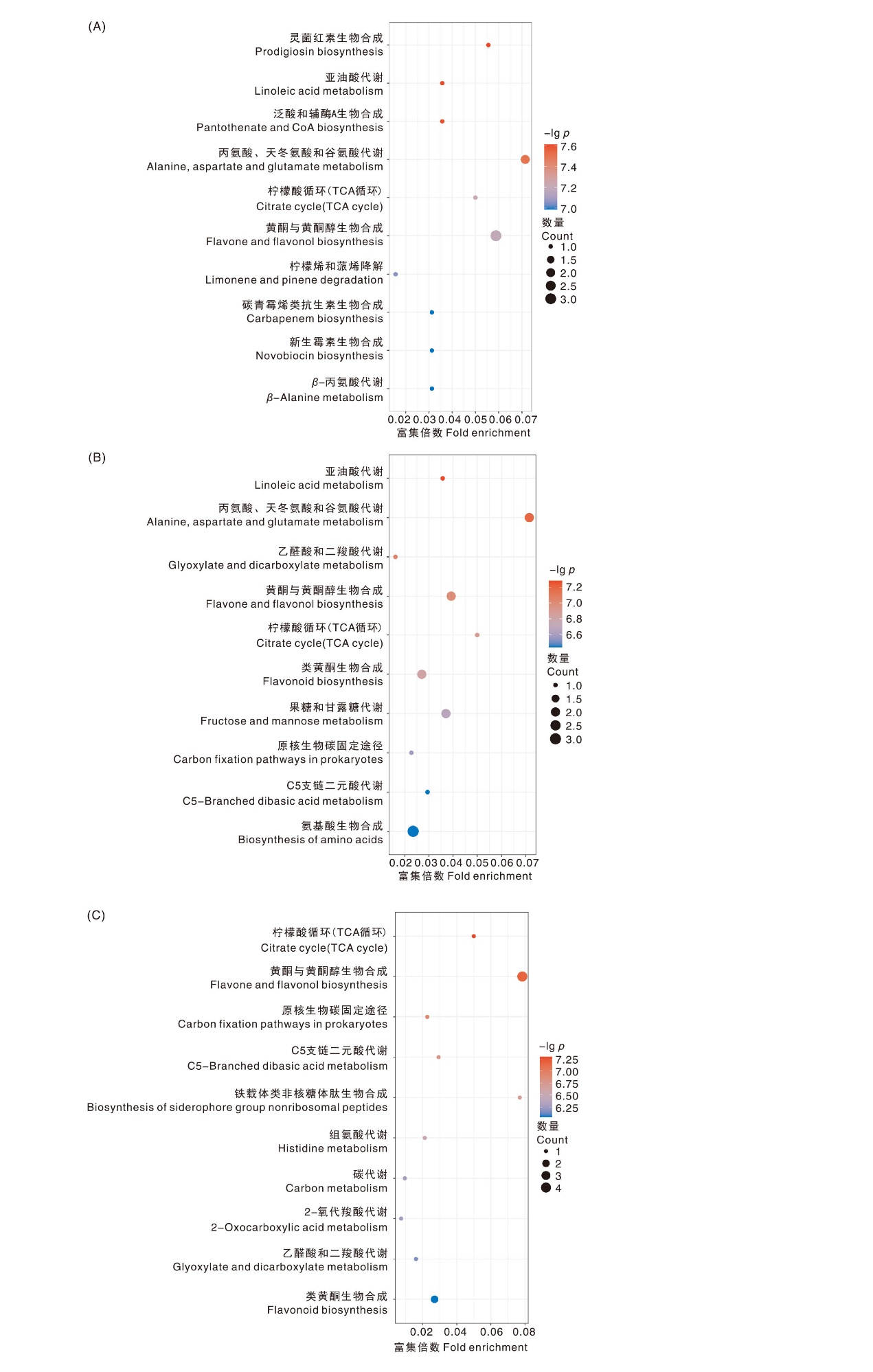
Fig.2 KEGG enrichment map of differential metabolites in different regions A, Sichuan vs Zhejiang; B, Jiangxi vs Zhejiang; C, Anhui vs Zhejiang.
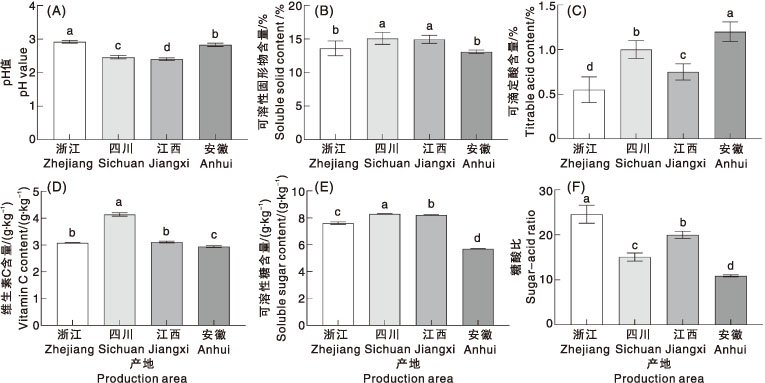
Fig.3 Quality indicators of Lanmei 1 from different production areas Bars marked without the same letter indicate significant difference at p<0.05.The same as below.
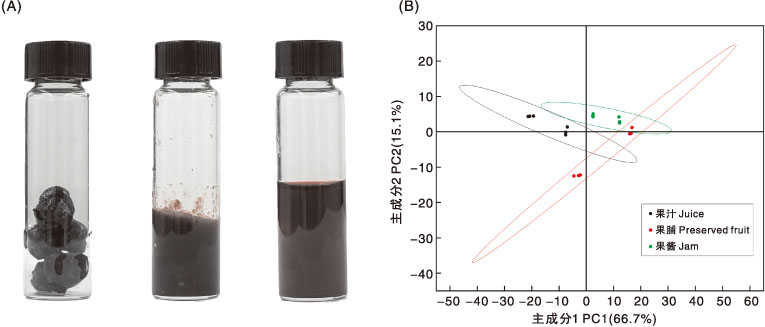
Fig.4 Processed products of Lanmei 1 from Sichuan production area and the results of their electronic tongue PCA analysis From left to right in Figure A are preserved fruit, jam, and fruit juice.
| 产品Product | 组织形态Tissue form | 色泽Colour | 气味Aroma | 口感Taste | 总得分Total score |
|---|---|---|---|---|---|
| 果脯Preserved | 23.30±1.68 a | 23.60±0.80 a | 23.20±1.08 a | 23.70±0.78 a | 93.80±1.89 a |
| 果酱Jam | 14.30±1.35 b | 12.90±1.37 b | 18.10±1.87 c | 21.90±1.14 b | 67.20±2.86 c |
| 果汁Juice | 23.30±0.64 a | 23.90±0.83 a | 22.00±1.18 b | 19.20±1.72 c | 88.40±1.56 b |
Table 4 Sensory evaluation results of processed products from blueberry variety Lanmei 1 in Sichuan production area
| 产品Product | 组织形态Tissue form | 色泽Colour | 气味Aroma | 口感Taste | 总得分Total score |
|---|---|---|---|---|---|
| 果脯Preserved | 23.30±1.68 a | 23.60±0.80 a | 23.20±1.08 a | 23.70±0.78 a | 93.80±1.89 a |
| 果酱Jam | 14.30±1.35 b | 12.90±1.37 b | 18.10±1.87 c | 21.90±1.14 b | 67.20±2.86 c |
| 果汁Juice | 23.30±0.64 a | 23.90±0.83 a | 22.00±1.18 b | 19.20±1.72 c | 88.40±1.56 b |
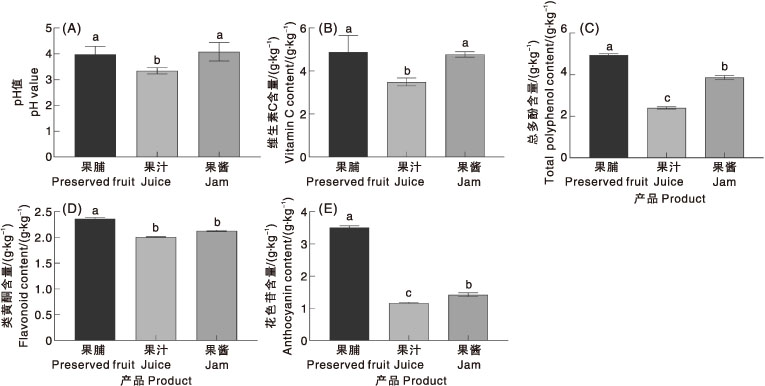
Fig.5 Results of quality indicators for different processed products
| [1] | WU Y Q, HAN T Y, YANG H, et al. Known and potential health benefits and mechanisms of blueberry anthocyanins: a review[J]. Food Bioscience, 2023, 55: 103050. |
| [2] | 张晓晓, 黄午阳, 於虹, 等. 不同种植地区蓝莓果中花色苷的分布[J]. 中国食品学报, 2022, 22(10): 314-324. |
| ZHANG X X, HUANG W Y, YU H, et al. The distribution of anthocyanins in blueberry fruits from different growing locations[J]. Journal of Chinese Institute of Food Science and Technology, 2022, 22(10): 314-324. | |
| [3] | WEI Z W, YANG H Y, SHI J, et al. Effects of different light wavelengths on fruit quality and gene expression of anthocyanin biosynthesis in blueberry (Vaccinium corymbosm)[J]. Cells, 2023, 12(9): 1225. |
| [4] | ZHOU Y J, LIU Y Q, ZHANG X, et al. Effects of soil properties and microbiome on highbush blueberry (Vaccinium corymbosum) growth[J]. Agronomy, 2022, 12(6): 1263. |
| [5] | LIU Z L, XIE L, ZIELINSKA M, et al. Improvement of drying efficiency and quality attributes of blueberries using innovative far-infrared radiation heating assisted pulsed vacuum drying (FIR-PVD)[J]. Innovative Food Science & Emerging Technologies, 2022, 77: 102948. |
| [6] | MICHALSKA A, ŁYSIAK G. Bioactive compounds of blueberries: post-harvest factors influencing the nutritional value of products[J]. International Journal of Molecular Sciences, 2015, 16(8): 18642-18663. |
| [7] | CABANILLAS-BOJORQUEZ L A, VALDEZ-BARO O, GUTIERREZ-GRIJALVA E P, et al. Antioxidant capacity and evaluation of total phenolic content of optimized blueberry (Vaccinium corymbosum) wine[J]. Acta Scientiarum Technology, 2021, 43: e55134. |
| [8] | SANDRI I G, FONTANA R C, BARFKNECHT D M, et al. Clarification of fruit juices by fungal pectinases[J]. LWT-Food Science and Technology, 2011, 44(10): 2217-2222. |
| [9] | TANG C Q, GU Q Y, LI X W, et al. Hydroxycinnamate decarboxylase in Metschnikowia pulcherrima promotes the formation of vinylphenolic pyranoanthocyanins to enhance the color stability of blueberry wine[J]. LWT, 2024, 207: 116633. |
| [10] | 乔慧茹, 房祥军, 吴伟杰, 等. 蓝莓与铁皮石斛叶复合乳酸菌发酵饮料工艺优化与品质分析[J]. 浙江农业学报, 2025, 37(3): 654-666. |
| QIAO H R, FANG X J, WU W J, et al. Process optimization and quality analysis of composite lactic acid bacteria fermented beverage with blueberries and Dendrobium officinale leaves[J]. Acta Agriculturae Zhejiangensis, 2025, 37(3): 654-666. | |
| [11] | PEREZ C, TAGLIANI C, ARCIA P, et al. Blueberry by-product used as an ingredient in the development of functional cookies[J]. Food Science and Technology International, 2018, 24(4): 301-308. |
| [12] | 张琴, 黄世安, 林欣, 等. 基于UPLC-MS/MS的3个李品种果实初生代谢物分析[J]. 食品科学, 2022, 43(16): 226-234. |
| ZHANG Q, HUANG S A, LIN X, et al. Analysis of primary metabolites in three plum varieties using ultra-high performance liquid chromatography-tandem mass spectrometry[J]. Food Science, 2022, 43(16): 226-234. | |
| [13] | 姚沛琳, 刘梦茹, 杨澳, 等. 基于非靶向代谢组学的蓝莓酵素和沙棘酵素代谢产物特征比较[J]. 食品工业科技, 2022, 43(19): 160-166. |
| YAO P L, LIU M R, YANG A, et al. Comparison of metabolite characteristics of blueberry jiaosu and sea-buckthorn jiaosu based on non-targeted metabolomics approach[J]. Science and Technology of Food Industry, 2022, 43(19): 160-166. | |
| [14] | 王倩, 张长青, 李广平, 等. 基于UPLC-QTOF/MS的蓝莓果实发育代谢组学差异分析[J]. 江苏农业科学, 2020, 48(24): 148-152. |
| WANG Q, ZHANG C Q, LI G P, et al. Metabolomics difference analysis of blueberry fruit development based on UPLC-QTOF/MS[J]. Jiangsu Agricultural Sciences, 2020, 48(24): 148-152. | |
| [15] | 韩延超, 陈慧芝, 牛犇, 等. 振动胁迫对蓝莓花色苷代谢及相关基因表达的影响[J]. 浙江农业学报, 2024, 36(3): 622-633. |
| HAN Y C, CHEN H Z, NIU B, et al. Effect of vibration stress on anthocyanin metabolism and related gene expression in blueberry[J]. Acta Agriculturae Zhejiangensis, 2024, 36(3): 622-633. | |
| [16] | GHIRARDO A, FOCHI V, LANGE B, et al. Metabolomic adjustments in the orchid mycorrhizal fungus Tulasnella calospora during symbiosis with Serapias vomeracea[J]. New Phytologist, 2020, 228(6): 1939-1952. |
| [17] | CHEN S, LI M H, ZHENG G Y, et al. Metabolite profiling of 14 Wuyi rock tea cultivars using UPLC-QTOF MS and UPLC-QqQ MS combined with chemometrics[J]. Molecules, 2018, 23(2): 104. |
| [18] | 曹建康, 姜微波, 赵玉梅. 果蔬采后生理生化实验指导[M]. 北京: 中国轻工业出版社, 2007. |
| [19] | ZHANG Y Q, WANG H X, CHEN H J, et al. The crucial evaluation indexes and relative measurement methods of edible value for fresh fruits and vegetables: a review[J]. Future Postharvest and Food, 2024, 1(2): 222-236. |
| [20] | 王晓艳. 物流振动对蓝莓贮藏品质及花色苷代谢的影响[D]. 舟山: 浙江海洋大学, 2022. |
| WANG X Y. Effects of logistics vibration on storage quality and anthocyanin metabolism in blueberries[D]. Zhoushan: Zhejiang Ocean University, 2022. | |
| [21] | 刘慧, 刘杰超, 吕真真, 等. 加工工艺对蓝莓汁和蓝莓酒中花色苷及类黄酮的影响[J]. 中国酿造, 2018, 37(8): 158-162. |
| LIU H, LIU J C, LV Z Z, et al. Effect of processing technology on the contents of anthocyanins and flavonoids in blueberry juice and wine[J]. China Brewing, 2018, 37(8): 158-162. | |
| [22] | FRACASSETTI D, DEL BO’ C, SIMONETTI P, et al. Effect of time and storage temperature on anthocyanin decay and antioxidant activity in wild blueberry (Vaccinium angustifolium) powder[J]. Journal of Agricultural and Food Chemistry, 2013, 61(12): 2999-3005. |
| [23] | 刘艺, 李冰, 鲁宝君, 等. 多指标综合评价不同产区蓝莓的品质[J]. 北方园艺, 2020(8): 15-23. |
| LIU Y, LI B, LU B J, et al. Comprehensive evaluation of blueberry quality in different producing areas by multiple indicators[J]. Northern Horticulture, 2020(8): 15-23. | |
| [24] | 刘军波, 邹礼根, 邱静, 等. 蓝莓果干脱水加工工艺[J]. 浙江农业科学, 2021, 62(9): 1867-1869. |
| LIU J B, ZOU L G, QIU J, et al. Study on dehydration process of blueberry[J]. Journal of Zhejiang Agricultural Sciences, 2021, 62(9): 1867-1869. | |
| [25] | 王少娟, 党娅, 赵桦. 蓝莓果酱加工工艺技术研究[J]. 黑龙江农业科学, 2016(7): 102-107. |
| WANG S J, DANG Y, ZHAO H. Researchon processing technology of blueberry jam[J]. Heilongjiang Agricultural Sciences, 2016(7): 102-107. | |
| [26] | 唐卿雁, 廖小琳, 杨丽丽, 等. 蓝莓果汁饮品配方优化及品质分析[J]. 食品研究与开发, 2022, 43(5): 115-122. |
| TANG Q Y, LIAO X L, YANG L L, et al. Formula optimization and quality analysis of blueberry juice beverage[J]. Food Research and Development, 2022, 43(5): 115-122. | |
| [27] | TASA T A, STARAST M, VOOL E, et al. Influence of soil type on half-highbush blueberry productivity[J]. Agricultural and Food Science, 2012, 21(4): 409-420. |
| [28] | 吕芳楠, 温靖, 徐玉娟, 等. 蓝莓果实的营养价值和药理作用及其加工利用[J]. 安徽农业科学, 2016, 44(18): 85-87. |
| LYU F N, WEN J, XU Y J, et al. Nutritional value, pharmacological action and processing and utilization of blueberry fruits[J]. Journal of Anhui Agricultural Sciences, 2016, 44(18): 85-87. | |
| [29] | 李斌, 鲍义文, 李佳欣, 等. 蓝莓加工副产物资源综合利用及新业态发展趋势[J]. 食品科学技术学报, 2024, 42(4): 1-10. |
| LI B, BAO Y W, LI J X, et al. Comprehensive utilization of blueberry processing by-product resources and development trend of new business forms[J]. Journal of Food Science and Technology, 2024, 42(4): 1-10. | |
| [30] | ADUNOLA P M, FERRÃO L F V, AZEVEDO C F, et al. The effect of environmental variables on the genotyping-by-environment interaction in blueberry[J]. Euphytica, 2024, 220(7): 113. |
| [31] | 欧晓华, 王储炎, 李珂昕, 等. 安徽省主栽蓝莓品种果实的综合品质研究[J]. 中国南方果树, 2019, 48(2): 125-129. |
| OU X H, WANG C Y, LI K X, et al. Integrated quality of main blueberry cultivars in Anhui Province[J]. South China Fruits, 2019, 48(2): 125-129. | |
| [32] | 韩斯, 孟宪军, 汪艳群, 等. 不同品种蓝莓品质特性及聚类分析[J]. 食品科学, 2015, 36(6): 140-144. |
| HAN S, MENG X J, WANG Y Q, et al. Quality properties and cluster analysis of different blueberry cultivars[J]. Food Science, 2015, 36(6): 140-144. | |
| [33] | 熊喜红, 徐晓云, 张强, 等. 湖北和云南地区蓝莓果实加工特性研究[J]. 北方园艺, 2020(2): 23-31. |
| XIONG X H, XU X Y, ZHANG Q, et al. Study on processing quality characteristics of blueberry fruit from Hubei and Yunnan Provinces[J]. Northern Horticulture, 2020(2): 23-31. | |
| [34] | DEL BO’ C, RISO P, BRAMBILLA A, et al. Blanching improves anthocyanin absorption from highbush blueberry (Vaccinium corymbosum L.) purée in healthy human volunteers: a pilot study[J]. Journal of Agricultural and Food Chemistry, 2012, 60(36): 9298-9304. |
| [35] | SANNI-OLAYIWOLA H O, KOLAWOLE F L, ONIFADE F O, et al. Phytochemical composition, antioxidant activities and anti-obesity potential of selected vegetables as affected by drying methods[J]. Future Postharvest and Food, 2024, 1(3): 360-375. |
| [36] | SYAMALADEVI R M, ANDREWS P K, DAVIES N M, et al. Storage effects on anthocyanins, phenolics and antioxidant activity of thermally processed conventional and organic blueberries[J]. Journal of the Science of Food and Agriculture, 2012, 92(4): 916-924. |
| [37] | 张雨, 韩延超, 刘瑞玲, 等. FIRD-HPD方式对蓝莓干燥特性及品质的影响[J]. 中国食品学报, 2024, 24(6): 237-247. |
| ZHANG Y, HAN Y C, LIU R L, et al. Effect of FIRD-HPD method on drying characteristics and quality of blueberry[J]. Journal of Chinese Institute of Food Science and Technology, 2024, 24(6): 237-247. | |
| [38] | ZHANG L L, WANG W B, YUE X Y, et al. Gallic acid as a copigment enhance anthocyanin stabilities and color characteristics in blueberry juice[J]. Journal of Food Science and Technology, 2020, 57(4): 1405-1414. |
| [1] | QIAO Huiru, FANG Xiangjun, WU Weijie, LIU Ruiling, CHEN Hangjun, DENG Shanggui, SHA Hao, GAO Haiyan. Process optimization and quality analysis of composite lactic acid bacteria fermented beverage with blueberries and Dendrobium officinale leaves [J]. Acta Agriculturae Zhejiangensis, 2025, 37(3): 654-666. |
| [2] | HAN Yanchao, CHEN Huizhi, NIU Ben, ZHANG Xiaoshuan, HAN Shuren, WANG Xiaoyan, WANG Guannan, LIU Ruiling, GAO Haiyan. Effect of vibration stress on anthocyanin metabolism and related gene expression in blueberry [J]. Acta Agriculturae Zhejiangensis, 2024, 36(3): 622-633. |
| [3] | JIN Xiaojie, ZHANG Jingzhen, YANG Xinsun. Comparative metabolite profiling of rhizome and bulbil of wild Chinese yam (Dioscorea polystachya Turcz.) from Wuxue by widely targeted metabolomics [J]. Acta Agriculturae Zhejiangensis, 2022, 34(4): 727-735. |
| [4] | SHI Yujie, LI Xinglong, TANG Yuan, YU Haiping, WU Xiaoyong. Study on metabolic differences of white quinoa from two areas based on GC-MS [J]. , 2019, 31(6): 869-877. |
| [5] | LI Lu, HAN Qiang, WU Weijie, FANG Xiangjun, GAO Haiyan. Optimization of drying process of blueberry-apple reconstituted fruit cake and its influence on quality [J]. , 2019, 31(5): 816-822. |
| [6] | KANG Haiting, LING Danyan, WU Zhijuan, LU Mei, ZONG Yu, GUO Weidong. Pathogen isolation and identification of blueberry stem canker and screening of disease resistant cultivars [J]. , 2019, 31(3): 436-443. |
| [7] | MA Linlong, JIN Xiaofang, CAO Dan, LIU Yanli, GONG Ziming, WANG Shengpeng, LIU Panpan. Suitability for processing green tea from high amino acid content of tea introduced to Hubei Province [J]. , 2017, 29(2): 251-260. |
| [8] | REN Yanling1,TIAN Hong2, WANG Tao2,*, CAI Qiu2, CHEN Xiao2, WANG Xingning2, YU Xiaofei3, LUO Adong2, KE Shaoying2, OU Houding3, HUANG Die2. Investigation on insect pests and diseases on export base of blueberry [J]. , 2016, 28(6): 1025-. |
| [9] | XUE Lu1,LIU Xiao\|lu1, LU Xiao\|xiang1,ZHANG Peng2,CHEN Shao\|hui2,LI Jiang\|kuo2. Non\|destructive detection of blueberry hardness based on near\|infrared diffused spectroscope#br# [J]. , 2015, 27(9): 1646-. |
| [10] | YANG Le, HOU Zhi\|xia*, YANG Jun\|feng, GONG Zhong\|zhi, WANG Chong, SHI Wen\|jun. Effect of UV\|C treatment on phenolic compounds and relevant enzymes activities of blueberry [J]. , 2015, 27(6): 955-. |
| [11] | ZHAO Ying1, YANG Tao1, SUN Jin\|jie2, YANG Zhen1, WANG Hong1, XIAO Jun1,*. Identification of blueberry mycorrhizal fungi and its effect on blueberry growth [J]. , 2015, 27(3): 400-. |
| [12] | CAO Xuedan1, FANG Xiugui1, ZHOU Weidong2, QI Xingjiang3, ZHAO Kai1. Effects of clarification technology on the quality of blueberry juice#br# [J]. , 2014, 26(4): 1042-. |
| [13] | CHEN Hua-jiang;CHEN Wei-ping;LI Jian-hua;ZHOU Wei-dong;CAO Xue-dan. Preliminary report on adaptability selection of 10 blueberry varieties in Zhejiang [J]. , 2013, 25(4): 0-781. |
| [14] | ZHANG Huanchun;CHEN Xiaoyun;WANG Xiaofu;YANG Guiling;XU Junfeng;LI Yueying;*. Unintended effects and their detection in genetically modified crops [J]. , 2012, 24(1): 0-132. |
| Viewed | ||||||
|
Full text |
|
|||||
|
Abstract |
|
|||||

