Acta Agriculturae Zhejiangensis ›› 2026, Vol. 38 ›› Issue (4): 621-631.DOI: 10.3969/j.issn.1004-1524.20241022
• Crop Science • Previous Articles Next Articles
Comparative analysis on the tenderness and quality of wild ancient tea plants TZRR1 and Camellia sinensis L. cv. Fudingdabaicha in Guizhou
SHI Yina( ), WANG Yanxiab, WANG Juanyinga, HUANG Xiaozhena,b,*()
- a
Key Laboratory of Plant Resources Conservation and Germplasm Innovationin Mountainous Region (Ministry of Education), College of Life Sciences Guiyang 550025, China
bCollege of Tea Sciences, Guizhou University Guiyang 550025, China
-
Received:2024-11-23Online:2026-04-25Published:2026-05-08 -
Contact:HUANG Xiaozhen

CLC Number:
Cite this article
SHI Yin, WANG Yanxia, WANG Juanying, HUANG Xiaozhen. Comparative analysis on the tenderness and quality of wild ancient tea plants TZRR1 and Camellia sinensis L. cv. Fudingdabaicha in Guizhou[J]. Acta Agriculturae Zhejiangensis, 2026, 38(4): 621-631.
share this article
Add to citation manager EndNote|Ris|BibTeX
URL: http://www.zjnyxb.cn/EN/10.3969/j.issn.1004-1524.20241022
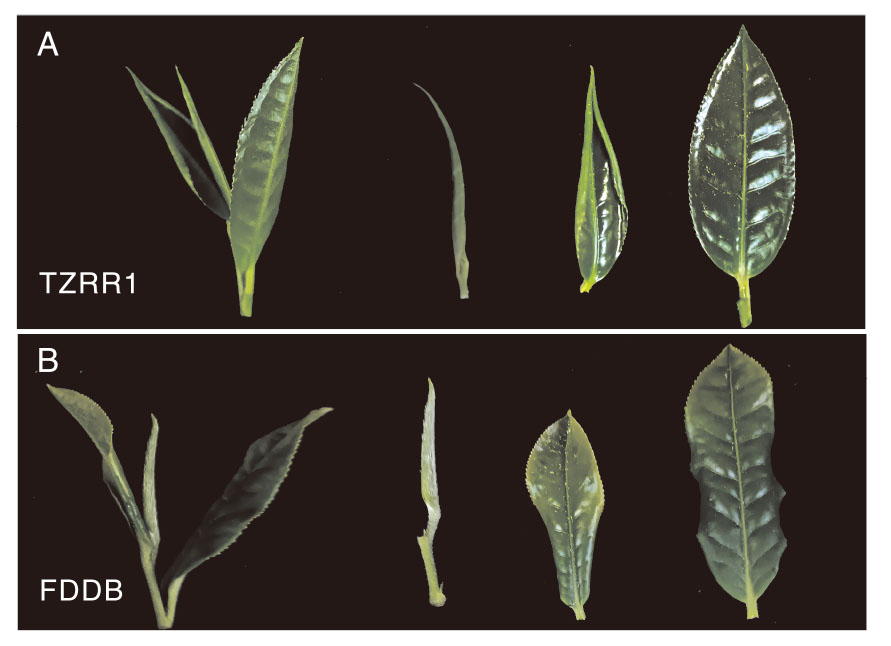
Fig.1 Phenotypes of buds and leaves in TZRR1 and FDDB A,One bud and two leaves of TZRR1; B,One bud and two leaves of FDDB.
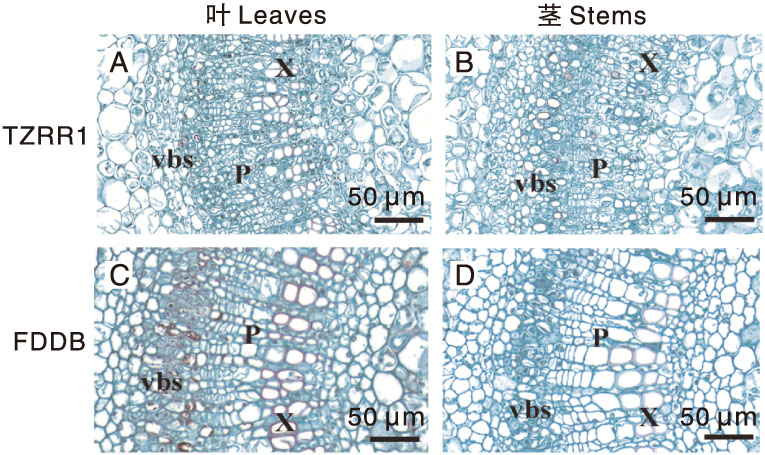
Fig.2 Anatomical structure of leaves and stems of TZRR1 and FDDB A, Cross-sectional lignification of TZRR1 leaves; B, Cross-sectional lignification of TZRR1 stems; C, Cross-sectional lignification of FDDB leaves; D, Cross-sectional lignification of FDDB stems. X, Xylem; vbs, Bundle sheath; P, Phloem.
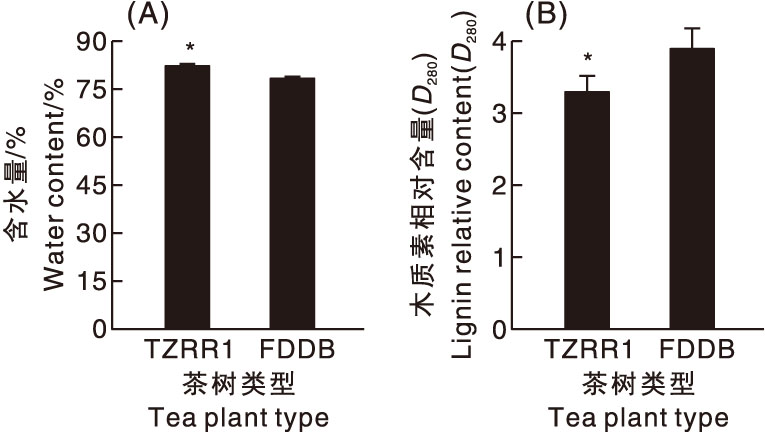
Fig.3 The water content and lignin relative content of fresh leaves of TZRR1 and FDDB “*”indicates a significant (p<0.05) difference between different tea plant types.
| 茶树类型 Tea plant type | 氨基酸含量/% Amino acids content/% | 茶多酚含量/% Tea polyphenols content/% | 酚氨比 Ratio of polyphenols to amino acids | 水浸出物含量/% Water extract content/% |
|---|---|---|---|---|
| TZRR1 | 3.26±0.22* | 21.97±1.30** | 6.74±0.06 | 44.05±1.07** |
| FDDB | 3.92±0.33 | 17.54±0.21 | 4.47±0.35 | 39.13±0.32 |
Table 1 Biochemical components of TZRR1与FDDB
| 茶树类型 Tea plant type | 氨基酸含量/% Amino acids content/% | 茶多酚含量/% Tea polyphenols content/% | 酚氨比 Ratio of polyphenols to amino acids | 水浸出物含量/% Water extract content/% |
|---|---|---|---|---|
| TZRR1 | 3.26±0.22* | 21.97±1.30** | 6.74±0.06 | 44.05±1.07** |
| FDDB | 3.92±0.33 | 17.54±0.21 | 4.47±0.35 | 39.13±0.32 |
| 茶树类型 Tea plant type | 外形得分 Shape score | 汤色得分 Color score | 香气得分 Aroma score | 滋味得分 Flavor score | 叶底得分 Infused leaves score | 总分 Total score |
|---|---|---|---|---|---|---|
| FDDB | 87.20±0.84 | 92.00±0.71 | 92.00±1.22 | 93.00±0.45 | 89.00±1.00 | 90.60 |
| TZRR1 | 89.20±1.09 | 92.20±0.83 | 93.50±0.50 | 92.00±0.79 | 92.00±0.71 | 91.80 |
Table 2 Sensory quality in steamed green samples of TZRR1 and FDDB
| 茶树类型 Tea plant type | 外形得分 Shape score | 汤色得分 Color score | 香气得分 Aroma score | 滋味得分 Flavor score | 叶底得分 Infused leaves score | 总分 Total score |
|---|---|---|---|---|---|---|
| FDDB | 87.20±0.84 | 92.00±0.71 | 92.00±1.22 | 93.00±0.45 | 89.00±1.00 | 90.60 |
| TZRR1 | 89.20±1.09 | 92.20±0.83 | 93.50±0.50 | 92.00±0.79 | 92.00±0.71 | 91.80 |
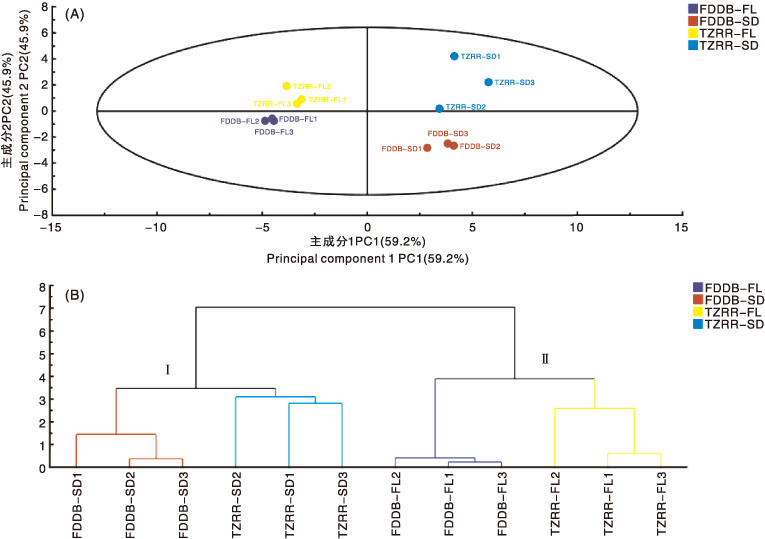
Fig.4 PCA and HCA in fresh leaves and steamed green samples of TZRR1 and FDDB A, Principal component analysis of aroma components in fresh leaves and steamed green samples of TZRR1 and FDDB; B, Hierarchical cluster analysis of aroma components in fresh leaves and steamed green samples of TZRR1 and FDDB. 1, 2, and 3 represent the three replicates of a set of samples.
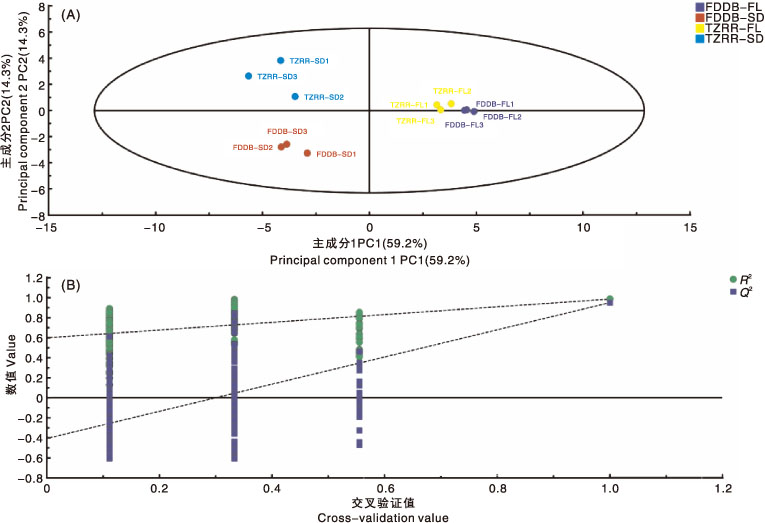
Fig.5 PLS-DA and displacement test in fresh leaves and steamed green samples of TZRR1 and FDDB A, Partial least squares discrimination analysis scores of aroma components in fresh leaves and steamed green samples of TZRR1 and FDDB; B, Cross-validation of aroma components in fresh leaves and steamed green samples of TZRR1 and FDDB. 1, 2, and 3 represent the three replicates of a set of samples.
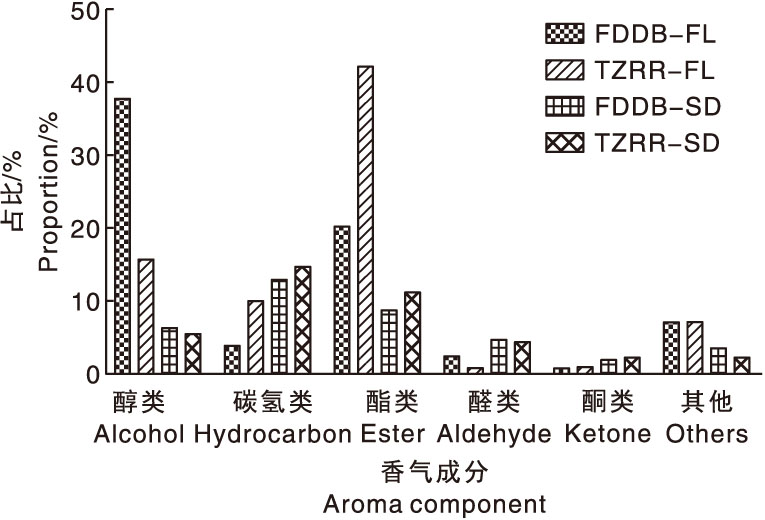
Fig.6 Aroma components in fresh leaves and steamed green samples of TZRR1 and FDDB
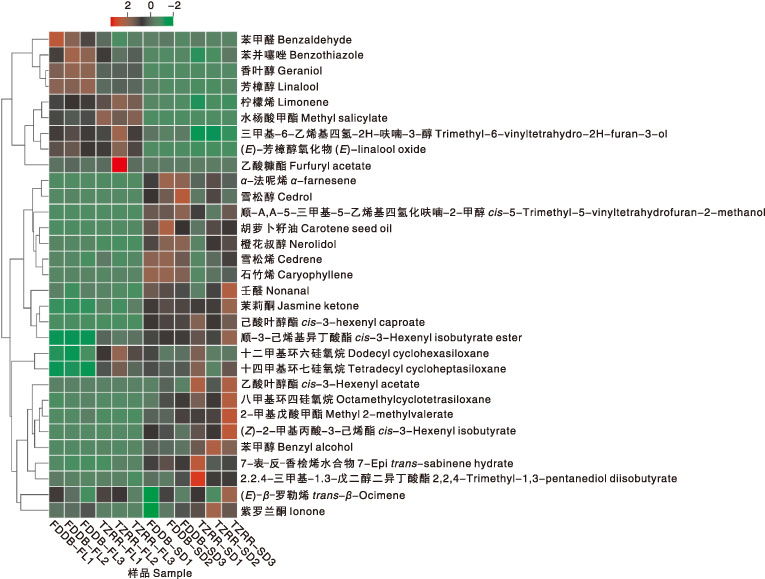
Fig.7 Clustering heat maps of relative contents in different aroma components of TZRR1 and FDDB 1, 2, and 3 represent the three replicates of a set of samples.
| [1] | 张霞, 徐淑浩, 龙雨蛟, 等. 静态顶空-气质联用法测定烟草中的挥发性香气成分[J]. 新型工业化, 2021, 11(2): 93-97. |
| ZHANG X, XU S H, LONG Y J, et al. Determination of volatile aroma components in tobacco by static headspace-gas chromatography-mass spectrometry[J]. The Journal of New Industrialization, 2021, 11(2): 93-97. | |
| [2] | 刘金仙, 傅仙玉, 卢莉, 等. 遮阴对‘佛手’茶树生长及品质的影响[J]. 中国农学通报, 2022, 38(13): 66-70. |
| LIU J X, FU X Y, LU L, et al. Effects of shading treatments on the growth and quality of Camellia sinensis ‘Foshou’[J]. Chinese Agricultural Science Bulletin, 2022, 38(13): 66-70. | |
| [3] | LU L T, CHEN H F, WANG X J, et al. Genome-level diversification of eight ancient tea populations in the Guizhou and Yunnan regions identifies candidate genes for core agronomic traits[J]. Horticulture Research, 2021, 8: 190. |
| [4] | 宛晓春. 茶叶生物化学[M]. 3版. 北京: 中国农业出版社, 2003. |
| [5] | 陈玉琼, 余志, 张芸, 等. 茶树品种、部位和嫩度对茶多糖含量和活性的影响[J]. 华中农业大学学报, 2005, 24(4): 406-409. |
| CHEN Y Q, YU Z, ZHANG Y, et al. Effect of tea cultivars and tenderness on tea polysaccharide[J]. Journal of Huazhong Agricultural University, 2005, 24(4): 406-409. | |
| [6] | 袴田胜弘, 前原三利, 潘根生. 伴随新梢的生育茶叶全氮量、游离氨基酸、咖啡碱、茶多酚的变化[J]. 茶叶, 1980, 6(1): 53. |
| KU T, QIAN Y, PAN G S. Changes of total nitrogen, free amino acids, caffeine and tea polyphenols in growing tea with new shoots[J]. Chaye Journal of Tea, 1980, 6(1): 53. | |
| [7] | 黄惠华, 袁春华. 茶树春梢生长期粗纤维含量的变化及与节茎长度的相关性[J]. 湖南农业大学学报(自然科学版), 1990, 16(4): 337-342. |
| HUANG H H, YUAN C H. The change of rude fibre content of growing tea shoots and correlation between rude fibre content and stem length[J]. Journal of Hunan Agricultural University(Natural Sciences), 1990, 16(4): 337-342. | |
| [8] | 周森杰, 黄创盛, 李春霖, 等. 不同香气类型龙井茶香气组成及其相关组分比较[J]. 浙江大学学报(农业与生命科学版), 2021, 47(2): 203-211. |
| ZHOU S J, HUANG C S, LI C L, et al. Aroma compositions and comparison of their related components of Longjing tea with different aroma types[J]. Journal of Zhejiang University(Agriculture and Life Sciences), 2021, 47(2): 203-211. | |
| [9] | 黄艳, 成浩. 茶树新梢“持嫩性”研究进展[J]. 安徽农业科学, 2011, 39(17): 10260-10262. |
| HUANG Y, CHENG H. Review on shoot tenderness-keeping ability of Camellia sinensis(L.) Kuntze[J]. Journal of Anhui Agricultural Sciences, 2011, 39(17): 10260-10262. | |
| [10] | SHEN J Z, WANG Y, DING Z T, et al. Metabolic analyses reveal growth characteristics of young tea shoots in spring[J]. Scientia Horticulturae, 2019, 246: 478-489. |
| [11] | ZHANG W J, GUO W L, HE C X, et al. Exploring the quality and application potential of the remaining tea stems after the postharvest tea leaves: the example of Lu’an Guapian tea (Camellia sinensis L.)[J]. Foods, 2022, 11(15): 2357. |
| [12] | 杨建坤. 木质素与茶树新梢嫩度关系的研究[D]. 杨凌: 西北农林科技大学, 2019. |
| YANG J K. Study on relation between lignin and shoot tendness of Camellia sinensis[D]. Yangling: Northwest A & F University, 2019. | |
| [13] | 王梦琪, 朱荫, 张悦, 等. 茶叶挥发性成分中关键呈香成分研究进展[J]. 食品科学, 2019, 40(23): 341-349. |
| WANG M Q, ZHU Y, ZHANG Y, et al. A review of recent research on key aroma compounds in tea[J]. Food Science, 2019, 40(23): 341-349. | |
| [14] | KANG Suyoung, 朱荫, 郑新强, 等. 不同季节绿茶香气成分的判别与聚类分析[J]. 食品科学, 2018, 39(14): 268-275. |
| SUYOUNG K, ZHU Y, ZHENG X Q, et al. Multivariate statistical analysis of volatiles compounds in green teas from different harvesting seasons[J]. Food Science, 2018, 39(14): 268-275. | |
| [15] | 郭建军, 周艺, 王小英, 等. 贵州不同产区代表绿茶的品质特征及香气组分分析[J]. 食品工业科技, 2021, 42(5): 78-84, 92. |
| GUO J J, ZHOU Y, WANG X Y, et al. Analysis of quality features and aroma components in Guizhou representative green tea[J]. Science and Technology of Food Industry, 2021, 42(5): 78-84, 92. | |
| [16] | 龙立梅, 宋沙沙, 李柰, 等. 3种名优绿茶特征香气成分的比较及种类判别分析[J]. 食品科学, 2015, 36(2): 114-119. |
| LONG L M, SONG S S, LI N, et al. Comparisons of characteristic aroma components and cultivar discriminant analysis of three varieties of famous green tea[J]. Food Science, 2015, 36(2): 114-119. | |
| [17] | 杨金玲. 西双版纳地区古茶树种质资源的遗传多样性分析[D]. 昆明: 云南大学, 2018. |
| YANG J L. Genetic diversity analysis of ancient tea plants in Xishuangbanna area[D]. Kunming: Yunnan University, 2018. | |
| [18] | 冯花, 王飞权, 陈荣冰, 等. 不同来源地茶树种质资源表型性状遗传多样性分析[J]. 热带作物学报, 2021, 42(10): 2758-2768. |
| FENG H, WANG F Q, CHEN R B, et al. Genetic diversity analysis of phenotypic characters of tea germplasm resources from different origins[J]. Chinese Journal of Tropical Crops, 2021, 42(10): 2758-2768. | |
| [19] | 陈湖芳. 基于基因组重测序揭示贵州古茶树起源与进化的研究[D]. 贵阳: 贵州大学, 2021. |
| CHEN H F. Study on the origin and evolution of ancient tea trees in Guizhou based on genome resequencing[D]. Guiyang: Guizhou University, 2021. | |
| [20] | 刘佳佳. 杜仲漆酶基因EuLAC1的克隆及功能分析[D]. 贵阳: 贵州大学, 2020. |
| LIU J J. Cloning and functional analysis of EuLAC1 encoding laccase in Eucommia ulmoides oliv[D]. Guiyang: Guizhou University, 2020. | |
| [21] | HUANG X Z, ZENG X F, CAI M L, et al. The MSI1 member OsRBAP1 gene, identified by a modified MutMap method, is required for rice height and spikelet fertility[J]. Plant Science, 2022, 320: 111201. |
| [22] | 范霞, 陈荣顺. SPME/GC-MS法结合电子鼻技术测定茶叶中的香气成分[J]. 检验检疫学刊, 2019, 29(2): 1-6, 12. |
| FAN X, CHEN R S. Determination of aromatic components in tea by SPME/GC-MS combined with electronic nose technology[J]. Journal of Inspection and Quarantine, 2019, 29(2): 1-6, 12. | |
| [23] | YAMASHITA H, KATAI H, OHNISHI T, et al. Tissue-dependent variation profiles of tea quality-related metabolites in new shoots of tea accessions[J]. Frontiers in Nutrition, 2021, 8: 659807. |
| [24] | 黎鹏. 基于GIS的临沧市古茶树资源保护与开发利用研究[D]. 银川: 宁夏大学, 2023. |
| LI P. Ancient tea tree resources in Lincang based on GIS research on protection, development and utilization[D]. Yinchuan: Ningxia University, 2023. | |
| [25] | YE J H, ZHANG Q, LI M Z, et al. Tea quality of the mysterious “Dahongpao mother tree” (Camellia sinensis)[J]. Foods, 2024, 13(10): 1548. |
| [26] | 黄艳. 茶树新梢嫩度的仪器测定方法和时空变化规律研究[D]. 北京: 中国农业科学院, 2011. |
| HUANG Y. Study on instrumental analysis techniques of tea shoot tendernes and its temporal and spatial variation[D]. Beijing: Chinese Academy of Agricultural Sciences, 2011. | |
| [27] | YANG H B, JIA X Y, GAO T, et al. The CsmiR397a-CsLAC17 module regulates lignin biosynthesis to balance the tenderness and gray blight resistance in young tea shoots[J]. Horticulture Research, 2024, 11(5): uhae085. |
| [28] | 高童. 茶树新梢嫩度变化过程中的转录组分析及CsLAC3介导木质素合成的功能研究[D]. 杨凌: 西北农林科技大学, 2023. |
| GAO T. Transcriptome analysis of tea shoot tenderness and functional study of CsLAC3 involved in lignin synthesis[D]. Yangling: Northwest A & F University, 2023. | |
| [29] | 杨兴荣, 矣兵, 李友勇, 等. 野生古茶树资源主要生化成分多样性分析[J]. 中国农学通报, 2016, 32(22): 133-139. |
| YANG X R, YI B, LI Y Y, et al. Diversity analysis of main biochemical components of wild ancient tea tree resources[J]. Chinese Agricultural Science Bulletin, 2016, 32(22): 133-139. | |
| [30] | 刘琴玲, 罗晓波, 周斌, 等. 雷波西宁古茶树试制红茶感官审评及生化成分分析[J]. 四川林业科技, 2022, 43(5): 102-106. |
| LIU Q L, LUO X B, ZHOU B, et al. Sensory quality evaluation and biochemical composition analysis of black tea made from Xining ancient tea trees in Leibo County[J]. Journal of Sichuan Forestry Science and Technology, 2022, 43(5): 102-106. | |
| [31] | 陈志云, 李杰, 冯雨, 等. 茶多酚生物活性及作用机制研究进展[J]. 食品工业科技, 2024, 45(13): 333-341. |
| CHEN Z Y, LI J, FENG Y, et al. Research progress on bioactivity and mechanism of tea polyphenols[J]. Science and Technology of Food Industry, 2024, 45(13): 333-341. | |
| [32] | 沈晓静, 字成庭, 辉绍良, 等. 咖啡化学成分及其生物活性研究进展[J]. 热带亚热带植物学报, 2021, 29(1): 112-122. |
| SHEN X J, ZI C T, HUI S L, et al. Advances on chemical components and biological activities of coffee[J]. Journal of Tropical and Subtropical Botany, 2021, 29(1): 112-122. | |
| [33] | 金磊, 练学燕, 杨植溢, 等. 基于HS-SPME-GC-MS分析不同茶树品种川红工夫红茶香气差异[J]. 食品工业科技, 2024, 45(19): 268-277. |
| JIN L, LIAN X Y, YANG Z Y, et al. Differences in aroma of Chuanhong congou black tea of different tea plant varieties based on HS-SPME-GC-MS analysis[J]. Science and Technology of Food Industry, 2024, 45(19): 268-277. | |
| [34] | 石亚丽, 朱荫, 马婉君, 等. 名优炒青绿茶挥发性成分研究进展[J]. 茶叶科学, 2021, 41(3): 285-301. |
| SHI Y L, ZHU Y, MA W J, et al. Research progress on the volatile compounds of premium roasted green tea[J]. Journal of Tea Science, 2021, 41(3): 285-301. | |
| [35] | SHI Y L, ZHU Y, MA W J, et al. Characterisation of the volatile compounds profile of Chinese pan-fried green tea in comparison with baked green tea, steamed green tea, and sun-dried green tea using approaches of molecular sensory science[J]. Current Research in Food Science, 2022, 5: 1098-1107. |
| [36] | 王梦琪. 基于SBSE-GC-MS的“清香”绿茶挥发性成分及其关键呈香成分研究[D]. 北京: 中国农业科学院, 2020. |
| WANG M Q. Study on volatiles and key aroma compounds of “fresh scent” green tea based on SBSE-GC-MS[D]. Beijing: Chinese Academy of Agricultural Sciences, 2020. | |
| [37] | YIN P, KONG Y S, LIU P P, et al. A critical review of key odorants in green tea: Identification and biochemical formation pathway[J]. Trends in Food Science & Technology, 2022, 129: 221-232. |
| [1] | WANG Huajie, CUI Hongchun, ZHAO Yun, HUANG Haitao, ZHU Lingping. Research progress on quality and safety evaluation systems for matcha [J]. Acta Agriculturae Zhejiangensis, 2026, 38(4): 809-823. |
| [2] | DU Chenfei, LI Wenjue, WEI Chunyan, CAI Danying, WANG Yuezhi, SHI Zebin, DAI Meisong, GAO Yongbin. Research progress on genetic map construction in fruit trees and QTL identification of major fruit quality traits [J]. Acta Agriculturae Zhejiangensis, 2026, 38(3): 609-620. |
| [3] | ZHANG Yue, WANG Jingran, ZHOU Qiang, CHEN Meiling, WANG Yanhong. Effects of exogenous spraying of folic acid on the folic acid content and quality of rice [J]. Acta Agriculturae Zhejiangensis, 2026, 38(2): 197-205. |
| [4] | LIU Jing, WANG Jian, HUANG Yu, WU Xiaohua, GUO Xuanhe, WANG Ying, LI Guojing, XU Xiaojiang. Indicator screening and model development for evaluating pumpkin fruit quality [J]. Acta Agriculturae Zhejiangensis, 2026, 38(2): 248-257. |
| [5] | XU Weimeng, XU Yan, CHEN Guoli. Comprehensive evaluation of waxy corn quality based on various analytical methods [J]. Acta Agriculturae Zhejiangensis, 2025, 37(9): 1840-1848. |
| [6] | ZHU Weijing, WU Jia, HONG Chunlai, ZHU Fengxiang, HONG Leidong, ZHANG Tao, ZHANG Shuo, ZHU Huifen. Effects of straw mulching on water, heat, fertility status of soil and yield and quality of flat peach [J]. Acta Agriculturae Zhejiangensis, 2025, 37(9): 1924-1932. |
| [7] | HE Shixiong, YANG Lei, QI Anmin, CHENG Ji, WANG Min, LI Yingkui, HONG Lin. Effects of interstock on leaf photosynthetic characteristics, physicochemical properties and fruit quality of three mandarin hybrids [J]. Acta Agriculturae Zhejiangensis, 2025, 37(8): 1680-1693. |
| [8] | ZHANG Shunchang, XU Jigen, FU Chengyue, PU Zhanxu, HU Lipeng, WU Hao, LI Junbing, XIN Liang, LEI Yuanjun. Effect of amino acid calcium spraying on peel cracking and quality of citrus hybrid Hongmeiren [J]. Acta Agriculturae Zhejiangensis, 2025, 37(8): 1706-1715. |
| [9] | YAN Fulin, LANG Yunhu, JIAN Yingquan, CHEN Xiongfei, WEI Wei, WANG Zhiwei, AN Jiangyong, REN Deqiang, DING Ning, WEI Shenghua. Response of yield and quality of Radix Ardisia to soil physiochemical properties [J]. Acta Agriculturae Zhejiangensis, 2025, 37(8): 1766-1775. |
| [10] | FENG Yiyu, REN Hongjie. Quantitative assessment of new quality productive forces in China’s livestock industry: based on panel data in 2007-2021 [J]. Acta Agriculturae Zhejiangensis, 2025, 37(8): 1805-1816. |
| [11] | HUANG Xianke, HUANG Xiaolin, ZHANG Xiang, LI Min, CAI Yilong, CHEN Ran. Effects of oyster shells on the growth performance of Penaeus vannamei and water quality, and microbial community characteristics on shell surfaces [J]. Acta Agriculturae Zhejiangensis, 2025, 37(7): 1441-1450. |
| [12] | WANG Chengyang, LIU Jieya, WU Minyi, XIE Boyi, HONG Decheng, LENG Feng, WU Guoquan. Effect of calcium treatment on the fruit quality of Reliance grape under waterlogging [J]. Acta Agriculturae Zhejiangensis, 2025, 37(7): 1451-1458. |
| [13] | ZHANG Yuanyuan, LI Meng. The estimation of new quality productive forces level, developmental retardation and cultivation path of feed enterprises [J]. Acta Agriculturae Zhejiangensis, 2025, 37(7): 1580-1594. |
| [14] | ZHANG Ruonan, MEN Xiaoming, QIN Kaipeng, WANG Binbin, WU Jie, DING Xiangbin, XU Ziwei, QI Keke. Comparative study on growth performance, carcass quality, meat performance and profitability of different crossbreed combinations of Lvjiahei pigs [J]. Acta Agriculturae Zhejiangensis, 2025, 37(6): 1203-1211. |
| [15] | XIANG Ying, CONG Jianmin, PAN Danhong, TAO Yonggang. Comprehensive evaluation of the growth process of different tomato varieties under spring organic greenhouse planting [J]. Acta Agriculturae Zhejiangensis, 2025, 37(6): 1252-1261. |
| Viewed | ||||||
|
Full text |
|
|||||
|
Abstract |
|
|||||

