Acta Agriculturae Zhejiangensis ›› 2026, Vol. 38 ›› Issue (4): 687-695.DOI: 10.3969/j.issn.1004-1524.20250246
• Horticultural Science • Previous Articles Next Articles
Karyotype analysis and fluorescence in situ hybridization localization of ribosomal DNA and telomeric repeats in root tip chromosomes of Hyacinthoides non-scripta
LIU Huanhuan1,2( ), SU Xiaoqian2, DU Wenkai1, HU Fengrong2,*()
- 1
School of Landscape Architecture ,Jiangsu Vocational College of Agriculture and Forestry Zhenjiang 212400, Jiangsu, China
2College of Landscape Architecture ,Nanjing Forestry University Nanjing 210037, China
-
Received:2025-03-27Online:2026-04-25Published:2026-05-08 -
Contact:HU Fengrong

CLC Number:
Cite this article
LIU Huanhuan, SU Xiaoqian, DU Wenkai, HU Fengrong. Karyotype analysis and fluorescence in situ hybridization localization of ribosomal DNA and telomeric repeats in root tip chromosomes of Hyacinthoides non-scripta[J]. Acta Agriculturae Zhejiangensis, 2026, 38(4): 687-695.
share this article
Add to citation manager EndNote|Ris|BibTeX
URL: http://www.zjnyxb.cn/EN/10.3969/j.issn.1004-1524.20250246
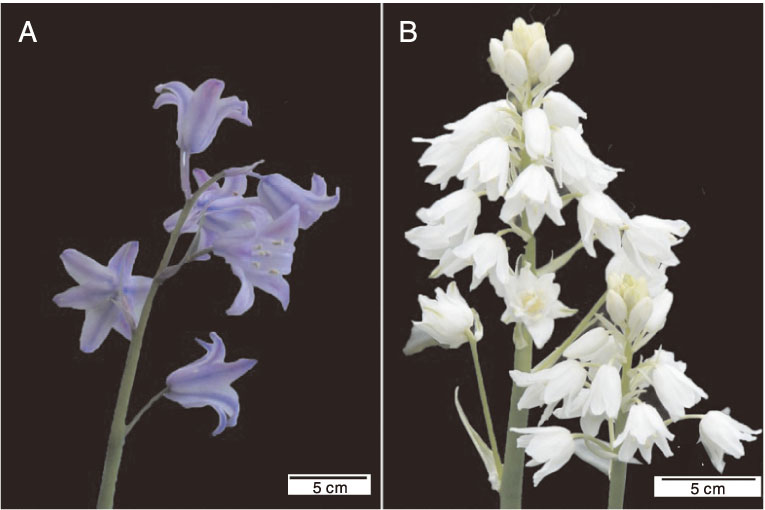
Fig.1 Hyacinthoides non-scripta with blue flower (A) and white flower (B)
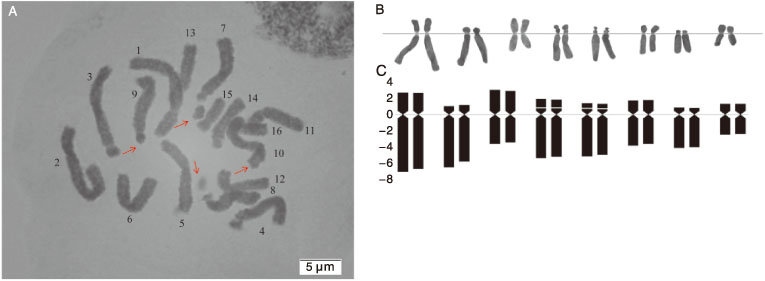
Fig.2 The metaphase chromosome (A), karyotype (B) and karyotype pattern (C) of Hyacinthoides non-scripta with white flowers The red arrows refer chromosomes with nucleolar organizing region. The same as Figure 3.
| 序号 No. | 相对长度/% Relative length/% | 臂比(长臂/ 短臂) Arm ratio (L/S) | 着丝粒 位置 Position of centromere | 着丝粒 指数/% Centromeric index/% | 相对长度 系数 Coefficient of relative length | 相对长 度类型 Type of relative length | ||
|---|---|---|---|---|---|---|---|---|
| 短臂 Short arm | 长臂 Long arm | 全长 Full length | ||||||
| 1 | 2.78±0.04 | 7.13±0.08 | 9.91±0.11 | 2.57±0.03 | sm | 28.02 | 1.59 | L |
| 2 | 2.70±0.06 | 6.79±0.26 | 9.49±0.20 | 2.52±0.15 | sm | 28.48 | 1.52 | L |
| 3 | 1.09±0.07 | 6.58±0.34 | 7.67±0.39 | 6.04±0.27 | st | 14.25 | 1.23 | M2 |
| 4 | 1.22±0.15 | 5.90±0.14 | 7.12±0.19 | 4.98±0.60 | st | 17.09 | 1.14 | M2 |
| 5 | 3.12±0.05 | 3.68±0.11 | 6.80±0.13 | 1.18±0.03 | m | 45.91 | 1.09 | M2 |
| 6 | 2.95±0.02 | 3.45±0.16 | 6.40±0.14 | 1.17±0.06 | m | 46.07 | 1.02 | M2 |
| 7 | 0.77±0.04 | 5.50±0.11 | (6.27±0.09)+(1.09±0.08) | 7.14±0.51 | t | 12.87 | 1.00 | M2 |
| 8 | 0.74±0.10 | 5.28±0.06 | (6.02±0.15)+(1.02±0.01) | 7.13±1.03 | t | 12.74 | 0.96 | M1 |
| 9 | 0.71±0.09 | 5.23±0.05 | (5.94±0.13)+(0.61±0.10) | 7.37±0.86 | t | 12.46 | 0.95 | M1 |
| 10 | 0.68±0.09 | 5.01±0.06 | (5.69±0.10)+(056±0.12) | 7.37±1.01 | t | 11.90 | 0.91 | M1 |
| 11 | 1.80±0.06 | 3.79±0.05 | 5.59±0.081 | 2.11±0.07 | sm | 32.22 | 0.89 | M1 |
| 12 | 1.82±0.04 | 3.66±0.02 | 5.48±0.03 | 2.01±0.05 | sm | 33.19 | 0.88 | M1 |
| 13 | 0.92±0.10 | 4.19±0.21 | 5.11±0.24 | 4.63±0.50 | st | 18.06 | 0.82 | M1 |
| 14 | 0.79±0.05 | 4.04±0.20 | 4.83±0.21 | 5.19±0.43 | st | 16.29 | 0.77 | M1 |
| 15 | 1.42±0.21 | 2.56±0.11 | 3.98±0.31 | 1.87±0.23 | sm | 35.71 | 0.64 | S |
| 16 | 1.31±0.14 | 2.38±0.10 | 3.69±0.22 | 1.85±0.16 | sm | 35.47 | 0.59 | S |
Table 1 Chromosome karyotype parameters of Hyacinthoides non-scripta with white flowers
| 序号 No. | 相对长度/% Relative length/% | 臂比(长臂/ 短臂) Arm ratio (L/S) | 着丝粒 位置 Position of centromere | 着丝粒 指数/% Centromeric index/% | 相对长度 系数 Coefficient of relative length | 相对长 度类型 Type of relative length | ||
|---|---|---|---|---|---|---|---|---|
| 短臂 Short arm | 长臂 Long arm | 全长 Full length | ||||||
| 1 | 2.78±0.04 | 7.13±0.08 | 9.91±0.11 | 2.57±0.03 | sm | 28.02 | 1.59 | L |
| 2 | 2.70±0.06 | 6.79±0.26 | 9.49±0.20 | 2.52±0.15 | sm | 28.48 | 1.52 | L |
| 3 | 1.09±0.07 | 6.58±0.34 | 7.67±0.39 | 6.04±0.27 | st | 14.25 | 1.23 | M2 |
| 4 | 1.22±0.15 | 5.90±0.14 | 7.12±0.19 | 4.98±0.60 | st | 17.09 | 1.14 | M2 |
| 5 | 3.12±0.05 | 3.68±0.11 | 6.80±0.13 | 1.18±0.03 | m | 45.91 | 1.09 | M2 |
| 6 | 2.95±0.02 | 3.45±0.16 | 6.40±0.14 | 1.17±0.06 | m | 46.07 | 1.02 | M2 |
| 7 | 0.77±0.04 | 5.50±0.11 | (6.27±0.09)+(1.09±0.08) | 7.14±0.51 | t | 12.87 | 1.00 | M2 |
| 8 | 0.74±0.10 | 5.28±0.06 | (6.02±0.15)+(1.02±0.01) | 7.13±1.03 | t | 12.74 | 0.96 | M1 |
| 9 | 0.71±0.09 | 5.23±0.05 | (5.94±0.13)+(0.61±0.10) | 7.37±0.86 | t | 12.46 | 0.95 | M1 |
| 10 | 0.68±0.09 | 5.01±0.06 | (5.69±0.10)+(056±0.12) | 7.37±1.01 | t | 11.90 | 0.91 | M1 |
| 11 | 1.80±0.06 | 3.79±0.05 | 5.59±0.081 | 2.11±0.07 | sm | 32.22 | 0.89 | M1 |
| 12 | 1.82±0.04 | 3.66±0.02 | 5.48±0.03 | 2.01±0.05 | sm | 33.19 | 0.88 | M1 |
| 13 | 0.92±0.10 | 4.19±0.21 | 5.11±0.24 | 4.63±0.50 | st | 18.06 | 0.82 | M1 |
| 14 | 0.79±0.05 | 4.04±0.20 | 4.83±0.21 | 5.19±0.43 | st | 16.29 | 0.77 | M1 |
| 15 | 1.42±0.21 | 2.56±0.11 | 3.98±0.31 | 1.87±0.23 | sm | 35.71 | 0.64 | S |
| 16 | 1.31±0.14 | 2.38±0.10 | 3.69±0.22 | 1.85±0.16 | sm | 35.47 | 0.59 | S |
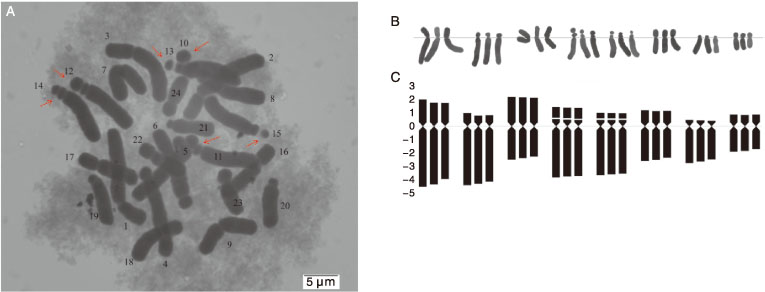
Fig.3 Metaphase chromosomes (A), karyotype (B), and idiogram (C) of Hyacinthoides non-scripta with blue flowers
| 序号 No. | 相对长度/% Relative length/% | 臂比(长臂/ 短臂) Arm ratio (L/S) | 着丝粒 位置 Position of centromere | 着丝粒 指数/% Centromeric index/% | 相对长度 系数 Coefficient of relative length | 相对长 度类型 Type of relative length | ||
|---|---|---|---|---|---|---|---|---|
| 短臂 Short arm | 长臂 Long arm | 全长 Full length | ||||||
| 1 | 2.00±0.09 | 4.49±0.07 | 6.49±0.14 | 2.26±0.08 | sm | 30.77 | 1.56 | L |
| 2 | 1.74±0.04 | 4.33±0.08 | 6.07±0.11 | 2.49±0.05 | sm | 28.67 | 1.46 | L |
| 3 | 1.74±0.03 | 3.93±0.09 | 5.66±0.09 | 2.27±0.07 | sm | 30.67 | 1.36 | L |
| 4 | 0.99±0.14 | 4.37±0.25 | 5.36±0.12 | 4.63±0.79 | st | 18.46 | 1.29 | L |
| 5 | 0.80±0.04 | 4.27±0.14 | 5.06±0.12 | 5.37±0.40 | st | 15.73 | 1.21 | M2 |
| 6 | 0.83±0.07 | 4.12±0.17 | 4.95±0.10 | 5.07±0.58 | st | 16.71 | 1.19 | M2 |
| 7 | 2.19±0.06 | 2.47±0.13 | 4.66±0.19 | 1.13±0.04 | m | 47.00 | 1.12 | M2 |
| 8 | 2.15±0.08 | 2.37±0.10 | 4.53±0.18 | 1.10±0.02 | m | 47.50 | 1.09 | M2 |
| 9 | 2.11±0.08 | 2.25±0.06 | 4.36±0.13 | 1.07±0.02 | m | 48.32 | 1.05 | M2 |
| 10 | 0.53±0.02 | 3.80±0.16 | (4.33±0.15)+(0.80±0.03) | 7.20±0.47 | t | 12.24 | 1.04 | M2 |
| 11 | 0.49±0.04 | 3.73±0.14 | (4.23±0.10)+(0.79±0.06) | 7.73±0.95 | t | 11.67 | 1.01 | M2 |
| 12 | 0.44±0.03 | 3.69±0.13 | (4.13±0.10)+(0.81±0.08) | 8.48±0.96 | t | 10.73 | 0.99 | M1 |
| 13 | 0.48±0.04 | 3.63±0.12 | (4.11±0.09)+(0.41±0.03) | 7.73±0.94 | t | 11.76 | 0.99 | M1 |
| 14 | 0.48±0.04 | 3.57±0.10 | (4.06±0.08)+(0.40±0.01) | 7.52±0.78 | t | 11.90 | 0.97 | M1 |
| 15 | 0.47±0.03 | 3.52±0.09 | (3.99±0.06)+(0.39±0.04) | 7.55±0.76 | t | 11.85 | 0.96 | M1 |
| 16 | 1.18±0.02 | 2.58±0.10 | 3.76±0.11 | 2.17±0.08 | sm | 31.50 | 0.90 | M1 |
| 17 | 1.13±0.08 | 2.50±0.21 | 3.63±0.19 | 2.27±0.31 | sm | 31.04 | 0.87 | M1 |
| 18 | 1.13±0.11 | 2.34±0.15 | 3.47±0.19 | 2.11±0.27 | sm | 32.63 | 0.83 | M1 |
| 19 | 0.47±0.08 | 2.73±0.05 | 3.21±0.06 | 6.07±0.94 | st | 14.76 | 0.77 | M1 |
| 20 | 0.44±0.01 | 2.61±0.03 | 3.06±0.02 | 5.90±0.23 | st | 14.50 | 0.73 | S |
| 21 | 0.41±0.03 | 2.46±0.08 | 2.87±0.08 | 6.05±0.46 | st | 14.30 | 0.69 | S |
| 22 | 0.88±0.01 | 1.89±0.13 | 2.76±0.14 | 2.15±0.13 | sm | 31.76 | 0.66 | S |
| 23 | 0.85±0.01 | 1.84±0.12 | 2.68±0.11 | 2.18±0.16 | sm | 31.55 | 0.64 | S |
| 24 | 0.87±0.05 | 1.70±0.05 | 2.57±0.10 | 1.96±0.05 | sm | 33.81 | 0.62 | S |
Table 2 Parameters of chromosome karyotype of Hyacinthoides non-scripta with blue flowers
| 序号 No. | 相对长度/% Relative length/% | 臂比(长臂/ 短臂) Arm ratio (L/S) | 着丝粒 位置 Position of centromere | 着丝粒 指数/% Centromeric index/% | 相对长度 系数 Coefficient of relative length | 相对长 度类型 Type of relative length | ||
|---|---|---|---|---|---|---|---|---|
| 短臂 Short arm | 长臂 Long arm | 全长 Full length | ||||||
| 1 | 2.00±0.09 | 4.49±0.07 | 6.49±0.14 | 2.26±0.08 | sm | 30.77 | 1.56 | L |
| 2 | 1.74±0.04 | 4.33±0.08 | 6.07±0.11 | 2.49±0.05 | sm | 28.67 | 1.46 | L |
| 3 | 1.74±0.03 | 3.93±0.09 | 5.66±0.09 | 2.27±0.07 | sm | 30.67 | 1.36 | L |
| 4 | 0.99±0.14 | 4.37±0.25 | 5.36±0.12 | 4.63±0.79 | st | 18.46 | 1.29 | L |
| 5 | 0.80±0.04 | 4.27±0.14 | 5.06±0.12 | 5.37±0.40 | st | 15.73 | 1.21 | M2 |
| 6 | 0.83±0.07 | 4.12±0.17 | 4.95±0.10 | 5.07±0.58 | st | 16.71 | 1.19 | M2 |
| 7 | 2.19±0.06 | 2.47±0.13 | 4.66±0.19 | 1.13±0.04 | m | 47.00 | 1.12 | M2 |
| 8 | 2.15±0.08 | 2.37±0.10 | 4.53±0.18 | 1.10±0.02 | m | 47.50 | 1.09 | M2 |
| 9 | 2.11±0.08 | 2.25±0.06 | 4.36±0.13 | 1.07±0.02 | m | 48.32 | 1.05 | M2 |
| 10 | 0.53±0.02 | 3.80±0.16 | (4.33±0.15)+(0.80±0.03) | 7.20±0.47 | t | 12.24 | 1.04 | M2 |
| 11 | 0.49±0.04 | 3.73±0.14 | (4.23±0.10)+(0.79±0.06) | 7.73±0.95 | t | 11.67 | 1.01 | M2 |
| 12 | 0.44±0.03 | 3.69±0.13 | (4.13±0.10)+(0.81±0.08) | 8.48±0.96 | t | 10.73 | 0.99 | M1 |
| 13 | 0.48±0.04 | 3.63±0.12 | (4.11±0.09)+(0.41±0.03) | 7.73±0.94 | t | 11.76 | 0.99 | M1 |
| 14 | 0.48±0.04 | 3.57±0.10 | (4.06±0.08)+(0.40±0.01) | 7.52±0.78 | t | 11.90 | 0.97 | M1 |
| 15 | 0.47±0.03 | 3.52±0.09 | (3.99±0.06)+(0.39±0.04) | 7.55±0.76 | t | 11.85 | 0.96 | M1 |
| 16 | 1.18±0.02 | 2.58±0.10 | 3.76±0.11 | 2.17±0.08 | sm | 31.50 | 0.90 | M1 |
| 17 | 1.13±0.08 | 2.50±0.21 | 3.63±0.19 | 2.27±0.31 | sm | 31.04 | 0.87 | M1 |
| 18 | 1.13±0.11 | 2.34±0.15 | 3.47±0.19 | 2.11±0.27 | sm | 32.63 | 0.83 | M1 |
| 19 | 0.47±0.08 | 2.73±0.05 | 3.21±0.06 | 6.07±0.94 | st | 14.76 | 0.77 | M1 |
| 20 | 0.44±0.01 | 2.61±0.03 | 3.06±0.02 | 5.90±0.23 | st | 14.50 | 0.73 | S |
| 21 | 0.41±0.03 | 2.46±0.08 | 2.87±0.08 | 6.05±0.46 | st | 14.30 | 0.69 | S |
| 22 | 0.88±0.01 | 1.89±0.13 | 2.76±0.14 | 2.15±0.13 | sm | 31.76 | 0.66 | S |
| 23 | 0.85±0.01 | 1.84±0.12 | 2.68±0.11 | 2.18±0.16 | sm | 31.55 | 0.64 | S |
| 24 | 0.87±0.05 | 1.70±0.05 | 2.57±0.10 | 1.96±0.05 | sm | 33.81 | 0.62 | S |
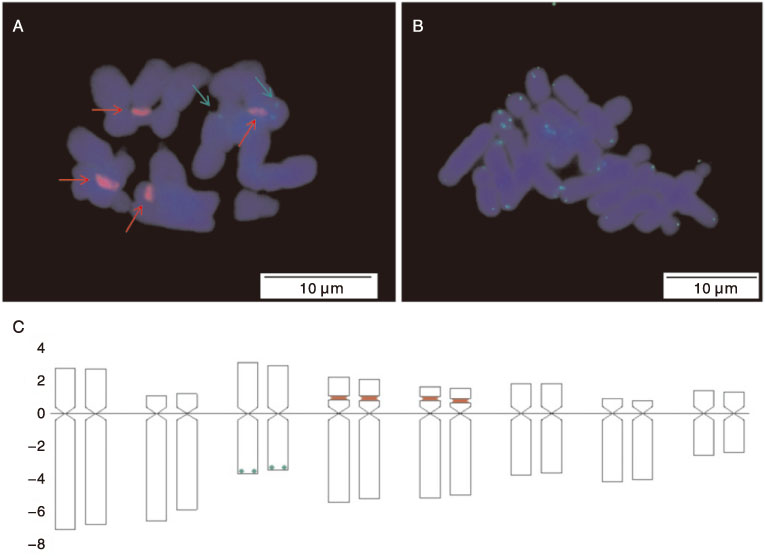
Fig.4 Fluorescence in situ hybridization results of mid-stage chromosomes in Hyacinthoides non-scripta with white flower A, The distribution of 45S rDNA (red arrow) and 5S rDNA (green arrow) signals on the chromosomes; B, The distribution of telomere repeat signal on the chromosome; C, FISH karyotype pattern diagram.
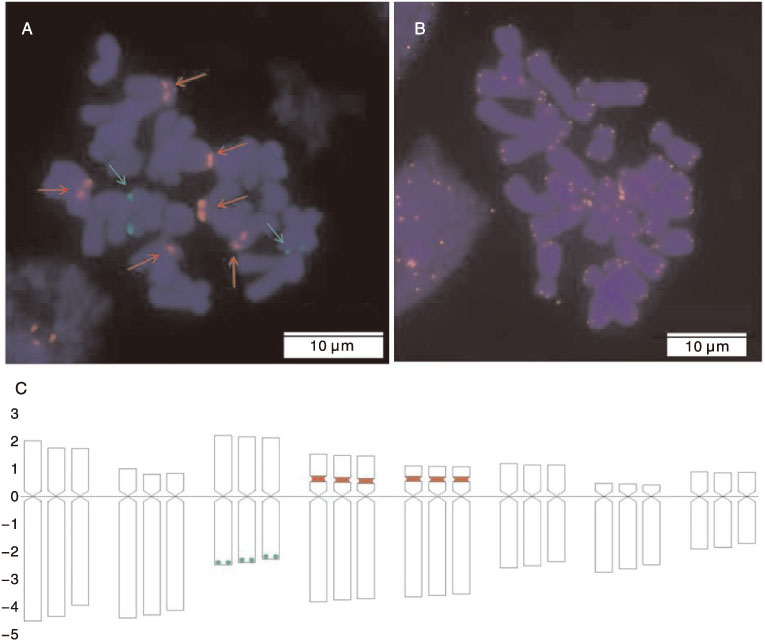
Fig.5 Fluorescence in situ hybridization results of mid-stage chromosomes in Hyacinthoides non-scripta with blue flower A, The distribution of 45S rDNA (red arrow) and 5S rDNA (green arrow) signals on the chromosomes; B, The distribution of telomere repeat signal on the chromosome; C, FISH karyotype pattern diagram.
| [1] | 何丽娟. 不同种类及种源枸杞染色体核型分析[D]. 兰州: 甘肃农业大学, 2016. |
| HE L J. Chromosome karyotype analysis on different species and provenance of Lycium L.[D]. Lanzhou: Gansu Agricultural University, 2016. | |
| [2] | ANJALI M, SRIVASTAVA A K. Karyological studies in twelve accessions of Carthamus tinctoriusi[J]. Caryologia, 2012, 65(1): 1-6. |
| [3] | 程诗袁, 何佳丽, 韩福彬, 等. 麝香百合和‘雪皇后’的形态特征、核型及ISSR标记分析[J]. 生物技术通报, 2025, 41(3): 219-229. |
| CHENG S Y, HE J L, HAN F B, et al. Morphological characterization, karyotype and ISSR marker of Lilium longiflorum and L. longiflorum ‘Snow Queen’[J]. Biotechnology Bulletin, 2025, 41(3): 219-229. | |
| [4] | JIANG J M. Fluorescence in situ hybridization in plants: recent developments and future applications[J]. Chromosome Research, 2019, 27(3): 153-165. |
| [5] | 徐延浩, 李立家. 花生45S rDNA和5S rDNA的染色体定位研究[J]. 武汉植物学研究, 2010(6): 649-653. |
| XU Y H, LI L J. Physical mapping of the 45S rDNA and 5S rDNA in the peanut (Arachis hypogaea L.)[J]. Journal of Wuhan Botanical Research, 2010(6): 649-653. | |
| [6] | 王晶, 杨冰洁, 潘隆应, 等. 基于荧光原位杂交技术的紫薇属植物核型分析[J]. 西北植物学报, 2016, 36(1): 30-36. |
| WANG J, YANG B J, PAN L Y, et al. Karyotype analysis of Lagerstroemia species with 45S rDNA-FISH[J]. Acta Botanica Boreali-Occidentalia Sinica, 2016, 36(1): 30-36. | |
| [7] | 卿秋静. 九种百合属植物核型及遗传变异研究[D]. 雅安: 四川农业大学, 2011. |
| QING Q J. Karyotypes and genetic variations in 9 species of Lilium[D]. Ya’an: Sichuan Agricultural University, 2011. | |
| [8] | 黄想安. 中国石蒜属部分种的核型研究及其遗传关系的AFLP分析[D]. 开封: 河南大学, 2010. |
| HUANG X A. The karyotype study and the AFLP analysis of genetic relationships of some Lycoris species in China[D]. Kaifeng: Henan University, 2010. | |
| [9] | 屈连伟. 郁金香属植物细胞学观察及多倍体种质创新研究[D]. 沈阳: 沈阳农业大学, 2018. |
| QU L W. Cytological observation and polyploid germplasm innovation in the genus Tulipa[D]. Shenyang: Shenyang Agricultural University, 2018. | |
| [10] | EBUELE V O, SANTORO A, THOSS V. Phosphorus speciation by 31P NMR spectroscopy in bracken [Pteridium aquilinum(L.) Kuhn] and bluebell [Hyacinthoides non-scripta (L.) Chouard ex Rothm.] dominated semi-natural upland soil[J]. Science of the Total Environment, 2016, 566: 1318-1328. |
| [11] | RAHEEM D J, TAWFIKE A F, ABDELMOHSEN U R, et al. Application of metabolomics and molecular networking in investigating the chemical profile and antitrypanosomal activity of British bluebells (Hyacinthoides non-scripta)[J]. Scientific Reports, 2019, 9: 2547. |
| [12] | LEVAN A, FREDGA K, SANDBERG A A. Nomenclature for centromeric position on chromosomes[J]. Hereditas, 2009, 52(2): 201-220. |
| [13] | STEBBINS G L. Chromosomals evolution in high plants[M]. London: Edward Arnold, 1971: 85-105. |
| [14] | 李懋学. 作物染色体及其研究技术[M]. 北京: 中国农业出版社, 1996. |
| [15] | ARANO H. Cytological studies in subfamily carduoideae (Compositae) of Japan XVI[J]. Shokubutsugaku Zasshi, 1964, 77(908): 59-65. |
| [16] | SZINAY D, WIJNKER E, VAN DEN BERG R, et al. Chromosome evolution in Solanum traced by cross-species BAC-FISH[J]. New Phytologist, 2012, 195(3): 688-698. |
| [17] | 房磊, 杨斌, 张伟娜, 等. 异源三倍体为父本的百合杂交后代倍性调查及FISH分析[J]. 分子植物育种, 2014(1): 138-143. |
| FANG L, YANG B, ZHANG W N, et al. The ploidy level investigation and FISH analysis of the progenies from allotriploid Lilium as male[J]. Molecular Plant Breeding, 2014(1): 138-143. | |
| [18] | 贾美丽. 葡萄风信子离体繁殖与多倍体诱导研究[D]. 杨凌: 西北农林科技大学, 2010. |
| JIA M L. Study on in vitro propagation and polyploid induction of grape Hyacinthus orientalis[D]. Yangling: Northwest A & F University, 2010. | |
| [19] | SAHA P, SARKAR D, KUNDU A, et al. Karyotype analysis and chromosomal evolution in Asian species of Corchorus(Malvaceae s. l.)[J]. Genetic Resources and Crop Evolution, 2014, 61(6): 1173-1188. |
| [20] | 王中轩, 魏迟, 廉玉芹, 等. 中国原产4种野生百合的核型分析[J]. 园艺学报, 2013, 40(11): 2207-2212. |
| WANG Z X, WEI C, LIAN Y Q, et al. Karyotype analysis of four Lilium species from China[J]. Acta Horticulturae Sinica, 2013, 40(11): 2207-2212. | |
| [21] | 阳亚迪. 百合属部分物种的分子细胞遗传学和系统进化分析[D]. 株洲: 湖南工业大学, 2024. |
| YANG Y D. Molecular cytogenetic and phylogenetic analysis of some species of Lilium[D]. Zhuzhou: Hunan University of Technology, 2024. | |
| [22] | 杨雪珍, 贾月慧, 张克中, 等. 部分中国野生百合的核型分析[J]. 西北植物学报, 2013, 33(5): 922-930. |
| YANG X Z, JIA Y H, ZHANG K Z, et al. Karyotype analysis of several wild lilies native to China[J]. Acta Botanica Boreali-Occidentalia Sinica, 2013, 33(5): 922-930. | |
| [23] | 王娟. 基于染色体原位杂交的中国樱桃核型分析及其基因组构成的初步探究[D]. 雅安: 四川农业大学, 2018. |
| WANG J. Karyotype analysis and preliminary investigation of genome composition of Chinese cherry based on chromosome in situ hybridization[D]. Ya’an: Sichuan Agricultural University, 2018. | |
| [24] | 佘朝文, 罗嫣. 云实的45S rDNA检测和核型分析[J]. 西北植物学报, 2019, 39(5): 911-916. |
| SHE C W, LUO Y. Detection of 45S rDNA and karyotype analysis of Caesalpinia decapetala(Roth) alston[J]. Acta Botanica Boreali-Occidentalia Sinica, 2019, 39(5): 911-916. | |
| [25] | 谭炯锐, 王晶, 高华北, 等. 中国17种蔷薇属植物45S和5S的rDNA分布研究[J]. 西北植物学报, 2019, 39(8): 1333-1343. |
| TAN J R, WANG J, GAO H B, et al. Distribution of 45S and 5S rDNA in 17 Rosa species of China[J]. Acta Botanica Boreali-Occidentalia Sinica, 2019, 39(8): 1333-1343. | |
| [26] | ROSATO M, MORENO-SAIZ J C, GALIÁN J A, et al. Evolutionary site-number changes of ribosomal DNA loci during speciation: complex scenarios of ancestral and more recent polyploid events[J]. AoB Plants, 2015, 7: plv135. |
| [27] | 产祝龙, 向林, 王艳平. 郁金香种质资源、育种进展及种球国产化思考[J]. 华中农业大学学报, 2022, 41(2): 144-150. |
| CHAN Z L, XIANG L, WANG Y P. Germplasm, breeding and localization of tulip bulbs in China[J]. Journal of Huazhong Agricultural University, 2022, 41(2): 144-150. |
| [1] | LEI Zhiwei, LI Xinxin, XU Heng, ZHANG Heng, ZHU Ying, ZHANG Hua. Identification of QTLs for stem borer resistance using chromosome segment substitution lines in rice [J]. Acta Agriculturae Zhejiangensis, 2025, 37(3): 530-537. |
| [2] | ZHANG Huanhuan, FAN Tingxiu, GAO Shuangcheng, FAN Bingyou, SHI Guo’an. Comparative analysis of karyotype, anther morphology and pollen characteristics for two varieties of tree peony cut flower [J]. Acta Agriculturae Zhejiangensis, 2025, 37(2): 329-337. |
| [3] | JIAN Jieliang, GU Huaxin, GU Zhurong, WANG Baolian, FAN Fenglin, WU Xuguo, XU Xiaojun. Morphological character and karyotype of Acrossocheilus kreyenbergii [J]. Acta Agriculturae Zhejiangensis, 2025, 37(10): 2042-2048. |
| [4] | LIU Fangfang, CHEN Honglin, LIU Feng, XU Xiaojun, HUANG Fuyong, LOU Bao, QIAN Haojie. Comparative analysis of chromosome karyotype between male and female red claw crayfish (Cherax quadricarinatus) [J]. Acta Agriculturae Zhejiangensis, 2023, 35(9): 2079-2089. |
| [5] | YANG Mei, HU Xiaolan, SHEN Tao, TAN Kang, LIU Dailing, QIU Hongbo. Construction of single fragment substitution lines of maize 8th chromosome and sreening of resistant maize germplasm to gray leaf spot [J]. Acta Agriculturae Zhejiangensis, 2021, 33(3): 383-389. |
| [6] | LONG Haimei, ZHANG Nanqing, LI Zongyan, WANG Qin, FU Chao. Study on chromosome technique of Calendula officinalis and its karyotype [J]. , 2020, 32(1): 86-92. |
| [7] | SU Xiaoqian, WANG Fei, HU Fengrong. Karyotype analysis of 3 diploid hyacinth cultivars [J]. , 2019, 31(9): 1509-1515. |
| [8] | SUN Bo, TIAN Yu-xiao, XIA Xue, LI Meng-jiao, LUO Ling-ling, LI Lin, CHEN Qing, ZHANG Fen, TANG Hao-ru. Optimization of chromosome preparation and karyotype analysis of leaf beet [J]. , 2016, 28(10): 1704-1710. |
| [9] | CHEN Liu, YU Bin, NI Zheng, HUA Jiong\|gang, YE Wei\|cheng, YUN Tao, Zhang Cun*. Construction and characterization of a recombinant duck enteritis virus expressing E protein of duck Tembusu virus [J]. , 2015, 27(11): 1889-. |
| [10] | YU yu;LIANG Cheng-yuan;LIU Yan;LI Wei-lin*. Observation on biological characters of autopolyploid of mint (Mentha haplocalyx Briq.) [J]. , 2013, 25(4): 0-763. |
| [11] | LYU Gui-hua;XYU Xiu;LU Hua-bing;GUO Guo-jin*. Primary research on corn haploid breeding [J]. , 2012, 24(6): 0-960. |
| Viewed | ||||||
|
Full text |
|
|||||
|
Abstract |
|
|||||

