浙江农业学报 ›› 2026, Vol. 38 ›› Issue (4): 687-695.DOI: 10.3969/j.issn.1004-1524.20250246
蓝铃花根尖染色体核型分析及其核糖体DNA与端粒重复序列的荧光原位杂交定位
刘换换1,2( ), 苏晓倩2, 杜文凯1, 胡凤荣2,*()
- 1
江苏农林职业技术学院 风景园林学院 江苏 镇江 212400
2南京林业大学 风景园林学院 江苏 南京 210037
-
收稿日期:2025-03-27出版日期:2026-04-25发布日期:2026-05-08 -
作者简介:胡凤荣,E-mail: hufengrong2003@sina.com
刘换换,研究方向为园林植物遗传育种。E-mail: lhh91@jsafc.edu.cn -
通讯作者:胡凤荣 -
基金资助:江苏农林职业技术学院青年扶持项目(2022kj07)
Karyotype analysis and fluorescence in situ hybridization localization of ribosomal DNA and telomeric repeats in root tip chromosomes of Hyacinthoides non-scripta
LIU Huanhuan1,2(), SU Xiaoqian2, DU Wenkai1, HU Fengrong2,*()
- 1
School of Landscape Architecture ,Jiangsu Vocational College of Agriculture and Forestry Zhenjiang 212400, Jiangsu, China
2College of Landscape Architecture ,Nanjing Forestry University Nanjing 210037, China
-
Received:2025-03-27Published:2026-04-25Online:2026-05-08 -
Contact:HU Fengrong

摘要:
为从细胞学角度解析不同花色蓝铃花品种间的亲缘关系与进化程度,并为倍性育种提供细胞学依据,以白色和蓝色蓝铃花品种为材料,采用根尖压片法进行核型分析并绘制核型模式图,同时以45S rDNA和5S rDNA为探针进行双色荧光原位杂交(FISH),并对染色体端粒重复序列进行定位。核型分析结果显示:白色蓝铃花为二倍体,染色体数量2n=2x=16,平均臂比为4.07,核型不对称系数为75.18%,核型公式为2n=2x=16=2m+6sm+4st+4t(sat);蓝色蓝铃花为三倍体,染色体数量2n=3x=24,平均臂比为4.27,核型不对称系数为75.20%,核型公式为2n=3x=24=3m+9sm+6st+6t(sat)。2个品种均属3B核型,各具2对在短臂末端带有随体的t(端部着丝粒)染色体。FISH定位结果表明:45S rDNA信号位于染色体次缢痕区域,5S rDNA信号位于m(中部着丝粒)染色体的长臂顶端;端粒重复序列信号分布于所有染色体两端,在染色体长短臂上无特异性分布。白色蓝铃花检测到4个45S rDNA位点和2个5S rDNA位点;蓝色蓝铃花检测到6个45S rDNA位点和3个5S rDNA位点。核型分析与FISH定位结果一致表明,蓝色蓝铃花是由白色蓝铃花染色体组完整加倍形成,该结果为蓝铃花倍性育种提供了细胞学层面的理论依据。
中图分类号:
引用本文
刘换换, 苏晓倩, 杜文凯, 胡凤荣. 蓝铃花根尖染色体核型分析及其核糖体DNA与端粒重复序列的荧光原位杂交定位[J]. 浙江农业学报, 2026, 38(4): 687-695.
LIU Huanhuan, SU Xiaoqian, DU Wenkai, HU Fengrong. Karyotype analysis and fluorescence in situ hybridization localization of ribosomal DNA and telomeric repeats in root tip chromosomes of Hyacinthoides non-scripta[J]. Acta Agriculturae Zhejiangensis, 2026, 38(4): 687-695.
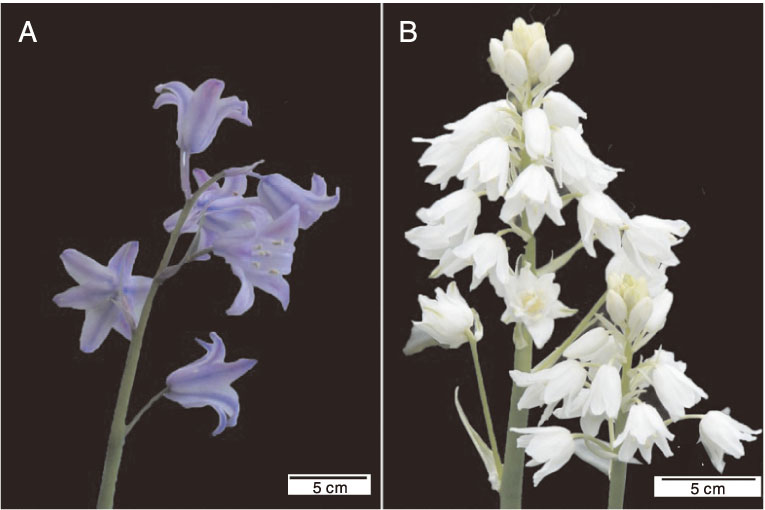
图1 蓝色蓝铃花(A)与白色蓝铃花(B)
Fig.1 Hyacinthoides non-scripta with blue flower (A) and white flower (B)
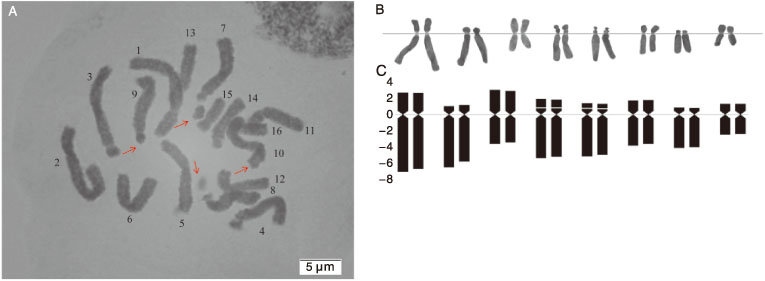
图2 白色蓝铃花的中期染色体(A)、核型(B)与核型模式图(C) 红色箭头指示含核仁组织区(NOR)的染色体。图3同。
Fig.2 The metaphase chromosome (A), karyotype (B) and karyotype pattern (C) of Hyacinthoides non-scripta with white flowers The red arrows refer chromosomes with nucleolar organizing region. The same as Figure 3.
| 序号 No. | 相对长度/% Relative length/% | 臂比(长臂/ 短臂) Arm ratio (L/S) | 着丝粒 位置 Position of centromere | 着丝粒 指数/% Centromeric index/% | 相对长度 系数 Coefficient of relative length | 相对长 度类型 Type of relative length | ||
|---|---|---|---|---|---|---|---|---|
| 短臂 Short arm | 长臂 Long arm | 全长 Full length | ||||||
| 1 | 2.78±0.04 | 7.13±0.08 | 9.91±0.11 | 2.57±0.03 | sm | 28.02 | 1.59 | L |
| 2 | 2.70±0.06 | 6.79±0.26 | 9.49±0.20 | 2.52±0.15 | sm | 28.48 | 1.52 | L |
| 3 | 1.09±0.07 | 6.58±0.34 | 7.67±0.39 | 6.04±0.27 | st | 14.25 | 1.23 | M2 |
| 4 | 1.22±0.15 | 5.90±0.14 | 7.12±0.19 | 4.98±0.60 | st | 17.09 | 1.14 | M2 |
| 5 | 3.12±0.05 | 3.68±0.11 | 6.80±0.13 | 1.18±0.03 | m | 45.91 | 1.09 | M2 |
| 6 | 2.95±0.02 | 3.45±0.16 | 6.40±0.14 | 1.17±0.06 | m | 46.07 | 1.02 | M2 |
| 7 | 0.77±0.04 | 5.50±0.11 | (6.27±0.09)+(1.09±0.08) | 7.14±0.51 | t | 12.87 | 1.00 | M2 |
| 8 | 0.74±0.10 | 5.28±0.06 | (6.02±0.15)+(1.02±0.01) | 7.13±1.03 | t | 12.74 | 0.96 | M1 |
| 9 | 0.71±0.09 | 5.23±0.05 | (5.94±0.13)+(0.61±0.10) | 7.37±0.86 | t | 12.46 | 0.95 | M1 |
| 10 | 0.68±0.09 | 5.01±0.06 | (5.69±0.10)+(056±0.12) | 7.37±1.01 | t | 11.90 | 0.91 | M1 |
| 11 | 1.80±0.06 | 3.79±0.05 | 5.59±0.081 | 2.11±0.07 | sm | 32.22 | 0.89 | M1 |
| 12 | 1.82±0.04 | 3.66±0.02 | 5.48±0.03 | 2.01±0.05 | sm | 33.19 | 0.88 | M1 |
| 13 | 0.92±0.10 | 4.19±0.21 | 5.11±0.24 | 4.63±0.50 | st | 18.06 | 0.82 | M1 |
| 14 | 0.79±0.05 | 4.04±0.20 | 4.83±0.21 | 5.19±0.43 | st | 16.29 | 0.77 | M1 |
| 15 | 1.42±0.21 | 2.56±0.11 | 3.98±0.31 | 1.87±0.23 | sm | 35.71 | 0.64 | S |
| 16 | 1.31±0.14 | 2.38±0.10 | 3.69±0.22 | 1.85±0.16 | sm | 35.47 | 0.59 | S |
表1 白色蓝铃花染色体核型参数
Table 1 Chromosome karyotype parameters of Hyacinthoides non-scripta with white flowers
| 序号 No. | 相对长度/% Relative length/% | 臂比(长臂/ 短臂) Arm ratio (L/S) | 着丝粒 位置 Position of centromere | 着丝粒 指数/% Centromeric index/% | 相对长度 系数 Coefficient of relative length | 相对长 度类型 Type of relative length | ||
|---|---|---|---|---|---|---|---|---|
| 短臂 Short arm | 长臂 Long arm | 全长 Full length | ||||||
| 1 | 2.78±0.04 | 7.13±0.08 | 9.91±0.11 | 2.57±0.03 | sm | 28.02 | 1.59 | L |
| 2 | 2.70±0.06 | 6.79±0.26 | 9.49±0.20 | 2.52±0.15 | sm | 28.48 | 1.52 | L |
| 3 | 1.09±0.07 | 6.58±0.34 | 7.67±0.39 | 6.04±0.27 | st | 14.25 | 1.23 | M2 |
| 4 | 1.22±0.15 | 5.90±0.14 | 7.12±0.19 | 4.98±0.60 | st | 17.09 | 1.14 | M2 |
| 5 | 3.12±0.05 | 3.68±0.11 | 6.80±0.13 | 1.18±0.03 | m | 45.91 | 1.09 | M2 |
| 6 | 2.95±0.02 | 3.45±0.16 | 6.40±0.14 | 1.17±0.06 | m | 46.07 | 1.02 | M2 |
| 7 | 0.77±0.04 | 5.50±0.11 | (6.27±0.09)+(1.09±0.08) | 7.14±0.51 | t | 12.87 | 1.00 | M2 |
| 8 | 0.74±0.10 | 5.28±0.06 | (6.02±0.15)+(1.02±0.01) | 7.13±1.03 | t | 12.74 | 0.96 | M1 |
| 9 | 0.71±0.09 | 5.23±0.05 | (5.94±0.13)+(0.61±0.10) | 7.37±0.86 | t | 12.46 | 0.95 | M1 |
| 10 | 0.68±0.09 | 5.01±0.06 | (5.69±0.10)+(056±0.12) | 7.37±1.01 | t | 11.90 | 0.91 | M1 |
| 11 | 1.80±0.06 | 3.79±0.05 | 5.59±0.081 | 2.11±0.07 | sm | 32.22 | 0.89 | M1 |
| 12 | 1.82±0.04 | 3.66±0.02 | 5.48±0.03 | 2.01±0.05 | sm | 33.19 | 0.88 | M1 |
| 13 | 0.92±0.10 | 4.19±0.21 | 5.11±0.24 | 4.63±0.50 | st | 18.06 | 0.82 | M1 |
| 14 | 0.79±0.05 | 4.04±0.20 | 4.83±0.21 | 5.19±0.43 | st | 16.29 | 0.77 | M1 |
| 15 | 1.42±0.21 | 2.56±0.11 | 3.98±0.31 | 1.87±0.23 | sm | 35.71 | 0.64 | S |
| 16 | 1.31±0.14 | 2.38±0.10 | 3.69±0.22 | 1.85±0.16 | sm | 35.47 | 0.59 | S |
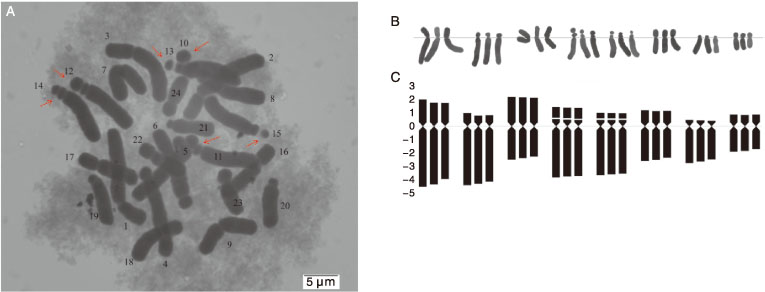
图3 蓝色蓝铃花中期染色体(A)、核型(B)和核型模式图(C)
Fig.3 Metaphase chromosomes (A), karyotype (B), and idiogram (C) of Hyacinthoides non-scripta with blue flowers
| 序号 No. | 相对长度/% Relative length/% | 臂比(长臂/ 短臂) Arm ratio (L/S) | 着丝粒 位置 Position of centromere | 着丝粒 指数/% Centromeric index/% | 相对长度 系数 Coefficient of relative length | 相对长 度类型 Type of relative length | ||
|---|---|---|---|---|---|---|---|---|
| 短臂 Short arm | 长臂 Long arm | 全长 Full length | ||||||
| 1 | 2.00±0.09 | 4.49±0.07 | 6.49±0.14 | 2.26±0.08 | sm | 30.77 | 1.56 | L |
| 2 | 1.74±0.04 | 4.33±0.08 | 6.07±0.11 | 2.49±0.05 | sm | 28.67 | 1.46 | L |
| 3 | 1.74±0.03 | 3.93±0.09 | 5.66±0.09 | 2.27±0.07 | sm | 30.67 | 1.36 | L |
| 4 | 0.99±0.14 | 4.37±0.25 | 5.36±0.12 | 4.63±0.79 | st | 18.46 | 1.29 | L |
| 5 | 0.80±0.04 | 4.27±0.14 | 5.06±0.12 | 5.37±0.40 | st | 15.73 | 1.21 | M2 |
| 6 | 0.83±0.07 | 4.12±0.17 | 4.95±0.10 | 5.07±0.58 | st | 16.71 | 1.19 | M2 |
| 7 | 2.19±0.06 | 2.47±0.13 | 4.66±0.19 | 1.13±0.04 | m | 47.00 | 1.12 | M2 |
| 8 | 2.15±0.08 | 2.37±0.10 | 4.53±0.18 | 1.10±0.02 | m | 47.50 | 1.09 | M2 |
| 9 | 2.11±0.08 | 2.25±0.06 | 4.36±0.13 | 1.07±0.02 | m | 48.32 | 1.05 | M2 |
| 10 | 0.53±0.02 | 3.80±0.16 | (4.33±0.15)+(0.80±0.03) | 7.20±0.47 | t | 12.24 | 1.04 | M2 |
| 11 | 0.49±0.04 | 3.73±0.14 | (4.23±0.10)+(0.79±0.06) | 7.73±0.95 | t | 11.67 | 1.01 | M2 |
| 12 | 0.44±0.03 | 3.69±0.13 | (4.13±0.10)+(0.81±0.08) | 8.48±0.96 | t | 10.73 | 0.99 | M1 |
| 13 | 0.48±0.04 | 3.63±0.12 | (4.11±0.09)+(0.41±0.03) | 7.73±0.94 | t | 11.76 | 0.99 | M1 |
| 14 | 0.48±0.04 | 3.57±0.10 | (4.06±0.08)+(0.40±0.01) | 7.52±0.78 | t | 11.90 | 0.97 | M1 |
| 15 | 0.47±0.03 | 3.52±0.09 | (3.99±0.06)+(0.39±0.04) | 7.55±0.76 | t | 11.85 | 0.96 | M1 |
| 16 | 1.18±0.02 | 2.58±0.10 | 3.76±0.11 | 2.17±0.08 | sm | 31.50 | 0.90 | M1 |
| 17 | 1.13±0.08 | 2.50±0.21 | 3.63±0.19 | 2.27±0.31 | sm | 31.04 | 0.87 | M1 |
| 18 | 1.13±0.11 | 2.34±0.15 | 3.47±0.19 | 2.11±0.27 | sm | 32.63 | 0.83 | M1 |
| 19 | 0.47±0.08 | 2.73±0.05 | 3.21±0.06 | 6.07±0.94 | st | 14.76 | 0.77 | M1 |
| 20 | 0.44±0.01 | 2.61±0.03 | 3.06±0.02 | 5.90±0.23 | st | 14.50 | 0.73 | S |
| 21 | 0.41±0.03 | 2.46±0.08 | 2.87±0.08 | 6.05±0.46 | st | 14.30 | 0.69 | S |
| 22 | 0.88±0.01 | 1.89±0.13 | 2.76±0.14 | 2.15±0.13 | sm | 31.76 | 0.66 | S |
| 23 | 0.85±0.01 | 1.84±0.12 | 2.68±0.11 | 2.18±0.16 | sm | 31.55 | 0.64 | S |
| 24 | 0.87±0.05 | 1.70±0.05 | 2.57±0.10 | 1.96±0.05 | sm | 33.81 | 0.62 | S |
表2 蓝色蓝铃花染色体核型参数
Table 2 Parameters of chromosome karyotype of Hyacinthoides non-scripta with blue flowers
| 序号 No. | 相对长度/% Relative length/% | 臂比(长臂/ 短臂) Arm ratio (L/S) | 着丝粒 位置 Position of centromere | 着丝粒 指数/% Centromeric index/% | 相对长度 系数 Coefficient of relative length | 相对长 度类型 Type of relative length | ||
|---|---|---|---|---|---|---|---|---|
| 短臂 Short arm | 长臂 Long arm | 全长 Full length | ||||||
| 1 | 2.00±0.09 | 4.49±0.07 | 6.49±0.14 | 2.26±0.08 | sm | 30.77 | 1.56 | L |
| 2 | 1.74±0.04 | 4.33±0.08 | 6.07±0.11 | 2.49±0.05 | sm | 28.67 | 1.46 | L |
| 3 | 1.74±0.03 | 3.93±0.09 | 5.66±0.09 | 2.27±0.07 | sm | 30.67 | 1.36 | L |
| 4 | 0.99±0.14 | 4.37±0.25 | 5.36±0.12 | 4.63±0.79 | st | 18.46 | 1.29 | L |
| 5 | 0.80±0.04 | 4.27±0.14 | 5.06±0.12 | 5.37±0.40 | st | 15.73 | 1.21 | M2 |
| 6 | 0.83±0.07 | 4.12±0.17 | 4.95±0.10 | 5.07±0.58 | st | 16.71 | 1.19 | M2 |
| 7 | 2.19±0.06 | 2.47±0.13 | 4.66±0.19 | 1.13±0.04 | m | 47.00 | 1.12 | M2 |
| 8 | 2.15±0.08 | 2.37±0.10 | 4.53±0.18 | 1.10±0.02 | m | 47.50 | 1.09 | M2 |
| 9 | 2.11±0.08 | 2.25±0.06 | 4.36±0.13 | 1.07±0.02 | m | 48.32 | 1.05 | M2 |
| 10 | 0.53±0.02 | 3.80±0.16 | (4.33±0.15)+(0.80±0.03) | 7.20±0.47 | t | 12.24 | 1.04 | M2 |
| 11 | 0.49±0.04 | 3.73±0.14 | (4.23±0.10)+(0.79±0.06) | 7.73±0.95 | t | 11.67 | 1.01 | M2 |
| 12 | 0.44±0.03 | 3.69±0.13 | (4.13±0.10)+(0.81±0.08) | 8.48±0.96 | t | 10.73 | 0.99 | M1 |
| 13 | 0.48±0.04 | 3.63±0.12 | (4.11±0.09)+(0.41±0.03) | 7.73±0.94 | t | 11.76 | 0.99 | M1 |
| 14 | 0.48±0.04 | 3.57±0.10 | (4.06±0.08)+(0.40±0.01) | 7.52±0.78 | t | 11.90 | 0.97 | M1 |
| 15 | 0.47±0.03 | 3.52±0.09 | (3.99±0.06)+(0.39±0.04) | 7.55±0.76 | t | 11.85 | 0.96 | M1 |
| 16 | 1.18±0.02 | 2.58±0.10 | 3.76±0.11 | 2.17±0.08 | sm | 31.50 | 0.90 | M1 |
| 17 | 1.13±0.08 | 2.50±0.21 | 3.63±0.19 | 2.27±0.31 | sm | 31.04 | 0.87 | M1 |
| 18 | 1.13±0.11 | 2.34±0.15 | 3.47±0.19 | 2.11±0.27 | sm | 32.63 | 0.83 | M1 |
| 19 | 0.47±0.08 | 2.73±0.05 | 3.21±0.06 | 6.07±0.94 | st | 14.76 | 0.77 | M1 |
| 20 | 0.44±0.01 | 2.61±0.03 | 3.06±0.02 | 5.90±0.23 | st | 14.50 | 0.73 | S |
| 21 | 0.41±0.03 | 2.46±0.08 | 2.87±0.08 | 6.05±0.46 | st | 14.30 | 0.69 | S |
| 22 | 0.88±0.01 | 1.89±0.13 | 2.76±0.14 | 2.15±0.13 | sm | 31.76 | 0.66 | S |
| 23 | 0.85±0.01 | 1.84±0.12 | 2.68±0.11 | 2.18±0.16 | sm | 31.55 | 0.64 | S |
| 24 | 0.87±0.05 | 1.70±0.05 | 2.57±0.10 | 1.96±0.05 | sm | 33.81 | 0.62 | S |
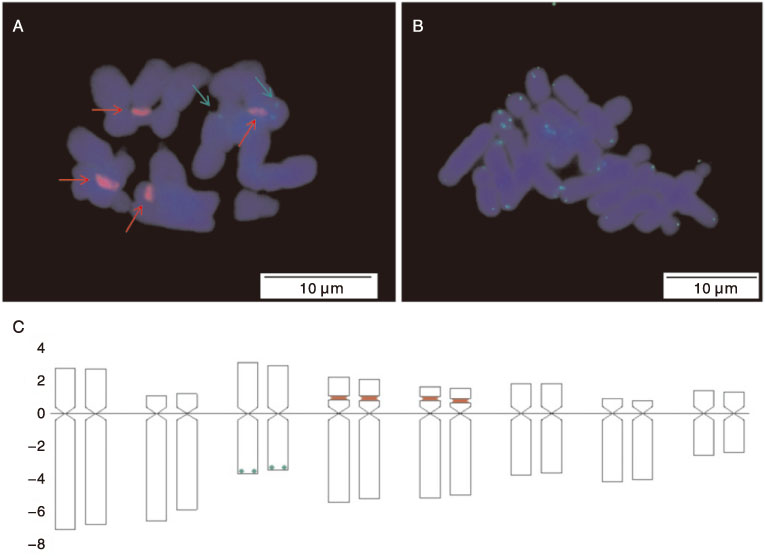
图4 白花蓝铃花中期染色体的荧光原位杂交结果 A,45S rDNA(红色箭头)与5S rDNA(绿色箭头)信号在染色体上的分布;B,端粒重复序列信号在染色体上的分布;C,FISH核型模式图。
Fig.4 Fluorescence in situ hybridization results of mid-stage chromosomes in Hyacinthoides non-scripta with white flower A, The distribution of 45S rDNA (red arrow) and 5S rDNA (green arrow) signals on the chromosomes; B, The distribution of telomere repeat signal on the chromosome; C, FISH karyotype pattern diagram.
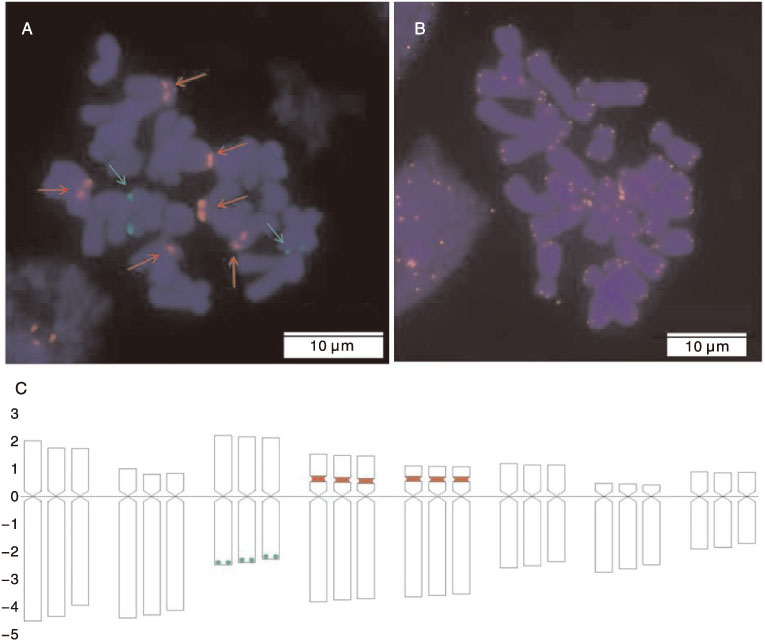
图5 蓝色蓝铃花中期染色体的荧光原位杂交结果 A,45S rDNA(红色箭头)与5S rDNA(绿色箭头)在染色体上的分布;B,端粒重复序列在染色体上的分布;C,FISH核型模式图。
Fig.5 Fluorescence in situ hybridization results of mid-stage chromosomes in Hyacinthoides non-scripta with blue flower A, The distribution of 45S rDNA (red arrow) and 5S rDNA (green arrow) signals on the chromosomes; B, The distribution of telomere repeat signal on the chromosome; C, FISH karyotype pattern diagram.
| [1] | 何丽娟. 不同种类及种源枸杞染色体核型分析[D]. 兰州: 甘肃农业大学, 2016. |
| HE L J. Chromosome karyotype analysis on different species and provenance of Lycium L.[D]. Lanzhou: Gansu Agricultural University, 2016. | |
| [2] | ANJALI M, SRIVASTAVA A K. Karyological studies in twelve accessions of Carthamus tinctoriusi[J]. Caryologia, 2012, 65(1): 1-6. |
| [3] | 程诗袁, 何佳丽, 韩福彬, 等. 麝香百合和‘雪皇后’的形态特征、核型及ISSR标记分析[J]. 生物技术通报, 2025, 41(3): 219-229. |
| CHENG S Y, HE J L, HAN F B, et al. Morphological characterization, karyotype and ISSR marker of Lilium longiflorum and L. longiflorum ‘Snow Queen’[J]. Biotechnology Bulletin, 2025, 41(3): 219-229. | |
| [4] | JIANG J M. Fluorescence in situ hybridization in plants: recent developments and future applications[J]. Chromosome Research, 2019, 27(3): 153-165. |
| [5] | 徐延浩, 李立家. 花生45S rDNA和5S rDNA的染色体定位研究[J]. 武汉植物学研究, 2010(6): 649-653. |
| XU Y H, LI L J. Physical mapping of the 45S rDNA and 5S rDNA in the peanut (Arachis hypogaea L.)[J]. Journal of Wuhan Botanical Research, 2010(6): 649-653. | |
| [6] | 王晶, 杨冰洁, 潘隆应, 等. 基于荧光原位杂交技术的紫薇属植物核型分析[J]. 西北植物学报, 2016, 36(1): 30-36. |
| WANG J, YANG B J, PAN L Y, et al. Karyotype analysis of Lagerstroemia species with 45S rDNA-FISH[J]. Acta Botanica Boreali-Occidentalia Sinica, 2016, 36(1): 30-36. | |
| [7] | 卿秋静. 九种百合属植物核型及遗传变异研究[D]. 雅安: 四川农业大学, 2011. |
| QING Q J. Karyotypes and genetic variations in 9 species of Lilium[D]. Ya’an: Sichuan Agricultural University, 2011. | |
| [8] | 黄想安. 中国石蒜属部分种的核型研究及其遗传关系的AFLP分析[D]. 开封: 河南大学, 2010. |
| HUANG X A. The karyotype study and the AFLP analysis of genetic relationships of some Lycoris species in China[D]. Kaifeng: Henan University, 2010. | |
| [9] | 屈连伟. 郁金香属植物细胞学观察及多倍体种质创新研究[D]. 沈阳: 沈阳农业大学, 2018. |
| QU L W. Cytological observation and polyploid germplasm innovation in the genus Tulipa[D]. Shenyang: Shenyang Agricultural University, 2018. | |
| [10] | EBUELE V O, SANTORO A, THOSS V. Phosphorus speciation by 31P NMR spectroscopy in bracken [Pteridium aquilinum(L.) Kuhn] and bluebell [Hyacinthoides non-scripta (L.) Chouard ex Rothm.] dominated semi-natural upland soil[J]. Science of the Total Environment, 2016, 566: 1318-1328. |
| [11] | RAHEEM D J, TAWFIKE A F, ABDELMOHSEN U R, et al. Application of metabolomics and molecular networking in investigating the chemical profile and antitrypanosomal activity of British bluebells (Hyacinthoides non-scripta)[J]. Scientific Reports, 2019, 9: 2547. |
| [12] | LEVAN A, FREDGA K, SANDBERG A A. Nomenclature for centromeric position on chromosomes[J]. Hereditas, 2009, 52(2): 201-220. |
| [13] | STEBBINS G L. Chromosomals evolution in high plants[M]. London: Edward Arnold, 1971: 85-105. |
| [14] | 李懋学. 作物染色体及其研究技术[M]. 北京: 中国农业出版社, 1996. |
| [15] | ARANO H. Cytological studies in subfamily carduoideae (Compositae) of Japan XVI[J]. Shokubutsugaku Zasshi, 1964, 77(908): 59-65. |
| [16] | SZINAY D, WIJNKER E, VAN DEN BERG R, et al. Chromosome evolution in Solanum traced by cross-species BAC-FISH[J]. New Phytologist, 2012, 195(3): 688-698. |
| [17] | 房磊, 杨斌, 张伟娜, 等. 异源三倍体为父本的百合杂交后代倍性调查及FISH分析[J]. 分子植物育种, 2014(1): 138-143. |
| FANG L, YANG B, ZHANG W N, et al. The ploidy level investigation and FISH analysis of the progenies from allotriploid Lilium as male[J]. Molecular Plant Breeding, 2014(1): 138-143. | |
| [18] | 贾美丽. 葡萄风信子离体繁殖与多倍体诱导研究[D]. 杨凌: 西北农林科技大学, 2010. |
| JIA M L. Study on in vitro propagation and polyploid induction of grape Hyacinthus orientalis[D]. Yangling: Northwest A & F University, 2010. | |
| [19] | SAHA P, SARKAR D, KUNDU A, et al. Karyotype analysis and chromosomal evolution in Asian species of Corchorus(Malvaceae s. l.)[J]. Genetic Resources and Crop Evolution, 2014, 61(6): 1173-1188. |
| [20] | 王中轩, 魏迟, 廉玉芹, 等. 中国原产4种野生百合的核型分析[J]. 园艺学报, 2013, 40(11): 2207-2212. |
| WANG Z X, WEI C, LIAN Y Q, et al. Karyotype analysis of four Lilium species from China[J]. Acta Horticulturae Sinica, 2013, 40(11): 2207-2212. | |
| [21] | 阳亚迪. 百合属部分物种的分子细胞遗传学和系统进化分析[D]. 株洲: 湖南工业大学, 2024. |
| YANG Y D. Molecular cytogenetic and phylogenetic analysis of some species of Lilium[D]. Zhuzhou: Hunan University of Technology, 2024. | |
| [22] | 杨雪珍, 贾月慧, 张克中, 等. 部分中国野生百合的核型分析[J]. 西北植物学报, 2013, 33(5): 922-930. |
| YANG X Z, JIA Y H, ZHANG K Z, et al. Karyotype analysis of several wild lilies native to China[J]. Acta Botanica Boreali-Occidentalia Sinica, 2013, 33(5): 922-930. | |
| [23] | 王娟. 基于染色体原位杂交的中国樱桃核型分析及其基因组构成的初步探究[D]. 雅安: 四川农业大学, 2018. |
| WANG J. Karyotype analysis and preliminary investigation of genome composition of Chinese cherry based on chromosome in situ hybridization[D]. Ya’an: Sichuan Agricultural University, 2018. | |
| [24] | 佘朝文, 罗嫣. 云实的45S rDNA检测和核型分析[J]. 西北植物学报, 2019, 39(5): 911-916. |
| SHE C W, LUO Y. Detection of 45S rDNA and karyotype analysis of Caesalpinia decapetala(Roth) alston[J]. Acta Botanica Boreali-Occidentalia Sinica, 2019, 39(5): 911-916. | |
| [25] | 谭炯锐, 王晶, 高华北, 等. 中国17种蔷薇属植物45S和5S的rDNA分布研究[J]. 西北植物学报, 2019, 39(8): 1333-1343. |
| TAN J R, WANG J, GAO H B, et al. Distribution of 45S and 5S rDNA in 17 Rosa species of China[J]. Acta Botanica Boreali-Occidentalia Sinica, 2019, 39(8): 1333-1343. | |
| [26] | ROSATO M, MORENO-SAIZ J C, GALIÁN J A, et al. Evolutionary site-number changes of ribosomal DNA loci during speciation: complex scenarios of ancestral and more recent polyploid events[J]. AoB Plants, 2015, 7: plv135. |
| [27] | 产祝龙, 向林, 王艳平. 郁金香种质资源、育种进展及种球国产化思考[J]. 华中农业大学学报, 2022, 41(2): 144-150. |
| CHAN Z L, XIANG L, WANG Y P. Germplasm, breeding and localization of tulip bulbs in China[J]. Journal of Huazhong Agricultural University, 2022, 41(2): 144-150. |
| [1] | 雷志伟, 李新欣, 徐恒, 张恒, 朱英, 张华. 利用染色体片段替换系鉴定水稻二化螟抗性QTL[J]. 浙江农业学报, 2025, 37(3): 530-537. |
| [2] | 张欢欢, 范挺秀, 高双成, 范丙友, 史国安. 2个牡丹切花品种核型、花药形态与花粉特性的比较[J]. 浙江农业学报, 2025, 37(2): 329-337. |
| [3] | 简杰亮, 顾华鑫, 顾祝荣, 王宝莲, 范峰林, 吴旭国, 许晓军. 薄颌光唇鱼的形态特征与染色体核型分析[J]. 浙江农业学报, 2025, 37(10): 2042-2048. |
| [4] | 葛健辉, 管辛帅, 刘金殿, 任晋东, 许晓军. 一种利用微创采血快速制备鳖科动物染色体核型的方法[J]. 浙江农业学报, 2025, 37(1): 32-38. |
| [5] | 刘芳芳, 陈红林, 刘峰, 许晓军, 黄福勇, 楼宝, 钱豪杰. 雌雄红螯螯虾染色体核型比较分析[J]. 浙江农业学报, 2023, 35(9): 2079-2089. |
| [6] | 杨梅, 胡小兰, 申涛, 谭康, 刘代铃, 邱红波. 玉米第8染色体单片段代换系的构建与灰斑病抗性材料筛选[J]. 浙江农业学报, 2021, 33(3): 383-389. |
| [7] | 龙海梅, 张楠卿, 李宗艳, 王琴, 付超. 金盏菊根尖细胞染色体制片与核型分析[J]. 浙江农业学报, 2020, 32(1): 86-92. |
| [8] | 苏晓倩, 王斐, 胡凤荣. 3个二倍体风信子品种核型分析[J]. 浙江农业学报, 2019, 31(9): 1509-1515. |
| [9] | 孙勃, 田玉肖, 夏雪, 李梦娇, 罗玲玲, 李琳, 陈清, 张芬, 汤浩茹. 叶用甜菜染色体制片条件优化及核型分析[J]. 浙江农业学报, 2016, 28(10): 1704-1710. |
| [10] | 陈柳,余斌,倪征,华炯钢,叶伟成,云涛,张存*. 表达鸭坦布苏病毒E蛋白的重组鸭瘟病毒的构建及其生物学特性[J]. 浙江农业学报, 2015, 27(11): 1889-. |
| [11] | 于盱;梁呈元;刘艳;李维林*. 薄荷同源多倍体的生物学性状观察[J]. , 2013, 25(4): 0-763. |
| [12] | 吕桂华;徐秀红;卢华兵;郭国锦*. 单倍体诱导系在玉米育种研究中的初探[J]. , 2012, 24(6): 0-960. |
| [13] | 陈大福;牛宝龙;翁宏飚;孟智启 . 棉铃虫(Helicoverpa armigera)幼虫性特征和精子的发生[J]. , 2004, 16(6): 0-357. |
| 阅读次数 | ||||||
|
全文 |
|
|||||
|
摘要 |
|
|||||

