Acta Agriculturae Zhejiangensis ›› 2026, Vol. 38 ›› Issue (2): 217-224.DOI: 10.3969/j.issn.1004-1524.20250155
• Animal Science • Previous Articles Next Articles
Impact of Israeli acute paralysis virus infection on the production of royal jelly in Apis mellifera ligustica
FAN Yingxi( ), LIU Yao, ZHENG Qiulan, ZHENG Huoqing()
College of Animal Science ,Zhejiang University Hangzhou 310058, China
-
Received:2025-03-06Online:2026-02-25Published:2026-03-24

CLC Number:
Cite this article
FAN Yingxi, LIU Yao, ZHENG Qiulan, ZHENG Huoqing. Impact of Israeli acute paralysis virus infection on the production of royal jelly in Apis mellifera ligustica[J]. Acta Agriculturae Zhejiangensis, 2026, 38(2): 217-224.
share this article
Add to citation manager EndNote|Ris|BibTeX
URL: http://www.zjnyxb.cn/EN/10.3969/j.issn.1004-1524.20250155
| 病毒或基因名称 Name of virus or gene | 正向引物序列(5'→3') Forward primer sequence(5'→3') | 反向引物序列(5'→3') Reverse primer sequence(5'→3') | 参考文献 Reference |
|---|---|---|---|
| 以色列急性麻痹病毒 | TCGCTGAAGGCATGTATTTC | ATTACCACTGCTCCGACACA | [ |
| Israeli acute paralysis virus | |||
| mrjp1 | TATTCCATTGCTTCGTTACTCG | TCTTGTCTTCTTTCATCGCTACC | [ |
| mrjp2 | AACTGTACCTGTATGTGCTCCAAA | TATAGCTTGAACAGCCAAAGACAC | [ |
| mrjp3 | GATGTGGACAGATGGCGTGA | CTGTCAAATTTGTCGACCGCA | [ |
| β-actin | TTGTATGCCAACACTGTCCTTT | TGGCGCGATGATCTTAATTT | [ |
Table 1 Information of primers for Israeli acute paralysis virus and mrjp genes
| 病毒或基因名称 Name of virus or gene | 正向引物序列(5'→3') Forward primer sequence(5'→3') | 反向引物序列(5'→3') Reverse primer sequence(5'→3') | 参考文献 Reference |
|---|---|---|---|
| 以色列急性麻痹病毒 | TCGCTGAAGGCATGTATTTC | ATTACCACTGCTCCGACACA | [ |
| Israeli acute paralysis virus | |||
| mrjp1 | TATTCCATTGCTTCGTTACTCG | TCTTGTCTTCTTTCATCGCTACC | [ |
| mrjp2 | AACTGTACCTGTATGTGCTCCAAA | TATAGCTTGAACAGCCAAAGACAC | [ |
| mrjp3 | GATGTGGACAGATGGCGTGA | CTGTCAAATTTGTCGACCGCA | [ |
| β-actin | TTGTATGCCAACACTGTCCTTT | TGGCGCGATGATCTTAATTT | [ |
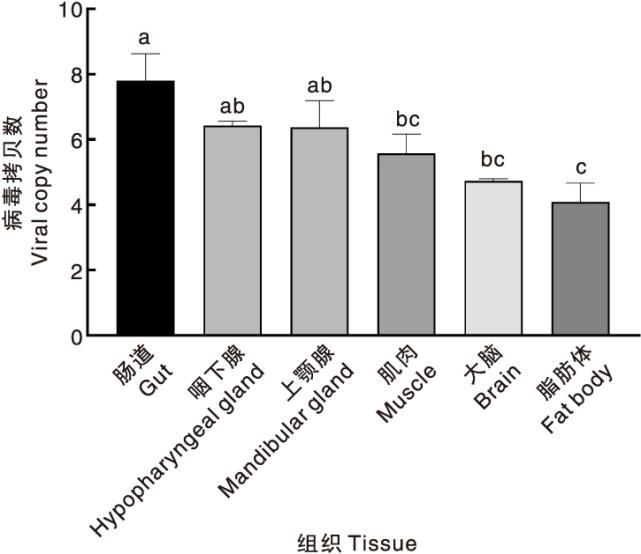
Fig.1 Tissue tropism of Israeli acute paralysis virus The viral copy number is expressed as the common logarithm value.Data on the columns marked without the same lowercase letter indicated significant differences at p<0.05. The same as below.
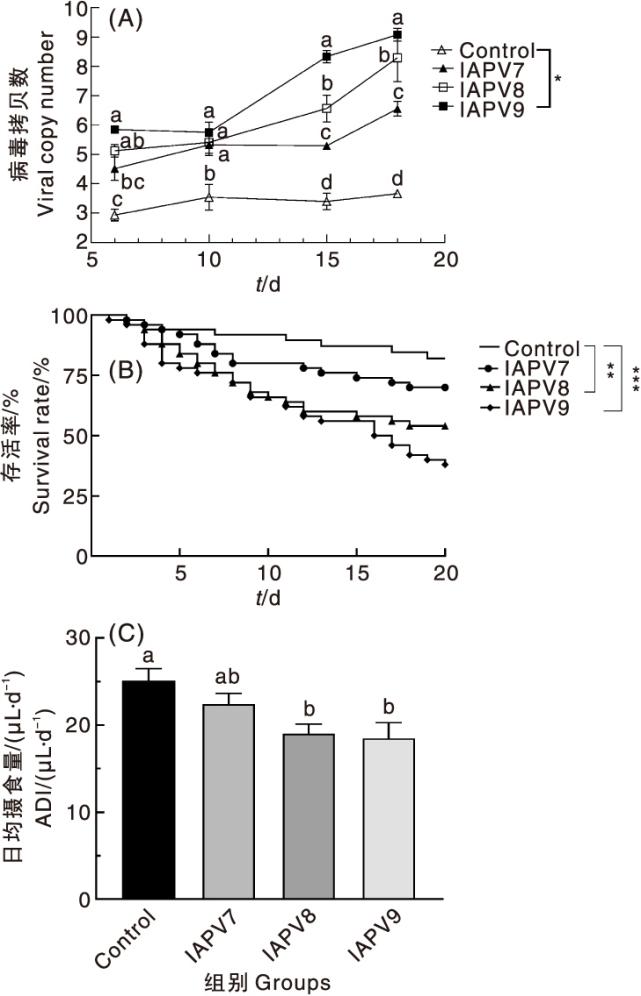
Fig.2 Impact of Israeli acute paralysis virus infection on worker bees physiology A, Viral titer in worker bee heads after treatment with different concentrations of IAPV; B, Survival rate of worker bees following treatment with different concentrations of IAPV; C, Food consumption of work bees after treatment with different concentrations of IAPV. ADI, Average daily intake. Dots in the line marked without the same letters indicate significant difference at p<0.05. * indicates p<0.05, ** indicates p<0.01, *** indicates p<0.001.
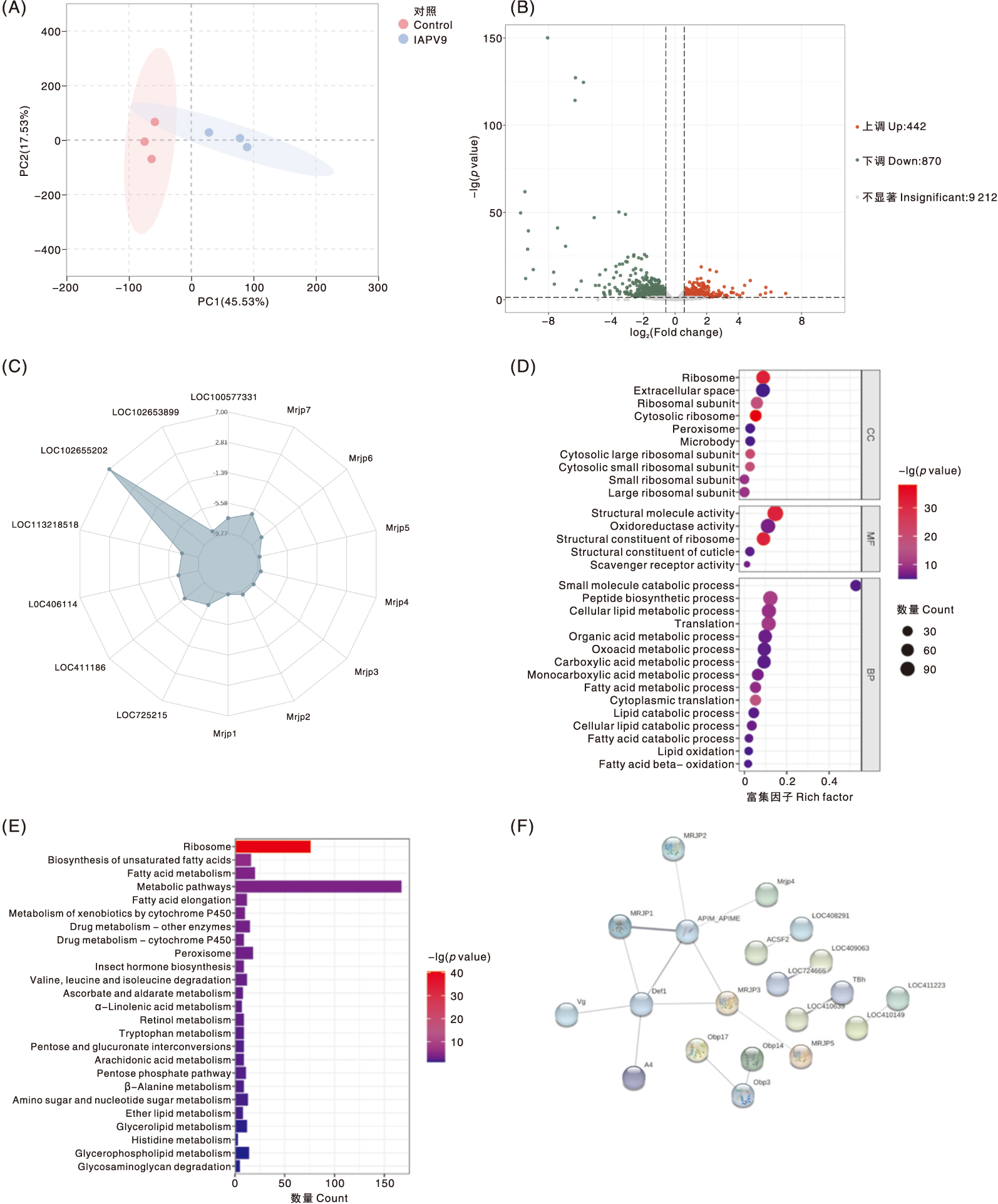
Fig.3 Impact of Israeli acute paralysis virus infection on the transcriptional profile of worker bees heads A, Principal component analysis of head gene expression; B, Volcano plot of differentially expressed genes; C, Genes exhibiting the most significant expression differences; D, GO functional enrichment analysis of DEG; E, KEGG pathway enrichment analysis of DEG; F, Protein-protein interaction network of DEG.
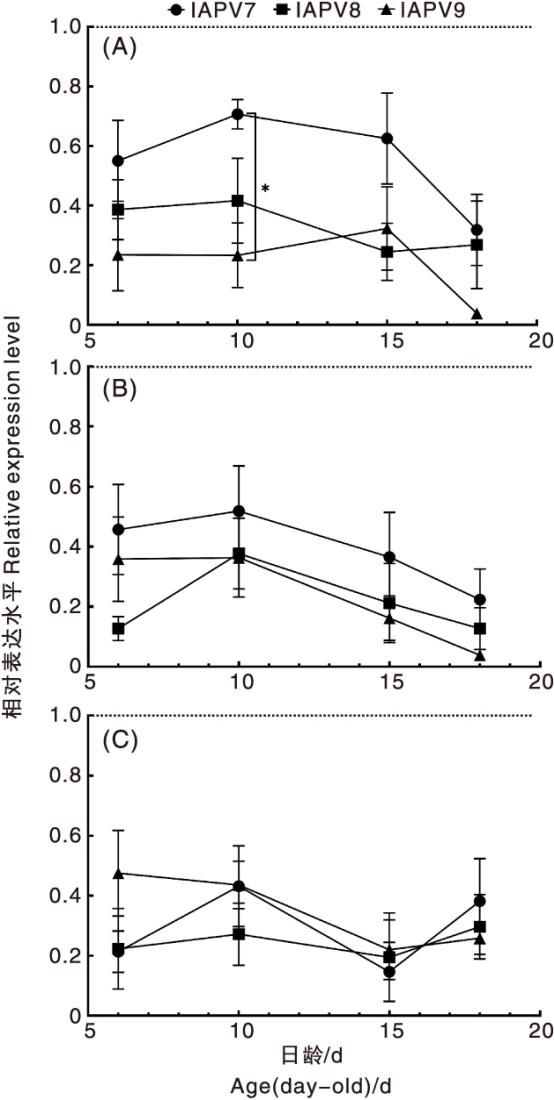
Fig.4 Relative expression levels of mrjp1(A), mrjp2(B), mrjp3(C) in the heads of worker bees after infection with different concentrations of Israeli acute paralysis virus The dashed line indicates the control group. * indicates the significant difference (p<0.05) compared with the control group.
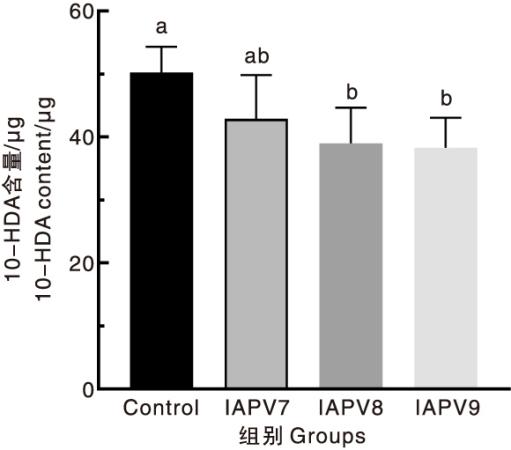
Fig.5 10-HDA content in the head of individual worker bees on day 18
| [1] | POTTS S G, BIESMEIJER J C, KREMEN C, et al. Global pollinator declines: trends, impacts and drivers[J]. Trends in Ecology & Evolution, 2010, 25(6): 345-353. |
| [2] | HIGHFIELD A C, EL NAGAR A, MACKINDER L C M, et al. Deformed wing virus implicated in overwintering honeybee colony losses[J]. Applied and Environmental Microbiology, 2009, 75(22): 7212-7220. |
| [3] | GOULSON D, NICHOLLS E, BOTÍAS C, et al. Bee declines driven by combined stress from parasites, pesticides, and lack of flowers[J]. Science, 2015, 347(6229): 1255957. |
| [4] | GENERSCH E. Honey bee pathology: current threats to honey bees and beekeeping[J]. Applied Microbiology and Biotechnology, 2010, 87(1): 87-97. |
| [5] | PELLETT P E, MITRA S, HOLLAND T C. Basics of virology[J]. Handbook of Clinical Neurology, 2014, 123: 45-66. |
| [6] | CHEN Y P, PETTIS J S, CORONA M, et al. Israeli acute paralysis virus: epidemiology, pathogenesis and implications for honey bee health[J]. PLoS Pathogens, 2014, 10(7): e1004261. |
| [7] | MAORI E, LAVI S, MOZES-KOCH R, et al. Isolation and characterization of Israeli acute paralysis virus, a dicistrovirus affecting honeybees in Israel: evidence for diversity due to intra-and inter-species recombination[J]. The Journal of General Virology, 2007, 88(Pt 12): 3428-3438. |
| [8] | JIANKE L, AIPING W. Comprehensive technology for maximizing royal jelly production[J]. American Bee Journal, 2005, 145(8): 661-664. |
| [9] | ZHU K G, LIU M H, FU Z, et al. Plant microRNAs in larval food regulate honeybee caste development[J]. PLoS Genetics, 2017, 13(8): e1006946. |
| [10] | BUTTSTEDT A, MORITZ R F A, ERLER S. Origin and function of the major royal jelly proteins of the honeybee (Apis mellifera) as members of the yellow gene family[J]. Biological Reviews, 2014, 89(2): 255-269. |
| [11] | SCHMITZOVÁ J, KLAUDINY J, ALBERT S, et al. A family of major royal jelly proteins of the honeybee Apis mellifera L[J]. Cellular and Molecular Life Sciences, 1998, 54(9): 1020-1030. |
| [12] | ZHANG G Z, CHEN Y N, WU Y Q, et al. The effect of nutritional status on the synthesis ability, protein content and gene expression of mandibular glands in honey bee (Apis mellifera) workers[J]. Journal of Apicultural Research, 2024, 63(4): 747-756. |
| [13] | BONCRISTIANI H F, EVANS J D, CHEN Y P, et al. In vitro infection of pupae with Israeli acute paralysis virus suggests disturbance of transcriptional homeostasis in honey bees (Apis mellifera)[J]. PLoS One, 2013, 8(9): e73429. |
| [14] | 黄知楚, 周倪红, 刘瑶, 等. 抗蜜蜂病毒天然产物的初步筛选研究[J]. 浙江农业学报, 2024, 36(1): 67-74. |
| HUANG Z C, ZHOU N H, LIU Y, et al. Natural products screening with resistance to honeybee viruses[J]. Acta Agriculturae Zhejiangensis, 2024, 36(1): 67-74. | |
| [15] | CHEN Y P, ZHAO Y, HAMMOND J, et al. Multiple virus infections in the honey bee and genome divergence of honey bee viruses[J]. Journal of Invertebrate Pathology, 2004, 87(2/3): 84-93. |
| [16] | 朱玉洁. 不同发育时期意大利蜜蜂咽下腺中长链非编码RNA的差异表达研究[D]. 合肥: 安徽农业大学, 2022. |
| ZHU Y J. Differential expression of long non-coding RNA in the hypopharyngeal glands of Apis mellifera ligustica at different developmental stages[D]. Hefei: Anhui Agricultural University, 2022. | |
| [17] | 马兰婷. 营养和幼虫诱导对意大利蜜蜂咽下腺发育的分子调节机制[D]. 泰安: 山东农业大学, 2016. |
| MA L T. The molecular mechanisms of nutrition and larvae inducing on hypopharyngeal gland development of Apis mellifera[D]. Tai’an: Shandong Agricultural University, 2016. | |
| [18] | AI H X, YAN X, HAN R C. Occurrence and prevalence of seven bee viruses in Apis mellifera and Apis cerana apiaries in China[J]. Journal of Invertebrate Pathology, 2012, 109(1): 160-164. |
| [19] | 黄少康, 荆战星, 李三妹, 等. 不同日龄意蜂工蜂上颚腺10-HDA分泌规律研究[J]. 海峡科学, 2010(10): 231. |
| HUANG S K, JING Z X, LI S M, et al. Study on the secretion pattern of 10-HDA in the mandibular glands of Italian honeybee workers of different ages[J]. Straits Science, 2010(10): 231. | |
| [20] | COX-FOSTER D L, CONLAN S, HOLMES E C, et al. A metagenomic survey of microbes in honey bee colony collapse disorder[J]. Science, 2007, 318(5848): 283-287. |
| [21] | CHAN Q W, FOSTER L J. Changes in protein expression during honey bee larval development[J]. Genome Biology, 2008, 9(10): R156. |
| [22] | TIAN W L, LI M, GUO H Y, et al. Architecture of the native major royal jelly protein 1 oligomer[J]. Nature Communications, 2018, 9: 3373. |
| [23] | MELLIOU E, CHINOU I. Chemistry and bioactivities of royal jelly[M]//ATTAUR R. Studies in natural products chemistry. Amsterdam: Elsevier, 2014: 261-290. |
| [24] | GARCIA-AMOEDO L H, DE ALMEIDA-MURADIAN L B. Determination of trans-10-hydroxy-2-decenoic acid (10-HDA) in royal jelly from São Paulo State, Brazil[J]. Ciência e Tecnologia de Alimentos, 2003, 23: 62-65. |
| [25] | ACOSTA-REYES F, NEUPANE R, FRANK J, et al. The Israeli acute paralysis virus IRES captures host ribosomes by mimicking a ribosomal state with hybrid tRNAs[J]. The EMBO Journal, 2019, 38(21): e102226. |
| [26] | NAGY P D, POGANY J. The dependence of viral RNA replication on co-opted host factors[J]. Nature Reviews Microbiology, 2012, 10(2): 137-149. |
| [27] | CHUKKAPALLI V, HEATON N S, RANDALL G. Lipids at the interface of virus-host interactions[J]. Current Opinion in Microbiology, 2012, 15(4): 512-518. |
| [28] | MUNICIO A M, ODRIOZOLA J M, RAMOS J A. In vitro regulation by NADPH of fatty acid biosynthesis with larval and pharate adult homogenates of the fly, Ceratitis capitata[J]. Insect Biochemistry, 1972, 2(7): 353-360. |
| [1] | MA Li, LAN Yi, XIE Bingxin, ZHOU Chunlu, LUO Shuyuan, XU Wenkun, DONG Xinxing, YAN Dawei. Study of polymorphism in the VRTN gene and its association with production traits in (Duroc×Saba)♂×[Yorkshire×(Landrace×Saba)]♀ [J]. Acta Agriculturae Zhejiangensis, 2024, 36(7): 1502-1510. |
| [2] | BAN Xue, MA Xiangyu, ZHANG Feipeng, ZHANG Wangbin. Acute toxicity and risk assessment of pesticides aginst pear fire blight on Italian honeybees [J]. Acta Agriculturae Zhejiangensis, 2023, 35(9): 2160-2168. |
| [3] | XIAO Lihan, XIN Meiguo, LU Wenjing, YE Qin, ZHANG Cen, XIAO Chaogeng, CHEN Di. Effects of different storage conditions on quality of royal jelly from three pollen sources [J]. Acta Agriculturae Zhejiangensis, 2023, 35(5): 1161-1167. |
| [4] | ZHANG Yuhao, MA Weihua, LIU Jinjia, MA Xiumei, JIANG Yusuo. Effects of sublethal doses of dinotefuran on genes expression and enzymes activities related to immune and detoxification in foragers of Apis mellifera ligustica [J]. Acta Agriculturae Zhejiangensis, 2023, 35(3): 575-581. |
| [5] | LU Xin, ZHOU Jinghang, YANG Chaoyun, ZHANG Menghua, YE Lianmeng, LI Shuzhen, HUANG Xixia, MA Yun, WANG Xingping, SHI Yuangang. Functional annotation of candidate genes for milk production and reproductive traits in Xinjiang Brown cattle [J]. , 2019, 31(12): 1987-1995. |
| [6] | ZHAO Yunxiang, YANG Wenpan, GAO Ning, PENG Xing, ZHANG Conglin, CHEN Yaosheng, LIU Xiaohong. Genetic correlation analysis between the longevity and first parity reproduction traits of Large White sows [J]. , 2019, 31(11): 1812-1818. |
| Viewed | ||||||
|
Full text |
|
|||||
|
Abstract |
|
|||||

