浙江农业学报 ›› 2026, Vol. 38 ›› Issue (5): 919-933.DOI: 10.3969/j.issn.1004-1524.20250403
贵州引种的武夷岩茶功效成分与香气特征
池琴1,2( ), 魏福晓1,2, 周美1,2, 林绍霞1,2, 柳小兰1,2, 李春燕1,2, 杨永刚3, 王道平1,2,*()
- 1
贵州省天然产物研究中心 贵州 贵阳 550014
2贵州医科大学 中药功效成分发掘与利用全国重点实验室 贵州 贵阳 550014
3湄潭银柜山茶业有限公司 贵州 湄潭 564100
-
收稿日期:2025-05-22出版日期:2026-05-25发布日期:2026-06-02 -
作者简介:池琴,研究方向为质谱分析与检测分析。E-mail:504247807@qq.com -
通讯作者:*王道平,E-mail:84531790@qq.com -
基金资助:贵州省科技计划项目(黔科合中引地〔2023〕026号);贵州省科技计划项目(黔科合支撑〔2023〕一般053)
Functional components and aroma characteristics of introduced Wuyi rock tea in Guizhou of China
CHI Qin1,2(), WEI Fuxiao1,2, ZHOU Mei1,2, LIN Shaoxia1,2, LIU Xiaolan1,2, LI Chunyan1,2, YANG Yonggang3, WANG Daoping1,2,*()
- 1
Natural Products Research Center of Guizhou Province Guiyang 550014, China
2State Key Laboratory of Discovery and Utilization of Functional Components in Traditional Chinese Medicine ,Guizhou Medical University Guiyang 550014, China
3Meitan Yinguishan Tea Co. ,Ltd. Meitan 564100, Guizhou, China
-
Received:2025-05-22Published:2026-05-25Online:2026-06-02

摘要:
为探究贵州引种武夷岩茶种质资源的品质差异,以贵州湄潭县银柜山茶叶苗圃内19个武夷岩茶品种为研究对象,测定其8种功效成分和香气成分,并通过差异分析、聚类分析、主成分分析等方法对岩茶样品品质进行综合评价。结果表明,不同岩茶中游离氨基酸、茶多酚、咖啡碱、儿茶素(C)、表儿茶素(EC)、表没食子儿茶素(EGC)、表儿茶素没食子酸酯(ECG)和表没食子儿茶素没食子酸酯(EGCG)含量差异较大,分别为1.26%~2.69%、8.41%~21.93%、1.54%~4.04%、0.07%~0.34%、0.13%~0.40%、0.19%~1.64%、0.22%~0.76%和0.36%~2.33%。主成分分析结果显示,对岩茶品质影响较大的2个成分分别为游离氨基酸和茶多酚;以欧氏距离10为阈值进行划分,19个武夷岩茶品种可分为4类。综合评分显示,矮脚乌龙评分最高,其次为黄奇,水金龟排名第三。香气成分研究表明,19个新鲜岩茶品种共检出117种香气成分,包括醇类、醛类、酯类、酮类、酸类、烯烃类、芳香族类、烷烃类、杂环类和其他类。香气成分中醇类含量最高,其次为酯类和烯烃类。其中矮脚乌龙中香叶醇含量最高,水金龟中芳樟醇含量最高,金锁匙中水杨酸甲酯含量最高。芳樟醇、香叶醇、水杨酸甲酯为19个岩茶品种的关键香气成分。本研究为武夷岩茶在贵州的引种栽培、品质评价和产品开发提供了科学依据,对推动贵州茶产业可持续发展具有积极意义。
中图分类号:
引用本文
池琴, 魏福晓, 周美, 林绍霞, 柳小兰, 李春燕, 杨永刚, 王道平. 贵州引种的武夷岩茶功效成分与香气特征[J]. 浙江农业学报, 2026, 38(5): 919-933.
CHI Qin, WEI Fuxiao, ZHOU Mei, LIN Shaoxia, LIU Xiaolan, LI Chunyan, YANG Yonggang, WANG Daoping. Functional components and aroma characteristics of introduced Wuyi rock tea in Guizhou of China[J]. Acta Agriculturae Zhejiangensis, 2026, 38(5): 919-933.
| 编号 No. | 品种 Cultivar | 亲本/产地 Parents/origin |
|---|---|---|
| Y1 | 矮脚乌龙 Aijiao Wulong | 福建建瓯 Jian’ou, Fujian |
| Y2 | 水仙Shuixian | 福建南平Nanping, Fujian |
| Y3 | 紫玫瑰Zimeigui | 铁观音×黄旦Tieguanyin×Huangdan |
| Y4 | 肉桂Rougui | 福建武夷山Wuyishan, Fujian |
| Y5 | 黄奇 Huangqi | 黄金桂×白奇兰 Huangjingui×Baiqilan |
| Y6 | 金锁匙Jinsuoshi | 福建武夷山Wuyishan, Fujian |
| Y7 | 黄观音 Huangguanyin | 黄金桂×铁观音 Huangjingui×Tieguanyin |
| Y8 | 春兰Chunlan | 福建武夷山Wuyishan, Fujian |
| Y9 | 丹桂Dangui | 大红袍×肉桂Dahongpao×Rougui |
| Y10 | 白瑞香Bairuixiang | 福建武夷山Wuyishan, Fujian |
| Y11 | 玉麒麟Yuqilin | 福建武夷山Wuyishan, Fujian |
| Y12 | 黄玫瑰 Huangmeigui | 黄观音×黄旦 Huangguanyin×Huangdan |
| Y13 | 白鸡冠Baijiguan | 福建武夷山Wuyishan, Fujian |
| Y14 | 紫龙袍Zilongpao | 福建武夷山Wuyishan, Fujian |
| Y15 | 大红袍Dahongpao | 福建武夷山Wuyishan, Fujian |
| Y16 | 北斗Beidou | 福建武夷山Wuyishan, Fujian |
| Y17 | 水金龟Shuijingui | 福建武夷山Wuyishan, Fujian |
| Y18 | 金观音 Jinguanyin | 铁观音×黄金桂 Tieguanyin×Huangjingui |
| Y19 | 石乳Shiru | 福建武夷山Wuyishan, Fujian |
表1 19个岩茶品种信息表
Table 1 Information table of 19 rock tea cultivars
| 编号 No. | 品种 Cultivar | 亲本/产地 Parents/origin |
|---|---|---|
| Y1 | 矮脚乌龙 Aijiao Wulong | 福建建瓯 Jian’ou, Fujian |
| Y2 | 水仙Shuixian | 福建南平Nanping, Fujian |
| Y3 | 紫玫瑰Zimeigui | 铁观音×黄旦Tieguanyin×Huangdan |
| Y4 | 肉桂Rougui | 福建武夷山Wuyishan, Fujian |
| Y5 | 黄奇 Huangqi | 黄金桂×白奇兰 Huangjingui×Baiqilan |
| Y6 | 金锁匙Jinsuoshi | 福建武夷山Wuyishan, Fujian |
| Y7 | 黄观音 Huangguanyin | 黄金桂×铁观音 Huangjingui×Tieguanyin |
| Y8 | 春兰Chunlan | 福建武夷山Wuyishan, Fujian |
| Y9 | 丹桂Dangui | 大红袍×肉桂Dahongpao×Rougui |
| Y10 | 白瑞香Bairuixiang | 福建武夷山Wuyishan, Fujian |
| Y11 | 玉麒麟Yuqilin | 福建武夷山Wuyishan, Fujian |
| Y12 | 黄玫瑰 Huangmeigui | 黄观音×黄旦 Huangguanyin×Huangdan |
| Y13 | 白鸡冠Baijiguan | 福建武夷山Wuyishan, Fujian |
| Y14 | 紫龙袍Zilongpao | 福建武夷山Wuyishan, Fujian |
| Y15 | 大红袍Dahongpao | 福建武夷山Wuyishan, Fujian |
| Y16 | 北斗Beidou | 福建武夷山Wuyishan, Fujian |
| Y17 | 水金龟Shuijingui | 福建武夷山Wuyishan, Fujian |
| Y18 | 金观音 Jinguanyin | 铁观音×黄金桂 Tieguanyin×Huangjingui |
| Y19 | 石乳Shiru | 福建武夷山Wuyishan, Fujian |
| 编号 No. | 香气Aroma | 滋味Taste | 总分 Total score | |||||
|---|---|---|---|---|---|---|---|---|
| 评语 Comments | 评分 Score | 评语 Comments | 评分 Score | |||||
| Y1 | 果香香气浓郁 Rich fruity aroma | 90 | 浓醇鲜爽回甘 Rich, mellow, fresh, brisk and sweet aftertaste | 91 | 90.5 | |||
| Y2 | 花香,火攻香显 Floral aroma, with distinct fire-roasted aroma | 83 | 醇厚回甘 Mellow and sweet aftertaste | 88 | 85.5 | |||
| Y3 | 香气平正略显玫瑰花香 The aroma is mild and well-balanced, with a slight | 82 | 醇厚顺滑 Mellow and sweet aftertaste | 85 | 83.5 | |||
| hint of rose | ||||||||
| Y4 | 花香、桂皮香显 The fragrance of flowers and cinnamon is prominent | 90 | 醇厚甘滑 Mellow, sweet and smooth | 88 | 89.0 | |||
| Y5 | 香气清高The aroma is delicate and refreshing | 82 | 鲜爽甘滑Fresh, refreshing, sweet and smooth | 86 | 84.0 | |||
| Y6 | 香气淡薄The aroma is faint | 81 | 醇厚略苦Mellow and slightly bitter | 86 | 83.5 | |||
| Y7 | 香气馥郁带花香The aroma is rich and floral | 90 | 醇厚甘涩Mellow, sweet and astringent | 85 | 87.5 | |||
| Y8 | 香气清雅略带花香 The aroma is delicate and slightly floral | 84 | 醇厚青涩 Mellow and greenish | 82 | 83.0 | |||
| Y9 | 香气浓郁带花果香 Rich aroma with floral and fruity notes | 88 | 平和青涩 Peaceful and greenish | 79 | 83.5 | |||
| Y10 | 香气清高The aroma is delicate and refreshing | 85 | 平和爽滑Mild and smooth | 80 | 82.5 | |||
| Y11 | 花果香香气馥郁 The fragrance of flowers and fruits is rich and strong | 90 | 醇和略青涩 Mellow and slightly astringent | 86 | 88.0 | |||
| Y12 | 香气淡薄略带玫瑰花香 The aroma is light and slightly reminiscent of rose fragrance | 82 | 醇厚顺滑 Mellow and smooth | 89 | 85.5 | |||
| Y13 | 香气淡薄略带果香 The aroma is light with a hint of fruitiness | 82 | 醇和顺滑 Mellow and smooth | 82 | 82.0 | |||
| Y14 | 果香香气馥郁The fruity aroma is rich and fragrant | 90 | 醇厚甘滑Mellow, sweet and smooth | 88 | 89.0 | |||
| Y15 | 果香香气馥郁 The fruity aroma is rich and fragrant | 90 | 醇厚鲜爽回甘 Mellow, fresh, brisk and with a sweet aftertaste | 88 | 89.0 | |||
| Y16 | 香气幽长略带花香 The aroma is delicate and long-lasting, with a | 89 | 平和甘滑 Peaceful, sweet and smooth | 80 | 84.5 | |||
| slight floral note | ||||||||
| Y17 | 香气鲜爽带花香 The aroma is fresh and brisk with a floral fragrance | 90 | 醇厚鲜爽 Mellow, rich, fresh and brisk | 89 | 89.5 | |||
| Y18 | 香气馥郁带花香Rich aroma with floral notes | 90 | 醇厚甘鲜Mellow, sweet and fresh | 85 | 87.5 | |||
| Y19 | 香气低闷The aroma is dull and stuffy | 80 | 醇厚顺滑微苦Mellow, smooth and slightly bitter | 86 | 83.0 | |||
表2 19个岩茶品种的滋味与香气审评结果
Table 2 Evaluation results of taste and aroma of 19 rock tea cultivars
| 编号 No. | 香气Aroma | 滋味Taste | 总分 Total score | |||||
|---|---|---|---|---|---|---|---|---|
| 评语 Comments | 评分 Score | 评语 Comments | 评分 Score | |||||
| Y1 | 果香香气浓郁 Rich fruity aroma | 90 | 浓醇鲜爽回甘 Rich, mellow, fresh, brisk and sweet aftertaste | 91 | 90.5 | |||
| Y2 | 花香,火攻香显 Floral aroma, with distinct fire-roasted aroma | 83 | 醇厚回甘 Mellow and sweet aftertaste | 88 | 85.5 | |||
| Y3 | 香气平正略显玫瑰花香 The aroma is mild and well-balanced, with a slight | 82 | 醇厚顺滑 Mellow and sweet aftertaste | 85 | 83.5 | |||
| hint of rose | ||||||||
| Y4 | 花香、桂皮香显 The fragrance of flowers and cinnamon is prominent | 90 | 醇厚甘滑 Mellow, sweet and smooth | 88 | 89.0 | |||
| Y5 | 香气清高The aroma is delicate and refreshing | 82 | 鲜爽甘滑Fresh, refreshing, sweet and smooth | 86 | 84.0 | |||
| Y6 | 香气淡薄The aroma is faint | 81 | 醇厚略苦Mellow and slightly bitter | 86 | 83.5 | |||
| Y7 | 香气馥郁带花香The aroma is rich and floral | 90 | 醇厚甘涩Mellow, sweet and astringent | 85 | 87.5 | |||
| Y8 | 香气清雅略带花香 The aroma is delicate and slightly floral | 84 | 醇厚青涩 Mellow and greenish | 82 | 83.0 | |||
| Y9 | 香气浓郁带花果香 Rich aroma with floral and fruity notes | 88 | 平和青涩 Peaceful and greenish | 79 | 83.5 | |||
| Y10 | 香气清高The aroma is delicate and refreshing | 85 | 平和爽滑Mild and smooth | 80 | 82.5 | |||
| Y11 | 花果香香气馥郁 The fragrance of flowers and fruits is rich and strong | 90 | 醇和略青涩 Mellow and slightly astringent | 86 | 88.0 | |||
| Y12 | 香气淡薄略带玫瑰花香 The aroma is light and slightly reminiscent of rose fragrance | 82 | 醇厚顺滑 Mellow and smooth | 89 | 85.5 | |||
| Y13 | 香气淡薄略带果香 The aroma is light with a hint of fruitiness | 82 | 醇和顺滑 Mellow and smooth | 82 | 82.0 | |||
| Y14 | 果香香气馥郁The fruity aroma is rich and fragrant | 90 | 醇厚甘滑Mellow, sweet and smooth | 88 | 89.0 | |||
| Y15 | 果香香气馥郁 The fruity aroma is rich and fragrant | 90 | 醇厚鲜爽回甘 Mellow, fresh, brisk and with a sweet aftertaste | 88 | 89.0 | |||
| Y16 | 香气幽长略带花香 The aroma is delicate and long-lasting, with a | 89 | 平和甘滑 Peaceful, sweet and smooth | 80 | 84.5 | |||
| slight floral note | ||||||||
| Y17 | 香气鲜爽带花香 The aroma is fresh and brisk with a floral fragrance | 90 | 醇厚鲜爽 Mellow, rich, fresh and brisk | 89 | 89.5 | |||
| Y18 | 香气馥郁带花香Rich aroma with floral notes | 90 | 醇厚甘鲜Mellow, sweet and fresh | 85 | 87.5 | |||
| Y19 | 香气低闷The aroma is dull and stuffy | 80 | 醇厚顺滑微苦Mellow, smooth and slightly bitter | 86 | 83.0 | |||
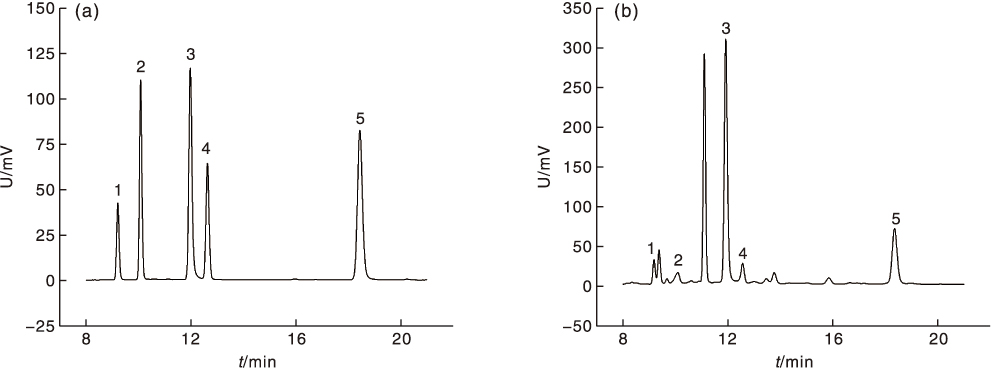
图1 混合标准品溶液与供试品溶液的高效液相色谱图 a,5种儿茶素混合标准品溶液;b,样品溶液。1,儿茶素;2,表儿茶素;3,表儿茶素没食子酸酯;4,表没食子儿茶素;5,表没食子儿茶素没食子酸酯。
Fig.1 High-performance liquid chromatograms of the mixed standard solution and the test sample solution a, Mixed standard solution of five catechins; b, Sample solution. 1, Catechin; 2, Epicatechin; 3, Epicatechin gallate; 4, Epigallocatechin; 5, Epigallocatechin gallate.
| 标准品 Standard substance | 线性方程 Linear equation | 线性范围/ (μg·mL-1) Linear range/ (μg·mL-1) | 相关系数 Correlation coefficient | 检测限/ (μg·mL-1) Limit of detection/ (μg·mL-1) | 定量限/ (μg·mL-1) Limit of quantification/ (μg·mL-1) |
|---|---|---|---|---|---|
| 谷氨酸Glutamic acid | y=3.434 3x-0.095 4 | 8~96 | 0.995 | 2.60 | 22.40 |
| 没食子酸Gallic acid | y=0.009 1x-0.001 6 | 10~80 | 0.999 | 2.40 | 20.70 |
| 咖啡碱Caffeine | y=10.548x-53.495 | 25~100 | 0.991 | 0.37 | 1.47 |
| C | y=18.124x-37.047 | 12.5~100 | 0.991 | 2.30 | 16.50 |
| EC | y=18.756x-25.893 | 12.5~100 | 0.991 | 2.40 | 17.30 |
| ECG | y=49.793x-55.245 | 12.5~100 | 0.990 | 2.20 | 19.10 |
| EGC | y=5.593 6x-15.555 | 12.5~100 | 0.989 | 1.70 | 16.90 |
| EGCG | y=43.311x-53.223 | 12.5~100 | 0.990 | 1.50 | 16.20 |
表3 岩茶中8种活性成分的线性方程、线性范围、相关系数、检出限与定量限
Table 3 Linear equations, linear ranges, correlation coefficients, limits of detection, and limits of quantification of the eight active components in rock tea
| 标准品 Standard substance | 线性方程 Linear equation | 线性范围/ (μg·mL-1) Linear range/ (μg·mL-1) | 相关系数 Correlation coefficient | 检测限/ (μg·mL-1) Limit of detection/ (μg·mL-1) | 定量限/ (μg·mL-1) Limit of quantification/ (μg·mL-1) |
|---|---|---|---|---|---|
| 谷氨酸Glutamic acid | y=3.434 3x-0.095 4 | 8~96 | 0.995 | 2.60 | 22.40 |
| 没食子酸Gallic acid | y=0.009 1x-0.001 6 | 10~80 | 0.999 | 2.40 | 20.70 |
| 咖啡碱Caffeine | y=10.548x-53.495 | 25~100 | 0.991 | 0.37 | 1.47 |
| C | y=18.124x-37.047 | 12.5~100 | 0.991 | 2.30 | 16.50 |
| EC | y=18.756x-25.893 | 12.5~100 | 0.991 | 2.40 | 17.30 |
| ECG | y=49.793x-55.245 | 12.5~100 | 0.990 | 2.20 | 19.10 |
| EGC | y=5.593 6x-15.555 | 12.5~100 | 0.989 | 1.70 | 16.90 |
| EGCG | y=43.311x-53.223 | 12.5~100 | 0.990 | 1.50 | 16.20 |
| 编号 No. | 游离氨基酸 含量 Free amino acids content | 茶多酚含量 Tea polyphenols content | 咖啡碱含量 Caffeine content | 儿茶素含量 Catechin content | 儿茶素总量 Total catechins content | ||||
|---|---|---|---|---|---|---|---|---|---|
| C | EC | EGC | ECG | EGCG | |||||
| Y1 | 2.60±0.22 | 21.93±1.13 | 4.04±0.39 | 0.34±0.08 | 0.40±0.04 | 1.64±0.06 | 0.56±0.08 | 2.33±0.36 | 5.26±0.49 |
| Y2 | 1.26±0.19 | 8.41±0.55 | 1.54±0.32 | 0.07±0.02 | 0.25±0.04 | 0.35±0.04 | 0.25±0.03 | 0.36±0.05 | 1.28±0.07 |
| Y3 | 1.68±0.17 | 12.60±0.59 | 2.10±0.29 | 0.17±0.02 | 0.21±0.05 | 0.50±0.09 | 0.37±0.04 | 0.85±0.07 | 2.11±0.09 |
| Y4 | 2.12±0.22 | 15.77±1.36 | 2.63±0.51 | 0.21±0.04 | 0.27±0.04 | 0.79±0.07 | 0.44±0.05 | 1.37±0.13 | 3.08±0.12 |
| Y5 | 2.69±0.16 | 15.13±1.25 | 3.41±0.41 | 0.25±0.09 | 0.35±0.03 | 1.02±0.10 | 0.38±0.03 | 1.10±0.13 | 3.10±0.15 |
| Y6 | 1.81±0.16 | 14.21±0.82 | 2.47±0.35 | 0.21±0.05 | 0.38±0.03 | 0.93±0.12 | 0.43±0.05 | 1.07±0.17 | 3.02±0.33 |
| Y7 | 1.55±0.20 | 13.91±0.45 | 2.05±0.45 | 0.18±0.04 | 0.15±0.04 | 0.31±0.07 | 0.32±0.03 | 0.83±0.09 | 1.79±0.07 |
| Y8 | 1.78±0.15 | 18.01±0.63 | 2.16±0.14 | 0.21±0.03 | 0.22±0.03 | 0.34±0.04 | 0.56±0.02 | 0.95±0.07 | 2.27±0.05 |
| Y9 | 2.04±0.16 | 15.85±0.73 | 2.83±0.29 | 0.15±0.06 | 0.25±0.05 | 0.55±0.08 | 0.22±0.02 | 0.52±0.08 | 1.69±0.17 |
| Y10 | 2.00±0.16 | 14.10±0.52 | 2.29±0.20 | 0.15±0.02 | 0.18±0.05 | 0.41±0.07 | 0.31±0.03 | 0.77±0.07 | 1.82±0.08 |
| Y11 | 2.18±0.16 | 13.62±0.36 | 3.42±0.22 | 0.22±0.03 | 0.24±0.04 | 0.48±0.09 | 0.55±0.06 | 1.27±0.12 | 2.75±0.31 |
| Y12 | 1.88±0.23 | 11.20±0.60 | 1.88±0.21 | 0.33±0.05 | 0.32±0.03 | 0.85±0.04 | 0.44±0.05 | 1.51±0.09 | 3.45±0.17 |
| Y13 | 1.97±0.17 | 12.74±0.62 | 2.11±0.13 | 0.21±0.02 | 0.31±0.04 | 0.78±0.08 | 0.47±0.04 | 1.15±0.07 | 2.92±0.05 |
| Y14 | 2.56±0.16 | 15.19±1.10 | 3.00±0.21 | 0.20±0.06 | 0.34±0.03 | 0.73±0.04 | 0.39±0.04 | 0.88±0.10 | 2.52±0.16 |
| Y15 | 2.43±0.21 | 16.64±1.26 | 4.04±0.17 | 0.22±0.04 | 0.23±0.04 | 0.43±0.03 | 0.76±0.08 | 1.21±0.11 | 2.85±0.24 |
| Y16 | 1.88±0.16 | 13.65±0.41 | 2.81±0.28 | 0.20±0.05 | 0.13±0.02 | 0.19±0.05 | 0.45±0.04 | 0.57±0.03 | 1.54±0.10 |
| Y17 | 2.13±0.15 | 19.40±0.94 | 4.04±0.15 | 0.23±0.05 | 0.15±0.04 | 0.65±0.03 | 0.55±0.03 | 2.31±0.10 | 3.89±0.16 |
| Y18 | 1.96±0.15 | 14.59±0.61 | 3.49±0.33 | 0.22±0.03 | 0.23±0.03 | 0.56±0.03 | 0.38±0.04 | 1.04±0.07 | 2.42±0.11 |
| Y19 | 2.27±0.20 | 15.91±0.89 | 3.72±0.32 | 0.28±0.06 | 0.23±0.03 | 0.30±0.05 | 0.62±0.07 | 1.02±0.09 | 2.45±0.15 |
| CV/% | 19.02 | 20.78 | 28.92 | 34.29 | 32.27 | 54.27 | 30.64 | 46.29 | 35.18 |
表4 19个岩茶品种的营养成分含量
Table 4 Nutrient content of 19 rock tea cultivars
| 编号 No. | 游离氨基酸 含量 Free amino acids content | 茶多酚含量 Tea polyphenols content | 咖啡碱含量 Caffeine content | 儿茶素含量 Catechin content | 儿茶素总量 Total catechins content | ||||
|---|---|---|---|---|---|---|---|---|---|
| C | EC | EGC | ECG | EGCG | |||||
| Y1 | 2.60±0.22 | 21.93±1.13 | 4.04±0.39 | 0.34±0.08 | 0.40±0.04 | 1.64±0.06 | 0.56±0.08 | 2.33±0.36 | 5.26±0.49 |
| Y2 | 1.26±0.19 | 8.41±0.55 | 1.54±0.32 | 0.07±0.02 | 0.25±0.04 | 0.35±0.04 | 0.25±0.03 | 0.36±0.05 | 1.28±0.07 |
| Y3 | 1.68±0.17 | 12.60±0.59 | 2.10±0.29 | 0.17±0.02 | 0.21±0.05 | 0.50±0.09 | 0.37±0.04 | 0.85±0.07 | 2.11±0.09 |
| Y4 | 2.12±0.22 | 15.77±1.36 | 2.63±0.51 | 0.21±0.04 | 0.27±0.04 | 0.79±0.07 | 0.44±0.05 | 1.37±0.13 | 3.08±0.12 |
| Y5 | 2.69±0.16 | 15.13±1.25 | 3.41±0.41 | 0.25±0.09 | 0.35±0.03 | 1.02±0.10 | 0.38±0.03 | 1.10±0.13 | 3.10±0.15 |
| Y6 | 1.81±0.16 | 14.21±0.82 | 2.47±0.35 | 0.21±0.05 | 0.38±0.03 | 0.93±0.12 | 0.43±0.05 | 1.07±0.17 | 3.02±0.33 |
| Y7 | 1.55±0.20 | 13.91±0.45 | 2.05±0.45 | 0.18±0.04 | 0.15±0.04 | 0.31±0.07 | 0.32±0.03 | 0.83±0.09 | 1.79±0.07 |
| Y8 | 1.78±0.15 | 18.01±0.63 | 2.16±0.14 | 0.21±0.03 | 0.22±0.03 | 0.34±0.04 | 0.56±0.02 | 0.95±0.07 | 2.27±0.05 |
| Y9 | 2.04±0.16 | 15.85±0.73 | 2.83±0.29 | 0.15±0.06 | 0.25±0.05 | 0.55±0.08 | 0.22±0.02 | 0.52±0.08 | 1.69±0.17 |
| Y10 | 2.00±0.16 | 14.10±0.52 | 2.29±0.20 | 0.15±0.02 | 0.18±0.05 | 0.41±0.07 | 0.31±0.03 | 0.77±0.07 | 1.82±0.08 |
| Y11 | 2.18±0.16 | 13.62±0.36 | 3.42±0.22 | 0.22±0.03 | 0.24±0.04 | 0.48±0.09 | 0.55±0.06 | 1.27±0.12 | 2.75±0.31 |
| Y12 | 1.88±0.23 | 11.20±0.60 | 1.88±0.21 | 0.33±0.05 | 0.32±0.03 | 0.85±0.04 | 0.44±0.05 | 1.51±0.09 | 3.45±0.17 |
| Y13 | 1.97±0.17 | 12.74±0.62 | 2.11±0.13 | 0.21±0.02 | 0.31±0.04 | 0.78±0.08 | 0.47±0.04 | 1.15±0.07 | 2.92±0.05 |
| Y14 | 2.56±0.16 | 15.19±1.10 | 3.00±0.21 | 0.20±0.06 | 0.34±0.03 | 0.73±0.04 | 0.39±0.04 | 0.88±0.10 | 2.52±0.16 |
| Y15 | 2.43±0.21 | 16.64±1.26 | 4.04±0.17 | 0.22±0.04 | 0.23±0.04 | 0.43±0.03 | 0.76±0.08 | 1.21±0.11 | 2.85±0.24 |
| Y16 | 1.88±0.16 | 13.65±0.41 | 2.81±0.28 | 0.20±0.05 | 0.13±0.02 | 0.19±0.05 | 0.45±0.04 | 0.57±0.03 | 1.54±0.10 |
| Y17 | 2.13±0.15 | 19.40±0.94 | 4.04±0.15 | 0.23±0.05 | 0.15±0.04 | 0.65±0.03 | 0.55±0.03 | 2.31±0.10 | 3.89±0.16 |
| Y18 | 1.96±0.15 | 14.59±0.61 | 3.49±0.33 | 0.22±0.03 | 0.23±0.03 | 0.56±0.03 | 0.38±0.04 | 1.04±0.07 | 2.42±0.11 |
| Y19 | 2.27±0.20 | 15.91±0.89 | 3.72±0.32 | 0.28±0.06 | 0.23±0.03 | 0.30±0.05 | 0.62±0.07 | 1.02±0.09 | 2.45±0.15 |
| CV/% | 19.02 | 20.78 | 28.92 | 34.29 | 32.27 | 54.27 | 30.64 | 46.29 | 35.18 |
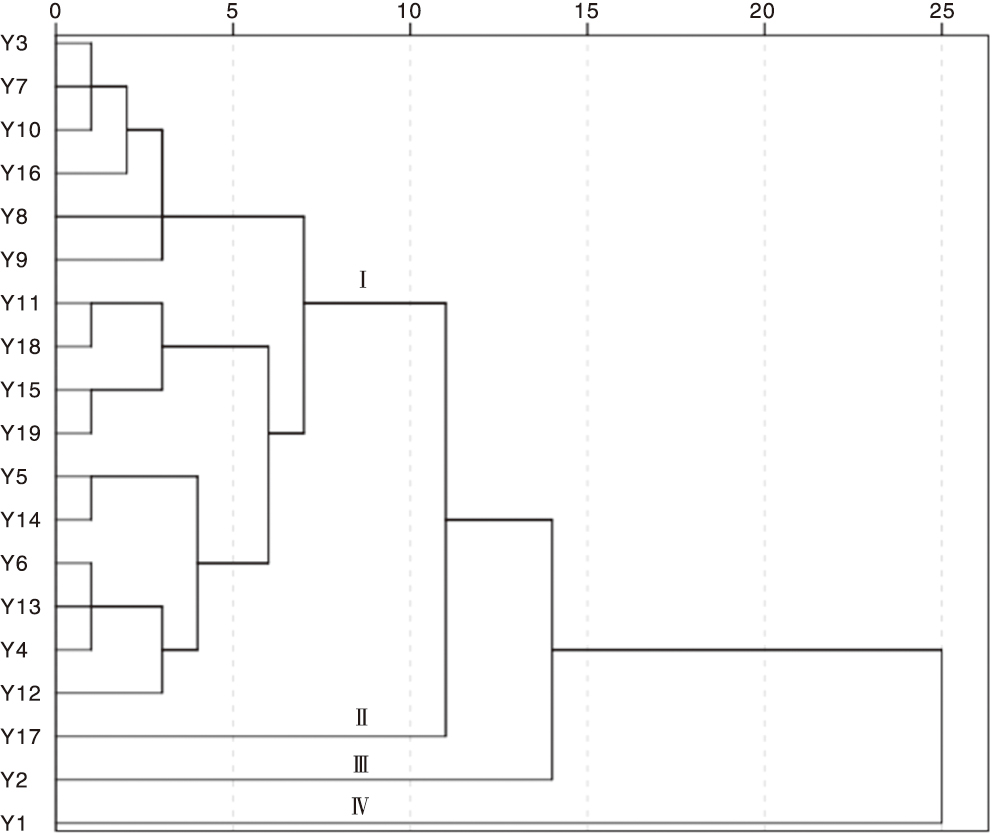
图2 19个岩茶品种的聚类分析树状图
Fig.2 Cluster analysis dendrogram of 19 rock tea cultivars
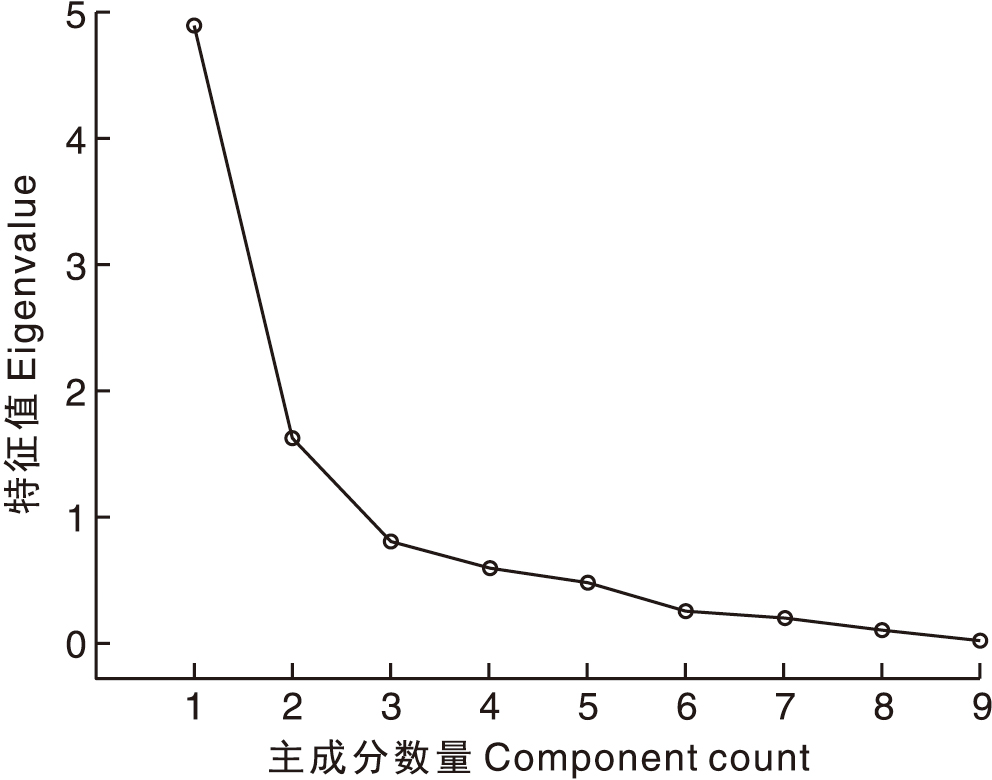
图3 主成分分析碎石图
Fig.3 Scree plot of principal component analysis
| 编号 No. | 因子1 Factor 1 | 因子2 Factor 2 | 主成分1得分 PC1 score | 主成分2得分 PC2 score | 综合得分 Comprehensive score | 排序 Ranking |
|---|---|---|---|---|---|---|
| Y1 | 2.60 | 1.12 | 5.51 | 1.42 | 4.42 | 1 |
| Y2 | -2.10 | 0.88 | -4.46 | 1.12 | -2.98 | 19 |
| Y3 | -0.89 | 0.15 | -1.89 | 0.19 | -1.34 | 15 |
| Y4 | 0.22 | 0.34 | 0.47 | 0.43 | 0.46 | 8 |
| Y5 | 0.83 | 1.03 | 1.75 | 1.31 | 1.63 | 2 |
| Y6 | 0.05 | 1.39 | 0.11 | 1.77 | 0.55 | 7 |
| Y7 | -1.11 | -0.43 | -2.35 | -0.55 | -1.87 | 18 |
| Y8 | -0.23 | -0.77 | -0.49 | -0.97 | -0.62 | 13 |
| Y9 | -0.65 | 0.32 | -1.37 | 0.41 | -0.90 | 14 |
| Y10 | -0.85 | -0.24 | -1.80 | -0.31 | -1.40 | 16 |
| Y11 | 0.21 | -0.65 | 0.45 | -0.82 | 0.11 | 10 |
| Y12 | 0.18 | 1.37 | 0.38 | 1.74 | 0.74 | 5 |
| Y13 | -0.13 | 0.86 | -0.27 | 1.10 | 0.10 | 11 |
| Y14 | 0.28 | 0.67 | 0.59 | 0.85 | 0.66 | 6 |
| Y15 | 0.85 | -1.64 | 1.79 | -2.09 | 0.76 | 4 |
| Y16 | -0.77 | -1.22 | -1.64 | -1.56 | -1.62 | 17 |
| Y17 | 1.04 | -1.59 | 2.20 | -2.02 | 1.08 | 3 |
| Y18 | -0.07 | -0.31 | -0.14 | -0.39 | -0.21 | 12 |
| Y19 | 0.54 | -1.28 | 1.15 | -1.63 | 0.42 | 9 |
表5 19个岩茶品种的综合评分与排序
Table 5 Comprehensive scores and rankings of 19 rock tea cultivars
| 编号 No. | 因子1 Factor 1 | 因子2 Factor 2 | 主成分1得分 PC1 score | 主成分2得分 PC2 score | 综合得分 Comprehensive score | 排序 Ranking |
|---|---|---|---|---|---|---|
| Y1 | 2.60 | 1.12 | 5.51 | 1.42 | 4.42 | 1 |
| Y2 | -2.10 | 0.88 | -4.46 | 1.12 | -2.98 | 19 |
| Y3 | -0.89 | 0.15 | -1.89 | 0.19 | -1.34 | 15 |
| Y4 | 0.22 | 0.34 | 0.47 | 0.43 | 0.46 | 8 |
| Y5 | 0.83 | 1.03 | 1.75 | 1.31 | 1.63 | 2 |
| Y6 | 0.05 | 1.39 | 0.11 | 1.77 | 0.55 | 7 |
| Y7 | -1.11 | -0.43 | -2.35 | -0.55 | -1.87 | 18 |
| Y8 | -0.23 | -0.77 | -0.49 | -0.97 | -0.62 | 13 |
| Y9 | -0.65 | 0.32 | -1.37 | 0.41 | -0.90 | 14 |
| Y10 | -0.85 | -0.24 | -1.80 | -0.31 | -1.40 | 16 |
| Y11 | 0.21 | -0.65 | 0.45 | -0.82 | 0.11 | 10 |
| Y12 | 0.18 | 1.37 | 0.38 | 1.74 | 0.74 | 5 |
| Y13 | -0.13 | 0.86 | -0.27 | 1.10 | 0.10 | 11 |
| Y14 | 0.28 | 0.67 | 0.59 | 0.85 | 0.66 | 6 |
| Y15 | 0.85 | -1.64 | 1.79 | -2.09 | 0.76 | 4 |
| Y16 | -0.77 | -1.22 | -1.64 | -1.56 | -1.62 | 17 |
| Y17 | 1.04 | -1.59 | 2.20 | -2.02 | 1.08 | 3 |
| Y18 | -0.07 | -0.31 | -0.14 | -0.39 | -0.21 | 12 |
| Y19 | 0.54 | -1.28 | 1.15 | -1.63 | 0.42 | 9 |
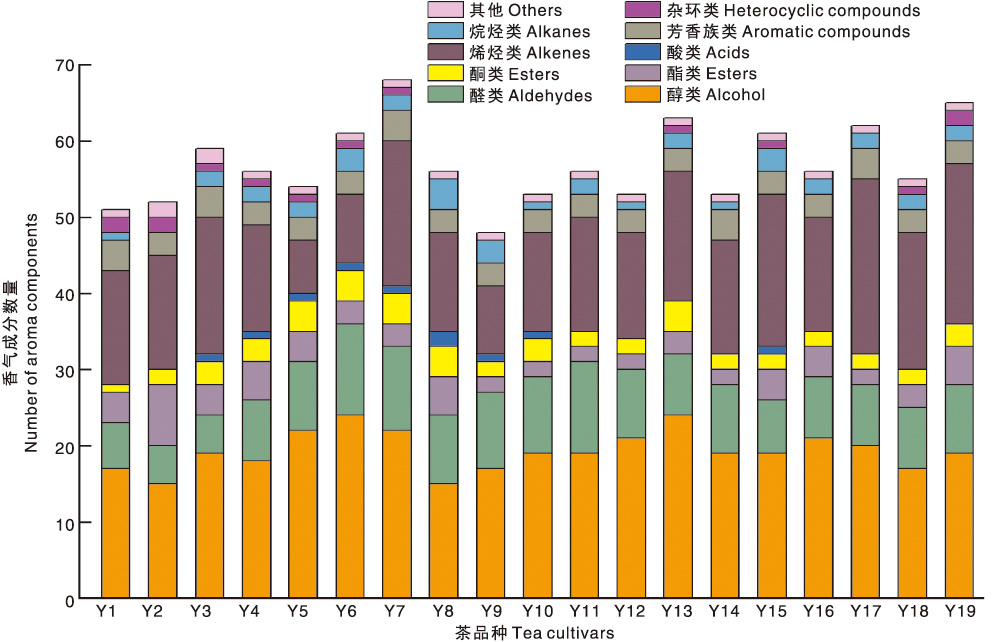
图4 19个岩茶品种的香气成分数量
Fig.4 Number of aroma components in 19 rock tea cultivars
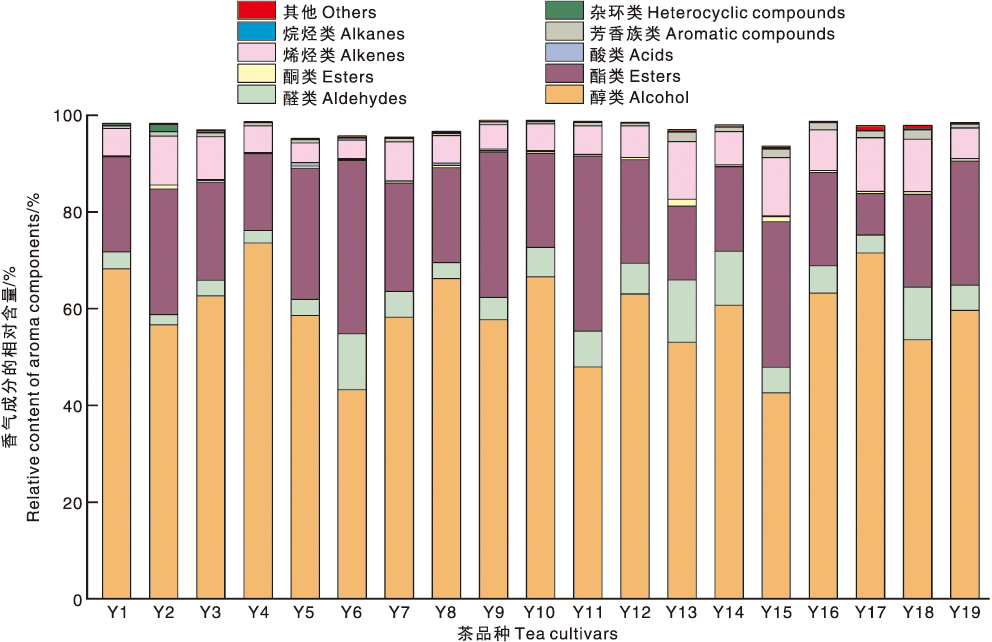
图5 19个岩茶品种香气成分的相对含量
Fig.5 Relative contents of aroma components in 19 rock tea cultivars
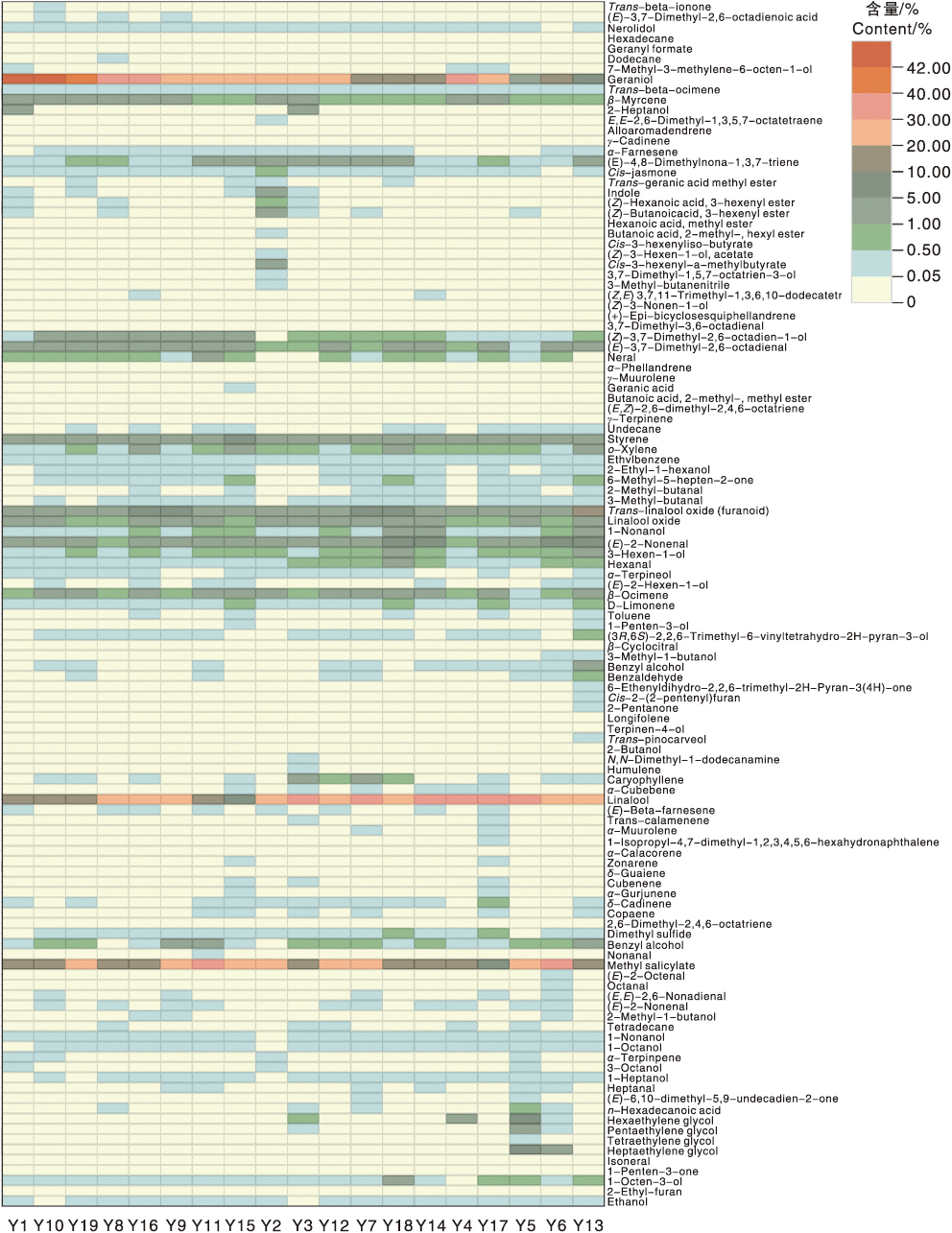
图6 19个岩茶品种香气组分含量热图 Ethanol,乙醇;Dimethyl sulfide,二甲硫醚;2-Butanol,仲丁醇;3-methyl-Butanal,异戊醛;2-Methyl-butanal,2-甲基丁醛;1-Penten-3-ol,1-戊烯-3-醇;1-Penten-3-one,1-戊烯-3-酮;2-Pentanone,2-戊酮;2-Ethyl-furan,2-乙基呋喃;3-Methyl-butanenitrile,异戊腈;3-Methyl-1-butanol,异戊醇;2-Methyl-1-butanol,2-甲基丁醇;Toluene,甲苯;Butanoic acid, 2-methyl-, methyl ester,2-甲基丁酸甲酯;Hexanal,己醛;(E)-2-Hexenal,反式-2-己烯醛;3-Hexen-1-ol,3-已烯-1-醇;Ethylbenzene,乙苯;(E)-2-Hexen-1-ol,反式-2-己烯-1-醇;1-Hexanol,1-己醇;o-Xylene,邻二甲苯;Styrene,苯乙烯;Heptanal,正庚醛;Benzaldehyde,苯甲醛;2-Heptanol,2-庚醇;1-Heptanol,1-庚醇;Hexanoic acid, methyl ester,己酸甲酯;1-Octen-3-ol,蘑菇醇;6-Methyl-5-hepten-2-one,6-甲基-5-庚烯-2-酮;β-Myrcene,月桂烯;Cis-2-(2-pentenyl)furan,顺式-2-(2-戊烯基)呋喃;Octanal,辛醛;3-Octanol,3-辛醇;α-Phellandrene,水芹烯;(Z)-3-Hexen-1-ol, acetate,叶醇;α-Terpinpene,α-萜品烯;2-Ethyl-1-hexanol,2-乙基-1-己醇;D-Limonene,D-柠檬烯;Trans-beta-ocimene,反式β-罗勒烯;Benzyl alcohol,苯甲醇;β-Ocimene,β-罗勒烯;γ-Terpinene,γ-萜品烯;(E)-2-Octenal,反式-2-辛烯醛;1-Octanol,正辛醇;Linalool oxide,氧化芳樟醇;Trans-linalool oxide (furanoid),反式芳樟醇氧化物(呋喃);Undecane,正十一烷;Linalool,芳樟醇;3,7-Dimethyl-1,5,7-octatrien-3-ol,3,7-二甲基-1,5,7-辛三烯-3-醇;6-Ethenyldihydro-2,2,6-trimethyl-2H-Pyran-3(4H)-one,2H-吡喃-3(4H)-酮,6-乙烯基二氢-2,2,6-三甲基;Nonanal,壬醛;(E)-4,8-Dimethylnona-1,3,7-triene,(E)-4,8-二甲基-1,3,7-壬三烯;Phenylethyl alcohol,苯乙醇;(E,Z)-2,6-dimethyl-2,4,6-octatriene,2,6-二甲基-2,4,6-辛三烯;(Z)-3-Nonen-1-ol,顺-3-壬烯-1-醇;E,E-2,6-Dimethyl-1,3,5,7-octatetraene,E,E-2,6-二甲基-1,3,5,7-辛四烯;2,6-Dimethyl-2,4,6-octatriene,2,6-二甲基-2,4,6-辛三烯;Cis-3-hexenyl iso-butyrate,顺-3-己烯基丁酸酯;Trans-pinocarveol,反式-松香芹醇;(E,E)-2,6-Nonadienal,(E,E)-2,6-壬二烯醛;(E)-2-Nonenal,反式2-壬烯醛;Isoneral,异橙花醛;1-Nonanol,1-壬醇;(3R,6S)-2,2,6-Trimethyl-6-vinyltetrahydro-2H-pyran-3-ol,(3R,6S)-2,2,6-三甲基-6-乙烯基四氢-2H-吡喃-3-醇;3,7-Dimethyl-3,6-octadienal,3,7-二甲基-3,6-辛二烯醛;Terpinen-4-ol,4-松油醇;(Z)-Butanoic acid, 3-hexenyl ester,(Z)-丁酸-3-己烯酯;Dodecane,十二烷;α-Terpineol,α-松油醇;Methyl salicylate,水杨酸甲酯;β-Cyclocitral,β-环柠檬醛;7-Methyl-3-methylene-6-octen-1-ol,7-甲基-3-亚甲基-6-辛烯-1-醇;(Z)-3,7-Dimethyl-2,6-octadien-1-ol,(Z)-3,7-二甲基-2,6-辛二烯-1-醇;Cis-3-hexenyl-α-methylbutyrate,2-甲基丁酸叶醇酯;Butanoic acid, 2-methyl-, hexyl ester,2-甲基丁酸己酯;Neral,柠檬醛;Geraniol,香叶醇;(E)-3,7-Dimethyl-2,6-octadienal,橙花醛;Geranyl formate,甲酸香叶酯;(E)-3,7-Dimethyl-2,6-octadienoic acid,反式-香叶酸;Indole,吲哚;Trans-geranic acid methyl ester,反式香叶酸甲酯;α-Cubebene,α-荜澄茄油烯;Geranic acid,香叶酸;(Z)-Hexanoic acid, 3-hexenyl ester,(Z)-己酸,3-己烯基酯;Copaene,古巴烯;Tetradecane,正十四烷;Cis-jasmone,顺式茉莉酮;Longifolene,长叶烯;α-Gurjunene,α-古芸烯;Caryophyllene,石竹烯;(E)-6,10-dimethyl-5,9-undecadien-2-one,香叶基丙酮;Humulene,葎草烯;(E)-beta-Farnesene,(E)-beta-金合欢烯;(Z,E) 3,7,11-Trimethyl-1,3,6,10-dodecatetraene,(Z,E)-3,7,11-三甲基-1,3,6,10-十二碳四烯;Trans-beta-ionone,反式-β紫罗兰酮;(+)-Epi-bicyclosesquiphellandrene,(+)-epi-双环倍半水芹烯;Alloaromadendrene,别香橙烯;γ-Muurolene,γ-依兰油烯;1-Isopropyl-4,7-dimethyl-1,2,3,4,5,6-hexahydronaphthalene,1-异丙基-4,7-二甲基-1,2,3,4,5,6-六氢萘;N,N-Dimethyl-1-dodecanamine,N,N-二甲基-1-十二胺;α-Farnesene,α-金合欢烯;δ-Guaiene,δ-愈创木烯;γ-Cadinene,γ-杜松烯;α-Muurolene,α-衣兰油烯;δ-Cadinene,δ-杜松烯;Trans-calamenene,反式菖蒲烯;Zonarene,佐纳烯;Cubenene,古巴烯;α-Calacorene,α-卡拉柯烯;Tetraethylene glycol,四甘醇;Nerolidol,橙花叔醇;Hexadecane,十六烷;Pentaethylene glycol,五乙二醇;n-Hexadecanoic acid,棕榈酸;Hexaethylene glycol,六乙二醇;Heptaethylene glycol,庚乙二烯乙二醇。
Fig.6 Heatmap of aroma component contents in 19 rock tea cultivars
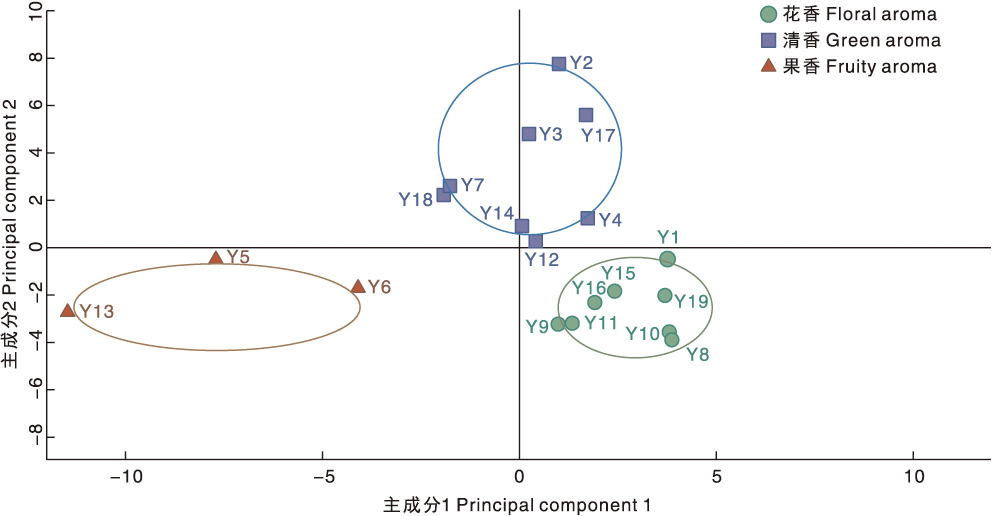
图7 19个岩茶品种香气的PLS-DA得分图
Fig.7 PLS-DA score plot of aroma in 19 rock tea cultivars
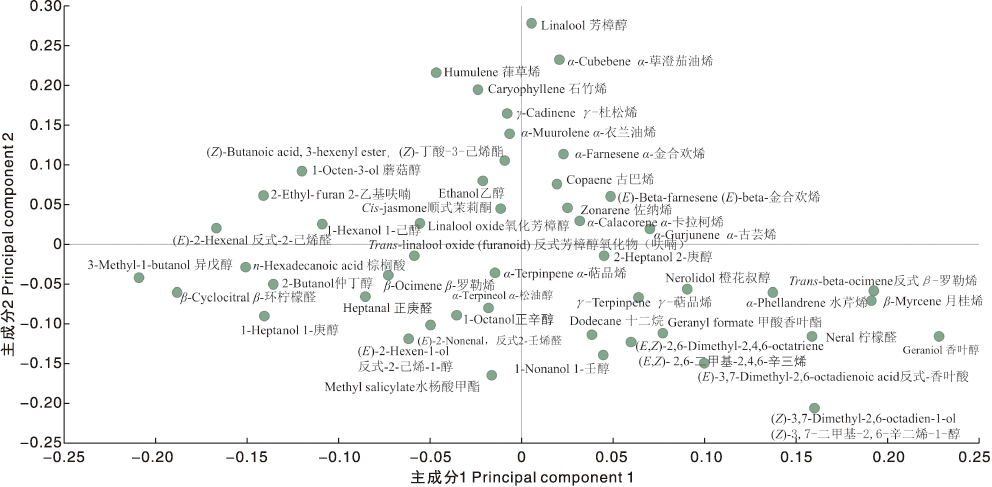
图8 19个岩茶品种香气的PLS-DA载荷图
Fig.8 PLS-DA loading plot of aroma in 19 rock tea cultivars
| [1] | 陈荣平. 不同茶树种质武夷岩茶滋味成分的靶向代谢组分析[J]. 茶叶学报, 2024, 65(6): 19-30. |
| CHEN R P. Flavor of Wuyi rock teas analyzed by targeted metabolomics[J]. Acta Tea Sinica, 2024, 65(6): 19-30. | |
| [2] | 戴浩民, 张灵枝, 梁轶琳, 等. 乌龙茶茶树品种制白茶的风味特征及特征组分分析[J]. 食品科学, 2024, 45(2): 229-239. |
| DAI H M, ZHANG L Z, LIANG Y L, et al. Analysis of flavor characteristics and characteristic components of white tea made from oolong tea cultivars[J]. Food Science, 2024, 45(2): 229-239. | |
| [3] | 宋晓月, 吴志锋, 邱慕涛, 等. 不同年份武夷岩茶水仙主要滋味物质分析与感官评价[J]. 食品与机械, 2024, 40(6): 170-175. |
| SONG X Y, WU Z F, QIU M T, et al. Analysis of main taste substances and sensory evaluation of Shuixian Wuyi rock tea narcissus in different years[J]. Food & Machinery, 2024, 40(6): 170-175. | |
| [4] | 邵淑贤, 徐梦婷, 林燕萍, 等. 基于电子鼻与HS-SPME-GC-MS技术对不同产地黄观音乌龙茶香气差异分析[J]. 食品科学, 2023, 44(4): 232-239. |
| SHAO S X, XU M T, LIN Y P, et al. Differential analysis of aroma components of Huangguanyin oolong tea from different geographical origins using electronic nose and headspace solid-phase microextraction-gas chromatography-mass spectrometry[J]. Food Science, 2023, 44(4): 232-239. | |
| [5] | 梁轶琳, 张灵枝, 戴浩民, 等. HS-SPME-GC-MS分析武夷岩茶呈香挥发性物质[J]. 食品与生物技术学报, 2024, 43(5): 110-121. |
| LIANG Y L, ZHANG L Z, DAI H M, et al. Analysis of aroma volatile compounds in Wuyi rock tea based on HS-SPME-GC-MS[J]. Journal of Food Science and Biotechnology, 2024, 43(5): 110-121. | |
| [6] | 涂云飞, 刁春华, 左小博. 绿茶与红茶中VC、茶氨酸、儿茶素及茶黄素HPLC同时定量研究[J]. 贵茶, 2023(1): 54-58. |
| TU Y F, DIAO C H, ZUO X B. Simultaneous determination of vitamin C, theanine, catechins and theaflavins in green tea and black tea by HPLC[J]. Journal of Guizhou Tea, 2023(1): 54-58. | |
| [7] | 贵州省绿茶品牌发展促进会. 贵州茶叶中风味挥发性物质的测定气相色谱质谱法: T/GZTPA 0001—2021[S/OL]. (2021-11-25)[2025-04-11]. https://d.wanfangdata.com.cn/standard/T/GZTPA%200001-2021. |
| [8] | 范仕胜, 肖一璇, 范乔. 茶叶中氨基酸含量及其检测方法研究进展[J]. 农技服务, 2023, 40(1): 41-44. |
| FAN S S, XIAO Y X, FAN Q. Research progress on amino acid content in tea and its detection methods[J]. Agricultural Technology Service, 2023, 40(1): 41-44. | |
| [9] | 张芬, 温立香, 彭靖茹, 等. 六堡茶渥堆过程中主要生化成分和茶汤色泽变化及其相关性研究[J]. 食品科技, 2019, 44(2): 83-87. |
| ZHANG F, WEN L X, PENG J R, et al. The changes and correlations of main chemical components and color of tea infusion during pile-fermentation of Liupao tea[J]. Food Science and Technology, 2019, 44(2): 83-87. | |
| [10] | 刘苇, 邓朝义, 陈兴, 等. 大厂茶茶叶中游离氨基酸及挥发性芳香物质分析[J]. 浙江林业科技, 2021, 41(3): 1-14. |
| LIU W, DENG C Y, CHEN X, et al. Determination of free amino acid and volatile aromatic compound in Camellia tachangensis[J]. Journal of Zhejiang Forestry Science and Technology, 2021, 41(3): 1-14. | |
| [11] | GUO Y F, LI D L, QIU H J, et al. Genome-wide association studies reveal the genetic basis of amino acid content variation in tea plants[J]. Journal of Integrative Agriculture, 2023, 22(11): 3364-3379. |
| [12] | LIU D D, WEI K, ZHANG C Y, et al. The potential effects of chlorophyll-deficient mutation and tree age on the accumulation of amino acid components in tea plants[J]. Food Chemistry, 2023, 411: 135527. |
| [13] | 戚亭, 裴华, 郭利攀, 等. 正交实验法优化4种茶叶中茶多酚的提取工艺研究[J]. 浙江农业科学, 2023, 64(8): 1977-1982. |
| QI T, PEI H, GUO L P, et al. Optimization of extraction process of tea polyphenols in four teas by orthogonal experiment[J]. Journal of Zhejiang Agricultural Sciences, 2023, 64(8): 1977-1982. | |
| [14] | YANG X Y, ZOU B, ZHANG X J, et al. A sensor array based on a nanozyme with polyphenol oxidase activity for the identification of tea polyphenols and Chinese green tea[J]. Biosensors and Bioelectronics, 2024, 250: 116056. |
| [15] | WEN X, WU P Y, LI F, et al. Study on the relationship between tea polyphenols alleviating osteoporosis and the changes of microorganism-metabolite-intestinal barrier[J]. Microbial Pathogenesis, 2024, 188: 106564. |
| [16] | 吴以龙, 王康, 武增才, 等. 高效液相色谱法测定与比较5种不同提取方法提取的茶叶咖啡因[J]. 食品研究与开发, 2023, 44(3): 195-200. |
| WU Y L, WANG K, WU Z C, et al. Determination and comparison of tea caffeine extracted by five different extraction methods by high performance liquid chromatography[J]. Food Research and Development, 2023, 44(3): 195-200. | |
| [17] | 张凯新, 孔祥慧, 徐卫奇, 等. 高效液相色谱法同时测定茶叶中表儿茶素及其氧化二聚体、没食子酸和咖啡碱的含量[J]. 食品工业科技, 2023, 44(19): 366-373. |
| ZHANG K X, KONG X H, XU W Q, et al. Simultaneous determination of epi-catechins and their oxidized dimers, gallic acid and caffeine in tea by HPLC[J]. Science and Technology of Food Industry, 2023, 44(19): 366-373. | |
| [18] | FU X M, CHEN Y Y, MEI X, et al. Regulation of formation of volatile compounds of tea (Camellia sinensis) leaves by single light wavelength[J]. Scientific Reports, 2015, 5: 16858. |
| [19] | YE J H, LV Y Q, LIU S R, et al. Effects of light intensity and spectral composition on the transcriptome profiles of leaves in shade grown tea plants (Camellia sinensis L.) and regulatory network of flavonoid biosynthesis[J]. Molecules, 2021, 26(19): 5836. |
| [20] | WANG M, YANG J, LI J L, et al. Effects of temperature and light on quality-related metabolites in tea [Camellia sinensis(L.) Kuntze] leaves[J]. Food Research International, 2022, 161: 111882. |
| [21] | ZHOU B, CHEN Y Y, ZENG L T, et al. Soil nutrient deficiency decreases the postharvest quality-related metabolite contents of tea [Camellia sinensis(L.) Kuntze] leaves[J]. Food Chemistry, 2022, 377: 132003. |
| [22] | ZHENG Y C, HU Q C, WU Z J, et al. Volatile metabolomics and coexpression network analyses provide insight into the formation of the characteristic cultivar aroma of oolong tea (Camellia sinensis)[J]. LWT, 2022, 164: 113666. |
| [23] | HAN Z X, RANA M M, LIU G F, et al. Green tea flavour determinants and their changes over manufacturing processes[J]. Food Chemistry, 2016, 212: 739-748. |
| [24] | YUN J, CUI C J, ZHANG S H, et al. Use of headspace GC/MS combined with chemometric analysis to identify the geographic origins of black tea[J]. Food Chemistry, 2021, 360: 130033. |
| [25] | 罗学平, 李丽霞, 练学燕, 等. SPME-GC-MS联用法分析四川青心乌龙红茶香气成分[J]. 南方农业, 2021, 15(16): 7-11. |
| LUO X P, LI L X, LIAN X Y, et al. Analysis of aroma components of Sichuan Qingxin oolong black tea by SPME-GC-MS[J]. South China Agriculture, 2021, 15(16): 7-11. | |
| [26] | 张磊, 俞滢, 梁子钧, 等. 茶树新品系‘福黄1号’白茶的特征香气成分及其在加工过程中的动态变化[J]. 食品科学, 2024, 45(22): 134-145. |
| ZHANG L, YU Y, LIANG Z J, et al. Characteristic aroma compounds of white tea made from ‘Fuhuang 1’, a new tea strain, and their dynamic changes during processing[J]. Food Science, 2024, 45(22): 134-145. | |
| [27] | 王丽丽, 张应根, 杨军国, 等. 顶空固相微萃取/气相色谱: 质谱联用法分析绿茶和白茶香气物质[J]. 茶叶学报, 2017, 58(1): 1-7. |
| WANG L L, ZHANG Y G, YANG J G, et al. Analysis of aroma components in green and white teas using headspace solid phase microextraction coupled with gas chromatography-mass spectrometry[J]. Acta Tea Sinica, 2017, 58(1): 1-7. | |
| [28] | 尹洪旭, 杨艳芹, 姚月凤, 等. 基于气相色谱-质谱技术与多元统计分析对不同栗香特征绿茶判别分析[J]. 食品科学, 2019, 40(4): 192-198. |
| YIN H X, YANG Y Q, YAO Y F, et al. Discrimination of different characteristics of chestnut-like green tea based on gas chromatography-mass spectrometry and multivariate statistical data analysis[J]. Food Science, 2019, 40(4): 192-198. | |
| [29] | 阳景阳, 陈远权, 梁贤智, 等. HS-SPME-GC-MS结合OAV对乌龙茶树品种制花香型红茶的香气评价[J]. 食品工业科技, 2025, 46(6): 315-324. |
| YANG J Y, CHEN Y Q, LIANG X Z, et al. HS-SPME-GC-MS coupled with OAV to evaluate the aroma of flowery black tea made from oolong tea varieties[J]. Science and Technology of Food Industry, 2025, 46(6): 315-324. | |
| [30] | 吴小清, 周菲菲, 叶影, 等. 不同茶树品种制龙井茶的香气特征研究[J]. 浙江农业学报, 2022, 34(3): 437-446. |
| WU X Q, ZHOU F F, YE Y, et al. Analysis of aroma characteristics of Longjing tea made from different tea cultivars[J]. Acta Agriculturae Zhejiangensis, 2022, 34(3): 437-446. | |
| [31] | 周春明, 袁海波, 秦志荣, 等. 花香绿茶的香气成分分析[J]. 广州食品工业科技, 2004, 20(2): 101-104. |
| ZHOU C M, YUAN H B, QIN Z R, et al. Analysis on aromatic constituents of fragrant green teas[J]. Guangzhou Food Science and Technology, 2004, 20(2): 101-104. | |
| [32] | 王苗苗, 秦嘉泽. 五种珍稀濒危兰花的挥发性成分分析[J]. 浙江农业学报, 2024, 36(12): 2727-2738. |
| WANG M M, QIN J Z. Volatile components in flowers of 5 rare and endangered orchids[J]. Acta Agriculturae Zhejiangensis, 2024, 36(12): 2727-2738. | |
| [33] | 袁杰, 翁连进, 耿頔, 等. 茶叶香气的影响因素[J]. 氨基酸和生物资源, 2014, 36(1): 14-18. |
| YUAN J, WENG L J, GENG D, et al. Affecting factors of the tea aroma[J]. Amino Acids & Biotic Resources, 2014, 36(1): 14-18. | |
| [34] | 胡腾飞, 萧涵, 谢贺, 等. 基于GC×GC-TOFMS-O分析3种武夷岩茶的关键香气成分[J]. 现代食品科技, 2024, 40(6): 221-230. |
| HU T F, XIAO H, XIE H, et al. Analysis of key aroma compounds in three varieties of Wuyi rock tea based on GC×GC-TOFMS-O[J]. Modern Food Science and Technology, 2024, 40(6): 221-230. |
| [1] | 郑婷, 向江, 魏灵珠, 吴江, 程建徽. 基于WGCNA分析CPPU和TDZ对天工墨玉葡萄香气影响及关键基因挖掘[J]. 浙江农业学报, 2025, 37(2): 311-320. |
| [2] | 朱学慧, 谢辉, 韩守安, 王敏, 白世践, 马云龙, 王艳蒙, 麦斯乐, 潘明启, 张雯. 两种植物生长调节剂对无核白鸡心葡萄果实品质的影响[J]. 浙江农业学报, 2024, 36(6): 1309-1319. |
| [3] | 吴小清, 周菲菲, 叶影, 黄艳梅, 杨蕾玉, 黄海涛, 吴媛媛. 不同茶树品种制龙井茶的香气特征研究[J]. 浙江农业学报, 2022, 34(3): 437-446. |
| [4] | 李欣燕, 王方玲, 张明月, 邵志晖, 王俊, 阳苇丽, 赵铭钦. 干旱胁迫下保水剂对雪茄烟叶碳氮代谢和中性香气物质含量的影响[J]. 浙江农业学报, 2022, 34(12): 2610-2621. |
| [5] | 葛诗蓓, 金迪迪, 杨明来, 王辉, 张兰, 韩文炎, 李鑫. 不同比例红蓝光对茶叶品质成分的影响与相关调控机理研究[J]. 浙江农业学报, 2022, 34(10): 2105-2111. |
| [6] | 张婷, 刘慧琴, 郭勤卫, 李朝森, 章心惠, 项小敏, 赵东风, 万红建. 十六份辣椒材料游离氨基酸组成的主成分分析与聚类分析[J]. 浙江农业学报, 2021, 33(4): 640-650. |
| [7] | 高娉娉, 温华婷, 赵美, 王婧. 粟酒裂殖酵母接种方式对黑比诺干红葡萄酒品质的影响[J]. 浙江农业学报, 2021, 33(12): 2397-2405. |
| [8] | 赵广民, 刘秀婷, 代兵, 杨华, 吕文涛, 王远霞, 肖英平. 早期断奶及谷氨酰胺添加对仔猪血清游离氨基酸及其代谢产物的影响[J]. 浙江农业学报, 2020, 32(10): 1764-1771. |
| [9] | 赵国富, 王金敖, 谢庭辉. 红颜草莓不同发育时期营养品质及香气变化[J]. 浙江农业学报, 2018, 30(12): 2044-2048. |
| [10] | 余翔1,李元实2,刘栋3,王瑞停2,帖金鑫1,马林1,*. 一株增香微生物的分离鉴定及其发酵产香条件优化[J]. 浙江农业学报, 2016, 28(4): 670-. |
| [11] | 曹健;张惠杰;许春平;*. 二年残孔菌胞外多糖组分分析及其在卷烟中的应用[J]. , 2014, 26(2): 0-279284. |
| [12] | 肖明礼;杨庆;林锐峰;普元柱;*;包秀萍;李仙. 风味蛋白酶提升烟叶抽吸品质的研究[J]. , 2014, 26(1): 0-185. |
| [13] | 杨勇;刘强;*;宋海星;官春云;*;荣湘民;彭建伟 . 氮磷钾配比对油菜养分吸收、碳氮代谢产物和籽粒产量的影响[J]. , 2012, 24(1): 0-104. |
| [14] | 陆剑飞;黄晓华;殷琛. 0.0016%丙酰芸苔素内酯AS对茶叶生产的影响[J]. , 2011, 23(4): 0-765. |
| 阅读次数 | ||||||
|
全文 |
|
|||||
|
摘要 |
|
|||||

