浙江农业学报 ›› 2026, Vol. 38 ›› Issue (8): 1563-1573.DOI: 10.3969/j.issn.1004-1524.20250696
丝瓜种子形态多样性评价及其核糖体失活蛋白含量比较
穆好鑫1,2( ), 陈潇琪2, 方萍萍1,2, 李朝森2, 韦静2, 王雪艳2, 张婷2, 杨立飞1,*(), 赵东风2,*()
- 1
南京农业大学 园艺学院 江苏 南京 211800
2衢州市农业林业科学研究院 蔬菜研究所 浙江 衢州 324000
-
收稿日期:2025-11-11出版日期:2026-08-25发布日期:2026-09-14 -
作者简介:穆好鑫,研究方向为蔬菜作物遗传育种及胁迫响应机理。E-mail:2023804293@stu.njau.edu.cn -
通讯作者:*杨立飞,E-mail:lfy@njau.edu.cn;赵东风,E-mail:zhaodongfengzhang@163.com -
基金资助:衢州市科技计划项目(2025K177);衢州市科技计划项目(2024K063);中国博士后科学基金面上项目(2025M773722)
Evaluation of the morphological diversity of Luffa seeds and comparison of the contents of ribosome-inactivating proteins
MU Haoxin1,2(), CHEN Xiaoqi2, FANG Pingping1,2, LI Chaosen2, WEI Jing2, WANG Xueyan2, ZHANG Ting2, YANG Lifei1,*(), ZHAO Dongfeng2,*()
- 1
College of Horticulture ,Nanjing Agricultural University Nanjing 211800, China
2Vegetable Research Institute ,Quzhou Academy of Agricultural and Forestry Sciences Quzhou 324000, Zhejiang, China
-
Received:2025-11-11Published:2026-08-25Online:2026-09-14

摘要:
为了探究丝瓜种子形态多样性及其与核糖体失活蛋白含量的关系,本研究通过对国内外收集的175份普通丝瓜和49份有棱丝瓜种质的长度、宽度、长宽比、周长、面积、厚度、百粒重和种子颜色共8个种子性状进行分析,并基于颜色和聚类结果随机测定了其中21份丝瓜种子的核糖体失活蛋白含量。结果表明,普通丝瓜颜色为黑色的种质最多,占比80.57%,有棱丝瓜均为黑色。数量性状中,普通丝瓜宽度和百粒重的变异系数最高,长宽比的变异系数最低。有棱丝瓜的百粒重和周长的变异系数分别为最高和最低。相关分析表明,2个种质的种子长度、周长、面积和百粒重之间均存在极显著(p<0.01)正相关。逐步回归分析表明,2个种质的面积和厚度可解释其种子百粒重50.0%以上的变异。主成分分析和聚类分析不仅进一步揭示了各形态性状间的相关性,且将普通丝瓜划分为4个组,将有棱丝瓜划分为3个组。有棱丝瓜的核糖体失活蛋白含量显著(p<0.05)高于普通丝瓜,但在同一种质不同群组间无显著差异。此外,着色深的丝瓜种子核糖体失活蛋白含量较白色种子含量高。本研究结果可为丝瓜种质资源的评价、保护与创新利用提供科学依据。
中图分类号:
引用本文
穆好鑫, 陈潇琪, 方萍萍, 李朝森, 韦静, 王雪艳, 张婷, 杨立飞, 赵东风. 丝瓜种子形态多样性评价及其核糖体失活蛋白含量比较[J]. 浙江农业学报, 2026, 38(8): 1563-1573.
MU Haoxin, CHEN Xiaoqi, FANG Pingping, LI Chaosen, WEI Jing, WANG Xueyan, ZHANG Ting, YANG Lifei, ZHAO Dongfeng. Evaluation of the morphological diversity of Luffa seeds and comparison of the contents of ribosome-inactivating proteins[J]. Acta Agriculturae Zhejiangensis, 2026, 38(8): 1563-1573.
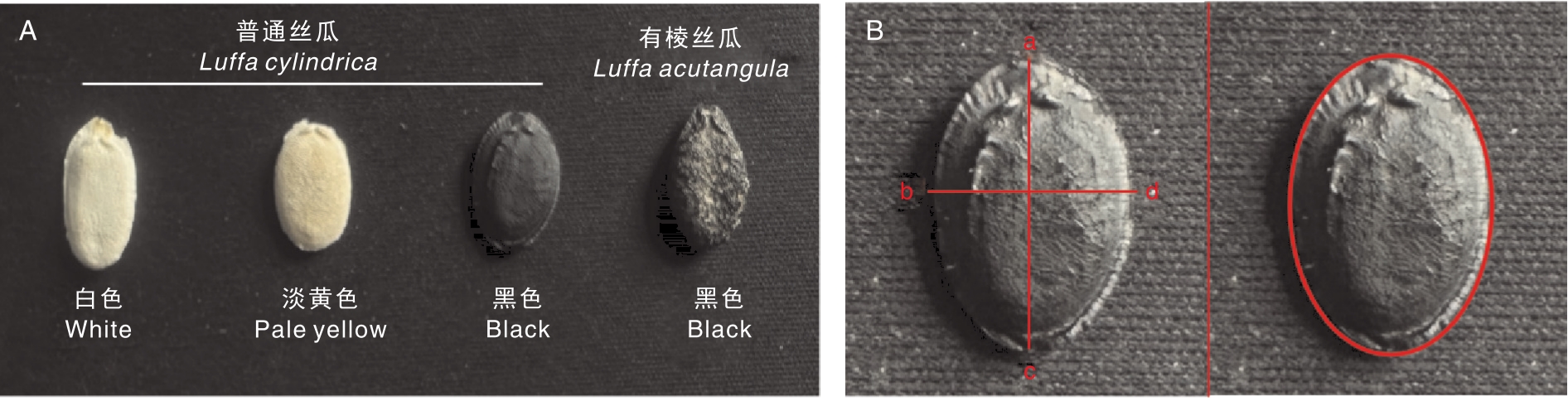
图1 种子颜色和种子长、宽等性状测量位置示意图 A图为普通丝瓜和有棱丝瓜种子颜色。B图中a-c和b-d的红色直线线段分别代表种子的长度和宽度,红色曲线圆圈分别代表种子的周长和面积。
Fig.1 Schematic diagram of the measurement position of seed color, seed length, and width presents the seed color of Luffa cylindrica and Luffa acutangula.The red straight line segments of a-c and b-d in B represent the seed length and width, respectively. The red curve circles represent the circumference and area of the seed, respectively.
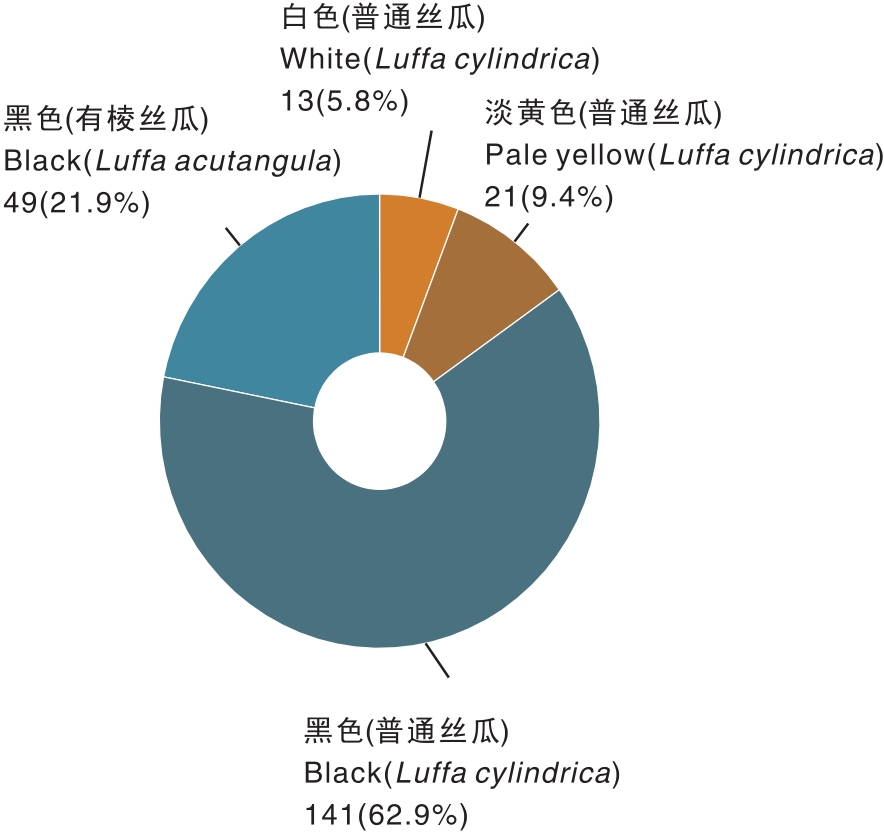
图2 224份丝瓜种质资源颜色及数量
Fig.2 The color and quantities of 224 Luffa germplasm resources
| 种质 Germplasm | 指标 Index | 长度/mm Length/mm | 宽度/mm Width/mm | 长宽比 Length-to- width ratio | 周长/mm Circumference/ mm | 面积/mm2 Area/mm2 | 厚度/mm Thickness/mm | 百粒重/g Hundred-seed weight/g |
|---|---|---|---|---|---|---|---|---|
| 普通丝瓜 Luffa cylindrica | 平均值Average value | 11.93 | 7.59 | 1.57 | 30.34 | 58.74 | 2.68 | 11.06 |
| 最大值Maximum | 14.6 | 9.33 | 1.98 | 56.51 | 81.06 | 3.69 | 15.60 | |
| 最小值Minimum | 9.46 | 5.38 | 1.30 | 23.05 | 35.59 | 1.91 | 6.20 | |
| 变异系数/% CV/% | 7.30 | 14.58 | 6.23 | 10.03 | 13.87 | 7.81 | 14.58 | |
| 有棱丝瓜 Luffa acutangula | 平均值Average value | 12.58 | 7.51 | 1.68 | 29.42 | 53.98 | 3.25 | 15.22 |
| 最大值Maximum | 14.62 | 8.74 | 1.99 | 32.25 | 65.14 | 3.70 | 19.21 | |
| 最小值Minimum | 10.92 | 6.58 | 1.48 | 26.20 | 42.15 | 2.82 | 9.76 | |
| 变异系数/% CV/% | 5.92 | 6.05 | 7.57 | 4.83 | 9.15 | 7.35 | 14.73 |
表1 丝瓜种子变异系数
Table 1 Coefficient of variation (CV) of Luffa
| 种质 Germplasm | 指标 Index | 长度/mm Length/mm | 宽度/mm Width/mm | 长宽比 Length-to- width ratio | 周长/mm Circumference/ mm | 面积/mm2 Area/mm2 | 厚度/mm Thickness/mm | 百粒重/g Hundred-seed weight/g |
|---|---|---|---|---|---|---|---|---|
| 普通丝瓜 Luffa cylindrica | 平均值Average value | 11.93 | 7.59 | 1.57 | 30.34 | 58.74 | 2.68 | 11.06 |
| 最大值Maximum | 14.6 | 9.33 | 1.98 | 56.51 | 81.06 | 3.69 | 15.60 | |
| 最小值Minimum | 9.46 | 5.38 | 1.30 | 23.05 | 35.59 | 1.91 | 6.20 | |
| 变异系数/% CV/% | 7.30 | 14.58 | 6.23 | 10.03 | 13.87 | 7.81 | 14.58 | |
| 有棱丝瓜 Luffa acutangula | 平均值Average value | 12.58 | 7.51 | 1.68 | 29.42 | 53.98 | 3.25 | 15.22 |
| 最大值Maximum | 14.62 | 8.74 | 1.99 | 32.25 | 65.14 | 3.70 | 19.21 | |
| 最小值Minimum | 10.92 | 6.58 | 1.48 | 26.20 | 42.15 | 2.82 | 9.76 | |
| 变异系数/% CV/% | 5.92 | 6.05 | 7.57 | 4.83 | 9.15 | 7.35 | 14.73 |
| 性状 Trait | 长度 Length | 宽度 Width | 长宽比 Length-to-width ratio | 周长 Circumference | 面积 Area | 厚度 Thickness |
|---|---|---|---|---|---|---|
| 宽度Width | 0.635** | |||||
| 长宽比Length-to-width ratio | 0.442** | -0.407** | ||||
| 周长Circumference | 0.555** | 0.487** | 0.084 | |||
| 面积Area | 0.791** | 0.731** | 0.081 | 0.704** | ||
| 厚度Thickness | 0.155* | 0.043 | 0.162* | 0.046 | -0.030 | |
| 百粒重Hundred-seed weight | 0.641** | 0.588** | 0.071 | 0.555** | 0.727** | 0.100 |
表2 普通丝瓜种子各性状之间的表型(rp)相关系数
Table 2 Phenotypic (rp) correlation coefficients between traits of Luffa cylindrica seeds
| 性状 Trait | 长度 Length | 宽度 Width | 长宽比 Length-to-width ratio | 周长 Circumference | 面积 Area | 厚度 Thickness |
|---|---|---|---|---|---|---|
| 宽度Width | 0.635** | |||||
| 长宽比Length-to-width ratio | 0.442** | -0.407** | ||||
| 周长Circumference | 0.555** | 0.487** | 0.084 | |||
| 面积Area | 0.791** | 0.731** | 0.081 | 0.704** | ||
| 厚度Thickness | 0.155* | 0.043 | 0.162* | 0.046 | -0.030 | |
| 百粒重Hundred-seed weight | 0.641** | 0.588** | 0.071 | 0.555** | 0.727** | 0.100 |
| 性状 Trait | 长度 Length | 宽度 Width | 长宽比 Length-to-width ratio | 周长 Circumference | 面积 Area | 厚度 Thickness |
|---|---|---|---|---|---|---|
| 宽度Width | 0.215 | |||||
| 长宽比Length-to-width ratio | 0.616** | -0.635** | ||||
| 周长Circumference | 0.738** | 0.586** | 0.109 | |||
| 面积Area | 0.718** | 0.710** | -0.003 | 0.911** | ||
| 厚度Thickness | 0.328* | 0.205 | 0.111 | 0.340* | 0.312* | |
| 百粒重Hundred-seed weight | 0.514** | 0.551** | -0.035 | 0.581** | 0.679** | 0.464** |
表3 有棱丝瓜种子各性状之间的表型(rp)相关系数
Table 3 Phenotypic (rp) correlation coefficients between traits of Luffa acutangula seeds
| 性状 Trait | 长度 Length | 宽度 Width | 长宽比 Length-to-width ratio | 周长 Circumference | 面积 Area | 厚度 Thickness |
|---|---|---|---|---|---|---|
| 宽度Width | 0.215 | |||||
| 长宽比Length-to-width ratio | 0.616** | -0.635** | ||||
| 周长Circumference | 0.738** | 0.586** | 0.109 | |||
| 面积Area | 0.718** | 0.710** | -0.003 | 0.911** | ||
| 厚度Thickness | 0.328* | 0.205 | 0.111 | 0.340* | 0.312* | |
| 百粒重Hundred-seed weight | 0.514** | 0.551** | -0.035 | 0.581** | 0.679** | 0.464** |
| 性状 Trait | 各性状均值Mean values of each trait | F值 F value | p值 p value | |||
|---|---|---|---|---|---|---|
| Ⅰ(n=51) | Ⅱ(n=44) | Ⅲ(n=45) | Ⅳ(n=35) | |||
| 长度Length | 12.31±0.32 | 11.06±0.55 | 11.52±0.50 | 12.98±0.68 | 110.613 | <0.001 |
| 宽度Width | 7.51±0.21 | 6.99±0.41 | 7.83±0.31 | 8.16±0.42 | 85.191 | <0.001 |
| 长宽比Length-to-width ratio | 1.64±0.05 | 1.59±0.10 | 1.47±0.06 | 1.59±0.09 | 41.520 | <0.001 |
| 周长Circumference | 30.53±1.00 | 27.61±1.60 | 30.02±1.04 | 33.94±4.26 | 54.446 | <0.001 |
| 面积Area | 59.83±3.64 | 49.25±5.20 | 58.53±3.94 | 69.34±5.64 | 126.291 | <0.001 |
| 百粒重Hundred-seed weight | 11.23±0.98 | 9.46±1.17 | 10.90±0.95 | 13.01±1.31 | 68.807 | <0.001 |
表4 普通丝瓜种子聚类分析产生的4个组群各性状均值
Table 4 The mean values of each trait of 4 groups generated by cluster analysis of Luffa cylindrica seeds
| 性状 Trait | 各性状均值Mean values of each trait | F值 F value | p值 p value | |||
|---|---|---|---|---|---|---|
| Ⅰ(n=51) | Ⅱ(n=44) | Ⅲ(n=45) | Ⅳ(n=35) | |||
| 长度Length | 12.31±0.32 | 11.06±0.55 | 11.52±0.50 | 12.98±0.68 | 110.613 | <0.001 |
| 宽度Width | 7.51±0.21 | 6.99±0.41 | 7.83±0.31 | 8.16±0.42 | 85.191 | <0.001 |
| 长宽比Length-to-width ratio | 1.64±0.05 | 1.59±0.10 | 1.47±0.06 | 1.59±0.09 | 41.520 | <0.001 |
| 周长Circumference | 30.53±1.00 | 27.61±1.60 | 30.02±1.04 | 33.94±4.26 | 54.446 | <0.001 |
| 面积Area | 59.83±3.64 | 49.25±5.20 | 58.53±3.94 | 69.34±5.64 | 126.291 | <0.001 |
| 百粒重Hundred-seed weight | 11.23±0.98 | 9.46±1.17 | 10.90±0.95 | 13.01±1.31 | 68.807 | <0.001 |
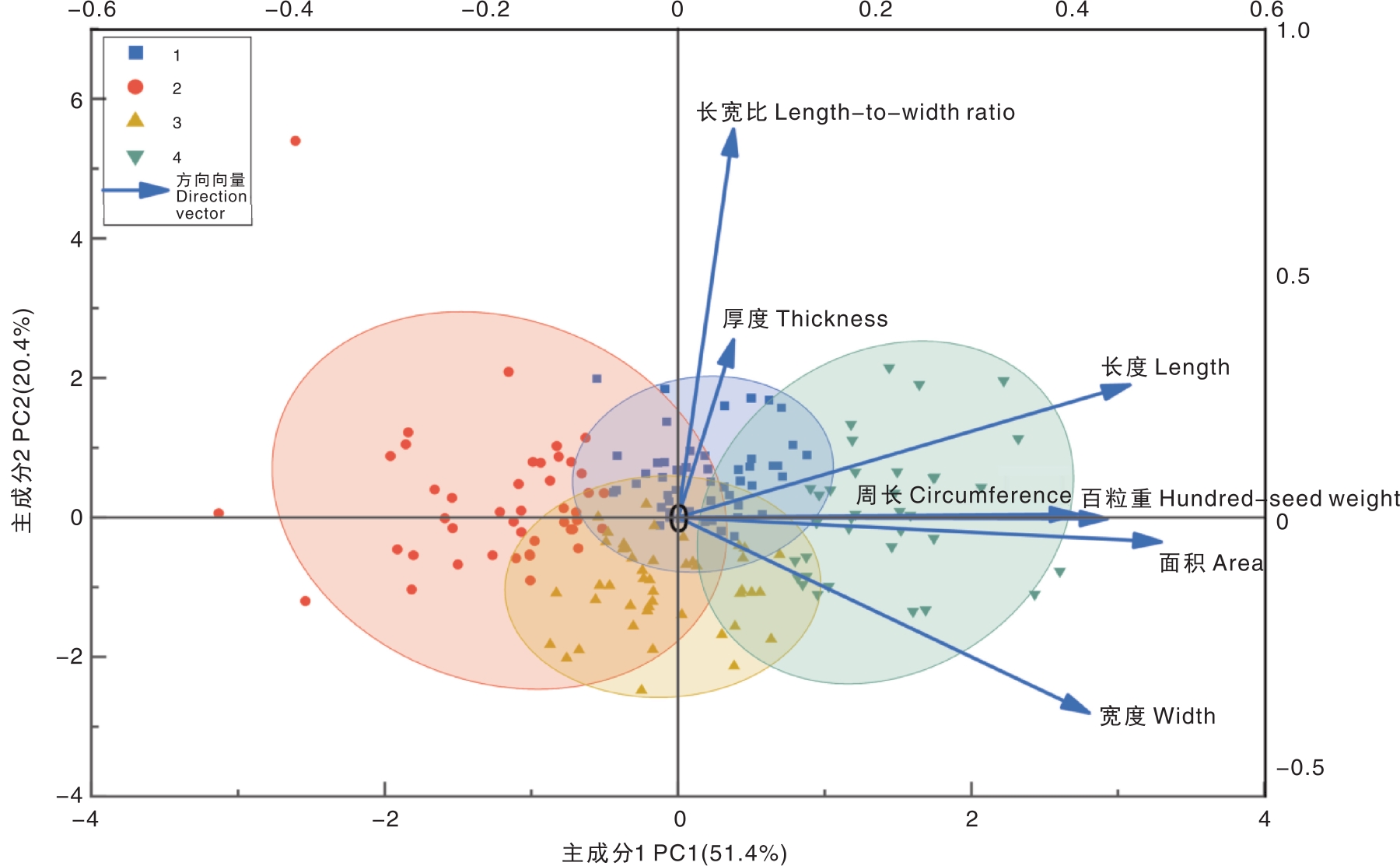
图3 普通丝瓜7个种子性状的模式分析 方向向量表示正或负相关性,不同符号代表聚类分析结果的不同分组。图4同。
Fig.3 Schema analysis of 7 seed traits of Luffa cylindrica seeds Direction vectors represent positive or negative correlations, and different symbols represent different groups of clustering analysis results. Figure 4 is the same.
| 性状 Trait | 各性状均值Mean values of each trait | F值 F value | p值 p value | ||
|---|---|---|---|---|---|
| Ⅰ(n=14) | Ⅱ(n=18) | Ⅲ(n=17) | |||
| 长度Length | 13.24±0.61 | 12.02±0.46 | 12.63±0.63 | 18.282 | <0.001 |
| 宽度Width | 7.99±0.32 | 7.30±0.37 | 7.33±0.33 | 19.555 | <0.001 |
| 周长Circumference | 31.01±0.68 | 28.26±0.99 | 29.32±0.96 | 36.613 | <0.001 |
| 面积Area | 59.92±2.29 | 49.48±3.35 | 53.85±2.86 | 50.784 | <0.001 |
| 厚度Thickness | 3.35±0.21 | 3.05±0.16 | 3.37±0.20 | 15.248 | <0.001 |
| 百粒重Hundred-seed weight | 17.59±0.91 | 13.36±1.90 | 15.24±1.33 | 32.358 | <0.001 |
表5 有棱丝瓜种子聚类分析产生的3个组群各性状均值
Table 5 The mean values of each trait of 3 groups generated by cluster analysis of 49 Luffa acutangula seeds
| 性状 Trait | 各性状均值Mean values of each trait | F值 F value | p值 p value | ||
|---|---|---|---|---|---|
| Ⅰ(n=14) | Ⅱ(n=18) | Ⅲ(n=17) | |||
| 长度Length | 13.24±0.61 | 12.02±0.46 | 12.63±0.63 | 18.282 | <0.001 |
| 宽度Width | 7.99±0.32 | 7.30±0.37 | 7.33±0.33 | 19.555 | <0.001 |
| 周长Circumference | 31.01±0.68 | 28.26±0.99 | 29.32±0.96 | 36.613 | <0.001 |
| 面积Area | 59.92±2.29 | 49.48±3.35 | 53.85±2.86 | 50.784 | <0.001 |
| 厚度Thickness | 3.35±0.21 | 3.05±0.16 | 3.37±0.20 | 15.248 | <0.001 |
| 百粒重Hundred-seed weight | 17.59±0.91 | 13.36±1.90 | 15.24±1.33 | 32.358 | <0.001 |
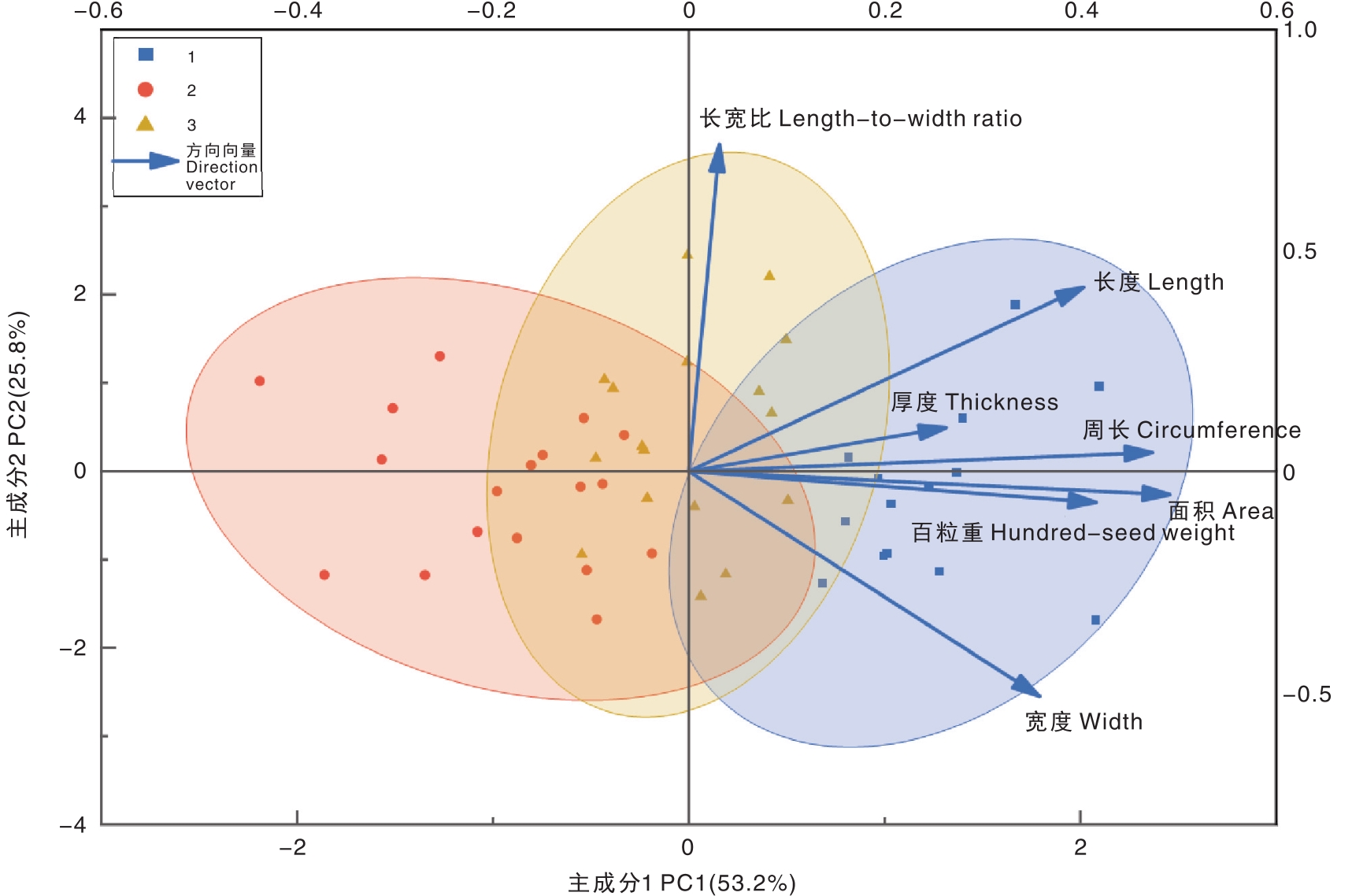
图4 有棱丝瓜7个种子性状的模式分析
Fig.4 Schema analysis of 7 seed traits of Luffa acutangula seeds
| 指标 Index | 回归系数 Regression coefficient | 95% CI | 共线性诊断Collinearity diagnostics | |
|---|---|---|---|---|
| VIF | 容忍度Tolerance | |||
| 常数Constant | 0.041(0.033) | -2.405~2.487 | — | — |
| 面积Area | 0.145**(14.188) | 0.125~0.165 | 1.001 | 0.999 |
| 厚度Thickness | 0.939*(2.365) | 0.155~1.723 | 1.001 | 0.999 |
表6 普通丝瓜种质的逐步回归分析结果
Table 6 Results of stepwise regression analysis of Luffa cylindrica germplasm
| 指标 Index | 回归系数 Regression coefficient | 95% CI | 共线性诊断Collinearity diagnostics | |
|---|---|---|---|---|
| VIF | 容忍度Tolerance | |||
| 常数Constant | 0.041(0.033) | -2.405~2.487 | — | — |
| 面积Area | 0.145**(14.188) | 0.125~0.165 | 1.001 | 0.999 |
| 厚度Thickness | 0.939*(2.365) | 0.155~1.723 | 1.001 | 0.999 |
| 指标 Index | 回归系数 Regression coefficient | 95% CI | 共线性诊断Collinearity diagnostics | |
|---|---|---|---|---|
| VIF | 容忍度Tolerance | |||
| 常数Constant | -7.333*(-2.134) | -14.250~-0.417 | — | — |
| 面积Area | 0.260**(5.564) | 0.166~0.354 | 1.108 | 0.902 |
| 厚度Thickness | 2.627*(2.630) | 0.616~4.637 | 1.108 | 0.902 |
表7 有棱丝瓜种质的逐步回归分析结果
Table 7 Results of stepwise regression analysis of 49 Luffa acutangula germplasms
| 指标 Index | 回归系数 Regression coefficient | 95% CI | 共线性诊断Collinearity diagnostics | |
|---|---|---|---|---|
| VIF | 容忍度Tolerance | |||
| 常数Constant | -7.333*(-2.134) | -14.250~-0.417 | — | — |
| 面积Area | 0.260**(5.564) | 0.166~0.354 | 1.108 | 0.902 |
| 厚度Thickness | 2.627*(2.630) | 0.616~4.637 | 1.108 | 0.902 |
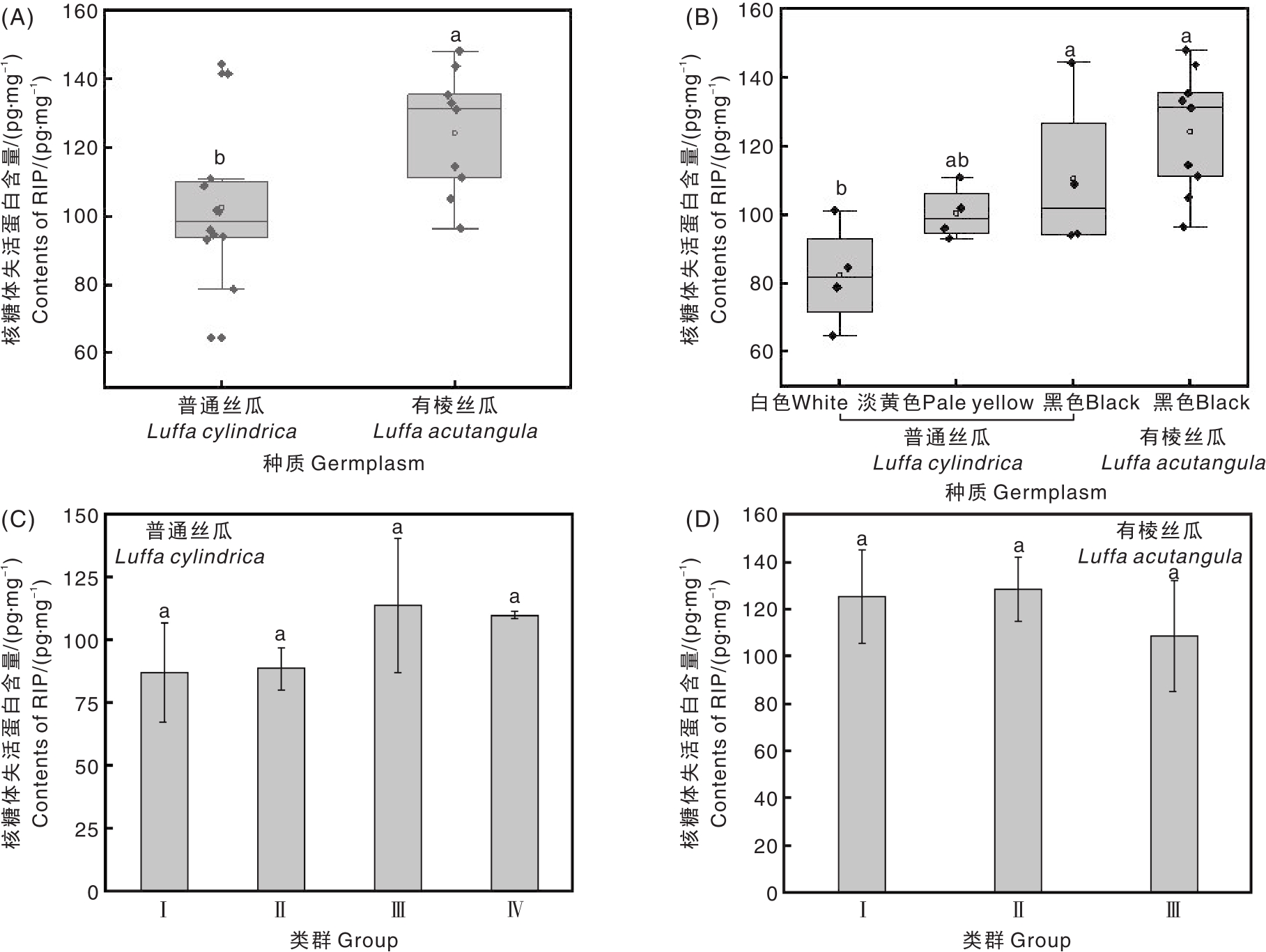
图5 丝瓜种子中核糖体失活蛋白含量 柱上无相同小写字母表示不同组别间差异显著(p<0.05)。
Fig.5 Ribosome-inactivating protein (RIP) contents in Luffa seeds The absence of identical lowercase letters on the column indicates significant (p<0.05) differences between different groups.
| [1] | 张强, 尹丽, 周旖璇, 等. 丝瓜多酚组成、提取分离、含量测定及生物活性的研究进展[J]. 中国药房, 2020, 31(23): 2928-2932. |
| Zhang Q, Yin L, Zhou Y X, et al. Research progress on composition, extraction and separation, content determination and biological activity of polyphenols from Luffa[J]. China Pharmacy, 2020, 31(23): 2928-2932. | |
| [2] | 张婷, 王雪艳, 郭勤卫, 等. 基于表型性状的丝瓜初级核心种质库的构建[J]. 热带作物学报, 2025, 46(1): 106-114. |
| Zhang T, Wang X Y, Guo Q W, et al. Construction of core germplasm collection based on phenotypic characters in Luffa spp.[J]. Chinese Journal of Tropical Crops, 2025, 46(1): 106-114. | |
| [3] | 李佳欣, 冯玉. 丝瓜不同部位药理作用研究进展[J]. 食品工业科技, 2021, 42(10): 355-361. |
| Li J X, Feng Y. Research progress on pharmacological action of different parts of Luffa cylindrica(L.) roem[J]. Science and Technology of Food Industry, 2021, 42(10): 355-361. | |
| [4] | 郭勤卫, 张婷, 刘慧琴, 等. 应用ISSR分子标记评价我国丝瓜种质资源遗传多样性[J]. 浙江农业学报, 2020, 32(4): 616-623. |
| Guo Q W, Zhang T, Liu H Q, et al. Evaluation of genetic diversity in Luffa germplasm resources in China based on ISSR molecular marker[J]. Acta Agriculturae Zhejiangensis, 2020, 32(4): 616-623. | |
| [5] | 王娇阳, 赵永彬, 冯春梅. 浙江省丝瓜种质资源主成分分析和聚类分析[J]. 植物遗传资源学报, 2014, 15(6): 1374-1379. |
| Wang J Y, Zhao Y B, Feng C M. Principal component analysis and cluster analysis of Luffa germplasm resources in Zhejiang Province[J]. Journal of Plant Genetic Resources, 2014, 15(6): 1374-1379. | |
| [6] | 吕名秀, 王秀娟, 卢奎, 等. 丝瓜籽蛋白提取工艺的研究[J]. 中国油脂, 2013, 38(8): 18-21. |
| Lyu M X, Wang X J, Lu K, et al. Extraction of Luffa seed protein[J]. China Oils and Fats, 2013, 38(8): 18-21. | |
| [7] | 郝艳丽. 超临界萃取丝瓜籽油的工艺研究[J]. 粮食与油脂, 2018, 31(4): 43-45. |
| Hao Y L. Study on super-critical fluid extraction of Luffa seeds oil[J]. Cereals & Oils, 2018, 31(4): 43-45. | |
| [8] | 王小娟. 丝瓜籽核糖体失活蛋白的纯化及其性质的研究[D]. 上海: 华东师范大学, 2004. |
| Wang X J. Purification of luffin-B from the seeds of Luffa cylindrica and the studies of properties[D]. Shanghai: East China Normal University, 2004. | |
| [9] | Sharma A, Gupta S, Sharma N R, et al. Expanding role of ribosome-inactivating proteins: From toxins to therapeutics[J]. IUBMB Life, 2023, 75(2): 82-96. |
| [10] | Maqsood Q, Sumrin A, Ali Q, et al. In-silico analysis of ribosome inactivating protein (RIP) of the Cucurbitaceae family[J]. AMB Express, 2024, 14(1): 61. |
| [11] | 陈琴, 李洋, 郭元元, 等. 丝瓜种质资源遗传多样性研究进展[J/OL]. 分子植物育种, 2023-07-06. https://link.cnki.net/urlid/46.1068.S.20230706.0823.002. |
| Chen Q, Li Y, Guo Y Y, et al. Research progress on genetic diversity of Luffa germplasm resources[J/OL]. Molecular Plant Breeding, 2023-07-06. https://link.cnki.net/urlid/46.1068.S.20230706.0823.002. | |
| [12] | 乔舒婷, 董文其, 许云飞, 等. 丝瓜种质资源表型鉴定及遗传多样性分析[J/OL]. 分子植物育种, 2022-04-28. https://link.cnki.net/urlid/46.1068.S.20220427.1533.020. |
| Qiao S T, Dong W Q, Xu Y F, et al. Phenotype identification and genetic diversity analysis of sponge gourd germplasm resources[J/OL]. Molecular Plant Breeding, 2022-04-28. https://link.cnki.net/urlid/46.1068.S.20220427.1533.020. | |
| [13] | 韩富亮, 袁春龙, 郭安鹊, 等. 二喹啉甲酸法(BCA)分析蛋白多肽的原理、影响因素和优点[J]. 食品与发酵工业, 2014, 40(11): 202-207. |
| Han F L, Yuan C L, Guo A Q, et al. The principle, influence factors and advantages of bicinchoninic acid method(BCA) for protein and peptide assay[J]. Food and Fermentation Industries, 2014, 40(11): 202-207. | |
| [14] | Bhutia N D, Sureja A K, Munshi A D, et al. Morphological and molecular characterization of Satputia (Luffa hermaphrodita Singh & Bhandari) revealed substantial diversity for use in breeding programme[J]. Genetic Resources and Crop Evolution, 2022, 69(7): 2485-2500. |
| [15] | Sun D D. Selection of the linear regression model according to the parameter estimation[J]. Wuhan University Journal of Natural Sciences, 2000, 5(4): 400-405. |
| [16] | 陈慢慢, 田翔, 陈凌, 等. 谷子重组自交系主要农艺性状和品质性状相关分析[J]. 植物遗传资源学报, 2023, 24(1): 172-180. |
| Chen M M, Tian X, Chen L, et al. Correlation analysis of key agronomic traits and food quality using a foxtail millet recombinant inbred lines[J]. Journal of Plant Genetic Resources, 2023, 24(1): 172-180. | |
| [17] | Chen S C, Antonelli A, Huang X, et al. Large seeds as a defensive strategy against partial granivory in the Fagaceae[J]. Journal of Ecology, 2025, 113(3): 598-607. |
| [18] | Moles A T, Ackerly D D, Webb C O, et al. A brief history of seed size[J]. Science, 2005, 307(5709): 576-580. |
| [19] | 孔维良, 孟攀奇, 李愚鹤, 等. 海南南部地区冬季黄瓜杂交制种技术[J]. 中国蔬菜, 2025(9): 199-203. |
| Kong W L, Meng P Q, Li Y H, et al. Hybrid seed production techniques of cucumber in winter in southern Hainan[J]. China Vegetables, 2025(9): 199-203. | |
| [20] | Crossa J, Martini J W R, Gianola D, et al. Deep kernel and deep learning for genome-based prediction of single traits in multi environment breeding trials[J]. Frontiers in Genetics, 2019, 10: 1168. |
| [21] | Khaki S, Pham H, Han Y, et al. Convolutional neural networks for image-based corn kernel detection and counting[J]. Sensors, 2020, 20(9): 2721. |
| [22] | Saroj R, Soumya S L, Singh S, et al. Unraveling the relationship between seed yield and yield-related traits in a diversity panel of Brassica juncea using multi-traits mixed model[J]. Frontiers in Plant Science, 2021, 12: 651936. |
| [23] | 高楠, 李逸涵, 孙佳琦, 等. 抗菌肽应用研究进展[J]. 农业生物技术学报, 2025, 33(6): 1382-1397. |
| Gao N, Li Y H, Sun J Q, et al. Research progress on the application of antimicrobial peptides[J]. Journal of Agricultural Biotechnology, 2025, 33(6): 1382-1397. | |
| [24] | Kao Y, Chou C H, Huang L C, et al. Momordicine I suppresses glioma growth by promoting apoptosis and impairing mitochondrial oxidative phosphorylation[J]. EXCLI Journal, 2023, 22: 482-498. |
| [25] | Wong J H, Bao H, Ng T B, et al. New ribosome-inactivating proteins and other proteins with protein synthesis-inhibiting activities[J]. Applied Microbiology and Biotechnology, 2020, 104(10): 4211-4226. |
| [26] | Yang Y X, Wang X Y, Lin T, et al. Opportunities and challenges for ribosome-inactivating proteins in traditional Chinese medicine plants[J]. Toxicon, 2023, 234: 107278. |
| [1] | 郭维, 马贤森, 聂红艳, 宋治豪, 周轶, 陈光勋, 陈正武. 35份贵州茶树种质资源的生化成分多样性分析与综合评价[J]. 浙江农业学报, 2026, 38(8): 1517-1528. |
| [2] | 石玉洁, 柴亚倩, 高璐瑶, 董文其, 张鹏, 周胜军, 王欣, 朱育强, 孙玉燕. 基于小RNA深度测序的浙江省丝瓜病毒种类鉴定[J]. 浙江农业学报, 2026, 38(8): 1620-1627. |
| [3] | 姜楠, 邓欣瑶, 钟敏, 程新. 多糖对镉胁迫下水稻种子萌发与糖代谢的影响[J]. 浙江农业学报, 2026, 38(6): 1164-1176. |
| [4] | 兰会杰, 高宏伟, 吉嘉若, 蔡瑞国, 张敏, 林小虎, 杨敏. 45份小豆种质的综合评价[J]. 浙江农业学报, 2026, 38(6): 1177-1186. |
| [5] | 邓云丹, 陆承锐, 李录山, 徐永艳. 10种百合鳞茎营养成分的测定与评价[J]. 浙江农业学报, 2026, 38(6): 1228-1235. |
| [6] | 李佳奇, 胡宽莲, 沈子靖, 史建国, 何韵. 不同霜冻胁迫时间下霜桑叶品质的变化[J]. 浙江农业学报, 2026, 38(5): 934-943. |
| [7] | 原增艳, 任欣欣, 宋小锋, 朱畇昊. 壳寡糖-纳米银的抗菌活性及其对红花种子萌发和幼苗生长的影响[J]. 浙江农业学报, 2026, 38(1): 76-84. |
| [8] | 许卫猛, 徐妍, 陈国立. 基于多种分析方法的糯玉米品质综合评价[J]. 浙江农业学报, 2025, 37(9): 1840-1848. |
| [9] | 刘国敏, 郑虚, 廖玉娇, 覃叶欣, 覃维治. 嫁接对低温胁迫下马铃薯苗抗寒性的影响[J]. 浙江农业学报, 2025, 37(8): 1615-1623. |
| [10] | 谈亚丽, 高梦祥, 李晓洁, 周英杰, 熊健, 曾子琦, 李啸, 杨华. 湖北省主栽核桃在不同采收期的品质[J]. 浙江农业学报, 2025, 37(7): 1459-1468. |
| [11] | 江振蓝, 陈付勋, 罗双飞, 罗烨琴, 沙晋明. 基于多光谱变换和主成分分析的土壤全铁含量随机森林模型反演[J]. 浙江农业学报, 2025, 37(7): 1521-1532. |
| [12] | 岳丽, 庄红梅, 祖力皮牙·买买提, 王佳敏, 毛红艳, 张英仙, 尼格尔热依·亚迪卡尔, 于明. 基于主成分分析与聚类分析的芜菁肉质根质地品质综合评价[J]. 浙江农业学报, 2025, 37(5): 1057-1071. |
| [13] | 许竹溦, 雷俊, 邵晓伟, 陈润兴, 姜欢, 汪寿根, 余文慧. 基于层次分析法与模糊综合评价法的衢州鲜食大豆低聚糖种质资源评价研究[J]. 浙江农业学报, 2025, 37(4): 754-766. |
| [14] | 刘思彤, 侯宇, 潘家荃, 周桦楠, 崔亮, 万博, 于涛. 甘薯对低温胁迫的生理响应及耐寒性评价[J]. 浙江农业学报, 2025, 37(4): 767-778. |
| [15] | 兰雪成, 赵凤亮, 张光旭, 李杨, 郭晓红. 纳米氧化锌和纳米氧化硅对水稻种子萌发的影响[J]. 浙江农业学报, 2025, 37(2): 269-277. |
| 阅读次数 | ||||||
|
全文 |
|
|||||
|
摘要 |
|
|||||

