浙江农业学报 ›› 2026, Vol. 38 ›› Issue (6): 1177-1186.DOI: 10.3969/j.issn.1004-1524.20250640
45份小豆种质的综合评价
兰会杰( ), 高宏伟, 吉嘉若, 蔡瑞国, 张敏, 林小虎, 杨敏*()
河北科技师范学院 农学与生物科技学院 河北省作物逆境生物学重点实验室, 河北 秦皇岛 066600
-
收稿日期:2025-10-10出版日期:2026-06-25发布日期:2026-07-14 -
作者简介:兰会杰,研究方向为植物逆境生理。E-mail:17743882703@163.com -
通讯作者:*杨敏,E-mail : 86553117@163.com -
基金资助:河北省现代农业产业技术体系创新团队(杂粮杂豆)项目(HBCT2024070405)
Comprehensive evaluation of 45 adzuki bean germplasms
LAN Huijie(), GAO Hongwei, JI Jiaruo, CAI Ruiguo, ZHANG Min, LIN Xiaohu, YANG Min*()
Hebei Key Laboratory of Crop Stress Biology ,College of Agronomy and Biotechnology, Hebei Normal University of Science and Technology, Qinhuangdao 066600 Hebei, China
-
Received:2025-10-10Published:2026-06-25Online:2026-07-14

摘要:
小豆作为我国重要的传统杂粮作物,兼具农业经济与营养健康价值,但其主产区面临种质退化、抗逆性衰退与品质性状分离等瓶颈问题。本研究以45份小豆种质资源为材料,系统测定其农艺性状及淀粉、粗蛋白含量,构建基于熵权法的改进隶属函数模型(EWM-UMF),并结合主成分分析(PCA)、判别函数分析(DFA)和层次聚类分析(HCA)解析性状关联网络,得出种质综合系数。结果表明:单株荚数和单株粒数的变异系数最高,分别为30.16%和28.03%,粗蛋白含量的变异系数最小,为4.27%;主成分分析提取3个主成分,分别表征产量构成因子、籽粒大小与分枝特性、植株形态,累计方差贡献率为69.860%;系统聚类分析将种质划分为3个类群,其中第Ⅰ类群为2份低产型种质,第Ⅱ类群为4份高产型种质,第Ⅲ类群为39份中产大粒高淀粉型种质。通过隶属函数综合评价,筛选出A35、A40、A39、A11和A13共5份优级种质。逐步回归分析表明,株高、茎粗、分枝数、单株荚数、单株粒数、单株籽粒产量和粗蛋白含量为关键评价指标。本研究创新性整合多维度统计方法,形成层级式评价体系,可为小豆种质资源评价与筛选提供理论依据与实践指导。
中图分类号:
引用本文
兰会杰, 高宏伟, 吉嘉若, 蔡瑞国, 张敏, 林小虎, 杨敏. 45份小豆种质的综合评价[J]. 浙江农业学报, 2026, 38(6): 1177-1186.
LAN Huijie, GAO Hongwei, JI Jiaruo, CAI Ruiguo, ZHANG Min, LIN Xiaohu, YANG Min. Comprehensive evaluation of 45 adzuki bean germplasms[J]. Acta Agriculturae Zhejiangensis, 2026, 38(6): 1177-1186.
| 编号 Number | 种质名称 Germplasm name | 编号 Number | 种质名称 Germplasm name | 编号 Number | 种质名称 Germplasm name | 编号 Number | 种质名称 Germplasm name |
|---|---|---|---|---|---|---|---|
| A1 | GHPX02 | A13 | 保红2008.31-2 Baohong 2008.31-2 | A25 | 品红2011-18 Pinhong 2011-18 | A37 | 10.0309-3-3-1-1-3-1-1-1-1-1 |
| A2 | I19012-27 | A14 | 红泉3号 Hongquan 3 | A26 | 日本大纳言 Dainagon Adzuki | A38 | 2.(混黑*9218)-2-4-1-1-2 2.(hunhei*9218)-2-4-1-1-2 |
| A3 | 白红2号 Baihong 2 | A15 | 红象2号 Hongxiang 2 | A27 | 唐红2010-12 Tanghong 2010-12 | A39 | 3.030-3-3-1-1-3-1-1-1-1-2 |
| A4 | 白红8号 Baihong 8 | A16 | 吉红9号 Jihong 9 | A28 | 唐山红小豆 Tangshanhongxiaodou | A40 | 4.1105-5-5-1 |
| A5 | 白红9号 Baihong 9 | A17 | 吉红10号 Jihong 10 | A29 | 同杂-6 Tongza-6 | A41 | 5.0921-4-2-1-2-1-1 |
| A6 | 保红876 Baohong 876 | A18 | 冀红4号 Jihong 4 | A30 | 音更 Yingeng | A42 | 6.1105反-5-5-2 6.1105 Fan-5-5-2 |
| A7 | 保红947 Baohong 947 | A19 | 冀红8号 Jihong 8 | A31 | 渝红1号 Yuhong 1 | A43 | 7.1218-6-4 |
| A8 | 保红0764 Baohong 0764 | A20 | 冀红13号 Jihong 13 | A32 | 渝红2号 Yuhong 2 | A44 | 8.1019-9-1-3-3 |
| A9 | 保红0778 Baohong 0778 | A21 | 冀红14号 Jihong 14 | A33 | 渝红5号 Yuhong 5 | A45 | 9.0001-15-10-2-2-4-2-1-1-2 |
| A10 | 保红3992 Baohong 3992 | A22 | 冀红16号 Jihong 16 | A34 | 珍珠红 Zhenzhuhong | ||
| A11 | 保红4795 Baohong 5795 | A23 | 冀红9218 Jihong 9218 | A35 | 中红7号 Zhonghong 7 | ||
| A12 | 保红8824 Baohong 8824 | A24 | 垦鉴红 Kenjianhong | A36 | 1.1218-8-3 |
表1 试验材料编号及名称
Table 1 Number and name of test material
| 编号 Number | 种质名称 Germplasm name | 编号 Number | 种质名称 Germplasm name | 编号 Number | 种质名称 Germplasm name | 编号 Number | 种质名称 Germplasm name |
|---|---|---|---|---|---|---|---|
| A1 | GHPX02 | A13 | 保红2008.31-2 Baohong 2008.31-2 | A25 | 品红2011-18 Pinhong 2011-18 | A37 | 10.0309-3-3-1-1-3-1-1-1-1-1 |
| A2 | I19012-27 | A14 | 红泉3号 Hongquan 3 | A26 | 日本大纳言 Dainagon Adzuki | A38 | 2.(混黑*9218)-2-4-1-1-2 2.(hunhei*9218)-2-4-1-1-2 |
| A3 | 白红2号 Baihong 2 | A15 | 红象2号 Hongxiang 2 | A27 | 唐红2010-12 Tanghong 2010-12 | A39 | 3.030-3-3-1-1-3-1-1-1-1-2 |
| A4 | 白红8号 Baihong 8 | A16 | 吉红9号 Jihong 9 | A28 | 唐山红小豆 Tangshanhongxiaodou | A40 | 4.1105-5-5-1 |
| A5 | 白红9号 Baihong 9 | A17 | 吉红10号 Jihong 10 | A29 | 同杂-6 Tongza-6 | A41 | 5.0921-4-2-1-2-1-1 |
| A6 | 保红876 Baohong 876 | A18 | 冀红4号 Jihong 4 | A30 | 音更 Yingeng | A42 | 6.1105反-5-5-2 6.1105 Fan-5-5-2 |
| A7 | 保红947 Baohong 947 | A19 | 冀红8号 Jihong 8 | A31 | 渝红1号 Yuhong 1 | A43 | 7.1218-6-4 |
| A8 | 保红0764 Baohong 0764 | A20 | 冀红13号 Jihong 13 | A32 | 渝红2号 Yuhong 2 | A44 | 8.1019-9-1-3-3 |
| A9 | 保红0778 Baohong 0778 | A21 | 冀红14号 Jihong 14 | A33 | 渝红5号 Yuhong 5 | A45 | 9.0001-15-10-2-2-4-2-1-1-2 |
| A10 | 保红3992 Baohong 3992 | A22 | 冀红16号 Jihong 16 | A34 | 珍珠红 Zhenzhuhong | ||
| A11 | 保红4795 Baohong 5795 | A23 | 冀红9218 Jihong 9218 | A35 | 中红7号 Zhonghong 7 | ||
| A12 | 保红8824 Baohong 8824 | A24 | 垦鉴红 Kenjianhong | A36 | 1.1218-8-3 |
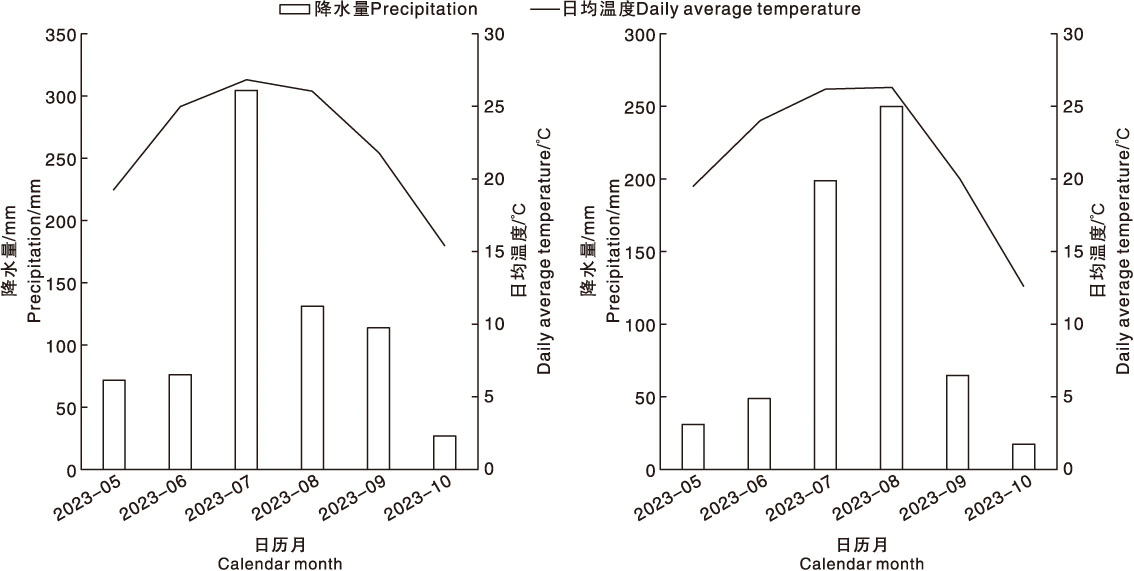
图1 小豆生育期日均气温与降水量
Fig.1 Daily average temperature and precipitation during the growth period of adzuki bean
| 性状 Character | 株高/cm Plant height/cm | 茎粗/mm Stem diameter/mm | 分枝数 Branch number | 单株荚数 Pod number per plant | 单株粒数 Grain number per plant | 千粒重/g 1 000-grain weight/g | 单株籽粒产量/g Grain yield per plant/g | 淀粉含量/% Starch content/% | 粗蛋白含量/% Crude protein content/% |
|---|---|---|---|---|---|---|---|---|---|
| 最大值Maximum | 77.70 | 8.14 | 18.33 | 72.70 | 329.18 | 178.58 | 33.57 | 60.94 | 25.49 |
| 最小值Minimun | 24.12 | 4.98 | 7.33 | 8.94 | 55.13 | 77.41 | 7.75 | 46.47 | 20.10 |
| 平均值Average | 47.14 | 6.95 | 12.63 | 42.77 | 192.62 | 141.34 | 26.54 | 53.49 | 23.11 |
| 标准差 Standard deviation | 11.93 | 0.61 | 2.28 | 12.90 | 53.98 | 24.08 | 4.32 | 3.81 | 0.99 |
| 变异系数/% Coefficient of variation/% | 25.30 | 8.83 | 18.06 | 30.16 | 28.03 | 17.04 | 16.26 | 7.12 | 4.27 |
表2 45份小豆种质的9个性状统计
Table 2 Statistics of 9 characters of 45 adzuki bean germplasms
| 性状 Character | 株高/cm Plant height/cm | 茎粗/mm Stem diameter/mm | 分枝数 Branch number | 单株荚数 Pod number per plant | 单株粒数 Grain number per plant | 千粒重/g 1 000-grain weight/g | 单株籽粒产量/g Grain yield per plant/g | 淀粉含量/% Starch content/% | 粗蛋白含量/% Crude protein content/% |
|---|---|---|---|---|---|---|---|---|---|
| 最大值Maximum | 77.70 | 8.14 | 18.33 | 72.70 | 329.18 | 178.58 | 33.57 | 60.94 | 25.49 |
| 最小值Minimun | 24.12 | 4.98 | 7.33 | 8.94 | 55.13 | 77.41 | 7.75 | 46.47 | 20.10 |
| 平均值Average | 47.14 | 6.95 | 12.63 | 42.77 | 192.62 | 141.34 | 26.54 | 53.49 | 23.11 |
| 标准差 Standard deviation | 11.93 | 0.61 | 2.28 | 12.90 | 53.98 | 24.08 | 4.32 | 3.81 | 0.99 |
| 变异系数/% Coefficient of variation/% | 25.30 | 8.83 | 18.06 | 30.16 | 28.03 | 17.04 | 16.26 | 7.12 | 4.27 |
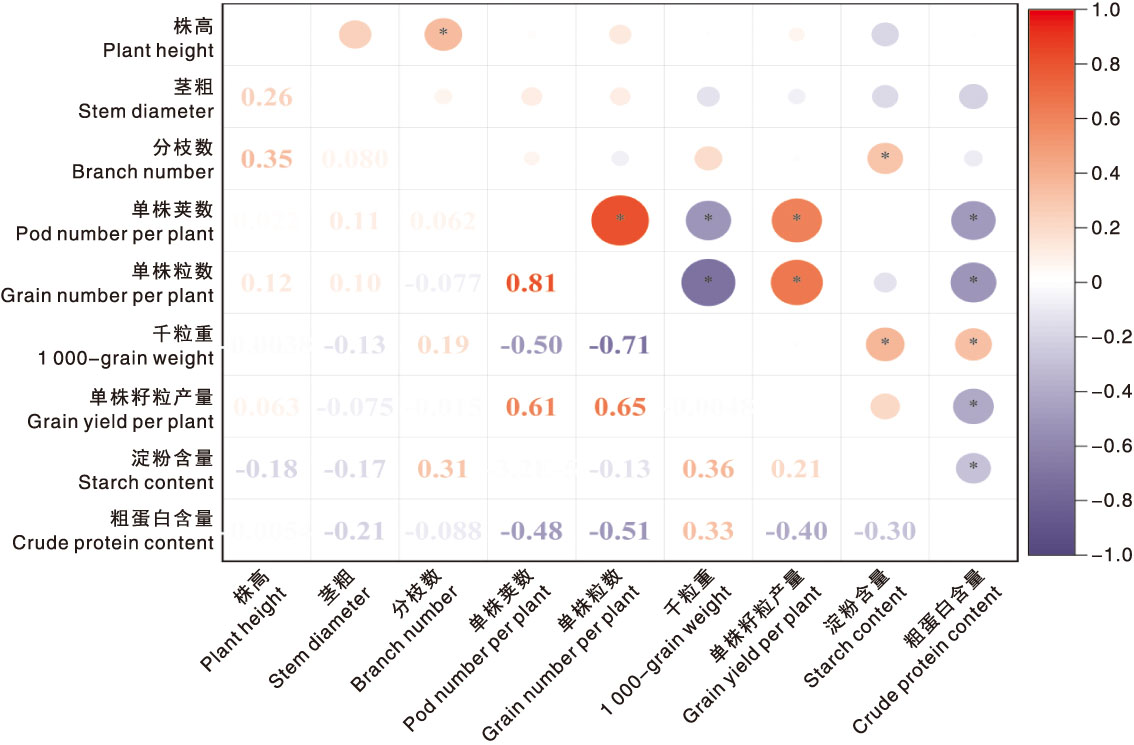
图2 小豆性状间相关分析 *表示相关性达显著水平(p<0.05)。
Fig.2 Correlation analysis of adzuki bean characters * indicates that the correlation is significant(p<0.05).
| 指标 Index | 因子载荷Factor loading | ||
|---|---|---|---|
| PC1 | PC2 | PC3 | |
| 株高Plant height | 0.062 | -0.004 | 0.669 |
| 茎粗Stem diameter | 0.108 | -0.162 | 0.507 |
| 分枝数Branch number | -0.014 | 0.428 | 0.500 |
| 单株荚数Pod number per plant | 0.503 | 0.053 | -0.035 |
| 单株粒数Grain number per plant | 0.541 | -0.087 | -0.033 |
| 千粒重1 000-grain weight | -0.375 | 0.422 | 0.019 |
| 单株籽粒产量Grain yield per plant | 0.385 | 0.315 | -0.147 |
| 淀粉含量Starch content | -0.020 | 0.666 | -0.145 |
| 粗蛋白含量Crude protein content | -0.386 | -0.245 | -0.019 |
| 特征值Eigenvalue | 3.108 | 1.702 | 1.477 |
| 方差贡献率/% Variance contribution rate/% | 34.530 | 18.920 | 16.410 |
| 累计方差贡献率/% Cumulative variance contribution rate/% | 34.530 | 53.450 | 69.860 |
| 因子权重Factor weight | 0.494 | 0.271 | 0.235 |
表3 小豆种质资源主成分分析
Table 3 Principal component analysis of adzuki bean germplasm resources
| 指标 Index | 因子载荷Factor loading | ||
|---|---|---|---|
| PC1 | PC2 | PC3 | |
| 株高Plant height | 0.062 | -0.004 | 0.669 |
| 茎粗Stem diameter | 0.108 | -0.162 | 0.507 |
| 分枝数Branch number | -0.014 | 0.428 | 0.500 |
| 单株荚数Pod number per plant | 0.503 | 0.053 | -0.035 |
| 单株粒数Grain number per plant | 0.541 | -0.087 | -0.033 |
| 千粒重1 000-grain weight | -0.375 | 0.422 | 0.019 |
| 单株籽粒产量Grain yield per plant | 0.385 | 0.315 | -0.147 |
| 淀粉含量Starch content | -0.020 | 0.666 | -0.145 |
| 粗蛋白含量Crude protein content | -0.386 | -0.245 | -0.019 |
| 特征值Eigenvalue | 3.108 | 1.702 | 1.477 |
| 方差贡献率/% Variance contribution rate/% | 34.530 | 18.920 | 16.410 |
| 累计方差贡献率/% Cumulative variance contribution rate/% | 34.530 | 53.450 | 69.860 |
| 因子权重Factor weight | 0.494 | 0.271 | 0.235 |
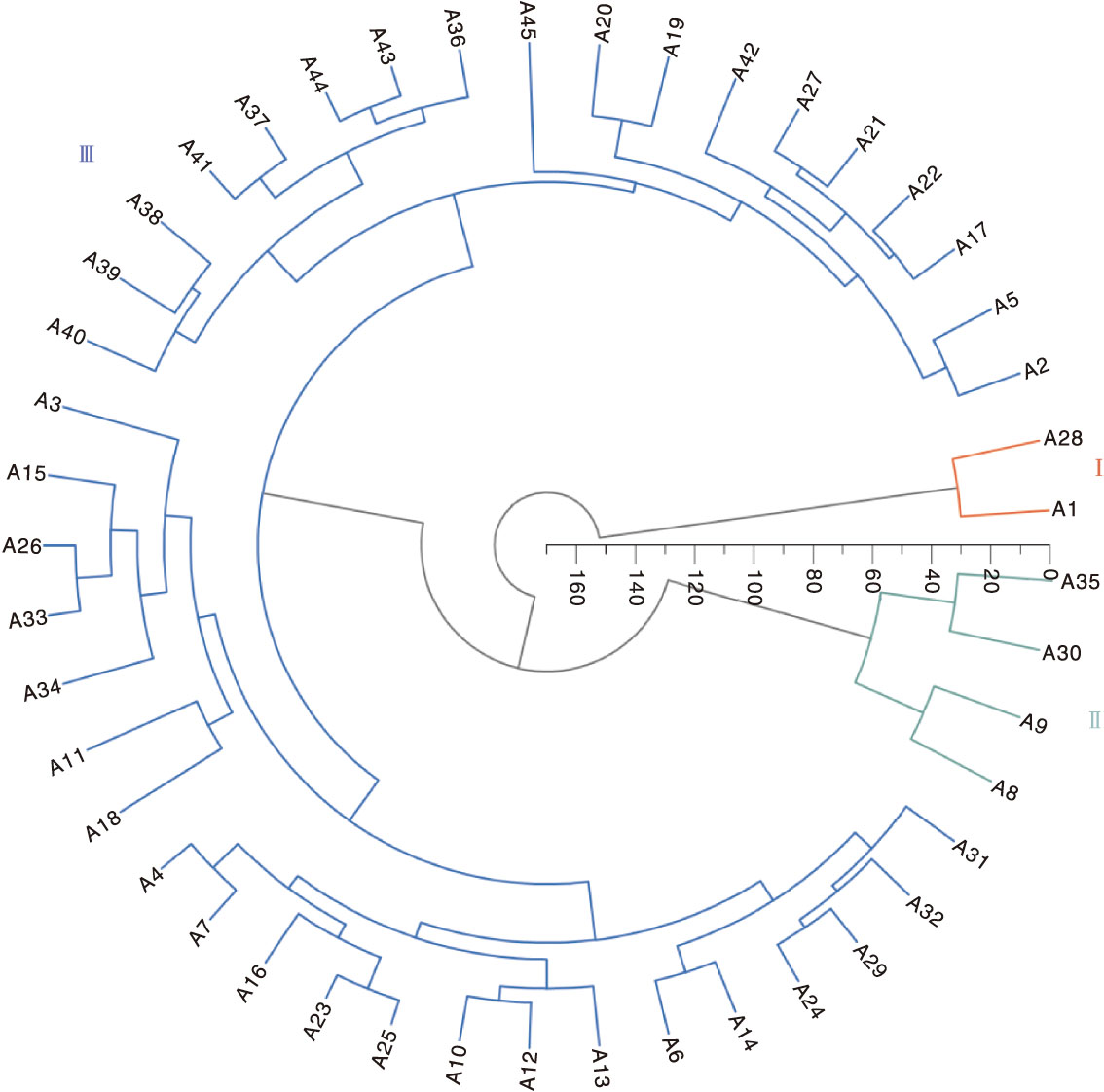
图3 45份小豆种质聚类图
Fig.3 Cluster map of 45 adzuki bean accessions
| 性状 Traits | 类群Ⅰ Group Ⅰ | 类群Ⅱ Group Ⅱ | 类群Ⅲ Group Ⅲ | |||
|---|---|---|---|---|---|---|
| 均值 Mean | 变异系数/% CV/% | 均值 Mean | 变异系数/% CV/% | 均值 Mean | 变异系数/% CV/% | |
| 株高/cm Plant height/cm | 36.87 | 8.78 | 55.10 | 15.45 | 46.85 | 25.82 |
| 茎粗/mm Stem diameter/mm | 6.83 | 21.34 | 7.25 | 9.18 | 6.92 | 8.34 |
| 分枝数Branch number | 10.42 | 5.66 | 12.42 | 15.52 | 12.76 | 18.27 |
| 单株荚数Pod number per plant | 10.22 | 17.64 | 57.87 | 16.09 | 42.89 | 24.00 |
| 单株粒数Grain number per plant | 57.11 | 4.89 | 299.21 | 7.61 | 188.64 | 18.01 |
| 千粒重/g 1 000-grain weight/g | 133.32 | 2.33 | 95.39 | 18.33 | 146.46 | 13.56 |
| 单株籽粒产量/g Grain yield per plant/g | 12.61 | 54.53 | 28.36 | 14.59 | 27.07 | 10.53 |
| 淀粉含量/% Starch content/% | 52.58 | 0.98 | 52.88 | 8.84 | 53.59 | 7.22 |
| 粗蛋白含量/% Crude protein content/% | 24.08 | 5.31 | 22.10 | 6.28 | 23.16 | 3.79 |
表4 小豆种质不同类群性状特征
Table 4 Character characteristics of different groups of adzuki bean germplasm
| 性状 Traits | 类群Ⅰ Group Ⅰ | 类群Ⅱ Group Ⅱ | 类群Ⅲ Group Ⅲ | |||
|---|---|---|---|---|---|---|
| 均值 Mean | 变异系数/% CV/% | 均值 Mean | 变异系数/% CV/% | 均值 Mean | 变异系数/% CV/% | |
| 株高/cm Plant height/cm | 36.87 | 8.78 | 55.10 | 15.45 | 46.85 | 25.82 |
| 茎粗/mm Stem diameter/mm | 6.83 | 21.34 | 7.25 | 9.18 | 6.92 | 8.34 |
| 分枝数Branch number | 10.42 | 5.66 | 12.42 | 15.52 | 12.76 | 18.27 |
| 单株荚数Pod number per plant | 10.22 | 17.64 | 57.87 | 16.09 | 42.89 | 24.00 |
| 单株粒数Grain number per plant | 57.11 | 4.89 | 299.21 | 7.61 | 188.64 | 18.01 |
| 千粒重/g 1 000-grain weight/g | 133.32 | 2.33 | 95.39 | 18.33 | 146.46 | 13.56 |
| 单株籽粒产量/g Grain yield per plant/g | 12.61 | 54.53 | 28.36 | 14.59 | 27.07 | 10.53 |
| 淀粉含量/% Starch content/% | 52.58 | 0.98 | 52.88 | 8.84 | 53.59 | 7.22 |
| 粗蛋白含量/% Crude protein content/% | 24.08 | 5.31 | 22.10 | 6.28 | 23.16 | 3.79 |
| [1] | 徐宁, 程须珍, 王丽侠, 等. 用于中国小豆种质资源遗传多样性分析SSR分子标记筛选及应用[J]. 作物学报, 2009, 35(2): 219-227. |
| XU N, CHENG X Z, WANG L X, et al. Screening and application of SSR molecular markers for genetic diversity analysis of Chinese adzuki bean germplasm resources[J]. Acta Agronomica Sinica, 2009, 35(2): 219-227. | |
| [2] | KANG Y J, SATYAWAN D, SHIM S, et al. Draft genome sequence of adzuki bean, Vigna angularis[J]. Scientific Reports, 2015, 5: 8069. |
| [3] | LIU L, BESTEL S, SHI J M, et al. Paleolithic human exploitation of plant foods during the Last Glacial Maximum in North China[J]. Proceedings of the National Academy of Sciences of the United States of America, 2013, 110(14): 5380-5385. |
| [4] | YAO Y, XUE P, ZHU Y Y, et al. Antioxidant and immunoregulatory activity of polysaccharides from adzuki beans (Vigna angularis)[J]. Food Research International, 2015, 77: 251-256. |
| [5] | CHU L W, ZHAO P, HUANG X Q, et al. Genetic analysis of seed coat colour in adzuki bean (Vigna angularis L.)[J]. Plant Genetic Resources: Characterization and Utilization, 2021, 19(1): 67-73. |
| [6] | KITANO-OKADA T, ITO A, KOIDE A, et al. Anti-obesity role of adzuki bean extract containing polyphenols: in vivo and in vitro effects[J]. Journal of the Science of Food and Agriculture, 2012, 92(13): 2644-2651. |
| [7] | 颜群翔, 庞玉辉, 洪壮壮, 等. 141份国内外小麦种质资源主要性状遗传多样性分析与特异性评价[J]. 作物杂志, 2025(1): 26-34. |
| YAN Q X, PANG Y H, HONG Z Z, et al. Genetic diversity analysis and specificity evaluation of main traits of 141 wheat germplasm resources at domestic and foreign[J]. Crops, 2025(1): 26-34. | |
| [8] | CHIEN C C, SEIKO T, MUTO C, et al. A single domestication origin of adzuki bean in Japan and the evolution of domestication genes[J]. Science, 2025, 388(6750): eads2871. |
| [9] | 胡亮亮, 陈燕华, 王成, 等. 小豆种质资源产量性状的多环境评价与优异种质筛选[J]. 植物遗传资源学报, 2025, 26(7): 1342-1354. |
| HU L L, CHEN Y H, WANG C, et al. Multi-environment evaluation and elite germplasm selection for yield traits in adzuki bean (Vigna angularis)[J]. Journal of Plant Genetic Resources, 2025, 26(7): 1342-1354. | |
| [10] | 胡亮亮, 周洪妹, 王晓磊, 等. 小豆产量相关性状的基因型与环境互作效应及稳定性分析[J]. 作物学报, 2025, 51(10): 2581-2594. |
| HU L L, ZHOU H M, WANG X L, et al. Analysis of genotype ×environment interaction and stability of yield-related traits in adzuki bean (Vigna angularis)[J]. Acta Agronomica Sinica, 2025, 51(10): 2581-2594. | |
| [11] | EDEM U U L, OSUAGWU A N, UDENSI O U. Assessment of genetic diversity in Sphenostylis stenocarpa(hochst ex. a rich harms) using morphological markers[J]. Asian Journal of Biology, 2023, 19(4): 74-85. |
| [12] | 昝香存, 常莹莹, 董海滨, 等. 河南省小麦种质资源品质特性多样性分析[J]. 植物遗传资源学报, 2025, 26(1): 67-78. |
| ZAN X C, CHANG Y Y, DONG H B, et al. Quality characteristics diversity of wheat germplasm resources in Henan Province[J]. Journal of Plant Genetic Resources, 2025, 26(1): 67-78. | |
| [13] | HEGDE V S, KUMAR J. Identification of agronomic traits to enhance biomass and grain yield of chickpea under rainfed short-duration environment[J]. Legume Research-An International Journal, 2015, 38(5): 5-9. |
| [14] | WANG Q J, JIANG Y, LIAO Z Q, et al. Evaluation of the contribution of teosinte to the improvement of agronomic, grain quality and yield traits in maize (Zea mays)[J]. Plant Breeding, 2020, 139(3): 589-599. |
| [15] | 王晓磊, 康泽然, 魏云山, 等. 20份小豆种质资源农艺性状鉴定与综合评价[J]. 江苏农业科学, 2023, 51(2): 98-104. |
| WANG X L, KANG Z R, WEI Y S, et al. Identification and comprehensive evaluation of agronomic traits of 20 Vigna angularis germplasm resources[J]. Jiangsu Agricultural Sciences, 2023, 51(2): 98-104. | |
| [16] | 周桂梅, 刘振兴, 陈健, 等. 小豆品种形态特征研究及综合评价[J]. 植物遗传资源学报, 2014, 15(5): 1144-1149. |
| ZHOU G M, LIU Z X, CHEN J, et al. Factor analysis and comprehensive assessment for agronomic traits of adzuki bean[J]. Journal of Plant Genetic Resources, 2014, 15(5): 1144-1149. | |
| [17] | 石建斌, 周红, 王宁, 等. 陆地棉纤维品质与主要农艺性状的相关性分析[J]. 江苏农业学报, 2019, 35(4): 770-775. |
| SHI J B, ZHOU H, WANG N, et al. Correlation analysis between fiber quality and main agronomic traits of upland cotton (Gossypium hirsutum L.)[J]. Jiangsu Journal of Agricultural Sciences, 2019, 35(4): 770-775. | |
| [18] | 张鲜, 赵少迪, 胡传伟, 等. 不同苦荞种质资源耐荫性评价及鉴定指标的筛选[J]. 核农学报, 2025, 39(2): 223-232. |
| ZHANG X, ZHAO S D, HU C W, et al. Evaluation of different Tartary buckwheat germplasm resources for shade tolerance and screening of identification indexes[J]. Journal of Nuclear Agricultural Sciences, 2025, 39(2): 223-232. | |
| [19] | 周全, 路秋梅, 赵张晨, 等. 244份春小麦苗期抗旱性的鉴定[J]. 中国农业科学, 2024, 57(9): 1646-1657. |
| ZHOU Q, LU Q M, ZHAO Z C, et al. Identification of drought resistance of 244 spring wheat varieties at seedling stage[J]. Scientia Agricultura Sinica, 2024, 57(9): 1646-1657. | |
| [20] | LIU X Y, SUN J X, WANG X Y, et al. Correlation between floral color attributes and volatile components among 10 fragrant Phalaenopsis cultivars[J]. Phyton, 2025, 94(2): 379-391. |
| [21] | 胡晴园, 公丹, 潘晓威, 等. 国家食用豆产业技术体系2019—2021年普通豇豆新品种(系)联合鉴定分析[J]. 作物杂志, 2024(3): 76-81. |
| HU Q Y, GONG D, PAN X W, et al. Joint identification of new varieties(lines)of cowpea during 2019-2021 organized by China agricultural research system of food legume[J]. Crops, 2024(3): 76-81. | |
| [22] | 公丹, 潘晓威, 王素华, 等. 国家食用豆产业技术体系绿豆新品种(系)联合鉴定[J]. 作物杂志, 2019(4): 30-36. |
| GONG D, PAN X W, WANG S H, et al. Multi-loci identifications on new varieties (lines)of mungbean from China agriculture research system on food legume[J]. Crops, 2019(4): 30-36. | |
| [23] | LEE I, WE G J, KIM D E, et al. Classification of rice cultivars based on cluster analysis of hydration and pasting properties of their starches[J]. LWT-Food Science and Technology, 2012, 48(2): 164-168. |
| [24] | 周桂梅, 陈琳, 刘振兴, 等. 小豆种质资源农艺性状鉴定与综合评价[J]. 江苏农业科学, 2023, 51(21): 44-49. |
| ZHOU G M, CHEN L, LIU Z X, et al. Identification and comprehensive evaluation of agronomic traits of adzuki bean germplasm resources[J]. Jiangsu Agricultural Sciences, 2023, 51(21): 44-49. | |
| [25] | 石广成, 杨万明, 杜维俊, 等. 大豆耐盐种质的筛选及其耐盐生理特性分析[J]. 生物技术通报, 2022, 38(4): 174-183. |
| SHI G C, YANG W M, DU W J, et al. Screening of salt-tolerant soybean germplasm and physiological characteristics analysis of its salt tolerance[J]. Biotechnology Bulletin, 2022, 38(4): 174-183. | |
| [26] | 饶庆琳, 姜敏, 吕建伟, 等. 花生种质资源品质性状分析及综合评价[J]. 植物遗传资源学报, 2024, 25(9): 1454-1467. |
| RAO Q L, JIANG M, LYU J W, et al. Analysis and comprehensive evaluation of quality characters of peanuts germplasm resources[J]. Journal of Plant Genetic Resources, 2024, 25(9): 1454-1467. |
| [1] | 邓云丹, 陆承锐, 李录山, 徐永艳. 10种百合鳞茎营养成分的测定与评价[J]. 浙江农业学报, 2026, 38(6): 1228-1235. |
| [2] | 胡江龙, 姜万龙, 彭辉, 吴骏成, 张真, 汤近天, 张雅芬, 叶子弘. 茭白种质资源收集及不同茭白品种对茭白胡麻斑病的抗性评价[J]. 浙江农业学报, 2026, 38(5): 886-897. |
| [3] | 李佳奇, 胡宽莲, 沈子靖, 史建国, 何韵. 不同霜冻胁迫时间下霜桑叶品质的变化[J]. 浙江农业学报, 2026, 38(5): 934-943. |
| [4] | 麻慧芳, 王娟菲, 薛红丽, 任果香, 史关燕. 杂交谷子新品系产量与表型性状的遗传分析[J]. 浙江农业学报, 2026, 38(3): 428-439. |
| [5] | 刘静, 王尖, 黄钰, 吴晓花, 郭轩赫, 汪颖, 李国景, 许小江. 南瓜果实品质评价的指标筛选与模型构建[J]. 浙江农业学报, 2026, 38(2): 248-257. |
| [6] | 钟弘睿, 褚云霞, 邓姗, 张余, 张永春, 任丽, 赵洪, 章毅颖, 刘昆, 曹建国, 陈海荣. 基于特异性、一致性、稳定性测试的朱顶红品种资源遗传多样性分析[J]. 浙江农业学报, 2026, 38(2): 258-268. |
| [7] | 何苏悦, 李燕, 丁云倩, 李欣泽, 韩庆辉, 陈小央. 基于SSR标记的浙江省地方玉米种质遗传关系分析[J]. 浙江农业学报, 2026, 38(1): 24-34. |
| [8] | 许卫猛, 徐妍, 陈国立. 基于多种分析方法的糯玉米品质综合评价[J]. 浙江农业学报, 2025, 37(9): 1840-1848. |
| [9] | 刘国敏, 郑虚, 廖玉娇, 覃叶欣, 覃维治. 嫁接对低温胁迫下马铃薯苗抗寒性的影响[J]. 浙江农业学报, 2025, 37(8): 1615-1623. |
| [10] | 谈亚丽, 高梦祥, 李晓洁, 周英杰, 熊健, 曾子琦, 李啸, 杨华. 湖北省主栽核桃在不同采收期的品质[J]. 浙江农业学报, 2025, 37(7): 1459-1468. |
| [11] | 江振蓝, 陈付勋, 罗双飞, 罗烨琴, 沙晋明. 基于多光谱变换和主成分分析的土壤全铁含量随机森林模型反演[J]. 浙江农业学报, 2025, 37(7): 1521-1532. |
| [12] | 岳丽, 庄红梅, 祖力皮牙·买买提, 王佳敏, 毛红艳, 张英仙, 尼格尔热依·亚迪卡尔, 于明. 基于主成分分析与聚类分析的芜菁肉质根质地品质综合评价[J]. 浙江农业学报, 2025, 37(5): 1057-1071. |
| [13] | 何国欣, 李素娟, 王剑, 陶晓园, 叶子弘, 陈光, 徐盛春. 大豆种质苗期低氮耐性筛选和鉴定[J]. 浙江农业学报, 2025, 37(5): 965-976. |
| [14] | 刘思彤, 侯宇, 潘家荃, 周桦楠, 崔亮, 万博, 于涛. 甘薯对低温胁迫的生理响应及耐寒性评价[J]. 浙江农业学报, 2025, 37(4): 767-778. |
| [15] | 李艳翠, 李福强, 周波. 不同生育期亏缺灌溉对蒙古黄芪光合特性、产量与品质的影响[J]. 浙江农业学报, 2025, 37(4): 779-789. |
| 阅读次数 | ||||||
|
全文 |
|
|||||
|
摘要 |
|
|||||

