浙江农业学报 ›› 2025, Vol. 37 ›› Issue (12): 2449-2457.DOI: 10.3969/j.issn.1004-1524.20240672
浙江省2014—2023年区域试验中水稻品种的稻瘟病抗性分析
郝中娜1( ), 邱海萍1, 柴荣耀1, 韩展誉2, 张震1, 王艳丽1, 王教瑜1, 刘鑫2,*()
- 1.浙江省农业科学院 植物保护与微生物研究所,浙江省国家农作物品种抗性鉴定试验站,浙江 杭州 310021
2.浙江省种子管理总站,浙江 杭州 310020
-
收稿日期:2024-07-23出版日期:2025-12-25发布日期:2026-01-09 -
作者简介:郝中娜(1978—),女,黑龙江哈尔滨人,博士,副研究员,研究方向为作物抗病性。E-mail:haozhongna1999@sina.com -
通讯作者:*刘鑫,E-mail:zjseed@126.com -
基金资助:浙江省农业农村现代化先行资金项目(2014—2023年);浙江省“十四五”水稻新品种选育重大科技专项(2021C02063-3)
Analysis of rice blast resistance in rice varieties from regional trials in Zhejiang Province of China from 2014 to 2023
HAO Zhongna1(), QIU Haiping1, CHAI Rongyao1, HAN Zhanyu2, ZHANG Zhen1, WANG Yanli1, WANG Jiaoyu1, LIU Xin2,*()
- 1. Zhejiang National Test Station for Resistance Identification of Crop Variety, Institute of Plant Protection and Microbiology, Zhejiang Academy of Agricultural Sciences, Hangzhou 310021, China
2. Seed Management Station of Zhejiang Province, Hangzhou 310020, China
-
Received:2024-07-23Online:2025-12-25Published:2026-01-09

摘要:
2014—2023年,分别采用人工接种鉴定和自然诱发鉴定对浙江省水稻区域试验的1 498个新品种进行苗叶瘟和穗瘟抗性鉴定,分析浙江省水稻新品种的稻瘟病抗性水平,并比较不同类型品种间的抗性差异。结果显示,除穗瘟发病率病级外,参试品种的苗叶瘟病级、穗瘟损失率病级、稻瘟病综合指数、穗瘟损失率最高病级的平均值均处于偏中抗水平。其中,2018年和2020年参试品种的稻瘟病抗性表现最佳,2023年参试品种的苗叶瘟抗性最差,而2016年参试品种在穗瘟抗性与综合抗性方面均表现最差。参试品种以中抗类型占比最高,其次为中感类型。基于稻瘟病综合指数判断,参试品种的达标率为94.9%,抗病率(即高抗、抗和中抗合计占比)为57.1%;基于穗瘟损失率最高病级判断,参试品种的达标率为92.9%,抗病率为67.4%。根据稻瘟病综合指数判断,不同类型水稻品种的抗性水平从高到低依次为单季籼粳杂交稻>早籼稻>单季杂交籼稻>连作杂交晚籼稻>单季晚粳稻>连作晚粳稻。
中图分类号:
引用本文
郝中娜, 邱海萍, 柴荣耀, 韩展誉, 张震, 王艳丽, 王教瑜, 刘鑫. 浙江省2014—2023年区域试验中水稻品种的稻瘟病抗性分析[J]. 浙江农业学报, 2025, 37(12): 2449-2457.
HAO Zhongna, QIU Haiping, CHAI Rongyao, HAN Zhanyu, ZHANG Zhen, WANG Yanli, WANG Jiaoyu, LIU Xin. Analysis of rice blast resistance in rice varieties from regional trials in Zhejiang Province of China from 2014 to 2023[J]. Acta Agriculturae Zhejiangensis, 2025, 37(12): 2449-2457.
| 水稻类型 Rice type | 每年的水稻品种数量Number of rice varieties in different years | 合计 Total | |||||||||
|---|---|---|---|---|---|---|---|---|---|---|---|
| 2014 | 2015 | 2016 | 2017 | 2018 | 2019 | 2020 | 2021 | 2022 | 2023 | ||
| 早籼稻Early indica rice | 24 | 13 | 12 | 24 | 23 | 25 | 25 | 25 | 25 | 27 | 223 |
| 单季杂交籼稻Single-season hybrid indica rice | 27 | 37 | 24 | 25 | 34 | 34 | 28 | 36 | 34 | 38 | 317 |
| 单季籼粳杂交稻Single-season hybrid indica-japonica rice | 26 | 26 | 36 | 24 | 24 | 36 | 39 | 50 | 51 | 51 | 363 |
| 单季晚粳稻Single-season late japonica rice | 13 | 13 | 14 | 12 | 23 | 26 | 26 | 26 | 25 | 27 | 205 |
| 连作杂交晚籼稻Continuous cropping hybrid late indica rice | 25 | 28 | 12 | 14 | 13 | 13 | 13 | 14 | 13 | 13 | 158 |
| 连作晚粳稻Continuous cropping late japonica rice | 12 | 11 | 11 | 12 | 12 | 14 | 12 | 14 | 14 | 14 | 126 |
| 连作籼粳杂交稻Continuous cropping indica-japonica hybrid rice | 0 | 7 | 0 | 0 | 0 | 0 | 14 | 14 | 13 | 14 | 62 |
| 特早熟晚粳稻Especially early maturing late japonica rice | 7 | 0 | 0 | 0 | 0 | 13 | 12 | 0 | 0 | 0 | 32 |
| 特早熟籼稻Especial early maturing indica rice | 0 | 0 | 0 | 0 | 0 | 12 | 0 | 0 | 0 | 0 | 12 |
| 合计Total | 134 | 135 | 109 | 111 | 129 | 173 | 169 | 179 | 175 | 184 | 1 498 |
表1 浙江省各类型水稻2014—2023年参与区域试验的品种数量
Table 1 Rice varieties in regional trials in Zhejiang Province from 2014-2023
| 水稻类型 Rice type | 每年的水稻品种数量Number of rice varieties in different years | 合计 Total | |||||||||
|---|---|---|---|---|---|---|---|---|---|---|---|
| 2014 | 2015 | 2016 | 2017 | 2018 | 2019 | 2020 | 2021 | 2022 | 2023 | ||
| 早籼稻Early indica rice | 24 | 13 | 12 | 24 | 23 | 25 | 25 | 25 | 25 | 27 | 223 |
| 单季杂交籼稻Single-season hybrid indica rice | 27 | 37 | 24 | 25 | 34 | 34 | 28 | 36 | 34 | 38 | 317 |
| 单季籼粳杂交稻Single-season hybrid indica-japonica rice | 26 | 26 | 36 | 24 | 24 | 36 | 39 | 50 | 51 | 51 | 363 |
| 单季晚粳稻Single-season late japonica rice | 13 | 13 | 14 | 12 | 23 | 26 | 26 | 26 | 25 | 27 | 205 |
| 连作杂交晚籼稻Continuous cropping hybrid late indica rice | 25 | 28 | 12 | 14 | 13 | 13 | 13 | 14 | 13 | 13 | 158 |
| 连作晚粳稻Continuous cropping late japonica rice | 12 | 11 | 11 | 12 | 12 | 14 | 12 | 14 | 14 | 14 | 126 |
| 连作籼粳杂交稻Continuous cropping indica-japonica hybrid rice | 0 | 7 | 0 | 0 | 0 | 0 | 14 | 14 | 13 | 14 | 62 |
| 特早熟晚粳稻Especially early maturing late japonica rice | 7 | 0 | 0 | 0 | 0 | 13 | 12 | 0 | 0 | 0 | 32 |
| 特早熟籼稻Especial early maturing indica rice | 0 | 0 | 0 | 0 | 0 | 12 | 0 | 0 | 0 | 0 | 12 |
| 合计Total | 134 | 135 | 109 | 111 | 129 | 173 | 169 | 179 | 175 | 184 | 1 498 |
| 年份 | 菌株来源 | 菌株编号(生理小种) |
|---|---|---|
| Year | Source of strain | Number of strain (physiologic race ) |
| 2014 | 籼稻Indica rice | 14-12(ZA1)、14-24(ZA9)、14-28(ZB1)、14-15(ZB5)、14-22(ZB13)、14-20(ZC5)、14-27(ZC15) |
| 粳稻Japonica rice | 14-36(ZA15)、14-39(ZA41)、14-41(ZA59)、14-32(ZA63)、14-35(ZB15) | |
| 2015 | 籼稻Indica rice | 15-173(ZA1)、15-116(ZA13)、15-133(ZB1)、15-166(ZB5)、15-176(ZB13)、15-117(ZC13)、15-143(ZC15) |
| 粳稻Japonica rice | 15-114(ZA35)、15-108(ZA51)、15-53(ZB1)、15-13(ZC15)、15-105(ZD1) | |
| 2016 | 籼稻Indica rice | 16-158(ZA1)、16-59(ZA33)、16-150(ZB1)、16-164(ZB5)、16-163(ZB13)、16-36(ZC13)、16-176(ZC15) |
| 粳稻Japonica rice | 16-56(ZA19)、16-174(ZA59)、16-166(ZB9)、16-82(ZC11)、16-122(ZD3) | |
| 2017 | 籼稻Indica rice | 17-57(ZA1)、17-49(ZA5)、17-36(ZA33)、17-1(ZB1)、17-21(ZB13)、17-20(ZC13)、17-34(ZC15) |
| 粳稻Japonica rice | 17-87(ZA1)、17-63(ZA33)、17-60(ZA49)、17-18(ZC15)、17-54(ZE3)、17-230(ZF1) | |
| 2018 | 籼稻Indica rice | 18-59(ZA1)、18-60(ZA5)、18-65(ZA9)、18-2(ZB1)、18-68(ZB13)、18-127(ZC13)、18-13(ZC15) |
| 粳稻Japonica rice | 18-51(ZA1)、18-73(ZA33)、18-75(ZA49)、18-64(ZC15)、18-56(ZD3)、18-20(ZE3)、18-11(ZF1) | |
| 2019 | 籼稻Indica rice | 19-12(ZA33)、19-2(ZB13)、19-4(ZC13)、19-3(ZC15)、19-20(ZE3) |
| 粳稻Japonica rice | 19-28(ZA1)、19-34(ZA9)、19-25(ZB1)、19-37(ZC13)、19-46(ZD3)、19-54(ZE3)、19-23(ZG1) | |
| 2020 | 籼稻Indica rice | 20-10(ZB7)、20-4(ZB32)、20-1(ZC13)、20-13(ZC15)、20-18(ZE3) |
| 粳稻Japonica rice | 20-20(ZA1)、20-23(ZA49)、20-27(ZB25)、20-32(ZC15)、20-39(ZE1)、20-54(ZE3)、20-33(ZG1) | |
| 2021 | 籼稻Indica rice | 21-20(ZA33)、21-16(ZB1)、21-100(ZB9)、21-11(ZB13)、21-9(ZC1)、21-83(ZC5) |
| 粳稻Japonica rice | 21-145(ZA1)、21-138(ZA33)、21-148(ZA49)、21-142(ZB1)、21-164(ZB13)、21-126(ZC1)、21-135(ZG1) | |
| 2022 | 籼稻Indica rice | 22-28(ZB1)、22-48(ZB11)、22-41(ZB13)、22-13(ZC1)、22-6(ZC13) |
| 粳稻Japonica rice | 22-51(ZA1)、22-73(ZA33)、22-75(ZA49)、22-53(ZB1)、22-91(ZB13)、22-80(ZC1)、22-71(ZG1) | |
| 2023 | 籼稻Indica rice | 23-145(ZA1)、23-160(ZA17)、23-140(ZB1)、23-164(ZB3)、23-116(ZB5)、23-66(ZD5) |
| 粳稻Japonica rice | 23-291(ZA1)、23-311(ZA9)、23-329(ZA13)、23-319(ZA25)、23-376(ZB1)、23-323(ZB5) |
表2 水稻苗叶瘟鉴定所用的菌株信息
Table 2 Information of strains used for identification of rice leaf blast
| 年份 | 菌株来源 | 菌株编号(生理小种) |
|---|---|---|
| Year | Source of strain | Number of strain (physiologic race ) |
| 2014 | 籼稻Indica rice | 14-12(ZA1)、14-24(ZA9)、14-28(ZB1)、14-15(ZB5)、14-22(ZB13)、14-20(ZC5)、14-27(ZC15) |
| 粳稻Japonica rice | 14-36(ZA15)、14-39(ZA41)、14-41(ZA59)、14-32(ZA63)、14-35(ZB15) | |
| 2015 | 籼稻Indica rice | 15-173(ZA1)、15-116(ZA13)、15-133(ZB1)、15-166(ZB5)、15-176(ZB13)、15-117(ZC13)、15-143(ZC15) |
| 粳稻Japonica rice | 15-114(ZA35)、15-108(ZA51)、15-53(ZB1)、15-13(ZC15)、15-105(ZD1) | |
| 2016 | 籼稻Indica rice | 16-158(ZA1)、16-59(ZA33)、16-150(ZB1)、16-164(ZB5)、16-163(ZB13)、16-36(ZC13)、16-176(ZC15) |
| 粳稻Japonica rice | 16-56(ZA19)、16-174(ZA59)、16-166(ZB9)、16-82(ZC11)、16-122(ZD3) | |
| 2017 | 籼稻Indica rice | 17-57(ZA1)、17-49(ZA5)、17-36(ZA33)、17-1(ZB1)、17-21(ZB13)、17-20(ZC13)、17-34(ZC15) |
| 粳稻Japonica rice | 17-87(ZA1)、17-63(ZA33)、17-60(ZA49)、17-18(ZC15)、17-54(ZE3)、17-230(ZF1) | |
| 2018 | 籼稻Indica rice | 18-59(ZA1)、18-60(ZA5)、18-65(ZA9)、18-2(ZB1)、18-68(ZB13)、18-127(ZC13)、18-13(ZC15) |
| 粳稻Japonica rice | 18-51(ZA1)、18-73(ZA33)、18-75(ZA49)、18-64(ZC15)、18-56(ZD3)、18-20(ZE3)、18-11(ZF1) | |
| 2019 | 籼稻Indica rice | 19-12(ZA33)、19-2(ZB13)、19-4(ZC13)、19-3(ZC15)、19-20(ZE3) |
| 粳稻Japonica rice | 19-28(ZA1)、19-34(ZA9)、19-25(ZB1)、19-37(ZC13)、19-46(ZD3)、19-54(ZE3)、19-23(ZG1) | |
| 2020 | 籼稻Indica rice | 20-10(ZB7)、20-4(ZB32)、20-1(ZC13)、20-13(ZC15)、20-18(ZE3) |
| 粳稻Japonica rice | 20-20(ZA1)、20-23(ZA49)、20-27(ZB25)、20-32(ZC15)、20-39(ZE1)、20-54(ZE3)、20-33(ZG1) | |
| 2021 | 籼稻Indica rice | 21-20(ZA33)、21-16(ZB1)、21-100(ZB9)、21-11(ZB13)、21-9(ZC1)、21-83(ZC5) |
| 粳稻Japonica rice | 21-145(ZA1)、21-138(ZA33)、21-148(ZA49)、21-142(ZB1)、21-164(ZB13)、21-126(ZC1)、21-135(ZG1) | |
| 2022 | 籼稻Indica rice | 22-28(ZB1)、22-48(ZB11)、22-41(ZB13)、22-13(ZC1)、22-6(ZC13) |
| 粳稻Japonica rice | 22-51(ZA1)、22-73(ZA33)、22-75(ZA49)、22-53(ZB1)、22-91(ZB13)、22-80(ZC1)、22-71(ZG1) | |
| 2023 | 籼稻Indica rice | 23-145(ZA1)、23-160(ZA17)、23-140(ZB1)、23-164(ZB3)、23-116(ZB5)、23-66(ZD5) |
| 粳稻Japonica rice | 23-291(ZA1)、23-311(ZA9)、23-329(ZA13)、23-319(ZA25)、23-376(ZB1)、23-323(ZB5) |
| 病级 | 抗性类型 | 单穗损失率 | 穗瘟发病率 | 穗瘟损失率 | 稻瘟病综合指数 |
|---|---|---|---|---|---|
| Disease grade | Resistance type | Loss rate per panicle/% | Incidence of panicle blast/% | Loss rate of panicle blast/% | Composite index |
| 0 | 高抗Highly resistant | 0 | 0 | 0 | <0.1 |
| 1 | 抗Resistant | ≤5.0 | ≤5.0 | ≤5.0 | 0.1~2.0 |
| 3 | 中抗Moderately resistant | 5.1~20.0 | 5.1~10.0 | 5.1~15.0 | 2.1~4.0 |
| 5 | 中感Moderately susceptible | 20.1~50.0 | 10.1~25.0 | 15.1~30.0 | 4.1~6.0 |
| 7 | 感Susceptible | 50.1~70.0 | 25.1~50.0 | 30.1~50.0 | 6.1~7.5 |
| 9 | 高感Highly susceptible | ≥70.1 | ≥50.1 | ≥50.1 | 7.6~9.0 |
表3 水稻稻瘟病穗瘟抗性与综合评价分级标准
Table 3 Grading standard for rice resistance to panicle blast and composite evaluation
| 病级 | 抗性类型 | 单穗损失率 | 穗瘟发病率 | 穗瘟损失率 | 稻瘟病综合指数 |
|---|---|---|---|---|---|
| Disease grade | Resistance type | Loss rate per panicle/% | Incidence of panicle blast/% | Loss rate of panicle blast/% | Composite index |
| 0 | 高抗Highly resistant | 0 | 0 | 0 | <0.1 |
| 1 | 抗Resistant | ≤5.0 | ≤5.0 | ≤5.0 | 0.1~2.0 |
| 3 | 中抗Moderately resistant | 5.1~20.0 | 5.1~10.0 | 5.1~15.0 | 2.1~4.0 |
| 5 | 中感Moderately susceptible | 20.1~50.0 | 10.1~25.0 | 15.1~30.0 | 4.1~6.0 |
| 7 | 感Susceptible | 50.1~70.0 | 25.1~50.0 | 30.1~50.0 | 6.1~7.5 |
| 9 | 高感Highly susceptible | ≥70.1 | ≥50.1 | ≥50.1 | 7.6~9.0 |
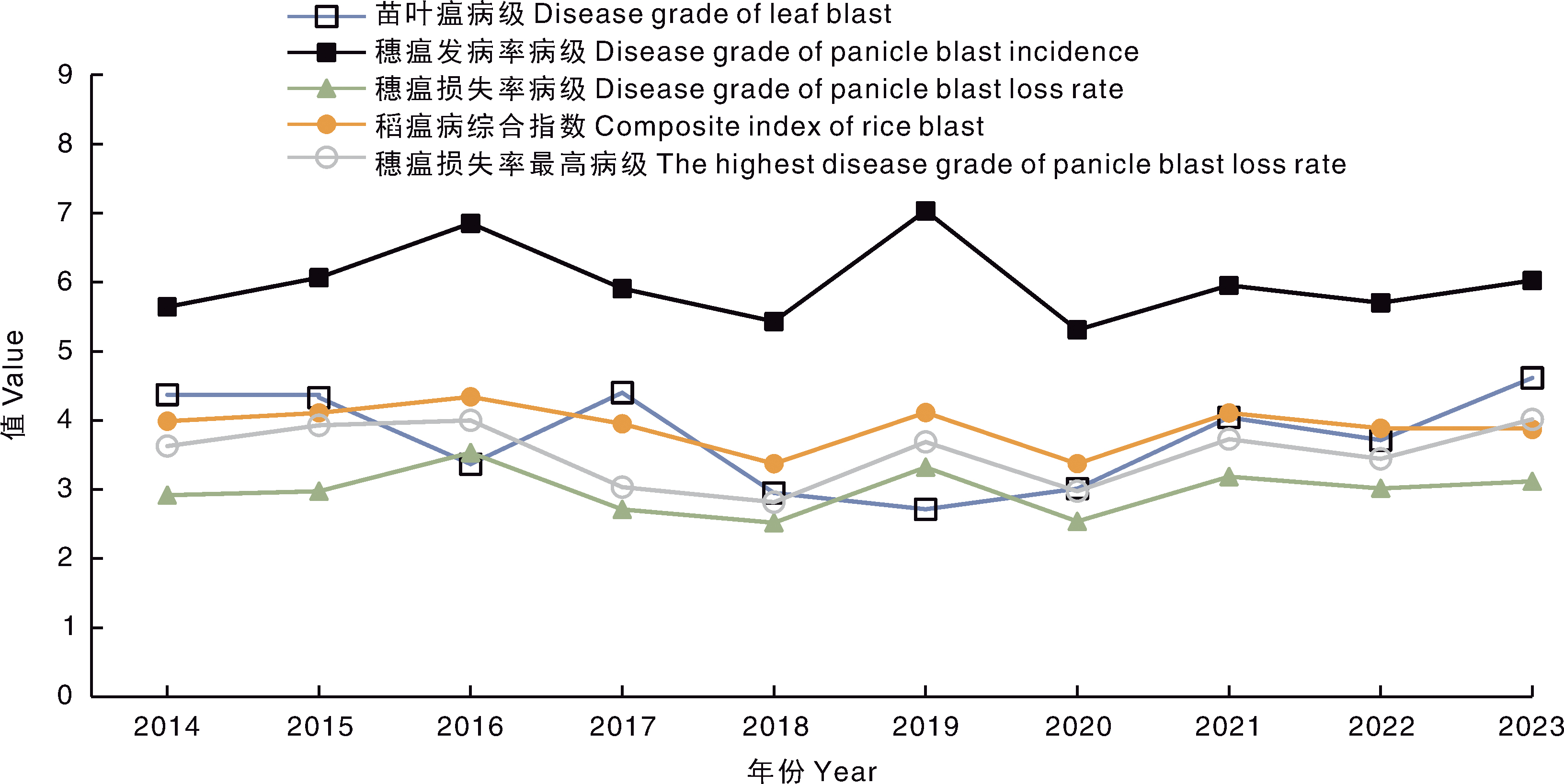
图1 供试水稻品种在2014—2023年的稻瘟病病级
Fig.1 Rice blast disease grade of rice varieties in 2014-2023
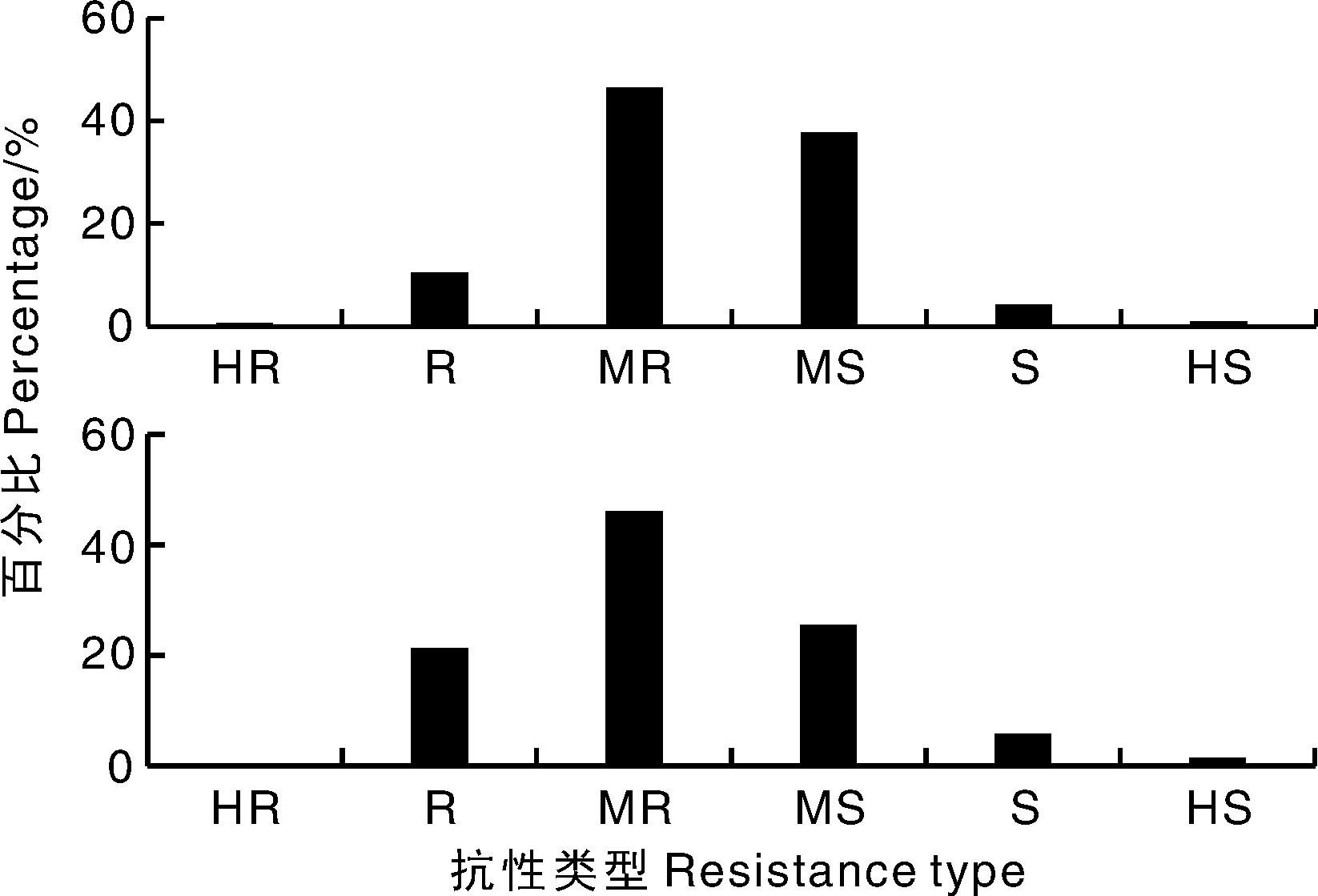
图2 基于稻瘟病综合指数(上)和穗瘟损失率最高病级(下)的水稻参试品种的整体抗性类型分布 HR,高抗;R,抗;MR,中抗;MS,中感;S,感;HS,高感。下同。
Fig.2 Distribution of overall resistance types of rice varieties based on the composite index of rice blast (top) and the highest disease grade of panicle blast loss rate (bottom) HR, Highly resistant; R, Resistant; MR, Moderately resistant; MS, Moderately susceptible; S, Susceptible; HS, Highly susceptible. The same as below.
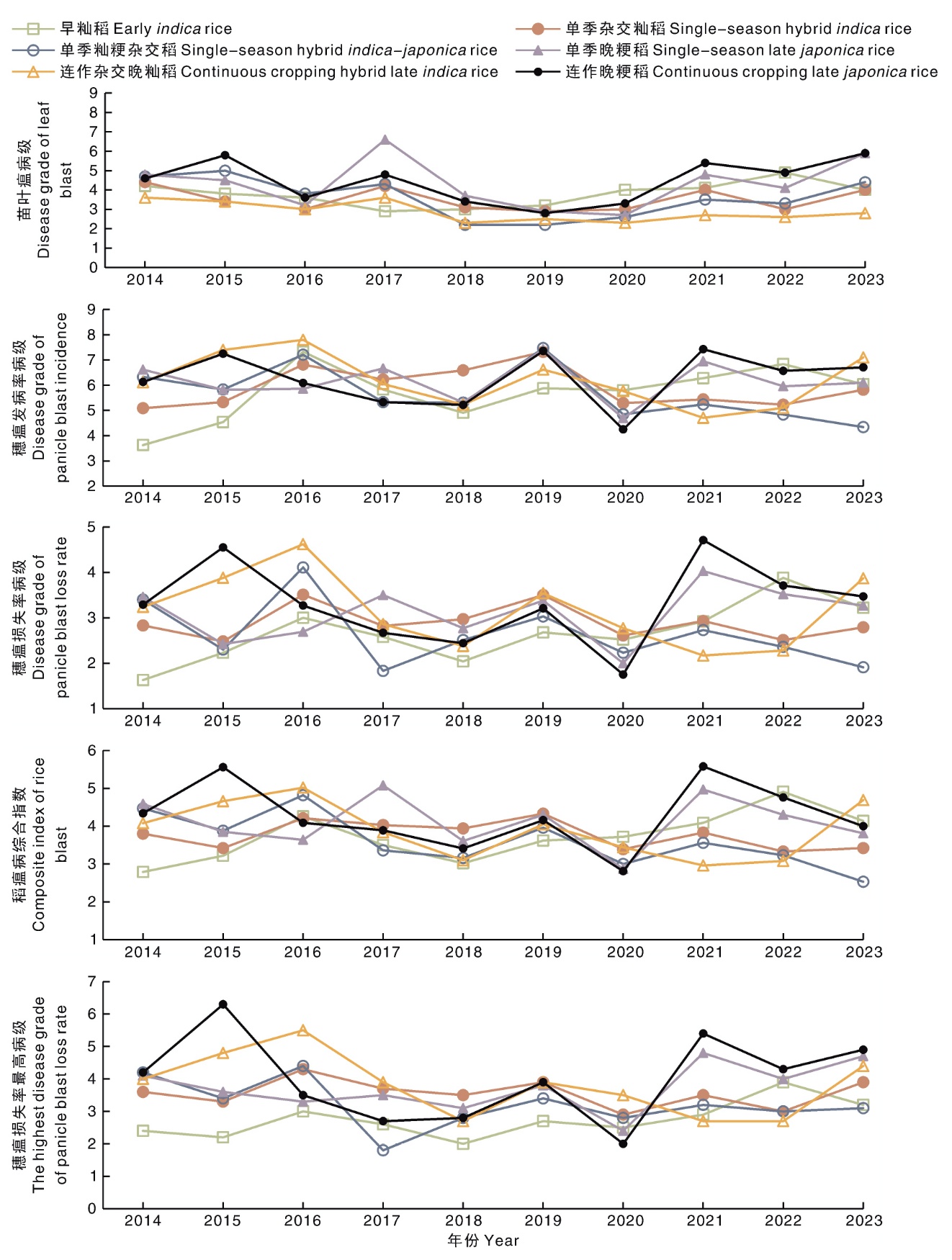
图3 不同类型水稻品种的稻瘟病病级
Fig.3 Rice blast grade of different types of rice
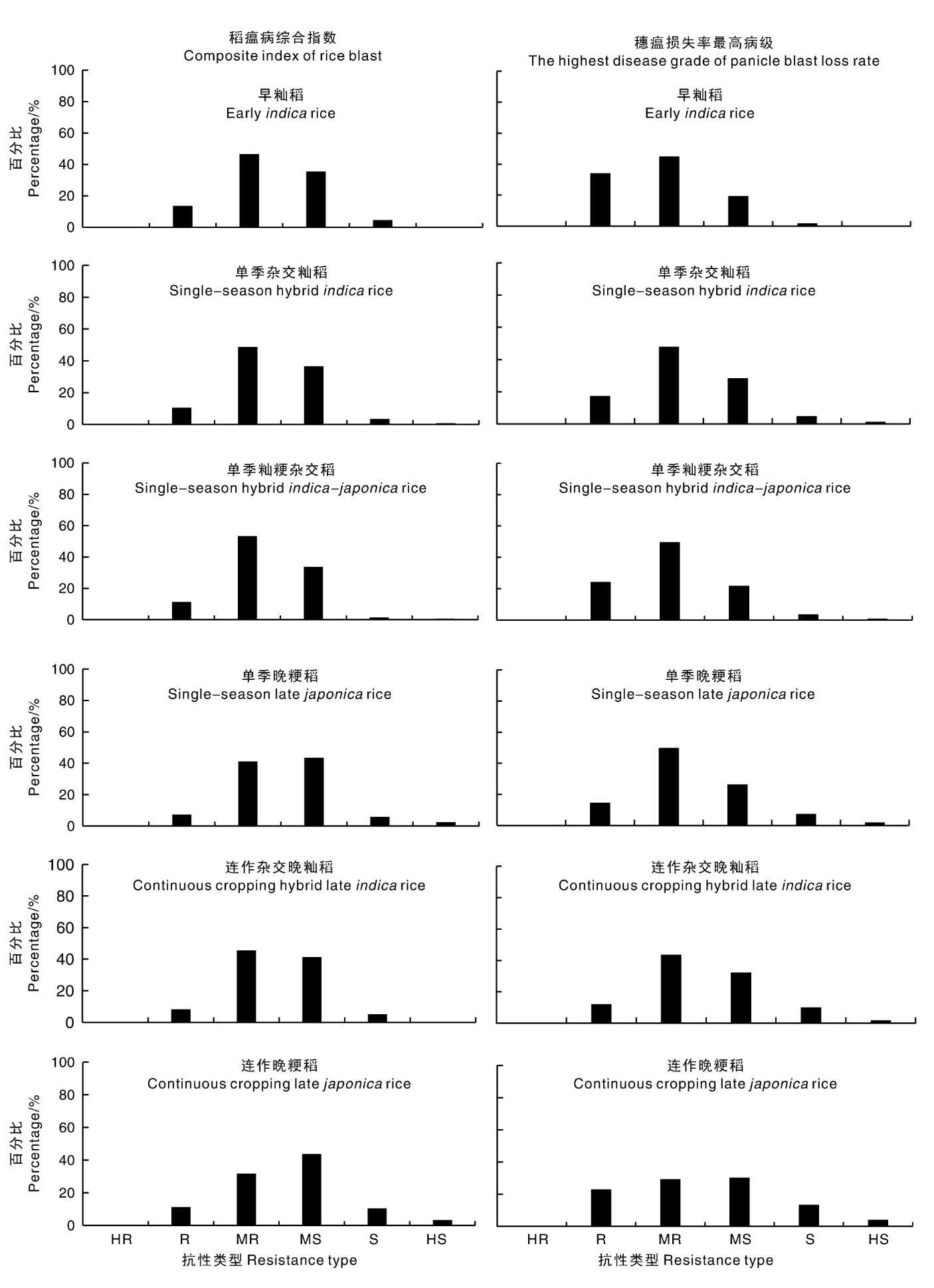
图4 不同类型水稻的稻瘟病抗性分布
Fig.4 Distribution of rice blast resistance of different types of rice
| [1] | 鄂志国, 孙红伟, 林海, 等. 浙江育成和审定水稻品种分析(1980—2019)[J]. 植物遗传资源学报, 2020, 21(3): 542-548. |
| E Z G, SUN H W, LIN H, et al. Analysis of rice varieties bred and certified in Zhejiang Province, China(1980-2019)[J]. Journal of Plant Genetic Resources, 2020, 21(3): 542-548. (in Chinese with English abstract) | |
| [2] | 施俊生, 王仁杯, 郁晓敏, 等. 浙江省水稻审定品种主要性状分析[J]. 浙江农业科学, 2019, 60(6): 865-866, 868. |
| SHI J S, WANG R B, YU X M, et al. Character analysis of approval rice varieties in Zhejiang Province[J]. Journal of Zhejiang Agricultural Sciences, 2019, 60(6): 865-866, 868. (in Chinese) | |
| [3] | 杨仕华, 廖琴, 谷铁城, 等. 南方稻区国家水稻品种区域试验进展及建议[J]. 中国种业, 2009, 12: 12-14. |
| YANG S H, LIAO Q, GU T C, et al. Progress and suggestions on regional trials of national rice varieties in southern rice-growing areas[J]. China Seed Industry, 2009, 12: 12-14. (in Chinese) | |
| [4] | 郝中娜, 毛雪琴, 柴荣耀, 等. 国家长江中下游稻区品种区域试验籼稻稻瘟病抗性分析[J]. 中国水稻科学, 2019, 33(2): 152-157. |
| HAO Z N, MAO X Q, CHAI R Y, et al. Analysis of resistance to rice blast in indica rice varieties from rice regional trials in the middle and lower reaches of the Yangtze River in China[J]. Chinese Journal of Rice Science, 2019, 33(2): 152-157. (in Chinese with English abstract) | |
| [5] | 鄂志国, 程本义, 孙红伟, 等. 近40年我国水稻育成品种分析[J]. 中国水稻科学, 2019, 33(6): 523-531. |
| E Z G, CHENG B Y, SUN H W, et al. Analysis on Chinese improved rice varieties in recent four decades[J]. Chinese Journal of Rice Science, 2019, 33(6): 523-531. (in Chinese with English abstract) | |
| [6] | 沈文杰, 陈晴晴, 胡逸群, 等. 安徽省水稻区试品种(系)稻瘟病抗性鉴定和评价[J]. 浙江农业科学, 2022, 63(6): 1338-1341. |
| SHEN W J, CHEN Q Q, HU Y Q, et al. Identification and evaluation of rice blast resistance of rice varieties from regional trials in Anhui Province[J]. Journal of Zhejiang Agricultural Sciences, 2022, 63(6): 1338-1341. (in Chinese) | |
| [7] | 齐中强, 于俊杰, 张荣胜, 等. 江苏省2016—2020年水稻新品种(系)和主栽品种对稻瘟病的抗病性评价[J]. 江苏农业科学, 2022, 50(1): 91-96. |
| QI Z Q, YU J J, ZHANG R S, et al. Identification and evaluation of resistance of new rice cultivars(lines) and main cultivars to rice blast in Jiangsu Province from 2016 to 2020[J]. Jiangsu Agricultural Sciences, 2022, 50(1): 91-96. (in Chinese) | |
| [8] | 李莉, 刘晓梅, 姜兆远, 等. 2015—2019年吉林省水稻区试品种(系)稻瘟病抗性鉴定与评价[J]. 东北农业科学, 2020, 45(5): 43-46. |
| LI L, LIU X M, JIANG Z Y, et al. Identification and evaluation of blast resistance of rice varieties (lines) in the regional test in Jilin Province from 2015 to 2019[J]. Journal of Northeast Agricultural Sciences, 2020, 45(5): 43-46. (in Chinese with English abstract) | |
| [9] | 姜秀英, 于永梅, 魏松红, 等. 2016—2020年辽宁省水稻区域试验参试品种(系)稻瘟病抗性评述[J]. 北方水稻, 2024, 54(1): 12-16. |
| JIANG X Y, YU Y M, WEI S H, et al. Evaluation of resistance to rice blast in rice varieties (lines) from regional trails in Liaoning Province from 2016 to 2020[J]. Northern Rice, 2024, 54(1): 12-16. (in Chinese with English abstract) | |
| [10] | 中华人民共和国农业部.水稻品种试验稻瘟病抗性鉴定与评价技术规程: NY/T 2646—2014[S]. 北京: 中国农业出版社, 2015. |
| [11] | 陶荣祥, 陈建明, 廖琴. 水稻病虫害田间手册:病虫害鉴别与抗性鉴定[M]. 北京: 中国农业科学技术出版社, 2006. |
| [12] | HAO Z N, QIU H P, ZHANG Z, et al. Mass cultivation of conidia of Pyricularia oryzae[J]. Journal of Plant Pathology, 2022, 104: 363-368. |
| [13] | International Rice Research Institute (IRRI). Standard evaluation system for rice (SES)[M]. Manila: IRRI, 2002. |
| [14] | 肖丹凤, 张佩胜, 王玲, 等. 中国稻瘟病菌种群分布及优势生理小种的研究进展[J]. 中国水稻科学, 2013, 27(3): 312-320. |
| XIAO D F, ZHANG P S, WANG L, et al. Research progress on populations and physiological race distribution of rice blast pathogen(Magnaporthe grisea) in China[J]. Chinese Journal of Rice Science, 2013, 27(3): 312-320. (in Chinese with English abstract) | |
| [15] | ZHU L, SUN J, WU G C, et al. Identification of rice varieties and determination of their geographical origin in China using Raman spectroscopy[J]. Journal of Cereal Science, 2018, 82: 175-182. |
| [16] | 郝中娜, 张红志, 朱旭东, 等. 籼、粳稻上分离的稻瘟病菌致病性分析[J]. 植物保护学报, 2006, 33(4): 337-340. |
| HAO Z N, ZHANG H Z, ZHU X D, et al. Pathogenicity analysis of Magnaporthe grisea derive from indica and japonica rice[J]. Journal of Plant Protection, 2006, 33(4): 337-340. (in Chinese with English abstract) | |
| [17] | HAO Z N, ZHANG Z, QIU H P, et al. Differences in pathogenicity and physiologic races between Pyricularia oryzae isolates from indica and japonica rice varieties[J]. Journal of Plant Pathology, 2021, 103: 1141-1146. |
| [18] | 孙漱沅. 水稻稻瘟病及其防治[M]. 上海: 上海科学技术出版社, 1986. |
| [19] | 林建荣, 宋昕蔚, 吴明国, 等. 籼粳超级杂交稻育种技术创新与品种培育[J]. 中国农业科学, 2016, 49(2): 207-218. |
| LIN J R, SONG X W, WU M G, et al. Breeding technology innovation of indica-japonica super hybrid rice and varietal breeding[J]. Scientia Agricultura Sinica, 2016, 49(2): 207-218. (in Chinese with English abstract) | |
| [20] | 阮晓亮, 石建尧, 陆永法, 等. 浙江省籼粳杂交晚稻品种发展与展望[J]. 中国稻米, 2016, 22(4): 8-12. |
| RUAN X L, SHI J Y, LU Y F, et al. Development and prospect of indica-japonica hybrid late rice cultivar in Zhejiang Province[J]. China Rice, 2016, 22(4): 8-12. (in Chinese with English abstract) |
| [1] | 裴惠民, 巫明明, 翟荣荣, 叶靖, 金月, 朱仪, 侯建军, 朱国富, 叶胜海. 低镉水稻基因功能与新品种培育研究进展[J]. 浙江农业学报, 2025, 37(9): 2012-2020. |
| [2] | 易明, 孙宏, 沈琦, 汤江武. 异位发酵床技术在畜禽粪污处理中的研究进展[J]. 浙江农业学报, 2025, 37(6): 1390-1396. |
| [3] | 吴佳奇, 朱学明, 鲍坚东, 王操屹, 周肖瑜, 李琳, 林福呈. 稻瘟病生物防治研究进展[J]. 浙江农业学报, 2025, 37(3): 736-744. |
| [4] | 韩清宇, 程林润, 李月红, 仇智灵, 后猛, 楼兵干. 六十份甘薯种质资源对基腐病的抗性评价与抗病相关指标分析[J]. 浙江农业学报, 2024, 36(7): 1616-1625. |
| [5] | 褚田芬, 雷玲, 李勤锋, 吴平, 洪文杰, 郑蔚然. 浙江省西瓜中农药残留风险评估[J]. 浙江农业学报, 2024, 36(5): 1153-1160. |
| [6] | 黄昌丽, 朱学明, 李琳, 鲍坚东, 俞晓平, 林福呈. 稻瘟病菌MoZds1的功能分析[J]. 浙江农业学报, 2024, 36(3): 559-568. |
| [7] | 柴荣耀, 游雨欣, 邱海萍, 郭峻宁, 张震, 李斌, 沈升法, 王艳丽. 甘薯抗茎腐病鉴定技术的建立及种质资源抗性分析[J]. 浙江农业学报, 2024, 36(3): 569-578. |
| [8] | 陈钰佩, 单英杰, 陆若辉, 朱伟锋, 孔海民. 浙江省主要作物的施肥现状与减施潜力[J]. 浙江农业学报, 2024, 36(11): 2566-2574. |
| [9] | 郭娜纳, 李伟, 黄立娟, 张涛, 魏兵强. 辣椒抗番茄斑萎病毒研究进展[J]. 浙江农业学报, 2024, 36(10): 2416-2425. |
| [10] | 汪洁, 陆若辉, 朱伟锋, 陈钰佩, 单英杰. 浙江省主要粮食作物秸秆还田替代化肥的潜力[J]. 浙江农业学报, 2023, 35(8): 1853-1863. |
| [11] | 杨清, 刘胜红, 黄二宾, 杜嵘宇, 王芳, 邓佳. 经羧甲基壳聚糖诱导的葡萄柚果实转录组WRKY基因分析及抗性相关基因挖掘[J]. 浙江农业学报, 2023, 35(3): 598-614. |
| [12] | 林小兵, 张鸿燕, 张秋梅, 周利军, 徐德胜, 郭乃嘉, 邱祥凤, 黄海平. 基于多指标的镉低积累水稻品种筛选[J]. 浙江农业学报, 2023, 35(11): 2507-2515. |
| [13] | 李家玺, 顾冉, 刘焱, 张耀伟. 大白菜苗期对Pantoea agglomerans抗性鉴定方法的建立与应用[J]. 浙江农业学报, 2023, 35(10): 2408-2414. |
| [14] | 杨春, 孟泽洪, 李帅, 梁思慧, 乔大河, 陈正武. 十二个茶树品种对茶棍蓟马、茶小绿叶蝉抗性表现及抗性成分初步鉴定[J]. 浙江农业学报, 2022, 34(8): 1713-1724. |
| [15] | 傅嘉艺, 童磊, 苏飞, 郑珂, 厉海林, 曹轶蓉, 苏娜. 浙江省“农创客”在乡村发展中的带动效应及其影响路径[J]. 浙江农业学报, 2022, 34(8): 1796-1805. |
| 阅读次数 | ||||||
|
全文 |
|
|||||
|
摘要 |
|
|||||

