浙江农业学报 ›› 2026, Vol. 38 ›› Issue (2): 301-309.DOI: 10.3969/j.issn.1004-1524.20240999
桑断枝烂叶病病原鉴定及47个桑树品种的抗性评价
陈泉1,2( ), 栗辉1,2, 杨靖1,2, 徐嵩琳1,2, 张淑康1,2, 刘忠贤2,3,*(), 何锦辉3,*()
1.重庆三峡农业科学院 重庆 404155 2.重庆三峡学院 生物与食品工程学院 重庆 404100 3.重庆市万州区经济作物发展中心 重庆 404401
-
收稿日期:2024-11-21出版日期:2026-02-25发布日期:2026-03-24 -
作者简介:陈泉,主要从事植物病理和果树栽培研究。E-mail:chenquan0616@126.com -
通讯作者:*刘忠贤,E-mail:1058043435@qq.com;
何锦辉,E-mail:334634330@qq.com -
基金资助:重庆市教育委员会科学技术研究重点项目(KJ202301289858551);重庆市现代农业技术体系(蚕桑)创新团队专项(CQMAITS202511)
Identification of the pathogen causing mulberry snags rotten leaves disease and resistance of 47 mulberry varieties
CHEN Quan1,2(), LI Hui1,2, YANG Jing1,2, XU Songlin1,2, ZHANG Shukang1,2, LIU Zhongxian2,3,*(), HE Jinhui3,*()
1. Chongqing Three Gorges Academy of Agricultural Sciences Chongqing 404155, China 2. College of Biology and Food Engineering ,Chongqing Three Gorges University Chongqing 404100, China 3. Economic Crop Development Center in Wanzhou District of Chongqing City Chongqing 404401, China
-
Received:2024-11-21Published:2026-02-25Online:2026-03-24

摘要:
为明确重庆黔江桑树产区普遍发生的叶片病害的病原,并评估不同桑树品种对桑断枝烂叶病的抗性水平,以建立精准高效的防控方法,减少桑叶损失,本研究开展了相关实验。通过田间采样,室内分离培养,PCR扩增ITS、ACT、TUB、TEF 4个基因片段并构建系统发育树,确定了病原菌种类;通过室内离体接种47个桑树品种叶片6 d后,根据发病率和病斑平均直径评价不同桑树品种的抗病性。从重庆黔江区桑叶上分离到菌株HBB1,被鉴定为桑断枝烂叶病病原菌(Boeremia exigua)的一个新变种,命名为Boeremia exigua var. mori。接种HBB1菌株后,川桑7657、湖桑32、农桑14号等21个品种的发病率达100%,川桑90-4发病率最低(53.84%)。病斑直径方面,川桑33、川桑39、川桑7657等6个品种的病斑直径大于12 mm,为高感品种;辐射1号病斑直径为2.09 mm,为高抗品种;抗病或中抗品种有32个。综上,本研究首次明确了重庆黔江桑断枝烂叶病的病原为新变种Boeremia exigua var. mori,并系统揭示了桑品种对该病原的抗性差异,可为抗病品种选育与病害精准防控提供科学依据。
中图分类号:
引用本文
陈泉, 栗辉, 杨靖, 徐嵩琳, 张淑康, 刘忠贤, 何锦辉. 桑断枝烂叶病病原鉴定及47个桑树品种的抗性评价[J]. 浙江农业学报, 2026, 38(2): 301-309.
CHEN Quan, LI Hui, YANG Jing, XU Songlin, ZHANG Shukang, LIU Zhongxian, HE Jinhui. Identification of the pathogen causing mulberry snags rotten leaves disease and resistance of 47 mulberry varieties[J]. Acta Agriculturae Zhejiangensis, 2026, 38(2): 301-309.
| 扩增区域 Amplified region | 正向引物序列(5'→3') Forward primer sequence (5'→3') | 反向引物序列(5'→3') Reverse primer sequence (5'→3') |
|---|---|---|
| ITS | TCCGTAGGTGAACCTTGCGG | TCCTCCGCTTATTGATATGC |
| ACT | ATGTGCAAGGCCGGTTTCGC | TACGAGTCCTTCTGGCCCAT |
| TUB | GGTAACCAAATCGGTGCTGCTTTC | AACCTCAGTGTAGTGACCCTTGGC |
| TEF | CATCGAGAAGTTCGAGAAGG | TACTTGAAGGAACCCTTACC |
表1 引物信息
Table 1 Primer information
| 扩增区域 Amplified region | 正向引物序列(5'→3') Forward primer sequence (5'→3') | 反向引物序列(5'→3') Reverse primer sequence (5'→3') |
|---|---|---|
| ITS | TCCGTAGGTGAACCTTGCGG | TCCTCCGCTTATTGATATGC |
| ACT | ATGTGCAAGGCCGGTTTCGC | TACGAGTCCTTCTGGCCCAT |
| TUB | GGTAACCAAATCGGTGCTGCTTTC | AACCTCAGTGTAGTGACCCTTGGC |
| TEF | CATCGAGAAGTTCGAGAAGG | TACTTGAAGGAACCCTTACC |
| 序号 Code | 品种 Cultivar | 序号 Code | 品种 Cultivar | 序号 Code | 品种 Cultivar |
|---|---|---|---|---|---|
| 1 | 农桑14号Nongsang 14 | 17 | 嘉陵20号Jialing 20 | 33 | 川桑33 Chuansang 33 |
| 2 | 油桑Yousang | 18 | 嘉陵16号Jialing 16 | 34 | 川桑90-4 Chuansang 90-4 |
| 3 | 桂优62 Guiyou 62 | 19 | 桐桑Tongsang | 35 | 川桑826 Chuansang 826 |
| 4 | 桂优12 Guiyou 12 | 20 | 821 821 | 36 | 川桑7657 Chuansang 7657 |
| 5 | 云桑1号Yunsang 1 | 21 | 实钴11-6 Shigu 11-6 | 37 | 川桑3723 Chuansang 3723 |
| 6 | 云桑2号Yunsang 2 | 22 | 西农751 Xinong 751 | 38 | 选一号Xuan 1 |
| 7 | 湖桑32号Husang 32 | 23 | 蓬1号Peng 1 | 39 | 丰田5号Fengtian 5 |
| 8 | 秋茗Qiuming | 24 | 蓬2号Peng 2 | 40 | 蔬菜桑Shucaisang |
| 9 | 农桑8号Nongsang 8 | 25 | 小冠桑Xiaoguansang | 41 | 青皮湖桑Qingpihusang |
| 10 | 双头荷叶白Shuangtouheyebai | 26 | 辅射1号Fushe 1 | 42 | 湖桑7号Husang 7 |
| 11 | 荷叶白Heyebai | 27 | 强桑1号Qiangsang 1 | 43 | 充场Chongchang |
| 12 | 北场1号Beichang 1 | 28 | 茶叶桑Chayesang | 44 | 南1号Nan 1 |
| 13 | 西农1号Xinong 1 | 29 | 川桑48-3 Chuansang 48-3 | 45 | 陕桑305 Shansang 305 |
| 14 | 育711 Yu 711 | 30 | 川桑98-1 Chuansang 98-1 | 46 | 渝桑101 Yusang 101 |
| 15 | 云11 Yun 11 | 31 | 台桑14-1 Taisang 14-1 | 47 | 饲料桑Siliaosang |
| 16 | 新之一濑Xinzhiyilai | 32 | 川桑39 Chuansang 39 |
表2 试验所用桑树品种
Table 2 Mulberry cultivars used in this study
| 序号 Code | 品种 Cultivar | 序号 Code | 品种 Cultivar | 序号 Code | 品种 Cultivar |
|---|---|---|---|---|---|
| 1 | 农桑14号Nongsang 14 | 17 | 嘉陵20号Jialing 20 | 33 | 川桑33 Chuansang 33 |
| 2 | 油桑Yousang | 18 | 嘉陵16号Jialing 16 | 34 | 川桑90-4 Chuansang 90-4 |
| 3 | 桂优62 Guiyou 62 | 19 | 桐桑Tongsang | 35 | 川桑826 Chuansang 826 |
| 4 | 桂优12 Guiyou 12 | 20 | 821 821 | 36 | 川桑7657 Chuansang 7657 |
| 5 | 云桑1号Yunsang 1 | 21 | 实钴11-6 Shigu 11-6 | 37 | 川桑3723 Chuansang 3723 |
| 6 | 云桑2号Yunsang 2 | 22 | 西农751 Xinong 751 | 38 | 选一号Xuan 1 |
| 7 | 湖桑32号Husang 32 | 23 | 蓬1号Peng 1 | 39 | 丰田5号Fengtian 5 |
| 8 | 秋茗Qiuming | 24 | 蓬2号Peng 2 | 40 | 蔬菜桑Shucaisang |
| 9 | 农桑8号Nongsang 8 | 25 | 小冠桑Xiaoguansang | 41 | 青皮湖桑Qingpihusang |
| 10 | 双头荷叶白Shuangtouheyebai | 26 | 辅射1号Fushe 1 | 42 | 湖桑7号Husang 7 |
| 11 | 荷叶白Heyebai | 27 | 强桑1号Qiangsang 1 | 43 | 充场Chongchang |
| 12 | 北场1号Beichang 1 | 28 | 茶叶桑Chayesang | 44 | 南1号Nan 1 |
| 13 | 西农1号Xinong 1 | 29 | 川桑48-3 Chuansang 48-3 | 45 | 陕桑305 Shansang 305 |
| 14 | 育711 Yu 711 | 30 | 川桑98-1 Chuansang 98-1 | 46 | 渝桑101 Yusang 101 |
| 15 | 云11 Yun 11 | 31 | 台桑14-1 Taisang 14-1 | 47 | 饲料桑Siliaosang |
| 16 | 新之一濑Xinzhiyilai | 32 | 川桑39 Chuansang 39 |
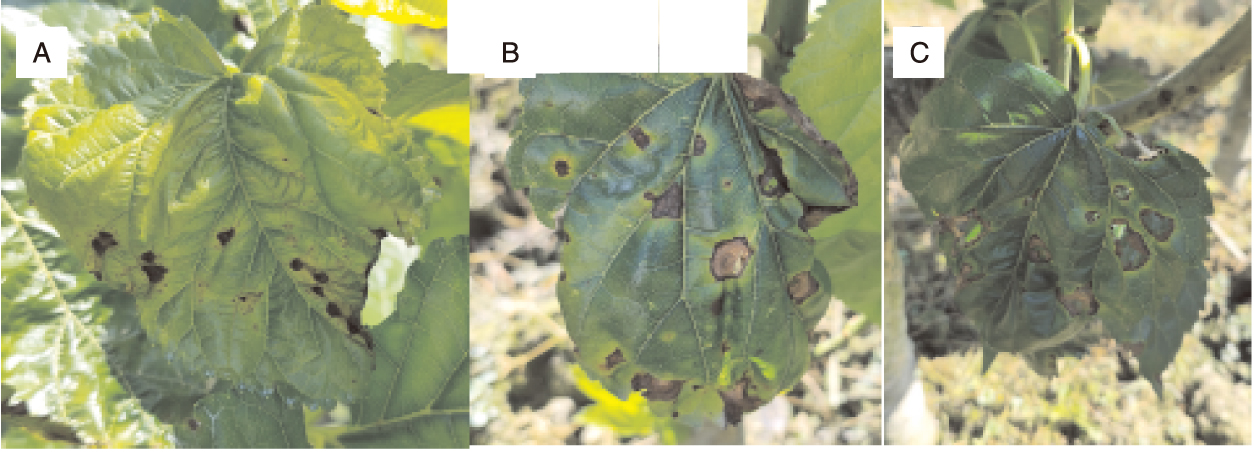
图1 桑断枝烂叶病症状 A,幼嫩叶片发病症状;B,成熟叶片发病症状;C,下部老叶穿孔症状。
Fig.1 Symptoms of mulberry snags rotten leaves disease A, Symptoms on young leaves; B, Symptoms on mature leaves; C, Perforation symptoms on lower old leaves.

图2 HBB1菌株菌落特征和孢子形态 A,菌丝正面;B,菌丝背面;C,菌丝(5 d);D,老龄菌丝(15 d);E,分生孢子。
Fig.2 Colony and conidial morphology of strain HBB1 A, Upper surface of mycelial mat; B, Lower surface of mycelial mat; C, Young mycelia (5 d); D, Senescent mycelia (15 d); E, Conidia.
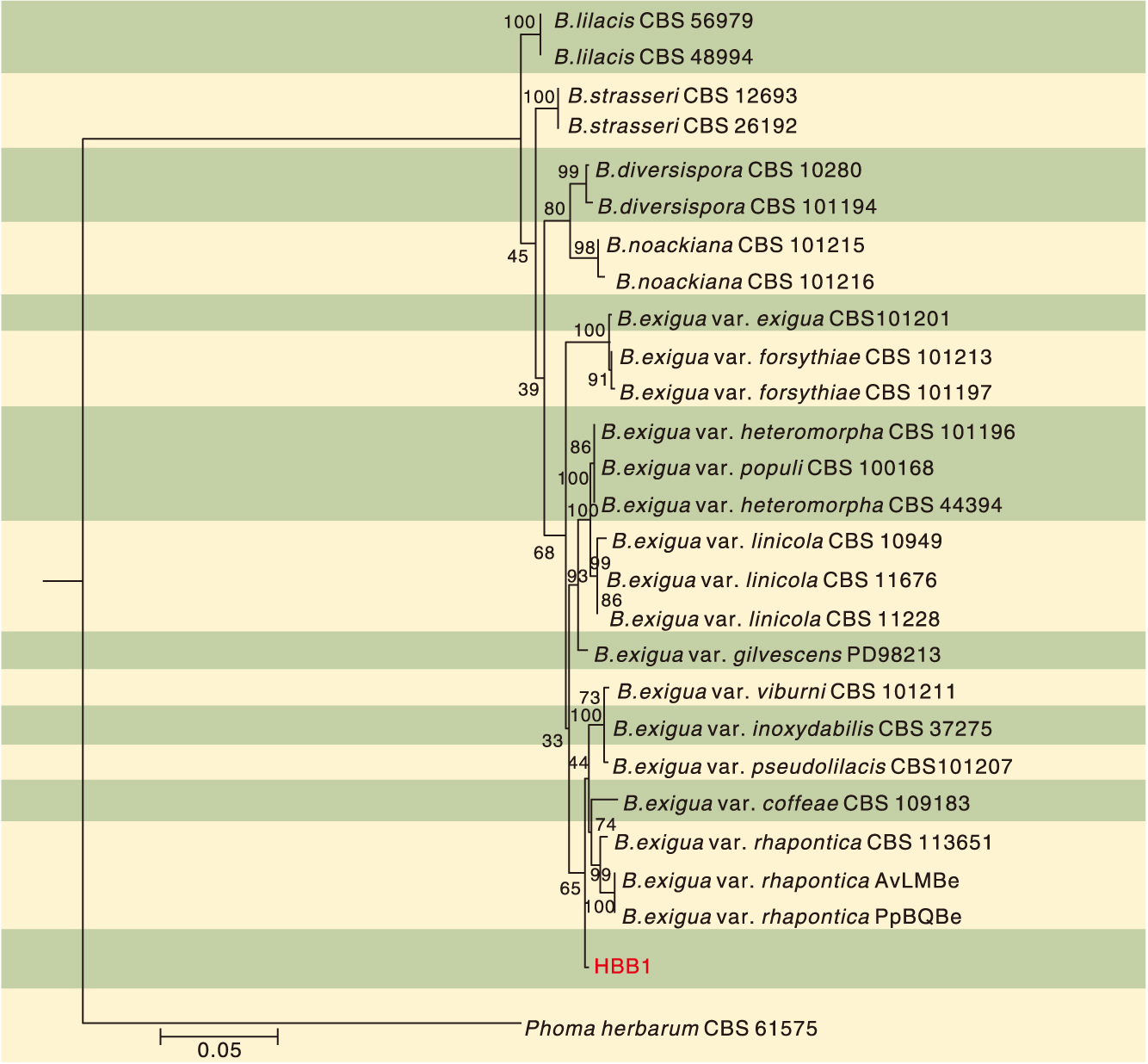
图3 基于多基因序列的桑断枝烂叶病菌系统进化树
Fig.3 Phylogenetic tree of the mulberry snags rotten leaves disease pathogen (Boeremia exigua var. mori) based on multi-gene sequences
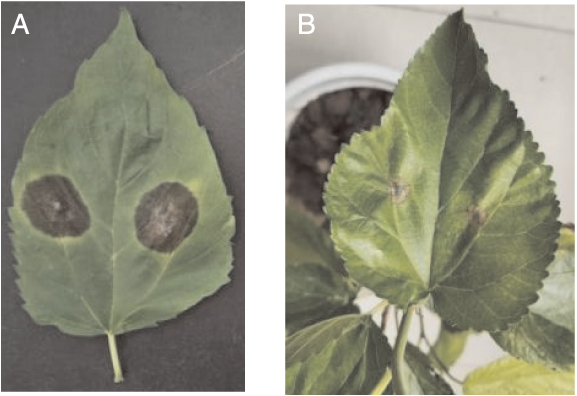
图4 HBB1菌株离体(A)和活体(B)接种桑叶产生的症状
Fig.4 Symptoms produced by strain HBB1 inoculation on mulberry leaves in vitro(A) and in vivo(B)
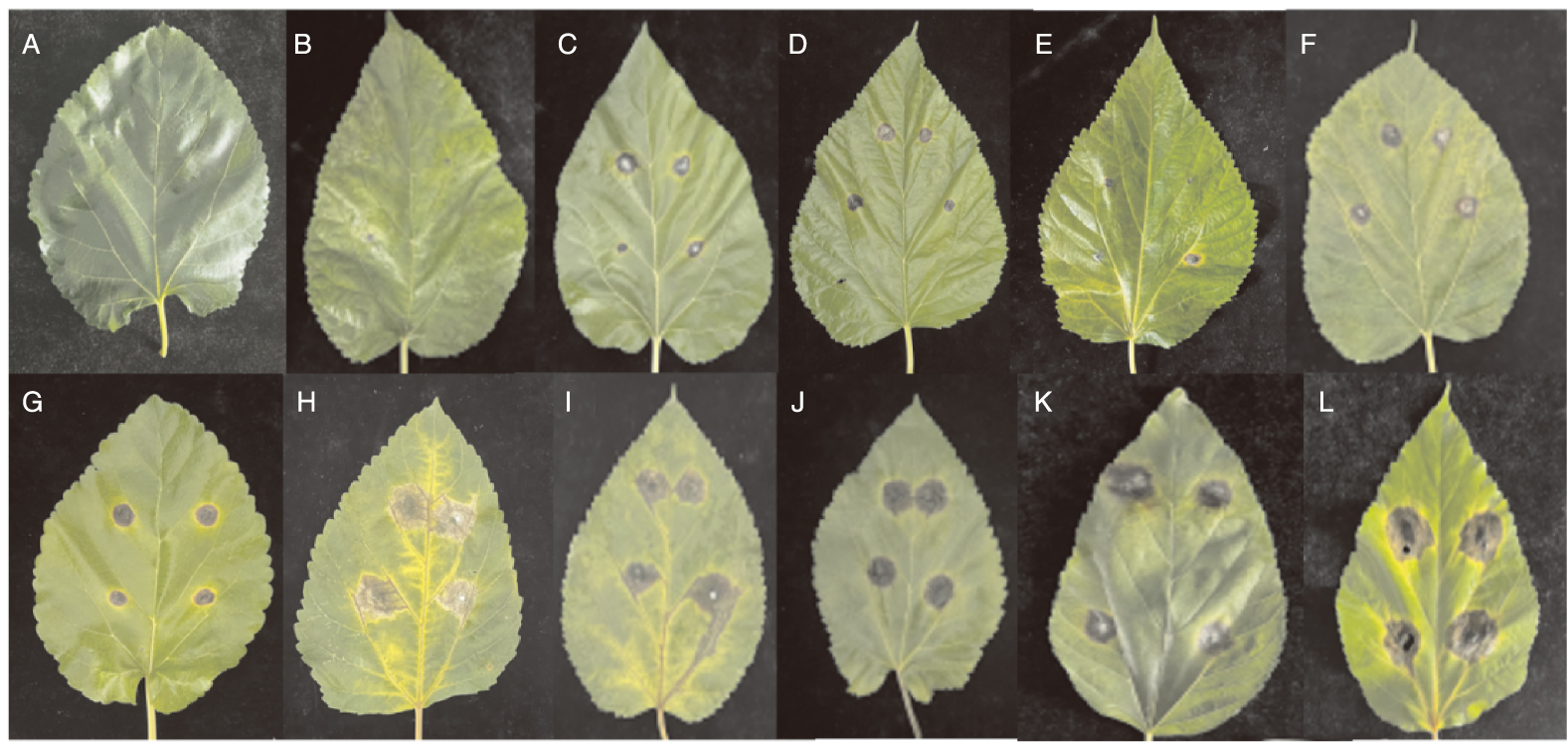
图5 部分桑树品种叶片接种桑断枝烂叶病菌后的症状 A,PDA;B,辐射1号;C,农桑14号;D,贵优12;E,云11;F,茶叶桑;G,油桑;H,北场1号;I,荷叶白;J,充场;K,川桑48-3;L,川桑33。
Fig.5 Symptoms on leaves of some mulberry varieties after inoculation with the mulberry snags rotten leaves disease pathogen A, PDA; B, Fushe 1; C, Nongsang 14; D, Guiyou 12; E, Yun 11; F, Chayesang; G, Yousang; H, Beichang 1; I, Heyebai; J, Chongchang; K, Chuansang 48-3; L, Chuansang 33.
| 品种 Variety | 发病率/% Incidence/% | 病斑直径/mm Diameter of infection sites/mm | 抗性 Resistance | 品种 Variety | 发病率/% Incidence/% | 病斑直径/mm Diameter of infection sites/mm | 抗性 Resis- tance |
|---|---|---|---|---|---|---|---|
| 川桑33 Chuansang 33 | 88.89±8.39 | 12.80±0.26 | HS | 饲料桑Siliaosang | 82.50±10.9 | 8.28±0.24 | MR |
| 川桑39 Chuansang 39 | 61.37±10.28 | 13.44±0.41 | HS | 双头荷叶白Shuangtouheyebai | 100.00±0 | 7.52±0.50 | MR |
| 川桑7657 Chuansang 7657 | 100.00±0 | 12.40±0.36 | HS | 云桑2号Yunsang 2 | 100.00±0 | 8.50±0.50 | MR |
| 川桑48-3 Chuansang 48-3 | 89.26±8.91 | 18.42±0.38 | HS | 南1号Nan 1 | 90.67±9.29 | 6.58±0.28 | MR |
| 川桑3723 Chuansang 3723 | 88.79±8.25 | 17.83±0.24 | HS | 丰田5号Fengtian 5 | 100.00±0 | 6.24±0.25 | MR |
| 台桑14-1 Taisang 14-1 | 80.61±10.05 | 13.99±0.19 | HS | 新之一濑Xinzhiyilai | 100.00±0 | 6.83±0.28 | MR |
| 川桑826 Chuansang 826 | 81.83±7.90 | 10.11±0.37 | S | 湖桑32 Husang 32 | 100.00±0 | 8.23±0.25 | MR |
| 川桑90-4 Chuansang 90-4 | 53.84±12.71 | 10.02±0.48 | S | 茶叶桑Chayesang | 98.67±2.31 | 5.74±0.25 | R |
| 选一号Xuan 1 | 88.64±8.05 | 11.42±0.38 | S | 821 821 | 88.61±8.01 | 5.33±0.28 | R |
| 充场Chongchang | 100.00±0 | 9.54±0.34 | S | 实钴11-6 Shigu 11-6 | 100.00±0 | 5.25±0.25 | R |
| 云桑1号Yunsang 1 | 100.00±0 | 9.98±0.53 | S | 西农751 Xinong 751 | 100.00±0 | 5.30±0.30 | R |
| 荷叶白Heyebai | 88.61±8.01 | 10.74±0.25 | S | 贵优62 Guiyou 62 | 71.94±12.54 | 5.38±0.34 | R |
| 北场1号Beichang 1 | 100.00±0 | 9.56±0.22 | S | 嘉陵16 Jialing 16 | 100.00±0 | 4.76±0.25 | R |
| 强桑1号Qiangsang 1 | 84.89±6.83 | 9.57±0.21 | S | 云11 Yun 11 | 100.00±0 | 5.39±0.36 | R |
| 西农1号Xinong 1 | 100.00±0 | 7.11±0.36 | MR | 嘉陵20 Jialing 20 | 71.39±10.08 | 5.04±0.26 | R |
| 蔬菜桑Shucaisang | 85.56±5.85 | 7.27±0.25 | MR | 蓬1号Peng 1 | 85.89±5.83 | 5.63±0.35 | R |
| 农桑14号Nongsang 14 | 100.00±0 | 6.59±0.37 | MR | 油桑Yousang | 78.99±8.52 | 5.28±0.25 | R |
| 陕桑305 Shansang 305 | 87.94±7.92 | 7.29±0.26 | MR | 青皮湖桑Qingpihusang | 78.06±7.56 | 3.58±0.19 | R |
| 秋茗Qiuming | 100.00±0 | 8.81±0.27 | MR | 湖桑7号Husang 7 | 79.17±8.78 | 4.76±0.25 | R |
| 渝桑101 Yusang 101 | 100.00±0 | 7.28±0.25 | MR | 桐桑Tongsang | 100.00±0 | 5.80±0.26 | R |
| 农桑8号Nongsang 8 | 100.00±0 | 6.24±0.25 | MR | 贵优12 Guiyou 12 | 69.72±9.59 | 4.53±0.50 | R |
| 蓬2号Peng 2 | 100.00±0 | 6.79±0.21 | MR | 小冠桑Xiaoguansang | 100.00±0 | 3.92±0.19 | R |
| 育711 Yu 711 | 83.89±8.39 | 6.55±0.43 | MR | 辐射1号Fushe 1 | 88.55±7.93 | 2.09±0.52 | HR |
| 川桑98-1 Chuansang 98-1 | 62.22±10.72 | 6.61±0.26 | MR |
表3 桑断枝烂叶病病原菌接种6 d后47个桑叶品种的发病情况及其抗性
Table 3 Disease development and resistance of 47 mulberry varieties at 6 days after inoculation with mulberry snags rotten leaves disease pathogen
| 品种 Variety | 发病率/% Incidence/% | 病斑直径/mm Diameter of infection sites/mm | 抗性 Resistance | 品种 Variety | 发病率/% Incidence/% | 病斑直径/mm Diameter of infection sites/mm | 抗性 Resis- tance |
|---|---|---|---|---|---|---|---|
| 川桑33 Chuansang 33 | 88.89±8.39 | 12.80±0.26 | HS | 饲料桑Siliaosang | 82.50±10.9 | 8.28±0.24 | MR |
| 川桑39 Chuansang 39 | 61.37±10.28 | 13.44±0.41 | HS | 双头荷叶白Shuangtouheyebai | 100.00±0 | 7.52±0.50 | MR |
| 川桑7657 Chuansang 7657 | 100.00±0 | 12.40±0.36 | HS | 云桑2号Yunsang 2 | 100.00±0 | 8.50±0.50 | MR |
| 川桑48-3 Chuansang 48-3 | 89.26±8.91 | 18.42±0.38 | HS | 南1号Nan 1 | 90.67±9.29 | 6.58±0.28 | MR |
| 川桑3723 Chuansang 3723 | 88.79±8.25 | 17.83±0.24 | HS | 丰田5号Fengtian 5 | 100.00±0 | 6.24±0.25 | MR |
| 台桑14-1 Taisang 14-1 | 80.61±10.05 | 13.99±0.19 | HS | 新之一濑Xinzhiyilai | 100.00±0 | 6.83±0.28 | MR |
| 川桑826 Chuansang 826 | 81.83±7.90 | 10.11±0.37 | S | 湖桑32 Husang 32 | 100.00±0 | 8.23±0.25 | MR |
| 川桑90-4 Chuansang 90-4 | 53.84±12.71 | 10.02±0.48 | S | 茶叶桑Chayesang | 98.67±2.31 | 5.74±0.25 | R |
| 选一号Xuan 1 | 88.64±8.05 | 11.42±0.38 | S | 821 821 | 88.61±8.01 | 5.33±0.28 | R |
| 充场Chongchang | 100.00±0 | 9.54±0.34 | S | 实钴11-6 Shigu 11-6 | 100.00±0 | 5.25±0.25 | R |
| 云桑1号Yunsang 1 | 100.00±0 | 9.98±0.53 | S | 西农751 Xinong 751 | 100.00±0 | 5.30±0.30 | R |
| 荷叶白Heyebai | 88.61±8.01 | 10.74±0.25 | S | 贵优62 Guiyou 62 | 71.94±12.54 | 5.38±0.34 | R |
| 北场1号Beichang 1 | 100.00±0 | 9.56±0.22 | S | 嘉陵16 Jialing 16 | 100.00±0 | 4.76±0.25 | R |
| 强桑1号Qiangsang 1 | 84.89±6.83 | 9.57±0.21 | S | 云11 Yun 11 | 100.00±0 | 5.39±0.36 | R |
| 西农1号Xinong 1 | 100.00±0 | 7.11±0.36 | MR | 嘉陵20 Jialing 20 | 71.39±10.08 | 5.04±0.26 | R |
| 蔬菜桑Shucaisang | 85.56±5.85 | 7.27±0.25 | MR | 蓬1号Peng 1 | 85.89±5.83 | 5.63±0.35 | R |
| 农桑14号Nongsang 14 | 100.00±0 | 6.59±0.37 | MR | 油桑Yousang | 78.99±8.52 | 5.28±0.25 | R |
| 陕桑305 Shansang 305 | 87.94±7.92 | 7.29±0.26 | MR | 青皮湖桑Qingpihusang | 78.06±7.56 | 3.58±0.19 | R |
| 秋茗Qiuming | 100.00±0 | 8.81±0.27 | MR | 湖桑7号Husang 7 | 79.17±8.78 | 4.76±0.25 | R |
| 渝桑101 Yusang 101 | 100.00±0 | 7.28±0.25 | MR | 桐桑Tongsang | 100.00±0 | 5.80±0.26 | R |
| 农桑8号Nongsang 8 | 100.00±0 | 6.24±0.25 | MR | 贵优12 Guiyou 12 | 69.72±9.59 | 4.53±0.50 | R |
| 蓬2号Peng 2 | 100.00±0 | 6.79±0.21 | MR | 小冠桑Xiaoguansang | 100.00±0 | 3.92±0.19 | R |
| 育711 Yu 711 | 83.89±8.39 | 6.55±0.43 | MR | 辐射1号Fushe 1 | 88.55±7.93 | 2.09±0.52 | HR |
| 川桑98-1 Chuansang 98-1 | 62.22±10.72 | 6.61±0.26 | MR |
| [1] | 商务部市场运行和消费促进司. 2020年中国茧丝绸行业发展报告[EB/OL]. (2021-07-29)[2024-11-21]. https://jscscyxs.mofcom.gov.cn/jscFile/jsc/_news/2021/7/1627538079755.html. |
| [2] | 刘率男, 刘泉, 刘玉玲, 等. 桑枝总生物碱片研发历程回顾(二): 现代药理学理念诠释中药的药效特点及药理作用机制[J]. 中国糖尿病杂志, 2020, 28(8): 635-640. I) |
| LIU S N, LIU Q, LIU Y L, et al. Review of the research and development of Ramulus Mori (Sangzhi) alkaloids (II): modern pharmacological concepts interpret the characteristics of pharmacological effects and mechanisms of traditional Chinese medicines[J]. Chinese Journal of Diabetes, 2020, 28(8): 635-640. | |
| [3] | 王春莉, 陈忠琴, 徐蕾蕾, 等. 绿色合成桑叶银纳米粒及其抗菌抗癌活性[J]. 精细化工, 2021, 38(1): 130-137. |
| WANG C L, CHEN Z Q, XU L L, et al. Green synthesis of silver nanoparticles with aqueous Folium Mori extracts and their antimicrobial and anticancer activities[J]. Fine Chemicals, 2021, 38(1): 130-137. | |
| [4] | 张猛. 三峡库区消落带桑树内生和根际真菌群落结构及其提升桑树抗逆性能的研究[D]. 重庆: 西南大学, 2020. |
| ZHANG M. Research on the community structure of mulberry endophytic and rhizosphere fungi and their improvement of stress resistance in the hydro-fluctuation belt of the three gorges reservoir area[D]. Chongqing: Southwest University, 2020. | |
| [5] | 张芳, 王晓红, 罗泽虎, 等. 桑树幼苗对重金属镉的分布与富集规律[J]. 农技服务, 2020, 37(10): 17-19. |
| ZHANG F, WANG X H, LUO Z H, et al. Distribution and accumulation of cadmium in mulberry seedlings[J]. Agricultural Technology Service, 2020, 37(10): 17-19. | |
| [6] | 涂亚婷. 桑断枝烂叶病菌(Boeremia exigua GXH1)生物学特性及致病机理探究[D]. 重庆: 西南大学, 2022. |
| TU Y T. Biological characteristics and pathogenesis of Boeremia exigua GXH1[D]. Chongqing: Southwest University, 2022. | |
| [7] | 浦冠勤, 黄艳君, 毛建萍, 等. 中国桑树病害名录(Ⅰ)[J]. 中国蚕业, 2012, 33(2): 21-24. |
| PU G Q, HUANG Y J, MAO J P, et al. List of mulberry diseases in China (Ⅰ)[J]. China Sericulture, 2012, 33(2): 21-24. | |
| [8] | 陈小青, 朱方容, 宾荣佩, 等. 桑断枝烂叶病病原菌对桑树不同部位的致病性测定[J]. 广西蚕业, 2016, 53(2): 12-15. |
| CHEN X Q, ZHU F R, BIN R P, et al. Pathogenicity assay of the pathogen causing mulberry branch break and leaf rot disease on different parts of the mulberry tree[J]. Guangxi Sericulture, 2016, 53(2): 12-15. | |
| [9] | 韦海玲. 桑断枝烂叶病的病原菌种类鉴定[D]. 南宁: 广西大学, 2015. |
| WEI H L. Identification of pathogen species of mulberry snags rotten leaves disease[D]. Nanning: Guangxi University, 2015. | |
| [10] | MACHOWICZ-STEFANIAK Z, ZIMOWSKA B, ZALEWSKA E. The occurrence and pathogenicity of Phoma exigua Desm. var. Exigua for selected species of herbs[J]. Acta Agrobotanica, 2012, 61(2): 157-166. |
| [11] | AVESKAMP M M, WOUDENBERG J H C, DE GRUYTER J, et al. Development of taxon-specific sequence characterized amplified region (SCAR) markers based on actin sequences and DNA amplification fingerprinting (DAF): a case study in the Phoma exigua species complex[J]. Molecular Plant Pathology, 2009, 10(3): 403-414. |
| [12] | TIWARI R, SINGH S, SINGH N, et al. Unwrapping the hydrolytic system of the phytopathogenic fungus Phoma exigua by secretome analysis[J]. Process Biochemistry, 2014, 49(10): 1630-1636. |
| [13] | MASI M, ZONNO M C, BOARI A, et al. Terpestacin, a toxin produced by Phoma exigua var. Heteromorpha, the causal agent of a severe foliar disease of oleander (Nerium oleander L.)[J]. Natural Product Research, 2022, 36(5): 1253-1259. |
| [14] | 王若琳, 徐伟芳, 王飞, 等. 桑树内生拮抗菌的分离鉴定及其对桑断枝烂叶病的生防初探[J]. 微生物学报, 2019, 59(11): 2130-2143. |
| WANG R L, XU W F, WANG F, et al. Isolation and identification of an antagonistic endophytic bacterium from mulberry for biocontrol against Boeremia exigua[J]. Acta Microbiologica Sinica, 2019, 59(11): 2130-2143. | |
| [15] | 王若琳. 桑树内生拮抗菌的分离鉴定及其对桑断枝烂叶病生防机制的初探[D]. 重庆: 西南大学, 2021. |
| WANG R L. Isolation and identification of an antagonistic endophyte from mulberry and preliminary exploration its biocontrol mechanism against Boeremia exigua[D]. Chongqing: Southwest University, 2021. | |
| [16] | LAN Y R, DUAN T Y. Characterization of Boeremia exigua causing stem necrotic lesions on Luobuma in northwest China[J]. Scientific Reports, 2022, 12: 21609. |
| [17] | KOIKE S T, SUBBARAO K V, VERKLEY G J M, et al. Phoma basal rot of romaine lettuce in California caused by Phoma exigua: occurrence, characterization, and control[J]. Plant Disease, 2006, 90(10): 1268-1275. |
| [18] | 孙雅楠, 哀嘉彬, 唐爱妙, 等. 浙江桑葚菌核病的病原菌鉴定及其对4种杀菌剂的抗性检测[J]. 果树学报, 2020, 37(12): 1934-1940. |
| SUN Y N, AI J B, TANG A M, et al. Identification of pathogenic fungi causing mulberry fruit sclerotiniose and their resistance to four fungicides in Zhejiang[J]. Journal of Fruit Science, 2020, 37(12): 1934-1940. | |
| [19] | 危玲, 刘刚, 熊丽平, 等. 4个果桑品种对桑椹小粒型菌核病的田间抗性鉴定[J]. 安徽农业科学, 2012, 40(1): 267-268. |
| WEI L, LIU G, XIONG L P, et al. Field resistance identification of four mulberry varieties to mulberry sorosis disease[J]. Journal of Anhui Agricultural Sciences, 2012, 40(1): 267-268. | |
| [20] | 朱方容, 朱光书, 林强, 等. 76个桑树杂交组合对青枯病的抗性鉴定与评价[J]. 蚕业科学, 2014, 40(5): 781-789. |
| ZHU F R, ZHU G S, LIN Q, et al. Identification and evaluation on disease resistance of 76 mulberry hybridized combinations to bacterial wilt disease[J]. Acta Sericologica Sinica, 2014, 40(5): 781-789. | |
| [21] | 邵蝴蝶, 刘婉蓉, 唐翠明, 等. 桑树根结线虫病抗性品种鉴定及防治药剂筛选[J]. 仲恺农业工程学院学报, 2019, 32(1): 9-12. |
| SHAO H D, LIU W R, TANG C M, et al. Evaluation of mulberry varieties resistance to root-knot nematode disease and screening of control agents[J]. Journal of Zhongkai University of Agriculture and Engineering, 2019, 32(1): 9-12. | |
| [22] | 左媛媛. 桑树炭疽病抗性评价及抗病相关基因挖掘[D]. 武汉: 华中农业大学, 2023. |
| ZUO Y Y. Evaluation of mulberry anthracnose resistance and mining of resistance related genes[D]. Wuhan: Huazhong Agricultural University, 2023. | |
| [23] | KATOH K, STANDLEY D M. MAFFT multiple sequence alignment software version 7: improvements in performance and usability[J]. Molecular Biology and Evolution, 2013, 30(4): 772-780. |
| [24] | CAPELLA-GUTIÉRREZ S, SILLA-MARTÍNEZ J M, GABALDÓN T. trimAl: a tool for automated alignment trimming in large-scale phylogenetic analyses[J]. Bioinformatics, 2009, 25(15): 1972-1973. |
| [25] | ZHANG D, GAO F L, JAKOVLIć I, et al. PhyloSuite: an integrated and scalable desktop platform for streamlined molecular sequence data management and evolutionary phylogenetics studies[J]. Molecular Ecology Resources, 2020, 20(1): 248-255. |
| [26] | NGUYEN L T, SCHMIDT H A, VON HAESELER A, et al. IQ-TREE: a fast and effective stochastic algorithm for estimating maximum-likelihood phylogenies[J]. Molecular Biology and Evolution, 2015, 32(1): 268-274. |
| [1] | 任晓蓉, 王新全, 张善英, 王萌, 朱鸿明, 章程辉, 齐沛沛. 基于LC-MS/MS的桑叶5种生物活性物质的同时检测[J]. 浙江农业学报, 2025, 37(10): 2179-2189. |
| [2] | 曹乃馨, 罗阳兰, 阎勇, 解修超, 张雯龙. 桑树桑黄JM-1胞外多糖液态培养基优化及其抗氧化性研究[J]. 浙江农业学报, 2024, 36(6): 1245-1255. |
| [3] | 李亚妮, 陈卫良, 毛碧增. 温郁金根茎腐烂病的病原鉴定[J]. 浙江农业学报, 2024, 36(5): 1086-1093. |
| [4] | 陆春霞, 刘开莉, 梁贵秋, 肖潇, 韦伟, 徐雯雯, 陈菁, 莫炳巧, 李小群, 黎尔纳, 黄旭华, 李安华, 韦师妮. 十一个桑黄菌株的形态学观察与分子鉴定[J]. 浙江农业学报, 2024, 36(4): 800-810. |
| [5] | 罗芷涵, 刘朋飞, 于军, 齐鹤, 陈小光, 楼兵干. 国槐枝枯病病原菌鉴定及其生物学特性[J]. 浙江农业学报, 2024, 36(3): 579-588. |
| [6] | 阮馨颖, 宋婷婷, 张作法, 金群力, 陈春, 蔡为明. 桑黄类大型真菌中多酚类物质研究进展[J]. 浙江农业学报, 2024, 36(3): 704-718. |
| [7] | 陈恒辉, 王军峰, 韩延超, 陈慧芝, 吴伟杰, 丁玉庭, 童川, 郜海燕. 干燥方式对桑叶枸杞固体饮料品质的影响及其口感优化[J]. 浙江农业学报, 2024, 36(1): 205-214. |
| [8] | 朱燕, 魏佳, 许自龙, 林天宝, 杨升, 刘岩, 吕志强, 刘培刚. 促生长植物激素对桑树叶片衰老过程生理生化指标的影响[J]. 浙江农业学报, 2023, 35(6): 1278-1285. |
| [9] | 钟石, 曹英龙, 王文琼, 霍进喜, 孙雨晴, 宣利江, 李有贵. 人工栽培桑黄HPLC指纹图谱及主成分含量测定[J]. 浙江农业学报, 2023, 35(3): 658-665. |
| [10] | 杨玲, 沙楠景, 潘鹏举, 吴伯志. 云南地区铁线莲叶枯病病原菌的鉴定和主要生物学特性[J]. 浙江农业学报, 2022, 34(7): 1449-1456. |
| [11] | 郑美瑜, 王璐, 刘哲, 张文娟, 高浦, 陆胜民. 桑黄中抑制α-葡萄糖苷酶活性成分提取及其化学成分鉴定[J]. 浙江农业学报, 2022, 34(5): 949-958. |
| [12] | 杨继芬, 杨文, 杜伟, 廖鹏飞, 刘永辉, 白红英, 丁志伟, 董占鹏. 秋季桑园喷水对保幼激素类农药影响家蚕原种繁育的效果[J]. 浙江农业学报, 2022, 34(4): 720-726. |
| [13] | 程安东, 汪本勤. 金寨县桑黄的菌种鉴定与生长特性研究[J]. 浙江农业学报, 2021, 33(12): 2234-2244. |
| [14] | 范铭, 向露, 徐文慧, 曹艳, 刘哲, 陆胜民. 大孔树脂纯化桑葚渣中α-淀粉酶抑制剂的工艺优化及其活性成分研究[J]. 浙江农业学报, 2019, 31(7): 1154-1160. |
| [15] | 王伟科, 袁卫东, 陆娜, 宋吉玲, 闫静. 基于ISSR的野生桑树桑黄菌株遗传多样性分析[J]. 浙江农业学报, 2019, 31(3): 414-419. |
| 阅读次数 | ||||||
|
全文 |
|
|||||
|
摘要 |
|
|||||

