浙江农业学报 ›› 2026, Vol. 38 ›› Issue (7): 1410-1419.DOI: 10.3969/j.issn.1004-1524.20250326
基于生物滴滤氨氮硝化的猪场沼液控氨固氮运行参数优化
王振旗1,2( ), 杨静仁2, 周雪飞1,*(), 倪远之2, 胡双庆2, 苗文亮2
- 1
同济大学 环境科学与工程学院 上海 200092
2上海市环境科学研究院 生态环境部污染物环境健康影响评价重点实验室 上海 200233
-
收稿日期:2025-04-22出版日期:2026-07-25发布日期:2026-08-20 -
作者简介:王振旗,主要从事畜禽养殖废弃物资源化利用与污染防控技术研究。E-mail: wangzq@saes.sh.cn -
通讯作者:*周雪飞,E-mail: zhouxuefei@tongji.edu.cn -
基金资助:上海市农业科技创新项目(沪农科A2025006);国家自然科学基金青年科学基金(52200104)
Optimization of operation parameters of ammonia nitrogen fixation in swine farm biogas slurry based on ammonia nitrogen nitrification by bio-trickling filter
WANG Zhenqi1,2(), YANG Jingren2, ZHOU Xuefei1,*(), NI Yuanzhi2, HU Shuangqing2, MIAO Wenliang2
- 1
College of Environmental Science and Engineering ,Tongji University Shanghai 200092, China
2Key Laboratory of Environmental Health Impact Assessment of Emerging Contaminants ,Ministry of Ecology and Environment, Shanghai Academy of Environmental Sciences Shanghai 200233, China
-
Received:2025-04-22Published:2026-07-25Online:2026-08-20

摘要: 针对生猪养殖沼液储存和还田过程中氨挥发造成的氮损失问题,设计一种微泡沫填料的生物滴滤反应器,采用序批式单因素试验方法,考察了循环布水流量、填料高度、进水氨氮质量浓度等关键参数对沼液氨氮硝化效率的影响。结果表明,在常温环境条件下,循环布水流量为2.0~3.0 L·min-1、填料高度为90 cm、进水氨氮质量浓度为80~100 mg·L-1时,反应器拥有较好的硝化性能,24 h氨氮的最高转化率达86.6%,总氮损失率为6.5%~13.8%,出水硝态氮产生量与氨氮转化量的比[Δ(
中图分类号:
引用本文
王振旗, 杨静仁, 周雪飞, 倪远之, 胡双庆, 苗文亮. 基于生物滴滤氨氮硝化的猪场沼液控氨固氮运行参数优化[J]. 浙江农业学报, 2026, 38(7): 1410-1419.
WANG Zhenqi, YANG Jingren, ZHOU Xuefei, NI Yuanzhi, HU Shuangqing, MIAO Wenliang. Optimization of operation parameters of ammonia nitrogen fixation in swine farm biogas slurry based on ammonia nitrogen nitrification by bio-trickling filter[J]. Acta Agriculturae Zhejiangensis, 2026, 38(7): 1410-1419.
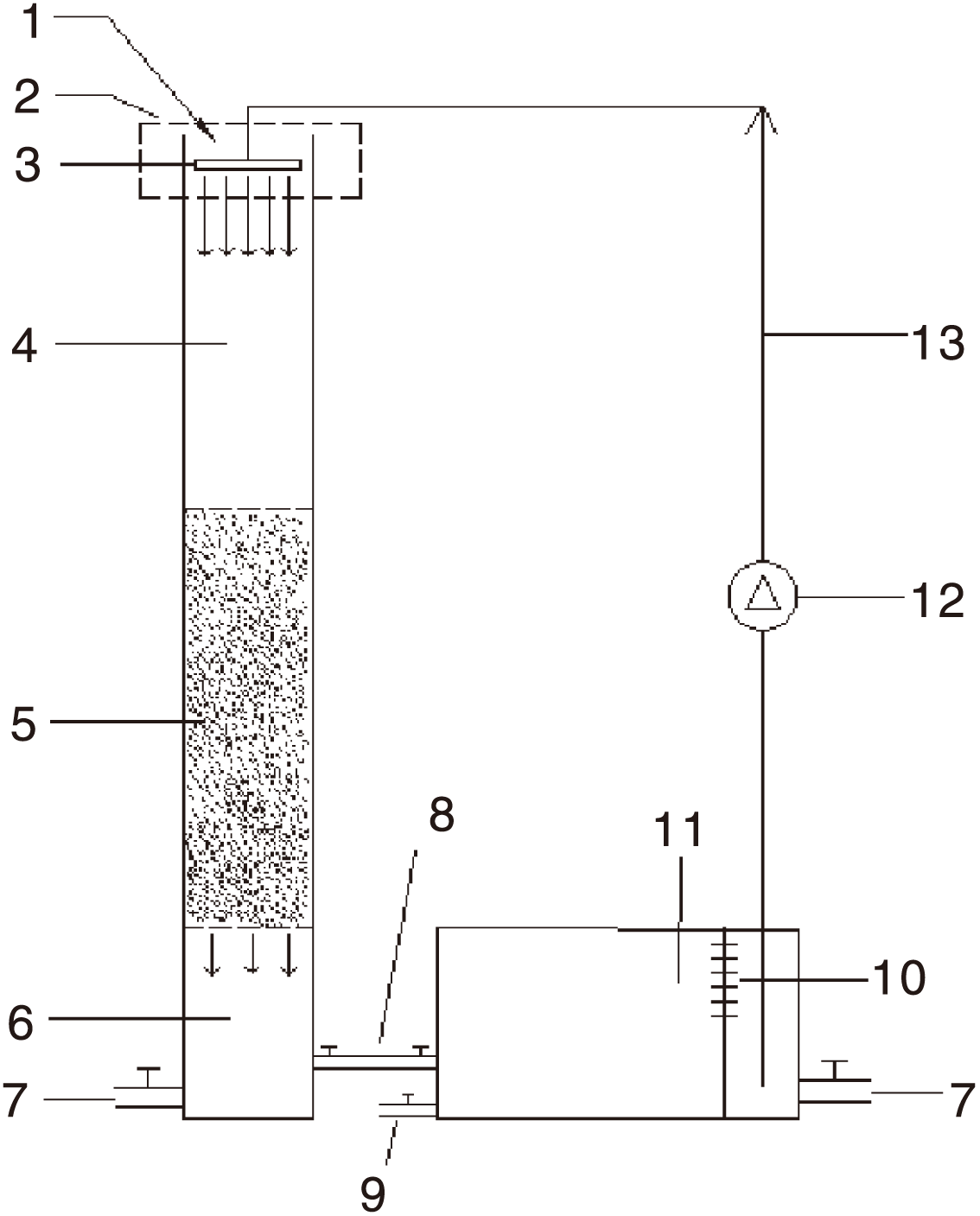
图1 生物滴滤反应器示意图 1,通风口;2,布水区;3,布水器;4,充氧区;5,填料层;6,储水区;7,排水/泥口;8,回流管;9,排泥口;10,溢流板;11,调节池;12,回流泵;13,管道。
Fig.1 Schematic diagram of bio-trickling filter reactor 1, Air-vent; 2, Water distribution area; 3, Water distributor; 4, Oxygenation zone; 5, Packing layer; 6, Water storage area; 7, Drainage / mud outlet; 8, Reflux tube; 9, Mud outlet; 10, Overflow plate; 11, Regulating pool; 12, Reflux pump; 13, Pipeline.
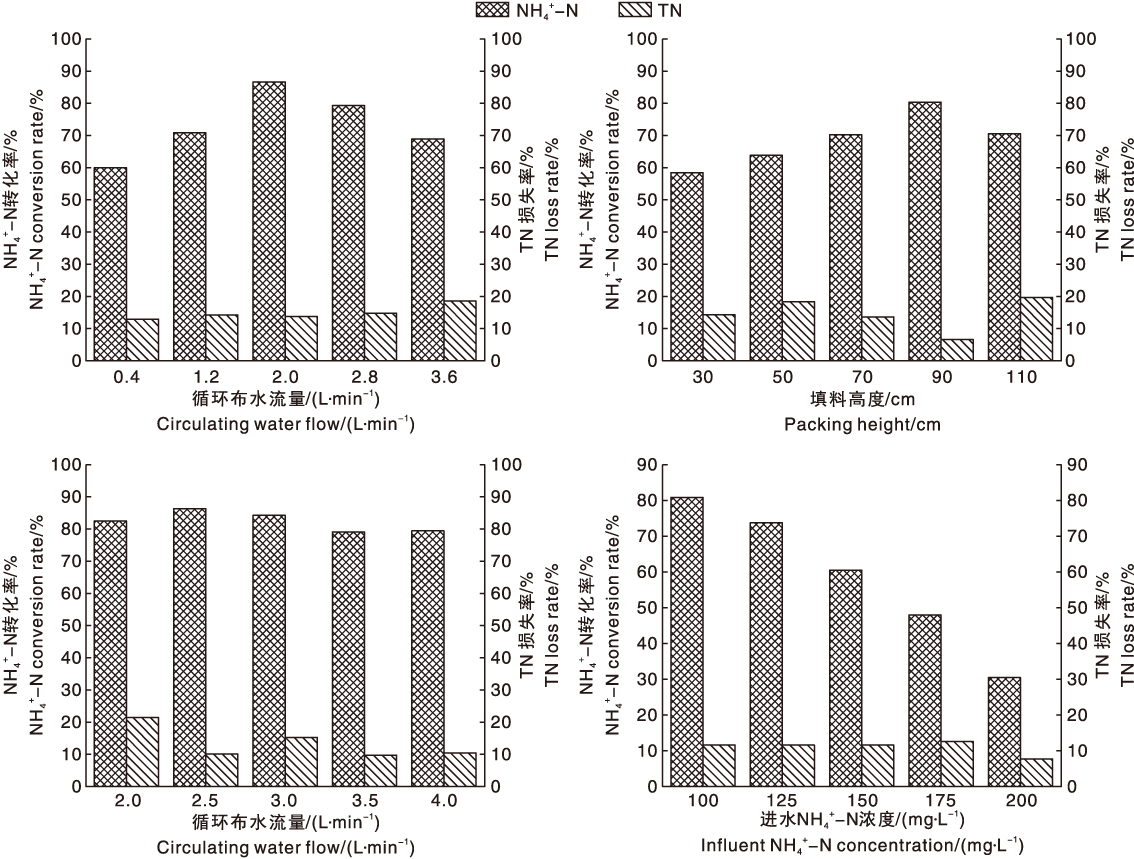
图2 不同运行参数对氨氮(${{\mathrm{NH}}_{4}}^{+}$-N)转化率和总氮(TN)损失率的影响
Fig.2 Effects of different operating parameters on ammonia nitrogen (${{\mathrm{NH}}_{4}}^{+}$-N) conversion rate and total nitrogen (TN) loss rate
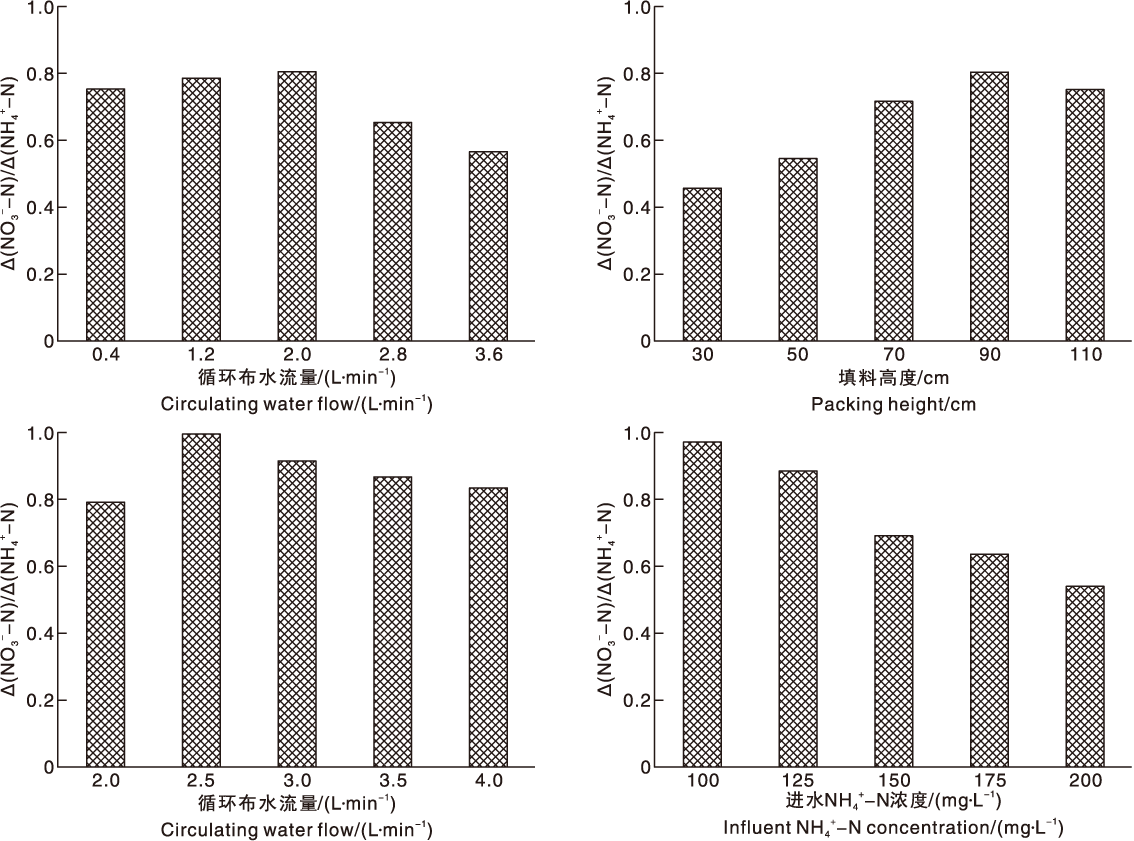
图3 不同运行参数对硝态氮产生量与氨氮转化量的比[Δ(${\mathrm{NO}}_{3}^{-}$-N)/Δ(${\mathrm{NH}}_{4}^{+}$-N)]的影响
Fig.3 Effects of different operating parameters on the ratio of nitrate nitrogen production to ammonia nitrogen conversion [Δ(${{\mathrm{NO}}_{3}}^{-}$-N)/Δ(${{\mathrm{NH}}_{4}}^{+}$-N)]
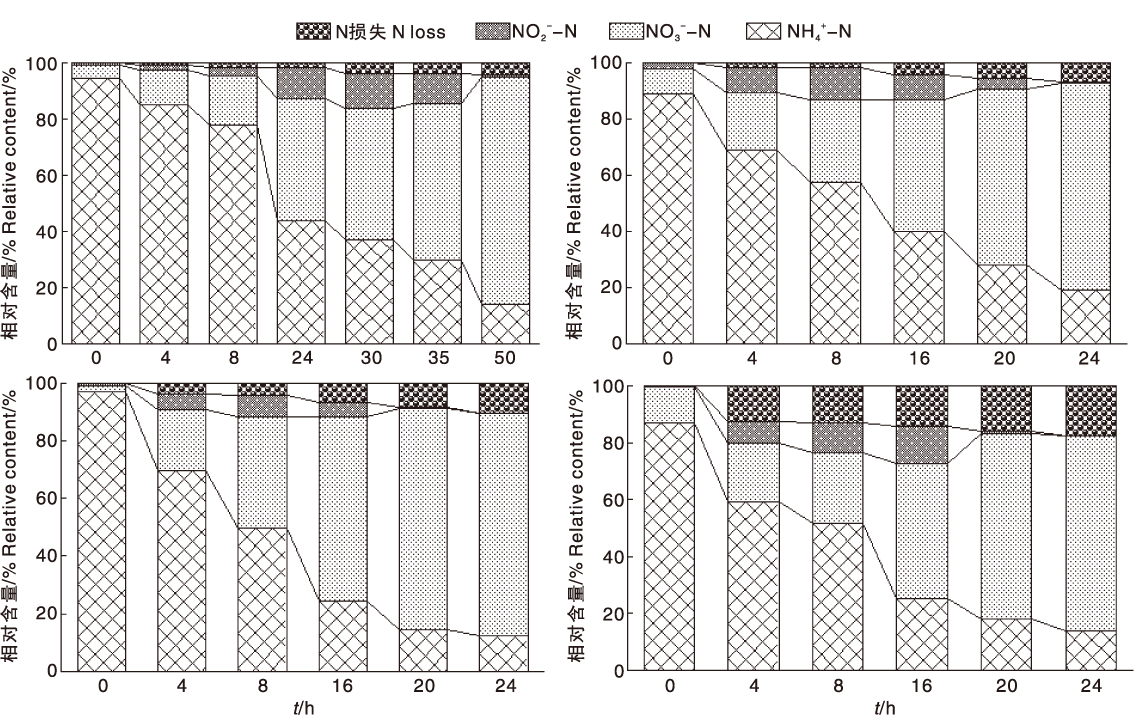
图4 不同运行参数对氮素转化的影响
Fig.4 Effects of different operating parameters on nitrogen conversion
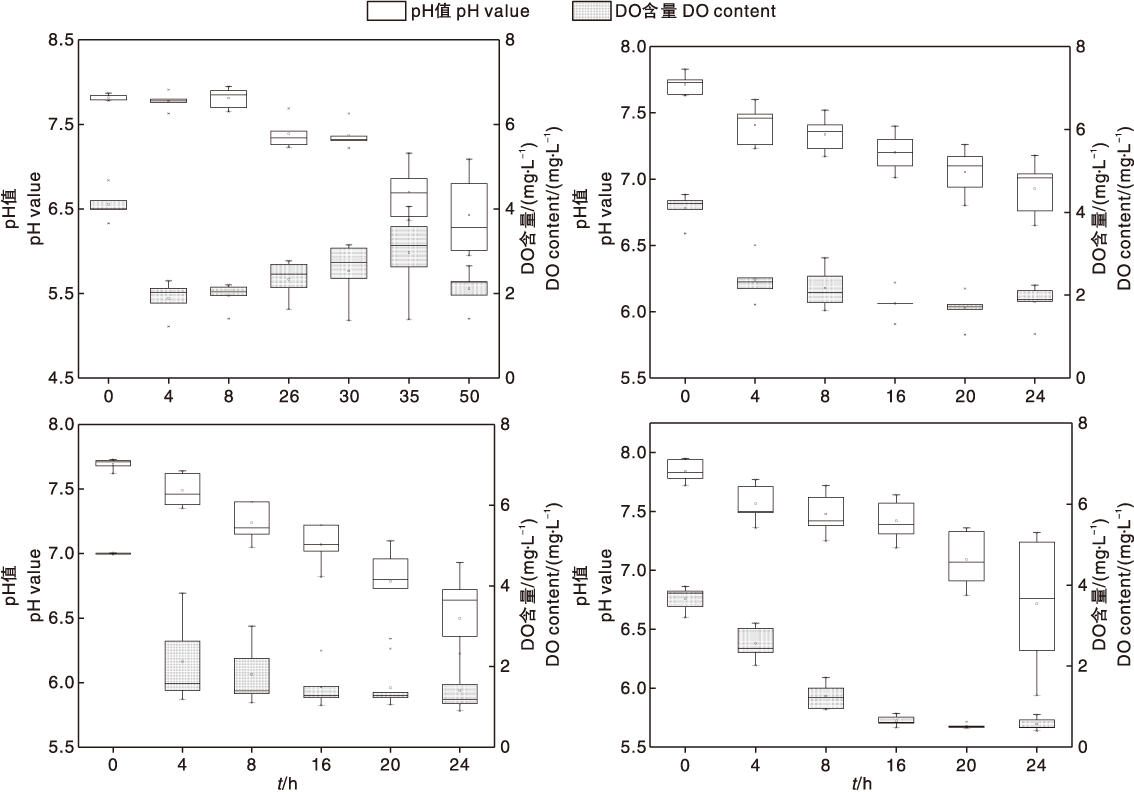
图5 不同运行参数对pH值和溶解氧(DO)含量的影响
Fig.5 Effects of different operating parameters on pH value and dissolved oxygen (DO) content
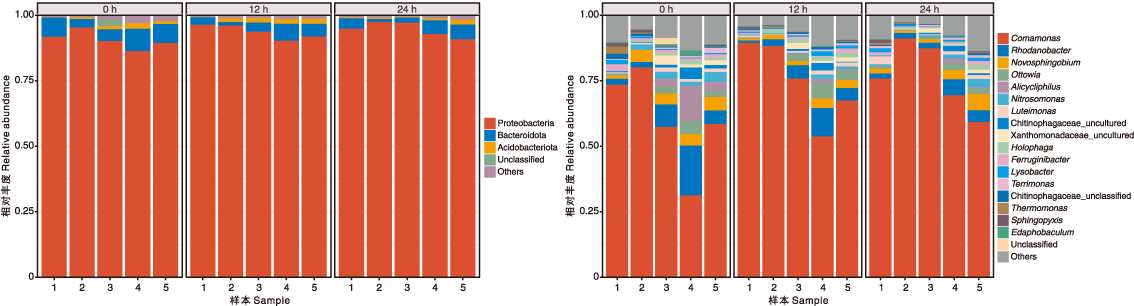
图6 门水平(左)和属水平(右)上的微生物群落分布 Proteobacteria,变形菌门;Bacteroidota,拟杆菌门;Acidobacteriota,酸杆菌门;Unclassified,未分类;Others,其他;Comamonas,丛毛单胞菌属;Rhodanobacter,罗河杆菌属;Novosphingobium,新鞘氨醇杆菌属;Ottowia,奥托氏菌属;Alicycliphilus,脂环菌属;Nitrosomonas,亚硝化单胞菌属;Luteimonas,藤黄色单胞菌属(鲁特氏菌属);Chitinophagaceae_uncultured,几丁质杆菌科未培养菌属;Xanthomonadaceae_uncultured,黄单胞菌科未培养菌属;Holophaga,全噬菌属;Ferruginibacter,铁锈杆菌属;Lysobacter,溶杆菌属;Terrimonas,土生单胞菌属;Chitinophagaceae_unclassified,噬几丁质菌科未分类菌属;Thermomonas,热单胞菌属;Sphingopyxis,鞘氨醇盒菌属;Edaphobaculum,土杆属(未定名)。1~5所对应的进水氨氮质量浓度依次为100、125、150、175、200 mg·L-1。
Fig.6 Microbial community distribution of phylum level (left) and genus level (right) The initial ammonia nitrogen concentrations corresponding to 1-5 are 100, 125, 150, 175 and 200 mg·L-1, respectively.
| [1] | 吴浩玮, 孙小淇, 梁博文, 等. 我国畜禽粪便污染现状及处理与资源化利用分析[J]. 农业环境科学学报, 2020, 39(6): 1168-1176. |
| Wu H W, Sun X Q, Liang B W, et al. Analysis of livestock and poultry manure pollution in China and its treatment and resource utilization[J]. Journal of Agro-Environment Science, 2020, 39(6): 1168-1176. | |
| [2] | 安婧, 丁子明, 高程程, 等. 畜禽粪便污染的环境风险与资源化处理技术分析[J]. 环境科学, 2023, 44(8): 4764-4774. |
| An J, Ding Z M, Gao C C, et al. Analysis of the environmental risk of livestock manure pollution and resource treatment technology[J]. Environmental Science, 2023, 44(8): 4764-4774. | |
| [3] | 宣梦, 许振成, 吴根义, 等. 我国规模化畜禽养殖粪污资源化利用分析[J]. 农业资源与环境学报, 2018, 35(2): 126-132. |
| Xuan M, Xu Z C, Wu G Y, et al. Analysis of utilization of fecal resources in large-scale livestock and poultry breeding in China[J]. Journal of Agricultural Resources and Environment, 2018, 35(2): 126-132. | |
| [4] | 王小彬, 闫湘, 李秀英. 畜禽粪污厌氧发酵沼液农用之环境安全风险[J]. 中国农业科学, 2021, 54(1): 110-139. |
| Wang X B, Yan X, Li X Y. Environmental safety risk for application of anaerobic fermentation biogas slurry from livestock manure in agricultural land in China[J]. Scientia Agricultura Sinica, 2021, 54(1): 110-139. | |
| [5] | Wang Y, Dong H M, Zhu Z P, et al. CH4, NH3, N2O and NO emissions from stored biogas digester effluent of pig manure at different temperatures[J]. Agriculture, Ecosystems & Environment, 2016, 217: 1-12. |
| [6] | Wang Y, Dong H M, Zhu Z P, et al. Mitigating greenhouse gas and ammonia emissions from swine manure management: a system analysis[J]. Environmental Science & Technology, 2017, 51(8): 4503-4511. |
| [7] | 薛文涛, 林聪, 孙钦平, 等. 不同发酵原料沼液的氨挥发特性研究[J]. 可再生能源, 2016, 34(5): 780-785. |
| Xue W T, Lin C, Sun Q P, et al. Research on ammonia emission characteristic of different fermentation raw material[J]. Renewable Energy Resources, 2016, 34(5): 780-785. | |
| [8] | Hou H, Zhou S, Hosomi M, et al. Ammonia emissions from anaerobically-digested slurry and chemical fertilizer applied to flooded forage rice[J]. Water, Air, and Soil Pollution, 2007, 183(1): 37-48. |
| [9] | Schilke-Gartley K L, Sims J T. Ammonia volatilization from poultry manure-amended soil[J]. Biology and Fertility of Soils, 1993, 16(1): 5-10. |
| [10] | Sharpe R R, Harper L A. Ammonia and nitrous oxide emissions from sprinkler irrigation applications of swine effluent[J]. Journal of Environmental Quality, 1997, 26(6): 1703-1706. |
| [11] | Bergström A K, Jansson M. Atmospheric nitrogen deposition has caused nitrogen enrichment and eutrophication of lakes in the Northern Hemisphere[J]. Global Change Biology, 2006, 12(4): 635-643. |
| [12] | Pacifico F, Delon C, Jambert C, et al. Measurements of nitric oxide and ammonia soil fluxes from a wet savanna ecosystem site in West Africa during the DACCIWA field campaign[J]. Atmospheric Chemistry and Physics, 2019, 19(4): 2299-2325. |
| [13] | 刘波, 刘筱, 韩宇捷, 等. 规模化养猪场典型沼气工程各排放节点氨排放特征研究[J]. 农业工程学报, 2018, 34(23): 179-185. |
| Liu B, Liu X, Han Y J, et al. Study on emission characteristics of ammonia from anaerobic digesters in industrial pig farm[J]. Transactions of the Chinese Society of Agricultural Engineering, 2018, 34(23): 179-185. | |
| [14] | 刘文科, 杨其长, 王顺清. 沼液在蔬菜上的应用及其土壤质量效应[J]. 中国沼气, 2009, 27(1): 43-46. |
| Liu W K, Yang Q C, Wang S Q. A review on effect of biogas slurry on vegetables and soil[J]. China Biogas, 2009, 27(1): 43-46. | |
| [15] | Ponce K H, Peet M M, Harlow C D, et al. Assessment of swine waste bioremediation using greenhouse tomatoes[J]. Acta Horticulturae, 2004(633): 415-423. |
| [16] | 苗文亮. 基于生物滴滤氨氮硝化的猪场氨减排技术研究[D]. 上海: 华东理工大学, 2021. |
| Miao W L. Research on ammonia emission reduction technology of pig farm based on biological trickling ammonium nitrogen nitrification[D]. Shanghai: East China University of Science and Technology, 2021. | |
| [17] | Regueiro I, Coutinho J, Fangueiro D. Alternatives to sulfuric acid for slurry acidification: impact on slurry composition and ammonia emissions during storage[J]. Journal of Cleaner Production, 2016, 131: 296-307. |
| [18] | Petersen S O, Andersen A J, Eriksen J. Effects of cattle slurry acidification on ammonia and methane evolution during storage[J]. Journal of Environmental Quality, 2012, 41(1): 88-94. |
| [19] | 李路路, 董红敏, 朱志平, 等. 酸化处理对猪场原水和沼液存储过程中气体排放的影响[J]. 农业环境科学学报, 2016, 35(4): 774-784. |
| Li L L, Dong H M, Zhu Z P, et al. Effects of acidification on gas emissions from raw pig slurry and biogas liquid during storage[J]. Journal of Agro-Environment Science, 2016, 35(4): 774-784. | |
| [20] | Sakamoto N, Tani M, Navarrete I A, et al. Covering dairy slurry stores with hydrophobic fertilisers reduces greenhouse gases and other polluting gas emissions[J]. Australian Journal of Experimental Agriculture, 2008, 48(2): 202. |
| [21] | 王悦, 刘婧怡, 张佳男, 等. 改性膨胀蛭石覆盖对沼液贮存氨气和温室气体排放影响[J]. 农业环境科学学报, 2021, 40(4): 902-913. |
| Wang Y, Liu J Y, Zhang J N, et al. Ammonia and greenhouse gas mitigation from biogas slurry storage using a modified expanded vermiculite cover[J]. Journal of Agro-Environment Science, 2021, 40(4): 902-913. | |
| [22] | 肖其亮, 朱坚, 彭华, 等. 稻田氨挥发损失及减排技术研究进展[J]. 农业环境科学学报, 2021, 40(1): 16-25. |
| Xiao Q L, Zhu J, Peng H, et al. Ammonia volatilization loss and emission reduction measures in paddy fields[J]. Journal of Agro-Environment Science, 2021, 40(1): 16-25. | |
| [23] | 张振华. 作物硝态氮转运利用与氮素利用效率的关系[J]. 植物营养与肥料学报, 2017, 23(1): 217-223. |
| Zhang Z H. The relationship between nitrate transport and utilization in crop and nitrogen utilization efficiency[J]. Journal of Plant Nutrition and Fertilizer, 2017, 23(1): 217-223. | |
| [24] | 田霄鸿, 李生秀. 几种蔬菜对硝态氮、铵态氮的相对吸收能力[J]. 植物营养与肥料学报, 2000, 6(2): 194-201. |
| Tian X H, Li S X. Uptake capacity of several vegetable crops to nitrate and ammonium[J]. Plant Nutrition and Fertilizer Science, 2000, 6(2): 194-201. | |
| [25] | 马庆旭, 吴良欢, 曹小闯, 等. 营养液pH和氮形态对小白菜生长、氮素吸收及品质的影响[J]. 水土保持学报, 2015, 29(6): 64-68. |
| Ma Q X, Wu L H, Cao X C, et al. Effects of pH and nitrogen forms of hydroponic nutrient solution on the growth, nitrogen absorption and edible quality of pakchoi (Brassica chinensis L.)[J]. Journal of Soil and Water Conservation, 2015, 29(6): 64-68. | |
| [26] | 唐伟杰, 官春云, 林良斌, 等. 不同硝铵比对油菜生长、生理与产量的影响[J]. 植物营养与肥料学报, 2018, 24(5): 1338-1348. |
| Tang W J, Guan C Y, Lin L B, et al. Effects of nitrate and ammonium supply ratios on growth, physiology and yield of oilseed rape (Brassica napus L.)[J]. Journal of Plant Nutrition and Fertilizers, 2018, 24(5): 1338-1348. | |
| [27] | 崔纪菡, 赵静, 孟建, 等. 铵态氮和硝态氮对谷子形态和生物量的影响研究[J]. 中国农业科技导报, 2017, 19(10): 66-72. |
| Cui J H, Zhao J, Meng J, et al. Effect of ammonium nitrogen and nitrate nitrogen on the morphology and biomass of foxtail millet (Setaria italic L.)[J]. Journal of Agricultural Science and Technology, 2017, 19(10): 66-72. | |
| [28] | Cheng J, Shearin T E, Peet M M, et al. Utilization of treated swine wastewater for greenhouse tomato production[J]. Water Science and Technology, 2004, 50(2): 77-82. |
| [29] | 富立鹏. 生物过滤除臭填料挂膜驯化试验研究[J]. 工业安全与环保, 2007, 33(12): 6-7. |
| Fu L P. The research on the odor removal bio-film demestication experiment by bio-filter[J]. Industrial Safety and Environmental Protection, 2007, 33(12): 6-7. | |
| [30] | 乔昕, 王博, 郭媛媛, 等. 羟胺对氨氧化菌和亚硝酸盐氧化菌的竞争性选择[J]. 环境科学, 2020, 41(8): 3765-3772. |
| Qiao X, Wang B, Guo Y Y, et al. Competitive selection of hydroxylamine on ammonia oxidizing bacteria and nitrite oxidizing bacteria[J]. Environmental Science, 2020, 41(8): 3765-3772. | |
| [31] | Zhou J, Wang H Y, Yang K, et al. Autotrophic denitrification by nitrate-dependent Fe(II) oxidation in a continuous up-flow biofilter[J]. Bioprocess and Biosystems Engineering, 2016, 39(2): 277-284. |
| [32] | Zhang T, Shao M F, Ye L. 454 Pyrosequencing reveals bacterial diversity of activated sludge from 14 sewage treatment plants[J]. The ISME Journal, 2012, 6(6): 1137-1147. |
| [33] | Hill V R, Kahler A M, Jothikumar N, et al. Multistate evaluation of an ultrafiltration-based procedure for simultaneous recovery of enteric microbes in 100-liter tap water samples[J]. Applied and Environmental Microbiology, 2007, 73(13): 4218-4225. |
| [1] | 应孟飞, 管毅伦, 靳泽文, 赵坤, 平立凤, 柴彦君, 李艳, 沈月, 颜军. 生物炭-沼液配施对酸性红壤氮素转化的长期效应[J]. 浙江农业学报, 2026, 38(4): 731-744. |
| [2] | 巴仕浩, 童文彬, 杨海峻, 江建锋, 李子川, 吴春艳, 唐旭, 柴彦君, 李艳. 沼液施用协同化肥减量在茭白生产和土壤改良上的效果[J]. 浙江农业学报, 2026, 38(1): 126-135. |
| [3] | 应永飞, 韩东轩, 孟芳, 俞遴, 沈佳栾, 汪开英. 沼液替代化肥对水稻产量、品质和土壤特性的影响[J]. 浙江农业学报, 2025, 37(4): 880-891. |
| [4] | 赵嘉豪, 徐杏, 周卫东, 杨华, 赵喜红, 汪雯. 猪场废水与周边水环境中细菌和耐药基因的特征[J]. 浙江农业学报, 2025, 37(3): 621-632. |
| [5] | 毛尔晔, 张潇丹, 颉建明, 马宁, 常有麟, 胡世莲. 日光温室主动蓄放热系统热过程模拟与参数优化研究[J]. 浙江农业学报, 2024, 36(3): 671-680. |
| [6] | 潘亚杰, 常会庆, 宋盼盼. 规模化猪场粪便养分特征与堆肥过程中填料添加的影响[J]. 浙江农业学报, 2023, 35(7): 1690-1698. |
| [7] | 肖华, 徐杏, 谢传奇, 周昕, 周卫东, 唐文升. 鸟粪石沉淀预处理对猪场沼液双膜浓缩工艺的影响[J]. 浙江农业学报, 2023, 35(6): 1407-1415. |
| [8] | 江涛, 王立国, 孙芳芳, 成剑波, 何腾兵, 秦松, 范成五, 阴文芳. 沼渣生物质炭对西南喀斯特山区沼液灌溉土壤氮淋溶和白菜产量的影响[J]. 浙江农业学报, 2021, 33(11): 2104-2115. |
| [9] | 陈建能, 周赟, 贾江鸣, 陈天龙, 蔡双雷, 喻陈楠. 基于大蒜根盘特征的精确切根机构优化设计[J]. 浙江农业学报, 2021, 33(11): 2174-2184. |
| [10] | 程鹏飞, 王艳, 杨期勇, 刘德富, 刘天中. 微藻贴壁培养对沼液废水的处理效果[J]. 浙江农业学报, 2017, 29(9): 1564-1569. |
| [11] | 邵文奇, 纪力, 孙春梅, 姜晓剑, 文廷刚, 唐金陵, 章安康. 不同沼液施用量对水稻生长、产量及重金属含量的影响[J]. 浙江农业学报, 2017, 29(12): 1963-1969. |
| [12] | 陈贵1,赵国华2,张红梅1,沈亚强1,杨继锋3,冯四海4,陈小忠3,程旺大1,*. 沼液浇灌对茭白氮磷钾养分吸收利用特性的影响[J]. 浙江农业学报, 2016, 28(3): 474-. |
| [13] | 奚辉;薛智勇;*;陈喜靖;姜丽娜;王卫平. 沼液不同灌溉量对茭白产量、品质及土壤肥力的影响[J]. , 2013, 25(6): 0-1341. |
| [14] | 朱凤香;王卫平;陈晓旸;洪春来;吴传珍;薛智勇*. 利用人工湿地栽种水生作物对沼液进行无害化消解[J]. , 2011, 23(2): 0-368. |
| [15] | 李艾芬;李瑾;张晓伟;龚晓春. 机插秧单季晚稻中沼液的施用技术研究[J]. , 2011, 23(2): 0-387. |
| 阅读次数 | ||||||
|
全文 |
|
|||||
|
摘要 |
|
|||||

