Acta Agriculturae Zhejiangensis ›› 2026, Vol. 38 ›› Issue (3): 506-519.DOI: 10.3969/j.issn.1004-1524.20250207
• Plant Protection • Previous Articles Next Articles
Isolation, identification and pathogenicity determination of seed-borne fungi in Glycyrrhiza uralensis Fisch.
CHEN Runli1( ), LIU Pengfei1, TANG Siyin2, LOU Binggan1,*()
- 1.
Ministry of Agriculture and Rural Affairs Key Laboratory of Molecular Biology of Crop Pathogens and Insect Pests ,Institute of Biotechnology, Zhejiang University Hangzhou 310058, China
2.Xinjiang Huafang Chinese Herbal Medicine Co. ,Ltd. Yuli 841500, Xinjiang, China
-
Received:2025-03-20Online:2026-03-25Published:2026-04-17

CLC Number:
Cite this article
CHEN Runli, LIU Pengfei, TANG Siyin, LOU Binggan. Isolation, identification and pathogenicity determination of seed-borne fungi in Glycyrrhiza uralensis Fisch.[J]. Acta Agriculturae Zhejiangensis, 2026, 38(3): 506-519.
share this article
Add to citation manager EndNote|Ris|BibTeX
URL: http://www.zjnyxb.cn/EN/10.3969/j.issn.1004-1524.20250207
| 甘草种类Species of licorice | 种子编号Seed No. | 种子来源Seed source |
|---|---|---|
| 乌拉尔甘草Glycyrrhiza uralensis Fisch. | W-XJ-B | 新疆库尔勒市Korla, Xinjiang |
| W-BZ-1 | 新疆博湖县Bohu, Xinjiang | |
| W-BZ-2 | 新疆轮台县Luntai, Xinjiang | |
| W-YL-1 | 新疆伊宁市Yining, Xinjiang | |
| W-CF-1 | 内蒙古赤峰市Chifeng, Inner Mongolia | |
| W-H-1 | 内蒙古巴彦淖尔市Bayannur, Inner Mongolia | |
| W-H-2 | 内蒙古杭锦旗Hanggin Banner, Inner Mongolia | |
| W-H-3 | 内蒙古阿拉善盟Alagxa, Inner Mongolia | |
| W-GS-1 | 甘肃张掖市Zhangye, Gansu | |
| W-GS-2 | 甘肃武威市Wuwei, Gansu | |
| W-SB-1 | 陕西榆林市Yulin, Shaanxi | |
| 胀果甘草Glycyrrhiza inflata Bat. | Z-AKS-1 | 新疆阿克苏沙雅县Xayar, Aksu, Xinjiang |
| Z-AKS-2 | 新疆阿拉尔幸福镇Xingfu Town, Aral, Xinjiang | |
| Z-AKS-3 | 新疆阿拉尔科克库勒镇Kekekule Town, Aral, Xinjiang | |
| Z-AKS-4 | 新疆阿拉尔新开岭镇Xinkailing Town, Aral, Xinjiang | |
| 光果甘草Glycyrrhiza glabra L. | G-AKS-1 | 新疆阿拉尔新开岭镇Xinkailing Town, Aral, Xinjiang |
| G-YL-1 | 新疆伊宁胡地亚于孜镇Hudiya Yuzi Town, Yining, Xinjiang | |
| G-YL-2 | 新疆伊宁拜什墩农场Baishidun Farm, Yining, Xinjiang | |
| 腺毛甘草Glycyrrhiza glandulifera Ledeb. | X-YL-1 | 新疆伊宁拜什墩农场Baishidun Farm, Yining, Xinjiang |
Table 1 Source information of licorice seeds
| 甘草种类Species of licorice | 种子编号Seed No. | 种子来源Seed source |
|---|---|---|
| 乌拉尔甘草Glycyrrhiza uralensis Fisch. | W-XJ-B | 新疆库尔勒市Korla, Xinjiang |
| W-BZ-1 | 新疆博湖县Bohu, Xinjiang | |
| W-BZ-2 | 新疆轮台县Luntai, Xinjiang | |
| W-YL-1 | 新疆伊宁市Yining, Xinjiang | |
| W-CF-1 | 内蒙古赤峰市Chifeng, Inner Mongolia | |
| W-H-1 | 内蒙古巴彦淖尔市Bayannur, Inner Mongolia | |
| W-H-2 | 内蒙古杭锦旗Hanggin Banner, Inner Mongolia | |
| W-H-3 | 内蒙古阿拉善盟Alagxa, Inner Mongolia | |
| W-GS-1 | 甘肃张掖市Zhangye, Gansu | |
| W-GS-2 | 甘肃武威市Wuwei, Gansu | |
| W-SB-1 | 陕西榆林市Yulin, Shaanxi | |
| 胀果甘草Glycyrrhiza inflata Bat. | Z-AKS-1 | 新疆阿克苏沙雅县Xayar, Aksu, Xinjiang |
| Z-AKS-2 | 新疆阿拉尔幸福镇Xingfu Town, Aral, Xinjiang | |
| Z-AKS-3 | 新疆阿拉尔科克库勒镇Kekekule Town, Aral, Xinjiang | |
| Z-AKS-4 | 新疆阿拉尔新开岭镇Xinkailing Town, Aral, Xinjiang | |
| 光果甘草Glycyrrhiza glabra L. | G-AKS-1 | 新疆阿拉尔新开岭镇Xinkailing Town, Aral, Xinjiang |
| G-YL-1 | 新疆伊宁胡地亚于孜镇Hudiya Yuzi Town, Yining, Xinjiang | |
| G-YL-2 | 新疆伊宁拜什墩农场Baishidun Farm, Yining, Xinjiang | |
| 腺毛甘草Glycyrrhiza glandulifera Ledeb. | X-YL-1 | 新疆伊宁拜什墩农场Baishidun Farm, Yining, Xinjiang |
| 基因 Gene | 引物名称 Primer name | 引物序列(5'→3') Primer sequence (5'→3') | 参考文献 Reference |
|---|---|---|---|
| rDNA-ITS | ITS1 | TCCGTAGGTGAACCTGCGG | [ |
| ITS4 | TCCTCCGCTTATTGATATGC | ||
| LSU | LR0R | ACCCGCTGAACTTAAGC | |
| LR5 | TCCTGAGGGAAACTTCG | ||
| tef1* | EF1-728F | CATCGAGAAGTTCGAGAAGG | [ |
| EF1-986R | TACTTGAAGGAACCCTTACC | ||
| raTEF-F | TACAAGGGATGGAACAA | [ | |
| raTEF-R | AGCAAACTTACAGGCAA | ||
| anTEF-F | CCTTCAAGTACGCYTGGGTTC | [ | |
| anTEF-R | TTCTTGGAGTCACCGGCAA | ||
| afTEF-F | GTGAATTCGAGGCTGGT | [ | |
| afTEF-R | GAGGGGAAGACGGAGAG |
Table 2 Primers used in this study
| 基因 Gene | 引物名称 Primer name | 引物序列(5'→3') Primer sequence (5'→3') | 参考文献 Reference |
|---|---|---|---|
| rDNA-ITS | ITS1 | TCCGTAGGTGAACCTGCGG | [ |
| ITS4 | TCCTCCGCTTATTGATATGC | ||
| LSU | LR0R | ACCCGCTGAACTTAAGC | |
| LR5 | TCCTGAGGGAAACTTCG | ||
| tef1* | EF1-728F | CATCGAGAAGTTCGAGAAGG | [ |
| EF1-986R | TACTTGAAGGAACCCTTACC | ||
| raTEF-F | TACAAGGGATGGAACAA | [ | |
| raTEF-R | AGCAAACTTACAGGCAA | ||
| anTEF-F | CCTTCAAGTACGCYTGGGTTC | [ | |
| anTEF-R | TTCTTGGAGTCACCGGCAA | ||
| afTEF-F | GTGAATTCGAGGCTGGT | [ | |
| afTEF-R | GAGGGGAAGACGGAGAG |
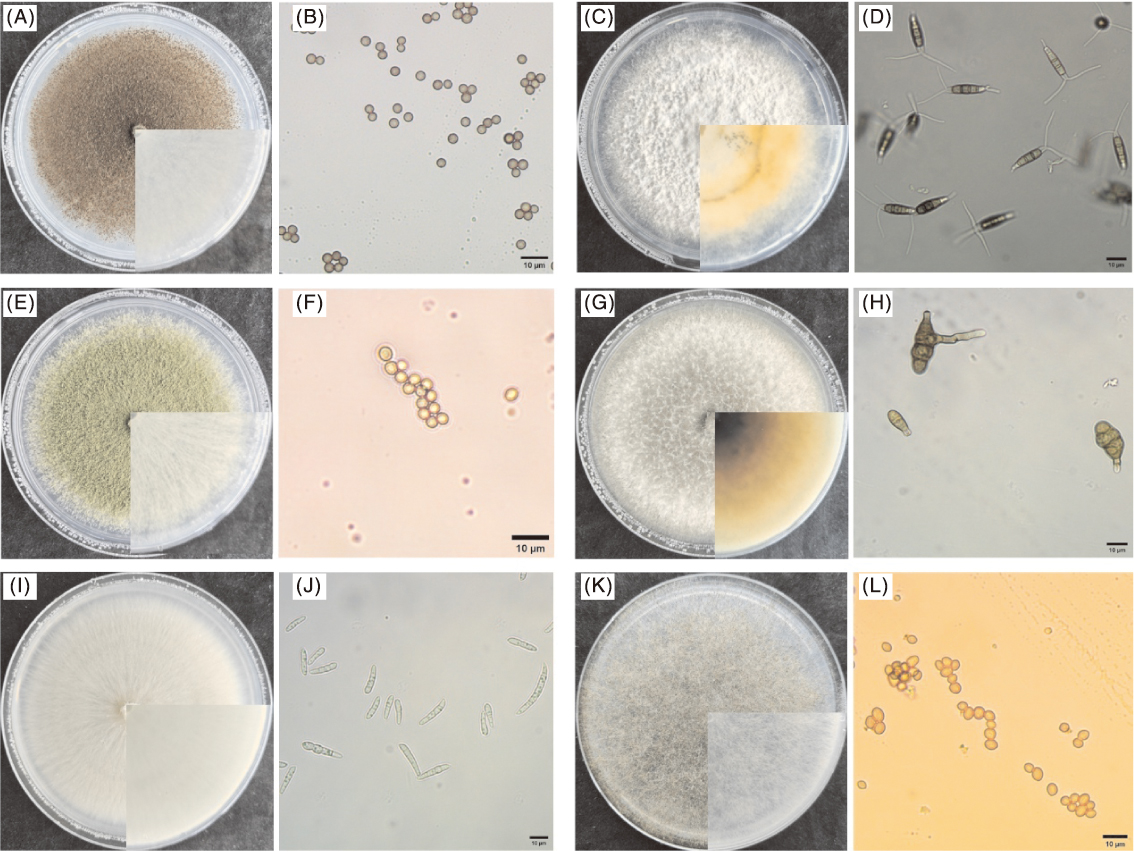
Fig.1 Morphological characteristics of seed-borne fungi in licorice Colonies and conidial morphology of each strain cultured on PDA medium for 7 days: A and B, Aspergillus niger B-Z-3; C and D, Neopestalotiopsis clavispora B-Z-4; E and F, Aspergillus flavus B-Z-6; G and H, Alternaria tenuissima CF-Z-8; I and J, Fusarium equiseti CF-Z-11. K and L, Morphology of the colony and sporangiospores of Rhizopus arrhizus CF-Z-12 cultured for 3 days.
| 代表性菌株 Representative strain | 基因名称 Gene name | 序列长度/bp Sequence length/bp | GenBank登录号 GenBank accession number | 比对结果 Alignment result | 相似度/% Similarity/% |
|---|---|---|---|---|---|
| B-Z-3 | ITS | 604 | PQ343918 | 黑曲霉 | 99.83 |
| tef1 | 457 | PQ736917 | Aspergillus niger | 99.56 | |
| LSU | 960 | PV682703 | 99.58 | ||
| B-Z-4 | ITS | 554 | PQ345466 | 新棒状拟盘多毛孢 | 99.46 |
| tef1 | 298 | PV643062 | Neopestalotiopsis clavispora | 98.99 | |
| LSU | 938 | PV682704 | 99.56 | ||
| B-Z-6 | ITS | 599 | PQ345471 | 黄曲霉 | 99.83 |
| tef1 | 384 | PV643063 | Aspergillus flavus | 100.00 | |
| LSU | 949 | PV682705 | 99.15 | ||
| CF-Z-8 | ITS | 576 | PQ345473 | 细极链格孢 | 99.83 |
| tef1 | 281 | PV643064 | Alternaria tenuissima | 100.00 | |
| LSU | 928 | PV682706 | 99.89 | ||
| CF-Z-11 | ITS | 549 | PQ345475 | 木贼镰刀菌 | 99.82 |
| tef1 | 285 | PV643065 | Fusarium equiseti | 98.59 | |
| LSU | 916 | PV682707 | 99.78 | ||
| CF-Z-12 | ITS | 631 | PQ345479 | 少根根霉 | 99.84 |
| tef1 | 475 | PV643066 | Rhizopus arrhizus | 99.37 | |
| LSU | 1 035 | PV682708 | 98.07 |
Table 3 Comparison of rDNA ITS, tef1, and LSU sequences of seed-borne fungi in licorice
| 代表性菌株 Representative strain | 基因名称 Gene name | 序列长度/bp Sequence length/bp | GenBank登录号 GenBank accession number | 比对结果 Alignment result | 相似度/% Similarity/% |
|---|---|---|---|---|---|
| B-Z-3 | ITS | 604 | PQ343918 | 黑曲霉 | 99.83 |
| tef1 | 457 | PQ736917 | Aspergillus niger | 99.56 | |
| LSU | 960 | PV682703 | 99.58 | ||
| B-Z-4 | ITS | 554 | PQ345466 | 新棒状拟盘多毛孢 | 99.46 |
| tef1 | 298 | PV643062 | Neopestalotiopsis clavispora | 98.99 | |
| LSU | 938 | PV682704 | 99.56 | ||
| B-Z-6 | ITS | 599 | PQ345471 | 黄曲霉 | 99.83 |
| tef1 | 384 | PV643063 | Aspergillus flavus | 100.00 | |
| LSU | 949 | PV682705 | 99.15 | ||
| CF-Z-8 | ITS | 576 | PQ345473 | 细极链格孢 | 99.83 |
| tef1 | 281 | PV643064 | Alternaria tenuissima | 100.00 | |
| LSU | 928 | PV682706 | 99.89 | ||
| CF-Z-11 | ITS | 549 | PQ345475 | 木贼镰刀菌 | 99.82 |
| tef1 | 285 | PV643065 | Fusarium equiseti | 98.59 | |
| LSU | 916 | PV682707 | 99.78 | ||
| CF-Z-12 | ITS | 631 | PQ345479 | 少根根霉 | 99.84 |
| tef1 | 475 | PV643066 | Rhizopus arrhizus | 99.37 | |
| LSU | 1 035 | PV682708 | 98.07 |
| 甘草种类 Species of licorice | 种子编号 Seed umber | 种子来源 Seed source | 每粒种子孢子负荷量 Spore load per seed | 菌株数(占比/%) Strain count(Percentage/%) | ||
|---|---|---|---|---|---|---|
| 黄曲霉 Aspergillus flavus | 黑曲霉 Aspergillus niger | 少根根霉 Rhizopus arrhizus | ||||
| 乌拉尔甘草 Glycyrrhiza uralensis Fisch. | W-XJ-B | 新疆库尔勒市Korla, Xinjiang | 60.83 | 33(45.21) | 40(54.79) | 0(0) |
| W-BZ-1 | 新疆博湖县Bohu, Xinjiang | 2.08 | 2(40.00) | 2(40.00) | 1(20.00) | |
| W-BZ-2 | 新疆轮台县Luntai, Xinjiang | 2.92 | 3(42.86) | 2(28.57) | 2(28.57) | |
| W-YL-1 | 新疆伊宁市Yining, Xinjiang | 5.00 | 4(33.33) | 3(25.00) | 5(41.67) | |
| W-CF-1 | 内蒙古赤峰市Chifeng, Inner Mongolia | 2.92 | 2(28.57) | 3(42.86) | 2(28.57) | |
| W-H-1 | 内蒙古巴彦淖尔市Bayannur, Inner Mongolia | 3.33 | 2(25.00) | 5(62.50) | 1(12.50) | |
| W-H-2 | 内蒙古杭锦旗Hanggin Banner, Inner Mongolia | 4.17 | 4(40.00) | 6(60.00) | 0(0) | |
| W-H-3 | 内蒙古阿拉善盟Alagxa, Inner Mongolia | 8.75 | 6(28.57) | 10(47.62) | 5(23.81) | |
| W-GS-1 | 甘肃张掖市Zhangye, Gansu | 4.17 | 4(40.00) | 5(50.00) | 1(10.00) | |
| W-GS-2 | 甘肃武威市Wuwei, Gansu | 10.00 | 8(33.33) | 7(29.17) | 9(37.50) | |
| W-SB-1 | 陕西榆林市Yulin, Shaanxi | 5.83 | 4(28.57) | 5(35.71) | 5(35.71) | |
| 胀果甘草 Glycyrrhiza inflata Bat. | Z-AKS-1 | 新疆阿克苏沙雅县Xayar, Aksu, Xinjiang | 6.67 | 6(37.50) | 4(25.00) | 6(37.50) |
| Z-AKS-2 | 新疆阿拉尔幸福镇Xingfu Town, Aral, Xinjiang | 9.17 | 7(31.82) | 11(50.00) | 4(18.18) | |
| Z-AKS-3 | 新疆阿拉尔科克库勒镇Kekekule Town, Aral, Xinjiang | 8.33 | 4(20.00) | 9(45.00) | 7(35.00) | |
| Z-AKS-4 | 新疆阿拉尔新开岭镇Xinkailing Town, Aral, Xinjiang | 5.42 | 5(38.46) | 6(46.15) | 2(15.38) | |
| 光果甘草 Glycyrrhiza glabra L. | G-AKS-1 | 新疆阿拉尔新开岭镇Xinkailing Town, Aral, Xinjiang | 6.25 | 3(20.00) | 8(53.33) | 4(26.67) |
| G-YL-1 | 新疆伊宁胡地亚于孜镇Hudiya Yuzi Town, Yining, Xinjiang | 8.75 | 5(23.81) | 12(57.14) | 4(19.05) | |
| G-YL-2 | 新疆伊宁拜什墩农场Baishidun Farm, Yining, Xinjiang | 10.00 | 5(20.83) | 14(58.33) | 5(20.83) | |
| 腺毛甘草 Glycyrrhiza glandulifera Ledeb. | X-YL-1 | 新疆伊宁拜什墩农场Baishidun Farm, Yining, Xinjiang | 2.92 | 2(28.57) | 4(57.14) | 1(14.29) |
Table 4 The types and isolation frequency of fungi carried on the surface of licorice seeds
| 甘草种类 Species of licorice | 种子编号 Seed umber | 种子来源 Seed source | 每粒种子孢子负荷量 Spore load per seed | 菌株数(占比/%) Strain count(Percentage/%) | ||
|---|---|---|---|---|---|---|
| 黄曲霉 Aspergillus flavus | 黑曲霉 Aspergillus niger | 少根根霉 Rhizopus arrhizus | ||||
| 乌拉尔甘草 Glycyrrhiza uralensis Fisch. | W-XJ-B | 新疆库尔勒市Korla, Xinjiang | 60.83 | 33(45.21) | 40(54.79) | 0(0) |
| W-BZ-1 | 新疆博湖县Bohu, Xinjiang | 2.08 | 2(40.00) | 2(40.00) | 1(20.00) | |
| W-BZ-2 | 新疆轮台县Luntai, Xinjiang | 2.92 | 3(42.86) | 2(28.57) | 2(28.57) | |
| W-YL-1 | 新疆伊宁市Yining, Xinjiang | 5.00 | 4(33.33) | 3(25.00) | 5(41.67) | |
| W-CF-1 | 内蒙古赤峰市Chifeng, Inner Mongolia | 2.92 | 2(28.57) | 3(42.86) | 2(28.57) | |
| W-H-1 | 内蒙古巴彦淖尔市Bayannur, Inner Mongolia | 3.33 | 2(25.00) | 5(62.50) | 1(12.50) | |
| W-H-2 | 内蒙古杭锦旗Hanggin Banner, Inner Mongolia | 4.17 | 4(40.00) | 6(60.00) | 0(0) | |
| W-H-3 | 内蒙古阿拉善盟Alagxa, Inner Mongolia | 8.75 | 6(28.57) | 10(47.62) | 5(23.81) | |
| W-GS-1 | 甘肃张掖市Zhangye, Gansu | 4.17 | 4(40.00) | 5(50.00) | 1(10.00) | |
| W-GS-2 | 甘肃武威市Wuwei, Gansu | 10.00 | 8(33.33) | 7(29.17) | 9(37.50) | |
| W-SB-1 | 陕西榆林市Yulin, Shaanxi | 5.83 | 4(28.57) | 5(35.71) | 5(35.71) | |
| 胀果甘草 Glycyrrhiza inflata Bat. | Z-AKS-1 | 新疆阿克苏沙雅县Xayar, Aksu, Xinjiang | 6.67 | 6(37.50) | 4(25.00) | 6(37.50) |
| Z-AKS-2 | 新疆阿拉尔幸福镇Xingfu Town, Aral, Xinjiang | 9.17 | 7(31.82) | 11(50.00) | 4(18.18) | |
| Z-AKS-3 | 新疆阿拉尔科克库勒镇Kekekule Town, Aral, Xinjiang | 8.33 | 4(20.00) | 9(45.00) | 7(35.00) | |
| Z-AKS-4 | 新疆阿拉尔新开岭镇Xinkailing Town, Aral, Xinjiang | 5.42 | 5(38.46) | 6(46.15) | 2(15.38) | |
| 光果甘草 Glycyrrhiza glabra L. | G-AKS-1 | 新疆阿拉尔新开岭镇Xinkailing Town, Aral, Xinjiang | 6.25 | 3(20.00) | 8(53.33) | 4(26.67) |
| G-YL-1 | 新疆伊宁胡地亚于孜镇Hudiya Yuzi Town, Yining, Xinjiang | 8.75 | 5(23.81) | 12(57.14) | 4(19.05) | |
| G-YL-2 | 新疆伊宁拜什墩农场Baishidun Farm, Yining, Xinjiang | 10.00 | 5(20.83) | 14(58.33) | 5(20.83) | |
| 腺毛甘草 Glycyrrhiza glandulifera Ledeb. | X-YL-1 | 新疆伊宁拜什墩农场Baishidun Farm, Yining, Xinjiang | 2.92 | 2(28.57) | 4(57.14) | 1(14.29) |
| 甘草种类 Species of licorice | 种子编号 Seed number | 种子来源 Seed source | 带菌率/% Infection rate/% | 菌株数(占比/%) Strain count(Percentage/%) | |||||
|---|---|---|---|---|---|---|---|---|---|
| 黄曲霉 Aspergillus flavus | 黑曲霉 Aspergillus niger | 少根根霉 Rhizopus arrhizus | 细极链格孢 Alternaria tenuissima | 木贼镰刀菌 Fusarium equiseti | 新棒状拟盘多毛孢 Neopestalotiopsis clavispora | ||||
| 乌拉尔甘草 Glycyrrhiza uralensis Fisch. | W-XJ-B | 新疆库尔勒市 Korla, Xinjiang | 12.96 | 0(0) | 4(28.57) | 0(0) | 8(57.14) | 0(0) | 2(14.29) |
| W-BZ-1 | 新疆博湖县 Bohu, Xinjiang | 18.52 | 2(10.00) | 3(15.00) | 4(20.00) | 11(55.00) | 0(0) | 0(0) | |
| W-BZ-2 | 新疆轮台县 Luntai, Xinjiang | 21.30 | 4(17.39) | 2(8.70) | 3(13.04) | 13(56.52) | 0(0) | 1(4.35) | |
| W-YL-1 | 新疆伊宁市 Yining, Xinjiang | 31.48 | 3(8.82) | 5(14.71) | 4(11.76) | 20(58.82) | 0(0) | 2(5.88) | |
| W-CF-1 | 内蒙古赤峰市 Chifeng, Inner Mongolia | 37.96 | 2(4.88) | 13(31.71) | 0(0) | 24(58.54) | 2(4.88) | 0(0) | |
| W-H-1 | 内蒙古巴彦淖尔市 Bayannur, Inner Mongolia | 29.63 | 4(12.50) | 6(18.75) | 5(15.63) | 14(43.75) | 3(9.38) | 0(0) | |
| W-H-2 | 内蒙古杭锦旗 Hanggin Banner, Inner Mongolia | 26.85 | 3(10.34) | 3(10.34) | 4(13.79) | 18(62.07) | 1(3.45) | 0(0) | |
| W-H-3 | 内蒙古阿拉善盟 Alagxa, Inner Mongolia | 25.93 | 4(14.29) | 5(17.86) | 3(10.71) | 16(57.14) | 0(0) | 0(0) | |
| W-GS-1 | 甘肃张掖市 Zhangye, Gansu | 37.96 | 6(14.63) | 8(19.51) | 4(9.76) | 21(51.22) | 0(0) | 2(4.88) | |
| W-GS-2 | 甘肃武威市 Wuwei, Gansu | 21.30 | 3(13.04) | 4(17.39) | 2(8.70) | 13(56.52) | 0(0) | 1(4.35) | |
| W-SB-1 | 陕西榆林市 Yulin, Shaanxi | 15.74 | 2(11.76) | 3(17.65) | 2(11.67) | 6(35.29) | 2(11.67) | 2(11.67) | |
| 胀果甘草 Glycyrrhiza inflata Bat. | Z-AKS-1 | 新疆阿克苏沙雅县 Xayar, Aksu, Xinjiang | 12.04 | 3(23.08) | 2(15.38) | 1(7.69) | 7(53.85) | 0(0) | 0(0) |
| Z-AKS-2 | 新疆阿拉尔幸福镇 Xingfu Town, Aral, Xinjiang | 20.37 | 2(9.09) | 5(22.73) | 4(18.18) | 11(50.00) | 0(0) | 0(0) | |
| Z-AKS-3 | 新疆阿拉尔科 克库勒镇 Kekekule Town, Aral, Xinjiang | 19.44 | 3(14.29) | 4(19.05) | 4(19.05) | 9(42.86) | 1(4.76) | 0(0) | |
| Z-AKS-4 | 新疆阿拉尔新开岭镇 Xinkailing Town, Aral, Xinjiang | 23.15 | 6(24.00) | 2(8.00) | 3(12.00) | 12(48.00) | 2(8.00) | 0(0) | |
| 光果甘草 Glycyrrhiza glabra L. | G-AKS-1 | 新疆阿拉尔新开岭镇 Xinkailing Town, Aral, Xinjiang | 13.89 | 3(20.00) | 6(40.00) | 3(20.00) | 3(20.00) | 0(0) | 0(0) |
| G-YL-1 | 新疆伊宁胡地 亚于孜镇 Hudiya Yuzi Town, Yining, Xinjiang | 16.67 | 5(27.78) | 4(22.22) | 3(16.67) | 6(33.33) | 0(0) | 0(0) | |
| G-YL-2 | 新疆伊宁拜什墩农场 Baishidun Farm,Yining, Xinjiang | 25.00 | 8(29.63) | 3(11.11) | 5(18.52) | 11(40.74) | 0(0) | 0(0) | |
| 腺毛甘草 Glycyrrhiza glandulifera Ledeb. | X-YL-1 | 新疆伊宁拜什墩农场 Baishidun Farm, Yining, Xinjiang | 10.19 | 3(27.27) | 1(9.09) | 2(18.18) | 5(45.45) | 0(0) | 0(0) |
Table 5 The types and isolation frequency of endophytic fungi within licorice seeds
| 甘草种类 Species of licorice | 种子编号 Seed number | 种子来源 Seed source | 带菌率/% Infection rate/% | 菌株数(占比/%) Strain count(Percentage/%) | |||||
|---|---|---|---|---|---|---|---|---|---|
| 黄曲霉 Aspergillus flavus | 黑曲霉 Aspergillus niger | 少根根霉 Rhizopus arrhizus | 细极链格孢 Alternaria tenuissima | 木贼镰刀菌 Fusarium equiseti | 新棒状拟盘多毛孢 Neopestalotiopsis clavispora | ||||
| 乌拉尔甘草 Glycyrrhiza uralensis Fisch. | W-XJ-B | 新疆库尔勒市 Korla, Xinjiang | 12.96 | 0(0) | 4(28.57) | 0(0) | 8(57.14) | 0(0) | 2(14.29) |
| W-BZ-1 | 新疆博湖县 Bohu, Xinjiang | 18.52 | 2(10.00) | 3(15.00) | 4(20.00) | 11(55.00) | 0(0) | 0(0) | |
| W-BZ-2 | 新疆轮台县 Luntai, Xinjiang | 21.30 | 4(17.39) | 2(8.70) | 3(13.04) | 13(56.52) | 0(0) | 1(4.35) | |
| W-YL-1 | 新疆伊宁市 Yining, Xinjiang | 31.48 | 3(8.82) | 5(14.71) | 4(11.76) | 20(58.82) | 0(0) | 2(5.88) | |
| W-CF-1 | 内蒙古赤峰市 Chifeng, Inner Mongolia | 37.96 | 2(4.88) | 13(31.71) | 0(0) | 24(58.54) | 2(4.88) | 0(0) | |
| W-H-1 | 内蒙古巴彦淖尔市 Bayannur, Inner Mongolia | 29.63 | 4(12.50) | 6(18.75) | 5(15.63) | 14(43.75) | 3(9.38) | 0(0) | |
| W-H-2 | 内蒙古杭锦旗 Hanggin Banner, Inner Mongolia | 26.85 | 3(10.34) | 3(10.34) | 4(13.79) | 18(62.07) | 1(3.45) | 0(0) | |
| W-H-3 | 内蒙古阿拉善盟 Alagxa, Inner Mongolia | 25.93 | 4(14.29) | 5(17.86) | 3(10.71) | 16(57.14) | 0(0) | 0(0) | |
| W-GS-1 | 甘肃张掖市 Zhangye, Gansu | 37.96 | 6(14.63) | 8(19.51) | 4(9.76) | 21(51.22) | 0(0) | 2(4.88) | |
| W-GS-2 | 甘肃武威市 Wuwei, Gansu | 21.30 | 3(13.04) | 4(17.39) | 2(8.70) | 13(56.52) | 0(0) | 1(4.35) | |
| W-SB-1 | 陕西榆林市 Yulin, Shaanxi | 15.74 | 2(11.76) | 3(17.65) | 2(11.67) | 6(35.29) | 2(11.67) | 2(11.67) | |
| 胀果甘草 Glycyrrhiza inflata Bat. | Z-AKS-1 | 新疆阿克苏沙雅县 Xayar, Aksu, Xinjiang | 12.04 | 3(23.08) | 2(15.38) | 1(7.69) | 7(53.85) | 0(0) | 0(0) |
| Z-AKS-2 | 新疆阿拉尔幸福镇 Xingfu Town, Aral, Xinjiang | 20.37 | 2(9.09) | 5(22.73) | 4(18.18) | 11(50.00) | 0(0) | 0(0) | |
| Z-AKS-3 | 新疆阿拉尔科 克库勒镇 Kekekule Town, Aral, Xinjiang | 19.44 | 3(14.29) | 4(19.05) | 4(19.05) | 9(42.86) | 1(4.76) | 0(0) | |
| Z-AKS-4 | 新疆阿拉尔新开岭镇 Xinkailing Town, Aral, Xinjiang | 23.15 | 6(24.00) | 2(8.00) | 3(12.00) | 12(48.00) | 2(8.00) | 0(0) | |
| 光果甘草 Glycyrrhiza glabra L. | G-AKS-1 | 新疆阿拉尔新开岭镇 Xinkailing Town, Aral, Xinjiang | 13.89 | 3(20.00) | 6(40.00) | 3(20.00) | 3(20.00) | 0(0) | 0(0) |
| G-YL-1 | 新疆伊宁胡地 亚于孜镇 Hudiya Yuzi Town, Yining, Xinjiang | 16.67 | 5(27.78) | 4(22.22) | 3(16.67) | 6(33.33) | 0(0) | 0(0) | |
| G-YL-2 | 新疆伊宁拜什墩农场 Baishidun Farm,Yining, Xinjiang | 25.00 | 8(29.63) | 3(11.11) | 5(18.52) | 11(40.74) | 0(0) | 0(0) | |
| 腺毛甘草 Glycyrrhiza glandulifera Ledeb. | X-YL-1 | 新疆伊宁拜什墩农场 Baishidun Farm, Yining, Xinjiang | 10.19 | 3(27.27) | 1(9.09) | 2(18.18) | 5(45.45) | 0(0) | 0(0) |
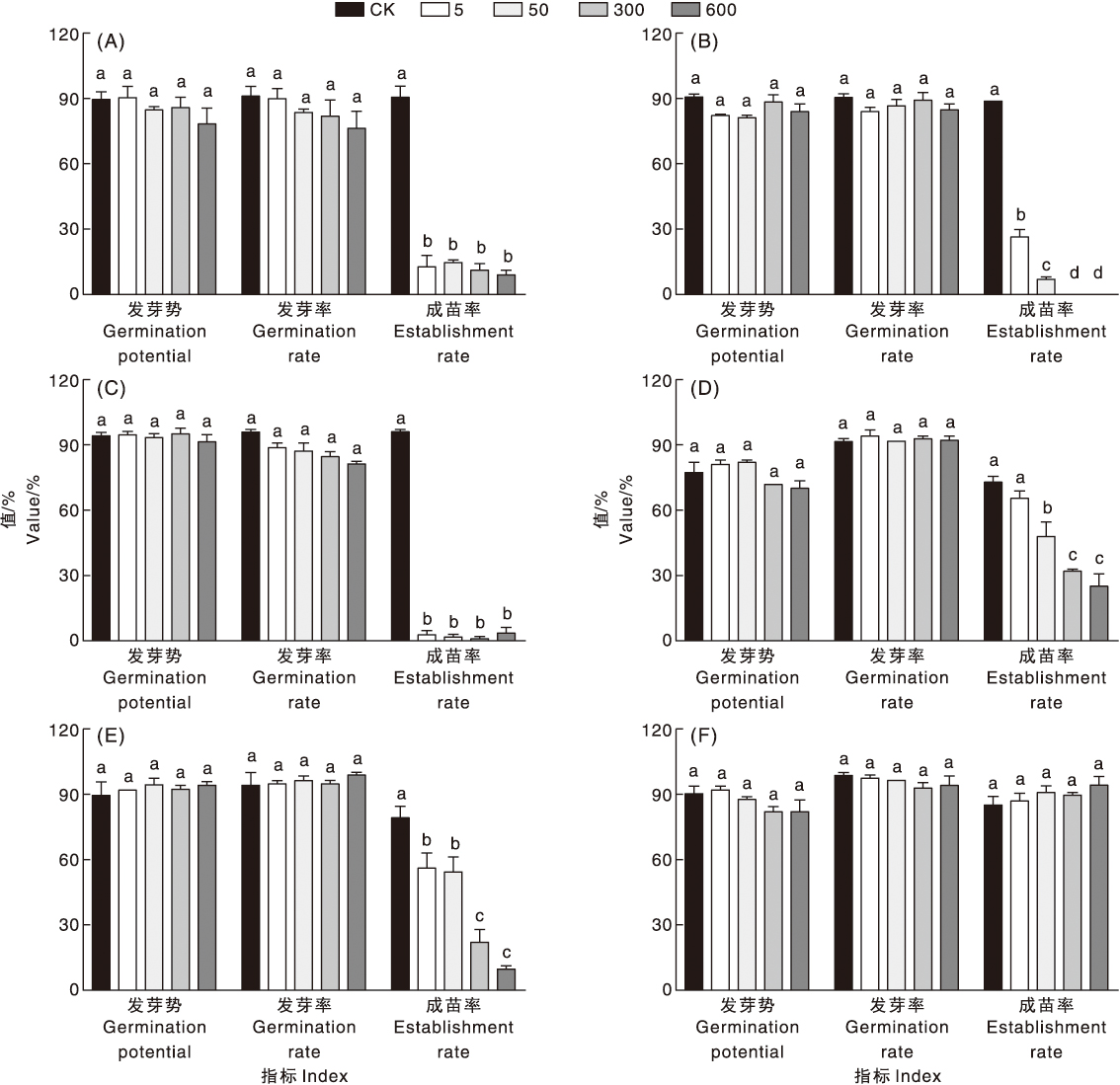
Fig.2 Germination potential, germination rate, and establishment rate of licoriceseeds under plate conditions with different spore loads of seed-borne fungi 600 represented spore loads per seed of 0, 5, 50, 300 and 600, respectively. Bars marked without the same lowercase letters indicate significant (p<0.05) differences among spore load treatments. The same as below.
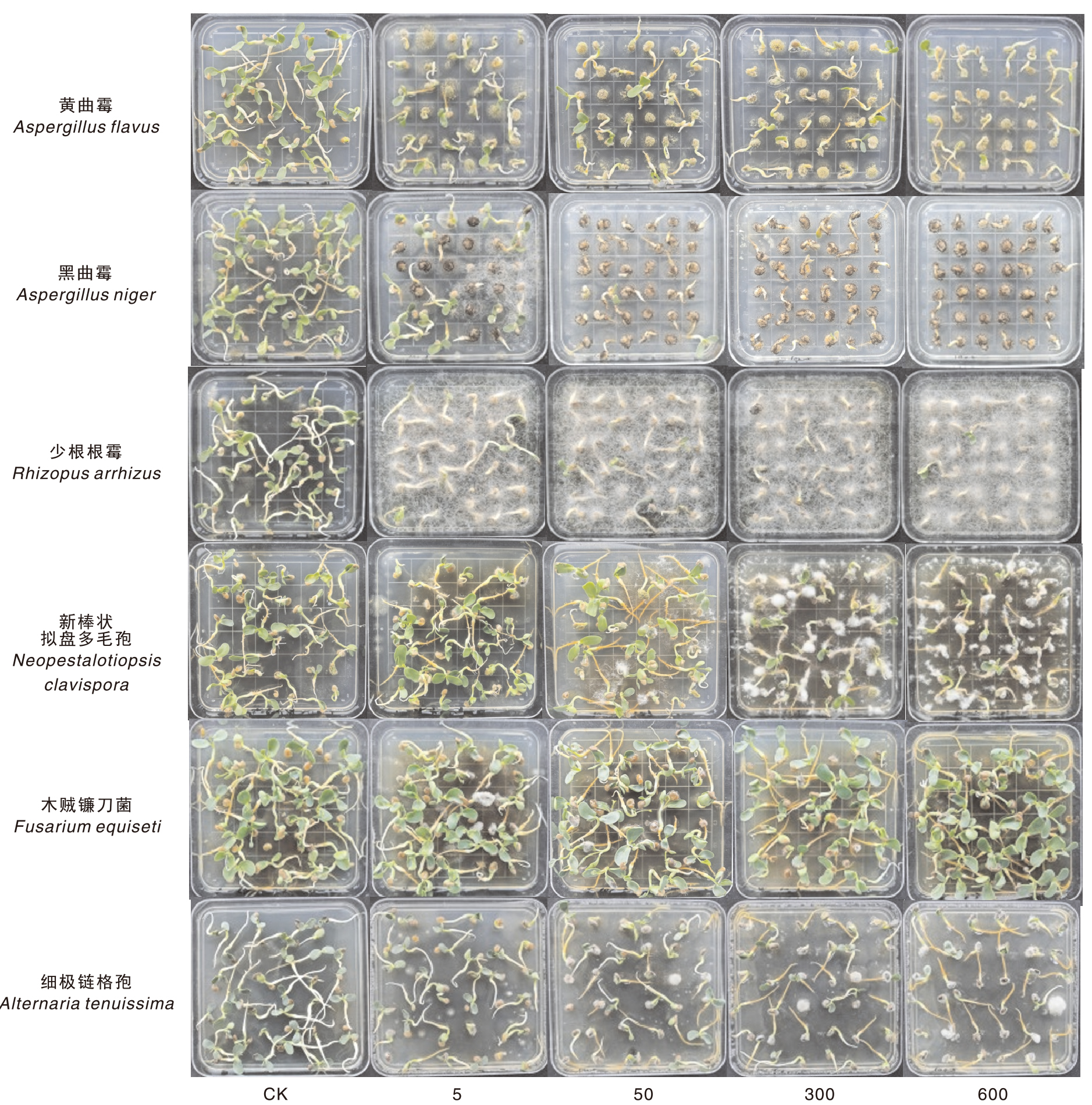
Fig.3 Seedling emergence of licorice under plate conditions treated with different spore loads of seed-borne fungi
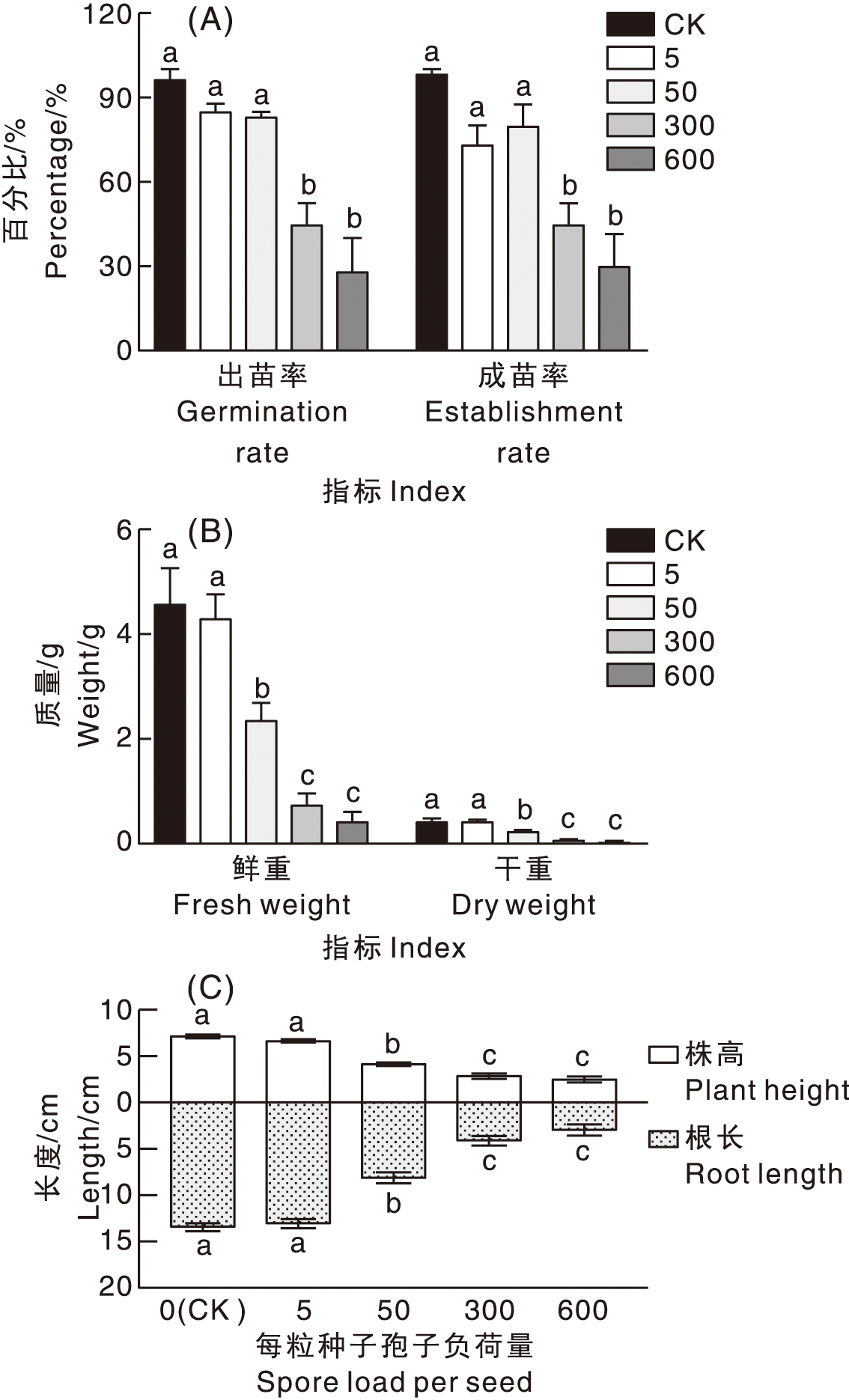
Fig.4 Growth indices of potted licorice under treatments with different spore loads of Aspergillus flavus A, Germination rate and establishment rate; B, Biomass; C, Plant height and root length.
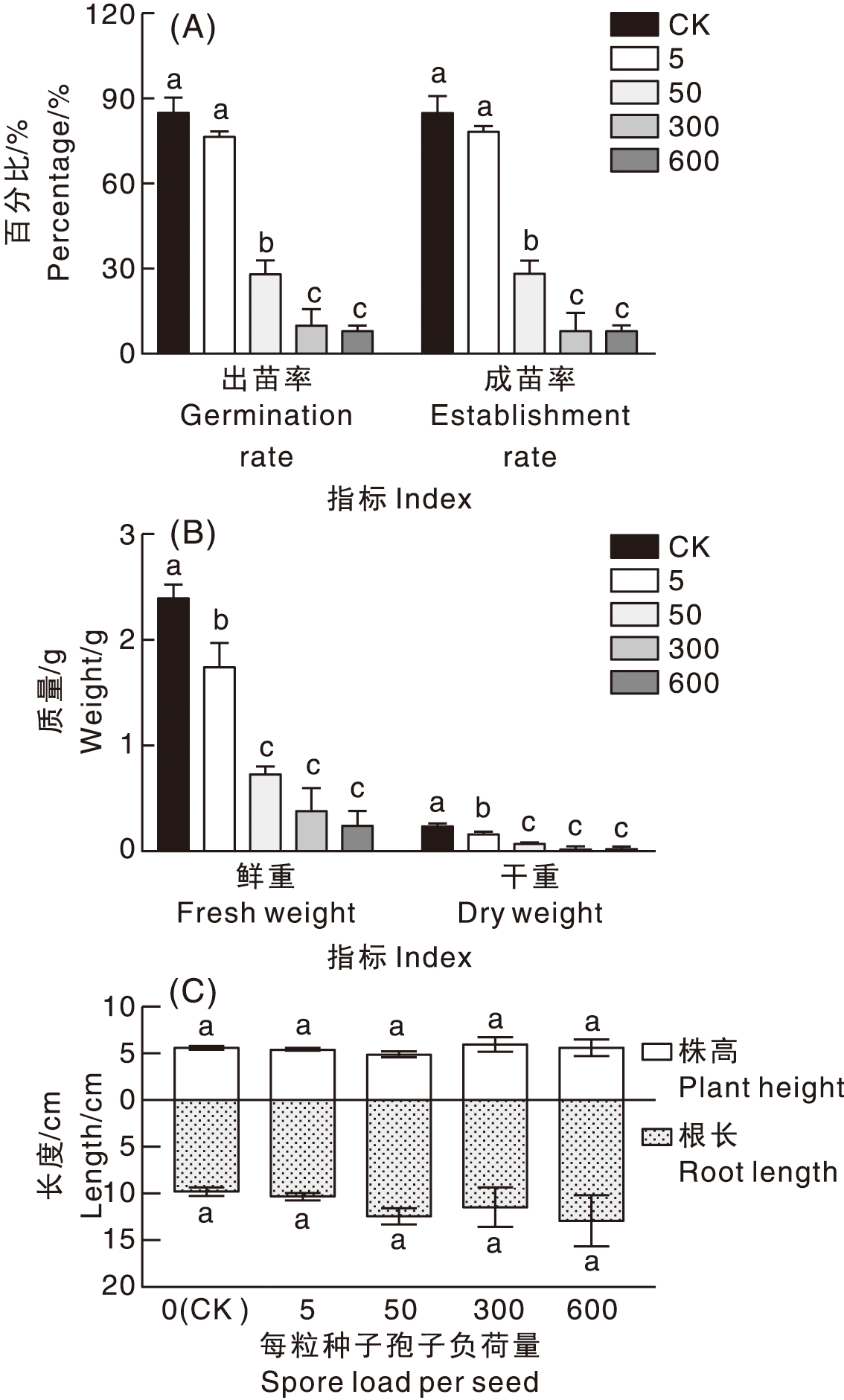
Fig.5 Growth indices of potted licorice under treatments with different spore loads of Rhizopus arrhizus A, Germination rate and establishment rate; B, Biomass; C, Plant height and root length.
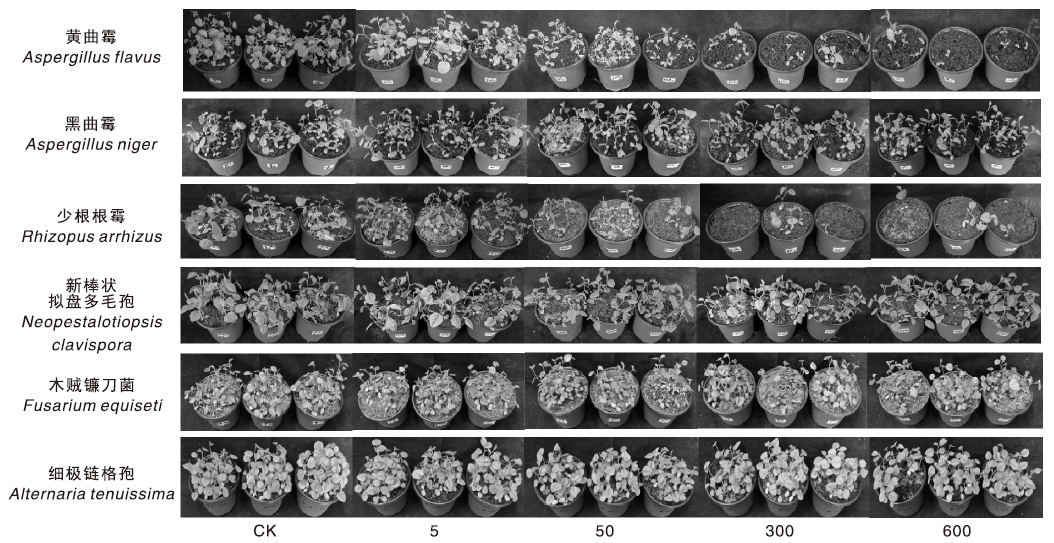
Fig.6 Seedling survival of licorice under pot conditions treated with different spore loads of seed-borne fungi
| [1] | 董诚明, 谷巍. 药用植物栽培学[M]. 3版. 上海: 上海科学技术出版社, 2020. 2020. |
| [2] | 李伟, 钟鹏, 刘泽东, 等. 甘草的药理作用及其在畜牧业的应用[J]. 中国饲料, 2023(17): 49-55. |
| LI W, ZHONG P, LIU Z D, et al. Pharmacological action of licorice and its application in animal husbandry[J]. China Feed, 2023(17): 49-55. | |
| [3] | 何兰. 名贵中药材绿色栽培技术:枸杞甘草[M]. 北京: 科学技术文献出版社, 2004. |
| [4] | 包芳, 尚兴朴, 赵玉钊, 等. 甘草种子的颜色分类与发芽试验研究[J]. 中药材, 2021, 44(10): 2280-2284. |
| BAO F, SHANG X P, ZHAO Y Z, et al. Study on color classification and germination test of Glycyrrhiza uralensis seeds[J]. Journal of Chinese Medicinal Materials, 2021, 44(10): 2280-2284. | |
| [5] | KUMAR R, GUPTA A. Seed-borne diseases of agricultural crops: detection, diagnosis & management[M]. Singapore: Springer Singapore, 2020. |
| [6] | GAWANDE S P, NAGRALE D T, SHARMA A K. Major seed-borne diseases of important forage and fibre crops: symptomatology, aetiology and their economic importance[M]//Seed-borne diseases of agricultural crops: detection, diagnosis & management. Singapore: Springer Singapore, 2020: 577-620. |
| [7] | 淡红梅, 李静, 李先恩, 等. 甘草种子带菌检测和药剂消毒处理效果研究[J]. 中国中药杂志, 2006, 31(7): 542-546. |
| DAN H M, LI J, LI X E, et al. Testing of seed-borne fungi of Glycyrrihiza seed and disinfection effect of several fungicides on seed-borne fungi[J]. China Journal of Chinese Materia Medica, 2006, 31(7): 542-546. | |
| [8] | 杨力钢, 黄中乔, 刘鹏飞, 等. 甘草种子带菌检测及药剂消毒处理效果[J]. 植物保护, 2006, 32(5): 84-87. |
| YANG L G, HUANG Z Q, LIU P F, et al. Detection of carrier bacteria in Glycyrrhiza uralensis seeds and disinfection effect of chemicals[J]. Plant Protection, 2006, 32(5): 84-87. | |
| [9] | 徐秀兰, 尚兴朴, 马丽娟, 等. 甘草种子携带真菌检测与致病性分析[J]. 中国现代中药, 2020, 22(12): 2043-2048. |
| XU X L, SHANG X P, MA L J, et al. Detection and pathogenicity test of seed-borne fungi of Glycyrrhiza uralensis seed[J]. Modern Chinese Medicine, 2020, 22(12): 2043-2048. | |
| [10] | 魏景超遗. 真菌鉴定手册[M]. 上海: 上海科学技术出版社, 1979. |
| [11] | 赖崇德, 蔡华静, 夏海林, 等. 一株产柚苷酶菌株黑曲霉的分离及菌种鉴定的初步研究[J]. 江西农业大学学报, 2005, 27(5): 759-763. |
| LAI C D, CAI H J, XIA H L, et al. A study on screening, cultivation and identification of naringinase-producing strain of Aspergillus nigeer A166[J]. Acta Agriculturae Universitatis Jiangxiensis, 2005, 27(5): 759-763. | |
| [12] | ABARCA M L, ACCENSI F, CANO J, et al. Taxonomy and significance of black Aspergilli[J]. Antonie van Leeuwenhoek, 2004, 86(1): 33-49. |
| [13] | MAHARACHCHIKUMBURA S S N, HYDE K D, GROENEWALD J Z, et al. Pestalotiopsis revisited[J]. Studies in Mycology, 2014, 79(1): 121-186. |
| [14] | CHEN Y J, ZENG L, SHU N, et al. Pestalotiopsis-like species causing gray blight disease on Camellia sinensis in China[J]. Plant Disease, 2018, 102(1): 98-106. |
| [15] | MESA L M, LEÓN-PINTO G. Gum-like exudate from Laguncularia racemosa (white mangrove) as culture media for fungi[J]. Investigacion Clinica, 1993, 34(2): 85-98. |
| [16] | 冯云利, 华蓉, 郭相, 等. 皱木耳病原真菌分离及鉴定[J]. 北方园艺, 2023(22): 116-124. |
| FENG Y L, HUA R, GUO X, et al. Pathogenic fungi of artificially cultivated Auricularia delicata[J]. Northern Horticulture, 2023(22): 116-124. | |
| [17] | ELLIS M B. Dematiaceous hyphomycetes[M]. UK: Commonwealth Mycological Institute, Kew, Surrey, England, 1971: 464-488. |
| [18] | 张敬泽, 张天宇, 王瑾. 链格孢属种间培养性状的分类研究[J]. 浙江农业大学学报, 1997(5): 511-514. |
| ZHANG J Z, ZHANG T Y, WANG J. A taxonomic study on interspecific culture traits of Alternaria[J]. Journal of Zhejiang Agricultural University, 1997(5): 511-514. | |
| [19] | BOOTH. The genus fusarium[M]. Kew, Surrey: Commonwealth Mycological Institute, 1971. |
| [20] | CROUS P W, LOMBARD L, SANDOVAL-DENIS M, et al. Fusarium: more than a node or a foot-shaped basal cell[J]. Studies in Mycology, 2021, 98: 100116. |
| [21] | OGUNLANA E O. Fungal air spora at Ibadan, Nigeria[J]. Applied Microbiology, 1975, 29(4): 458-463. |
| [22] | 韦祖生, 徐钏, 黄秋伟, 等. 木薯少根根霉分离、鉴定及其对淀粉消化特性分析[J]. 农业研究与应用, 2023, 36(1): 63-70. |
| WEI Z S, XU C, HUANG Q W, et al. Isolation, identification of Rhizopus arrhizus in cassava and analysis of its effects on starch digestion[J]. Agricultural Research and Application, 2023, 36(1): 63-70. | |
| [23] | CHI M H, PARK S Y, LEE Y H. A quick and safe method for fungal DNA extraction[J]. The Plant Pathology Journal, 2009, 25(1): 108-111. |
| [24] | SCHOCH C L, SEIFERT K A, HUHNDORF S, et al. Nuclear ribosomal internal transcribed spacer (ITS) region as a universal DNA barcode marker for fungi[J]. Proceedings of the National Academy of Sciences of the United States of America, 2012, 109(16): 6241-6246. |
| [25] | SCHOCH C L, CROUS P W, GROENEWALD J Z, et al. A class-wide phylogenetic assessment of Dothideomycetes[J]. Studies in Mycology, 2009, 64: 1-15. |
| [26] | DOLATABADI S, DE HOOG G S, MEIS J F, et al. Species boundaries and nomenclature of Rhizopus arrhizus (syn. R. oryzae)[J]. Mycoses, 2014, 57(S3): 108-127. |
| [27] | ACCENSI F. New PCR method to differentiate species in the Aspergillus niger aggregate[J]. FEMS Microbiology Letters, 1999, 180(2): 191-196. |
| [28] | ZHU G Y, WANG X, CHEN T M, et al. First report of Aspergillus flavus causing fruit rot on kiwifruit in China[J]. Plant Disease, 2022, 106(7): 1990. |
| [29] | 高晨轩, 南志标. 我国牧草种带真菌研究进展[J]. 草业科学, 2019, 36(7): 1792-1802. |
| GAO C X, NAN Z B. Progress in research on the seed-borne fungi of forage in China[J]. Pratacultural Science, 2019, 36(7): 1792-1802. | |
| [30] | 郭海雅. 弋江籽紫云英种带真菌致病性及杀菌剂筛选[D]. 兰州: 兰州大学, 2020. |
| GUO H Y. The pathogenicity of seed-borne fungi in Astragalus sinicus Var. Yijiangzi and fungicides screening[D]. Lanzhou: Lanzhou University, 2020. | |
| [31] | 邢会琴. 玉米种子真菌区系和种带优势镰孢菌遗传多样性及其致病机理研究[D]. 兰州: 甘肃农业大学, 2018. |
| XING H Q. Mycobiota and genetic diversity using ISSR analysys and pathogenicity characterization of dominant Fusarium isolatesin maize storageseeds[D]. Lanzhou: Gansu Agricultural University, 2018. | |
| [32] | YAGO J I, ROH J H, BAE S D, et al. The effect of seed-borne mycoflora from sorghum and foxtail millet seeds on germination and disease transmission[J]. Mycobiology, 2011, 39(3): 206-218. |
| [33] | 吴学宏, 刘西莉, 刘鹏飞, 等. 西瓜种子带菌检测及杀菌剂消毒处理效果[J]. 农药学学报, 2003, 5(3): 39-44. |
| WU X H, LIU X L, LIU P F, et al. Testing of seed-borne fungi of major watermelon varieties in China and disinfection effect of several fungicides on seed-borne fungi[J]. Chinese Journal of Pesticide Science, 2003, 5(3): 39-44. | |
| [34] | 刘屹湘, 刘鹏飞, 黄中乔, 等. 新疆食葵种子健康检测和杀菌剂消毒处理初步研究[J]. 植物保护, 2008, 34(2): 120-124. |
| LIU Y X, LIU P F, HUANG Z Q, et al. Testing of seed-borne fungi on sunflower seeds from Xinjiang and disinfecting effects of several fungicides on seed-borne fungi[J]. Plant Protection, 2008, 34(2): 120-124. | |
| [35] | 马婷燕. 苜蓿种带真菌种类及其致病性研究[D]. 兰州: 兰州大学, 2020. |
| MA T Y. Study on alfalfa seed-borne fungi and pathogenicity[D]. Lanzhou: Lanzhou University, 2020. | |
| [36] | 李春杰, 南志标. 苜蓿种带真菌及其致病性测定[J]. 草业学报, 2000, 9(1): 27-36. |
| LI C J, NAN Z B. Seed-borne fungi of lucerne and their pathogenicity to lucerne seed and seedling[J]. Acta Prataculturae Sinica, 2000, 9(1): 27-36. | |
| [37] | 王子萱, 王继华. 黑曲霉对大豆种子萌发及幼苗生长的促生作用[J]. 华北农学报, 2022, 37(S1): 133-140. |
| WANG Z X, WANG J H. Effect of Aspergillus niger on seed germination and seedling growth of soybean[J]. Acta Agriculturae Boreali-Sinica, 2022, 37(S1): 133-140. | |
| [38] | 代毅. 西北甘草主要病害调查、病原鉴定及其生物学特性研究[D]. 乌鲁木齐: 新疆农业大学, 2021. |
| DAI Y. Survey, identification and biological characteristics determination of major licorice diseases in northwest China[D]. Urumqi: Xinjiang Agricultural University, 2021. | |
| [39] | 黄思良, 卢维宏, 陶爱丽, 等. 南阳市玉米穗腐病致病镰刀菌种群结构分析[J]. 南阳师范学院学报, 2012, 11(3): 54-57. |
| HUANG S L, LU W H, TAO A L, et al. Structural analysis of Fusarium species causing maize ear rot in Nanyang city[J]. Journal of Nanyang Teachers College, 2012, 11(3): 54-57. | |
| [40] | 袁梦蕾, 崔明悦, 张子通, 等. 丹参根腐病病原菌及其生防菌的筛选[J]. 中国农学通报, 2024, 40(30):119-127. |
| YUAN M L, CUI M Y, ZHANG Z T, et al. Pathogens of Salvia miltiorrhiza root rot and screening of biocontrol agents[J]. Chinese Agricultural Science Bulletin, 2024, 40(30): 119-127. | |
| [41] | 何雪, 张强强, 顾沛雯. 宁夏银川地区苜蓿根腐病病原鉴定及致病性测定[J]. 西北农林科技大学学报(自然科学版), 2025, 53(6): 92-104. |
| HE X, ZHANG Q Q, GU P W. Identification and pathogenicity test of pathogens causing alfalfa root rot in Yinchuan, Ningxia[J]. Journal of Northwest A & F University (Natural Science Edition), 2025, 53(6): 92-104. | |
| [42] | 王梦园, 杜延全, 闫加力, 等. 一株草莓根腐病病原菌的鉴定及生物学特性分析[J]. 中国农学通报, 2024, 40(13): 113-120. |
| WANG M Y, DU Y Q, YAN J L, et al. Identification and biological characteristics analysis of a pathogen of strawberry root rot[J]. Chinese Agricultural Science Bulletin, 2024, 40(13): 113-120. | |
| [43] | PÉREZ-PIZÁ M C, STRIKER G G, STENGLEIN S A. Seed-borne diseases in pasture grasses and legumes: state of the art and gaps in knowledge[J]. Journal of Plant Diseases and Protection, 2023, 130(2): 225-244. |
| [44] | 保尔·尼尔高. 种子病理学[M]. 北京: 农业出版社, 1987. |
| [1] | JI Yangyang, ZHANG Peng, LIU Xiaoqiang, DONG Zhenru, ZHANG Wei, FAN Ting. Oxidative stress response and biosorption capacity of Aspergillus flavus TL-F3 under nano silver particles stress [J]. Acta Agriculturae Zhejiangensis, 2023, 35(1): 128-137. |
| Viewed | ||||||
|
Full text |
|
|||||
|
Abstract |
|
|||||

