Acta Agriculturae Zhejiangensis ›› 2026, Vol. 38 ›› Issue (4): 696-706.DOI: 10.3969/j.issn.1004-1524.20250254
• Plant Protection • Previous Articles Next Articles
Isolation, identification, and control of the pathogen causing leaf spot disease on Hydrangea macrophylla Bo Dalan
ZHANG Yu1( ), CHEN Jingjing1, WEN Lianhao1, YANG Zhenyi2, YANG Cenghua2, TONG Yi2, WANG Chao1,*()
- 1
Southwest Research Center for Landscape Architecture Engineering ,State Forestry and Grassland Administration, Yunnan Province Engineering Research Center for Functional Flower Resources and Industrialization, Key Laboratory of Forest Disaster Warning and Control in Universities of Yunnan Province, Yunnan Province South and Southeast Asia Joint R&D Center of Economic Forest Full Industry Chain,Southwest Forestry University Kunming 650224, China
2Kunming Yang Yueji Horticulture Co. ,Ltd. Kunming 652501, China
-
Received:2025-04-02Online:2026-04-25Published:2026-05-08 -
Contact:WANG Chao

CLC Number:
Cite this article
ZHANG Yu, CHEN Jingjing, WEN Lianhao, YANG Zhenyi, YANG Cenghua, TONG Yi, WANG Chao. Isolation, identification, and control of the pathogen causing leaf spot disease on Hydrangea macrophylla Bo Dalan[J]. Acta Agriculturae Zhejiangensis, 2026, 38(4): 696-706.
share this article
Add to citation manager EndNote|Ris|BibTeX
URL: http://www.zjnyxb.cn/EN/10.3969/j.issn.1004-1524.20250254
| 基因名称 Gene name | 正向引物序列(5'→3') Forward primer sequence(5'→3') | 反向引物序列(5'→3') Reverse primer sequence(5'→3') | 扩增片段长度/bp Amplicon length/bp |
|---|---|---|---|
| ITS | TCCGTAGGTGAACCTGCGG | TCCTCCGCTTATTGATATGC | 560 |
| LSU | ACCCGCTGAACTTAAGC | TCCTGAGGGAAACTTCG | 870 |
| TUB | GGTAACCAAATCGGTGCTGCTTTC | ACCCTCAGTGTAGTGACCCTTGGC | 460 |
Table 1 Primers used for PCR amplification
| 基因名称 Gene name | 正向引物序列(5'→3') Forward primer sequence(5'→3') | 反向引物序列(5'→3') Reverse primer sequence(5'→3') | 扩增片段长度/bp Amplicon length/bp |
|---|---|---|---|
| ITS | TCCGTAGGTGAACCTGCGG | TCCTCCGCTTATTGATATGC | 560 |
| LSU | ACCCGCTGAACTTAAGC | TCCTGAGGGAAACTTCG | 870 |
| TUB | GGTAACCAAATCGGTGCTGCTTTC | ACCCTCAGTGTAGTGACCCTTGGC | 460 |
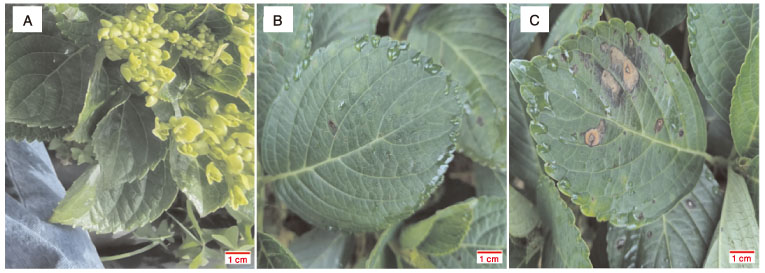
Fig.1 Field symptoms of leaf spot disease on Bo Dalan A, Healthy leaves in the field; B and C, Diseased leaves in the field and the associated symptom manifestations.
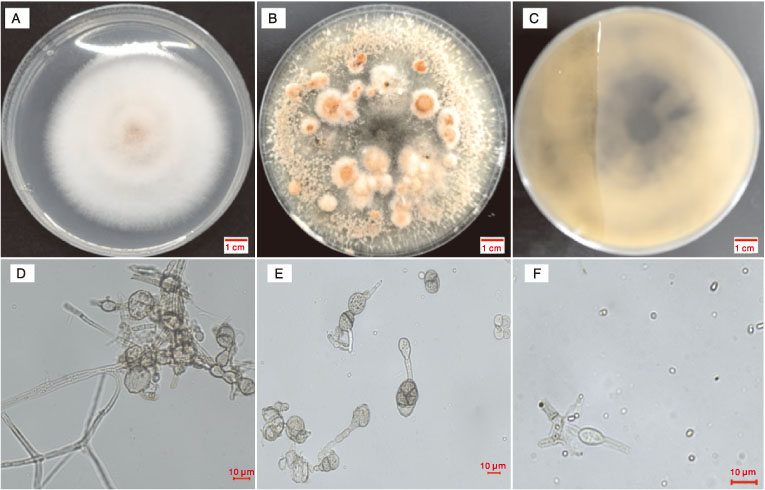
Fig.2 Morphological characteristics of the fungal pathogen on PDA medium A, B and C, Colony morphology; D, Mycelial morphology; E, Chlamydospores; F, Conidia.
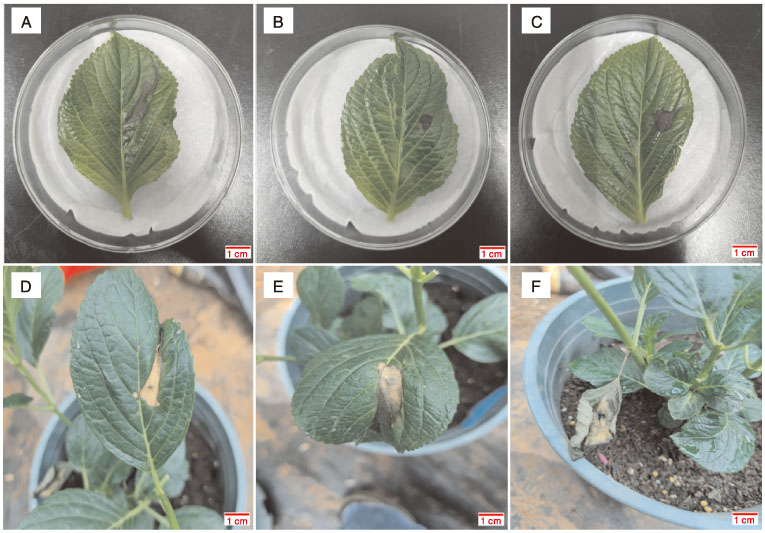
Fig.3 Symptoms of hydrangea leaves after pathogen inoculation A, B and C, Leaf disease symptoms after in vitro inoculation indoors; D, E and F, Leaf disease symptoms after in vivo inoculation in the greenhouse.
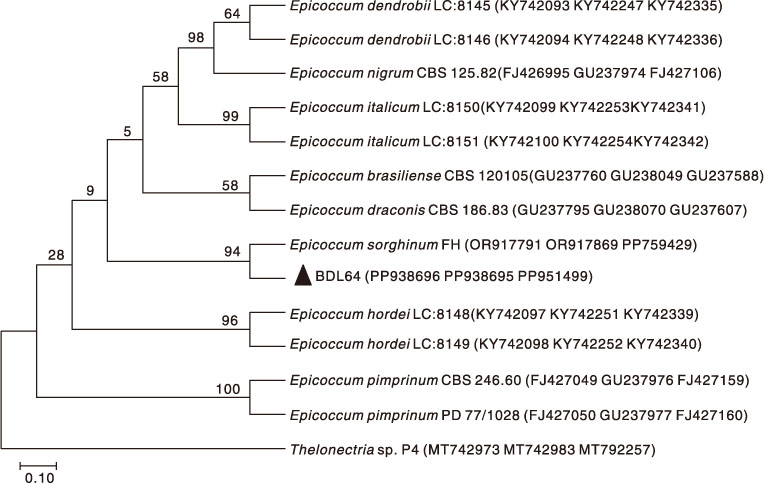
Fig.4 Multigene phylogenetic tree based on ITS sequence, LSU and TUB genes The accession number of the primer corresponding to this strain in the NCBI database is indicated in parentheses.
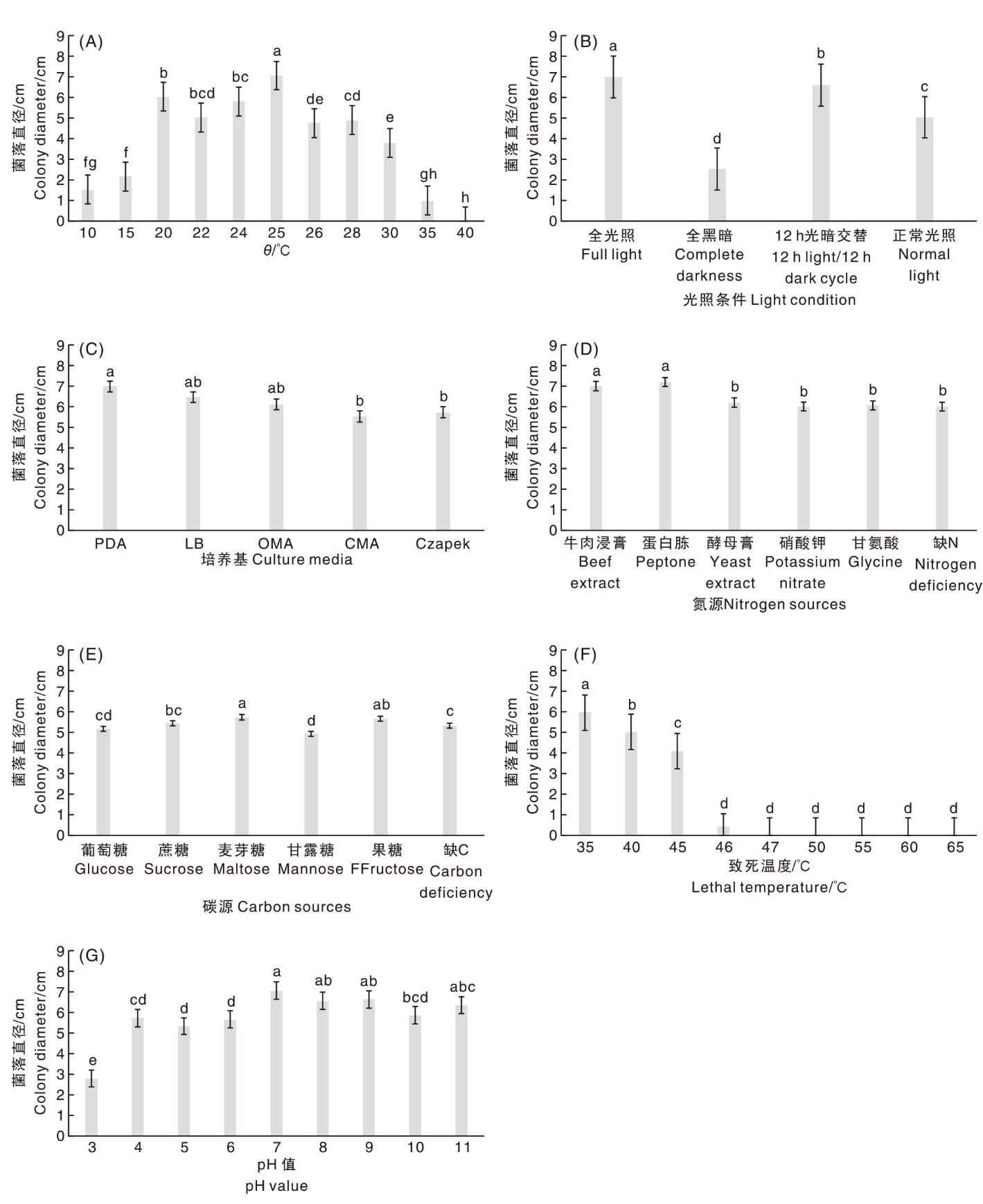
Fig.5 Effects of temperature, light conditions, culture medium, nitrogen source, carbon source, lethal temperature, and pH value on mycelial growth of Epicoccum sorghinum PDA, Potato dextrose agar medium; LB, Luria-Bertani broth medium; OMA, Oatmeal agar medium; CMA, Corn meal agar medium; Czapek, Czapek medium.
| 药剂 Fungicide | 毒力回归方程 Toxicity regression equation | 抑制中浓度/ (mg·L-1) EC50/(mg·L-1) | 相关系数 Correlation coefficient |
|---|---|---|---|
| 50%腐霉利·福美双WP 50% Thiram + procymidone WP | y=0.764 5x+3.794 2 | 1.577 3 | 0.969 3 |
| 72%霜脲氰·代森锰锌WP 72% Mancozeb + gymoxanil WP | y=0.979 4x+3.378 7 | 1.655 5 | 0.972 4 |
| 70%烯酰吗啉·霜脲氰WG 70% Dimethomorph + cymoxanil WG | y=0.435 4x+3.925 9 | 2.466 6 | 0.932 6 |
| 80%烯酰吗啉WG 80% Dimethomorph WG | y=2.477 6x-1.655 0 | 2.686 1 | 0.951 5 |
| 69%烯酰吗啉·代森锰锌WP 69% Dimethomorph + mancozeb WP | y=1.119 3x+3.117 4 | 1.681 9 | 0.992 0 |
| 10%多抗霉素WP 10% Polyoxin WP | y=2.136 4x+0.230 8 | 2.232 4 | 0.950 6 |
| 50%多菌灵WP 50% Carbendazim WP | y=5.854 0x-3.121 9 | 1.387 4 | 0.776 9 |
| 70%嘧霉胺WG 70% Pyrimethanil WG | y=6.639 6x-7.112 9 | 1.824 3 | 0.785 7 |
| 10%苯醚甲环唑WG 10% Difenoconazole WG | y=0.886 3x+3.890 1 | 1.252 2 | 0.910 0 |
Table 2 Toxicity regression equations of the nine tested fungicides
| 药剂 Fungicide | 毒力回归方程 Toxicity regression equation | 抑制中浓度/ (mg·L-1) EC50/(mg·L-1) | 相关系数 Correlation coefficient |
|---|---|---|---|
| 50%腐霉利·福美双WP 50% Thiram + procymidone WP | y=0.764 5x+3.794 2 | 1.577 3 | 0.969 3 |
| 72%霜脲氰·代森锰锌WP 72% Mancozeb + gymoxanil WP | y=0.979 4x+3.378 7 | 1.655 5 | 0.972 4 |
| 70%烯酰吗啉·霜脲氰WG 70% Dimethomorph + cymoxanil WG | y=0.435 4x+3.925 9 | 2.466 6 | 0.932 6 |
| 80%烯酰吗啉WG 80% Dimethomorph WG | y=2.477 6x-1.655 0 | 2.686 1 | 0.951 5 |
| 69%烯酰吗啉·代森锰锌WP 69% Dimethomorph + mancozeb WP | y=1.119 3x+3.117 4 | 1.681 9 | 0.992 0 |
| 10%多抗霉素WP 10% Polyoxin WP | y=2.136 4x+0.230 8 | 2.232 4 | 0.950 6 |
| 50%多菌灵WP 50% Carbendazim WP | y=5.854 0x-3.121 9 | 1.387 4 | 0.776 9 |
| 70%嘧霉胺WG 70% Pyrimethanil WG | y=6.639 6x-7.112 9 | 1.824 3 | 0.785 7 |
| 10%苯醚甲环唑WG 10% Difenoconazole WG | y=0.886 3x+3.890 1 | 1.252 2 | 0.910 0 |
| [1] | 谢利媛. 南国山花园艺科技有限责任公司总经理杨玉勇: 让自育绣球品种走向国际[N]. 中国花卉报, 2024-08-01( 2). |
| [2] | 张诗文, 王超, 李丽娟, 等. 绣球市场销售情况调查: ‘博大蓝’是市场最为畅销的绣球切花品种[J]. 中国花卉园艺, 2022(6): 30-31. |
| ZHANG S W, WANG C, LI L J, et al. Investigation on the market sales of Hydrangea: ‘Bodalan’ is the best-selling variety of Hydrangea cut flowers in the market[J]. China Flowers & Horticulture, 2022(6): 30-31. | |
| [3] | 安璐, 柳玉霞. 国家林业和草原局向世界推介4个中国优良林草植物新品种[J]. 林业科技通讯, 2023(6): 19. |
| AN L, LIU Y X. The National Forestry and Grassland Bureau introduced four new varieties of excellent forest and grass plants in China to the world[J]. Forest Science and Technology, 2023(6): 19. | |
| [4] | LI Y H, MMBAGA M T, ZHOU B R, et al. Diseases of Hydrangea[M]//MCGOVERN R J, ELMER W H. Handbook of florists’ crops diseases. Cham: Springer International Publishing, 2018: 987-1006. |
| [5] | NAGASHIMA S, TOJO M. Hydrangea diseases in Japan[J]. Japan Agricultural Research Quarterly, 2023, 57(3): 183-194. |
| [6] | JEONG M H, PARK J, CHOI E D, et al. First report of leaf spot on Hydrangea macrophylla caused by Boeremia exigua in Korea[J]. Plant Disease, 2025, 109(1): 235-239. |
| [7] | GARIBALDI A, GILARDI G, MINERDI D, et al. First report of leaf spot caused by Phoma exigua on Hydrangea macrophylla in Italy[J]. Plant Disease, 2006, 90(8): 1113. |
| [8] | GARIBALDI A, GILARDI G, FRATI S, et al. First report of leaf spot caused by Alternaria alternata on Hydrangea macrophylla in Italy[J]. Plant Disease, 2007, 91(6): 767. |
| [9] | LI C X, CAO P, DU C J, et al. First report of leaf spot caused by Cladosporium tenuissimum on panicle Hydrangea(Hydrangea paniculata) in China[J]. Plant Disease, 2021, 105(8): 2240. |
| [10] | ZHU J Z, CHEN J, WANG Y, et al. Leaf spot of Hydrangea macrophylla caused by Corynespora cassiicola in China[J]. Canadian Journal of Plant Pathology, 2020, 42(1): 125-132. |
| [11] | 赵娟, 乔广行, 段佳琪, 等. 八仙花叶斑病病原的分离与鉴定[J]. 植物病理学报, 2023, 53(4): 721-724. |
| ZHAO J, QIAO G H, DUAN J Q, et al. Isolation and identification of the pathogen causing leaf spot on Hydrangea macrophylla[J]. Acta Phytopathologica Sinica, 2023, 53(4): 721-724. | |
| [12] | 柳丽娜, 刘晔, 李媛媛, 等. 38个茶用菊品种苗期对黑斑病的抗性鉴定[J]. 南京农业大学学报, 2021, 44(1): 68-77. |
| LIU L N, LIU Y, LI Y Y, et al. Resistance identification to black spot disease of 38 cultivars of Chrysanthemum for tea at seedling stage[J]. Journal of Nanjing Agricultural University, 2021, 44(1): 68-77. | |
| [13] | 朱香. Epicoccum sorghinum的分离及多基因转玉米株系的抗性鉴定[D]. 武汉: 华中农业大学, 2018. |
| ZHU X. Isolation of Epicoccum sorghinum and resistance identification of multi-transgenes maize lines[D]. Wuhan: Huazhong Agricultural University, 2018. | |
| [14] | 彭成彬, 王泽榕, 阮俊峰, 等. 柳叶蜡梅真菌病害分离鉴定及生物学特性[J]. 福建农业学报, 2021, 36(4): 457-463. |
| PENG C B, WANG Z R, RUAN J F, et al. Identification and biology of leaf spot pathogen on Chimonanthus salicifolius[J]. Fujian Journal of Agricultural Sciences, 2021, 36(4): 457-463. | |
| [15] | 黄鈜琳, 尹桥秀, 江仕龙, 等. 茶叶斑病病原菌高粱附球菌(Epicoccum sorghinum)的鉴定及生物学特性[J]. 热带作物学报, 2021, 42(11): 3269-3277. |
| HUANG H L, YIN Q X, JIANG S L, et al. Identification and biological characteristics of Epicoccum sorghinum, pathogen of tea leaf spot[J]. Chinese Journal of Tropical Crops, 2021, 42(11): 3269-3277. | |
| [16] | 安宣鲜, 桑维钧, 卢燕回, 等. 烟草叶斑病病原菌Epicoccum latusicollum的鉴定、生物学特性及室内药剂筛选[J]. 热带作物学报, 2022, 43(12): 2534-2544. |
| AN X X, SANG W J, LU Y H, et al. Identification, biological characteristics and fungicide screening of tobacco leaf spot disease pathogen Epicoccum latusicollum[J]. Chinese Journal of Tropical Crops, 2022, 43(12): 2534-2544. | |
| [17] | 陈慧杰, 邓衍明, 齐香玉, 等. 绣球叶斑病病原鉴定及其生物学特性[J]. 江苏农业科学, 2022, 50(7): 106-111. |
| CHEN H J, DENG Y M, QI X Y, et al. Identification of pathogen from Hydrangea leaf spot disease and its biological characteristics[J]. Jiangsu Agricultural Sciences, 2022, 50(7): 106-111. | |
| [18] | ZOU J, YAO H, LEI T T, et al. Epicoccum sorghinum causing leaf spot on Polygonatum cyrtonema in China[J]. Plant Disease, 2024, 108(5): 1398. |
| [19] | 黄琳钰, 彭辉, 姜万龙, 等. 茭白叶斑病病原高粱附球菌的鉴定及防治药剂筛选[J]. 植物病理学报, 2024, 54(5): 1029-1035. |
| HUANG L Y, PENG H, JIANG W L, et al. Identification of pathogenic fungus Epicoccum sorghinum causing leaf spot of Zizania latifolia and laboratory screening of its sensitive chemical agents[J]. Acta Phytopathologica Sinica, 2024, 54(5): 1029-1035. | |
| [20] | 袁军. 中国西南地区亚隔孢壳科(Didymellaceae)植物病原真菌分子系统学研究[D]. 贵阳: 贵州大学, 2021. |
| YUAN J. Molecular systematics of plant pathogenic fungi in Didymellaceae in southwest China[D]. Guiyang: Guizhou University, 2021. | |
| [21] | 肖志鹏, 王灿, 袁野, 等. 衡阳烟区烟草叶斑病病原菌的鉴定[J]. 湖南生态科学学报, 2024, 11(3): 98-102. |
| XIAO Z P, WANG C, YUAN Y, et al. Identification of the pathogenic fungus causing tobacco leaf spot disease in Hengyang Region[J]. Journal of Hunan Ecological Science, 2024, 11(3): 98-102. | |
| [22] | ZENG H, LU Q, LI R. First report of leaf spot of lily caused by Epicoccum sorghinum in China[J]. Plant Disease, 2018, 102(12): 2648. |
| [23] | LIU L M, ZHAO Y, ZHANG Y L, et al. First report of leaf spot disease on rice caused by Epicoccum sorghinum in China[J]. Plant Disease, 2020, 104(10): 2735. |
| [24] | XIAO C Y, LI R Y, SONG X C, et al. First report of soft rot on Dendrobium officinale caused by Epicoccum sorghinum in China[J]. Plant Disease, 2022, 106(3): 1063. |
| [25] | XU X, LI J J, YANG X L, et al. Epicoccum spp. causing maize leaf spot in Heilongjiang Province, China[J]. Plant Disease, 2022, 106(12): 3050-3060. |
| [26] | 闫浩浩, 米耀族, 桑明玉, 等. 蓝靛果叶斑病病原高粱附球菌(Epicoccum sorghinum)分离鉴定及生物学特性[J]. 北方园艺, 2023(5): 39-46. |
| YAN H H, MI Y Z, SANG M Y, et al. Isolation, identification and biological characteristics of the pathogen Epicoccum sorghinum of leaf spot on blue honeysuckle (Lonicera caerulea L.)[J]. Northern Horticulture, 2023(5): 39-46. | |
| [27] | 周佳, 罗鸣, 许佳伟, 等. 半夏叶斑病病原菌的鉴定、生物学特性及其有效杀菌剂研究[J]. 中药材, 2023, 46(3): 562-569. |
| ZHOU J, LUO M, XU J W, et al. Identification, biological characteristics and fungicide screening of the pathogen of leaf spot disease in Pinellia ternata[J]. Journal of Chinese Medicinal Materials, 2023, 46(3): 562-569. | |
| [28] | 彭辉. 茭白五种叶斑病病原菌的分离鉴定、药敏性分析及检测方法研究[D]. 杭州: 中国计量大学, 2022. |
| PENG H. Isolation, identification, fungicide sensitivity and detection methods of five species of leaf spot pathogens in Zizania latifolia[D]. Hangzhou: China University of Metrology, 2022. |
| [1] | LI Shuo, CHEN Tao, GU Gang, HU Zhongliang, PAN Xi, YIN Changlin, HUANG Shan, LIANG Haoyi, XIAO Shun, LIN Zhihui, LIU Guokun. Identification of pathogens causing brown spot disease on cigar tobacco and their pathogenicity to cigar tobacco varieties [J]. Acta Agriculturae Zhejiangensis, 2026, 38(4): 707-719. |
| [2] | CHEN Quan, LI Hui, YANG Jing, XU Songlin, ZHANG Shukang, LIU Zhongxian, HE Jinhui. Identification of the pathogen causing mulberry snags rotten leaves disease and resistance of 47 mulberry varieties [J]. Acta Agriculturae Zhejiangensis, 2026, 38(2): 301-309. |
| [3] | CHEN Jingjing, ZHANG Yu, WEN Lianhao, LIU Guangyan, ZHOU Mei, LI Zhengmin, XIONG Haiyan, YANG Zhenyi, YANG Zenghua, TONG Yi, WANG Chao. Isolation, identification and control of the pathogen causing leaf spot disease on hydrangea [J]. Acta Agriculturae Zhejiangensis, 2026, 38(1): 105-113. |
| [4] | SHEN Guoqiang, WANG Mingde, GUAN Yawen, WU Jun, WANG Hanrong. Identification, biological characteristics and control agents screening of pathogens of curvular leaf spot disease of sorghum [J]. Acta Agriculturae Zhejiangensis, 2025, 37(7): 1492-1500. |
| [5] | LIU Pengfei, ZHANG Shuhan, HONG Kai, SHAO Yue, LOU Binggan. Isolation and identification of the pathogen causing tomato canker in Zhejiang Province of China [J]. Acta Agriculturae Zhejiangensis, 2025, 37(6): 1293-1300. |
| [6] | MA Xian, YOU Yuwei, KANG Juan, WANG Guoqin, ZHENG Rui, SU Jianyu, YUE Sijun. Pathogen identification of post-harvest rotten Lycium barbarum and screening of natural fungicides [J]. Acta Agriculturae Zhejiangensis, 2025, 37(6): 1327-1335. |
| [7] | WANG Chao, LI Yanjie, NIU Yun, WEN Lianhao, CHEN Jingjing, WU Hongzhi, YANG Yuyong, WU Yandi. Biological characterization of black spot pathogens in Rosa chinensis and evaluation of varietal resistance [J]. Acta Agriculturae Zhejiangensis, 2025, 37(5): 1087-1096. |
| [8] | JI Mengting, CHEN Changjiang, ZHU Ling, ZHAN Menglin, XIAO Shun, CAI Xueqing. Identification of etiological bacterium causing leaf spot disease on Ficus carica [J]. Acta Agriculturae Zhejiangensis, 2025, 37(5): 1097-1106. |
| [9] | GONG Xinxin, LIU Ruiling, HAN Yanchao, MENG Xianghong, GAO Haiyan, CHEN Hangjun. Isolation and identification of main postharvest pathogens of four edible fungi [J]. Acta Agriculturae Zhejiangensis, 2025, 37(2): 456-465. |
| [10] | DING Yingying, YANG Linping, YANG Qing, ZHANG Zichen, CAI Linying, YANG Kang, LI Chen, LIU Huiwen, BAO Guangbin, WANG Qing, WANG Guijun. Isolation, identification and pathogenicity of two novel goose astrovirus strains [J]. Acta Agriculturae Zhejiangensis, 2025, 37(12): 2458-2467. |
| [11] | XIE Yujia, LI Zhenjiang, SHA Feiyu, ZHANG Lin, TONG Yana, QIAO Changsheng, CAO Weifeng. Isolation, screening, and functional characteristics of endophytes from strawberry [J]. Acta Agriculturae Zhejiangensis, 2025, 37(12): 2525-2534. |
| [12] | BAO Mengnan, LI Jinbin, ZHANG Xian, YAN Jiahui. Identification of Meloidogyne spp. infecting tomato in Haidong City, Qinghai Province, China [J]. Acta Agriculturae Zhejiangensis, 2025, 37(12): 2545-2553. |
| [13] | LI Yani, CHEN Weiliang, MAO Bizeng. Pathogen identification of root rot of Curcuma wenyujin [J]. Acta Agriculturae Zhejiangensis, 2024, 36(5): 1086-1093. |
| [14] | YANG Lei, WANG Xiaofu, WEI Wei, CHEN Xiaoyun, PENG Cheng, XU Xiaoli, XU Junfeng. The antifungal responses of insects against an entomopathogenic fungi, Beauveria bassiana and their application potential in pest control [J]. Acta Agriculturae Zhejiangensis, 2024, 36(4): 825-836. |
| [15] | HE Jiawei, Huang Leqin, LU Zhenyu, FANG Jin, LEI Ziyang, ZHANG Huijuan, JIANG Ming. Isolation and identification of the pathogen causing leaf spot disease on a rare and endangered plant species Rhododendron huadingense [J]. Acta Agriculturae Zhejiangensis, 2024, 36(4): 837-845. |
| Viewed | ||||||
|
Full text |
|
|||||
|
Abstract |
|
|||||

