Acta Agriculturae Zhejiangensis ›› 2026, Vol. 38 ›› Issue (2): 225-238.DOI: 10.3969/j.issn.1004-1524.20250315
• Animal Science • Previous Articles Next Articles
Highly efficient extraction technology of chitooligosaccharides in the chrysalis shell of Hermetia illucens
LIU He1,2( ), KOU Rui1,2, LI Junli1,2, PENG Shiliang1,2, LIAN Tianjing1,2, MAI Liwen1,2, YANG Xia1,2, WANG Dingmei1,2, SHAO Mingying3,*()
1. Environmental and Plant Protection Institute ,Chinese Academy of Tropical Agricultural Sciences Haikou 571101, China 2. Hainan Danzhou Tropical Agro-ecosystem National Observation and Research Station Danzhou 571737, Hainan, China 3. Hainan Vocational University Haikou 570216, China
-
Received:2025-04-17Online:2026-02-25Published:2026-03-24

CLC Number:
Cite this article
LIU He, KOU Rui, LI Junli, PENG Shiliang, LIAN Tianjing, MAI Liwen, YANG Xia, WANG Dingmei, SHAO Mingying. Highly efficient extraction technology of chitooligosaccharides in the chrysalis shell of Hermetia illucens[J]. Acta Agriculturae Zhejiangensis, 2026, 38(2): 225-238.
share this article
Add to citation manager EndNote|Ris|BibTeX
URL: http://www.zjnyxb.cn/EN/10.3969/j.issn.1004-1524.20250315
| 编号 Serial number | 葡萄糖体积/mL Volume of glucose/mL | 葡萄糖质量浓度/(mg·mL-1) Concentration of glucose/(mg·mL-1) |
|---|---|---|
| 1 | 0 | 0 |
| 2 | 0.4 | 0.2 |
| 3 | 0.8 | 0.4 |
| 4 | 1.2 | 0.6 |
| 5 | 1.6 | 0.8 |
| 6 | 2.0 | 1.0 |
Table 1 Plotting of the reducing sugar standard curve
| 编号 Serial number | 葡萄糖体积/mL Volume of glucose/mL | 葡萄糖质量浓度/(mg·mL-1) Concentration of glucose/(mg·mL-1) |
|---|---|---|
| 1 | 0 | 0 |
| 2 | 0.4 | 0.2 |
| 3 | 0.8 | 0.4 |
| 4 | 1.2 | 0.6 |
| 5 | 1.6 | 0.8 |
| 6 | 2.0 | 1.0 |
| 水平 Level | (A)几丁质酶 质量/g Chitinase mass/g | (C)超声时 间/min Ultrasonic time/min | (D)酶解时间/d Enzymatic hydrolysis time/d |
|---|---|---|---|
| 1 | 0.1 | 10 | 1 |
| 2 | 0.5 | 30 | 2 |
| 3 | 1.0 | 60 | 3 |
Table 2 Orthogonal experimental factors and levels
| 水平 Level | (A)几丁质酶 质量/g Chitinase mass/g | (C)超声时 间/min Ultrasonic time/min | (D)酶解时间/d Enzymatic hydrolysis time/d |
|---|---|---|---|
| 1 | 0.1 | 10 | 1 |
| 2 | 0.5 | 30 | 2 |
| 3 | 1.0 | 60 | 3 |
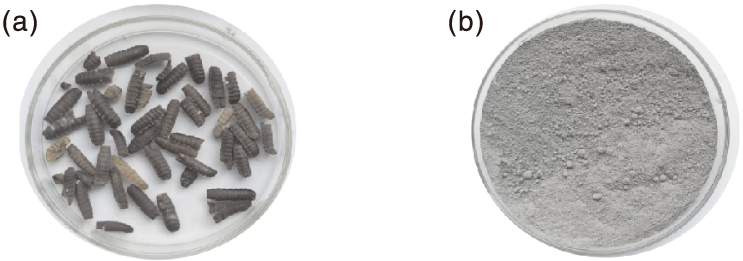
Fig.1 Chrysalis shell of the black soldier fly(a) and chrysalis shell powder of the black soldier fly after ultramicro grinding(b)
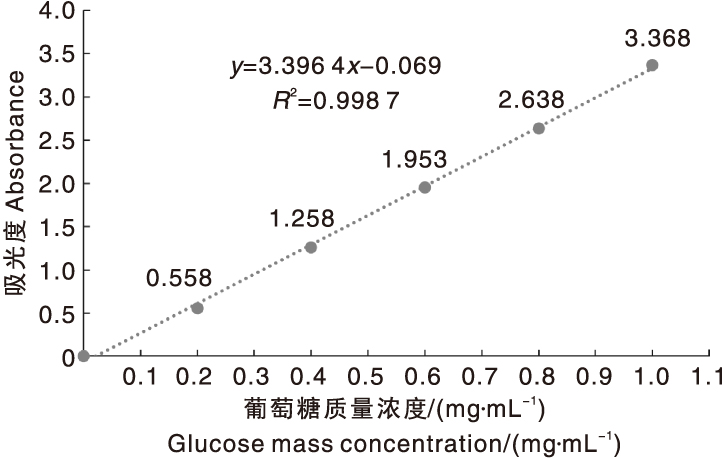
Fig.2 Standard curve of reducing sugar
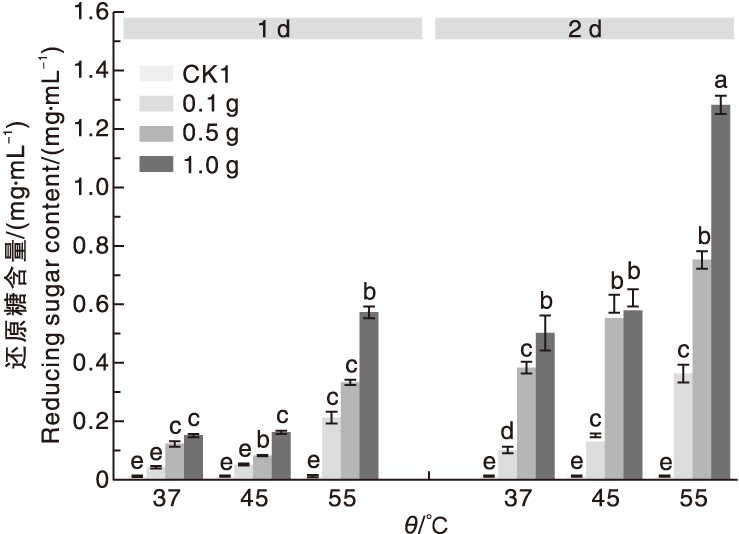
Fig.3 Reducing sugar content under different treatments Bars marked without the same lowercase letter indicated significant differences at p<0.05. The same as below.
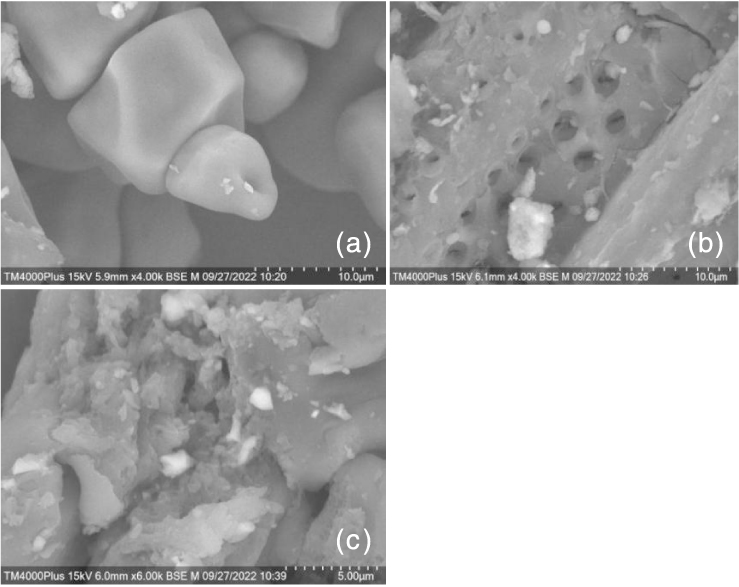
Fig.4 Scanning electron microscopy image of chitin powder a, Chitin powder before ultrasound; b, Chitin powder after ultrasound; c, Chitin after enzymatic and ultrasound.
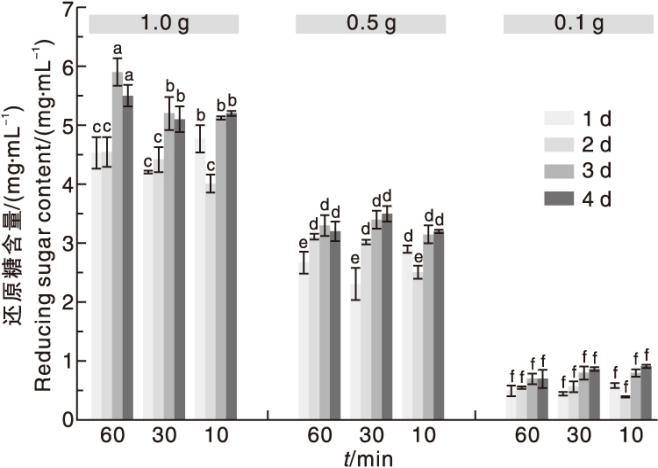
Fig.5 Reducing sugar content under different ultrasonic crushing conditions
| 试验号 Test No. | A | C | D | 空列 Blank column | 降解率/% Degradation rate/% |
|---|---|---|---|---|---|
| 1 | 1 | 1 | 1 | 1 | 11.0 g |
| 2 | 1 | 2 | 2 | 2 | 5.0 i |
| 3 | 1 | 3 | 3 | 3 | 7.0 h |
| 4 | 2 | 1 | 2 | 3 | 29.0 e |
| 5 | 2 | 2 | 3 | 1 | 42.5 d |
| 6 | 2 | 3 | 1 | 2 | 26.7 f |
| 7 | 3 | 1 | 3 | 2 | 58.0 a |
| 8 | 3 | 2 | 1 | 3 | 53.5 b |
| 9 | 3 | 3 | 2 | 1 | 54.7 c |
Table 3 Orthogonal experimental design and the results
| 试验号 Test No. | A | C | D | 空列 Blank column | 降解率/% Degradation rate/% |
|---|---|---|---|---|---|
| 1 | 1 | 1 | 1 | 1 | 11.0 g |
| 2 | 1 | 2 | 2 | 2 | 5.0 i |
| 3 | 1 | 3 | 3 | 3 | 7.0 h |
| 4 | 2 | 1 | 2 | 3 | 29.0 e |
| 5 | 2 | 2 | 3 | 1 | 42.5 d |
| 6 | 2 | 3 | 1 | 2 | 26.7 f |
| 7 | 3 | 1 | 3 | 2 | 58.0 a |
| 8 | 3 | 2 | 1 | 3 | 53.5 b |
| 9 | 3 | 3 | 2 | 1 | 54.7 c |
| 因素 Factor | k1/% | k2/% | k3/% | R | 最优水平 The optimal level |
|---|---|---|---|---|---|
| A | 7.67 | 32.72 | 55.40 | 47.73 | 3 |
| C | 32.67 | 33.67 | 29.46 | 4.20 | 2 |
| D | 30.39 | 29.57 | 35.83 | 6.27 | 3 |
Table 4 Results of range analysis
| 因素 Factor | k1/% | k2/% | k3/% | R | 最优水平 The optimal level |
|---|---|---|---|---|---|
| A | 7.67 | 32.72 | 55.40 | 47.73 | 3 |
| C | 32.67 | 33.67 | 29.46 | 4.20 | 2 |
| D | 30.39 | 29.57 | 35.83 | 6.27 | 3 |
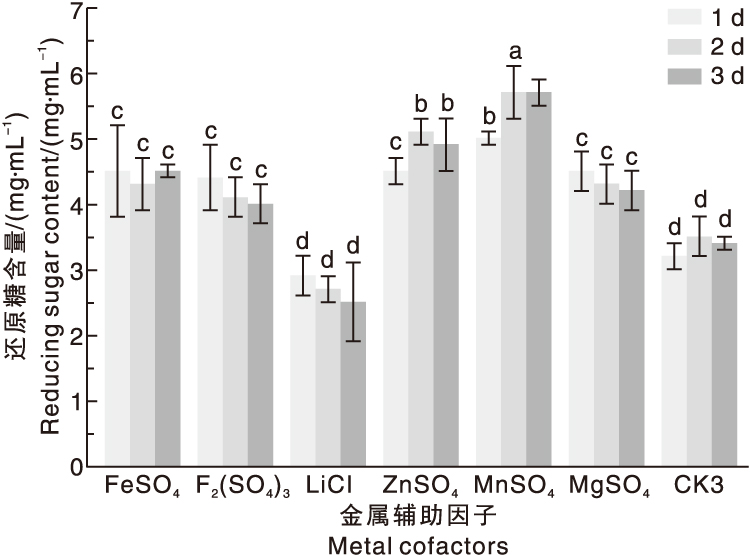
Fig.6 Reducing sugar content with different metal cofactors
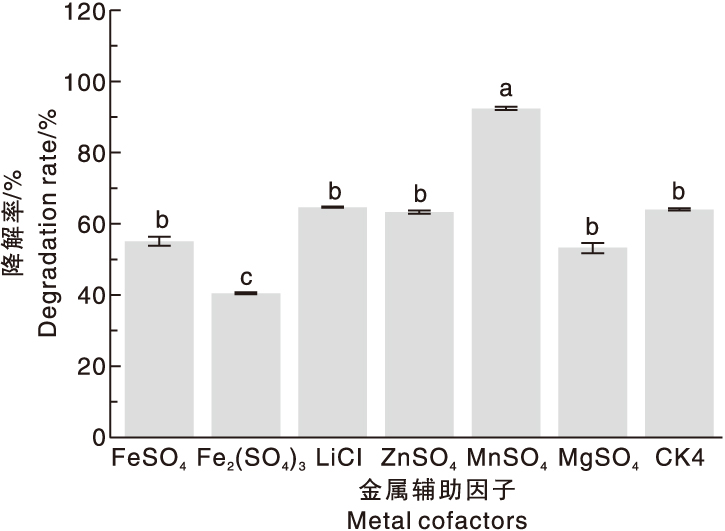
Fig.7 Degradation rate of chitin by acidic cellulase in the presence of different metal cofactors
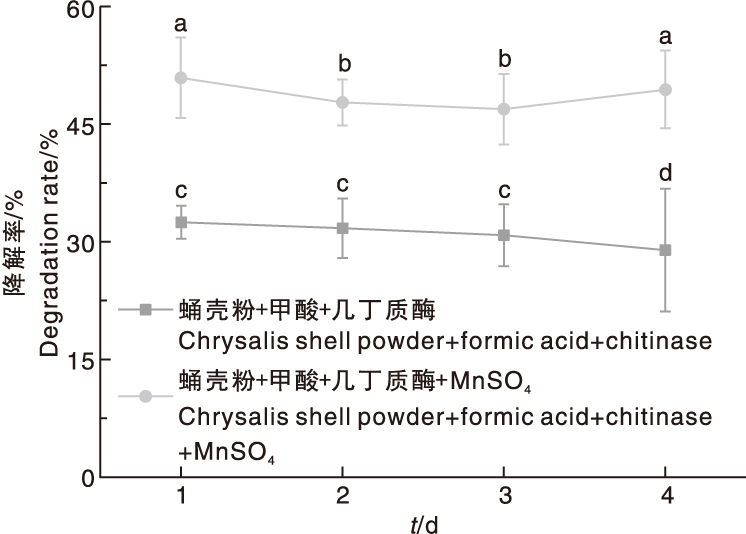
Fig.8 Degradation rate of chitin by chitinase in the presence of MnSO4 The values without the same lowercase letters indicate significant (p<0.05) difference. The same as below.
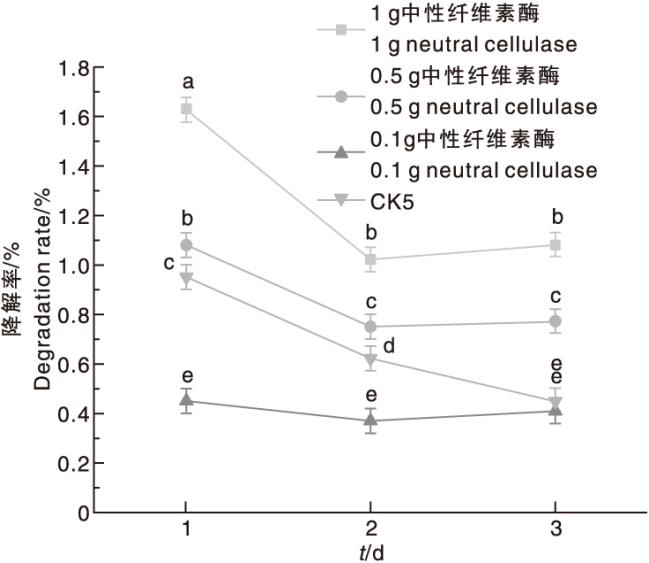
Fig.9 Chitin degradation rate by neutral cellulase
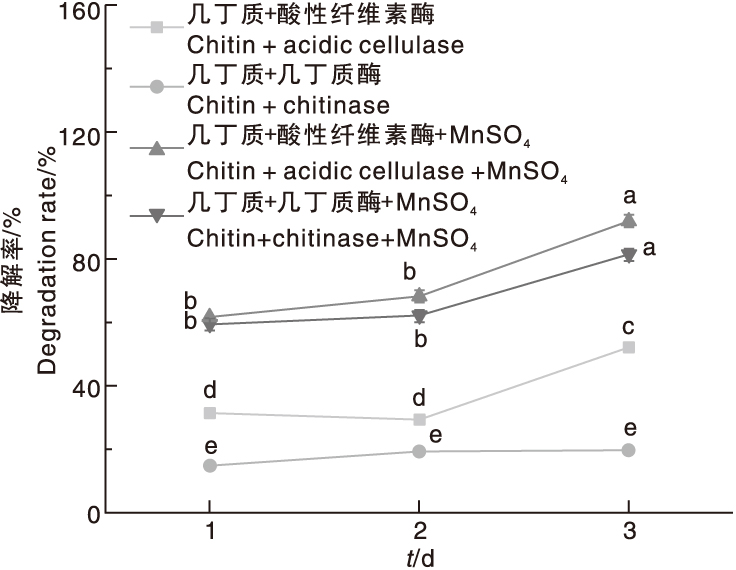
Fig.10 Degradation rate of chitin by acidic cellulase
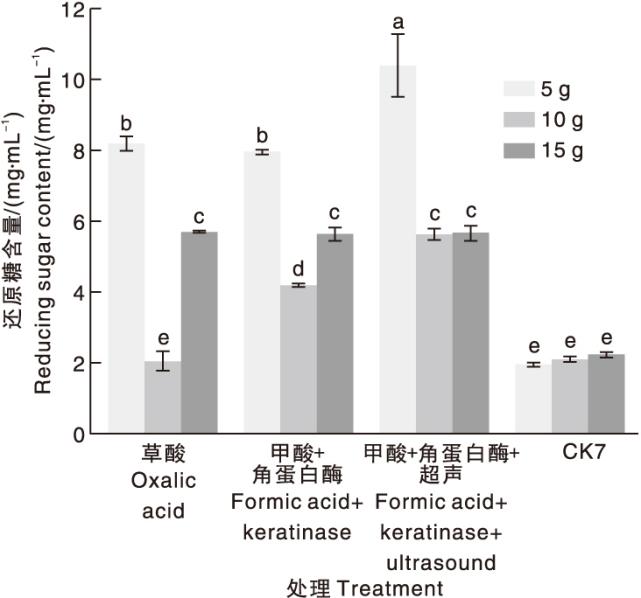
Fig.11 Reducing sugar content of chitin by formic acid, keratinase, and ultrasonic treatment
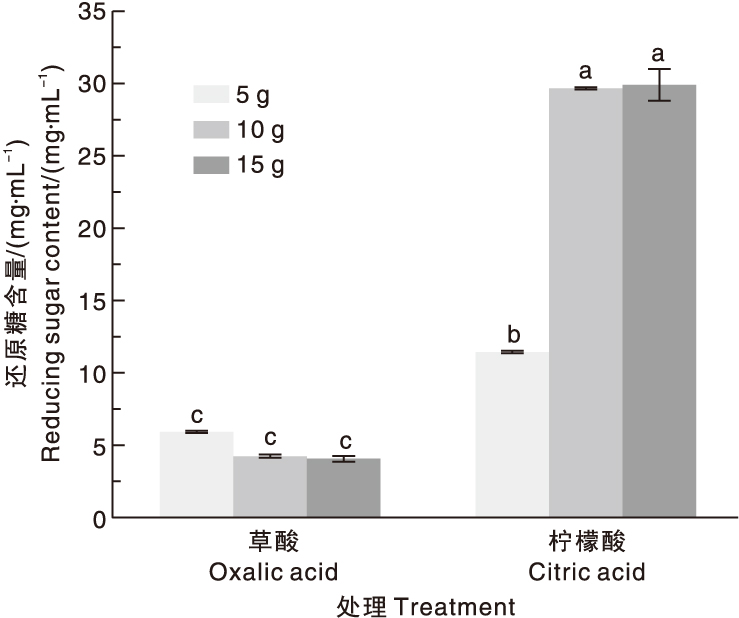
Fig.12 Reducing sugar content produced by chitinase hydrolysis following demineralization using oxalic acid or citric acid
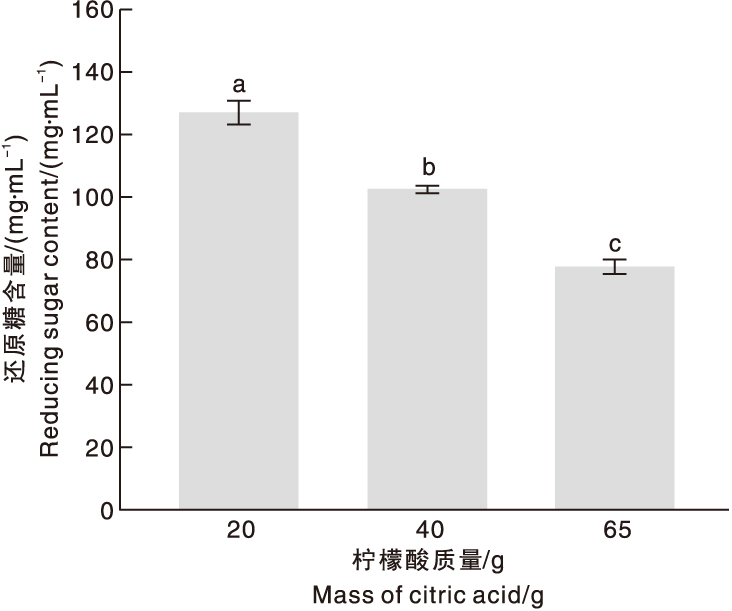
Fig.13 Influence of different masses of citric acid on the reducing sugar content in chitin degradation by acidic cellulase
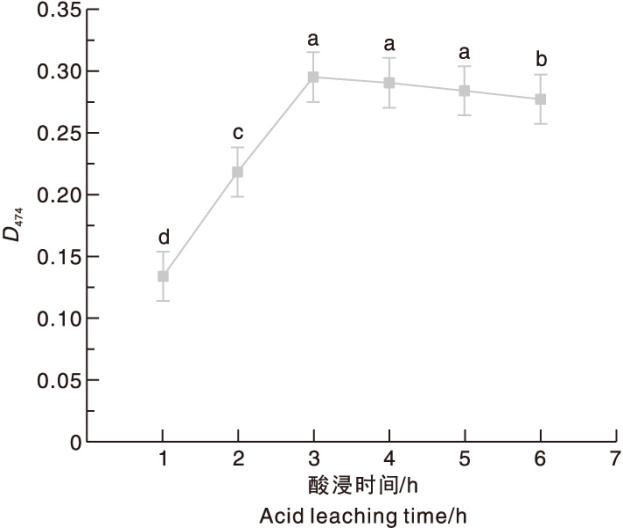
Fig.14 Absorbance of filtrate at 474 nm (D474) under different acid leaching time
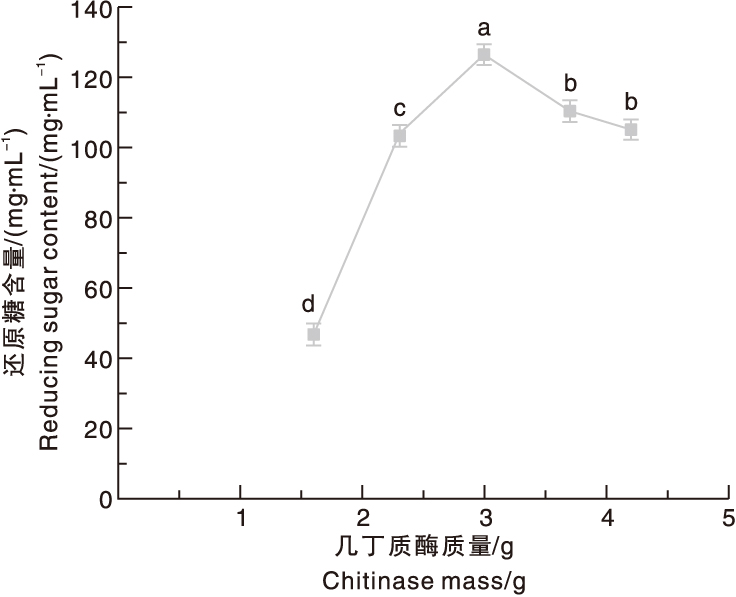
Fig.15 Content of reducing sugars produced from chitin degradation with varying masses of chitinase
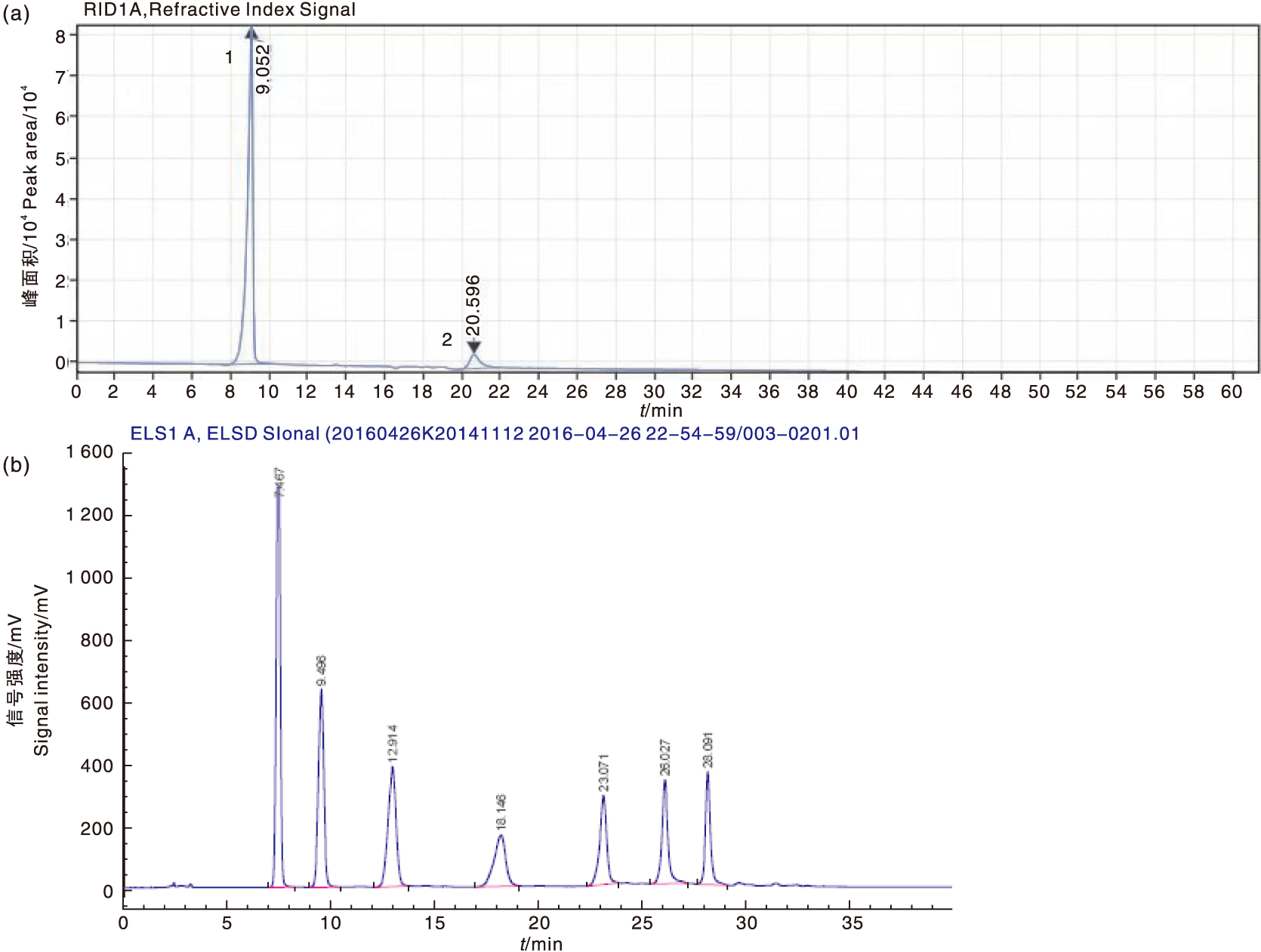
Fig.16 HPLC analysis results of the degradation products a, Detection results of the sample, peak 1 is chitotriose, and peak 2 is the enriched main mixture of heterosaccharides; b, Detection results of chitobiose-chitoheptaose standards.
| [1] | 陶兴华. 易腐垃圾黑水虻转化工程中溶解性有机质光谱及微生物群落变化特征研究[D]. 杭州: 浙江大学, 2021. |
| TAO X H. Dynamic features on spectra of dissolved organic matter and microbial community during full-scale black soldier fly larvae bioconversion for biodegradable domestic waste[D]. Hangzhou: Zhejiang University, 2021. | |
| [2] | LI Z Z, MAO R Y, TENG D, et al. Antibacterial and immunomodulatory activities of insect defensins-DLP2 and DLP4 against multidrug-resistant Staphylococcus aureus[J]. Scientific Reports, 2017, 7: 12124. |
| [3] | 侯雪阳, 李林, 许长峰, 等. 黑水虻特性及应用研究进展[J]. 特种经济动植物, 2022, 25(4): 56-60. |
| HOU X Y, LI L, XU C F, et al. Research progress on characteristics and application of black Hydrangea[J]. Special Economic Animals and Plants, 2022, 25(4): 56-60. | |
| [4] | RATCLIFFE N, AZAMBUJA P, MELLO C B. Recent advances in developing insect natural products as potential modern day medicines[J]. Evidence-Based Complementary and Alternative Medicine, 2014, 2014: 904958. |
| [5] | 强敬雯, 王晚晴, 唐曼玉, 等. 黑水虻转化厨余垃圾及产品应用相关研究进展[J]. 饲料工业, 2023, 44(6): 25-32. |
| QIANG J W, WANG W Q, TANG M Y, et al. Research progress of kitchen waste transformation and product application of black soldier fly[J]. Feed Industry, 2023, 44(6): 25-32. | |
| [6] | 赵燕, 宋斌, 侯凤香, 等. 黑水虻幼虫粉替代豆粕对蛋鸡产蛋性能、血清指标及免疫功能的影响[J]. 中国畜牧杂志, 2023, 59(3): 240-246. |
| ZHAO Y, SONG B, HOU F X, et al. Effects of black Hydrangea larva powder instead of soybean meal on laying performance, serum indexes and immune function of laying hens[J]. Chinese Journal of Animal Science, 2023, 59(3): 240-246. | |
| [7] | 孙星照. 虻粪二次堆肥过程中溶解性有机质波谱与微生物群落动态变化特征的研究[D]. 杭州: 浙江大学, 2019. |
| SUN X Z. Dynamic features on spectrum of dissolved organic matter and microbial community in black soldier fly larvae (Hermetia illucens) vermicompost during secondary composting[D]. Hangzhou: Zhejiang University, 2019. | |
| [8] | HENRY M, GASCO L, PICCOLO G, et al. Review on the use of insects in the diet of farmed fish: past and future[J]. Animal Feed Science and Technology, 2015, 203: 1-22. |
| [9] | ISHAK S, KAMARI A. Biodiesel from black soldier fly larvae grown on restaurant kitchen waste[J]. Environmental Chemistry Letters, 2019, 17(2): 1143-1150. |
| [10] | FURMAN D P, YOUNG R D, CATTS P E. Hermetia illucens(Linnaeus) as a factor in the natural control of Musca domestica Linnaeus[J]. Journal of Economic Entomology, 1959, 52(5): 917-921. |
| [11] | 王成成, 贾昭炎, 刘洋, 等. 黑水虻转化有机生活废弃物相关研究进展[J]. 生物加工过程, 2021, 19(4): 432-439. |
| WANG C C, JIA Z Y, LIU Y, et al. Progress in transformation of organic domestic waste by black soldier fly[J]. Chinese Journal of Bioprocess Engineering, 2021, 19(4): 432-439. | |
| [12] | 张建旭, 王旭旭, 孙一丹, 等. 电解水在小龙虾壳脱矿物质和蛋白质中的应用[J]. 中国食品学报, 2021, 21(1): 157-165. |
| ZHANG J X, WANG X X, SUN Y D, et al. The application of electrolyzed water in demineralization and deproteinization of crayfish shell[J]. Journal of Chinese Institute of Food Science and Technology, 2021, 21(1): 157-165. | |
| [13] | 廖晶. 猴头菇加工余渣中几丁质的提取、改性及多尺度结构变化对凝胶性能的影响机制[D]. 广州: 华南理工大学, 2021. |
| LIAO J. Extraction and modification of chitin from the Hericium erinaceus residue and the effect mechanism of multi-scale structural changes on gel properties[D]. Guangzhou: South China University of Technology, 2021. | |
| [14] | MERZENDORFER H. Insect chitin synthases: a review[J]. Journal of Comparative Physiology B: Biochemical, Systemic, and Environmental Physiology, 2006, 176(1): 1-15. |
| [15] | ARNOLD N D, BRÜCK W M, GARBE D, et al. Enzymatic modification of native chitin and conversion to specialty chemical products[J]. Marine Drugs, 2020, 18(2): 93. |
| [16] | DEGUCHI S, TSUJII K, HORIKOSHI K. In situ microscopic observation of chitin and fungal cells with chitinous cell walls in hydrothermal conditions[J]. Scientific Reports, 2015, 5: 11907. |
| [17] | ZHOU Y, LI S Y, LI D D, et al. Enzymatic preparation of chitooligosaccharides and their anti-obesity application[J]. Bioscience, Biotechnology, and Biochemistry, 2020, 84(7): 1460-1466. |
| [18] | MONREAL J, REESE E T. The chitinase of Serratia marcescens[J]. Canadian Journal of Microbiology, 1969, 15(7): 689-696. |
| [19] | 姚婉生, 王雪, 侯海荣, 等. 几丁寡糖制备的研究进展[J]. 山东科学, 2006, 19(3): 27-31. |
| YAO W S, WANG X, HOU H R, et al. Advances in preparation of chitooligosaccharides[J]. Shandong Science, 2006, 19(3): 27-31. | |
| [20] | KHAN F I, RAHMAN S, QUEEN A, et al. Implications of molecular diversity of chitin and its derivatives[J]. Applied Microbiology and Biotechnology, 2017, 101(9): 3513-3536. |
| [21] | LOMBARD V, GOLACONDA RAMULU H, DRULA E, et al. The carbohydrate-active enzymes database (CAZy) in 2013[J]. Nucleic Acids Research, 2014, 42(Database issue): D490-D495. |
| [22] | FUNKHOUSER J D, ARONSON N N Jr. Chitinase family GH18: evolutionary insights from the genomic history of a diverse protein family[J]. BMC Evolutionary Biology, 2007, 7: 96. |
| [23] | DUTTA B, DESKA J, BANDOPADHYAY R, et al. In silico characterization of bacterial chitinase: illuminating its relationship with archaeal and eukaryotic cousins[J]. Journal of Genetic Engineering and Biotechnology, 2021, 19(1): 19. |
| [24] | 陈龙, 董飞龙, 寇峰, 等. 春尺蠖几丁质酶AcinCht10基因的克隆及在逆境胁迫下的表达[J]. 西南农业学报, 2022, 35(9): 2068-2076. |
| CHEN L, DONG F L, KOU F, et al. Molecular cloning and expression analysis of chitinase AcinCht10 from Apocheima cinerarius under stress[J]. Southwest China Journal of Agricultural Sciences, 2022, 35(9): 2068-2076. | |
| [25] | 朱景一, 马振宇, 肖敏, 等. 壳聚糖与细菌细胞膜相互作用的分子动力学研究[J]. 生物化学与生物物理进展, 2023, 50(8): 1995-2005. |
| ZHU J Y, MA Z Y, XIAO M, et al. Molecular dynamics simulations of the interaction between chitosan and bacterial membranes[J]. Progress in Biochemistry and Biophysics, 2023, 50(8): 1995-2005. | |
| [26] | 朱先玉, 丛海花, 尹恒. 几丁质脱乙酰酶的特点及应用[J]. 渔业研究, 2019, 41(2): 167-174. |
| ZHU X Y, CONG H H, YIN H. Characteristics and application of chitin deacetylase[J]. Journal of Fisheries Research, 2019, 41(2): 167-174. | |
| [27] | 赵祥杰, 邝哲师, 叶明强, 等. 蚕蛹几丁质开发利用研究进展[J]. 蚕业科学, 2008, 34(3): 575-580. |
| ZHAO X J, KUANG Z S, YE M Q, et al. Advances on comprehensive utilization of chitin from silkworm Pupa[J]. Science of Sericulture, 2008, 34(3): 575-580. | |
| [28] | 武大引. 甲壳低聚糖的制备及性能测定[D]. 青岛: 青岛科技大学, 2017. |
| WU D Y. Preparation and properties of chitooligosaccharide[D]. Qingdao: Qingdao University of Science & Technology, 2017. | |
| [29] | KUMAR A, KUMAR D, GEORGE N, et al. A process for complete biodegradation of shrimp waste by a novel marine isolate Paenibacillus sp. AD with simultaneous production of chitinase and chitin oligosaccharides[J]. International Journal of Biological Macromolecules, 2018, 109: 263-272. |
| [30] | POSHINA D N, RAIK S V, SUKHOVA A A, et al. Nonspecific enzymatic hydrolysis of a highly ordered chitopolysaccharide substrate[J]. Carbohydrate Research, 2020, 498: 108191. |
| [31] | 杜敬河. 甲壳素酶产生菌的筛选及酶法制备甲壳低聚糖的研究[D]. 广州: 华南农业大学, 2016. |
| DU J H. Screening of chitinase producing bacteria and preparation of chitin oligosaccharides by enzymatic hydrolysis[D]. Guangzhou: South China Agricultural University, 2016. | |
| [32] | 张群. 几丁质资源生物加工关键技术研究[J]. 食品与生物技术学报, 2022, 41(5): 112. |
| ZHANG Q. Study on key technologies of chitin resource bioprocessing[J]. Journal of Food Science and Biotechnology, 2022, 41(5): 112. | |
| [33] | HORN S J, SØRBOTTEN A, SYNSTAD B, et al. Endo/exo mechanism and processivity of family 18 chitinases produced by Serratia marcescens[J]. The FEBS Journal, 2006, 273(3): 491-503. |
| [34] | VAAJE-KOLSTAD G, HORN S J, VAN AALTEN D M F, et al. The non-catalytic chitin-binding protein CBP21 from Serratia marcescens is essential for chitin degradation[J]. Journal of Biological Chemistry, 2005, 280(31): 28492-28497. |
| [35] | REYNOLDS S E, SAMUELS R I. Physiology and biochemistry of insect moulting fluid[J]. Advances in Insect Physiology, 1996, 26: 157-232. |
| [36] | 李妍, 李家磊, 师献雪, 等. 昆虫几丁质酶功能研究、酶学性质及应用研究进展[J]. 科技视界, 2021(32): 69-72. |
| LI Y, LI J L, SHI X X, et al. Research progress on function, enzymatic properties and application of insect chitinase[J]. Science & Technology Vision, 2021(32): 69-72. | |
| [37] | LEVIN R M, KRIEGER N N, WINZLER R J. Glucmsumine and acetylglucosamine tolerance in man[J]. The Journal of Laboratory and Clinical Medicine, 1961, 58: 927-932. |
| [38] | 时杰. 废弃虾蟹壳的资源化利用技术研究[D]. 海口: 海南大学, 2011. |
| SHI J. Studies on shrimp and crab shell waste of the resource utilization[D]. Haikou: Hainan University, 2011. | |
| [39] | 肖宇, 于宏伟, 马爱进, 等. 球磨、超声和盐酸处理对几丁质的微观结构和酶促脱乙酰效率的影响[J]. 食品科学, 2023, 44(7): 114-122. |
| XIAO Y, YU H W, MA A J, et al. Effects of ball milling, ultrosonic or hydrochloric acid treatment on the microstructure and enzymatic deacetylation efficiency of chitin[J]. Food Science, 2023, 44(7): 114-122. | |
| [40] | 侯福荣. 超声在酶促降解几丁质过程中的作用研究[D]. 杭州: 浙江大学, 2021. |
| HOU F R. Study on the role of ultrasound in the enzymatic degradation of chitin[D]. Hangzhou: Zhejiang University, 2021. | |
| [41] | 刘洋, 肖宇, 马爱进, 等. 超微粉碎和高压均质联合处理对几丁质理化性质及微观结构的影响[J]. 食品科学, 2022, 43(19): 102-109. |
| LIU Y, XIAO Y, MA A J, et al. Effect of combined treatment of ultra-micro grinding and high pressure homogenization on the physicochemical properties and microstructure of chitin[J]. Food Science, 2022, 43(19): 102-109. | |
| [42] | LERTWATTANASERI T, ICHIKAWA N, MIZOGUCHI T, et al. Microwave technique for efficient deacetylation of chitin nanowhiskers to a chitosan nanoscaffold[J]. Carbohydrate Research, 2009, 344(3): 331-335. |
| [43] | AJAVAKOM A, SUPSVETSON S, SOMBOOT A, et al. Products from microwave and ultrasonic wave assisted acid hydrolysis of chitin[J]. Carbohydrate Polymers, 2012, 90(1): 73-77. |
| [44] | ZHANG W C, ZHAO Y, XU L, et al. Superfine grinding induced amorphization and increased solubility of α-chitin[J]. Carbohydrate Polymers, 2020, 237: 116145. |
| [45] | ZHANG Q, DUAN L R, LI Y C. Positive effects and mechanism of ultrasound on chitin preparation from shrimp shells by co-fermentation[J]. Ultrasonics Sonochemistry, 2022, 88: 106066. |
| [46] | 宁为民. 一株几丁质降解菌的分离鉴定、酶基因克隆表达及对凡纳对虾生长和肠道菌群影响[D]. 湛江: 广东海洋大学, 2021. |
| NING W M. Isolation and identification of a chitin-degrading bacterium, cloning and expression of chitinase genes, and its effect on the growth and intestinal microbiota of Penaeus vannamei[D]. Zhanjiang: Guangdong Ocean University, 2021. | |
| [47] | OH S H, VO T S, NGO D H, et al. Prevention of H2O2-induced oxidative stress in murine microglial BV-2 cells by chitin-oligomers[J]. Process Biochemistry, 2016, 51(12): 2170-2175. |
| [48] | ALLAN G G, PEYRON M. Molecular weight manipulation of chitosan. I: kinetics of depolymerization by nitrous acid[J]. Carbohydrate Research, 1995, 277(2): 257-272. |
| [49] | CHANG K L, TAI M C, CHENG F H. Kinetics and products of the degradation of chitosan by hydrogen peroxide[J]. Journal of Agricultural and Food Chemistry, 2001, 49(10): 4845-4851. |
| [50] | LI Z Y, LIU C Z, HONG S, et al. Recent advances in extraction and processing of chitin using deep eutectic solvents[J]. Chemical Engineering Journal, 2022, 446: 136953. |
| [51] | RAIMUNDO I, SILVA R, MEUNIER L, et al. Functional metagenomics reveals differential chitin degradation and utilization features across free-living and host-associated marine microbiomes[J]. Microbiome, 2021, 9(1): 43. |
| [52] | WANG X Y, ISBRANDT T, STRUBE M L, et al. Chitin degradation machinery and secondary metabolite profiles in the marine bacterium Pseudoalteromonas rubra S4059[J]. Marine Drugs, 2021, 19(2): 108. |
| [53] | UNGKULPASVICH U, BARAMEE S, UKE A, et al. Symbiotic chitin degradation by a novel anaerobic thermophilic bacterium Hydrogenispora sp. UUS1-1 and the bacterium Tepidanaerobacter sp. GT38[J]. Enzyme and Microbial Technology, 2021, 144: 109740. |
| [54] | 吴昊, 刘嘉荔, 杨静文, 等. 双酶协同降解胶体几丁质及其作用机制[J]. 食品科学, 2022, 43(6): 74-80. |
| WU H, LIU J L, YANG J W, et al. Synergistic enzymatic degradation of colloidal chitin and its mechanism[J]. Food Science, 2022, 43(6): 74-80. | |
| [55] | EGGERT F M, GERMAIN J P. Rapid demineralization in acidic buffers[J]. Histochemistry, 1979, 59(3): 215-224. |
| [1] | YUAN Zengyan, REN Xinxin, SONG Xiaofeng, ZHU Yunhao. Antifungal activity of chitooligosaccharide-nano silver and its effects on safflower seed germination and seedling growth [J]. Acta Agriculturae Zhejiangensis, 2026, 38(1): 76-84. |
| [2] | YANG Songhua, SHI Guiyang, WANG Jingqin, CHEN Zhu. Effects of soybean root exudates on insoluble phosphorus in soil under low phosphorus stress [J]. Acta Agriculturae Zhejiangensis, 2023, 35(6): 1396-1406. |
| [3] | WU Jiao, GONG Chengyu, CHEN Chaoqun, CHEN Hongxu, LIU Junhong, TANG Wenjing, CHU Yuanqi, YANG Wenlong, ZHANG Yao, GONG Ronggao. Ecological response of organic acid metabolism of Huangguogan fruits at different altitudes [J]. Acta Agriculturae Zhejiangensis, 2023, 35(4): 853-861. |
| [4] | WANG Tonglin, YE Hongxia, ZHENG Jirong, LI Ming. Research progress of main flavor compounds in tomato fruits [J]. , 2020, 32(8): 1513-1522. |
| [5] | GONG Shasha, MENG Qingling, QIAO Jun, ZHONG Wenqiang, HUANG Yunfu, ZHANG Guowu, CHEN Ying, CAI Xuepeng. Gene cloning and bioactivity analysis of chitinase gene AO-483 from Arthrobotrys oligospora XJ-A1 [J]. , 2019, 31(2): 222-228. |
| [6] | DAI Lin, XU Yuanyuan, XIONG Bo, HUANG Shengjia, SUN Guochao, WANG Zhihui. Accumulation characteristics of ascorbic acid, glutathione and organic acids in Huangguogan fruit [J]. , 2018, 30(8): 1341-1348. |
| [7] | YING Quansheng, HE Yong, WANG Yinger, CAO Tingting, GU Binquan, WANG Yuhong. Effects of grafting with different rootstocks on watermelon fruit quality [J]. , 2017, 29(4): 590-596. |
| [8] | LIU Lin\|hao1,2, WANG Yu2, LI Guo\|hua1, FANG Guo\|dong2, WANG Lei3,4,*. Impact of low\|molecular weight organic acids on dechlorination of 4\|ClBP by nanoscale zero\|valent iron#br# [J]. , 2015, 27(8): 1451-. |
| [9] | HOU Li\|juan;YAO Fang\|jie;*;SONG Jin\|di. Effects of organic fertilizer of mushroom residue on the quality of Capsicum annuum L. [J]. , 2013, 25(6): 0-1297. |
| [10] | XIE Xiao-bo;QIU ying-ying;QI Xing-jiang;*;WANG Tao;XIANG Kang-hua;CHENG Wei-li;LIANG Sen-miao;ZHENG Xi-liang;JIN Wei. Analysis on dynamic changes of organic acid components and their content in fruits of Myrica rubra [J]. , 2013, 25(4): 0-790. |
| [11] | WEN Yu-zhuan;FU Yun-peng;*;TIAN Xiang-hua;HUANG Ruo-ping;YU Xing-zhen;LIU Jian-jun;CUI Hui-min. Effect of different organic acids on physiological properties and chemical components in oriental tobacco [J]. , 2011, 23(2): 0-297. |
| Viewed | ||||||
|
Full text |
|
|||||
|
Abstract |
|
|||||

