Acta Agriculturae Zhejiangensis ›› 2026, Vol. 38 ›› Issue (3): 471-480.DOI: 10.3969/j.issn.1004-1524.20250272
• Horticultural Science • Previous Articles Next Articles
Effect of proanthocyanidin on the stability of Dendrobium officinale anthocyanins and its copigmentation mechanism
YANG Chenchen1,2( ), TAO Wenyang2, XING Jianrong2, ZHOU Wanyi2, WANG Mengzhu2, LI Ming1, YANG Ying2,*(), ZHAO Yuping1,*()
- 1.
Huaiyin Institute of Technology Huai’an 223001, Jiangsu, China
2.Institute of Food Science ,Zhejiang Academy of Agricultural Sciences Hangzhou 310021, China
-
Received:2025-04-07Online:2026-03-25Published:2026-04-17

CLC Number:
Cite this article
YANG Chenchen, TAO Wenyang, XING Jianrong, ZHOU Wanyi, WANG Mengzhu, LI Ming, YANG Ying, ZHAO Yuping. Effect of proanthocyanidin on the stability of Dendrobium officinale anthocyanins and its copigmentation mechanism[J]. Acta Agriculturae Zhejiangensis, 2026, 38(3): 471-480.
share this article
Add to citation manager EndNote|Ris|BibTeX
URL: http://www.zjnyxb.cn/EN/10.3969/j.issn.1004-1524.20250272
| 处理 Treatment | n(DOA)∶n(辅色素) n(DOA)∶n(copigment) | Dλ,max | ΔDλ,max/% | λmax/nm | Δλmax/nm |
|---|---|---|---|---|---|
| DOA | — | 0.233±0.008 d | — | 542±0 e | — |
| DOA-C | 1∶40 | 0.258±0.017 bcd | 22.781±0.447 e | 544±0 c | 2±0 c |
| 1∶20 | 0.255±0.016 bcd | 20.328±0.298 f | 544±1 c | 2±1 c | |
| 1∶10 | 0.249±0.013 bcd | 16.306±0.280 h | 543±0 d | 1±0 d | |
| 1∶1 | 0.239±0.005 cd | 6.894±0.265 i | 543±0 d | 1±0 d | |
| DOA-GSPEs | 1∶40 | 0.336±0.025 a | 61.512±0.488 a | 545±0 b | 3±0 b |
| 1∶20 | 0.266±0.021 bc | 28.326±0.313 c | 545±1 b | 3±1 b | |
| 1∶10 | 0.249±0.013 bcd | 16.087±0.377 h | 544±0 c | 2±0 c | |
| 1∶1 | 0.237±0.006 cd | 4.807±0.329 j | 544±1 c | 2±1 c | |
| DOA-BLPEs | 1∶40 | 0.278±0.024 b | 35.213±0.311 b | 546±0 a | 4±0 a |
| 1∶20 | 0.265±0.020 bc | 27.614±0.294 d | 546±0 a | 4±0 a | |
| 1∶10 | 0.253±0.015 bcd | 19.262±0.355 g | 545±0 b | 3±0 b | |
| 1∶1 | 0.239±0.005 cd | 6.670±0.464 i | 544±0 c | 2±0 c |
Table 1 Influence of copigments on DOA absorption wavelength
| 处理 Treatment | n(DOA)∶n(辅色素) n(DOA)∶n(copigment) | Dλ,max | ΔDλ,max/% | λmax/nm | Δλmax/nm |
|---|---|---|---|---|---|
| DOA | — | 0.233±0.008 d | — | 542±0 e | — |
| DOA-C | 1∶40 | 0.258±0.017 bcd | 22.781±0.447 e | 544±0 c | 2±0 c |
| 1∶20 | 0.255±0.016 bcd | 20.328±0.298 f | 544±1 c | 2±1 c | |
| 1∶10 | 0.249±0.013 bcd | 16.306±0.280 h | 543±0 d | 1±0 d | |
| 1∶1 | 0.239±0.005 cd | 6.894±0.265 i | 543±0 d | 1±0 d | |
| DOA-GSPEs | 1∶40 | 0.336±0.025 a | 61.512±0.488 a | 545±0 b | 3±0 b |
| 1∶20 | 0.266±0.021 bc | 28.326±0.313 c | 545±1 b | 3±1 b | |
| 1∶10 | 0.249±0.013 bcd | 16.087±0.377 h | 544±0 c | 2±0 c | |
| 1∶1 | 0.237±0.006 cd | 4.807±0.329 j | 544±1 c | 2±1 c | |
| DOA-BLPEs | 1∶40 | 0.278±0.024 b | 35.213±0.311 b | 546±0 a | 4±0 a |
| 1∶20 | 0.265±0.020 bc | 27.614±0.294 d | 546±0 a | 4±0 a | |
| 1∶10 | 0.253±0.015 bcd | 19.262±0.355 g | 545±0 b | 3±0 b | |
| 1∶1 | 0.239±0.005 cd | 6.670±0.464 i | 544±0 c | 2±0 c |
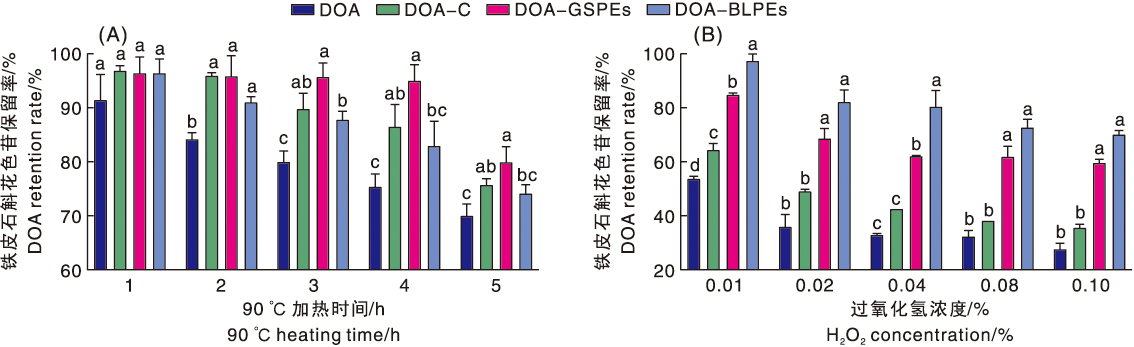
Fig.1 DOA stability analysis Bars with different lowercase letters indicate significant (p<0.05) differences among different sample groups within the same heating time (A) or H2O2 concentration (B).
| 处理 Treatment | Ea/(kJ·mol-1) | R2 | T/K | K/h-1 | t1/2/h | ΔH/(kJ·mol-1) | ΔG/(kJ·mol-1) | ΔS/(J·mol-1) |
|---|---|---|---|---|---|---|---|---|
| DOA | 29.964±1.873 d | 0.991 | 313.15 | 0.034±0.002 hi | 20.39±1.20 fg | 27.360±1.873 d | 88.108±0.153 m | -193.989±6.009 d |
| 323.15 | 0.045±0.003 g | 15.40±1.03 ghi | 27.277±1.873 d | 89.790±0.179 k | -193.447±5.825 d | |||
| 333.15 | 0.061±0.004 e | 11.36±0.74 ijk | 27.194±1.873 d | 91.687±0.182 gh | -193.583±5.650 d | |||
| 343.15 | 0.078±0.005 c | 8.89±0.57 ijk | 27.111±1.873 d | 93.771±0.183 d | -194.260±5.486 d | |||
| 353.15 | 0.098±0.006 a | 7.07±0.43 k | 27.028±1.873 d | 95.848±0.180 a | -194.875±5.329 d | |||
| DOA-C | 35.713±2.156 c | 0.990 | 313.15 | 0.018±0.001 lm | 38.51±2.14 c | 33.109±2.156 c | 87.223±0.145 n | -172.805±6.905 c |
| 323.15 | 0.024±0.002 jk | 28.88±2.41 de | 33.026±2.156 c | 89.335±0.224 l | -174.249±6.712 c | |||
| 333.15 | 0.037±0.002 h | 18.73±1.01 fgh | 32.943±2.156 c | 91.053±0.150 i | -174.426±6.500 c | |||
| 343.15 | 0.055±0.004 f | 12.60±0.92 hijk | 32.860±2.156 c | 92.737±0.208 f | -174.493±6.325 c | |||
| 353.15 | 0.086±0.005 b | 8.06±0.47 jk | 32.777±2.156 c | 94.180±0.171 c | -173.873±6.135 c | |||
| DOA-GSPEs | 53.195±2.487 b | 0.994 | 313.15 | 0.007±0.001 n | 99.02±14.15 a | 50.591±2.487 b | 89.815±0.372 k | -125.255±8.074 b |
| 323.15 | 0.014±0.001 m | 49.51±3.54 b | 50.508±2.487 b | 90.808±0.192 ij | -124.710±7.724 b | |||
| 333.15 | 0.026±0.002 jk | 26.66±2.05 e | 50.425±2.487 b | 92.019±0.213 g | -124.849±7.508 b | |||
| 343.15 | 0.047±0.003 g | 14.75±0.94 ghij | 50.342±2.487 b | 93.183±0.182 e | -124.847±7.283 b | |||
| 353.15 | 0.067±0.005 d | 10.35±0.77 ijk | 50.259±2.487 b | 94.932±0.219 b | -126.499±7.093 b | |||
| DOA-BLPEs | 65.058±3.012 a | 0.992 | 313.15 | 0.013±0.001 m | 53.32±4.10 b | 62.454±3.012 a | 89.933±0.200 k | -87.747±9.664 a |
| 323.15 | 0.021±0.001 kl | 33.01±1.57 cd | 62.371±3.012 a | 90.520±0.128 j | -87.106±9.347 a | |||
| 333.15 | 0.029±0.002 ij | 23.90±1.65 ef | 62.288±3.012 a | 91.450±0.191 h | -87.534±9.085 a | |||
| 343.15 | 0.038±0.003 h | 18.24±1.44 fgh | 62.205±3.012 a | 92.008±0.225 g | -86.852±8.838 a | |||
| 353.15 | 0.049±0.004 g | 14.14±1.15 ghij | 62.122±3.012 a | 93.621±0.240 d | -89.195±8.599 a |
Table 2 Degradation kinetics and thermodynamic parameters
| 处理 Treatment | Ea/(kJ·mol-1) | R2 | T/K | K/h-1 | t1/2/h | ΔH/(kJ·mol-1) | ΔG/(kJ·mol-1) | ΔS/(J·mol-1) |
|---|---|---|---|---|---|---|---|---|
| DOA | 29.964±1.873 d | 0.991 | 313.15 | 0.034±0.002 hi | 20.39±1.20 fg | 27.360±1.873 d | 88.108±0.153 m | -193.989±6.009 d |
| 323.15 | 0.045±0.003 g | 15.40±1.03 ghi | 27.277±1.873 d | 89.790±0.179 k | -193.447±5.825 d | |||
| 333.15 | 0.061±0.004 e | 11.36±0.74 ijk | 27.194±1.873 d | 91.687±0.182 gh | -193.583±5.650 d | |||
| 343.15 | 0.078±0.005 c | 8.89±0.57 ijk | 27.111±1.873 d | 93.771±0.183 d | -194.260±5.486 d | |||
| 353.15 | 0.098±0.006 a | 7.07±0.43 k | 27.028±1.873 d | 95.848±0.180 a | -194.875±5.329 d | |||
| DOA-C | 35.713±2.156 c | 0.990 | 313.15 | 0.018±0.001 lm | 38.51±2.14 c | 33.109±2.156 c | 87.223±0.145 n | -172.805±6.905 c |
| 323.15 | 0.024±0.002 jk | 28.88±2.41 de | 33.026±2.156 c | 89.335±0.224 l | -174.249±6.712 c | |||
| 333.15 | 0.037±0.002 h | 18.73±1.01 fgh | 32.943±2.156 c | 91.053±0.150 i | -174.426±6.500 c | |||
| 343.15 | 0.055±0.004 f | 12.60±0.92 hijk | 32.860±2.156 c | 92.737±0.208 f | -174.493±6.325 c | |||
| 353.15 | 0.086±0.005 b | 8.06±0.47 jk | 32.777±2.156 c | 94.180±0.171 c | -173.873±6.135 c | |||
| DOA-GSPEs | 53.195±2.487 b | 0.994 | 313.15 | 0.007±0.001 n | 99.02±14.15 a | 50.591±2.487 b | 89.815±0.372 k | -125.255±8.074 b |
| 323.15 | 0.014±0.001 m | 49.51±3.54 b | 50.508±2.487 b | 90.808±0.192 ij | -124.710±7.724 b | |||
| 333.15 | 0.026±0.002 jk | 26.66±2.05 e | 50.425±2.487 b | 92.019±0.213 g | -124.849±7.508 b | |||
| 343.15 | 0.047±0.003 g | 14.75±0.94 ghij | 50.342±2.487 b | 93.183±0.182 e | -124.847±7.283 b | |||
| 353.15 | 0.067±0.005 d | 10.35±0.77 ijk | 50.259±2.487 b | 94.932±0.219 b | -126.499±7.093 b | |||
| DOA-BLPEs | 65.058±3.012 a | 0.992 | 313.15 | 0.013±0.001 m | 53.32±4.10 b | 62.454±3.012 a | 89.933±0.200 k | -87.747±9.664 a |
| 323.15 | 0.021±0.001 kl | 33.01±1.57 cd | 62.371±3.012 a | 90.520±0.128 j | -87.106±9.347 a | |||
| 333.15 | 0.029±0.002 ij | 23.90±1.65 ef | 62.288±3.012 a | 91.450±0.191 h | -87.534±9.085 a | |||
| 343.15 | 0.038±0.003 h | 18.24±1.44 fgh | 62.205±3.012 a | 92.008±0.225 g | -86.852±8.838 a | |||
| 353.15 | 0.049±0.004 g | 14.14±1.15 ghij | 62.122±3.012 a | 93.621±0.240 d | -89.195±8.599 a |
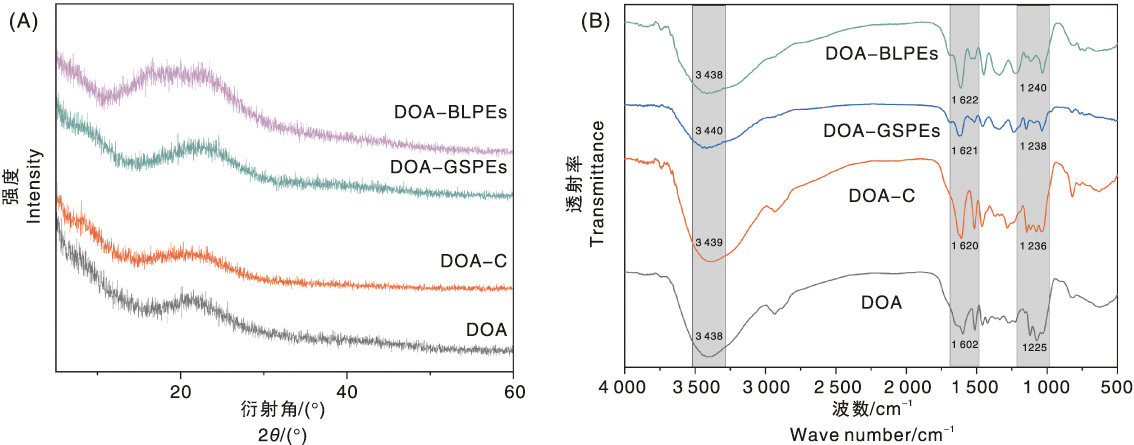
Fig.2 Characterization of DOA and copigments A, X-ray diffraction (XRD) analysis; B, Fourier transform infrared spectroscopy (FT-IR) analysis.
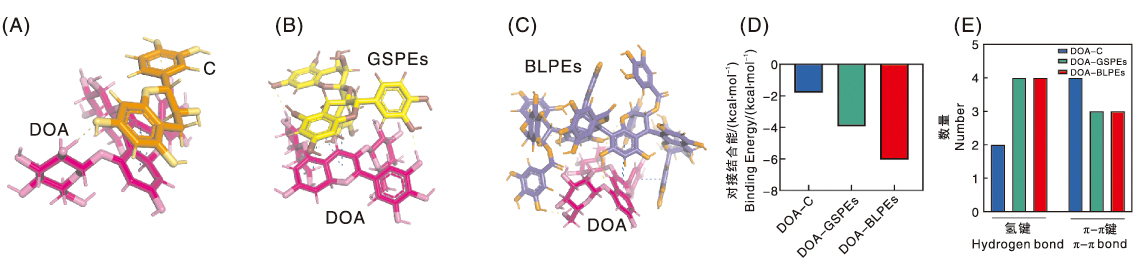
Fig.3 Molecular docking data of DOA and copigments A, DOA-C; B, DOA-GSPEs; C, DOA-BLPEs; D, Binding energy; E, Numbers of hydrogen bonds and π-π interactions.
| [1] | SADOWSKA-BARTOSZ I, BARTOSZ G. Antioxidant activity of anthocyanins and anthocyanidins: a critical review[J]. International Journal of Molecular Sciences, 2024, 25(22): 12001. |
| [2] | LI F, LI H J, LI S B, et al. A review of Lycium ruthenicum Murray: geographic distribution tracing, bioactive components, and functional properties[J]. Heliyon, 2024, 10(21): e39566. |
| [3] | ENARU B, DRECANU G, POP T D, et al. Anthocyanins: factors affecting their stability and degradation[J]. Antioxidants, 2021, 10(12): 1967. |
| [4] | FAN L L, WANG Y, XIE P J, et al. Copigmentation effects of phenolics on color enhancement and stability of blackberry wine residue anthocyanins: chromaticity, kinetics and structural simulation[J]. Food Chemistry, 2019, 275: 299-308. |
| [5] | TROUILLAS P, SANCHO-GARCÍA J C, DE FREITAS V, et al. Stabilizing and modulating color by copigmentation: insights from theory and experiment[J]. Chemical Reviews, 2016, 116(9): 4937-4982. |
| [6] | GENÇDAǦ E, ÖZDEMIR E E, DEMIRCI K, et al. Copigmentation and stabilization of anthocyanins using organic molecules and encapsulation techniques[J]. Current Plant Biology, 2022, 29: 100238. |
| [7] | ZHANG B, WANG Q, ZHOU P P, et al. Copigmentation evidence of oenin with phenolic compounds: a comparative study of spectrographic, thermodynamic and theoretical data[J]. Food Chemistry, 2020, 313: 126163. |
| [8] | YU K J, SONG Y S, LIN J X, et al. The complexities of proanthocyanidin biosynthesis and its regulation in plants[J]. Plant Communications, 2023, 4(2): 100498. |
| [9] | LI L Q, ZHANG Y, SUN B G, et al. The neuroprotective effects of Chinese bayberry leaves proanthocyanidins[J]. Journal of Functional Foods, 2018, 40: 554-563. |
| [10] | YI F X, HOU F Y, ZHAN S Q, et al. Preparation, characterization and application of pH-responsive smart film based on chitosan/zein and red radish anthocyanin[J]. International Journal of Biological Macromolecules, 2023, 253: 127037. |
| [11] | REN Z Y, QIU F N, WANG Y J, et al. Network analysis of transcriptome and LC-MS reveals a possible biosynthesis pathway of anthocyanins in Dendrobium officinale[J]. BioMed Research International, 2020, 2020: 6512895. |
| [12] | ZHANG Y, ZHOU X Z, TAO W Y, et al. Antioxidant and antiproliferative activities of proanthocyanidins from Chinese bayberry (Myrica rubra Sieb. et Zucc.) leaves[J]. Journal of Functional Foods, 2016, 27: 645-654. |
| [13] | HALGREN T A, NACHBAR R B. Merck molecular force field IV: conformational energies and geometries for MMFF94[J]. Journal of Computational Chemistry, 1996, 17(5/6): 587-615. |
| [14] | SEERAM N P, BOURQUIN L D, NAIR M G. Degradation products of cyanidin glycosides from tart cherries and their bioactivities[J]. Journal of Agricultural and Food Chemistry, 2001, 49(10): 4924-4929. |
| [15] | RUENROENGKLIN N, YANG B, LIN H T, et al. Degradation of anthocyanin from Litchi fruit pericarp by H2O2and hydroxyl radical[J]. Food Chemistry, 2009, 116(4): 995-998. |
| [16] | FAVARO L, BALCÃO V, ROCHA L, et al. Physicochemical characterization of a crude anthocyanin extract from the fruits of Jussara(Euterpe edulis Martius): potential for food and pharmaceutical applications[J]. Journal of the Brazilian Chemical Society, 2018, 29(10): 2072-2088. |
| [17] | LYU J H, LI J M, JIANG W G, et al. Copigmentation effects of different phenolics on color stability of three basic anthocyanins in wines: chromaticity, thermodynamics and molecular dynamics simulation[J]. Food Chemistry, 2025, 476: 143499. |
| [18] | ZHANG L L, WANG W B, YUE X Y, et al. Gallic acid as a copigment enhance anthocyanin stabilities and color characteristics in blueberry juice[J]. Journal of Food Science and Technology, 2020, 57(4): 1405-1414. |
| [19] | WANG J D, ZHAO Y Q, SUN B, et al. The structure of anthocyanins and the copigmentation by common micromolecular copigments: a review[J]. Food Research International, 2024, 176: 113837. |
| [20] | NIE M, WANG L, LU S M, et al. Protective effect of amino acids on the stability of bayberry anthocyanins and the interaction mechanism between l-methionine and cyanidin-3-O-glycoside[J]. Food Chemistry, 2022, 396: 133689. |
| [21] | MERCALI G D, JAESCHKE D P, TESSARO I C, et al. Degradation kinetics of anthocyanins in acerola pulp: comparison between ohmic and conventional heat treatment[J]. Food Chemistry, 2013, 136(2): 853-857. |
| [22] | SOUSA D, BASÍLIO N, OLIVEIRA J, et al. A new insight into the degradation of anthocyanins: reversible versus the irreversible chemical processes[J]. Journal of Agricultural and Food Chemistry, 2022, 70(2): 656-668. |
| [23] | MOSHFEGH N, NIAKOUSARY M, HOSSEINI S M H, et al. Effect of maltodextrin and Persian gum as wall materials and tannic acid as copigment on some properties of encapsulated sour cherry anthocyanin microcapsules[J]. Food Chemistry, 2025, 463: 141165. |
| [24] | SERRANO C, LAMAS B, OLIVEIRA M C, et al. Exploring the potential of anthocyanin-based edible coatings in confectionery: temperature stability, pH, and biocapacity[J]. Foods, 2024, 13(15): 2450. |
| [25] | CAI W H, TREFS J L, HUGEL T, et al. Anisotropy of π-π stacking as basis for superlubricity[J]. ACS Materials Letters, 2023, 5(1): 172-179. |
| [26] | ZHANG B, HE F, ZHOU P P, et al. Copigmentation between malvidin-3-O-glucoside and hydroxycinnamic acids in red wine model solutions: investigations with experimental and theoretical methods[J]. Food Research International, 2015, 78: 313-320. |
| [1] | KANG Ying, YE Tao, BAI Xueying, ZHANG Xuejiao. Study on the preparation of dual-protein yogurt by co-fermentation with Weissella confusa and its storage stability [J]. Acta Agriculturae Zhejiangensis, 2026, 38(6): 1099-1111. |
| [2] | SHI Qiwei, WU Shaofu, TAO Juanhua, WU Lianghuan, MA Qingxu, LIU Xiu, HAN Kefeng. Effects of exogenous organic materials amendments on soil aggregate stability and accumulation of organic carbon and total nitrogen in yellow clayey paddy soil [J]. Acta Agriculturae Zhejiangensis, 2026, 38(4): 720-730. |
| [3] | CAO Yongqing, YAO Xiaohua, WANG Kailiang, REN Huadong. Interannual stability of main traits for Camellia oleifera Abel. [J]. Acta Agriculturae Zhejiangensis, 2025, 37(8): 1624-1633. |
| [4] | REN Jindong, CHEN Honglin, NIU Baolong, XU Xiaojun, LOU Bao. Mining new housekeeping genes of Macrobrachium rosenbergii based on transcriptome analysis [J]. Acta Agriculturae Zhejiangensis, 2025, 37(7): 1424-1429. |
| [5] | SUN Fengting, WANG Xu, HAN Xinyu, XU Zhenlan, WU Shenggan, HUANG Hao, TANG Tao, SHENG Qing, WANG Qiang, SHEN Guoqiang, ZHAO Xueping. Effect of sodium nitrophenolate on flavonoid content and antioxidant activity in Dendrobium officinale [J]. Acta Agriculturae Zhejiangensis, 2025, 37(4): 934-942. |
| [6] | QIAO Huiru, FANG Xiangjun, WU Weijie, LIU Ruiling, CHEN Hangjun, DENG Shanggui, SHA Hao, GAO Haiyan. Process optimization and quality analysis of composite lactic acid bacteria fermented beverage with blueberries and Dendrobium officinale leaves [J]. Acta Agriculturae Zhejiangensis, 2025, 37(3): 654-666. |
| [7] | HUANG Hao, TANG Tao, XU Zhenlan, ZHAO Xueping. Effects of pyraclostrobin on polysaccharide and flavone in Dendrobium officinale [J]. Acta Agriculturae Zhejiangensis, 2025, 37(1): 115-125. |
| [8] | ZHANG Ni, TAO Wenyang, LUO Mengfan, ZHOU Wanyi, ZHENG Xiaojie, LI Yanpo, JIN Huoxi, YANG Ying. Effects of enzyme-assisted extraction on composition and gut microbiota regulation function of Dendrobium officinale polysaccharide [J]. Acta Agriculturae Zhejiangensis, 2024, 36(9): 2099-2109. |
| [9] | ZHAO Xiaoliang, LU Yun, KANG Xingxing, LONG Zeyu, ZHENG Xiaojie. Extraction, structural characterization and antioxidant activity of polysaccharide from Dendrobium officinale in Yandang Mountain, China [J]. Acta Agriculturae Zhejiangensis, 2024, 36(8): 1898-1908. |
| [10] | ZHU Yan, DING Lan, CHEN Yiqian, HUANG Xiujing, JIANG Weiwei, CHEN Donghong. Identification and functional analysis of CLE gene family in Dendrobium officinale Kimura et Migo [J]. Acta Agriculturae Zhejiangensis, 2024, 36(7): 1583-1590. |
| [11] | WANG Xiaomei, LUO Yuqin, ZHAO Xueping, LU Lanfei, FANG Nan, WANG Xiangyun, JIANG Jinhua, HE Hongmei, ZHANG Changpeng, WANG Qiang. Residues and dietary risk assessment of fluopyram in Dendrobium officinale [J]. Acta Agriculturae Zhejiangensis, 2024, 36(7): 1666-1676. |
| [12] | XIONG Rui, OUYANG Ning, OU Xi, ZHONG Kangyu, ZHOU Wentao, WANG Hongrui, LONG Pan, XU Ying, FU Zhiqiang. Effect of straw returning and tillage method on soil aggregates and carbon, nitrogen content in double-season rice [J]. Acta Agriculturae Zhejiangensis, 2024, 36(6): 1347-1356. |
| [13] | LI Yaping, JIN Fulai, HUANG Zonggui, ZHANG Tao, DUAN Xiaojing, JIANG Wu, TAO Zhengming, CHEN Jiadong. Identification and expression pattern analysis of glycoside hydrolase GH3 gene family in Dendrobium officinale [J]. Acta Agriculturae Zhejiangensis, 2024, 36(4): 790-799. |
| [14] | CUI Ningbo, WANG Siman, FAN Yueyuan. Study on import stability of feed grain in China under “dual circulation” pattern [J]. Acta Agriculturae Zhejiangensis, 2024, 36(3): 681-689. |
| [15] | LI Jingrui, TAO Wenyang, YANG Ying, ZHOU Wanyi, LU Shengmin, WANG Yangguang. Comparative studies of polysaccharides of three Dendrobium species from Zhejiang Province and exploration of their physiological functions [J]. Acta Agriculturae Zhejiangensis, 2023, 35(8): 1888-1895. |
| Viewed | ||||||
|
Full text |
|
|||||
|
Abstract |
|
|||||

