Acta Agriculturae Zhejiangensis ›› 2026, Vol. 38 ›› Issue (4): 720-730.DOI: 10.3969/j.issn.1004-1524.20250617
• Environmental Science • Previous Articles Next Articles
Effects of exogenous organic materials amendments on soil aggregate stability and accumulation of organic carbon and total nitrogen in yellow clayey paddy soil
SHI Qiwei1( ), WU Shaofu2, TAO Juanhua1, WU Lianghuan3, MA Qingxu3, LIU Xiu3, HAN Kefeng3,*()
- 1
Agricultural and Aquatic Technology Promotion Station in Keqiao District of Shaoxing City Shaoxing 312030, Zhejiang, China
2Shaoxing Grain and Oil Crop Technology Promotion Center Shaoxing 312000, Zhejiang, China
3Zhejiang Provincial Key Laboratory of Agricultural Resources and Environment ,College of Environmental & Resource Sciences, Zhejiang University Hangzhou 310058, China
-
Received:2025-09-26Online:2026-04-25Published:2026-05-08 -
Contact:HAN Kefeng

CLC Number:
Cite this article
SHI Qiwei, WU Shaofu, TAO Juanhua, WU Lianghuan, MA Qingxu, LIU Xiu, HAN Kefeng. Effects of exogenous organic materials amendments on soil aggregate stability and accumulation of organic carbon and total nitrogen in yellow clayey paddy soil[J]. Acta Agriculturae Zhejiangensis, 2026, 38(4): 720-730.
share this article
Add to citation manager EndNote|Ris|BibTeX
URL: http://www.zjnyxb.cn/EN/10.3969/j.issn.1004-1524.20250617
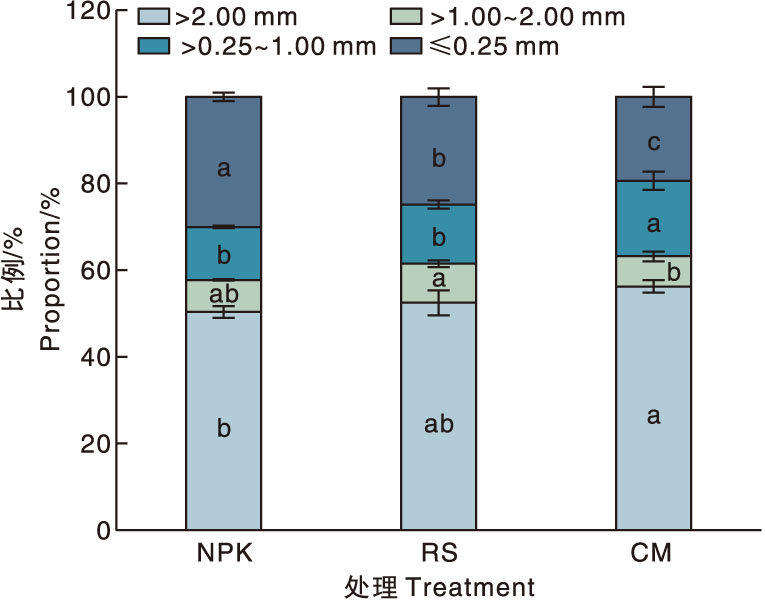
Fig.1 Distribution of soil aggregate composition under different treatments Bars marked without the same letter indicate significant (p<0.05) difference within treatments under the same particle size. The same as below.
| 处理Treatment | BD/(g·cm-3) | MWD/mm | GMD/mm | R0.25/% |
|---|---|---|---|---|
| NPK | 0.95±0.03 a | 1.73±0.01 b | 0.96±0.01 b | 69.94±1.00 b |
| RS | 0.93±0.02 ab | 1.83±0.01 ab | 1.01±0.03 ab | 75.20±1.95 ab |
| CM | 0.82±0.08 b | 1.90±0.02 a | 1.05±0.04 a | 80.61±2.30 a |
Table 1 Effects of different treatments on soil bulk density and aggregate stability
| 处理Treatment | BD/(g·cm-3) | MWD/mm | GMD/mm | R0.25/% |
|---|---|---|---|---|
| NPK | 0.95±0.03 a | 1.73±0.01 b | 0.96±0.01 b | 69.94±1.00 b |
| RS | 0.93±0.02 ab | 1.83±0.01 ab | 1.01±0.03 ab | 75.20±1.95 ab |
| CM | 0.82±0.08 b | 1.90±0.02 a | 1.05±0.04 a | 80.61±2.30 a |
| 指标 Index | 与不同粒径团聚体比例的相关系数Correlation coefficient with the proportion of aggregates with different particle sizes | |||
|---|---|---|---|---|
| >2.00 mm | >1.00~2.00 mm | >0.25~1.00 mm | ≤0.25 mm | |
| MWD | 0.69* | -0.10 | 0.87** | -0.89** |
| GMD | 0.76** | -0.22 | 0.82** | -0.90** |
| R0.25 | 0.91** | -0.12 | 0.79** | -0.920** |
Table 2 Correlation within soil aggregate stability indexes and particle size distribution
| 指标 Index | 与不同粒径团聚体比例的相关系数Correlation coefficient with the proportion of aggregates with different particle sizes | |||
|---|---|---|---|---|
| >2.00 mm | >1.00~2.00 mm | >0.25~1.00 mm | ≤0.25 mm | |
| MWD | 0.69* | -0.10 | 0.87** | -0.89** |
| GMD | 0.76** | -0.22 | 0.82** | -0.90** |
| R0.25 | 0.91** | -0.12 | 0.79** | -0.920** |
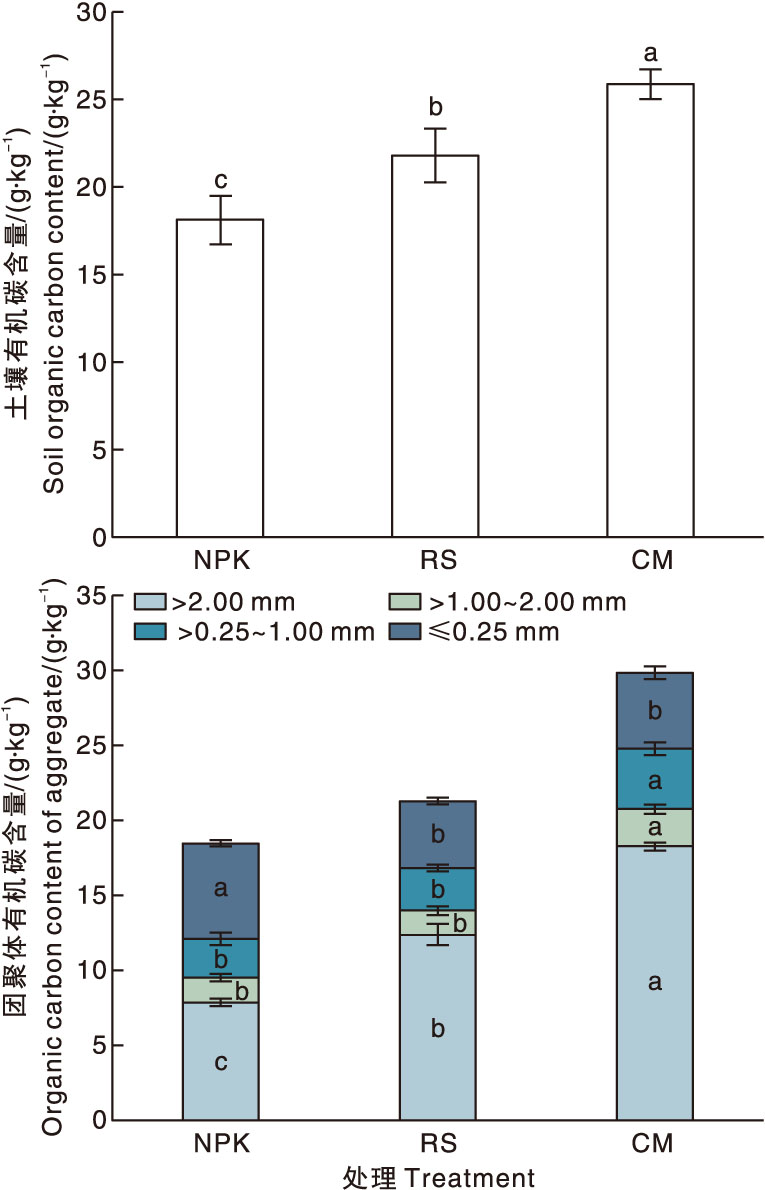
Fig.2 Soil organic carbon content and organic carbon content of aggregates with different particle sizes under different treatments Bars marked without the same letter indicate significant (p<0.05) difference. The same as below.
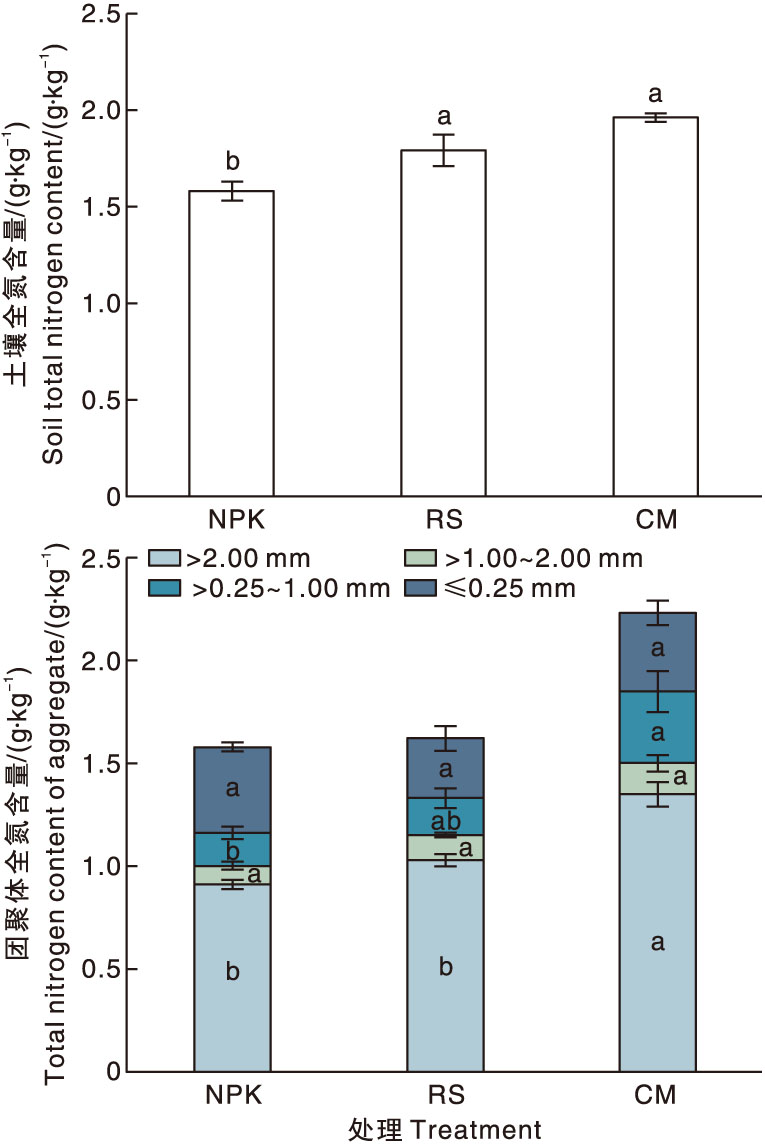
Fig.3 Soil total nitrogen content and total nitrogen content of aggregates with different particle sizes under different treatments
| 处理 Treatment | 不同粒径团聚体的有机碳储量/(t·hm-2) Organic carbon storage of soil aggregates with different particle sizes/(t·hm-2) | 不同粒径团聚体的有机碳贡献率/% Contribution rate of organic carbon in aggregates with different particle sizes/% | ||||||
|---|---|---|---|---|---|---|---|---|
| >2.00 mm | >1.00~ 2.00 mm | >0.25~ 1.00 mm | ≤0.25 mm | >2.00 mm | >1.00~ 2.00 mm | >0.25~ 1.00 mm | ≤0.25 mm | |
| NPK | 101.16±5.46 c | 2.26±0.38 a | 6.17±0.11 b | 36.36±1.72 a | 49.88±1.61 b | 7.64±0.95 a | 12.45±1.66 a | 30.06±2.31 a |
| RS | 120.70±6.11 b | 2.64±0.32 a | 7.21±0.26 b | 20.52±0.64 b | 58.16±2.03 a | 7.47±1.32 a | 13.36±1.02 a | 21.00±1.47 b |
| CM | 168.85±9.91 a | 2.96±0.18 a | 11.43±0.79 a | 16.10±1.10 c | 61.11±1.15 a | 8.41±0.92 a | 13.43±1.04 a | 17.05±1.24 b |
Table 3 Organic carbon storage and contribution rate of soil aggregates with different particle sizes under different treatments
| 处理 Treatment | 不同粒径团聚体的有机碳储量/(t·hm-2) Organic carbon storage of soil aggregates with different particle sizes/(t·hm-2) | 不同粒径团聚体的有机碳贡献率/% Contribution rate of organic carbon in aggregates with different particle sizes/% | ||||||
|---|---|---|---|---|---|---|---|---|
| >2.00 mm | >1.00~ 2.00 mm | >0.25~ 1.00 mm | ≤0.25 mm | >2.00 mm | >1.00~ 2.00 mm | >0.25~ 1.00 mm | ≤0.25 mm | |
| NPK | 101.16±5.46 c | 2.26±0.38 a | 6.17±0.11 b | 36.36±1.72 a | 49.88±1.61 b | 7.64±0.95 a | 12.45±1.66 a | 30.06±2.31 a |
| RS | 120.70±6.11 b | 2.64±0.32 a | 7.21±0.26 b | 20.52±0.64 b | 58.16±2.03 a | 7.47±1.32 a | 13.36±1.02 a | 21.00±1.47 b |
| CM | 168.85±9.91 a | 2.96±0.18 a | 11.43±0.79 a | 16.10±1.10 c | 61.11±1.15 a | 8.41±0.92 a | 13.43±1.04 a | 17.05±1.24 b |
| 处理 Treatment | 不同粒径团聚体的全氮储量/(t·hm-2) Total nitrogen storage of soil aggregates with different particle sizes/(t·hm-2) | 不同粒径团聚体的全氮贡献率/% Contribution rate of total nitrogen in aggregates with different particle sizes/% | ||||||
|---|---|---|---|---|---|---|---|---|
| >2.00 mm | >1.00~ 2.00 mm | >0.25~ 1.00 mm | ≤0.25 mm | >2.00 mm | >1.00~ 2.00 mm | >0.25~ 1.00 mm | ≤0.25 mm | |
| NPK | 8.68±0.42 b | 0.13±0.03 a | 0.37±0.08 b | 2.42±0.20 a | 57.26±1.18 b | 5.93±1.00 a | 10.01±1.74 c | 26.80±1.64 a |
| RS | 10.11±1.55 ab | 0.20±0.02 a | 0.47±0.13 b | 1.35±0.28 b | 63.29±2.87 a | 7.48±1.39 a | 11.39±1.02 b | 17.84±2.00 b |
| CM | 12.49±1.79 a | 0.17±0.07 a | 1.01±0.06 a | 1.17±0.10 b | 60.94±4.48 ab | 6.54±1.31 a | 15.71±3.43 a | 16.81±1.62 b |
Table 4 Total nitrogen storage and contribution rate of soil aggregates with different particle sizes under different treatments
| 处理 Treatment | 不同粒径团聚体的全氮储量/(t·hm-2) Total nitrogen storage of soil aggregates with different particle sizes/(t·hm-2) | 不同粒径团聚体的全氮贡献率/% Contribution rate of total nitrogen in aggregates with different particle sizes/% | ||||||
|---|---|---|---|---|---|---|---|---|
| >2.00 mm | >1.00~ 2.00 mm | >0.25~ 1.00 mm | ≤0.25 mm | >2.00 mm | >1.00~ 2.00 mm | >0.25~ 1.00 mm | ≤0.25 mm | |
| NPK | 8.68±0.42 b | 0.13±0.03 a | 0.37±0.08 b | 2.42±0.20 a | 57.26±1.18 b | 5.93±1.00 a | 10.01±1.74 c | 26.80±1.64 a |
| RS | 10.11±1.55 ab | 0.20±0.02 a | 0.47±0.13 b | 1.35±0.28 b | 63.29±2.87 a | 7.48±1.39 a | 11.39±1.02 b | 17.84±2.00 b |
| CM | 12.49±1.79 a | 0.17±0.07 a | 1.01±0.06 a | 1.17±0.10 b | 60.94±4.48 ab | 6.54±1.31 a | 15.71±3.43 a | 16.81±1.62 b |
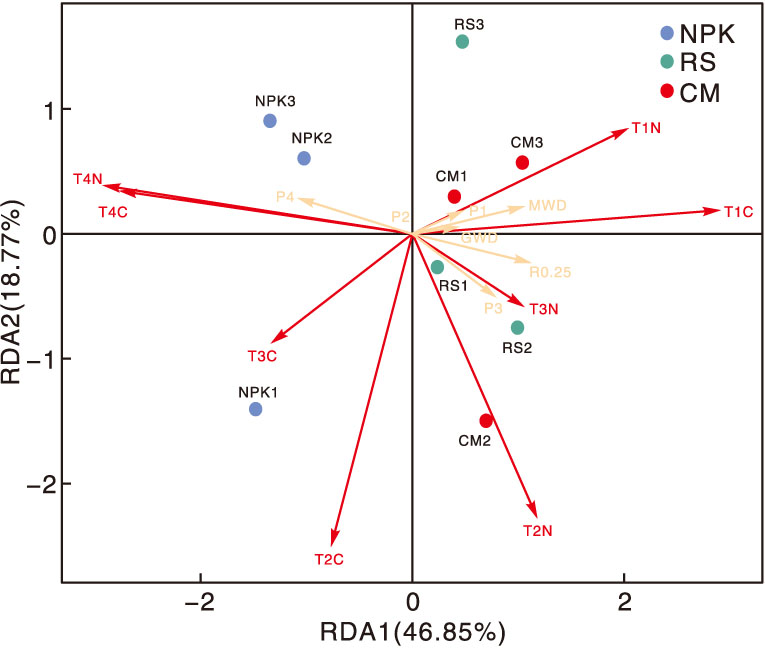
Fig.4 Redundancy analysis (RDA) between soil aggregate distribution and stability and organic carbon and total nitrogen contribution rate of soil aggregates T1C, T2C, T3C and T4C in the figure represent the contribution rate of organic carbon in aggregates with particle sizes of >2.00,>1.00~2.00,>0.25~1.00, ≤0.25 mm, respectively; T1N, T2N, T3N, T4N represent the contribution rate of total nitrogen in aggregates with particle sizes of >2.00, >1.00~2.00, >0.25~1.00, ≤0.25 mm, respectively; P1, P2, P3 and P4 represent the proportion of aggregates with particle sizes of >2.00, >1.00~2.00, >0.25~1.00, ≤0.25 mm, respectively; MWD, GMD and R0.25 represent the average weight diameter, geometric average diameter, and the proportion (mass froction) of aggregates with particle size >0.25 mm, respectively; NPK1, NPK2, NPK3 represent three replicates of NPK treatment, and the remaining points are represented analogously.
| [30] | 陆太伟, 蔡岸冬, 徐明岗, 等. 施用有机肥提升不同土壤团聚体有机碳含量的差异性[J]. 农业环境科学学报, 2018, 37(10): 2183-2193. |
| LU T W, CAI A D, XU M G, et al. Variation in sequestration of organic carbon associated with differently sized aggregates after organic manure application[J]. Journal of Agro-Environment Science, 2018, 37(10): 2183-2193. | |
| [31] | 田慎重, 王瑜, 张玉凤, 等. 旋耕转深松和秸秆还田增加农田土壤团聚体碳库[J]. 农业工程学报, 2017, 33(24): 133-140. |
| TIAN S Z, WANG Y, ZHANG Y F, et al. Residue returning with subsoiling replacing rotary tillage improving aggregate and associated carbon[J]. Transactions of the Chinese Society of Agricultural Engineering, 2017, 33(24): 133-140. | |
| [32] | 刘敏, 吴敬芳, 黄星瑜, 等. 有机肥替代氮肥对水稻产量、品质及土壤肥力的影响[J]. 江西农业学报, 2024, 36(7): 1-6. |
| LIU M, WU J F, HUANG X Y, et al. Effects of organic fertilizer replacing nitrogen fertilizer on rice yield, quality and soil fertility[J]. Acta Agriculturae Jiangxi, 2024, 36(7): 1-6. | |
| [33] | 毛伟, 李文西, 赵雨涵, 等. 有机肥替代部分化肥对水稻产量及土壤理化性质的影响[J]. 农学学报, 2021, 11(8): 32-36. |
| MAO W, LI W X, ZHAO Y H, et al. Effects of organic fertilizer substitute for chemical fertilizer on rice yield and soil physicochemical properties[J]. Journal of Agriculture, 2021, 11(8): 32-36. | |
| [1] | 熊瑞, 欧阳宁, 欧茜, 等. 秸秆还田与耕作方式对双季稻土壤团聚体及碳氮含量的影响[J]. 浙江农业学报, 2024, 36(6): 1347-1356. |
| XIONG R, OUYANG N, OU Q, et al. Effect of straw returning and tillage method on soil aggregates and carbon, nitrogen content in double-season rice[J]. Acta Agriculturae Zhejiangensis, 2024, 36(6): 1347-1356. | |
| [34] | 肖霜霜, 叶莹莹, 张伟, 等. 干扰/利用方式对喀斯特石灰土团聚体分布及其碳氮含量的影响[J]. 生态学杂志, 2016, 35(5): 1140-1146. |
| XIAO S S, YE Y Y, ZHANG W, et al. Carbon and nitrogen contents in calcareous soil aggregates affected by disturbance and land use in karst region, China[J]. Chinese Journal of Ecology, 2016, 35(5): 1140-1146. | |
| [2] | 常玥昕, 王俊, 杨彩迪, 等. 秸秆还田对黄土高原典型农田土壤团聚体组成及其碳组分的影响[J]. 环境科学, 2025, 46(10): 6531-6538. |
| CHANG Y X, WANG J, YANG C D, et al. Effect of straw return on soil aggregate composition and carbon fractions in typical farmland of the Loess Plateau[J]. Environmental Science, 2025, 46(10): 6531-6538. | |
| [35] | 廖雅汶, 廖萍, 刘建秀, 等. 秸秆生物炭对红壤菜地土壤团聚体组成及其碳氮分布的短期效应[J]. 扬州大学学报(农业与生命科学版), 2023, 44(5): 41-48. |
| LIAO Y W, LIAO P, LIU J X, et al. Short-term effects of straw biochar on the composition of soil aggregates and their carbon and nitrogen distribution in red soil vegetable fields[J]. Journal of Yangzhou University(Agricultural and Life Science Edition), 2023, 44(5): 41-48. | |
| [36] | 区晓琳, 陈志彪, 陈志强, 等. 亚热带侵蚀红壤区植被恢复过程中土壤团聚体化学计量特征[J]. 土壤学报, 2018, 55(5): 1156-1167. |
| OU X L, CHEN Z B, CHEN Z Q, et al. Stoichiometrc characteristics of soil aggregates in subtropical eroded red soil under vegetation restoration[J]. Acta Pedologica Sinica, 2018, 55(5): 1156-1167. | |
| [37] | 俞巧钢, 杨艳, 邹平, 等. 有机物料对稻田土壤团聚体及有机碳分布的影响[J]. 水土保持学报, 2017, 31(6): 170-175. |
| YU Q G, YANG Y, ZOU P, et al. Effect of organic materials application on soil aggregate and soil organic carbon in rice fields[J]. Journal of Soil and Water Conservation, 2017, 31(6): 170-175. | |
| [38] | 吴嘉俊, 童文彬, 江建锋, 等. 水稻秸秆炭施用对水稻土团聚体稳定性及其碳氮分布的影响[J]. 植物营养与肥料学报, 2024, 30(3): 457-468. |
| WU J J, TONG W B, JIANG J F, et al. Application of rice straw biochar increases soil aggregate stability and carbon and nitrogen distribution in paddy soil[J]. Journal of Plant Nutrition and Fertilizers, 2024, 30(3): 457-468. | |
| [3] | MAO X L, SUN T, ZHU L J, et al. Microbial adaption to stoichiometric imbalances regulated the size of soil mineral-associated organic carbon pool under continuous organic amendments[J]. Geoderma, 2024, 445: 116883. |
| [4] | 陈晓玲, 王飞, 章逸敏, 等. 长期化肥与有机物料配施对黄泥田水稻籽粒氨基酸及主要矿质元素含量的影响[J]. 土壤通报, 2024, 55(3): 729-735. |
| CHEN X L, WANG F, ZHANG Y M, et al. Effects of long-term fertilization and organic material combination on amino acid and major mineral element contents of rice grains in yellow-mud field[J]. Chinese Journal of Soil Science, 2024, 55(3): 729-735. | |
| [5] | 王利民, 黄东风, 何春梅, 等. 紫云英还田对黄泥田土壤理化和微生物特性及水稻产量的影响[J]. 生态学报, 2023, 43(11): 4782-4797. |
| WANG L M, HUANG D F, HE C M, et al. Impacts of the Chinese milk vetch (Astragalus sinicus L.) residue incorporation on soil physicochemical, microbial properties and rice yields in yellow-mud paddy field[J]. Acta Ecologica Sinica, 2023, 43(11): 4782-4797. | |
| [6] | 尤赛雅, 王新雅, 秦碧蓉, 等. 新复垦耕地不同有机物料培肥效果及其评价指标优化[J]. 中国水稻科学, 2025, 39(5): 690-702. |
| YOU S Y, WANG X Y, QIN B R, et al. Fertilization effects of different exogenous organic materials in newly reclaimed cultivated land and its optimization of evaluation indicators[J]. Chinese Journal of Rice Science, 2025, 39(5): 690-702. | |
| [7] | 杨永辉, 张运红, 高翠民, 等. 长期增施有机肥对土壤物理特征、微生物生物量碳氮及土壤酶活性的影响[J]. 干旱地区农业研究, 2025, 43(3): 107-115. |
| YANG Y H, ZHANG Y H, GAO C M, et al. Effects of long-term organic fertilizer application on soil properties, microbial biomass, carbon and nitrogen content, and soil enzyme activity[J]. Agricultural Research in the Arid Areas, 2025, 43(3): 107-115. | |
| [8] | 李冰洁, 高菊生, 段英华, 等. 长期秸秆还田水稻土团聚体内铁结合态有机碳的分布特征及其性质[J]. 植物营养与肥料学报, 2025, 31(4): 621-630. |
| LI B J, GAO J S, DUAN Y H, et al. Distribution and properties of iron-bound organic carbon of aggregates in paddy soil under long-term straw incorporation[J]. Journal of Plant Nutrition and Fertilizers, 2025, 31(4): 621-630. | |
| [9] | 宋旭昕, 刘同旭. 土壤铁矿物形态转化影响有机碳固定研究进展[J]. 生态学报, 2021, 41(20): 7928-7938. |
| SONG X X, LIU T X. Effects of soil iron mineral transformation on organic carbon sequestration: a review[J]. Acta Ecologica Sinica, 2021, 41(20): 7928-7938. | |
| [10] | 段勋, 李哲, 刘淼, 等. 铁介导的土壤有机碳固持和矿化研究进展[J]. 地球科学进展, 2022, 37(2): 202-211. |
| DUAN X, LI Z, LIU M, et al. Progress of the iron-mediated soil organic carbon preservation and mineralization[J]. Advances in Earth Science, 2022, 37(2): 202-211. | |
| [11] | 湛凯翔, 龙健, 李娟, 等. 施用有机物料对黄壤团聚体稳定性及有机碳含量的影响[J]. 土壤通报, 2024, 55(5): 1282-1291. |
| ZHAN K X, LONG J, LI J, et al. Effects of applying organic materials on aggregate stability and organic carbon in yellow soil[J]. Chinese Journal of Soil Science, 2024, 55(5): 1282-1291. | |
| [12] | 秦崧悦, 吴新亮, 褚保森, 等. 贺兰山不同坡向和海拔梯度土壤团聚体组成和稳定性变化特征及其影响因素[J]. 生态学报, 2024, 44(17): 7770-7785. |
| QIN S Y, WU X L, CHU B S, et al. Characteristics and influencing factors of soil aggregate composition and stability under different slope orientation and elevation gradients in Helan Mountain[J]. Acta Ecologica Sinica, 2024, 44(17): 7770-7785. | |
| [13] | 李天姿, 张彦军, 党水纳, 等. 耕作和秸秆还田影响农田土壤团聚体分布及有机碳的整合分析[J]. 环境科学, 2025, 46(9): 5694-5704. |
| LI T Z, ZHANG Y J, DANG S N, et al. Effects of tillage and straw return on the distribution of soil aggregates and integration of organic carbon in farmland soil[J]. Environmental Science, 2025, 46(9): 5694-5704. | |
| [14] | JU F F, CHEN L Z, KONG Y Y, et al. Abiotic chlorination of organic matter in the soil environment: a simulation study[J]. Organic Geochemistry, 2024, 198: 104877. |
| [15] | 徐江兵, 李成亮, 何园球, 等. 不同施肥处理对旱地红壤团聚体中有机碳含量及其组分的影响[J]. 土壤学报, 2007, 44(4): 675-682. |
| XU J B, LI C L, HE Y Q, et al. Effect of fertilization on organic carbon content and fractionation of aggregates in upland red soil[J]. Acta Pedologica Sinica, 2007, 44(4): 675-682. | |
| [16] | 吴鹏豹, 解钰, 漆智平, 等. 生物炭对花岗岩砖红壤团聚体稳定性及其总碳分布特征的影响[J]. 草地学报, 2012, 20(4): 643-649. |
| WU P B, XIE Y, QI Z P, et al. Effects of biochar on stability and total carbon distribution of aggregates in granitic laterite[J]. Acta Agrestia Sinica, 2012, 20(4): 643-649. | |
| [17] | 方凯, 孙丽丽, 周昌敏, 等. 长期秸秆还田对双季稻土壤有机碳组分及碳库管理指数的影响[J]. 福建农业学报, 2022, 37(9): 1216-1224. |
| FANG K, SUN L L, ZHOU C M, et al. Effects of long-term spent straw incorporation on organic carbons in soil and carbon pool management at two-crop rice fields[J]. Fujian Journal of Agricultural Sciences, 2022, 37(9): 1216-1224. | |
| [18] | 王飞, 李清华, 何春梅, 等. 不同施肥处理对黄泥田团聚体有机碳固持及其组分的影响[J]. 中国生态农业学报(中英文), 2023, 31(2): 315-324. |
| WANG F, LI Q H, HE C M, et al. Long-term fertilization effects on soil aggregates organic carbon sequestration and distribution in a yellow-mud paddy soil[J]. Chinese Journal of Eco-Agriculture, 2023, 31(2): 315-324. | |
| [19] | 陈超, 宓文海, 居静, 等. 长期不同施肥模式对中低产黄泥田土壤团聚体组成及碳组分的影响[J]. 华北农学报, 2022, 37(3): 168-174. |
| CHEN C, MI W H, JU J, et al. Effect of long-term different fertilization pattern on soil aggregate composition and organic carbon fractions in yellow clayey paddy soil[J]. Acta Agriculturae Boreali-Sinica, 2022, 37(3): 168-174. | |
| [20] | 廖超林, 黎丽娜, 谢丽华, 等. 增减施有机肥对红壤性水稻土团聚体稳定性及胶结物的影响[J]. 土壤学报, 2021, 58(4): 978-988. |
| LIAO C L, LI L N, XIE L H, et al. Effect of increased or decreased application of organic manure on aggregates stability and soil cement in red paddy soil[J]. Acta Pedologica Sinica, 2021, 58(4): 978-988. | |
| [21] | 孟艳, 沈亚文, 孟维伟, 等. 生物炭施用对农田土壤团聚体及有机碳影响的整合分析[J]. 环境科学, 2023, 44(12): 6847-6856. |
| MENG Y, SHEN Y W, MENG W W, et al. Effect of biochar on agricultural soil aggregates and organic carbon: a meta-analysis[J]. Environmental Science, 2023, 44(12): 6847-6856. | |
| [22] | 邓华, 高明, 龙翼, 等. 生物炭和秸秆还田对紫色土旱坡地土壤团聚体与有机碳的影响[J]. 环境科学, 2021, 42(11): 5481-5490. |
| DENG H, GAO M, LONG Y, et al. Effects of biochar and straw return on soil aggregate and organic carbon on purple soil dry slope land[J]. Environmental Science, 2021, 42(11): 5481-5490. | |
| [23] | 柴晶晶, 刘振华, 安桦, 等. 轮作油菜提高石灰性土壤固碳能力及团聚体稳定性[J]. 中国油料作物学报, 2025, 47(3): 743-753. |
| CHAI J J, LIU Z H, AN H, et al. Crop rotation of rapeseed improves carbon sequestration capacity and aggregate stability of calcareous soil[J]. Chinese Journal of Oil Crop Sciences, 2025, 47(3): 743-753. | |
| [24] | 范倩玉, 刘振华, 李晋, 等. 不同轮作模式对潮土团聚体及其有机碳分布的影响[J]. 应用与环境生物学报, 2021, 27(1): 81-88. |
| FAN Q Y, LIU Z H, LI J, et al. Effects of different crop rotation patterns on soil aggregates and organic carbon distribution in fluvo-aquic soil[J]. Chinese Journal of Applied & Environmental Biology, 2021, 27(1): 81-88. | |
| [25] | 何冰, 李廷亮, 栗丽, 等. 采煤塌陷区复垦土壤团聚体碳氮分布对施肥的响应[J]. 水土保持学报, 2018, 32(4): 184-189. |
| HE B, LI T L, LI L, et al. Response of carbon and nitrogen distribution of reclaimed soil aggregates to fertilizers in coal mining subsidence area[J]. Journal of Soil and Water Conservation, 2018, 32(4): 184-189. | |
| [26] | 程乙, 任昊, 刘鹏, 等. 不同栽培管理模式对农田土壤团聚体组成及其碳、氮分布的影响[J]. 应用生态学报, 2016, 27(11): 3521-3528. |
| CHENG Y, REN H, LIU P, et al. Effects of different cultivation practices on composition, carbon and nitrogen distribution of soil aggregates in farmlands[J]. Chinese Journal of Applied Ecology, 2016, 27(11): 3521-3528. | |
| [27] | 庞津雯, 王钰皓, 陶宏扬, 等. 生物炭不同添加量对旱作覆膜农田土壤团聚体特性及有机碳含量的影响[J]. 中国农业科学, 2023, 56(9): 1729-1743. |
| PANG J W, WANG Y H, TAO H Y, et al. Effects of different biochar application rates on soil aggregate characteristics and organic carbon contents for film-mulching field in semiarid areas[J]. Scientia Agricultura Sinica, 2023, 56(9): 1729-1743. | |
| [28] | 徐香茹, 汪景宽. 土壤团聚体与有机碳稳定机制的研究进展[J]. 土壤通报, 2017, 48(6): 1523-1529. |
| XU X R, WANG J K. A review on different stabilized mechanisms of soil aggregates and organic carbon[J]. Chinese Journal of Soil Science, 2017, 48(6): 1523-1529. | |
| [29] | 张平良, 刘晓伟, 曾骏, 等. 长期施用有机肥对西北半干旱区小麦田土壤团聚体分布及其有机碳的影响[J]. 中国土壤与肥料, 2024(4): 1-8. |
| ZHANG P L, LIU X W, ZENG J, et al. Effects of long-term organic manure application on the distribution and organic carbon content of soil aggregates in wheat field of northwest semi-arid region[J]. Soil and Fertilizer Sciences in China, 2024(4): 1-8. |
| [1] | LIN Xiaobing, LI Jiang, CHENG Yanhong, WANG Binqiang, HE Shaolang, HUANG Shangshu, HUANG Qianru. Effects of organic materials on soil microbial biomass, mineral nitrogen content and rice yield [J]. Acta Agriculturae Zhejiangensis, 2025, 37(6): 1309-1318. |
| [2] | LIAO Yanfeng, ZHOU Jiahao, YAN Xinyu, LIU Junyao, LI Tao, ZHU Hai, YANG Jun. Research progress on the mechanisms of extracellular polymeric substances (EPS) in stabilizing soil aggregates and organic carbon [J]. Acta Agriculturae Zhejiangensis, 2025, 37(11): 2408-2425. |
| [3] | WANG Yunlong, JIA Shengqiang, CUI Lingyu, LYU Haohao, SHEN Alin, SU Yao. Interactions of soil carbon and nitrogen distribution with nitrogen fixing and denitrifying bacteria community under straw returning [J]. Acta Agriculturae Zhejiangensis, 2025, 37(10): 2150-2164. |
| [4] | XU Junyan, QIU Gaoyang, LIU Junli, GUO Bin, LI Hua, CHEN Xiaodong, WANG Yuan, FU Qinglin. Effects of montmorillonite, kaolinite and basalt on soil carbon sequestration [J]. Acta Agriculturae Zhejiangensis, 2024, 36(8): 1867-1877. |
| [5] | XIONG Rui, OUYANG Ning, OU Xi, ZHONG Kangyu, ZHOU Wentao, WANG Hongrui, LONG Pan, XU Ying, FU Zhiqiang. Effect of straw returning and tillage method on soil aggregates and carbon, nitrogen content in double-season rice [J]. Acta Agriculturae Zhejiangensis, 2024, 36(6): 1347-1356. |
| [6] | AI Ran, HE Jie, LIN Haizhong, WENG Liqing, CHEN Zhaoming, MA Junwei, WANG Qiang. Soil organic carbon content and structural characteristics in water bamboo fields with different cultivation time [J]. Acta Agriculturae Zhejiangensis, 2024, 36(11): 2558-2565. |
| [7] | ZHA Guichao, SUN Xiangyang, LI Suyan, YU Lei, YUE Zongwei, WANG Chenchen, WEI Ningxian, XU Xijie. Characteristics of soil organic carbon and its components in different green space types in Tongzhou District of Beijing, China [J]. Acta Agriculturae Zhejiangensis, 2023, 35(7): 1699-1708. |
| [8] | HAO Liuliu, DAI Lili, PENG Liang, CHEN Siyuan, TAO Ling, LI Gu, ZHANG Hui. Active organic carbon, microbial community structure and their relationship in rice rhizosphere soil of rice-crayfish co-culture systems [J]. Acta Agriculturae Zhejiangensis, 2023, 35(12): 2901-2913. |
| [9] | JIA Shengqiang, FAN Huishan, CHEN Xijing, YU Man, SHEN Alin, SU Yao. Driving mechanism of soil denitrifying bacterial community by soil organic carbon after long-term of straw return [J]. Acta Agriculturae Zhejiangensis, 2021, 33(9): 1686-1699. |
| [10] | ZHANG Qingqing, LIANG Jing, WU Haibing, ZHENG Sijun, HUANG Junhua. Effect of land use change on soil organic carbon pool in process of urbanization: a case study of Sanlin Green Wedge, Shanghai [J]. Acta Agriculturae Zhejiangensis, 2021, 33(6): 1062-1068. |
| [11] | JIN Yanan, ZHANG Baifa, HAO Yun, WU Jianhong, LYU Jun. Dynamic analysis of river nitrogen and phosphorus pollution based on LOADEST model and wavelet transform [J]. , 2020, 32(9): 1692-1701. |
| [12] | SHI Chuanqi, HU Baozhong, YU Shaopeng, MENG Bo, YANG Chunxue, LIU Jia, DING Junnan. Water purification effect of Ceratophyllum demersum L. and change of microbial community under different treatments [J]. , 2020, 32(6): 1070-1081. |
| [13] | XIA Wenjian, QIN Wenjing, LIU Jia, CHEN Xiaofen, ZHANG Lifang, CAO Weidong, XU Changxu, CHEN Jingrui. Vertical distribution of soil organic carbon and dissolved organic carbon in reddish paddy soil under long-term green manure utilization [J]. , 2020, 32(5): 878-885. |
| [14] | JIAN Xing, ZHAI Xiaoyu, WANG Yu, CAI Yangyang. Influence of land use changes on soil total organic carbon and dissolved organic carbon in wetland [J]. , 2020, 32(3): 475-482. |
| [15] | YANG Hongyun, LUO Jianjun, SUN Aizhen, WAN Ying, YI Wenlong. Study on estimation model of total nitrogen content in rice leaves based on image characteristics [J]. Acta Agriculturae Zhejiangensis, 2020, 32(12): 2232-2243. |
| Viewed | ||||||
|
Full text |
|
|||||
|
Abstract |
|
|||||

