Acta Agriculturae Zhejiangensis ›› 2026, Vol. 38 ›› Issue (4): 731-744.DOI: 10.3969/j.issn.1004-1524.20250738
• Environmental Science • Previous Articles Next Articles
Long-term effects of combined application of biochar and biogas slurry on nitrogen transformation in acidic red soil
YING Mengfei1( ), GUAN Yilun2, JIN Zewen2,*(), ZHAO Kun3, PING Lifeng2, CHAI Yanjun2, LI Yan4, SHEN Yue5, YAN Jun5
- 1
Shaoxing Grain and Oil Crops Technology Promotion Center Shaoxing 312000, China
2Key Laboratory of Recycling and Eco-Treatment of Waste Biomass of Zhejiang Province ,School of Environment and Natural Resources, Zhejiang University of Science and Technology Hangzhou 310023, China
3College of Information Science and Technology ,Zhejiang Shuren University Hangzhou 310015, China
4Institute of Environment ,Resource, Soil and Fertilizer, Zhejiang Academy of Agricultural Sciences Hangzhou 310021, China
5Zhejiang Cultivated Land Quality and Fertilizer Administration Station Hangzhou 310020, China
-
Received:2025-12-06Online:2026-04-25Published:2026-05-08 -
Contact:JIN Zewen

CLC Number:
Cite this article
YING Mengfei, GUAN Yilun, JIN Zewen, ZHAO Kun, PING Lifeng, CHAI Yanjun, LI Yan, SHEN Yue, YAN Jun. Long-term effects of combined application of biochar and biogas slurry on nitrogen transformation in acidic red soil[J]. Acta Agriculturae Zhejiangensis, 2026, 38(4): 731-744.
share this article
Add to citation manager EndNote|Ris|BibTeX
URL: http://www.zjnyxb.cn/EN/10.3969/j.issn.1004-1524.20250738
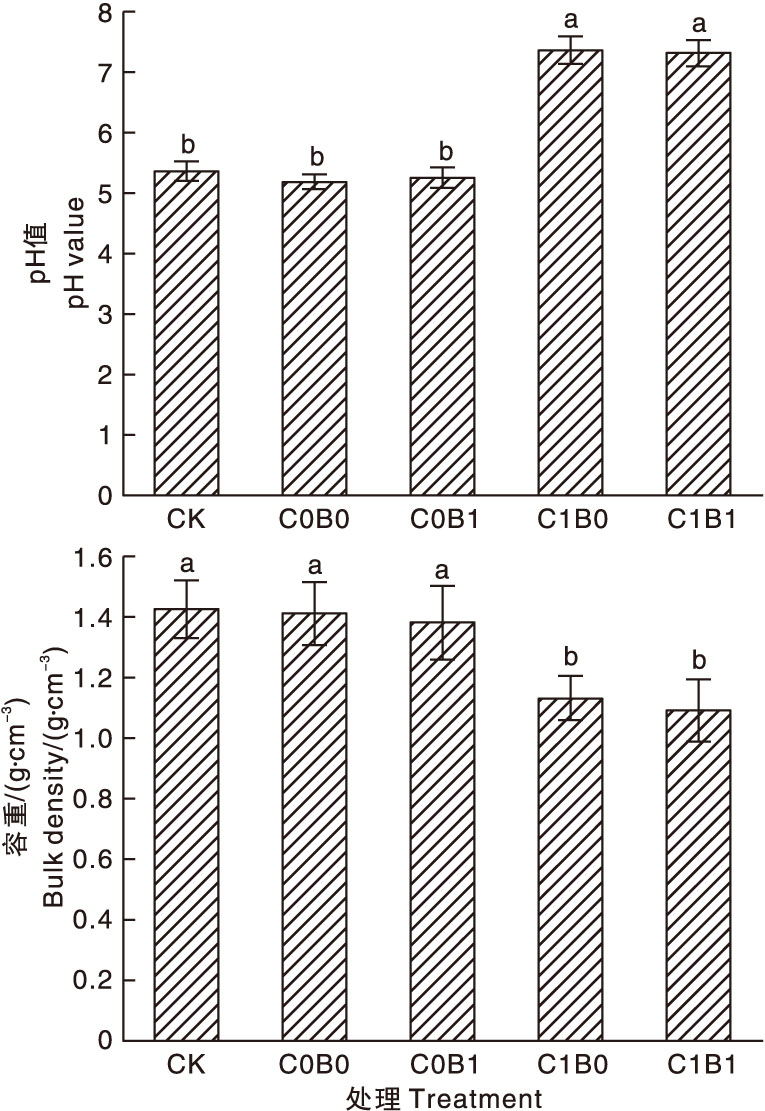
Fig.1 Soil pH value and bulk density under biochar and biogas slurry treatments Bars marked without the same letters indicate significant difference at p<0.05. The same as below.
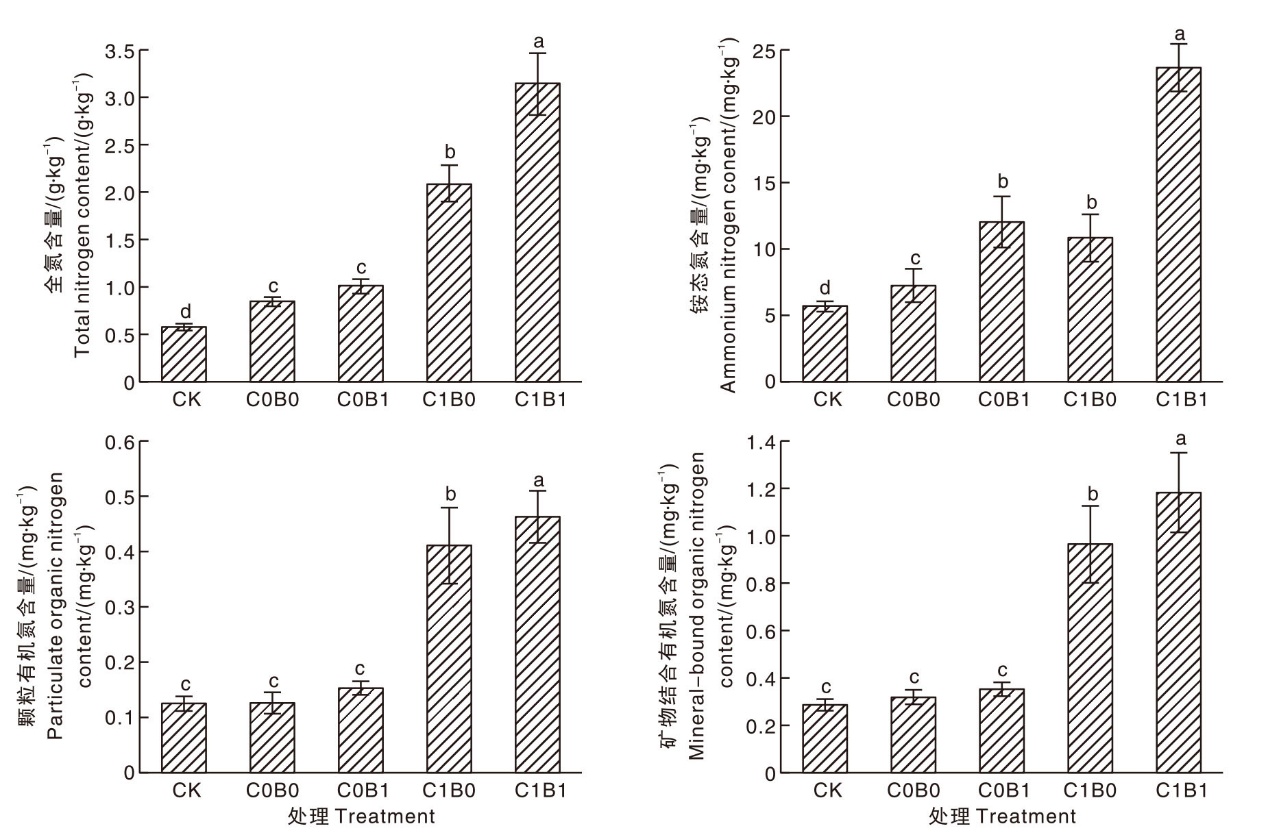
Fig.2 Contents of soil total nitrogen, ammonium nitrogen, particulate organic nitrogen (PON) and mineral-associated organic nitrogen (MAON) under biochar and biogas slurry treatments
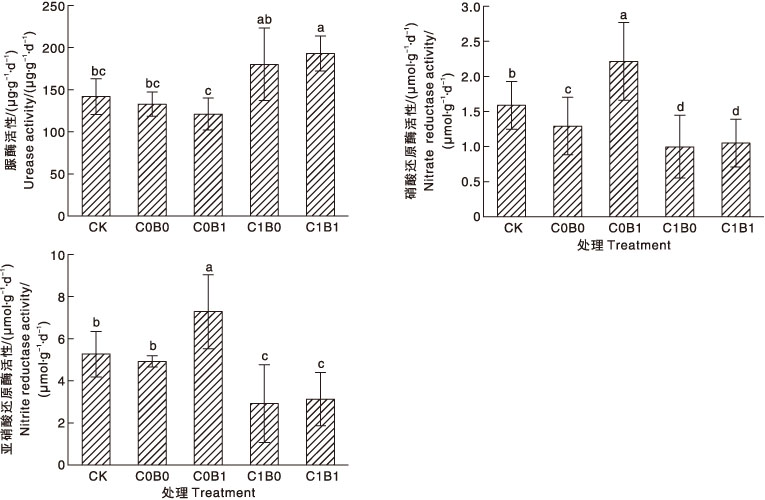
Fig.3 Activities of soil urease, nitrate reductase and nitrite reductase under biochar and biogas slurry treatments
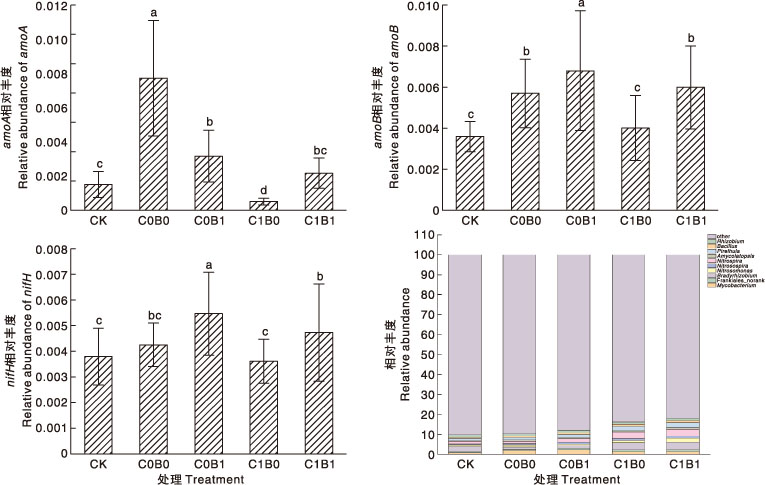
Fig.4 Soil functional genes abundance and microbial relative abundance under biochar and biogas slurry treatments
| 处理 Treatment | 历年产量r/(t·hm-2) Yield in each year/(t·hm-2) | AEN/(kg· kg-1) | |||||
|---|---|---|---|---|---|---|---|
| 2020 | 2021 | 2022 | 2023 | 2024 | 平均值Mean | ||
| CK | 4.38±0.31 c | 5.03±0.44 c | 4.07±0.56 c | 3.61±0.27 c | 2.14±0.44 c | 3.85±0.38 c | 0 |
| C0B0 | 21.67±2.42 b | 22.34±1.34 b | 23.09±2.65 b | 19.28±1.24 b | 15.71±2.39 b | 20.42±2.01 b | 86.3 |
| C0B1 | 25.22±3.20 b | 23.90±2.21 b | 22.28±2.37 b | 21.39±2.26 b | 16.07±1.73 b | 21.77±2.24 b | 93.3 |
| C1B0 | 47.58±3.76 a | 46.92±4.32 a | 47.05±6.64 a | 46.39±4.28 a | 42.09±4.32 a | 46.00±5.35 a | 219.5 |
| C1B1 | 49.76±5.25 a | 46.82±3.36 a | 46.40±4.32 a | 44.83±5.76 a | 43.06±2.28 a | 46.17±3.98 a | 220.4 |
Table 1 Yield and agronomic efficiency of nitrogen (AEN) of sweet potato under biochar and biogas slurry treatments
| 处理 Treatment | 历年产量r/(t·hm-2) Yield in each year/(t·hm-2) | AEN/(kg· kg-1) | |||||
|---|---|---|---|---|---|---|---|
| 2020 | 2021 | 2022 | 2023 | 2024 | 平均值Mean | ||
| CK | 4.38±0.31 c | 5.03±0.44 c | 4.07±0.56 c | 3.61±0.27 c | 2.14±0.44 c | 3.85±0.38 c | 0 |
| C0B0 | 21.67±2.42 b | 22.34±1.34 b | 23.09±2.65 b | 19.28±1.24 b | 15.71±2.39 b | 20.42±2.01 b | 86.3 |
| C0B1 | 25.22±3.20 b | 23.90±2.21 b | 22.28±2.37 b | 21.39±2.26 b | 16.07±1.73 b | 21.77±2.24 b | 93.3 |
| C1B0 | 47.58±3.76 a | 46.92±4.32 a | 47.05±6.64 a | 46.39±4.28 a | 42.09±4.32 a | 46.00±5.35 a | 219.5 |
| C1B1 | 49.76±5.25 a | 46.82±3.36 a | 46.40±4.32 a | 44.83±5.76 a | 43.06±2.28 a | 46.17±3.98 a | 220.4 |
| 处理 Treatment | 历年产量/(t·hm-2) Yield in each year/(t·hm-2) | AEN/(kg· kg-1) | |||||
|---|---|---|---|---|---|---|---|
| 2020 | 2021 | 2022 | 2023 | 2024 | 平均值Mean | ||
| CK | 3.16±0.34 c | 3.51±0.28 c | 2.90±0.25 c | 3.67±0.43 c | 3.39±0.52 c | 3.33±0.46 c | 0 |
| C0B0 | 43.65±3.35 b | 36.49±3.56 b | 32.86±2.28 b | 27.36±2.29 b | 20.31±3.34 b | 32.13±2.89 b | 127.4 |
| C0B1 | 46.55±4.48 b | 41.11±7.21 b | 36.72±3.56 b | 33.78±4.21 b | 25.92±3.25 b | 36.82±4.43 b | 148.1 |
| C1B0 | 64.01±5.27 a | 58.24±6.25 a | 51.31±4.89 a | 52.44±3.56 a | 45.45±5.56 a | 54.29±4.76 a | 225.5 |
| C1B1 | 66.11±6.12 a | 60.56±5.73 a | 55.26±5.56 a | 52.27±6.25 a | 47.37±5.23 a | 56.31±5.48 a | 234.4 |
Table 2 Yield and agronomic efficiency of nitrogen (AEN) of Chinese cabbage under biochar and biogas slurry treatments
| 处理 Treatment | 历年产量/(t·hm-2) Yield in each year/(t·hm-2) | AEN/(kg· kg-1) | |||||
|---|---|---|---|---|---|---|---|
| 2020 | 2021 | 2022 | 2023 | 2024 | 平均值Mean | ||
| CK | 3.16±0.34 c | 3.51±0.28 c | 2.90±0.25 c | 3.67±0.43 c | 3.39±0.52 c | 3.33±0.46 c | 0 |
| C0B0 | 43.65±3.35 b | 36.49±3.56 b | 32.86±2.28 b | 27.36±2.29 b | 20.31±3.34 b | 32.13±2.89 b | 127.4 |
| C0B1 | 46.55±4.48 b | 41.11±7.21 b | 36.72±3.56 b | 33.78±4.21 b | 25.92±3.25 b | 36.82±4.43 b | 148.1 |
| C1B0 | 64.01±5.27 a | 58.24±6.25 a | 51.31±4.89 a | 52.44±3.56 a | 45.45±5.56 a | 54.29±4.76 a | 225.5 |
| C1B1 | 66.11±6.12 a | 60.56±5.73 a | 55.26±5.56 a | 52.27±6.25 a | 47.37±5.23 a | 56.31±5.48 a | 234.4 |
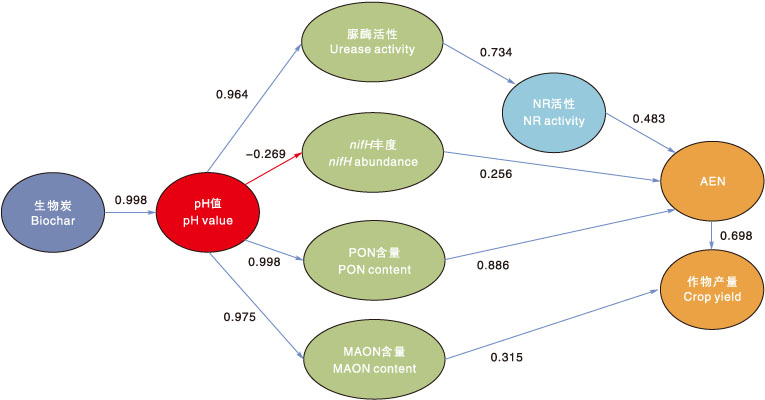
Fig.5 Structural equation model of soil pH value under biochar regulation on nitrogen transformation, soil properties and crop yield Ellipses represent observed/latent variables: exogenous driver (biochar), mediators [soil pH value, urease activity, nitrate reductase (NR) activity, (relative) abundance of nitrogen-fixing functional gene nifH, particulate organic nitrogen (PON) content, mineral-associated organic nitrogen (MAON) content], and responses [agronomic efficiency of nitrogen (AEN), crop yield]. Arrows indicate the causal paths between variables. The values on the lines are standardized path coefficients, and the absolute value reflects the strength of the effect. The direction of the arrow represents the direction of the effect [blue arrows are significantly (p<0.05) positive paths, red arrow is significantly negative path].
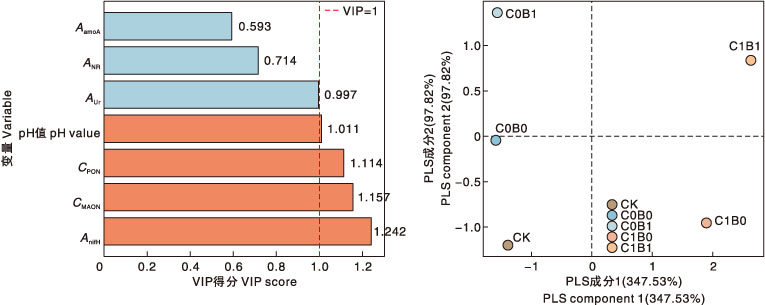
Fig.6 Partial least squares regression (PLS) analysis of factors influencing crop yield and agronomic efficiency of nitrogen AamoA, Relative abundance of amoA gene; ANR, Nitrate reductase activity; AUr, Urease activity; cPON, Particulate organic nitrogen content; cMAON, Mineral-associated organic nitrogen content; AnifH, Relative abundance of nifH gene. The same as below. Left panel shows PLS variable importance (VIP score), with the red dashed line indicating the VIP=1 threshold (variables with VIP>1 contribute more to model explanation). Right panel shows PLS component score plot.
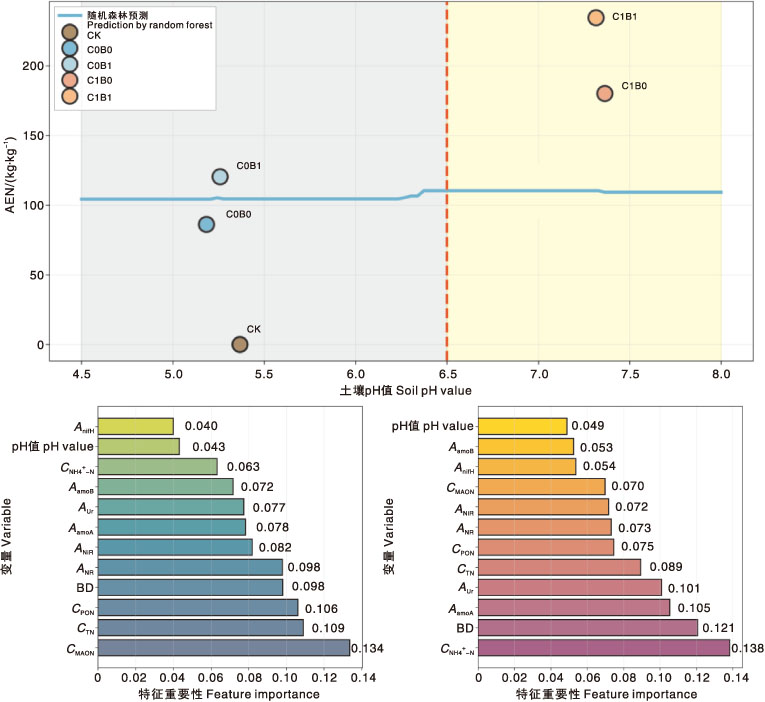
Fig.7 Important variables identified by random forest model affecting agronomic efficiency of nitrogen (AEN) and their relative importance ${c}_{\mathrm{N}{\mathrm{H}}_{4}^{+}\mathrm{-}\mathrm{N}}$, Ammonium nitrogen content; AamoB, Relative abundance of amoB gene; ANiR, Nitrite reductase activity; BD, Bulk density; cTN, Total nitrogen content. The same as below.Top panel shows the random forest prediction curve illustrating the relationship between soil pH value and agronomic efficiency of nitrogen (AEN). The red dashed line in the top panel indicates the critical threshold of pH value of 6.5, with the left gray area representing the acidic region (pH value<6.5) and the right yellow area representing the neutral-alkaline region (pH value >6.5). The left part of the bottom panel shows the feature importance ranking for agronomic efficiency of nitrogen (determination coefficient of 0.916 1). The right part of the bottom panel shows the feature importance ranking for crop yield (determination coefficient of 0.765 5).
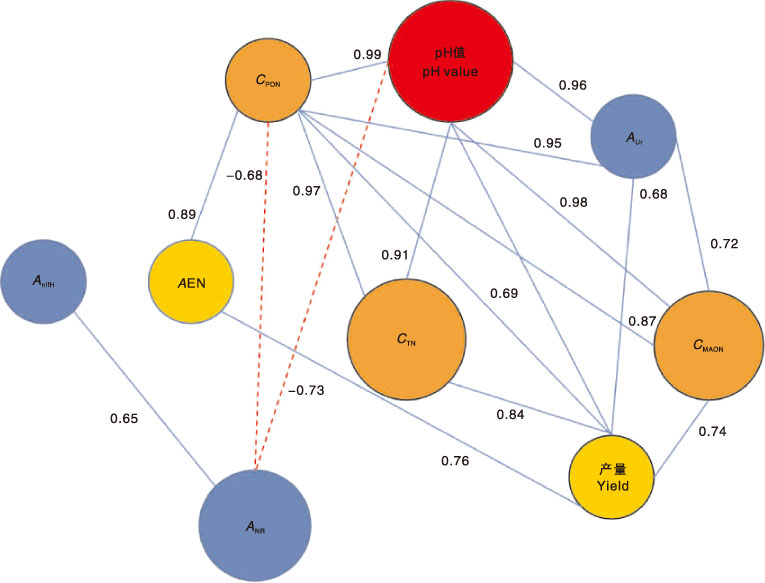
Fig.8 The correlation network diagram of the nitrogen cycling process, enzyme activity, nitrogen forms, and crop yield, agronomic efficiency of nitrogen (AEN) mediated by soil pH value Nodes represent variables related to soil nitrogen transformation. Node size indicates variable importance. Lines represent correlations between variables: blue solid lines for positive correlations (r>0.6), red dashed lines for negative correlations (r<-0.6), with values on lines indicating correlation coefficients.
| [1] | ZAMAN M, SAGGAR S, BLENNERHASSETT J D, et al. Effect of urease and nitrification inhibitors on N transformation, gaseous emissions of ammonia and nitrous oxide, pasture yield and N uptake in grazed pasture system[J]. Soil Biology and Biochemistry, 2009, 41(6): 1270-1280. |
| [2] | HE G, WANG Z H, LI F C, et al. Soil nitrate-N residue, loss and accumulation affected by soil surface management and precipitation in a winter wheat-summer fallow system on dryland[J]. Nutrient Cycling in Agroecosystems, 2016, 106(1): 31-46. |
| [3] | JU X T, XING G X, CHEN X P, et al. Reducing environmental risk by improving N management in intensive Chinese agricultural systems[J]. Proceedings of the National Academy of Sciences of the United States of America, 2009, 106(9): 3041-3046. |
| [4] | CHEN X P, CUI Z L, FAN M S, et al. Producing more grain with lower environmental costs[J]. Nature, 2014, 514(7523): 486-489. |
| [5] | GUO J H, LIU X J, ZHANG Y, et al. Significant acidification in major Chinese croplands[J]. Science, 2010, 327(5968): 1008-1010. |
| [6] | MENG C, TIAN D S, ZENG H, et al. Global soil acidification impacts on belowground processes[J]. Environmental Research Letters, 2019, 14(7): 074003. |
| [7] | KOCHIAN L V, HOEKENGA O A, PINEROS M A. How do crop plants tolerate acid soils?: mechanisms of aluminum tolerance and phosphorous efficiency[J]. Annual Review of Plant Biology, 2004, 55: 459-493. |
| [8] | SINGH R, NYE P H. The effect of soil pH and high urea concentrations on urease activity in soil[J]. Journal of Soil Science, 1984, 35(4): 519-527. |
| [9] | ZHANG L M, HU H W, SHEN J P, et al. Ammonia-oxidizing archaea have more important role than ammonia-oxidizing bacteria in ammonia oxidation of strongly acidic soils[J]. The ISME Journal, 2012, 6(5): 1032-1045. |
| [10] | GRUBER N, GALLOWAY J N. An earth-system perspective of the global nitrogen cycle[J]. Nature, 2008, 451(7176): 293-296. |
| [11] | KUYPERS M M M, MARCHANT H K, KARTAL B. The microbial nitrogen-cycling network[J]. Nature Reviews Microbiology, 2018, 16(5): 263-276. |
| [12] | 隋倩雯, 董红敏, 朱志平, 等. 沼液深度处理技术研究与应用现状[J]. 中国农业科技导报, 2011, 13(1): 83-87. |
| SUI Q W, DONG H M, ZHU Z P, et al. Present status of biogas effluent treatment technology research and application[J]. Journal of Agricultural Science and Technology, 2011, 13(1): 83-87. | |
| [13] | WANG Z C, SANUSI I A, WANG J D, et al. Biogas slurry significantly improved degraded farmland soil quality and promoted Capsicum spp. production[J]. Plants, 2024, 13(2): 265. |
| [14] | TANG Y F, LUO L M, CARSWELL A, et al. Changes in soil organic carbon status and microbial community structure following biogas slurry application in a wheat-rice rotation[J]. Science of the Total Environment, 2021, 757: 143786. |
| [15] | 陈彪, 陈晓晨, 肖艳春, 等. 沼液生物熟化及资源化安全利用调控技术研究与应用[J]. 中国科技成果, 2018(13): 65-66. |
| CHEN B, CHEN X C, XIAO Y C, et al. Research and application of control technology for biological maturation and safe resource utilization of biogas slurry[J]. China Science and Technology Achievements, 2018(13): 65-66. | |
| [16] | LEHMANN E, JOSEPH S. Biochar for environmental management[M]. London: Earthscan, 2009. |
| [17] | SONG Y Z, LI Y F, CAI Y J, et al. Biochar decreases soil N2O emissions in Moso bamboo plantations through decreasing labile N concentrations, N-cycling enzyme activities and nitrification/denitrification rates[J]. Geoderma, 2019, 348: 135-145. |
| [18] | LONG, X X, YU Z N, LIU S, et al. A systematic review of biochar aging and the potential eco-environmental risk in heavy metal contaminated soil[J]. Journal of Hazardous Materials, 2024, 472: 134345. |
| [19] | QUAN G X, FAN Q Y, ZIMMERMAN A R, et al. Effects of laboratory biotic aging on the characteristics of biochar and its water-soluble organic products[J]. Journal of Hazardous Materials, 2020, 382: 121071. |
| [20] | GUL S, WHALEN J K, THOMAS B W, et al. Physico-chemical properties and microbial responses in biochar-amended soils: mechanisms and future directions[J]. Agriculture, Ecosystems & Environment, 2015, 206: 46-59. |
| [21] | 鲁如坤. 土壤农业化学分析方法[M]. 北京: 中国农业科学技术出版社, 2000. |
| [22] | 郑慧芬, 吴红慧, 翁伯琦, 等. 施用生物炭提高酸性红壤茶园土壤的微生物特征及酶活性[J]. 中国土壤与肥料, 2019(2): 68-74. |
| ZHENG H F, WU H H, WENG B Q, et al. Improved soil microbial characteristics and enzyme activities with wheat straw biochar addition to an acid tea plantation in red soil[J]. Soils and Fertilizers Sciences in China, 2019(2): 68-74. | |
| [23] | 李双双, 陈晨, 段鹏鹏, 等. 生物质炭对酸性菜地土壤N2O排放及相关功能基因丰度的影响[J]. 植物营养与肥料学报, 2018, 24(2): 414-423. |
| LI S S, CHEN C, DUAN P P, et al. Effects of biochar application on N2O emissions and abundance of nitrogen related functional genes in an acidic vegetable soil[J]. Journal of Plant Nutrition and Fertilizers, 2018, 24(2): 414-423. (in Chinese with English abstract) | |
| [24] | 张文康, 陈渠东, 姚光伟, 等. 生物质炭-沼液联用对土壤微生物及碳氮功能基因的影响[J]. 环境化学, 2026, 45(2): 527-537. |
| ZHANG W K, CHEN Q D, YAO G W, et al. Effects of biochar-biogas slurry application on soil microorganisms and functional genes[J]. Environmental Chemistry, 2026, 45(2): 527-537. | |
| [25] | CHINTALA R, MOLLINEDO J, SCHUMACHER T E, et al. Effect of biochar on chemical properties of acidic soil[J]. Archives of Agronomy and Soil Science, 2014, 60(3): 393-404. |
| [26] | 许云翔, 何莉莉, 刘玉学, 等. 施用生物炭6年后对稻田土壤酶活性及肥力的影响[J]. 应用生态学报, 2019, 30(4): 1110-1118. |
| XU Y X, HE L L, LIU Y X, et al. Effects of biochar addition on enzyme activity and fertility in paddy soil after six years[J]. Chinese Journal of Applied Ecology, 2019, 30(4): 1110-1118. (in Chinese) | |
| [27] | WANG J Y, RIAZ M, BABAR S, et al. Iron-modified biochar reduces nitrogen loss and improves nitrogen retention in Luvisols by adsorption and microbial regulation[J]. Science of the Total Environment, 2023, 879: 163196. |
| [28] | LUO S S, WANG S J, TIAN L, et al. Long-term biochar application influences soil microbial community and its potential roles in semiarid farmland[J]. Applied Soil Ecology, 2017, 117: 10-15. |
| [29] | JIN Z W, CHEN C, CHEN X M, et al. Soil acidity, available phosphorus content, and optimal biochar and nitrogen fertilizer application rates: a five-year field trial in upland red soil, China[J]. Field Crops Research, 2019, 232: 77-87. |
| [30] | VAN DEN HEUVEL R N, BAKKER S E, JETTEN M S M, et al. Decreased N2O reduction by low soil pH causes high N2O emissions in a riparian ecosystem[J]. Geobiology, 2011, 9(3): 294-300. |
| [31] | LIN Y X, YE G P, LIU D Y, et al. Long-term application of lime or pig manure rather than plant residues suppressed diazotroph abundance and diversity and altered community structure in an acidic Ultisol[J]. Soil Biology and Biochemistry, 2018, 123: 218-228. |
| [32] | 杜臻杰, 齐学斌, 陈效民, 等. 生物质炭和猪场沼液对潮土水力特征参数的影响[J]. 水土保持学报, 2014, 28(1): 189-192. |
| DU Z J, QI X B, CHEN X M, et al. Effect of biochar and piggery biogas slurry on hydraulic characteristic parameter of alluvial soil[J]. Journal of Soil and Water Conservation, 2014, 28(1): 189-192. |
| [1] | BA Shihao, TONG Wenbin, YANG Haijun, JIANG Jianfeng, LI Zichuan, WU Chunyan, TANG Xu, CHAI Yanjun, LI Yan. Effect of biogas slurry application with chemical fertilizer reduction on water bamboo production and soil improvement [J]. Acta Agriculturae Zhejiangensis, 2026, 38(1): 126-135. |
| [2] | WEI Qingcui, JIANG Naying, SHEN Junyang, ZHANG Huanchao, ZHANG Hengfeng. Effects of reduced chemical fertilization and biochar application on nitrogen and phosphorus leaching and soil properties of sandy soil [J]. Acta Agriculturae Zhejiangensis, 2025, 37(9): 1943-1950. |
| [3] | SU Yang, SHANG Xiaolan, QIAN Zhongming, WU Lingen, HUANG Jiaqi, ZHUANG Haifeng, ZHAO Yufei, DANG Hongyang, XU Lijun. Effects of synergistic enhancement of straw returning to the field with decomposition agent and biochar on soil quality and rice growth [J]. Acta Agriculturae Zhejiangensis, 2025, 37(5): 1139-1148. |
| [4] | YING Yongfei, HAN Dongxuan, MENG Fang, YU Lin, SHEN Jialuan, WANG Kaiying. Effects of biogas slurry substituting chemical fertilizer on rice yield and quality and soil characteristics [J]. Acta Agriculturae Zhejiangensis, 2025, 37(4): 880-891. |
| [5] | WU Jialong, CHI Ming, GAO Yan, WANG Xiang, SHEN Haiou. Effects of biochar application on soil physiochemical indicators at sloping farmland in black soil region [J]. Acta Agriculturae Zhejiangensis, 2024, 36(9): 2060-2069. |
| [6] | FU Zhiqiang, LIU Zhen, MA Chunhua, WEN Mengling, XI Ruchun. Effects of biochar and biochar-based fertilizers on soil quality and plant growth [J]. Acta Agriculturae Zhejiangensis, 2024, 36(7): 1634-1645. |
| [7] | YU Chao, WANG Yinyu, LIU Qizhen, WANG Yun, SHEN Hong, FENG Ying. Effects of application of biochar from different raw materials combined with inorganic amendments on cadmium accumulation in pakchoi shoots and soil cadmium inactivation [J]. Acta Agriculturae Zhejiangensis, 2024, 36(3): 613-621. |
| [8] | MA Ling, ZHANG Zhenwu, FANG Yingzi, WU Huixin, XING Chenghua. Effects of nitrogen reduction and biochar application on growth and development of Citurs reticulata Blanco cv. ‘Ponkan’ and soil properties [J]. Acta Agriculturae Zhejiangensis, 2024, 36(12): 2739-2747. |
| [9] | WU Yuke, WANG Feng, WANG Yifan, WU Xueping, ZHU Weiqin. Parameters optimization for vermicomposting of cow dung and changes of properties of composting residues [J]. Acta Agriculturae Zhejiangensis, 2024, 36(10): 2308-2315. |
| [10] | HAN Jing, ZHU Yiting, ZHENG Chi, MA Lihong, ZHANG Yanan, ZENG Qiuyan, LIU Shuliang, CHEN Shujuan. Activation of soybean shell biochar and its adsorption performance for carbaryl [J]. Acta Agriculturae Zhejiangensis, 2023, 35(9): 2202-2211. |
| [11] | XIAO Hua, XU Xing, XIE Chuanqi, ZHOU Xin, ZHOU Weidong, TANG Wensheng. Effect of struvite precipitation pretreatment on membrane concentration process of piggery biogas slurry [J]. Acta Agriculturae Zhejiangensis, 2023, 35(6): 1407-1415. |
| [12] | XU Yang, REN Yilin, WANG Haojie, HUANG Qiuhang, XING Boyuan, CAO Hongliang. Comprehensive evaluation of rape straw biochar as slow-release carrier under different preparation conditions [J]. Acta Agriculturae Zhejiangensis, 2023, 35(4): 893-902. |
| [13] | RUAN Zebin, WANG Lange, LAN Wangkaining, XU Yan, CHEN Junhui, LIU Dan. Effects of nitrogen reduction and biochar on nitrogen uptake by rice and soil physiochemical properties [J]. Acta Agriculturae Zhejiangensis, 2023, 35(2): 394-402. |
| [14] | WANG Weiwei, MEI Yi, WU Yongcheng, WAN Hongjian, CHEN Changjun, ZHENG Qingsong, ZHENG Jiaqiu. Effects of corncob biochar application on soil characteristics and pepper growth under continuous cropping [J]. Acta Agriculturae Zhejiangensis, 2023, 35(1): 156-163. |
| [15] | CUI Wenfang, CHEN Jing, LU Fukuan, QIN Li, QIN Dezhi, WANG Liping, GAO Julin. Effects of biochar application combined with nitrogen reduction on yield and nitrogen use efficiency of maize [J]. Acta Agriculturae Zhejiangensis, 2022, 34(2): 248-254. |
| Viewed | ||||||
|
Full text |
|
|||||
|
Abstract |
|
|||||

