浙江农业学报 ›› 2026, Vol. 38 ›› Issue (4): 824-836.DOI: 10.3969/j.issn.1004-1524.20250237
• 综述 • 上一篇
低温贮藏下梨果实代谢及其调控技术研究进展
李文珏1,2( ), 杜辰飞1,2, 魏春艳2, 蔡丹英2, 王月志2, 施泽彬2, 戴美松2,*(), 徐凯1,*()
- 1
浙江农林大学 园艺科学学院 浙江 杭州 311300
2浙江省农业科学院 园艺研究所 浙江 杭州 310021
-
收稿日期:2025-03-24出版日期:2026-04-25发布日期:2026-05-08 -
作者简介:李文珏,研究方向为梨育种与品质形成机理。E-mail:lwj990707@163.com -
基金资助:浙江省果品新品种选育重点研发计划(2021C02066-5);国家现代农业(梨)产业技术体系(CARS-28-03)
Research progress on metabolism and regulation technologies of pear fruit during low-temperature storage
LI Wenjue1,2(), DU Chenfei1,2, WEI Chunyan2, CAI Danying2, WANG Yuezhi2, SHI Zebin2, DAI Meisong2,*(), XU Kai1,*()
- 1
College of Horticultural Science ,Zhejiang A&F University Hangzhou 311300, China
2Institute of Horticulture ,Zhejiang Academy of Agricultural Sciences Hangzhou 310021, China
-
Received:2025-03-24Published:2026-04-25Online:2026-05-08

摘要:
梨果实采后易因代谢失衡导致品质劣变,低温贮藏作为延缓果实衰老的关键技术,可有效维持果实品质。近年来,代谢组学被广泛应用于揭示不同梨品种在低温贮藏条件下的代谢变化。然而,不当低温或长期低温贮藏易诱发冷害,其分子机制涉及低温信号转导途径中转录因子对冷响应基因的级联调控,进而激活苯丙烷类代谢与活性氧清除系统,引起膜脂过氧化、能量代谢失衡和次生代谢物异常积累,最终导致梨果实褐变、木质化与香气丧失等典型品质劣变。因此,低温贮藏常需结合其他保鲜调控技术以缓解冷害。本文系统阐述了低温贮藏下梨果实的生理代谢动态及其分子调控网络,综述了近年来低温协同调控技术在冷害防控中的应用进展,并展望了基于多组学技术解析品质变化、开发精准调控技术的未来研究方向,以期为梨果实采后保鲜技术的优化提供理论依据。
中图分类号:
引用本文
李文珏, 杜辰飞, 魏春艳, 蔡丹英, 王月志, 施泽彬, 戴美松, 徐凯. 低温贮藏下梨果实代谢及其调控技术研究进展[J]. 浙江农业学报, 2026, 38(4): 824-836.
LI Wenjue, DU Chenfei, WEI Chunyan, CAI Danying, WANG Yuezhi, SHI Zebin, DAI Meisong, XU Kai. Research progress on metabolism and regulation technologies of pear fruit during low-temperature storage[J]. Acta Agriculturae Zhejiangensis, 2026, 38(4): 824-836.
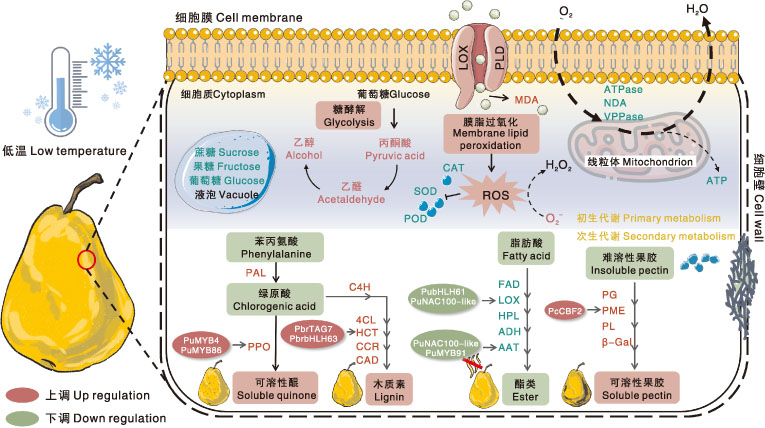
图1 梨果实低温贮藏品质劣变模式图 PLD,磷脂酶D;LOX,脂氧合酶;MDA,丙二醛;ROS,活性氧;ATPase,ATP合酶;NDA,NADH脱氢酶;VPPase,液泡质子-无机焦磷酸酶;CAT,过氧化氢酶;POD,过氧化物酶;SOD,超氧化物歧化酶;ATP,腺苷三磷酸;PAL,苯丙氨酸解氨酶;PPO,多酚氧化酶;C4H,肉桂酸-4-羟化酶;4CL,对香豆酸:辅酶A连接酶;HCT,羟基肉桂酰基转移酶;CCR,肉桂酰辅酶A还原酶;CAD,肉桂醇脱氢酶;FAD,脂肪酸去饱和酶;HPL,氢过氧化物裂解酶;ADH,醇脱氢酶;AAT,醇酰基转移酶;PG,多聚半乳糖醛酸酶;PME,果胶甲酯酶;PL,果胶裂解酶;β-Gal,β-半乳糖苷酶。红色字体或红色背景标注的酶、基因和代谢物表示受低温诱导,绿色则表示受低温抑制。
Fig.1 Schematic diagram of quality deterioration in pear fruits induced by cold storage PLD, Phospholipase D; LOX, Lipoxygenase; MDA, Malondialdehyde; ROS, Reactive oxygen species; ATPase, ATP synthase; NDA, NADH dehydrogenase; VPPase, Vacuoles-inorganic pyrophosphatase; CAT, Catalase; POD, Peroxidase; SOD, Superoxide dismutase; ATP, Adenosine triphosphate; PAL, Phenylalanine ammonia-lyase; PPO, Polyphenol oxidase; C4H, Cinnamate 4-hydroxylase; 4CL, 4-Coumarate: CoA ligase; HCT, Hydroxycinnamoyl transferase; CCR, Cinnamoyl-CoA reductase; CAD, Cinnamyl alcohol dehydrogenase; FAD, Fatty acid desaturase; HPL, Hydroperoxide lyase; ADH, Alcohol dehydrogenase; AAT, Alcohol acyltransferase; PG, Polygalacturonase; PME, Pectin methylesterase; PL, Pectate lyase; β-Gal, β-Galactosidase. Enzymes, genes and metabolites marked in red font or with red backgrounds indicate those induced by low temperature, while those in green are suppressed by low temperature.
| [1] | CAO Y F, TIAN L M, GAO Y, et al. Genetic diversity of cultivated and wild Ussurian Pear (Pyrus ussuriensis Maxim.) in China evaluated with M13-tailed SSR markers[J]. Genetic Resources and Crop Evolution, 2012, 59(1): 9-17. |
| [2] | MAO H J, LV Y H, CHEN G G, et al. Effects of cuticular wax on the postharvest physiology in fragrant pear at different storages[J]. Journal of the Science of Food and Agriculture, 2022, 102(11): 4425-4434. |
| [3] | 李兰婷. 不同采收贮藏方式对‘新梨7号’果实品质、果皮结构的影响[D]. 阿拉尔: 塔里木大学, 2017. |
| LI L T. Effects of different harvesting and storage methods on fruit quality and pericarp structure of ‘Xinli No. 7’[D]. Arar: Tarim University, 2017. | |
| [4] | KAN C N, GAO Y, WAN C P, et al. Influence of different cold storage times on quality of “Cuiguan” pear fruits during shelf life[J]. Journal of Food Processing and Preservation, 2019, 43(12): e14245. |
| [5] | 钟耀广. 贮藏环境条件对晚香梨品质影响[J]. 北方园艺, 2000(4): 61-62. |
| ZHONG Y G. Effects of storage environmental conditions on the quality of Wanxiang pear[J]. Northern Horticulture, 2000(4): 61-62. | |
| [6] | 许桓瑜. 低温和1-MCP调控梨果实采后贮藏效果的组学研究[D]. 南京: 南京农业大学, 2018. |
| XU H Y. Omics-based study on the effect of posthavested quality of pear fruit treated by low temperature and 1-MCP[D]. Nanjing: Nanjing Agricultural University, 2018. | |
| [7] | 林河通, 洪启征, 袁振林, 等. 黄花梨果实冷藏适温的研究[J]. 农业工程学报, 1997, 13(1): 206-210. |
| LIN H T, HONG Q Z, YUAN Z L, et al. Study on the optimum cool storage temperature for Huanghua pear fruits[J]. Transactions of the Chinese Society of Agricultural Engineering, 1997, 13(1): 206-210. | |
| [8] | YI X R, ZHAO B Y, TANG Y, et al. Transcriptome analysis reveals the regulation of metabolic processes during the post-harvest cold storage of pear[J]. Genomics, 2020, 112(6): 3933-3942. |
| [76] | MIN D D, LI F J, ALI M, et al. Application of methyl jasmonate to control disease of postharvest fruit and vegetables: a Meta-analysis[J]. Postharvest Biology and Technology, 2024, 208: 112667. |
| [77] | ZHANG L, ZHANG L L. Methyl jasmonate maintained higher esters content of ‘Nanguo’ pear on shelf life by regulating unsaturated fatty acid and reactive oxygen metabolisms[J]. Horticulture, Environment, and Biotechnology, 2024, 65(3): 501-513. |
| [9] | WANG J W, JIANG Y G, LI G D, et al. Effect of low temperature storage on energy and lipid metabolisms accompanying peel browning of ‘Nanguo’ pears during shelf life[J]. Postharvest Biology and Technology, 2018, 139: 75-81. |
| [10] | YOU J, CHAN Z L. ROS regulation during abiotic stress responses in crop plants[J]. Frontiers in Plant Science, 2015, 6: 1092. |
| [11] | 杨洋, 陈琪琪, 郭丽红, 等. 低温维持果蔬采后活性氧代谢平衡的抗氧化转录调控机制研究进展[J]. 食品工业科技, 2023, 44(5): 451-458. |
| YANG Y, CHEN Q Q, GUO L H, et al. Research progress on regulation of antioxidant transcription in reactive oxygen species metabolism of postharvest fruits and vegetables during low temperature storage[J]. Science and Technology of Food Industry, 2023, 44(5): 451-458. | |
| [12] | 王亚. 丰水梨果实发育及贮藏期的品质变化研究[D]. 南京: 南京农业大学, 2006. |
| WANG Y. Fruit quality changes during development and storage of Housui pear fruit[D]. Nanjing: Nanjing Agricultural University, 2006. | |
| [78] | LUO M L, ZHOU X, HAO Y, et al. Methyl jasmonate pretreatment improves aroma quality of cold-stored ‘Nanguo’ pears by promoting ester biosynthesis[J]. Food Chemistry, 2021, 338: 127846. |
| [79] | LUO M L, ZHOU X, SUN H J, et al. Glycine betaine treatment alleviates loss of aroma-related esters in cold-stored ‘Nanguo’ pears by regulating the lipoxygenase pathway[J]. Food Chemistry, 2020, 316: 126335. |
| [80] | 李灿婴, 侯佳宝, 张浪, 等. 外源甜菜碱处理对南果梨果实贮藏品质的影响[J]. 包装与食品机械, 2021, 39(4): 31-37. |
| LI C Y, HOU J B, ZHANG L, et al. Effect of exogenous glycine betaine treatment on storage quality of Nanguo pears[J]. Packaging and Food Machinery, 2021, 39(4): 31-37. | |
| [81] | YAO M M, ZHOU X, JI Y R, et al. Potential of ethylene in alleviating cold-induced volatile esters loss of ‘Nanguo’ pears by regulating the lipoxygenase pathway[J]. Environmental and Experimental Botany, 2022, 194: 104723. |
| [82] | LI X Y, GAO S Y, YANG L, et al. Ethylene promotes ester biosynthesis through PuERF13/PuDof2.5 synergically activated PuAAT1 during ripening of cold-stored ‘Nanguo’ pear[J]. Postharvest Biology and Technology, 2023, 195: 112108. |
| [83] | ZHAI R, LIU J L, LIU F X, et al. Melatonin limited ethylene production, softening and reduced physiology disorder in pear (Pyrus communis L.) fruit during senescence[J]. Postharvest Biology and Technology, 2018, 139: 38-46. |
| [84] | 刘建龙. 外源褪黑素对梨果实发育、采后品质和抗轮纹病的影响及其调控机制研究[D]. 杨凌: 西北农林科技大学, 2019. |
| LIU J L. Regulatory function of exogenous melatonin on fruit development, postharvest fruit quality and ring rot disease resistance in pears[D]. Yangling: Northwest A & F University, 2019. | |
| [85] | 陈绳良, 陈祖超, 刘杰超, 等. 圆黄梨和黄金梨的贮藏保鲜试验研究[J]. 农产品加工·学刊, 2007(10): 13-15. |
| [13] | GILL S S, TUTEJA N. Reactive oxygen species and antioxidant machinery in abiotic stress tolerance in crop plants[J]. Plant Physiology and Biochemistry, 2010, 48(12): 909-930. |
| [14] | ZHOU H S, TIAN M Y, HUANG W, et al. Physiological and transcriptomic analysis of ‘Whangkeumbae’ pear core browning during low-temperature storage[J]. Gene Expression Patterns, 2020, 36: 119113. |
| [15] | 孙扬扬. 转录因子PuMYB4/86协同调控冷藏南果梨果皮褐变的分子机制[D]. 沈阳: 沈阳农业大学, 2024. |
| SUN Y Y. Molecular mechanism of transcription factors PuMYB4/86 synergistically regulating pericarp browning in cold-stored ‘Nanguo’ pears[D]. Shenyang: Shenyang Agricultural University, 2024. | |
| [16] | SHI F, ZHOU X, ZHOU Q, et al. Membrane lipid metabolism changes and aroma ester loss in low-temperature stored Nanguo pears[J]. Food Chemistry, 2018, 245: 446-453. |
| [17] | SHENG L, ZHOU X, LIU Z Y, et al. Changed activities of enzymes crucial to membrane lipid metabolism accompany pericarp browning in ‘Nanguo’ pears during refrigeration and subsequent shelf life at room temperature[J]. Postharvest Biology and Technology, 2016, 117: 1-8. |
| [18] | 孙华军. 转录因子PuMYB21/54协同调控膜脂代谢关键基因PuPLDβ1介导冷藏南果梨果皮褐变的分子机制[D]. 沈阳: 沈阳农业大学, 2020. |
| SUN H J. Molecular mechanism of transcription factors PuMYB21/54 synergistically regulating key gene PuPLDβ1 in membrane lipid metabolism-mediated pericarp browning of cold-stored ‘Nanguo’ pears[D]. Shenyang: Shenyang Agricultural University, 2020. | |
| [19] | 李治梅, 张玉星, 许建锋, 等. 鸭梨、黄金梨果实结构与耐贮性的关系[J]. 果树学报, 2006, 23(1): 108-110. |
| LI Z M, ZHANG Y X, XU J F, et al. Effects of fruit tissue structure of Yali and Whangkeumbae pear cultivars on the fruit storability[J]. Journal of Fruit Science, 2006, 23(1): 108-110. | |
| [20] | 刘剑锋, 李国怀, 彭抒昂, 等. 秋子梨的果皮结构与果实的耐贮性[J]. 园艺学报, 2007, 34(4): 1007-1010. |
| LIU J F, LI G H, PENG S A, et al. Pericarp structure and storage quality of Pyrus ussuriensis fruits[J]. Acta Horticulturae Sinica, 2007, 34(4): 1007-1010. | |
| [21] | 张微, 赵迎丽, 杨志国, 等. ‘玉露香’梨果皮蜡质含量提取方法及成分研究[J]. 食品科技, 2022, 47(1): 34-40. |
| ZHANG W, ZHAO Y L, YANG Z G, et al. Extraction method and analysis of waxy components from ‘Yuluxiang’ pear pericarp[J]. Food Science and Technology, 2022, 47(1): 34-40. | |
| [22] | 张琦, 姜喜, 段黄金. 不同贮藏方式对梨果皮组织结构的影响[J]. 果树学报, 2016, 33(S1): 175-179. |
| ZHANG Q, JIANG X, DUAN H J. Effects of different storage methods on the structure of pear skin tissue[J]. Journal of Fruit Science, 2016, 33(S1): 175-179. | |
| [23] | 马炜, 田玉婷, 赵婷婷, 等. 不同品种(系)梨贮藏过程果实失重率与果皮叶绿素、蜡质含量的变化[J]. 北方果树, 2019(4): 5-8. |
| MA W, TIAN Y T, ZHAO T T, et al. Changes of weight loss rate, chlorophyll and wax content in different pear varieties(lines) during storage[J]. Northern Fruits, 2019(4): 5-8. | |
| [24] | 宿胜男. 不同贮藏条件下香梨蜡质结构和成分的变化与其耐贮性关系的研究[D]. 石河子: 石河子大学, 2018. |
| SU S N. Study on the relationship between the changes of waxy structures and components and their storability of Korla fragrant pear under different storage conditions[D]. Shihezi: Shihezi University, 2018. | |
| [25] | 尹燕. 梨果实表皮蜡质化学组分在发育和贮藏期的变化[D]. 兰州: 甘肃农业大学, 2010. |
| YIN Y. Changes in chemical components of cuticular wax in pear fruits during development and storage[D]. Lanzhou: Gansu Agricultural University, 2010. | |
| [26] | 赵晓敏, 杨静, 李学文, 等. 1-MCP常温处理对库尔勒香梨活性氧相关代谢的影响[J]. 食品与发酵工业, 2014, 40(9): 219-223. |
| ZHAO X M, YANG J, LI X W, et al. Effect of 1-methylcyclopropene treatment on the metabolism of reactive oxygen in Korle fragrant pear stored at room temperature[J]. Food and Fermentation Industries, 2014, 40(9): 219-223. | |
| [27] | CURRY E. Effects of 1-MCP applied postharvest on epicuticular wax of apples (Malus domestica Borkh.) during storage[J]. Journal of the Science of Food and Agriculture, 2008, 88(6): 996-1006. |
| [28] | 高海生, 贾艳茹, 魏建梅, 等. 用物性分析仪检测鸭梨和京白梨果实采后质地的变化[J]. 园艺学报, 2012, 39(7): 1359-1364. |
| GAO H S, JIA Y R, WEI J M, et al. Studies on the post-harvested fruit texture changes of ‘Yali’ and ‘Jingbaili’ pears by using texture analyzer[J]. Acta Horticulturae Sinica, 2012, 39(7): 1359-1364. | |
| [29] | HEWITT S, DHINGRA A. Beyond ethylene: new insights regarding the role of alternative oxidase in the respiratory climacteric[J]. Frontiers in Plant Science, 2020, 11: 543958. |
| [30] | 王阳, 王文辉, 贾晓辉, 等. 不同货架温度对‘南果梨’果实软化及果皮颜色的影响[J]. 中国果树, 2019(2): 53-56. |
| WANG Y, WANG W H, JIA X H, et al. Effects of different shelf-life temperatures on fruit softening and peel color of ‘Nanguoli’ pear[J]. China Fruits, 2019(2): 53-56. | |
| [31] | 张鹏龙, 陈复生, 杨宏顺, 等. 果实成熟软化过程中细胞壁降解研究进展[J]. 食品科技, 2010, 35(11): 62-66. |
| ZHANG P L, CHEN F S, YANG H S, et al. Research advances on cell wall disassembly in fruit ripening and softening[J]. Food Science and Technology, 2010, 35(11): 62-66. | |
| [32] | 魏建梅, 齐秀东, 张海娥, 等. 京白梨果实采后PG、糖苷酶和LOX活性变化及其基因表达特性[J]. 园艺学报, 2012, 39(1): 31-39. |
| WEI J M, QI X D, ZHANG H E, et al. The activity and gene expression of polygalacturonase, glycosidase and lipoxygenase in postharvest ‘Jingbaili’ pear fruit[J]. Acta Horticulturae Sinica, 2012, 39(1): 31-39. | |
| [33] | 戴晓楠. 低温贮藏对‘三季梨’后熟软化的影响研究[D]. 烟台: 鲁东大学, 2024. |
| DAI X N. Effect of low temperature storage on ripening and softening of ‘Docteur jules guyot’ pear[D]. Yantai: Ludong University, 2024. | |
| [34] | XIE J Q, CAO B L, XU K. Uncovering the dominant role of root lignin accumulation in silicon-induced resistance to drought in tomato[J]. International Journal of Biological Macromolecules, 2024, 259: 129075. |
| [35] | 洪盼婷. 茉莉酸甲酯对低温贮藏下梨果实木质化的作用及其调控机制[D]. 重庆: 西南大学, 2024. |
| HONG P T. The role and regulatory mechanism of methyl jasmonate on lignification of pear fruit under low-temperature storage[D]. Chongqing: Southwest University, 2024. | |
| [36] | 刘莉. ‘黄冠’梨果皮褐斑形成机制研究[D]. 合肥: 安徽农业大学, 2021. |
| [85] | CHEN S L, CHEN Z C, LIU J C, et al. Preliminary study on storage of round and golden pear[J]. Academic Periodical of Farm Products Processing, 2007(10): 13-15. |
| [86] | HE J G, FENG Y X, CHENG Y D, et al. Effects of preharvest aminoethoxyvinylglycine (AVG) treatment on fruit ripening, core browning and related gene expression in ‘Huangguan’ pear (Pyrus bretschneideri Rehd.)[J]. Horticulturae, 2023, 9(2): 179. |
| [87] | 董倩. 采收成熟度、1-MCP结合贮前预熟对冷藏后南梨果皮褐变的影响[D]. 沈阳: 沈阳农业大学, 2016. |
| DONG Q. Effects of harvest maturity, 1-MCP combined with pre-storage ripening on peel browning of cold-stored ‘Nanguo’ pears[D]. Shenyang: Shenyang Agricultural University, 2016. | |
| [88] | WANG J W, LV M, LI G D, et al. Effect of intermittent warming on alleviation of peel browning of ‘Nanguo’ pears by regulation energy and lipid metabolisms after cold storage[J]. Postharvest Biology and Technology, 2018, 142: 99-106. |
| [89] | CHENG Y D, LIU L Q, ZHAO G Q, et al. The effects of modified atmosphere packaging on core browning and the expression patterns of PPO and PAL genes in ‘Yali’ pears during cold storage[J]. LWT-Food Science and Technology, 2015, 60(2): 1243-1248. |
| [90] | 赵周胜, 谭书明, 俞露, 等. 不同处理方式对黄花梨果实贮藏效果的影响[J]. 中国农学通报, 2010, 26(16): 53-57. |
| ZHAO Z S, TAN S M, YU L, et al. Study on storage effects of the Huanghua pear with different treatments[J]. Chinese Agricultural Science Bulletin, 2010, 26(16): 53-57. | |
| [91] | KOU X H, JIANG B L, ZHANG Y, et al. The regulation of sugar metabolism in Huangguan pears (Pyrus pyrifolia Nakai) with edible coatings of calcium or pullulan during cold storage[J]. Horticultural Science and Technology, 2016, 34(6): 889-911. |
| [36] | LIU L. Study on the formation mechanism of pericarp brown spot in ‘Huangguan’ pear[D]. Hefei: Anhui Agricultural University, 2021. |
| [37] | XU R R, ZHOU J H, DENG L Z, et al. Transcriptomics integrated with metabolomics analysis of cold-induced lenticel disorder via the lignin pathway upon postharvest ‘Xinli No.7’ pear fruit[J]. Postharvest Biology and Technology, 2025, 220: 113315. |
| [38] | DUAN R W, ZHANG X Z, LIU Y D, et al. Transcriptome and physiological analysis highlight lignin metabolism of the fruit dots disordering during postharvest cold storage in ‘Danxiahong’ pear[J]. Genes, 2023, 14(9): 1785. |
| [39] | SOTO-VACA A, GUTIERREZ A, LOSSO J N, et al. Evolution of phenolic compounds from color and flavor problems to health benefits[J]. Journal of Agricultural and Food Chemistry, 2012, 60(27): 6658-6677. |
| [40] | LI D, CHENG Y D, DONG Y, et al. Effects of low temperature conditioning on fruit quality and peel browning spot in ‘Huangguan’ pears during cold storage[J]. Postharvest Biology and Technology, 2017, 131: 68-73. |
| [41] | WANG J W, ZHOU X, ZHOU Q, et al. Proteomic analysis of peel browning of ‘Nanguo’ pears after low-temperature storage[J]. Journal of the Science of Food and Agriculture, 2017, 97(8): 2460-2467. |
| [42] | 盛蕾. 基于膜脂代谢的冷藏南果梨果皮褐变分子机制及防褐调控研究[D]. 沈阳: 沈阳农业大学, 2016. |
| SHENG L. Study on the molecular mechanism of refrigeration on membrane lipid metabolism of pericarp browning in Nanguo pears and regulation measures[D]. Shenyang: Shenyang Agricultural University, 2016. | |
| [43] | 王志华, 姜云斌, 王文辉, 等. 不同低温贮藏对砀山酥梨货架期组织褐变和品质的影响[J]. 园艺学报, 2014, 41(12): 2393-2401. |
| WANG Z H, JIANG Y B, WANG W H, et al. Effects of different low storage temperatures on tissue browning and quality of ‘Dangshan suli’ pears during shelf-life[J]. Acta Horticulturae Sinica, 2014, 41(12): 2393-2401. | |
| [44] | 马岩松, 车芙蓉, 张平, 等. 南果梨多酚氧化酶最适作用酶促褐变底物的分析确定[J]. 食品科学, 2000, 21(1): 11-13. |
| MA Y S, CHE F R, ZHANG P, et al. Analyses ang determination on optimal enzyme browniny substrate of Nanguo pear polyphenolic[J]. Food Science, 2000, 21(1): 11-13. | |
| [45] | SAITO T. Advances in Japanese pear breeding in Japan[J]. Breeding Science, 2016, 66(1): 46-59. |
| [46] | 蒋爽, 岳晓燕, 滕元文, 等. 不同砂梨果实中糖酸含量及代谢相关基因表达分析[J]. 果树学报, 2016, 33(S1): 65-70. |
| JIANG S, YUE X Y, TENG Y W, et al. The contents of sugars and acids, and the expression analysis of metabolism-associated genes in fruit of Pyrus pyrifolia[J]. Journal of Fruit Science, 2016, 33(S1): 65-70. | |
| [47] | LIU J, MENG Z X, LIU B R, et al. Application of a metabolomics method in the study of pear fruit storage[J]. Analytical Methods, 2024, 16(45): 7699-7709. |
| [48] | ZHAO Y N, GENG J H, ZHANG Y, et al. Changes in sugar metabolism and fruit quality of different pear cultivars during cold storage[J]. Transactions of Tianjin University, 2019, 25(4): 389-399. |
| [49] | 黄丽, 王亮, 赵迎丽, 等. 3种梨贮藏期间果实品质、可溶性糖和有机酸含量变化[J]. 食品研究与开发, 2023, 44(10): 46-52. |
| HUANG L, WANG L, ZHAO Y L, et al. Changes in fruit quality, soluble sugar and organic acid content of three pear species during storage[J]. Food Research and Development, 2023, 44(10): 46-52. | |
| [50] | 刘清鹤, 荆琳, 王成荣, 等. 鲁秀梨果实在生长发育中后期及贮藏过程中糖酸累积的变化[J]. 果树学报, 2022, 39(5): 743-751. |
| LIU Q H, JING L, WANG C R, et al. Changes in accumulation of sugars and acids in the fruits of Luxiu pear during the mid to late period of growth and development and postharvest storage[J]. Journal of Fruit Science, 2022, 39(5): 743-751. | |
| [51] | DIAS C, RIBEIRO T, RODRIGUES A C, et al. Cold storage demand for ‘Rocha’ pear ripening: a comparison between a shorter and longer cold period[J]. Scientia Horticulturae, 2022, 299: 111033. |
| [52] | 赵锡武, 何玉莲. 果糖的特性及应用[J]. 饮料工业, 2006, 9(4): 4-9. |
| ZHAO X W, HE Y L. Characteristics and use of fructose[J]. The Beverage Industry, 2006, 9(4): 4-9. | |
| [53] | 王君, 李磊, 谢冰, 等. 采后黄冠梨果实糖代谢及相关酶活性变化规律[J]. 食品科学, 2010, 31(18): 390-393. |
| WANG J, LI L, XIE B, et al. Changes of carbohydrate metabolism and related enzyme activities in postharvest Huangguan pears[J]. Food Science, 2010, 31(18): 390-393. | |
| [54] | WANG J W, DONG S Z, JIANG Y G, et al. Influence of long-term cold storage on phenylpropanoid and soluble sugar metabolisms accompanied with peel browning of ‘Nanguo’ pears during subsequent shelf life[J]. Scientia Horticulturae, 2020, 260: 108888. |
| [55] | ITAI A, TANAHASHI T. Inhibition of sucrose loss during cold storage in Japanese pear (Pyrus pyrifolia Nakai) by 1-MCP[J]. Postharvest Biology and Technology, 2008, 48(3): 355-363. |
| [56] | 丁耐克. 食品风味化学[M]. 北京: 中国轻工业出版社, 1996. |
| [57] | 张泽煌, 史怀, 许家辉, 等. 黄皮果实成熟和低温贮藏过程中有机酸的代谢[J]. 福建农业学报, 2006, 21(4): 375-378. |
| ZHANG Z H, SHI H, XU J H, et al. Organic acid metabolism of wampee (Clausena lansium) fruits during ripening and low temperature storage[J]. Fujian Journal of Agricultural Sciences, 2006, 21(4): 375-378. | |
| [58] | 郭润姿. 不同处理对采后黄冠梨果实有机酸代谢酶及其基因表达的影响[D]. 天津: 天津大学, 2012. |
| GUO R Z. Effect of different treatments on the organic acids metabolizing enzymes and related genes expression in post-harvest Huangguan pear fruit[D]. Tianjin: Tianjin University, 2012. | |
| [59] | WANG X H, CHEN Y Y, ZHANG J J, et al. Comparative analysis of volatile aromatic compounds from a wide range of pear (Pyrus L.) germplasm resources based on HS-SPME with GC-MS[J]. Food Chemistry, 2023, 418: 135963. |
| [60] | 卜庆状, 纪淑娟, 李江阔, 等. 冷藏后南果梨常温后熟期香气成分变化[J]. 食品科学, 2013, 34(2): 273-276. |
| BU Q Z, JI S J, LI J K, et al. Changes in aroma components of cold-stored Nanguo pears during postharvest ripening at room temperature[J]. Food Science, 2013, 34(2): 273-276. | |
| [61] | LUO M L, SUN H J, GE W Y, et al. PuNAC100-like/PubHLH61 co-regulate PuLOX3 mediating ester biosynthesis in cold-stored ‘Nanguo’ pears[J]. Postharvest Biology and Technology, 2023, 205: 112498. |
| [62] | 李晨辉, 朱元娣, 仇占南, 等. 不同贮藏方式对‘京白梨’果实香气成分的影响[J]. 果树学报, 2016, 33(S1): 157-165. |
| LI C H, ZHU Y D, QIU Z N, et al. Effects of different storage methods on aromatic components in ‘Jingbaili’ fruit[J]. Journal of Fruit Science, 2016, 33(S1): 157-165. | |
| [63] | 李彩林. 红香酥梨贮藏期香气成分及果实品质变化研究[D]. 太原: 山西大学, 2020. |
| LI C L. Study on changes of aroma components and fruit quality of red fragrant pear during storage[D]. Taiyuan: Shanxi University, 2020. | |
| [64] | LWIN H P, RUDELL D R, LEE J. Metabolism and cold chain performance of ‘Chuhwangbae’ Asian pears as impacted by 1-MCP treatment[J]. Scientia Horticulturae, 2021, 288: 110357. |
| [65] | SHI F, ZHOU X, YAO M M, et al. miRNAs play important roles in aroma weakening during the shelf life of ‘Nanguo’ pear after cold storage[J]. Food Research International, 2019, 116: 942-952. |
| [66] | QIAN M, WANG L B, ZHANG S L, et al. Investigation of proline in superficial scald development during low temperature storage of ‘Dangshansuli’ pear fruit[J]. Postharvest Biology and Technology, 2021, 181: 111643. |
| [67] | CHENG S B, OUYANG H, GUO W B, et al. Proteomic and physiological analysis of ‘Korla’ fragrant pears (Pyrus×brestschneideri Rehd) during postharvest under cold storage[J]. Scientia Horticulturae, 2021, 288: 110428. |
| [68] | 寇莉苹. 温度和气体成分对富士苹果果肉褐变的影响[D]. 杨凌: 西北农林科技大学, 2001. |
| KOU L P. Study on effection of temperature and gas on flesh browning of ‘Fuji’ apples[D]. Yangling: Northwest A & F University, 2001. | |
| [69] | XU F X, ZHANG K X, LIU S Y. Evaluation of 1-methylcyclopropene (1-MCP) and low temperature conditioning (LTC) to control brown of Huangguan pears[J]. Scientia Horticulturae, 2020, 259: 108738. |
| [70] | WANG J W, ZHOU X, ZHOU Q, et al. Low temperature conditioning alleviates peel browning by modulating energy and lipid metabolisms of ‘Nanguo’ pears during shelf life after cold storage[J]. Postharvest Biology and Technology, 2017, 131: 10-15. |
| [71] | YAO M M, ZHOU X, ZHOU Q, et al. Low temperature conditioning alleviates loss of aroma-related esters of ‘Nanguo’ pears by regulation of ethylene signal transduction[J]. Food Chemistry, 2018, 264: 263-269. |
| [72] | 张园. 外源脱落酸处理对冷藏南果梨果皮褐变抑制作用机理研究[D]. 沈阳: 沈阳农业大学, 2023. |
| ZHANG Y. Mechanism of exogenous abscisic acid treatment on inhibiting peel browning of cold-stored ‘Nanguo’ pears[D]. Shenyang: Shenyang Agricultural University, 2023. | |
| [73] | 曲艺. 油菜素内酯调控南果梨果实乙烯合成的机制研究[D]. 沈阳: 沈阳农业大学, 2018. |
| QU Y. Mechanism of brassinolide regulating ethylene synthesis in ‘Nanguo’ pear fruits[D]. Shenyang: Shenyang Agricultural University, 2018. | |
| [74] | 程顺昌. 不同采收期南果梨采后褐变发生机理及调控技术研究[D]. 沈阳: 沈阳农业大学, 2013. |
| CHENG S C. Mechanism and regulation technology of postharvest browning in ‘Nanguo’ pears harvested at different periods[D]. Shenyang: Shenyang Agricultural University, 2013. | |
| [75] | LUO M L, GE W Y, SUN H J, et al. Salicylic acid treatment alleviates diminished ester production in cold-stored ‘Nanguo’ pear by promoting the transcription of PuAAT[J]. Postharvest Biology and Technology, 2022, 187: 111849. |
| [1] | 叶慎奕, 沈超怡, 牛犇, 刘瑞玲, 房祥军, 陈慧芝, 陈杭君, 吴伟杰, 郜海燕. 蓝莓原料产地差异及其加工适用性[J]. 浙江农业学报, 2026, 38(4): 755-768. |
| [2] | 甘裕萍, 巩卫琪, 周晨阳, 李春田, 王俊文, 刘晨星, 夏其乐, 陆胜民. 梨-石斛复合果泥的护色工艺优化与杀菌方式对其贮藏品质的影响[J]. 浙江农业学报, 2025, 37(12): 2602-2614. |
| [3] | 袁晓, 蒋园园, 朱云娜, 曲姗姗, 王玉昆, 原远, 王斌. JAZ家族基因在采后黄瓜低温贮藏条件下的表达分析[J]. 浙江农业学报, 2024, 36(8): 1820-1831. |
| [4] | 唐丽, 李林枫, 崔宝丰, 刘振亚, 李亚鹏, 张王斌. 库尔勒香梨树皮内生菌结构多样性与影响因子分析[J]. 浙江农业学报, 2024, 36(11): 2546-2557. |
| [5] | 王诗瑶, 辛镇忠, 王连, 王愈. beta@壳聚糖保鲜涂层的制备及其对太谷梨枣品质的影响[J]. 浙江农业学报, 2023, 35(9): 2212-2221. |
| [6] | 崔玉照, 颜冬云, 王文昊, 谭慧婷, 孙伟. 不同钙制剂对烟富3号苹果采后贮藏品质的影响[J]. 浙江农业学报, 2023, 35(7): 1582-1590. |
| [7] | 徐锴, 赵德英, 张少瑜, 闫帅, 侯桂学. 五九香梨树不同发育期营养元素需求规律[J]. 浙江农业学报, 2023, 35(6): 1328-1337. |
| [8] | 吴传美, 何季, 吴文珊, 蔡俊, 向仰州. 间作对刺梨园土壤团聚体化学计量特征和养分贡献率的影响[J]. 浙江农业学报, 2023, 35(5): 1132-1143. |
| [9] | 林东璞, 臧要强, 张霄鹏, 周徐子鑫, 马均. 红苞凤梨AbF3'5'H基因上游调控因子筛选[J]. 浙江农业学报, 2023, 35(1): 79-89. |
| [10] | 李含芬, 李鼎立, 王然, 马春晖. 不同矮化中间砧对黄金梨树体生长的影响及嫁接亲和性相关性分析[J]. 浙江农业学报, 2022, 34(6): 1175-1182. |
| [11] | 朱诗君, 金树权, 姚红燕, 徐志豪, 罗幼君, 陈若霞. 不同基肥及追肥配比对凤梨生长、产量和品质的影响[J]. 浙江农业学报, 2022, 34(6): 1217-1226. |
| [12] | 赵龙龙, 卫洁, 谢映平, 李捷. 中国梨木虱翅型变化及其影响因素初探[J]. 浙江农业学报, 2022, 34(1): 120-127. |
| [13] | 吴嘉维, 姚张良, 胡琪琪, 张杰, 陈轶, 蒋建荣, 周国鑫, 王霞. 浙北桐乡梨锈病防治适期和防治药剂研究[J]. 浙江农业学报, 2021, 33(9): 1668-1675. |
| [14] | 邹文雄, 吴伟, 关亚静, 曹栋栋, 卞晓波, 施德云, 丁丽玲. 水稻种子休眠调控技术研究进展[J]. 浙江农业学报, 2021, 33(2): 369-379. |
| [15] | 王士臻, 王教瑜, 王艳丽, 孙国仓. 麦瘟病与小麦抗麦瘟基因研究进展[J]. 浙江农业学报, 2021, 33(11): 2205-2212. |
| 阅读次数 | ||||||
|
全文 |
|
|||||
|
摘要 |
|
|||||

