浙江农业学报 ›› 2026, Vol. 38 ›› Issue (7): 1388-1399.DOI: 10.3969/j.issn.1004-1524.20250558
浙江省百合灰葡萄孢菌的生物学特性及防治药剂筛选
蒋沅均1,2( ), 付曼曼2, 程凡1, 吴超2,*()
- 1
三峡大学 生物与制药学院 ,天然产物研究与利用湖北省重点实验室 湖北 宜昌 443002
2浙江省农业科学院 园艺所 浙江 杭州 310021
-
收稿日期:2025-08-26出版日期:2026-07-25发布日期:2026-08-20 -
作者简介:蒋沅均,主要从事植物分子育种及病害防治研究。E-mail:18274582247@163.com -
通讯作者:*吴超,E-mail: wuchao@zaas.ac.cn -
基金资助:浙江省农业重大技术协同推广计划(2023ZDXT11-2)
Biological characteristics of Botrytis cinerea (gray mold) of lily in Zhejiang Province of China and screening of their control fungicides
JIANG Yuanjun1,2(), FU Manman2, CHENG Fan1, WU Chao2,*()
- 1
Hubei Key Laboratory of Natural Products Research and Utilization ,College of Biological & Pharmaceutical Sciences, China Three Gorges University Yichang 443002, Hubei, China
2Institute of Horticulture ,Zhejiang Academy of Agricultural Sciences Hangzhou 310021, China
-
Received:2025-08-26Published:2026-07-25Online:2026-08-20

摘要: 为系统探究我国浙江地区百合灰霉病病原菌的生长规律及其对杀菌剂的敏感性,本研究通过分离纯化获得致病菌株HM-G,通过结合形态学观察与分子生物学鉴定明确了菌株种类,采用生物学特性分析确定了其最适生长条件;并在离体接种条件下评价其对不同百合品种的致病性,同时利用平板对峙法对16种杀菌剂进行抑菌效果筛选。结果显示,HM-G菌株为灰葡萄孢菌(Botrytis cinerea),其最适生长基质为马铃薯葡萄糖琼脂(PDA)培养基、最适温度为25 ℃,且其菌丝在12 h/12 h光暗交替条件下生长最快。致病性评价中,12个百合品种的病情指数达40以上,其中5个品种总发病率超70%。杀菌剂筛选结果显示,500倍液的50%多菌灵(抑菌率39.41%)和625倍液的400 g·L-1嘧霉胺(抑菌率42.80%)对该菌株有明显抑制效果,同时,HM-G菌株表现出高温敏感、抗药性明显、侵染性强及发病率高的特点。本研究明确了浙江地区百合灰霉病的主要致病类型及其生长特性,为该地区百合灰霉病防控策略的制定与抗病育种工作提供了理论依据。
中图分类号:
引用本文
蒋沅均, 付曼曼, 程凡, 吴超. 浙江省百合灰葡萄孢菌的生物学特性及防治药剂筛选[J]. 浙江农业学报, 2026, 38(7): 1388-1399.
JIANG Yuanjun, FU Manman, CHENG Fan, WU Chao. Biological characteristics of Botrytis cinerea (gray mold) of lily in Zhejiang Province of China and screening of their control fungicides[J]. Acta Agriculturae Zhejiangensis, 2026, 38(7): 1388-1399.
| 品种 Variety | 品系 Strain |
|---|---|
| 司库 Siku | 亚洲百合 Asiatic Hybrids |
| 望景楼 Wangjinglou | LA杂交百合 Lilium Asiatic×Longiflorum |
| 伊迪莎 Editha | 东方百合 Oriental Hybrids |
| 沙漠橙 Desert Orange | LA杂交百合 Lilium Asiatic×Longiflorum |
| 粉瑞拉 Pink Rilla | 亚洲百合 Asiatic Hybrids |
| 黄色苏蕾 Yellow Sully | LA杂交百合 Lilium Asiatic×Longiflorum |
| 烦恼 Trouble | LA杂交百合 Lilium Asiatic×Longiflorum |
| 印度夏日 Indian Summerset | LA杂交百合 Lilium Asiatic×Longiflorum |
| 拉蒙 Ramon | 东方百合 Oriental Hybrids |
| 粉色雷诺 Pink Renault | LA杂交百合 Lilium Asiatic×Longiflorum |
| 桑德兰 Sunderland | OT杂交百合 Oriental×Trumpet |
| 红色活力 Red Vitality | 亚洲百合 Asiatic Hybrids |
| 帝王黄 Imperial Yellow | OT杂交百合 Oriental×Trumpet |
| 伊萨贝拉 Isabella | 东方百合 Oriental Hybrids |
| 那升维尔 Nashville | 亚洲百合 Asiatic Hybrids |
| 天使 Angel | 东方百合 Oriental Hybrids |
| 眼线 Eyeliner | LA杂交百合 Lilium Asiatic×Longiflorum |
| 红鹰 Red Eagle | 亚洲百合 Asiatic Hybrids |
表1 供试百合种质资源信息
Table 1 Information of lily germplasm resources
| 品种 Variety | 品系 Strain |
|---|---|
| 司库 Siku | 亚洲百合 Asiatic Hybrids |
| 望景楼 Wangjinglou | LA杂交百合 Lilium Asiatic×Longiflorum |
| 伊迪莎 Editha | 东方百合 Oriental Hybrids |
| 沙漠橙 Desert Orange | LA杂交百合 Lilium Asiatic×Longiflorum |
| 粉瑞拉 Pink Rilla | 亚洲百合 Asiatic Hybrids |
| 黄色苏蕾 Yellow Sully | LA杂交百合 Lilium Asiatic×Longiflorum |
| 烦恼 Trouble | LA杂交百合 Lilium Asiatic×Longiflorum |
| 印度夏日 Indian Summerset | LA杂交百合 Lilium Asiatic×Longiflorum |
| 拉蒙 Ramon | 东方百合 Oriental Hybrids |
| 粉色雷诺 Pink Renault | LA杂交百合 Lilium Asiatic×Longiflorum |
| 桑德兰 Sunderland | OT杂交百合 Oriental×Trumpet |
| 红色活力 Red Vitality | 亚洲百合 Asiatic Hybrids |
| 帝王黄 Imperial Yellow | OT杂交百合 Oriental×Trumpet |
| 伊萨贝拉 Isabella | 东方百合 Oriental Hybrids |
| 那升维尔 Nashville | 亚洲百合 Asiatic Hybrids |
| 天使 Angel | 东方百合 Oriental Hybrids |
| 眼线 Eyeliner | LA杂交百合 Lilium Asiatic×Longiflorum |
| 红鹰 Red Eagle | 亚洲百合 Asiatic Hybrids |
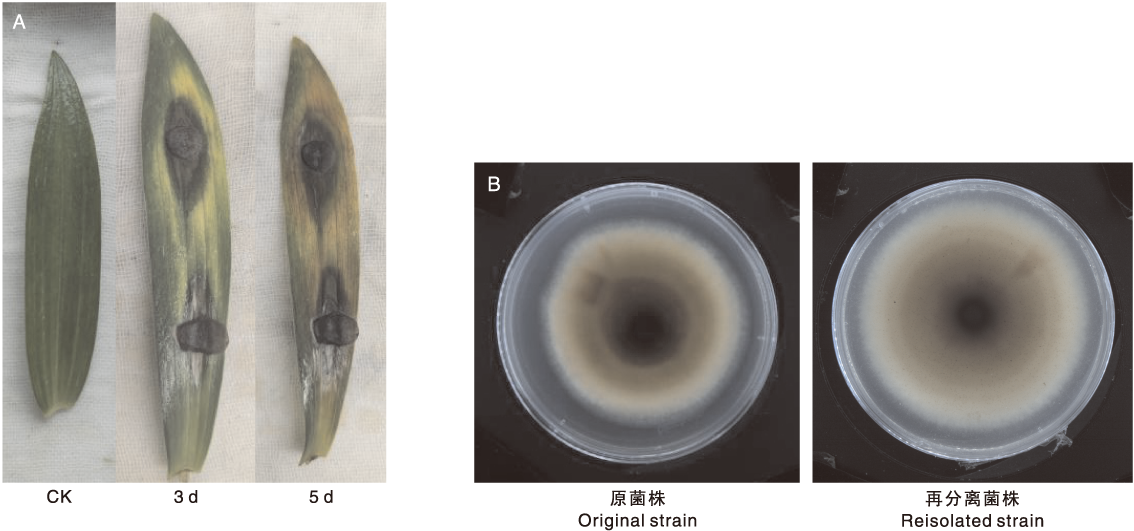
图1 百合离体回接发病症状及病原菌再分离 A,病原菌回接后的病害发展情况;B,病原菌的再分离结果。
Fig.1 Pathogenic symptoms of in vitro reinoculation and re-isolation of pathogenic fungi in lilies A, Disease development after reinoculation with pathogenic fungi; B, Re-isolation result of pathogenic fungi.
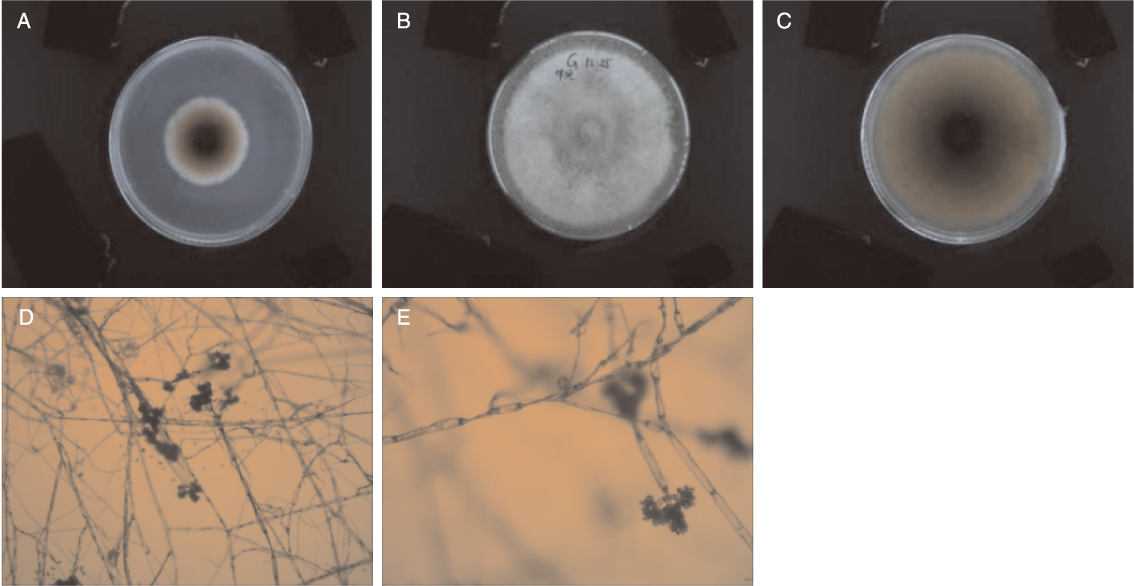
图2 病原菌在PDA平板上的形态特征 A,培养初期的背面(3 d);B,培养后期的正面(14 d);C,培养后期的背面(14 d);D,菌丝体;E,分生孢子及分生孢子梗。
Fig.2 Morphological characteristics of the pathogenic fungus on PDA plates A, Reverse side of early-stage culture(3 d); B, Front side of late-stage culture(14 d); C, Reverse side of late-stage culture(14 d); D, Mycelium; E, Conidia and conidiophores.
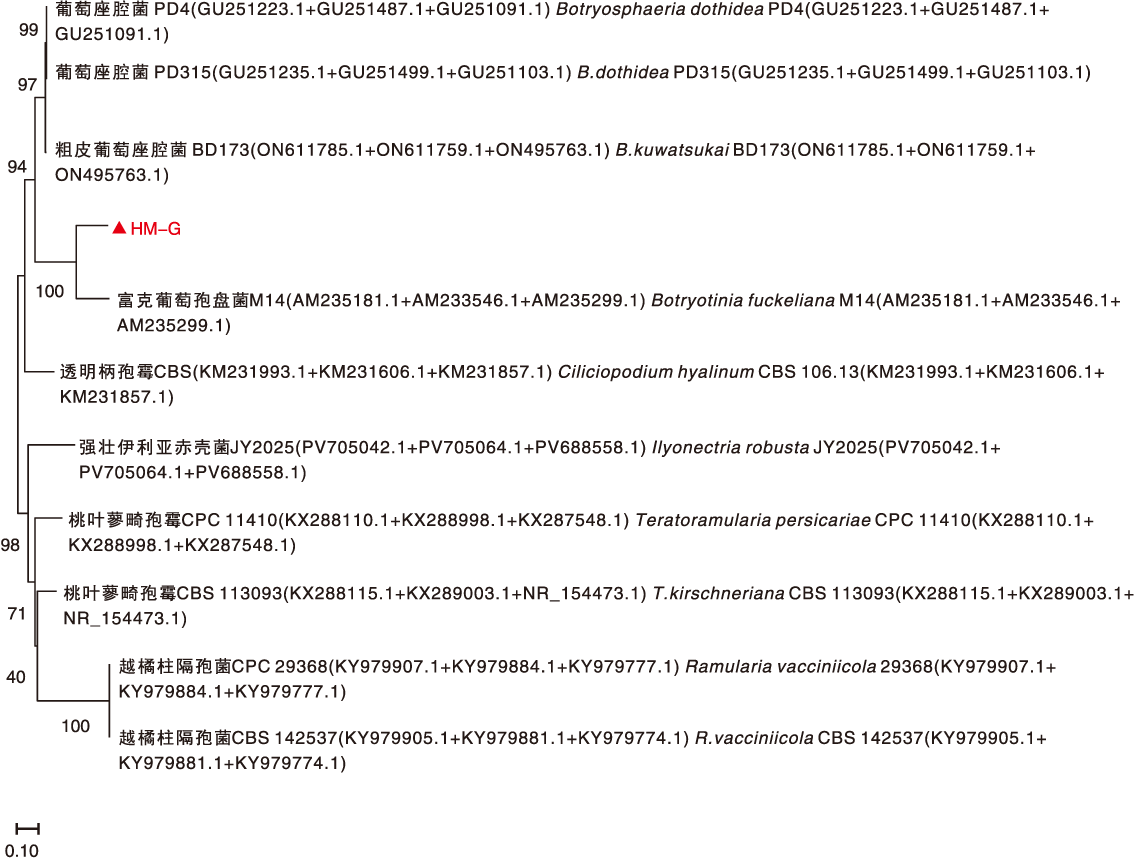
图3 NJ法构建的基于TEF1-α-HIS-ITS序列的多基因联合系统发育树
Fig.3 Phylogenetic tree constructed by the neighbor-joining (NJ) method based on the combined multi-gene sequences of TEF1-α-HIS-ITS.
| 品种 Variety | 品系 Strain | 正面发病率/% Front incidence rate/% | 背面发病率/% Back incidence rate/% | 总发病率/% Total incidence rate/% | 病情指数 Disease index |
|---|---|---|---|---|---|
| 司库 Siku | 亚洲百合 Asiatic Hybrids | 90.0 | 80.0 | 85.0 | 83.3±3.0 a |
| 望景楼 Wangjinglou | LA杂交百合 Lilium Asiatic×Longiflorum | 100.0 | 100.0 | 100.0 | 70.3±5.1 b |
| 伊迪莎 Editha | 东方百合 Oriental Hybrids | 70.0 | 60.0 | 65.0 | 67.4±7.8 bc |
| 沙漠橙 Desert Orange | LA杂交百合 Lilium Asiatic×Longiflorum | 100.0 | 80.0 | 90.0 | 62.6±2.8 cd |
| 粉瑞拉 Pink Rilla | 亚洲百合 Asiatic Hybrids | 60.0 | 80.0 | 70.0 | 59.3±1.7 de |
| 黄色苏蕾 Yellow Sully | LA杂交百合 Lilium Asiatic×Longiflorum | 80.0 | 20.0 | 50.0 | 55.2±5.1 ef |
| 烦恼 Trouble | LA杂交百合 Lilium Asiatic×Longiflorum | 80.0 | 50.0 | 65.0 | 50.4±2.8 fg |
| 印度夏日 Indian Summerset | LA杂交百合 Lilium Asiatic×Longiflorum | 100.0 | 60.0 | 80.0 | 50.0±1.1 fg |
| 拉蒙 Ramon | 东方百合 Oriental Hybrids | 70.0 | 20.0 | 45.0 | 49.3±3.5 fgh |
| 粉色雷诺 Pink Renault | LA杂交百合 Lilium Asiatic×Longiflorum | 70.0 | 30.0 | 50.0 | 44.8±3.4 ghi |
| 桑德兰 Sunderland | OT杂交百合 Oriental×Trumpet | 80.0 | 30.0 | 55.0 | 43.0±3.6 ij |
| 红色活力 Red Vitality | 亚洲百合 Asiatic Hybrids | 80.0 | 40.0 | 60.0 | 40.4±1.7 jk |
| 帝王黄 Imperial Yellow | OT杂交百合 Oriental×Trumpet | 60.0 | 20.0 | 40.0 | 38.9±4.0 jkl |
| 伊萨贝拉 Isabella | 东方百合 Oriental Hybrids | 70.0 | 30.0 | 50.0 | 34.8±2.8 klm |
| 那升维尔 Nashville | 亚洲百合 Asiatic Hybrids | 50.0 | 10.0 | 30.0 | 32.6±5.0 lm |
| 天使 Angel | 东方百合 Oriental Hybrids | 40.0 | 10.0 | 25.0 | 30.0±3.3 m |
| 眼线 Eyeliner | LA杂交百合 Lilium Asiatic×Longiflorum | 60.0 | 10.0 | 35.0 | 15.6±2.3 n |
| 红鹰 Red Eagle | 亚洲百合 Asiatic Hybrids | 40.0 | 0 | 20.0 | 7.4±1.7 o |
表2 百合种质资源的致病性分析
Table 2 Analysis of disease resistance of lily germplasm resources
| 品种 Variety | 品系 Strain | 正面发病率/% Front incidence rate/% | 背面发病率/% Back incidence rate/% | 总发病率/% Total incidence rate/% | 病情指数 Disease index |
|---|---|---|---|---|---|
| 司库 Siku | 亚洲百合 Asiatic Hybrids | 90.0 | 80.0 | 85.0 | 83.3±3.0 a |
| 望景楼 Wangjinglou | LA杂交百合 Lilium Asiatic×Longiflorum | 100.0 | 100.0 | 100.0 | 70.3±5.1 b |
| 伊迪莎 Editha | 东方百合 Oriental Hybrids | 70.0 | 60.0 | 65.0 | 67.4±7.8 bc |
| 沙漠橙 Desert Orange | LA杂交百合 Lilium Asiatic×Longiflorum | 100.0 | 80.0 | 90.0 | 62.6±2.8 cd |
| 粉瑞拉 Pink Rilla | 亚洲百合 Asiatic Hybrids | 60.0 | 80.0 | 70.0 | 59.3±1.7 de |
| 黄色苏蕾 Yellow Sully | LA杂交百合 Lilium Asiatic×Longiflorum | 80.0 | 20.0 | 50.0 | 55.2±5.1 ef |
| 烦恼 Trouble | LA杂交百合 Lilium Asiatic×Longiflorum | 80.0 | 50.0 | 65.0 | 50.4±2.8 fg |
| 印度夏日 Indian Summerset | LA杂交百合 Lilium Asiatic×Longiflorum | 100.0 | 60.0 | 80.0 | 50.0±1.1 fg |
| 拉蒙 Ramon | 东方百合 Oriental Hybrids | 70.0 | 20.0 | 45.0 | 49.3±3.5 fgh |
| 粉色雷诺 Pink Renault | LA杂交百合 Lilium Asiatic×Longiflorum | 70.0 | 30.0 | 50.0 | 44.8±3.4 ghi |
| 桑德兰 Sunderland | OT杂交百合 Oriental×Trumpet | 80.0 | 30.0 | 55.0 | 43.0±3.6 ij |
| 红色活力 Red Vitality | 亚洲百合 Asiatic Hybrids | 80.0 | 40.0 | 60.0 | 40.4±1.7 jk |
| 帝王黄 Imperial Yellow | OT杂交百合 Oriental×Trumpet | 60.0 | 20.0 | 40.0 | 38.9±4.0 jkl |
| 伊萨贝拉 Isabella | 东方百合 Oriental Hybrids | 70.0 | 30.0 | 50.0 | 34.8±2.8 klm |
| 那升维尔 Nashville | 亚洲百合 Asiatic Hybrids | 50.0 | 10.0 | 30.0 | 32.6±5.0 lm |
| 天使 Angel | 东方百合 Oriental Hybrids | 40.0 | 10.0 | 25.0 | 30.0±3.3 m |
| 眼线 Eyeliner | LA杂交百合 Lilium Asiatic×Longiflorum | 60.0 | 10.0 | 35.0 | 15.6±2.3 n |
| 红鹰 Red Eagle | 亚洲百合 Asiatic Hybrids | 40.0 | 0 | 20.0 | 7.4±1.7 o |
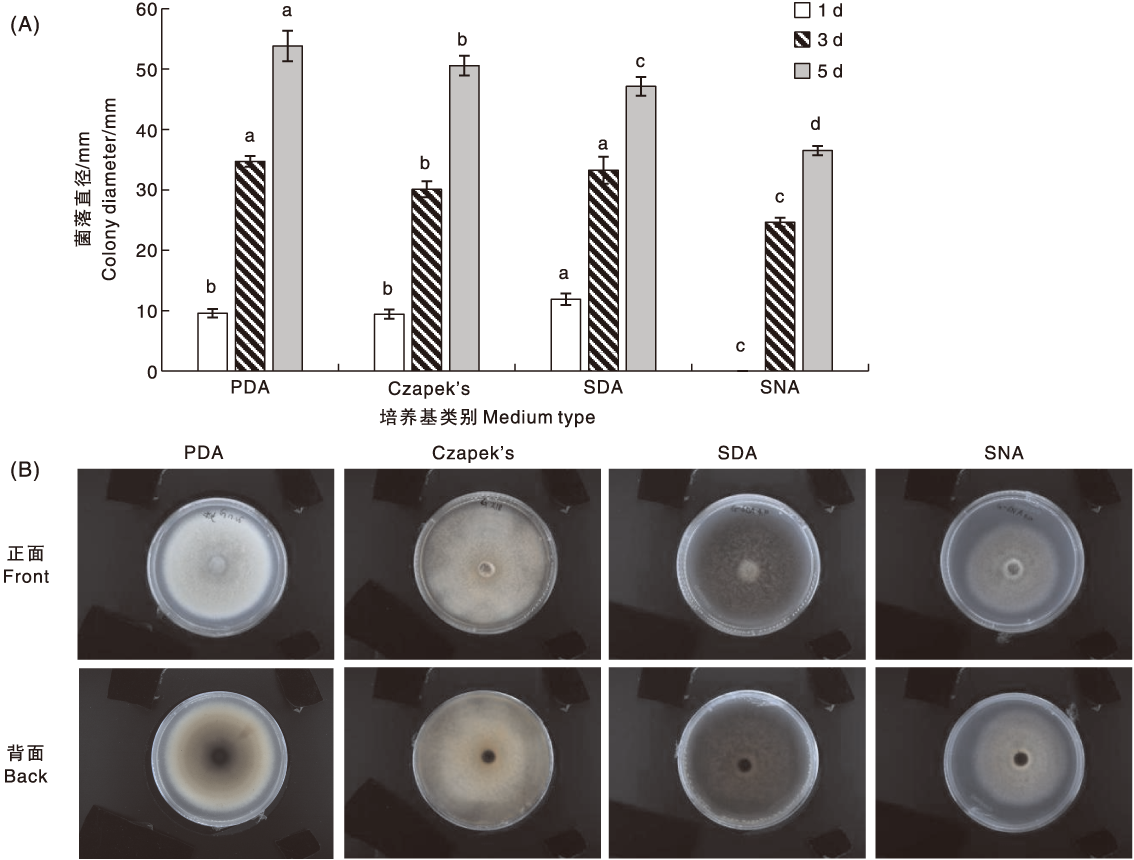
图4 不同培养基对病原菌HM-G生长的影响 PDA,马铃薯葡萄糖琼脂培养基;Czapek,查氏培养基;SDA,沙氏固体培养基;SNA,合成低营养琼脂培养基。A,菌落直径。相同时间下,柱上无相同小写字母表示各处理间差异显著(p<0.05)。图5~6同;B,培养7 d后的菌落形态。
Fig.4 Effects of different media on the growth of pathogenic fungus HM-G PDA,Potato dextrose agar medium; Czapek, Czapek’s medium; SDA, Sabouraud’s agar medium; SNA, Synthetic low nutrient agar medium. A, Colony diameters. At the same point, the absence of identical lowercase letters on the bars indicates significant (p<0.05) differences between treatment groups. The same as Fig. 5-Fig. 6; B, Colony morphology after 7 days of cultivation.
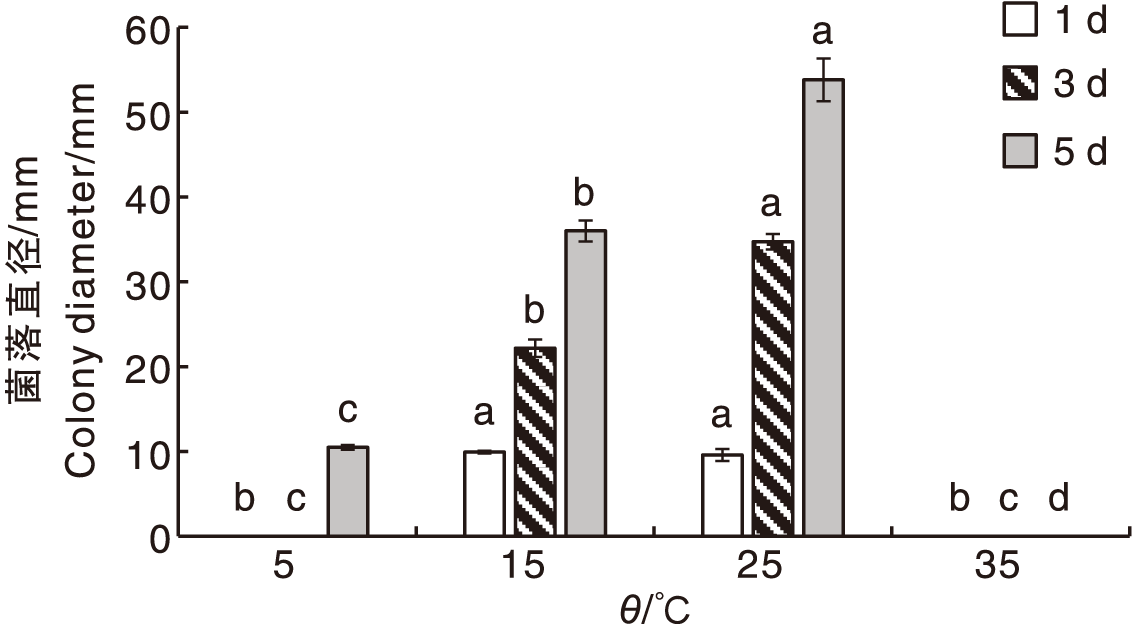
图5 温度对病原菌HM-G生长的影响
Fig.5 Effect of temperature on the growth of pathogenic fungus HM-G
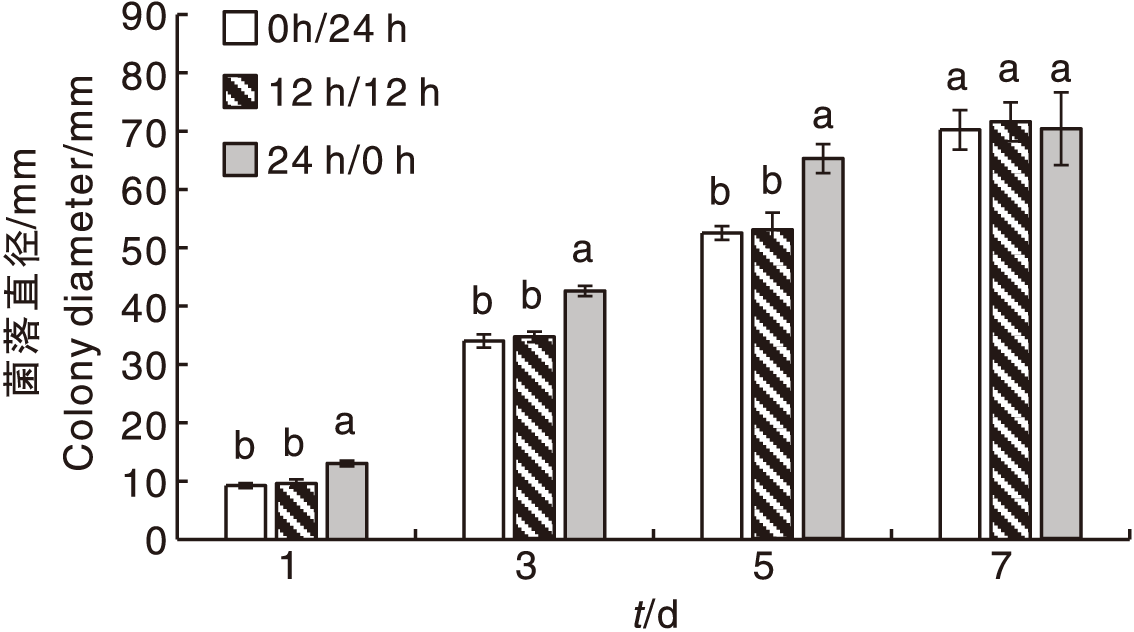
图6 光照对病原菌HM-G生长的影响
Fig.6 Effect of light on the growth of pathogenic fungus HM-G
| 药剂名称 Pesticide name | 剂型 Formulation | 药剂稀释倍数 Dilution times | 菌落平均直径/mm Average colony diameter/mm | 抑菌率/% Inhibition rate/% |
|---|---|---|---|---|
| 60%苯醚甲环唑 60% Difenoconazole | 可湿性粉剂 Wettable powder | 1 000 | 46.30±2.64 cd | 23.61 |
| 66.8%丙森·缬霉威 66.8% Propineb iprovalicarb | 可湿性粉剂 Wettable powder | 1 000 | ― | 0 |
| 80%代森锰锌 80% Mancozeb | 可湿性粉剂 Wettable powder | 500 | 48.74±1.23 bcd | 18.75 |
| 50%多菌灵 50% Carbendazim | 可湿性粉剂 Wettable powder | 500 | 38.38±1.12 e | 39.41 |
| 64%恶霜·锰锌 64% Oxadixyl mancozeb | 可湿性粉剂 Wettable powder | 500 | 50.52±0.78 bc | 15.20 |
| 62.5 g·L-1精甲·咯菌腈 62.5 g·L-1 Mefenoxam fludioxonil | 悬浮剂 SC | 1 000 | ― | 0 |
| 40%菌核净 40%Dimethachlon | 可湿性粉剂 WP | 250 | 45.54±0.57 d | 25.13 |
| 20%硫磺·三唑酮 20% Sulfur triadimefon | 可湿性粉剂 WP | 625 | ― | 0 |
| 50%氯溴异氰尿酸 50% Chlorobromoisocyanuric acid | 可湿性粉剂 WP | 1 000 | ― | 0 |
| 250 g·L-1嘧菌酯 250 g·L-1 Azoxystrobin | 悬浮剂 Suspension concentrate | 1 000 | ― | 0 |
| 400 g·L-1嘧霉胺 400 g·L-1 Pyrimethanil | 悬浮剂 Suspension concentrate | 625 | 36.68±0.49 e | 42.80 |
| 25%氰烯菌酯 25% Phenamacril | 悬浮剂 Suspension concentrate | 500 | ― | 0 |
| 430 g·L-1戊唑醇 430 g·L-1 Tebuconazole | 悬浮剂 Suspension concentrate | 2000 | 51.36±1.23 b | 13.52 |
| 50%烯酰吗啉 50% Dimethomorph | 可湿性粉剂WP | 1 000 | ― | 0 |
| 80%乙蒜素 80% Ethyl allicin | 乳油 Emulsifiable concentrate | 1 000 | ― | 0 |
| 2%中生·四霉素 2% Zhongshengmycin Tetramycin | 可溶性液剂 Soluble liquid | 1 000 | ― | 0 |
| CK | ― | ― | 58.14±0.37 a | ― |
表3 杀菌剂对百合灰霉病病原菌的抑制效果
Table 3 Inhibitory effect of fungicides on the pathogenic fungus causing lily gray mold
| 药剂名称 Pesticide name | 剂型 Formulation | 药剂稀释倍数 Dilution times | 菌落平均直径/mm Average colony diameter/mm | 抑菌率/% Inhibition rate/% |
|---|---|---|---|---|
| 60%苯醚甲环唑 60% Difenoconazole | 可湿性粉剂 Wettable powder | 1 000 | 46.30±2.64 cd | 23.61 |
| 66.8%丙森·缬霉威 66.8% Propineb iprovalicarb | 可湿性粉剂 Wettable powder | 1 000 | ― | 0 |
| 80%代森锰锌 80% Mancozeb | 可湿性粉剂 Wettable powder | 500 | 48.74±1.23 bcd | 18.75 |
| 50%多菌灵 50% Carbendazim | 可湿性粉剂 Wettable powder | 500 | 38.38±1.12 e | 39.41 |
| 64%恶霜·锰锌 64% Oxadixyl mancozeb | 可湿性粉剂 Wettable powder | 500 | 50.52±0.78 bc | 15.20 |
| 62.5 g·L-1精甲·咯菌腈 62.5 g·L-1 Mefenoxam fludioxonil | 悬浮剂 SC | 1 000 | ― | 0 |
| 40%菌核净 40%Dimethachlon | 可湿性粉剂 WP | 250 | 45.54±0.57 d | 25.13 |
| 20%硫磺·三唑酮 20% Sulfur triadimefon | 可湿性粉剂 WP | 625 | ― | 0 |
| 50%氯溴异氰尿酸 50% Chlorobromoisocyanuric acid | 可湿性粉剂 WP | 1 000 | ― | 0 |
| 250 g·L-1嘧菌酯 250 g·L-1 Azoxystrobin | 悬浮剂 Suspension concentrate | 1 000 | ― | 0 |
| 400 g·L-1嘧霉胺 400 g·L-1 Pyrimethanil | 悬浮剂 Suspension concentrate | 625 | 36.68±0.49 e | 42.80 |
| 25%氰烯菌酯 25% Phenamacril | 悬浮剂 Suspension concentrate | 500 | ― | 0 |
| 430 g·L-1戊唑醇 430 g·L-1 Tebuconazole | 悬浮剂 Suspension concentrate | 2000 | 51.36±1.23 b | 13.52 |
| 50%烯酰吗啉 50% Dimethomorph | 可湿性粉剂WP | 1 000 | ― | 0 |
| 80%乙蒜素 80% Ethyl allicin | 乳油 Emulsifiable concentrate | 1 000 | ― | 0 |
| 2%中生·四霉素 2% Zhongshengmycin Tetramycin | 可溶性液剂 Soluble liquid | 1 000 | ― | 0 |
| CK | ― | ― | 58.14±0.37 a | ― |
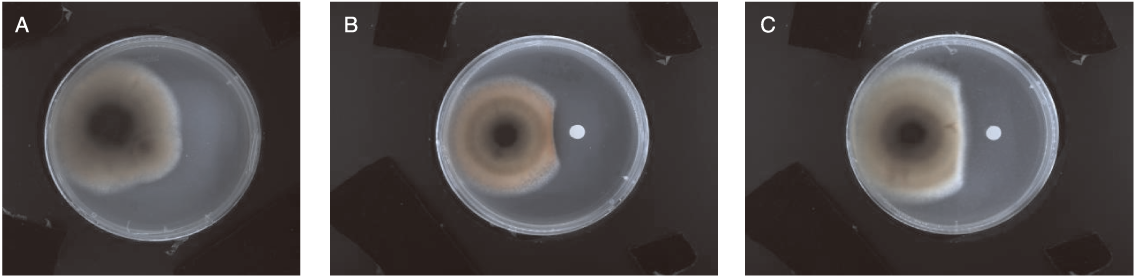
图7 杀菌剂对病原菌的抑制效果 A,CK;B,50%多菌灵;C,400 g·L-1嘧霉胺。
Fig.7 Comparison of inhibitory effects of fungicides on pathogenic fungi A, CK; B, 50% Carbendazim; C, 400 g·L-1 Pyrimethanil.
| [1] | 唐蓉, 沈宁东, 韦梅琴, 等. 观赏百合鳞片气培过程中器官分化[J]. 北方园艺, 1998(增刊): 96-98. |
| Tang R, Shen N D, Wei M Q, et al. Organ differentiation during aeroponic culture of ornamental lily bulbs[J]. Journal of Northern Horticulture, 1998, (S1): 99-101. | |
| [2] | 白滨, 杨花莲, 何苏琴, 等. 兰州百合叶枯病病原菌形态特征及生物学特性研究[J]. 中国蔬菜, 2013(16): 78-84. |
| Bai B, Yang H L, He S Q, et al. Studies on morphology and biological characteristics of Botrytis elliptica(Berk.) Cooke causing foliage blight of Lilium davidii Duch. var. unicolor(Hoog) Cotton[J]. China Vegetables, 2013, (16): 78-84. | |
| [3] | Zhang H S, Wu X T, Liu X J, et al. Hydrogen gas improves the postharvest quality of Lanzhou lily (Lilium davidii var. unicolor) bulbs[J]. Plants, 2023, 12(4): 946. |
| [4] | 王存颖, 梁巧兰, 魏列新, 等. 两种矿物源农药与化学农药混配对百合灰霉病菌抑菌增效作用评价[J]. 甘肃农业大学学报, 2024, 59(3): 195-203. |
| Wang C Y, Liang Q L, Wei L X, et al. Evaluation of the synergistic effect of two mineral and chemical fungicides mixed on Botrytis cinerea[J]. Journal of Gansu Agricultural University, 2024, 59 (3):195-203. | |
| [5] | 李欣冉, 吴昀, 任梓铭, 等. 百合灰霉病研究进展[J]. 中国植保导刊, 2024, 44(4): 20-27. |
| Li X R, Wu Y, Ren Z M, et al. Progress in the study of grey mould of Lilium spp[J]. Journal of China Plant Protection, 2024, 44 (4): 20-27. | |
| [6] | Kumari S, Kanth B K, Ahn J Y, et al. Genome-wide transcriptomic identification and functional insight of lily WRKY genes responding to Botrytis fungal disease[J]. Plants, 2021, 10(4): 776. |
| [7] | Chiou A L, Wu W S. Isolation, identification and evaluation of bacterial antagonists against Botrytis elliptica on lily[J]. Journal of Phytopathology, 2001, 149(6): 319-324. |
| [8] | 瞿友均, 徐源辉. 百合灰霉病的发生特点和综合防治方法[J]. 中国植保导刊, 2010, 30(4): 26-27. |
| Qu Y J, Xu Y H. Occurrence characteristics and integrated control methods of lily gray mold[J]. Journal of China Plant Protection, 2010, 30 (4):26-27. | |
| [9] | 罗大成. 17%吡唑醚菌酯·氟苯醚酰胺悬浮剂研制及对番茄灰霉病田间防治效果[D]. 杨凌: 西北农林科技大学, 2021. |
| Luo D C. Preparation of pyraclostrobin·flubeneteram 17%SC and its field control effect on tomato Botrytis cinerea[D]. Yangling: Northwest A&F University, 2021. | |
| [10] | Leroux P, Fritz R, Debieu D, et al. Mechanisms of resistance to fungicides in field strains of Botrytis cinerea[J]. Pest Management Science, 2002, 58(9): 876-888. |
| [11] | 仇硕, 夏科, 李秀娟, 等. 龙牙百合两种病害致病菌的分离、鉴定及抑制效应研究[J]. 广西植物, 2018, 38(1): 109-118. |
| Qiu S, Xia K, Li X J, et al. Isolation, identification and inhibiting effects of pathogens that caused two kinds of diseases in Lilium brownii var. Viridulum[J]. Guihaia, 2018, 38 (1): 109-118. | |
| [12] | 蔺珂, 梁巧兰, 魏列新, 等. 5种矿物源农药对兰州百合3种病害室内防效评价[J]. 植物保护, 2022, 48(1): 338-346. |
| Lin K, Liang Q L, Wei L X, et al. Evaluation of indoor control effects of five mineral pesticides against three diseases of Lanzhou lily[J]. Plant Protection, 2022, 48 (1): 338-346. | |
| [13] | 皇甫运红, 戴德江, 时浩杰, 等. 浙江省果蔬灰霉病菌对嘧菌酯的抗药性研究[J]. 农药学学报, 2013, 15(5): 504-510. |
| Huangfu Y H, Dai D J, Shi H J, et al. Study on resistance of Botrytis cinerea to azoxystrobin collected from fruits and vegetables in Zhejiang Province[J]. Journal of Pesticide Science, 2013, 15 (5): 504-510. | |
| [14] | 张铭芳, 李卉, 韩东洋, 等. 不同百合种质资源对灰霉病的抗性[J]. 江苏农业学报, 2022, 38(4): 1078-1084. |
| Zhang M F, Li H, Han D Y, et al. Resistance of different lily germplasm resources to Botrytis cinerea[J]. Journal of Jiangsu Agricultural Sciences, 2022, 38 (4): 1078-1084. | |
| [15] | 魏景超. 真菌鉴定手册[M]. 北京: 科学出版社, 1979. |
| Wei J C. Handbook of Fungal Identification[M]. Beijing: Science Press, 1979. | |
| [16] | Wang L Y, Hu J P, Li D S, et al. Isolation and control of Botrytis cinerea in postharvest green pepper fruit[J]. Scientia Horticulturae, 2022, 302: 111159. |
| [17] | 吴琼, 梁巧兰, 张娜. 番茄主要病害病原菌培养条件及室内药剂筛选[J]. 甘肃农业大学学报, 2018, 53(5): 79-86. |
| Wu Q, Liang Q L, Zhang N. Cultural conditions of pathogens of main tomato diseases and fungicides screening in laboratory[J]. Journal of Gansu Agricultural University, 2018, 53 (5):79-86. | |
| [18] | 杜艳丽. 康宁霉素对东方百合(Lilium Oriental hybrid)生长及灰霉病防治效果的研究[D]. 聊城: 聊城大学, 2019. |
| Du Y L. Study on the effect of trichokonins on the growth of Lilium Oriental hybrid and the control of Botrytis cinerea[D]. Liaocheng: Liaocheng University, 2019. | |
| [19] | Cao X, Du Y L, Zhang X S, et al. First report of leaf blight disease on Lanzhou lily (Lilium davidii var. unicolor) caused by Botrytis cinerea in China[J]. Plant Disease, 2020, 104(1): 291. |
| [20] | 张莉雪, 张紫薇, 宋云泽, 等. 不同百合品种的花和叶片对灰葡萄孢菌(Botrytis cinerea)的抗性评价[J]. 安徽农业大学学报, 2024, 51(2): 230-238. |
| Zhang L X, Zhang Z W, Song Y Z, et al. Evaluation of resistance of flowers and leaves of different lily cultivars to Botrytis cinerea[J]. Journal of Anhui Agricultural University, 2024, 51 (2): 230-238. | |
| [21] | 徐琼, 徐秉良, 王芳. 观赏百合叶枯病症状类型与病原菌鉴定[J]. 植物保护, 2006, 32(5): 61-64. |
| Xu Q, Xu B L, Wang F. Symptom types and identification of lily blight[J]. Plant Protection, 2006, 32 (5): 61-64. | |
| [22] | Alam M M, Alam K M, Momotaz R, et al. Botrytis gray mold of Lilium in Bangladesh: diagnosis, basic study and control[J]. Heliyon, 2024, 10(12): e33165. |
| [23] | 杜艳丽, 曹兴, 王桂清, 等. 百合灰霉病病原菌鉴定及其部分生物学特性测定[J]. 南方农业学报, 2019, 50(2): 307-314. |
| Du Y L, Cao X, Wang G Q, et al. Identification and partial biological characteristics of pathogen causing lily gray mold[J]. Journal of Southern Agriculture, 2019, 50 (2): 307-314. | |
| [24] | 朱丽梅, 胡凤荣, 罗凤霞. 不同百合品种对百合灰霉病的抗病性鉴定[J]. 植物保护, 2010, 36(3): 148-151. |
| Zhu L M, Hu F R, Luo F X. Identification of disease resistance of Lilium species to lily gray mould[J]. Plant Protection, 2010, 36 (3): 148-151. | |
| [25] | Fu Y Y, Li J, Wu H, et al. Analyses of Botrytis cinerea-responsive LrWRKY genes from Lilium regale reveal distinct roles of two LrWRKY transcription factors in mediating responses to B. cinerea[J]. Plant Cell Reports, 2022, 41(4): 995-1012. |
| [26] | Cui Q, Yan X, Gao X, et al. Analysis of WRKY transcription factors and characterization of two Botrytis cinerea-responsive LrWRKY genes from Lilium regale[J]. Plant Physiology and Biochemistry, 2018, 127: 525-536. |
| [27] | Ding L P, Wu Z, Xiang J, et al. A LlWRKY33-LlHSFA4-LlCAT2 module confers resistance to Botrytis cinerea in lily[J]. Horticulture Research, 2024, 11: uhad254. |
| [28] | 陈琪. 灰葡萄孢对速克灵抗性遗传及病理生理学的研究[D]. 合肥: 安徽农业大学, 2004. |
| Chen Q. Studies on Inheritance of resistance to procymidone and pathphysiology of Botrytis cinerea[D]. Hefei: Anhui Agricultural University, 2004. | |
| [29] | 严慧丽, 杨利娟, 裴毅, 等. 兰州百合枯萎病病原鉴定及防治药剂筛选[J/OL]. 分子植物育种, 2024-11-20. https://link.cnki.net/urlid/46.1068.S.20241120.1347.010. |
| Yan H L, Yang L J, Pei Y, et al. Identification of pathogens of Lanzhou lily wilt and screening of control agents[J/OL]. Molecular Plant Breeding, 2024-11-20. https://link.cnki.net/urlid/46.1068.S.20241120.1347.010. | |
| [30] | 叶艳英, 熊春晖, 袁经相, 等. 植物源杀菌剂防治灰霉病研究进展[J]. 生物灾害科学, 2016, 39(1): 27-31. |
| Ye Y Y, Xiong C H, Yuan J S, et al. A research progresses of botanical fungicides against Botrytis cinerea[J]. Journal of Biological Disasters Science, 2016, 39(1): 27-31. | |
| [31] | 张天术, 肖群英, 周佳民, 等. 不同化学药剂对药用百合卷丹灰霉病的防治效果[J]. 湖南农业科学, 2022(7): 50-52. |
| Zhang T S, Xiao Q Y, Zhou J M, et al. Study on the prevention and control effects of different chemicals on gray mold disease of Lilium lancifolium Thunb[J]. Hunan Agricultural Sciences, 2022, (7): 50-52. | |
| [32] | 杨升炯, 宋新兰. 百合灰霉病药剂防治试验[J]. 植保技术与推广, 1995, 15(5): 35. |
| Yang S J, Song X L. Fungicide control experiment of lily Botrytis cinerea[J]. Plant Protection Technology and Extension, 1995, (5): 35. | |
| [33] | 陈宇春, 陈敏, 王其刚, 等. 植物灰霉病及抗性研究进展[J]. 江苏农业科学, 2020, 48(15): 42-51. |
| Chen Y C, Chen M, Wang Q G, et al. Research progress of plant gray mold and resistance[J]. Jiangsu Agricultural Sciences, 2020, 48 (15): 42-51. | |
| [34] | 尹向田, 迟军利, 韩星, 等. 芽孢杆菌与化学杀菌剂复配防治葡萄灰霉病的研究[J]. 中外葡萄与葡萄酒, 2024(4): 95-101. |
| Yin X T, Chi J L, Han X, et al. Research on combination of Bacillus and fungicide to control gray mold of grapevine[J]. Sino-Overseas Grapevine & Wine, 2024, (4): 95-101. | |
| [35] | 张晓翠, 许春丽, 周倩影, 等. 武夷菌素与嘧菌环胺复配防治葡萄灰霉病[J]. 中国生物防治学报, 2025, 41(1): 156-164. |
| Zhang X C, Xu C L, Zhou QY, et al. Control effect of wuyiencin and cyprodinil on Botrytis cinerea[J]. Chinese Journal of Biological Control, 2025, 41 (1): 156-164. |
| [1] | 刘光炎, 熊海燕, 周梅, 李正敏, 王金燕, 陈晶晶, 张玉, 王超. 绣球湖蓝炭疽病病原菌的分离、鉴定与防治[J]. 浙江农业学报, 2026, 38(7): 1400-1409. |
| [2] | 邓云丹, 陆承锐, 李录山, 徐永艳. 10种百合鳞茎营养成分的测定与评价[J]. 浙江农业学报, 2026, 38(6): 1228-1235. |
| [3] | 蒋志丽, 沈玲玲, 吴震, 王阳光, 陆胜民. 微酸性电解水结合ε-聚赖氨酸盐酸盐对百合鳞片的保鲜效果[J]. 浙江农业学报, 2026, 38(5): 991-997. |
| [4] | 张玉, 陈晶晶, 温联好, 杨振翼, 杨曾华, 童译, 王超. 绣球博大蓝叶斑病病原菌的分离鉴定与防治[J]. 浙江农业学报, 2026, 38(4): 696-706. |
| [5] | 陈晶晶, 张玉, 温联好, 刘光炎, 周梅, 李正敏, 熊海燕, 杨振翼, 杨曾华, 童译, 王超. 绣球叶斑病的病原菌分离鉴定与防治研究[J]. 浙江农业学报, 2026, 38(1): 105-113. |
| [6] | 邓玉莲, 谭琳, 牛丽, 卢前程, 周玲红, 李桂花, 胡秋龙. 一株茶根腐病拮抗真菌的筛选鉴定与生物学特性研究[J]. 浙江农业学报, 2025, 37(7): 1469-1480. |
| [7] | 沈国强, 汪明德, 关雅文, 武军, 王汉荣. 高粱弯孢叶斑病病原菌鉴定、生物学特性研究及防治药剂筛选[J]. 浙江农业学报, 2025, 37(7): 1492-1500. |
| [8] | 王超, 李艳杰, 牛芸, 温联好, 陈晶晶, 吴红芝, 杨玉勇, 吴艳迪. 月季黑斑病病原菌的生物学特性与品种抗性评价[J]. 浙江农业学报, 2025, 37(5): 1087-1096. |
| [9] | 刘亚婷, 吴立东, 邱胤晖, 陈国钰, 钟柳青. 辣椒炭疽病病原菌分离鉴定及防治药剂筛选[J]. 浙江农业学报, 2025, 37(11): 2315-2324. |
| [10] | 罗芷涵, 刘朋飞, 于军, 齐鹤, 陈小光, 楼兵干. 国槐枝枯病病原菌鉴定及其生物学特性[J]. 浙江农业学报, 2024, 36(3): 579-588. |
| [11] | 刘筱琳, 孙婷婷, 杨捷, 何恒斌. 天香百合、药百合黄酮醇合成酶FLS基因克隆和表达分析[J]. 浙江农业学报, 2024, 36(2): 344-357. |
| [12] | 王士臻, 黄俊, 李明江, 黄英杰, 张娟. 浙江省桂花叶斑病的病原鉴定及生物学特性等相关研究[J]. 浙江农业学报, 2024, 36(12): 2763-2773. |
| [13] | 潘长漭, 王玉珊, 黄秋月, 何建清, 巴桑旺姆, 张格杰. 卷须猴头菌的鉴定及生物学特性研究[J]. 浙江农业学报, 2024, 36(10): 2229-2237. |
| [14] | 冯连荣, 张妍, 赵鑫闻, 宋立志, 梁德军. 一株野生金针菇菌种的分离、鉴定与生物学特性研究[J]. 浙江农业学报, 2023, 35(5): 1088-1096. |
| [15] | 孙珊珊, 其美拉姆, 李强, 曾南方, 郑诚, 张白玉, 颜其贵. 表达PRRSV NADC30-like毒株GP5-M的重组伪狂犬病病毒的构建及其生物学特性探究[J]. 浙江农业学报, 2023, 35(11): 2555-2567. |
| 阅读次数 | ||||||
|
全文 |
|
|||||
|
摘要 |
|
|||||

