浙江农业学报 ›› 2026, Vol. 38 ›› Issue (2): 269-283.DOI: 10.3969/j.issn.1004-1524.20241050
膜荚黄芪TCP基因家族全基因组分析及其对非生物胁迫的响应
马琦洋a( ), 黄雪莲b,*()
a.浙江中医药大学 第一临床医学院 浙江 杭州 310053 b.浙江中医药大学 基础医学院 浙江 杭州 310053
-
收稿日期:2024-12-02出版日期:2026-02-25发布日期:2026-03-24 -
作者简介:马琦洋,主要从事中药资源鉴定与草药分子生理研究。E-mail: mqy20242025@163.com -
通讯作者:*黄雪莲,E-mail: h25872968110xl@126.com -
基金资助:省级创业训练计划(S202310344003X);2023浙江省新苗人才计划(2023R410004)
Genome-wide analysis of the TCP gene family in Astragalus membranaceus (Fisch.) Bunge and its response to abiotic stress
MA Qiyanga(), HUANG Xuelianb,*()
a. The First Clinical Medical College, Zhejiang Chinese Medical University Hangzhou 310053, China b. School of Basic Medical Sciences ,Zhejiang Chinese Medical University Hangzhou 310053, China
-
Received:2024-12-02Published:2026-02-25Online:2026-03-24

摘要:
本研究旨在鉴定和分析膜荚黄芪TCP基因家族,并揭示其对非生物胁迫的响应,为研究膜荚黄芪TCP基因在非生物胁迫中的功能提供理论依据。通过生物信息学方法对膜荚黄芪TCP基因及其编码的氨基酸序列进行系统分析,利用RNA-seq技术研究膜荚黄芪TCP基因在不同组织(根、茎和叶)中的表达模式,并通过实时荧光定量PCR(RT-qPCR)验证了5个代表性AmTCP基因在非生物胁迫(高温、干旱、盐胁迫)条件下的表达谱。结果表明,共鉴定出24个TCP基因且不均匀分布于膜荚黄芪的8条染色体上。24个AmTCP基因可分为Ⅰ类(PCF)和Ⅱ类(CYC/TB1和CIN)。同一亚家族蛋白具有高度相似的基序组成,大多数AmTCP基因缺乏内含子。片段重复在膜荚黄芪TCP基因家族进化中发挥了重要作用。此外,启动子区域分析发现多个光响应元件和激素响应元件。组织表达分析显示,AmTCP基因具有显著的组织表达特异性。在非生物胁迫下,5个代表性AmTCP基因的表达水平存在显著差异,其中AmTCP18和AmTCP19基因在多种胁迫条件下均表现出较高的表达水平。综上所述,AmTCP18和AmTCP19可能在膜荚黄芪对非生物胁迫的响应中发挥关键作用,本研究为膜荚黄芪TCP基因家族的进一步功能和进化研究奠定了基础。
中图分类号:
引用本文
马琦洋, 黄雪莲. 膜荚黄芪TCP基因家族全基因组分析及其对非生物胁迫的响应[J]. 浙江农业学报, 2026, 38(2): 269-283.
MA Qiyang, HUANG Xuelian. Genome-wide analysis of the TCP gene family in Astragalus membranaceus (Fisch.) Bunge and its response to abiotic stress[J]. Acta Agriculturae Zhejiangensis, 2026, 38(2): 269-283.
| 基因 Gene | 正向引物(5'→3') Forward primer (5'→3') | 反向引物(5'→3') Reverse primer (5'→3') |
|---|---|---|
| Actin | CTCTCTCAGCACCTTCGAGCAG | TCCACATACAACCGCTCCACTG |
| AmTCP8 | CCAGGCGGAACCGAGCATTATTG | TCGCTTCCTGCTGCTGATGATGA |
| AmTCP16 | AACGGCGATGATGGCGATGATG | TGCTGCTGCTGCTGCTGATG |
| AmTCP18 | GCGGCAGCGGCAACTATAACAA | GCTCGGAATATGATGATGATGCGGAAT |
| AmTCP19 | AGCAGCAGCAGCAGCAGAAC | CGTTGTTGCCGGTATCCAGGTT |
| AmTCP23 | AGCCGCACCAACTGGAACATTAC | TCTGATGCTGATGCTGGTTCTGATG |
表1 RT-qPCR引物
Table 1 Primers for RT-qPCR
| 基因 Gene | 正向引物(5'→3') Forward primer (5'→3') | 反向引物(5'→3') Reverse primer (5'→3') |
|---|---|---|
| Actin | CTCTCTCAGCACCTTCGAGCAG | TCCACATACAACCGCTCCACTG |
| AmTCP8 | CCAGGCGGAACCGAGCATTATTG | TCGCTTCCTGCTGCTGATGATGA |
| AmTCP16 | AACGGCGATGATGGCGATGATG | TGCTGCTGCTGCTGCTGATG |
| AmTCP18 | GCGGCAGCGGCAACTATAACAA | GCTCGGAATATGATGATGATGCGGAAT |
| AmTCP19 | AGCAGCAGCAGCAGCAGAAC | CGTTGTTGCCGGTATCCAGGTT |
| AmTCP23 | AGCCGCACCAACTGGAACATTAC | TCTGATGCTGATGCTGGTTCTGATG |
| 蛋白名 Protein name | 基因名 Gene name | 氨基酸数量 Amino acid quantity | 相对分子质量/ku Relative molecular weight/ku | 等电点 Isoelectric point | 不稳定系数 Instability index | 脂肪指数 Aliphatic index | 亲水性 Hydrophilicity |
|---|---|---|---|---|---|---|---|
| AmTCP1 | Amem01G08650.1 | 334 | 36.25 | 9.62 | 61.72 | 72.78 | -0.355 |
| AmTCP2 | Amem01G26990.1 | 353 | 37.44 | 5.99 | 52.15 | 67.73 | -0.460 |
| AmTCP3 | Amem01G29700.1 | 412 | 44.15 | 7.97 | 67.32 | 58.33 | -0.720 |
| AmTCP4 | Amem01G30870.1 | 349 | 39.08 | 8.44 | 53.65 | 55.62 | -0.756 |
| AmTCP5 | Amem01G31480.1 | 342 | 39.30 | 9.16 | 57.79 | 55.85 | -1.099 |
| AmTCP6 | Amem01G39660.1 | 329 | 35.68 | 6.21 | 43.87 | 57.63 | -0.681 |
| AmTCP7 | Amem02G01750.1 | 261 | 27.81 | 9.56 | 48.82 | 70.73 | -0.475 |
| AmTCP8 | Amem02G07350.1 | 233 | 25.13 | 9.10 | 52.77 | 70.52 | -0.566 |
| AmTCP9 | Amem02G13390.1 | 203 | 21.44 | 8.44 | 61.98 | 68.82 | -0.265 |
| AmTCP10 | Amem02G30910.1 | 344 | 36.12 | 5.46 | 54.31 | 65.00 | -0.358 |
| AmTCP11 | Amem02G31020.1 | 344 | 36.13 | 5.46 | 53.03 | 65.00 | -0.358 |
| AmTCP12 | Amem03G33990.1 | 375 | 41.03 | 6.90 | 66.54 | 52.88 | -0.784 |
| AmTCP13 | Amem03G35070.1 | 430 | 47.97 | 7.42 | 47.37 | 59.35 | -0.770 |
| AmTCP14 | Amem04G15690.1 | 417 | 44.13 | 6.90 | 56.30 | 57.15 | -0.661 |
| AmTCP15 | Amem05G34130.3 | 450 | 49.85 | 7.21 | 52.74 | 52.27 | -0.986 |
| AmTCP16 | Amem06G00490.1 | 494 | 52.19 | 6.15 | 62.09 | 50.63 | -0.856 |
| AmTCP17 | Amem06G06270.2 | 355 | 39.83 | 8.56 | 58.10 | 55.55 | -1.028 |
| AmTCP18 | Amem06G19960.1 | 177 | 20.64 | 10.50 | 49.17 | 69.44 | -0.921 |
| AmTCP19 | Amem06G25360.1 | 348 | 37.92 | 5.67 | 57.14 | 59.17 | -0.719 |
| AmTCP20 | Amem07G03630.1 | 358 | 40.03 | 8.28 | 49.00 | 71.84 | -0.665 |
| AmTCP21 | Amem07G04880.1 | 391 | 44.30 | 9.12 | 51.58 | 66.14 | -0.874 |
| AmTCP22 | Amem09G02360.1 | 358 | 40.20 | 8.26 | 54.21 | 55.89 | -0.885 |
| AmTCP23 | Amem09G03560.1 | 322 | 35.47 | 9.62 | 52.23 | 58.79 | -0.730 |
| AmTCP24 | Amem09G20040.1 | 362 | 40.59 | 8.87 | 44.80 | 69.53 | -0.735 |
表2 24个AmTCP基因及其编码蛋白的理化性质
Table 2 Physicochemical characteristics of 24 AmTCP genes and their encoded proteins
| 蛋白名 Protein name | 基因名 Gene name | 氨基酸数量 Amino acid quantity | 相对分子质量/ku Relative molecular weight/ku | 等电点 Isoelectric point | 不稳定系数 Instability index | 脂肪指数 Aliphatic index | 亲水性 Hydrophilicity |
|---|---|---|---|---|---|---|---|
| AmTCP1 | Amem01G08650.1 | 334 | 36.25 | 9.62 | 61.72 | 72.78 | -0.355 |
| AmTCP2 | Amem01G26990.1 | 353 | 37.44 | 5.99 | 52.15 | 67.73 | -0.460 |
| AmTCP3 | Amem01G29700.1 | 412 | 44.15 | 7.97 | 67.32 | 58.33 | -0.720 |
| AmTCP4 | Amem01G30870.1 | 349 | 39.08 | 8.44 | 53.65 | 55.62 | -0.756 |
| AmTCP5 | Amem01G31480.1 | 342 | 39.30 | 9.16 | 57.79 | 55.85 | -1.099 |
| AmTCP6 | Amem01G39660.1 | 329 | 35.68 | 6.21 | 43.87 | 57.63 | -0.681 |
| AmTCP7 | Amem02G01750.1 | 261 | 27.81 | 9.56 | 48.82 | 70.73 | -0.475 |
| AmTCP8 | Amem02G07350.1 | 233 | 25.13 | 9.10 | 52.77 | 70.52 | -0.566 |
| AmTCP9 | Amem02G13390.1 | 203 | 21.44 | 8.44 | 61.98 | 68.82 | -0.265 |
| AmTCP10 | Amem02G30910.1 | 344 | 36.12 | 5.46 | 54.31 | 65.00 | -0.358 |
| AmTCP11 | Amem02G31020.1 | 344 | 36.13 | 5.46 | 53.03 | 65.00 | -0.358 |
| AmTCP12 | Amem03G33990.1 | 375 | 41.03 | 6.90 | 66.54 | 52.88 | -0.784 |
| AmTCP13 | Amem03G35070.1 | 430 | 47.97 | 7.42 | 47.37 | 59.35 | -0.770 |
| AmTCP14 | Amem04G15690.1 | 417 | 44.13 | 6.90 | 56.30 | 57.15 | -0.661 |
| AmTCP15 | Amem05G34130.3 | 450 | 49.85 | 7.21 | 52.74 | 52.27 | -0.986 |
| AmTCP16 | Amem06G00490.1 | 494 | 52.19 | 6.15 | 62.09 | 50.63 | -0.856 |
| AmTCP17 | Amem06G06270.2 | 355 | 39.83 | 8.56 | 58.10 | 55.55 | -1.028 |
| AmTCP18 | Amem06G19960.1 | 177 | 20.64 | 10.50 | 49.17 | 69.44 | -0.921 |
| AmTCP19 | Amem06G25360.1 | 348 | 37.92 | 5.67 | 57.14 | 59.17 | -0.719 |
| AmTCP20 | Amem07G03630.1 | 358 | 40.03 | 8.28 | 49.00 | 71.84 | -0.665 |
| AmTCP21 | Amem07G04880.1 | 391 | 44.30 | 9.12 | 51.58 | 66.14 | -0.874 |
| AmTCP22 | Amem09G02360.1 | 358 | 40.20 | 8.26 | 54.21 | 55.89 | -0.885 |
| AmTCP23 | Amem09G03560.1 | 322 | 35.47 | 9.62 | 52.23 | 58.79 | -0.730 |
| AmTCP24 | Amem09G20040.1 | 362 | 40.59 | 8.87 | 44.80 | 69.53 | -0.735 |
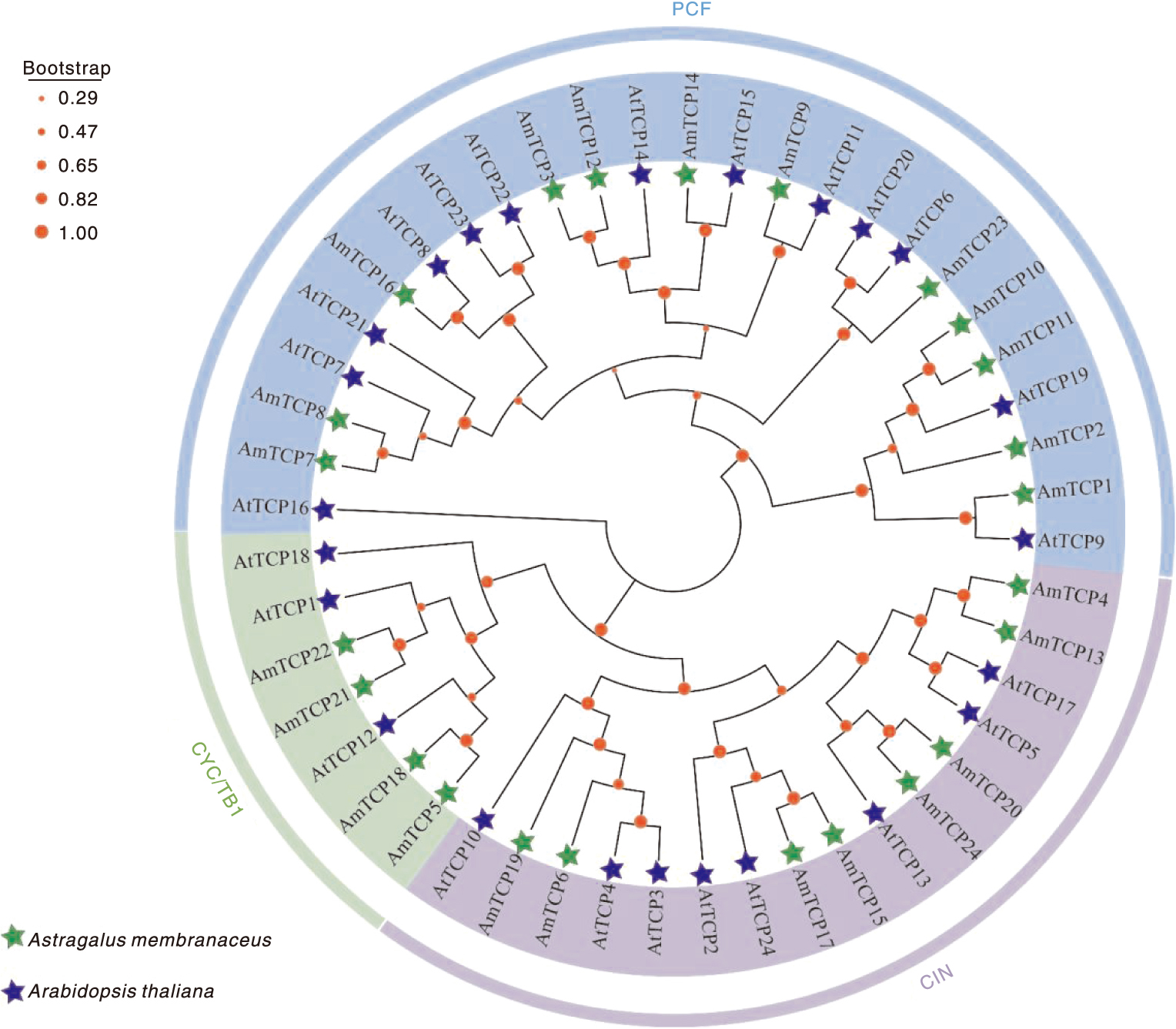
图1 膜荚黄芪和拟南芥TCP基因家族的系统发育分析
Fig.1 Phylogenetic analysis of the TCP gene family in Astragalus membranaceus(Fisch.) Bunge and Arabidopsis thaliana
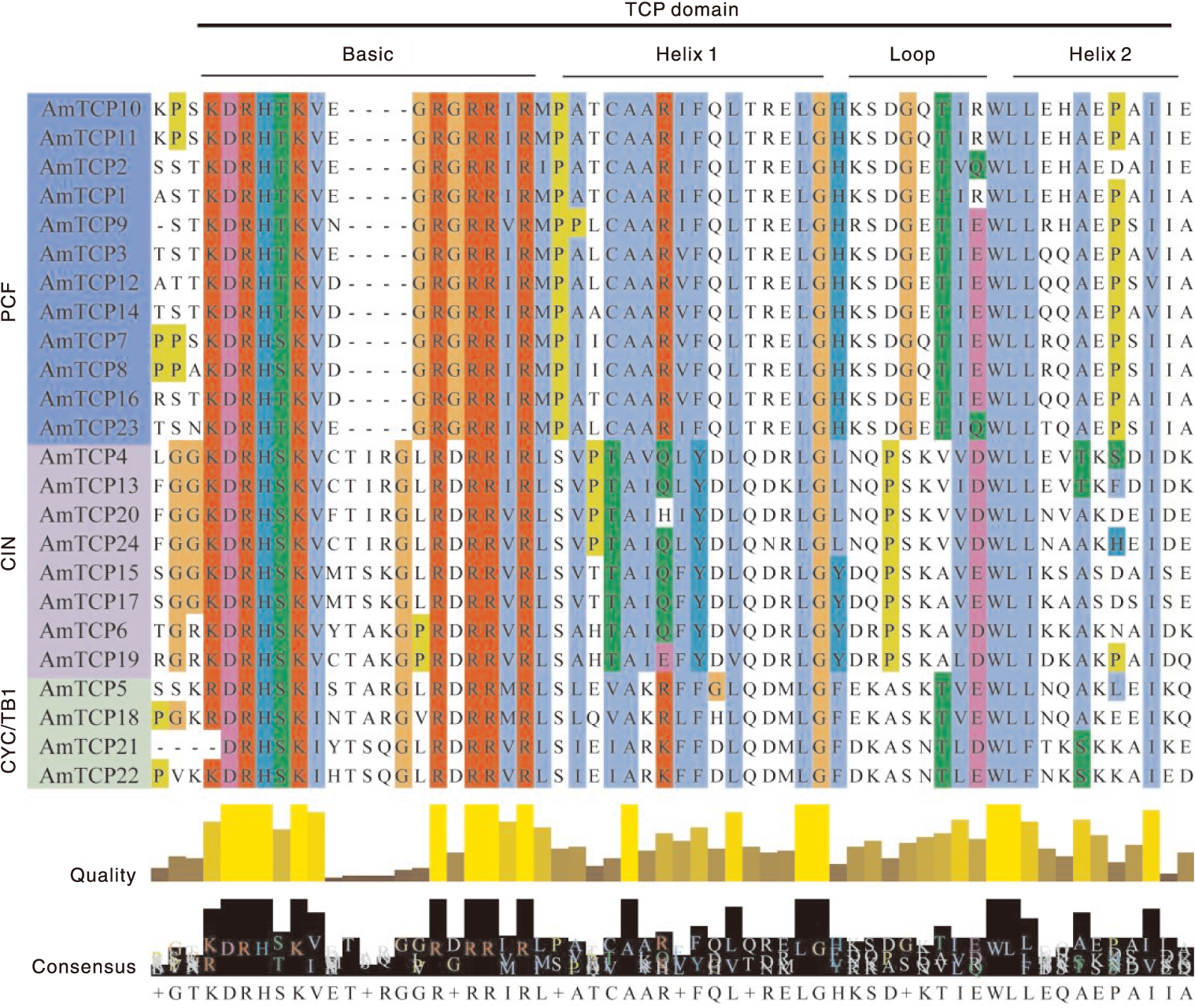
图2 AmTCP蛋白多序列比对
Fig.2 Multi sequence alignment of AmTCP protein
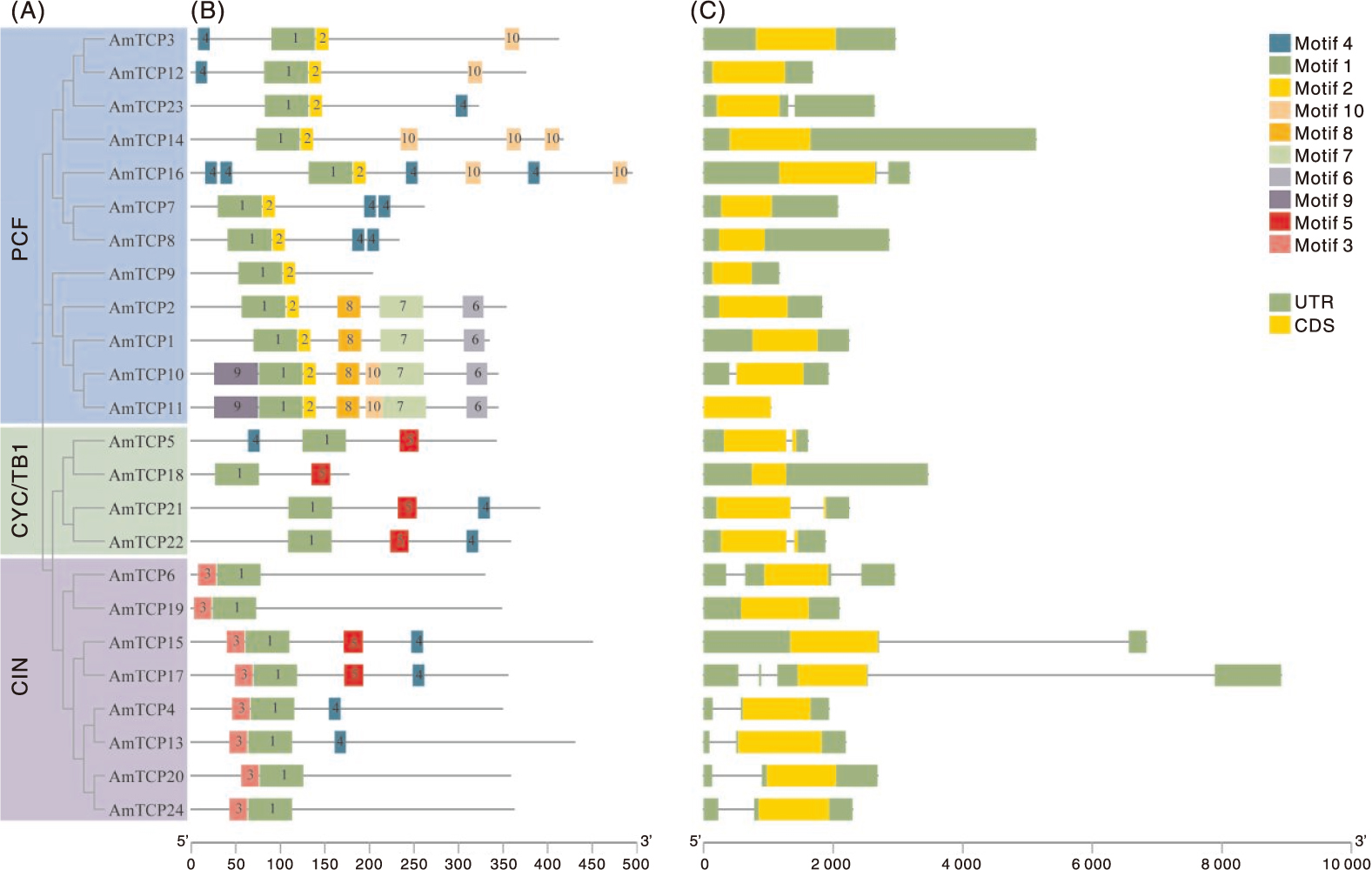
图3 AmTCP基因家族进化树(A)、保守基序(B)和基因结构(C)分析
Fig.3 Analysis of the AmTCP gene family evolutionary tree (A), conserved motifs (B) and gene structure (C)
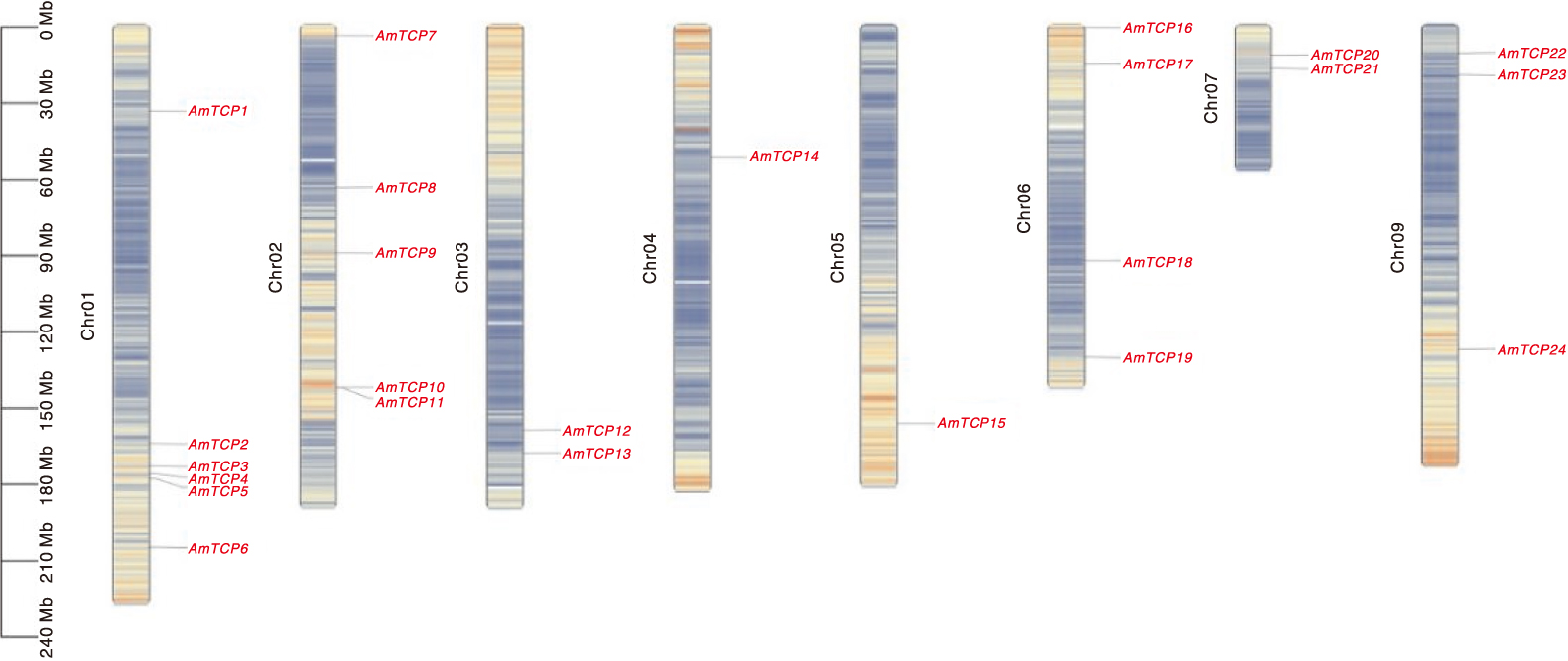
图4 AmTCP基因家族的染色体定位
Fig.4 Chromosomal localisation of the AmTCP gene family
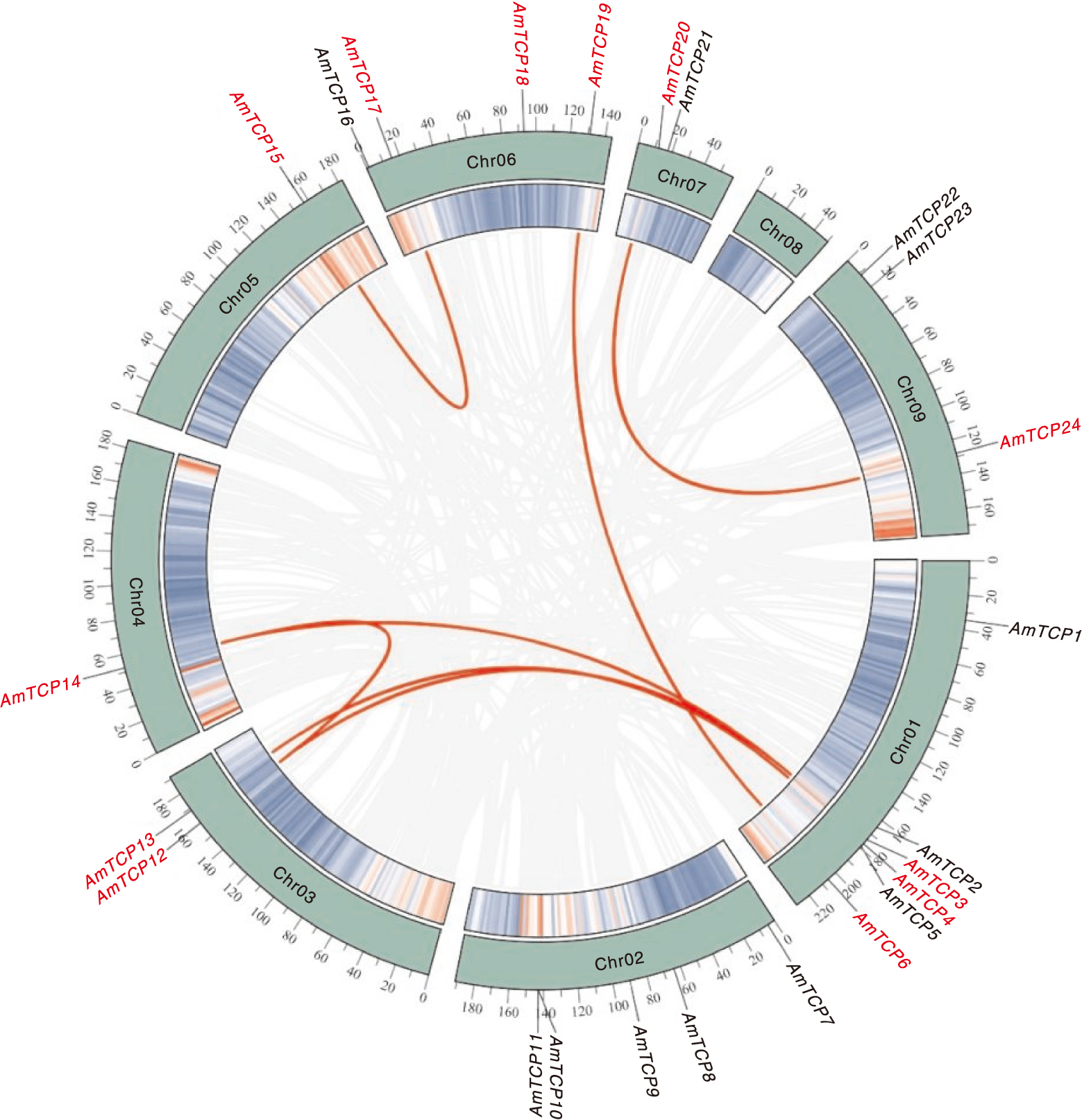
图5 AmTCP基因的共线性 内环的绿线代表每条染色体的基因密度,共线性基因用浅灰色线表示,AmTCP的种内共线性基因对用红色曲线表示,字体也标为红色。
Fig.5 Colinearity of the AmTCP gene The green line in the inner ring represents the gene density per chromosome, co-lined genes are indicated by light gray lines, and intraspecific co-lined gene pairs of AmTCP are labeled with red curves and the font is also labeled in red.
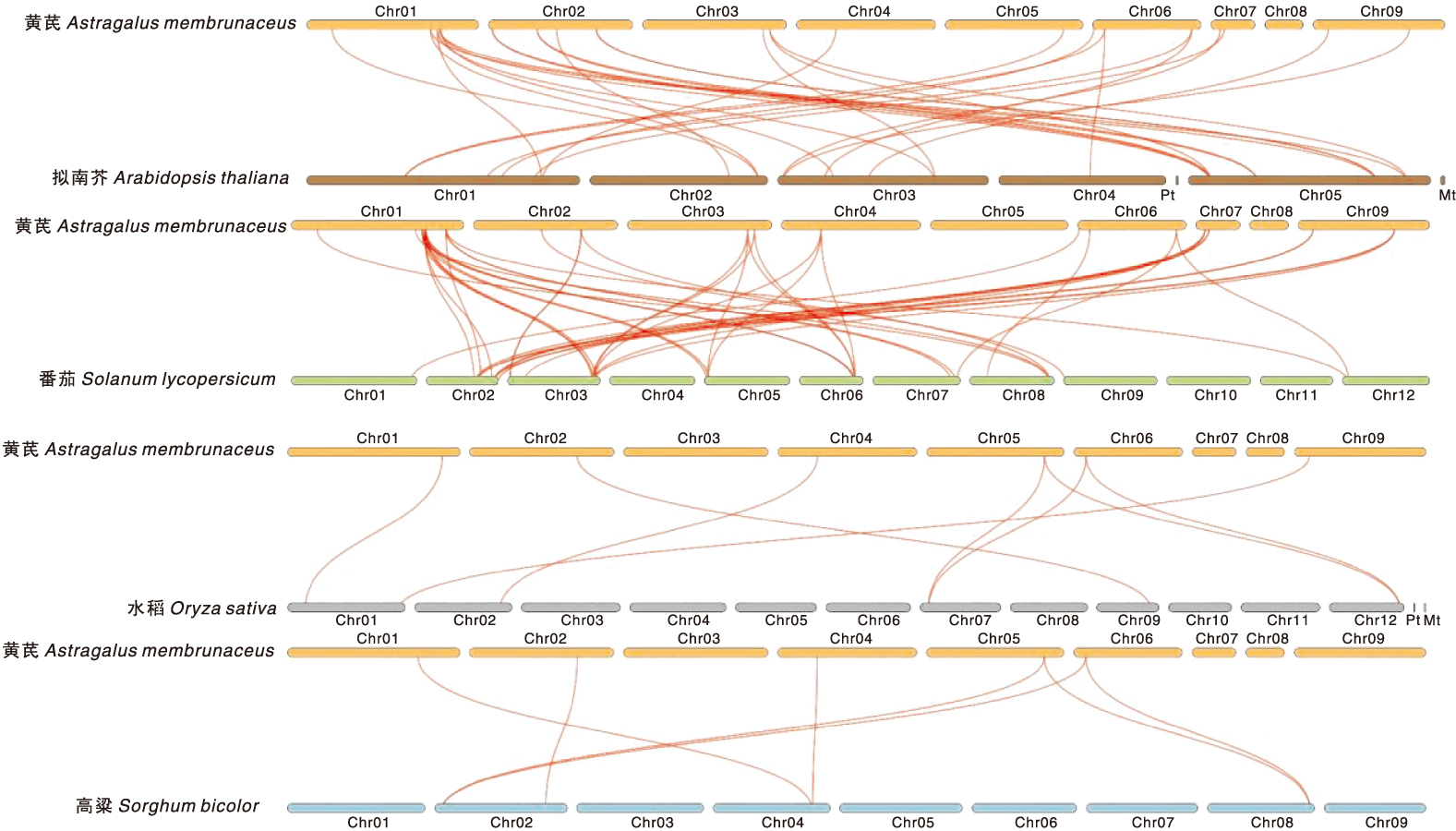
图6 AmTCP基因与4种代表性植物的共线性
Fig.6 Colinearity between AmTCP gene and four representative plants
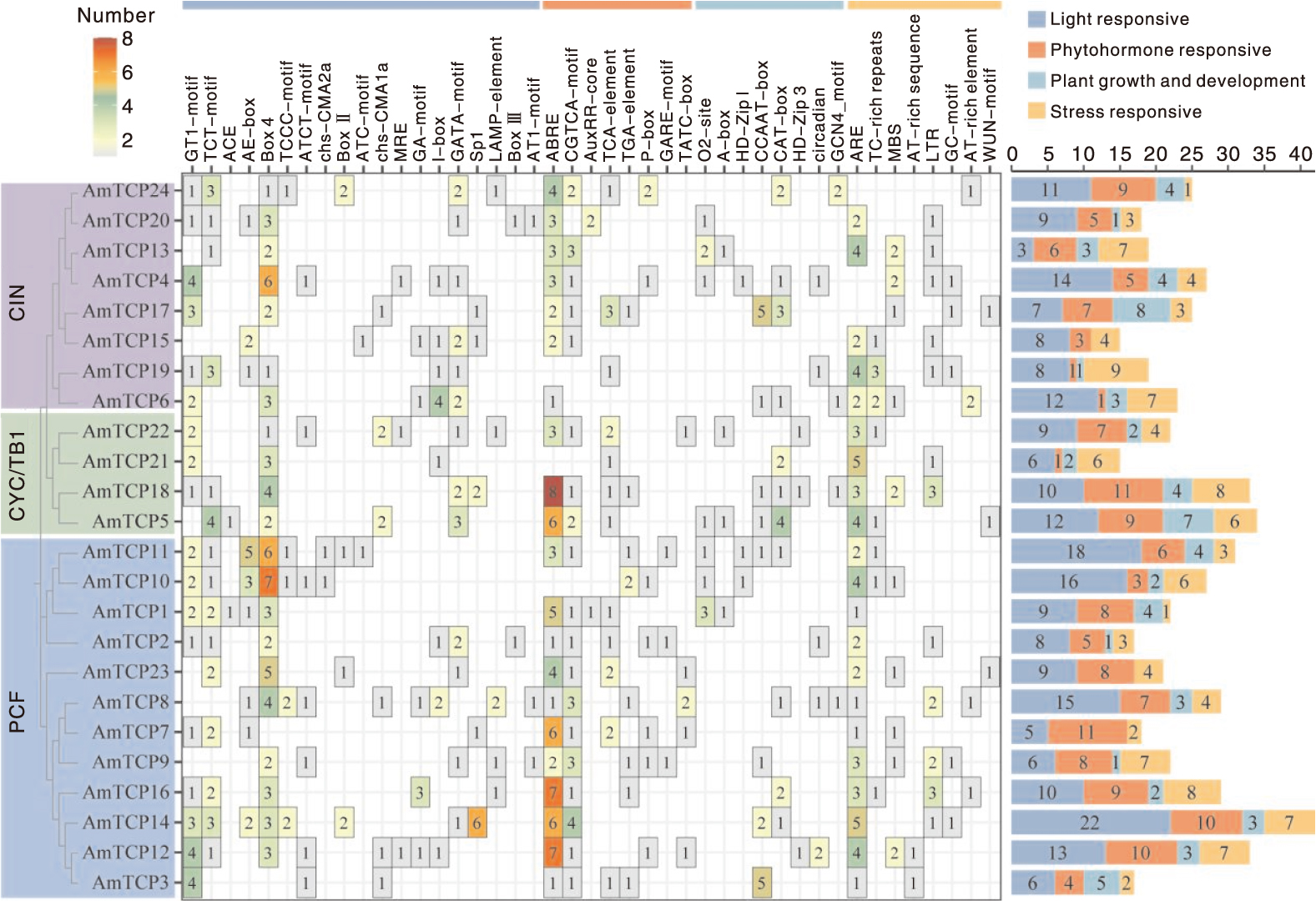
图7 AmTCP基因启动子的顺式作用元件
Fig.7 Cis-acting elements of the AmTCP gene promoter
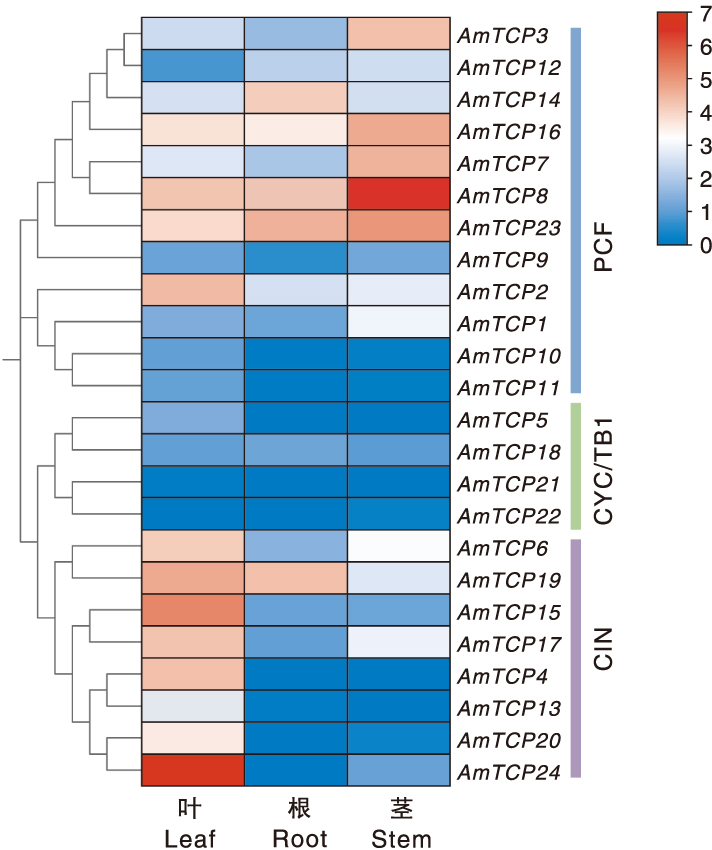
图8 AmTCP基因在不同组织的表达 颜色条代表标准化表达水平(log2转换的倍数变化)。红色和蓝色表示上调和下调的基因,白色表示无表达。右边蓝色、绿色和紫色条带分别表示PCF、CYC/TB1和CIN亚家族。
Fig.8 AmTCP gene expression in different tissues Color bars represent normalised expression levels (log2 converted fold change). Red and blue indicate up- and down-regulated genes, and white indicates no expression. The blue, green and purple bands on the right represent the PCF, CYC/TB1 and CIN subfamilies.
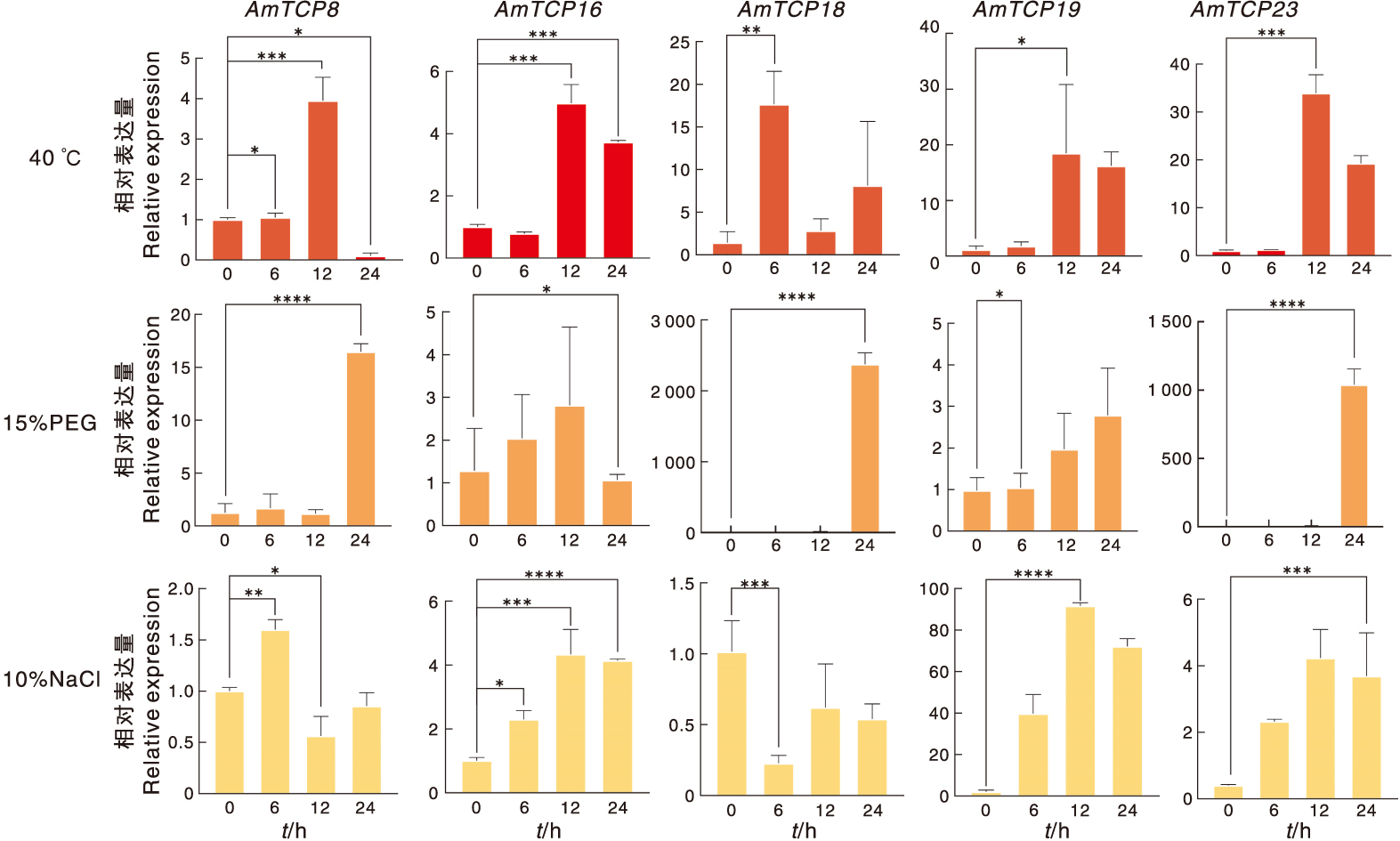
图9 AmTCP基因在非生物胁迫下的表达 高温(40 ℃),干旱(15% PEG),盐(10% NaCl)。“*”表示不同处理间在0.05水平差异显著,“**”表示不同处理间在0.01水平差异显著,“***”表示不同处理间在0.000 5水平差异显著,“****”表示不同处理间在0.000 1水平差异显著。
Fig.9 Expression of AmTCP genes under abiotic stress High temperature (40 ℃), drought (15% PEG), salt (10% NaCl). “*” indicates a significant difference at the 0.05 level between different treatments, “**” indicates a significant difference at the 0.01 level between different treatments, “***” indicates a significant difference at the 0.000 5 level between different treatments, “****” indicates a significant difference at the 0.000 1 level between different treatments.
| [1] | CUBAS P, LAUTER N, DOEBLEY J, et al. The TCP domain: a motif found in proteins regulating plant growth and development[J]. The Plant Journal, 1999, 18(2): 215-222. |
| [2] | DOEBLEY J, STEC A, HUBBARD L. The evolution of apical dominance in maize[J]. Nature, 1997, 386(6624): 485-488. |
| [3] | LUO D, CARPENTER R, VINCENT C, et al. Origin of floral asymmetry in Antirrhinum[J]. Nature, 1996, 383(6603): 794-799. |
| [4] | KOSUGI S, OHASHI Y. PCF1 and PCF2 specifically bind to cis elements in the rice proliferating cell nuclear antigen gene[J]. The Plant Cell, 1997, 9(9): 1607-1619. |
| [5] | AGGARWAL P, DAS GUPTA M, JOSEPH A P, et al. Identification of specific DNA binding residues in the TCP family of transcription factors in Arabidopsis[J]. The Plant Cell, 2010, 22(4): 1174-1189. |
| [6] | MARTÍN-TRILLO M, CUBAS P. TCP genes: a family snapshot ten years later[J]. Trends in Plant Science, 2010, 15(1): 31-39. |
| [7] | PARAPUNOVA V, BUSSCHER M, BUSSCHER-LANGE J, et al. Identification, cloning and characterization of the tomato TCP transcription factor family[J]. BMC Plant Biology, 2014, 14(1): 157. |
| [8] | LI Z, LI B, SHEN W, et al. Comprehensive genomic identification and expression analysis of TCP transcription factors in kiwifruit (Actinidia chinensis)[J]. BMC Genomics, 2019, 19(1): 271. |
| [9] | QI X H, SUN S L, XU P, et al. Genome-wide identification and expression analysis of the TCP transcription factor genes in Capsicum annuum L.[J]. International Journal of Molecular Sciences, 2016, 17(6): 702. |
| [10] | WANG Y, CHEN D, WANG D, et al. Genome-wide analysis of TCP transcription factor gene family in Medicago sativa reveals significant roles in shoot lateral organ development[J]. BMC Plant Biology, 2015, 15: 29. |
| [11] | LIU C, LYU T T, SHEN Y H, et al. Genome-wide identification and integrated analysis of TCP genes controlling ginsenoside biosynthesis in Panax ginseng[J]. BMC Plant Biology, 2024, 24(1): 47. |
| [12] | KOYAMA T, SATO F, OHME-TAKAGI M. Roles of miR319 and TCP transcription factors in leaf development[J]. Plant Physiology, 2017, 175(2): 874-885. |
| [13] | GUAN P, RIPOLL J J, WANG R, et al. Interacting TCP and NLP transcription factors control plant responses to nitrate availability[J]. Proceedings of the National Academy of Sciences of the United States of America, 2017, 114(9): 2419-2424. |
| [14] | MUKHOPADHYAY P, TYAGI A K. OsTCP19 influences developmental and abiotic stress signaling by modulating ABI4-mediated pathways[J]. Scientific Reports, 2015, 5: 9998. |
| [15] | SHARMA R, SINGH G, BHATTACHARYA S, et al. A genome-wide survey of TCP transcription factors provides insights into their functional roles in chickpea (Cicer arietinum L.)[J]. Scientific Reports, 2018, 8(1): 8455. |
| [16] | WU X Y, LI J Z, WEN X H, et al. Genome-wide identification of the TCP gene family in Chrysanthemum lavandulifolium and its homologs expression patterns during flower development in different Chrysanthemum species[J]. Frontiers in Plant Science, 2023, 14(1): 1276123. |
| [17] | CHAI W, JIANG P, HUANG G, et al. ZmTCP42, a TCP transcription factor from maize, confers drought tolerance in transgenic Arabidopsis[J]. International Journal of Molecular Sciences, 2021, 22(4): 2024. |
| [18] | MA J, WANG Q L, SUN R R, et al. Genome-wide identification and expression analysis of TCP transcription factors in Gossypium raimondii[J]. Scientific Reports, 2014, 4: 6645. |
| [19] | 后叶虎, 邱璐, 靳晓杰, 等. 基于化学生物信息学方法探讨黄芪通过调节能量代谢发挥“补气”功效的物质基础和分子机制[J]. 中国现代应用药学, 2023, 40(14): 1906. |
| HOU Y H, QIU L, JIN X J, et al. Exploration on material basis and molecular mechanism of astragali radix exerting the effect of “Qi-invigorating” through regulating energy metabolism based on chemo-bio informatics methods[J]. Chinese Journal of Modern Applied Pharmacy, 2023, 40(14): 1906. | |
| [20] | 余意, 胡明华, 张丹丹, 等. 黄芪多糖对气虚大鼠的补气作用及其机制探讨[J]. 中药新药与临床药理, 2021, 32(4): 505. |
| YU Y, HU M H, ZHANG D D, et al. The “Qi-invigorating” effect and possible underlying mechanism of astragalus polysaccharides on rats with Qi-deficiency[J]. Chinese Journal of New Drugs and Clinical Remedies, 2021, 32(4): 505. | |
| [21] | 周文静, 柴智, 刘佳欣, 等. 黄芪补气功用探微[J]. 中国民间疗法, 2021, 29(20): 1. |
| ZHOU W J, CHAI Z, LIU J X, et al. Study on the function of “Qi-invigorating” with Astragalus membranaceus[J]. Chinese Folk Therapy, 2021, 29(20): 1. | |
| [22] | 张倩倩, 李光跃, 苏优拉, 等. 干旱胁迫对蒙古黄芪和膜荚黄芪不同器官黄酮类成分积累的影响[J]. 西北植物学报, 2020, 40(7): 1201. |
| ZHANG Q Q, LI G Y, SU Y L, et al. Effects of drought stress on flavonoid accumulation in different organs of Astragalus mongholicus and Astragalus membranaceus[J]. Acta Botanica Boreali-Occidentalia Sinica, 2020, 40(7): 1201. | |
| [23] | 王楠, 高静, 岳正刚, 等. 黄芪种子萌发对光温条件和旱盐胁迫的响应特征[J]. 草业学报, 2018, 27(1): 106. |
| WANG N, GAO J, YUE Z G, et al. Response characteristics of Astragalus seed germination to light-temperature conditions and drought-salt stress[J]. Acta Prataculturae Sinica, 2018, 27(1): 106. | |
| [24] | 刘洋. 应用代谢组学对比研究两种黄芪响应UV-B和干旱胁迫的代谢基础[D]. 哈尔滨: 东北林业大学, 2016. |
| LIU Y. Comparative study on the metabolic basis of two Astragalus membranaceus species in response to UV-B and drought stress based on metabolomics[D]. Harbin: Northeast Forestry University, 2016. | |
| [25] | WANG J L, WANG H W, CAO Y N, et al. Comprehensive evolutionary analysis of the TCP gene family: Further insights for its origin, expansion, and diversification[J]. Frontiers in Plant Science, 2022, 13: 994567. |
| [26] | ZHOU H Y, HWARARI D, MA H Y, et al. Genomic survey of TCP transcription factors in plants: phylogenomics, evolution and their biology[J]. Frontiers in Genetics, 2022, 13: 1060546. |
| [27] | FAN H J, CHAI Z, YANG X K, et al. Chromosome-scale genome assembly of Astragalus membranaceus using PacBio and Hi-C technologies[J]. Scientific Data, 2024, 11(1):1071. |
| [28] | CHEN C J, WU Y, LI J W, et al. TBtools-Ⅱ: a “one for all, all for one” bioinformatics platform for biological big-data mining[J]. Molecular Plant, 2023, 16(11): 1733-1742. |
| [29] | CHEN S F, ZHOU Y Q, CHEN Y R, et al. Fastp: an ultra-fast all-in-one FASTQ preprocessor[J]. Bioinformatics, 2018, 34(17): i884-i890. |
| [30] | THAKUR V. RNA-seq data analysis for differential gene expression using HISAT2-stringtie-ballgown pipeline[J]. Methods in Molecular Biology, 2024, 2812: 101-113. |
| [31] | LIAO Y, SMYTH G K, SHI W. FeatureCounts: an efficient general purpose program for assigning sequence reads to genomic features[J]. Bioinformatics, 2014, 30(7): 923-930. |
| [32] | LIU D K, ZHANG C, ZHAO X, et al. Genome-wide analysis of the TCP gene family and their expression pattern in Cymbidium goeringii[J]. Frontiers in Plant Science, 2022, 13: 1068969. |
| [33] | SU C, ZHANG J, ZHENG C, et al. The orchid TCP gene family: genome-wide identification and expression analysis in different developmental stages and stress conditions[J]. BMC Plant Biology, 2019, 19(1): 1-16. |
| [34] | CAO S, ZHOU X, XIONG Z, et al. Genome-wide analysis of TCP transcription factor family in rye reveals their involvement in growth and abiotic stress responses[J]. International Journal of Molecular Sciences, 2021, 22(3): 1216. |
| [35] | LIN X, WU M, ZHANG Z, et al. Genome-wide analysis of TCP gene family in alfalfa (Medicago sativa L.) identifies roles in stem development and response to salt stress[J]. International Journal of Molecular Sciences, 2020, 21(6): 2021. |
| [36] | LIU H L, WU M, LI F, et al. TCP transcription factors in moso bamboo (Phyllostachys edulis): genome-wide identification and expression analysis[J]. Frontiers in Plant Science, 2018, 10(9):1263. |
| [37] | JEFFARES D C, PENKETT C J, BÄHLER J. Rapidly regulated genes are intron poor[J]. Trends in Genetics, 2008, 24(8): 375-378. |
| [38] | FLAGEL L E, WENDEL J F. Gene duplication and evolutionary novelty in plants[J]. New Phytologist, 2009, 183(3): 557-564. |
| [39] | Steven B. Cannon, Arvind Mitra, Andrew Baumgarten, et al. The roles of segmental and tandem gene duplication in the evolution of large gene families in Arabidopsis thaliana[J]. BMC Plant Biology, 2004, 4(1): 10. |
| [40] | LIU D H, LUO Y, HAN H, et al. Genome-wide analysis of citrus TCP transcription factors and their responses to abiotic stresses[J]. BMC Plant Biology, 2022, 22(1): 325. |
| [41] | XU Y, WANG Y, ZHANG L, et al. Genome-wide identification and characterization of the TCP transcription factor gene family in Broussonetia papyrifera[J]. Genes, 2021, 12(9): 1368. |
| [42] | VAN DE PEER Y, MAERE S, MEYER A. The evolutionary significance of ancient genome duplications[J]. Nature Reviews Genetics, 2009, 10(10): 725-732. |
| [43] | SHI G, XU Y, XIE K, et al. Evolution and expression analysis of TCP transcription factors in rice and Arabidopsis[J]. Journal of Plant Physiology, 2021, 266: 153523. |
| [44] | DHAKA N, BHARDWAJ V, SHARMA M K, et al. Evolving tale of TCPs: new paradigms and old lacunae[J]. Frontiers in Plant Science, 2017, 8: 479. |
| [45] | NATH U, CRAWFORD B C W, CARPENTER R, et al. Genetic control of surface curvature[J]. Science, 2003, 299(5611): 1404-1407. |
| [46] | DAVIÈRE J M, WILD M, REGNAULT T, et al. Class I TCP-DELLA interactions in inflorescence shoot apex determine plant height[J]. Current Biology, 2014, 24(16): 1923-1928. |
| [47] | 关紫微. 水稻耐逆基因OsTCP家族及OsSRZ1基因的功能研究[D]. 长沙: 湖南农业大学, 2021. |
| GUAN Z W. Functional study of OsTCP gene family and OsSRZ1 gene in rice stress tolerance[D]. Changsha: Hunan Agricultural University, 2021. | |
| [48] | JIANG Y, JIANG D, XIA M, et al. Genome-wide identification and expression analysis of the TCP gene family related to developmental and abiotic stress in ginger[J]. Plants, 2023, 12(19): 3389. |
| [49] | WU Q S, BAZZINI A A. Translation and mRNA stability control[J]. Annual Review of Biochemistry, 2023, 92: 227-245. |
| [50] | LEI N, YU X, LI S, et al. Phylogeny and expression pattern analysis of TCP transcription factors in cassava seedlings exposed to cold and/or drought stress[J]. Scientific Reports, 2017, 7: 10016. |
| [51] | YANG M F, HE G D, HOU Q D, et al. Systematic analysis and expression profiles of TCP gene family in Tartary buckwheat (Fagopyrum tataricum(L.) Gaertn.) revealed the potential function of FtTCP15 and FtTCP18 in response to abiotic stress[J]. BMC Genomics, 2022, 23(1): 415. |
| [52] | XU Y Z, LIU H L, GAO Y M, et al. The TCP transcription factor PeTCP10 modulates salt tolerance in transgenic Arabidopsis[J]. Plant Cell Reports, 2021, 40(10): 1971-1987. |
| [53] | SELAHATTIN D, AALT D J V D, ANDREA B, et al. Analysis of functional redundancies within the Arabidopsis TCP transcription factor family[J]. Journal of Experimental Botany, 2013, 64(18):5673-5685. |
| [1] | 胡心柔, 王梅, 张雅芬, 蔡为明, 金群力. 非生物胁迫对灵芝生长发育及其响应机制的影响[J]. 浙江农业学报, 2025, 37(5): 1182-1190. |
| [2] | 欧晋稳, 张古文, 冯志娟, 王斌, 卜远鹏, 徐钰, 茹磊, 刘娜, 龚亚明. 大豆海藻糖-6-磷酸磷酸酶基因GmTPP的鉴定及其在生长发育和非生物胁迫响应中的表达分析[J]. 浙江农业学报, 2024, 36(9): 2031-2041. |
| [3] | 张思懿, 崔博文, 王佳玲, 蔺吉祥, 杨青杰. 非生物胁迫下植物根系的生理与分子响应研究进展[J]. 浙江农业学报, 2024, 36(10): 2391-2401. |
| [4] | 张余, 金明伟, 任丽, 章毅颖, 赵洪, 刘昆, 邓姗, 褚云霞, 李寿国, 张靖立, 黄静艳, 陈海荣. 辣椒CaERF70的表达特征和转录自激活活性分析[J]. 浙江农业学报, 2024, 36(10): 2247-2256. |
| [5] | 寿伟松, 王铎, 沈佳, 许昕阳, 张跃建, 何艳军. 西瓜蔗糖转运蛋白SUT家族的鉴定及其在果实发育和逆境响应中的表达分析[J]. 浙江农业学报, 2024, 36(1): 94-102. |
| [6] | 熊雪, 赵丽娜, 杨森林, SAMIAH Arif, 张屹东. 甜瓜CmCIPK家族全基因组鉴定和逆境条件下的表达分析[J]. 浙江农业学报, 2021, 33(9): 1625-1639. |
| [7] | 何佳琦, 翟莹, 张军, 邱爽, 李铭杨, 赵艳, 张梅娟, 马天意. 大豆转录因子GmDof1.5的克隆与非生物胁迫诱导表达[J]. 浙江农业学报, 2021, 33(1): 1-7. |
| [8] | 邱文怡, 王诗雨, 李晓芳, 徐恒, 张华, 朱英, 王良超. MYB转录因子参与植物非生物胁迫响应与植物激素应答的研究进展[J]. 浙江农业学报, 2020, 32(7): 1317-1328. |
| [9] | 瓮巧云, 赵彦敏, 张贺, 宋晋辉, 马海莲, 袁进成, 刘颖慧. 玉米ZmREM基因的克隆与逆境胁迫后表达分析[J]. 浙江农业学报, 2016, 28(11): 1822-1827. |
| 阅读次数 | ||||||
|
全文 |
|
|||||
|
摘要 |
|
|||||

