浙江农业学报 ›› 2026, Vol. 38 ›› Issue (6): 1099-1111.DOI: 10.3969/j.issn.1004-1524.20250709
融合魏斯氏菌协同发酵制备双蛋白酸奶及其稳定性研究
康颖( ), 叶滔, 白雪莹, 张雪娇*()
邵阳学院 食品与化学工程学院 ,豆制品加工与安全控制湖南省重点实验室 湖南 邵阳 422000
-
收稿日期:2025-11-23出版日期:2026-06-25发布日期:2026-07-14 -
作者简介:康颖,研究方向为豆制品加工及应用。E-mail:191722536@qq.com -
通讯作者:*张雪娇,E-mail:380711974@qq.com -
基金资助:邵阳学院研究生科研创新项目(CX2024SY021);湖南省自然科学基金(2022JJ50232);湖南省教育厅重点项目(21A0480)
Study on the preparation of dual-protein yogurt by co-fermentation with Weissella confusa and its storage stability
KANG Ying(), YE Tao, BAI Xueying, ZHANG Xuejiao*()
Hunan Provincial Key Laboratory of Soybean Products Processing and Safety Control ,College of Food Science and Chemical Engineering, Shaoyang University Shaoyang 422000, Hunan, China
-
Received:2025-11-23Published:2026-06-25Online:2026-07-14

摘要:
为制备质地稳定、口感适宜且营养丰富的动植物双蛋白酸奶,本研究首次利用高产葡聚糖的融合魏斯氏菌(Weissella confusa)SY628菌株协同商业酸奶发酵剂(YF-L904菌粉)对豆浆-牛奶混合体系共发酵,制备新型双蛋白酸奶,在单因素试验的基础上结合响应面法优化发酵工艺,并通过检测主要营养成分、理化性质、质构、流变特性、微观结构等指标,评估其在28 d储藏期间的品质稳定性。结果表明,双蛋白酸奶的最佳发酵工艺为:牛奶与豆浆配比6∶4,发酵温度30 ℃,菌液配比(SY628菌液与YF-L904菌液之比)1∶3,蔗糖添加量6%,菌液接种量3%。在此条件下,感官评分达88.67分。最佳发酵工艺下制得的双蛋白酸奶(SYF)的多糖含量为22.6 g·kg-1,显著(p<0.05)高于仅添加商业酸奶发酵剂制得的酸奶(CN)。在28 d的储藏期内,SYF显示出更高的硬度、内聚性、弹性等质地特性,更高的持水性,更高的储能模量、损耗模量和复黏度,拥有更致密的片层状凝胶结构,储藏稳定性更佳。本研究为开发零添加剂的功能性双蛋白酸奶提供了可行的技术方案,并拓展了融合魏斯氏菌在功能性发酵食品中的应用前景。
中图分类号:
引用本文
康颖, 叶滔, 白雪莹, 张雪娇. 融合魏斯氏菌协同发酵制备双蛋白酸奶及其稳定性研究[J]. 浙江农业学报, 2026, 38(6): 1099-1111.
KANG Ying, YE Tao, BAI Xueying, ZHANG Xuejiao. Study on the preparation of dual-protein yogurt by co-fermentation with Weissella confusa and its storage stability[J]. Acta Agriculturae Zhejiangensis, 2026, 38(6): 1099-1111.
| 等级(评分) Grade (socre) | 组织状态 Texture | 滋味 Taste | 气味 Odor | 颜色 Color |
|---|---|---|---|---|
| 优秀(≥80) Excellent (≥80) | 组织状态均匀,无乳清析出,凝块完整,无油脂上浮 Uniform texture, no whey separation, intact curd, no fat floating | 酸甜适中,无颗粒感和黏口感,整体味感协调、柔和 Well-balanced sour and sweet taste, no graininess or stickiness, harmonious and mild overall flavor | 奶香浓郁,无豆腥味,整体气味协调 Rich milk aroma, no beany flavor, harmonious overall odor | 色泽均匀,呈乳白色,有光泽 Uniform color, milky white in appearance, with luster |
| 良好(60~79 ) Good (60-79) | 组织状态均匀,少量乳清析出,凝块完整,轻微油脂上浮 Uniform texture, a small amount of whey separation, intact curd, slight fat floating | 酸甜感较协调,轻微颗粒感和黏口感,整体味感较协调 Relatively balanced sour and sweet taste, slight graininess and stickiness, fairly harmonious overall flavor | 奶香较淡,轻微豆腥味,整体气味较协调 Light milk aroma, slight beany flavor, fairly harmonious overall odor | 淡黄色,色泽均匀有光泽 Pale yellow, uniform color with luster |
| 一般(40~59) Acceptable (40-59) | 组织状态粗糙,乳清较多,有气泡和轻微开裂,油脂上浮较重 Coarse texture, considerable whey separation, with bubbles and slight cracking, obvious fat floating | 偏酸或偏甜,颗粒感和黏口感较重,整体味感不协调 Sour- or sweet-biased taste, obvious graininess and stickiness, discordant overall flavor | 无奶香味,豆腥味较重,整体气味尚可接受 No milk aroma, obvious beany flavor, overall odor acceptable | 色泽异常,光泽稍差 Abnormal color, slightly poor luster |
| 差(≤39) Poor (≤39) | 组织状态粗糙,有大量气泡且乳清析出严重,油脂上浮严重 Coarse texture, numerous bubbles, severe whey separation, serious fat floating | 过酸或过甜,颗粒感和黏口感严重,整体味感极不协调,口感粗糙 Overly sour or sweet taste, severe graininess and stickiness, extremely discordant overall flavor, coarse mouthfeel | 无奶香味,豆腥味严重,整体气味不协调 No milk aroma, severe beany flavor, discordant overall odor | 颜色不均,色泽异常,无光泽 Uneven color, abnormal hue, no luster |
表1 双蛋白酸奶的感官评价标准
Table 1 Sensory evaluation criteria for dual-protein yogurt
| 等级(评分) Grade (socre) | 组织状态 Texture | 滋味 Taste | 气味 Odor | 颜色 Color |
|---|---|---|---|---|
| 优秀(≥80) Excellent (≥80) | 组织状态均匀,无乳清析出,凝块完整,无油脂上浮 Uniform texture, no whey separation, intact curd, no fat floating | 酸甜适中,无颗粒感和黏口感,整体味感协调、柔和 Well-balanced sour and sweet taste, no graininess or stickiness, harmonious and mild overall flavor | 奶香浓郁,无豆腥味,整体气味协调 Rich milk aroma, no beany flavor, harmonious overall odor | 色泽均匀,呈乳白色,有光泽 Uniform color, milky white in appearance, with luster |
| 良好(60~79 ) Good (60-79) | 组织状态均匀,少量乳清析出,凝块完整,轻微油脂上浮 Uniform texture, a small amount of whey separation, intact curd, slight fat floating | 酸甜感较协调,轻微颗粒感和黏口感,整体味感较协调 Relatively balanced sour and sweet taste, slight graininess and stickiness, fairly harmonious overall flavor | 奶香较淡,轻微豆腥味,整体气味较协调 Light milk aroma, slight beany flavor, fairly harmonious overall odor | 淡黄色,色泽均匀有光泽 Pale yellow, uniform color with luster |
| 一般(40~59) Acceptable (40-59) | 组织状态粗糙,乳清较多,有气泡和轻微开裂,油脂上浮较重 Coarse texture, considerable whey separation, with bubbles and slight cracking, obvious fat floating | 偏酸或偏甜,颗粒感和黏口感较重,整体味感不协调 Sour- or sweet-biased taste, obvious graininess and stickiness, discordant overall flavor | 无奶香味,豆腥味较重,整体气味尚可接受 No milk aroma, obvious beany flavor, overall odor acceptable | 色泽异常,光泽稍差 Abnormal color, slightly poor luster |
| 差(≤39) Poor (≤39) | 组织状态粗糙,有大量气泡且乳清析出严重,油脂上浮严重 Coarse texture, numerous bubbles, severe whey separation, serious fat floating | 过酸或过甜,颗粒感和黏口感严重,整体味感极不协调,口感粗糙 Overly sour or sweet taste, severe graininess and stickiness, extremely discordant overall flavor, coarse mouthfeel | 无奶香味,豆腥味严重,整体气味不协调 No milk aroma, severe beany flavor, discordant overall odor | 颜色不均,色泽异常,无光泽 Uneven color, abnormal hue, no luster |
| 牛奶与豆 浆配比 Milk-to- soymilk ratio | 酸度/°T Titratable acidity/°T | 持水性/% Water holding capacity/% | 感官评分 Sensory score |
|---|---|---|---|
| 9∶1 | 71.33±0.47 c | 94.85±0.01 d | 81.00±1.48 d |
| 8∶2 | 72.00±0.82 bc | 96.46±0.01 c | 82.40±1.20 c |
| 7∶3 | 73.00±0.00 ab | 98.29±0.01 b | 83.40±1.20 c |
| 6∶4 | 74.33±0.47 a | 99.92±0.00 a | 87.60±1.43 a |
| 5∶5 | 66.67±0.47 d | 99.93±0.00 a | 85.40±0.80 b |
| 4∶6 | 65.33±0.47 d | 99.95±0.00 a | 83.90±1.97 c |
| 3∶7 | 62.00±0.82 e | 99.97±0.00 a | 79.80±1.33 d |
| 2∶8 | 59.00±0.82 f | 99.98±0.00 a | 73.10±1.70 e |
| 1∶9 | 55.33±0.94 g | 99.99±0.00 a | 71.80±1.25 f |
表2 牛奶与豆浆配比对双蛋白酸奶品质的影响
Table 2 Effect of milk-to-soymilk ratio on the quality of dual-protein yogurt
| 牛奶与豆 浆配比 Milk-to- soymilk ratio | 酸度/°T Titratable acidity/°T | 持水性/% Water holding capacity/% | 感官评分 Sensory score |
|---|---|---|---|
| 9∶1 | 71.33±0.47 c | 94.85±0.01 d | 81.00±1.48 d |
| 8∶2 | 72.00±0.82 bc | 96.46±0.01 c | 82.40±1.20 c |
| 7∶3 | 73.00±0.00 ab | 98.29±0.01 b | 83.40±1.20 c |
| 6∶4 | 74.33±0.47 a | 99.92±0.00 a | 87.60±1.43 a |
| 5∶5 | 66.67±0.47 d | 99.93±0.00 a | 85.40±0.80 b |
| 4∶6 | 65.33±0.47 d | 99.95±0.00 a | 83.90±1.97 c |
| 3∶7 | 62.00±0.82 e | 99.97±0.00 a | 79.80±1.33 d |
| 2∶8 | 59.00±0.82 f | 99.98±0.00 a | 73.10±1.70 e |
| 1∶9 | 55.33±0.94 g | 99.99±0.00 a | 71.80±1.25 f |
| 蔗糖添 加量/% Sucrose addition amount/% | 酸度/°T Titratable acidity/°T | 持水性/% Water holding capacity/% | 感官评分 Sensory score |
|---|---|---|---|
| 2 | 67.00±0.82 b | 99.40±0.01 b | 64.90±1.58 g |
| 3 | 67.33±0.47 b | 99.73±0.01 ab | 67.00±1.67 f |
| 4 | 68.67±1.70 ab | 99.78±0.01 ab | 71.30±1.62 e |
| 5 | 69.00±0.82 ab | 99.83±0.01 a | 76.60±1.28 c |
| 6 | 70.00±0.82 a | 99.90±0.01 a | 83.70±1.42 a |
| 7 | 66.67±0.94 b | 99.86±0.01 a | 80.10±1.45 b |
| 8 | 63.33±1.25 c | 99.80±0.01 ab | 76.90±1.16 c |
| 9 | 61.67±1.25 c | 99.75±0.01 ab | 73.90±1.51 d |
表3 蔗糖添加量对双蛋白酸奶品质的影响
Table 3 Effect of sucrose addition amount on the quality of dual-protein yogurt
| 蔗糖添 加量/% Sucrose addition amount/% | 酸度/°T Titratable acidity/°T | 持水性/% Water holding capacity/% | 感官评分 Sensory score |
|---|---|---|---|
| 2 | 67.00±0.82 b | 99.40±0.01 b | 64.90±1.58 g |
| 3 | 67.33±0.47 b | 99.73±0.01 ab | 67.00±1.67 f |
| 4 | 68.67±1.70 ab | 99.78±0.01 ab | 71.30±1.62 e |
| 5 | 69.00±0.82 ab | 99.83±0.01 a | 76.60±1.28 c |
| 6 | 70.00±0.82 a | 99.90±0.01 a | 83.70±1.42 a |
| 7 | 66.67±0.94 b | 99.86±0.01 a | 80.10±1.45 b |
| 8 | 63.33±1.25 c | 99.80±0.01 ab | 76.90±1.16 c |
| 9 | 61.67±1.25 c | 99.75±0.01 ab | 73.90±1.51 d |
| 菌液接 种量/% Inoculum size/% | 酸度/°T Titratable acidity/°T | 持水性/% Water holding capacity/% | 感官评分 Sensory score |
|---|---|---|---|
| 1 | 63.33±0.47 d | 99.88±0.01 a | 72.50±1.20 d |
| 2 | 68.33±0.47 c | 99.88±0.01 a | 80.40±1.11 b |
| 3 | 71.00±0.82 b | 99.90±0.01 a | 83.70±1.19 a |
| 4 | 72.33±0.47 b | 99.91±0.01 a | 77.80±1.40 c |
| 5 | 72.67±0.47 b | 99.91±0.01 a | 78.00±0.77 bc |
| 6 | 76.33±1.25 a | 99.94±0.01 a | 78.80±1.25 b |
表4 菌液接种量对双蛋白酸奶品质的影响
Table 4 Effect of inoculum size on the quality of dual-protein yogurt
| 菌液接 种量/% Inoculum size/% | 酸度/°T Titratable acidity/°T | 持水性/% Water holding capacity/% | 感官评分 Sensory score |
|---|---|---|---|
| 1 | 63.33±0.47 d | 99.88±0.01 a | 72.50±1.20 d |
| 2 | 68.33±0.47 c | 99.88±0.01 a | 80.40±1.11 b |
| 3 | 71.00±0.82 b | 99.90±0.01 a | 83.70±1.19 a |
| 4 | 72.33±0.47 b | 99.91±0.01 a | 77.80±1.40 c |
| 5 | 72.67±0.47 b | 99.91±0.01 a | 78.00±0.77 bc |
| 6 | 76.33±1.25 a | 99.94±0.01 a | 78.80±1.25 b |
| 发酵温度/℃ Fermentation temperature/℃ | 酸度/°T Titratable acidity/°T | 持水性/% Water holding capacity/% | 感官评分 Sensory score |
|---|---|---|---|
| 30 | 65.33±0.47 d | 99.85±0.01 a | 81.35±2.97 ab |
| 32 | 71.33±0.47 c | 99.72±0.01 a | 82.85±1.96 a |
| 34 | 82.00±0.81 a | 98.96±0.01 a | 75.95±2.52 b |
| 36 | 81.00±1.41 a | 95.77±0.01 b | 69.85±1.93 c |
| 38 | 77.33±0.47 b | 92.67±0.01 c | 66.65±2.31 d |
| 40 | 75.67±1.70 b | 69.92±0.01 d | 57.85±2.13 e |
| 42 | 66.00±0.82 d | 60.15±0.01 e | 52.35±1.68 f |
| 44 | 60.67±0.94 e | 49.00±0.01 f | 43.55±2.90 g |
表5 发酵温度对双蛋白酸奶品质的影响
Table 5 Effect of fermentation temperature on the quality of dual-protein yogurt
| 发酵温度/℃ Fermentation temperature/℃ | 酸度/°T Titratable acidity/°T | 持水性/% Water holding capacity/% | 感官评分 Sensory score |
|---|---|---|---|
| 30 | 65.33±0.47 d | 99.85±0.01 a | 81.35±2.97 ab |
| 32 | 71.33±0.47 c | 99.72±0.01 a | 82.85±1.96 a |
| 34 | 82.00±0.81 a | 98.96±0.01 a | 75.95±2.52 b |
| 36 | 81.00±1.41 a | 95.77±0.01 b | 69.85±1.93 c |
| 38 | 77.33±0.47 b | 92.67±0.01 c | 66.65±2.31 d |
| 40 | 75.67±1.70 b | 69.92±0.01 d | 57.85±2.13 e |
| 42 | 66.00±0.82 d | 60.15±0.01 e | 52.35±1.68 f |
| 44 | 60.67±0.94 e | 49.00±0.01 f | 43.55±2.90 g |
| 菌液配比 Ratio of bacterial liquids | 酸度/°T Titratable acidity/°T | 持水性/% Water holding capacity/% | 感官评分/分 Sensory score/score |
|---|---|---|---|
| 3∶1 | 60.33±0.47 d | 99.85±0.00 a | 75.20±1.16 d |
| 2∶1 | 66.33±0.94 c | 99.83±0.00 a | 79.80±0.75 c |
| 1∶1 | 70.33±0.47 b | 99.70±0.00 a | 83.40±1.20 ab |
| 1∶2 | 73.33±0.47 a | 97.64±0.00 b | 85.20±1.08 a |
| 1∶3 | 72.00±0.82 a | 98.00±0.00 b | 80.10±1.04 bc |
表6 菌液配比对双蛋白酸奶品质的影响
Table 6 Effect of ratio of bacterial liquids on the quality of dual-protein yogurt
| 菌液配比 Ratio of bacterial liquids | 酸度/°T Titratable acidity/°T | 持水性/% Water holding capacity/% | 感官评分/分 Sensory score/score |
|---|---|---|---|
| 3∶1 | 60.33±0.47 d | 99.85±0.00 a | 75.20±1.16 d |
| 2∶1 | 66.33±0.94 c | 99.83±0.00 a | 79.80±0.75 c |
| 1∶1 | 70.33±0.47 b | 99.70±0.00 a | 83.40±1.20 ab |
| 1∶2 | 73.33±0.47 a | 97.64±0.00 b | 85.20±1.08 a |
| 1∶3 | 72.00±0.82 a | 98.00±0.00 b | 80.10±1.04 bc |
| 试验号No. | A | B | C | Y |
|---|---|---|---|---|
| 1 | 0 | 0 | 0 | 90.00 |
| 2 | 1 | 0 | -1 | 50.33 |
| 3 | -1 | 0 | 1 | 71.67 |
| 4 | 0 | 1 | 1 | 71.67 |
| 5 | 0 | -1 | -1 | 74.33 |
| 6 | 1 | -1 | 0 | 54.33 |
| 7 | -1 | 0 | -1 | 77.00 |
| 8 | 1 | 1 | 0 | 51.00 |
| 9 | 0 | 0 | 0 | 88.00 |
| 10 | -1 | 1 | 0 | 71.33 |
| 11 | 1 | 0 | 1 | 53.00 |
| 12 | 0 | 0 | 0 | 87.00 |
| 13 | -1 | -1 | 0 | 76.33 |
| 14 | 0 | 1 | -1 | 80.33 |
| 15 | 0 | -1 | 1 | 92.00 |
| 16 | 0 | 0 | 0 | 85.67 |
| 17 | 0 | 0 | 0 | 86.67 |
表7 响应面试验设计与结果
Table 7 Response surface test design and results
| 试验号No. | A | B | C | Y |
|---|---|---|---|---|
| 1 | 0 | 0 | 0 | 90.00 |
| 2 | 1 | 0 | -1 | 50.33 |
| 3 | -1 | 0 | 1 | 71.67 |
| 4 | 0 | 1 | 1 | 71.67 |
| 5 | 0 | -1 | -1 | 74.33 |
| 6 | 1 | -1 | 0 | 54.33 |
| 7 | -1 | 0 | -1 | 77.00 |
| 8 | 1 | 1 | 0 | 51.00 |
| 9 | 0 | 0 | 0 | 88.00 |
| 10 | -1 | 1 | 0 | 71.33 |
| 11 | 1 | 0 | 1 | 53.00 |
| 12 | 0 | 0 | 0 | 87.00 |
| 13 | -1 | -1 | 0 | 76.33 |
| 14 | 0 | 1 | -1 | 80.33 |
| 15 | 0 | -1 | 1 | 92.00 |
| 16 | 0 | 0 | 0 | 85.67 |
| 17 | 0 | 0 | 0 | 86.67 |
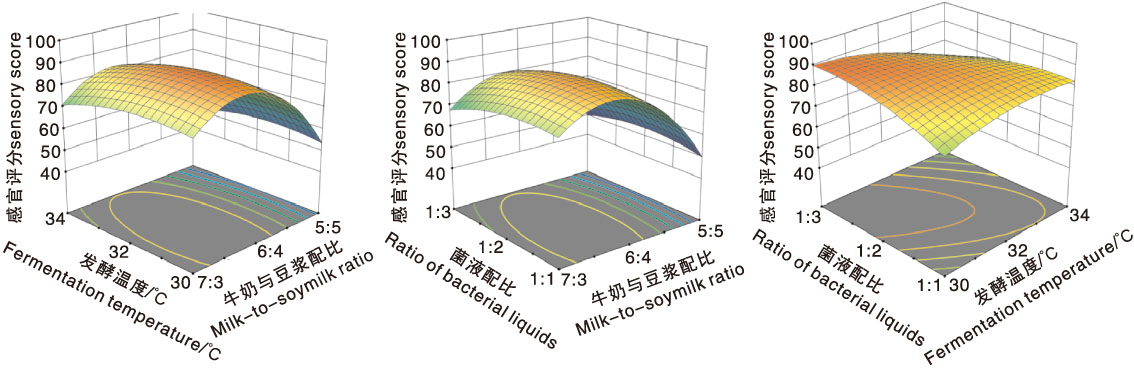
图1 各因素交互作用对双蛋白酸奶感官评分影响的响应面图
Fig.1 Response surface plots of the effect of interaction of factors on the sensory score of dual-protein yogurt
| 储藏时间/d Storage time/d | pH值pH value | 酸度/°T Titratable acidity/°T | ||
|---|---|---|---|---|
| SYF | CN | SYF | CN | |
| 1 | 4.50±0.01 a | 4.45±0.01 a | 74.67±0.47 e | 68.33±0.47 d |
| 7 | 4.43±0.01 b | 4.38±0.01 b | 78.33±0.94 d | 70.00±0.82 d |
| 14 | 4.37±0.01 c | 4.28±0.01 c | 80.33±0.47 c | 72.33±0.47 c |
| 21 | 4.34±0.01 d | 4.24±0.01 d | 82.00±0.82 b | 74.00±0.82 b |
| 28 | 4.32±0.01 e | 4.20±0.01 e | 83.67±0.47 a | 75.67±0.47 a |
表8 储藏期间样品的pH值与酸度变化
Table 8 Changes in pH value and titratable acidity of samples during storage
| 储藏时间/d Storage time/d | pH值pH value | 酸度/°T Titratable acidity/°T | ||
|---|---|---|---|---|
| SYF | CN | SYF | CN | |
| 1 | 4.50±0.01 a | 4.45±0.01 a | 74.67±0.47 e | 68.33±0.47 d |
| 7 | 4.43±0.01 b | 4.38±0.01 b | 78.33±0.94 d | 70.00±0.82 d |
| 14 | 4.37±0.01 c | 4.28±0.01 c | 80.33±0.47 c | 72.33±0.47 c |
| 21 | 4.34±0.01 d | 4.24±0.01 d | 82.00±0.82 b | 74.00±0.82 b |
| 28 | 4.32±0.01 e | 4.20±0.01 e | 83.67±0.47 a | 75.67±0.47 a |
| 储藏时间 Storage time/d | 样品 Sample | 硬度/g Hardness/g | 黏附性/(g·s) Adhesiveness/ (g·s) | 回复性/% Resilience/% | 内聚性 Cohesiveness | 弹性/% Springiness/% | 胶着性 Gumminess | 咀嚼性 Chewiness | 持水性/% Water holding capacity/% |
|---|---|---|---|---|---|---|---|---|---|
| 1 | SYF | 36.47± 0.36 d | -85.31± 0.30 d | 14.39± 1.01 a | 0.62± 0.01 a | 82.59± 0.13 d | 27.33± 0.48 b | 22.70± 0.36 c | 85.13± 0.38 a |
| CN | 31.42± 0.47 e | -75.32± 0.45 d | 12.09± 0.77 a | 0.58± 0.01 a | 77.37± 0.24 c | 22.80± 0.22 b | 17.84± 0.58 c | 45.42± 0.56 a | |
| 7 | SYF | 46.98± 0.80 b | -94.96± 0.77 b | 12.94± 0.55 ab | 0.62± 0.01 a | 83.54± 0.95 b | 28.75± 0.56 a | 23.59± 0.55 b | 83.04± 0.85 b |
| CN | 41.37± 0.66 a | -88.28± 0.83 a | 10.03± 0.26 b | 0.58± 0.01 a | 80.82± 0.55 a | 24.50± 0.39 a | 19.62± 0.51 a | 40.80± 0.81 b | |
| 14 | SYF | 49.04± 1.01 a | -98.96± 0.73 a | 12.44± 0.43 b | 0.61± 0.01 a | 85.74± 0.20 a | 28.75± 0.56 a | 25.38± 0.76 a | 81.90± 0.65 c |
| CN | 38.30± 0.60 b | -83.65± 0.50 b | 8.99± 0.19 b | 0.57± 0.01 a | 79.68± 0.78 b | 24.50± 0.39 a | 18.60± 0.35 b | 38.05± 0.45 c | |
| 21 | SYF | 45.63± 0.67 b | -93.56± 0.53 bc | 12.14± 0.65 b | 0.59± 0.01 b | 83.07± 0.46 c | 27.04± 0.64 b | 22.32± 0.22 c | 80.32± 0.64 d |
| CN | 36.12± 0.42 c | -78.71± 0.41 c | 7.91± 0.46 c | 0.55± 0.01 b | 76.60± 0.36 d | 22.47± 0.18 c | 17.32± 0.64 c | 33.73± 0.68 d | |
| 28 | SYF | 43.48± 0.40 c | -92.21± 0.18 c | 11.18± 0.39 c | 0.58± 0.01 b | 81.94± 0.34 e | 26.22± 0.35 c | 21.63± 0.31 d | 78.89± 0.68 e |
| CN | 33.95± 0.28 d | -75.82± 0.18 d | 6.66± 0.16 d | 0.53± 0.01 b | 74.73± 0.23 e | 21.72± 0.52 d | 16.48± 0.03 d | 31.47± 0.73 e |
表9 储藏期间样品的质构与持水性变化
Table 9 Changes in texture and water-holding capacity of samples during storage
| 储藏时间 Storage time/d | 样品 Sample | 硬度/g Hardness/g | 黏附性/(g·s) Adhesiveness/ (g·s) | 回复性/% Resilience/% | 内聚性 Cohesiveness | 弹性/% Springiness/% | 胶着性 Gumminess | 咀嚼性 Chewiness | 持水性/% Water holding capacity/% |
|---|---|---|---|---|---|---|---|---|---|
| 1 | SYF | 36.47± 0.36 d | -85.31± 0.30 d | 14.39± 1.01 a | 0.62± 0.01 a | 82.59± 0.13 d | 27.33± 0.48 b | 22.70± 0.36 c | 85.13± 0.38 a |
| CN | 31.42± 0.47 e | -75.32± 0.45 d | 12.09± 0.77 a | 0.58± 0.01 a | 77.37± 0.24 c | 22.80± 0.22 b | 17.84± 0.58 c | 45.42± 0.56 a | |
| 7 | SYF | 46.98± 0.80 b | -94.96± 0.77 b | 12.94± 0.55 ab | 0.62± 0.01 a | 83.54± 0.95 b | 28.75± 0.56 a | 23.59± 0.55 b | 83.04± 0.85 b |
| CN | 41.37± 0.66 a | -88.28± 0.83 a | 10.03± 0.26 b | 0.58± 0.01 a | 80.82± 0.55 a | 24.50± 0.39 a | 19.62± 0.51 a | 40.80± 0.81 b | |
| 14 | SYF | 49.04± 1.01 a | -98.96± 0.73 a | 12.44± 0.43 b | 0.61± 0.01 a | 85.74± 0.20 a | 28.75± 0.56 a | 25.38± 0.76 a | 81.90± 0.65 c |
| CN | 38.30± 0.60 b | -83.65± 0.50 b | 8.99± 0.19 b | 0.57± 0.01 a | 79.68± 0.78 b | 24.50± 0.39 a | 18.60± 0.35 b | 38.05± 0.45 c | |
| 21 | SYF | 45.63± 0.67 b | -93.56± 0.53 bc | 12.14± 0.65 b | 0.59± 0.01 b | 83.07± 0.46 c | 27.04± 0.64 b | 22.32± 0.22 c | 80.32± 0.64 d |
| CN | 36.12± 0.42 c | -78.71± 0.41 c | 7.91± 0.46 c | 0.55± 0.01 b | 76.60± 0.36 d | 22.47± 0.18 c | 17.32± 0.64 c | 33.73± 0.68 d | |
| 28 | SYF | 43.48± 0.40 c | -92.21± 0.18 c | 11.18± 0.39 c | 0.58± 0.01 b | 81.94± 0.34 e | 26.22± 0.35 c | 21.63± 0.31 d | 78.89± 0.68 e |
| CN | 33.95± 0.28 d | -75.82± 0.18 d | 6.66± 0.16 d | 0.53± 0.01 b | 74.73± 0.23 e | 21.72± 0.52 d | 16.48± 0.03 d | 31.47± 0.73 e |
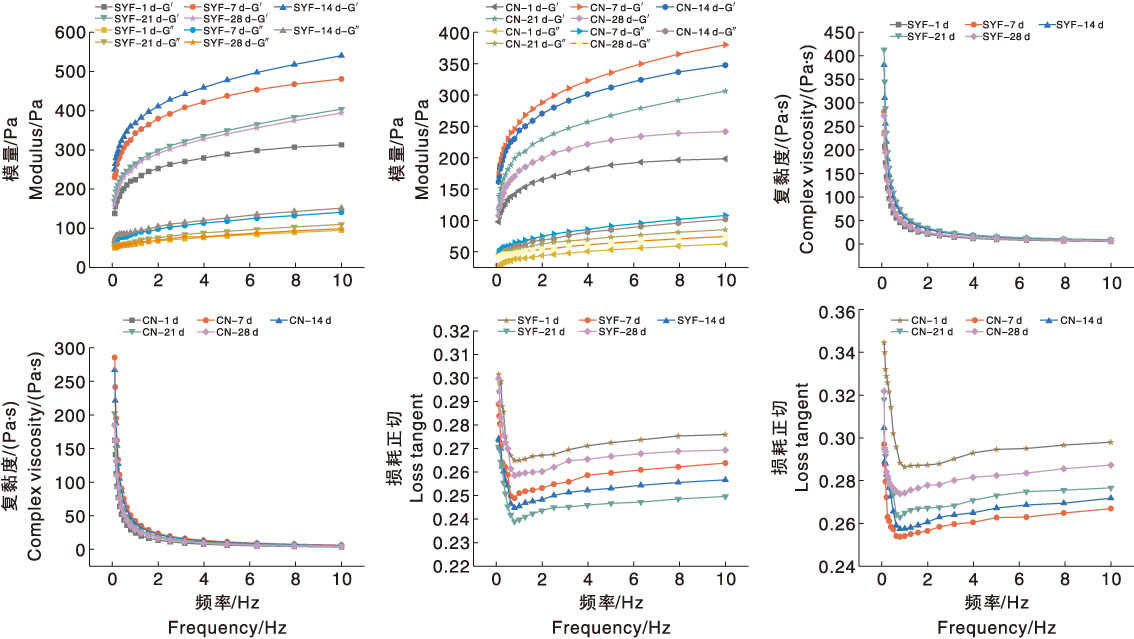
图2 储藏期间样品的流变特性变化 G',储能模量;G″,损耗模量。
Fig.2 Changes in the rheological properties of samples during storage G', Storage modulus; G″, Loss modulus.
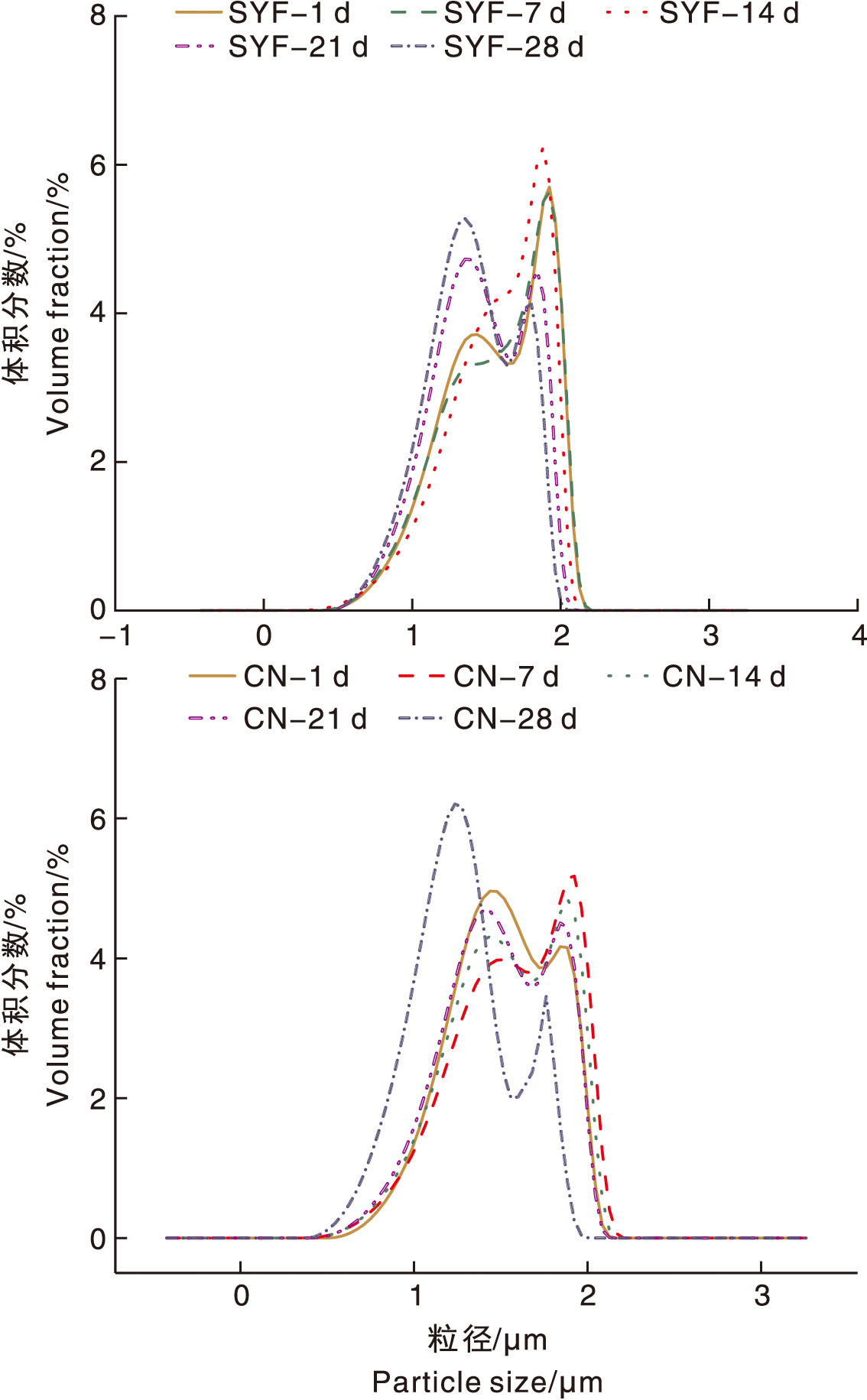
图3 储藏期间样品的粒径变化 图中粒径值已转换为其常用对数值。
Fig.3 Changes in particle size of samples during storage The particle sizes are shown after conversion into common logarithmic values.
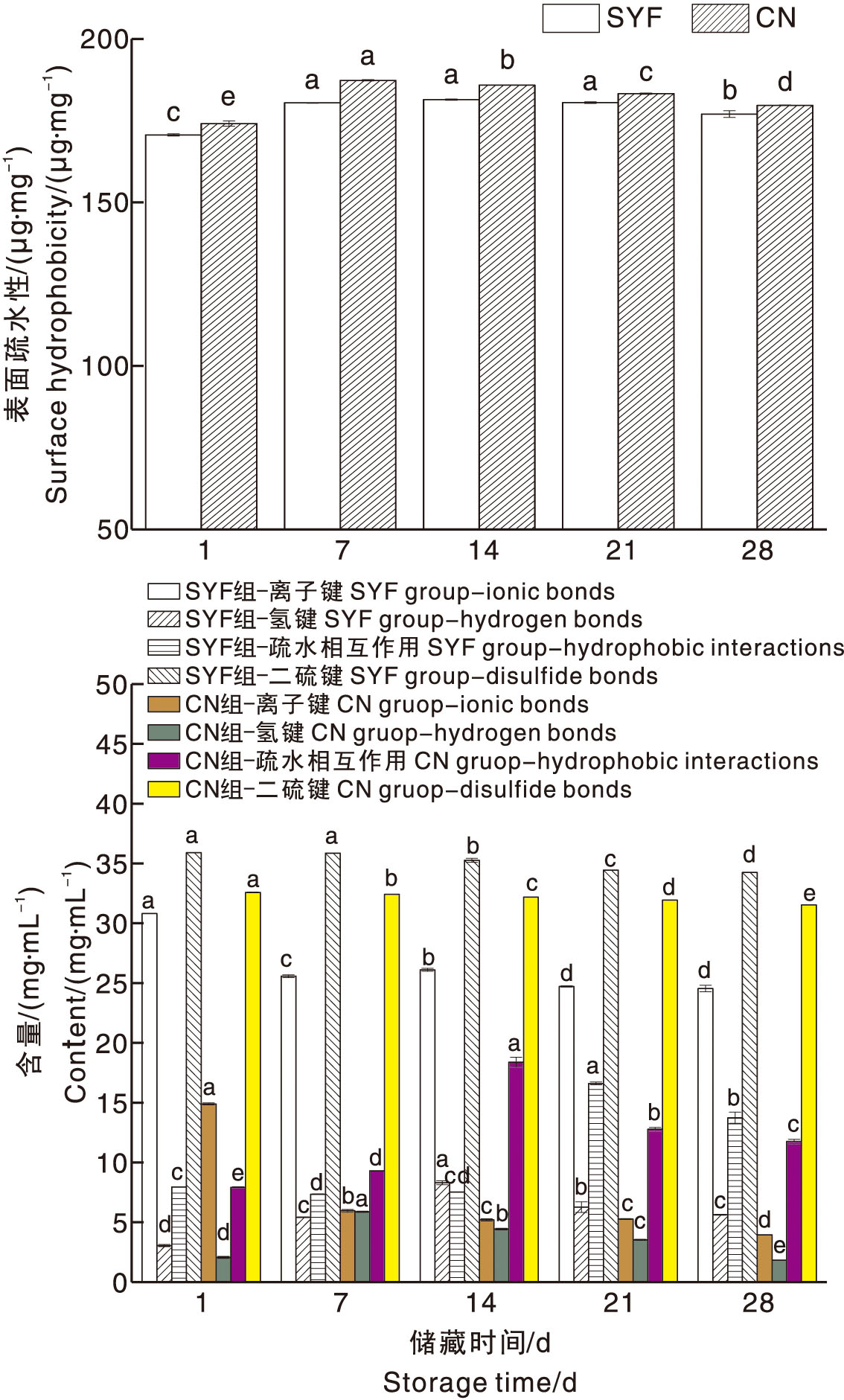
图4 储藏期间样品表面疏水性(上)和分子间作用力(下)的变化 柱上无相同字母的表示同一指标下不同处理间差异显著(p<0.05)。
Fig.4 Changes of surface hydrophobicity (top) and intermolecular forces (bottom) of samples during storage Bars marked without the same letters indicate signifiant (p<0.05) difference within treatments under the same index.
| 储藏时间 Storage time/d | 样品 Sample | 活菌数/ (CFU·mL-1) Viable cell count/ (CFU·mL-1) | 感官评分 Sensory score | ||||
|---|---|---|---|---|---|---|---|
| 颜色 Color | 气味 Odor | 滋味 Taste | 组织状态 Texture | 总分 Total | |||
| 1 | SYF | 9.4×10⁸ | 17.60±1.02 a | 16.90±0.94 b | 26.60±1.28 a | 26.30±1.34 ab | 87.40±1.85 ab |
| CN | 1.3×10⁴ | 16.40±0.92 abc | 16.80±0.98 a | 24.90±0.70 b | 24.20±0.98 ab | 82.30±1.79 b | |
| 7 | SYF | 2.8×10⁸ | 17.70±1.42 a | 17.30±1.00 a | 27.20±1.08 a | 26.80±1.08 a | 89.00±2.15 a |
| CN | 9.6×10³ | 17.40±0.92 a | 17.10±0.70 a | 26.30±0.90 a | 24.90±0.47 a | 85.70±1.35 a | |
| 14 | SYF | 3.1×10⁷ | 17.60±0.66 a | 17.20±0.47 ab | 26.00±0.77 b | 26.00±1.26 ab | 86.80±1.54 b |
| CN | 7.1×10³ | 16.70±0.90 ab | 17.00±0.89 a | 23.40±0.92 c | 23.10±1.37 bc | 80.20±1.47 b | |
| 21 | SYF | 2.1×10⁷ | 17.30±0.78 b | 16.80±0.87 bc | 25.30±1.10 b | 25.30±0.90 b | 84.70±1.00 c |
| CN | 5.1×10³ | 15.50±0.81 c | 15.80±0.74 b | 23.10±0.94 c | 22.00±1.41 c | 76.40±1.28 c | |
| 28 | SYF | 8.3×10⁶ | 16.80±0.87 c | 16.40±0.80 c | 23.90±0.94 c | 23.80±0.75 c | 80.90±1.04 d |
| CN | 1.4×10³ | 15.70±0.90 bc | 15.50±0.81 b | 21.40±1.11 d | 19.30±1.49 d | 71.90±0.94 d | |
表10 储藏期间样品的活菌数与感官评分变化
Table 10 Changes in viable cell count and sensory score of samples during storage
| 储藏时间 Storage time/d | 样品 Sample | 活菌数/ (CFU·mL-1) Viable cell count/ (CFU·mL-1) | 感官评分 Sensory score | ||||
|---|---|---|---|---|---|---|---|
| 颜色 Color | 气味 Odor | 滋味 Taste | 组织状态 Texture | 总分 Total | |||
| 1 | SYF | 9.4×10⁸ | 17.60±1.02 a | 16.90±0.94 b | 26.60±1.28 a | 26.30±1.34 ab | 87.40±1.85 ab |
| CN | 1.3×10⁴ | 16.40±0.92 abc | 16.80±0.98 a | 24.90±0.70 b | 24.20±0.98 ab | 82.30±1.79 b | |
| 7 | SYF | 2.8×10⁸ | 17.70±1.42 a | 17.30±1.00 a | 27.20±1.08 a | 26.80±1.08 a | 89.00±2.15 a |
| CN | 9.6×10³ | 17.40±0.92 a | 17.10±0.70 a | 26.30±0.90 a | 24.90±0.47 a | 85.70±1.35 a | |
| 14 | SYF | 3.1×10⁷ | 17.60±0.66 a | 17.20±0.47 ab | 26.00±0.77 b | 26.00±1.26 ab | 86.80±1.54 b |
| CN | 7.1×10³ | 16.70±0.90 ab | 17.00±0.89 a | 23.40±0.92 c | 23.10±1.37 bc | 80.20±1.47 b | |
| 21 | SYF | 2.1×10⁷ | 17.30±0.78 b | 16.80±0.87 bc | 25.30±1.10 b | 25.30±0.90 b | 84.70±1.00 c |
| CN | 5.1×10³ | 15.50±0.81 c | 15.80±0.74 b | 23.10±0.94 c | 22.00±1.41 c | 76.40±1.28 c | |
| 28 | SYF | 8.3×10⁶ | 16.80±0.87 c | 16.40±0.80 c | 23.90±0.94 c | 23.80±0.75 c | 80.90±1.04 d |
| CN | 1.4×10³ | 15.70±0.90 bc | 15.50±0.81 b | 21.40±1.11 d | 19.30±1.49 d | 71.90±0.94 d | |
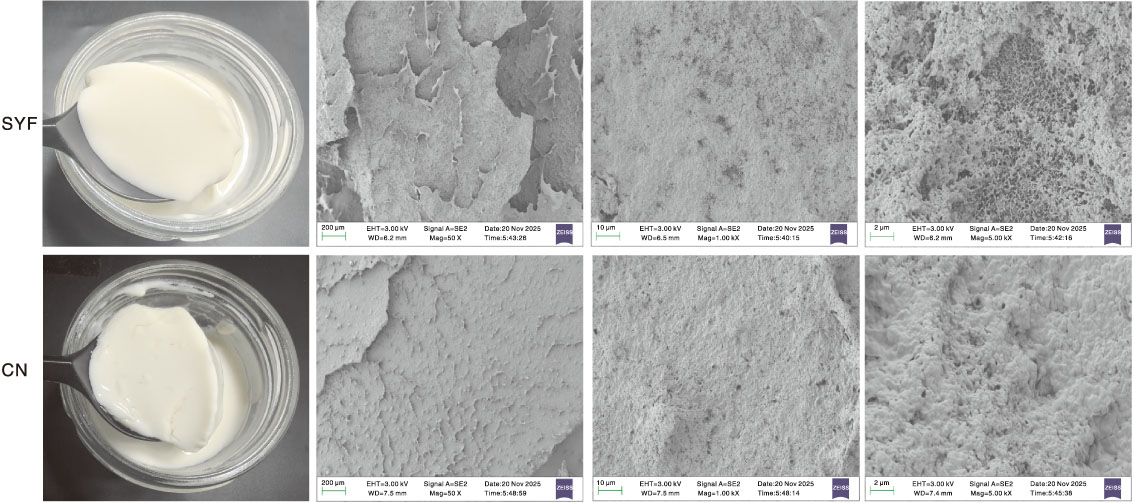
图5 不同样品的外观照片和扫描电镜图
Fig.5 Appearance photos and scanning electron microscope images of different samples
| [1] | REN W W, LIANG H S, LI B, et al. Towards ideal plant-based yogurts: evaluating component and processing effects on mouthfeel and stability[J]. Journal of Future Foods, 2025, 5(5): 455-469. |
| [2] | 惠丹阳. 大豆蛋白部分替代牛乳蛋白对酸奶品质的影响研究[D]. 湘潭: 湘潭大学, 2023. |
| HUI D Y. Study on the effect of partial substitution of soy protein for cow’s milk protein on the quality of yogurt[D]. Xiangtan: Xiangtan University, 2023. | |
| [3] | YANG M, TANG Y H, LI H F, et al. Exploring the effect of milk protein concentrate on the physicochemical and digestive properties of fermentation-induced mung bean protein gels[J]. International Journal of Biological Macromolecules, 2025, 318: 145090. |
| [4] | MÉNDEZ-GALARRAGA M P, CURUTCHET A, ARZUAGA M R. Hybrid yogurts: exploring the functional, sensory and nutritional potential of dairy-plant protein combinations[J]. Food Reviews International, 2025, 41(7): 2150-2166. |
| [5] | EREM E, KILIC-AKYILMAZ M. The role of fermentation with lactic acid bacteria in quality and health effects of plant-based dairy analogues[J]. Comprehensive Reviews in Food Science and Food Safety, 2024, 23(4): e13402. |
| [6] | ZANG J W, LIN T, SHI Y B, et al. Recent advances in exopolysaccharide-protein interactions in fermented dairy- and plant-based yogurts: mechanisms, influencing factors, health benefits, analytical techniques, and future directions[J]. Comprehensive Reviews in Food Science and Food Safety, 2025, 24(4): e70219. |
| [7] | WANG X J, LAI J H, YE C, et al. Modulation of gut microbiota and storage stability of yogurt fortified with novel EPS-producing Lactiplantibacillus plantarum DPA1C[J]. Food Research International, 2025, 222: 117154. |
| [8] | LIU M W, LI X, YE T, et al. Safety evaluation of Weissella confusa SY628 and the effect of its fermentation on the taste and quality of soy yogurt[J]. Frontiers in Microbiology, 2025, 16: 1567399. |
| [9] | JIAN C, YANG X Z, TUCCILLO F, et al. Impact of fermentation conditions and dextran structure on the rheological and textural properties of a novel high-protein, high-fiber and low-fat plant-based cheese[J]. Food Hydrocolloids, 2025, 164: 111209. |
| [10] | 邹方红. 融合魏斯氏菌SW1生理生化特性及在乳制品中的应用研究[D]. 济南: 山东师范大学, 2024. |
| ZOU F H. Physiological and biochemical characteristics of Weissella confusa SW1 and its application in dairy products[D]. Jinan: Shandong Normal University, 2024. | |
| [11] | 李筱, 刘牧雯, 钟蓉莲, 等. 融合魏斯氏菌发酵制备凝固型大豆酸奶及其稳定性分析[J]. 食品与发酵工业, 2025, 51(15): 118-124. |
| LI X, LIU M W, ZHONG R L, et al. Preparation and stability analysis of set-style soybean yogurt fermented by Weissella confusa strain[J]. Food and Fermentation Industries, 2025, 51(15): 118-124. | |
| [12] | BOUROUIS I, MCCLEMENTS D J, CHEN C S, et al. Formulations and evaluations of structural and physico-chemical properties of soy yogurts: effect of incorporating soy protein isolate/chitosan complexed microgels[J]. LWT, 2024, 206: 116569. |
| [13] | 卢一帆. 大豆/牛奶双蛋白酸奶的制备及品质评价[D]. 杨凌: 西北农林科技大学, 2023. |
| LU Y F. Preparation and quality evaluation of soybean/milk dual protein yogurt[D]. Yangling: Northwest A & F University, 2023. | |
| [14] | LIU X, ZHANG Z W, CHEN Y J, et al. Chain reactions of temperature-induced egg white protein amorphous aggregates: formation, structure and material composition of thermal gels[J]. Food Chemistry, 2024, 460: 140785. |
| [15] | LI S Y, HU M, WEN W, et al. Effect of different strains on quality characteristics of soy yogurt: physicochemical, nutritional, safety features, sensory, and formation mechanism[J]. Food Chemistry, 2024, 22: 101359. |
| [16] | 张敏华, 丁长河, 李睿尧, 等. 不同功能糖对低温搅拌型酸奶质量及发酵过程的影响[J]. 食品工业科技, 2025, 46(15): 167-177. |
| ZHANG M H, DING C H, LI R Y, et al. Effects of different functional sugars on the quality and fermentation process of low-temperature stirred yogurt[J]. Science and Technology of Food Industry, 2025, 46(15): 167-177. | |
| [17] | 汤晓娟. 产胞外多糖酸面团发酵及其冷冻面团抗冻机理研究[D]. 无锡: 江南大学, 2019. |
| TANG X J. Sourdough fermented by exopolysaccharide forming strain: application and mechanism studies in frozen dough[D]. Wuxi: Jiangnan University, 2019. | |
| [18] | TIWARI S, KAVITAKE D, DEVI P B, et al. Bacterial exopolysaccharides for improvement of technological, functional and rheological properties of yoghurt[J]. International Journal of Biological Macromolecules, 2021, 183: 1585-1595. |
| [19] | GE Z W, BAO X, FENG X, et al. In situ exopolysaccharides from Lactobacillus helveticus MB2-1 in Sayram ketteki yoghurt: set yoghurts properties and interactions with sodium caseinate[J]. International Journal of Biological Macromolecules, 2022, 216: 871-881. |
| [20] | WANG Y, LEI A L, ZHAN Z Y, et al. Effect of transglutaminase treatment on the physicochemical properties and structural characteristics of soy protein isolate/konjac glucomannan complex[J]. Food Chemistry, 2025, 470: 142642. |
| [21] | REN Y M, SHEN X, YANG X Y, et al. Analysis of the effect of lactobacillus exopolysaccharide on the rheological properties of fermented soybean protein gel: using acid-induced soybean protein as the model[J]. Food Hydrocolloids, 2025, 159: 110662. |
| [22] | ZHAO J, BHANDARI B, GAIANI C, et al. Physicochemical and microstructural properties of fermentation-induced almond emulsion-filled gels with varying concentrations of protein, fat and sugar contents[J]. Current Research in Food Science, 2021, 4: 577-587. |
| [23] | WANG X L, KONG X Z, ZHANG C M, et al. Comparison of physicochemical properties and volatile flavor compounds of plant-based yoghurt and dairy yoghurt[J]. Food Research International, 2023, 164: 112375. |
| [24] | 赖鲸慧. 不同乳酸菌胞外多糖特性比较及在凝固型酸奶中的应用研究[D]. 雅安: 四川农业大学, 2022. |
| LAI J H. Comparison of exopolysaccharide properties from different lactic acid bacteria and the application in set yoghurt[D]. Ya’an: Sichuan Agricultural University, 2022. | |
| [25] | MA R Y, MIAO N, ZHANG Q Y, et al. A new attempt to develop fermented milk with low whey protein allergenic potential using a top-down method[J]. Food Bioscience, 2023, 53: 102594. |
| [26] | LI T Q, ZHANG J C, HU A N, et al. Effect of transglutaminase and laccase on pea protein gel properties compared to that of soybean[J]. Food Hydrocolloids, 2024, 156: 110314. |
| [27] | LI J H, WEI Y X, GU L P, et al. Enhancing stability of fermented egg white gels: influence of guar and xanthan gum addition order during yogurt-like fermentation[J]. International Journal of Biological Macromolecules, 2025, 292: 139260. |
| [28] | PANG Z H, DEETH H, SHARMA R, et al. Effect of addition of gelatin on the rheological and microstructural properties of acid milk protein gels[J]. Food Hydrocolloids, 2015, 43: 340-351. |
| [29] | WANG Y Q, FU Y M, LI W, et al. Modulation of soy protein immunoreactivity by different matrix structures of lactic acid bacterium-induced soy protein gels: epitope destruction during in vitro gastroduodenal digestion and absorption[J]. Food Research International, 2023, 173: 113281. |
| [30] | WANG Y, DONG X Q, ZHANG Y G, et al. Effect of the combined addition of hyaluronic acid and gellan gum on the physicochemical and digestive properties of tofu[J]. International Journal of Biological Macromolecules, 2025, 311: 143735. |
| [31] | AL NOMAN M A, SLAGHUIS H, VOS A, et al. Hybrid yoghurt: enhancing consumer acceptance by combining dairy and plant-based derivatives[J]. The Journal of Dairy Research, 2024, 91(4): 498-504. |
| [32] | PENG X H, LIU Y T, LI J N, et al. Natural polysaccharides mediated “low-molecular-bridging” network in fermented soybean protein gels: interaction, microstructure, and rheological properties[J]. Food Research International, 2025, 220: 117113. |
| [1] | 石其伟, 伍少福, 陶娟花, 吴良欢, 马庆旭, 刘秀, 韩科峰. 外源有机物料长期施用对黄泥田团聚体稳定性和有机碳氮积累的影响[J]. 浙江农业学报, 2026, 38(4): 720-730. |
| [2] | 杨晨辰, 陶文扬, 邢建荣, 周万怡, 王梦竹, 李明, 杨颖, 赵玉萍. 原花色素对铁皮石斛花色苷稳定性的影响及其作用机制[J]. 浙江农业学报, 2026, 38(3): 471-480. |
| [3] | 曹永庆, 姚小华, 王开良, 任华东. 普通油茶主要性状的年际稳定性[J]. 浙江农业学报, 2025, 37(8): 1624-1633. |
| [4] | 任晋东, 陈红林, 牛宝龙, 许晓军, 楼宝. 基于转录组分析挖掘罗氏沼虾新内参基因[J]. 浙江农业学报, 2025, 37(7): 1424-1429. |
| [5] | 熊瑞, 欧阳宁, 欧茜, 钟康裕, 周文涛, 王泓睿, 龙攀, 徐莹, 傅志强. 秸秆还田与耕作方式对双季稻土壤团聚体及碳氮含量的影响[J]. 浙江农业学报, 2024, 36(6): 1347-1356. |
| [6] | 崔宁波, 王斯曼, 范月圆. “双循环”格局下中国饲料粮进口稳定性研究[J]. 浙江农业学报, 2024, 36(3): 681-689. |
| [7] | 张春荣, 郭钤, 孔丽萍, 吴园园, 林琴, 许振岚, 赵学平, 汤涛. 嘧菌酯在杨梅中的残留行为及膳食暴露风险评估[J]. 浙江农业学报, 2023, 35(4): 942-951. |
| [8] | 汤晓, 马明. 四种常见粽叶提取物的抑菌活性与稳定性[J]. 浙江农业学报, 2022, 34(6): 1287-1397. |
| [9] | 李娟, 庄晋财, 郑晶晶. 城乡要素共生背景下的土地入股双层多方利益博弈主体合作机制[J]. 浙江农业学报, 2022, 34(11): 2567-2582. |
| [10] | 唐晓姝, 胡博, 陈雪梅, 张白曦. 黑果腺肋花楸榨汁工艺研究与果汁品质评价[J]. 浙江农业学报, 2021, 33(12): 2406-2414. |
| [11] | 陈章, 吴华健, 毛天骄, 韩业芹, 孙裴, 魏建忠, 李东风, 李郁. 猪链球菌2型制苗用菌株的筛选[J]. 浙江农业学报, 2020, 32(1): 57-64. |
| [12] | 赵建霞, 沈颖越, 冯伟林, 金群力, 宋婷婷, 范丽军, 蔡为明. 双孢蘑菇内参基因的筛选与矫正[J]. 浙江农业学报, 2019, 31(8): 1312-1320. |
| [13] | 吴琼娟, 杨志鹏, 姚焱彬, 陆萍, 魏建忠, 孙裴, 李郁. 猪红斑丹毒丝菌制苗用菌株的筛选[J]. 浙江农业学报, 2018, 30(9): 1467-1475. |
| [14] | 夏其乐, 曹艳, 陈剑兵, 韩延超, 刘瑞玲. 改善杨梅露酒色泽稳定性的研究[J]. 浙江农业学报, 2018, 30(10): 1775-1781. |
| [15] | 王连晓1,史正涛1,*,刘新有2,3,冯泽波1,肖冬冬1. 不同林龄橡胶林土壤团聚体分布特征及其稳定性研究[J]. 浙江农业学报, 2016, 28(8): 1381-. |
| 阅读次数 | ||||||
|
全文 |
|
|||||
|
摘要 |
|
|||||

