浙江农业学报 ›› 2026, Vol. 38 ›› Issue (8): 1589-1597.DOI: 10.3969/j.issn.1004-1524.20250457
新疆地区伊犁郁金香花色表型多样性及其与地理因子的相关性
秦斗文( ), 田吉婷, 巨秀婷*()
青海大学 农牧学院 ,青海省园林植物与观赏园艺重点实验室,青海大学高原花卉研究中心 青海 西宁 810016
-
收稿日期:2025-06-23出版日期:2026-08-25发布日期:2026-09-14 -
作者简介:秦斗文,主要从事观赏植物遗传育种研究。E-mail:qindouwen@163.com -
通讯作者:*巨秀婷,E-mail:juxiuting@163.com -
基金资助:青海省自然科学基金(2025-ZJ-950M);中国科学院“西部之光”人才培养项目(中科人字〔2022〕4号)
Phenotypic diversity of flower color of Tulipa iliensis in Xinjiang of China and its correlation with geographical factors
QIN Douwen(), TIAN Jiting, JU Xiuting*()
Key Laboratory of Landscape Plants and Ornamental Horticulture of Qinghai Province ,Plateau Flower Research Center of Qinghai University, College of Agriculture and Animal Husbandry, Qinghai University Xining 810016, China
-
Received:2025-06-23Published:2026-08-25Online:2026-09-14

摘要:
为探究伊犁郁金香自然分布居群花色表型多样性,利用色差仪对自然分布的23个伊犁郁金香居群315个个体进行花色表型值测定,利用单因素方差分析、聚类分析、相关分析等方法研究不同居群的花色表型多样性。结果表明:伊犁郁金香不同居群之间花色明度值(L*)、红度值(a*)、黄度值(b*)、彩度值(C*)、色调角(h)均有不同程度的变化,且部分居群之间差异较大,23个居群的L*介于45.64~67.19之间,主要为中等明度;a*变化范围为2.43~14.95,花色偏红色且红色强度为低红度;b*变化范围为19.13~40.83,花色偏黄色且黄色强度为低中黄度;C*变化范围为25.88~43.50,饱和度等级为中高饱和度;h变化范围为24.82~78.27,颜色类型为红色、橙红色和橙黄色。23个居群的聚类分析结果显示,在欧氏平均距离为5时可划分为3个类群,类群Ⅰ、Ⅱ均有10个居群,占比均为43.48%。其中类群Ⅱ的10个居群花色以橙色系为主,类群Ⅲ仅有花色变异较大的3个居群(BDW、BSF、NLT),占比为13.04%,花色以橙红色为主。不同居群花色性状与地理因子之间的相关性分析表明L*、b*、C*和h与纬度均呈极显著正相关,L*、a*、b*、C*、h与海拔和经度无显著相关性。该研究证实,在纬度的影响下,采样区内伊犁郁金香自然居群花色表型具有多样性,存在丰富的花色变异。
中图分类号:
引用本文
秦斗文, 田吉婷, 巨秀婷. 新疆地区伊犁郁金香花色表型多样性及其与地理因子的相关性[J]. 浙江农业学报, 2026, 38(8): 1589-1597.
QIN Douwen, TIAN Jiting, JU Xiuting. Phenotypic diversity of flower color of Tulipa iliensis in Xinjiang of China and its correlation with geographical factors[J]. Acta Agriculturae Zhejiangensis, 2026, 38(8): 1589-1597.
| 居群编号 Population number | 采样地点 Location | 样本数量 Sample quantity | 海拔/m Altitude/m | 经度(E) Longitude(E) | 纬度(N) Latitude(N) |
|---|---|---|---|---|---|
| BDW | 乌鲁木齐市水磨沟区 Shuimogou District, Urumqi City, China | 15 | 803~853 | 87°42'27″ | 43°52'14″ |
| SRG | 乌鲁木齐市水磨沟区 Shuimogou District, Urumqi City, China | 15 | 924~1 007 | 87°46'54″ | 43°49'14″ |
| XLG | 乌鲁木齐市沙依巴克区 Saybagh District, Urumqi City, China | 15 | 866~885 | 87°30'01″ | 43°50'01″ |
| SMG | 乌鲁木齐市水磨沟区 Shuimogou District, Urumqi City, China | 15 | 958~984 | 87°42'53″ | 43°47'40″ |
| LCG | 乌鲁木齐市米东区 Midong District, Urumqi City, China | 15 | 896~944 | 87°48'01″ | 43°54'28″ |
| HXG | 乌鲁木齐市米东区 Midong District, Urumqi City, China | 15 | 1 067~1 155 | 87°53'46″ | 43°54'20″ |
| MXT | 乌鲁木齐市乌鲁木齐县 Urumqi County, Urumqi City, China | 15 | 1 531~1 629 | 87°37'52″ | 43°26'57″ |
| YML | 乌鲁木齐市沙依巴克区 Saybagh District, Urumqi City, China | 15 | 937~964 | 87°34'26″ | 43°47'54″ |
| BFG | 乌鲁木齐市乌鲁木齐县 Urumqi County, Urumqi City, China | 12 | 1 707~1 721 | 87°16'10″ | 43°27'13″ |
| BSF | 伊犁哈萨克自治州察布查尔锡伯自治县 Qapqal Xibe Autonomous County, Ili Kazak Autonomous Prefecture, China | 15 | 1 745~1 808 | 81°12'23″ | 43°32'56″ |
| YLH | 伊犁哈萨克自治州察布查尔锡伯自治县 Qapqal Xibe Autonomous County, Ili Kazak Autonomous Prefecture, China | 4 | 656~657 | 81°07'19″ | 43°29'44″ |
| NLT | 伊犁哈萨克自治州新源县 Xinyuan County, Ili Kazak Autonomous Prefecture, China | 15 | 1 685~1 723 | 80°57'59″ | 44°19'54″ |
| SMS | 昌吉回族自治州呼图壁县 Hutubi County, Changji Hui Autonomous Prefecture, China | 15 | 1 264~1 296 | 81°34'03″ | 43°43'39″ |
| GYM | 昌吉回族自治州呼图壁县 Hutubi County, Changji Hui Autonomous Prefecture, China | 15 | 1 333~1 369 | 84°18'39″ | 43°16'03″ |
| QEG | 昌吉回族自治州呼图壁县 Hutubi County, Changji Hui Autonomous Prefecture, China | 15 | 1 418~1 429 | 86°35'13″ | 43°48'07″ |
| KJS | 昌吉回族自治州呼图壁县 Hutubi County, Changji Hui Autonomous Prefecture, China | 15 | 1 637~1 673 | 86°37'25″ | 43°47'27″ |
| FHH | 昌吉回族自治州玛纳斯县 Manas County, Changji Hui Autonomous Prefecture, China | 15 | 1 349~1 364 | 86°29'19″ | 43°49'23″ |
| YHC | 昌吉回族自治州玛纳斯县 Manas County, Changji Hui Autonomous Prefecture, China | 15 | 1 332~1 334 | 86°20'07″ | 43°50'16″ |
| SWS | 塔城地区沙湾市 Shawan City, Tacheng Prefecture, China | 15 | 1 313~1 328 | 86°14'01″ | 43°52'46″ |
| GYG | 塔城地区沙湾市 Shawan City, Tacheng Prefecture, China | 14 | 1 289~1 327 | 86°11'30″ | 43°55'33″ |
| BET | 塔城地区沙湾市博尔通古乡 Bortonggu Township, Shawan City, Tacheng Prefecture, China | 15 | 1 668~1 697 | 85°51'22″ | 43°58'04″ |
| BYG | 塔城地区沙湾市博尔通古乡 Bortonggu Township, Shawan City, Tacheng Prefecture, China | 15 | 1 723~1 732 | 85°52'19″ | 43°55'58″ |
| XGB | 塔城地区沙湾市博尔通古乡 Bortonggu Township, Shawan City, Tacheng Prefecture, China | 5 | 955~962 | 85°15'19″ | 43°59'46″ |
表1 采样点信息
Table 1 Sampling location information
| 居群编号 Population number | 采样地点 Location | 样本数量 Sample quantity | 海拔/m Altitude/m | 经度(E) Longitude(E) | 纬度(N) Latitude(N) |
|---|---|---|---|---|---|
| BDW | 乌鲁木齐市水磨沟区 Shuimogou District, Urumqi City, China | 15 | 803~853 | 87°42'27″ | 43°52'14″ |
| SRG | 乌鲁木齐市水磨沟区 Shuimogou District, Urumqi City, China | 15 | 924~1 007 | 87°46'54″ | 43°49'14″ |
| XLG | 乌鲁木齐市沙依巴克区 Saybagh District, Urumqi City, China | 15 | 866~885 | 87°30'01″ | 43°50'01″ |
| SMG | 乌鲁木齐市水磨沟区 Shuimogou District, Urumqi City, China | 15 | 958~984 | 87°42'53″ | 43°47'40″ |
| LCG | 乌鲁木齐市米东区 Midong District, Urumqi City, China | 15 | 896~944 | 87°48'01″ | 43°54'28″ |
| HXG | 乌鲁木齐市米东区 Midong District, Urumqi City, China | 15 | 1 067~1 155 | 87°53'46″ | 43°54'20″ |
| MXT | 乌鲁木齐市乌鲁木齐县 Urumqi County, Urumqi City, China | 15 | 1 531~1 629 | 87°37'52″ | 43°26'57″ |
| YML | 乌鲁木齐市沙依巴克区 Saybagh District, Urumqi City, China | 15 | 937~964 | 87°34'26″ | 43°47'54″ |
| BFG | 乌鲁木齐市乌鲁木齐县 Urumqi County, Urumqi City, China | 12 | 1 707~1 721 | 87°16'10″ | 43°27'13″ |
| BSF | 伊犁哈萨克自治州察布查尔锡伯自治县 Qapqal Xibe Autonomous County, Ili Kazak Autonomous Prefecture, China | 15 | 1 745~1 808 | 81°12'23″ | 43°32'56″ |
| YLH | 伊犁哈萨克自治州察布查尔锡伯自治县 Qapqal Xibe Autonomous County, Ili Kazak Autonomous Prefecture, China | 4 | 656~657 | 81°07'19″ | 43°29'44″ |
| NLT | 伊犁哈萨克自治州新源县 Xinyuan County, Ili Kazak Autonomous Prefecture, China | 15 | 1 685~1 723 | 80°57'59″ | 44°19'54″ |
| SMS | 昌吉回族自治州呼图壁县 Hutubi County, Changji Hui Autonomous Prefecture, China | 15 | 1 264~1 296 | 81°34'03″ | 43°43'39″ |
| GYM | 昌吉回族自治州呼图壁县 Hutubi County, Changji Hui Autonomous Prefecture, China | 15 | 1 333~1 369 | 84°18'39″ | 43°16'03″ |
| QEG | 昌吉回族自治州呼图壁县 Hutubi County, Changji Hui Autonomous Prefecture, China | 15 | 1 418~1 429 | 86°35'13″ | 43°48'07″ |
| KJS | 昌吉回族自治州呼图壁县 Hutubi County, Changji Hui Autonomous Prefecture, China | 15 | 1 637~1 673 | 86°37'25″ | 43°47'27″ |
| FHH | 昌吉回族自治州玛纳斯县 Manas County, Changji Hui Autonomous Prefecture, China | 15 | 1 349~1 364 | 86°29'19″ | 43°49'23″ |
| YHC | 昌吉回族自治州玛纳斯县 Manas County, Changji Hui Autonomous Prefecture, China | 15 | 1 332~1 334 | 86°20'07″ | 43°50'16″ |
| SWS | 塔城地区沙湾市 Shawan City, Tacheng Prefecture, China | 15 | 1 313~1 328 | 86°14'01″ | 43°52'46″ |
| GYG | 塔城地区沙湾市 Shawan City, Tacheng Prefecture, China | 14 | 1 289~1 327 | 86°11'30″ | 43°55'33″ |
| BET | 塔城地区沙湾市博尔通古乡 Bortonggu Township, Shawan City, Tacheng Prefecture, China | 15 | 1 668~1 697 | 85°51'22″ | 43°58'04″ |
| BYG | 塔城地区沙湾市博尔通古乡 Bortonggu Township, Shawan City, Tacheng Prefecture, China | 15 | 1 723~1 732 | 85°52'19″ | 43°55'58″ |
| XGB | 塔城地区沙湾市博尔通古乡 Bortonggu Township, Shawan City, Tacheng Prefecture, China | 5 | 955~962 | 85°15'19″ | 43°59'46″ |
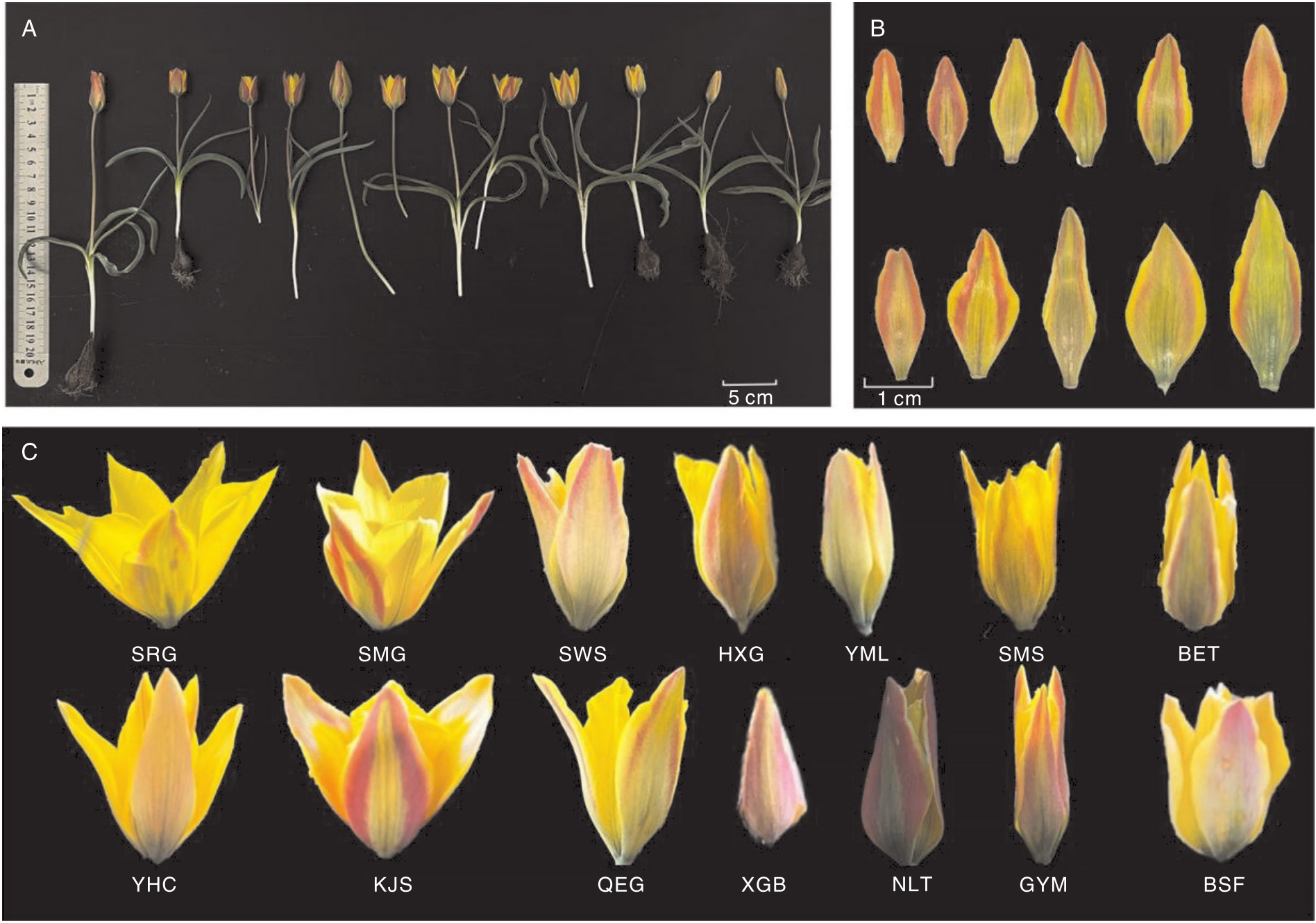
图1 伊犁郁金香部分居群表型性状特征 A,部分居群伊犁郁金香个体形态;B,部分居群伊犁郁金香外轮花被片背面;C,部分居群伊犁郁金香花朵形态。
Fig.1 Phenotypic characteristics of some populations of Tulipa iliensis A, Individual morphology of Tulipa iliensis in some populations; B, Back side of outer perianth of Tulipa iliensis in some populations; C, Petal morphology of Tulipa iliensis in some populations.
| 居群Population | L* | a* | b* | C* | h/(°) |
|---|---|---|---|---|---|
| BDW | 52.96±1.97 fg | 10.08±1.68 abcd | 22.78±2.41 gh | 26.39±1.78 gh | 51.10±11.07 ab |
| SRG | 55.39±1.68 def | 12.70±1.97 ab | 28.20±2.02 efg | 31.98±1.80 efgh | 65.20±3.82 a |
| XLG | 57.22±1.46 cdef | 10.18±1.57 abcd | 29.43±2.49 defg | 31.89±2.30 efgh | 69.36±3.69 a |
| SMG | 56.12±1.89 def | 10.41±2.07 abcd | 27.48±3.35 efgh | 31.18±2.78 efgh | 54.05±11.51 ab |
| HXG | 55.44±1.58 def | 11.68±1.56 abc | 25.80±1.51 fgh | 29.09±1.25 fgh | 64.87±3.39 a |
| LCG | 58.17±2.13 cdef | 9.03±1.43 abcd | 30.40±2.67 cdefg | 32.49±2.36 defgh | 58.93±11.09 ab |
| MXT | 53.88±1.90 efg | 4.52±1.86 de | 23.57±2.41 gh | 25.97±1.49 h | 25.62±18.75 b |
| YML | 59.27±1.73 bcdef | 6.23±1.44 cde | 33.54±1.79 abcdef | 34.85±1.29 bcdef | 66.23±11.60 a |
| BFG | 60.33±1.72 bcde | 2.43±1.88 e | 34.24±2.61 abcdef | 35.22±2.16 bcdef | 24.82±24.27 b |
| BSF | 49.27±2.28 gh | 13.39±1.49 ab | 24.29±2.16 gh | 28.48±2.74 fgh | 58.44±4.23 ab |
| YLH | 57.35±2.92 cdef | 5.99±1.40 cde | 31.11±3.97 bcdefg | 31.86±3.74 efgh | 78.27±3.54 a |
| NLT | 45.64±2.07 h | 14.95±1.35 a | 19.13±2.90 h | 25.88±2.12 h | 47.49±5.24 ab |
| GYG | 62.87±1.80 abc | 8.95±1.96 abcd | 39.43±2.30 ab | 41.08±2.27 abc | 76.74±2.84 a |
| YHC | 61.97±1.40 abcd | 10.38±1.23 abcd | 40.05±2.16 ab | 41.58±2.21 ab | 75.39±1.48 a |
| QEG | 61.06±1.92 abcd | 8.91±0.80 abcd | 35.66±2.41 abcde | 37.16±2.07 abcde | 74.20±2.70 a |
| SMS | 57.39±1.75 cdef | 10.80±2.45 abc | 30.16±2.40 cdefg | 33.71±1.97 cdefg | 57.10±11.13 ab |
| GYM | 62.81±1.36 abc | 6.38±1.55 cde | 38.83±2.19 abc | 39.84±2.10 abcd | 56.49±15.24 ab |
| FHH | 61.67±1.05 abcd | 8.65±1.08 bcd | 39.69±1.87 ab | 40.86±1.81 abc | 77.38±1.76 a |
| SWS | 64.78±2.01 ab | 8.74±1.43 bcd | 40.83±2.29 a | 42.30±1.99 ab | 64.98±11.19 a |
| KJS | 59.86±2.09 bcde | 11.53±1.54 abc | 37.43±3.62 abcd | 40.23±3.07 abc | 70.05±4.05 a |
| BET | 59.43±1.66 bcde | 7.50±1.84 bcde | 36.05±2.63 abcde | 37.98±2.03 abcde | 52.18±15.25 ab |
| XGB | 67.19±2.59 a | 9.63±1.87 abcd | 42.20±4.71 a | 43.50±4.57 a | 76.69±3.12 a |
| BYG | 60.19±1.36 bcde | 9.49±1.32 abcd | 35.21±1.65 abcde | 36.97±1.34 abcde | 74.29±2.70 a |
表2 伊犁郁金香不同居群的花色性状
Table 2 Flower colour traits of different populations of Tulipa iliensis
| 居群Population | L* | a* | b* | C* | h/(°) |
|---|---|---|---|---|---|
| BDW | 52.96±1.97 fg | 10.08±1.68 abcd | 22.78±2.41 gh | 26.39±1.78 gh | 51.10±11.07 ab |
| SRG | 55.39±1.68 def | 12.70±1.97 ab | 28.20±2.02 efg | 31.98±1.80 efgh | 65.20±3.82 a |
| XLG | 57.22±1.46 cdef | 10.18±1.57 abcd | 29.43±2.49 defg | 31.89±2.30 efgh | 69.36±3.69 a |
| SMG | 56.12±1.89 def | 10.41±2.07 abcd | 27.48±3.35 efgh | 31.18±2.78 efgh | 54.05±11.51 ab |
| HXG | 55.44±1.58 def | 11.68±1.56 abc | 25.80±1.51 fgh | 29.09±1.25 fgh | 64.87±3.39 a |
| LCG | 58.17±2.13 cdef | 9.03±1.43 abcd | 30.40±2.67 cdefg | 32.49±2.36 defgh | 58.93±11.09 ab |
| MXT | 53.88±1.90 efg | 4.52±1.86 de | 23.57±2.41 gh | 25.97±1.49 h | 25.62±18.75 b |
| YML | 59.27±1.73 bcdef | 6.23±1.44 cde | 33.54±1.79 abcdef | 34.85±1.29 bcdef | 66.23±11.60 a |
| BFG | 60.33±1.72 bcde | 2.43±1.88 e | 34.24±2.61 abcdef | 35.22±2.16 bcdef | 24.82±24.27 b |
| BSF | 49.27±2.28 gh | 13.39±1.49 ab | 24.29±2.16 gh | 28.48±2.74 fgh | 58.44±4.23 ab |
| YLH | 57.35±2.92 cdef | 5.99±1.40 cde | 31.11±3.97 bcdefg | 31.86±3.74 efgh | 78.27±3.54 a |
| NLT | 45.64±2.07 h | 14.95±1.35 a | 19.13±2.90 h | 25.88±2.12 h | 47.49±5.24 ab |
| GYG | 62.87±1.80 abc | 8.95±1.96 abcd | 39.43±2.30 ab | 41.08±2.27 abc | 76.74±2.84 a |
| YHC | 61.97±1.40 abcd | 10.38±1.23 abcd | 40.05±2.16 ab | 41.58±2.21 ab | 75.39±1.48 a |
| QEG | 61.06±1.92 abcd | 8.91±0.80 abcd | 35.66±2.41 abcde | 37.16±2.07 abcde | 74.20±2.70 a |
| SMS | 57.39±1.75 cdef | 10.80±2.45 abc | 30.16±2.40 cdefg | 33.71±1.97 cdefg | 57.10±11.13 ab |
| GYM | 62.81±1.36 abc | 6.38±1.55 cde | 38.83±2.19 abc | 39.84±2.10 abcd | 56.49±15.24 ab |
| FHH | 61.67±1.05 abcd | 8.65±1.08 bcd | 39.69±1.87 ab | 40.86±1.81 abc | 77.38±1.76 a |
| SWS | 64.78±2.01 ab | 8.74±1.43 bcd | 40.83±2.29 a | 42.30±1.99 ab | 64.98±11.19 a |
| KJS | 59.86±2.09 bcde | 11.53±1.54 abc | 37.43±3.62 abcd | 40.23±3.07 abc | 70.05±4.05 a |
| BET | 59.43±1.66 bcde | 7.50±1.84 bcde | 36.05±2.63 abcde | 37.98±2.03 abcde | 52.18±15.25 ab |
| XGB | 67.19±2.59 a | 9.63±1.87 abcd | 42.20±4.71 a | 43.50±4.57 a | 76.69±3.12 a |
| BYG | 60.19±1.36 bcde | 9.49±1.32 abcd | 35.21±1.65 abcde | 36.97±1.34 abcde | 74.29±2.70 a |
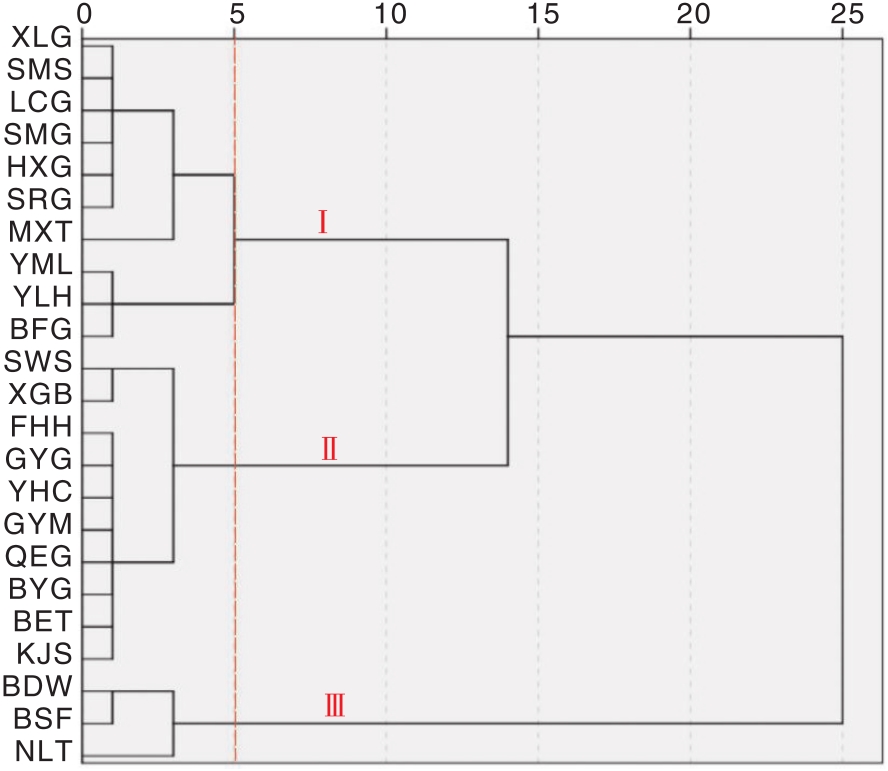
图2 23个伊犁郁金香居群花色参数的聚类分析
Fig.2 Cluster analysis of flower color parameters in 23 populations of Tulipa iliensis
| 类群 Group | 居群数量 Number of populations | L* | a* | b* | C* | h/(°) | 百分比/% Percentage/% |
|---|---|---|---|---|---|---|---|
| Ⅰ | 10 | 53.88~60.33 | 2.43~12.70 | 23.57~34.24 | 25.97~35.22 | 24.82~78.27 | 43.48 |
| Ⅱ | 10 | 59.43~67.19 | 6.38~11.53 | 35.21~42.20 | 36.97~43.50 | 52.18~77.38 | 43.48 |
| Ⅲ | 3 | 45.64~52.96 | 10.08~14.95 | 19.13~24.29 | 25.88~28.48 | 47.49~58.44 | 13.04 |
表3 伊犁郁金香各类群的花色参数特征
Table 3 Characteristics of flower color parameters in different groups of Tulipa iliensis
| 类群 Group | 居群数量 Number of populations | L* | a* | b* | C* | h/(°) | 百分比/% Percentage/% |
|---|---|---|---|---|---|---|---|
| Ⅰ | 10 | 53.88~60.33 | 2.43~12.70 | 23.57~34.24 | 25.97~35.22 | 24.82~78.27 | 43.48 |
| Ⅱ | 10 | 59.43~67.19 | 6.38~11.53 | 35.21~42.20 | 36.97~43.50 | 52.18~77.38 | 43.48 |
| Ⅲ | 3 | 45.64~52.96 | 10.08~14.95 | 19.13~24.29 | 25.88~28.48 | 47.49~58.44 | 13.04 |
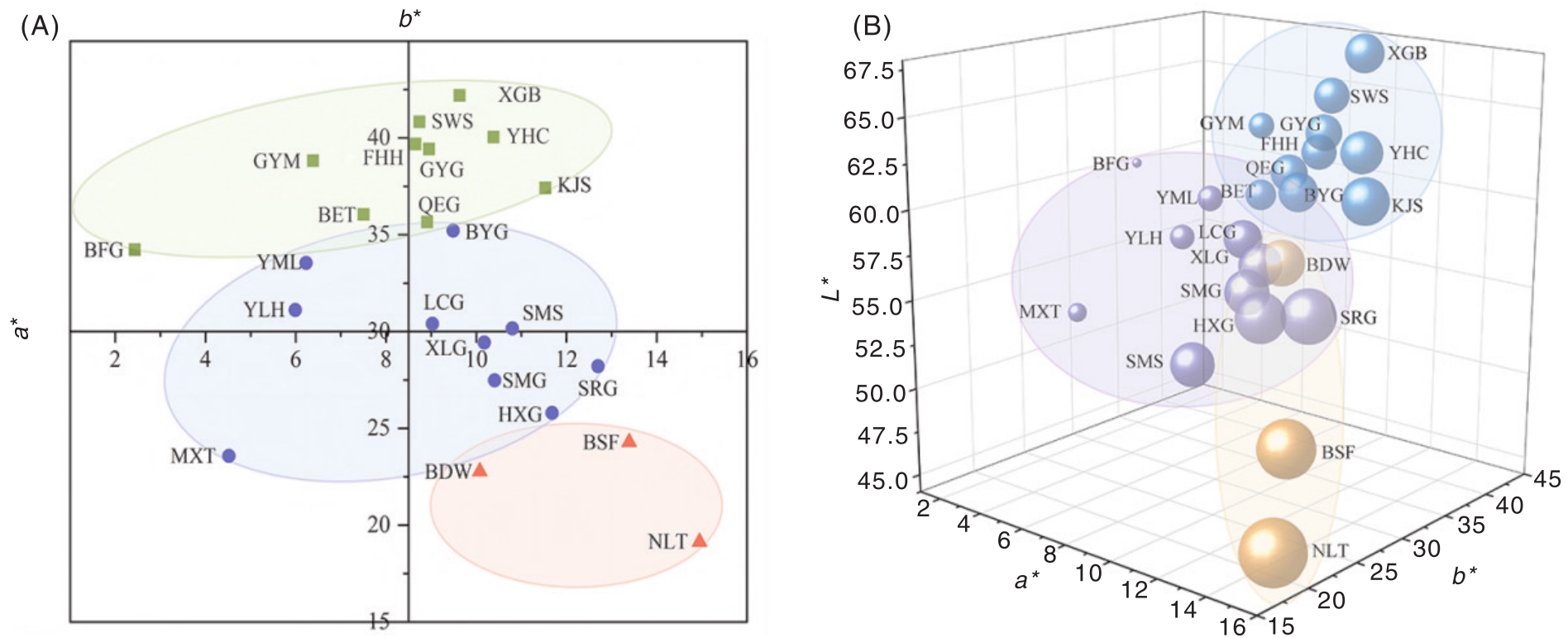
图3 伊犁郁金香a*、b*二维分布图(A)和L*、a*、b*三维分布图(B)
Fig.3 Two-dimensional distribution diagram of a*, b* (A) and three-dimensional distribution diagram of L*, a* and b* (B) of Tulipa iliensis
| 性状 Traits | 相关系数Correlation coefficient | ||
|---|---|---|---|
| 海拔 Altitude | 经度 Longitude | 纬度 Latitude | |
| L* | -0.144 | 0.202 | 0.712** |
| a* | 0.030 | -0.178 | 0.020 |
| b* | 0.037 | 0.009 | 0.639** |
| C* | 0.088 | -0.006 | 0.632** |
| h | -0.365 | -0.248 | 0.665** |
表4 伊犁郁金香花色性状与地理因子的相关系数
Table 4 Correlation coefficients between flower color traits of Tulipa iliensis and geographical factors
| 性状 Traits | 相关系数Correlation coefficient | ||
|---|---|---|---|
| 海拔 Altitude | 经度 Longitude | 纬度 Latitude | |
| L* | -0.144 | 0.202 | 0.712** |
| a* | 0.030 | -0.178 | 0.020 |
| b* | 0.037 | 0.009 | 0.639** |
| C* | 0.088 | -0.006 | 0.632** |
| h | -0.365 | -0.248 | 0.665** |
| [1] | 张艺祎. 四川独蒜兰居群花色数量分布模式及调控基因研究[D]. 福州: 福建农林大学, 2019. |
| Zhang Y Y. Flower colors distribution pattern and regulated genes within population of Pleione limprichtii[D]. Fuzhou: Fujian Agriculture and Forestry University, 2019. | |
| [2] | Menzel R, Shmida A. The ecology of flower colours and the natural colour vision of insect pollinators: the Israeli flora as a study case[J]. Biological Reviews, 1993, 68(1): 81-120. |
| [3] | Ellis A G, Johnson S D. The evolution of floral variation without pollinator shifts in Gorteria diffusa(Asteraceae)[J]. American Journal of Botany, 2009, 96(4): 793-801. |
| [4] | Trunschke J, Lunau K, Pyke G H, et al. Flower color evolution and the evidence of pollinator-mediated selection[J]. Frontiers in Plant Science, 2021, 12: 617851. |
| [5] | 迟楠燕. 华北耧斗菜(Aquilegia yabeana)野生居群间花色变异的初步研究[D]. 西安: 陕西师范大学, 2019. |
| Chi N Y. Preliminary study on flower color variation among wild populations of Aquilegia yabeana[D]. Xi’an: Shaanxi Normal University, 2019. | |
| [6] | 邢桂梅, 刘振雷, 张艳秋, 等. 三个野生郁金香的繁殖方法[J]. 北方园艺, 2018(6): 62-67. |
| Xing G M, Liu Z L, Zhang Y Q, et al. Propagation methods of three wild tulips[J]. Northern Horticulture, 2018(6): 62-67. | |
| [7] | 谭敦炎. 新疆的郁金香属种质资源[J]. 植物杂志, 2001(6): 1. |
| Tan D Y. Germplasm resources of tulip in Xinjiang[J]. Plants, 2001(6): 1. | |
| [8] | Xing G M, Qu L W, Zhang W, et al. Study on interspecific hybridization between tulip cultivars and wild species native to China[J]. Euphytica, 2020, 216(4): 66. |
| [9] | 张艳秋, 吴天宇, 张宏斌, 等. 通过远缘杂交培育郁金香新品种‘雪域湘妃’[J]. 辽宁林业科技, 2024(2): 1-4. |
| Zhang Y Q, Wu T Y, Zhang H B, et al. Breeding new tulip varieties‘Xueyu Xiangfei’ by distant hybridization[J]. Liaoning Forestry Science and Technology, 2024(2): 1-4. | |
| [10] | 李涛, 许震, 富锐. 新疆2种野生郁金香的生物学特性及栽培利用[J]. 现代园艺, 2016, 39(8): 6. |
| Li T, Xu Z, Fu R. Biological characteristics and cultivation and utilization of two wild tulips in Xinjiang[J]. Xiandai Horticulture, 2016, 39(8): 6. | |
| [11] | 邢桂梅, 张艳秋, 张伟, 等. 中国野生郁金香资源研究及利用进展[C]// 中国园艺学会球宿根花卉分会, 中国园艺学会. 中国球宿根花卉研究进展2019. 北京:中国林业出版社, 2019: 18-23. |
| [12] | 田蔼茜, 秦巧平, 张志国, 等. 萱草花色育种研究进展[J]. 植物生理学报, 2023, 59(1): 1-12. |
| Tian A X, Qin Q P, Zhang Z G, et al. Research progress of daylily (Hemerocallis spp.) flower coloration breeding[J]. Plant Physiology Journal, 2023, 59(1): 1-12. | |
| [13] | 葛翎, 黄晓德, 张峰伦, 等. 郁金香的化学成分及药理活性研究进展[J]. 中国野生植物资源, 2019, 38(5): 79-83. |
| Ge L, Huang X D, Zhang F L, et al. Research progress on chemical constituents and pharmacological activities of tulips[J]. Chinese Wild Plant Resources, 2019, 38(5): 79-83. | |
| [14] | 康晓珊, 张永智, 杨维康, 等. 新疆野生郁金香的园艺价值及保护利用[J]. 安徽农业科学, 2018, 46(24): 39-41. |
| Kang X S, Zhang Y Z, Yang W K, et al. Ornamental value of wild Tulipa L. resources and protection in Xinjiang[J]. Journal of Anhui Agricultural Sciences, 2018, 46(24): 39-41. | |
| [15] | 王玉荣. 新疆郁金香属植物生物学特性及资源评价研究[D]. 乌鲁木齐: 新疆农业大学, 2001. |
| Wang Y R. Studies on the biological characters and resources evaluation of Tulipa from Xinjiang[D]. Urumqi: Xinjiang Agricultural University, 2001. | |
| [16] | 张晓菲, 杨佳明, 商旭文, 等. 萱草育种目标研究[J]. 园艺与种苗, 2020, 40(9): 22-23. |
| Zhang X F, Yang J M, Shang X W, et al. Study on breeding target of Hemerocallis fulva[J]. Horticulture & Seed, 2020, 40(9): 22-23. | |
| [17] | 王美辰, 朱培龙, 程少颖, 等. RHS比色卡法与基于CIELAB色差仪法评价丁香花色的差异分析[J/OL]. 草地学报, 2026-04-21. https://link.cnki.net/urlid/11.3362.S.20260421.1430.005. |
| Wang M C, Zhu P L, Cheng S Y, et al. Analysis of the differences between the RHS color chart method and CIELAB-based colorimetric method in evaluating lilac flower colors[J/OL]. Acta Agrestia Sinica, 2026-04-21. https://link.cnki.net/urlid/11.3362.S.20260421.1430.005. | |
| [18] | Zhao L Q, Liu Y, Huang Q, et al. Effects of cell morphology, physiology, biochemistry and CHS genes on four flower colors of Impatiens uliginosa[J]. Frontiers in Plant Science, 2024, 15: 1343830. |
| [19] | Tanaka Y, Sasaki N, Ohmiya A. Biosynthesis of plant pigments: anthocyanins, betalains and carotenoids[J]. The Plant Journal, 2008, 54(4): 733-749. |
| [20] | Li W, Liu H, Cheng Z J, et al. DNA methylation and histone modifications regulate de novo shoot regeneration in Arabidopsis by modulating WUSCHEL expression and auxin signaling[J]. PLoS Genetics, 2011, 7(8): e1002243. |
| [21] | Hondo T, Yoshida K, Nakagawa A, et al. Structural basis of blue-colour development in flower petals from Commelina communis[J]. Nature, 1992, 358(6386): 515-518. |
| [22] | Berendsen R L, Pieterse C M J, Bakker P A H M. The rhizosphere microbiome and plant health[J]. Trends in Plant Science, 2012, 17(8): 478-486. |
| [23] | Fan X Q, Trunschke J, Ren Z X, et al. Why are the inner and outer sides of many flower petals differently coloured?[J]. Plant Biology, 2024, 26(5): 665-674. |
| [24] | Sobral M, Losada M, Veiga T, et al. Flower color preferences of insects and livestock: effects on Gentiana lutea reproductive success[J]. PeerJ, 2016, 4: e1685. |
| [25] | 李正春, 刘福元. 早春返青最早的优质牧草: 天山郁金香[J]. 农村百事通, 2008(20): 44. |
| Li Z C, Liu F Y. Tulip in Tianshan Mountain: the earliest high-quality forage grass turning green in early spring[J]. Nongcun Baishitong, 2008(20): 44. | |
| [26] | Wang H, Talavera M, Min Y, et al. Neutral processes contribute to patterns of spatial variation for flower colour in the Mediterranean Iris lutescens(Iridaceae)[J]. Annals of Botany, 2016, 117(6): 995-1007. |
| [27] | Qin D W, Liu W Q, Tian J T, et al. Genetic structure and phylogeographic of Tulipa iliensis[J]. Pakistan Journal of Botany, 2025, 57(4): 1388-1397. |
| [28] | 章彦君, 王艺光, 周杰, 等. 不同花色凤仙花群体性状变异分析[J]. 浙江林业科技, 2022, 42(4): 37-43. |
| Zhang Y J, Wang Y G, Zhou J, et al. Variation in traits of Impatiens balsamina population with different floral color[J]. Journal of Zhejiang Forestry Science and Technology, 2022, 42(4): 37-43. | |
| [29] | 庞薇. 华北耧斗菜(Aquilegia yabeana)野生居群间花色变异的遗传学基础研究[D]. 西安: 陕西师范大学, 2021. |
| Pang W. Genetic basis of flower color variation among wild populations of Aquilegia yabeana[D]. Xi’an: Shaanxi Normal University, 2021. | |
| [30] | Ma Y Y, Ma X, Gao X, et al. Light induced regulation pathway of anthocyanin biosynthesis in plants[J]. International Journal of Molecular Sciences, 2021, 22(20): 11116. |
| [31] | Yoshida K, Toyama-Kato Y, Kameda K, et al. Sepal color variation of Hydrangea macrophylla and vacuolar pH measured with a proton-selective microelectrode[J]. Plant & Cell Physiology, 2003, 44(3): 262-268. |
| [32] | Griesbach R J. Correlation of pH and light intensity on flower color in potted Eustoma grandiflorum grise[J]. HortScience, 1992, 27(7): 817-818. |
| [33] | Shrestha M, Tai K C, Dyer A G, et al. Flower colour and size-signals vary with altitude and resulting climate on the tropical-subtropical islands of Taiwan[J]. Frontiers in Plant Science, 2024, 15: 1304849. |
| [34] | Kashin A S, Kritskaya T A, Kondratieva A O, et al. The geographical distribution of flower colour in Tulipa suaveolens Roth across its European range[J]. Biology Bulletin, 2022, 49(10): 1947-1957. |
| [35] | Koski M H, Ashman T L. Macroevolutionary patterns of ultraviolet floral pigmentation explained by geography and associated bioclimatic factors[J]. New Phytologist, 2016, 211(2): 708-718. |
| [36] | Ruhland C T, Day T A. Effects of ultraviolet-B radiation on leaf elongation, production and phenylpropanoid concentrations of Deschampsia antarctica and Colobanthus quitensis in Antarctica[J]. Physiologia Plantarum, 2000, 109(3): 244-251. |
| [37] | Koski M H, Ashman T L. Floral pigmentation patterns provide an example of Gloger’s rule in plants[J]. Nature Plants, 2015, 1: 14007. |
| [38] | Mathesius U. Flavonoid functions in plants and their interactions with other organisms[J]. Plants, 2018, 7(2): 30. |
| [1] | 郭维, 马贤森, 聂红艳, 宋治豪, 周轶, 陈光勋, 陈正武. 35份贵州茶树种质资源的生化成分多样性分析与综合评价[J]. 浙江农业学报, 2026, 38(8): 1517-1528. |
| [2] | 黄国洪, 马艺妮, 何佳欣, 屠莉, 廖伟彪, 刘凤栾. 亚洲莲全基因组SSR的基本特征与遗传变异[J]. 浙江农业学报, 2026, 38(8): 1574-1588. |
| [3] | 兰会杰, 高宏伟, 吉嘉若, 蔡瑞国, 张敏, 林小虎, 杨敏. 45份小豆种质的综合评价[J]. 浙江农业学报, 2026, 38(6): 1177-1186. |
| [4] | 邓云丹, 陆承锐, 李录山, 徐永艳. 10种百合鳞茎营养成分的测定与评价[J]. 浙江农业学报, 2026, 38(6): 1228-1235. |
| [5] | 麻慧芳, 王娟菲, 薛红丽, 任果香, 史关燕. 杂交谷子新品系产量与表型性状的遗传分析[J]. 浙江农业学报, 2026, 38(3): 428-439. |
| [6] | 杨晨辰, 陶文扬, 邢建荣, 周万怡, 王梦竹, 李明, 杨颖, 赵玉萍. 原花色素对铁皮石斛花色苷稳定性的影响及其作用机制[J]. 浙江农业学报, 2026, 38(3): 471-480. |
| [7] | 刘静, 王尖, 黄钰, 吴晓花, 郭轩赫, 汪颖, 李国景, 许小江. 南瓜果实品质评价的指标筛选与模型构建[J]. 浙江农业学报, 2026, 38(2): 248-257. |
| [8] | 何苏悦, 李燕, 丁云倩, 李欣泽, 韩庆辉, 陈小央. 基于SSR标记的浙江省地方玉米种质遗传关系分析[J]. 浙江农业学报, 2026, 38(1): 24-34. |
| [9] | 许卫猛, 徐妍, 陈国立. 基于多种分析方法的糯玉米品质综合评价[J]. 浙江农业学报, 2025, 37(9): 1840-1848. |
| [10] | 刘思彤, 侯宇, 潘家荃, 周桦楠, 崔亮, 万博, 于涛. 甘薯对低温胁迫的生理响应及耐寒性评价[J]. 浙江农业学报, 2025, 37(4): 767-778. |
| [11] | 郭赛赛, 聂智星, 傅鸿妃, 王同林, 邵志勇, 王宏, 郑积荣. 37份辣椒种质资源的表型性状及SRAP遗传多样性分析[J]. 浙江农业学报, 2025, 37(2): 300-310. |
| [12] | 杨贵仁, 穆宏磊, 吴伟杰, 房祥军, 陈慧芝, 牛犇, 陈杭君, 郜海燕. 酪蛋白对杨梅汁中花色苷的工艺优化及保持研究[J]. 浙江农业学报, 2025, 37(1): 178-188. |
| [13] | 秦斗文, 刘伟强, 田吉婷, 巨秀婷. 伊犁郁金香cpDNA-PCR体系构建与遗传多样性分析[J]. 浙江农业学报, 2025, 37(1): 78-89. |
| [14] | 董莉莉, 徐志浩, 严灿龙, 范小平, 金泽兰, 王忠华. 基于表型与分子标记对浙贝母不同育种群体的分子鉴定与亲缘关系研究[J]. 浙江农业学报, 2024, 36(8): 1719-1730. |
| [15] | 李亚东, 罗小波, 彭潇, 杨光乾, 金月月, 祖贵东, 田欢, 张万萍. 萝卜SNP和InDel分子标记开发及与表型性状关联分析[J]. 浙江农业学报, 2024, 36(5): 1055-1066. |
| 阅读次数 | ||||||
|
全文 |
|
|||||
|
摘要 |
|
|||||

