Acta Agriculturae Zhejiangensis ›› 2026, Vol. 38 ›› Issue (5): 979-990.DOI: 10.3969/j.issn.1004-1524.20250263
• Environmental Science • Previous Articles Next Articles
Effects of crop rotation and microbial agent application on the rhizosphere soil microbial community of protected tomato
MAO Xiaomei1( ), JU Xinghui1, ZHU Lijing2, YANG Jian1,*()
- 1
Changxing County Agricultural Technology Extension Station Changxing 313100, Zhejiang, China
2Changxing Lijing Family Farm Changxing 313100, Zhejiang, China
-
Received:2025-04-03Online:2026-05-25Published:2026-06-02

CLC Number:
Cite this article
MAO Xiaomei, JU Xinghui, ZHU Lijing, YANG Jian. Effects of crop rotation and microbial agent application on the rhizosphere soil microbial community of protected tomato[J]. Acta Agriculturae Zhejiangensis, 2026, 38(5): 979-990.
share this article
Add to citation manager EndNote|Ris|BibTeX
URL: http://www.zjnyxb.cn/EN/10.3969/j.issn.1004-1524.20250263
| 样本 Sample | 序列数 Sequence number | 平均长度/bp Average length/bp | 最小长度/bp Minimum length/bp | 最大长度/bp Maximum length/bp | ||||
|---|---|---|---|---|---|---|---|---|
| 细菌Bacteria | 真菌Fungi | 细菌Bacteria | 真菌Fungi | 细菌Bacteria | 真菌Fungi | 细菌Bacteria | 真菌Fungi | |
| D | 72 535±9 034 | 65 014±7 045 | 413 | 250 | 259 | 133 | 458 | 490 |
| M | 78 392±3 510 | 74 703±5 058 | 416 | 248 | 229 | 117 | 493 | 496 |
| N | 76 315±2 328 | 80 091±4 870 | 416 | 246 | 228 | 141 | 470 | 522 |
Table 1 Statistics of valid sequence data after quality control
| 样本 Sample | 序列数 Sequence number | 平均长度/bp Average length/bp | 最小长度/bp Minimum length/bp | 最大长度/bp Maximum length/bp | ||||
|---|---|---|---|---|---|---|---|---|
| 细菌Bacteria | 真菌Fungi | 细菌Bacteria | 真菌Fungi | 细菌Bacteria | 真菌Fungi | 细菌Bacteria | 真菌Fungi | |
| D | 72 535±9 034 | 65 014±7 045 | 413 | 250 | 259 | 133 | 458 | 490 |
| M | 78 392±3 510 | 74 703±5 058 | 416 | 248 | 229 | 117 | 493 | 496 |
| N | 76 315±2 328 | 80 091±4 870 | 416 | 246 | 228 | 141 | 470 | 522 |
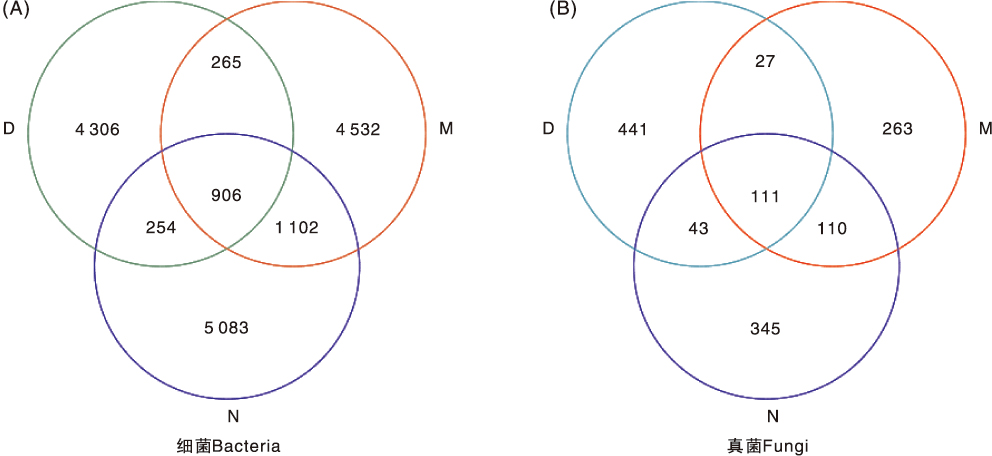
Fig.1 Venn diagram of the bacterial and fungal community composition in the rhizosphere soil D, Rice-tomato rotation treatment; M, Tomato continuous cropping with microbial agent treatment; N, Tomato continuous cropping treatment. The same as below.
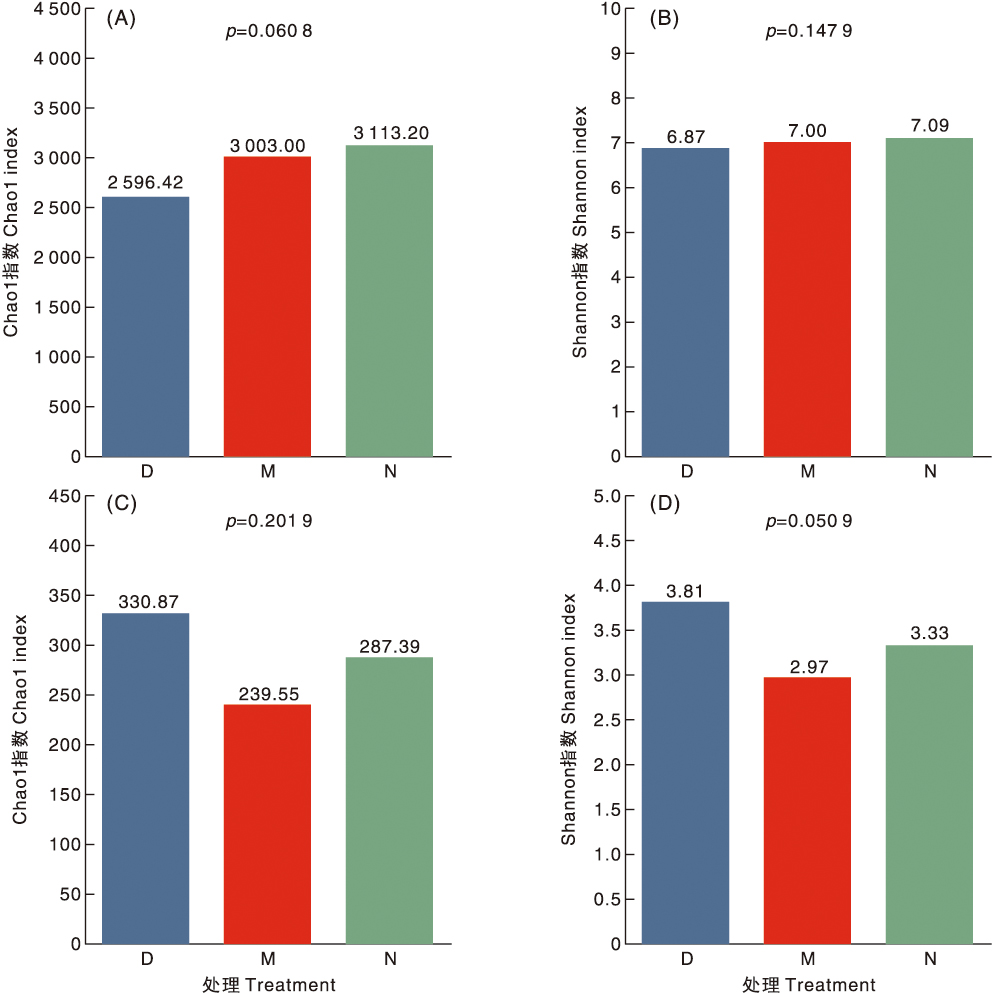
Fig.2 Alpha diversity of rhizosphere soil microbial communities A, Chao1 index of the bacterial communities; B, Shannon index of the bacterial communities; C, Chao1 index of the fungal communities; D, Shannon index of the fungal communities.
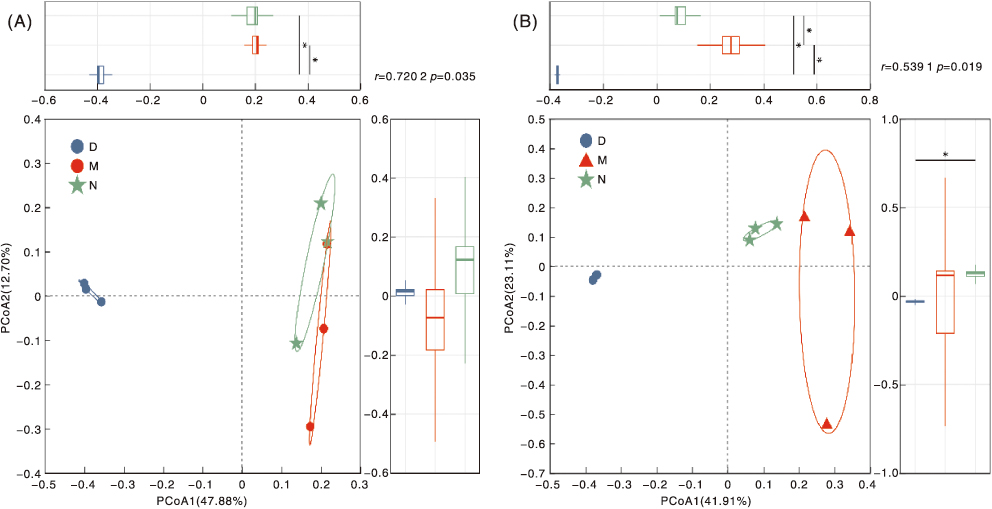
Fig.3 Principal coordinates analysis (PCoA) of rhizosphere soil bacterial (A) and fungal (B) communities
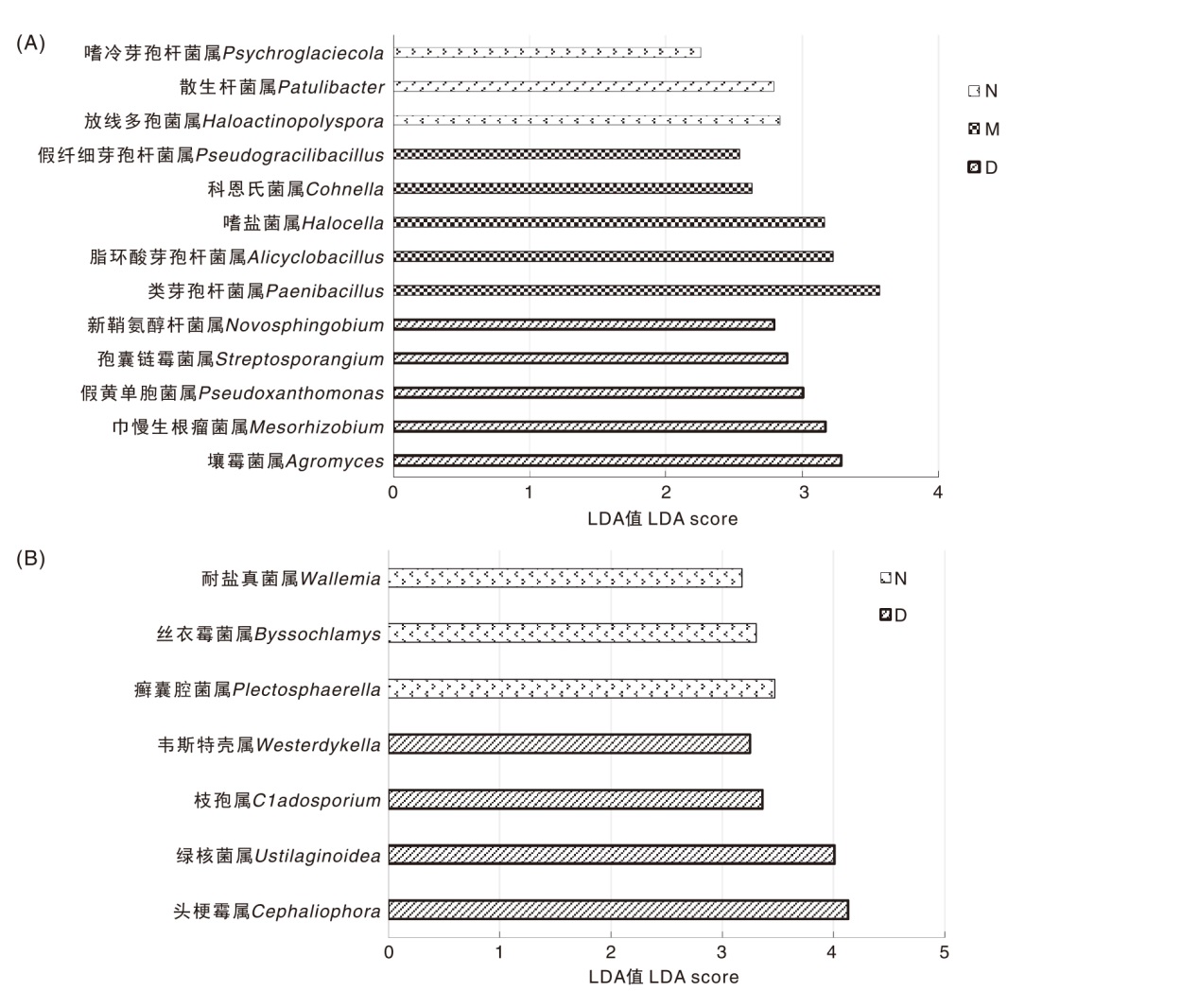
Fig.4 Linear discriminant analysis (LDA) score distribution of rhizosphere soil bacterial (A) and fungal (B) communities
| 分类 Taxonomy | 门 Phylum | 相对丰度Relative abundance | ||
|---|---|---|---|---|
| D | M | N | ||
| 细菌Bacteria | 放线菌门Actinobacteriota | 33.420±5.496 a | 16.600±2.028 b | 21.380±4.258 b |
| 变形菌门Proteobacteria | 20.570±0.908 a | 23.630±2.958 a | 25.550±3.005 a | |
| 绿弯菌门Chloroflexi | 20.090±1.929 a | 17.900±0.812 ab | 15.350±2.469 b | |
| 厚壁菌门Firmicutes | 7.929±1.372 b | 17.540±3.100 a | 14.840±3.331 a | |
| 酸杆菌门Acidobacteriota | 5.917±0.876 b | 9.845±1.323 a | 7.439±1.345 ab | |
| 芽单胞菌门Gemmatimonadota | 4.195±0.224 b | 5.762±0.591 ab | 6.434±0.964 a | |
| 髌骨菌门Patescibacteria | 0.366±0.091 b | 1.062±0.054 a | 1.020±0.131 a | |
| 盐厌氧菌门Halanaerobiaeota | 0.252±0.085 a | 0.508±0.242 a | 0.146±0.007 a | |
| 脱铁杆菌门Deferrisomatota | 0.021±0.008 a | 0 b | 0 b | |
| 河床菌门Zixibacteria | 0.011±0.001 a | 0.001 a | 0 a | |
| Methylomirabilota | 0.090±0.034 a | 0.012±0.021 b | 0.023±0.024 ab | |
| 真菌Fungi | 子囊菌门Ascomycota | 88.470±0.801 a | 74.110±18.300 a | 85.820±2.091 a |
| 被孢霉门Mortierellomycota | 3.554±0.762 a | 19.45±14.890 a | 9.470±1.529 a | |
| 担子菌门Basidiomycota | 3.727±0.139 a | 3.727±3.253 a | 1.631±0.360 a | |
| 罗兹菌门Rozellomycota | 0.068±0.019 a | 0.007±0.012 b | 0.014±0.024 b | |
| 壶菌门Chytridiomycota | 0.062±0.024 a | 0.006±0.008 b | 0.012±0.007 b | |
Table 2 Relative abundance of rhizosphere soil microbial communities at the phylum level Unit:%
| 分类 Taxonomy | 门 Phylum | 相对丰度Relative abundance | ||
|---|---|---|---|---|
| D | M | N | ||
| 细菌Bacteria | 放线菌门Actinobacteriota | 33.420±5.496 a | 16.600±2.028 b | 21.380±4.258 b |
| 变形菌门Proteobacteria | 20.570±0.908 a | 23.630±2.958 a | 25.550±3.005 a | |
| 绿弯菌门Chloroflexi | 20.090±1.929 a | 17.900±0.812 ab | 15.350±2.469 b | |
| 厚壁菌门Firmicutes | 7.929±1.372 b | 17.540±3.100 a | 14.840±3.331 a | |
| 酸杆菌门Acidobacteriota | 5.917±0.876 b | 9.845±1.323 a | 7.439±1.345 ab | |
| 芽单胞菌门Gemmatimonadota | 4.195±0.224 b | 5.762±0.591 ab | 6.434±0.964 a | |
| 髌骨菌门Patescibacteria | 0.366±0.091 b | 1.062±0.054 a | 1.020±0.131 a | |
| 盐厌氧菌门Halanaerobiaeota | 0.252±0.085 a | 0.508±0.242 a | 0.146±0.007 a | |
| 脱铁杆菌门Deferrisomatota | 0.021±0.008 a | 0 b | 0 b | |
| 河床菌门Zixibacteria | 0.011±0.001 a | 0.001 a | 0 a | |
| Methylomirabilota | 0.090±0.034 a | 0.012±0.021 b | 0.023±0.024 ab | |
| 真菌Fungi | 子囊菌门Ascomycota | 88.470±0.801 a | 74.110±18.300 a | 85.820±2.091 a |
| 被孢霉门Mortierellomycota | 3.554±0.762 a | 19.45±14.890 a | 9.470±1.529 a | |
| 担子菌门Basidiomycota | 3.727±0.139 a | 3.727±3.253 a | 1.631±0.360 a | |
| 罗兹菌门Rozellomycota | 0.068±0.019 a | 0.007±0.012 b | 0.014±0.024 b | |
| 壶菌门Chytridiomycota | 0.062±0.024 a | 0.006±0.008 b | 0.012±0.007 b | |
| 分类 Taxonomy | 属 Genera | 相对丰度Relative abundance | ||||||
|---|---|---|---|---|---|---|---|---|
| D | M | N | ||||||
| 细菌Bacteria | 芽孢杆菌属Bacillus | 3.165±0.356 b | 8.249±0.953 a | 7.299±1.977 a | ||||
| 链霉菌属Streptomyces | 5.559±0.454 a | 2.388±0.472 b | 2.466±0.392 b | |||||
| 东氏菌属Dongia | 1.381±0.161 b | 2.192±0.742 ab | 2.709±0.100 a | |||||
| 鞘氨醇单胞菌属Sphingomonas | 1.206±0.098 a | 2.305±0.561 a | 2.526±1.209 a | |||||
| 诺卡氏菌属Nocardioides | 1.361±0.451 a | 0.951±0.363 a | 1.691±0.252 a | |||||
| Iamia | 2.584±1.119 a | 0.392±0.070 b | 0.530±0.216 b | |||||
| Actinophytocola | 1.536±0.211 a | 0.280±0.078 b | 0.490±0.231 b | |||||
| 分枝杆菌属Mycobacterium | 1.285±0.238 a | 0.428±0.131 b | 0.575±0.190 b | |||||
| 德沃斯氏菌属Devosia | 0.963±0.045 a | 0.520±0.151 b | 0.610±0.167 b | |||||
| 海洋芽孢杆菌属Oceanobacillus | 0.376±0.068 b | 0.827±0.289 a | 0.595±0.012 ab | |||||
| 气氨微菌属Aeromicrobium | 0.878±0.144 a | 0.394±0.163 b | 0.409±0.088 b | |||||
| 类芽孢杆菌属Paenibacillus | 0.131±0.080 b | 0.894±0.276 a | 0.608±0.169 ab | |||||
| 嗜热碱性菌属Anoxybacillus | 0.370±0.035 b | 0.620±0.097 a | 0.481±0.130 ab | |||||
| Kribbella | 0.735±0.153 a | 0.182±0.043 b | 0.321±0.172 b | |||||
| Lysobacter | 0.495±0.010 a | 0.236±0.136 b | 0.331±0.097 ab | |||||
| 野村菌属Nonomuraea | 0.717±0.096 a | 0.145±0.069 b | 0.125±0.012 b | |||||
| 藤黄单胞菌属Luteimonas | 0.495±0.077 a | 0.224±0.106 b | 0.255±0.104 ab | |||||
| 诺卡氏菌属Nocardia | 0.584±0.143 a | 0.165±0.096 b | 0.141±0.028 b | |||||
| Candidatus_Solibacter | 0.433±0.102 a | 0.210±0.069 b | 0.245±0.058 ab | |||||
| Pseudolabrys | 0.447±0.058 a | 0.256±0.131 ab | 0.178±0.035 b | |||||
| Nitrospira | 0.238±0.043 b | 0.254±0.034 ab | 0.342±0.038 a | |||||
| 中慢生根瘤菌属Mesorhizobium | 0.413±0.030 a | 0.260±0.096 ab | 0.138±0.051 b | |||||
| 真菌Fungi | 曲霉属Aspergillus | 20.44±4.012 a | 12.110±11.820 a | 31.25±6.714 a | ||||
| 被孢霉属Mortierella | 3.411±0.738 a | 19.180±14.720 a | 9.332±1.488 a | |||||
| 毛葡孢属Botryotrichum | 16.15±6.427 a | 5.210±1.755 a | 10.45±7.969 a | |||||
| 金孢属Chrysosporium | 0.911±0.455 a | 24.270±41.90 a | 0.307±0.044 a | |||||
| 无茎真菌属Acaulium | 8.716±1.238 a | 0.191±0.070 b | 0.312±0.162 b | |||||
| Fungi_gen_Incertae_sedis | 2.427±0.267 a | 0.561±0.428 b | 0.908±0.514 b | |||||
| 头梗霉属Cephaliophora | 2.537±1.031 a | 0.008±0.014 b | 0 b | |||||
| 绿核菌属Ustilaginoidea | 2.127±0.377 a | 0.064±0.087 b | 0.166±0.135 b | |||||
| Chaetomium | 1.294±0.482 a | 0.425±0.242 ab | 0.353±0.350 b | |||||
| 枝孢属Cladosporium | 0.633±0.102 a | 0.199±0.098 b | 0.338±0.066 b | |||||
| Sarocladium | 0.713±0.172 a | 0 b | 0 b | |||||
| 节担菌属Wallemia | 0.004±0.007 b | 0.092±0.067 ab | 0.226±0.068 a | |||||
| 韦斯特壳属Westerdykella | 0.276±0.054 a | 0.002±0.004 b | 0.007±0.006 b | |||||
| 球腔菌属Phaeosphaeria | 0.167±0.054 a | 0 b | 0 b | |||||
| 假单胞菌属Pseudogymnoascus | 0.097±0.035 a | 0 b | 0 b | |||||
Table 3 Relative abundance of rhizosphere soil microbial communities at the genus level Unit:%
| 分类 Taxonomy | 属 Genera | 相对丰度Relative abundance | ||||||
|---|---|---|---|---|---|---|---|---|
| D | M | N | ||||||
| 细菌Bacteria | 芽孢杆菌属Bacillus | 3.165±0.356 b | 8.249±0.953 a | 7.299±1.977 a | ||||
| 链霉菌属Streptomyces | 5.559±0.454 a | 2.388±0.472 b | 2.466±0.392 b | |||||
| 东氏菌属Dongia | 1.381±0.161 b | 2.192±0.742 ab | 2.709±0.100 a | |||||
| 鞘氨醇单胞菌属Sphingomonas | 1.206±0.098 a | 2.305±0.561 a | 2.526±1.209 a | |||||
| 诺卡氏菌属Nocardioides | 1.361±0.451 a | 0.951±0.363 a | 1.691±0.252 a | |||||
| Iamia | 2.584±1.119 a | 0.392±0.070 b | 0.530±0.216 b | |||||
| Actinophytocola | 1.536±0.211 a | 0.280±0.078 b | 0.490±0.231 b | |||||
| 分枝杆菌属Mycobacterium | 1.285±0.238 a | 0.428±0.131 b | 0.575±0.190 b | |||||
| 德沃斯氏菌属Devosia | 0.963±0.045 a | 0.520±0.151 b | 0.610±0.167 b | |||||
| 海洋芽孢杆菌属Oceanobacillus | 0.376±0.068 b | 0.827±0.289 a | 0.595±0.012 ab | |||||
| 气氨微菌属Aeromicrobium | 0.878±0.144 a | 0.394±0.163 b | 0.409±0.088 b | |||||
| 类芽孢杆菌属Paenibacillus | 0.131±0.080 b | 0.894±0.276 a | 0.608±0.169 ab | |||||
| 嗜热碱性菌属Anoxybacillus | 0.370±0.035 b | 0.620±0.097 a | 0.481±0.130 ab | |||||
| Kribbella | 0.735±0.153 a | 0.182±0.043 b | 0.321±0.172 b | |||||
| Lysobacter | 0.495±0.010 a | 0.236±0.136 b | 0.331±0.097 ab | |||||
| 野村菌属Nonomuraea | 0.717±0.096 a | 0.145±0.069 b | 0.125±0.012 b | |||||
| 藤黄单胞菌属Luteimonas | 0.495±0.077 a | 0.224±0.106 b | 0.255±0.104 ab | |||||
| 诺卡氏菌属Nocardia | 0.584±0.143 a | 0.165±0.096 b | 0.141±0.028 b | |||||
| Candidatus_Solibacter | 0.433±0.102 a | 0.210±0.069 b | 0.245±0.058 ab | |||||
| Pseudolabrys | 0.447±0.058 a | 0.256±0.131 ab | 0.178±0.035 b | |||||
| Nitrospira | 0.238±0.043 b | 0.254±0.034 ab | 0.342±0.038 a | |||||
| 中慢生根瘤菌属Mesorhizobium | 0.413±0.030 a | 0.260±0.096 ab | 0.138±0.051 b | |||||
| 真菌Fungi | 曲霉属Aspergillus | 20.44±4.012 a | 12.110±11.820 a | 31.25±6.714 a | ||||
| 被孢霉属Mortierella | 3.411±0.738 a | 19.180±14.720 a | 9.332±1.488 a | |||||
| 毛葡孢属Botryotrichum | 16.15±6.427 a | 5.210±1.755 a | 10.45±7.969 a | |||||
| 金孢属Chrysosporium | 0.911±0.455 a | 24.270±41.90 a | 0.307±0.044 a | |||||
| 无茎真菌属Acaulium | 8.716±1.238 a | 0.191±0.070 b | 0.312±0.162 b | |||||
| Fungi_gen_Incertae_sedis | 2.427±0.267 a | 0.561±0.428 b | 0.908±0.514 b | |||||
| 头梗霉属Cephaliophora | 2.537±1.031 a | 0.008±0.014 b | 0 b | |||||
| 绿核菌属Ustilaginoidea | 2.127±0.377 a | 0.064±0.087 b | 0.166±0.135 b | |||||
| Chaetomium | 1.294±0.482 a | 0.425±0.242 ab | 0.353±0.350 b | |||||
| 枝孢属Cladosporium | 0.633±0.102 a | 0.199±0.098 b | 0.338±0.066 b | |||||
| Sarocladium | 0.713±0.172 a | 0 b | 0 b | |||||
| 节担菌属Wallemia | 0.004±0.007 b | 0.092±0.067 ab | 0.226±0.068 a | |||||
| 韦斯特壳属Westerdykella | 0.276±0.054 a | 0.002±0.004 b | 0.007±0.006 b | |||||
| 球腔菌属Phaeosphaeria | 0.167±0.054 a | 0 b | 0 b | |||||
| 假单胞菌属Pseudogymnoascus | 0.097±0.035 a | 0 b | 0 b | |||||
| 处理 Treatment | OM/ (g·kg-1) | pH值 pH value | TN/ (g·kg-1) | AP/ (mg·kg-1) | AK/ (mg·kg-1) | EX-Ca/ (cmol·kg-1) | EX-Mg/ (cmol·kg-1) | TDS/ (g·kg-1) | CEC/ (cmol·kg-1) |
|---|---|---|---|---|---|---|---|---|---|
| D | 39.53± 0.32 c | 6.73± 0.01 b | 2.45± 0.01 c | 56.30± 0.40 c | 235.00± 0.15 a | 20.20± 0.27 c | 2.96± 0.04 a | 1.89± 0.09 a | 19.23± 0.32 a |
| M | 41.00± 0.27 b | 6.94± 0.02 a | 2.50± 0.40 b | 63.63± 0.40 b | 229.00± 0.06 a | 22.30± 0.66 b | 2.54± 0.04 c | 1.07± 0.05 b | 18.43± 0.29 b |
| N | 42.90± 0.17 a | 6.93± 0.01 a | 2.56± 0.01 a | 73.70± 0.79 a | 204.00± 0.06 a | 24.60± 1.15 a | 2.86± 0.02 b | 1.97± 0.03 a | 19.40± 0.27 a |
Table 4 Physicochemical properties of the rhizosphere soil
| 处理 Treatment | OM/ (g·kg-1) | pH值 pH value | TN/ (g·kg-1) | AP/ (mg·kg-1) | AK/ (mg·kg-1) | EX-Ca/ (cmol·kg-1) | EX-Mg/ (cmol·kg-1) | TDS/ (g·kg-1) | CEC/ (cmol·kg-1) |
|---|---|---|---|---|---|---|---|---|---|
| D | 39.53± 0.32 c | 6.73± 0.01 b | 2.45± 0.01 c | 56.30± 0.40 c | 235.00± 0.15 a | 20.20± 0.27 c | 2.96± 0.04 a | 1.89± 0.09 a | 19.23± 0.32 a |
| M | 41.00± 0.27 b | 6.94± 0.02 a | 2.50± 0.40 b | 63.63± 0.40 b | 229.00± 0.06 a | 22.30± 0.66 b | 2.54± 0.04 c | 1.07± 0.05 b | 18.43± 0.29 b |
| N | 42.90± 0.17 a | 6.93± 0.01 a | 2.56± 0.01 a | 73.70± 0.79 a | 204.00± 0.06 a | 24.60± 1.15 a | 2.86± 0.02 b | 1.97± 0.03 a | 19.40± 0.27 a |
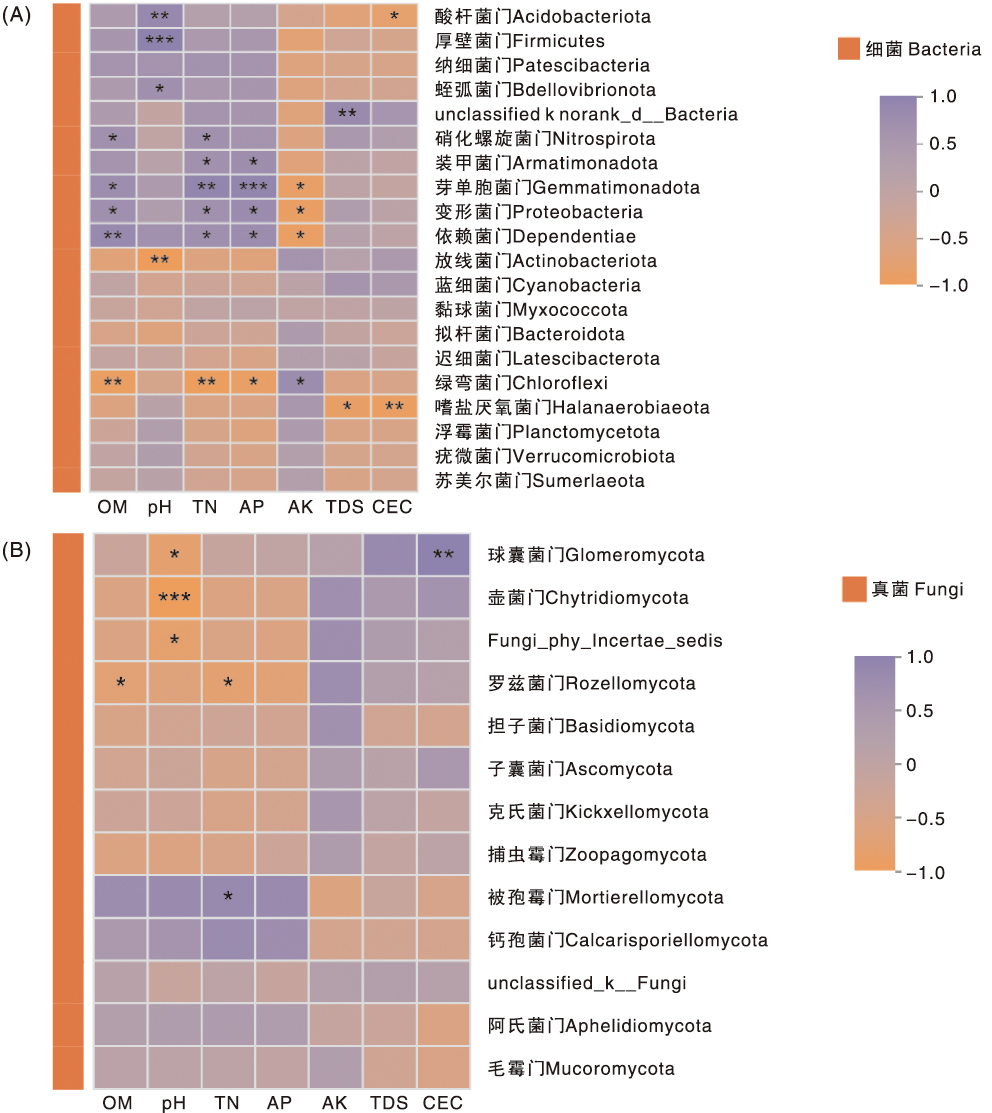
Fig.5 Correlation between soil microbial communities and soil nutrient contents OM, Organic matter content; TN, Total nitrogen content; AP, Available phosphorus content; AK, Available potassium content; TDS, Total dissolved solids content; CEC, Cation exchange capacity. * indicates 0.01<p≤0.05; ** indicates 0.001<p≤0.01, and *** indicates p≤0.001. Red indicates a positive correlation, and blue indicates a negative correlation.
| [1] | 马香, 杜明伦, 唐燕琼, 等. 番茄-水稻水旱轮作对土壤微生物多样性的影响[C]// 中国生物工程学会第十一届学术年会暨2017年全国生物技术大会论文集. 2017: 152-153. |
| [2] | 伍朝荣, 何琼, 黄福忠, 等. 水稻-番茄轮作植物寄生线虫及微生物群落结构差异[J]. 土壤, 2022, 54(1): 64-71. |
| WU C R, HE Q, HUANG F Z, et al. Differences of plant parasitic nematode and microbial community structures between rotation and continuous cropping[J]. Soils, 2022, 54(1): 64-71. | |
| [3] | 姜宇, 王娟, 刘力勇, 等. 化肥与微生物菌肥配施对番茄生长、产量和品质的影响[J]. 中国蔬菜, 2024(8): 103-108. |
| JIANG Y, WANG J, LIU L Y, et al. The effects of combined application of chemical fertilizers and microbial fertilizers on tomato growth, yield, and quality[J]. China Vegetables, 2024(8): 103-108. | |
| [4] | 李得铭, 徐云龙, 邓涛, 等. 复合微生物菌肥对番茄青枯病发生和根际土壤细菌群落的影响[J]. 南方农业学报, 2024, 55(9): 2641-2652. |
| LI D M, XU Y L, DENG T, et al. Effects of compound microbial fertilizer on the occurrence of tomato bacterial wilt and bacterial community of tomato rhizosphere soil[J]. Journal of Southern Agriculture, 2024, 55(9): 2641-2652. | |
| [5] | 侯慧, 董坤, 杨智仙, 等. 连作障碍发生机理研究进展[J]. 土壤, 2016, 48(6): 1068-1076. |
| HOU H, DONG K, YANG Z X, et al. Advance in mechanism of continuous cropping obstacle[J]. Soils, 2016, 48(6): 1068-1076. | |
| [6] | 王广印, 郭卫丽, 王胜楠, 等. 玉米秸秆、生物菌肥和土壤调理剂对日光温室越冬茬番茄土壤盐及重金属含量的影响[J]. 湖北农业科学, 2018, 57(6): 55-59. |
| WANG G Y, GUO W L, WANG S N, et al. The influence of corn straw, bio-bacterial fertilizer and soil conditioner on soil salt and heavy metals contents in over-winter tomato of the solar greenhouse[J]. Hubei Agricultural Sciences, 2018, 57(6): 55-59. | |
| [7] | 王广印, 郭卫丽, 王胜楠, 等. 秸秆、生物菌肥和土壤调理剂施用对日光温室越冬茬番茄生长、坐果及果实品质的影响[J]. 中国农学通报, 2018, 34(15): 55-59. |
| WANG G Y, GUO W L, WANG S N, et al. Application of straw, bio-bacterial fertilizer and soil conditioner on growth, fruit setting and fruit quality of over-winter tomato in solar greenhouse[J]. Chinese Agricultural Science Bulletin, 2018, 34(15): 55-59. | |
| [8] | 乔蓬蕾, 吴凤芝, 周新刚. 连作对作物根际土壤微生物菌群及酶活性影响[J]. 沈阳农业大学学报, 2013, 44(5): 524-530. |
| QIAO P L, WU F Z, ZHOU X G. Effects of continuous cropping on soil microbe communities and enzyme activity[J]. Journal of Shenyang Agricultural University, 2013, 44(5): 524-530. | |
| [9] | 赵峥, 朱元宏, 周德平, 等. 不同轮作模式对稻田土壤肥力和微生物群落结构的影响[J]. 农业环境科学学报, 2024, 43(4): 874-885. |
| ZHAO Z, ZHU Y H, ZHOU D P, et al. Effects of different rotation patterns on soil fertility and microbial community composition in a paddy field system[J]. Journal of Agro-Environment Science, 2024, 43(4): 874-885. | |
| [10] | 鲜文东, 张潇橦, 李文均. 绿弯菌的研究现状及展望[J]. 微生物学报, 2020, 60(9): 1801-1820. |
| XIAN W D, ZHANG X T, LI W J. Research status and prospect on bacterial phylum Chloroflexi[J]. Acta Microbiologica Sinica, 2020, 60(9): 1801-1820. | |
| [11] | 王光华, 刘俊杰, 于镇华, 等. 土壤酸杆菌门细菌生态学研究进展[J]. 生物技术通报, 2016, 32(2): 14-20. |
| WANG G H, LIU J J, YU Z H, et al. Research progress of acidobacteria ecology in soils[J]. Biotechnology Bulletin, 2016, 32(2): 14-20. | |
| [12] | 余顺平, 杨济达, 朱红业, 等. 水旱轮作对设施蔬菜土壤微生物群落结构与功能的影响[J/OL]. 中国生态农业学报(中英文), 2026. [2026-04-13]. https://link.cnki.net/urlid/13.1432.S.20260108.1701.003. |
| YU S P, YANG J D, ZHU H Y, et al. Effects of flooding-drying rotation on soil microbial community structure and function in protected vegetable fields[J/OL]. Chinese Journal of Eco-Agriculture, 2026. [2026-04-13]. https://link.cnki.net/urlid/13.1432.S.20260108.1701.003. | |
| [13] | 马慧媛, 黄媛媛, 刘胜尧, 等. 微生物菌剂施用对设施茄子根际土壤养分和细菌群落多样性的影响[J]. 微生物学通报, 2020, 47(1): 140-150. |
| MA H Y, HUANG Y Y, LIU S Y, et al. Effects of microbial agents on nutrient and bacterial community diversity in rhizosphere soil of eggplant cultivated in facilities[J]. Microbiology China, 2020, 47(1): 140-150. | |
| [14] | 孙娟. 木质纤维素降解菌群的筛选及对秸秆的降解效应[D]. 南京: 南京农业大学, 2022. |
| SUN J. Screening of lignocellulose-degrading fungi and their degradation effect on straw[D]. Nanjing: Nanjing Agricultural University, 2022. | |
| [15] | 王军杰. 林业剩余物在园艺栽培基质与土壤改良中的应用[J]. 现代园艺, 2026, 49(2): 120-122. |
| WANG J J. Application of forestry residue in horticultural cultivation substrate and soil improvement[J]. Contemporary Horticulture, 2026, 49(2): 120-122. | |
| [16] | 袁宗胜. 复合微生物菌剂对毛竹土壤细菌群落结构的影响[J]. 福建农业学报, 2024, 39(4): 438-447. |
| YUAN Z S. Soil microbiome at Phyllostachys edulis forest affected by application of bioagent[J]. Fujian Journal of Agricultural Sciences, 2024, 39(4): 438-447. | |
| [17] | 宋慧宁. 连年玉米秸秆还田对土壤养分和土壤细菌、真菌群落结构的影响[D]. 长春: 吉林大学, 2022. |
| SONG H N. Effects of successive years of corn straw return on soil nutrients and soil bacterial and fungal community structure[D]. Changchun: Jilin University, 2022. |
| [1] | YANG Yushan, ZHANG Miaomiao, LYU Zengwei, CHEN Xue, HUANG Qiuliang, LIU Haoyang, CAO Minghui, HUANG Zhenbei, ZHANG Guofang. Effects of intercropping with soybean and alfalfa on the rhizosphere soil microbial community structure of Paeonia rockii [J]. Acta Agriculturae Zhejiangensis, 2026, 38(2): 351-363. |
| [2] | LI Chuanzhe, DONG Qingjun, JI Li, WANG Jidong, CHEN Chuan, ZHANG Ankang, ZHANG Yongchun, SHAO Wenqi. Effects of new-type fertilizers on soil nutrients, microbial community, and yield of rice and wheat in the typical ancient course area of Yellow River, China [J]. Acta Agriculturae Zhejiangensis, 2026, 38(1): 136-147. |
| [3] | SHI Jing, LI Jianhong, CHU Pengxing, YU Rui, JIANG Ming, CHEN Guangli, ZHAO Xiaoxia, FENG Li. Effects and mechanism of γ-polyglutamic acid coupled with chemical fertilizer on growth of Codonopsis pilosula [J]. Acta Agriculturae Zhejiangensis, 2026, 38(1): 85-94. |
| [4] | XU Weidong, LU Qiang, YAO Zhangliang, WANG Hui, WANG Ruisen, LANG Shuping. Response of diversity characteristics of summer weeds in rice fields to different rotation patterns [J]. Acta Agriculturae Zhejiangensis, 2025, 37(10): 2138-2149. |
| [5] | WAN Hefeng, LIU Guohua, WU Yuxiang, JIANG Juan, ZHANG Zhenming, LIU Yong. Influence of initial substrate pH value on physicochemical properties and microbial community during composting [J]. Acta Agriculturae Zhejiangensis, 2025, 37(10): 2165-2178. |
| [6] | LIU Wenwen, HU Lianqing, ZHOU Wanhai, WEI Qin, FENG Ruizhang, ZHAO Xin, CHE Litao, CHEN Jinyu. Effects of different contents of Camphora longepaniculata leaves in diets on intestinal pH, cecal fermentation and cecal microbiota of meat rabbits [J]. Acta Agriculturae Zhejiangensis, 2024, 36(6): 1279-1289. |
| [7] | ZHANG Hongfang, QIAN Tao, JIN Ting, XIE Xiaoling, WU Choufei, XIAO Yingping, MA Lingyan. Gut microbial profiles and its developmental changes of grass carp (Ctenopharyngodon idella) [J]. Acta Agriculturae Zhejiangensis, 2024, 36(4): 780-789. |
| [8] | ZHU Shijun, WANG Lili, JIN Shuquan, ZHOU Jinbo, WANG Feng, LU Xiaohong. Effects of different soil disinfection methods on soil fungal diversity and community structure [J]. Acta Agriculturae Zhejiangensis, 2023, 35(3): 639-646. |
| [9] | HAO Liuliu, DAI Lili, PENG Liang, CHEN Siyuan, TAO Ling, LI Gu, ZHANG Hui. Active organic carbon, microbial community structure and their relationship in rice rhizosphere soil of rice-crayfish co-culture systems [J]. Acta Agriculturae Zhejiangensis, 2023, 35(12): 2901-2913. |
| [10] | TIAN Xiu, TONG Bingli, XIE Yuangui, LIAO Xiaofeng, WU Tingting, LIU Jiming. Effects of rhizobacteria of Cinnamomum migao H. W. Li on medicinal active ingredients in fruit and its PICRUST function predictive analysis [J]. Acta Agriculturae Zhejiangensis, 2022, 34(9): 1837-1848. |
| [11] | LYU Qian, LUO Qiao, LUO Xue, CHEN Jiubing, MA Li, LUO Zhengzhong, YAO Xueping, YU Shumin, SHEN Liuhong, CAO Suizhong. Analysis of microbial community difference between sand and rubber bedding in dairy farm by high throughput sequencing technology [J]. Acta Agriculturae Zhejiangensis, 2022, 34(7): 1377-1385. |
| [12] | YAO Yanlai, ZHU Weijing, DING Jian, HONG Leidong, HONG Chunlai, WANG Weiping, ZHU Fengxiang, HE Weike, HONG Haiqing. Investigation and analysis of continuous cropping obstacle and soil environment in large-scale vegetable bases in Zhejiang Province, China [J]. Acta Agriculturae Zhejiangensis, 2022, 34(7): 1474-1484. |
| [13] | YUAN Wenya, KANG Yichen, YANG Xinyu, ZHNAG Ruyan, ZHOU Chuntao, WANG Yong, CHEN Xipeng, YU Huifang, QIN Shuhao. Effects of rhizosphere soil extract of Qingshui alfalfa (Medicago sativa L.) on enzyme activities and microbial communities in rhizosphere soil of continuous cropping potato [J]. Acta Agriculturae Zhejiangensis, 2022, 34(2): 240-247. |
| [14] | ZHANG Xiaobo, YU Chunlei, ZHANG Wenyang, YAN Ye, RUAN Fang. Variation characteristics of soil microbial diversity in chrysanthemum rhizosphere soil with different continuous cropping years [J]. Acta Agriculturae Zhejiangensis, 2022, 34(12): 2710-2719. |
| [15] | GAO Zhiyuan, YANG Shuna, WANG Zhaoli, WANG Zhihao, XI Xinyan, HE Juan, JIA Huijuan. Effects of different fumigation on continuous cropping soil in peach orchard [J]. Acta Agriculturae Zhejiangensis, 2022, 34(10): 2251-2258. |
| Viewed | ||||||
|
Full text |
|
|||||
|
Abstract |
|
|||||

