Acta Agriculturae Zhejiangensis ›› 2026, Vol. 38 ›› Issue (8): 1563-1573.DOI: 10.3969/j.issn.1004-1524.20250696
• Horticultural Science • Previous Articles Next Articles
Evaluation of the morphological diversity of Luffa seeds and comparison of the contents of ribosome-inactivating proteins
MU Haoxin1,2( ), CHEN Xiaoqi2, FANG Pingping1,2, LI Chaosen2, WEI Jing2, WANG Xueyan2, ZHANG Ting2, YANG Lifei1,*(), ZHAO Dongfeng2,*()
- 1
College of Horticulture ,Nanjing Agricultural University Nanjing 211800, China
2Vegetable Research Institute ,Quzhou Academy of Agricultural and Forestry Sciences Quzhou 324000, Zhejiang, China
-
Received:2025-11-11Online:2026-08-25Published:2026-09-14

CLC Number:
Cite this article
MU Haoxin, CHEN Xiaoqi, FANG Pingping, LI Chaosen, WEI Jing, WANG Xueyan, ZHANG Ting, YANG Lifei, ZHAO Dongfeng. Evaluation of the morphological diversity of Luffa seeds and comparison of the contents of ribosome-inactivating proteins[J]. Acta Agriculturae Zhejiangensis, 2026, 38(8): 1563-1573.
share this article
Add to citation manager EndNote|Ris|BibTeX
URL: http://www.zjnyxb.cn/EN/10.3969/j.issn.1004-1524.20250696
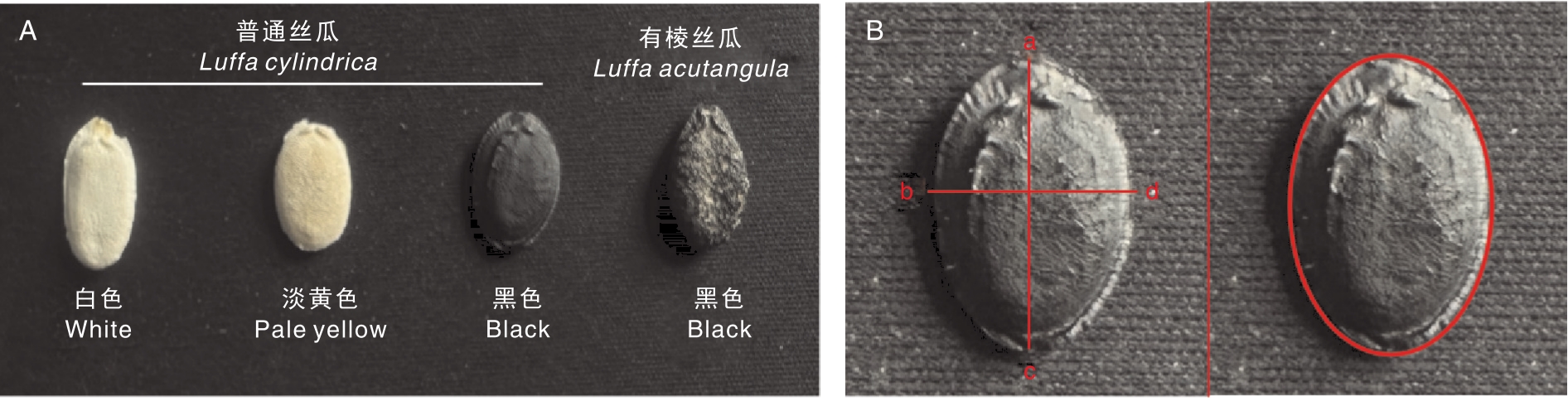
Fig.1 Schematic diagram of the measurement position of seed color, seed length, and width presents the seed color of Luffa cylindrica and Luffa acutangula.The red straight line segments of a-c and b-d in B represent the seed length and width, respectively. The red curve circles represent the circumference and area of the seed, respectively.
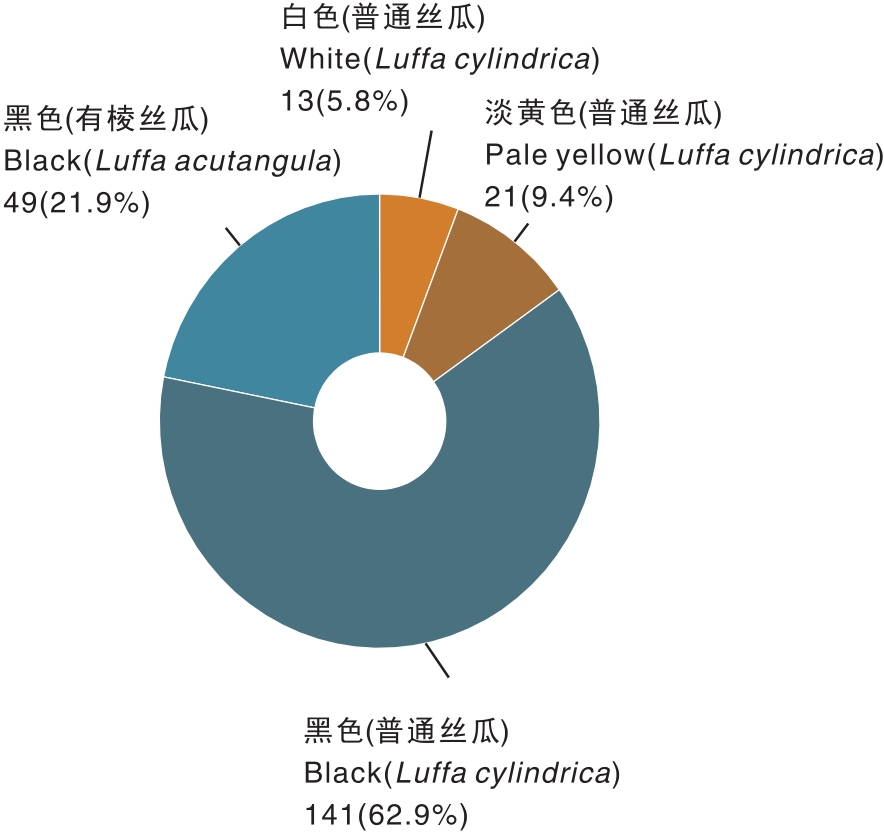
Fig.2 The color and quantities of 224 Luffa germplasm resources
| 种质 Germplasm | 指标 Index | 长度/mm Length/mm | 宽度/mm Width/mm | 长宽比 Length-to- width ratio | 周长/mm Circumference/ mm | 面积/mm2 Area/mm2 | 厚度/mm Thickness/mm | 百粒重/g Hundred-seed weight/g |
|---|---|---|---|---|---|---|---|---|
| 普通丝瓜 Luffa cylindrica | 平均值Average value | 11.93 | 7.59 | 1.57 | 30.34 | 58.74 | 2.68 | 11.06 |
| 最大值Maximum | 14.6 | 9.33 | 1.98 | 56.51 | 81.06 | 3.69 | 15.60 | |
| 最小值Minimum | 9.46 | 5.38 | 1.30 | 23.05 | 35.59 | 1.91 | 6.20 | |
| 变异系数/% CV/% | 7.30 | 14.58 | 6.23 | 10.03 | 13.87 | 7.81 | 14.58 | |
| 有棱丝瓜 Luffa acutangula | 平均值Average value | 12.58 | 7.51 | 1.68 | 29.42 | 53.98 | 3.25 | 15.22 |
| 最大值Maximum | 14.62 | 8.74 | 1.99 | 32.25 | 65.14 | 3.70 | 19.21 | |
| 最小值Minimum | 10.92 | 6.58 | 1.48 | 26.20 | 42.15 | 2.82 | 9.76 | |
| 变异系数/% CV/% | 5.92 | 6.05 | 7.57 | 4.83 | 9.15 | 7.35 | 14.73 |
Table 1 Coefficient of variation (CV) of Luffa
| 种质 Germplasm | 指标 Index | 长度/mm Length/mm | 宽度/mm Width/mm | 长宽比 Length-to- width ratio | 周长/mm Circumference/ mm | 面积/mm2 Area/mm2 | 厚度/mm Thickness/mm | 百粒重/g Hundred-seed weight/g |
|---|---|---|---|---|---|---|---|---|
| 普通丝瓜 Luffa cylindrica | 平均值Average value | 11.93 | 7.59 | 1.57 | 30.34 | 58.74 | 2.68 | 11.06 |
| 最大值Maximum | 14.6 | 9.33 | 1.98 | 56.51 | 81.06 | 3.69 | 15.60 | |
| 最小值Minimum | 9.46 | 5.38 | 1.30 | 23.05 | 35.59 | 1.91 | 6.20 | |
| 变异系数/% CV/% | 7.30 | 14.58 | 6.23 | 10.03 | 13.87 | 7.81 | 14.58 | |
| 有棱丝瓜 Luffa acutangula | 平均值Average value | 12.58 | 7.51 | 1.68 | 29.42 | 53.98 | 3.25 | 15.22 |
| 最大值Maximum | 14.62 | 8.74 | 1.99 | 32.25 | 65.14 | 3.70 | 19.21 | |
| 最小值Minimum | 10.92 | 6.58 | 1.48 | 26.20 | 42.15 | 2.82 | 9.76 | |
| 变异系数/% CV/% | 5.92 | 6.05 | 7.57 | 4.83 | 9.15 | 7.35 | 14.73 |
| 性状 Trait | 长度 Length | 宽度 Width | 长宽比 Length-to-width ratio | 周长 Circumference | 面积 Area | 厚度 Thickness |
|---|---|---|---|---|---|---|
| 宽度Width | 0.635** | |||||
| 长宽比Length-to-width ratio | 0.442** | -0.407** | ||||
| 周长Circumference | 0.555** | 0.487** | 0.084 | |||
| 面积Area | 0.791** | 0.731** | 0.081 | 0.704** | ||
| 厚度Thickness | 0.155* | 0.043 | 0.162* | 0.046 | -0.030 | |
| 百粒重Hundred-seed weight | 0.641** | 0.588** | 0.071 | 0.555** | 0.727** | 0.100 |
Table 2 Phenotypic (rp) correlation coefficients between traits of Luffa cylindrica seeds
| 性状 Trait | 长度 Length | 宽度 Width | 长宽比 Length-to-width ratio | 周长 Circumference | 面积 Area | 厚度 Thickness |
|---|---|---|---|---|---|---|
| 宽度Width | 0.635** | |||||
| 长宽比Length-to-width ratio | 0.442** | -0.407** | ||||
| 周长Circumference | 0.555** | 0.487** | 0.084 | |||
| 面积Area | 0.791** | 0.731** | 0.081 | 0.704** | ||
| 厚度Thickness | 0.155* | 0.043 | 0.162* | 0.046 | -0.030 | |
| 百粒重Hundred-seed weight | 0.641** | 0.588** | 0.071 | 0.555** | 0.727** | 0.100 |
| 性状 Trait | 长度 Length | 宽度 Width | 长宽比 Length-to-width ratio | 周长 Circumference | 面积 Area | 厚度 Thickness |
|---|---|---|---|---|---|---|
| 宽度Width | 0.215 | |||||
| 长宽比Length-to-width ratio | 0.616** | -0.635** | ||||
| 周长Circumference | 0.738** | 0.586** | 0.109 | |||
| 面积Area | 0.718** | 0.710** | -0.003 | 0.911** | ||
| 厚度Thickness | 0.328* | 0.205 | 0.111 | 0.340* | 0.312* | |
| 百粒重Hundred-seed weight | 0.514** | 0.551** | -0.035 | 0.581** | 0.679** | 0.464** |
Table 3 Phenotypic (rp) correlation coefficients between traits of Luffa acutangula seeds
| 性状 Trait | 长度 Length | 宽度 Width | 长宽比 Length-to-width ratio | 周长 Circumference | 面积 Area | 厚度 Thickness |
|---|---|---|---|---|---|---|
| 宽度Width | 0.215 | |||||
| 长宽比Length-to-width ratio | 0.616** | -0.635** | ||||
| 周长Circumference | 0.738** | 0.586** | 0.109 | |||
| 面积Area | 0.718** | 0.710** | -0.003 | 0.911** | ||
| 厚度Thickness | 0.328* | 0.205 | 0.111 | 0.340* | 0.312* | |
| 百粒重Hundred-seed weight | 0.514** | 0.551** | -0.035 | 0.581** | 0.679** | 0.464** |
| 性状 Trait | 各性状均值Mean values of each trait | F值 F value | p值 p value | |||
|---|---|---|---|---|---|---|
| Ⅰ(n=51) | Ⅱ(n=44) | Ⅲ(n=45) | Ⅳ(n=35) | |||
| 长度Length | 12.31±0.32 | 11.06±0.55 | 11.52±0.50 | 12.98±0.68 | 110.613 | <0.001 |
| 宽度Width | 7.51±0.21 | 6.99±0.41 | 7.83±0.31 | 8.16±0.42 | 85.191 | <0.001 |
| 长宽比Length-to-width ratio | 1.64±0.05 | 1.59±0.10 | 1.47±0.06 | 1.59±0.09 | 41.520 | <0.001 |
| 周长Circumference | 30.53±1.00 | 27.61±1.60 | 30.02±1.04 | 33.94±4.26 | 54.446 | <0.001 |
| 面积Area | 59.83±3.64 | 49.25±5.20 | 58.53±3.94 | 69.34±5.64 | 126.291 | <0.001 |
| 百粒重Hundred-seed weight | 11.23±0.98 | 9.46±1.17 | 10.90±0.95 | 13.01±1.31 | 68.807 | <0.001 |
Table 4 The mean values of each trait of 4 groups generated by cluster analysis of Luffa cylindrica seeds
| 性状 Trait | 各性状均值Mean values of each trait | F值 F value | p值 p value | |||
|---|---|---|---|---|---|---|
| Ⅰ(n=51) | Ⅱ(n=44) | Ⅲ(n=45) | Ⅳ(n=35) | |||
| 长度Length | 12.31±0.32 | 11.06±0.55 | 11.52±0.50 | 12.98±0.68 | 110.613 | <0.001 |
| 宽度Width | 7.51±0.21 | 6.99±0.41 | 7.83±0.31 | 8.16±0.42 | 85.191 | <0.001 |
| 长宽比Length-to-width ratio | 1.64±0.05 | 1.59±0.10 | 1.47±0.06 | 1.59±0.09 | 41.520 | <0.001 |
| 周长Circumference | 30.53±1.00 | 27.61±1.60 | 30.02±1.04 | 33.94±4.26 | 54.446 | <0.001 |
| 面积Area | 59.83±3.64 | 49.25±5.20 | 58.53±3.94 | 69.34±5.64 | 126.291 | <0.001 |
| 百粒重Hundred-seed weight | 11.23±0.98 | 9.46±1.17 | 10.90±0.95 | 13.01±1.31 | 68.807 | <0.001 |
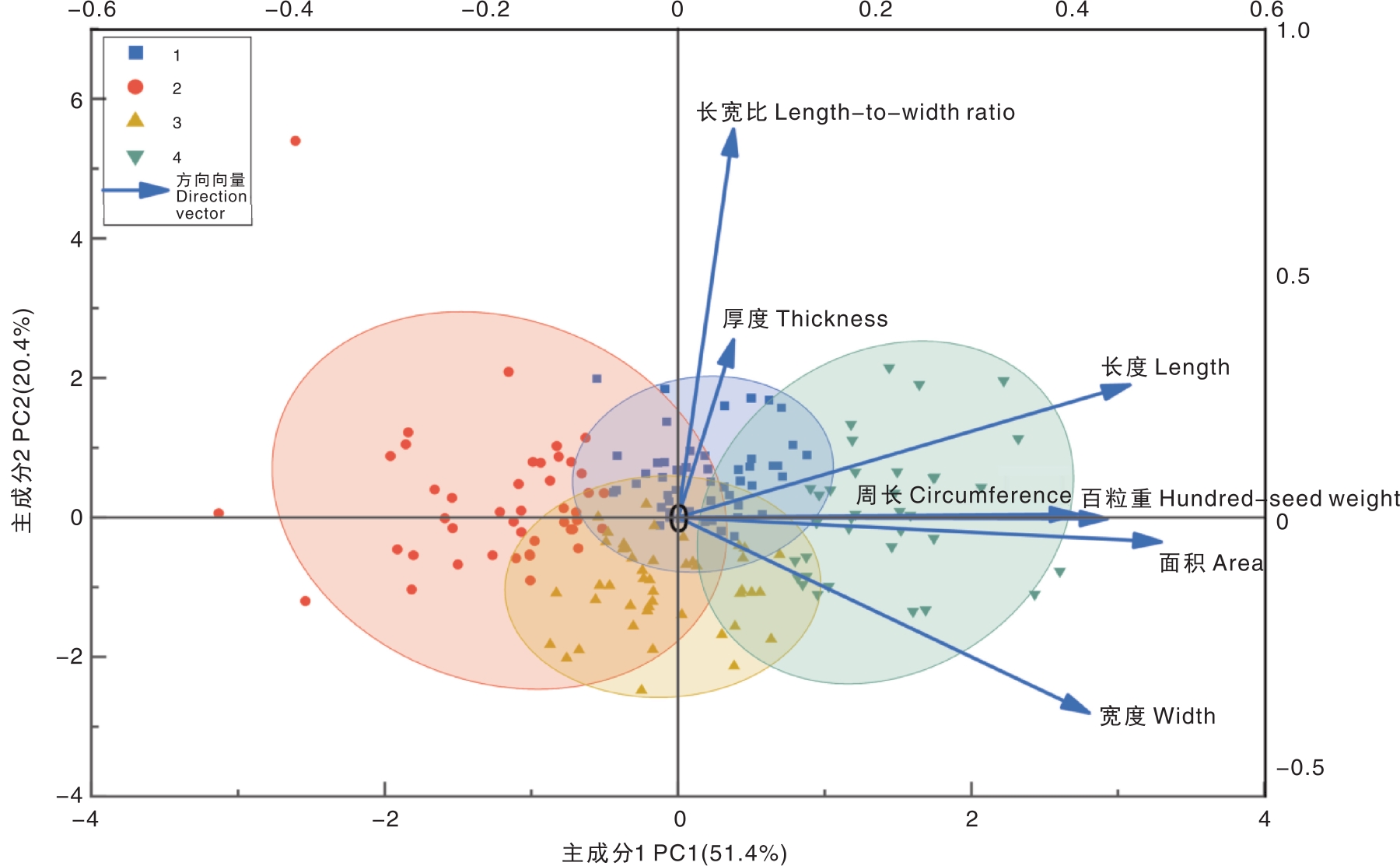
Fig.3 Schema analysis of 7 seed traits of Luffa cylindrica seeds Direction vectors represent positive or negative correlations, and different symbols represent different groups of clustering analysis results. Figure 4 is the same.
| 性状 Trait | 各性状均值Mean values of each trait | F值 F value | p值 p value | ||
|---|---|---|---|---|---|
| Ⅰ(n=14) | Ⅱ(n=18) | Ⅲ(n=17) | |||
| 长度Length | 13.24±0.61 | 12.02±0.46 | 12.63±0.63 | 18.282 | <0.001 |
| 宽度Width | 7.99±0.32 | 7.30±0.37 | 7.33±0.33 | 19.555 | <0.001 |
| 周长Circumference | 31.01±0.68 | 28.26±0.99 | 29.32±0.96 | 36.613 | <0.001 |
| 面积Area | 59.92±2.29 | 49.48±3.35 | 53.85±2.86 | 50.784 | <0.001 |
| 厚度Thickness | 3.35±0.21 | 3.05±0.16 | 3.37±0.20 | 15.248 | <0.001 |
| 百粒重Hundred-seed weight | 17.59±0.91 | 13.36±1.90 | 15.24±1.33 | 32.358 | <0.001 |
Table 5 The mean values of each trait of 3 groups generated by cluster analysis of 49 Luffa acutangula seeds
| 性状 Trait | 各性状均值Mean values of each trait | F值 F value | p值 p value | ||
|---|---|---|---|---|---|
| Ⅰ(n=14) | Ⅱ(n=18) | Ⅲ(n=17) | |||
| 长度Length | 13.24±0.61 | 12.02±0.46 | 12.63±0.63 | 18.282 | <0.001 |
| 宽度Width | 7.99±0.32 | 7.30±0.37 | 7.33±0.33 | 19.555 | <0.001 |
| 周长Circumference | 31.01±0.68 | 28.26±0.99 | 29.32±0.96 | 36.613 | <0.001 |
| 面积Area | 59.92±2.29 | 49.48±3.35 | 53.85±2.86 | 50.784 | <0.001 |
| 厚度Thickness | 3.35±0.21 | 3.05±0.16 | 3.37±0.20 | 15.248 | <0.001 |
| 百粒重Hundred-seed weight | 17.59±0.91 | 13.36±1.90 | 15.24±1.33 | 32.358 | <0.001 |
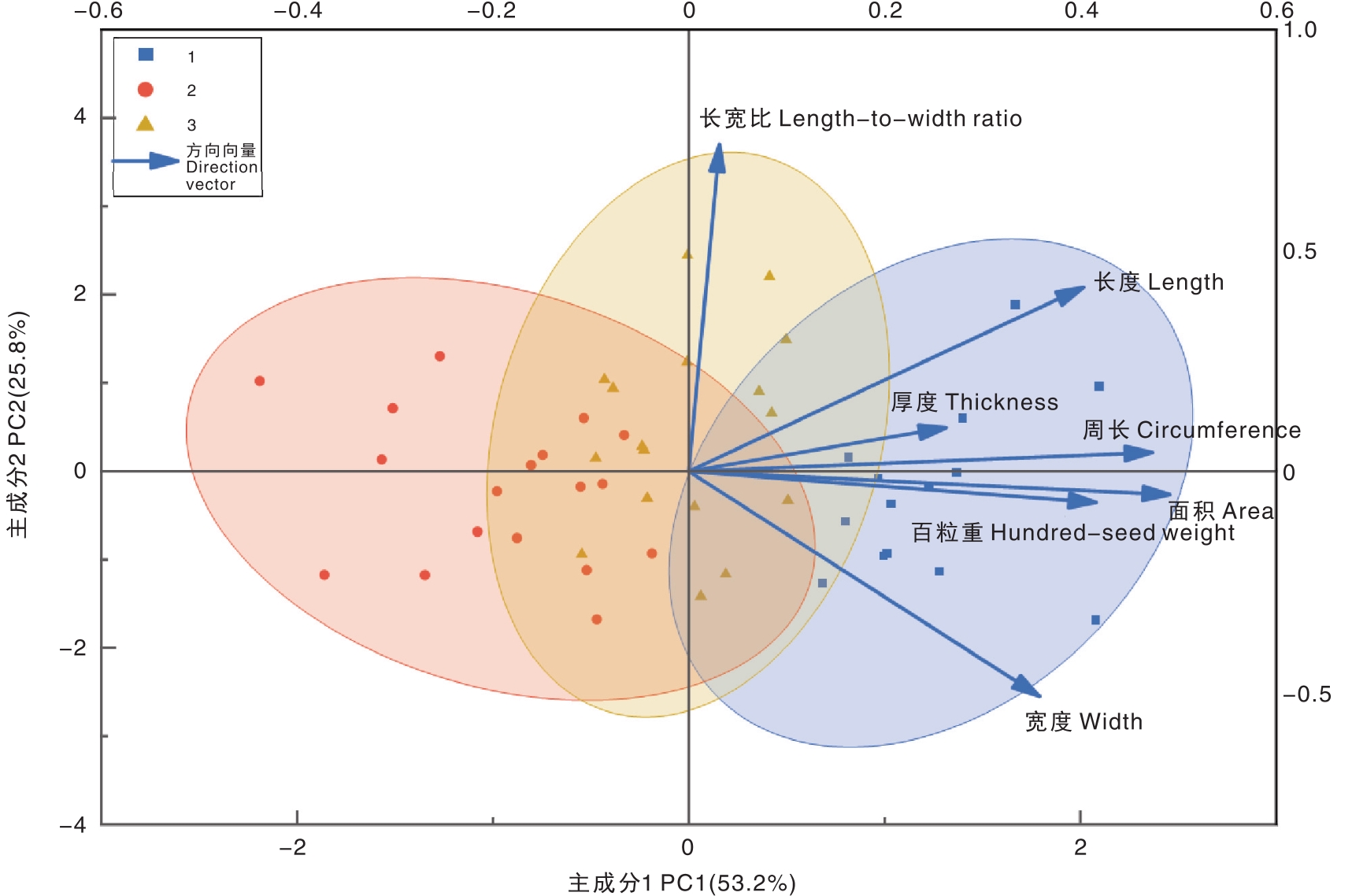
Fig.4 Schema analysis of 7 seed traits of Luffa acutangula seeds
| 指标 Index | 回归系数 Regression coefficient | 95% CI | 共线性诊断Collinearity diagnostics | |
|---|---|---|---|---|
| VIF | 容忍度Tolerance | |||
| 常数Constant | 0.041(0.033) | -2.405~2.487 | — | — |
| 面积Area | 0.145**(14.188) | 0.125~0.165 | 1.001 | 0.999 |
| 厚度Thickness | 0.939*(2.365) | 0.155~1.723 | 1.001 | 0.999 |
Table 6 Results of stepwise regression analysis of Luffa cylindrica germplasm
| 指标 Index | 回归系数 Regression coefficient | 95% CI | 共线性诊断Collinearity diagnostics | |
|---|---|---|---|---|
| VIF | 容忍度Tolerance | |||
| 常数Constant | 0.041(0.033) | -2.405~2.487 | — | — |
| 面积Area | 0.145**(14.188) | 0.125~0.165 | 1.001 | 0.999 |
| 厚度Thickness | 0.939*(2.365) | 0.155~1.723 | 1.001 | 0.999 |
| 指标 Index | 回归系数 Regression coefficient | 95% CI | 共线性诊断Collinearity diagnostics | |
|---|---|---|---|---|
| VIF | 容忍度Tolerance | |||
| 常数Constant | -7.333*(-2.134) | -14.250~-0.417 | — | — |
| 面积Area | 0.260**(5.564) | 0.166~0.354 | 1.108 | 0.902 |
| 厚度Thickness | 2.627*(2.630) | 0.616~4.637 | 1.108 | 0.902 |
Table 7 Results of stepwise regression analysis of 49 Luffa acutangula germplasms
| 指标 Index | 回归系数 Regression coefficient | 95% CI | 共线性诊断Collinearity diagnostics | |
|---|---|---|---|---|
| VIF | 容忍度Tolerance | |||
| 常数Constant | -7.333*(-2.134) | -14.250~-0.417 | — | — |
| 面积Area | 0.260**(5.564) | 0.166~0.354 | 1.108 | 0.902 |
| 厚度Thickness | 2.627*(2.630) | 0.616~4.637 | 1.108 | 0.902 |
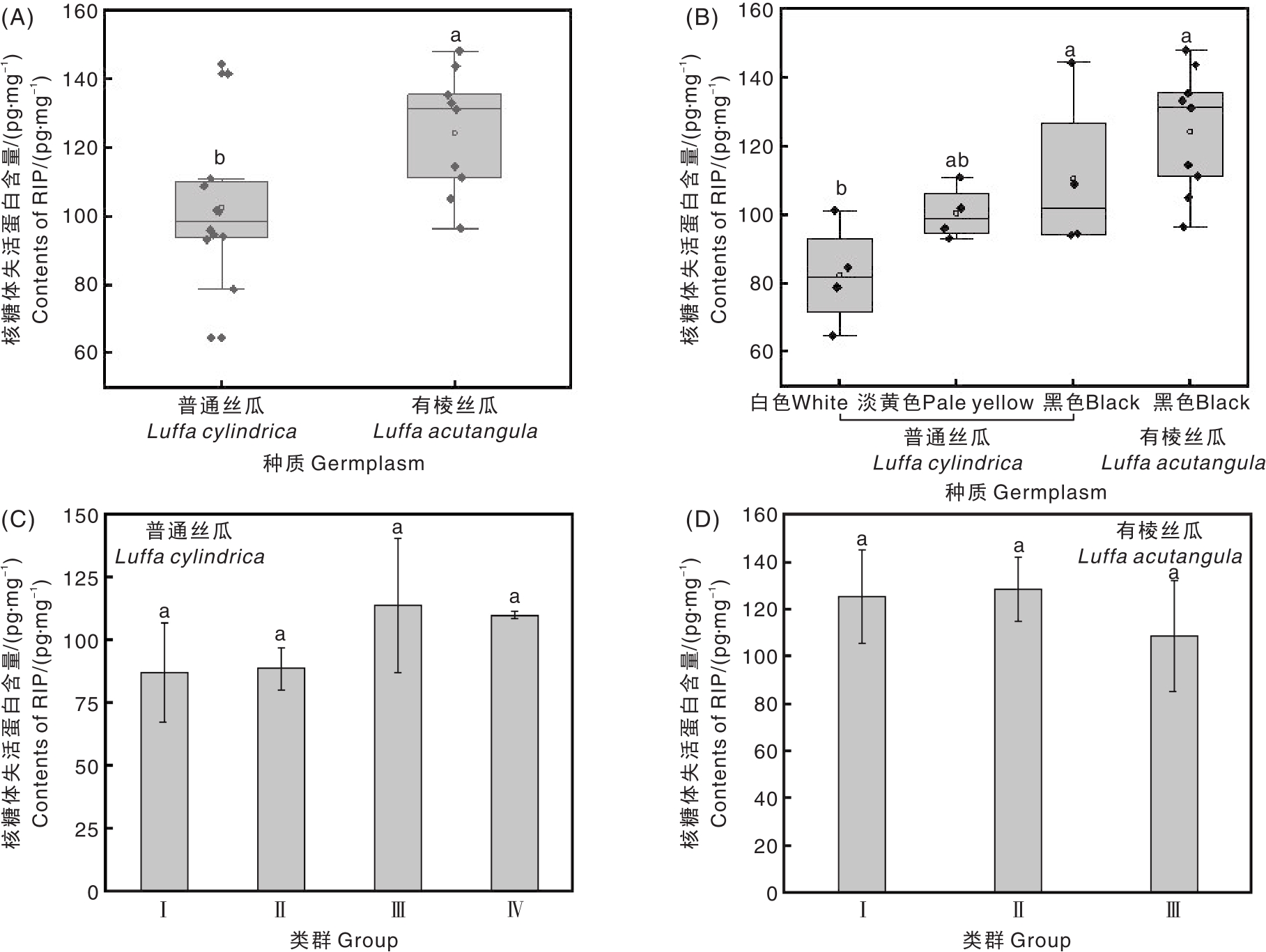
Fig.5 Ribosome-inactivating protein (RIP) contents in Luffa seeds The absence of identical lowercase letters on the column indicates significant (p<0.05) differences between different groups.
| [1] | 张强, 尹丽, 周旖璇, 等. 丝瓜多酚组成、提取分离、含量测定及生物活性的研究进展[J]. 中国药房, 2020, 31(23): 2928-2932. |
| Zhang Q, Yin L, Zhou Y X, et al. Research progress on composition, extraction and separation, content determination and biological activity of polyphenols from Luffa[J]. China Pharmacy, 2020, 31(23): 2928-2932. | |
| [2] | 张婷, 王雪艳, 郭勤卫, 等. 基于表型性状的丝瓜初级核心种质库的构建[J]. 热带作物学报, 2025, 46(1): 106-114. |
| Zhang T, Wang X Y, Guo Q W, et al. Construction of core germplasm collection based on phenotypic characters in Luffa spp.[J]. Chinese Journal of Tropical Crops, 2025, 46(1): 106-114. | |
| [3] | 李佳欣, 冯玉. 丝瓜不同部位药理作用研究进展[J]. 食品工业科技, 2021, 42(10): 355-361. |
| Li J X, Feng Y. Research progress on pharmacological action of different parts of Luffa cylindrica(L.) roem[J]. Science and Technology of Food Industry, 2021, 42(10): 355-361. | |
| [4] | 郭勤卫, 张婷, 刘慧琴, 等. 应用ISSR分子标记评价我国丝瓜种质资源遗传多样性[J]. 浙江农业学报, 2020, 32(4): 616-623. |
| Guo Q W, Zhang T, Liu H Q, et al. Evaluation of genetic diversity in Luffa germplasm resources in China based on ISSR molecular marker[J]. Acta Agriculturae Zhejiangensis, 2020, 32(4): 616-623. | |
| [5] | 王娇阳, 赵永彬, 冯春梅. 浙江省丝瓜种质资源主成分分析和聚类分析[J]. 植物遗传资源学报, 2014, 15(6): 1374-1379. |
| Wang J Y, Zhao Y B, Feng C M. Principal component analysis and cluster analysis of Luffa germplasm resources in Zhejiang Province[J]. Journal of Plant Genetic Resources, 2014, 15(6): 1374-1379. | |
| [6] | 吕名秀, 王秀娟, 卢奎, 等. 丝瓜籽蛋白提取工艺的研究[J]. 中国油脂, 2013, 38(8): 18-21. |
| Lyu M X, Wang X J, Lu K, et al. Extraction of Luffa seed protein[J]. China Oils and Fats, 2013, 38(8): 18-21. | |
| [7] | 郝艳丽. 超临界萃取丝瓜籽油的工艺研究[J]. 粮食与油脂, 2018, 31(4): 43-45. |
| Hao Y L. Study on super-critical fluid extraction of Luffa seeds oil[J]. Cereals & Oils, 2018, 31(4): 43-45. | |
| [8] | 王小娟. 丝瓜籽核糖体失活蛋白的纯化及其性质的研究[D]. 上海: 华东师范大学, 2004. |
| Wang X J. Purification of luffin-B from the seeds of Luffa cylindrica and the studies of properties[D]. Shanghai: East China Normal University, 2004. | |
| [9] | Sharma A, Gupta S, Sharma N R, et al. Expanding role of ribosome-inactivating proteins: From toxins to therapeutics[J]. IUBMB Life, 2023, 75(2): 82-96. |
| [10] | Maqsood Q, Sumrin A, Ali Q, et al. In-silico analysis of ribosome inactivating protein (RIP) of the Cucurbitaceae family[J]. AMB Express, 2024, 14(1): 61. |
| [11] | 陈琴, 李洋, 郭元元, 等. 丝瓜种质资源遗传多样性研究进展[J/OL]. 分子植物育种, 2023-07-06. https://link.cnki.net/urlid/46.1068.S.20230706.0823.002. |
| Chen Q, Li Y, Guo Y Y, et al. Research progress on genetic diversity of Luffa germplasm resources[J/OL]. Molecular Plant Breeding, 2023-07-06. https://link.cnki.net/urlid/46.1068.S.20230706.0823.002. | |
| [12] | 乔舒婷, 董文其, 许云飞, 等. 丝瓜种质资源表型鉴定及遗传多样性分析[J/OL]. 分子植物育种, 2022-04-28. https://link.cnki.net/urlid/46.1068.S.20220427.1533.020. |
| Qiao S T, Dong W Q, Xu Y F, et al. Phenotype identification and genetic diversity analysis of sponge gourd germplasm resources[J/OL]. Molecular Plant Breeding, 2022-04-28. https://link.cnki.net/urlid/46.1068.S.20220427.1533.020. | |
| [13] | 韩富亮, 袁春龙, 郭安鹊, 等. 二喹啉甲酸法(BCA)分析蛋白多肽的原理、影响因素和优点[J]. 食品与发酵工业, 2014, 40(11): 202-207. |
| Han F L, Yuan C L, Guo A Q, et al. The principle, influence factors and advantages of bicinchoninic acid method(BCA) for protein and peptide assay[J]. Food and Fermentation Industries, 2014, 40(11): 202-207. | |
| [14] | Bhutia N D, Sureja A K, Munshi A D, et al. Morphological and molecular characterization of Satputia (Luffa hermaphrodita Singh & Bhandari) revealed substantial diversity for use in breeding programme[J]. Genetic Resources and Crop Evolution, 2022, 69(7): 2485-2500. |
| [15] | Sun D D. Selection of the linear regression model according to the parameter estimation[J]. Wuhan University Journal of Natural Sciences, 2000, 5(4): 400-405. |
| [16] | 陈慢慢, 田翔, 陈凌, 等. 谷子重组自交系主要农艺性状和品质性状相关分析[J]. 植物遗传资源学报, 2023, 24(1): 172-180. |
| Chen M M, Tian X, Chen L, et al. Correlation analysis of key agronomic traits and food quality using a foxtail millet recombinant inbred lines[J]. Journal of Plant Genetic Resources, 2023, 24(1): 172-180. | |
| [17] | Chen S C, Antonelli A, Huang X, et al. Large seeds as a defensive strategy against partial granivory in the Fagaceae[J]. Journal of Ecology, 2025, 113(3): 598-607. |
| [18] | Moles A T, Ackerly D D, Webb C O, et al. A brief history of seed size[J]. Science, 2005, 307(5709): 576-580. |
| [19] | 孔维良, 孟攀奇, 李愚鹤, 等. 海南南部地区冬季黄瓜杂交制种技术[J]. 中国蔬菜, 2025(9): 199-203. |
| Kong W L, Meng P Q, Li Y H, et al. Hybrid seed production techniques of cucumber in winter in southern Hainan[J]. China Vegetables, 2025(9): 199-203. | |
| [20] | Crossa J, Martini J W R, Gianola D, et al. Deep kernel and deep learning for genome-based prediction of single traits in multi environment breeding trials[J]. Frontiers in Genetics, 2019, 10: 1168. |
| [21] | Khaki S, Pham H, Han Y, et al. Convolutional neural networks for image-based corn kernel detection and counting[J]. Sensors, 2020, 20(9): 2721. |
| [22] | Saroj R, Soumya S L, Singh S, et al. Unraveling the relationship between seed yield and yield-related traits in a diversity panel of Brassica juncea using multi-traits mixed model[J]. Frontiers in Plant Science, 2021, 12: 651936. |
| [23] | 高楠, 李逸涵, 孙佳琦, 等. 抗菌肽应用研究进展[J]. 农业生物技术学报, 2025, 33(6): 1382-1397. |
| Gao N, Li Y H, Sun J Q, et al. Research progress on the application of antimicrobial peptides[J]. Journal of Agricultural Biotechnology, 2025, 33(6): 1382-1397. | |
| [24] | Kao Y, Chou C H, Huang L C, et al. Momordicine I suppresses glioma growth by promoting apoptosis and impairing mitochondrial oxidative phosphorylation[J]. EXCLI Journal, 2023, 22: 482-498. |
| [25] | Wong J H, Bao H, Ng T B, et al. New ribosome-inactivating proteins and other proteins with protein synthesis-inhibiting activities[J]. Applied Microbiology and Biotechnology, 2020, 104(10): 4211-4226. |
| [26] | Yang Y X, Wang X Y, Lin T, et al. Opportunities and challenges for ribosome-inactivating proteins in traditional Chinese medicine plants[J]. Toxicon, 2023, 234: 107278. |
| [1] | GUO Wei, MA Xiansen, NIE Hongyan, SONG Zhihao, ZHOU Yi, CHEN Guangxun, CHEN Zhengwu. Diversity analysis and comprehensive evaluation of biochemical components of 35 accessions of tea plants in Guizhou Province, China [J]. Acta Agriculturae Zhejiangensis, 2026, 38(8): 1517-1528. |
| [2] | ZHANG Xiaoping, SHEN Hui, ZHANG Jie. Effect of spatial heterogeneity of solar greenhouse environment on the growth performance of tomato seedlings [J]. Acta Agriculturae Zhejiangensis, 2026, 38(7): 1345-1354. |
| [3] | LI Pengcheng, JIANG Xiaohu, YE Tiejun, ZHAO Zhihao, KANG Zijian, GUO Jinpeng, WU Mingliang. Study on soil water movement and optimal design of furrow-ridge structure in low-lying cold waterlogged fields [J]. Acta Agriculturae Zhejiangensis, 2026, 38(7): 1420-1431. |
| [4] | LI Peng, ZHAN Xi, ZHANG Hui. Process optimization and oxidative stability analysis of Camellia oleifera seed oil via supercritical carbon dioxide extraction [J]. Acta Agriculturae Zhejiangensis, 2026, 38(6): 1141-1152. |
| [5] | JIANG Nan, DENG Xinyao, ZHONG Min, CHENG Xin. Effects of exopolysaccharides on rice seed germination and sugar metabolism under cadmium stress [J]. Acta Agriculturae Zhejiangensis, 2026, 38(6): 1164-1176. |
| [6] | LAN Huijie, GAO Hongwei, JI Jiaruo, CAI Ruiguo, ZHANG Min, LIN Xiaohu, YANG Min. Comprehensive evaluation of 45 adzuki bean germplasms [J]. Acta Agriculturae Zhejiangensis, 2026, 38(6): 1177-1186. |
| [7] | DENG Yundan, LU Chengrui, LI Lushan, XU Yongyan. Determination and evaluation of nutrient contents in bulbs of 10 lily varieties [J]. Acta Agriculturae Zhejiangensis, 2026, 38(6): 1228-1235. |
| [8] | LI Jiaqi, HU Kuanlian, SHEN Zijing, SHI Jianguo, HE Yun. Changes in the quality of frost mulberry leaf under different frost stress periods [J]. Acta Agriculturae Zhejiangensis, 2026, 38(5): 934-943. |
| [9] | CHEN Runli, LIU Pengfei, TANG Siyin, LOU Binggan. Isolation, identification and pathogenicity determination of seed-borne fungi in Glycyrrhiza uralensis Fisch. [J]. Acta Agriculturae Zhejiangensis, 2026, 38(3): 506-519. |
| [10] | BIAN Xiaoxia, SHI Mengdi, YANG Yizhong, FAN Yingying, ZHANG Yuchen, WANG Yujing, WANG Fulan, WANG Cheng, LIU Fengjuan. Risk assessment of pesticide residues in Vitis vinifera cv. Thompson Seedless and dried products in Xinjiang of China [J]. Acta Agriculturae Zhejiangensis, 2026, 38(2): 372-382. |
| [11] | TONG Xuequan, JIN Yuguo, SONG Xi, WU Mingliang, JIANG Xiaohu, LUO Haifeng. Design and experiment of key components for a pneumatic recovery system in the low-loss harvesting header of rapeseed [J]. Acta Agriculturae Zhejiangensis, 2026, 38(1): 170-183. |
| [12] | YUAN Zengyan, REN Xinxin, SONG Xiaofeng, ZHU Yunhao. Antifungal activity of chitooligosaccharide-nano silver and its effects on safflower seed germination and seedling growth [J]. Acta Agriculturae Zhejiangensis, 2026, 38(1): 76-84. |
| [13] | LUO Yanglan, HUANG Liling, HUANG Shilyu, YAN Yong, WANG Canqin. Optimization of substrate formulation and cultivation techniques for Morchella eximia WSJD-1 in Guangxi region of China [J]. Acta Agriculturae Zhejiangensis, 2025, 37(9): 1881-1890. |
| [14] | LIU Guomin, ZHENG Xu, LIAO Yujiao, QIN Yexin, QIN Weizhi. Effect of grafting on cold resistance of potato seedlings under low temperature stress [J]. Acta Agriculturae Zhejiangensis, 2025, 37(8): 1615-1623. |
| [15] | ZHAO Fukang, MEI Huan, ZHANG Xiaoying, FU Qiaojuan. Feability of Pleurotus geesteranus residue as substrate for tissue culture seedlings of hybrid orchid [J]. Acta Agriculturae Zhejiangensis, 2025, 37(8): 1716-1722. |
| Viewed | ||||||
|
Full text |
|
|||||
|
Abstract |
|
|||||

