Acta Agriculturae Zhejiangensis ›› 2026, Vol. 38 ›› Issue (6): 1141-1152.DOI: 10.3969/j.issn.1004-1524.20250542
• Future Foods and Health • Previous Articles Next Articles
Process optimization and oxidative stability analysis of Camellia oleifera seed oil via supercritical carbon dioxide extraction
LI Peng1( ), ZHAN Xi2, ZHANG Hui1,*()
- 1
College of Biosystems Engineering and Food Science ,Zhejiang University Hangzhou 310058, China
2Zhejiang Publishing United Group Hangzhou 310006, China
-
Received:2025-08-14Online:2026-06-25Published:2026-07-14

CLC Number:
Cite this article
LI Peng, ZHAN Xi, ZHANG Hui. Process optimization and oxidative stability analysis of Camellia oleifera seed oil via supercritical carbon dioxide extraction[J]. Acta Agriculturae Zhejiangensis, 2026, 38(6): 1141-1152.
share this article
Add to citation manager EndNote|Ris|BibTeX
URL: http://www.zjnyxb.cn/EN/10.3969/j.issn.1004-1524.20250542
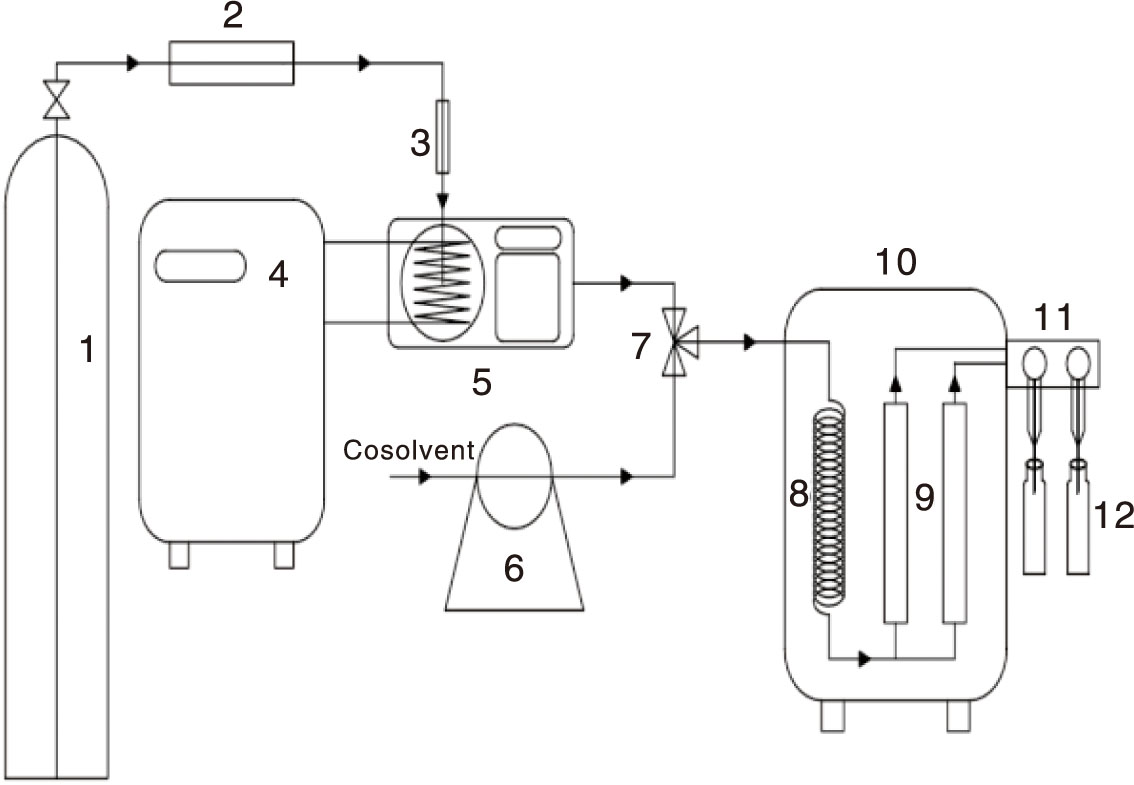
Fig.1 Schematic diagram of the supercritical carbon dioxide extraction system 1, CO2 gas cylinder; 2, Molecular sieve; 3, Porous metal filter; 4, Cooling circulator; 5, High-pressure pump; 6, Solvent aid pump; 7, Three-way valve; 8, Coil preheater; 9, Extraction vessel; 10, Oven with PID temperature controller; 11, Back pressure regulator; 12, Solvent collection container.
| 水平 Level | 变量Variable | |||
|---|---|---|---|---|
| X1/℃ | X2/MPa | X3/min | X4/min | |
| -2 | 35 | 8 | 10 | 12 |
| -1 | 50 | 16 | 20 | 24 |
| 0 | 65 | 24 | 30 | 36 |
| +1 | 80 | 32 | 40 | 48 |
| +2 | 95 | 40 | 50 | 60 |
Table 1 Independent variables and their coded levels
| 水平 Level | 变量Variable | |||
|---|---|---|---|---|
| X1/℃ | X2/MPa | X3/min | X4/min | |
| -2 | 35 | 8 | 10 | 12 |
| -1 | 50 | 16 | 20 | 24 |
| 0 | 65 | 24 | 30 | 36 |
| +1 | 80 | 32 | 40 | 48 |
| +2 | 95 | 40 | 50 | 60 |
| 实验号 Test number | 变量 Variable | 产率/% Yield/% | 角鲨烯含量/ (mg·kg-1) Squalene content/ (mg·kg-1) | 三萜烯醇含量/ (mg·kg-1) Triterpene alcohol content/ (mg·kg-1) | |||
|---|---|---|---|---|---|---|---|
| X1/℃ | X2/MPa | X3/min | X4/min | ||||
| 1 | 65 | 24 | 30 | 36 | 20.02±0.17 | 278.60±5.02 | 1 986.71±10.24 |
| 2 | 50 | 32 | 20 | 24 | 19.68±0.11 | 302.42±4.99 | 1 798.62±7.66 |
| 3 | 65 | 24 | 30 | 12 | 17.44±0.15 | 337.26±4.34 | 1 915.35±7.59 |
| 4 | 65 | 40 | 30 | 36 | 22.86±0.20 | 221.19±6.09 | 1 745.68±22.78 |
| 5 | 50 | 16 | 40 | 48 | 17.93±0.55 | 245.53±6.99 | 1 943.53±11.02 |
| 6 | 50 | 16 | 20 | 24 | 15.96±0.12 | 312.40±5.67 | 2 095.02±8.41 |
| 7 | 50 | 32 | 40 | 48 | 22.23±0.65 | 247.95±4.77 | 1 924.05±9.32 |
| 8 | 65 | 24 | 30 | 36 | 21.52±0.23 | 282.50±4.30 | 2 044.01±12.38 |
| 9 | 80 | 16 | 20 | 48 | 16.53±0.26 | 297.70±5.19 | 2 086.06±9.89 |
| 10 | 65 | 24 | 30 | 36 | 21.50±0.14 | 312.30±5.25 | 2 039.44±24.03 |
| 11 | 80 | 32 | 40 | 24 | 22.27±0.34 | 276.50±6.40 | 1 879.04±10.78 |
| 12 | 80 | 16 | 20 | 24 | 15.15±0.24 | 343.27±9.56 | 2 019.08±11.67 |
| 13 | 65 | 8 | 30 | 36 | 10.72±0.26 | 266.98±8.01 | 2 108.32±6.01 |
| 14 | 65 | 24 | 50 | 36 | 21.77±0.22 | 268.70±8.48 | 1 951.43±16.66 |
| 15 | 50 | 32 | 40 | 24 | 20.30±0.21 | 277.18±6.09 | 1 892.65±5.78 |
| 16 | 35 | 24 | 30 | 36 | 17.72±0.18 | 238.57±4.75 | 1 940.16±17.98 |
| 17 | 80 | 16 | 40 | 48 | 18.65±0.44 | 284.72±5.49 | 1 860.19±9.67 |
| 18 | 80 | 16 | 40 | 24 | 16.47±0.35 | 314.58±4.32 | 1 832.45±7.69 |
| 19 | 80 | 32 | 20 | 48 | 23.09±0.28 | 270.30±3.69 | 1 828.60±8.82 |
| 20 | 95 | 24 | 30 | 36 | 20.94±0.15 | 271.15±4.68 | 1 845.26±10.53 |
| 21 | 80 | 32 | 20 | 24 | 21.66±0.45 | 283.95±9.76 | 1 824.33±6.18 |
| 22 | 65 | 24 | 30 | 60 | 22.63±0.08 | 266.53±3.66 | 1 876.26±14.16 |
| 23 | 65 | 24 | 30 | 36 | 21.53±0.37 | 292.30±4.90 | 1 994.05±7.72 |
| 24 | 65 | 24 | 30 | 36 | 21.04±0.60 | 277.50±6.49 | 1 927.08±18.53 |
| 25 | 65 | 24 | 10 | 36 | 17.97±0.12 | 324.22±4.56 | 2 047.35±6.97 |
| 26 | 65 | 24 | 30 | 36 | 21.39±0.51 | 300.80±7.05 | 2 007.66±12.92 |
| 27 | 50 | 16 | 40 | 24 | 16.43±0.15 | 284.57±9.56 | 2 029.05±21.91 |
| 28 | 80 | 32 | 40 | 48 | 23.51±0.11 | 256.63±5.93 | 1 946.21±10.58 |
| 29 | 50 | 16 | 20 | 48 | 17.12±0.16 | 270.20±5.15 | 2 011.22±6.01 |
| 30 | 65 | 24 | 30 | 36 | 21.03±0.18 | 314.60±4.41 | 2 014.10±8.95 |
| 31 | 50 | 32 | 20 | 48 | 21.18±0.24 | 268.88±3.81 | 1 682.15±9.73 |
Table 2 Central composite experimental design for SC-CO2extraction and observed response values
| 实验号 Test number | 变量 Variable | 产率/% Yield/% | 角鲨烯含量/ (mg·kg-1) Squalene content/ (mg·kg-1) | 三萜烯醇含量/ (mg·kg-1) Triterpene alcohol content/ (mg·kg-1) | |||
|---|---|---|---|---|---|---|---|
| X1/℃ | X2/MPa | X3/min | X4/min | ||||
| 1 | 65 | 24 | 30 | 36 | 20.02±0.17 | 278.60±5.02 | 1 986.71±10.24 |
| 2 | 50 | 32 | 20 | 24 | 19.68±0.11 | 302.42±4.99 | 1 798.62±7.66 |
| 3 | 65 | 24 | 30 | 12 | 17.44±0.15 | 337.26±4.34 | 1 915.35±7.59 |
| 4 | 65 | 40 | 30 | 36 | 22.86±0.20 | 221.19±6.09 | 1 745.68±22.78 |
| 5 | 50 | 16 | 40 | 48 | 17.93±0.55 | 245.53±6.99 | 1 943.53±11.02 |
| 6 | 50 | 16 | 20 | 24 | 15.96±0.12 | 312.40±5.67 | 2 095.02±8.41 |
| 7 | 50 | 32 | 40 | 48 | 22.23±0.65 | 247.95±4.77 | 1 924.05±9.32 |
| 8 | 65 | 24 | 30 | 36 | 21.52±0.23 | 282.50±4.30 | 2 044.01±12.38 |
| 9 | 80 | 16 | 20 | 48 | 16.53±0.26 | 297.70±5.19 | 2 086.06±9.89 |
| 10 | 65 | 24 | 30 | 36 | 21.50±0.14 | 312.30±5.25 | 2 039.44±24.03 |
| 11 | 80 | 32 | 40 | 24 | 22.27±0.34 | 276.50±6.40 | 1 879.04±10.78 |
| 12 | 80 | 16 | 20 | 24 | 15.15±0.24 | 343.27±9.56 | 2 019.08±11.67 |
| 13 | 65 | 8 | 30 | 36 | 10.72±0.26 | 266.98±8.01 | 2 108.32±6.01 |
| 14 | 65 | 24 | 50 | 36 | 21.77±0.22 | 268.70±8.48 | 1 951.43±16.66 |
| 15 | 50 | 32 | 40 | 24 | 20.30±0.21 | 277.18±6.09 | 1 892.65±5.78 |
| 16 | 35 | 24 | 30 | 36 | 17.72±0.18 | 238.57±4.75 | 1 940.16±17.98 |
| 17 | 80 | 16 | 40 | 48 | 18.65±0.44 | 284.72±5.49 | 1 860.19±9.67 |
| 18 | 80 | 16 | 40 | 24 | 16.47±0.35 | 314.58±4.32 | 1 832.45±7.69 |
| 19 | 80 | 32 | 20 | 48 | 23.09±0.28 | 270.30±3.69 | 1 828.60±8.82 |
| 20 | 95 | 24 | 30 | 36 | 20.94±0.15 | 271.15±4.68 | 1 845.26±10.53 |
| 21 | 80 | 32 | 20 | 24 | 21.66±0.45 | 283.95±9.76 | 1 824.33±6.18 |
| 22 | 65 | 24 | 30 | 60 | 22.63±0.08 | 266.53±3.66 | 1 876.26±14.16 |
| 23 | 65 | 24 | 30 | 36 | 21.53±0.37 | 292.30±4.90 | 1 994.05±7.72 |
| 24 | 65 | 24 | 30 | 36 | 21.04±0.60 | 277.50±6.49 | 1 927.08±18.53 |
| 25 | 65 | 24 | 10 | 36 | 17.97±0.12 | 324.22±4.56 | 2 047.35±6.97 |
| 26 | 65 | 24 | 30 | 36 | 21.39±0.51 | 300.80±7.05 | 2 007.66±12.92 |
| 27 | 50 | 16 | 40 | 24 | 16.43±0.15 | 284.57±9.56 | 2 029.05±21.91 |
| 28 | 80 | 32 | 40 | 48 | 23.51±0.11 | 256.63±5.93 | 1 946.21±10.58 |
| 29 | 50 | 16 | 20 | 48 | 17.12±0.16 | 270.20±5.15 | 2 011.22±6.01 |
| 30 | 65 | 24 | 30 | 36 | 21.03±0.18 | 314.60±4.41 | 2 014.10±8.95 |
| 31 | 50 | 32 | 20 | 48 | 21.18±0.24 | 268.88±3.81 | 1 682.15±9.73 |
| 响应变量 Response variable | F值 F value | p值 p value | R2 | 调整R2 | 失拟项p值 p value of lack of fit |
|---|---|---|---|---|---|
| 产率Yield | 34.17 | <0.000 1 | 0.968 | 0.939 | 0.173 |
| 角鲨烯含量Squalene content | 12.21 | <0.000 1 | 0.914 | 0.840 | 0.833 |
| 三萜烯醇含量Triterpene alcohol content | 14.83 | <0.000 1 | 0.928 | 0.866 | 0.567 |
Table 3 Variance analysis of the response surface second-order polynomial regression model
| 响应变量 Response variable | F值 F value | p值 p value | R2 | 调整R2 | 失拟项p值 p value of lack of fit |
|---|---|---|---|---|---|
| 产率Yield | 34.17 | <0.000 1 | 0.968 | 0.939 | 0.173 |
| 角鲨烯含量Squalene content | 12.21 | <0.000 1 | 0.914 | 0.840 | 0.833 |
| 三萜烯醇含量Triterpene alcohol content | 14.83 | <0.000 1 | 0.928 | 0.866 | 0.567 |
| 响应值 Response value | 变量 Variable | 回归系数 Regression coefficient | F值 F value | p值 p value |
|---|---|---|---|---|
| 产率Yield | 截距Intercept | 21.15 | — | — |
| X1 | 0.540 6 | 13.67 | <0.000 1 | |
| X2 | 2.65 | 327.99 | 0.002 0 | |
| X3 | 0.643 0 | 19.33 | <0.000 1 | |
| X4 | 0.945 9 | 41.83 | 0.000 5 | |
| X1X2 | 0.486 1 | 7.36 | <0.000 1 | |
| -0.408 5 | 9.30 | 0.015 3 | ||
| -1.04 | 60.59 | 0.007 7 | ||
| 角鲨烯含量 Squalene content | 截距Intercept | 224.72 | — | — |
| X2 | -12.09 | 17.76 | <0.000 1 | |
| X4 | -27.17 | 89.68 | <0.000 1 | |
| X1X2 | -9.56 | 7.41 | 0.015 1 | |
| X1X3 | -12.99 | 13.66 | 0.002 0 | |
| X1X4 | 8.13 | 5.36 | 0.034 2 | |
| -10.41 | 15.70 | 0.001 1 | ||
| -9.78 | 13.85 | 0.001 9 | ||
| 三萜烯醇含量 Triterpene alcohol content | 截距Intercept | 2 001.86 | — | — |
| X2 | -76.09 | 14.83 | <0.000 1 | |
| X1X2 | 28.86 | 94.61 | 0.008 3 | |
| X1X3 | -27.65 | 9.07 | 0.010 7 | |
| X1X4 | 26.28 | 8.33 | 0.014 4 | |
| X2X3 | 65.90 | 7.53 | <0.000 1 | |
| -29.45 | 47.31 | 0.000 8 | ||
| -20.88 | 16.88 | 0.010 2 | ||
| -28.68 | 8.48 | 0.001 0 |
Table 4 Regression coefficients and p-values of Camellia oleifera seed oil extracted by SC-CO2 after applying the backward elimination method
| 响应值 Response value | 变量 Variable | 回归系数 Regression coefficient | F值 F value | p值 p value |
|---|---|---|---|---|
| 产率Yield | 截距Intercept | 21.15 | — | — |
| X1 | 0.540 6 | 13.67 | <0.000 1 | |
| X2 | 2.65 | 327.99 | 0.002 0 | |
| X3 | 0.643 0 | 19.33 | <0.000 1 | |
| X4 | 0.945 9 | 41.83 | 0.000 5 | |
| X1X2 | 0.486 1 | 7.36 | <0.000 1 | |
| -0.408 5 | 9.30 | 0.015 3 | ||
| -1.04 | 60.59 | 0.007 7 | ||
| 角鲨烯含量 Squalene content | 截距Intercept | 224.72 | — | — |
| X2 | -12.09 | 17.76 | <0.000 1 | |
| X4 | -27.17 | 89.68 | <0.000 1 | |
| X1X2 | -9.56 | 7.41 | 0.015 1 | |
| X1X3 | -12.99 | 13.66 | 0.002 0 | |
| X1X4 | 8.13 | 5.36 | 0.034 2 | |
| -10.41 | 15.70 | 0.001 1 | ||
| -9.78 | 13.85 | 0.001 9 | ||
| 三萜烯醇含量 Triterpene alcohol content | 截距Intercept | 2 001.86 | — | — |
| X2 | -76.09 | 14.83 | <0.000 1 | |
| X1X2 | 28.86 | 94.61 | 0.008 3 | |
| X1X3 | -27.65 | 9.07 | 0.010 7 | |
| X1X4 | 26.28 | 8.33 | 0.014 4 | |
| X2X3 | 65.90 | 7.53 | <0.000 1 | |
| -29.45 | 47.31 | 0.000 8 | ||
| -20.88 | 16.88 | 0.010 2 | ||
| -28.68 | 8.48 | 0.001 0 |
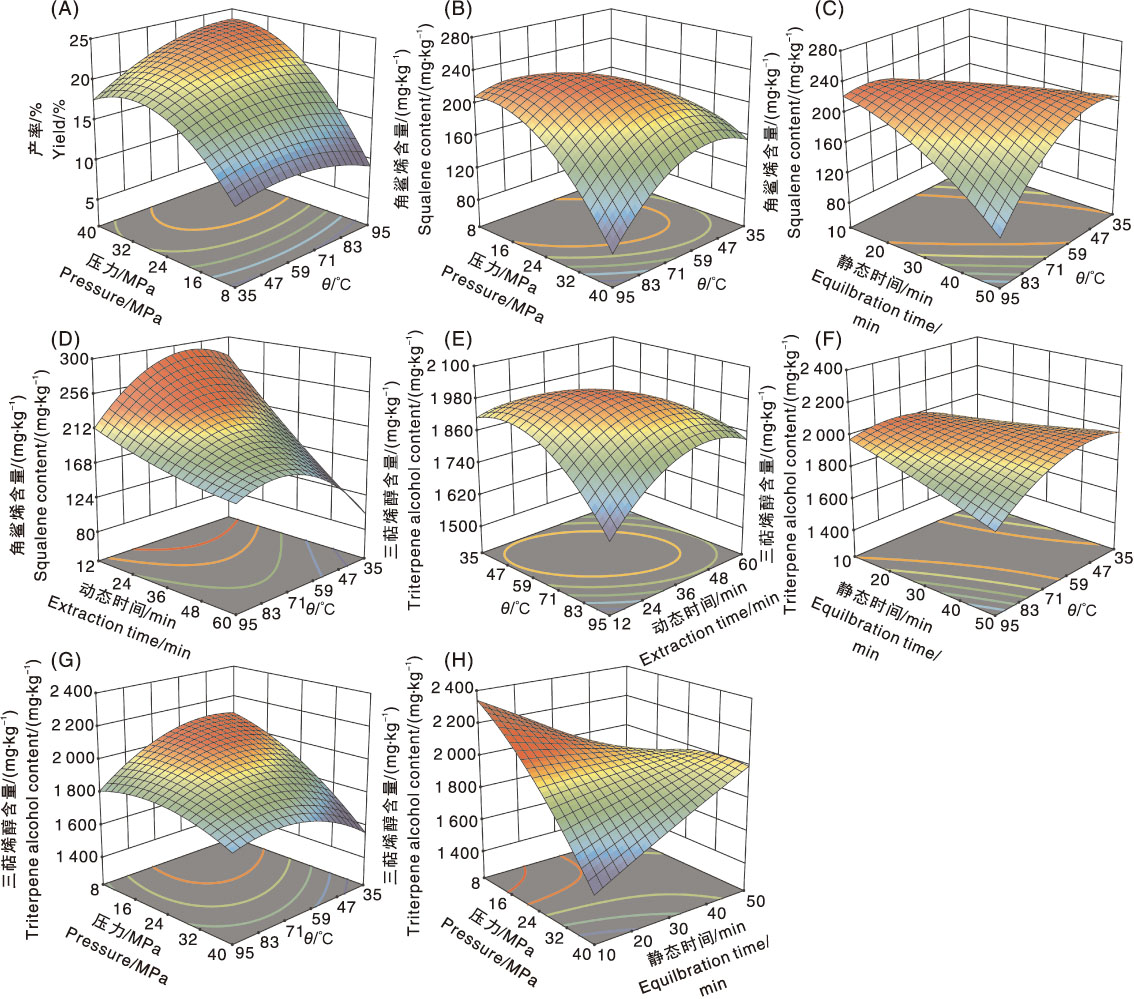
Fig.2 The interactive effects of SC-CO2 extraction parameters on Camellia oleifera seed oil yield, squalene content and triterpene alcohol content
| 条件 Condition | 产率/% Yield/% | 角鲨烯含量/ (mg·kg-1) Squalene content/ (mg·kg-1) | 三萜烯醇含量/ (mg·kg-1) Triterpene alcohol content/(mg·kg-1) |
|---|---|---|---|
| Y1 | 23.96±0.63 a | 163.25±6.46 c | 1 783.32±15.86 c |
| Y2 | 16.32±0.74 b | 288.89±6.37 a | 1 985.33±6.98 b |
| Y3 | 12.64±0.36 c | 225.88±9.04 b | 2 283.50±22.75 a |
Table 5 Yield, squalene, and triterpene alcohol contents of Camellia oleifera seed oil in model validation experiment
| 条件 Condition | 产率/% Yield/% | 角鲨烯含量/ (mg·kg-1) Squalene content/ (mg·kg-1) | 三萜烯醇含量/ (mg·kg-1) Triterpene alcohol content/(mg·kg-1) |
|---|---|---|---|
| Y1 | 23.96±0.63 a | 163.25±6.46 c | 1 783.32±15.86 c |
| Y2 | 16.32±0.74 b | 288.89±6.37 a | 1 985.33±6.98 b |
| Y3 | 12.64±0.36 c | 225.88±9.04 b | 2 283.50±22.75 a |
| 条件 Conditions | 脂肪酸组分含量/%Contents of fatty acid composition/% | α-生育酚含量/ (mg·kg-1) α-Tocopherol content/ (mg·kg-1) | 多酚含量/ (mg·kg-1) Polyphenols content/ (mg·kg-1) | ||||||||||||
|---|---|---|---|---|---|---|---|---|---|---|---|---|---|---|---|
| C6: 0 | C8: 0 | C10: 0 | C11: 0 | C12: 0 | C13: 0 | C16: 0 | C17: 0 | C18: 0 | C18: 1顺式 C18:1 cis | C18: 2顺式 C18:2 cis | C18: 3n3 | C24: 1 | |||
| Y1 | 0.82 | 0.68 | 0.65 | 0.60 | 0.51 | 0.51 | 7.72 | 6.56 | 2.15 | 64.98 | 6.41 | 0.69 | 0.56 | 125.49±0.75 b | 188.50±2.80 b |
| Y2 | 0.76 | 0.64 | 0.60 | 0.56 | 0.47 | 0.47 | 7.72 | 6.15 | 2.15 | 66.28 | 6.39 | 0.65 | 0.52 | 104.37±0.88 c | 126.40±1.50 c |
| Y3 | 0.73 | 0.61 | 0.58 | 0.53 | 0.45 | 0.45 | 7.73 | 6.04 | 2.17 | 66.74 | 6.42 | 0.64 | 0.50 | 134.35±0.39 a | 229.60±3.30 a |
Table 6 Fatty acid composition, α-tocopherol content and polyphenol content in Camellia oleifera seed oil
| 条件 Conditions | 脂肪酸组分含量/%Contents of fatty acid composition/% | α-生育酚含量/ (mg·kg-1) α-Tocopherol content/ (mg·kg-1) | 多酚含量/ (mg·kg-1) Polyphenols content/ (mg·kg-1) | ||||||||||||
|---|---|---|---|---|---|---|---|---|---|---|---|---|---|---|---|
| C6: 0 | C8: 0 | C10: 0 | C11: 0 | C12: 0 | C13: 0 | C16: 0 | C17: 0 | C18: 0 | C18: 1顺式 C18:1 cis | C18: 2顺式 C18:2 cis | C18: 3n3 | C24: 1 | |||
| Y1 | 0.82 | 0.68 | 0.65 | 0.60 | 0.51 | 0.51 | 7.72 | 6.56 | 2.15 | 64.98 | 6.41 | 0.69 | 0.56 | 125.49±0.75 b | 188.50±2.80 b |
| Y2 | 0.76 | 0.64 | 0.60 | 0.56 | 0.47 | 0.47 | 7.72 | 6.15 | 2.15 | 66.28 | 6.39 | 0.65 | 0.52 | 104.37±0.88 c | 126.40±1.50 c |
| Y3 | 0.73 | 0.61 | 0.58 | 0.53 | 0.45 | 0.45 | 7.73 | 6.04 | 2.17 | 66.74 | 6.42 | 0.64 | 0.50 | 134.35±0.39 a | 229.60±3.30 a |
| 条件 Conditions | DPPH (IC50)/ (g·L-1) | ABTS (IC50)/ (g·L-1) | IP/h |
|---|---|---|---|
| Y1 | 22.65±0.75 b | 75.87±1.02 b | 12.89±0.32 a |
| Y2 | 30.41±0.88 a | 94.79±1.35 a | 3.73±0.08 c |
| Y3 | 29.91±0.39 a | 63.57±0.96 c | 8.28±0.19 b |
Table 7 Characterization of antioxidant capacity of Camellia oleifera seed oil
| 条件 Conditions | DPPH (IC50)/ (g·L-1) | ABTS (IC50)/ (g·L-1) | IP/h |
|---|---|---|---|
| Y1 | 22.65±0.75 b | 75.87±1.02 b | 12.89±0.32 a |
| Y2 | 30.41±0.88 a | 94.79±1.35 a | 3.73±0.08 c |
| Y3 | 29.91±0.39 a | 63.57±0.96 c | 8.28±0.19 b |
| [35] | MA X, HUANG C B, ZHENG C, et al. Effect of oil extraction methods on walnut oil quality characteristics and the functional properties of walnut protein isolate[J]. Food Chemistry, 2024, 438: 138052. |
| [36] | CHABNI A, BAÑARES C, TORRES C F. Study of the oxidative stability via Oxitest and Rancimat of phenolic-rich olive oils obtained by a sequential process of dehydration, expeller and supercritical CO2extractions[J]. Frontiers in Nutrition, 2024, 11: 1494091. |
| [1] | ZHU F, WU R, CHEN B L, et al. Development of an efficient procedure for preparing high quality Camellia oleifera seed oil by enzymatic extraction and demulsification[J]. Industrial Crops and Products, 2024, 212: 118392. |
| [2] | YE M Q, ZHOU H F, HAO J R, et al. Microwave pretreatment on microstructure, characteristic compounds and oxidative stability of camellia seeds[J]. Industrial Crops and Products, 2021, 161: 113193. |
| [37] | WANG H W, LIU Y Q, WEI S L, et al. Application of response surface methodology to optimise supercritical carbon dioxide extraction of essential oil from Cyperus rotundus Linn[J]. Food Chemistry, 2012, 132(1): 582-587. |
| [38] | PAN W J, LIAO A M, ZHANG J G, et al. Supercritical carbon dioxide extraction of the oak silkworm (Antheraea pernyi) pupal oil: process optimization and composition determination[J]. International Journal of Molecular Sciences, 2012, 13(2): 2354-2367. |
| [39] | 王永华, 吴振强, 谭字榴, 等. 前处理条件对超临界CO2萃取隐甲藻油脂的影响[J]. 食品与发酵工业, 2002, 28(4): 15-18. |
| WANG Y H, WU Z Q, TAN Z L, et al. Effect of pretreatment on the extraction of oil from C. cohnni by supercritical CO2[J]. Food and Fermentation Industries, 2002, 28(4): 15-18. | |
| [3] | LU Y C, HOU R R, SHAO S X, et al. In-depth potential mechanism of combined demulsification pretreatments (isopropanol ultrasonic pretreatments and Ca2+flow additions) during aqueous enzymatic extractions of camellia oils[J]. Food Chemistry, 2023, 414: 135681. |
| [4] | ZHANG F, ZHU F, CHEN B L, et al. Composition, bioactive substances, extraction technologies and the influences on characteristics of Camellia oleifera oil: a review[J]. Food Research International, 2022, 156: 111159. |
| [40] | PEREIRA C G, MEIRELES M A A. Supercritical fluid extraction of bioactive compounds: fundamentals, applications and economic perspectives[J]. Food and Bioprocess Technology, 2010, 3(3): 340-372. |
| [41] | WEJNEROWSKA G, HEINRICH P, GACA J. Separation of squalene and oil from Amaranthus seeds by supercritical carbon dioxide[J]. Separation and Purification Technology, 2013, 110: 39-43. |
| [5] | GAO L, JIN L H, LIU Q N, et al. Recent advances in the extraction, composition analysis and bioactivity of camellia(Camellia oleifera Abel.) oil[J]. Trends in Food Science & Technology, 2024, 143: 104211. |
| [6] | QIN P J, SHEN J J, WEI J, et al. A critical review of the bioactive ingredients and biological functions of Camellia oleifera oil[J]. Current Research in Food Science, 2024, 8: 100753. |
| [7] | ZHANG X L, MA H L, QUAISIE J, et al. Tea saponin extracted from seed pomace of Camellia oleifera Abel ameliorates DNCB-induced atopic dermatitis-like symptoms in BALB/c mice[J]. Journal of Functional Foods, 2022, 91: 105001. |
| [8] | JIAO S C, DENG L J, NIU M, et al. Restorative effects of camellia oil on the skin-barrier function in a model of DNCB-induced atopic dermatitis[J]. European Journal of Histochemistry, 2025, 69(1): 4147. |
| [9] | LIN C Y, CHEN S Y, LEE W T, et al. Immunomodulatory effect of camellia oil (Camellia oleifera Abel.) on CD19+B cells enrichment and IL-10 production in BALB/c mice[J]. Journal of Functional Foods, 2022, 88: 104863. |
| [10] | AKIHISA T, YASUKAWA K, KIMURA Y, et al. Triterpene alcohols from camellia and sasanqua oils and their anti-inflammatory effects[J]. Chemical and Pharmaceutical Bulletin, 1997, 45(12): 2016-2023. |
| [11] | LOU-BONAFONTE J M, MARTÍNEZ-BEAMONTE R, SANCLEMENTE T, et al. Current insights into the biological action of squalene[J]. Molecular Nutrition & Food Research, 2018, 62(15): 1800136. |
| [12] | WANG D X, WANG T T, ZHANG Z H, et al. Recent advances in the effects of dietary polyphenols on inflammation in vivo: potential molecular mechanisms, receptor targets, safety issues, and uses of nanodelivery system and polyphenol polymers[J]. Current Opinion in Food Science, 2022, 48: 100921. |
| [13] | JIN C Y, CHU C, ZHU X H, et al. Fractional extraction phenolics from C. oleifera seed kernels exhibited anti-inflammatory effect via PI3K/Akt/NF-κB signaling pathway under Caco-2/RAW264.7 co-culture cell model[J]. Food Research International, 2024, 197: 115268. |
| [14] | THOMPSON M D, COONEY R V. The potential physiological role of γ-tocopherol in human health: a qualitative review[J]. Nutrition and Cancer, 2020, 72(5): 808-825. |
| [15] | HUANG H R, HE Y, CUI X X, et al. Potent inhibitory effect of δ-tocopherol on prostate cancer cells cultured in vitro and grown as xenograft tumors in vivo[J]. Journal of Agricultural and Food Chemistry, 2014, 62(44): 10752-10758. |
| [16] | LI G H, MA L, YAN Z P, et al. Extraction of oils and phytochemicals from Camellia oleifera seeds: trends, challenges, and innovations[J]. Processes, 2022, 10(8): 1489. |
| [17] | KARRAR E, SHETH S, WEI W, et al. Effect of microwave heating on lipid composition, oxidative stability, color value, chemical properties, and antioxidant activity of gurum (Citrullus lanatus var. Colocynthoide) seed oil[J]. Biocatalysis and Agricultural Biotechnology, 2020, 23: 101504. |
| [18] | HRABOVSKI N, SINADINOVIĆ-FIŠER S, NIKOLOVSKI B, et al. Phytosterols in pumpkin seed oil extracted by organic solvents and supercritical CO2[J]. European Journal of Lipid Science and Technology, 2012, 114(10): 1204-1211. |
| [42] | 卢克刚, 张红霞. 植物来源角鲨烯的制备与检测方法研究进展[J]. 食品研究与开发, 2019, 40(9): 217-224. |
| LU K G, ZHANG H X. Research progress in preparation and detection methods of squalene from plants[J]. Food Research and Development, 2019, 40(9): 217-224. | |
| [19] | 祝华明, 戴贤君, 郑睿行. 加工工艺对茶油中多环芳烃组成及含量的影响[J]. 食品与机械, 2015, 31(4): 59-61. |
| ZHU H M, DAI X J, ZHENG R H. Effect of processing technology on composition and concentration of PAHs in camellia seed oil[J]. Food & Machinery, 2015, 31(4): 59-61. | |
| [43] | 刘晓庚, 陈梅梅, 谢亚桐. 夹带剂及其对超临界CO2萃取效能的影响[J]. 食品科学, 2004, 25(11): 353-357. |
| LIU X G, CHEN M M, XIE Y T. Modifier effect on the efficacy of supercritical CO2extraction[J]. Food Science, 2004, 25(11): 353-357. | |
| [44] | 廖传华, 黄振仁. 夹带剂对超临界CO2萃取过程的影响[J]. 香料香精化妆品, 2004(1): 34-37. |
| LIAO C H, HUANG Z R. Effect of modifier on supercritical CO2 extraction[J]. Flavour Fragrance Cosmetics, 2004(1): 34-37. | |
| [20] | 黄鑫, 张利军, 张保艳. 油茶籽油提取方法对比分析[J]. 中国油脂, 2019, 44(6): 9-13. |
| HUANG X, ZHANG L J, ZHANG B Y. Comparison of extraction methods of oil-tea camellia seed oil[J]. China Oils and Fats, 2019, 44(6): 9-13. | |
| [21] | DHARA O, PRASANNA RANI K N, CHAKRABARTI P P. Supercritical carbon dioxide extraction of vegetable oils: retrospective and prospects[J]. European Journal of Lipid Science and Technology, 2022, 124(8): 2200006. |
| [22] | UWINEZA P A, WAŚKIEWICZ A. Recent advances in supercritical fluid extraction of natural bioactive compounds from natural plant materials[J]. Molecules, 2020, 25(17): 3847. |
| [23] | AHANGARI H, KING J W, EHSANI A, et al. Supercritical fluid extraction of seed oils: a short review of current trends[J]. Trends in Food Science & Technology, 2021, 111: 249-260. |
| [24] | CHEMAT F, ABERT VIAN M, RAVI H K, et al. Review of alternative solvents for green extraction of food and natural products: panorama, principles, applications and prospects[J]. Molecules, 2019, 24(16): 3007. |
| [25] | JIRARATTANARANGSRI W, MUANGRAT R. Comparison of supercritical CO2 and screw press extraction methods for producing oil from Camellia sinensis var. assamica seeds: physicochemical properties and antioxidant activity[J]. Journal of Applied Research on Medicinal and Aromatic Plants, 2022, 31: 100413. |
| [26] | HE J H, LIN D, LIN S Z, et al. Quality comparison of camellia(Camellia oleifera C. Abel) seed oil with different extraction methods[J]. International Food Research Journal, 2023, 30(1): 182-192. |
| [27] | 谭传波, 田华, 赖琼玮, 等. 不同工艺山茶油中生物活性物质含量的比较[J]. 中国油脂, 2018, 43(12): 41-44. |
| TAN C B, TIAN H, LAI Q W, et al. Comparison of contents of bioactive substances in oil-tea camellia seed oils from different processes[J]. China Oils and Fats, 2018, 43(12): 41-44. | |
| [45] | 叶虔臻, 王微, 董柳青, 等. 山茶油脱臭馏出物中角鲨烯的分离纯化及对猪油抗氧化作用的研究[J]. 中国粮油学报, 2019, 34(7): 62-67. |
| YE Q Z, WANG W, DONG L Q, et al. Isolation and purification of squalene from camellia oil deodorized distillate and its antioxidant activity in lard[J]. Journal of the Chinese Cereals and Oils Association, 2019, 34(7): 62-67. | |
| [28] | 刘金, 江敏, 岳希洁, 等. 茶籽油提取技术及研究进展[J]. 食品工业, 2022, 43(4): 283-286. |
| LIU J, JIANG M, YUE X J, et al. Advances in research on extraction technologies of camellia seed oil[J]. The Food Industry, 2022, 43(4): 283-286. | |
| [46] | NAZIRI E, CONSONNI R, TSIMIDOU M Z. Squalene oxidation products: monitoring the formation, characterisation and pro-oxidant activity[J]. European Journal of Lipid Science and Technology, 2014, 116(10): 1400-1411. |
| [47] | 马宇晨, 王光宜, 刘乐乐, 等. 植物油中内源性成分的抗氧化作用[J]. 食品工业科技, 2023, 44(24): 119-130. |
| [29] | DAI Q Q, YANG Y D, CHEN K, et al. Optimization of supercritical CO2operative parameters to simultaneously increase the extraction yield of oil and pentacyclic triterpenes from artichoke leaves and stalks by response surface methodology and ridge analysis[J]. European Journal of Lipid Science and Technology, 2019, 121(2): 1800120 |
| [30] | SZPISJÁK-GULYÁS N, AL-TAYAWI A N, HORVÁTH Z H, et al. Methods for experimental design, central composite design and the Box-Behnken design, to optimise operational parameters: a review[J]. Acta Alimentaria, 2023, 52(4): 521-537. |
| [31] | 黄翠莉, 吴苏喜. 响应面法对超临界CO2萃取茶籽仁油的工艺优化[J]. 生物加工过程, 2010, 8(3):13-17. |
| HUANG C L, WU S X. Optimization of supercritical carbon dioxide extraction process of camellia seed kernel oil by response surface methodology[J]. Chinese Journal of Bioprocess Engineering, 2010, 8(3):13-17. | |
| [32] | 黄闪闪, 吴苏喜, 谭传波. 微波预处理-超临界CO2萃取高品质茶籽油的工艺研究[J]. 食品工业科技, 2014, 35(24): 253-257. |
| HUANG S S, WU S X, TAN C B. Study on the supercritical carbon dioxide extraction process combined with microwave pretreatment for efficiently extracting high quality camellia seed oil[J]. Science and Technology of Food Industry, 2014, 35(24): 253-257. | |
| [33] | RIBEIRO P P C, DA SILVA CHAVES DAMASCENO K S F, DE VERAS B O, et al. Chemical and biological activities of faveleira (Cnidoscolus quercifolius Pohl) seed oil for potential health applications[J]. Food Chemistry, 2021, 337: 127771. |
| [34] | SHAO P, LIU Q, FANG Z X, et al. Chemical composition, thermal stability and antioxidant properties of tea seed oils obtained by different extraction methods: supercritical fluid extraction yields the best oil quality[J]. European Journal of Lipid Science and Technology, 2015, 117(3): 355-365. |
| [47] | MA Y C, WANG G Y, LIU L L, et al. Antioxidant effects of endogenous components in vegetable oils[J]. Science and Technology of Food Industry, 2023, 44(24): 119-130. |
| [48] | MA Y C, WANG G Y, DENG Z Y, et al. Effects of endogenous anti-oxidative components from different vegetable oils on their oxidative stability[J]. Foods, 2023, 12(11): 2273. |
| [1] | SUN Da, MAO Binyu, HUANG Danyi, CUI Hongchun, XIA Bing, ZHENG Xuxia. Study on the quality of West Lake Longjing tea in different regions based on soil properties [J]. Acta Agriculturae Zhejiangensis, 2026, 38(6): 1087-1098. |
| [2] | WANG Ting, FAN Yuxin, WANG Hui, DU Jingshan, SHI Qiuhuan, WANG Yujie, SHEN Hongtao, WANG Yanfang, XI Jiaqin, LIU Ling. Influence of Bacillus methylotrophicus on contents and coordination of chemical composition based on the primary-cured greenish tobacco [J]. Acta Agriculturae Zhejiangensis, 2025, 37(9): 1969-1980. |
| [3] | YANG Xueyu, NIU Li, TAN Lin, DENG Yulian, BAO Qiang, HU Qiulong. Optimization of the culture conditions of Bacillus subtilis subsp. inaquosorum kc-16 [J]. Acta Agriculturae Zhejiangensis, 2025, 37(12): 2563-2573. |
| [4] | ZHOU Maocuo, LU Jianxiong, GUO Xiaonong, FENG Yulan, CHAI Weiwei, GAO Pengfei. Optimization of quinoa straw fermentation process based on response surface methodology [J]. Acta Agriculturae Zhejiangensis, 2024, 36(9): 2020-2030. |
| [5] | SUN Jian, REN Jiangjian, WANG Haige, JIANG Jianming, WANG Zhi’an, YU Xuping. Tissue culture and breeding of Pleione formosana Hayata and chemical composition analysis of its pseudobulbs [J]. Acta Agriculturae Zhejiangensis, 2024, 36(2): 358-364. |
| [6] | ZHAO Han, XIANG Kexin, LIU Chunju, LI Bin, LI Dajing, LI Yue, NIU Liying, YU Rui. Relationship between chemical composition, microstructure and texture of different varieties of peach fruits [J]. Acta Agriculturae Zhejiangensis, 2024, 36(12): 2705-2718. |
| [7] | LU Xinbo, YUAN Ying, WANG Jun, WANG Huawen, XIA Jun, WU Dan, TIAN Jinhu, YE Xingqian, YIN Jie, JIANG Jian. Effect of extrusion treatment on chemical composition and aroma of flue-cured tobacco leaves for heat-not-burn cigarettes [J]. Acta Agriculturae Zhejiangensis, 2024, 36(12): 2803-2811. |
| [8] | LYU Jing, WU Zhiyong, GUO Xiaonong, FENG Yulan, LU Jianxiong, CHAI Weiwei. Optimization of fermented quinoa straw with lactic acid bacteria by response surface methodology [J]. Acta Agriculturae Zhejiangensis, 2022, 34(9): 1866-1876. |
| [9] | CHEN Di, XIAO Chaogeng, LU Wenjing, YE Qin, WANG Fei. Effects of different heat treatment methods on quality of leisure pine nuts [J]. Acta Agriculturae Zhejiangensis, 2022, 34(4): 808-813. |
| [10] | PENG Caiwang, ZHOU Ting, SUN Songlin, XIE Yelin, WEI Yuan. Calibration of parameters of black soldier fly in discrete method simulation based on response angle of particle heap [J]. Acta Agriculturae Zhejiangensis, 2022, 34(4): 814-823. |
| [11] | LI Hongmei, LU Shengmin, ZHENG Meiyu, CAO Feng, ZHANG Wenjuan, DONG Mingsheng. Comparison on qualitative characters of fruit paste processed using two main loquat varieties cultivated in Zhejiang Province, China [J]. Acta Agriculturae Zhejiangensis, 2022, 34(10): 2277-2285. |
| [12] | YANG Yeshuang, ZHANG Yingping, CHEN Yifan, ZHANG Jin, LI Huanhuan, CHEN Lihong, TANG Honggang, GAO Bin. Optimization of formulation of reconstituted liquid egg by response surface methodology [J]. Acta Agriculturae Zhejiangensis, 2022, 34(1): 153-162. |
| [13] | ZHAI Xiuming, LI Jie, TANG Min, HU Fangjie, ZHANG Jun, HOU Yujia, XU Ze. Diversity analysis of 30 tea (Camelia sinensis) germplasm resources in Chongqing based on agronomic traits and biochemical components [J]. Acta Agriculturae Zhejiangensis, 2021, 33(7): 1244-1255. |
| [14] | WANG Yuxin, DENG Yanli, YAO Songlin, WANG Ying, WANG Jihong. Comparison of quality of Hawk tea (Litsea coreana var. sinensis) in four counties of Guizhou Province [J]. Acta Agriculturae Zhejiangensis, 2021, 33(1): 142-149. |
| [15] | YANG Zhi, LI Wenyi, GAO Yuntao, XIONG Huabin, CHEN Yijian, YANG Huijuan. Optimization of extraction process of total flavonoids from Acerola cherry by response surface methodology and their antioxidant activities [J]. , 2020, 32(10): 1866-1872. |
| Viewed | ||||||
|
Full text |
|
|||||
|
Abstract |
|
|||||

