浙江农业学报 ›› 2026, Vol. 38 ›› Issue (1): 170-183.DOI: 10.3969/j.issn.1004-1524.20250126
油菜低损收获割台气力回收装置关键部件设计与试验
童学权1( ), 金裕国1, 宋熙1, 吴明亮1,2, 蒋啸虎1,2, 罗海峰1,2,*()
- 1.湖南农业大学 机电工程学院,湖南 长沙 410128
2.湖南省现代农业装备工程技术研究中心,湖南 长沙 410128
-
收稿日期:2025-02-24出版日期:2026-01-25发布日期:2026-02-11 -
作者简介:童学权,研究方向为农业机械性能试验与创新设计。E-mail:tongxuequan2022@163.com -
通讯作者:罗海峰,E-mail:luohaifeng@hunau.edu.cn -
基金资助:国家重点研发计划项目(2022YFD2300103);湖南省教育厅资助科研项目(22B0188);湖南省农业农村厅项目(湘财农指202045)
Design and experiment of key components for a pneumatic recovery system in the low-loss harvesting header of rapeseed
TONG Xuequan1(), JIN Yuguo1, SONG Xi1, WU Mingliang1,2, JIANG Xiaohu1,2, LUO Haifeng1,2,*()
- 1. College of Engineering, Hunan Agricultural University, Changsha 410128, China
2. Hunan Key Laboratory of Intelligent Agricultural Machinery and Equipment, Changsha 410128, China
-
Received:2025-02-24Online:2026-01-25Published:2026-02-11

摘要:
针对油菜联合收获过程中割台损失率高的问题,采用“双向进风-中间集中供气”方法设计了一种割台气力回收装置,该装置主要包括风机、传动系统、供气装置、割台和防溅挡板。通过供气装置产生的稳定风幕,以气吹方式实现炸荚掉落籽粒在割台上的定向回收,从而达到低损收获。基于Fluent对供气装置气流管道内部流场进行仿真优化,以气流主管左右进风口内径、气流变径管末端内径和气流支管出口内径为试验因素,以出口风速不均匀性为评价指标,开展三元二次回归正交组合仿真试验。结果表明,影响出口风速不均匀性的主次顺序依次为气流支管出口内径、气流变径管末端内径、气流主管左右进风口内径;管道最优参数组合为气流主管左右进风口内径63 mm、气流变径管末端内径56 mm、气流支管出口内径14 mm。以风机转速、水平距离和水平倾角为试验因素,以籽粒回收率为评价指标,开展台架试验;结果表明,当风机转速3 000 r·min-1、水平距离350.5 mm、水平倾角76.8°时籽粒回收效果最佳。在现有油菜联合收获机上,利用脱粒动力加装一套机械传动系统驱动气力回收装置,试制了油菜气吹式割台低损联合收获机。该气力回收装置出口风速不均匀性为1.19%,气流稳定性良好;田间试验结果表明,割台损失率为2.75%,较未启用气力回收功能时割台损失率降低1.3百分点,实现了低损联合收获作业。
中图分类号:
引用本文
童学权, 金裕国, 宋熙, 吴明亮, 蒋啸虎, 罗海峰. 油菜低损收获割台气力回收装置关键部件设计与试验[J]. 浙江农业学报, 2026, 38(1): 170-183.
TONG Xuequan, JIN Yuguo, SONG Xi, WU Mingliang, JIANG Xiaohu, LUO Haifeng. Design and experiment of key components for a pneumatic recovery system in the low-loss harvesting header of rapeseed[J]. Acta Agriculturae Zhejiangensis, 2026, 38(1): 170-183.
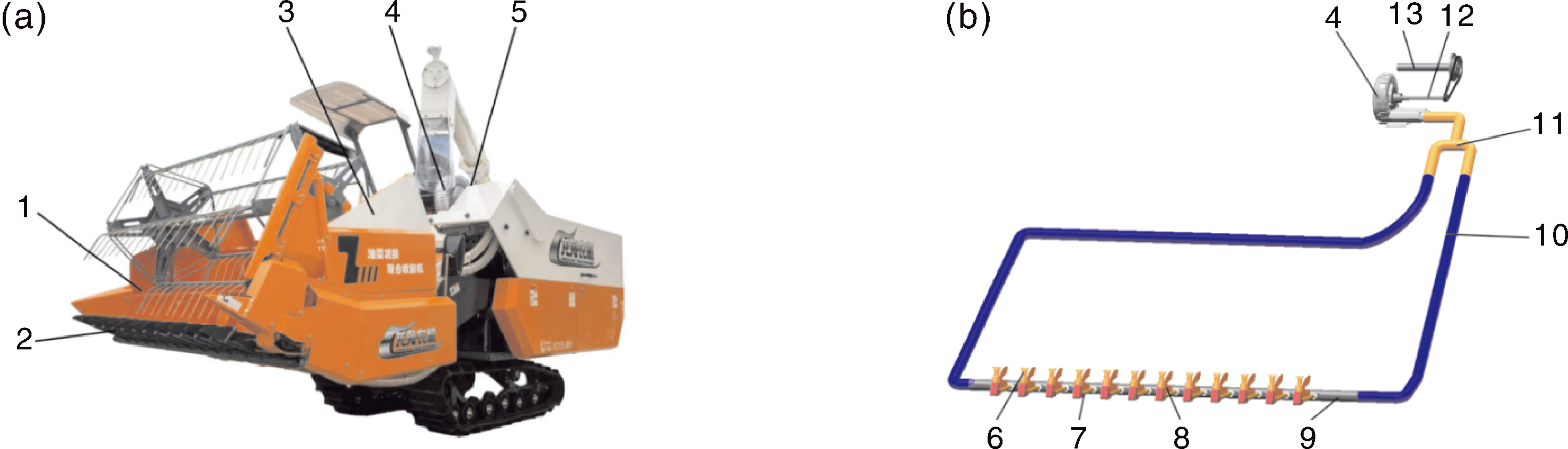
图1 割台气力回收装置结构示意图 a,低损失油菜联合收获机气吹式割台样机;b,割台低损失回收气流单元示意图。1,割台;2,供气装置;3,防溅挡板;4,风机;5,传动系统;6,鸭嘴喷头;7,气流支管;8,连接片;9,气流主管;10,气流软管;11,气流分流器;12,风机转轴;13,脱粒输入轴。
Fig.1 Structural schematic diagram of the header pneumatic recovery device a, Prototype of low-loss rapeseed combining harvester with air-blown header; b, Schematic diagram of low loss recovery air supply unit for cutting table. 1, Cutting table; 2, Air supply unit; 3, Splash guard; 4, Blower; 5, Transmission system; 6, Duckbill nozzle; 7, Airflow branch duct; 8, Connection piece; 9, Airflow main duct; 10, Airflow hose; 11, Airflow diverter; 12, Blower rotor shaft; 13, Threshing input shaft.
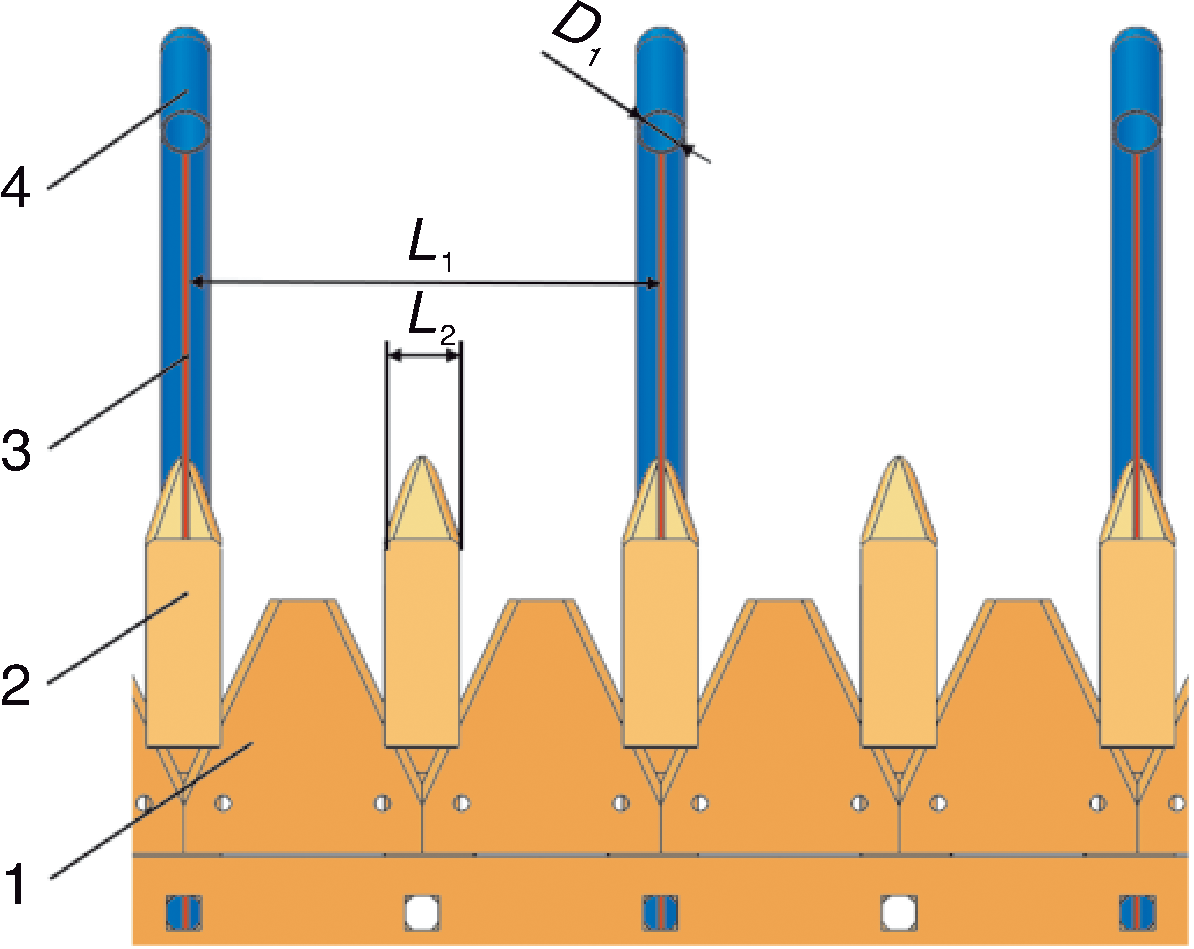
图2 护刃器与气流支管一体化示意图 1,割刀;2,护刃器;3,连接片;4,气流支管。D1,气流支管内径;L1,割刀护刃器间距;L2,护刃器两端垂直距离。
Fig.2 Schematic diagram of the integration of the blade guard and the airflow branch duct 1, Cutter; 2, Blade guard; 3, Connecting piece; 4, Airflow branch duct. D1, Inner diameter of the airflow branch duct; L1, Spacing between the cutter guards; L2, Vertical distance between the two ends of the cutter guard.
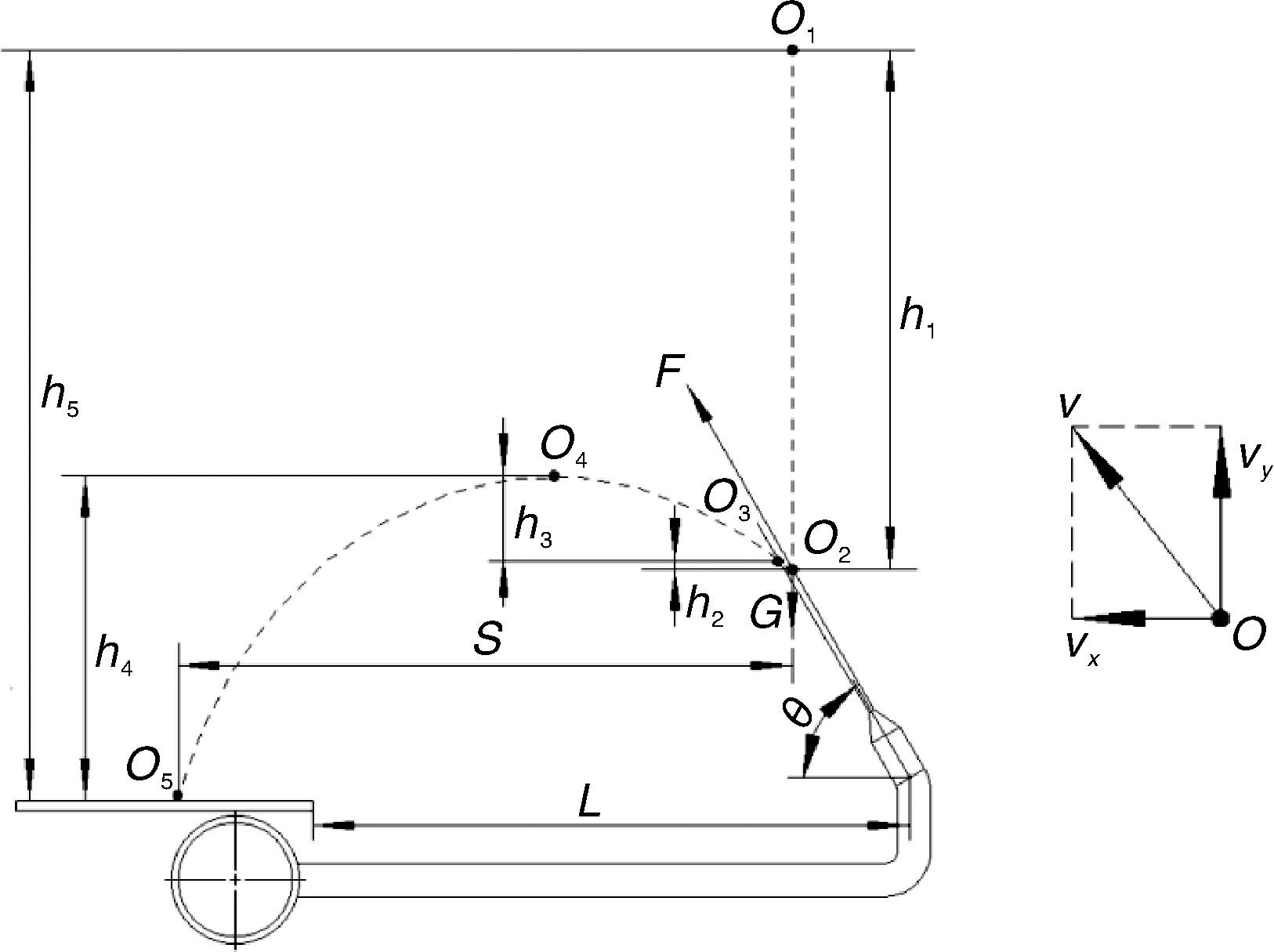
图3 籽粒运动分析图 L,气流支管出口距割刀水平距离(简称水平距离);θ,出口与水平方向倾角(简称水平倾角);vx,籽粒在O点的水平速度;vy,籽粒在O点的竖直速度。
Fig.3 Diagram of grain motion L, Horizontal distance between the outlet of branch airflow duct and the installation point of the horizontal cutter (abbreviated as horizontal distance); θ, Angle of inclination between the outlet and the horizontal direction (abbreviated as horizontal inclination angle); vx, Horizontal velocity of the grain at point O; vy, Vertical velocity of the grain at point O.
| 参数 Parameters | 结构形态 Configuration | 进风口风速/(m·s-1) Wind speed of inlet/(m·s-1) | 气流主管内径/mm Inner diameter of the main airflow duct/mm | 气流支管内径/mm Inner diameter of the branch airflow duct/mm |
|---|---|---|---|---|
| 模型A Model A | 单侧进风Single-side air intake | 60 | 60 | 18 |
| 模型B Model B | 双侧进风Double-side air intake | 30 | 60 | 18 |
| 模型C Model C | 双中通进风Dual-central air intake | 30 | 60 | 18 |
表1 3种气流管道模型参数
Table 1 Parameters of the three airflow duct models
| 参数 Parameters | 结构形态 Configuration | 进风口风速/(m·s-1) Wind speed of inlet/(m·s-1) | 气流主管内径/mm Inner diameter of the main airflow duct/mm | 气流支管内径/mm Inner diameter of the branch airflow duct/mm |
|---|---|---|---|---|
| 模型A Model A | 单侧进风Single-side air intake | 60 | 60 | 18 |
| 模型B Model B | 双侧进风Double-side air intake | 30 | 60 | 18 |
| 模型C Model C | 双中通进风Dual-central air intake | 30 | 60 | 18 |
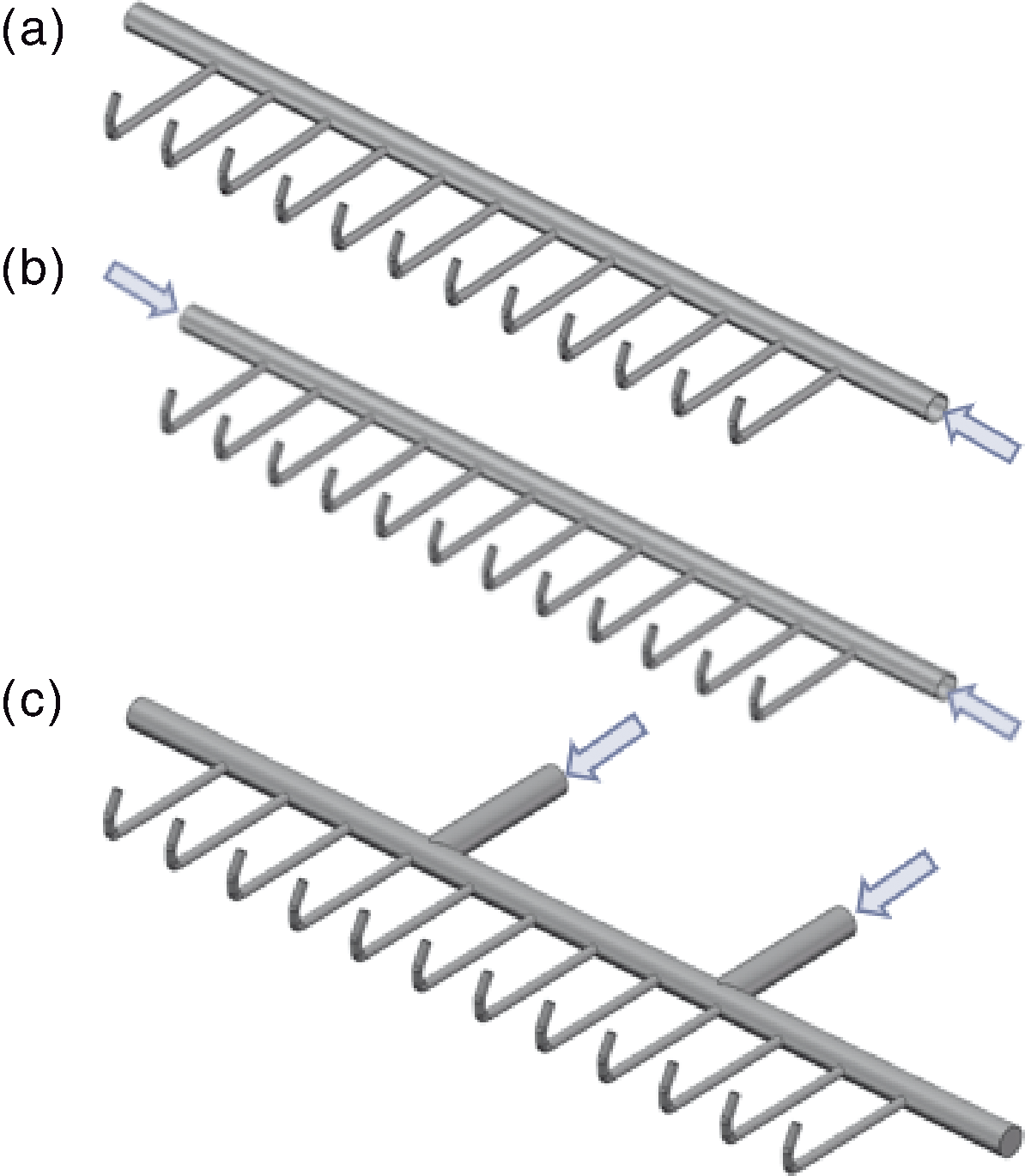
图4 管道模型进风示意图 a,单侧进风管道模型;b,双侧进风管道模型;c,双中通进风管道模型。
Fig.4 Schematic diagram of air intake in the duct model a, Modeling of single-side air intake; b, Modeling of double-side air intake; c, Dual-central air intake.
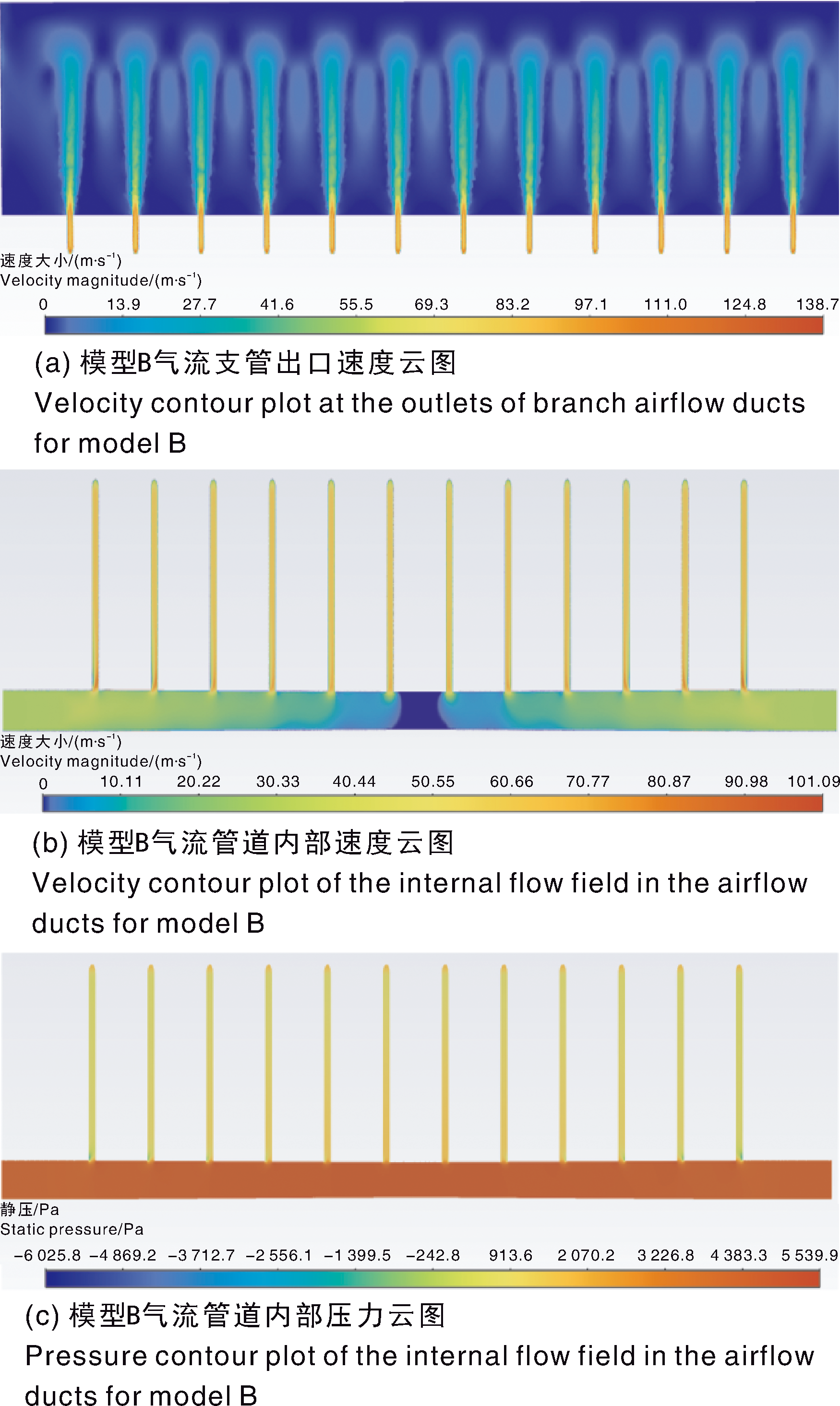
图5 气流管道内部流场
Fig.5 The internal flow field of the airflow duct
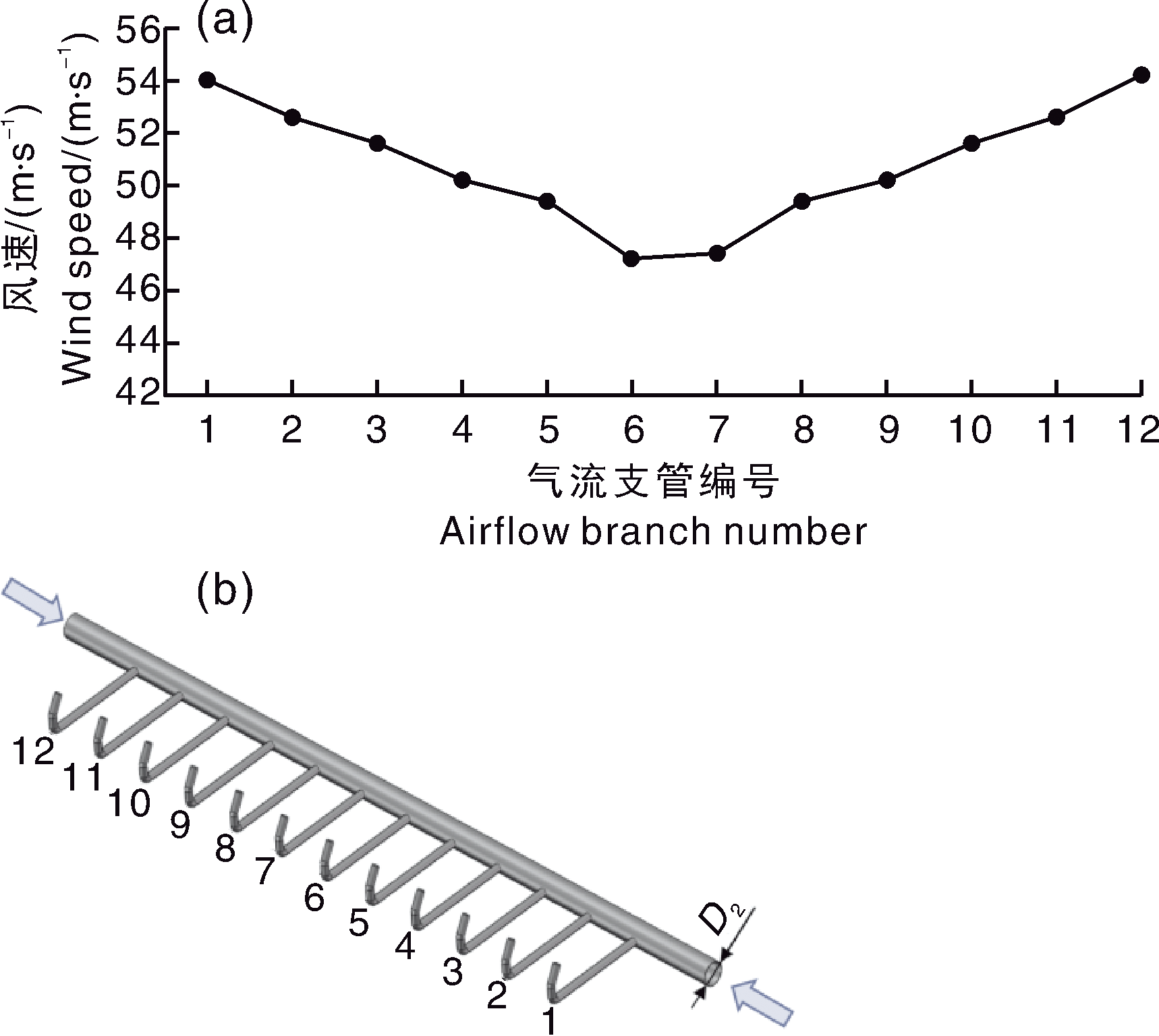
图6 模型B各支管出口风速变化示意图 a,模型B各支管出口风速;b,模型B各支管编号。D2,主管内径。下同。
Fig.6 Schematic diagram of wind speed variation at the outlet of each branch duct in model B a, Wind speed at the outlet of branch ducts for model B; B, Each branch duct number of Model B. D2, Inner diameter of main duct.The same as below.
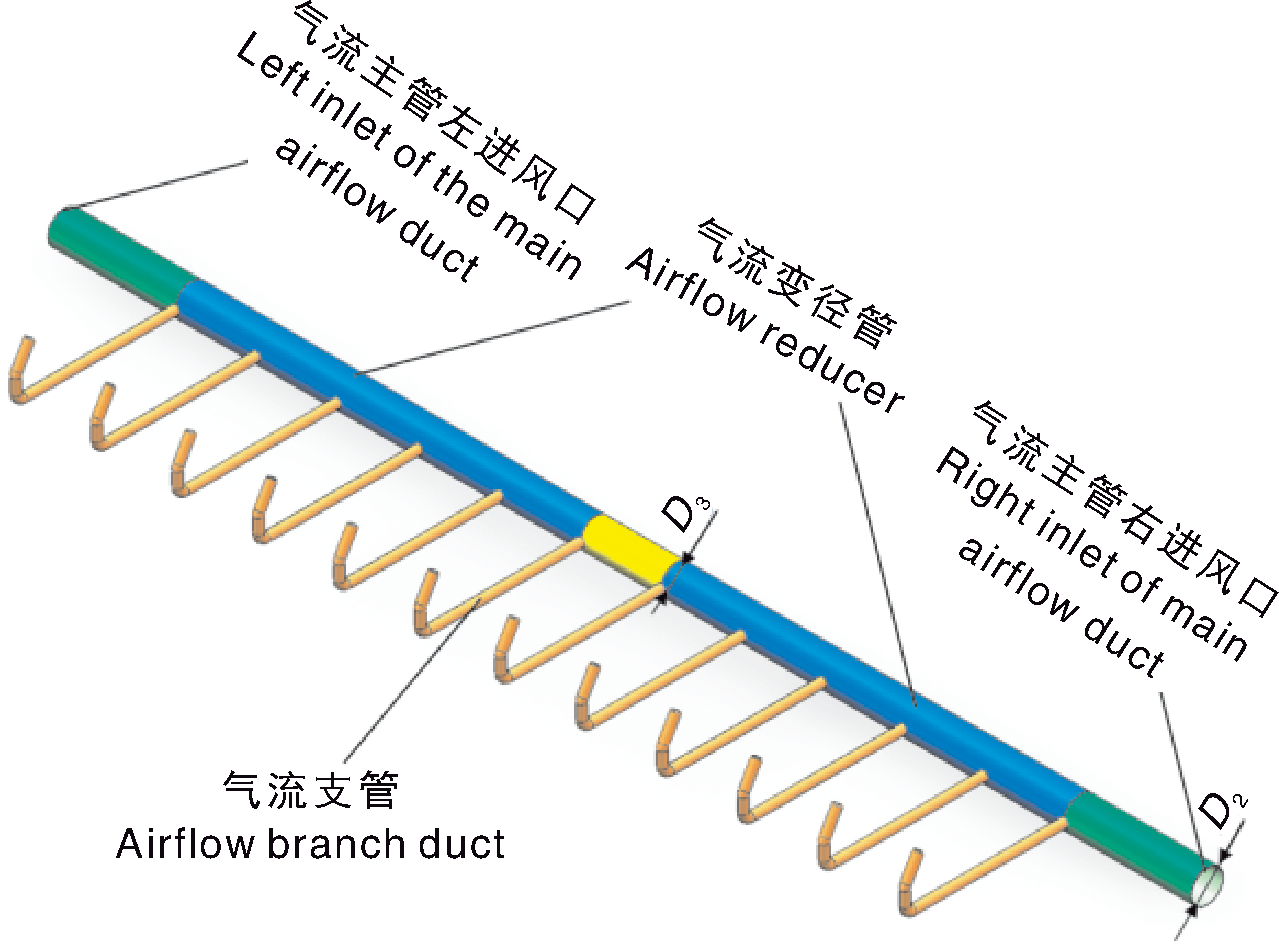
图7 变径管道结构示意图 D3,变径管末端内径。
Fig.7 Schematic diagram of the reducer structure D3, Inner diameter at the end of the reducer.
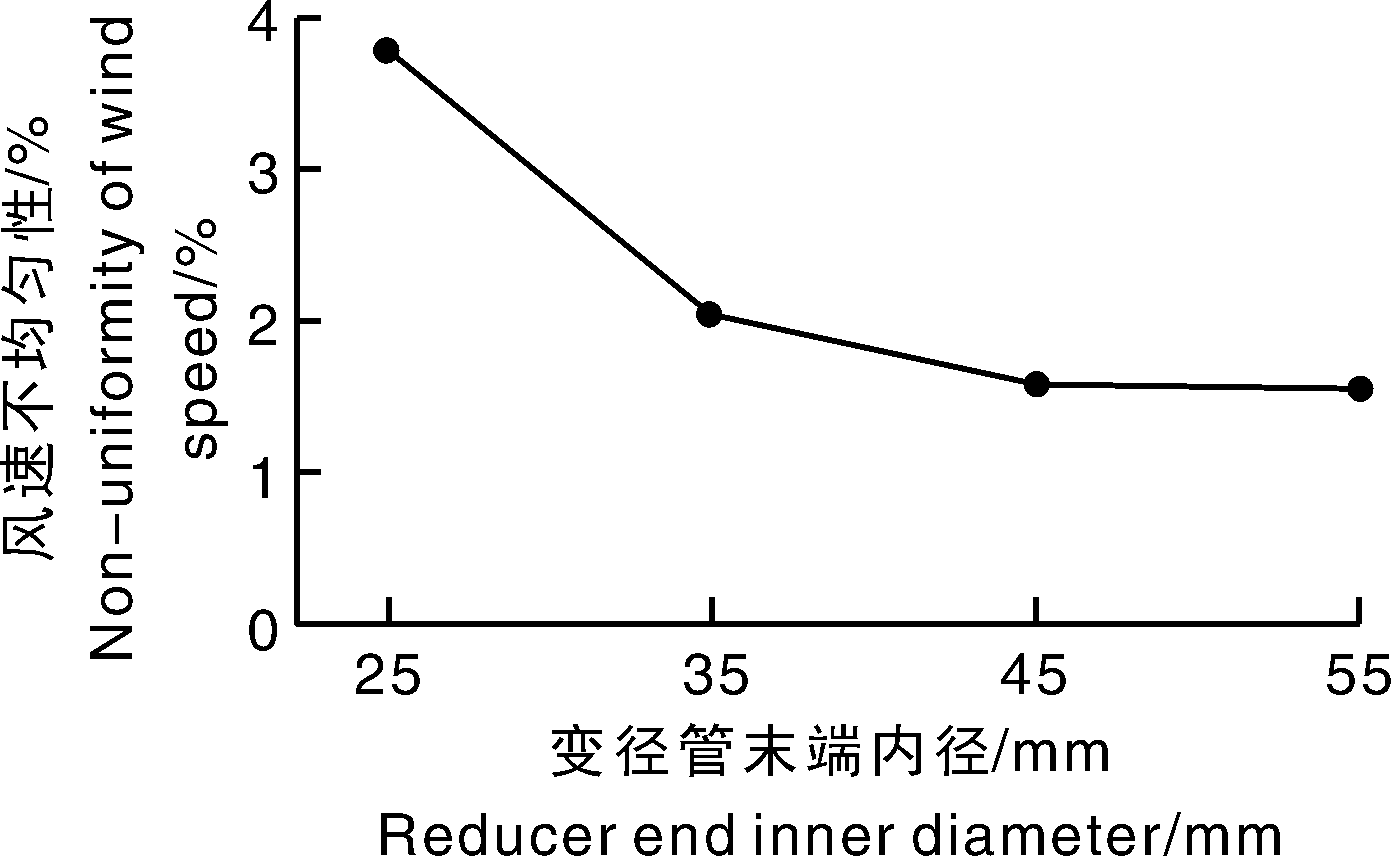
图8 不同变径管末端内径的出口风速不均匀性变化曲线
Fig.8 Wind speed non-uniformity curve at outlet of the reducer with different end inner diameters
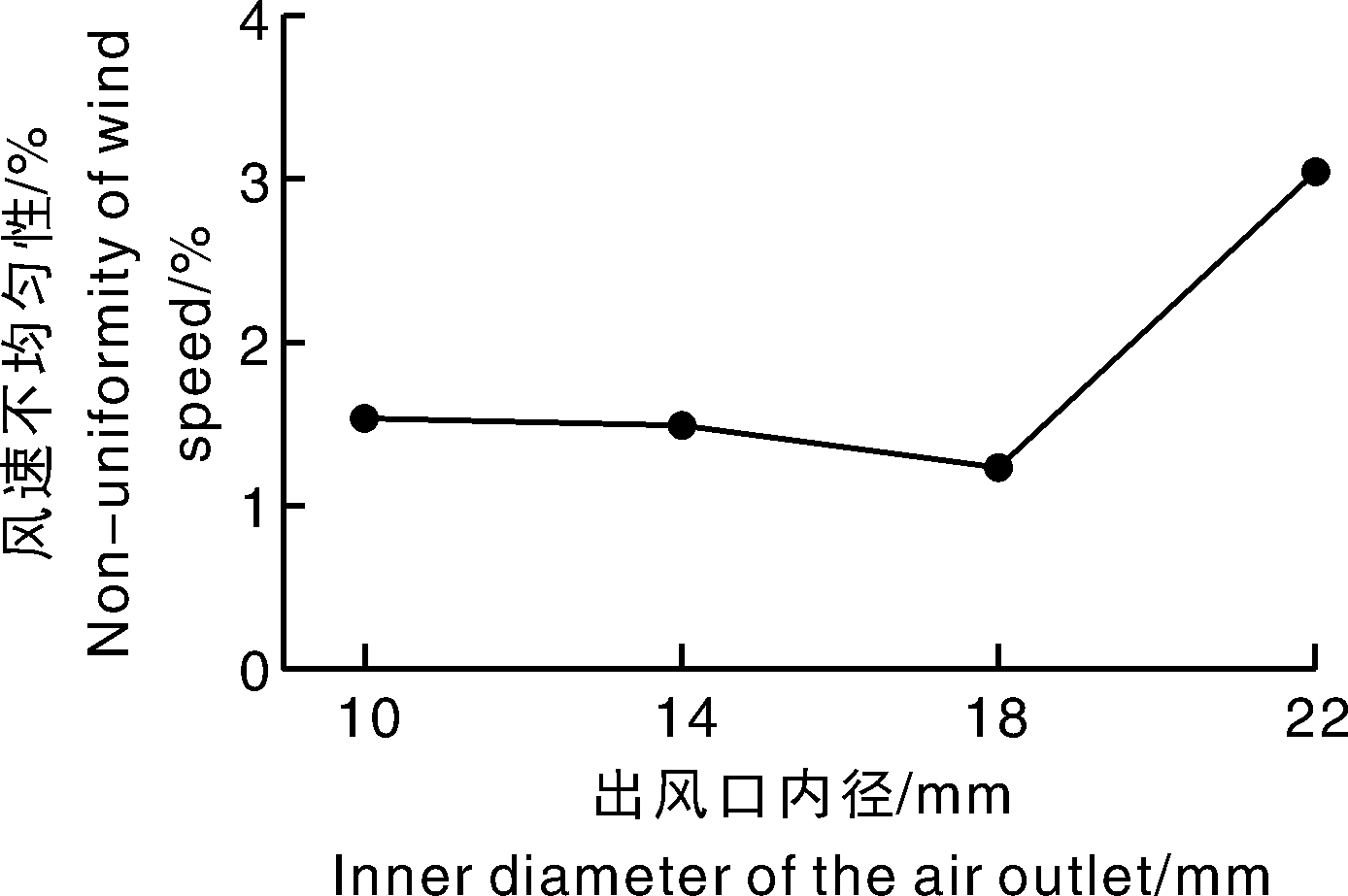
图9 不同支管内径的出口风速不均匀性变化曲线
Fig.9 Wind speed non-uniformity curve at outlet of the branch duct with different inner diameters
| 编码 Code | 因素Factors | ||
|---|---|---|---|
| A | B | C | |
| -1 | 50 | 50 | 14 |
| 0 | 60 | 55 | 18 |
| 1 | 70 | 60 | 22 |
表2 交互试验因素编码
Table 2 Factor code of factorial experiments mm
| 编码 Code | 因素Factors | ||
|---|---|---|---|
| A | B | C | |
| -1 | 50 | 50 | 14 |
| 0 | 60 | 55 | 18 |
| 1 | 70 | 60 | 22 |
| 试验组 Test group | A/mm | B/mm | C/mm | W/% |
|---|---|---|---|---|
| 1 | -1 | -1 | 0 | 2.24 |
| 2 | 1 | -1 | 0 | 1.46 |
| 3 | -1 | 1 | 0 | 2.01 |
| 4 | 1 | 1 | 0 | 2.76 |
| 5 | -1 | 0 | -1 | 1.35 |
| 6 | -1 | 0 | -1 | 1.02 |
| 7 | -1 | 0 | 1 | 3.46 |
| 8 | 1 | 0 | 1 | 3.04 |
| 9 | 0 | -1 | -1 | 1.03 |
| 10 | 0 | 1 | -1 | 1.49 |
| 11 | 0 | -1 | 1 | 3.19 |
| 12 | 0 | 1 | 1 | 3.16 |
| 13 | 0 | 0 | 0 | 1.18 |
| 14 | 0 | 0 | 0 | 1.18 |
表3 试验方案与结果
Table 3 Test protocol and results
| 试验组 Test group | A/mm | B/mm | C/mm | W/% |
|---|---|---|---|---|
| 1 | -1 | -1 | 0 | 2.24 |
| 2 | 1 | -1 | 0 | 1.46 |
| 3 | -1 | 1 | 0 | 2.01 |
| 4 | 1 | 1 | 0 | 2.76 |
| 5 | -1 | 0 | -1 | 1.35 |
| 6 | -1 | 0 | -1 | 1.02 |
| 7 | -1 | 0 | 1 | 3.46 |
| 8 | 1 | 0 | 1 | 3.04 |
| 9 | 0 | -1 | -1 | 1.03 |
| 10 | 0 | 1 | -1 | 1.49 |
| 11 | 0 | -1 | 1 | 3.19 |
| 12 | 0 | 1 | 1 | 3.16 |
| 13 | 0 | 0 | 0 | 1.18 |
| 14 | 0 | 0 | 0 | 1.18 |
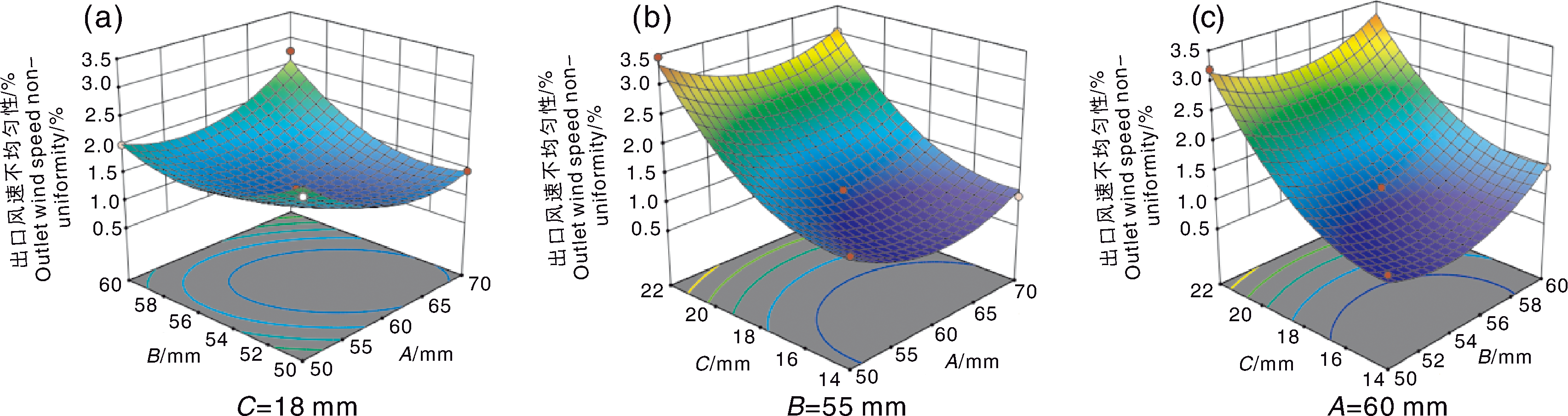
图10 交互因素对出口风速不均匀性影响的响应曲面 A,左右进风口内径;B,变径管末端内径;C,支管出口内径。
Fig.10 Response surface of interaction effects on wind speed non-uniformity at outlet A, Inner diameter of left and right air inlet; B, Inner diameter at the end of the reducer; C, Inner diameter of the branch duct outlet.
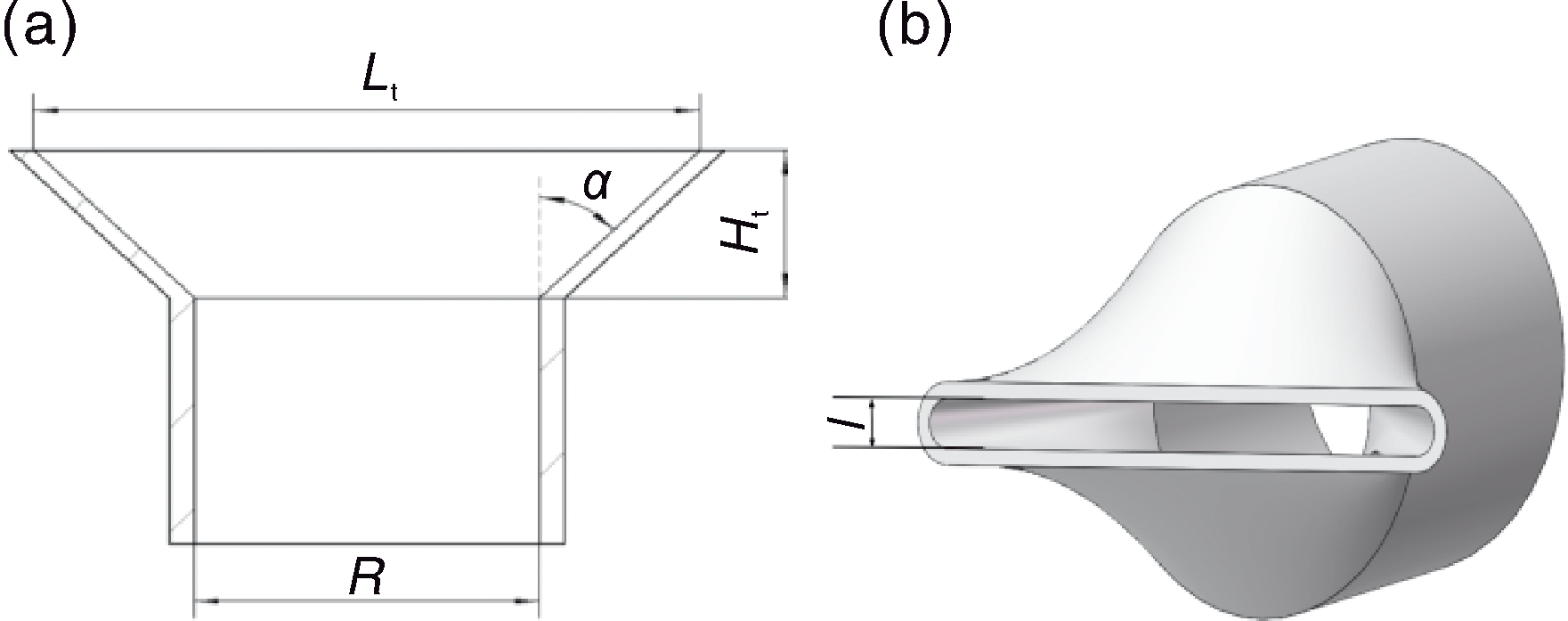
图11 鸭嘴喷头示意图
Fig.11 Schematic diagram of the duckbill nozzle
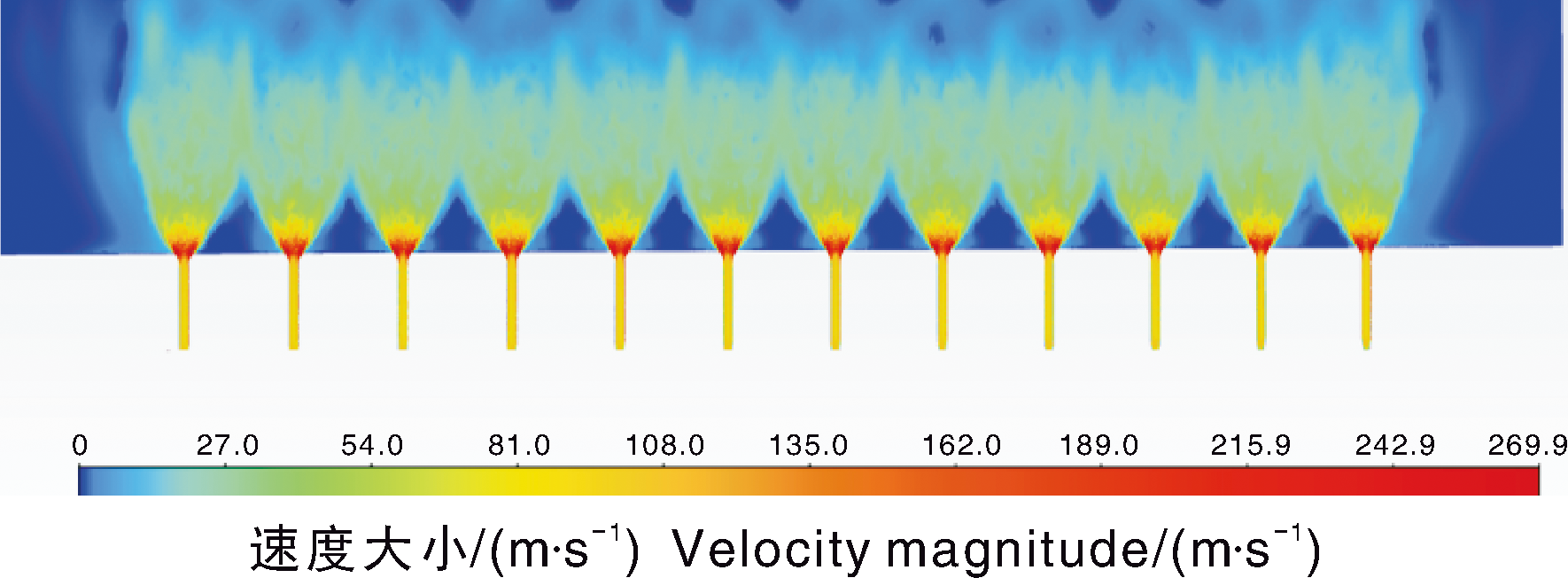
图12 管道出口风速云图
Fig.12 Contour of wind speed at the outlet of the duct
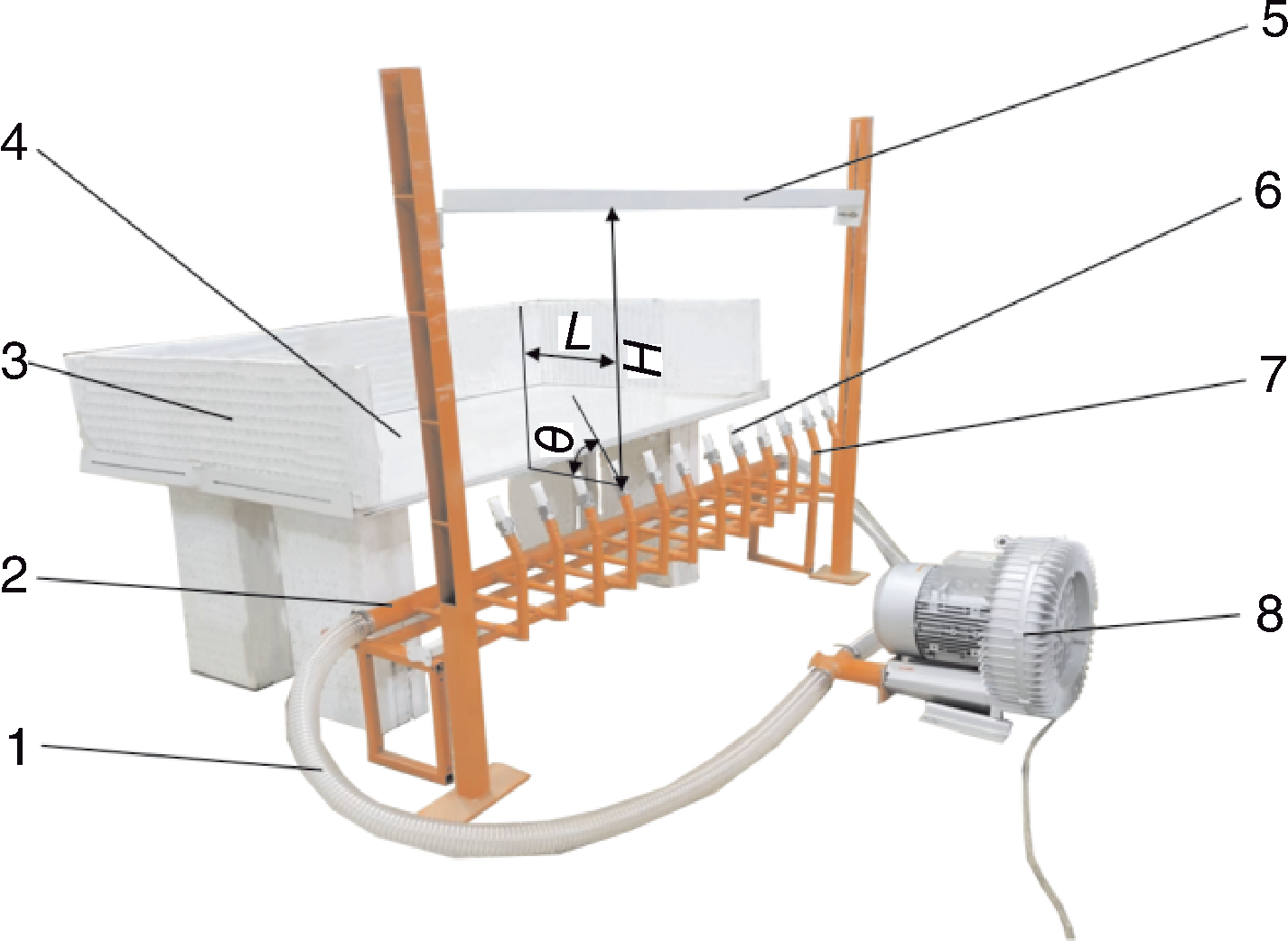
图13 台架试验 1,气流软管;2,气流主管;3,防溅挡板;4,收集平台;5,长槽;6,鸭嘴喷头;7,气流支管;8,风机。H为长槽与收集平台之间的垂直距离。
Fig.13 Bench test 1, Airflow hose; 2, Airflow main duct; 3, Splash guard; 4, Collection platform; 5, Long slot; 6, Duckbill nozzle; 7, Airflow branch duct; 8, Fan. H, Vertical distance from long slot to collection platform.
| 编码 Code | 因素Factors | ||
|---|---|---|---|
| f/Hz | L/mm | θ/(°) | |
| -1 | 30 | 300 | 60 |
| 0 | 40 | 350 | 70 |
| 1 | 50 | 400 | 80 |
表4 台架试验因素编码
Table 4 Factor code of bench test
| 编码 Code | 因素Factors | ||
|---|---|---|---|
| f/Hz | L/mm | θ/(°) | |
| -1 | 30 | 300 | 60 |
| 0 | 40 | 350 | 70 |
| 1 | 50 | 400 | 80 |
| 试验组 Test group | f/Hz | L/mm | θ/(°) | ω/% |
|---|---|---|---|---|
| 1 | -1 | -1 | 0 | 13.2 |
| 2 | 1 | -1 | 0 | 64.6 |
| 3 | -1 | 1 | 0 | 12.8 |
| 4 | 1 | 1 | 0 | 64.8 |
| 5 | -1 | 0 | -1 | 14.4 |
| 6 | 1 | 0 | -1 | 58.7 |
| 7 | -1 | 0 | 1 | 13.8 |
| 8 | 1 | 0 | 1 | 65.4 |
| 9 | 0 | -1 | -1 | 38.6 |
| 10 | 0 | 1 | -1 | 41.3 |
| 11 | 0 | -1 | 1 | 42.2 |
| 12 | 0 | -1 | 1 | 42.3 |
| 13 | 0 | 0 | 0 | 44.1 |
| 14 | 0 | 0 | 0 | 45.7 |
| 15 | 0 | 0 | 0 | 44.4 |
| 16 | 0 | 0 | 0 | 44.9 |
| 17 | 0 | 0 | 0 | 45.8 |
表5 试验设计方案与结果
Table 5 Experimental design and results
| 试验组 Test group | f/Hz | L/mm | θ/(°) | ω/% |
|---|---|---|---|---|
| 1 | -1 | -1 | 0 | 13.2 |
| 2 | 1 | -1 | 0 | 64.6 |
| 3 | -1 | 1 | 0 | 12.8 |
| 4 | 1 | 1 | 0 | 64.8 |
| 5 | -1 | 0 | -1 | 14.4 |
| 6 | 1 | 0 | -1 | 58.7 |
| 7 | -1 | 0 | 1 | 13.8 |
| 8 | 1 | 0 | 1 | 65.4 |
| 9 | 0 | -1 | -1 | 38.6 |
| 10 | 0 | 1 | -1 | 41.3 |
| 11 | 0 | -1 | 1 | 42.2 |
| 12 | 0 | -1 | 1 | 42.3 |
| 13 | 0 | 0 | 0 | 44.1 |
| 14 | 0 | 0 | 0 | 45.7 |
| 15 | 0 | 0 | 0 | 44.4 |
| 16 | 0 | 0 | 0 | 44.9 |
| 17 | 0 | 0 | 0 | 45.8 |
| 方差来源 Source of variance | 平方和 Square sum | 自由度 Degree of freedom | 均方 Mean square | F | p |
|---|---|---|---|---|---|
| 模型Model | 5 127.27 | 9 | 569.70 | 371.12 | <0.000 1 |
| f | 4 965.06 | 1 | 4 965.06 | 3 234.42 | <0.000 1 |
| L | 0.845 0 | 1 | 0.845 0 | 0.550 5 | 0.442 3 |
| θ | 14.31 | 1 | 14.31 | 9.32 | 0.018 5 |
| fL | 0.090 0 | 1 | 0.090 0 | 0.058 6 | 0.815 6 |
| fθ | 13.32 | 1 | 13.32 | 8.68 | 0.021 5 |
| Lθ | 1.69 | 1 | 1.69 | 1.10 | 0.326 9 |
| f2 | 88.23 | 1 | 88.23 | 57.47 | 0.000 1 |
| L2 | 10.15 | 1 | 10.15 | 6.61 | 0.036 9 |
| θ2 | 22.81 | 1 | 22.81 | 14.86 | 0.006 3 |
| 残差Residual | 10.75 | 7 | 1.54 | ||
| 失拟项Lack of fit | 8.44 | 3 | 2.81 | 4.87 | 0.080 0 |
| 总和Total | 5 138.02 | 16 |
表6 回归方程方差分析
Table 6 Analysis of variance for the regression equation
| 方差来源 Source of variance | 平方和 Square sum | 自由度 Degree of freedom | 均方 Mean square | F | p |
|---|---|---|---|---|---|
| 模型Model | 5 127.27 | 9 | 569.70 | 371.12 | <0.000 1 |
| f | 4 965.06 | 1 | 4 965.06 | 3 234.42 | <0.000 1 |
| L | 0.845 0 | 1 | 0.845 0 | 0.550 5 | 0.442 3 |
| θ | 14.31 | 1 | 14.31 | 9.32 | 0.018 5 |
| fL | 0.090 0 | 1 | 0.090 0 | 0.058 6 | 0.815 6 |
| fθ | 13.32 | 1 | 13.32 | 8.68 | 0.021 5 |
| Lθ | 1.69 | 1 | 1.69 | 1.10 | 0.326 9 |
| f2 | 88.23 | 1 | 88.23 | 57.47 | 0.000 1 |
| L2 | 10.15 | 1 | 10.15 | 6.61 | 0.036 9 |
| θ2 | 22.81 | 1 | 22.81 | 14.86 | 0.006 3 |
| 残差Residual | 10.75 | 7 | 1.54 | ||
| 失拟项Lack of fit | 8.44 | 3 | 2.81 | 4.87 | 0.080 0 |
| 总和Total | 5 138.02 | 16 |
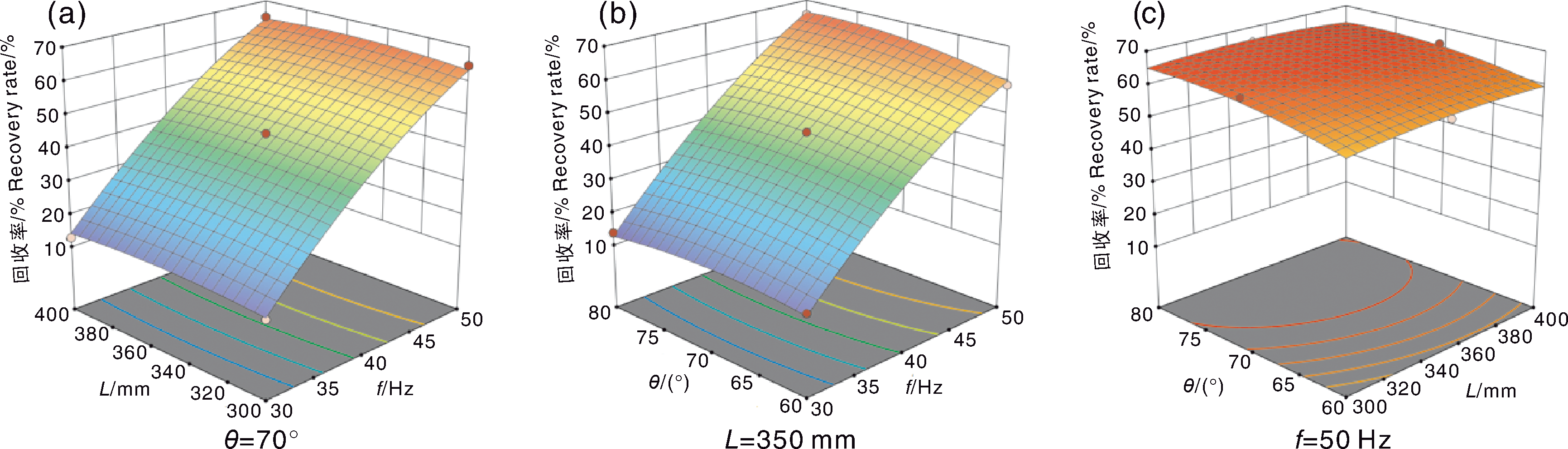
图14 交互因素对回收率影响的响应曲面 f,风机工作频率;L,水平距离;θ,水平倾角。
Fig.14 Response surface of the effect of interaction factors on the recovery rate f, Frequency; L, Horizontal distance; θ, Horizontal inclination.
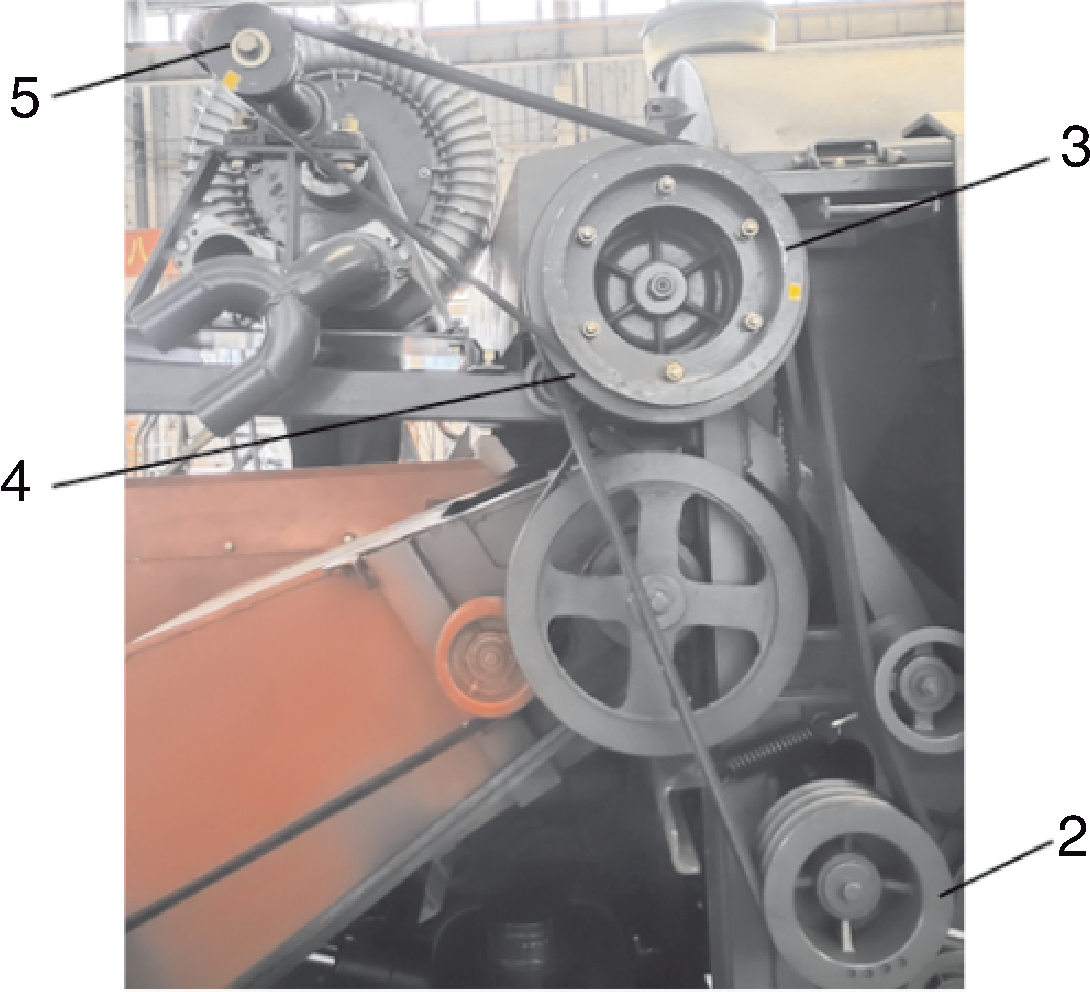
图15 风机传动安装图
Fig.15 Fan drive system installation diagram
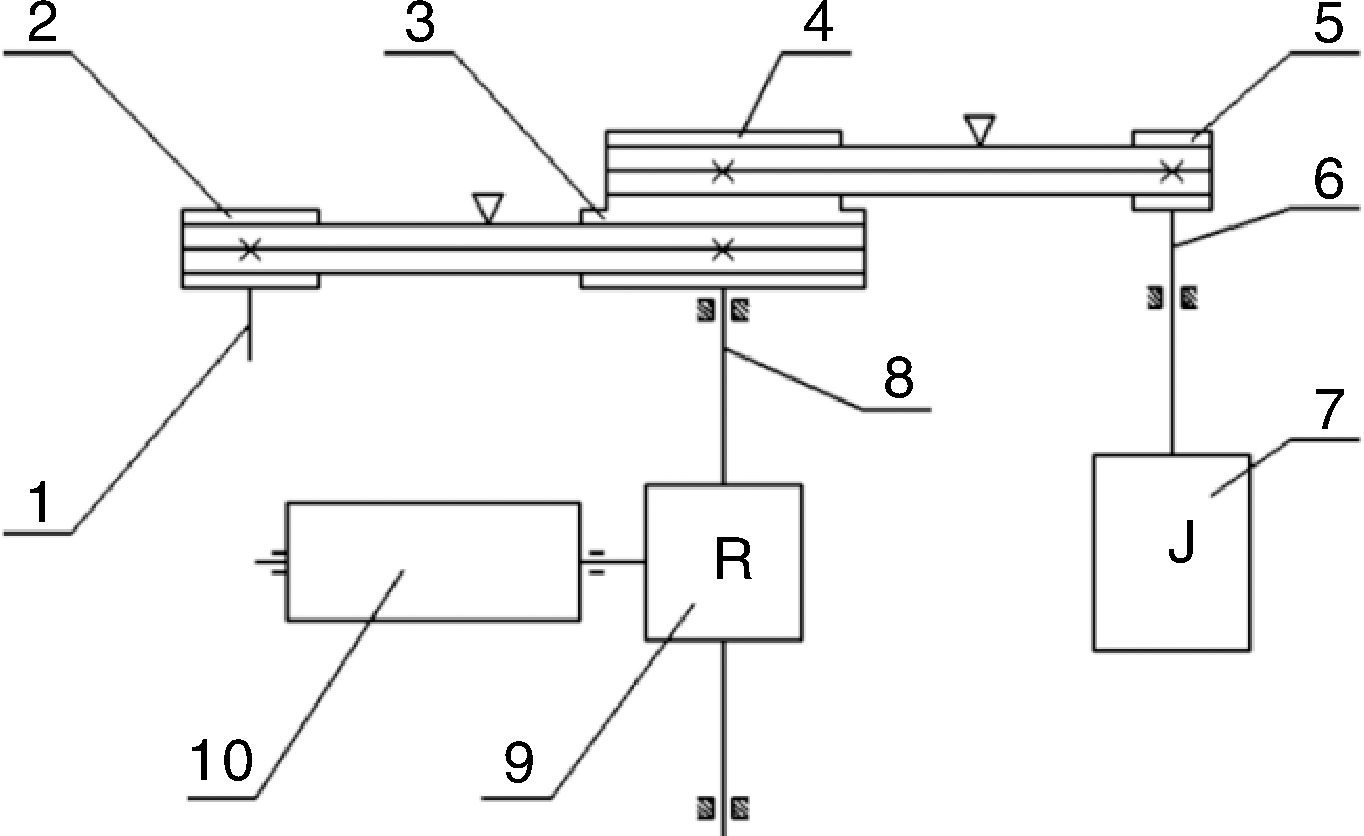
图16 风机传动系统简图 1,收获机贯流风机轴;2,贯流风机皮带轮;3,脱粒复式皮带轮(Ⅰ);4,脱粒复式皮带轮(Ⅱ);5,风机皮带轮;6,风机轴;7,风机;8,脱粒输入轴;9,换向装置;10,脱粒滚筒。
Fig.16 Schematic diagram of fan drive system 1, Harvester cross-flow fan shaft; 2, Cross-flow fan pulley; 3, Threshing compound pulley (Ⅰ); 4, Threshing compound pulley (Ⅱ); 5, Fan pulley; 6, Fan shaft; 7, Fan; 8, Threshing input shaft; 9, Commutator; 10, Threshing roller.
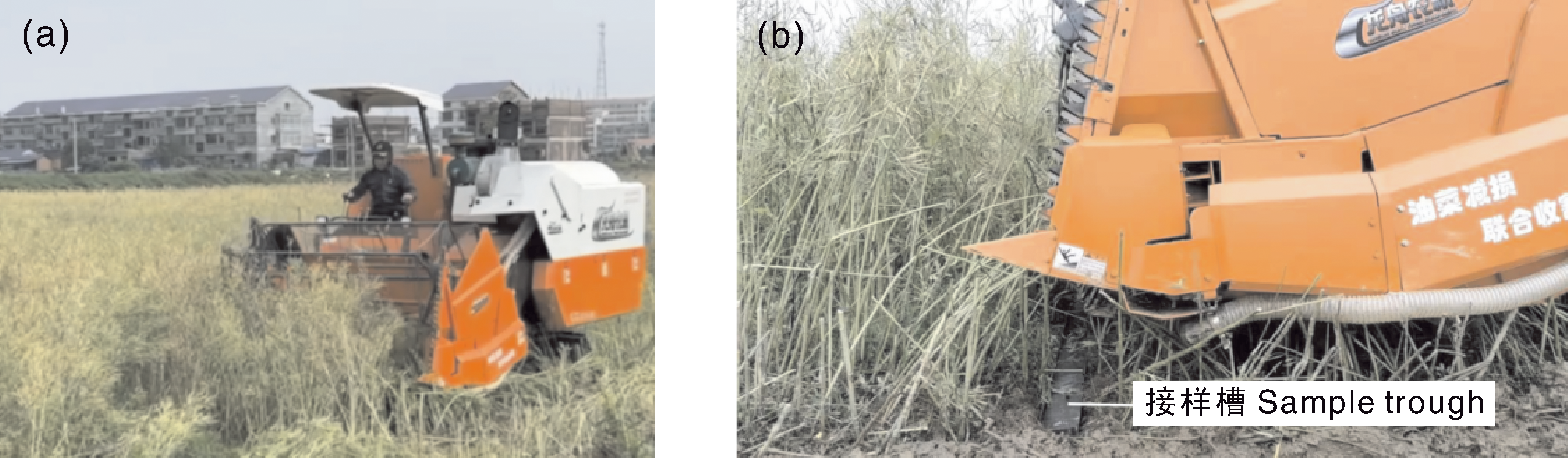
图17 田间试验
Fig.17 Field test
| 试验序号 Test number | 前进速度/(m·s-1) Forward speed/(m·s-1) | 接样槽回收总质量/g Total mass collected in sample trough/g | 割台损失质量/(g·m-2) Header loss mass/(g·m-2) | 割台损失率/% Header loss rate/% |
|---|---|---|---|---|
| 1 | 1.12 | 2.88 | 4.80 | 2.41 |
| 2 | 1.04 | 3.72 | 6.20 | 3.11 |
| 3 | 1.08 | 3.27 | 5.45 | 2.73 |
| 平均值Average value | 1.08 | 3.29 | 5.48 | 2.75 |
表7 田间试验结果
Table 7 Results of field experiments
| 试验序号 Test number | 前进速度/(m·s-1) Forward speed/(m·s-1) | 接样槽回收总质量/g Total mass collected in sample trough/g | 割台损失质量/(g·m-2) Header loss mass/(g·m-2) | 割台损失率/% Header loss rate/% |
|---|---|---|---|---|
| 1 | 1.12 | 2.88 | 4.80 | 2.41 |
| 2 | 1.04 | 3.72 | 6.20 | 3.11 |
| 3 | 1.08 | 3.27 | 5.45 | 2.73 |
| 平均值Average value | 1.08 | 3.29 | 5.48 | 2.75 |
| [1] | 张哲, 殷艳, 刘芳, 等. 我国油菜多功能开发利用现状及发展对策[J]. 中国油料作物学报, 2018, 40(5): 618-623. |
| ZHANG Z, YIN Y, LIU F, et al. Current situation and development countermeasures of Chinese rapeseed multifunctional development and utilization[J]. Chinese Journal of Oil Crop Sciences, 2018, 40(5): 618-623. | |
| [2] | 胡志勇, 鲜孟筑, 李俊. 我国油菜品种改良现状及发展趋势[J]. 中国农业大学学报, 2024, 29(3): 50-62. |
| HU Z Y, XIAN M Z, LI J. Current situation and development trends of rapeseed variety improvement in China[J]. Journal of China Agricultural University, 2024, 29(3): 50-62. | |
| [3] | 郑娟, 黄凰, 廖宜涛, 等. 长江中游地区油菜生产全程机械化技术进展与建议[J]. 中国油料作物学报, 2024, 46(2): 245-259. |
| ZHENG J, HUANG H, LIAO Y T, et al. Progress and suggestions on full mechanization of rapeseed production in the middle reaches of the Yangtze River[J]. Chinese Journal of Oil Crop Sciences, 2024, 46(2): 245-259. | |
| [4] | 李勤, 刘小焱, 盛紫微, 等. 我国油菜适合机械化收获关键农艺性状研究进展[J]. 中国油料作物学报, 2023, 45(5): 1053-1061. |
| LI Q, LIU X Y, SHENG Z W, et al. Research progress on target agronomic traits for mechanized harvesting of rapeseed in China[J]. Chinese Journal of Oil Crop Sciences, 2023, 45(5): 1053-1061. | |
| [5] | 马丽娜, 魏俊逸, 黄小毛, 等. 油菜联合收获机割台振动对田间收获落粒影响分析[J]. 农业机械学报, 2020, 51(S2): 134-138. |
| MA L N, WEI J Y, HUANG X M, et al. Analysis of the effect of oilseed rape combine harvester cutting table vibration on field harvesting grain drop[J]. Transactions of the Chinese Society for Agricultural Machinery, 2020, 51(S2): 134-138. | |
| [6] | 冉军辉, 沐森林, 李海同, 等. 油菜联合收获机往复式双动割刀行星轮驱动器设计与试验[J]. 农业工程学报, 2020, 36(9): 17-25. |
| RAN J H, MU S L, LI H T, et al. Design and test of planet gear driver of reciprocating double-acting cutter for rapeseed combine harvester[J]. Transactions of the Chinese Society of Agricultural Engineering, 2020, 36(9): 17-25. | |
| [7] | 周玉姣, 罗斌, 刘定炜, 等. 4LZ-4.0谷物联合收获机油菜割台设计与试验[J]. 中国农机化学报, 2023, 44(9): 22-27. |
| ZHOU Y J, LUO B, LIU D W, et al. Design and experiment of rape cutter in 4LZ-4.0 grain combine harvester[J]. Journal of Chinese Agricultural Mechanization, 2023, 44(9): 22-27. | |
| [8] | 李海同, 万星宇, 王华, 等. 油菜联合收获机集成式纵轴流脱离装置设计与试验[J]. 农业机械学报, 2017, 48(5): 108-116. |
| LI H T, WAN X Y, WANG H, et al. Design and experiment on integrated longitudinal axial flow threshing and separating device of rape combine harvester[J]. Transactions of the Chinese Society for Agricultural Machinery, 2017, 48(5): 108-116. | |
| [9] | 关卓怀, 吴崇友, 王刚, 等. 油菜联合收割机双向电驱动分行竖割刀设计[J]. 农业工程学报, 2019, 35(3): 1-8. |
| GUAN Z H, WU C Y, WANG G, et al. Design of bidirectional electric driven side vertical cutter for rape combine harvester[J]. Transactions of the Chinese Society of Agricultural Engineering, 2019, 35(3): 1-8. | |
| [10] | 马丽娜, 魏俊逸, 黄小毛, 等. 4LL-1.5Y型履带式油菜联合收获机割台振动分析[J]. 安徽农业大学学报, 2019, 46(4): 723-727. |
| MA L N, WEI J Y, HUANG X M, et al. Vibration analysis of cutting table of 4LL-1.5Y crawler rape combine harvester[J]. Journal of Anhui Agricultural University, 2019, 46(4): 723-727. | |
| [11] | 宗望远, 黄小毛, 潘海兵, 等. 下落油菜籽粒在无秸秆正压纵向气流场中的漂移特性[J]. 农业工程学报, 2015, 31(3): 70-76. |
| ZONG W Y, HUANG X M, PAN H B, et al. Drifting property of falling oil rape seeds in longitudinal positive pressure airflow field without stalks[J]. Transactions of the Chinese Society of Agricultural Engineering, 2015, 31(3): 70-76. | |
| [12] | 黄小毛, 查显涛, 宗望远, 等. 油菜联合收获割台落粒横流气压收集装置设计与试验[J]. 农业机械学报, 2016, 47(S1): 227-233. |
| HUANG X M, ZHA X T, ZONG W Y, et al. Design and test of an air-pressure collection device for fallen-grain crossflow in the cutting table of oilseed rape combine harvesters[J]. Transactions of the Chinese Society for Agricultural Machinery, 2016, 47(S1): 227-233. | |
| [13] | 李毅念, 易应武, 杜世伟, 等. 小区谷物联合收获机气吹式割台设计与试验[J]. 农业机械学报, 2017, 48(6): 79-87. |
| LI Y N, YI Y W, DU S W, et al. Design and experiment on air blowing header of plot combine harvester for grain[J]. Transactions of the Chinese Society for Agricultural Machinery, 2017, 48(6): 79-87. | |
| [14] | 王朕, 黄浩, 易应武, 等. 小型油菜联合收割机吹禾气流管道结构优化设计与试验[J]. 中国农机化学报, 2020, 41(9): 16-24. |
| WANG Z, HUANG H, YI Y W, et al. Optimization design and test of air-flow pipe structure in small-scale rape combined harvester[J]. Journal of Chinese Agricultural Mechanization, 2020, 41(9): 16-24. | |
| [15] | 关卓怀, 江涛, 沐森林, 等. 正负气压式油菜割台分行落粒回收装置设计与试验[J]. 农业机械学报, 2022, 53(7): 103-112. |
| GUAN Z H, JIANG T, MU S L, et al. Development and test of positive and negative pressure combined side knife cutting scattered seed recovery device for rapeseed header[J]. Transactions of the Chinese Society for Agricultural Machinery, 2022, 53(7): 103-112. | |
| [16] | 陈子民, 莫江婷, 陈广生, 等. 基于Fluent的顶风式热泵干燥箱气流场分析及优化[J]. 中国农业科技导报, 2024, 26(10): 135-144. |
| CHEN Z M, MO J T, CHEN G S, et al. Analysis and optimization of the airflow field in a head-air heat pump dryer based on fluent[J]. Journal of Agricultural Science and Technology, 2024, 26(10): 135-144. | |
| [17] | 李衍军, 刘瑞, 刘春晓, 等. 气送式排种器输种管内种子速度耦合仿真测定与试验[J]. 农业机械学报, 2021, 52(4): 54-61. |
| LI Y J, LIU R, LIU C X, et al. Simulation and test of seed velocity coupling in seed tube of pneumutic seed metering device[J]. Transactions of the Chinese Society for Agricultural Machinery, 2021, 52(4): 54-61. | |
| [18] | 陈树人, 肖君, 饶师任, 等. 黄花苜蓿收获机吹送装置气流速度场CFD分析[J]. 农业工程学报, 2016, 32(12): 39-46. |
| CHEN S R, XIAO J, RAO S R, et al. CFD numerical analysis of airflow blowing velocity-field of Medicago hispida harvester[J]. Transactions of the Chinese Society of Agricultural Engineering, 2016, 32(12): 39-46. | |
| [19] | 邱威, 丁为民, 傅锡敏, 等. 果园喷雾机圆环双流道风机的设计与试验[J]. 农业工程学报, 2012, 28(12): 13-17. |
| QIU W, DING W M, FU X M, et al. Design and experiment of ring double-channel fan for spraying machine in orchard[J]. Transactions of the Chinese Society of Agricultural Engineering, 2012, 28(12): 13-17. | |
| [20] | 邱威, 缪佳佳, 李小龙, 等. 果园多通道定向风送雾化装置设计与试验[J]. 南京农业大学学报, 2020, 43(3): 547-555. |
| QIU W, MIAO J J, LI X L, et al. Design and experiment of multi-channel directional atomizer for orchard sprayer[J]. Journal of Nanjing Agricultural University, 2020, 43(3): 547-555. | |
| [21] | 邱威, 邬伊浩, 周慧能, 等. 温室风幕式施药装置设计与试验[J]. 南京农业大学学报, 2023, 46(2): 405-415. |
| QIU W, WU Y H, ZHOU H N, et al. Design and test of greenhouse air curtain spraying device[J]. Journal of Nanjing Agricultural University, 2023, 46(2): 405-415. | |
| [22] | 吴崇友, 肖圣元, 金梅. 油菜联合收获与分段收获效果比较[J]. 农业工程学报, 2014, 30(17): 10-16. |
| WU C Y, XIAO S Y, JIN M. Comparation on rape combine harvesting and two-stage harvesting[J]. Transactions of the Chinese Society of Agricultural Engineering, 2014, 30(17): 10-16. | |
| [23] | 冯健, 李丹阳, 吴传云, 等. 油菜籽联合收获机作业效果综合测评[J]. 中国农机化学报, 2023, 44(1): 65-68. |
| FENG J, LI D Y, WU C Y, et al. Comprehensive testing on working effects of the rapeseed combine harvesters[J]. Journal of Chinese Agricultural Mechanization, 2023, 44(1): 65-68. | |
| [24] | 吴传云, 冯健, 陈兴和, 等. 油菜联合机收与分段机收作业效果综合测评[J]. 中国农机化学报, 2024, 45(2): 1-6. |
| WU C Y, FENG J, CHEN X H, et al. Comprehensive evaluation of the effectiveness of combined and segmented rapeseedharvesting operations[J]. Journal of Chinese Agricultural Mechanization, 2024, 45(2): 1-6. |
| [1] | 董智超, 岳宁燕, 吕魏, 余晓燚, 郑凯文, 宋海星, 陈海飞. 高、低含油量油菜品种的产量、品质和氮利用效率对施氮量的响应差异[J]. 浙江农业学报, 2025, 37(5): 998-1008. |
| [2] | 裴大妹, 赵洪平, 王龙, 李华欣, 赵志, 肖麓. 白菜型油菜分枝角度主基因+多基因混合遗传模型分析[J]. 浙江农业学报, 2025, 37(4): 745-753. |
| [3] | 陈威, 朱怡航, 顾清, 林宝刚, 张小斌. 基于机器视觉和YOLOv5的油菜角果表型参数分析[J]. 浙江农业学报, 2024, 36(6): 1379-1388. |
| [4] | 沈宇峰, 罗海峰, 吴明亮, 官春云. 油菜脱出物双向切流喂入式旋风分离清选装置的设计与试验[J]. 浙江农业学报, 2023, 35(5): 1178-1186. |
| [5] | 姚彦林, 马骊, 刘丽君, 蒲媛媛, 李学才, 王旺田, 方彦, 孙万仓, 武军艳. 白菜型油菜开花调控基因BrFT的生物信息学特性和表达分析[J]. 浙江农业学报, 2023, 35(5): 992-1000. |
| [6] | 徐洋, 任奕林, 王浩杰, 黄秋航, 邢博源, 曹红亮. 不同制备条件下油菜秸秆生物炭用作缓释载体的综合评价[J]. 浙江农业学报, 2023, 35(4): 893-902. |
| [7] | 许耀照, 曾秀存, 王振朝, 党仕卓, 刘永晶. NaCl胁迫对冬油菜种子萌发和生理特性的影响[J]. 浙江农业学报, 2023, 35(3): 499-508. |
| [8] | 郎春秀, 刘仁虎, 郑滔, 王伏林, 石江华, 胡张华, 吴关庭. 化学诱变获得甘蓝型油菜矮秆突变新种质[J]. 浙江农业学报, 2023, 35(11): 2516-2524. |
| [9] | 李虹桥, 赖莹, 母娜, 严红梅, 汤维群, 蒋小灵, 高雯, 吴永成. 密度对不同株高油菜冠层结构与群体光合能力的影响[J]. 浙江农业学报, 2022, 34(3): 419-427. |
| [10] | 冯玮, 李朋朋, 宋鹏. 甘蓝型油菜Kunitz蛋白酶抑制剂的异源表达与理化特征分析[J]. 浙江农业学报, 2022, 34(1): 112-119. |
| [11] | 陈纪鹏, 刘小林, 李生强, 刘显军, 胡月清, 陈桃. 白菜型油菜黄芽白与甘蓝型油菜湘油15种间杂交及其杂种后代的遗传学特征[J]. 浙江农业学报, 2021, 33(7): 1170-1176. |
| [12] | 李诗涛, 张王菲, 赵丽仙, 王熙媛. 基于时序PolSAR影像与决策树模型的油菜物候期识别[J]. 浙江农业学报, 2021, 33(11): 2116-2127. |
| [13] | 练华山, 李欣欣, 林立金, 廖明安. 表油菜素内酯对夏黑葡萄幼苗生长的影响[J]. 浙江农业学报, 2021, 33(10): 1889-1896. |
| [14] | 熊廷浩, 黄益国, 周旋, 鲁艳红, 资涛, 胡宇倩, 宋海星. 湖南省油菜主产区土壤养分含量与重金属污染风险评价[J]. 浙江农业学报, 2021, 33(10): 1904-1912. |
| [15] | 张仕林, 戴飞, 赵武云, 田斌, 陈邦善. 青稞联合收获机配套秸秆打捆装置设计与试验[J]. 浙江农业学报, 2020, 32(7): 1289-1301. |
| 阅读次数 | ||||||
|
全文 |
|
|||||
|
摘要 |
|
|||||

