浙江农业学报 ›› 2026, Vol. 38 ›› Issue (4): 745-754.DOI: 10.3969/j.issn.1004-1524.20250420
基于吡虫啉生态风险值的鸡粪稻田承载力估算
楚天舒1( ), 朱克白2, 杨宇辰2, 贺雪妮2, 赵智强3, 戴子扬4, 程沈航5, 汤树生6,*()
- 1
中国农业大学 资源与环境学院 北京 100193
2中国农业大学 工学院 北京 100083
3南方科技大学 环境科学与工程学院 广东 深圳 518055
4西北农林科技大学 动物医学院 陕西 杨凌 712199
5山西大学 合成生物学院 山西 太原 030006
6中国农业大学 动物医学院 北京 100193
-
收稿日期:2025-06-04出版日期:2026-04-25发布日期:2026-05-08 -
作者简介:汤树生, E-mail:tssfj@163.com
楚天舒,主要从事农业资源高效利用与环境保护研究。E-mail:chuts@cau.edu.cn -
通讯作者:汤树生 -
基金资助:国家重点研发计划(2023YFD1801105)
Estimation on paddy field carrying capacity of chicken manure based on imidacloprid ecological risk value
CHU Tianshu1(), ZHU Kebai2, YANG Yuchen2, HE Xueni2, ZHAO Zhiqiang3, DAI Ziyang4, CHENG Shenhang5, TANG Shusheng6,*()
- 1
College of Resources and Environmental Sciences ,China Agricultural University Beijing 100193, China
2College of Engineering ,China Agricultural University Beijing 100083, China
3School of Environmental Science and Engineering ,Southern University of Science and Technology Shenzhen 518055, Guangdong, China
4College of Veterinary Medicine ,Northwest A&F University Yangling 712199, Shaanxi, China
5School of Synthetic Biology ,Shanxi University Taiyuan 030006, China
6College of Veterinary Medicine ,China Agricultural University Beijing 100193, China
-
Received:2025-06-04Published:2026-04-25Online:2026-05-08 -
Contact:TANG Shusheng

摘要:
为探究农药残留是否会限制粪肥还田量与畜禽养殖量,本研究以浙江省的稻田为种植业研究对象,以肉鸡和蛋鸡养殖为养殖业研究对象,以吡虫啉为目标农药;根据吡虫啉在种养业间的流动特征,运用物质流分析法、风险商法和土壤环境影响预测法,构建基于吡虫啉生态风险值的鸡粪稻田承载力模型;参考土壤理化参数、土壤和鸡粪中农药残留量、鸡粪排泄量等参数的变异性,运用蒙特卡洛分析法,估算适宜的肉鸡或蛋鸡养殖量变化范围。结果表明,浙江省每公顷稻田短期、中期和长期可承载的肉鸡养殖量分别为38 064~62 793、5 336~15 759和0~1 492羽,蛋鸡养殖量分别为4 996~9 188、715~2 245和0~205羽。若肉鸡粪便和土壤中吡虫啉残留量减少25%,每公顷稻田可承载的肉鸡养殖量可分别相对增加33.3%和8.4%。综合考虑畜禽养殖业发展与农田土壤环境保护需求,建议大力推广农药减量增效技术,降低土壤吡虫啉残留,同时监测畜禽粪便中的农药残留,以促进浙江省种养业的绿色发展。
中图分类号:
引用本文
楚天舒, 朱克白, 杨宇辰, 贺雪妮, 赵智强, 戴子扬, 程沈航, 汤树生. 基于吡虫啉生态风险值的鸡粪稻田承载力估算[J]. 浙江农业学报, 2026, 38(4): 745-754.
CHU Tianshu, ZHU Kebai, YANG Yuchen, HE Xueni, ZHAO Zhiqiang, DAI Ziyang, CHENG Shenhang, TANG Shusheng. Estimation on paddy field carrying capacity of chicken manure based on imidacloprid ecological risk value[J]. Acta Agriculturae Zhejiangensis, 2026, 38(4): 745-754.
| 物种 Species | 观察时间/d Observed duration/d | EC50/ (mg·kg-1) | 参考文献 Reference |
|---|---|---|---|
| 灰虫Aporrectodea caliginosa | 7 | 0.8 | [ |
| 蚯蚓Lumbricus terrestris | 7 | 0.8 | [ |
| 盆虫Enchytraeus albidus | 21 | 22.3 | [ |
| 线虫Enchytraeus crypticus | 21 | 2.0 | [ |
| 螨虫Oppia nitens | 35 | 119.0 | [ |
| 普通土鳖Porcellio scaber | 28 | 6.7 | [ |
| 蚯蚓Eisenia andrei | 2~56 | 0.1~4.1 | [ |
| 跳虫Folsomia candida | 14~91 | 0.1~2.1 | [ |
表1 吡虫啉的毒性参数
Table 1 Toxicity parameters of imidacloprid
| 物种 Species | 观察时间/d Observed duration/d | EC50/ (mg·kg-1) | 参考文献 Reference |
|---|---|---|---|
| 灰虫Aporrectodea caliginosa | 7 | 0.8 | [ |
| 蚯蚓Lumbricus terrestris | 7 | 0.8 | [ |
| 盆虫Enchytraeus albidus | 21 | 22.3 | [ |
| 线虫Enchytraeus crypticus | 21 | 2.0 | [ |
| 螨虫Oppia nitens | 35 | 119.0 | [ |
| 普通土鳖Porcellio scaber | 28 | 6.7 | [ |
| 蚯蚓Eisenia andrei | 2~56 | 0.1~4.1 | [ |
| 跳虫Folsomia candida | 14~91 | 0.1~2.1 | [ |
| 参数 Index | 取值范围 Data range | 平均值 Mean | 标准差 SD | 参考文献 Reference | |
|---|---|---|---|---|---|
| Cb/(mg·kg-1) | 稻田土壤吡虫啉的质量分数 The mass fraction of imidacloprid in paddy fields soil | 1.00×10⁻⁴~7.27×10⁻³ | 3.69×10⁻³ | 1.20×10⁻³ | [ |
| D/m | 稻田耕层厚度 The thickness of the plough layer in the paddy fields | 0.07~0.40 | 0.24 | 0.06 | [ |
| ρ/(kg·m-3) | 稻田耕层土壤容重 The bulk density of the plough layer soil in the | 700~1 590 | 1 145 | 148 | [ |
| paddy fields | |||||
| Wm/(mg·kg-1) | 鸡粪吡虫啉质量分数 The mass fraction of imidacloprid in chicken manure | 7.56×10⁻³~9.24×10⁻³ | 8.40×10⁻³ | 2.80×10⁻⁴ | [ |
| Hb/kg | 每只肉鸡整个饲养周期的粪便排泄量 Total fecal excretion per broiler throughout | 2.23~5.20 | 3.72 | 0.50 | [ |
| the entire rearing period | |||||
| Hl/kg | 每只蛋鸡整个饲养周期的粪便排泄量 Total fecal excretion per laying hens throughout the | 3.84~50.94 | 27.39 | 7.85 | [ |
| entire rearing period | |||||
| Qp/mg | 每年农药施用后的稻田吡虫啉残留量 The residue of imidacloprid in the paddy fields after | 8.03~984.19 | 496.19 | 162.72 | [ |
| application each year |
表2 鸡粪稻田承载力计算参数与来源
Table 2 Calculate parameters and reference on paddy field carrying capacity of chicken manure
| 参数 Index | 取值范围 Data range | 平均值 Mean | 标准差 SD | 参考文献 Reference | |
|---|---|---|---|---|---|
| Cb/(mg·kg-1) | 稻田土壤吡虫啉的质量分数 The mass fraction of imidacloprid in paddy fields soil | 1.00×10⁻⁴~7.27×10⁻³ | 3.69×10⁻³ | 1.20×10⁻³ | [ |
| D/m | 稻田耕层厚度 The thickness of the plough layer in the paddy fields | 0.07~0.40 | 0.24 | 0.06 | [ |
| ρ/(kg·m-3) | 稻田耕层土壤容重 The bulk density of the plough layer soil in the | 700~1 590 | 1 145 | 148 | [ |
| paddy fields | |||||
| Wm/(mg·kg-1) | 鸡粪吡虫啉质量分数 The mass fraction of imidacloprid in chicken manure | 7.56×10⁻³~9.24×10⁻³ | 8.40×10⁻³ | 2.80×10⁻⁴ | [ |
| Hb/kg | 每只肉鸡整个饲养周期的粪便排泄量 Total fecal excretion per broiler throughout | 2.23~5.20 | 3.72 | 0.50 | [ |
| the entire rearing period | |||||
| Hl/kg | 每只蛋鸡整个饲养周期的粪便排泄量 Total fecal excretion per laying hens throughout the | 3.84~50.94 | 27.39 | 7.85 | [ |
| entire rearing period | |||||
| Qp/mg | 每年农药施用后的稻田吡虫啉残留量 The residue of imidacloprid in the paddy fields after | 8.03~984.19 | 496.19 | 162.72 | [ |
| application each year |
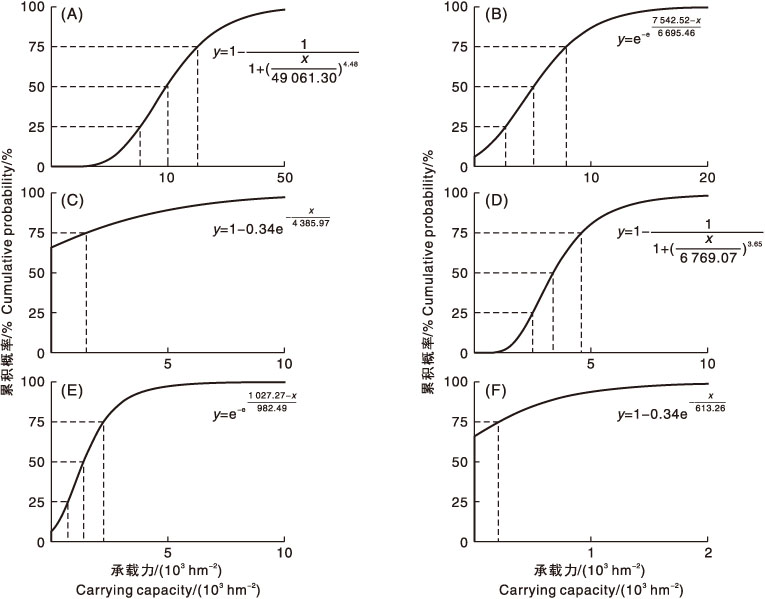
图1 浙江省鸡粪稻田承载力累积分布函数曲线 A,短期肉鸡粪稻田承载力;B,中期肉鸡粪稻田承载力;C,长期肉鸡粪稻田承载力;D,短期蛋鸡粪稻田承载力;E,中期蛋鸡粪稻田承载力;F,长期蛋鸡粪稻田承载力。
Fig.1 Cumulative distribution function curve for paddy field carrying capacity of chicken manure in Zhejiang Province A, Short-term paddy field carrying capacity of broiler manure; B, Medium-term paddy field carrying capacity of broiler manure; C, Long-term paddy field carrying capacity of broiler manure; D, Short-term paddy field carrying capacity of laying hen manure; E, Medium-term paddy field carrying capacity of laying hen manure; F, Long-term paddy field carrying capacity of laying hen manure.
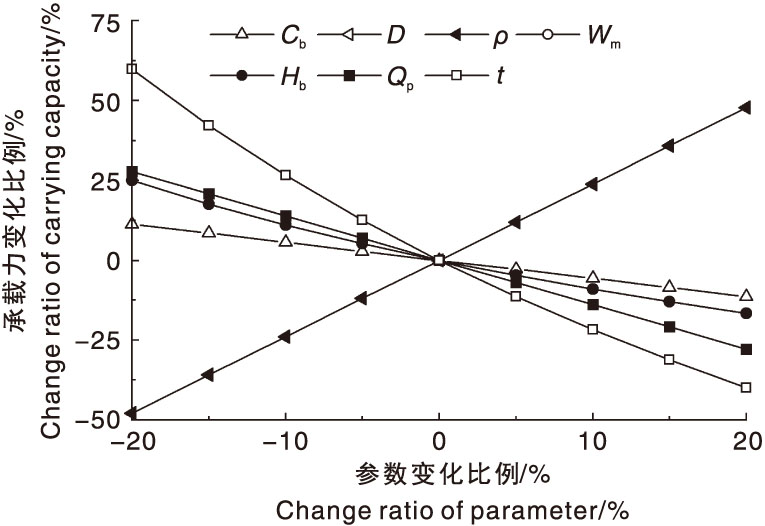
图2 浙江省中期肉鸡粪稻田承载力的敏感性分析结果 Cb为稻田土壤吡虫啉的质量分数,D为稻田耕层厚度,ρ为稻田耕层土壤容重,Wm为鸡粪吡虫啉质量分数,Hb为肉鸡整个饲养周期的粪便排泄量,Qp为每年农药施用后的稻田吡虫啉残留量,t为到达环境容量所需要的时间。图中ρ和D的敏感性分析结果相同,Wm和Hb的敏感性分析结果相同,因此曲线重叠。
Fig.2 The sensitivity analysis results of the medium-term paddy field carrying capacity of broiler manure in Zhejiang Province Cb represents the mass fraction of imidacloprid in paddy fields soil, D represents the thickness of the plough layer in the paddy fields, ρ represents the bulk density of the plough layer soil in the paddy fields, Wm represents the mass fraction of imidacloprid in chicken manure, Hb represents the total amount of feces excreted by broilers throughout the entire rearing period, Qp represents the residue of imidacloprid in the paddy fields after application each year, and t represents the time required to reach the environmental carrying capacity. In the figure, the results of sensitivity analysis for ρ and D are identical, and the results for Wm and Hb are also identical, hence, the symbols and the curves overlap.
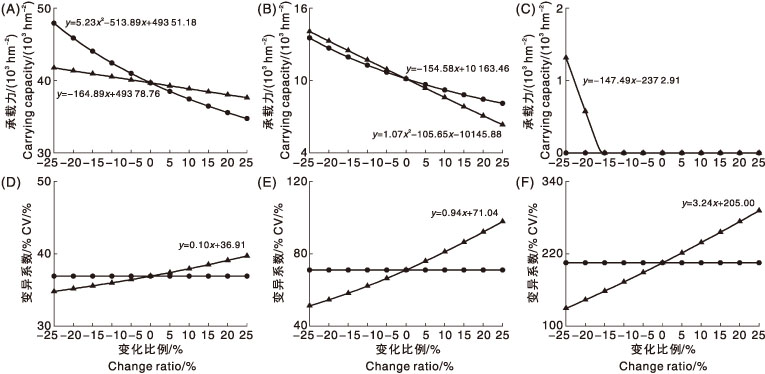
图3 不同时间尺度下的情景分析结果 A,短期肉鸡粪稻田承载力;B,中期肉鸡粪稻田承载力;C,长期肉鸡粪稻田承载力;D,短期肉鸡粪稻田承载力的变异系数;E,中期肉鸡粪稻田承载力的变异系数;F,长期肉鸡粪稻田承载力的变异系数。鸡粪稻田承载力取值为蒙特卡洛分析结果中的中位数。
Fig.3 Scenario analysis result at different time scales A, Short-term paddy field carrying capacity of broiler manure; B, Medium-term paddy field carrying capacity of broiler manure; C, Long-term paddy field carrying capacity of broiler manure; D, CV of short-term paddy field carrying capacity of broiler manure; E, CV of medium-term paddy field carrying capacity of broiler manure; F, CV of long-term paddy field carrying capacity of broiler manure. The paddy field carrying capacity of chicken manure is the median value in the Monte Carlo analysis results.
| [1] | 世界粮农组织. 统计数据库(FAOSTAT)2010—2021[EB/OL]. (2024-02-06) [2025-06-01]. https://www.fao.org/faostat/en/#home. |
| [2] | MAGGI F, TANG F H M, TUBIELLO F N. Agricultural pesticide land budget and river discharge to oceans[J]. Nature, 2023, 620(7976): 1013-1017. |
| [3] | LI Y J, MIAO R Q, KHANNA M. Neonicotinoids and decline in bird biodiversity in the United States[J]. Nature Sustainability, 2020, 3(12): 1027-1035. |
| [4] | MAMY L, PESCE S, SANCHEZ W, et al. Impacts of neonicotinoids on biodiversity: a critical review[J]. Environmental Science and Pollution Research, 2025, 32(6): 2794-2829. |
| [5] | JØRGENSEN P S, AKTIPIS A, BROWN Z, et al. Antibiotic and pesticide susceptibility and the anthropocene operating space[J]. Nature Sustainability, 2018, 1(11): 632-641. |
| [6] | TANG W X, WANG D, WANG J Q, et al. Pyrethroid pesticide residues in the global environment: an overview[J]. Chemosphere, 2018, 191: 990-1007. |
| [7] | WANG J M, XU J, JI X F, et al. Determination of veterinary drug/pesticide residues in livestock and poultry excrement using selective accelerated solvent extraction and magnetic material purification combined with ultra-high-performance liquid chromatograp-tandem mass spectrometry[J]. Journal of Chromatography A, 2020, 1617: 460808. |
| [8] | DONG Y, DAS S, PARSONS J R, et al. Simultaneous detection of pesticides and pharmaceuticals in three types of bio-based fertilizers by an improved QuEChERS method coupled with UHPLC-q-ToF-MS/MS[J]. Journal of Hazardous Materials, 2023, 458: 131992. |
| [9] | SHAO S Y, ZHANG S F, YU Z Y, et al. Insights into the fate of the novel pesticide vanisulfane from animal manure in plant-soil systems: assisted by carbon-14 labeling[J]. Journal of Agricultural and Food Chemistry, 2023, 71(2): 1139-1148. |
| [10] | 楚天舒, 王柄雄, 孟坦, 等. 基于农田土壤抗生素生态风险值的畜禽粪污农田承载力估算[J]. 中国农业大学学报, 2021, 26(3): 138-151. |
| CHU T S, WANG B X, MENG T, et al. Estimation on farmland carrying capacity for livestock and poultry manure based on farmland soil antibiotics ecological risk values[J]. Journal of China Agricultural University, 2021, 26(3): 138-151. | |
| [11] | 楚天舒, 王柄雄, 高思程, 等. 基于农田土壤重金属污染风险筛选值的畜禽粪污农田承载力估算[J]. 中国农业大学学报, 2021, 26(2): 125-138. |
| CHU T S, WANG B X, GAO S C, et al. Estimation on farmland carrying capacity for livestock and poultry manure based on risk screening values for farmland soil heavy metal contamination[J]. Journal of China Agricultural University, 2021, 26(2): 125-138. | |
| [12] | 穆虹宇, 庄重, 李彦明, 等. 我国畜禽粪便重金属含量特征及土壤累积风险分析[J]. 环境科学, 2020(2): 986-996. |
| MU H Y, ZHUANG Z, LI Y M, et al. Heavy metal contents in animal manure in China and the related soil accumulation risks[J]. Environmental Science, 2020(2): 986-996. | |
| [13] | 浙江省生态环境厅,浙江省农业农村厅. 关于印发浙江省农业面源污染治理与监督指导实施方案的通知[EB/OL]. (2022-08-02) [2025-06-01]. http://sthjt.zj.gov.cn/art/2022/8/2/art_1229263469_2413645.html. |
| [14] | 浙江省统计局,国家统计局浙江调查总队. 浙江统计年鉴-2011[M]. 北京: 中国统计出版社, 2011. |
| [15] | 浙江省发展和改革委员会,浙江省农业农村厅. 关于印发《浙江省畜牧业高质量发展“十四五”规划》的通知[EB/OL]. (2021-07-07) [2025-06-01]. https://www.zj.gov.cn/art/2021/7/7/art_1229203592_2310415.html. |
| [16] | U.S. Environmental Protection Agency. ECOTOX Databases[EB/OL]. (2024-02-06) [2025-06-01]. https://cfpub.epa.gov/ecotox/. |
| [17] | DITTBRENNER N, TRIEBSKORN R, MOSER I, et al. Physiological and behavioural effects of imidacloprid on two ecologically relevant earthworm species (Lumbricus terrestris and Aporrectodea caliginosa)[J]. Ecotoxicology, 2010, 19(8): 1567-1573. |
| [18] | NYOKA N W, KANYILE S N, BREDENHAND E, et al. Biochar alleviates the toxicity of imidacloprid and silver nanoparticles (AgNPs) to Enchytraeus albidus (Oligochaeta)[J]. Environmental Science and Pollution Research, 2018, 25(11): 10937-10945. |
| [19] | ALVES P R L, CARDOSO E J B N, MARTINES A M, et al. Earthworm ecotoxicological assessments of pesticides used to treat seeds under tropical conditions[J]. Chemosphere, 2013, 90(11): 2674-2682. |
| [20] | DE LIMA E SILVA C, BRENNAN N, BROUWER J M, et al. Comparative toxicity of imidacloprid and thiacloprid to different species of soil invertebrates[J]. Ecotoxicology, 2017, 26(4): 555-564. |
| [21] | BANDEIRA F O, ALVES P R L, HENNIG T B, et al. Toxicity of imidacloprid to the earthworm Eisenia andrei and collembolan Folsomia candida in three contrasting tropical soils[J]. Journal of Soils and Sediments, 2020, 20(4): 1997-2007. |
| [22] | DE LIMA E SILVA C, DE ROOIJ W, VERWEIJ R A, et al. Toxicity in neonicotinoids to Folsomia candida and Eisenia andrei[J]. Environmental Toxicology and Chemistry, 2020, 39(3): 548-555. |
| [23] | BANDEIRA F O, LOPES ALVES P R, HENNIG T B, et al. Effect of temperature on the toxicity of imidacloprid to Eisenia andrei and Folsomia candida in tropical soils[J]. Environmental Pollution, 2020, 267: 115565. |
| [24] | WANG K, QI S Z, MU X Y, et al. Evaluation of the toxicity, AChE activity and DNA damage caused by imidacloprid on earthworms, Eisenia fetida[J]. Bulletin of Environmental Contamination and Toxicology, 2015, 95(4): 475-480. |
| [25] | GE J, XIAO Y Z, CHAI Y Y, et al. Sub-lethal effects of six neonicotinoids on avoidance behavior and reproduction of earthworms (Eisenia fetida)[J]. Ecotoxicology and Environmental Safety, 2018, 162: 423-429. |
| [26] | GOMEZ-EYLES J L, SVENDSEN C, LISTER L, et al. Measuring and modelling mixture toxicity of imidacloprid and thiacloprid on Caenorhabditis elegans and Eisenia fetida[J]. Ecotoxicology and Environmental Safety, 2009, 72(1): 71-79. |
| [27] | WANG X, ZHU X P, PENG Q, et al. Multi-level ecotoxicological effects of imidacloprid on earthworm (Eisenia fetida)[J]. Chemosphere, 2019, 219: 923-932. |
| [28] | WANG K, PANG S, MU X Y, et al. Biological response of earthworm, Eisenia fetida, to five neonicotinoid insecticides[J]. Chemosphere, 2015, 132: 120-126. |
| [29] | BORI J, RIBALTA C, DOMENE X, et al. Environmental impacts of an imidacloprid-containing formulation: from soils to waters[J]. Afinidad, 2015, 72(571): 169-176. |
| [30] | IDINGER J. Laboratory studies to detect effects of selected plant protection products on Folsomia candida(Collembola: Isotomidae)[J]. Journal of Plant Diseases and Protection, 2002, 109(5): 512-529. |
| [31] | MABUBU J I, NAWAZ M, CAI W L, et al. Ecotoxicity of the neonicotinoid insecticides imidacloprid and thiacloprid to the soil-dwelling arthropod Folsomia candida(Collembola)[J]. Journal of the Kansas Entomological Society, 2017, 90(4): 323-333. |
| [32] | REYNOLDS W N P E. Imidacloprid insecticide treatments for hemlock woolly adelgid, Adelges tsugae Annand (Hemiptera: Adelgidae), affect a non-target soil arthropod community surrounding eastern hemlock, Tsuga canadensis(l.) Carriere[D]. State of Tennessee: The University of Tennessee, 2008 |
| [33] | OGUNGBEMI A O, VAN GESTEL C A M. Extrapolation of imidacloprid toxicity between soils by exposing Folsomia candida in soil pore water[J]. Ecotoxicology, 2018, 27(8): 1107-1115. |
| [34] | VAN GESTEL C A M, DE LIMA E SILVA C, LAM T, et al. Multigeneration toxicity of imidacloprid and thiacloprid to Folsomia candida[J]. Ecotoxicology, 2017, 26(3): 320-328. |
| [35] | 于相毅. 发达国家化学品环境风险评估原则与方法[M]. 北京: 中国环境出版集团, 2019. |
| [36] | 环境影响评价技术导则土壤环境(试行): HJ 964—2018[S]. |
| [37] | 朱介北, 邱威, 孙宁, 等. 基于序贯蒙特卡洛法的安全稳定控制系统架构可靠性分析[J]. 电力系统自动化, 2021, 45(15): 21-27. |
| ZHU J B, QIU W, SUN N, et al. Reliability analysis of security and stability control system architecture based on sequential Monte Carlo method[J]. Automation of Electric Power Systems, 2021, 45(15): 21-27. | |
| [38] | 杨子涵, 宋正河. 利用优选状态数的MCMC模拟农机装备负载[J]. 农业工程学报, 2021, 37(20): 15-22. |
| YANG Z H, SONG Z H. Simulation of agricultural equipment load using MCMC with optimal state number[J]. Transactions of the Chinese Society of Agricultural Engineering, 2021, 37(20): 15-22. | |
| [39] | QUAICOE O, ASISEH F, ALOKA A S. Enhancing year-round profitability for small-scale ranchers: an economic analysis of integrated cattle and mushroom production system[J]. Sustainability, 2024, 16(13): 5320. |
| [40] | SONG J, LIU Y Z, ZHUANG M H, et al. Estimating crop carbon footprint and associated uncertainty at prefecture-level city scale in China[J]. Resources, Conservation and Recycling, 2023, 199: 107263. |
| [41] | 李喆. 新烟碱类杀虫剂的环境残留及风险评价研究[D]. 杭州: 浙江工业大学, 2017. |
| LI Z. The environmental residue and risk assessment of neonicotinoid insecticides[D]. Hangzhou: Zhejiang University of Technology, 2017. | |
| [42] | 农业农村部耕地质量监测保护中心. 长三角区耕地质量评价[M]. 北京: 中国农业出版社, 2019. |
| [43] | 董红敏. 畜禽养殖业粪便污染监测核算方法与产排污系数手册[M]. 北京: 科学出版社, 2019. |
| [44] | 全国畜牧业标准化技术委员会. 畜禽粪便土地承载力测算方法: NY/T 3877—2021[S]. |
| [45] | 李琪. 水稻化肥农药减量增效技术推广路径分析[D]. 杭州: 浙江大学, 2018. |
| LI Q. A study on the extension of fertilizer-and pesticides-reducing technologies in rice[D]. Hangzhou: Zhejiang University, 2018. | |
| [46] | 中华人民共和国农业农村部. 关于印发《到2025年化肥减量化行动方案》和《到2025年化学农药减量化行动方案》的通知[EB/OL]. (2022-11-18) [2026-06-01]. https://www.moa.gov.cn/govpublic/ZZYGLS/202212/t20221201_6416398.htm. |
| [47] | 邵宜添. 信息对称促进农药减量化: 理论模型、典型案例与监管策略选择[J]. 浙江农业学报, 2022(6): 1326-1337. |
| SHAO Y T. How information symmetry promotes pesticide reduction: theoretical models, typical cases and regulatory strategies[J]. Acta Agriculturae Zhejiangensis, 2022(6): 1326-1337. | |
| [48] | 江德权, 莫小荣, 王宏航, 等. 衢州市农药包装废弃物回收和农药减量对策建议[J]. 中国植保导刊, 2022, 42(4): 103-106. |
| JIANG D Q, MO X R, WANG H H, et al. Countermeasures and suggestions on recycling pesticide packaging waste and pesticide reduction in Quzhou City[J]. China Plant Protection, 2022, 42(4): 103-106. | |
| [49] | 项朝阳, 纪楠楠. 社会资本对农户化肥农药减量技术采纳意愿的影响: 基于学习能力的中介和生态认知的调节[J]. 中国农业大学学报, 2021, 26(2): 150-163. |
| XIANG Z Y, JI N N. Impacts of social capital on farmers’ willingness to adopt for chemical fertilizer and pesticide reduction technology: based on the mediating effect of learning ability and the moderating effect of ecological cognition[J]. Journal of China Agricultural University, 2021, 26(2): 150-163. | |
| [50] | 操敏敏, 齐振宏, 刘可, 等. 农户兼业对其施用生物农药的影响: 基于农业社会化服务的调节作用[J]. 中国农业大学学报, 2020, 25(1): 191-205. |
| CAO M M, QI Z H, LIU K, et al. Effects of farmers’ concurrent business on biopesticide application: the moderating effect of agricultural social service[J]. Journal of China Agricultural University, 2020, 25(1): 191-205. | |
| [51] | 秦国庆, 杜宝瑞, 贾小虎, 等. 政策性农业保险的化肥、农药、农膜减量效应分析[J]. 中国农业大学学报, 2023, 28(1): 237-251. |
| QIN G Q, DU B R, JIA X H, et al. Analyze the reduction effect of policy-oriented agricultural insurance on chemical fertilizer, pesticide and agricultural plastic film[J]. Journal of China Agricultural University, 2023, 28(1): 237-251. | |
| [52] | PENG Y F, TANG J F, HONG M S, et al. Suppression of rice planthopper populations by the entomopathogenic fungus Metarhizium anisopliae without affecting the rice microbiota[J]. Applied and Environmental Microbiology, 2020, 86(21): e01337-e01320. |
| [53] | TANG L, LUO X F. Can agricultural insurance encourage farmers to apply biological pesticides? Evidence from rural China[J]. Food Policy, 2021, 105: 102174. |
| [54] | HUANG Y Z, LUO X F, LI Z L. Substitution or complementarity: why do rice farmers use a mix of biopesticides and chemical pesticides in China?[J]. Pest Management Science, 2022, 78(4): 1630-1639. |
| [55] | GUO Z H, CAI D D, BAI J C, et al. Intelligent rice field weed control in precision agriculture: from weed recognition to variable rate spraying[J]. Agronomy, 2024, 14(8): 1702. |
| [56] | WANG X, ZHANG Y Q, HU H F, et al. Evaluation of the droplet deposition and control effect of a special adjuvant for unmanned aerial vehicle (UAV) sprayers[J]. Journal of Pesticide Science, 2023, 48(3): 78-85. |
| [1] | 郝中娜, 邱海萍, 柴荣耀, 韩展誉, 张震, 王艳丽, 王教瑜, 刘鑫. 浙江省2014—2023年区域试验中水稻品种的稻瘟病抗性分析[J]. 浙江农业学报, 2025, 37(12): 2449-2457. |
| [2] | 王路童, 姜利红, 代家鹏, 陈粮, 曾光熙, 刘尔伦, 周湘丹, 肖云花, 方俊. 硫酸亚铁对鸡粪堆肥真菌群落的影响及其应用[J]. 浙江农业学报, 2025, 37(1): 169-177. |
| [3] | 褚田芬, 雷玲, 李勤锋, 吴平, 洪文杰, 郑蔚然. 浙江省西瓜中农药残留风险评估[J]. 浙江农业学报, 2024, 36(5): 1153-1160. |
| [4] | 陈钰佩, 单英杰, 陆若辉, 朱伟锋, 孔海民. 浙江省主要作物的施肥现状与减施潜力[J]. 浙江农业学报, 2024, 36(11): 2566-2574. |
| [5] | 汪洁, 陆若辉, 朱伟锋, 陈钰佩, 单英杰. 浙江省主要粮食作物秸秆还田替代化肥的潜力[J]. 浙江农业学报, 2023, 35(8): 1853-1863. |
| [6] | 傅嘉艺, 童磊, 苏飞, 郑珂, 厉海林, 曹轶蓉, 苏娜. 浙江省“农创客”在乡村发展中的带动效应及其影响路径[J]. 浙江农业学报, 2022, 34(8): 1796-1805. |
| [7] | 郭亮玺, 胡豹. 浙江省政策性农业保险机制创新回顾与改革对策研究[J]. 浙江农业学报, 2022, 34(5): 1081-1090. |
| [8] | 王丽娟, 陈秧分, 徐梦洁. 乡村振兴视域下农业跨区域投资区位及其决策机制——以浙江省为例[J]. 浙江农业学报, 2022, 34(4): 841-850. |
| [9] | 顾兴国, 闵庆文, 王英, 王斌. 浙江省农业文化遗产保护进展、问题与对策[J]. 浙江农业学报, 2022, 34(2): 397-408. |
| [10] | 傅琳琳, 毛晓红, 毛小报, 蔡日旋. 浙江省2013—2018年粮食综合生产能力评价[J]. 浙江农业学报, 2021, 33(9): 1748-1758. |
| [11] | 叶晗, 吴博文, 许红卫, 干牧野, 张晶, 王珂. 基于地理大数据的省域休闲农业空间格局及其影响因素研究——以浙江省为例[J]. 浙江农业学报, 2021, 33(7): 1264-1274. |
| [12] | 苗苗, 迮寒露, 吴永华. 浙江省耕地利用转型时空演变特征分析[J]. 浙江农业学报, 2021, 33(4): 753-760. |
| [13] | 孟幼青, 汪恩国, 陈吴健, 李艳敏, 程帆, 孟敏霞. 浙江省亚洲柑橘木虱黄龙病病原分布与消长规律[J]. 浙江农业学报, 2021, 33(3): 464-469. |
| [14] | 景亮亮, 柴军发, 高强, 曹爽, 洪波, 贾彦霞. 6种喷雾助剂对3种药剂表面张力与接触角的影响[J]. 浙江农业学报, 2020, 32(10): 1823-1833. |
| [15] | 傅琳琳, 毛小报, 毛晓红, 李海涛, 王瑾. 浙江农业可持续发展水平与区域差异综合评价——基于高质量发展视角[J]. 浙江农业学报, 2020, 32(10): 1880-1889. |
| 阅读次数 | ||||||
|
全文 |
|
|||||
|
摘要 |
|
|||||

