浙江农业学报 ›› 2025, Vol. 37 ›› Issue (12): 2516-2524.DOI: 10.3969/j.issn.1004-1524.20240800
不同水肥耦合对设施栽培番茄生长、产量和品质的影响
闫沛玉1( ), 张生银2, 陈亮3,4, 刘斌1,4,*()
- 1.甘肃省景泰川电力提灌水资源利用中心,甘肃 景泰 730400
2.中国科学院 西北生态环境资源研究院,甘肃 兰州 730099
3.甘肃省农业工程技术研究院,甘肃 武威 733006
4.甘肃农业大学 园艺学院,甘肃 兰州 730070
-
收稿日期:2024-09-10出版日期:2025-12-25发布日期:2026-01-09 -
作者简介:闫沛玉(1980—),男,甘肃景泰人,学士,高级工程师,主要从事农业灌溉技术研究。E-mail:463621361@qq.com -
通讯作者:*刘斌,E-mail:347582892@qq.com -
基金资助:甘肃省青年科技基金项目(23JRRD0001);甘肃省陇原青年创新创业人才项目(2021LQGR09);甘肃省水利科学试验研究与推广计划项目“景电灌区典型农作物节水控盐施肥灌溉制度研究”“农业水价综合改革背景下景电灌区主要经济作物滴灌节水灌溉制度研究”
Effects of water-fertilizer coupling on growth, yield and quality of tomato cultivated in facility
YAN Peiyu1(), ZHANG Shengyin2, CHEN Liang3,4, LIU Bin1,4,*()
- 1. Gansu Jingtaichuan Irrigation Water Resources Utilization Center, Jingtai 730400, Gansu, China
2. Northwest Institute of Eco-Environment and Resources, CAS, Lanzhou 730099, China
3. Gansu Provincial Institute of Agricultural Engineering and Technology, Wuwei 733006, Gansu, China
4. College of Horticulture, Gansu Agricultural University, Lanzhou 730070, China
-
Received:2024-09-10Online:2025-12-25Published:2026-01-09

摘要: 番茄作为我国重要的蔬菜作物之一,生产中不合理的灌溉和施肥现象普遍,严重影响着果实的产量与品质。为探明可提高番茄品质的水肥调控机制,本试验以181番茄为试材,设置了不同水平的水肥条件,分别以足水足肥为CK(灌水每槽每次87.32 L,施肥N 420 kg·hm-2、P2O5180 kg·hm-2、K2O 468.0 kg·hm-2),设置3个水分水平W1(每槽每次74.15 L)、W2(每槽每次65.42 L)、W3(每槽每次56.70 L),3个肥料水平F1(CK的100%肥量),F2(CK的85%肥量),F3(CK的70%肥量),并两两组合为W1F1、W1F2、W1F3、W2F1、W2F2、W2F3、W3F1、W3F2、W3F3,共9个处理。结果表明,W2F2水平下,番茄植株的株高、茎粗和叶面积较CK显著增加,W2F2、W2F3、W3F3处理下的可溶性固形物含量较CK分别显著增加了1.6、1.1、0.9百分点,W2F2的可溶性糖含量较CK显著增加2.0百分点,且W2F2处理下糖酸比最大,相较其他处理均有显著性差异,较CK显著增加100.06%;此外,W3F3的硝酸盐含量最低,W2F2单果重最高,与CK无显著差异,同时平均单株果数和产量显著高于其他处理。综合各指标,W2F2处理(灌水量每槽每次65.42 L,施肥量85%(即N 357 kg·hm-2、P2O5 153 kg·hm-2、K2O 397.8 kg·hm-2)能有效提高设施番茄的品质和产量,并达到节水节肥的效果,可作为日光温室基质栽培高品质番茄的适宜水肥耦合制度。
中图分类号:
引用本文
闫沛玉, 张生银, 陈亮, 刘斌. 不同水肥耦合对设施栽培番茄生长、产量和品质的影响[J]. 浙江农业学报, 2025, 37(12): 2516-2524.
YAN Peiyu, ZHANG Shengyin, CHEN Liang, LIU Bin. Effects of water-fertilizer coupling on growth, yield and quality of tomato cultivated in facility[J]. Acta Agriculturae Zhejiangensis, 2025, 37(12): 2516-2524.
| 处理 Treatments | 每槽每次灌水量 Irrigation amount per plot for once/L | 施肥量 Fertilizer application rate/(kg·hm-2) |
|---|---|---|
| CK | 87.23 | N 420,P2O5 180,K2O 468.0 |
| W1F1 | 74.15 | N 420,P2O5 180,K2O 468.0 |
| W1F2 | 74.15 | N 357,P2O5 153,K2O 397.8 |
| W1F3 | 74.15 | N 294,P2O5 126,K2O 327.6 |
| W2F1 | 65.42 | N 420,P2O5 180,K2O 468.0 |
| W2F2 | 65.42 | N 357,P2O5 153,K2O 397.8 |
| W2F3 | 65.42 | N 294,P2O5 126,K2O 327.6 |
| W3F1 | 56.70 | N 420,P2O5180,K2O 468.0 |
| W3F2 | 56.70 | N 357,P2O5 153,K2O 397.8 |
| W3F3 | 56.70 | N 294,P2O5 126,K2O 327.6 |
表1 试验方案设计
Table 1 Test scheme design
| 处理 Treatments | 每槽每次灌水量 Irrigation amount per plot for once/L | 施肥量 Fertilizer application rate/(kg·hm-2) |
|---|---|---|
| CK | 87.23 | N 420,P2O5 180,K2O 468.0 |
| W1F1 | 74.15 | N 420,P2O5 180,K2O 468.0 |
| W1F2 | 74.15 | N 357,P2O5 153,K2O 397.8 |
| W1F3 | 74.15 | N 294,P2O5 126,K2O 327.6 |
| W2F1 | 65.42 | N 420,P2O5 180,K2O 468.0 |
| W2F2 | 65.42 | N 357,P2O5 153,K2O 397.8 |
| W2F3 | 65.42 | N 294,P2O5 126,K2O 327.6 |
| W3F1 | 56.70 | N 420,P2O5180,K2O 468.0 |
| W3F2 | 56.70 | N 357,P2O5 153,K2O 397.8 |
| W3F3 | 56.70 | N 294,P2O5 126,K2O 327.6 |
| 处理 Treatments | 株高 Plant height/cm | 茎粗 Stem diameter/mm | 叶面积 Leaf area/cm2 |
|---|---|---|---|
| CK | 177.75±2.33 d | 9.68±0.16 c | 277.4±0.99 d |
| W1FI | 185.96±0.72 b | 9.57±0.10 c | 205.72±4.74 f |
| W1F2 | 186.10±0.40 b | 9.55±0.23 c | 219.89±4.90 f |
| W1F3 | 184.44±0.48 bc | 9.92±0.25 c | 235.83±2.48 e |
| W2F1 | 186.32±1.10 b | 9.80±0.22 c | 294.22±7.36 c |
| W2F2 | 191.35±1.34 a | 11.04±0.19 a | 337.74±1.91 a |
| W2F3 | 188.63±0.89 ab | 10.45±0.18 b | 296.44±2.32 c |
| W3F1 | 185.08±0.88 bc | 9.60±0.03 c | 300.00±2.91 c |
| W3F2 | 180.69±1.39 cd | 9.57±0.09 c | 315.68±4.86 b |
| W3F3 | 184.62±2.87 bc | 9.45±0.07 c | 316.98±4.56 b |
表2 不同水肥耦合处理下设施栽培番茄植株的生长情况
Table 2 Growth of tomato plants in greenhouse under different water and fertilizer coupling treatments
| 处理 Treatments | 株高 Plant height/cm | 茎粗 Stem diameter/mm | 叶面积 Leaf area/cm2 |
|---|---|---|---|
| CK | 177.75±2.33 d | 9.68±0.16 c | 277.4±0.99 d |
| W1FI | 185.96±0.72 b | 9.57±0.10 c | 205.72±4.74 f |
| W1F2 | 186.10±0.40 b | 9.55±0.23 c | 219.89±4.90 f |
| W1F3 | 184.44±0.48 bc | 9.92±0.25 c | 235.83±2.48 e |
| W2F1 | 186.32±1.10 b | 9.80±0.22 c | 294.22±7.36 c |
| W2F2 | 191.35±1.34 a | 11.04±0.19 a | 337.74±1.91 a |
| W2F3 | 188.63±0.89 ab | 10.45±0.18 b | 296.44±2.32 c |
| W3F1 | 185.08±0.88 bc | 9.60±0.03 c | 300.00±2.91 c |
| W3F2 | 180.69±1.39 cd | 9.57±0.09 c | 315.68±4.86 b |
| W3F3 | 184.62±2.87 bc | 9.45±0.07 c | 316.98±4.56 b |
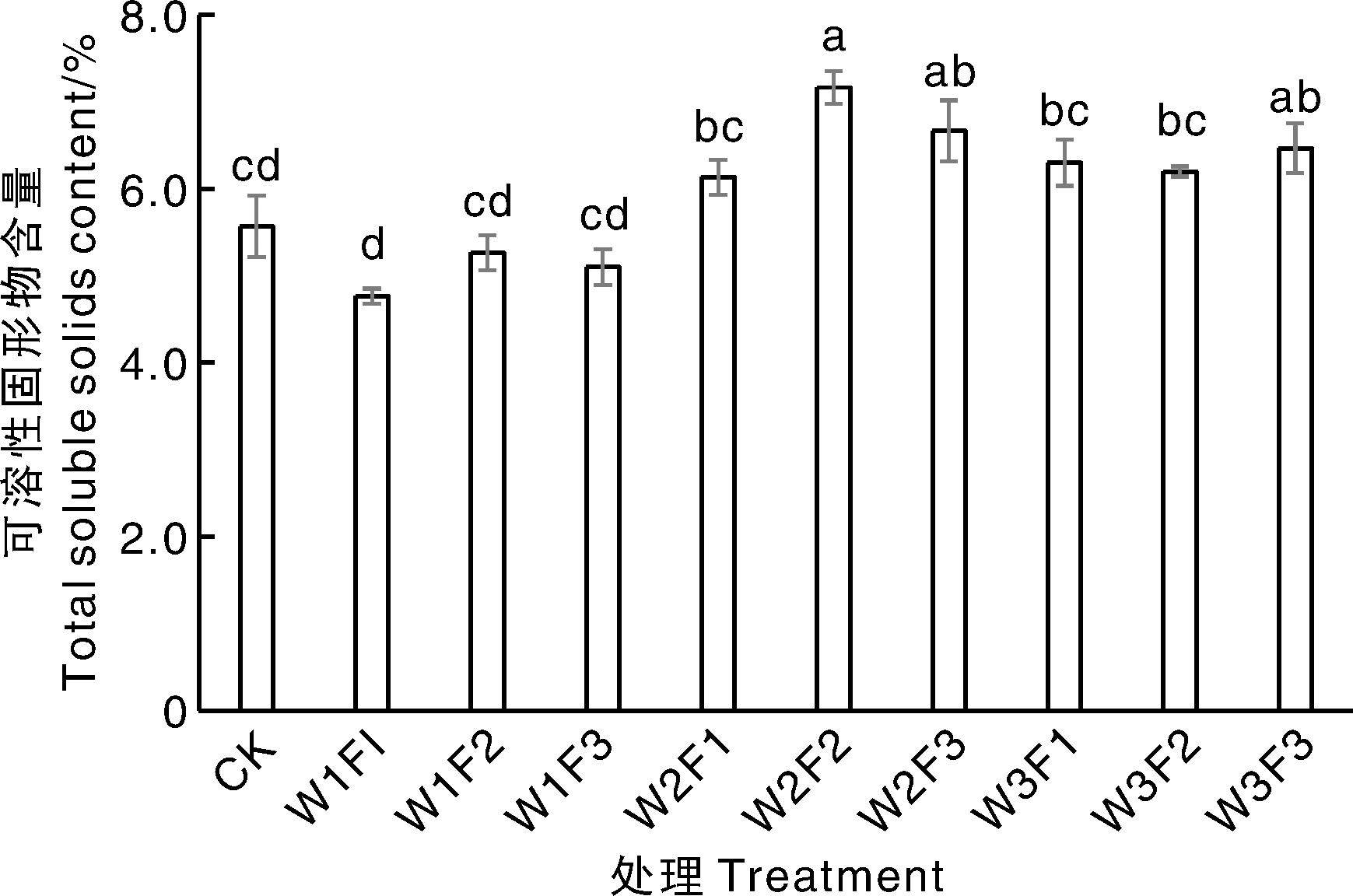
图1 不同水肥耦合处理下设施栽培番茄的可溶性固形物含量 不同处理间没有相同小写字母表示差异显著(p<0.05)。下同。
Fig.1 Total soluble solids content of tomatoes in greenhouse under different water and fertilizer coupling treatments The bars with different lowercase letters indicate the significant (p<0.05) difference. The same as below.
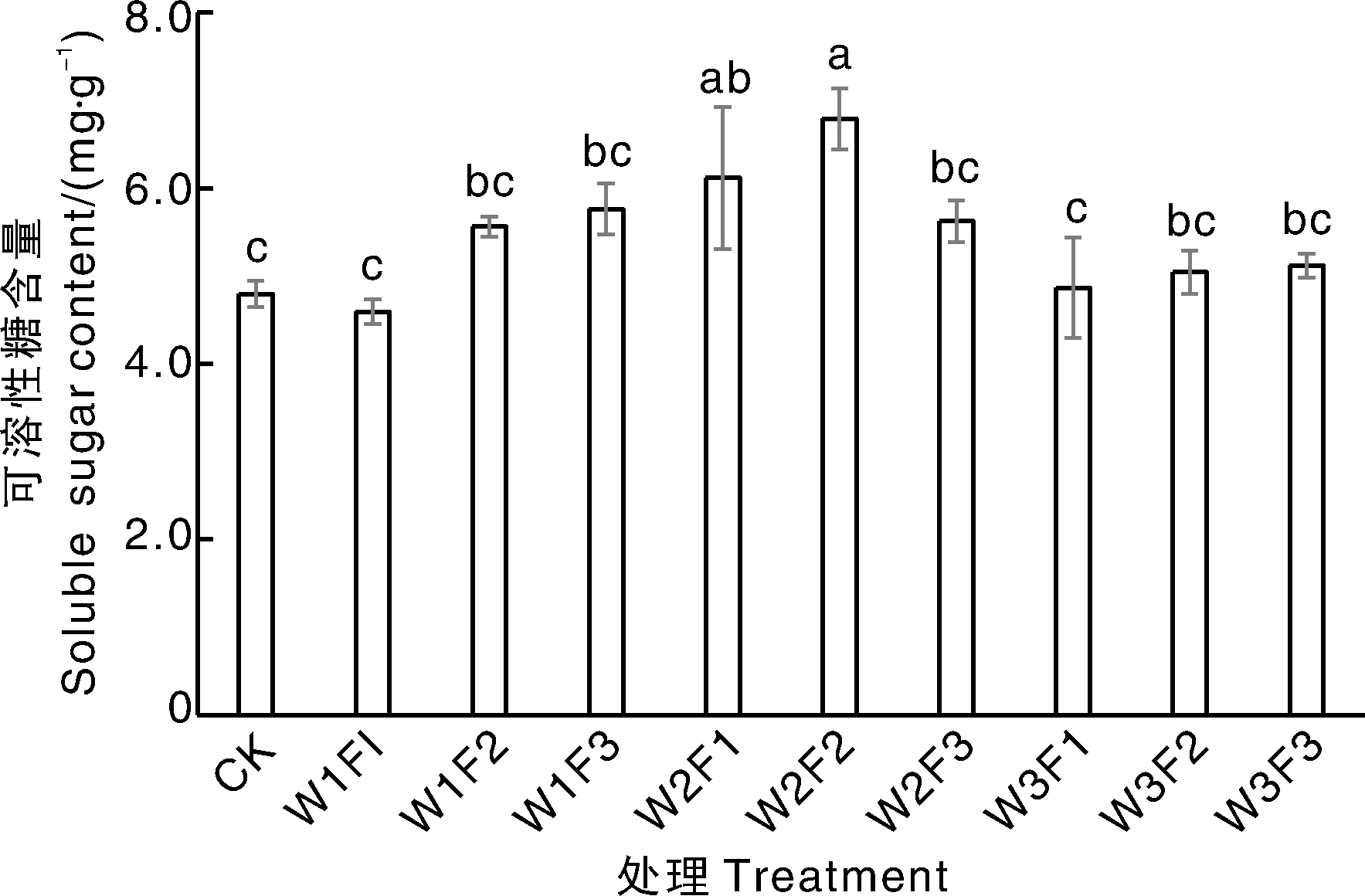
图2 不同水肥耦合处理下设施栽培番茄的可溶性糖含量
Fig.2 Soluble sugar content of tomatoes in greenhouse under different water and fertilizer coupling treatments
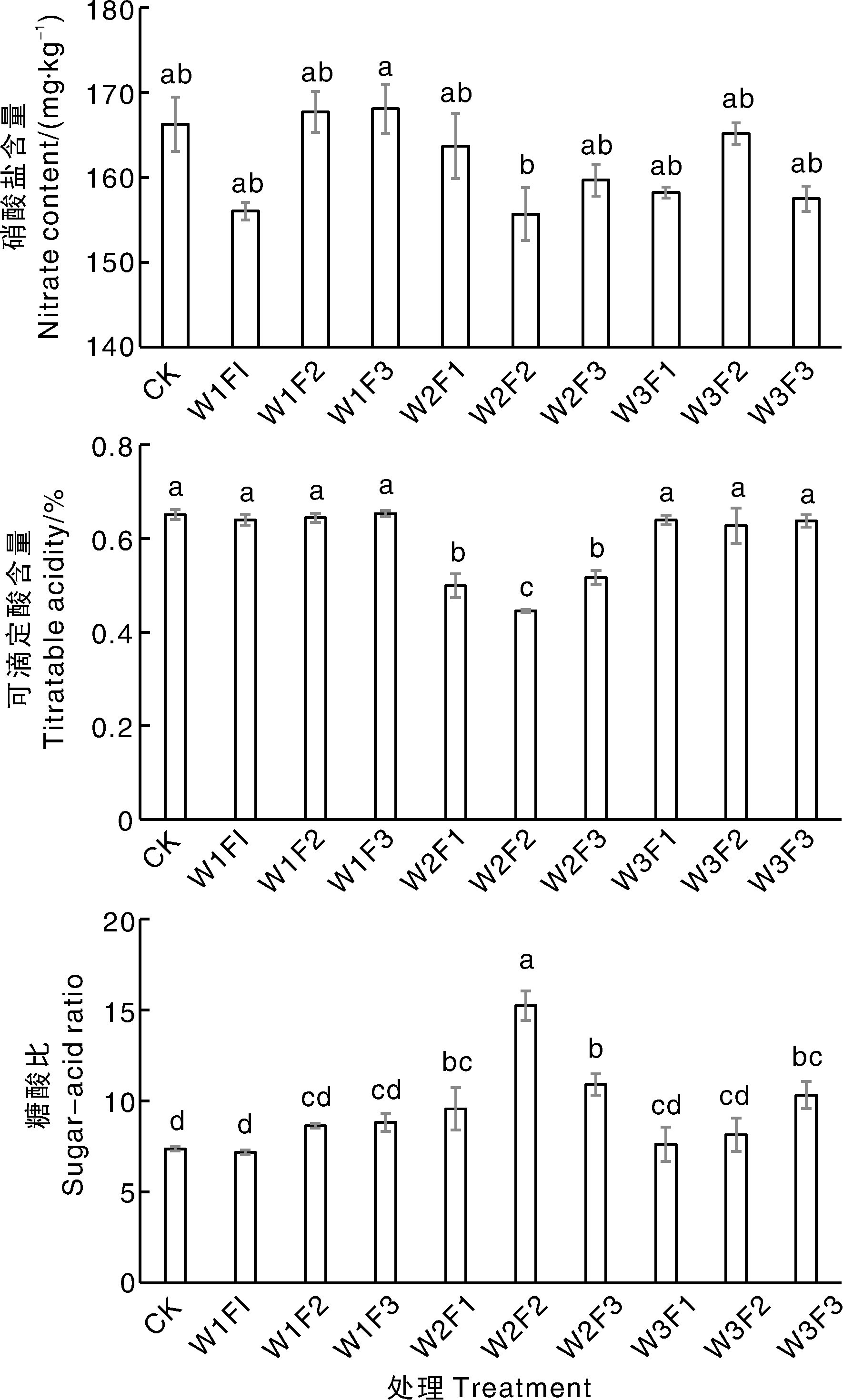
图3 不同水肥耦合处理下设施栽培番茄的硝酸盐含量、可滴定酸含量和糖酸比
Fig.3 Nitrate content, titratable acidity, and sugar-acid ratio of tomatoes in greenhouse under different water and fertilizer coupling treatments
| 处理 Treatments | 单果重 Single fruit weight/g | 单株果数 Number of fruit per plant | 每667 m2产量 Yield per 667 m2/kg | 水分利用效率 Water use efficiency/(kg·m-3) |
|---|---|---|---|---|
| CK | 97.34±0.27 a | 26.0±0.6 ab | 4 705.29±98.33 ab | 14.86±0.36 f |
| W1FI | 96.06±0.30 b | 25.3±0.3 bc | 4 524.49±67.04 bc | 16.55±0.25 d |
| W1F2 | 94.24±0.01 de | 25.0±0.1 cd | 4 380.35±0.54 cd | 16.03±0.01 de |
| W1F3 | 93.96±0.19 e | 24.3±0.3 cd | 4 250.98±57.15 cd | 15.55±0.21 ef |
| W2F1 | 95.38±0.24 c | 26.0±0.6 ab | 4 611.29±112.58 bc | 18.71±0.46 c |
| W2F2 | 97.46±0.09 a | 27.0±0.6 a | 4 892.49±102.29 a | 19.85±0.42 b |
| W2F3 | 94.48±0.21 de | 25.6±0.3 bc | 4 508.36±48.68 bc | 18.29±0.20 c |
| W3F1 | 95.93±0.24 bc | 25.6±0.3 bc | 4 578.18±67.82 bc | 20.85±0.31 a |
| W3F2 | 94.70±0.23 d | 24.0±0.6 d | 4 225.31±97.64 cd | 19.24±0.44 bc |
| W3F3 | 94.21±0.05 de | 23.6±0.3 d | 4 145.62±60.42 d | 18.88±0.28 bc |
表3 不同水肥耦合处理下设施栽培番茄的产量和水分利用效率
Table 3 Yield and water use efficiency of tomatoes in greenhouse under different water and fertilizer coupling treatments
| 处理 Treatments | 单果重 Single fruit weight/g | 单株果数 Number of fruit per plant | 每667 m2产量 Yield per 667 m2/kg | 水分利用效率 Water use efficiency/(kg·m-3) |
|---|---|---|---|---|
| CK | 97.34±0.27 a | 26.0±0.6 ab | 4 705.29±98.33 ab | 14.86±0.36 f |
| W1FI | 96.06±0.30 b | 25.3±0.3 bc | 4 524.49±67.04 bc | 16.55±0.25 d |
| W1F2 | 94.24±0.01 de | 25.0±0.1 cd | 4 380.35±0.54 cd | 16.03±0.01 de |
| W1F3 | 93.96±0.19 e | 24.3±0.3 cd | 4 250.98±57.15 cd | 15.55±0.21 ef |
| W2F1 | 95.38±0.24 c | 26.0±0.6 ab | 4 611.29±112.58 bc | 18.71±0.46 c |
| W2F2 | 97.46±0.09 a | 27.0±0.6 a | 4 892.49±102.29 a | 19.85±0.42 b |
| W2F3 | 94.48±0.21 de | 25.6±0.3 bc | 4 508.36±48.68 bc | 18.29±0.20 c |
| W3F1 | 95.93±0.24 bc | 25.6±0.3 bc | 4 578.18±67.82 bc | 20.85±0.31 a |
| W3F2 | 94.70±0.23 d | 24.0±0.6 d | 4 225.31±97.64 cd | 19.24±0.44 bc |
| W3F3 | 94.21±0.05 de | 23.6±0.3 d | 4 145.62±60.42 d | 18.88±0.28 bc |
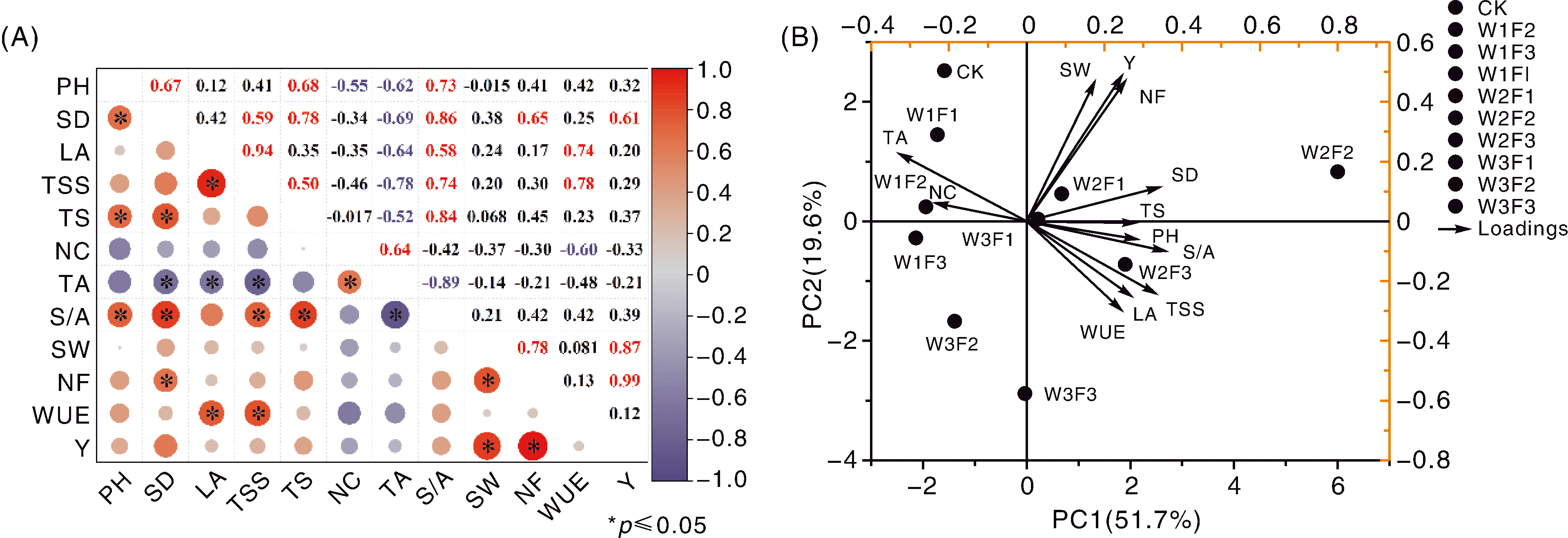
图4 水肥耦合处理下各指标的相关分析(A)与主成分分析(B) PH,株高;SD,茎粗;LA,叶面积;TSS,可溶性固形物含量;TS,可溶性糖含量;NC,硝酸盐含量;TA,可滴定酸含量;S/A,糖酸比;SW,单果重;NF,单株果数;WUE,水分利用效率;Y,产量。
Fig.4 Correlation analysis(A) and principal component analysis(B) of various indicators under water-fertilizer coupling treatment PH, Plant height; SD, Stem diameter; LA, Leaf area; TSS, Total soluble solids content; TS, Total sugar content; NC, Nitrate content; TA, Titratable acidity; S/A, Sugar-acid ratio; SW, Single fruit weight; NF, Number of fruits per plant; WUE, Water use efficiency; Y, Yield.
| [1] | 王晓晶. LED绿光对蔬菜生长及品质的影响[D]. 太谷: 山西农业大学, 2019. |
| WANG X J. Effects of LED green light on growth and quality of vegetable[D]. Taigu: Shanxi Agricultural University, 2019. (in Chinese with English abstract) | |
| [2] | 郝忠凤. 大棚种植番茄栽培技术[J]. 吉林农业, 2012(12): 77. |
| HAO Z F. Cultivation techniques of tomato planting in greenhouse[J]. Jilin Agriculture, 2012(12): 77. (in Chinese with English abstract) | |
| [3] | 周博, 陈竹君, 周建斌. 水肥调控对日光温室番茄产量、品质及土壤养分含量的影响[J]. 西北农林科技大学学报(自然科学版), 2006, 34(4): 58-62. |
| ZHOU B, CHEN Z J, ZHOU J B. Effect of different fertilizer and water managements on the yield and quality of tomatoes and nutrient accumulations in soil cultivated in sunlight greenhouse[J]. Journal of Northwest Sci-Tech University of Agriculture and Forestry(Natural Science Edition), 2006, 34(4): 58-62. (in Chinese with English abstract) | |
| [4] | 哈婷, 张向梅, 李建设, 等. 营养液供液量及供液频率对高糖度番茄生长、产量及品质的影响[J]. 西北农业学报, 2017, 26(10): 1484-1491. |
| HA T, ZHANG X M, LI J S, et al. Effects of supply amounts and frequencies of nutrient solution on plant growth and fruit quality of highly sugary tomato[J]. Acta Agriculturae Boreali-occidentalis Sinica, 2017, 26(10): 1484-1491. (in Chinese with English abstract) | |
| [5] | 李天来. 我国设施蔬菜科技与产业发展现状及趋势[J]. 中国农村科技, 2016(5): 75-77. |
| LI T L. Present situation and trend of technology and industry development of protected vegetables in China[J]. China Rural Science & Technology, 2016(5): 75-77. (in Chinese with English abstract) | |
| [6] | 孙振荣, 王兴田. 兰州地区设施番茄水肥耦合技术研究[J]. 农业科技与信息, 2017(7): 71-72. |
| SUN Z R, WANG X T. Study on coupling technology of water and fertilizer for protected tomato in Lanzhou area[J]. Agricultural Science-Technology and Information, 2017(7): 71-72. (in Chinese with English abstract) | |
| [7] | 朱保侠, 王鲁豫. 水肥一体化管理对设施番茄产量和经济效益的影响[J]. 现代农业科技, 2020(14): 58-59. |
| ZHU B X, WANG L Y. Effect of drip fertigation on yield and economic benefit of facility tomato[J]. Modern Agricultural Science and Technology, 2020(14): 58-59. (in Chinese with English abstract) | |
| [8] | 代顺冬, 韦树谷, 赖佳, 等. 水、氮、磷、钾耦合效应对大白菜产量的影响[J]. 四川农业大学学报, 2020, 38(3): 299-304. |
| DAI S D, WEI S G, LAI J, et al. Effects of coupling effects of water, nitrogen, phosphorus and potassium on the yield of Chinese cabbage[J]. Journal of Sichuan Agricultural University, 2020, 38(3): 299-304. (in Chinese with English abstract) | |
| [9] | 邢英英, 张富仓, 吴立峰, 等. 基于番茄产量品质水肥利用效率确定适宜滴灌灌水施肥量[J]. 农业工程学报, 2015, 31(S1): 110-121. |
| XING Y Y, ZHANG F C, WU L F, et al. Determination of optimal amount of irrigation and fertilizer under drip fertigated system based on tomato yield, quality, water and fertilizer use efficiency[J]. Transactions of the Chinese Society of Agricultural Engineering, 2015, 31(S1): 110-121. (in Chinese with English abstract) | |
| [10] | 王秀康, 杜常亮, 邢金金, 等. 基于水肥供应条件下温室番茄品质性状的主成分分析[J]. 分子植物育种, 2017, 15(2): 698-704. |
| WANG X K, DU C L, XING J J, et al. Effects of irrigation and fertilization on fruit quality of greenhouse tomatoes: principal component analysis[J]. Molecular Plant Breeding, 2017, 15(2): 698-704. (in Chinese with English abstract) | |
| [11] | 张宇. 设施农业水肥一体化技术推广应用[J]. 农业工程技术, 2023, 43(6): 34-35. |
| ZHANG Y. Popularization and application of water and fertilizer integration technology in protected agriculture[J]. Agricultural Engineering Technology, 2023, 43(6): 34-35. (in Chinese with English abstract) | |
| [12] | YANG Z. Research status and development trend of intelligent water fertilizer integration technology and equipment[J]. Hans Journal of Agricultural Sciences, 2020, 10(7): 419-425. |
| [13] | 梁嘉敏, 杨虎晨, 张立丹, 等. 我国水溶性肥料及水肥一体化的研究进展[J]. 广东农业科学, 2021, 48(5): 64-75. |
| LIANG J M, YANG H C, ZHANG L D, et al. Research progress of water-soluble fertilizer and fertigation in China[J]. Guangdong Agricultural Sciences, 2021, 48(5): 64-75. (in Chinese with English abstract) | |
| [14] | 毛震宇, 颉建明, 何志学, 等. 缓释肥替代普通化肥对蒜苗生长、产量及品质的影响[J]. 中国蔬菜, 2020(11): 66-71. |
| MAO Z Y, XIE J M, HE Z X, et al. Effects of slow-released fertilizer instead of chemical fertilizer on growth, yield and quality of garlic seedlings[J]. China Vegetables, 2020(11): 66-71. (in Chinese with English abstract) | |
| [15] | 柳帆红, 肖雪梅, 郁继华, 等. 不同时段补光对日光温室番茄营养与风味品质的影响[J]. 西北农业学报, 2020, 29(4): 570-578. |
| LIU F H, XIAO X M, YU J H, et al. Effect of light supplementation in different periods on nutrition and flavor quality of tomato in solar greenhouse[J]. Acta Agriculturae Boreali-occidentalis Sinica, 2020, 29(4): 570-578. (in Chinese with English abstract) | |
| [16] | ZHAO J X, FENG H Z, XU T R, et al. Physiological and environmental control on ecosystem water use efficiency in response to drought across the Northern Hemisphere[J]. Science of the Total Environment, 2021, 758: 143599. |
| [17] | 吕剑. 日光温室基质栽培越冬茬番茄灌水下限研究[D]. 兰州: 甘肃农业大学, 2012. |
| LYU J. The study of irrigation limits of overwintering tomato in heliogreenhouse under substrate culture[D]. Lanzhou: Gansu Agricultural University, 2012. (in Chinese with English abstract) | |
| [18] | 薛义霞, 栗东霞, 李亚灵. 番茄叶面积测量方法的研究[J]. 西北农林科技大学学报(自然科学版), 2006, 34(8): 116-120. |
| XUE Y X, LI D X, LI Y L. Study on method to measure tomato leaf area[J]. Journal of Northwest Sci-Tech University of Agriculture and Forestry(Natural Science Edition), 2006, 34(8): 116-120. (in Chinese with English abstract) | |
| [19] | 赵文举, 曹伟, 吴克倩, 等. 盐碱地水肥耦合对基质栽培番茄生长与产量品质的影响[J]. 排灌机械工程学报, 2024, 42(6): 619-626. |
| ZHAO W J, CAO W, WU K Q, et al. Effects of water and fertilizer coupling on growth, yield and quality of tomato in saline-alkali soil[J]. Journal of Drainage and Irrigation Machinery Engineering, 2024, 42(6): 619-626. (in Chinese with English abstract) | |
| [20] | 祝洋, 刘志应, 李新苗, 等. 水肥耦合效应对设施番茄生长及水分利用效率的影响[J]. 山东农业科学, 2024, 56(4): 92-101. |
| ZHU Y, LIU Z Y, LI X M, et al. Coupling effects of water and fertilizer on growth and water use efficiency of greenhouse tomato[J]. Shandong Agricultural Sciences, 2024, 56(4): 92-101. (in Chinese with English abstract) | |
| [21] | 孙艳琦. 控水施钙对温室番茄水分、养分生理和果实品质的影响[D]. 杨凌: 西北农林科技大学, 2013. |
| SUN Y Q. Effects of reduced irrigation and calcium fertilization on water and nutrients physiology and fruit quality of glasshouse tomatoes[D]. Yangling: Northwest A & F University, 2013. (in Chinese with English abstract) | |
| [22] | 文静, 黄海涛, 李家慧, 等. 水肥耦合对设施番茄肥料减施效应的影响[J]. 蔬菜, 2023(3): 27-31. |
| WEN J, HUANG H T, LI J H, et al. Effects of water and fertilizer coupling on fertilizer reduction of facility tomatoes[J]. Vegetables, 2023(3): 27-31. (in Chinese with English abstract) | |
| [23] | 刘璐, 白甜, 赵建锋, 等. 滴灌条件下不同施肥配比对小果型西瓜产量及品质的影响[J]. 浙江农业科学, 2023, 64(5): 1079-1082. |
| LIU L, BAI T, ZHAO J F, et al. Effects of different fertilization ratio on yield and quality of small fruit watermelon under drip irrigation[J]. Journal of Zhejiang Agricultural Sciences, 2023, 64(5): 1079-1082. (in Chinese with English abstract) | |
| [24] | 王雪科, 吴春燕, 韩潇怡, 等. 水肥耦合对日光温室番茄产量和品质的影响[J]. 江苏农业科学, 2023, 51(20): 167-172. |
| WANG X K, WU C Y, HAN X Y, et al. Effect of water and fertilizer coupling on yield and quality of tomato in solar greenhouse[J]. Jiangsu Agricultural Sciences, 2023, 51(20): 167-172. (in Chinese with English abstract) | |
| [25] | 袁丽萍, 司力珊, 张力, 等. 水氮耦合供应对温室番茄果实硝酸盐累积的影响[J]. 中国土壤与肥料, 2008(5): 33-35. |
| YUAN L P, SI L S, ZHANG L, et al. Effects of different irrigation and nitrogen supply on nitrate accumulation in tomato fruit in solar-greenhouse[J]. Soil and Fertilizer Sciences in China, 2008(5): 33-35. (in Chinese with English abstract) | |
| [26] | 王艳丹, 方海东, 李建查, 等. 不同水肥管理对番茄品质和产量的影响[J]. 农学学报, 2019, 9(6): 39-45. |
| WANG Y D, FANG H D, LI J C, et al. Effects of water and fertilizer management modes on quality and yield of tomato[J]. Journal of Agriculture, 2019, 9(6): 39-45. (in Chinese with English abstract) | |
| [27] | 牛童, 郁继华, 张国斌, 等. 水肥耦合对露地松花菜产量、品质及干物质积累的影响[J]. 甘肃农业大学学报, 2018, 53(6): 64-70, 81. |
| NIU T, YU J H, ZHANG G B, et al. Effects of water and fertilizer coupling on yield, quality and dry matter accumulation of loose-curd cauliflower[J]. Journal of Gansu Agricultural University, 2018, 53(6): 64-70, 81. (in Chinese with English abstract) | |
| [28] | 刘晓奇, 肖雪梅, 王俊文, 等. 水分亏缺对日光温室基质栽培番茄果实营养和风味品质的影响[J]. 江苏农业学报, 2021, 37(2): 443-453. |
| LIU X Q, XIAO X M, WANG J W, et al. Effects of water deficit on nutrition and flavor qualities of tomato fruits cultivated by substrate in solar greenhouse[J]. Jiangsu Journal of Agricultural Sciences, 2021, 37(2): 443-453. (in Chinese with English abstract) | |
| [29] | 王瑞, 刘晓奇, 颉博杰, 等. 水分亏缺对番茄果实外观品质和糖酸组分的动态调控[J]. 西北农业学报, 2023, 32(9): 1356-1364. |
| WANG R, LIU X Q, XIE B J, et al. Dynamic regulation of water deficit on appearance and sugar and acid components of tomato fruit[J]. Acta Agriculturae Boreali-occidentalis Sinica, 2023, 32(9): 1356-1364. (in Chinese with English abstract) | |
| [30] | 曹壮壮, 缪旻珉. 水肥一体化对设施蔬菜生产的影响研究进展[J]. 现代农业科技, 2020(18): 69-70. |
| CAO Z Z, MIAO M M. Research progress on the influence of water and fertilizer integration on protected vegetable production[J]. Modern Agricultural Science and Technology, 2020(18): 69-70. (in Chinese with English abstract) | |
| [31] | 李耀霞, 郁继华, 张国斌, 等. 灌水上限和施肥量对温室番茄根际土壤酶及微生物活性的影响[J]. 湖北农业科学, 2019, 58(24): 128-133. |
| LI Y X, YU J H, ZHANG G B, et al. Effects of irrigation limits and fertilizing amount on enzyme and microbial activity in greenhouse tomato rhizosphere soil[J]. Hubei Agricultural Sciences, 2019, 58(24): 128-133. (in Chinese with English abstract) | |
| [32] | 李春雨, 谭占明, 程云霞, 等. 水肥耦合对沙培番茄生长发育及品质的影响[J]. 新疆农业科学, 2022, 59(9): 2158-2169. |
| LI C Y, TAN Z M, CHENG Y X, et al. The influence of water and fertilizer coupling on the growth-development and quality of sand culture tomato[J]. Xinjiang Agricultural Sciences, 2022, 59(9): 2158-2169. (in Chinese with English abstract) | |
| [33] | 窦允清, 王振华, 张金珠, 等. 水肥耦合对滴灌加工番茄生理生长及产量的影响[J]. 江苏农业科学, 2019, 47(7): 124-129. |
| DOU Y Q, WANG Z H, ZHANG J Z, et al. Effects of water and fertilizer coupling on physiological growth and yield of tomato under drip irrigation[J]. Jiangsu Agricultural Sciences, 2019, 47(7): 124-129. (in Chinese with English abstract) |
| [1] | 许卫猛, 徐妍, 陈国立. 基于多种分析方法的糯玉米品质综合评价[J]. 浙江农业学报, 2025, 37(9): 1840-1848. |
| [2] | 闫沛中, 陈亮, 张生银, 刘斌. 水肥耦合对景电灌区膜下滴灌玉米产量及水肥利用效率的影响[J]. 浙江农业学报, 2025, 37(9): 1849-1859. |
| [3] | 吴菊, 杨飞, 吴国泉, 傅贤, 徐晨光. 砂培和土壤栽培对黄瓜生长、产量与品质的影响[J]. 浙江农业学报, 2025, 37(9): 1905-1913. |
| [4] | 朱为静, 吴佳, 洪春来, 朱凤香, 洪磊东, 张涛, 张硕, 诸惠芬. 秸秆覆盖对土壤水热肥及蟠桃产量和品质的影响[J]. 浙江农业学报, 2025, 37(9): 1924-1932. |
| [5] | 贺世雄, 杨蕾, 齐安民, 程籍, 王敏, 李英奎, 洪林. 中间砧对3种杂柑叶片光合特性、理化指标和果实品质的影响[J]. 浙江农业学报, 2025, 37(8): 1680-1693. |
| [6] | 张顺昌, 徐继根, 符成悦, 蒲占湑, 胡丽鹏, 吴昊, 李俊兵, 辛亮, 雷元军. 喷施氨基酸钙对红美人杂柑果皮龟裂与品质的影响[J]. 浙江农业学报, 2025, 37(8): 1706-1715. |
| [7] | 张智颖, 邱琴, 侯立娟, 徐平, 蒋宁, 林金盛, 李辉平, 曲绍轩, 马林, 王伟霞, 李福后. 杀虫剂施用对秀珍菇和毛木耳的安全性评价[J]. 浙江农业学报, 2025, 37(8): 1733-1742. |
| [8] | 严福林, 郎云虎, 简应权, 陈雄飞, 魏巍, 王志威, 安江勇, 任得强, 丁宁, 魏升华. 八爪金龙药材产量与品质对土壤理化性状的响应[J]. 浙江农业学报, 2025, 37(8): 1766-1775. |
| [9] | 王呈阳, 刘洁雅, 吴敏怡, 谢博伊, 洪德成, 冷锋, 吴国泉. 钙处理对涝害下寒香蜜葡萄果实品质的影响[J]. 浙江农业学报, 2025, 37(7): 1451-1458. |
| [10] | 张若楠, 门小明, 秦凯鹏, 王彬彬, 吴杰, 丁向彬, 徐子伟, 齐珂珂. 绿嘉黑猪的不同杂交组合生长性能、胴体品质、产肉性能和收益比较研究[J]. 浙江农业学报, 2025, 37(6): 1203-1211. |
| [11] | 项缨, 丛建民, 潘丹红, 陶永刚. 春大棚有机种植不同品种番茄的生育进程分析和综合评价研究[J]. 浙江农业学报, 2025, 37(6): 1252-1261. |
| [12] | 刘文琦, 胡齐赞, 岳智臣, 陶鹏, 雷娟利, 李必元, 赵彦婷, 王华森. 夏季高温对叶用芥菜外观与营养品质的影响[J]. 浙江农业学报, 2025, 37(6): 1262-1271. |
| [13] | 刘朋飞, 张舒涵, 洪凯, 邵越, 楼兵干. 浙江省番茄溃疡病病原菌分离与鉴定[J]. 浙江农业学报, 2025, 37(6): 1293-1300. |
| [14] | 张智, 何豪豪, 郁妙, 许剑锋. 化肥减量配施土壤改良剂对土壤酸度、土壤养分和水稻产量的影响[J]. 浙江农业学报, 2025, 37(6): 1301-1308. |
| [15] | 林小兵, 黎江, 成艳红, 王斌强, 何绍浪, 黄尚书, 黄欠如. 不同有机物料对土壤微生物生物量、矿质氮含量与水稻产量的影响[J]. 浙江农业学报, 2025, 37(6): 1309-1318. |
| 阅读次数 | ||||||
|
全文 |
|
|||||
|
摘要 |
|
|||||

