浙江农业学报 ›› 2026, Vol. 38 ›› Issue (1): 148-159.DOI: 10.3969/j.issn.1004-1524.20250048
磁分散固相萃取结合LC⁃MS/MS分析鱼肌肉中16种麻醉剂残留量
王美玉1,2( ), 刘真真2, 王新全2, 王娇2, 刘小琦1,2, 谷晨舒1,2, 杜丽慧1,*(), 齐沛沛1,2,*()
- 1.宁波大学 食品科学与工程学院,农产品质量安全全国重点实验室,浙江 宁波 315832
2.浙江省农业科学院 农产品质量安全与营养研究所,农产品质量安全全国重点实验室,浙江 杭州 310021
-
收稿日期:2025-01-20出版日期:2026-01-25发布日期:2026-02-11 -
作者简介:王美玉,研究方向为食品加工与安全。E-mail:wmy2156114686@163.com -
通讯作者:杜丽慧,E-mail:dulihui@nbu.edu.cn;齐沛沛,E-mail:qipeipei@zaas.ac.cn -
基金资助:浙江省重点研发计划(2023C02038);浙江省重点研发计划(2020C02023)
Determination of 16 anesthetic residues in fish muscle by magnetic dispersive solid-phase extraction combined with LC-MS/MS
WANG Meiyu1,2(), LIU Zhenzhen2, WANG Xinquan2, WANG Jiao2, LIU Xiaoqi1,2, GU Chenshu1,2, DU Lihui1,*(), QI Peipei1,2,*()
- 1. School of Food Science and Engineering, State Key Laboratory for Quality and Safety of Agro-Products, Ningbo University, Ningbo 315832, Zhejiang, China
2. Institute of Agro-Product Safety and Nutrition, State Key Laboratory for Quality and Safety of Agro-Products, Zhejiang Academy of Agricultural Sciences, Hangzhou 310021, China
-
Received:2025-01-20Online:2026-01-25Published:2026-02-11

摘要:
为建立鱼肌肉中16种麻醉剂残留的同步检测方法,本研究以磁性纳米材料为净化吸附剂,基于QuEChERS前处理技术,结合液相色谱-串联质谱(LC-MS/MS)建立了鱼肌肉中卡因类、苯二氮卓类和吩噻嗪类麻醉剂的检测方法。优化了萃取溶剂类型、磁性纳米材料Fe3O4@SiO2@DVB-NVP(聚二乙烯基苯-吡咯烷酮,Fe3O4-PLS)和N-丙基乙二胺(PSA)用量对目标物回收率的影响。确定以含0.5%(体积分数)乙酸的乙腈为萃取剂,氯化钠(NaCl)和无水硫酸镁(MgSO4)为盐析与除水材料,20 mg Fe3O4-PLS、10 mg PSA为净化吸附材料。在正离子电喷雾模式下,采用Luna Omega C18色谱柱(100 mm×2.1 mm,1.6 μm)分离,外标法定量。 结果表明,16种麻醉剂在0.5~200 μg·kg-1范围内线性关系良好,相关系数(r)≥ 0.996,仪器检出限(limit of detection, LOD)为0.08~0.57 μg·L-1。在1、10、100 μg·kg-1的添加水平下,16种麻醉剂的平均加标回收率为72.4%~110.8%,日内相对标准偏差(relative standard deviation, RSD)为0.4%~7.7%。实际样品分析中,三卡因和苯佐卡因检出率分别为26.1%和39.1%,二者的检出质量分数范围分别为2.07~6.34 μg·kg-1和1.44~2.87 μg·kg-1。本方法实用性强,可为鱼肌肉中16种麻醉剂的高通量残留分析提供参考。
中图分类号:
引用本文
王美玉, 刘真真, 王新全, 王娇, 刘小琦, 谷晨舒, 杜丽慧, 齐沛沛. 磁分散固相萃取结合LC⁃MS/MS分析鱼肌肉中16种麻醉剂残留量[J]. 浙江农业学报, 2026, 38(1): 148-159.
WANG Meiyu, LIU Zhenzhen, WANG Xinquan, WANG Jiao, LIU Xiaoqi, GU Chenshu, DU Lihui, QI Peipei. Determination of 16 anesthetic residues in fish muscle by magnetic dispersive solid-phase extraction combined with LC-MS/MS[J]. Acta Agriculturae Zhejiangensis, 2026, 38(1): 148-159.
| 化合物 Compound | CAS号 CAS number | 化学式 Chemical formula | 保留时间/min Retention time/min | 母离子(m/z) Parent ions(m/z) | 子离子(m/z) Product ions(m/z) | 碰撞能量/eV Collision energy/eV |
|---|---|---|---|---|---|---|
| 三卡因MS-222 | 886-86-2 | C10H15NO5S | 3.73 | 166.2 | 138.3*, 120.0 | -22,-24 |
| 丁卡因Tetracaine | 94-24-6 | C15H24N2O2 | 3.67 | 265.2 | 176.2*, 72.1 | -21,-40 |
| 普鲁卡因Procaine | 59-46-1 | C13H20N2O2 | 2.42 | 237.2 | 100.2*, 164.4 | -22,-23 |
| 利多卡因Lidocaine | 137-58-6 | C14H22N2O | 3.06 | 235.1 | 85.9*, 99.0 | -27,-31 |
| 苯佐卡因Benzocaine | 94-09-7 | C9H11NO2 | 3.75 | 166.1 | 138.1*, 94.0 | -18,-24 |
| 布比卡因Bupivacaine | 2180-92-9 | C18H28N2O | 3.63 | 289.2 | 140.2*,98.0 | -24,-54 |
| 奥沙西泮Oxazepam | 604-75-1 | C15H11ClN2O2 | 4.12 | 287.2 | 241.1*,193.1 | -30,-21 |
| 地西泮Diazepam | 439-14-5 | C16H13ClN2O | 4.33 | 285.1 | 193.1*,154.1 | -32,-28 |
| 去甲地西泮Nordiazepam | 1088-11-5 | C15H11ClN2O | 4.26 | 271.0 | 140.0*,165.0 | -20,-20 |
| 替马西泮Temazepam | 846-50-4 | C16H13ClN2O2 | 4.18 | 301.0 | 254.9*,177.0 | -13,-34 |
| 硝西泮Nitrazepam | 146-22-5 | C15H11N3O3 | 4.02 | 282.1 | 236.0*,180.0 | -34,-52 |
| 阿普唑仑Alprazolam | 28981-97-7 | C17H13ClN4 | 4.13 | 309.1 | 281.1*,205.0 | -39,-55 |
| 三唑仑Triazolam | 28911-01-5 | C17H12Cl2N4 | 4.08 | 343.1 | 308.1*,239.0 | -36,-55 |
| 异丙嗪Promethazine | 60-87-7 | C17H20N2S | 3.86 | 285.2 | 86.1*,198.1 | -25,-31 |
| 丙酰丙嗪Propionylpromazine | 7681-67-6 | C20H25ClN2OS | 3.99 | 341.2 | 100.2*,164.4 | -22,-23 |
| 异丙嗪亚砜Promethazine sulfoxide | 7640-51-9 | C17H20N2OS | 3.21 | 301.2 | 86.1*,198.1 | -32,-34 |
表1 16种麻醉剂的质谱参数
Table 1 Mass spectrum parameters of 16 anesthetics
| 化合物 Compound | CAS号 CAS number | 化学式 Chemical formula | 保留时间/min Retention time/min | 母离子(m/z) Parent ions(m/z) | 子离子(m/z) Product ions(m/z) | 碰撞能量/eV Collision energy/eV |
|---|---|---|---|---|---|---|
| 三卡因MS-222 | 886-86-2 | C10H15NO5S | 3.73 | 166.2 | 138.3*, 120.0 | -22,-24 |
| 丁卡因Tetracaine | 94-24-6 | C15H24N2O2 | 3.67 | 265.2 | 176.2*, 72.1 | -21,-40 |
| 普鲁卡因Procaine | 59-46-1 | C13H20N2O2 | 2.42 | 237.2 | 100.2*, 164.4 | -22,-23 |
| 利多卡因Lidocaine | 137-58-6 | C14H22N2O | 3.06 | 235.1 | 85.9*, 99.0 | -27,-31 |
| 苯佐卡因Benzocaine | 94-09-7 | C9H11NO2 | 3.75 | 166.1 | 138.1*, 94.0 | -18,-24 |
| 布比卡因Bupivacaine | 2180-92-9 | C18H28N2O | 3.63 | 289.2 | 140.2*,98.0 | -24,-54 |
| 奥沙西泮Oxazepam | 604-75-1 | C15H11ClN2O2 | 4.12 | 287.2 | 241.1*,193.1 | -30,-21 |
| 地西泮Diazepam | 439-14-5 | C16H13ClN2O | 4.33 | 285.1 | 193.1*,154.1 | -32,-28 |
| 去甲地西泮Nordiazepam | 1088-11-5 | C15H11ClN2O | 4.26 | 271.0 | 140.0*,165.0 | -20,-20 |
| 替马西泮Temazepam | 846-50-4 | C16H13ClN2O2 | 4.18 | 301.0 | 254.9*,177.0 | -13,-34 |
| 硝西泮Nitrazepam | 146-22-5 | C15H11N3O3 | 4.02 | 282.1 | 236.0*,180.0 | -34,-52 |
| 阿普唑仑Alprazolam | 28981-97-7 | C17H13ClN4 | 4.13 | 309.1 | 281.1*,205.0 | -39,-55 |
| 三唑仑Triazolam | 28911-01-5 | C17H12Cl2N4 | 4.08 | 343.1 | 308.1*,239.0 | -36,-55 |
| 异丙嗪Promethazine | 60-87-7 | C17H20N2S | 3.86 | 285.2 | 86.1*,198.1 | -25,-31 |
| 丙酰丙嗪Propionylpromazine | 7681-67-6 | C20H25ClN2OS | 3.99 | 341.2 | 100.2*,164.4 | -22,-23 |
| 异丙嗪亚砜Promethazine sulfoxide | 7640-51-9 | C17H20N2OS | 3.21 | 301.2 | 86.1*,198.1 | -32,-34 |
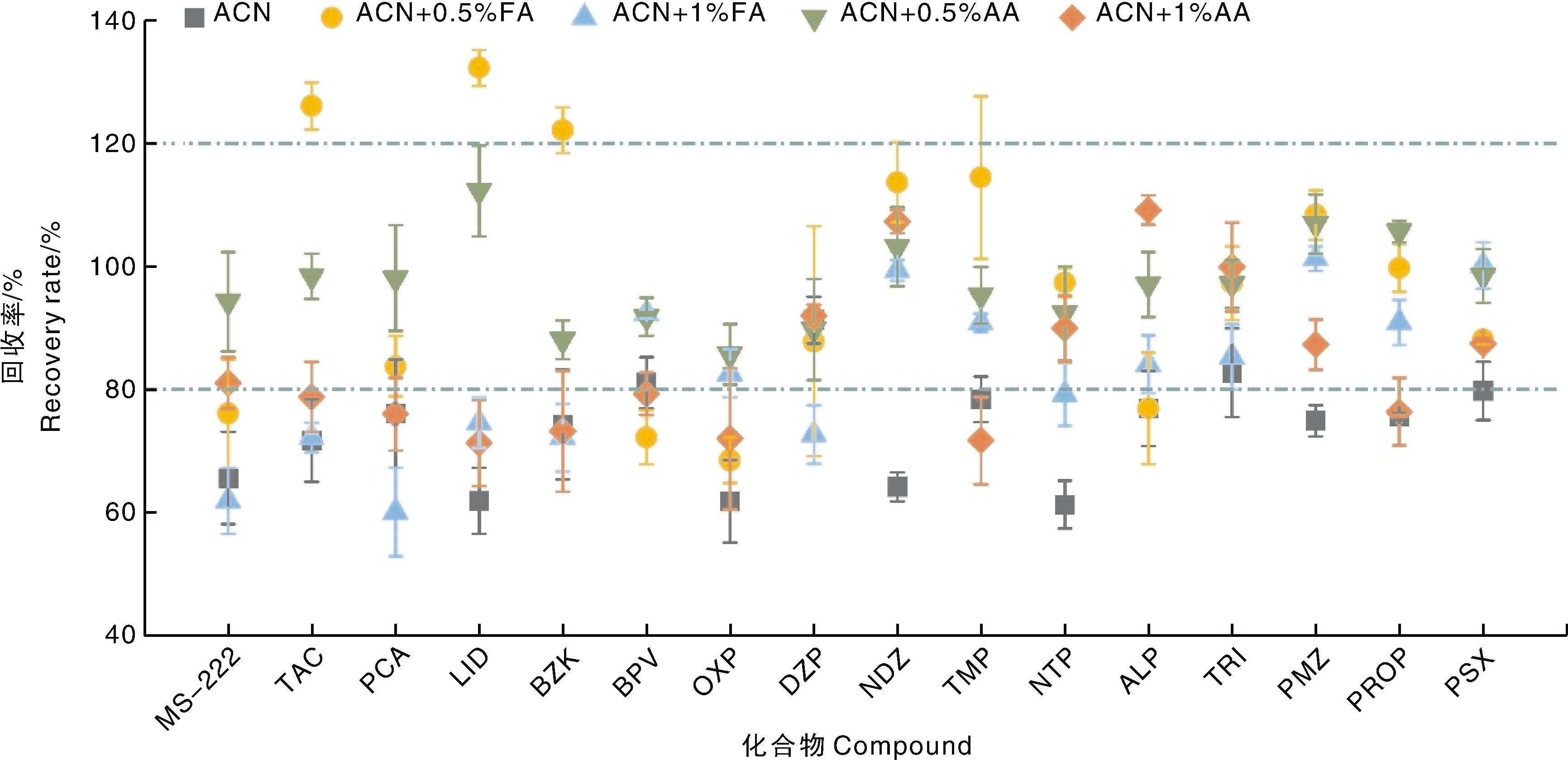
图1 不同萃取溶剂对16种麻醉剂回收率的影响(n=3) MS-222,三卡因;TAC,丁卡因;PCA,普鲁卡因;LID,利多卡因;BZK,苯佐卡因;BPV,布比卡因;OXP,奥沙西泮;DZP,地西泮;NDZ,去甲地西泮;TMP,替马西泮;NTP,硝西泮;ALP,阿普唑仑;TRI,三唑仑;PMZ,异丙嗪;PROP,丙酰丙嗪;PSX,异丙嗪亚砜;ACN,乙腈;ACN+0.5%FA,含0.5%甲酸的乙腈;ACN+1%FA,含1%甲酸的乙腈;ACN+0.5%AA,含0.5%乙酸的乙腈;ACN+1%AA,含1%乙酸的乙腈。下同。
Fig.1 Effects of different extraction solvents on recovery rates of 16 anesthetics (n=3) MS-222, Tricaine; TAC, Tetracaine; PCA, Procaine; LID, Lidocaine; BZK, Benzocaine; BPV, Bupivacaine; OXP, Oxazepam; DZP, Diazepam; NDZ, Nordiazepam; TMP, Temazepam; NTP, Nitrazepam; ALP, Alprazolam; TRI, Triazolam; PMZ, Promethazine; PROP, Propionylpromazine; PSX, Promethazine sulfoxide; ACN, Acetonitrile; ACN+0.5%FA, Acetonitrile with 0.5% formic acid; ACN+1%FA, Acetonitrile with 1% formic acid; ACN+0.5%AA, Acetonitrile with 0.5% acetic acid; ACN+1%AA, Acetonitrile with 1% acetic acid. The same as below.
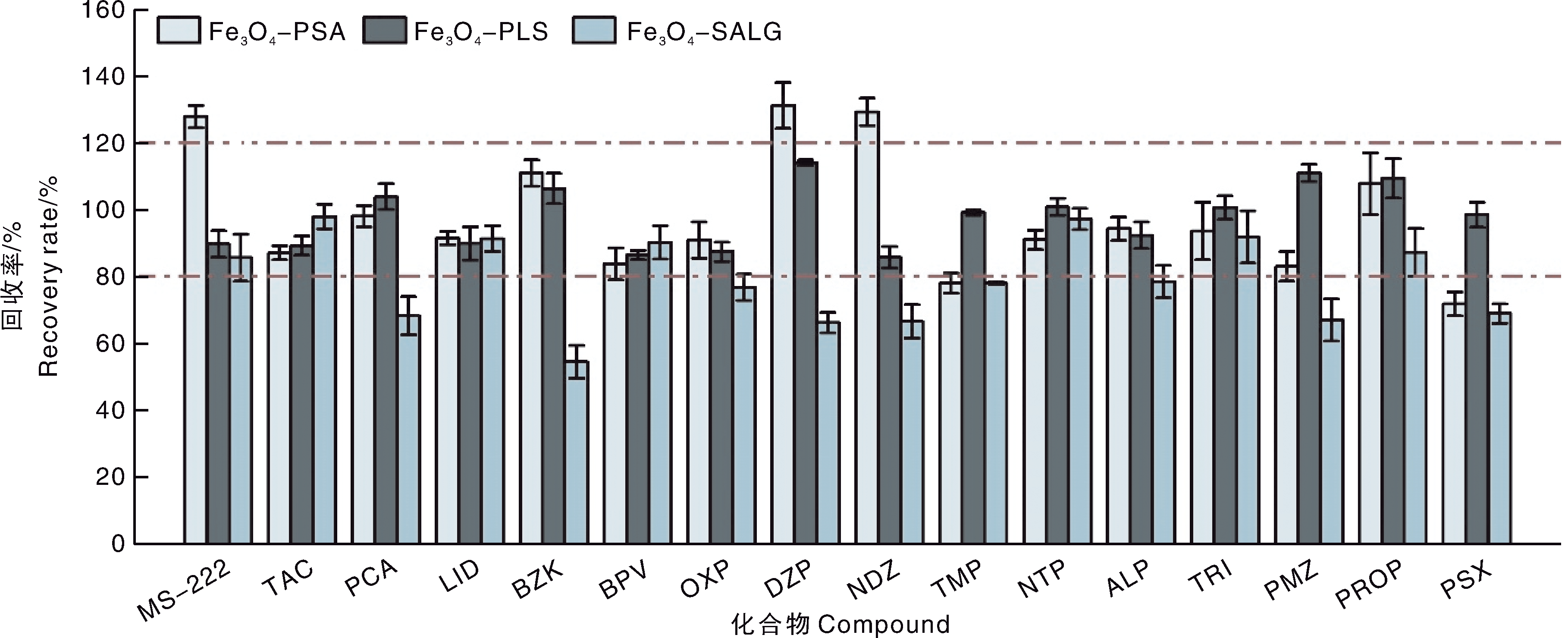
图2 不同磁性材料对16种麻醉剂回收率的影响(n=3) Fe3O4-PSA,N-丙基乙二胺修饰Fe3O4磁珠;Fe3O4-PLS,磁性聚合物颗粒Fe3O4@SiO2@DVB-NVP;Fe3O4@SiO2@SALG,海藻酸钠修饰Fe3O4生物聚合物。
Fig.2 Effect of different magnetic materials on recovery rate of 16 anesthetics (n=3) Fe3O4-PSA, N-propyl ethylenediamine modified Fe3O4 magnetic beads; Fe3O4-PLS, Magnetic polymer particle Fe3O4@SiO2@DVB-NVP; Fe3O4@SiO2@SALG, Sodium alginate modified Fe3O4 biopolymer.
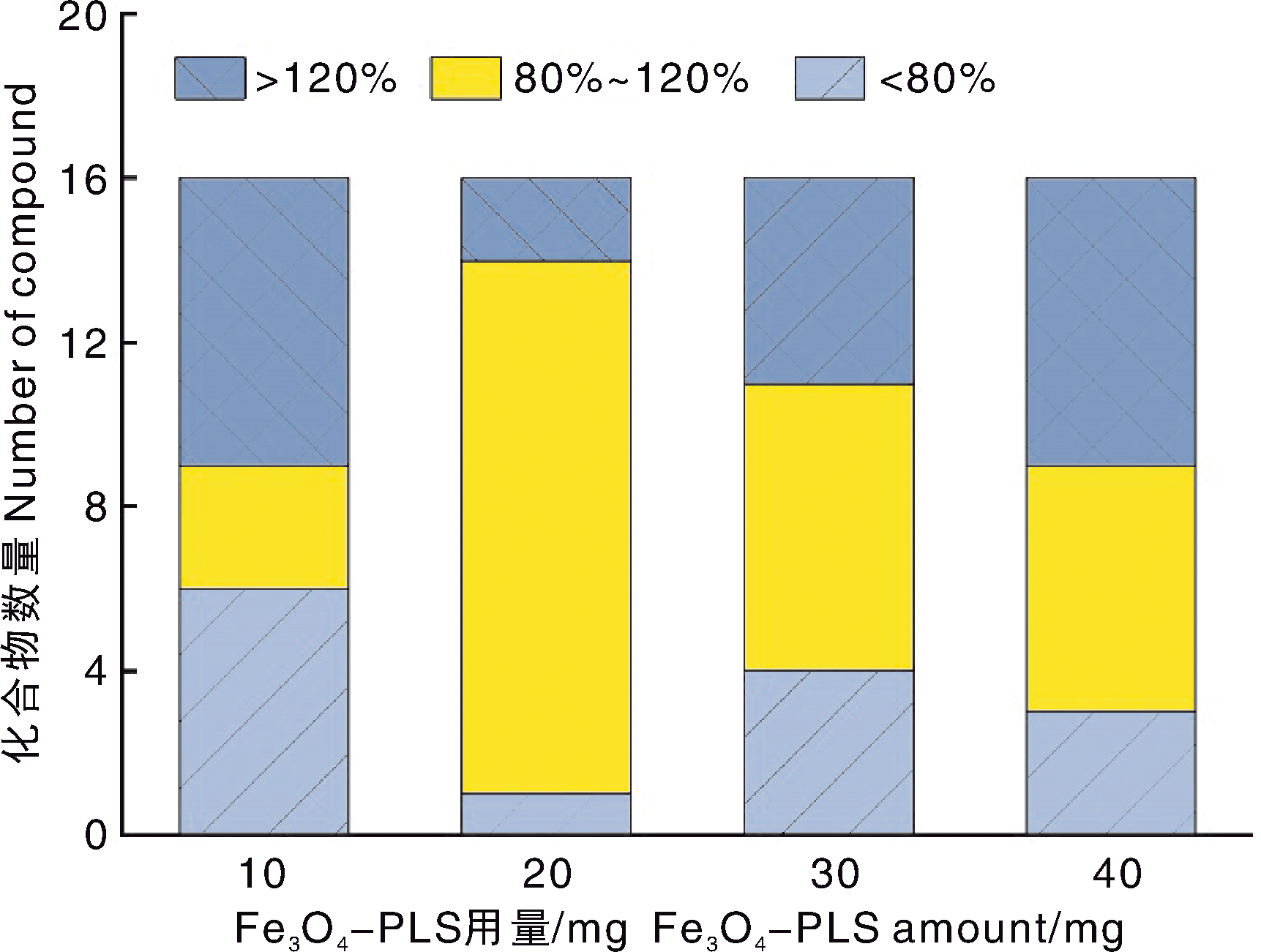
图3 Fe3O4-PLS用量对16种麻醉剂回收率的影响(n=3)
Fig.3 Effects of Fe3O4-PLS amount on recovery rate of 16 anesthetics(n=3)
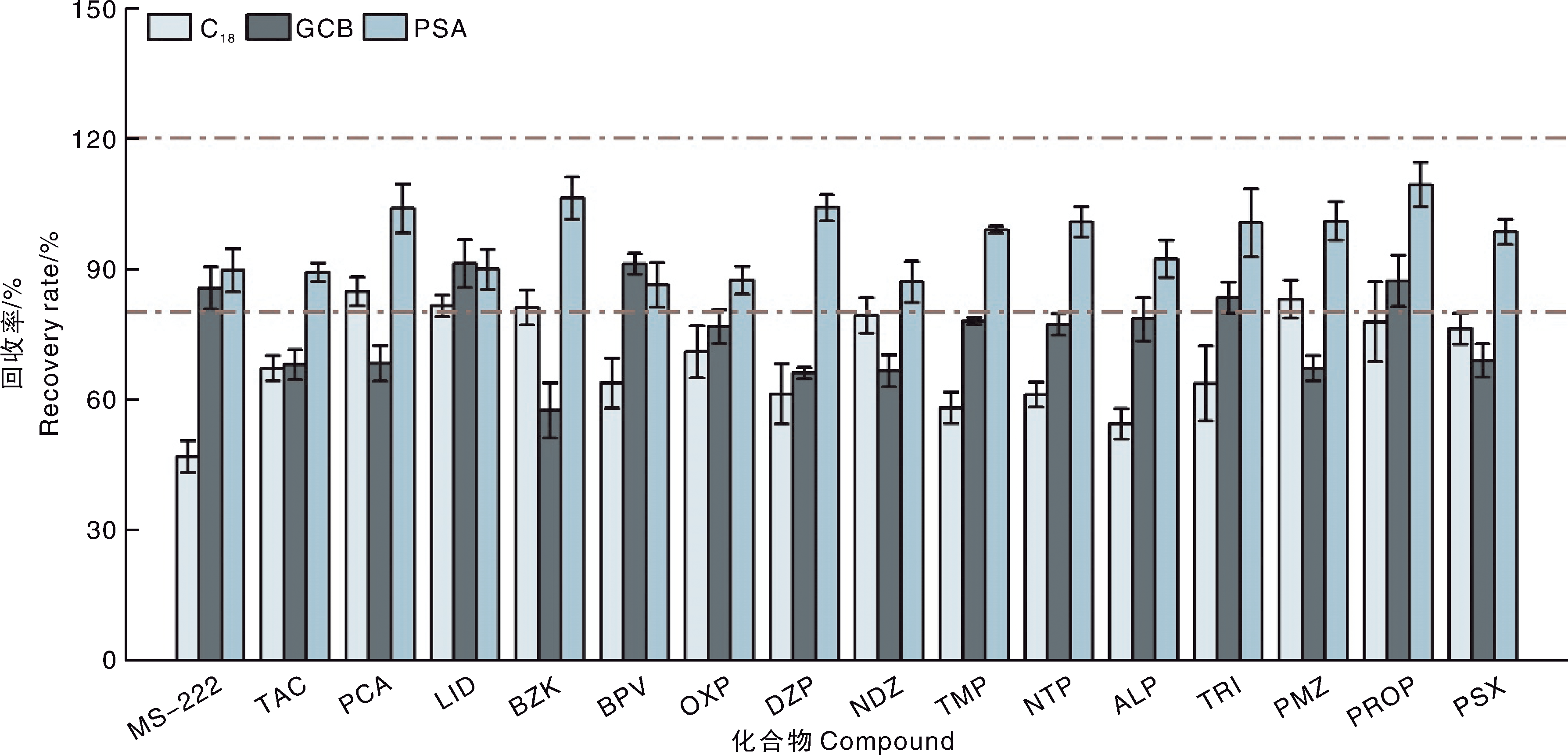
图4 净化材料类型对16种麻醉剂回收率的影响(n=3) C18,十八烷基硅烷;PSA,N-丙基乙二胺;GCB,石墨化炭黑。
Fig.4 Effect of purification material type on recovery rate of 16 anesthetics (n=3) C18, Octadecylsilane; PSA, N-propyl ethylenediamine; GCB, Graphitized carbon black.
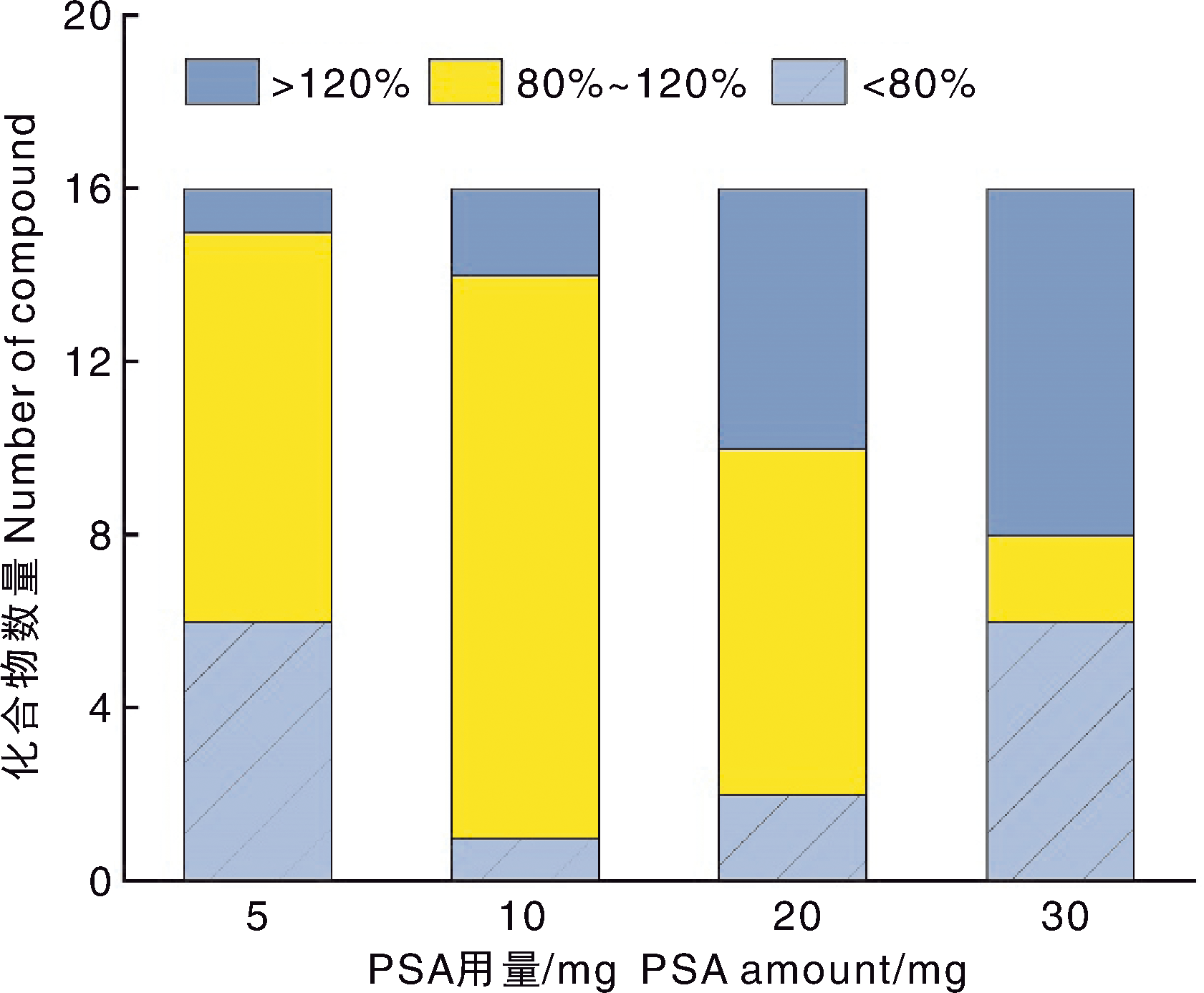
图5 PSA用量对16种麻醉剂回收率的影响(n=3)
Fig.5 Effect of PSA amount on recovery rate of 16 anesthetics (n=3)
| 化合物 Compound | 线性方程 Linear regression equation | 线性范围/(μg·kg-1) Linear range/ (μg·kg-1) | 相关系数 Correlation coefficient | 基质效应 Matrix effect | 检出限/(μg·kg-1) Limit of detection/ (μg·kg-1) |
|---|---|---|---|---|---|
| 三卡因MS-222 | Y=19 878X+19 312 | 0.5~200.0 | 0.999 | 0.83 | 0.57 |
| Y=24 069X+50 404 | 0.5~200.0 | 0.999 | 0.54 | ||
| 丁卡因Tetracaine | Y=311 769X+105 029 | 0.5~200.0 | 0.998 | 0.97 | 0.48 |
| Y=322 563X+7 290.8 | 0.5~200.0 | 0.999 | 0.52 | ||
| 普鲁卡因Procaine | Y=45 380X-21 710 | 0.5~200.0 | 0.998 | 1.06 | 0.44 |
| Y=42 921X-10 776 | 0.5~200.0 | 0.996 | 0.40 | ||
| 利多卡因Lidocaine | Y=274 357X-41 908 | 5.0~200.0 | 0.997 | 1.02 | 0.23 |
| Y=267 923X-53 578 | 5.0~200.0 | 0.998 | 0.25 | ||
| 苯佐卡因Benzocaine | Y=8 613.5X+741.44 | 0.5~200.0 | 1.000 | 0.85 | 0.42 |
| Y=10 130X+18 205 | 0.5~200.0 | 0.999 | 0.23 | ||
| 布比卡因Bupivacaine | Y=58 886X+148 900 | 2.0~200.0 | 0.997 | 1.05 | 0.08 |
| Y=56 115X-96 312 | 2.0~200.0 | 0.998 | 0.26 | ||
| 奥沙西泮Oxazepam | Y =1 772.9X-4 791.9 | 5.0~200.0 | 0.996 | 0.87 | 0.48 |
| Y=2 031.8X-5 816.1 | 5.0~200.0 | 0.997 | 0.44 | ||
| 地西泮Diazepam | Y=6 992.7X +2 291.2 | 1.0~200.0 | 0.996 | 0.88 | 0.50 |
| Y=7 948.1X-4 991.2 | 1.0~200.0 | 0.999 | 0.52 | ||
| 去甲地西泮Nordiazepam | Y=696.52X-1 346.3 | 2.0~200.0 | 0.999 | 0.93 | 0.33 |
| Y=752.32X+48.125 | 2.0~200.0 | 0.999 | 0.47 | ||
| 替马西泮Temazepam | Y=1 731.6 X-353.52 | 0.5~200.0 | 0.999 | 0.97 | 0.26 |
| Y=1 793.8X-320.5 | 0.5~200.0 | 0.996 | 0.41 | ||
| 硝西泮Nitrazepam | Y=975.71X+1 105.3 | 2.0~200.0 | 0.997 | 0.95 | 0.52 |
| Y=1 029.8X-2 018.5 | 2.0~200.0 | 0.998 | 0.39 | ||
| 阿普唑仑Alprazolam | Y=3 452X-855.7 | 0.5~200.0 | 0.999 | 0.92 | 0.46 |
| Y=3 745.5X-691.1 | 0.5~200.0 | 0.997 | 0.47 | ||
| 三唑仑Triazolam | Y=3 952.3X-158.53 | 0.5~200.0 | 0.999 | 1.05 | 0.32 |
| Y=3 747.9X+554.04 | 0.5~200.0 | 0.999 | 0.29 | ||
| 异丙嗪Promethazine | Y=23 559X-41 867 | 2.0~200.0 | 0.999 | 1.02 | 0.28 |
| Y=23 207X-21 523 | 2.0~200.0 | 0.999 | 0.23 | ||
| 丙酰丙嗪Propionylpromazine | Y=19 165X-22 787 | 2.0~200.0 | 0.998 | 1.03 | 0.33 |
| Y=18 539X-20 557 | 2.0~200.0 | 0.999 | 0.17 | ||
| 异丙嗪亚砜 | Y=5 951.2X-5 675.2 | 2.0~200.0 | 1.000 | 1.01 | 0.38 |
| Promethazine sulfoxide | Y=5 892.5X-8 374.2 | 2.0~200.0 | 0.999 | 0.29 |
表2 16种麻醉剂的线性回归方程、相关系数、基质效应和检出限
Table 2 Regression equations, correlation coefficient, matrix effect and limit of detection for 16 anesthetics
| 化合物 Compound | 线性方程 Linear regression equation | 线性范围/(μg·kg-1) Linear range/ (μg·kg-1) | 相关系数 Correlation coefficient | 基质效应 Matrix effect | 检出限/(μg·kg-1) Limit of detection/ (μg·kg-1) |
|---|---|---|---|---|---|
| 三卡因MS-222 | Y=19 878X+19 312 | 0.5~200.0 | 0.999 | 0.83 | 0.57 |
| Y=24 069X+50 404 | 0.5~200.0 | 0.999 | 0.54 | ||
| 丁卡因Tetracaine | Y=311 769X+105 029 | 0.5~200.0 | 0.998 | 0.97 | 0.48 |
| Y=322 563X+7 290.8 | 0.5~200.0 | 0.999 | 0.52 | ||
| 普鲁卡因Procaine | Y=45 380X-21 710 | 0.5~200.0 | 0.998 | 1.06 | 0.44 |
| Y=42 921X-10 776 | 0.5~200.0 | 0.996 | 0.40 | ||
| 利多卡因Lidocaine | Y=274 357X-41 908 | 5.0~200.0 | 0.997 | 1.02 | 0.23 |
| Y=267 923X-53 578 | 5.0~200.0 | 0.998 | 0.25 | ||
| 苯佐卡因Benzocaine | Y=8 613.5X+741.44 | 0.5~200.0 | 1.000 | 0.85 | 0.42 |
| Y=10 130X+18 205 | 0.5~200.0 | 0.999 | 0.23 | ||
| 布比卡因Bupivacaine | Y=58 886X+148 900 | 2.0~200.0 | 0.997 | 1.05 | 0.08 |
| Y=56 115X-96 312 | 2.0~200.0 | 0.998 | 0.26 | ||
| 奥沙西泮Oxazepam | Y =1 772.9X-4 791.9 | 5.0~200.0 | 0.996 | 0.87 | 0.48 |
| Y=2 031.8X-5 816.1 | 5.0~200.0 | 0.997 | 0.44 | ||
| 地西泮Diazepam | Y=6 992.7X +2 291.2 | 1.0~200.0 | 0.996 | 0.88 | 0.50 |
| Y=7 948.1X-4 991.2 | 1.0~200.0 | 0.999 | 0.52 | ||
| 去甲地西泮Nordiazepam | Y=696.52X-1 346.3 | 2.0~200.0 | 0.999 | 0.93 | 0.33 |
| Y=752.32X+48.125 | 2.0~200.0 | 0.999 | 0.47 | ||
| 替马西泮Temazepam | Y=1 731.6 X-353.52 | 0.5~200.0 | 0.999 | 0.97 | 0.26 |
| Y=1 793.8X-320.5 | 0.5~200.0 | 0.996 | 0.41 | ||
| 硝西泮Nitrazepam | Y=975.71X+1 105.3 | 2.0~200.0 | 0.997 | 0.95 | 0.52 |
| Y=1 029.8X-2 018.5 | 2.0~200.0 | 0.998 | 0.39 | ||
| 阿普唑仑Alprazolam | Y=3 452X-855.7 | 0.5~200.0 | 0.999 | 0.92 | 0.46 |
| Y=3 745.5X-691.1 | 0.5~200.0 | 0.997 | 0.47 | ||
| 三唑仑Triazolam | Y=3 952.3X-158.53 | 0.5~200.0 | 0.999 | 1.05 | 0.32 |
| Y=3 747.9X+554.04 | 0.5~200.0 | 0.999 | 0.29 | ||
| 异丙嗪Promethazine | Y=23 559X-41 867 | 2.0~200.0 | 0.999 | 1.02 | 0.28 |
| Y=23 207X-21 523 | 2.0~200.0 | 0.999 | 0.23 | ||
| 丙酰丙嗪Propionylpromazine | Y=19 165X-22 787 | 2.0~200.0 | 0.998 | 1.03 | 0.33 |
| Y=18 539X-20 557 | 2.0~200.0 | 0.999 | 0.17 | ||
| 异丙嗪亚砜 | Y=5 951.2X-5 675.2 | 2.0~200.0 | 1.000 | 1.01 | 0.38 |
| Promethazine sulfoxide | Y=5 892.5X-8 374.2 | 2.0~200.0 | 0.999 | 0.29 |
| 化合物 Compound | 日内回收率(相对标准偏差) Intra-day recovery rate (RSD) | 日间回收率(相对标准偏差) Inter-day recovery rate(RSD) | ||||
|---|---|---|---|---|---|---|
| 1 μg·kg-1 | 10 μg·kg-1 | 100 μg·kg-1 | 1 μg·kg-1 | 10 μg·kg-1 | 100 μg·kg-1 | |
| 三卡因Tricaine | 84.4(6.9) | 88.6(2.0) | 99.2(5.6) | 84.7(4.0) | 91.1(3.3) | 83.5(2.3) |
| 丁卡因Tetracaine | 79.3(1.1) | 95.9(4.1) | 98.5(6.4) | 95.9(1.1) | 83.6(4.1) | 91.3(6.2) |
| 普鲁卡因Procaine | 82.1(2.8) | 82.9(0.4) | 81.2(6.7) | 87.7(6.4) | 89.2(2.4) | 81.2(6.7) |
| 利多卡因Lidocaine | 96.4(6.3) | 91.0(3.3) | 99.4(3.6) | 97.2(3.3) | 99.8(1.4) | 100.2(3.5) |
| 苯佐卡因Benzocaine | 81.3(2.0) | 77.4(3.8) | 97.4(3.9) | 103.8(2.0) | 87.8(3.8) | 92.8(1.1) |
| 布比卡因Bupivacaine | 76.9(5.7) | 74.4(6.1) | 76.9(3.9) | 81.4(1.5) | 98.0(1.8) | 110.8(4.7) |
| 奥沙西泮Oxazepam | 82.9(0.8) | 87.6(7.2) | 97.3(3.4) | 78.9(8.1) | 89.3(3.3) | 101.8(6.5) |
| 地西泮Diazepam | 74.9(4.9) | 110.8(2.6) | 108.4(3.8) | 87.3(3.9) | 84.3(8.4) | 77.9(8.1) |
| 去甲地西泮Nordiazepam | 85.6(4.1) | 92.4(0.6) | 99.8(6.7) | 75.4(3.7) | 97.8(7.4) | 89.9(8.3) |
| 替马西泮Temazepam | 79.8(3.7) | 108.3(4.8) | 88.1(6.7) | 85.9(7.6) | 76.9(8.1) | 107.5(4.4) |
| 硝西泮Nitrazepam | 72.4(3.4) | 79.2(7.7) | 89.9(5.1) | 75.1(3.9) | 97.7(5.5) | 110.3(1.4) |
| 阿普唑仑Alprazolam | 79.1(3.6) | 84.1(5.3) | 109.2(4.7) | 87.4(6.3) | 98.0(4.0) | 96.7(2.9) |
| 三唑仑Triazolam | 77.2(7.3) | 85.3(6.8) | 99.9(5.3) | 90.3(6.1) | 81.4(2.4) | 86.4(3.6) |
| 异丙嗪Promethazine | 76.9(4.0) | 101.3(5.9) | 87.3(2.0) | 91.9(6.6) | 92.8(4.6) | 103.3(3.1) |
| 丙酰丙嗪Propionylpromazine | 75.7(3.9) | 90.9(7.5) | 76.4(3.7) | 89.7(5.8) | 92.0(6.0) | 106.4(4.9) |
| 异丙嗪亚砜Promethazine sulfoxide | 85.3(0.8) | 100.2(4.4) | 87.5(3.8) | 74.0(6.9) | 81.3(2.8) | 96.8(5.7) |
表3 3个加标水平下16种麻醉剂的日内与日间回收率及其相对标准偏差(RSD)(n=3)
Table 3 Recovery rate and intra-day and inter-day relative standard deviation (RSD) of 16 anesthetics at 3 additive levels (n=3) %
| 化合物 Compound | 日内回收率(相对标准偏差) Intra-day recovery rate (RSD) | 日间回收率(相对标准偏差) Inter-day recovery rate(RSD) | ||||
|---|---|---|---|---|---|---|
| 1 μg·kg-1 | 10 μg·kg-1 | 100 μg·kg-1 | 1 μg·kg-1 | 10 μg·kg-1 | 100 μg·kg-1 | |
| 三卡因Tricaine | 84.4(6.9) | 88.6(2.0) | 99.2(5.6) | 84.7(4.0) | 91.1(3.3) | 83.5(2.3) |
| 丁卡因Tetracaine | 79.3(1.1) | 95.9(4.1) | 98.5(6.4) | 95.9(1.1) | 83.6(4.1) | 91.3(6.2) |
| 普鲁卡因Procaine | 82.1(2.8) | 82.9(0.4) | 81.2(6.7) | 87.7(6.4) | 89.2(2.4) | 81.2(6.7) |
| 利多卡因Lidocaine | 96.4(6.3) | 91.0(3.3) | 99.4(3.6) | 97.2(3.3) | 99.8(1.4) | 100.2(3.5) |
| 苯佐卡因Benzocaine | 81.3(2.0) | 77.4(3.8) | 97.4(3.9) | 103.8(2.0) | 87.8(3.8) | 92.8(1.1) |
| 布比卡因Bupivacaine | 76.9(5.7) | 74.4(6.1) | 76.9(3.9) | 81.4(1.5) | 98.0(1.8) | 110.8(4.7) |
| 奥沙西泮Oxazepam | 82.9(0.8) | 87.6(7.2) | 97.3(3.4) | 78.9(8.1) | 89.3(3.3) | 101.8(6.5) |
| 地西泮Diazepam | 74.9(4.9) | 110.8(2.6) | 108.4(3.8) | 87.3(3.9) | 84.3(8.4) | 77.9(8.1) |
| 去甲地西泮Nordiazepam | 85.6(4.1) | 92.4(0.6) | 99.8(6.7) | 75.4(3.7) | 97.8(7.4) | 89.9(8.3) |
| 替马西泮Temazepam | 79.8(3.7) | 108.3(4.8) | 88.1(6.7) | 85.9(7.6) | 76.9(8.1) | 107.5(4.4) |
| 硝西泮Nitrazepam | 72.4(3.4) | 79.2(7.7) | 89.9(5.1) | 75.1(3.9) | 97.7(5.5) | 110.3(1.4) |
| 阿普唑仑Alprazolam | 79.1(3.6) | 84.1(5.3) | 109.2(4.7) | 87.4(6.3) | 98.0(4.0) | 96.7(2.9) |
| 三唑仑Triazolam | 77.2(7.3) | 85.3(6.8) | 99.9(5.3) | 90.3(6.1) | 81.4(2.4) | 86.4(3.6) |
| 异丙嗪Promethazine | 76.9(4.0) | 101.3(5.9) | 87.3(2.0) | 91.9(6.6) | 92.8(4.6) | 103.3(3.1) |
| 丙酰丙嗪Propionylpromazine | 75.7(3.9) | 90.9(7.5) | 76.4(3.7) | 89.7(5.8) | 92.0(6.0) | 106.4(4.9) |
| 异丙嗪亚砜Promethazine sulfoxide | 85.3(0.8) | 100.2(4.4) | 87.5(3.8) | 74.0(6.9) | 81.3(2.8) | 96.8(5.7) |
| 预处理方法 Preparation method | 吸附剂数量 Adsorbent amounts | 单个样品处理时间/min Single pretreatment time/min | 检出限/(μg·kg-1) Limit of detection/ (μg·kg-1) | 基质效应 Matrix effect | 回收率/% Recovery rate/% | 参考文献 Reference |
|---|---|---|---|---|---|---|
| SPE | Oasis PRiME HLB(150 mg/3 mL) | 22 | 1.50~6.00 | 0.58~0.85 | 76.8~110.0 | [ |
| DSPE | 50 mg PSA+10 mg C18+20 mg PS-GMA | 24 | 11.00~43.00 | 0.87~1.23 | 79.7~109.0 | [ |
| MDSPE | 20 mg Fe3O4-PLS+10 mg PSA | 7.5 | 0.08~0.57 | 0.83~1.06 | 72.4~110.8 | 本文This study |
表4 本方法与其他文献方法的对比
Table 4 Comparison of the present method with those reported in other literatures
| 预处理方法 Preparation method | 吸附剂数量 Adsorbent amounts | 单个样品处理时间/min Single pretreatment time/min | 检出限/(μg·kg-1) Limit of detection/ (μg·kg-1) | 基质效应 Matrix effect | 回收率/% Recovery rate/% | 参考文献 Reference |
|---|---|---|---|---|---|---|
| SPE | Oasis PRiME HLB(150 mg/3 mL) | 22 | 1.50~6.00 | 0.58~0.85 | 76.8~110.0 | [ |
| DSPE | 50 mg PSA+10 mg C18+20 mg PS-GMA | 24 | 11.00~43.00 | 0.87~1.23 | 79.7~109.0 | [ |
| MDSPE | 20 mg Fe3O4-PLS+10 mg PSA | 7.5 | 0.08~0.57 | 0.83~1.06 | 72.4~110.8 | 本文This study |
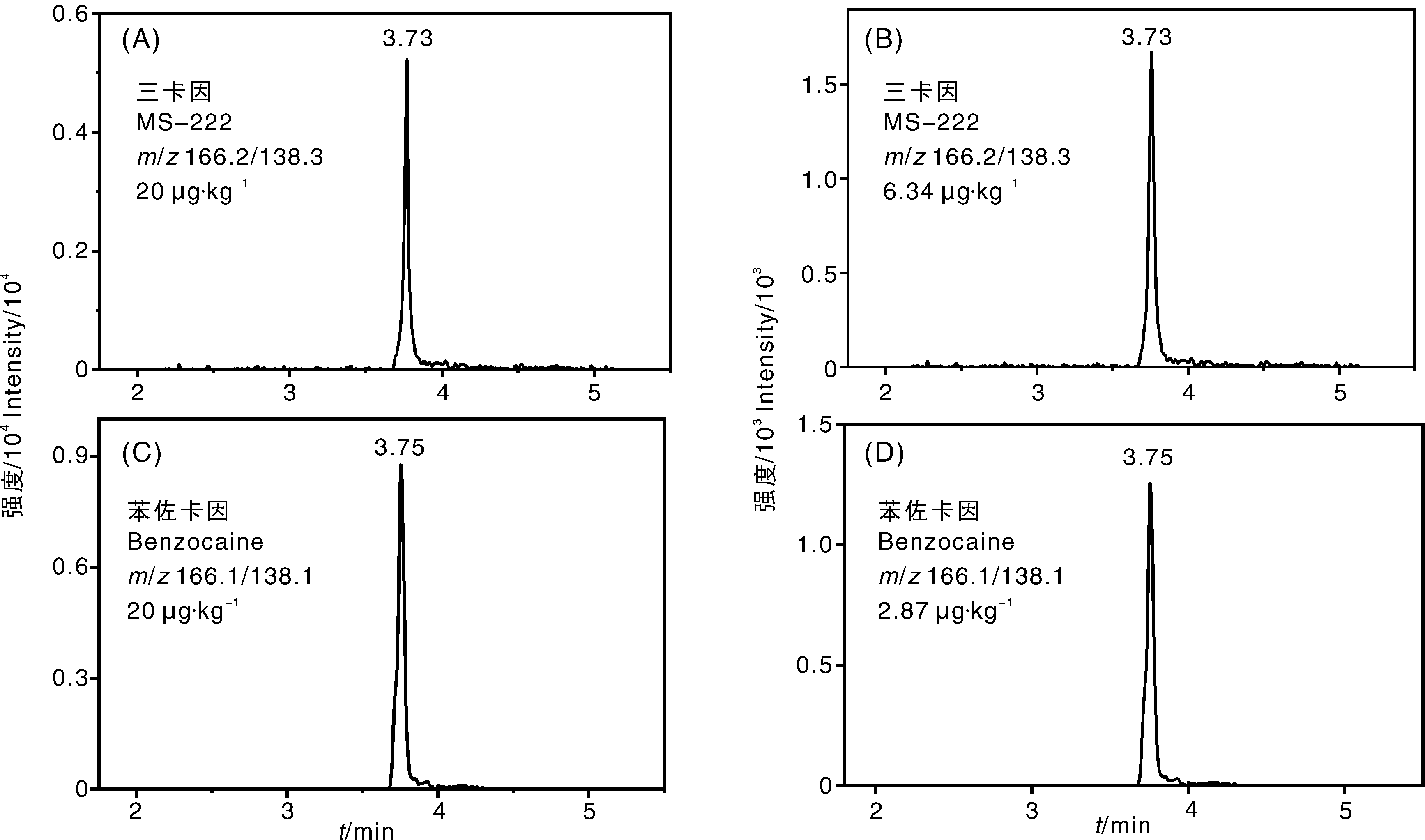
图6 标准品与阳性样品的提取离子流色谱图 A,三卡因基质匹配标准溶液(20 μg·kg-1);B,阳性样品(6.34 μg·kg-1);C,苯佐卡因基质匹配标准溶液(20 μg·kg-1);D,阳性样品(2.87 μg·kg-1)。
Fig.6 Extraction of ion chromatograms for standard and positive samples A, MS-222 matrix-matched standard solution (20 μg·kg-1); B, Positive sample (6.34 μg·kg-1); C, Benzocaine matrix-matched standard solution (20 μg·kg-1); D, Positive sample (2.87 μg·kg-1).
| 序号 No. | 样品 Sample | 三卡因 MS-222 | 苯佐卡因 Benzocaine |
|---|---|---|---|
| 1 | 鳙鱼Hypophthalmichthys nobilis | ND | ND |
| 2 | 鳙鱼Hypophthalmichthys nobilis | ND | ND |
| 3 | 白条鱼Chanodichthys erythropterus | ND | 1.44 |
| 4 | 鳙鱼Hypophthalmichthys nobilis | ND | ND |
| 5 | 鳊鱼Megalobrama amblycephala | ND | ND |
| 6 | 花链Hypophthalmichthys nobilis | ND | ND |
| 7 | 鲫鱼Carassius auratus | ND | ND |
| 8 | 黑鱼Channa argus | ND | ND |
| 9 | 草鱼Ctenopharyngodon idella | ND | 1.47 |
| 10 | 光唇鱼Acrossocheilus fasciatus | ND | 1.50 |
| 11 | 光唇鱼Acrossocheilus fasciatus | ND | ND |
| 12 | 光唇鱼Acrossocheilus fasciatus | ND | ND |
| 13 | 光唇鱼Acrossocheilus fasciatus | ND | ND |
| 14 | 马口鱼Opsariichthys bidens | ND | ND |
| 15 | 马口鱼Opsariichthys bidens | ND | ND |
| 16 | 光唇鱼Acrossocheilus fasciatus | 2.07 | ND |
| 17 | 光唇鱼Acrossocheilus fasciatus | 2.15 | 1.53 |
| 18 | 鲫鱼Carassius auratus | 2.31 | 1.61 |
| 19 | 马口鱼Opsariichthys bidens | ND | 1.72 |
| 20 | 马口鱼Opsariichthys bidens | ND | 1.78 |
| 21 | 胖头鱼Hypophthalmichthys nobilis | 3.98 | 1.80 |
| 22 | 胖头鱼Hypophthalmichthys nobilis | 5.76 | 2.87 |
| 23 | 鲫鱼Carassius auratus | 6.34 | ND |
表5 23种样品中麻醉剂检出情况及其质量分数(n=3)
Table 5 Mass fractions of anesthetics detected in 23 samples (n=3) μg·kg-1
| 序号 No. | 样品 Sample | 三卡因 MS-222 | 苯佐卡因 Benzocaine |
|---|---|---|---|
| 1 | 鳙鱼Hypophthalmichthys nobilis | ND | ND |
| 2 | 鳙鱼Hypophthalmichthys nobilis | ND | ND |
| 3 | 白条鱼Chanodichthys erythropterus | ND | 1.44 |
| 4 | 鳙鱼Hypophthalmichthys nobilis | ND | ND |
| 5 | 鳊鱼Megalobrama amblycephala | ND | ND |
| 6 | 花链Hypophthalmichthys nobilis | ND | ND |
| 7 | 鲫鱼Carassius auratus | ND | ND |
| 8 | 黑鱼Channa argus | ND | ND |
| 9 | 草鱼Ctenopharyngodon idella | ND | 1.47 |
| 10 | 光唇鱼Acrossocheilus fasciatus | ND | 1.50 |
| 11 | 光唇鱼Acrossocheilus fasciatus | ND | ND |
| 12 | 光唇鱼Acrossocheilus fasciatus | ND | ND |
| 13 | 光唇鱼Acrossocheilus fasciatus | ND | ND |
| 14 | 马口鱼Opsariichthys bidens | ND | ND |
| 15 | 马口鱼Opsariichthys bidens | ND | ND |
| 16 | 光唇鱼Acrossocheilus fasciatus | 2.07 | ND |
| 17 | 光唇鱼Acrossocheilus fasciatus | 2.15 | 1.53 |
| 18 | 鲫鱼Carassius auratus | 2.31 | 1.61 |
| 19 | 马口鱼Opsariichthys bidens | ND | 1.72 |
| 20 | 马口鱼Opsariichthys bidens | ND | 1.78 |
| 21 | 胖头鱼Hypophthalmichthys nobilis | 3.98 | 1.80 |
| 22 | 胖头鱼Hypophthalmichthys nobilis | 5.76 | 2.87 |
| 23 | 鲫鱼Carassius auratus | 6.34 | ND |
| [1] | 王兴益, 陈彦龙, 肖小华, 等. 水产品中有害物质分析样品前处理技术研究进展[J]. 色谱, 2021, 39(1): 34-45. |
| WANG X Y, CHEN Y L, XIAO X H, et al. Recent advances in sample preparation technologies for analysis of harmful substances in aquatic products[J]. Chinese Journal of Chromatography, 2021, 39(1): 34-45. | |
| [2] | WANG M L, QIAO Y, LUO Z H, et al. Development of a QuEChERS combined with LC-MS/MS method for determining 24 sedatives and anesthetics in animal-derived foods[J]. Journal of Food Composition and Analysis, 2024, 127: 106000. |
| [3] | ZHAO C Y, MA X Y, ZANG J L, et al. In situ enrichment and determination of 6 kinds of caine-type anesthetics in cosmetics and rat serum by thin layer chromatography-Raman spectroscopy[J]. Arabian Journal of Chemistry, 2023, 16(10): 105121. |
| [4] | 王展华, 梁晶晶, 施贝, 等. 通过式固相萃取结合UPLC-MS/MS同时检测水产品中麻醉剂及其代谢物残留[J]. 中国现代应用药学, 2023, 40(16): 2282-2287. |
| WANG Z H, LIANG J J, SHI B, et al. Simultaneous determination of anesthetics and metabolites in aquatic products by UPLC-MS/MS coupled with pass-through solid phase extraction[J]. Chinese Journal of Modern Applied Pharmacy, 2023, 40(16): 2282-2287. | |
| [5] | 吴少明, 欧阳立群, 孟鹏, 等. 固相萃取净化-超高效液相色谱-串联质谱法测定畜肉中18种卡因类麻醉剂[J]. 色谱, 2023, 41(5): 434-442. |
| WU S M, OUYANG L Q, MENG P, et al. Determination of 18 caine anesthetics in animal meat using solid phase extraction combined with ultra-performance liquid chromatography-tandem mass spectrometry[J]. Chinese Journal of Chromatography, 2023, 41(5): 434-442. | |
| [6] | HONG S, KWON N, KANG H S, et al. Development of an analytical method for detection of anesthetics and sedatives in fish[J]. Journal of AOAC International, 2022, 105(3): 774-783. |
| [7] | HUANG Q, ZHOU H, WU X L, et al. Simultaneous determination of the residues of anesthetics and sedatives in fish using LC-QLIT-MS/MS combined with DSPE[J]. Food Chemistry, 2023, 403: 134407. |
| [8] | 肖璇, 周凌聿, 陈春泉, 等. 超高效液相色谱-串联质谱法测定水产品中5种卡因类麻醉剂及其代谢物的不确定度[J]. 化学分析计量, 2024, 33(3): 121-128. |
| XIAO X, ZHOU L Y, CHEN C Q, et al. Uncertainty evaluation for determination of 5 caine anesthetics and their metabolites in aquatic products by ultra high performance liquid chromatography-tandem mass spectrometry[J]. Chemical Analysis and Meterage, 2024, 33(3): 121-128. | |
| [9] | BOYER S E, WHITE J S, STIER A C, et al. Effects of the fish anesthetic, clove oil (eugenol), on coral health and growth[J]. Journal of Experimental Marine Biology and Ecology, 2009, 369(1): 53-57. |
| [10] | YE L. Development and validation of a LC-MS/MS method for the determination of isoeugenol in finfish[J]. Food Chemistry, 2017, 228: 70-76. |
| [11] | 陈源. UPLC-MS/MS同时测定水产品中7种丁香酚类麻醉剂残留量[J]. 食品工业, 2024, 45(1): 280-283. |
| CHEN Y. Determination of 7 eugenol residues in aquatic products by UPLC-MS/MS[J]. The Food Industry, 2024, 45(1): 280-283. | |
| [12] | HUANG S Y, XU J Q, WU J Y, et al. Rapid detection of five anesthetics in tilapias by in vivo solid phase microextraction coupling with gas chromatography-mass spectrometry[J]. Talanta, 2017, 168: 263-268. |
| [13] | LIANG X, FENG T T, WU J H, et al. Vortex-assisted liquid-liquid micro-extraction followed by head space solid phase micro-extraction for the determination of eugenol in fish using GC-MS[J]. Food Analytical Methods, 2018, 11(3): 790-796. |
| [14] | 金慧玲, 刘真真, 范晓民, 等. 磁性“一步法”-液相色谱-串联质谱法测定水产品中28种有机磷农药残留[J]. 分析化学, 2024, 52(3): 419-439. |
| JIN H L, LIU Z Z, FAN X M, et al. Determination of 28 kinds of organophosphorus pesticide residues in aquatic products by magnetic “One-step” method combined with liquid chromatography-tandem mass spectrometry[J]. Chinese Journal of Analytical Chemistry, 2024, 52(3): 419-439. | |
| [15] | PENG X T, JIANG L, GONG Y, et al. Preparation of mesoporous ZrO2-coated magnetic microsphere and its application in the multi-residue analysis of pesticides and PCBs in fish by GC-MS/MS[J]. Talanta, 2015, 132: 118-125. |
| [16] | LIU H M, LI Y, WANG S K, et al. Magnetic solid-phase extraction of tetracyclines from milk using metal-organic framework MIL-101(Cr)-NH2 functionalised hydrophilic magnetic nanoparticles[J]. Food Chemistry, 2024, 452: 139579. |
| [17] | 刘真真. 功能磁性材料制备及其在海水和水产品中农药和抗生素残留分析中的应用研究[D]. 厦门: 厦门大学, 2021. |
| LIU Z Z. Preparation of functional magnetic material and its application in the determination of pesticide and antibiotic residues in seawater and aquatic products[D]. Xiamen: Xiamen University, 2021. | |
| [18] | LIU Z Z, ZHAO H Y, WANG J, et al. Magnetic polymer particles as a highly efficient and facile cleanup adsorbent for multi-pesticide residues analysis in aquatic products[J]. Ecotoxicology and Environmental Safety, 2022, 241: 113830. |
| [19] | LIU Z Z, QI P P, WANG J, et al. Development, validation, comparison, and implementation of a highly efficient and effective method using magnetic solid-phase extraction with hydrophilic-lipophilic-balanced materials for LC-MS/MS analysis of pesticides in seawater[J]. Science of The Total Environment, 2020, 708: 135221. |
| [20] | LIU Z Z, QI P P, WANG X Y, et al. Multi-pesticides residue analysis of grains using modified magnetic nanoparticle adsorbent for facile and efficient cleanup[J]. Food Chemistry, 2017, 230: 423-431. |
| [21] | 刘真真, 齐沛沛, 王新全, 等. 磁纳米材料净化-超高效液相色谱-串联质谱测定猕猴桃中多农药残留[J]. 色谱, 2016, 34(8): 762-772. |
| LIU Z Z, QI P P, WANG X Q, et al. Determination of pesticide multiresidue in kiwifruit by magnetic nanoparticles adsorbent purification and ultra performance liquid chromatographytandem mass spectrometry[J]. Chinese Journal of Chromatography, 2016, 34(8): 762-772. | |
| [22] | LI F, WANG Z H, ZHU B Q, et al. Development and application of a rapid screening SPE-LC-QTOF method for the quantification of 14 anesthetics in aquatic products[J]. Food Analytical Methods, 2023, 16(3): 633-649. |
| [23] | 魏丹, 国明, 张菊. 加速溶剂萃取-磁固相萃取-高效液相色谱-串联质谱法测定水产品中10种氟喹诺酮类药物残留[J]. 色谱, 2020, 38(12): 1413-1422. |
| WEI D, GUO M, ZHANG J. Determination of 10 fluoroquinolones residues in aquatic products by accelerated solvent extraction, magnetic solid-phase extraction, and high-performance liquid chromatography-tandem mass spectrometry[J]. Chinese Journal of Chromatography, 2020, 38(12): 1413-1422. | |
| [24] | 童学智, 陈东洋, 冯家力, 等. QuEChERS-超高效液相色谱-串联质谱法快速测定水产品中5种卤代苯醌[J]. 色谱, 2023, 41(6): 490-496. |
| TONG X Z, CHEN D Y, FENG J L, et al. Rapid determination of five halobenzoquinones in aquatic products by QuEChERS-ultra performance liquid chromatography-tandem mass spectrometry[J]. Chinese Journal of Chromatography, 2023, 41(6): 490-496. | |
| [25] | 刘小琦, 刘真真, 王美玉, 等. QuEChERS-超高效液相色谱-串联质谱分析鱼中13种全氟及多氟烷基化合物[J]. 色谱, 2024, 42(8): 740-748. |
| LIU X Q, LIU Z Z, WANG M Y, et al. Determination of 13 perfluorinated and polyfluoroalkyl substances in fishes by QuEChERS-ultra-high performance liquid chromatography-tandem mass spectrometry[J]. Chinese Journal of Chromatography, 2024, 42(8): 740-748. | |
| [26] | 周书威, 傅红, 杨方. 伯仲胺基团修饰Fe3O4磁性材料的制备和性能表征[J]. 复合材料学报, 2024, 41(4): 1977-1986. |
| ZHOU S W, FU H, YANG F. Preparation and performance characterization of primary secondary amine-modified Fe3O4 magnetic materials[J]. Acta Materiae Compositae Sinica, 2024, 41(4): 1977-1986. | |
| [27] | 王玮, 赵莹, 郭蓉, 等. QuEChERS-三重四极杆-气质联用法测定西洋参中227种农药残留[J]. 药物分析杂志, 2023, 43(11): 1897-1908. |
| WANG W, ZHAO Y, GUO R, et al. Determination of 227 pesticide residues in Panacis Quinquefolii Radix by QuEChERS-triple quadrupole-gas chromatography[J]. Chinese Journal of Pharmaceutical Analysis, 2023, 43(11): 1897-1908. | |
| [28] | 杨霄, 万译文, 黄华伟, 等. 分散固相萃取-超高效液相色谱-串联质谱法测定水产品中5种硝基咪唑类和6种苯二氮卓类药物[J]. 色谱, 2022, 40(7): 625-633. |
| YANG X, WAN Y W, HUANG H W, et al. Determination of five nitroimidazoles and six benzodiazepines in aquatic products using ultra-high performance liquid chromatography-tandem mass spectrometry coupled with dispersive solid-phase extraction[J]. Chinese Journal of Chromatography, 2022, 40(7): 625-633. | |
| [29] | QI P P, WANG J, LIU Z Z, et al. Integrated QuEChERS strategy for high-throughput multi-pesticide residues analysis of vegetables[J]. Journal of Chromatography A, 2021, 1659: 462589. |
| [30] | 高平, 杨曦, 莫彩娜, 等. 通过式固相萃取净化/高效液相色谱-串联质谱法快速测定水产品中6种麻醉剂残留[J]. 分析测试学报, 2019, 38(9): 1059-1065. |
| GAO P, YANG X, MO C N, et al. Rapid determination of six anesthetics residues in aquatic products by high performance liquid chromatography-tandem mass spectrometry with pass-through solid phase extraction[J]. Journal of Instrumental Analysis, 2019, 38(9): 1059-1065. | |
| [31] | 石芳, 寿旦, 金米聪, 等. 分散固相萃取-高效液相色谱法测定水产品中7种麻醉剂[J]. 色谱, 2022, 40(2): 139-147. |
| SHI F, SHOU D, JIN M C, et al. Dispersive solid-phase extraction combined with high-performance liquid chromatography for determination of seven anesthetics in aquatic products[J]. Chinese Journal of Chromatography, 2022, 40(2): 139-147. |
| [1] | 孙凤婷, 王旭, 韩新雨, 许振岚, 吴声敢, 黄浩, 汤涛, 盛清, 王强, 沈国强, 赵学平. 复硝酚钠对铁皮石斛中黄酮含量和抗氧化活性的影响[J]. 浙江农业学报, 2025, 37(4): 934-942. |
| [2] | 鲁一平, 练青平, 郭爱环, 罗凯, 许巧情, 原居林. 钱塘江唐家洲产卵场仔稚鱼的资源现状及其与环境因子的关系[J]. 浙江农业学报, 2025, 37(2): 278-287. |
| [3] | 黄慧灵, 韩明明, 潘鑫煜, 赵旭东, 颉志刚, 徐剑斌, 楼宝. 感染哈维氏弧菌小黄鱼的组织病理学和转录组学分析[J]. 浙江农业学报, 2025, 37(12): 2479-2493. |
| [4] | 肖毓淼, 马巧梅, 张思法, 何勇, 赵振卿. 鱼蛋白水解物对番茄幼苗生长及光合特性的影响[J]. 浙江农业学报, 2025, 37(12): 2504-2515. |
| [5] | 潘鑫煜, 黄慧灵, 韩明明, 沈宁远, 赵旭东, 楼宝. 刺激隐核虫感染对小黄鱼肠道的组织结构、免疫水平与微生物组成的影响[J]. 浙江农业学报, 2025, 37(11): 2265-2274. |
| [6] | 简杰亮, 顾华鑫, 顾祝荣, 王宝莲, 范峰林, 吴旭国, 许晓军. 薄颌光唇鱼的形态特征与染色体核型分析[J]. 浙江农业学报, 2025, 37(10): 2042-2048. |
| [7] | 任晓蓉, 王新全, 张善英, 王萌, 朱鸿明, 章程辉, 齐沛沛. 基于LC-MS/MS的桑叶5种生物活性物质的同时检测[J]. 浙江农业学报, 2025, 37(10): 2179-2189. |
| [8] | 李飞, 苏甜甜, 苏康杰, 徐可, 马力, 刘子明. 螺旋藻和红球藻对斑马鱼生长性能、抗氧化酶、磷酸酶和热休克蛋白的影响[J]. 浙江农业学报, 2024, 36(7): 1511-1518. |
| [9] | 裘丞军, 侯轩, 陈凯, 吴望君, 周炜, 段友刚. 超高效液相色谱-串联质谱法同时测定畜禽排泄物中15种喹诺酮类药物[J]. 浙江农业学报, 2024, 36(7): 1519-1529. |
| [10] | 王晓梅, 骆玉琴, 赵学平, 陆兰菲, 方楠, 王祥云, 蒋金花, 何红梅, 张昌朋, 王强. 氟吡菌酰胺在铁皮石斛中的残留与膳食风险[J]. 浙江农业学报, 2024, 36(7): 1666-1676. |
| [11] | 张红芳, 钱涛, 金婷, 谢小玲, 吴酬飞, 肖英平, 马灵燕. 草鱼肠道微生物谱及其发育性变化[J]. 浙江农业学报, 2024, 36(4): 780-789. |
| [12] | 汤永华, 石非凡, 林森, 张志鹏, 孟妍君, 刘兴通. 基于融合非局部操作的YOLOv5s高密度锦鲤鱼苗检测方法[J]. 浙江农业学报, 2024, 36(4): 952-967. |
| [13] | 葛健辉, 沈小明, 关文志, 管辛帅, 楼宝, 许晓军. 浙江平原池塘养殖马口鱼个体繁殖力研究[J]. 浙江农业学报, 2024, 36(11): 2476-2481. |
| [14] | 何雨, 刘峰, 张天乐, 楼宝, 魏福亮, 叶挺. 高温胁迫对小黄鱼肝脏组织结构和细胞凋亡的影响[J]. 浙江农业学报, 2024, 36(1): 58-66. |
| [15] | 刘士力, 练青平, 贾永义, 迟美丽, 李飞, 姜建湖, 刘一诺, 郑建波, 程顺, 顾志敏. 基于线粒体Cyt b基因序列的浙江省3个马口鱼群体遗传多样性分析[J]. 浙江农业学报, 2023, 35(2): 293-300. |
| 阅读次数 | ||||||
|
全文 |
|
|||||
|
摘要 |
|
|||||

