浙江农业学报 ›› 2026, Vol. 38 ›› Issue (7): 1432-1442.DOI: 10.3969/j.issn.1004-1524.20250235
不同绿肥管理模式对柑橘园土壤理化特性和细菌群落的调控效应
温明霞1( ), 李永杰2, 黄贝1
- 1
浙江省柑橘研究所 浙江 台州 318020
2临海市特产技术推广总站 浙江 临海 317000
-
收稿日期:2025-03-24出版日期:2026-07-25发布日期:2026-08-20 -
作者简介:温明霞,研究方向为土壤健康培育、柑橘优质高效栽培技术与农产品质量安全。E-mail:wenmx198@126.com -
基金资助:浙江省“三农九方”科技协作计划项目(2025SNJF063);浙江省“三农九方”科技协作计划项目(2025SNJF015-3)
Regulatory effects of different green manure management modes on soil physicochemical properties and bacterial communities in citrus orchards
WEN Mingxia1(), LI Yongjie2, HUANG Bei1
- 1
Zhejiang Citrus Research Institute Taizhou 318020, Zhejiang, China
2Linhai Specialty and Technology Extension Station Linhai 317000, Zhejiang, China
-
Received:2025-03-24Published:2026-07-25Online:2026-08-20

摘要: 为进一步明确行间生草对改善果园土壤生态环境的影响,本研究以柑橘园为研究对象,比较不同绿肥管理模式对柑橘园土壤理化特性和细菌群落的影响。结果表明,种植白三叶草后土壤碱解氮、全氮、无机磷、有机质含量分别显著(p<0.05)提高61.09%、52.85%、43.08%、60.72%;种植苕子后土壤碱解氮、有机质含量分别显著提高15.88%、55.85%;种植鼠茅后土壤有机质含量显著提升31.70%;在大棚内种植鼠茅后土壤碱解氮、全氮、有机质含量分别显著提升48.52%、18.03%、60.87%。对土壤细菌16S rRNA基因的V3~V4区进行高通量测序和分析,在Silva数据库上对应注释至43门620属微生物。种植白三叶草和在大棚内种植鼠茅后,鉴定到的土壤运算分类单元(OTU)数量分别显著增加17.17%、23.98%,且土壤微生物的α多样性增加。种植白三叶草、苕子、黑麦草、鼠茅和大棚内种植鼠茅前后,土壤细菌群落在属水平上分别有56、26、20、15、47个属的相对丰度差异显著。综上所述,在柑橘园种植白三叶草对提高土壤肥力和微生物多样性效果最佳,辅以大棚设施对生草管理具有明显的加成作用。
中图分类号:
引用本文
温明霞, 李永杰, 黄贝. 不同绿肥管理模式对柑橘园土壤理化特性和细菌群落的调控效应[J]. 浙江农业学报, 2026, 38(7): 1432-1442.
WEN Mingxia, LI Yongjie, HUANG Bei. Regulatory effects of different green manure management modes on soil physicochemical properties and bacterial communities in citrus orchards[J]. Acta Agriculturae Zhejiangensis, 2026, 38(7): 1432-1442.
| 样本 Sample | cAK/ (mg·kg-1) | cSAP/ (mg·kg-1) | cAN/ (mg·kg-1) | cTN/ (mg·kg-1) | cAP/ (mg·kg-1) | cIP/ (mg·kg-1) | cOM/ (g·kg-1) | pH值 pH value |
|---|---|---|---|---|---|---|---|---|
| CK1 | 68.58±0.45* | 1 630.75±37.43 | 58.65±2.66* | 1 279.80±28.34 | 38.12± 1.53* | 595.50±45.07* | 10.17±0.56 | 8.08±0.03 |
| CK2 | 81.75±0.08 | 1 534.28±26.09 | 39.60±1.31 | 1 052.08±70.68 | 17.78±0.65 | 439.99±26.02 | 10.07±1.04 | 8.23±0.03 |
| VM1 | 75.33±1.88 | 1 716.85±96.09 | 56.15±2.78 | 1 334.52±96.36 | 46.93±2.73* | 626.52±47.83 | 9.59±1.22* | 7.99±0.03 |
| VM2 | 75.67±3.00 | 1 567.48±40.13 | 62.43±2.05 | 1 519.45±14.66 | 28.76±1.82 | 788.95±82.08 | 12.63±0.33 | 8.10±0.03 |
| ID_VM1 | 69.73±0.53 | 1 936.89±26.30* | 41.63±0.92* | 1 102.65±22.59* | 48.66±1.40* | 680.79±42.37 | 8.05±1.15* | 8.18±0.03 |
| ID_VM2 | 67.73±0.95 | 1 695.56±14.53 | 61.83±2.62 | 1 301.48±18.73 | 38.38±0.85 | 720.16±3.31 | 12.95±0.11 | 8.08±0.02 |
| TR1 | 83.99±2.46* | 1 644.06±13.13 | 57.73±1.20* | 1 370.04±28.83* | 35.20±0.29 | 749.15±89.12* | 12.17±0.65* | 8.07±0.05 |
| TR2 | 64.44±0.52 | 1 645.82±68.74 | 93.00±1.86 | 2 094.06±232.21 | 38.01±0.10 | 1 071.90±25.79 | 19.56±3.37 | 7.91±0.08 |
| VD1 | 70.81±1.25 | 1 504.82±72.71 | 51.63±0.90* | 1 271.82±50.49 | 20.91±0.75 | 435.34±2.31 | 8.45±0.08* | 8.12±0.05 |
| VD2 | 69.16±0.25 | 1 529.68±59.77 | 59.83±0.48 | 1 190.50±31.74 | 21.18±0.50 | 469.74±5.45 | 13.17±0.58 | 8.02±0.02 |
| LP1 | 67.51±0.34 | 1 515.28±23.78 | 60.73±0.61 | 1 365.04±36.49 | 26.68±0.88 | 510.38±12.93 | 13.07±0.63 | 8.14±0.02 |
| LP2 | 64.43±0.98 | 1 413.52±70.98 | 55.78±0.96 | 1 341.82±34.48 | 24.08±0.72 | 481.58±17.92 | 12.44±0.49 | 8.15±0.01 |
表1 不同样本的土壤理化性质
Table 1 Physicochemical properties of different soil samples
| 样本 Sample | cAK/ (mg·kg-1) | cSAP/ (mg·kg-1) | cAN/ (mg·kg-1) | cTN/ (mg·kg-1) | cAP/ (mg·kg-1) | cIP/ (mg·kg-1) | cOM/ (g·kg-1) | pH值 pH value |
|---|---|---|---|---|---|---|---|---|
| CK1 | 68.58±0.45* | 1 630.75±37.43 | 58.65±2.66* | 1 279.80±28.34 | 38.12± 1.53* | 595.50±45.07* | 10.17±0.56 | 8.08±0.03 |
| CK2 | 81.75±0.08 | 1 534.28±26.09 | 39.60±1.31 | 1 052.08±70.68 | 17.78±0.65 | 439.99±26.02 | 10.07±1.04 | 8.23±0.03 |
| VM1 | 75.33±1.88 | 1 716.85±96.09 | 56.15±2.78 | 1 334.52±96.36 | 46.93±2.73* | 626.52±47.83 | 9.59±1.22* | 7.99±0.03 |
| VM2 | 75.67±3.00 | 1 567.48±40.13 | 62.43±2.05 | 1 519.45±14.66 | 28.76±1.82 | 788.95±82.08 | 12.63±0.33 | 8.10±0.03 |
| ID_VM1 | 69.73±0.53 | 1 936.89±26.30* | 41.63±0.92* | 1 102.65±22.59* | 48.66±1.40* | 680.79±42.37 | 8.05±1.15* | 8.18±0.03 |
| ID_VM2 | 67.73±0.95 | 1 695.56±14.53 | 61.83±2.62 | 1 301.48±18.73 | 38.38±0.85 | 720.16±3.31 | 12.95±0.11 | 8.08±0.02 |
| TR1 | 83.99±2.46* | 1 644.06±13.13 | 57.73±1.20* | 1 370.04±28.83* | 35.20±0.29 | 749.15±89.12* | 12.17±0.65* | 8.07±0.05 |
| TR2 | 64.44±0.52 | 1 645.82±68.74 | 93.00±1.86 | 2 094.06±232.21 | 38.01±0.10 | 1 071.90±25.79 | 19.56±3.37 | 7.91±0.08 |
| VD1 | 70.81±1.25 | 1 504.82±72.71 | 51.63±0.90* | 1 271.82±50.49 | 20.91±0.75 | 435.34±2.31 | 8.45±0.08* | 8.12±0.05 |
| VD2 | 69.16±0.25 | 1 529.68±59.77 | 59.83±0.48 | 1 190.50±31.74 | 21.18±0.50 | 469.74±5.45 | 13.17±0.58 | 8.02±0.02 |
| LP1 | 67.51±0.34 | 1 515.28±23.78 | 60.73±0.61 | 1 365.04±36.49 | 26.68±0.88 | 510.38±12.93 | 13.07±0.63 | 8.14±0.02 |
| LP2 | 64.43±0.98 | 1 413.52±70.98 | 55.78±0.96 | 1 341.82±34.48 | 24.08±0.72 | 481.58±17.92 | 12.44±0.49 | 8.15±0.01 |
| 样本Sample | n1 | n2 | n3 | AL | P1/% | P2/% | n4 |
|---|---|---|---|---|---|---|---|
| CK1 | 53 235±744 | 49 261±621* | 20 350 601±2 76 718* | 413.00±0.71* | 98.47±0.06* | 94.68±0.15* | 3 273±111 |
| CK2 | 52 270±400 | 45 850±526 | 19 120 284±217 691 | 417.00±0.41 | 98.98±0.01 | 96.33±0.04 | 2 927±90 |
| TR1 | 53 175±480 | 45 384±771 * | 18 897 879±304 612* | 416.50±0.50* | 98.99±0.01* | 96.39±0.04* | 2 778±122* |
| TR2 | 56 362±1 344 | 48 676±101 | 20 122 150±26 034 | 413.50±0.96 | 98.30±0.06 | 94.21±0.19 | 3 255±69 |
| VD1 | 48 002±4 412 | 41 296±3 732 | 17 132 382±1 548 802 | 415.00±0.01 | 98.99±0.02* | 96.37±0.04* | 3 083±190 |
| VD2 | 56 172±1 341 | 50 599±1 893 | 21 000 279±713 182 | 415.00±0.82 | 98.30±0.04 | 94.16±0.13 | 2 762±368 |
| LP1 | 52 697±853 | 45 976±785 | 19 031 381±307 148 | 414.00±0.71 | 99.02±0.02* | 96.45±0.08* | 3 228±109 |
| LP2 | 55 818±1 546 | 50 169±1 683 | 20 783 456±690 222 | 414.00±0.41 | 98.42±0.04 | 94.52±0.14 | 3 559±94 |
| VM1 | 53 592±563 | 45 323±635* | 18 772 581±256 736* | 414.50±0.87 | 99.00±0.01* | 96.41±0.02* | 2 785±92 |
| VM2 | 55 982±2 107 | 49 019±1 231 | 20 345 132±541 520 | 415.00±0.82 | 98.35±0.05 | 94.34±0.15 | 2 972±104 |
| ID_VM1 | 52 902±849 | 45 832±761* | 19 084 364±334 894* | 416.25±0.48* | 98.98±0.01* | 96.36±0.04* | 2 702±173* |
| ID_VM2 | 56 684±1 428 | 52 715±1 048 | 21 829 669±434 287 | 414.25±0.25 | 98.46±0.06 | 94.64±0.18 | 3 350±73 |
表2 不同样本的测序结果
Table 2 Sequencing results of different samples
| 样本Sample | n1 | n2 | n3 | AL | P1/% | P2/% | n4 |
|---|---|---|---|---|---|---|---|
| CK1 | 53 235±744 | 49 261±621* | 20 350 601±2 76 718* | 413.00±0.71* | 98.47±0.06* | 94.68±0.15* | 3 273±111 |
| CK2 | 52 270±400 | 45 850±526 | 19 120 284±217 691 | 417.00±0.41 | 98.98±0.01 | 96.33±0.04 | 2 927±90 |
| TR1 | 53 175±480 | 45 384±771 * | 18 897 879±304 612* | 416.50±0.50* | 98.99±0.01* | 96.39±0.04* | 2 778±122* |
| TR2 | 56 362±1 344 | 48 676±101 | 20 122 150±26 034 | 413.50±0.96 | 98.30±0.06 | 94.21±0.19 | 3 255±69 |
| VD1 | 48 002±4 412 | 41 296±3 732 | 17 132 382±1 548 802 | 415.00±0.01 | 98.99±0.02* | 96.37±0.04* | 3 083±190 |
| VD2 | 56 172±1 341 | 50 599±1 893 | 21 000 279±713 182 | 415.00±0.82 | 98.30±0.04 | 94.16±0.13 | 2 762±368 |
| LP1 | 52 697±853 | 45 976±785 | 19 031 381±307 148 | 414.00±0.71 | 99.02±0.02* | 96.45±0.08* | 3 228±109 |
| LP2 | 55 818±1 546 | 50 169±1 683 | 20 783 456±690 222 | 414.00±0.41 | 98.42±0.04 | 94.52±0.14 | 3 559±94 |
| VM1 | 53 592±563 | 45 323±635* | 18 772 581±256 736* | 414.50±0.87 | 99.00±0.01* | 96.41±0.02* | 2 785±92 |
| VM2 | 55 982±2 107 | 49 019±1 231 | 20 345 132±541 520 | 415.00±0.82 | 98.35±0.05 | 94.34±0.15 | 2 972±104 |
| ID_VM1 | 52 902±849 | 45 832±761* | 19 084 364±334 894* | 416.25±0.48* | 98.98±0.01* | 96.36±0.04* | 2 702±173* |
| ID_VM2 | 56 684±1 428 | 52 715±1 048 | 21 829 669±434 287 | 414.25±0.25 | 98.46±0.06 | 94.64±0.18 | 3 350±73 |
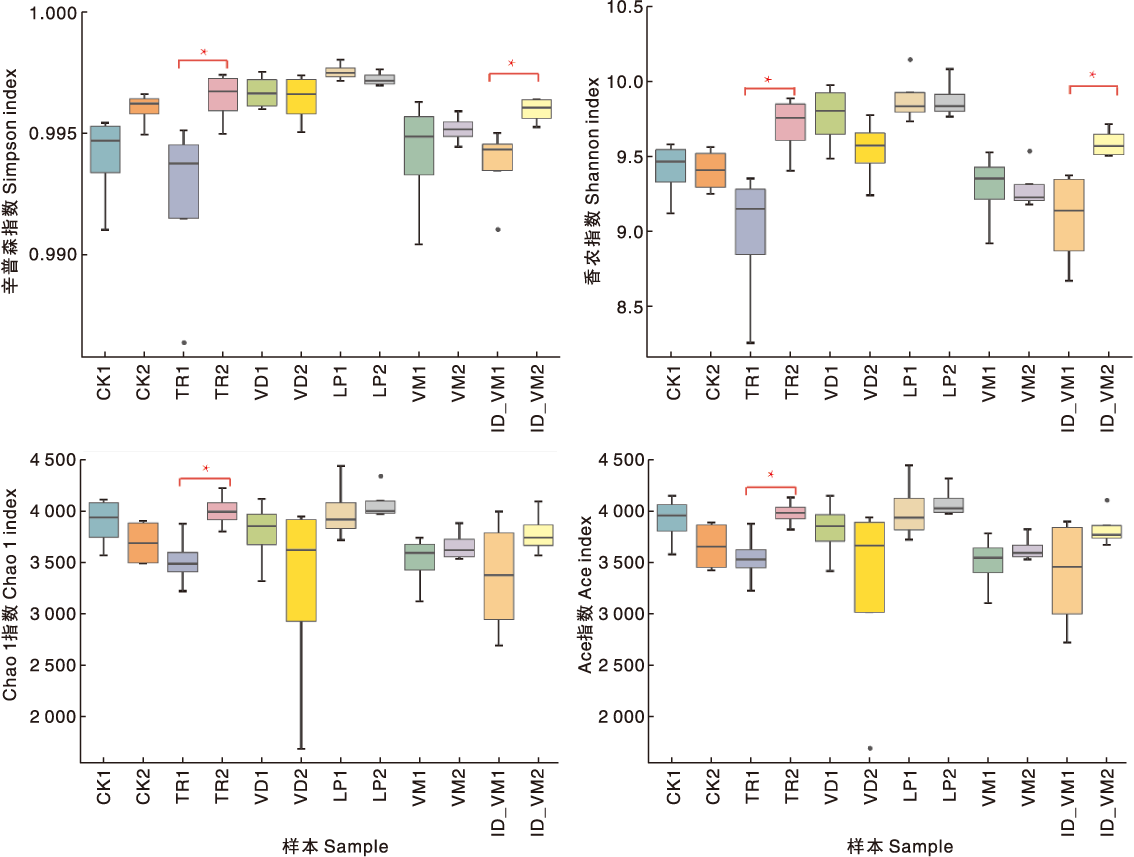
图1 不同样本的土壤细菌α多样性指数 标“*”的表示差异显著(p<0.05)。
Fig.1 Bacterial α-diversity of different soil samples “*” indicates significant difference at p<0.05.
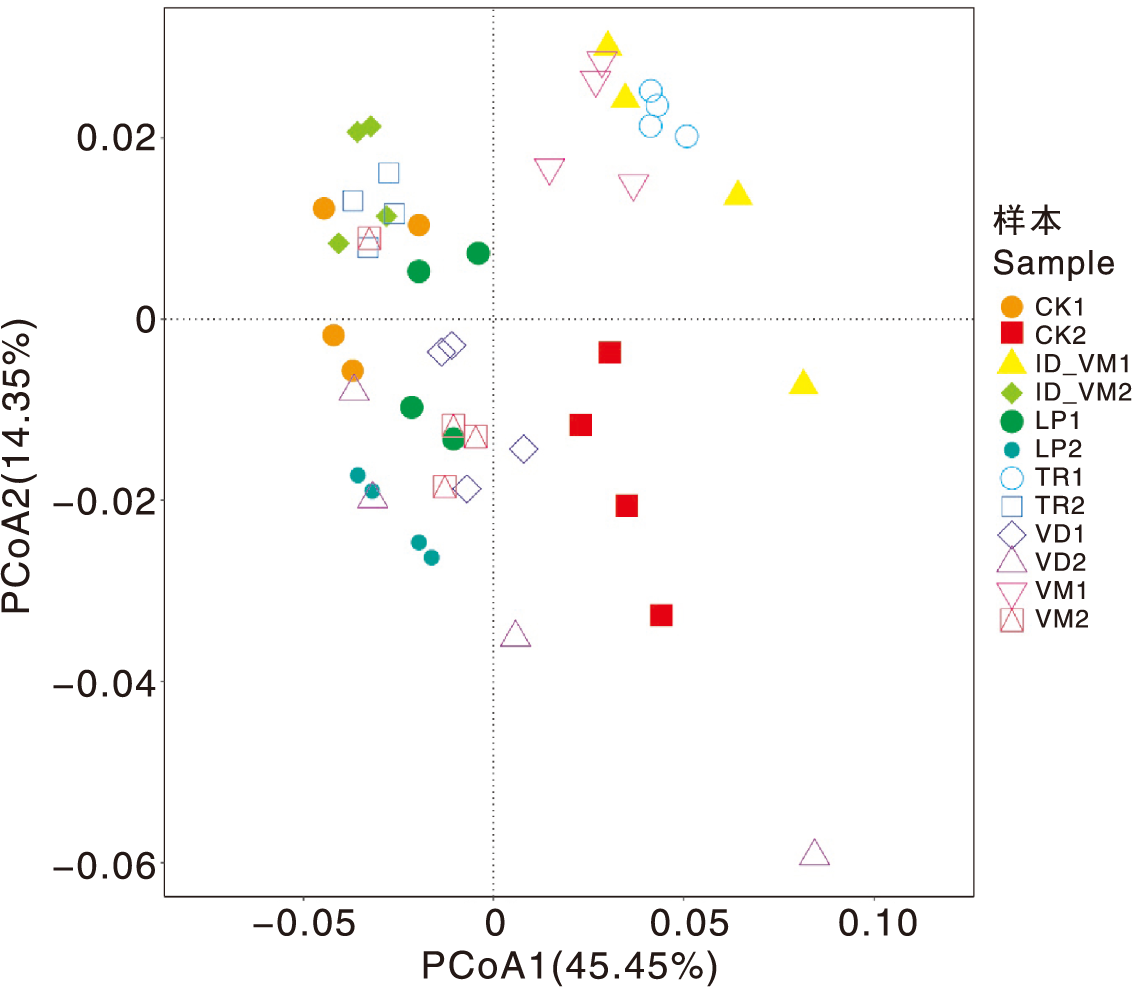
图2 土壤细菌β多样性的主坐标分析(PCoA) PCoA1,第1主坐标;PCoA2,第2主坐标。
Fig.2 Principal coordinate analysis (PCoA) of soil bacteria PCoA1, Principal coordinate 1; PCoA2, Principal coordinate 2.
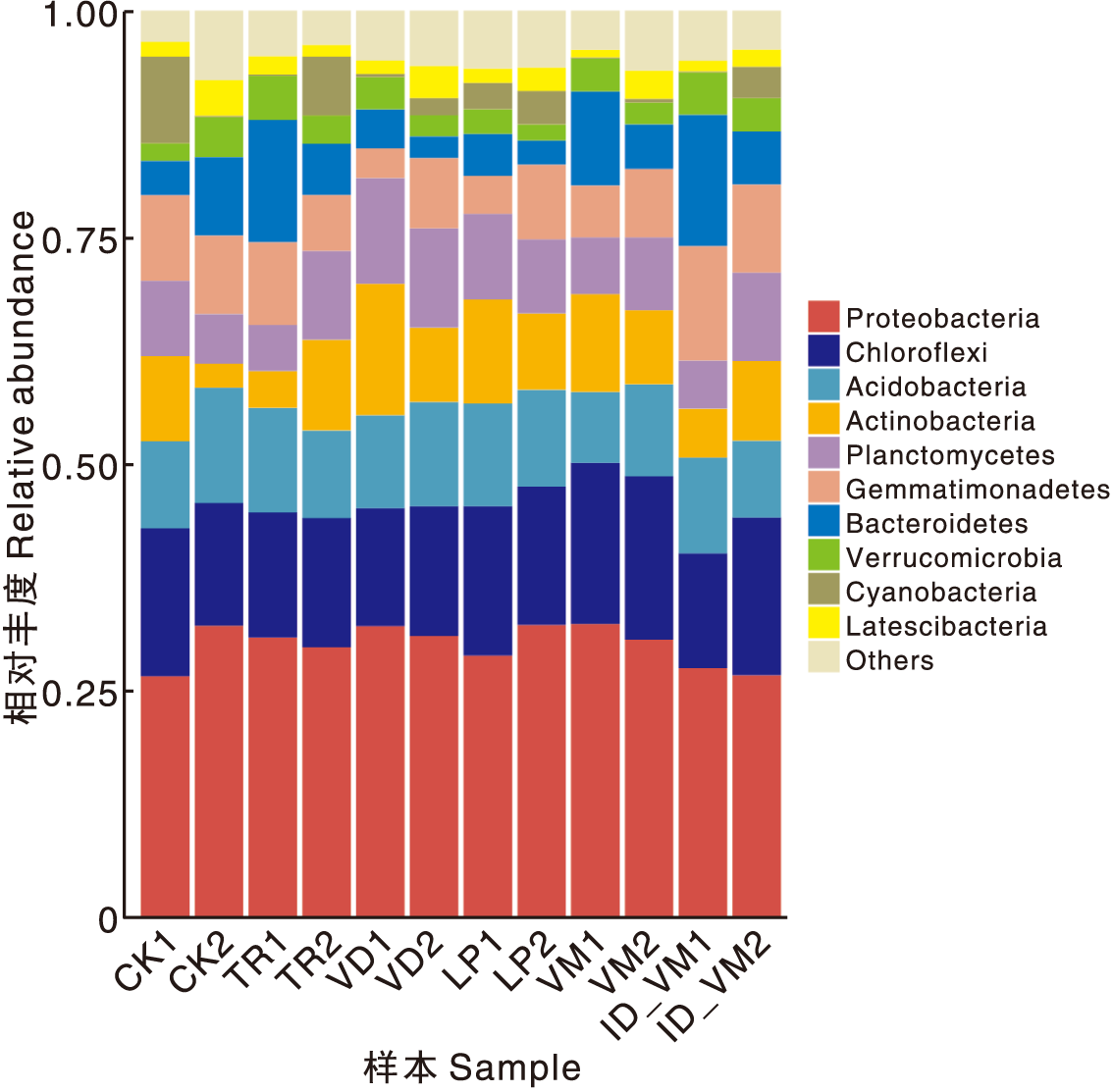
图3 不同处理对门水平上土壤细菌群落组成的影响 Proteobacteria,变形菌门;Chloroflexi,绿弯菌门;Acidobacteria,酸杆菌门;Actinobacteria,放线菌门; Planctomycetes,浮霉菌门;Gemmatimonadetes,芽单胞菌门;Bacteroidetes,拟杆菌门;Verrucomicrobia,疣微菌门;Cyanobacteria,蓝藻门;Latescibacteria,迟杆菌门;Others,其他。
Fig.3 Effects of different treatments on soil bacterial community composition at the phylum level
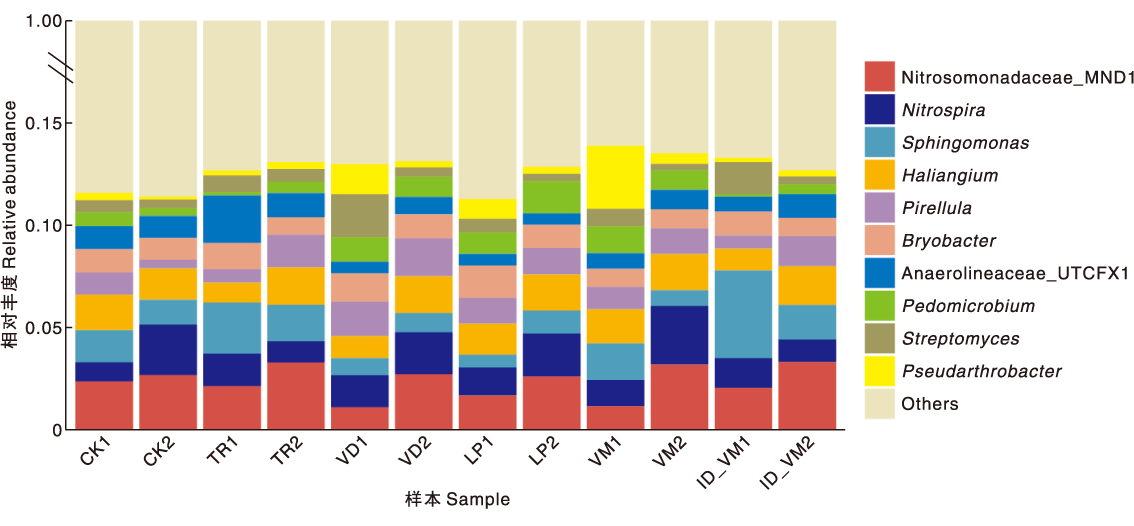
图4 不同处理对属水平上土壤细菌群落组成的影响 Nitrosomonadaceae_MND1,亚硝化单胞菌科MND1属;Nitrospira,硝化螺菌属;Sphingomonas,鞘脂单胞菌属;Haliangium,赭黄嗜盐囊菌属;Pirellula,小梨形菌属;Bryobacter,苔藓杆菌属;Anaerolineaceae_UTCFX1,厌氧绳菌科UTCFX1属;Pedomicrobium,土微菌属;Streptomyces,链霉菌属;Pseudarthrobacter,假节杆菌属; Others,其他。
Fig.4 Effects of different treatments on soil bacterial community composition at the genus level
| [1] | 李永杰, 金国强, 淳长品, 等. 柑橘果皮的发育特征及GA3的防裂效果[J]. 果树学报, 2021, 38(7): 1092-1101. |
| Li Y J, Jin G Q, Chun C P, et al. Developmental characteristics of citrus peel and the effect of gibberellic acid on fruit cracking[J]. Journal of Fruit Science, 2021, 38(7): 1092-1101. | |
| [2] | Kim N, Zabaloy M C, Guan K Y, et al. Do cover crops benefit soil microbiome: a meta-analysis of current research[J]. Soil Biology and Biochemistry, 2020, 142: 107701. |
| [3] | Ren J, Li F D, Yin C B. Orchard grass safeguards sustainable development of fruit industry in China[J]. Journal of Cleaner Production, 2023, 382: 135291. |
| [4] | Zang X P, Li K, Yun T Y, et al. Comparison between tropical legumes and natural grasses in improving tropical rainforest soil health: a case study in guava (Psidium Guajava L.) orchards[J]. BMC Plant Biology, 2025, 25(1): 378. |
| [5] | 赵宇卓, 吴碧波, 余朝旭, 等. 白枇杷微生物组及其与果实品质的关系[J]. 浙江大学学报(农业与生命科学版), 2024, 50(6): 907-919. |
| Zhao Y Z, Wu B B, Yu Z X, et al. Relationships between microbiome and fruit quality of white loquat[J]. Journal of Zhejiang University(Agriculture and Life Sciences), 2024, 50(6): 907-919. | |
| [6] | 刘崇义, 靳旭妹, 王莹莹, 等. 生草对关中平原有机猕猴桃园土壤养分及细菌群落的影响[J]. 草地学报, 2021, 29(12): 2711-2720. |
| Liu C Y, Jin X M, Wang Y Y, et al. Response of soil characteristics and bacterial communities to cover crops in organic kiwifruit orchard in Guanzhong Plain, China[J]. Acta Agrestia Sinica, 2021, 29(12): 2711-2720. | |
| [7] | 李青梅, 王华玲, 张玲玲, 等. 白三叶草和鼠茅草对果园土壤微生物和线虫群落的影响差异[J]. 植物营养与肥料学报, 2021, 27(6): 1055-1067. |
| Li Q M, Wang H L, Zhang L L, et al. Cover cropping with white clover and ratten grass impacts soil microbial and nematode communities[J]. Journal of Plant Nutrition and Fertilizers, 2021, 27(6): 1055-1067. | |
| [8] | 徐惠昌, 尤龙辉, 游惠明, 等. 不同土壤管理模式对锥栗园土壤真菌群组成的影响[J]. 果树学报, 2021, 38(11): 1942-1955. |
| Xu H C, You L H, You H M, et al. Effects of different soil management patterns on soil fungal community composition in a Castanea henryi orchard[J]. Journal of Fruit Science, 2021, 38(11): 1942-1955. | |
| [9] | 李霜霜, 钟春燕, 黄美华, 等. 铺地木蓝对肇庆地区柑橘园土壤养分及细菌群落的影响[J]. 广东农业科学, 2024, 51(1): 73-84. |
| Li S S, Zhong C Y, Huang M H, et al. Effects of Indigofera spicata on soil nutrients and bacterial communities of citrus orchards in Zhaoqing area[J]. Guangdong Agricultural Sciences, 2024, 51(1): 73-84. | |
| [10] | Zhao P N, Yu J, Zhang X Y, et al. Trifolium repens and biochar addition affecting soil nutrients and bacteria community[J]. Environmental Science and Pollution Research, 2023, 30(12): 33927-33941. |
| [11] | Velasco-Sánchez Á, Ferron L M E, Mani D T C, et al. Combination of Lolium perenne L. and Festuca arundinacea Schreb. improve yields under low phosphorus availability[J]. Nutrient Cycling in Agroecosystems, 2024, 128(2): 199-215. |
| [12] | 杨金鹏, 牟兰, 仇嘉悦, 等. 生草对滇中苹果园土壤酶活性和微生物群落多样性的影响[J]. 草地学报, 2025, 33(2): 419-428. |
| Yang J P, Mu L, Qiu J Y, et al. Effects of grass cultivation on soil enzyme activity and microbial community diversity of apple orchards in Dianzhong area of China[J]. Acta Agrestia Sinica, 2025, 33(2): 419-428. | |
| [13] | 王吕, 秦宇航, 吴玉红, 等. 猕猴桃园绿肥品种筛选和生草管理对土壤养分的影响[J]. 果树学报, 2023, 40(9): 1885-1893. |
| Wang L, Qin Y H, Wu Y H, et al. Selection of green manure varieties and effects of grass management modes on soil fertility in kiwifruit orchards[J]. Journal of Fruit Science, 2023, 40(9): 1885-1893. | |
| [14] | 姜凌, 岳小琼, 安靖玥, 等. 改性生物炭对Cd污染农田土壤的钝化修复机制及其对土壤细菌群落的影响[J]. 环境科学, 2024, 45(9): 5557-5569. |
| Jiang L, Yue X Q, An J Y, et al. Remediation mechanism of chitosan-modified biochar on Cd-contaminated farmland soil and its effect on bacterial community[J]. Environmental Science, 2024, 45(9): 5557-5569. | |
| [15] | 李光炫, 石岸, 张黎明, 等. 不同粒径生物质炭对土壤重金属钝化及细菌群落的影响[J]. 生态环境学报, 2022, 31(3): 583-592. |
| Li G X, Shi A, Zhang L M, et al. Effects of biochar with different particle sizes on soil heavy metal immobilization and bacterial community[J]. Ecology and Environmental Sciences, 2022, 31(3): 583-592. | |
| [16] | 鲍士旦. 土壤农化分析[M]. 3版. 北京: 中国农业出版社, 2000. |
| [17] | Siddiqui R, MacIver S K, Anuar T S, et al. Bacterial flora varies throughout the saltwater crocodile (Crocodylus porosus) gastrointestinal tract[J]. American Journal of Veterinary Research, 2023, 84(8): ajvr.23.03.0061. |
| [18] | Shama S, Qaisar R, Khan N A, et al. The role of 4-phenylbutyric acid in gut microbial dysbiosis in a mouse model of simulated microgravity[J]. Life, 2022, 12(9): 1301. |
| [19] | 刘明艳, 马嘉晗, 李瑜, 等. 16S rRNA基因高变区V4和V3-V4及测序深度对油藏细菌菌群分析的影响[J]. 微生物学通报, 2020, 47(2): 440-449. |
| Liu M Y, Ma J H, Li Y, et al. Influence of 16S rRNA gene V4 and V3-V4 sequencing and sequencing depth on unraveling bacterial communities inhabiting oil reservoirs[J]. Microbiology China, 2020, 47(2): 440-449. | |
| [20] | 陈凤梅, 程光民, 王萍, 等. 同源湖羊在不同生长环境条件下生长性能和瘤胃内容物微生物组成的差异[J]. 动物营养学报, 2020, 32(9): 4230-4241. |
| Chen F M, Cheng G M, Wang P, et al. Differences of growth performance and rumen content microbial composition of homologous hu sheep under different growing environmental conditions[J]. Chinese Journal of Animal Nutrition, 2020, 32(9): 4230-4241. | |
| [21] | 李尚玮, 杨文权, 赵冉, 等. 果树行间生草对苹果园土壤肥力的影响[J]. 草地学报, 2016, 24(4): 895-900. |
| Li S W, Yang W Q, Zhao R, et al. Effects of growing grass on soil fertility of the apple orchard[J]. Acta Agrestia Sinica, 2016, 24(4): 895-900. | |
| [22] | 辛贺明, 张喜焕. 梨园生草栽培增产提质和生态效应研究[J]. 中国果树, 2012(3): 13-17. |
| Xin H M, Zhang X H. Study on increasing yield, improving quality and ecological effect of grass cultivation in pear orchard[J]. China Fruits, 2012(3): 13-17. | |
| [23] | 肖力婷, 杨慧林, 黄文新, 等. 生草栽培对南丰蜜橘园土壤微生物群落结构与功能特征的影响[J]. 核农学报, 2022, 36(1): 190-200. |
| Xiao L T, Yang H L, Huang W X, et al. Effects of grass cultivation on soil microbial community structure and functional characteristics in Nanfeng tangerine orchard[J]. Journal of Nuclear Agricultural Sciences, 2022, 36(1): 190-200. | |
| [24] | Liliensiek A K, Thakuria D, Clipson N. Influences of plant species composition, fertilisation and Lolium perenne ingression on soil microbial community structure in three Irish grasslands[J]. Microbial Ecology, 2012, 63(3): 509-521. |
| [25] | Pivato B, Bru D, Busset H, et al. Positive effects of plant association on rhizosphere microbial communities depend on plant species involved and soil nitrogen level[J]. Soil Biology and Biochemistry, 2017, 114: 1-4. |
| [26] | 付学琴, 陈登云, 杨星鹏, 等. ‘南丰蜜橘’园生草对土壤团聚体养分和微生物特性及果实品质的影响[J]. 果树学报, 2020, 37(11): 1655-1666. |
| Fu X Q, Chen D Y, Yang X P, et al. Effects of grass cover in ‘Nanfeng’ tangerine orchard on nutrients and microbial characteristics in soil aggregates and fruit quality[J]. Journal of Fruit Science, 2020, 37(11): 1655-1666. | |
| [27] | 申卫收, 林先贵, 张华勇, 等. 不同施肥处理下蔬菜塑料大棚土壤微生物活性及功能多样性[J]. 生态学报, 2008, 28(6): 2682-2689. |
| Shen W S, Lin X G, Zhang H Y, et al. Microbial activity and functional diversity in soils used for the commercial production of cucumbers and tomatoes in polytunnel greenhouse, under different fertilization[J]. Acta Ecologica Sinica, 2008, 28(6): 2682-2689. | |
| [28] | Taghavi S, Garafola C, Monchy S, et al. Genome survey and characterization of endophytic bacteria exhibiting a beneficial effect on growth and development of poplar trees[J]. Applied and Environmental Microbiology, 2009, 75(3): 748-757. |
| [29] | 马阳, 张立宏, 张培, 等. 不同基肥措施对甜瓜产量和土壤性质、细菌多样性的影响[J]. 中国土壤与肥料, 2022(8): 104-111. |
| Ma Y, Zhang L H, Zhang P, et al. Effects of different basal fertilizer measures on muskmelon yield, soil properties and bacterial diversity[J]. Soil and Fertilizer Sciences in China, 2022(8): 104-111. | |
| [30] | 王宇佳. 亚硝化过程控制与厌氧氨氧化工艺运行及其微生物特性[D]. 沈阳: 东北大学, 2017. |
| Wang Y J. Nitritation process control and anammox process performance and their microbial characteristics[D]. Shenyang: Northeastern University, 2017. | |
| [31] | Liu H Y, Huang X, Tan W F, et al. High manure load reduces bacterial diversity and network complexity in a paddy soil under crop rotations[J]. Soil Ecology Letters, 2020, 2(2): 104-119. |
| [32] | 裴怀弟, 宿兵兵, 李琦, 等. 人参果生育期根际土壤细菌结构对施氮量的响应[J]. 植物营养与肥料学报, 2023, 29(6): 1125-1134. |
| Pei H D, Su B B, Li Q, et al. Response of rhizosphere bacterial community structure to nitrogen application rate during ginseng fruit (Solanum muricatum Aiton) growth stages[J]. Journal of Plant Nutrition and Fertilizers, 2023, 29(6): 1125-1134. | |
| [33] | 朱天琦, 谷强, 彭泽晨, 等. 土壤细菌结构和功能对团聚体碳、氮储量的响应:以高寒草甸、温性草原、荒漠为例[J]. 中国草地学报, 2023, 45(6): 92-102. |
| Zhu T Q, Gu Q, Peng Z C, et al.. Response of soil bacterial structure and function to carbon and nitrogen stocks in aggregates:a comparative study across alpine meadow, temperate grassland and desert[J]. Chinese Journal of Grassland, 2023, 45(6): 92-102. | |
| [34] | Lakshmikanth M, Manohar S, Lalitha J. Purification and characterization of β-agarase from agar-liquefying soil bacterium, Acinetobacter sp., AG LSL-1[J]. Process Biochemistry, 2009, 44(9): 999-1003. |
| [35] | 黄佩蓓, 焦念志, 冯洁, 等. 海洋浮霉状菌多样性与生态学功能研究进展[J]. 微生物学通报, 2014, 41(9): 1891-1902. |
| Huang P B, Jiao N Z, Feng J, et al. Research progress on Planctomycetes’ diversity and ecological function in marine environments[J]. Microbiology China, 2014, 41(9): 1891-1902. | |
| [36] | 李艳, 窦森, 尹显宝, 等. 纯培养条件下蓝细菌形成腐殖物质的可能性研究[J]. 土壤学报, 2016, 53(6): 1452-1463. |
| Li Y, Dou S, Yin X B, et al. Possibility of axenically cultured cyanobacteria forming humic substances[J]. Acta Pedologica Sinica, 2016, 53(6): 1452-1463. | |
| [37] | 姜冉冉, 江润海, 朱城强, 等. EDTA对铅胁迫下狗牙根根际土壤质量及微生物的影响[J]. 农业环境科学学报, 2022, 41(12): 2722-2732. |
| Jiang R R, Jiang R H, Zhu C Q, et al. Effects of EDTA on soil quality and microorganisms in rhizosphere of Cynodon dactylon under lead stress[J]. Journal of Agro-Environment Science, 2022, 41(12): 2722-2732. | |
| [38] | Sly L I, Hodgkindon M C, Arunpairojana V. Effect of water velocity on the early development of manganese-depositing biofilm in a drinking-water distribution system[J]. FEMS Microbiology Letters, 1988, 53(3/4): 175-186. |
| [39] | 罗昌国, 袁启凤, 陈守一, 等. 李园杂草管理方式对土壤细菌群落和生态功能的影响[J]. 经济林研究, 2024, 42(1): 304-316. |
| Luo C G, Yuan Q F, Chen S Y, et al. Effects of weed management methods on the soil bacterial communities and ecological function in plum orchard[J]. Non-wood Forest Research, 2024, 42(1): 304-316. | |
| [40] | 刘贤文, 郭华春. 马铃薯与玉米复合种植对土壤化感物质及土壤细菌群落结构的影响[J]. 中国生态农业学报(中英文), 2020, 28(6): 794-802. |
| LIU X W, GUO H C. Effects of potato and maize compound planting on soil allelochemicals and soil bacterial community structure[J]. Chinese Journal of Eco-Agriculture, 2020, 28(6): 794-802. |
| [1] | 李洋, 刘战群, 贺润平, 赵飞, 邢鲲, 杨存弟, 蒲秀兰. 微生物菌肥对土壤养分、甜瓜品质与病虫害防治效果的影响[J]. 浙江农业学报, 2026, 38(5): 909-918. |
| [2] | 吕勇杰, 孙万春, 马军伟, 朱晓芳, 叶静, 俞巧钢, 王强, 陈照明, 陈正道, 周俊, 何新华, 王峰. 南方红黄壤耕地酸化特征及其对土壤肥力与酶活性的影响——以缙云县酸化治理示范区为例[J]. 浙江农业学报, 2026, 38(5): 965-978. |
| [3] | 刘佳铭, 王楠, 马志梅, 吕卫光, 郑宪清, 宋科, 张翰林, 张海韵, 张月, 张娟琴. 蚯蚓-秸秆联合修复设施盐渍化土壤的效果及其作用机制[J]. 浙江农业学报, 2026, 38(2): 327-338. |
| [4] | 郭冉冉, 徐珂, 李正鹏, 严清彪, 李蓉, 韩梅. 绿肥还田对土壤无机磷组分及小麦磷吸收的影响[J]. 浙江农业学报, 2026, 38(1): 114-125. |
| [5] | 李传哲, 董青君, 纪力, 汪吉东, 陈川, 章安康, 张永春, 邵文奇. 新型肥料对典型黄河故道区土壤养分、微生物群落及稻麦产量的影响[J]. 浙江农业学报, 2026, 38(1): 136-147. |
| [6] | 张智, 何豪豪, 郁妙, 许剑锋. 化肥减量配施土壤改良剂对土壤酸度、土壤养分和水稻产量的影响[J]. 浙江农业学报, 2025, 37(6): 1301-1308. |
| [7] | 沈佳瑜, 邓燕, 张姬雯, 彭国方, 吴群, 朱齐超, 张卫峰, 李贝. 衢州市柑橘园碳排放与碳储量现状评价[J]. 浙江农业学报, 2025, 37(11): 2340-2353. |
| [8] | 胡铁军. 化肥减量配施微生物肥对西蓝花产量品质与土壤性质的影响[J]. 浙江农业学报, 2024, 36(7): 1657-1665. |
| [9] | 侯栋, 李亚莉, 岳宏忠, 张东琴, 姚拓, 黄书超, 杨海兴. 微生物菌肥替代部分化肥对花椰菜产量、品质及土壤微生物的影响[J]. 浙江农业学报, 2024, 36(3): 589-599. |
| [10] | 岳宗伟, 李嘉骁, 孙向阳, 刘国梁, 李素艳, 王晨晨, 查贵超, 魏宁娴. 化肥有机肥配施对土壤性质、樱桃果实品质和产量的影响[J]. 浙江农业学报, 2023, 35(9): 2192-2201. |
| [11] | 斯林林, 徐静, 曹凯, 张贤, 王建红. 绿肥种植对红壤旱地生土细菌群落结构的影响[J]. 浙江农业学报, 2023, 35(8): 1864-1875. |
| [12] | 吴传美, 何季, 吴文珊, 蔡俊, 向仰州. 间作对刺梨园土壤团聚体化学计量特征和养分贡献率的影响[J]. 浙江农业学报, 2023, 35(5): 1132-1143. |
| [13] | 鲁帅, 罗晓刚, 刘全伟, 张屹, 孟洋昊, 李洁, 张景来. 有机无机复混肥对小麦生长、土壤养分和重金属含量的影响[J]. 浙江农业学报, 2023, 35(4): 922-930. |
| [14] | 高风, 文仕知, 韦铄星, 欧汉彪, 王智慧. 桂西北石漠化区不同植被恢复类型对土壤理化性质、酶活与真菌群落多样性的影响[J]. 浙江农业学报, 2023, 35(10): 2425-2435. |
| [15] | 杨胜竹, 李响, 李朝文, 陈海念, 刘丽, 陆引罡, 曹卓洋. 贵州省烟草青枯病害区根际土壤养分及酶活性特征分析[J]. 浙江农业学报, 2023, 35(1): 146-155. |
| 阅读次数 | ||||||
|
全文 |
|
|||||
|
摘要 |
|
|||||

