Acta Agriculturae Zhejiangensis ›› 2026, Vol. 38 ›› Issue (1): 17-23.DOI: 10.3969/j.issn.1004-1524.20250089
• Crop Science • Previous Articles Next Articles
Generation of new glutinous rice germplasms via CRISPR/Cas9 technology
PAN Yueyun( ), HUANG Yuqing, DING Zhengquan, SHI Yang, HUANG Haixiang, LI Bai*()
- Jiaxing Academy of Agricultural Sciences, Jiaxing 314016, Zhejiang, China
-
Received:2025-02-07Online:2026-01-25Published:2026-02-11

CLC Number:
Cite this article
PAN Yueyun, HUANG Yuqing, DING Zhengquan, SHI Yang, HUANG Haixiang, LI Bai. Generation of new glutinous rice germplasms via CRISPR/Cas9 technology[J]. Acta Agriculturae Zhejiangensis, 2026, 38(1): 17-23.
share this article
Add to citation manager EndNote|Ris|BibTeX
URL: http://www.zjnyxb.cn/EN/10.3969/j.issn.1004-1524.20250089
| 引物名称 Primer name | 引物序列(5'→3') Primer sequence(5'→3') |
|---|---|
| Wx_sg1F | ttttggtctcctgcaTCCTCGGTACGACCAGTACAGTTTC- AGAGCTATGCTGGAAAC |
| Wx_sg2R | attcggtctccaaacTTGCTACAAGCGTGGAGTCGTGC- ACCAGCCGGGAATCGAA |
| Cas9_755F | GCCTACCACGAGAAGTACCC |
| Cas9_755R | GGCTTGATGAACTTGTAGAACTC |
| Wx_seqF | GCTGTAAGCACACACAAACTTC |
| Wx_seqR | AGAAGTAATCACTGACCTGGC |
Table 1 Primer sequences
| 引物名称 Primer name | 引物序列(5'→3') Primer sequence(5'→3') |
|---|---|
| Wx_sg1F | ttttggtctcctgcaTCCTCGGTACGACCAGTACAGTTTC- AGAGCTATGCTGGAAAC |
| Wx_sg2R | attcggtctccaaacTTGCTACAAGCGTGGAGTCGTGC- ACCAGCCGGGAATCGAA |
| Cas9_755F | GCCTACCACGAGAAGTACCC |
| Cas9_755R | GGCTTGATGAACTTGTAGAACTC |
| Wx_seqF | GCTGTAAGCACACACAAACTTC |
| Wx_seqR | AGAAGTAATCACTGACCTGGC |
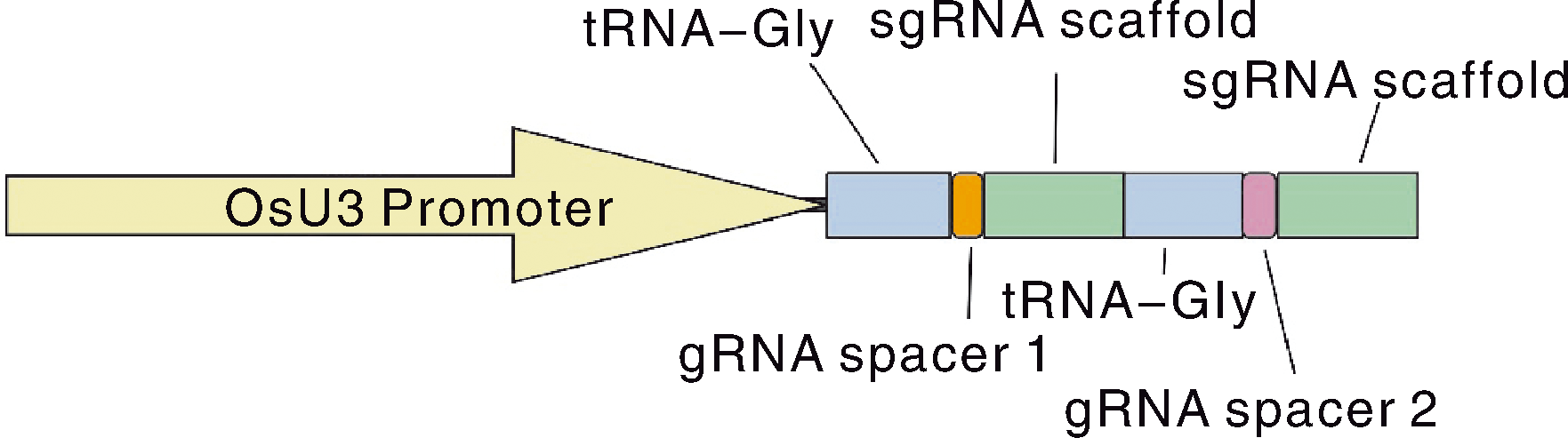
Fig.1 Schematic diagram of the partial structure of the CRISPR/Cas9 vector
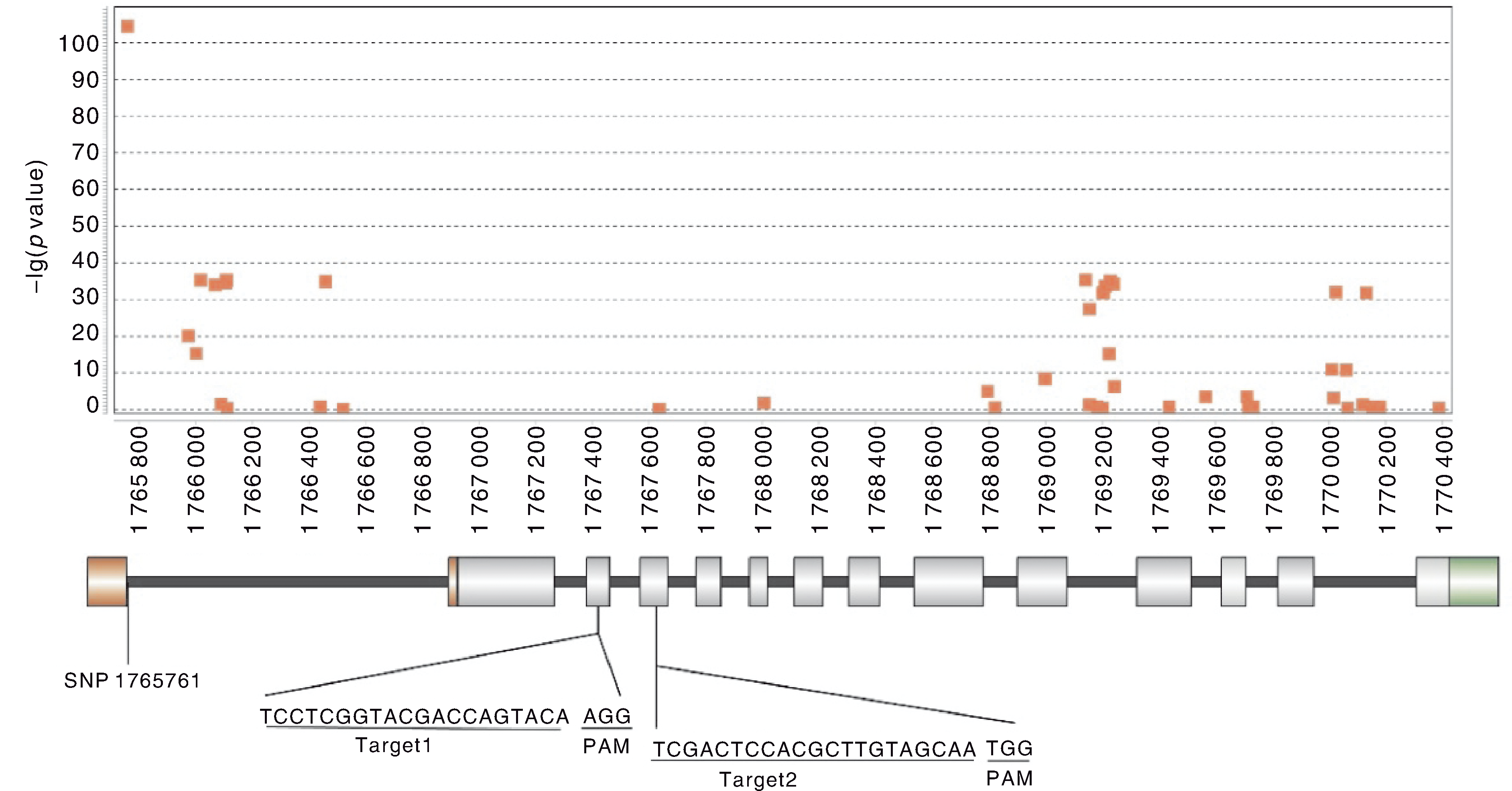
Fig.2 Association analysis of the Wx gene with the glutinous trait and locations of the two target sites
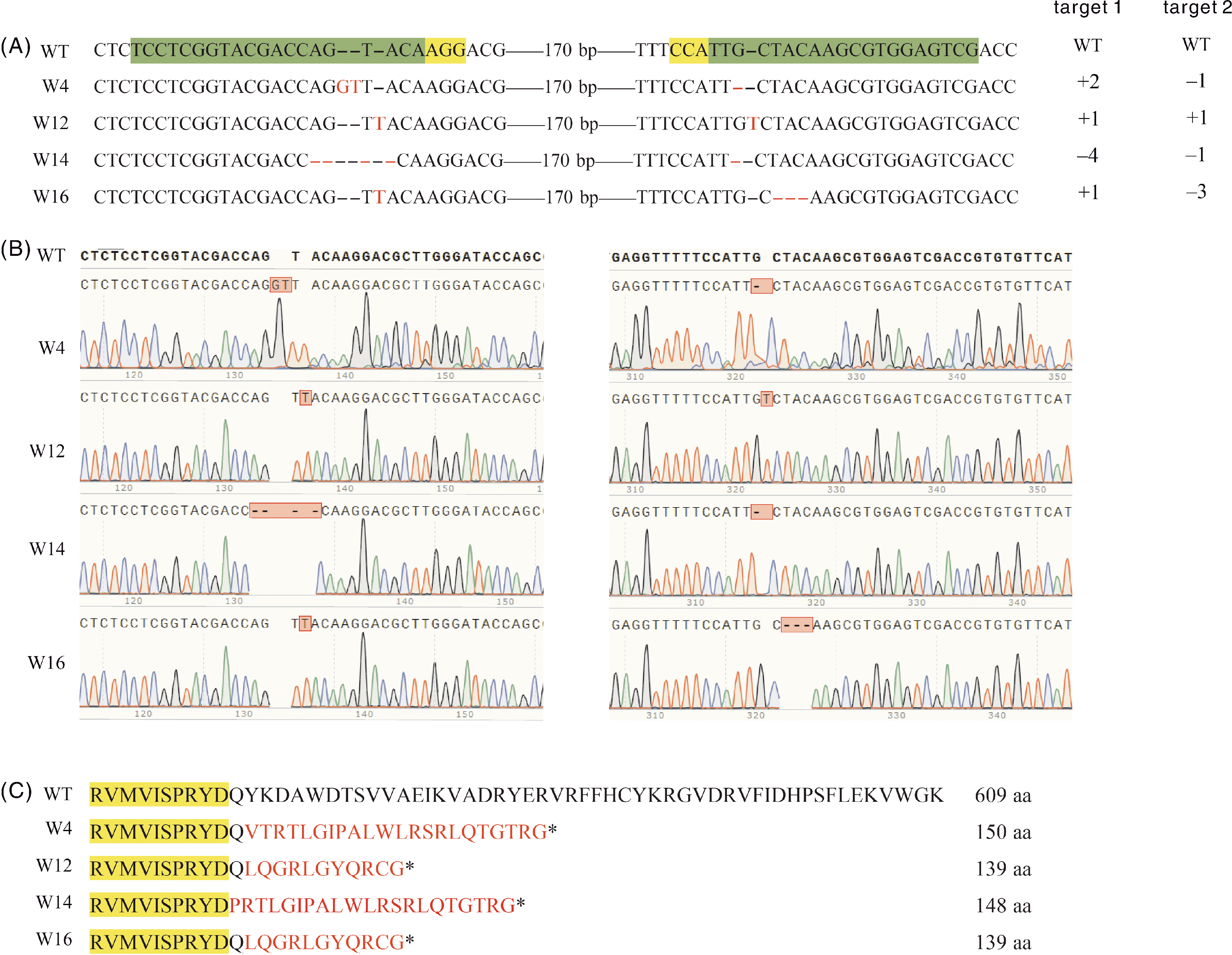
Fig.3 Mutation types of the four homozygous mutant lines A, The mutant genotype of the homozygous lines, the targeted sequence is highlighted in green shadow and the PAM sequence in yellow shadow, the changed nucleotides are highlighted in red. B, Sequencing peak map of the target region. C, Amino acid sequence of the mutant lines, the changed amino acids are highlighted in red. WT, Wild type; W4, W12, W14 and W16 are biallelic homozygous mutant lines.
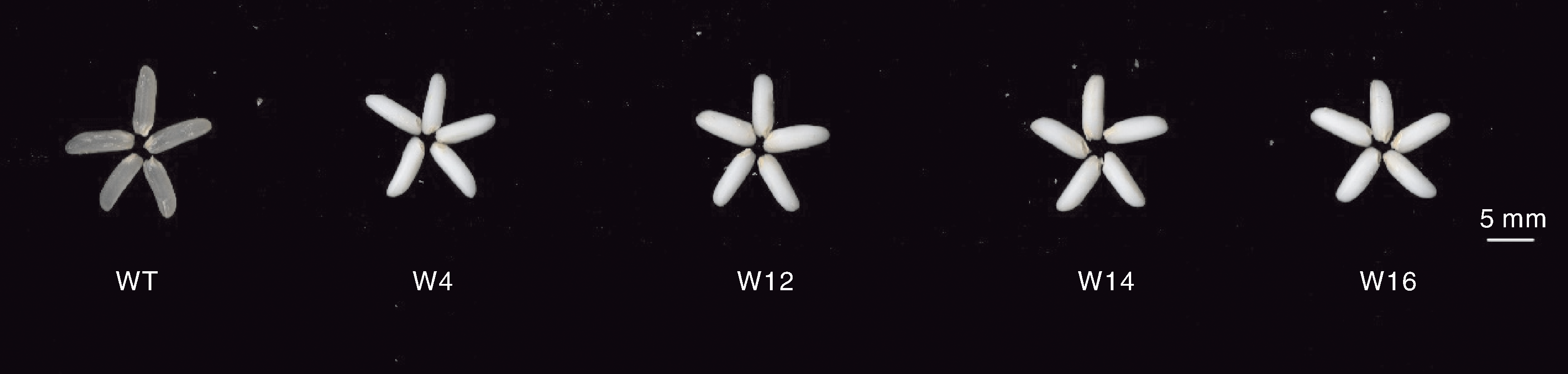
Fig.4 Grain phenotypes of wild-type and homozygous mutant lines WT, Wild type; W4, W12, W14 and W16 are biallelic homozygous mutant lines.
| 株系 Line | 株高/cm Plant height/cm | 粒长/mm Grain length/mm | 粒宽/mm Grain width/mm | 结实率/% Seed setting rate/% | 千粒重/g 1 000-grain weight/g | 单株有效穗数 Panicle number per plant | 每穗粒数 Grain number per panicle |
|---|---|---|---|---|---|---|---|
| WT | 102.15±3.66 | 10.54±0.08 | 3.51±0.05 | 85.33±3.13 | 30.61±0.84 | 10.70±1.06 | 145.50±8.64 |
| W4 | 101.85±3.91 | 10.13±0.07 | 3.45±0.04 | 84.93±2.91 | 30.13±0.98 | 10.60±0.97 | 143.60±9.31 |
| W12 | 102.78±3.40 | 10.64±0.08 | 3.50±0.06 | 85.88±3.04 | 30.65±0.77 | 10.40±0.84 | 143.45±9.02 |
| W14 | 99.58±2.87 | 10.38±0.09 | 3.49±0.06 | 86.45±3.78 | 29.64±1.02 | 10.30±1.34 | 139.73±12.83 |
| W16 | 99.85±3.54 | 9.98±0.07 | 3.42±0.05 | 83.86±2.06 | 29.39±0.87 | 10.80±1.14 | 147.38±9.40 |
Table 2 Agronomic traits of wild-type and homozygous mutant lines
| 株系 Line | 株高/cm Plant height/cm | 粒长/mm Grain length/mm | 粒宽/mm Grain width/mm | 结实率/% Seed setting rate/% | 千粒重/g 1 000-grain weight/g | 单株有效穗数 Panicle number per plant | 每穗粒数 Grain number per panicle |
|---|---|---|---|---|---|---|---|
| WT | 102.15±3.66 | 10.54±0.08 | 3.51±0.05 | 85.33±3.13 | 30.61±0.84 | 10.70±1.06 | 145.50±8.64 |
| W4 | 101.85±3.91 | 10.13±0.07 | 3.45±0.04 | 84.93±2.91 | 30.13±0.98 | 10.60±0.97 | 143.60±9.31 |
| W12 | 102.78±3.40 | 10.64±0.08 | 3.50±0.06 | 85.88±3.04 | 30.65±0.77 | 10.40±0.84 | 143.45±9.02 |
| W14 | 99.58±2.87 | 10.38±0.09 | 3.49±0.06 | 86.45±3.78 | 29.64±1.02 | 10.30±1.34 | 139.73±12.83 |
| W16 | 99.85±3.54 | 9.98±0.07 | 3.42±0.05 | 83.86±2.06 | 29.39±0.87 | 10.80±1.14 | 147.38±9.40 |
| [1] | ZHOU Z K, ROBARDS K, HELLIWELL S, et al. Composition and functional properties of rice[J]. International Journal of Food Science and Technology, 2002, 37(8): 849-868. |
| [2] | JULIANO B O. Structure, chemistry, and function of the rice grain and its fractions[J]. Cereal Foods World, 1992, 37: 772-779. |
| [3] | 齐琦. 黑糯米保健酒的工艺及品质研究[D]. 贵阳: 贵州大学, 2018. |
| QI Q. Study on the technology and quality of black glutinous rice health wine[D]. Guiyang: Guizhou University, 2018. | |
| [4] | 龙夫. 中国少数民族的美容文化[J]. 中国民族博览, 2000(2): 46-47. |
| LONG F. The beauty culture of ethnic minorities in China[J]. China National Exhibition, 2000(2): 46-47. | |
| [5] | WANG Z Y, WU Z L, XING Y Y, et al. Nucleotide sequence of rice waxy gene[J]. Nucleic Acids Research, 1990, 18(19): 5898. |
| [6] | WANG Z Y, ZHENG F Q, SHEN G Z, et al. The amylose content in rice endosperm is related to the post-transcriptional regulation of the waxy gene[J]. Plant Journal, 1995, 7(4): 613-622. |
| [7] | ISSHIKI M, MORINO K, NAKAJIMA M, et al. A naturally occurring functional allele of the rice waxy locus has a GT to TT mutation at the 5' splice site of the first intron[J]. Plant Journal, 1998, 15(1): 133-138. |
| [8] | WANCHANA S, TOOJINDA T, TRAGOONRUNG S, et al. Duplicated coding sequence in the waxy allele of tropical glutinous rice (Oryza sativa L.)[J]. Plant Science, 2003, 165(6): 1193-1199. |
| [9] | YANG J, WANG J, FAN F J, et al. Development of AS-PCR marker based on a key mutation confirmed by resequencing of Wx-mp in Milky Princess and its application in japonica soft rice (Oryza sativa L.) breeding[J]. Plant Breeding, 2013, 132(6): 595-603. |
| [10] | SATO H, SUZUKI Y, SAKAI M, et al. Molecular characterization of wx-mq, a novel mutant gene for low-amylose content in endosperm of rice (Oryza sativa L.)[J]. Breeding Science, 2002, 52(2): 131-135. |
| [11] | YANG Y, ZHOU L H, FENG L H, et al. Deciphering the role of waxy gene mutations in enhancing rice grain quality[J]. Foods, 2024, 13(11): 1624. |
| [12] | ZHANG C Q, ZHU J H, CHEN S J, et al. Wx lv, the ancestral allele of rice waxy gene[J]. Molecular Plant, 2019, 12(8): 1157-1166. |
| [13] | GAUR V S, SOOD S, GUZMÁN C, et al. Molecular insights on the origin and development of waxy genotypes in major crop plants[J]. Briefings in Functional Genomics, 2024, 23(3): 193-213. |
| [14] | RENGASAMY B, MANNA M, THAJUDDIN N B, et al. Breeding rice for yield improvement through CRISPR/Cas9 genome editing method: current technologies and examples[J]. Physiology and Molecular Biology of Plants, 2024, 30(2): 185-198. |
| [15] | 李可, 吴传银, 隋毅. CRISPR/Cas基因编辑技术在水稻育种中的研究进展[J]. 科学通报, 2025, 70(16): 2483-2494. |
| LI K, WU C Y, SUI Y. Research progress of CRISPR/Cas gene editing technology in rice breeding[J]. Chinese Science Bulletin, 2025, 70(16): 2483-2494. | |
| [16] | OKPALA N E, MO Z W, DUAN M Y, et al. The genetics and biosynthesis of 2-acetyl-1-pyrroline in fragrant rice[J]. Plant Physiology and Biochemistry, 2019, 135: 272-276. |
| [17] | 季新, 李猛, 杨阳, 等. 基于CRISPR/Cas9技术创制宜直播香型水稻[J]. 分子植物育种, 2023, 21(19): 6381-6389. |
| JI X, LI M, YANG Y, et al. Production of adapted direct-seeding fragrant rice based on CRISPR/Cas9 technology[J]. Molecular Plant Breeding, 2023, 21(19): 6381-6389. | |
| [18] | 胡彬华, 蒲志刚, 何志渊, 等. 利用CRISPR/Cas9技术敲除OsNramp5创制镉低积累水稻新种质[J]. 植物遗传资源学报, 2024, 25(7): 1211-1219. |
| HU B H, PU Z G, HE Z Y, et al. Generating low cadmium accumulation new rice germplasms by editing OsNramp5 using CRISPR/Cas9 technology[J]. Journal of Plant Genetic Resources, 2024, 25(7): 1211-1219. | |
| [19] | SASAKI A, YAMAJI N, YOKOSHO K, et al. Nramp5 is a major transporter responsible for manganese and cadmium uptake in rice[J]. The Plant Cell, 2012, 24(5): 2155-2167. |
| [20] | 赵考诚, 黄玲玲, 余志平, 等. 近20年浙江省糯稻品种育种现状及发展策略[J]. 中国稻米, 2024, 30(3): 84-87. |
| ZHAO K C, HUANG L L, YU Z P, et al. Breeding status and development strategies of glutinous rice varieties in Zhejiang Province in the past 20 years[J]. China Rice, 2024, 30(3): 84-87. | |
| [21] | 丁正权, 来乐春, 王士磊, 等. 优质食味长粒粳稻嘉禾香1号[J]. 中国种业, 2023(2): 126-127. |
| DING Z Q, LAI L C, WANG S L, et al. Jiahexiang1, a long-grain Japonica rice variety with fine-eating quality[J]. China Seed Industry, 2023(2): 126-127. | |
| [22] | MANSUETO L, FUENTES R R, BORJA F N, et al. Rice SNP-seek database update: new SNPs, indels, and queries[J]. Nucleic Acids Research, 2017, 45(D1): D1075-D1081. |
| [23] | JIANG C H, RASHID M A R, ZHANG Y H, et al. Genome wide association study on development and evolution of glutinous rice[J]. BMC Genomic Data, 2022, 23(1): 33. |
| [24] | BRADBURY P J, ZHANG Z W, KROON D E, et al. TASSEL: software for association mapping of complex traits in diverse samples[J]. Bioinformatics, 2007, 23(19): 2633-2635. |
| [25] | LIU W Z, XIE X R, MA X L, et al. DSDecode: a web-based tool for decoding of sequencing chromatograms for genotyping of targeted mutations[J]. Molecular Plant, 2015, 8(9): 1431-1433. |
| [26] | HIRANO H Y, EIGUCHI M, SANO Y. A single base change altered the regulation of the Waxy gene at the posttranscriptional level during the domestication of rice[J]. Molecular Biology and Evolution, 1998, 15(8): 978-987. |
| [27] | 汪秉琨, 张慧, 洪汝科, 等. CRISPR/Cas9系统编辑水稻Wx基因[J]. 中国水稻科学, 2018, 32(1): 35-42. |
| WANG B K, ZHANG H, HONG R K, et al. Wx gene editing via CRISPR/Cas9 system in rice[J]. Chinese Journal of Rice Science, 2018, 32(1): 35-42. | |
| [28] | 丁正权, 潘月云, 施扬, 等. 基于基因芯片的嘉禾系列长粒优质食味粳稻综合评价与比较[J]. 中国水稻科学, 2024, 38(4): 397-408. |
| DING Z Q, PAN Y Y, SHI Y, et al. Comprehensive evaluation and comparative analysis of Jiahe series long-grain japonica rice with high eating quality based on gene chip technology[J]. Chinese Journal of Rice Science, 2024, 38(4): 397-408. | |
| [29] | HUANG L C, LI Q F, ZHANG C Q, et al. Creating novel Wx alleles with fine-tuned amylose levels and improved grain quality in rice by promoter editing using CRISPR/Cas9 system[J]. Plant Biotechnology Journal, 2020, 18(11): 2164-2166. |
| [30] | XU Y, LIN Q P, LI X F, et al. Fine-tuning the amylose content of rice by precise base editing of the Wx gene[J]. Plant Biotechnology Journal, 2021, 19(1): 11-13. |
| [31] | ZENG D C, LIU T L, MA X L, et al. Quantitative regulation of Waxy expression by CRISPR/Cas9-based promoter and 5'UTR-intron editing improves grain quality in rice[J]. Plant Biotechnology Journal, 2020, 18(12): 2385-2387. |
| [32] | 周苏淮, 李芳, 李娟, 等. 植物基因组精准编辑技术: 引导编辑[J]. 科学通报, 2025, 70(16): 2414-2422. |
| ZHOU S H, LI F, LI J, et al. Plant genome precise editing technology-prime editing[J]. Chinese Science Bulletin, 2025, 70(16): 2414-2422. |
| [1] | ZHU Changsong, NA Qiting, ZHANG Mengzhuo, CAO Hui, LIU Shiying, ZHANG Zhengke, MENG Lanhuan. Effect of SlCHRC gene on tomato floral thermotolerance under high-temperature environment [J]. Acta Agriculturae Zhejiangensis, 2026, 38(1): 67-75. |
| [2] | WANG Lin, YUAN Jianlin, MIAO Chang, MA Yuhan, CAO Sanjie, ZHAO Qin. Construction of POR gene knockout, complementation and overexpression LO2 cell lines and preliminary application as AFB1 exposed model [J]. Acta Agriculturae Zhejiangensis, 2024, 36(2): 272-283. |
| [3] | TAN Yuhong, ZHOU Min, ZHANG Hua, ZHANG Heng, WANG Fulin, SONG Tao, ZHU Ying, XU Heng. Impact of high-temperature stress at grain filling stage on rice grain quality in different rice varieties [J]. Acta Agriculturae Zhejiangensis, 2024, 36(12): 2657-2665. |
| [4] | ZHANG Xuenan, WANG Lele, NIU Mingxuan, ZHAN Ni, REN Haojie, XU Haocong, YANG Kun, WU Liquan, KE Jian, YOU Cuicui, HE Haibing. Estimation of rice leaf water content based on leaf reflectance spectrum and chlorophyll fluorescence [J]. Acta Agriculturae Zhejiangensis, 2023, 35(6): 1265-1277. |
| [5] | SUN Shanshan, CHEMI Lhamo, LI Qiang, ZENG Nanfang, ZHENG Cheng, ZHANG Baiyu, YAN Qigui. Construction and biological characteristics of a recombinant pseudorabies virus expressing GP5-M of PRRSV NADC30-like virus strain [J]. Acta Agriculturae Zhejiangensis, 2023, 35(11): 2555-2567. |
| [6] | DING Zhaoxue, WANG Jiajie, SHEN Zhonghao, ZHOU Xiaolong, YANG Songbai, JIN Hangfeng, ZHAO Ayong, WANG Han. Construction of PK15 cells with porcine miR-22 upstream sequence mutation [J]. Acta Agriculturae Zhejiangensis, 2022, 34(9): 1849-1855. |
| [7] | OU Chun, ZHANG Min, DING Lin, YAO Xiamei, WANG Zelu, PENG Cheng, XU Junfeng. Application and policy regulation of CRISPR/Cas9 gene editing technology in plants [J]. Acta Agriculturae Zhejiangensis, 2022, 34(8): 1806-1814. |
| [8] | NIU Kaimeng, XU Junbo, ZHONG Liang, WANG Hua, ZHU Ying. Improving rice quality of ZH7954 by molecular marker-assisted selection [J]. , 2017, 29(8): 1221-1227. |
| [9] | YUAN Wenxia, WANG Xuming, LI Dongyue, ZHOU Jie, YAN Chengqi, CHEN Jianping. Application of the technology of CRISPR/Cas9 edit rice gene [J]. , 2017, 29(5): 685-693. |
| [10] | SHEN Chunxiu. CRISPR/Cas9 editing and expression analysis of LOC_Os10g05490 in rice under cold stress [J]. , 2017, 29(2): 177-185. |
| [11] | DAI Ji\|song1,2, ZHANG Hua2, ZHU Ying2, XU Heng2,*. A high\|throughput method for determination of apparent amylase content in rice [J]. , 2014, 26(6): 1421-. |
| Viewed | ||||||
|
Full text |
|
|||||
|
Abstract |
|
|||||

