Acta Agriculturae Zhejiangensis ›› 2026, Vol. 38 ›› Issue (6): 1112-1125.DOI: 10.3969/j.issn.1004-1524.20260090
• Future Foods and Health • Previous Articles Next Articles
Rapid and non-destructive identification of adulteration in Xizang yak ghee based on near infrared spectroscopy
LI Wenzhen1,2,3( ), MEI Hanyi2,3, WANG Shulin1, NIE Jing2,3, LI Chunlin2,3, ZHANG Yongzhi2,3, DENG Fengtao4, YUAN Yuwei2,3,*()
- 1
College of Agriculture and Animal Husbandry ,Qinghai University Xining 810016, China
2Institute of Agro-Product Safety and Nutrition ,Zhejiang Academy of Agricultural Sciences Hangzhou 310021, China
3Key Laboratory of Information Traceability for Agricultural Products ,Ministry of Agriculture and Rural Affairs Hangzhou 310021, China
4Zhejiang Hongpu Technology Co. ,Ltd. Hangzhou 310030, China
-
Received:2026-02-04Online:2026-06-25Published:2026-07-14

CLC Number:
Cite this article
LI Wenzhen, MEI Hanyi, WANG Shulin, NIE Jing, LI Chunlin, ZHANG Yongzhi, DENG Fengtao, YUAN Yuwei. Rapid and non-destructive identification of adulteration in Xizang yak ghee based on near infrared spectroscopy[J]. Acta Agriculturae Zhejiangensis, 2026, 38(6): 1112-1125.
share this article
Add to citation manager EndNote|Ris|BibTeX
URL: http://www.zjnyxb.cn/EN/10.3969/j.issn.1004-1524.20260090
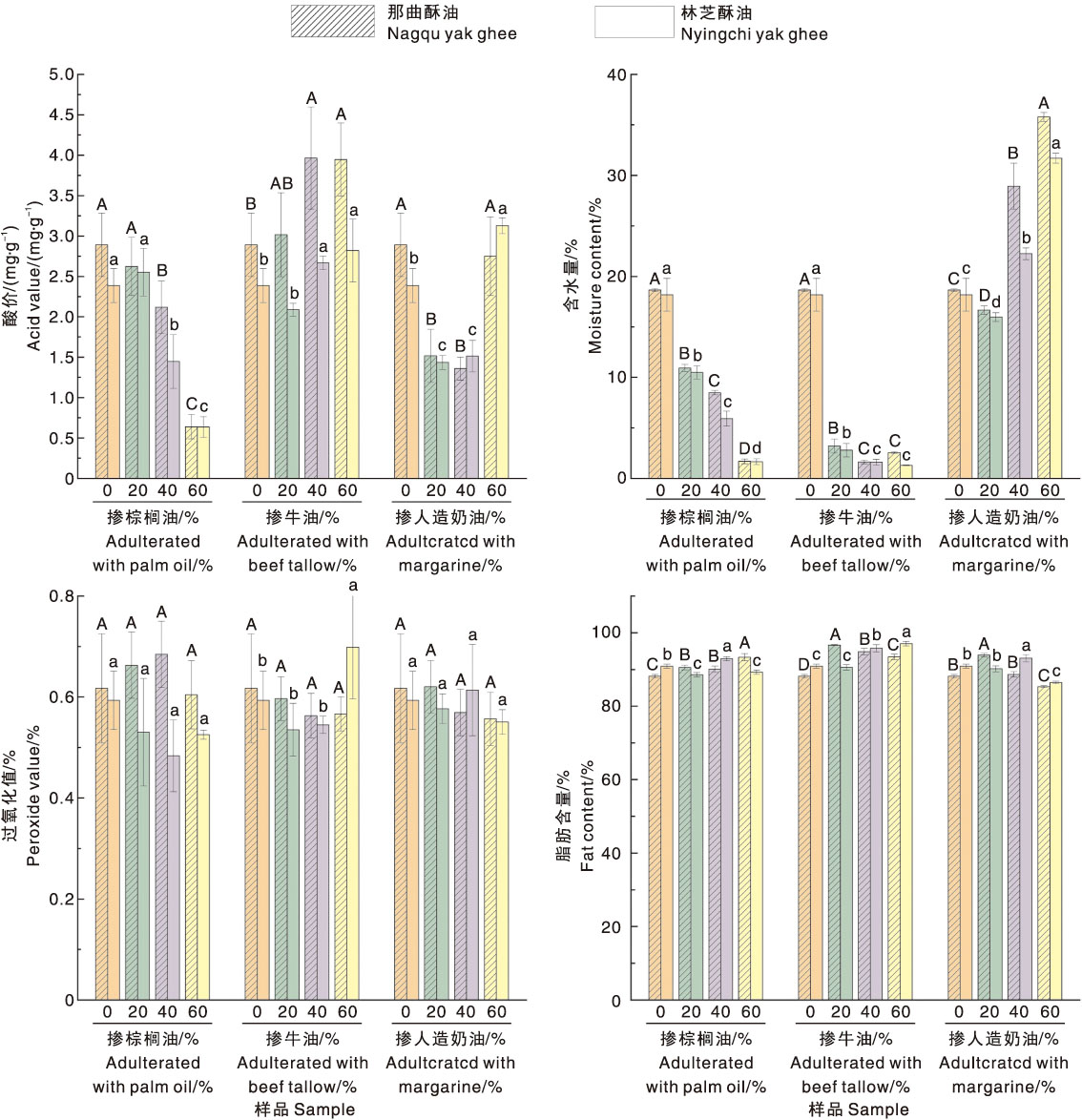
Fig.1 Physical and chemical characteristics of adulterated yak ghee Nagqu yak ghee with the same adulterant marked without the same uppercase letter between different adulteration levels indicates significant (p<0.05) differences, and Nyingchi yak ghee with the same adulterant marked without the same lowercase letter between different adulteration levels indicates significant (p<0.05) differences. Data are presented as mean±standard error of five replicates.
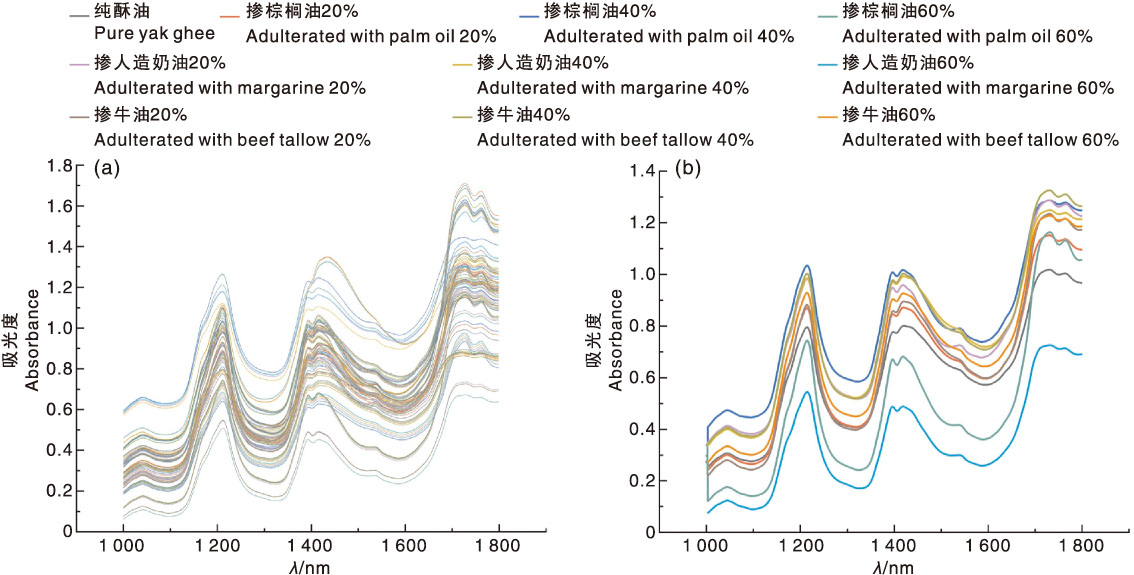
Fig.2 Original spectra (a) and average spectra (b) of adulterated Xizang yak ghee
| 主成分 Principal component | 方差贡献率 Variance contribution rate | 累计方差贡献率 Cumulative variance contribution rate |
|---|---|---|
| 1 | 89.4 | 89.4 |
| 2 | 8.3 | 97.7 |
| 3 | 1.9 | 99.6 |
| 4 | 0.3 | 99.9 |
| 5 | 0.1 | 99.9 |
Table 1 Variance contribution rates and cumulative variance contribution rate of the top 5 principal components
| 主成分 Principal component | 方差贡献率 Variance contribution rate | 累计方差贡献率 Cumulative variance contribution rate |
|---|---|---|
| 1 | 89.4 | 89.4 |
| 2 | 8.3 | 97.7 |
| 3 | 1.9 | 99.6 |
| 4 | 0.3 | 99.9 |
| 5 | 0.1 | 99.9 |
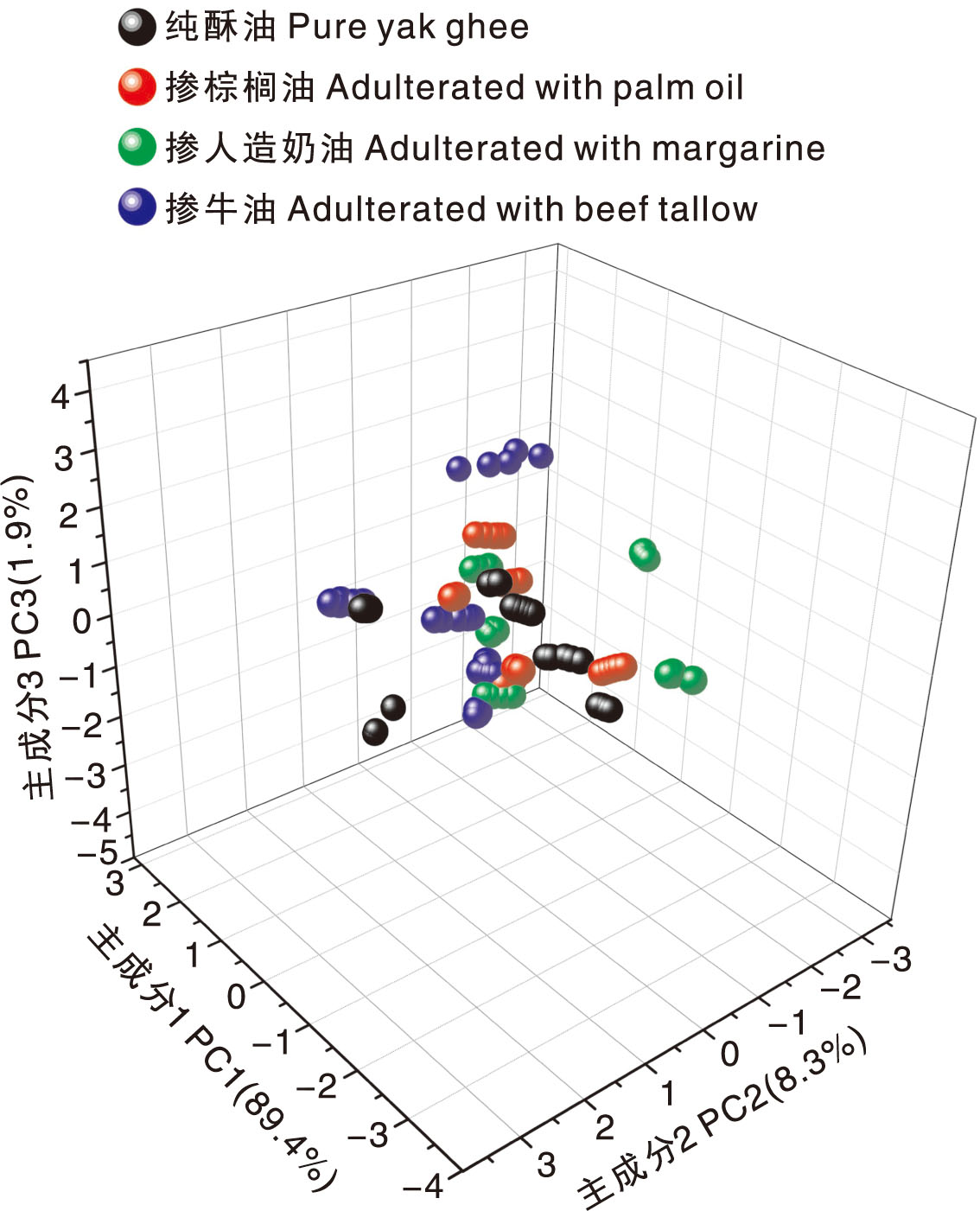
Fig.3 Principal component analysis score plot
| 模型 Model | 关键参数 Key parameter | 数据类型 Data type | 输入 变量 Input variable | 累计方差贡 献率/% Cumulative variance contribution rate/% | 训练集 Training set | 预测集 Prediction set | ||||
|---|---|---|---|---|---|---|---|---|---|---|
| 平均F1分数 Average F1 score | AUC | Kappa值 Kappa value | 平均F1分数 Average F1 score | AUC | Kappa值 Kappa value | |||||
| SVM | C=87.3 | 原始光谱Raw spectrum | 800 | — | 1 | 1 | 1 | 1 | 1 | 1 |
| KNN | k=5 | 原始光谱Raw spectrum | 800 | — | 1 | 1 | 1 | 1 | 1 | 1 |
| PCA-SVM | C=156.8 | 主成分得分 Principal component scores | 3 | ≥99 | 1 | 1 | 1 | 1 | 1 | 1 |
| PCA-KNN | k=5 | 主成分得分 Principal component scores | 3 | ≥99 | 1 | 1 | 1 | 1 | 1 | 1 |
Table 2 Discriminant accuracy of adulterated Xizang yak ghee based on the original spectra and PCA dimensionality-reduced spectra
| 模型 Model | 关键参数 Key parameter | 数据类型 Data type | 输入 变量 Input variable | 累计方差贡 献率/% Cumulative variance contribution rate/% | 训练集 Training set | 预测集 Prediction set | ||||
|---|---|---|---|---|---|---|---|---|---|---|
| 平均F1分数 Average F1 score | AUC | Kappa值 Kappa value | 平均F1分数 Average F1 score | AUC | Kappa值 Kappa value | |||||
| SVM | C=87.3 | 原始光谱Raw spectrum | 800 | — | 1 | 1 | 1 | 1 | 1 | 1 |
| KNN | k=5 | 原始光谱Raw spectrum | 800 | — | 1 | 1 | 1 | 1 | 1 | 1 |
| PCA-SVM | C=156.8 | 主成分得分 Principal component scores | 3 | ≥99 | 1 | 1 | 1 | 1 | 1 | 1 |
| PCA-KNN | k=5 | 主成分得分 Principal component scores | 3 | ≥99 | 1 | 1 | 1 | 1 | 1 | 1 |
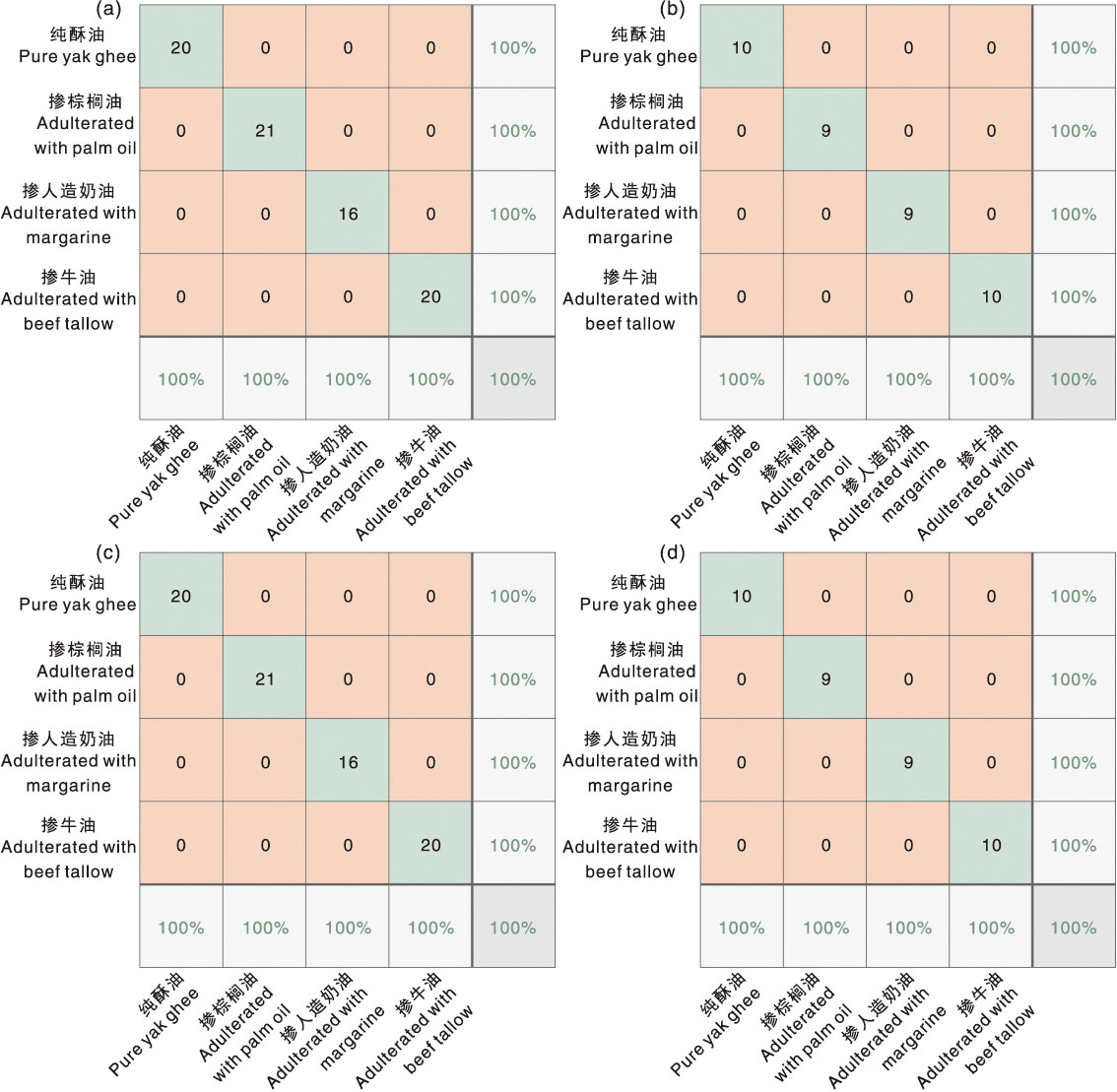
Fig.4 Adulteration identification model of Xizang yak ghee a, SVM prediction set; b, SVM training set; c, KNN prediction set; d, KNN training set. Green squares represent correctly classified samples by the model. Orange squares represent misclassified samples. The rightmost column of the matrix indicates the recall rate for each row’s true class samples. The bottom row shows the precision rate for each column’s predicted class samples, and the gray square in the bottom-right corner displays the model’s overall classification accuracy. All samples achieved 100% correct classification.
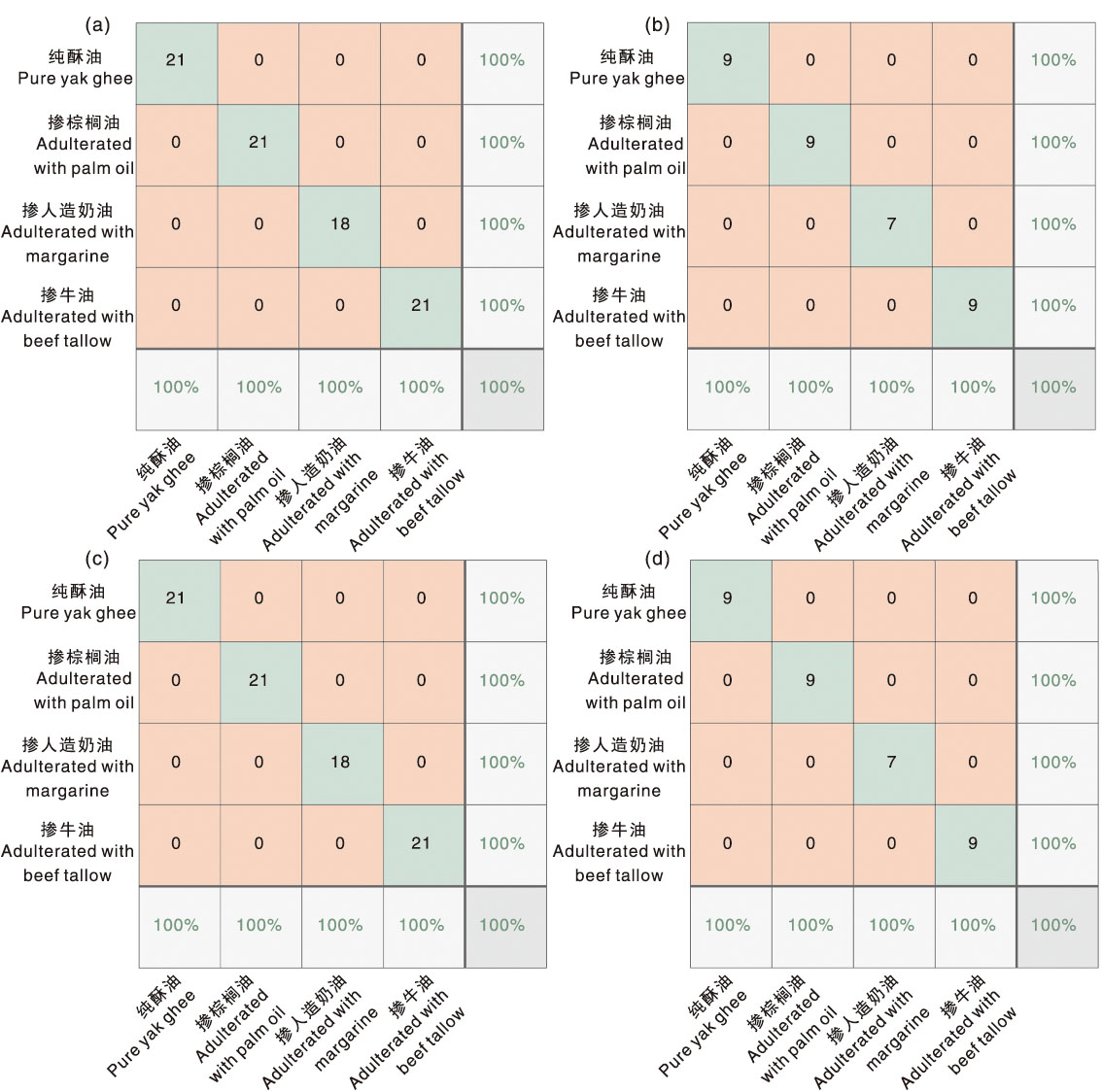
Fig.5 Adulteration identification model of Xizang yak ghee after PCA dimensionality reduction a, PCA-SVM prediction set; b, PCA-SVM training set; c, PCA-KNN prediction set; d, PCA-KNN training set. Green squares represent correctly classified samples by the model; orange squares represent misclassified samples. The rightmost column of the matrix indicates the recall rate for each row’s true class samples, the bottom row shows the precision rate for each column’s predicted class samples, and the gray square in the bottom-right corner displays the model’s overall classification accuracy. All samples achieved 100% correct classification.
| [1] | 杨婷婷, 孙万成, 罗毅皓, 等. 菜籽油、牦牛酥油和亚麻籽油调和油的制备及其稳定性研究[J]. 甘肃农业大学学报, 2026, 61(1): 274-279. |
| YANG T T, SUN W C, LUO Y H, et al. Development and stability evaluation of a blended oil from rapeseed oil, yak chee and linseed oil[J]. Journal of Gansu Agricultural University, 2026, 61(1): 274-279. | |
| [2] | 谭大明, 吴雪莲, 邱城, 等. 西藏自治区酥油、糌粑、青稞酒、风干牛肉质量安全调研[J]. 现代农业科技, 2011(2): 368-369. |
| TAN D M, WU X L, QIU C, et al. Investigation on the quality safety of Tibetan butter, tsampa, Qingke liquor and wind-dried yak meat in Tibet Autonomous Region of China[J]. Modern Agricultural Sciences and Technology, 2011(2): 368-369. | |
| [3] | 洪蕾, 杨丽杰, 张洋, 等. 精酥油的制作与脂肪酸组成分析[J]. 食品工业, 2013, 34(3): 190-192. |
| HONG L, YANG L J, ZHANG Y, et al. The processing technology and fatty acid composition analysis of pure butter[J]. The Food Industry, 2013, 34(3): 190-192. | |
| [4] | 王浩文, 张峰轶, 王传明, 等. 不同市售牛油理化性质与风味品质的比较[J]. 中国油脂, 2025, 50(2): 46-50. |
| WANG H W, ZHANG F Y, WANG C M, et al. Comparison of physicochemical properties and flavor quality of different commercially available beef tallow[J]. China Oils and Fats, 2025, 50(2): 46-50. | |
| [5] | 张阜青. 棕榈油基人造奶油品质缺陷及改善[D]. 无锡: 江南大学, 2009. |
| ZHANG F Q. The study on quality defects and improvement of palm oil-based margarine[D]. Wuxi: Jiangnan University, 2009. | |
| [6] | 孙美青, 马莺, 程金菊. 牦牛酥油理化性质研究[J]. 中国乳品工业, 2016, 44(3): 9-11. |
| SUN M Q, MA Y, CHENG J J. Physical and chemical properties of yak butter[J]. China Dairy Industry, 2016, 44(3): 9-11. | |
| [7] | 于海坤. 牛油与植物油复配脂肪酸平衡调和油的研究及品质分析[D]. 沈阳: 沈阳农业大学, 2022. |
| YU H K. Study and quality analysis of fatty acid balanced blended oil from beef tallow and vegetable oil[D]. Shenyang: Shenyang Agricultural University, 2022. | |
| [8] | 李响, 王晓霞, 刘辰, 等. 近红外光谱在乳制品检测中应用技术研究进展[J]. 中国检验检测, 2025, 33(1): 24-27. |
| LI X, WANG X X, LIU C, et al. Research progress on the application technology of near-infrared spectroscopy in dairy product detection[J]. China Inspection Body & Laboratory, 2025, 33(1): 24-27. | |
| [9] | 方芳, 王耀耀, 刘欣, 等. 基于近红外光谱技术的茶籽油掺伪定性鉴别和定量分析[J]. 中国粮油学报, 2023, 38(12): 203-210. |
| FANG F, WANG Y Y, LIU X, et al. Qualitative identification and quantitative analysis of adulterated in Camellia seed oil based on near infrared spectroscopy technology[J]. Journal of the Chinese Cereals and Oils Association, 2023, 38(12): 203-210. | |
| [10] | 黄宝莹, 佘之蕴, 王文敏, 等. 近红外光谱技术在乳制品快速检测中的应用研究进展[J]. 中国酿造, 2020, 39(7): 16-19. |
| HUANG B Y, SHE Z Y, WANG W M, et al. Research progress of near-infrared spectroscopy application in rapid detection of dairy products[J]. China Brewing, 2020, 39(7): 16-19. | |
| [11] | 洛曲, 于修烛, 张建新, 等. 基于近红外光谱的藏区酥油脂肪和蛋白质含量快速检测分析[J]. 中国油脂, 2018, 43(3): 136-140. |
| LUO Q, YU X Z, ZHANG J X, et al. Rapid determination of fat and protein contents in ghee using near-infrared spectroscopy[J]. China Oils and Fats, 2018, 43(3): 136-140. | |
| [12] | 赵小伟, 郑楠, 王加启, 等. 近红外光谱技术在乳及乳制品质量检测中的应用[J]. 动物营养学报, 2024, 36(9): 5451-5459. |
| ZHAO X W, ZHENG N, WANG J Q, et al. Application of near-infrared spectroscopy technology in milk and dairy products[J]. Chinese Journal of Animal Nutrition, 2024, 36(9): 5451-5459. | |
| [13] | 万恒兴, 余展旺, 冯丽雄. 二维相关近红外光谱的牦牛奶粉掺伪判别分析[J]. 山东化工, 2024, 53(20): 149-152. |
| WAN H X, YU Z W, FENG L X. PLS-discriminant analysis of adulterated yak milk powder based on two-dimensional correlation near-infrared spectroscopy[J]. Shandong Chemical Industry, 2024, 53(20): 149-152. | |
| [14] | 那琴. 基于近红外光谱技术结合化学计量学的驼乳及乳粉掺假检测研究[D]. 呼和浩特: 内蒙古农业大学, 2022. |
| NA Q. Research on adulteration detection of camel milk and milk powder based on near-infrared spectroscopy combined with chemometrics[D]. Hohhot: Inner Mongolia Agricultural University, 2022. | |
| [15] | 彭海洋, 巫忠东, 林涛, 等. 基于近红外光谱技术的牦牛奶粉掺假检测与产地识别研究[J]. 食品工业科技, 2024, 45(22): 9-17. |
| PENG H Y, WU Z D, LIN T, et al. Adulteration detection and origin identification of yak milk powder based on near-infrared spectroscopy technology[J]. Science and Technology of Food Industry, 2024, 45(22): 9-17. | |
| [16] | YU D X, GUO S, ZHANG X, et al. Combining stable isotope, multielement and untargeted metabolomics with chemometrics to discriminate the geographical origins of ginger (Zingiber officinale Roscoe)[J]. Food Chemistry, 2023, 426: 136577. |
| [17] | ROUDAK M A, FARAHANI M, HOSSEINBEIGI F B. Extension of K-nearest neighbors and introduction of an applicable prediction criterion for a novel Monte Carlo simulation-based method in structural reliability[J]. Structures, 2024, 66: 106867. |
| [18] | LIU D, SUN D W, ZENG X A. Recent advances in wavelength selection techniques for hyperspectral image processing in the food industry[J]. Food and Bioprocess Technology, 2014, 7(2): 307-323. |
| [19] | 周显青, 康招阳, 韩佳静, 等. 基于PCA-RF预测方便米饭品质模型的建立[J]. 河南工业大学学报(自然科学版), 2025, 46(2): 87-95. |
| ZHOU X Q, KANG Z Y, HAN J J, et al. Establishment of a PCA-RF-based prediction model for the quality of instant rice[J]. Journal of Henan University of Technology(Natural Science Edition), 2025, 46(2): 87-95. | |
| [20] | 王国胜. 核函数的性质及其构造方法[J]. 计算机科学, 2006, 33(6): 172-174. |
| WANG G S. Properties and construction methods of kernel in support vector machine[J]. Computer Science, 2006, 33(6): 172-174. | |
| [21] | 孙淑敏, 谢岩黎, 张严. 基于可见—近红外光谱的花生油二元掺伪体系鉴别研究[J]. 粮油食品科技, 2015, 23(6): 84-88. |
| SUN S M, XIE Y L, ZHANG Y. Identification of adulterate peanut oil binary system based on visible-near infrared spectroscopy[J]. Science and Technology of Cereals, Oils and Foods, 2015, 23(6): 84-88. | |
| [22] | 罗香, 刘波平, 冯利辉, 等. 近红外光谱技术用于花生油中棕榈油含量的测定[J]. 分析科学学报, 2010, 26(6): 673-676. |
| LUO X, LIU B P, FENG L H, et al. Determination of palm oil content in peanut oil samples by near infrared spectroscopy[J]. Journal of Analytical Science, 2010, 26(6): 673-676. | |
| [23] | 李梅, 智丽慧. 近红外光谱技术快速检测奶酪及其制品的核心质量指标[J]. 食品安全质量检测学报, 2025, 16(15): 51-56. |
| LI M, ZHI L H. Rapid detection of core quality indicators in cheese and cheese products by near-infrared spectroscopy[J]. Journal of Food Safety and Quality, 2025, 16(15): 51-56. | |
| [24] | 庄小丽, 相玉红, 强洪, 等. 近红外光谱和化学计量学方法用于橄榄油品质分析与掺杂量检测[J]. 光谱学与光谱分析, 2010, 30(4): 933-936. |
| ZHUANG X L, XIANG Y H, QIANG H, et al. Quality analysis of olive oil and quantification detection of adulteration in olive oil by near-infrared spectrometry and chemometrics[J]. Spectroscopy and Spectral Analysis, 2010, 30(4): 933-936. | |
| [25] | BAI L, ZHANG Z X, LI Y L, et al. Combining stable isotopes and multi-elements with machine learning chemometric models to identify the geographical origins of Tetrastigma hemsleyanum Diels et Gilg[J]. Food Chemistry, 2025, 469: 142496. |
| [26] | 刘红丽, 刘文捷, 毕艳兰, 等. 棕榈油在常温储存过程中品质变化的研究[J]. 河南工业大学学报(自然科学版), 2011, 32(2): 35-39. |
| LIU H L, LIU W J, BI Y L, et al. Study on the quality change of palm oil during normal storage[J]. Journal of Henan University of Technology(Natural Science Edition), 2011, 32(2): 35-39. | |
| [27] | 李东锐, 毕艳兰, 肖新生, 等. 食用油煎炸过程中的品质变化研究[J]. 中国油脂, 2006, 31(6): 34-36. |
| LI D R, BI Y L, XIAO X S, et al. Research on the change of edible oil quality during frying process[J]. China Oils and Fats, 2006, 31(6): 34-36. | |
| [28] | 刘佳敏, 何新益, 刘晓东, 等. 精炼对牛油主要理化指标及挥发性成分的影响[J]. 食品与机械, 2020, 36(4): 62-67. |
| LIU J M, HE X Y, LIU X D, et al. Effect of refining on main physical and chemical indexes and volatile components of beef tallow[J]. Food and Machinery, 2020, 36(4): 62-67. | |
| [29] | 左青, 费楚琼, 胡建新, 等. 特种油脂在我国食品工业中的应用[J]. 中国油脂, 2025, 50(9): 153-155. |
| ZUO Q, FEI C Q, HU J X, et al. Application of special oils in China’s food industry[J]. China Oils and Fats, 2025, 50(9): 153-155. | |
| [30] | 谢司伟, 刘春爱, 孙术国, 等. 西藏不同海拔牦牛酥油的营养、风味及功能特性比较[J]. 食品与机械, 2021, 37(2): 19-23. |
| XIE S W, LIU C A, SUN S G, et al. Comparison of nutritional, flavor and functional characteristics of Tibetan yak butter at different altitudes[J]. Food & Machinery, 2021, 37(2): 19-23. | |
| [31] | 秦士博, 徐学兵, 张虹, 等. 人造奶油氧化稳定性的研究进展[J]. 中国油脂, 2020, 45(5): 58-62. |
| QIN S B, XU X B, ZHANG H, et al. Advance in oxidative stability of margarine[J]. China Oils and Fats, 2020, 45(5): 58-62. | |
| [32] | 张琦. 酥油贮藏稳定性研究[D]. 天津: 天津商业大学, 2014. |
| ZHANG Q. Research on storage stability of ghee[D]. Tianjin: Tianjin University of Commerce, 2014. | |
| [33] | 高浩, 高媛惠, 薛颖. 近红外光谱法在食品营养成分检测中的应用研究[J]. 食品安全导刊, 2025(3): 156-158. |
| GAO H, GAO Y H, XUE Y. Research on the application of near-infrared spectroscopy in the detection of food nutrients[J]. China Food Safety Magazine, 2025(3): 156-158. | |
| [34] | 周禹, 张睿加, 袁伟东, 等. 近红外光谱及成像检测影响因素与校正方法研究进展[J]. 激光与光电子学进展, 2024, 61(4): 29-38. |
| ZHOU Y, ZHANG R J, YUAN W D, et al. Research progress on influencing factors and correction methods of near infrared spectroscopy and imaging[J]. Laser & Optoelectronics Progress, 2024, 61(4): 29-38. | |
| [35] | 邓焯文. 基于近红外光谱和计算机视觉技术结合深度学习算法的山茶油真实性鉴别研究[D]. 海口: 海南大学, 2024. |
| DENG Z W. Authenticity identification of camellia oil based on near-infrared spectroscopy and computer vision techniques combined with deep learning[D]. Haikou: Hainan University, 2024. |
| [1] | SUN Da, MAO Binyu, HUANG Danyi, CUI Hongchun, XIA Bing, ZHENG Xuxia. Study on the quality of West Lake Longjing tea in different regions based on soil properties [J]. Acta Agriculturae Zhejiangensis, 2026, 38(6): 1087-1098. |
| [2] | LI Kunfeng, LI Cheng, GAO Huaqi, HE Weiling, HUANG Lingxia. Effects of labor-saving management in cross-shaped plane trellis cultivation on growth, fruit yield and quality of fruit mulberry variety Da 10 [J]. Acta Agriculturae Zhejiangensis, 2026, 38(6): 1209-1217. |
| [3] | GE Fangying, YUE Wenhao, CAI Kangfeng, SONG Xiujuan, WANG Junmei, LIU Lei. Advances on studies in major malt quality traits of malting barley [J]. Acta Agriculturae Zhejiangensis, 2026, 38(5): 1024-1034. |
| [4] | ZHANG Hao, TAN Feng, ZHOU Yu, WANG Dachen, ZHOU Hongping, JIANG Hongzhe. Research progress of hyperspectral imaging technology in the in-situ sensing of crop quality and safety [J]. Acta Agriculturae Zhejiangensis, 2026, 38(5): 1035-1047. |
| [5] | LI Yang, LIU Zhanqun, HE Runping, ZHAO Fei, XING Kun, YANG Cundi, PU Xiulan. Effects of microbial fertilizer on soil nutrients, melon quality, pest and disease control efficacy [J]. Acta Agriculturae Zhejiangensis, 2026, 38(5): 909-918. |
| [6] | LI Jiaqi, HU Kuanlian, SHEN Zijing, SHI Jianguo, HE Yun. Changes in the quality of frost mulberry leaf under different frost stress periods [J]. Acta Agriculturae Zhejiangensis, 2026, 38(5): 934-943. |
| [7] | QIN Xiang, DENG Xianghong, HUANG Zhanrui, YUAN Chi, CHEN Hao, HU Lianhua, HE Wanying, ZHAO Liangzhong. Optimization and quality analysis of pulsed vacuum marination for quail eggs [J]. Acta Agriculturae Zhejiangensis, 2026, 38(5): 998-1007. |
| [8] | SHI Yin, WANG Yanxia, WANG Juanying, HUANG Xiaozhen. Comparative analysis on the tenderness and quality of wild ancient tea plants TZRR1 and Camellia sinensis L. cv. Fudingdabaicha in Guizhou [J]. Acta Agriculturae Zhejiangensis, 2026, 38(4): 621-631. |
| [9] | WANG Huajie, CUI Hongchun, ZHAO Yun, HUANG Haitao, ZHU Lingping. Research progress on quality and safety evaluation systems for matcha [J]. Acta Agriculturae Zhejiangensis, 2026, 38(4): 809-823. |
| [10] | DU Chenfei, LI Wenjue, WEI Chunyan, CAI Danying, WANG Yuezhi, SHI Zebin, DAI Meisong, GAO Yongbin. Research progress on genetic map construction in fruit trees and QTL identification of major fruit quality traits [J]. Acta Agriculturae Zhejiangensis, 2026, 38(3): 609-620. |
| [11] | ZHANG Yue, WANG Jingran, ZHOU Qiang, CHEN Meiling, WANG Yanhong. Effects of exogenous spraying of folic acid on the folic acid content and quality of rice [J]. Acta Agriculturae Zhejiangensis, 2026, 38(2): 197-205. |
| [12] | LIU Jing, WANG Jian, HUANG Yu, WU Xiaohua, GUO Xuanhe, WANG Ying, LI Guojing, XU Xiaojiang. Indicator screening and model development for evaluating pumpkin fruit quality [J]. Acta Agriculturae Zhejiangensis, 2026, 38(2): 248-257. |
| [13] | XU Weimeng, XU Yan, CHEN Guoli. Comprehensive evaluation of waxy corn quality based on various analytical methods [J]. Acta Agriculturae Zhejiangensis, 2025, 37(9): 1840-1848. |
| [14] | ZHU Weijing, WU Jia, HONG Chunlai, ZHU Fengxiang, HONG Leidong, ZHANG Tao, ZHANG Shuo, ZHU Huifen. Effects of straw mulching on water, heat, fertility status of soil and yield and quality of flat peach [J]. Acta Agriculturae Zhejiangensis, 2025, 37(9): 1924-1932. |
| [15] | HE Shixiong, YANG Lei, QI Anmin, CHENG Ji, WANG Min, LI Yingkui, HONG Lin. Effects of interstock on leaf photosynthetic characteristics, physicochemical properties and fruit quality of three mandarin hybrids [J]. Acta Agriculturae Zhejiangensis, 2025, 37(8): 1680-1693. |
| Viewed | ||||||
|
Full text |
|
|||||
|
Abstract |
|
|||||

