Acta Agriculturae Zhejiangensis ›› 2026, Vol. 38 ›› Issue (8): 1598-1609.DOI: 10.3969/j.issn.1004-1524.20250609
• Horticultural Science • Previous Articles Next Articles
Cloning, expression pattern, and enzyme activity analysis of the phenylalanine ammonia-lyase gene (EmPAL) in Euphorbia maculata
WU Qingyang1( ), GUI Mingming2, SONG Meiling1, GUO Sanbao3, ZHANG Zhigao4, HUANG Shenghe2,*()
- 1
Department of Basic Medicine ,Fuzhou Medical College Fuzhou 344000, Jiangxi, China
2Key Laboratory of Jianchangbang Traditional Chinese Medicine Research of Jiangxi Education Institutes ,Fuzhou Medical College Fuzhou 344000,Jiangxi, China
3Department of Pharmacy ,Fuzhou Medical College Fuzhou 344000,Jiangxi, China
4Fuzhou Branch of Jiangxi Tobacco Company Fuzhou 344000,Jiangxi, China
-
Received:2025-09-18Online:2026-08-25Published:2026-09-14

CLC Number:
Cite this article
WU Qingyang, GUI Mingming, SONG Meiling, GUO Sanbao, ZHANG Zhigao, HUANG Shenghe. Cloning, expression pattern, and enzyme activity analysis of the phenylalanine ammonia-lyase gene (EmPAL) in Euphorbia maculata[J]. Acta Agriculturae Zhejiangensis, 2026, 38(8): 1598-1609.
share this article
Add to citation manager EndNote|Ris|BibTeX
URL: http://www.zjnyxb.cn/EN/10.3969/j.issn.1004-1524.20250609
| 引物用途 Primer purpose | 引物名称 Primer name | 引物序列(5'→3') Primer sequence(5'→3') |
|---|---|---|
| cDNA合成cDNA synthesis | FZL | AAGCAGTGGTATCAACGCAGAGTTTTTTTTTTTTTTTTTTVN |
| cDNA 3'末端快速扩增 | EmPAL-XF | ATCCGAGTTGAGCTGGCTG |
| 3'-rapid amplification of cDNA ends,3'-RACE | EmPAL-RF | AGCAGTGGTATCAACGCAGAG |
| 交错式热不对称PCR | EmPAL-SR1 | AAGCTCTTTTTGCAAAGCACCACCTTGT |
| Thermal asymmetric interlaced polymerase chain reaction, Tail-PCR | EmPAL-SR2 | ACGATGGACTCCAGTCCGGCCTTGCAAAGCACCACCTTG- TTTAGTTCTTCTATGA |
| EmPAL-SR3 | AGTTCTTCTATGAGAAGTGGCACCAAAACCAGTAG | |
| EmPAL-SR4 | CCATCTCTGAGAAGAACCCAGATGG | |
| EmPAL-SR5 | ACGATGGACTCCAGTCCGGCCTTGCAAAGCACCACCTTG- TTTAGTTCTTCTATGA | |
| EmPAL-SR6 | AGTTCTTCTATGAGAAGTGGCACCAAAACCAGTAG | |
| ADF1 | ACGATGGACTCCAGAGCGGCCGCVNVNNNGGAA | |
| ADF2 | ACGATGGACTCCAGAGCGGCCGCBNBNNNGGTT | |
| ADF3 | ACGATGGACTCCAGAGCGGCCGCVVNVNNNCCAA | |
| ADF6 | ACGATGGACTCCAGAGCGGCCGCVNVNNCCTT | |
| ADF0 | ACGATGGACTCCAGAG | |
| ORF区克隆 | EmPAL-OF | CAAACCAAGCTTTCCATTAATTCAGAT |
| ORF clone | EmPAL-OR | CAAAAGCTCACATATCTAATGCACAAAC |
| 启动子克隆 | EmPAL-PF | GTTGGATGAAGTCAAAACATAGGGAG |
| Promoter clone | EmPAL-PR | GCCGTTTTGGTGGATGGATTC |
| 实时荧光定量PCR | EmPAL-qF | CGGGTTGCCTTCAAATCTAACG |
| RT-qPCR | EmPAL-qR | GTCAACCGACTCTTGTGTCTTTC |
| EmGDI1-qF | TCTAGGTCCCGTTGACGAGT | |
| EmGDI1-qR | TCGAGAGCCTTCCCAGTGAT | |
| 异源表达 | EmPAL-proF | CGAGCTCATGGAATCCATCCACCAAAACG |
| Heterologous expression | EmPAL-proR | CCCAAGCTTACAAATAGGAAGAGGAGCACCATTC |
Table 1 Primer sequences
| 引物用途 Primer purpose | 引物名称 Primer name | 引物序列(5'→3') Primer sequence(5'→3') |
|---|---|---|
| cDNA合成cDNA synthesis | FZL | AAGCAGTGGTATCAACGCAGAGTTTTTTTTTTTTTTTTTTVN |
| cDNA 3'末端快速扩增 | EmPAL-XF | ATCCGAGTTGAGCTGGCTG |
| 3'-rapid amplification of cDNA ends,3'-RACE | EmPAL-RF | AGCAGTGGTATCAACGCAGAG |
| 交错式热不对称PCR | EmPAL-SR1 | AAGCTCTTTTTGCAAAGCACCACCTTGT |
| Thermal asymmetric interlaced polymerase chain reaction, Tail-PCR | EmPAL-SR2 | ACGATGGACTCCAGTCCGGCCTTGCAAAGCACCACCTTG- TTTAGTTCTTCTATGA |
| EmPAL-SR3 | AGTTCTTCTATGAGAAGTGGCACCAAAACCAGTAG | |
| EmPAL-SR4 | CCATCTCTGAGAAGAACCCAGATGG | |
| EmPAL-SR5 | ACGATGGACTCCAGTCCGGCCTTGCAAAGCACCACCTTG- TTTAGTTCTTCTATGA | |
| EmPAL-SR6 | AGTTCTTCTATGAGAAGTGGCACCAAAACCAGTAG | |
| ADF1 | ACGATGGACTCCAGAGCGGCCGCVNVNNNGGAA | |
| ADF2 | ACGATGGACTCCAGAGCGGCCGCBNBNNNGGTT | |
| ADF3 | ACGATGGACTCCAGAGCGGCCGCVVNVNNNCCAA | |
| ADF6 | ACGATGGACTCCAGAGCGGCCGCVNVNNCCTT | |
| ADF0 | ACGATGGACTCCAGAG | |
| ORF区克隆 | EmPAL-OF | CAAACCAAGCTTTCCATTAATTCAGAT |
| ORF clone | EmPAL-OR | CAAAAGCTCACATATCTAATGCACAAAC |
| 启动子克隆 | EmPAL-PF | GTTGGATGAAGTCAAAACATAGGGAG |
| Promoter clone | EmPAL-PR | GCCGTTTTGGTGGATGGATTC |
| 实时荧光定量PCR | EmPAL-qF | CGGGTTGCCTTCAAATCTAACG |
| RT-qPCR | EmPAL-qR | GTCAACCGACTCTTGTGTCTTTC |
| EmGDI1-qF | TCTAGGTCCCGTTGACGAGT | |
| EmGDI1-qR | TCGAGAGCCTTCCCAGTGAT | |
| 异源表达 | EmPAL-proF | CGAGCTCATGGAATCCATCCACCAAAACG |
| Heterologous expression | EmPAL-proR | CCCAAGCTTACAAATAGGAAGAGGAGCACCATTC |
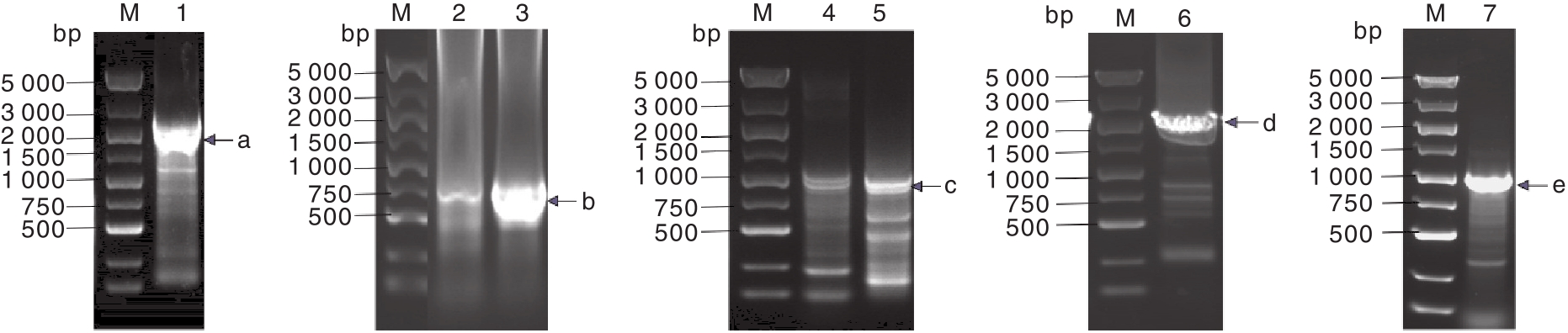
Fig.1 Cloning of EmPAL ORF and promoter M, DL 5 000; 1, PCR product of 3'-RACE; 2, Second round product of the first Tail PCR; 3, Third round product of the first Tail PCR; 4, Second round product of the second Tail PCR; 5, Third round product of the second Tail PCR; 6, PCR product of EmPAL ORF; 7, PCR product of EmPAL promoter.
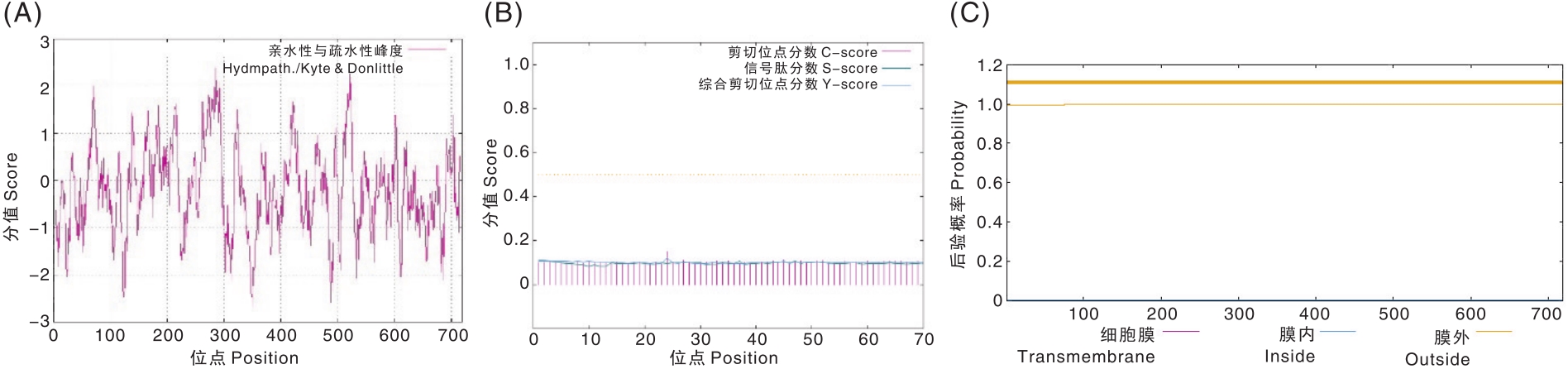
Fig.2 The physicochemical properties of EmPAL protein A, Hydrophobicity or hydrophilia prediction of EmPAL protein; B, Signal peptide prediction of EmPAL protein; C, Transmembrane domain prediction of EmPAL protein.
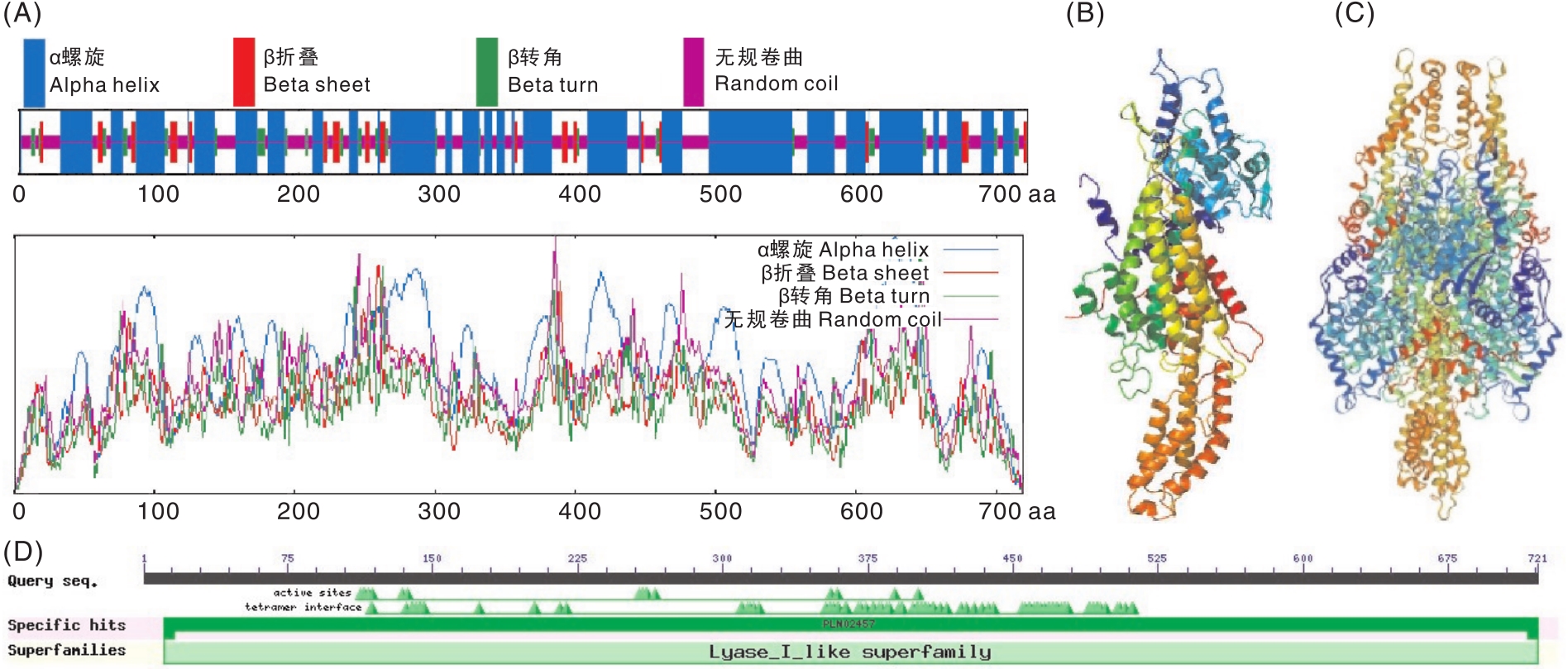
Fig.3 Structure of EmPAL protein A, The secondary structure of EmPAL; B, Monomer of EmPAL protein prediction; C, Homotetramer of EmPAL protein prediction; D, EmPAL protein superfamily.
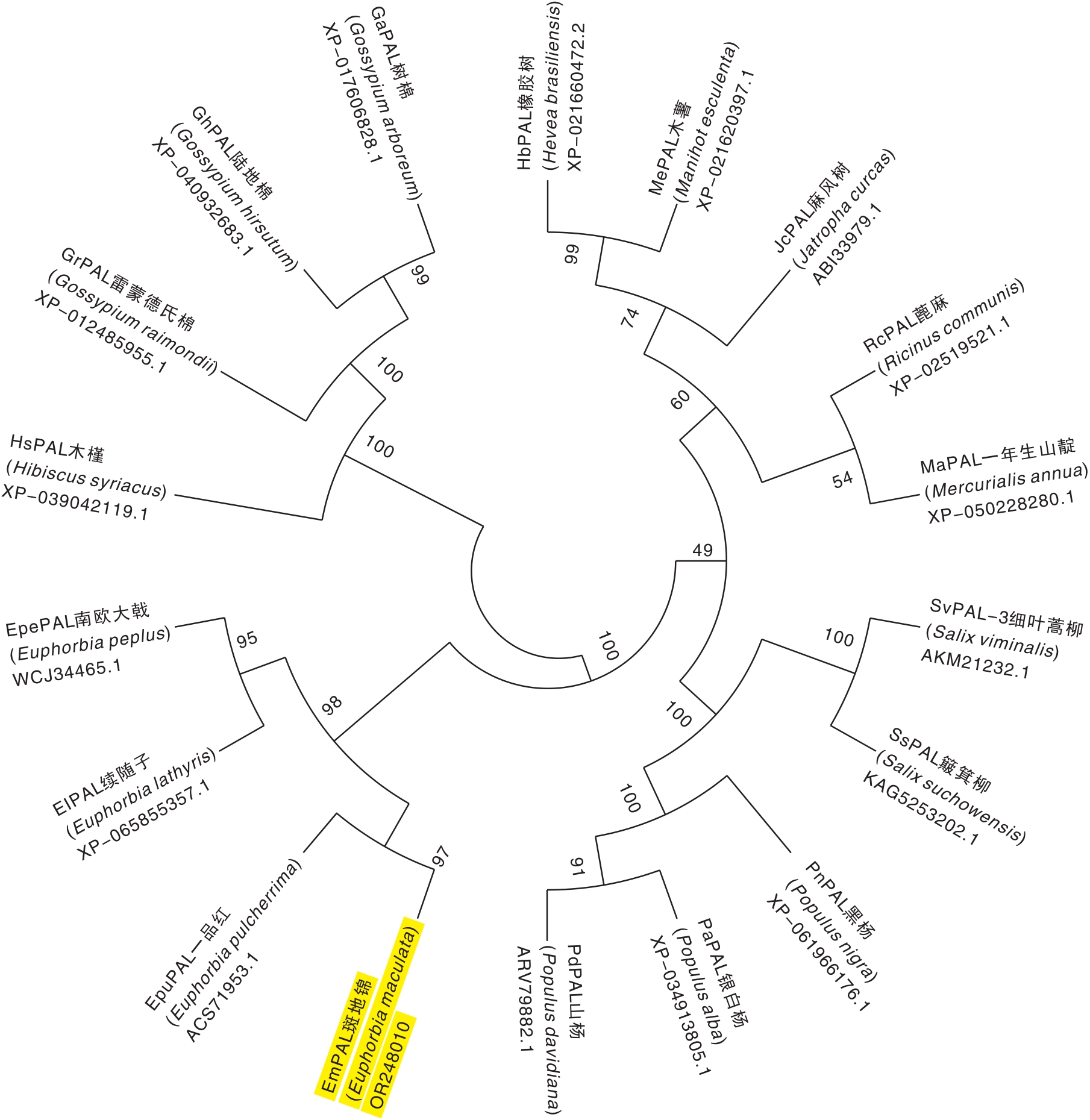
Fig.4 Phylogenetic tree of EmPAL and other PAL proteins from different plants
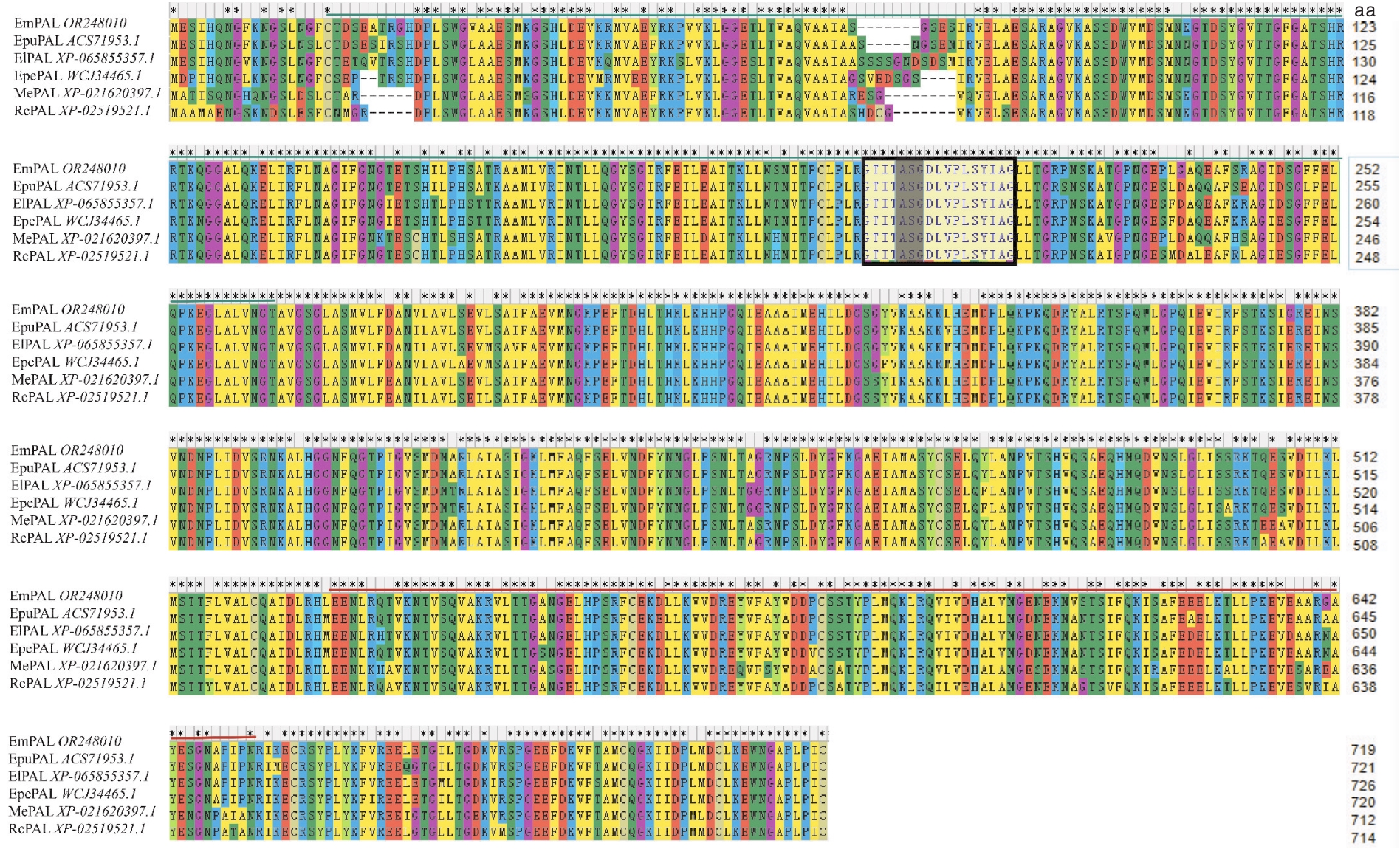
Fig.5 Multiple sequence alignment of EmPAL protein and its homologues from other Euphorbiaceae plants Green line, N-terminal; Red line, C-terminal embedded shielding domain; Black box, Active site; Black asterisks, Conserved sequence.
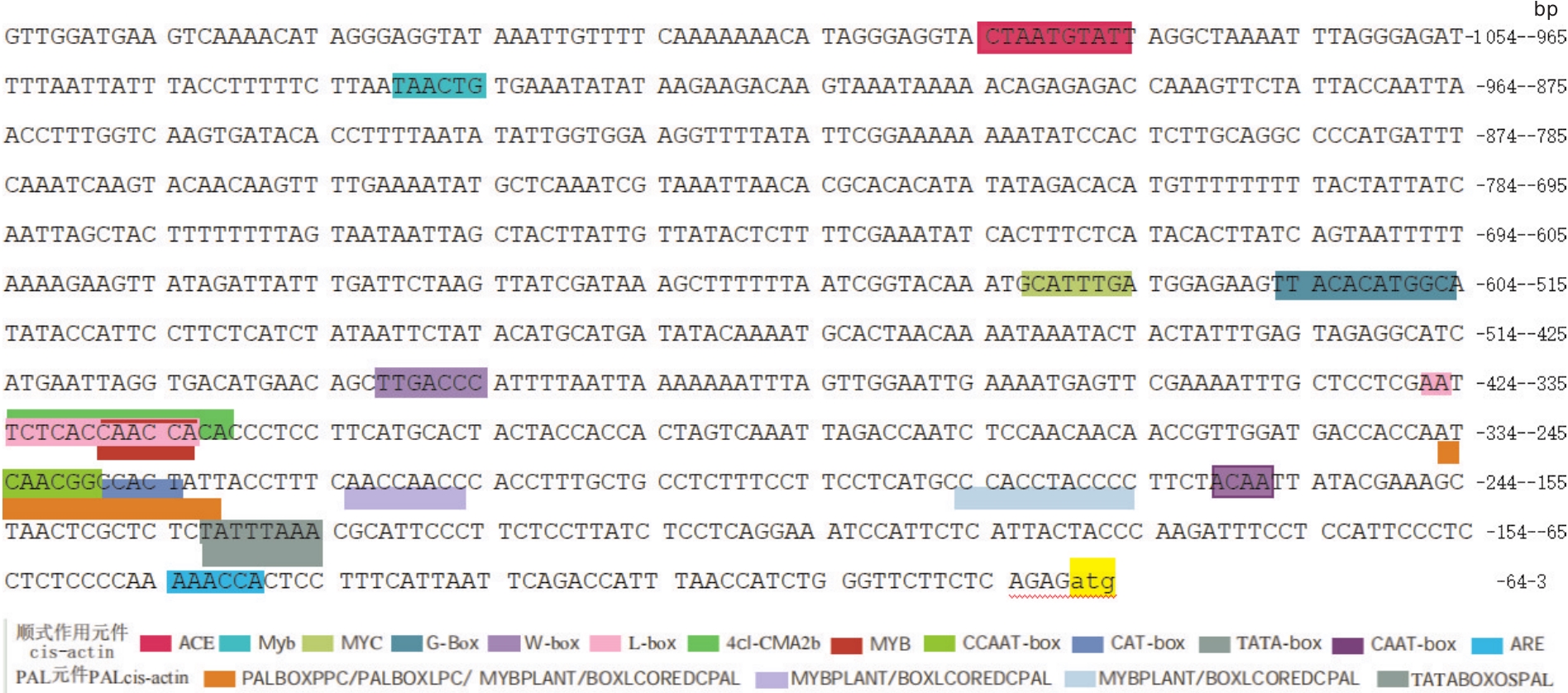
Fig.6 The cis-acting elements in the promoter of EmPAL
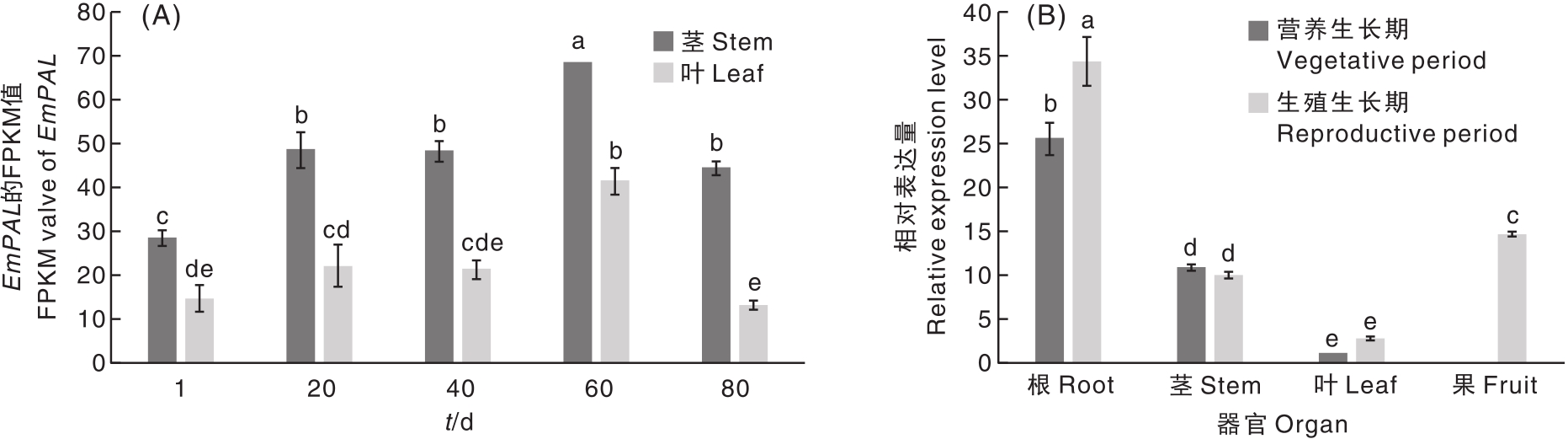
Fig.7 Expression pattern of EmPAL in Euphorbia maculata A, FPKM of EmPAL transcriptome at different periods; B, Relative expression of EmPAL at different developmental periods. The absence of identical lowercase letters on the column indicates significant (p<0.05) differences, as shown in Figure 8.
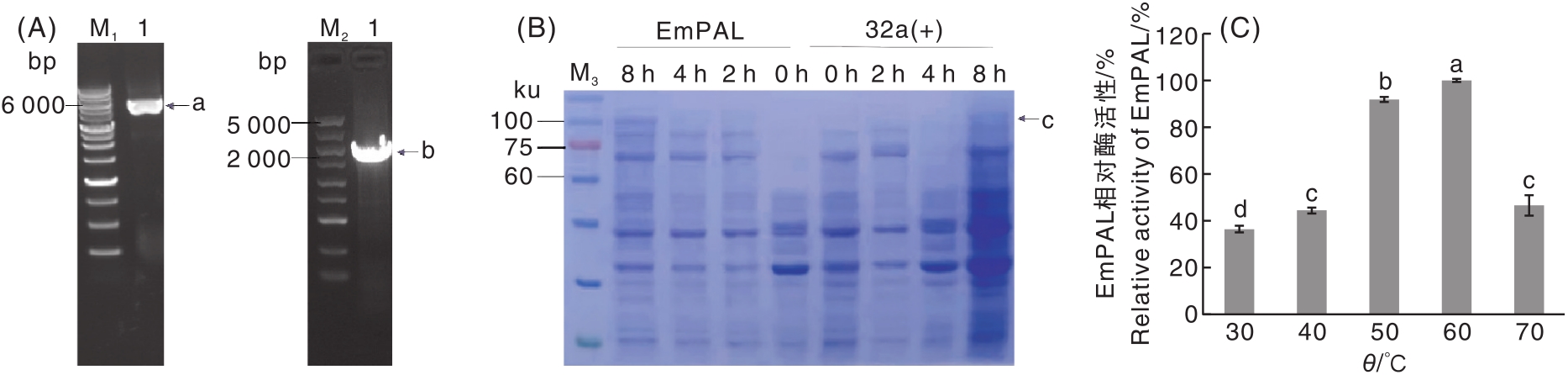
Fig.8 Prokaryotic expression and relative enzyme activity at different temperatures of EmPAL A, Construction of EmPAL prokaryotic expression vector, M1 and M2 are DNA markers (DL10 k), Lane 1 is the pET32a(+) plasmid, Lane 2 is the PCR of pET32a(+)-EmPAL monoclonal bacterial culture, a is the specific band of pET32a(+), and b is the specific band of EmPAL; B, EmPAL induced expression of SDS-PAGE in Escherichia coli BL21(DE3), c is a recombinant protein; C, Relative activity of EmPAL at different temperatures.
| [1] | 国家药典委员会. 中华人民共和国药典:一部[M]. 2020年版. 北京: 中国医药科技出版社, 2020. |
| [2] | 刘海松, 曲悦, 冀翔宇, 等. 基于UHPLC-Q-TOF-MS技术的斑地锦化学成分分析[J]. 中药材, 2021, 44(6): 1409-1414. |
| Liu H S, Qu Y, Ji X Y, et al. Analysis of chemical constituents of Parthenocissus tricuspidata based on UHPLC-Q-TOF-MS technology[J]. Journal of Chinese Medicinal Materials, 2021, 44(6): 1409-1414. | |
| [3] | 余德发, 孙新琪, 于肖辉, 等. GC-MS/MS法检测肠炎宁片及其药材中禁用农药残留[J]. 药品评价, 2023, 20(9): 1064-1069. |
| Yu D F, Sun X Q, Yu X H, et al. Determination of banned pesticide residues in Changyanning tablets and its medicinal materials by GC-MS/MS method[J]. Drug Evaluation, 2023, 20(9): 1064-1069. | |
| [4] | 邱晓旭, 王帅, 李天娇, 等. 地锦草抗肝癌药效部位提取纯化工艺研究[J]. 时珍国医国药, 2025, 36(14): 2674-2680. |
| Qiu X X, Wang S, Li T J, et al. Study on the extraction and purification technology and anti-hepatocellular carcinoma medicinal parts of Euphorbiae humifusae[J]. Journal of Li-Shizhen Traditional Chinese Medicine, 2025, 36(14): 2674-2680. | |
| [5] | 宁艳梅, 任远, 吴国泰, 等. 基于代谢组学技术探讨鳖血柴胡“清肝退热”作用的“物质—效应”机制[J]. 中草药, 2022, 53(24): 7763-7773. |
| Ning Y M, Ren Y, Wu G T, et al. “Substance-effect” mechanism of Bupleuri Radix processed with Trionyx’s blood on “liver-clearing and fever-relieving” based on metabolomics[J]. Chinese Traditional and Herbal Drugs, 2022, 53(24): 7763-7773. | |
| [6] | Ge W J, Xin J P, Tian R N. Phenylpropanoid pathway in plants and its role in response to heavy metal stress: a review[J]. Chinese Journal of Biotechnology, 2023, 39(2): 425-445. |
| [7] | Barros J, Dixon R A. Plant phenylalanine/tyrosine ammonia-lyases[J]. Trends in Plant Science, 2020, 25(1): 66-79. |
| [8] | 戢强强, 陈伟达, 陈敬东, 等. 青蒿苯丙氨酸解氨酶(AaPAL)基因家族鉴定及光调控分析[J]. 分子植物育种, 2023, 21(11): 3544-3551. |
| Ji Q Q, Chen W D, Chen J D, et al. Family identification and photoregulation analysis of phenylalanine ammonia lyase (AaPAL) gene of Artemisia annua[J]. Molecular Plant Breeding, 2023, 21(11): 3544-3551. | |
| [9] | 赵咏洋, 陈维嘉, 丁静峰, 等. 决明苯丙氨酸解氨酶(PAL)基因家族的全基因组分析[J]. 湖北农业科学, 2023, 62(6): 181-187. |
| Zhao Y Y, Chen W J, Ding J F, et al. Genome wide analysis of the phenylalanine ammonia lyase (PAL)gene family from Senna tora[J]. Hubei Agricultural Sciences, 2023, 62(6): 181-187. | |
| [10] | 刘俊频, 李胜立, 袁元, 等. 膜荚黄芪3个苯丙氨酸解氨酶基因的克隆与表达分析[J]. 中草药, 2019, 50(7): 1669-1675. |
| Liu J P, Li S L, Yuan Y, et al. Cloning and expression of three PAL genes in Astragalus membranaceus[J]. Chinese Traditional and Herbal Drugs, 2019, 50(7): 1669-1675. | |
| [11] | Huang J L, Gu M, Lai Z B, et al. Functional analysis of the Arabidopsis PAL gene family in plant growth, development, and response to environmental stress[J]. Plant Physiology, 2010, 153(4): 1526-1538. |
| [12] | Hsieh L S, Hsieh Y L, Yeh C S, et al. Molecular characterization of a phenylalanine ammonia-lyase gene (BoPAL1) from Bambusa oldhamii[J]. Molecular Biology Reports, 2011, 38(1): 283-290. |
| [13] | Jun S Y, Sattler S A, Cortez G S, et al. Biochemical and structural analysis of substrate specificity of a phenylalanine ammonia-lyase[J]. Plant Physiology, 2018, 176(2): 1452-1468. |
| [14] | Ren Y, Liu J M, He L P, et al. Effect of salicylic acid treatment on disease resistance to Coleosporium zanthoxyli in Chinese pepper (Zanthoxylum armatum)[J]. Plant Disease, 2024, 108(4): 960-970. |
| [15] | Zhao Q Z, Dong M Y, Li M F, et al. Light-induced flavonoid biosynthesis in Sinopodophyllum hexandrum with high-altitude adaptation[J]. Plants, 2023, 12(3): 575. |
| [16] | Peng X, Wu H, Chen H J, et al. Transcriptome profiling reveals candidate flavonol-related genes of Tetrastigma hemsleyanum under cold stress[J]. BMC Genomics, 2019, 20(1):687. |
| [17] | Liu Y G, Chen Y L. High-efficiency thermal asymmetric interlaced PCR for amplification of unknown flanking sequences[J]. BioTechniques, 2007, 43(5): 649-656. |
| [18] | 钟小菊, 吴晴阳, 张永康, 等. 斑地锦黄烷酮-3-羟化酶基因及启动子的克隆与分析[J]. 西北植物学报, 2021, 41(9): 1475-1481. |
| Zhong X J, Wu Q Y, Zhang Y K, et al. Cloning and analysis of flavanone 3-hydroxylase gene and its promoter from Euphorbia maculata L[J]. Acta Botanica Boreali-Occidentalia Sinica, 2021, 41(9): 1475-1481. | |
| [19] | Makgoo L, Mosebi S, Mbita Z. In silico analysis of s-DAPK-1: from structure to function and regulation[J]. Current Issues in Molecular Biology, 2025, 47(6): 416. |
| [20] | Ma H R, Yuan H L, Bu W X, et al. Identification and bioinformatics analysis of the HSP20 family in the peony[J]. Genes, 2025, 16(7): 742. |
| [21] | Segura-Alabart N, Serratosa F, Gómez S, et al. Nonunique UPGMA clusterings of microsatellite markers[J]. Briefings in Bioinformatics, 2022, 23(5): bbac312. |
| [22] | Wei Y X, Song Y H, Khan M A, et al. GhTPPA_2 enhancement of tobacco sugar accumulation and drought tolerance[J]. Gene, 2024, 894: 147969. |
| [23] | 许建丰, 桂明明, 张永康, 等. 基于转录组测序的斑地锦内参基因筛选及验证[J]. 热带作物学报, 2023, 44(11): 2273-2280. |
| Xu J F, Gui M M, Zhang Y K, et al. Selection and verification of the reference genes of Euphorbia maculata based on transcriptome sequencing[J]. Chinese Journal of Tropical Crops, 2023, 44(11): 2273-2280. | |
| [24] | 罗才林, 李林, 陈立, 等. 白及苯丙氨酸解氨酶基因的克隆、序列特征及激素响应表达分析[J]. 中草药, 2019, 50(3): 694-701. |
| Luo C L, Li L, Chen L, et al. Cloning, sequence characterization, expression profiling of hormones response of phenylalanine ammonia-lyase gene in Bletilla striata[J]. Chinese Traditional and Herbal Drugs, 2019, 50(3): 694-701. | |
| [25] | 何潇, 刘兴, 辛正琦, 等. 半夏PtPAL基因的克隆、表达与酶动力学分析[J]. 作物学报, 2021, 47(10): 1941-1952. |
| He X, Liu X, Xin Z Q, et al. Molecular cloning, expression, and enzyme kinetic analysis of a phenylalanine ammonia-lyase gene in Pinellia ternate[J]. Acta Agronomica Sinica, 2021, 47(10): 1941-1952. | |
| [26] | 张玉, 杨文静, 刘璇, 等. 马铃薯细胞壁蔗糖转化酶基因StCWIN1启动子克隆与表达及其在干旱胁迫下的作用分析[J]. 作物杂志, 2024(2): 54-61. |
| Zhang Y, Yang W J, Liu X, et al. Cloning and expression analysis of potato StCWIN1 gene promoter and its role under drought stress[J]. Crops, 2024(2): 54-61. | |
| [27] | Campos R, Nonogaki H, Suslow T, et al. Isolation and characterization of a wound inducible phenylalanine ammonia-lyase gene (LsPAL1) from Romaine lettuce leaves[J]. Physiologia Plantarum, 2004, 121(3): 429-438. |
| [28] | Khakdan F, Alizadeh H, Ranjbar M. Molecular cloning, functional characterization and expression of a drought inducible phenylalanine ammonia-lyase gene (ObPAL) from Ocimum basilicum L[J]. Plant Physiology and Biochemistry, 2018, 130: 464-472. |
| [29] | Sablowski R W, Moyano E, Culianez-Macia F A, et al. A flower-specific Myb protein activates transcription of phenylpropanoid biosynthetic genes[J]. The EMBO Journal, 1994, 13(1): 128-137. |
| [30] | Maeda K, Kimura S, Demura T, et al. DcMYB1 acts as a transcriptional activator of the carrot phenylalanine ammonia-lyase gene (DcPAL1) in response to elicitor treatment, UV-B irradiation and the dilution effect[J]. Plant Molecular Biology, 2005, 59(5): 739-752. |
| [31] | Logemann E, Parniske M, Hahlbrock K. Modes of expression and common structural features of the complete phenylalanine ammonia-lyase gene family in parsley[J]. Proceedings of the National Academy of Sciences of the United States of America, 1995, 92(13): 5905-5909. |
| [32] | Zhu Q, Ordiz M I, Dabi T, et al. Rice TATA binding protein interacts functionally with transcription factor IIB and the RF2a bZIP transcriptional activator in an enhanced plant in vitro transcription system[J]. The Plant Cell, 2002, 14(4): 795-803. |
| [33] | Sui Z W, Luo J, Yao R L, et al. Functional characterization and correlation analysis of phenylalanine ammonia-lyase (PAL) in coumarin biosynthesis from Peucedanum praeruptorum Dunn[J]. Phytochemistry, 2019, 158: 35-45. |
| [34] | Takshak S, Agrawal S B. Secondary metabolites and phenylpropanoid pathway enzymes as influenced under supplemental ultraviolet-B radiation in Withania somnifera, an indigenous medicinal plant[J]. Journal of Photochemistry and Photobiology B: Biology, 2014, 140: 332-343. |
| [35] | Xu F, Cai R, Cheng S Y, et al. Molecular cloning, characterization and expression of phenylalanine ammonia-lyase gene from Ginkgo biloba[J]. African Journal of Biotechnology, 2008, 7(6): 721-729. |
| [36] | Zhu Q L, Xie X R, Lin H X, et al. Isolation and functional characterization of a phenylalanine ammonia-lyase gene (SsPAL1) from Coleus(Solenostemon scutellarioides(L.) Codd)[J]. Molecules, 2015, 20(9): 16833-16851. |
| [37] | 张晨, 臧颖, 许倩, 等. 毛果杨苯丙氨酸解氨酶活性比较及肉桂酸制备[J]. 南京林业大学学报(自然科学版), 2020, 44(1): 97-104. |
| Zhang C, Zang Y, Xu Q, et al. Comparison on activities of phenylalanine ammonia-lyase from Populus trichocarpa and its application in trans-cinnamic acid production[J]. Journal of Nanjing Forestry University(Natural Sciences Edition), 2020, 44(1): 97-104. | |
| [38] | Phimchan P, Chanthai S, Bosland P W, et al. Enzymatic changes in phenylalanine ammonia-lyase, cinnamic-4-hydroxylase, capsaicin synthase, and peroxidase activities in Capsicum under drought stress[J]. Journal of Agricultural and Food Chemistry, 2014, 62(29): 7057-7062. |
| [1] | WANG Yao, SHI Linyong, ZHANG Heng, ZOU Guihua, ZHU Ying. Research progress on sorghum grain weight [J]. Acta Agriculturae Zhejiangensis, 2026, 38(8): 1717-1728. |
| [2] | WANG Rongli, XU Zixin, ZHANG Zhenwu, WU Huixin, XING Chenghua. Effects of nitrogen reduction combined with biochar application on the growth and soil enzyme activity of alfalfa in southern red soil [J]. Acta Agriculturae Zhejiangensis, 2026, 38(6): 1236-1245. |
| [3] | LYU Yongjie, SUN Wanchun, MA Junwei, ZHU Xiaofang, YE Jing, YU Qiaogang, WANG Qiang, CHEN Zhaoming, CHEN Zhengdao, ZHOU Jun, HE Xinhua, WANG Feng. Acidification characteristics of red and yellow cultivated soils in southern China and their impacts on soil fertility and enzyme activity: a case study of the soil acidification amelioration demonstration zone in Jinyun County of China [J]. Acta Agriculturae Zhejiangensis, 2026, 38(5): 965-978. |
| [4] | MIAO Bailing, CHEN Juanjuan, LI Liangjie, CHU Zongli, DONG Xiangxiang. The function of CchABCG5 gene in Camellia chekiangoleosa Hu [J]. Acta Agriculturae Zhejiangensis, 2025, 37(7): 1407-1416. |
| [5] | CHEN Mengwei, LIANG Xu, ZHANG Chenglei, LIANG Jing, XU Yingzi, XIANG Dandan, YANG Zhaoqu, XIE Yongdong. Effects of microbial fertilizer on soil properties and leaf nutrition of Dongkui bayberry [J]. Acta Agriculturae Zhejiangensis, 2025, 37(5): 1130-1138. |
| [6] | DU Song, TANG Tao, CHENG Xi, ZHAO Xueping, ZHANG Chunrong, LIANG Xiaoyu, WANG Meng, ZHANG Zhen, LI Yongcheng, ZHANG Chenghui. Exploring the degradation and soil enzyme impact of pyroxasulfone and its main metabolites in soils [J]. Acta Agriculturae Zhejiangensis, 2025, 37(4): 847-857. |
| [7] | ZHANG Meiying, MO Qian, QI Xiushuang, TONG Ningning, KONG Fan, LIU Zheng’an, LYU Changping, PENG Liping. Cloning and expression analysis of peony PoLPAT2 gene [J]. Acta Agriculturae Zhejiangensis, 2025, 37(2): 321-328. |
| [8] | SUN Peiyuan, RAN Bin, WANG Jiarui, LI Hongyou. Cloning and expression analysis of Fagopyrum tataricum FtDELLA gene [J]. Acta Agriculturae Zhejiangensis, 2024, 36(8): 1709-1718. |
| [9] | ZHU Guishuang, LI Yanxiao, ZHANG Anning, SUN Haonan, XU Xingyuan, LI Zhigang, XIANG Dianjun. Identification of RcGeBP transcription factor and cloning and expression analysis of RcGeBP2 gene in castor [J]. Acta Agriculturae Zhejiangensis, 2024, 36(8): 1731-1740. |
| [10] | JIANG Wenjun, SHU Hongsuo, CHEN Zhengman, REN Dianting, YANG Dang, TIAN Rongjiang, DU Zhaokui. Cloning, expression, and bioinformatics analysis of KoWRKY43 gene in Kandelia obovata [J]. Acta Agriculturae Zhejiangensis, 2024, 36(8): 1832-1843. |
| [11] | SONG Peng, LI Lixiang, JIANG Houlong, WANG Ru, LI Hui, ZHAO Pengyu, ZHANG Jun, QIN Pingwei, REN Jiangbo, CHEN Qingming. Effect of application of Brevibacillus laterosporus on potassium content of cured tobacco leaves and physiological characteristics of tobacco plants [J]. Acta Agriculturae Zhejiangensis, 2024, 36(3): 494-502. |
| [12] | LI Tian’en, ZHOU Sihan, SUN Hongchao, FU Yuan, SHI Tuanyuan, YAN Wenchao. Cloning and expression analysis of two hypothetical dense granule protein genes of Eimeria tenella in chickens [J]. Acta Agriculturae Zhejiangensis, 2024, 36(3): 503-514. |
| [13] | ZHANG Yu, JIN Mingwei, REN Li, ZHANG Yiying, ZHAO Hong, LIU Kun, DENG Shan, CHU Yunxia, LI Shouguo, ZHANG Jingli, HUANG Jingyan, CHEN Hairong. Expression patterns and transcriptional autoactivation analysis of CaERF70 in chili pepper [J]. Acta Agriculturae Zhejiangensis, 2024, 36(10): 2247-2256. |
| [14] | YUE Zongwei, LI Jiaxiao, SUN Xiangyang, LIU Guoliang, LI Suyan, WANG Chenchen, ZHA Guichao, WEI Ningxian. Effects of chemical fertilizer combined with organic fertilizer on soil properties, cherry fruit quality and yield [J]. Acta Agriculturae Zhejiangensis, 2023, 35(9): 2192-2201. |
| [15] | SONG Chuansheng, KANG Xiaofei, FAN Qingzhong, WANG Jungang, SHI Xue, ZHANG Ziru, TAN Qingqing, ZENG Xiaojiao, LIU Fang, LI Yingsai, HOU Changyue. Cloning, sequence analysis, prokaryotic expression of thymidine kinase from jujube witches’-broom phytoplasma [J]. Acta Agriculturae Zhejiangensis, 2023, 35(8): 1763-1772. |
| Viewed | ||||||
|
Full text |
|
|||||
|
Abstract |
|
|||||

