浙江农业学报 ›› 2026, Vol. 38 ›› Issue (4): 655-668.DOI: 10.3969/j.issn.1004-1524.20250320
植物工厂光周期对青菜生长、品质与光合参数的影响
张东鹤1,2( ), 崔佳维1, 苗辰1, 李晓锋1, 占绣萍2, 王齐旭2, 李建勇2,*(), 丁小涛1,*()
- 1
上海市农业科学院 上海市设施园艺技术重点实验室 上海 201403
2上海市农业技术推广服务中心 上海 201103
-
收稿日期:2025-04-22出版日期:2026-04-25发布日期:2026-05-08 -
作者简介:李建勇,E-mail:48685988@qq.com;丁小涛,E-mail:dingxiaotao@saas.sh.cn
张东鹤,主要从事蔬菜“四新”技术等研究。E-mail:18801283880@163.com -
通讯作者:李建勇,丁小涛 -
基金资助:上海市设施园艺技术重点实验室(KF202404)
Effects of different photoperiods on growth, quality, and photosynthetic parameters of pakchoi in plant factory
ZHANG Donghe1,2(), CUI Jiawei1, MIAO Chen1, LI Xiaofeng1, ZHAN Xiuping2, WANG Qixu2, LI Jianyong2,*(), DING Xiaotao1,*()
- 1
Shanghai Key Laboratory of Protected Horticultural Technology ,Shanghai Academy of Agricultural Sciences Shanghai 201605, China
2Shanghai Agricultural Technology Extension Service Center Shanghai 201103, China
-
Received:2025-04-22Published:2026-04-25Online:2026-05-08 -
Contact:LI Jianyong,DING Xiaotao

摘要:
为探究人工光植物工厂光周期对青菜生长与品质的影响,本研究选取4个青菜品种为材料,设置4个光周期处理:T1,10 h光照/14 h黑暗(10 L∶14 D);T2,13 h光照/11 h黑暗(13 L∶11 D);T3,16 h光照/8 h黑暗(16 L∶8 D);T4,19 h光照/5 h黑暗(19 L∶5 D)。测定各处理条件下青菜的生物量、生长指标、品质指标与光合参数。结果表明:适度延长光照时间(16 L∶8 D)可提高青菜的光合效率并增加植株生物量。品种紫衣在19 L∶5 D处理下地上部鲜重最大,较13 L∶11 D处理提高15.48%;品种SH-2、新夏青9号和艳青在16 L∶8 D处理下地上部鲜重最大,较13 L∶11 D处理分别提高16.00%、16.96%和23.68%。适度延长光照时间同时提高了青菜的可溶性糖、可溶性蛋白和花青素含量,并降低了硝酸盐含量。然而,持续超长光周期(光照时间19 h·d-1)会导致生长后期产量下降和外观品质降低,从而丧失商品性,这可能与超长光照时间引起部分青菜品种PSⅡ整体活性下降,进而发生光抑制有关。建议在人工光植物工厂的青菜生产中适当延长光照时间,苗期光照时间以16~19 h·d-1为宜,生长后期应适当缩短至16 h·d-1左右,以保证青菜产量和品质。
中图分类号:
引用本文
张东鹤, 崔佳维, 苗辰, 李晓锋, 占绣萍, 王齐旭, 李建勇, 丁小涛. 植物工厂光周期对青菜生长、品质与光合参数的影响[J]. 浙江农业学报, 2026, 38(4): 655-668.
ZHANG Donghe, CUI Jiawei, MIAO Chen, LI Xiaofeng, ZHAN Xiuping, WANG Qixu, LI Jianyong, DING Xiaotao. Effects of different photoperiods on growth, quality, and photosynthetic parameters of pakchoi in plant factory[J]. Acta Agriculturae Zhejiangensis, 2026, 38(4): 655-668.
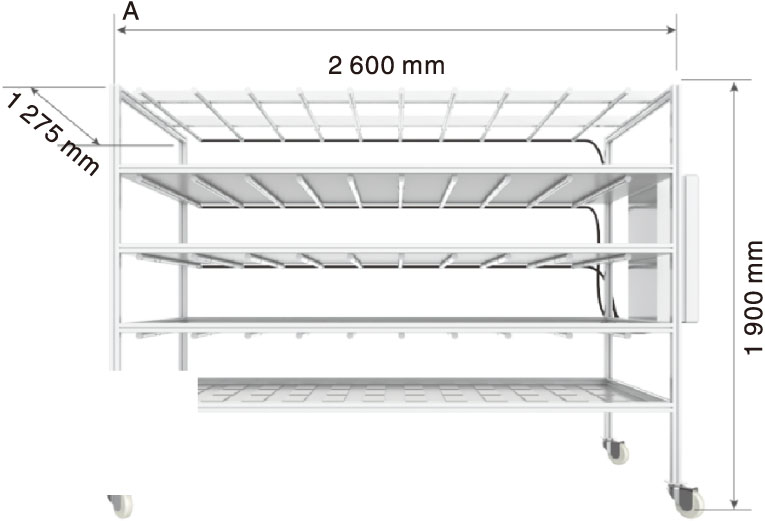
图1 立体栽培架
Fig.1 Vertical cultivation bed
| 光谱范围/nm Spectral range/nm | PPFD/(μmol· m-2·s-1) | PPF/(μmol· s-1) |
|---|---|---|
| 全波段Total(380~780) | 221.60 | 848.016 |
| 紫外光Ultraviolet light (380~399) | 0.13 | 0.048 |
| 蓝光Blue light (400~499) | 67.90 | 224.760 |
| 绿光Green light (500~599) | 28.40 | 94.068 |
| 红光Red light (600~699) | 125.40 | 529.080 |
| 远红光Far-red light(700~780) | 5.60 | 0.060 |
表1 LED补光灯的光量子通量密度(PPFD)和光合光子通量(PPF)
Table 1 Photosynthetic photon flux density (PPFD) and photosynthetic photon flux (PPF) of LED supplemental light
| 光谱范围/nm Spectral range/nm | PPFD/(μmol· m-2·s-1) | PPF/(μmol· s-1) |
|---|---|---|
| 全波段Total(380~780) | 221.60 | 848.016 |
| 紫外光Ultraviolet light (380~399) | 0.13 | 0.048 |
| 蓝光Blue light (400~499) | 67.90 | 224.760 |
| 绿光Green light (500~599) | 28.40 | 94.068 |
| 红光Red light (600~699) | 125.40 | 529.080 |
| 远红光Far-red light(700~780) | 5.60 | 0.060 |
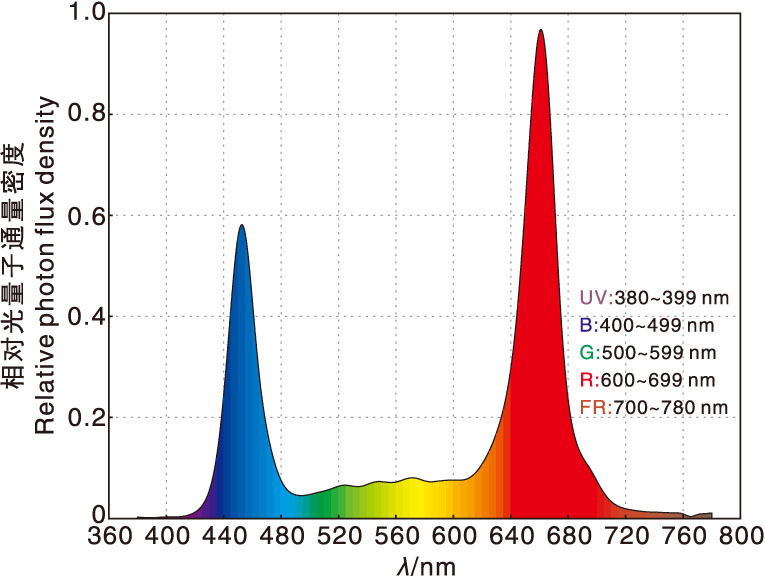
图2 所用LED灯的光谱图 UV,紫外光;B,蓝光;G,绿光;R,红光;FR,远红光。
Fig.2 Spectrum of the LED lamps used in this study UV, Ultraviolet light; B, Blue light; G, Green light; R, Red light; FR, Far-red light.
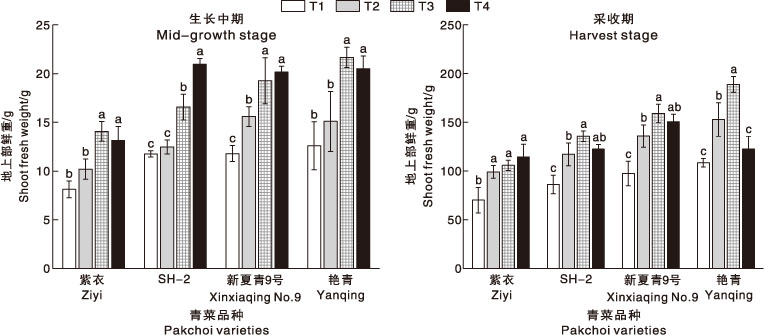
图3 不同光周期处理下青菜的地上部鲜重 同一品种柱上无相同小写字母表示不同处理间差异显著(p<0.05)。下同。
Fig.3 Shoot fresh weight of pakchoi under different photoperiod treatments Bars marked without the same lowercase letters for the same variety indicate significant (p<0.05) differences among treatments. The same as below.
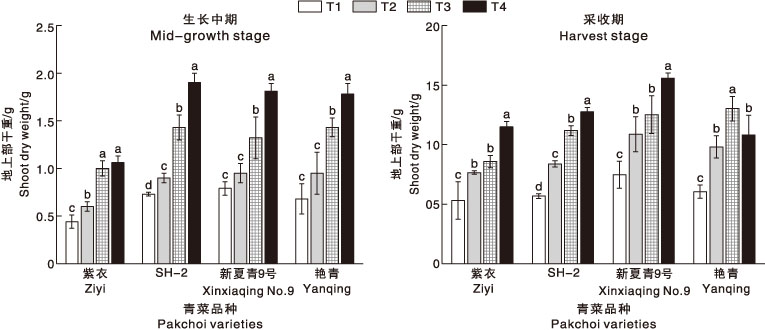
图4 不同光周期处理下青菜地上部干重
Fig.4 Shoot dry weight of pakchoi under different photoperiod treatments
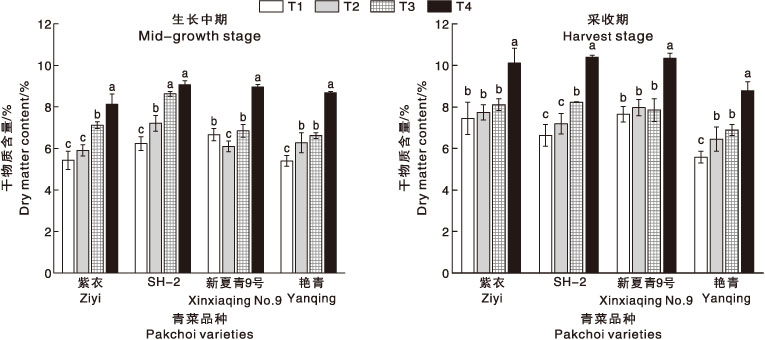
图5 不同光周期处理下青菜的干物质含量
Fig.5 Dry matter content of pakchoi under different photoperiod treatments
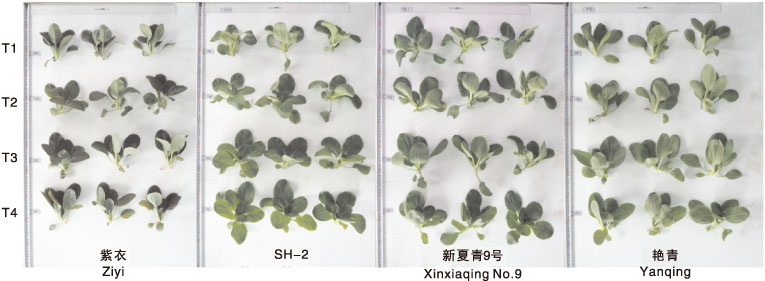
图6 不同光周期处理下青菜(生长中期)的长势
Fig.6 Growth of pakchoi under different photoperiod treatments (mid-growth stage)
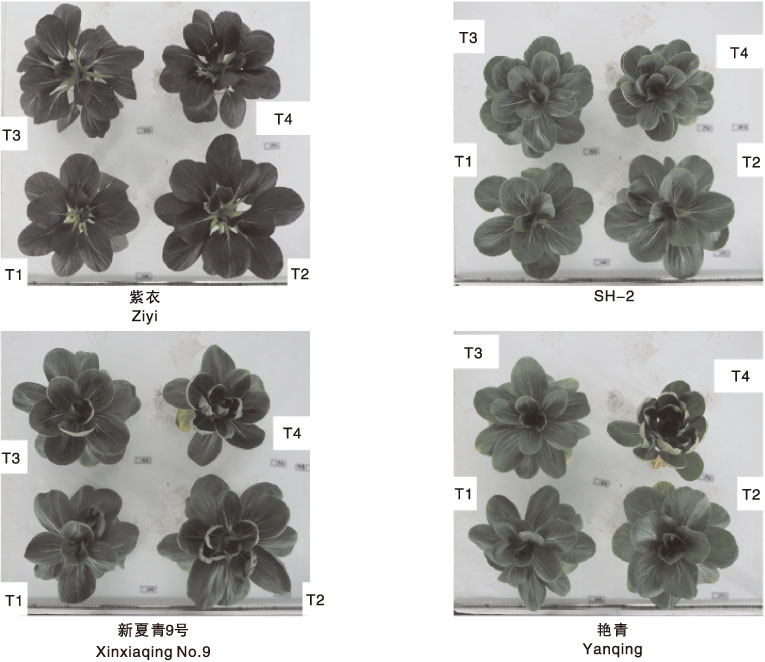
图7 不同光周期处理下青菜(采收期)的长势
Fig.7 Growth of pakchoi under different photoperiod treatments (harvest stage)
| 处理 Treatment | 叶片的焦边数Leaf edge scorch count | |||
|---|---|---|---|---|
| 紫衣 Ziyi | SH-2 | 新夏青9号 Xinxiaqing No.9 | 艳青 Yanqing | |
| T1 | 0 | 0 | 0 | 0 |
| T2 | 0 | 0 | 2.00 | 0 |
| T3 | 0 | 0 | 3.33 | 2.00 |
| T4 | 0 | 4.67 | 8.00 | 8.67 |
表2 不同光周期处理下各品种青菜采收期叶片的焦边数
Table 2 Leaf edge scorch count of pakchoi varieties at harvest stage under different photoperiod treatments
| 处理 Treatment | 叶片的焦边数Leaf edge scorch count | |||
|---|---|---|---|---|
| 紫衣 Ziyi | SH-2 | 新夏青9号 Xinxiaqing No.9 | 艳青 Yanqing | |
| T1 | 0 | 0 | 0 | 0 |
| T2 | 0 | 0 | 2.00 | 0 |
| T3 | 0 | 0 | 3.33 | 2.00 |
| T4 | 0 | 4.67 | 8.00 | 8.67 |
| 品种 Variety | 处理 Treatment | 株高/cm Plant height/cm | 株幅/cm Plant spread/cm | 叶片数 Leaf count | 最大叶长/cm Maximum leaf length/cm | 最大叶宽/cm Maximum leaf width/cm | 最大叶柄长/cm Maximum petiole length/cm | 最大叶柄宽/cm Maximum petiole width/cm | 叶柄厚度/mm Petiole thickness/mm |
|---|---|---|---|---|---|---|---|---|---|
| 紫衣 | T1 | 14.12 a | 28.02 b | 19.6 c | 20.97 a | 10.50 a | 8.43 a | 1.23 a | 2.80 a |
| Ziyi | T2 | 14.82 a | 31.20 a | 21.6 b | 23.10 a | 10.80 a | 9.50 a | 1.60 a | 3.24 a |
| T3 | 14.88 a | 32.06 a | 21.8 ab | 22.53 a | 10.67 a | 8.70 a | 1.67 a | 3.34 a | |
| T4 | 15.54 a | 30.50 a | 23.2 a | 22.00 a | 10.87 a | 8.20 a | 1.63 a | 3.20 a | |
| SH-2 | T1 | 12.00 b | 29.30 b | 18.4 c | 18.33 a | 10.47 a | 6.13 a | 2.20 b | 3.44 b |
| T2 | 13.22 ab | 30.90 a | 22.0 b | 18.50 a | 10.07 ab | 5.57 a | 2.60 a | 3.61 ab | |
| T3 | 14.26 a | 31.34 a | 24.4 a | 18.63 a | 10.13 ab | 5.50 a | 2.83 a | 4.12 a | |
| T4 | 12.40 b | 27.36 c | 24.2 a | 16.57 b | 9.30 b | 5.07 a | 2.63 a | 3.35 b | |
| 新夏青9号 | T1 | 12.98 b | 29.48 a | 20.6 c | 18.80 ab | 10.37 b | 6.07 ab | 2.27 b | 3.85 a |
| Xinxiaqing No.9 | T2 | 15.92 a | 30.24 a | 21.4 bc | 20.17 a | 11.70 a | 6.87 a | 2.37 ab | 4.34 a |
| T3 | 16.84 a | 30.76 a | 23.0 b | 19.77 a | 11.13 ab | 6.33 ab | 2.77 a | 4.48 a | |
| T4 | 13.96 b | 25.80 b | 25.4 a | 17.57 b | 10.43 b | 5.40 b | 2.43 ab | 4.23 a | |
| 艳青 | T1 | 14.00 b | 29.92 b | 19.4 b | 21.43 ab | 10.93 a | 7.63 a | 2.30 b | 4.15 b |
| Yanqing | T2 | 14.80 b | 35.72 a | 22.4 a | 22.53 a | 12.00 a | 7.43 ab | 2.77 a | 4.88 a |
| T3 | 14.96 b | 35.72 a | 23.4 a | 20.33 b | 11.33 a | 6.00 bc | 3.03 a | 4.95 a | |
| T4 | 17.24 a | 25.20 c | 23.4 a | 17.50 c | 10.37 a | 5.43 c | 2.90 a | 4.23 b |
表3 不同光周期处理下青菜采收期的生长指标
Table 3 Growth indices of pakchoi at harvest stage under different photoperiod treatments
| 品种 Variety | 处理 Treatment | 株高/cm Plant height/cm | 株幅/cm Plant spread/cm | 叶片数 Leaf count | 最大叶长/cm Maximum leaf length/cm | 最大叶宽/cm Maximum leaf width/cm | 最大叶柄长/cm Maximum petiole length/cm | 最大叶柄宽/cm Maximum petiole width/cm | 叶柄厚度/mm Petiole thickness/mm |
|---|---|---|---|---|---|---|---|---|---|
| 紫衣 | T1 | 14.12 a | 28.02 b | 19.6 c | 20.97 a | 10.50 a | 8.43 a | 1.23 a | 2.80 a |
| Ziyi | T2 | 14.82 a | 31.20 a | 21.6 b | 23.10 a | 10.80 a | 9.50 a | 1.60 a | 3.24 a |
| T3 | 14.88 a | 32.06 a | 21.8 ab | 22.53 a | 10.67 a | 8.70 a | 1.67 a | 3.34 a | |
| T4 | 15.54 a | 30.50 a | 23.2 a | 22.00 a | 10.87 a | 8.20 a | 1.63 a | 3.20 a | |
| SH-2 | T1 | 12.00 b | 29.30 b | 18.4 c | 18.33 a | 10.47 a | 6.13 a | 2.20 b | 3.44 b |
| T2 | 13.22 ab | 30.90 a | 22.0 b | 18.50 a | 10.07 ab | 5.57 a | 2.60 a | 3.61 ab | |
| T3 | 14.26 a | 31.34 a | 24.4 a | 18.63 a | 10.13 ab | 5.50 a | 2.83 a | 4.12 a | |
| T4 | 12.40 b | 27.36 c | 24.2 a | 16.57 b | 9.30 b | 5.07 a | 2.63 a | 3.35 b | |
| 新夏青9号 | T1 | 12.98 b | 29.48 a | 20.6 c | 18.80 ab | 10.37 b | 6.07 ab | 2.27 b | 3.85 a |
| Xinxiaqing No.9 | T2 | 15.92 a | 30.24 a | 21.4 bc | 20.17 a | 11.70 a | 6.87 a | 2.37 ab | 4.34 a |
| T3 | 16.84 a | 30.76 a | 23.0 b | 19.77 a | 11.13 ab | 6.33 ab | 2.77 a | 4.48 a | |
| T4 | 13.96 b | 25.80 b | 25.4 a | 17.57 b | 10.43 b | 5.40 b | 2.43 ab | 4.23 a | |
| 艳青 | T1 | 14.00 b | 29.92 b | 19.4 b | 21.43 ab | 10.93 a | 7.63 a | 2.30 b | 4.15 b |
| Yanqing | T2 | 14.80 b | 35.72 a | 22.4 a | 22.53 a | 12.00 a | 7.43 ab | 2.77 a | 4.88 a |
| T3 | 14.96 b | 35.72 a | 23.4 a | 20.33 b | 11.33 a | 6.00 bc | 3.03 a | 4.95 a | |
| T4 | 17.24 a | 25.20 c | 23.4 a | 17.50 c | 10.37 a | 5.43 c | 2.90 a | 4.23 b |
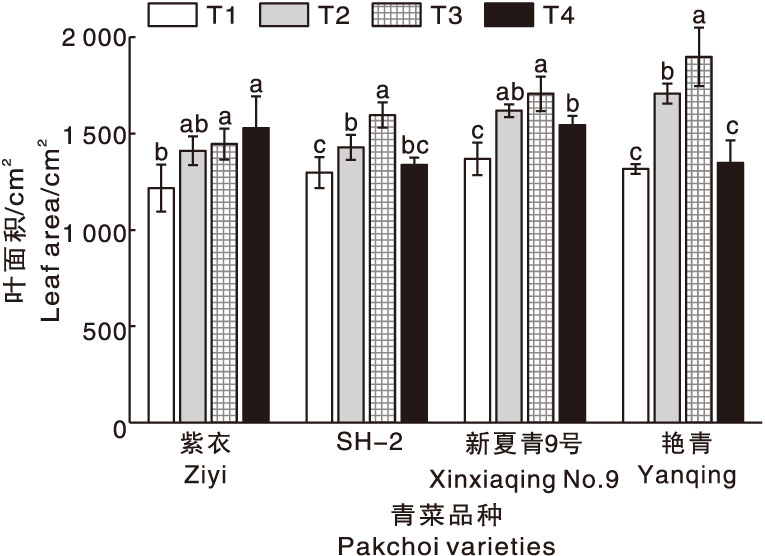
图8 不同光周期处理下青菜采收期的叶面积
Fig.8 Leaf area of pakchoi at harvest stage under different photoperiod treatments
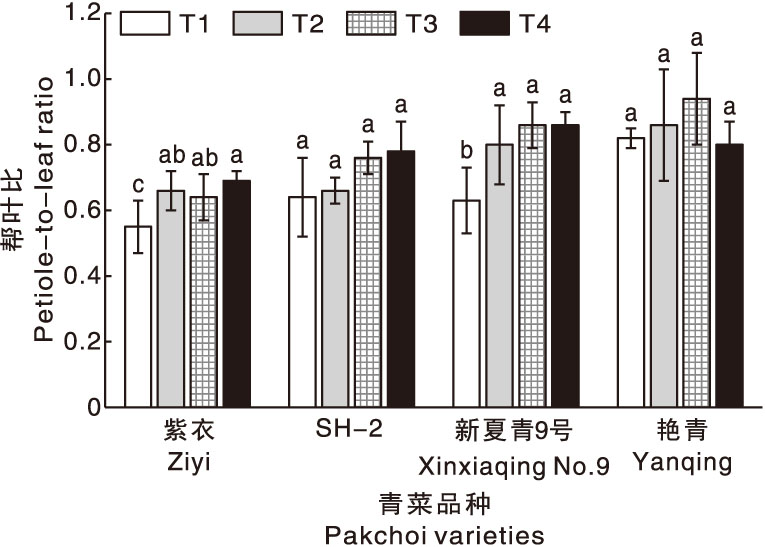
图9 不同光周期处理下青菜采收期的帮叶比
Fig.9 Petiole-to-leaf ratio of pakchoi at harvest stage under different photoperiod treatments
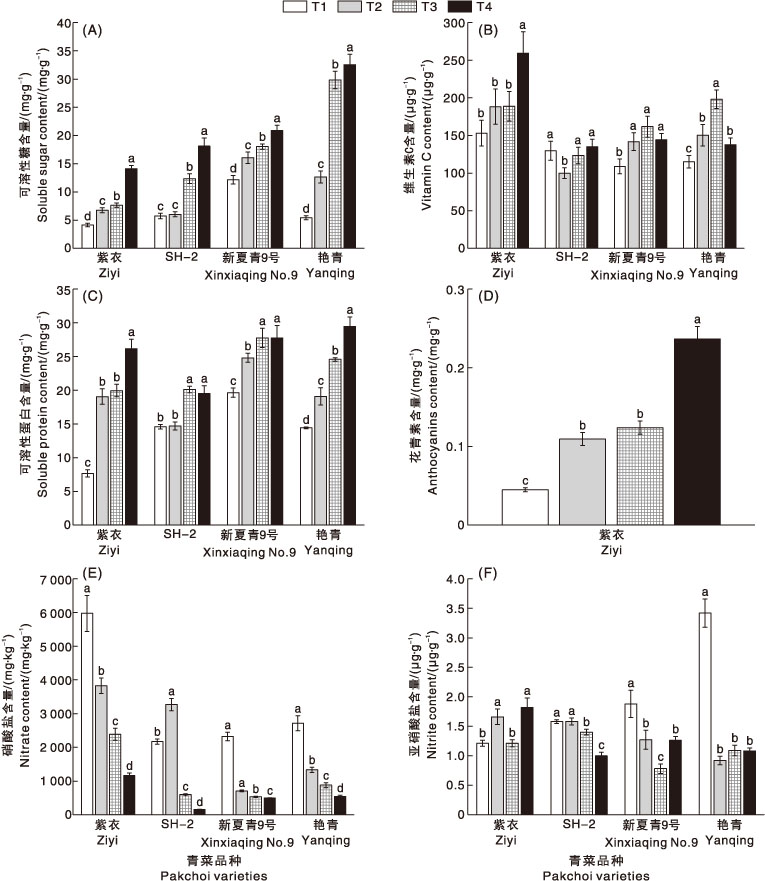
图10 不同光周期处理下青菜采收期的品质
Fig.10 Quality of pakchoi at harvest stage under different photoperiod treatments
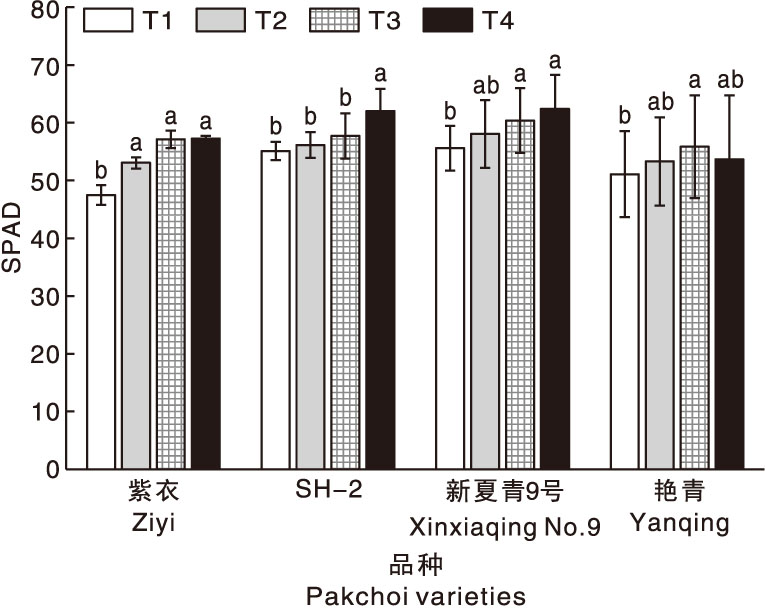
图11 不同光周期处理下青菜采收期叶片的SPAD值
Fig.11 SPAD values of leaf blades in pakchoi at harvest stage under different photoperiod treatments
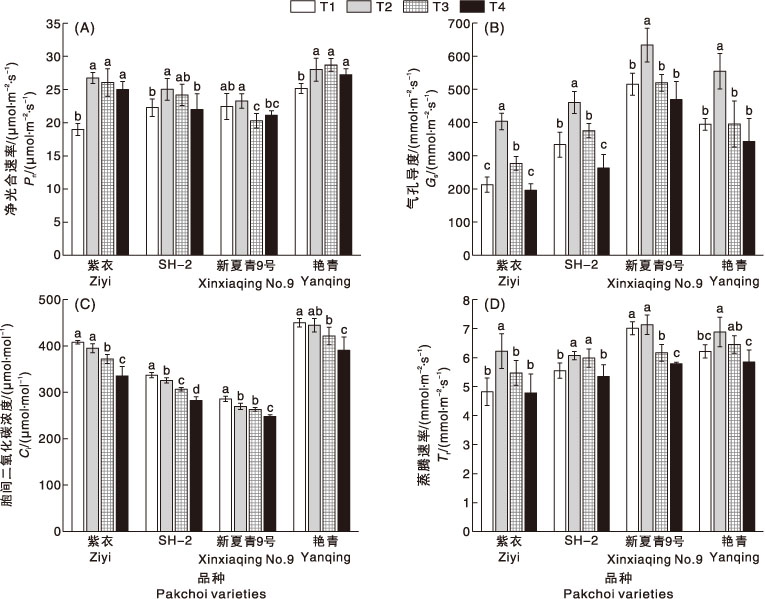
图12 不同光周期处理下青菜叶片的光合参数
Fig.12 Photosynthetic parameters of pakchoi leaves under different photoperiod treatments
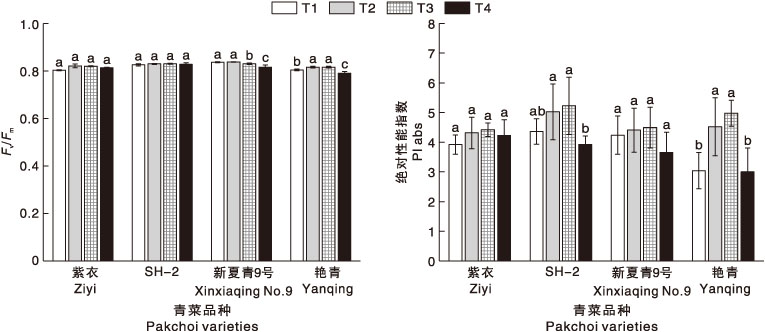
图13 不同光周期处理下青菜叶片的叶绿素荧光参数
Fig.13 Chlorophyll fluorescence parameters of pakchoi leaves under different photoperiod treatments
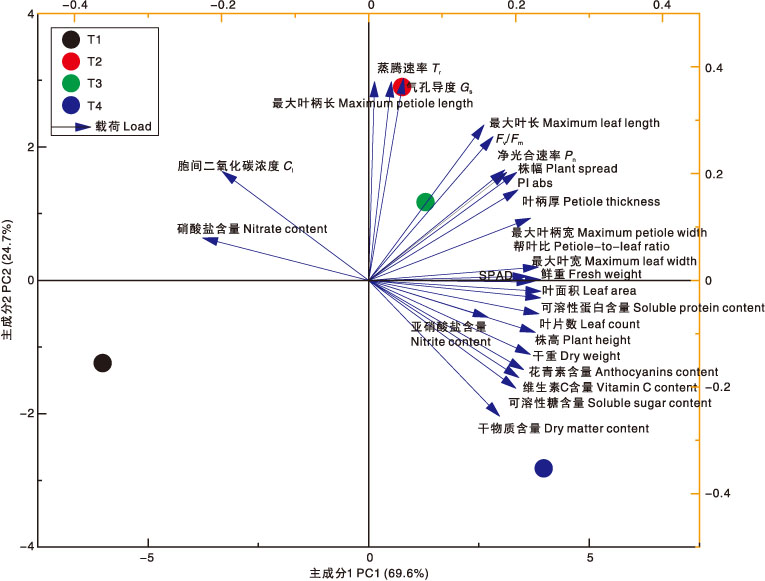
图14 主成分分析图
Fig.14 Principal component analysis (PCA) plot
| [1] | 周增产, 董微, 李秀刚, 等. 植物工厂产业发展现状与展望[J]. 农业工程技术, 2022, 42(1): 18-23. |
| ZHOU Z C, DONG W, LI X G, et al. Present situation and prospect of plant factory industry development[J]. Agricultural Engineering Technology, 2022, 42(1): 18-23. | |
| [2] | HENNY R L, GOBILIK J. Overview on leafy (pak choy) vegetable industry and vertical soilless culture application for pak choy production in Malaysia[J]. Transactions on Science and Technology, 2022, 9(4): 204-222. |
| [3] | 陈永快, 王涛, 兰婕, 等. 植物工厂内LED光调控在作物栽培中的研究进展[J]. 江苏农业科学, 2020, 48(23): 40-46. |
| CHEN Y K, WANG T, LAN J, et al. Research progress of LED light regulation in plant factories in crop cultivation[J]. Jiangsu Agricultural Sciences, 2020, 48(23): 40-46. | |
| [4] | RITCHIE R J. Modelling photosynthetic photon flux density and maximum potential gross photosynthesis[J]. Photosynthetica, 2010, 48(4): 596-609. |
| [5] | 巫一伦, 梁韶莉. 两种光周期对青梗菜生物产量的影响[J]. 山西农业科学, 2008, 36(11): 84-85. |
| WU Y L, LIANG S L. Effect of two photoperiods to biological production of Qinggeng cabbages[J]. Journal of Shanxi Agricultural Sciences, 2008, 36(11): 84-85. | |
| [6] | 余意, 刘文科. 弱光条件下光质和光周期对水培生菜生长与品质的影响[J]. 中国农业气象, 2015, 36(6): 739-745. |
| YU Y, LIU W K. Influence of light quality and photoperiod on growth and nutritional quality of three leaf-color lettuce cultivars under weak light[J]. Chinese Journal of Agrometeorology, 2015, 36(6): 739-745. | |
| [7] | 韩冰, 高文瑞, 孙艳军, 等. 不同光周期对番茄幼苗生理特性及定植后开花结果的影响[J]. 江西农业学报, 2025, 37(2): 70-74. |
| HAN B, GAO W R, SUN Y J, et al. Effects of different photoperiod on physiological characteristics, flowering and fruiting of tomato seedlings after planting[J]. Acta Agriculturae Jiangxi, 2025, 37(2): 70-74. | |
| [8] | 孙朝华, 李开, 雷喜红, 等. 不同光周期对水培生菜生长和品质的影响[J]. 蔬菜, 2020(5): 55-59. |
| SUN C H, LI K, LEI X H, et al. Effects of different photoperiod on growth and quality of hydroponic lettuce[J]. Vegetables, 2020(5): 55-59. | |
| [9] | YAO Y, ZHANG P, WANG H B, et al. How to advance up to seven generations of canola (Brassica napus L.) per annum for the production of pure line populations?[J]. Euphytica, 2016, 209(1): 113-119. |
| [10] | 李建勇, 张瑞明, 李恒松, 等. 上海地区夏季青菜有机栽培技术[J]. 上海农业科技, 2014(4): 101-102. |
| LI J Y, ZHANG R M, LI H S, et al. Organic cultivation techniques of green vegetables in summer in Shanghai area[J]. Shanghai Agricultural Science and Technology, 2014(4): 101-102. | |
| [11] | 李晓锋, 朱红芳, 卓昌盛, 等. 优质耐热青菜品种‘新夏青3号’的选育及栽培技术要点[J]. 上海农业科技, 2023(4): 90-91. |
| LI X F, ZHU H F, ZHUO C S, et al. Breeding and cultivation techniques of high-quality heat-resistant vegetable variety ‘Xinxiaqing No.3'[J]. Shanghai Agricultural Science and Technology, 2023( 4): 90-91. | |
| [12] | 张样平, 常丽英, 黄丹枫, 等. 日光型植物工厂绿叶蔬菜轨道式高效栽培与效益分析[J]. 中国蔬菜, 2019(9): 89-92. |
| ZHANG Y P, CHANG L Y, HUANG D F, et al. Efficient cultivation of green leafy vegetables in solar plant factory and its benefit analysis[J]. China Vegetables, 2019(9): 89-92. | |
| [13] | DING X T, JIANG Y P, ZHAO H, et al. Electrical conductivity of nutrient solution influenced photosynthesis, quality, and antioxidant enzyme activity of pakchoi (Brassica campestris L. ssp. Chinensis) in a hydroponic system[J]. PLoS One, 2018, 13(8): e0202090. |
| [14] | 孔令娟, 张峻, 陈珏, 等. 上海地区耐热青菜的生产和优势品种推荐[J]. 长江蔬菜, 2017(23): 15-17. |
| KONG L J, ZHANG J, CHEN J, et al. Production of heat-resistant vegetables in Shanghai and recommendation of dominant varieties[J]. Journal of Changjiang Vegetables, 2017(23): 15-17. | |
| [15] | YU L S, BU L J, LI D D, et al. Effects of far-red light and ultraviolet light-A on growth, photosynthesis, transcriptome, and metabolome of mint (Mentha haplocalyx Briq.)[J]. Plants, 2024, 13(24): 3495. |
| [16] | LI D D, SHEN H B, YU L S, et al. Transcriptomic and metabolomic insights into plant hormone modulation and secondary metabolite accumulation in basil under far-red and ultraviolet-a light[J]. International Journal of Molecular Sciences, 2025, 26(8): 3758. |
| [17] | SONG J L, HUANG H, SONG S W, et al. Effects of photoperiod interacted with nutrient solution concentration on nutritional quality and antioxidant and mineral content in lettuce[J]. Agronomy, 2020, 10(7): 920. |
| [18] | ALI ELMARDY N, YOUSEF A F, LIN K, et al. Photosynthetic performance of rocket (Eruca sativa. Mill.) grown under different regimes of light intensity, quality, and photoperiod[J]. PLoS One, 2021, 16(9): e0257745. |
| [19] | 韩冰, 高文瑞, 孙艳军, 等. 不同LED光照对番茄幼苗生理特性及定植后开花结果的影响[J]. 江苏农业学报, 2024, 40(12): 2219-2225. |
| HAN B, GAO W R, SUN Y J, et al. Effects of different LED illumination on physiological characteristics of tomato seedlings and flowering and fruiting after planting[J]. Jiangsu Journal of Agricultural Sciences, 2024, 40(12): 2219-2225. | |
| [20] | 刘庆, 连海峰, 刘世琦, 等. 不同光质LED光源对草莓光合特性、产量及品质的影响[J]. 应用生态学报, 2015, 26(6): 1743-1750. |
| LIU Q, LIAN H F, LIU S Q, et al. Effects of different LED light qualities on photosynthetic characteristics, fruit production and quality of strawberry[J]. Chinese Journal of Applied Ecology, 2015, 26(6): 1743-1750. | |
| [21] | GAUDREAU L, CHARBONNEAU J, VE'ZINA L P, et al. Photoperiod and photosynthetic photon flux influence growth and quality of greenhouse-grown lettuce[J]. HortScience, 1994, 29(11): 1285-1289. |
| [22] | 张传伟, 宋述尧, 赵春波, 等. 不同品种番茄营养品质分析与评价[J]. 中国蔬菜, 2011(18): 68-73. |
| ZHANG C W, SONG S Y, ZHAO C B, et al. Analysis and assessment on nutritional quality of different tomato varieties[J]. China Vegetables, 2011(18): 68-73. | |
| [23] | 王雪, 谢立波, 张慧. 辣椒果实维生素C含量的研究进展[J]. 北方园艺, 2019(19): 121-124. |
| WANG X, XIE L B, ZHANG H. Research progress of vitamin C content in pepper fruits[J]. Northern Horticulture, 2019(19): 121-124. | |
| [24] | 李晗懿, 彭枫, 张力劼, 等. 菠菜种质资源营养品质分析与评价[J]. 长江蔬菜, 2022(8): 41-46. |
| LI H Y, PENG F, ZHANG L J, et al. Analysis and evaluation of nutritional quality of spinach germplasm resources[J]. Journal of Changjiang Vegetables, 2022(8): 41-46. | |
| [25] | 高晓茹, 汪维红, 李佩荣, 等. 芸薹属作物花青素生物合成转录调控研究进展[J]. 蔬菜, 2025(1): 79-86. |
| GAO X R, WANG W H, LI P R, et al. Progress in transcriptional regulation of anthocyanin biosynthesis in Brassica crops[J]. Vegetables, 2025(1): 79-86. | |
| [26] | 张欢, 章丽丽, 李薇, 等. 不同光周期红光对油葵芽苗菜生长和品质的影响[J]. 园艺学报, 2012, 39(2): 297-304. |
| ZHANG H, ZHANG L L, LI W, et al. Effects of photoperiod under red LED on growth and quality of sunflower sprouts[J]. Acta Horticulturae Sinica, 2012, 39(2): 297-304. | |
| [27] | WU S H, LIU Y H, CUI X, et al. Assessment of potential nitrite safety risk of leafy vegetables after domestic cooking[J]. Foods, 2021, 10(12): 2953. |
| [28] | DEZHANGAH S, NAZARI F, KAMALI K, et al. A survey on nitrate level in vegetables to assess the potential health risks in Iran[J]. International Journal of Food Properties, 2022, 25(1): 1958-1973. |
| [29] | 赵京东, 宋彦涛, 何畅, 等. 不同叶绿素测定方法的比较研究[J]. 大连民族大学学报, 2020, 22(5): 405-410. |
| ZHAO J D, SONG Y T, HE C, et al. Comparative study on different methods of chlorophyll determination[J]. Journal of Dalian Nationalities University, 2020, 22(5): 405-410. | |
| [30] | 徐超华, 李军营, 崔明昆, 等. 延长光照时间对烟草叶片生长发育及光合特性的影响[J]. 西北植物学报, 2013, 33(4): 763-770. |
| XU C H, LI J Y, CUI M K, et al. Effects of supplemental lighting on growth and photosynthesis of tobacco leaves[J]. Acta Botanica Boreali-Occidentalia Sinica, 2013, 33(4): 763-770. | |
| [31] | NITSCHKE S, CORTLEVEN A, SCHMÜLLING T. Novel stress in plants by altering the photoperiod[J]. Trends in Plant Science, 2017, 22(11): 913-916. |
| [32] | SHIBAEVA T G, MAMAEV A V, SHERUDILO E G, et al. The role of photosynthetic daily light integral in plant response to extended photoperiods[J]. Russian Journal of Plant Physiology, 2022, 69(1): 7. |
| [33] | 曹刚, 张国斌, 郁继华, 等. 不同光质LED光源对黄瓜苗期生长及叶绿素荧光参数的影响[J]. 中国农业科学, 2013, 46(6): 1297-1304. |
| CAO G, ZHANG G B, YU J H, et al. Effects of different LED light qualities on cucumber seedling growth and chlorophyll fluorescence parameters[J]. Scientia Agricultura Sinica, 2013, 46(6): 1297-1304. | |
| [34] | JIANG Y P, DING X T, ZHANG D, et al. Soil salinity increases the tolerance of excessive sulfur fumigation stress in tomato plants[J]. Environmental and Experimental Botany, 2017, 133: 70-77. |
| [1] | 卯明娟, 普柒牛, 侯立娟, 马林, 蒋宁, 林金盛, 曲绍轩, 李辉平, 徐平, 刘迪. pH值与离子效应对草菇生物量与IAA合成的调控[J]. 浙江农业学报, 2026, 38(4): 669-679. |
| [2] | 李政升, 印轩鹏, 叶韵宇, 李俊瑜, 吴红芝. 营养枝数量对月季冠层和生物量的影响[J]. 浙江农业学报, 2026, 38(4): 680-686. |
| [3] | 薛倩, 吴梦露, 孙清明, 苏宏华. 不同光周期对斜纹夜蛾生殖行为的影响[J]. 浙江农业学报, 2026, 38(3): 541-550. |
| [4] | 董瑞丽, 顾蕾, 张梦, 周国模. 丽水市茶树碳储量和茶叶产品碳足迹研究[J]. 浙江农业学报, 2026, 38(2): 339-350. |
| [5] | 龚娜, 刘国丽, 陈珣, 马晓颖, 肇莹, 肖军. 一株野生肺形侧耳的鉴定及其液体发酵培养基的优化[J]. 浙江农业学报, 2024, 36(11): 2535-2545. |
| [6] | 孙丽娟, 李世民, 郭焕仙, 金友帆, 李树萍, 董琼. 树番茄幼苗生长与氮磷钾化学计量特征对光照、肥料的响应[J]. 浙江农业学报, 2023, 35(8): 1793-1804. |
| [7] | 肖家昶, 雷凤芸, 格桑, 马俊英, 贺茂林, 李艳文, 郑阳霞. 外源喷施氨基酸肥对豆瓣菜生长与硒吸收的影响[J]. 浙江农业学报, 2023, 35(7): 1638-1647. |
| [8] | 朱永基, 陶新宇, 陈小芳, 苏祥祥, 刘吉凯, 李新伟. 基于无人机多光谱影像植被指数与纹理特征的冬小麦地上部生物量估算[J]. 浙江农业学报, 2023, 35(12): 2966-2976. |
| [9] | 王薇薇, 梅燚, 吴永成, 万红建, 陈长军, 郑青松, 郑佳秋. 玉米芯生物炭对辣椒连作土壤性质和辣椒生长的影响[J]. 浙江农业学报, 2023, 35(1): 156-163. |
| [10] | 吴浩, 张雪松, 王丹. 不同CO2浓度和氮水平对冬小麦光合和生长特性的影响[J]. 浙江农业学报, 2022, 34(12): 2594-2602. |
| [11] | 赵龙龙, 卫洁, 谢映平, 李捷. 中国梨木虱翅型变化及其影响因素初探[J]. 浙江农业学报, 2022, 34(1): 120-127. |
| [12] | 马杰, 屈雯, 陈春艳, 王磊, 马俊, 刘针杉, 马维, 周平, 何远宽, 孙勃. 基于转录组序列的叶用芥菜奶奶青菜EST-SSR标记开发与遗传多样性分析[J]. 浙江农业学报, 2021, 33(9): 1640-1649. |
| [13] | 侯立娟, 李正鹏, 林金盛, 马林, 李辉平, 曲绍轩, 姜建新, 邹秀龙, 杨华平, 李长田, 蒋宁. 不同光质LED光照对草菇菌丝生长速度、菌丝分支与生物量的影响[J]. 浙江农业学报, 2021, 33(6): 1110-1116. |
| [14] | 练华山, 李欣欣, 林立金, 廖明安. 表油菜素内酯对夏黑葡萄幼苗生长的影响[J]. 浙江农业学报, 2021, 33(10): 1889-1896. |
| [15] | 袁玺垒, 王振山, 贾小平, 桑璐曼, 李剑峰, 张博. 光周期调控植物开花分子机制以及CCT基因家族研究进展[J]. 浙江农业学报, 2020, 32(6): 1133-1140. |
| 阅读次数 | ||||||
|
全文 |
|
|||||
|
摘要 |
|
|||||

