浙江农业学报 ›› 2026, Vol. 38 ›› Issue (2): 351-363.DOI: 10.3969/j.issn.1004-1524.20250154
间作大豆与苜蓿对紫斑牡丹根际土壤微生物群落结构的影响
杨玉山1( ), 张苗苗1, 吕增伟2, 陈雪1, 黄秋良1, 刘浩洋1, 曹明辉1, 黄振北1, 张国防1,*()
1.福建农林大学 林学院 福建 福州 350002 2.凉山彝族自治州林业草原科学研究院 四川 西昌 615050
-
收稿日期:2025-03-06出版日期:2026-02-25发布日期:2026-03-24 -
作者简介:杨玉山,研究方向为森林培育。E-mail:m15526303369@163.com -
通讯作者:*张国防,E-mail:fjzgfzgf@fafu.edu.cn -
基金资助:福建省科技计划项目(202210008);东西部协作项目(KH180062A);东西部协作项目(11891008004);东西部协作项目(KH190315A)
Effects of intercropping with soybean and alfalfa on the rhizosphere soil microbial community structure of Paeonia rockii
YANG Yushan1(), ZHANG Miaomiao1, LYU Zengwei2, CHEN Xue1, HUANG Qiuliang1, LIU Haoyang1, CAO Minghui1, HUANG Zhenbei1, ZHANG Guofang1,*()
1. College of Forestry ,Fujian Agriculture and Forestry University Fuzhou 350002, China 2. Institute of Forestry and Grassland Science ,Liangshan Yi Autonomous Prefecture Xichang 615050, Sichuan, China
-
Received:2025-03-06Published:2026-02-25Online:2026-03-24

摘要:
探究紫斑牡丹(Paeonia rockii)单作及其分别与大豆(Glycine max)、苜蓿(Medicago sativa L.)间作对根际土壤微生物群落结构的影响,为紫斑牡丹生态种植模式优化提供理论依据。以紫斑牡丹单作为对照,分别设置紫斑牡丹-大豆间作和紫斑牡丹-苜蓿间作处理,采集根际土壤样品,利用高通量测序技术分析细菌与真菌群落组成与多样性。结果表明:除速效钾外,间作大豆或苜蓿对土壤有效养分含量无显著影响,但改变了根际土壤的微生物群落结构。间作苜蓿提高了细菌群落的丰富度,间作大豆对真菌群落的丰富度与多样性无显著影响;间作大豆增加了变形菌门(Proteobacteria)、放线菌门(Actinobacteriota)和担子菌门(Basidiomycota)等有益菌群的相对丰度,并降低了病原菌镰刀菌属(Fusarium)的相对丰度。综上,紫斑牡丹间作有助于提升根际土壤有益菌丰度并抑制病原菌富集,其中间作大豆在改善真菌群落结构方面更具优势,更有利于改善紫斑牡丹根际土壤微生态环境。
中图分类号:
引用本文
杨玉山, 张苗苗, 吕增伟, 陈雪, 黄秋良, 刘浩洋, 曹明辉, 黄振北, 张国防. 间作大豆与苜蓿对紫斑牡丹根际土壤微生物群落结构的影响[J]. 浙江农业学报, 2026, 38(2): 351-363.
YANG Yushan, ZHANG Miaomiao, LYU Zengwei, CHEN Xue, HUANG Qiuliang, LIU Haoyang, CAO Minghui, HUANG Zhenbei, ZHANG Guofang. Effects of intercropping with soybean and alfalfa on the rhizosphere soil microbial community structure of Paeonia rockii[J]. Acta Agriculturae Zhejiangensis, 2026, 38(2): 351-363.
| 处理 Sample | pH值 pH value | SOM/(g·kg-1) | AN/(mg·kg-1) | AP/(mg·kg-1) | AK/(mg·kg-1) |
|---|---|---|---|---|---|
| CK | 8.80±0.08 a | 11.69±0.48 a | 28.31±2.10 a | 10.01±4.26 a | 7.38±0.06 a |
| DD | 8.84±0.03 a | 11.76±0.47 a | 41.69±8.82 a | 8.69±0.52 a | 6.99±0.21 b |
| MX | 8.78±0.04 a | 12.32±0.61 a | 29.56±9.57 a | 5.66±1.64 a | 7.39±0.08 a |
表1 根际土壤化学性质
Table 1 Chemical properties of the rhizosphere soil
| 处理 Sample | pH值 pH value | SOM/(g·kg-1) | AN/(mg·kg-1) | AP/(mg·kg-1) | AK/(mg·kg-1) |
|---|---|---|---|---|---|
| CK | 8.80±0.08 a | 11.69±0.48 a | 28.31±2.10 a | 10.01±4.26 a | 7.38±0.06 a |
| DD | 8.84±0.03 a | 11.76±0.47 a | 41.69±8.82 a | 8.69±0.52 a | 6.99±0.21 b |
| MX | 8.78±0.04 a | 12.32±0.61 a | 29.56±9.57 a | 5.66±1.64 a | 7.39±0.08 a |
| 微生物 Microorganism | 样品 Sample | 丰富度指数Richness index | 多样性指数Diversity index | 测序深度指数 Coverage index | ||
|---|---|---|---|---|---|---|
| ACE指数 ACE index | Chao 1指数 Chao 1 index | Simpson指数 Simpson index | Shannon指数 Shannon index | |||
| 细菌Bacteria | CK | 3 499.03±11.14 b | 3 501.64±16.05 b | 0.99±0.01 a | 10.76±0.00 a | 0.99±0.01 a |
| DD | 3 117.07±420.63 b | 3 114.06±424.58 b | 0.99±0.01 a | 10.50±0.13 a | 0.96±0.02 a | |
| MX | 4 108.92±338.89 a | 4 128.54±346.57 a | 0.99±0.01 a | 10.79±0.30 a | 0.95±0.01 a | |
| 真菌Fungi | CK | 865.56±33.97 a | 862.89±30.56 a | 0.97±0.01 a | 6.66±0.36 a | 0.99±0.02 a |
| DD | 1 102.47±178.82 a | 1 105.68±179.39 a | 0.96±0.01 a | 6.68±0.36 a | 0.98±0.04 a | |
| MX | 887.36±227.45 a | 889.43±226.88 a | 0.89±0.05 a | 5.42±0.62 a | 0.99±0.01 a | |
表2 根际土壤微生物的Alpha多样性
Table 2 Alpha diversity of rhizosphere soil microorganism
| 微生物 Microorganism | 样品 Sample | 丰富度指数Richness index | 多样性指数Diversity index | 测序深度指数 Coverage index | ||
|---|---|---|---|---|---|---|
| ACE指数 ACE index | Chao 1指数 Chao 1 index | Simpson指数 Simpson index | Shannon指数 Shannon index | |||
| 细菌Bacteria | CK | 3 499.03±11.14 b | 3 501.64±16.05 b | 0.99±0.01 a | 10.76±0.00 a | 0.99±0.01 a |
| DD | 3 117.07±420.63 b | 3 114.06±424.58 b | 0.99±0.01 a | 10.50±0.13 a | 0.96±0.02 a | |
| MX | 4 108.92±338.89 a | 4 128.54±346.57 a | 0.99±0.01 a | 10.79±0.30 a | 0.95±0.01 a | |
| 真菌Fungi | CK | 865.56±33.97 a | 862.89±30.56 a | 0.97±0.01 a | 6.66±0.36 a | 0.99±0.02 a |
| DD | 1 102.47±178.82 a | 1 105.68±179.39 a | 0.96±0.01 a | 6.68±0.36 a | 0.98±0.04 a | |
| MX | 887.36±227.45 a | 889.43±226.88 a | 0.89±0.05 a | 5.42±0.62 a | 0.99±0.01 a | |
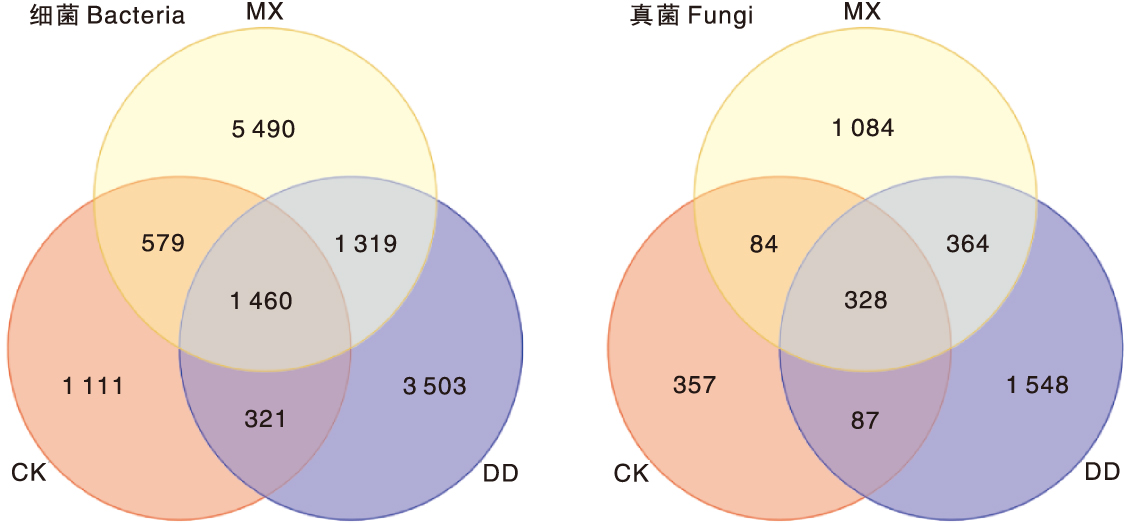
图1 根际土壤微生物的ASV数量 CK,紫斑牡丹单作;DD;紫斑牡丹+大豆间作;MX,紫斑牡丹+苜蓿间作。下同。
Fig.1 The number of ASVs of rhizosphere soil microorganism CK, P. rockii monoculture;DD, P. rockii-G. max intercropping;MX, P. rockii-M. sativa intercropping. The same as below.
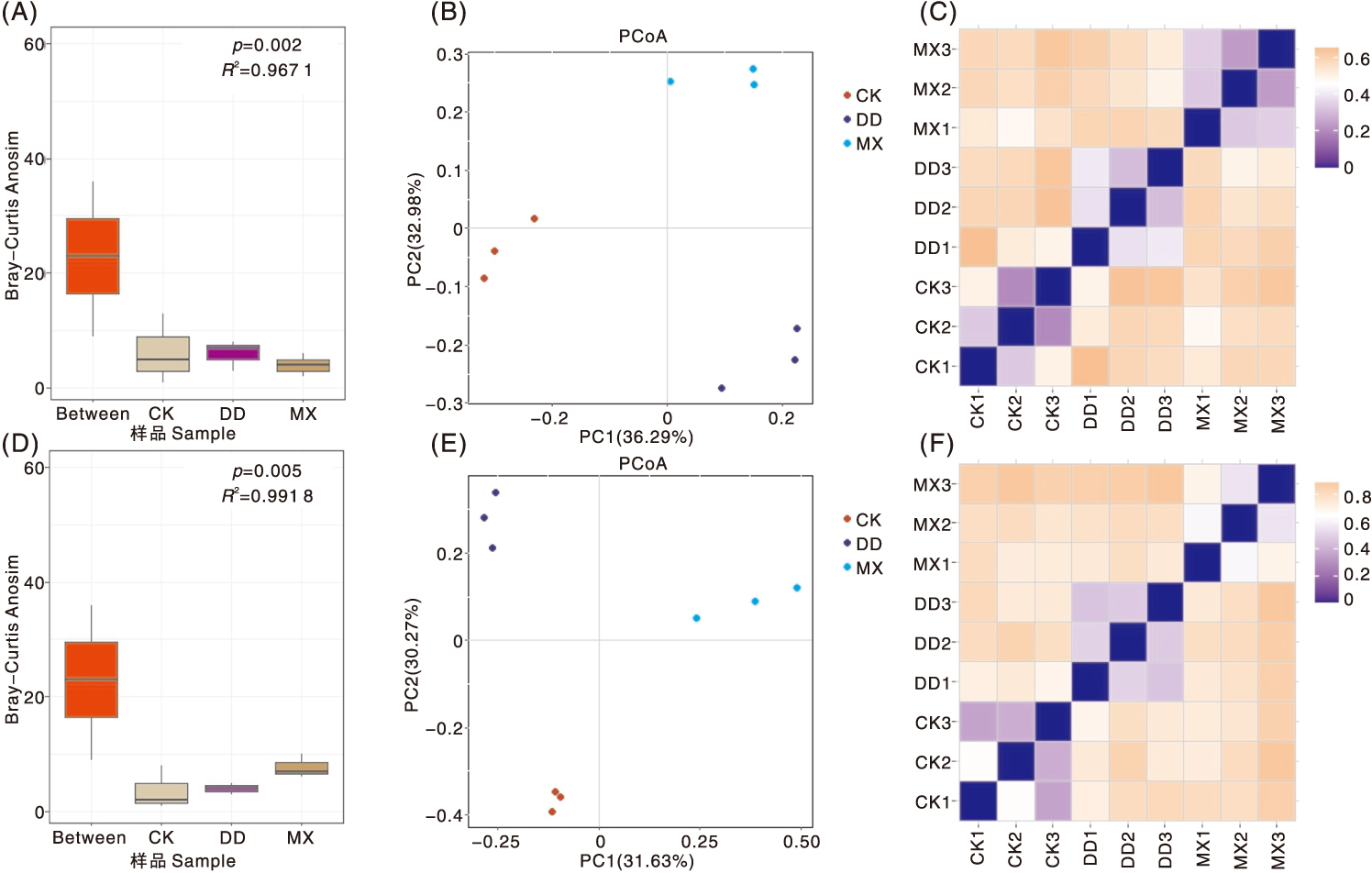
图2 根际土壤微生物群落的ANOSIM分析、PCoA分析与距离热图 A,细菌群落物种组成ANOSIM分析;B,细菌群落物种组成PCoA分析;C,细菌群落物种组成热图分析;D,真菌群落物种组成ANOSIM分析;E,真菌群落物种组成PCoA分析;F,真菌群落物种组成热图分析。R2,决定系数。
Fig.2 ANOSIM analysis, PCoA analysis, and distance heatmap of rhizosphere soil microbial community A, ANOSIM analysis of bacterial community composition; B, PCoA analysis of bacterial community composition; C, Heatmap analysis of bacterial community composition; D, ANOSIM analysis of fungal community composition; E, PCoA analysis of fungal community composition; F, Heatmap analysis of fungal community composition. R2, Determination coefficient.
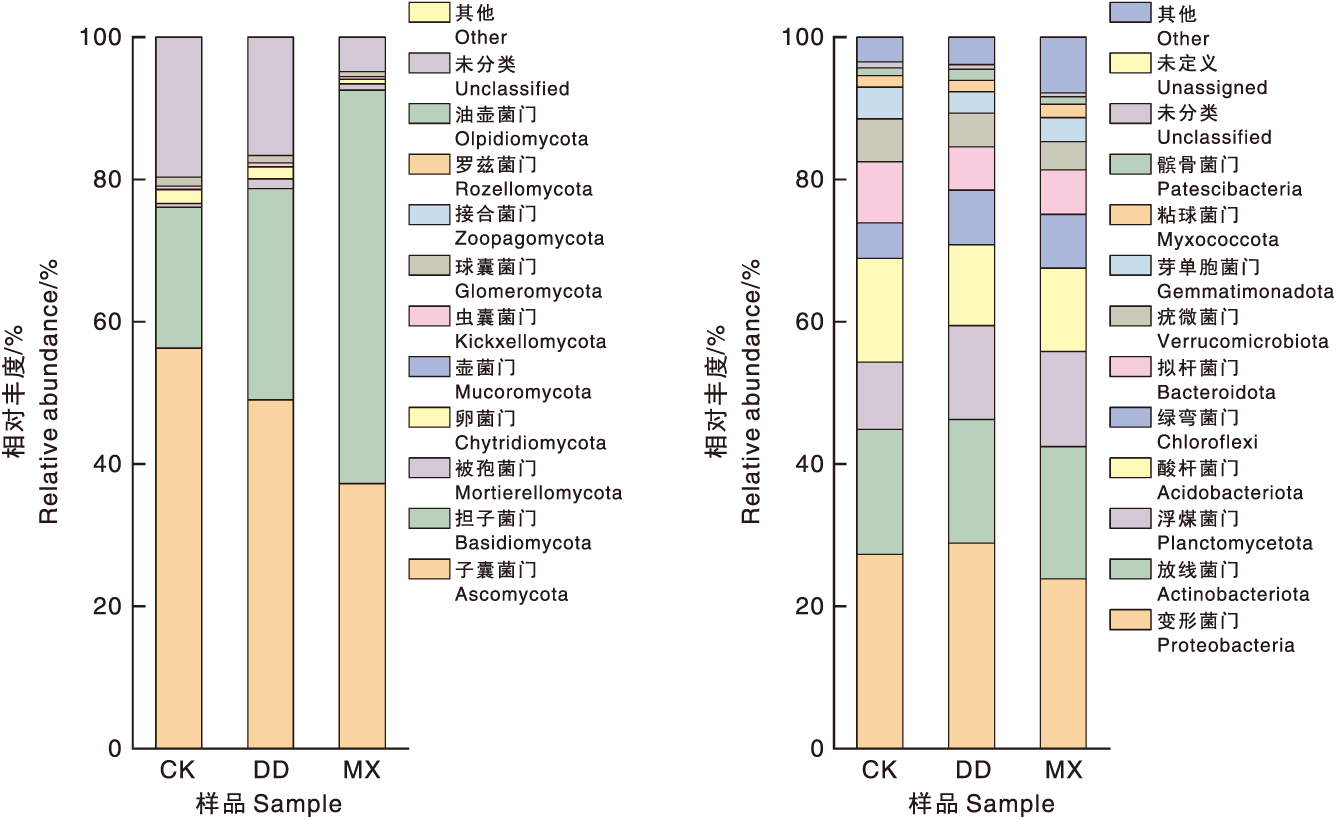
图3 真菌(左)和细菌(右)门水平的根际土壤微生物相对丰度
Fig.3 Relative abundance of rhizosphere soil microorganisms at the fungal (left) and bacterial (right) phylum level
| 细菌 Bacterium | 占比Proportion | 真菌 Fungus | 占比Proportion | ||||
|---|---|---|---|---|---|---|---|
| CK | DD | MX | CK | DD | MX | ||
| Vicinamibacteraceae | 4.69 | 2.62 | 2.83 | 拟鬼伞属Coprinopsis | 0 | 9.46 | 0 |
| 鞘氨醇单胞菌属Sphingomonas | 2.80 | 2.52 | 2.72 | 异茎点霉属Paraphoma | 0 | 1.99 | 0 |
| MND1 | 2.85 | 2.57 | 2.66 | 锥盖伞属Conocybe | 0 | 1.50 | 0 |
| WD2101_soil_group | 4.33 | 1.40 | 2.97 | 被孢霉属Mortierella | 0 | 1.37 | 0 |
| KD4-96 | 1.61 | 2.30 | 2.01 | 毛壳菌属Chaetomium | 0 | 4.48 | 0 |
| Gitt-GS-136 | 1.04 | 2.12 | 1.61 | 四枝孢属Tetracladium | 1.78 | 3.34 | 2.47 |
| 盖氏菌属Gaiella | 1.64 | 1.67 | 1.18 | 镰刀菌属Fusarium | 2.50 | 1.07 | 2.17 |
| MB-A2-108 | 1.35 | 1.32 | 1.12 | 外瓶霉属Exophiala | 3.85 | 5.22 | 3.98 |
| RB41 | 2.80 | 0 | 1.81 | 膜座霉属Hymenula | 3.96 | 2.09 | 1.61 |
| 小梨形菌属Pirellula | 0 | 1.39 | 1.08 | 枝孢属Cladosporium | 1.87 | 0 | 1.33 |
| Pir4_lineage | 0 | 1.43 | 1.37 | 拟折孢属Minimelanolocus | 1.57 | 1.55 | 0 |
| Subgroup_7 | 0 | 1.46 | 1.32 | 斑褶菇属Panaeolus | 1.75 | 0 | 0 |
| 出芽菌属Gemmata | 0 | 1.54 | 1.24 | 暗孔菌属Amaurodon | 1.70 | 0 | 2.78 |
| Pedosphaeraceae | 1.69 | 1.05 | 1.05 | 小荚孢腔菌属Sporormiella | 0 | 3.46 | 0 |
| 绿弯菌属Chloroflexus | 0 | 0 | 4.26 | 球毛壳孢属Chaetosphaeronema | 0 | 0 | 1.52 |
| TRA3-20 | 1.67 | 1.04 | 0 | 脐菇属Hebeloma | 7.53 | 0 | 4.37 |
| Rokubacteriales | 1.15 | 0 | 0 | 地孔菌属Geopora | 2.30 | 0 | 0 |
| 东秀珠氏菌属Dongia | 1.39 | 1.18 | 0 | 绒革菌属Tomentella | 3.25 | 0 | 2.56 |
| 土生单胞菌属Terrimonas | 1.14 | 0 | 0 | ||||
| Ellin6067 | 1.17 | 0 | 0 | ||||
| 黄色土杆菌属Chthoniobacter | 1.29 | 0 | 0 | ||||
| IMCC26256 | 1.04 | 0 | 0 | ||||
| Reyranella | 0 | 1.07 | 0 | ||||
表3 属水平的根际土壤微生物组成
Table 3 Rhizosphere soil microbial composition at the genus level
| 细菌 Bacterium | 占比Proportion | 真菌 Fungus | 占比Proportion | ||||
|---|---|---|---|---|---|---|---|
| CK | DD | MX | CK | DD | MX | ||
| Vicinamibacteraceae | 4.69 | 2.62 | 2.83 | 拟鬼伞属Coprinopsis | 0 | 9.46 | 0 |
| 鞘氨醇单胞菌属Sphingomonas | 2.80 | 2.52 | 2.72 | 异茎点霉属Paraphoma | 0 | 1.99 | 0 |
| MND1 | 2.85 | 2.57 | 2.66 | 锥盖伞属Conocybe | 0 | 1.50 | 0 |
| WD2101_soil_group | 4.33 | 1.40 | 2.97 | 被孢霉属Mortierella | 0 | 1.37 | 0 |
| KD4-96 | 1.61 | 2.30 | 2.01 | 毛壳菌属Chaetomium | 0 | 4.48 | 0 |
| Gitt-GS-136 | 1.04 | 2.12 | 1.61 | 四枝孢属Tetracladium | 1.78 | 3.34 | 2.47 |
| 盖氏菌属Gaiella | 1.64 | 1.67 | 1.18 | 镰刀菌属Fusarium | 2.50 | 1.07 | 2.17 |
| MB-A2-108 | 1.35 | 1.32 | 1.12 | 外瓶霉属Exophiala | 3.85 | 5.22 | 3.98 |
| RB41 | 2.80 | 0 | 1.81 | 膜座霉属Hymenula | 3.96 | 2.09 | 1.61 |
| 小梨形菌属Pirellula | 0 | 1.39 | 1.08 | 枝孢属Cladosporium | 1.87 | 0 | 1.33 |
| Pir4_lineage | 0 | 1.43 | 1.37 | 拟折孢属Minimelanolocus | 1.57 | 1.55 | 0 |
| Subgroup_7 | 0 | 1.46 | 1.32 | 斑褶菇属Panaeolus | 1.75 | 0 | 0 |
| 出芽菌属Gemmata | 0 | 1.54 | 1.24 | 暗孔菌属Amaurodon | 1.70 | 0 | 2.78 |
| Pedosphaeraceae | 1.69 | 1.05 | 1.05 | 小荚孢腔菌属Sporormiella | 0 | 3.46 | 0 |
| 绿弯菌属Chloroflexus | 0 | 0 | 4.26 | 球毛壳孢属Chaetosphaeronema | 0 | 0 | 1.52 |
| TRA3-20 | 1.67 | 1.04 | 0 | 脐菇属Hebeloma | 7.53 | 0 | 4.37 |
| Rokubacteriales | 1.15 | 0 | 0 | 地孔菌属Geopora | 2.30 | 0 | 0 |
| 东秀珠氏菌属Dongia | 1.39 | 1.18 | 0 | 绒革菌属Tomentella | 3.25 | 0 | 2.56 |
| 土生单胞菌属Terrimonas | 1.14 | 0 | 0 | ||||
| Ellin6067 | 1.17 | 0 | 0 | ||||
| 黄色土杆菌属Chthoniobacter | 1.29 | 0 | 0 | ||||
| IMCC26256 | 1.04 | 0 | 0 | ||||
| Reyranella | 0 | 1.07 | 0 | ||||
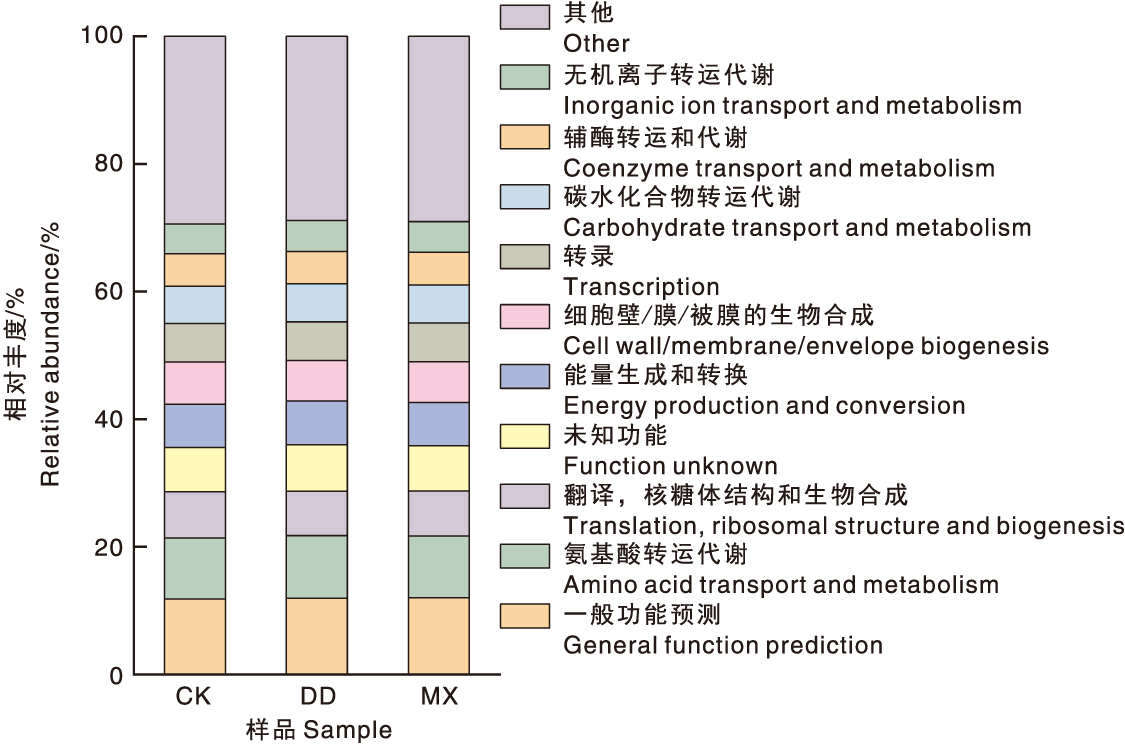
图4 COG功能分析
Fig.4 Analysis of COG functional categories
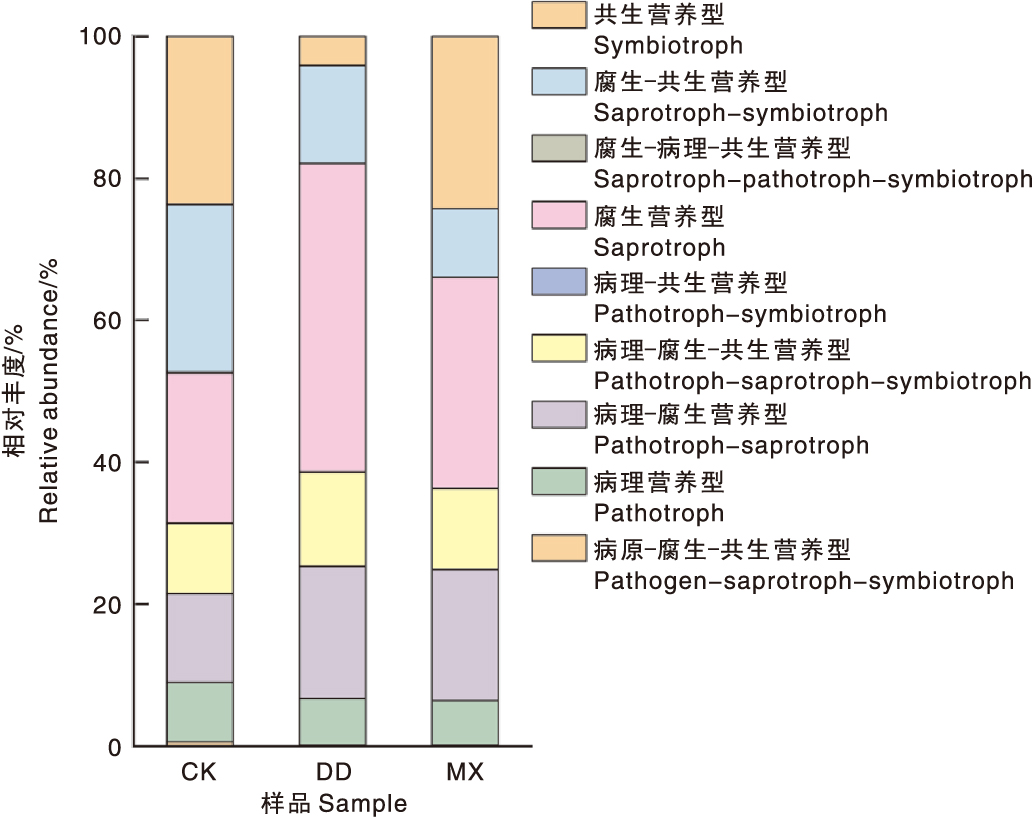
图5 根际土壤真菌的营养类群
Fig.5 Nutrient-based groups of rhizosphere soil fungi
| 类群 Group | 占比Proportion | ||
|---|---|---|---|
| CK | DD | MX | |
| 凋落物腐生-外生菌根-枯叶腐生-未知腐生真菌 | 21.94 | 7.05 | 5.17 |
| Dung saprotroph-ectomycorrhizal-litter saprotroph-undefined saprotroph | |||
| 外生菌根真菌Ectomycorrhizal | 21.18 | 0 | 21.58 |
| 凋落物腐生-植物腐生-木质腐生真菌Dung saprotroph-plant saprotroph-wood saprotroph | 0 | 16.94 | 1.52 |
| 动物病原-未知腐生真菌Animal pathogen-undefined saprotroph | 5.58 | 9.09 | 8.44 |
| 动物病原-凋落物腐生-内生-附生-植物腐生-木质腐生真菌 | 0 | 7.78 | 0 |
| Animal pathogen-dung saprotroph-endophyte-epiphyte-plant saprotroph-wood saprotroph | |||
| 植物病原菌Plant pathogen | 7.56 | 6.10 | 5.85 |
| 真菌寄生-植物病原-植物腐生真菌Fungal parasite-plant pathogen-plant saprotroph | 2.64 | 4.28 | 6.24 |
| 动物病原-内生-枯叶腐生-植物病原-土壤腐生-木质腐生真菌 | 3.58 | 1.87 | 4.57 |
| Animal pathogen-endophyte-lichen parasite-plant pathogen-soil saprotroph-wood saprotroph | |||
| 动物病原-内生-枯叶腐生-植物病原-木质腐生真菌 | 3.40 | 1.30 | 3.54 |
| Animal pathogen-endophyte-lichen parasite-plant pathogen-wood saprotroph | |||
| 动物病原-真菌寄生-未知腐生真菌Animal pathogen-fungal parasite-undefined saprotroph | 2.38 | 3.18 | 2.09 |
表4 根际土壤真菌功能类群
Table 4 Functional groups of rhizosphere soil fungi
| 类群 Group | 占比Proportion | ||
|---|---|---|---|
| CK | DD | MX | |
| 凋落物腐生-外生菌根-枯叶腐生-未知腐生真菌 | 21.94 | 7.05 | 5.17 |
| Dung saprotroph-ectomycorrhizal-litter saprotroph-undefined saprotroph | |||
| 外生菌根真菌Ectomycorrhizal | 21.18 | 0 | 21.58 |
| 凋落物腐生-植物腐生-木质腐生真菌Dung saprotroph-plant saprotroph-wood saprotroph | 0 | 16.94 | 1.52 |
| 动物病原-未知腐生真菌Animal pathogen-undefined saprotroph | 5.58 | 9.09 | 8.44 |
| 动物病原-凋落物腐生-内生-附生-植物腐生-木质腐生真菌 | 0 | 7.78 | 0 |
| Animal pathogen-dung saprotroph-endophyte-epiphyte-plant saprotroph-wood saprotroph | |||
| 植物病原菌Plant pathogen | 7.56 | 6.10 | 5.85 |
| 真菌寄生-植物病原-植物腐生真菌Fungal parasite-plant pathogen-plant saprotroph | 2.64 | 4.28 | 6.24 |
| 动物病原-内生-枯叶腐生-植物病原-土壤腐生-木质腐生真菌 | 3.58 | 1.87 | 4.57 |
| Animal pathogen-endophyte-lichen parasite-plant pathogen-soil saprotroph-wood saprotroph | |||
| 动物病原-内生-枯叶腐生-植物病原-木质腐生真菌 | 3.40 | 1.30 | 3.54 |
| Animal pathogen-endophyte-lichen parasite-plant pathogen-wood saprotroph | |||
| 动物病原-真菌寄生-未知腐生真菌Animal pathogen-fungal parasite-undefined saprotroph | 2.38 | 3.18 | 2.09 |
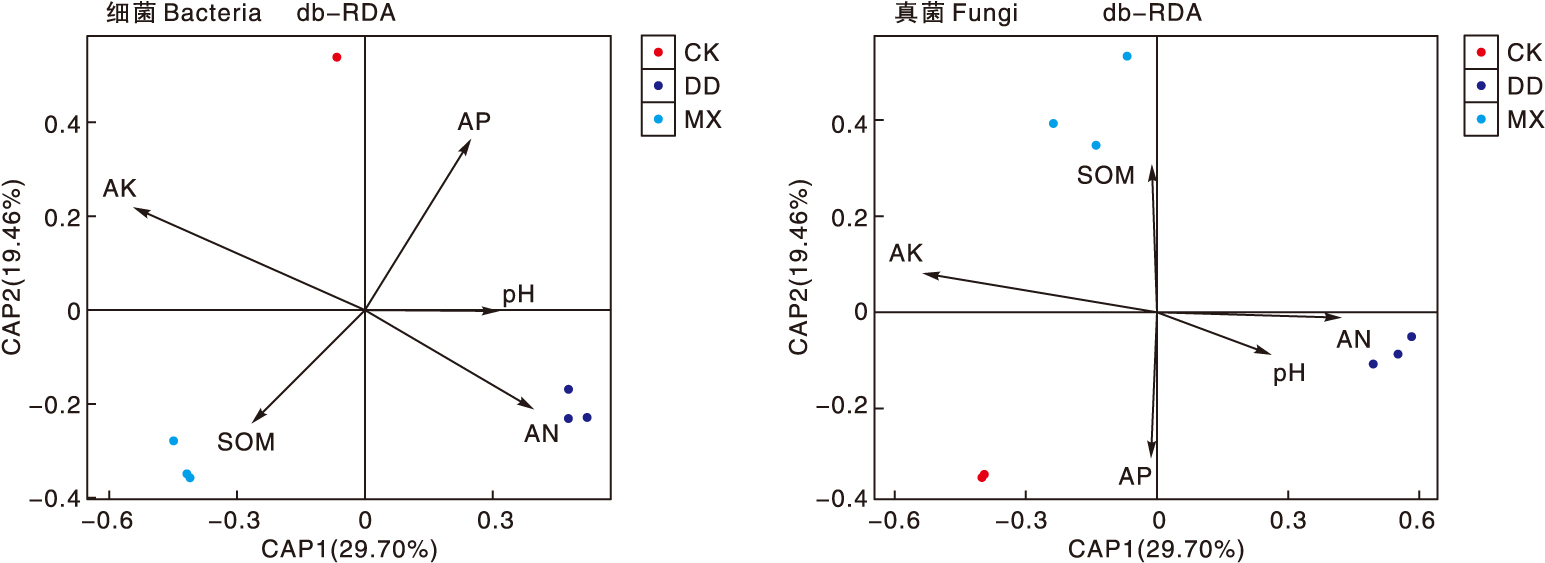
图6 根际土壤微生物的冗余分析
Fig.6 Redundancy analysis of rhizosphere soil microorganisms
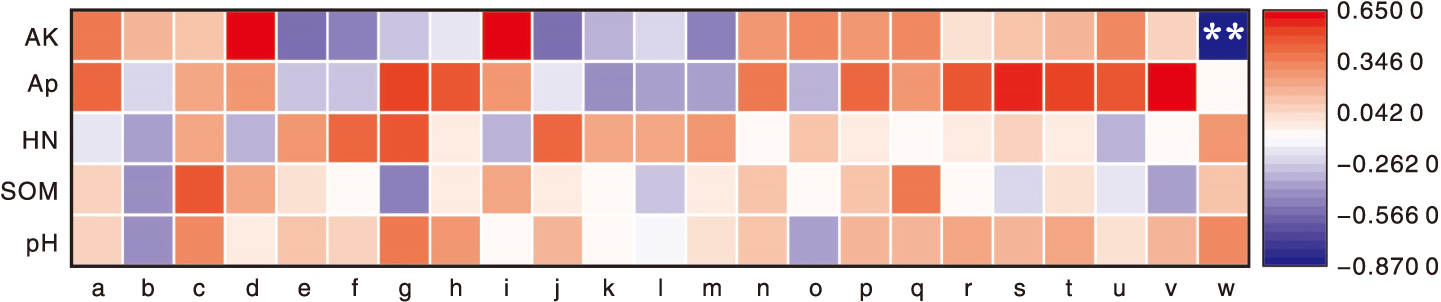
图7 紫斑牡丹+大豆间作模式下土壤细菌群落与根际土壤化学性质的相关性热图 SOM,土壤有机质含量;AN,碱解氮含量;AP,速效磷含量;AK,速效钾含量。a,Vicinamibacteraceae;b,鞘氨醇单胞菌属;c,MND1;d,WD2101_soil_group;e,KD4-96;f,Gitt-GS-136;g,盖氏菌属;h,MB-A2-108;i,RB41;j,小梨形菌属;k,Pir4_lineage;l,Subgroup_7;m,出芽菌属;n,Pedosphaeraceae;o,绿弯菌属;p,TRA3-20;q,Rokubacteriales;r,东秀珠氏菌属;s,土生单胞菌属;t,Ellin6067;u,黄色土杆菌属;v,IMCC26256;w,Reyranella。**表示相关性极显著(p<0.01)。
Fig.7 Correlation heatmap between soil bacterial communities and rhizosphere soil chemical properties under the Paeonia rockii-Glycine max intercropping pattern SOM, Soil organic matter content; AN, Alkali-hydrolyzable nitrogen content; AP, Available phosphorus content; AK, Available potassium content. a, Vicinamibacteraceae; b, Sphingomonas; c, MND1; d, WD2101_soil_group; e, KD4-96; f, Gitt-GS-136; g, Gaiella; h, MB-A2-108; i, RB41; j, Pirellula; k, Pir4_lineage; l, Subgroup_7; m, Gemmata; n, Pedosphaeraceae; o, Chloroflexus; p, TRA3-20; q, Rokubacteriales; r, Dongia; s, Terrimonas; t, Ellin6067; u, Chthoniobacter; v, IMCC26256; w, Reyranella. ** indicates significant correlation at p<0.01.
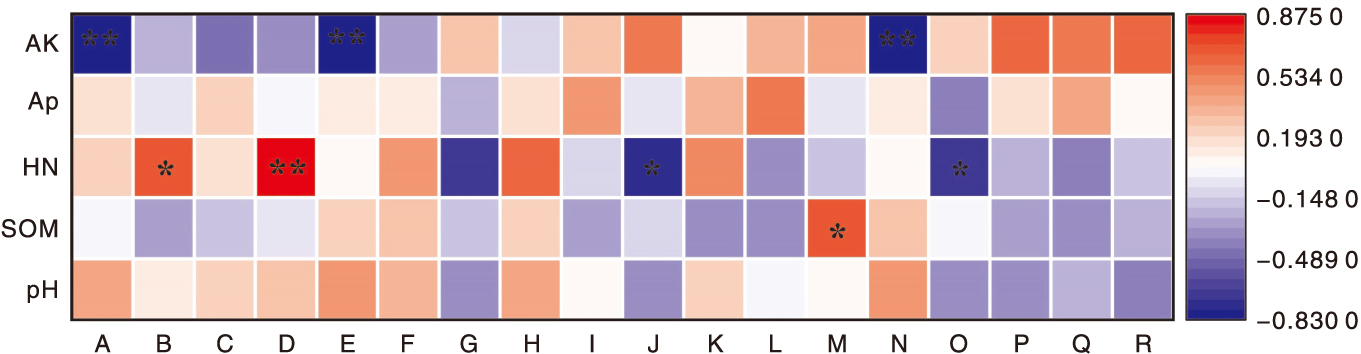
图8 紫斑牡丹+大豆间作模式下土壤真菌群落与根际土壤化学性质的相关性热图 SOM,土壤有机质含量;AN,碱解氮含量;AP,速效磷含量;AK,速效钾含量。A,拟鬼伞属;B,异茎点霉属;C,锥盖伞属;D,被孢霉属;E,毛壳菌属;F,四枝孢属;G,镰刀菌属;H,外瓶霉属;I,膜孢霉属;J,枝孢属;K,拟折孢属;L,斑褶菇属;M,暗孔菌属;N,小荚孢腔属;O,球毛壳孢属;P,脐菇属;Q,地孔菌属;R,绒革菌属;*表示显著相关(p<0.05),**表示极显著相关(p<0.01)。
Fig.8 Correlation heatmap between soil fungal communities and rhizosphere soil chemical properties under the Paeonia rockii-Glycine max intercropping pattern SOM, Soil organic matter content; AN, Alkali-hydrolyzable nitrogen content; AP, Available phosphorus content; AK, Available potassium content. A, Coprinopsis; B, Paraphoma; C, Conocybe; D, Mortierella; E, Chaetomium; F, Tetracladium; G, Fusarium; H, Exophiala; I, Hymenula; J, Cladosporium; K, Minimelanolocus; L, Panaeolus; M, Amaurodon; N, Sporormiella; O, Chaetosphaeronema; P, Hebeloma; Q, Geopora; R, Tomentella. * indicates significant correlation at p<0.05, ** indicates significant correlation at p<0.01.
| [1] | 司宝华, 罗建让, 张延龙. 基于专用目标的紫斑牡丹单株评价与筛选[J]. 北方园艺, 2023(10): 65-73. |
| SI B H, LUO J R, ZHANG Y L. Evaluation and screening of Paeonia rockii individual plant based on special objectives[J]. Northern Horticulture, 2023(10): 65-73. | |
| [2] | 贺欢, 杨馥霞, 汤玲, 等. 榆中半干旱地区紫斑牡丹繁育技术[J]. 西北园艺, 2023(9): 35-37. |
| HE H, YANG F X, TANG L, et al. Breeding techniques of Paeonia rockii in semi-arid area of Yuzhong[J]. Northwest Horticulture, 2023(9): 35-37. | |
| [3] | 马会萍, 彭正锋, 冀含乐, 等. 牡丹的食用价值及食用牡丹栽培技术[J]. 特种经济动植物, 2023, 26(5): 128-132. |
| MA H P, PENG Z F, JI H L, et al. Edible value of peony and its cultivation techniques[J]. Special Economic Animal and Plant, 2023, 26(5): 128-132. | |
| [4] | 陈法志, 陈镇, 戢小梅, 等. 油用牡丹种质资源及育种研究进展[J]. 江汉大学学报(自然科学版), 2019, 47(2): 181-185. |
| CHEN F Z, CHEN Z, JI X M, et al. Research progress on germplasm resources and breeding of oil peony[J]. Journal of Jianghan University Natural Science Edition, 2019, 47(2): 181-185. | |
| [5] | 钟玉君, 梁小龙, 王永峰, 等. 植物根际噬菌体生态研究进展[J]. 生态学杂志, 2025, 44(11): 3789-3800. |
| ZHONG Y J, LIANG X L, WANG Y F, et al. Research progress of bacteriophage ecology in plant rhizosphere[J]. Chinese Journal of Ecology, 2025, 44(11): 3789-3800. | |
| [6] | 张小芳, 张春平, 董全民, 等. 混播和单播栽培草地根际土壤代谢物和细菌群落结构的差异[J]. 应用与环境生物学报, 2025, 31(6): 939-951. |
| ZHANG X F, ZHANG C P, DONG Q M, et al. Difference of rhizosphere soil metabolites and bacterial community structure between mixed cropping and monocropping cultivation grassland[J]. Chinese Journal of Applied and Environmental Biology, 2025, 31(6): 939-951. | |
| [7] | HINSINGER P, BENGOUGH A G, VETTERLEIN D, et al. Rhizosphere: biophysics, biogeochemistry and ecological relevance[J]. Plant and Soil, 2009, 321(1): 117-152. |
| [8] | 王新宇. 玉米/紫花苜蓿间作体系氮素吸收提升的根际土壤—微生物互作机制研究[D]. 长春: 东北师范大学, 2021. |
| WANG X Y. Mechanism of root-soil-microorganism interactions in enhancing nitrogen uptake in maize/alfalfa intercropping systems[D]. Changchun: Northeast Normal University, 2021. | |
| [9] | 赵叶舟, 王浩铭, 汪自强. 豆科植物和根瘤菌在生态环境中的地位和作用[J]. 农业环境与发展, 2013, 30(4): 7-12. |
| ZHAO Y Z, WANG H M, WANG Z Q. The role of leguminous plants and Rhizobium in ecological environment[J]. Agro-Environment and Development, 2013, 30(4): 7-12. | |
| [10] | 张苗苗, 杨逢志, 杨先吉, 等. 退耕套种模式对云杉林土壤细菌群落及理化性质的影响[J]. 福建农林大学学报(自然科学版), 2025, 54(1): 59-73. |
| ZHANG M M, YANG F Z, YANG X J, et al. Impact of interplant patterns on soil bacterial community and physicochemical property in Picea asperata forests[J]. Journal of Fujian Agriculture and Forestry University(Natural Science Edition), 2025, 54(1): 59-73. | |
| [11] | 瓮巧云, 黄新军, 许翰林, 等. 玉米/大豆间作模式对青贮玉米产量、品质及土壤营养、根际微生物的影响[J]. 核农学报, 2021, 35(2): 462-470. |
| WENG Q Y, HUANG X J, XU H L, et al. Effects of corn/soybean intercropping mode on yield, quality, soil nutrition and rhizosphere microorganisms of silage corn[J]. Journal of Nuclear Agricultural Sciences, 2021, 35(2): 462-470. | |
| [12] | 李义林, 李坤, 李建查, 等. 有机肥和套种对干热区火龙果土壤微生物特性和产量、品质的影响[J]. 生态学杂志, 2024, 43(3): 656-664. |
| LI Y L, LI K, LI J C, et al. Effects of organic fertilizer and interplanting on soil microbial characteristics, yield and quality of pitaya in dry-hot area[J]. Chinese Journal of Ecology, 2024, 43(3): 656-664. | |
| [13] | 姜小凤, 赵亚兰, 徐琼, 等. 不同套种模式对药食两用玫瑰土壤微生物及酶活性的影响[J]. 中药材, 2022, 45(11): 2562-2565. |
| JIANG X F, ZHAO Y L, XU Q, et al. Effects of different intercropping patterns on soil microbes and enzyme activities of medicinal and edible roses[J]. Journal of Chinese Medicinal Materials, 2022, 45(11): 2562-2565. | |
| [14] | 马超然, 何树斌, 白雪纯, 等. 套种紫花苜蓿对玉米根际土壤碳、氮、磷及真菌群落的影响[J]. 草业科学, 2020, 37(1): 20-29. |
| MA C R, HE S B, BAI X C, et al. Effects of alfalfa intercropping on soil carbon, nitrogen, and phosphorus and the fungal community in the rhizosphere of soils in silage maize[J]. Pratacultural Science, 2020, 37(1): 20-29. | |
| [15] | 周霞, 李成忠, 梁大刚. 有机水溶肥对牡丹脂肪酸含量、土壤碳活性与利用的影响[J]. 江苏农业科学, 2024, 52(4): 239-244. |
| ZHOU X, LI C Z, LIANG D G. Effects of organic water-soluble fertilizer on fatty acid content, soil carbon activity and utilization of peony[J]. Jiangsu Agricultural Sciences, 2024, 52(4): 239-244. | |
| [16] | 张姗姗, 赵凡, 魏小豹, 等. ‘凤丹’和紫斑牡丹6个产地种子脂肪酸组分的比较[J]. 中国粮油学报, 2021, 36(3): 84-90. |
| ZHANG S S, ZHAO F, WEI X B, et al. Comparison of fatty acid components in seeds of’ Fengdan’ and Paeonia rockii from six producing areas[J]. Journal of the Chinese Cereals and Oils Association, 2021, 36(3): 84-90. | |
| [17] | 石欣隆, 刘伟, 张琳, 等. 紫斑牡丹籽产量及籽油品质综合评价[J]. 河南科技大学学报(自然科学版), 2020, 41(6): 73-80. |
| SHI X L, LIU W, ZHANG L, et al. Comprehensive evaluation of seed yield and seed oil quality of Paeonia rockii[J]. Journal of Henan University of Science and Technology(Natural Science), 2020, 41(6): 73-80. | |
| [18] | 王雪山, 杜秉海, 姚良同, 等. 种植年限对牡丹根际土壤微生物群落结构的影响[J]. 山东农业大学学报(自然科学版), 2012, 43(4): 508-516. |
| WANG X S, DU B H, YAO L T, et al. Effects of planting years on microbial communities’ structure in peony rhizosphere soil[J]. Journal of Shandong Agricultural University(Natural Science Edition), 2012, 43(4): 508-516. | |
| [19] | XUE D, HUANG X. Changes in soil microbial community structure with planting years and cultivars of tree peony (Paeonia suffruticosa)[J]. World Journal of Microbiology and Biotechnology, 2014, 30(2): 389-397. |
| [20] | 周江华, 刘慧春, 朱开元, 等. 油用牡丹‘凤丹’套种巨峰葡萄栽培技术[J]. 林业科技通讯, 2022(9): 56-57. |
| ZHOU J H, LIU H C, ZHU K Y, et al. Cultivation techniques of interplanting Kyoho grape with oil peony ‘Fengdan’[J]. Forest Science and Technology, 2022(9): 56-57. | |
| [21] | 许文营, 智利红. 豫西丘陵地区油用牡丹套作朝天椒技术[J]. 北方园艺, 2020(5): 172-175. |
| XU W Y, ZHI L H. Techniques of interplanting oil peony with pepper in hilly area of western Henan Province[J]. Northern Horticulture, 2020(5): 172-175. | |
| [22] | 徐绍清, 刘清, 黄士文, 等. 我国油用牡丹与林木的间作套种概况[J]. 现代园艺, 2017(14): 28-30. |
| XU S Q, LIU Q, HUANG S W, et al. General situation of intercropping between oil peony and forest trees in China[J]. Contemporary Horticulture, 2017(14): 28-30. | |
| [23] | 关佳莉, 丛悦, 徐媛媛, 等. 不同种植模式下黄芪根际环境与活性成分相关性研究[J]. 中草药, 2025, 56(12): 4399-4409. |
| GUAN J L, CONG Y, XU Y Y, et al. Correlation between rhizosphere environment and contents of active components of Astragali Radix from different cropping modes[J]. Chinese Traditional and Herbal Drugs, 2025, 56(12): 4399-4409. | |
| [24] | 鲍士旦. 土壤农化分析[M]. 3版. 北京: 中国农业出版社, 2000: 30-109. |
| [25] | 彭丽媛, 熊兴政, 欧阳, 等. 套种大豆和单施尿素对油桐生长和土壤理化性质的影响[J]. 重庆师范大学学报(自然科学版), 2017, 34(1): 100-107. |
| PENG L Y, XIONG X Z, OU Y, et al. Effects of soybean interplanting and urea application on growth and soil physical and chemical properties of tung oil tree[J]. Journal of Chongqing Normal University(Natural Science Edition), 2017, 34(1): 100-107. | |
| [26] | OHWAKI Y, SUGAHARA K. Active extrusion of protons and exudation of carboxylic acids in response to iron deficiency by roots of chickpea (Cicer arietinum L.)[J]. Plant and Soil, 1997, 189(1): 49-55. |
| [27] | 章家恩, 徐琪. 三峡库区退化土壤的恢复与重建研究[J]. 长江流域资源与环境, 1998, 7(3): 57-62. |
| ZHANG J E, XU Q. Research on restoration and reconstruction of degraded soils in the Three Gorges Reservoir area[J]. Resources and Environment in the Yangtze Basin, 1998, 7(3): 57-62. | |
| [28] | 牛燕蕙, 胡颖梅, 高明博, 等. 烤烟间作大豆对烤烟根际土壤微生物多样性的影响[J]. 西南农业学报, 2025, 38(3):429-440. |
| NIU Y H, HU Y M, GAO M B, et al. Effect of intercropping roasted tobacco with soybean on microbial diversity in tobacco rhizosphere soil[J]. Southwest China Journal of Agricultural Sciences, 2025, 38(3):429-440. | |
| [29] | 刘霏霏, 何万荣, 孙强, 等. 苜蓿绿肥对塔里木盆地苹果园土壤细菌多样性和功能的影响[J]. 中国农业科技导报, 2024, 26(8): 223-233. |
| LIU F F, HE W R, SUN Q, et al. Effect of alfalfa green manure on diversity and function of soil bacteria in apple orchards in Tarim basin[J]. Journal of Agricultural Science and Technology, 2024, 26(8): 223-233. | |
| [30] | 杨淑雅, 王镜如, 朱滢滢, 等. 杉木与浙江楠混交对根系分泌物和丛枝菌根真菌群落结构的影响[J]. 林业科学, 2024, 60(9): 59-68. |
| YANG S Y, WANG J R, ZHU Y Y, et al. Effects of Chinese fir mixed with Phoebe chekiangensis on root exudates and community structure of arbuscular mycorrhizal fungi[J]. Scientia Silvae Sinicae, 2024, 60(9): 59-68. | |
| [31] | DING K, ZHANG Y T, YRJÄLÄ K, et al. The introduction of Phoebe bournei into Cunninghamia lanceolata monoculture plantations increased microbial network complexity and shifted keystone taxa[J]. Forest Ecology and Management, 2022, 509: 120072. |
| [32] | 法蕾, 裴顺祥, 杜满义, 等. 油松人工林土壤微生物对结构调整的响应研究[J]. 林业科学研究, 2024, 37(3): 193-202. |
| FA L, PEI S X, DU M Y, et al. Response of soil microorganisms to structural adjustment in Pinus tabulaeformis plantation[J]. Forest Research, 2024(3): 193-202. | |
| [33] | 郭丽丽, 张晨洁, 王菲, 等. 牡丹野生种根际土壤细菌群落特征分析[J]. 南京林业大学学报(自然科学版), 2023, 47(3): 45-55. |
| GUO L L, ZHANG C J, WANG F, et al. Analysis of bacterial community characteristics in the rhizosphere soil of wild tree peony[J]. Journal of Nanjing Forestry University (Natural Sciences Edition), 2023, 47(3): 45-55. | |
| [34] | STONE B W, LI J H, KOCH B J, et al. Nutrients cause consolidation of soil carbon flux to small proportion of bacterial community[J]. Nature Communications, 2021, 12: 3381. |
| [35] | JIA M M, SUN X, CHEN M, et al. Deciphering the microbial diversity associated with healthy and wilted Paeonia suffruticosa rhizosphere soil[J]. Frontiers in Microbiology, 2022, 13: 967601. |
| [36] | LI Y H, HAN X, LI B, et al. Soil addition improves multifunctionality of degraded grasslands through increasing fungal richness and network complexity[J]. Geoderma, 2023, 437: 116607. |
| [37] | 姜沛沛, 曹扬, 陈云明, 等. 不同林龄油松(Pinus tabulaeformis)人工林植物、凋落物与土壤C、N、P化学计量特征[J]. 生态学报, 2016, 36(19): 6188-6197. |
| JIANG P P, CAO Y, CHEN Y M, et al. Stoichiometric characteristics of C, N and P in plants, litter and soil of Pinus tabulaeformis plantations at different ages[J]. Acta Ecologica Sinica, 2016, 36(19): 6188-6197. | |
| [38] | 曾志浩, 王思凡, 林文波, 等. 油松林下种植牡丹土壤真菌群落结构及多样性[J]. 福建林业科技, 2024, 51(2): 1-7. |
| ZENG Z H, WANG S F, LIN W B, et al. Community structure and diversity of soil fungi planted with peony under Pinus tabulaeformis forest[J]. Journal of Fujian Forestry Science and Technology, 2024, 51(2): 1-7. | |
| [39] | XIE A Q, SUN L M, ZHANG D L, et al. Changes in the root system of the herbaceous peony and soil properties under different years of continuous planting and replanting[J]. Horticultural Plant Journal, 2023, 9(4): 801-810. |
| [1] | 钟弘睿, 褚云霞, 邓姗, 张余, 张永春, 任丽, 赵洪, 章毅颖, 刘昆, 曹建国, 陈海荣. 基于特异性、一致性、稳定性测试的朱顶红品种资源遗传多样性分析[J]. 浙江农业学报, 2026, 38(2): 258-268. |
| [2] | 李传哲, 董青君, 纪力, 汪吉东, 陈川, 章安康, 张永春, 邵文奇. 新型肥料对典型黄河故道区土壤养分、微生物群落及稻麦产量的影响[J]. 浙江农业学报, 2026, 38(1): 136-147. |
| [3] | 施静, 李建宏, 褚鹏星, 余锐, 姜明, 陈光丽, 赵小霞, 冯莉. γ-聚谷氨酸配施化肥对党参生长的影响及其作用机制[J]. 浙江农业学报, 2026, 38(1): 85-94. |
| [4] | 陈亚飞, 史肖肖, 余水生, 叶碧欢, 宋其岩, 沈建军, 陈友吾. 浙江省遂昌九龙山国家级自然保护区虫生真菌资源调查[J]. 浙江农业学报, 2025, 37(9): 1891-1904. |
| [5] | 耿锐梅, 赵清海, 曹长代, 李峰, 王大海, 贺鹏霖, 刘洋, 李军民, 徐蕊, 宋志美, 胡海洲, 张玉. 烤烟品种中川208和CV87根际细菌群落分析[J]. 浙江农业学报, 2025, 37(7): 1512-1520. |
| [6] | 洪霞, 卢基来, 漆慧娟, 陈孝赏. 姜种质资源遗传多样性分析与核心种质资源库的构建[J]. 浙江农业学报, 2025, 37(6): 1233-1243. |
| [7] | 宋英俊, 蔡怡好, 张利霞, 吕淑芳, 李文文, 索晨美, 张昊, 侯典云, 赵杏利. 小麦根际真菌分离及其抗菌活性[J]. 浙江农业学报, 2025, 37(12): 2535-2544. |
| [8] | 潘鑫煜, 黄慧灵, 韩明明, 沈宁远, 赵旭东, 楼宝. 刺激隐核虫感染对小黄鱼肠道的组织结构、免疫水平与微生物组成的影响[J]. 浙江农业学报, 2025, 37(11): 2265-2274. |
| [9] | 应碧旷, 刘宇, 魏馨, 李晶, 王金旺. 加拿大一枝黄花入侵对温州沿海区域植物群落结构的影响[J]. 浙江农业学报, 2025, 37(11): 2325-2339. |
| [10] | 徐伟东, 陆强, 姚张良, 王晖, 王瑞森, 郎淑平. 水稻田夏熟杂草多样性特征对不同轮作模式的响应[J]. 浙江农业学报, 2025, 37(10): 2138-2149. |
| [11] | 万合锋, 刘国华, 武玉祥, 蒋娟, 张珍明, 刘勇. 物料初始pH值对堆肥理化性质及微生物群落的影响[J]. 浙江农业学报, 2025, 37(10): 2165-2178. |
| [12] | 秦斗文, 刘伟强, 田吉婷, 巨秀婷. 伊犁郁金香cpDNA-PCR体系构建与遗传多样性分析[J]. 浙江农业学报, 2025, 37(1): 78-89. |
| [13] | 张元元, 冯举伶, 肖婧凤, 关宇, 龙楚儿, 姚立蓉, 孟亚雄, 司二静, 李葆春, 马小乐, 王化俊, 周喜荣, 刘梅金, 汪军成. 青稞遗传多样性及其农艺性状与SSR标记的关联分析[J]. 浙江农业学报, 2024, 36(9): 1977-1989. |
| [14] | 董莉莉, 徐志浩, 严灿龙, 范小平, 金泽兰, 王忠华. 基于表型与分子标记对浙贝母不同育种群体的分子鉴定与亲缘关系研究[J]. 浙江农业学报, 2024, 36(8): 1719-1730. |
| [15] | 黄辉, 储忝江, 谢楠, 刘凯. 基于线粒体COI序列片段研究华鳈不同地理群体及其他鳈属鱼类的遗传多样性[J]. 浙江农业学报, 2024, 36(8): 1779-1788. |
| 阅读次数 | ||||||
|
全文 |
|
|||||
|
摘要 |
|
|||||

