浙江农业学报 ›› 2026, Vol. 38 ›› Issue (3): 471-480.DOI: 10.3969/j.issn.1004-1524.20250272
原花色素对铁皮石斛花色苷稳定性的影响及其作用机制
杨晨辰1,2( ), 陶文扬2, 邢建荣2, 周万怡2, 王梦竹2, 李明1, 杨颖2,*(), 赵玉萍1,*()
- 1.
淮阴工学院 江苏 淮安 223001
2.浙江省农业科学院 食品科学研究所 浙江 杭州 310021
-
收稿日期:2025-04-07出版日期:2026-03-25发布日期:2026-04-17 -
作者简介:杨晨辰,研究方向为食药同源植物加工。E-mail:chenc_yang@yeah.net -
通讯作者:*赵玉萍,E-mail: zhaoyuping@hyit.edu.cn;杨颖,E-mail: YangYing_sps@163.com -
基金资助:浙江省“三农九方”科技协作计划项目(2025SNJF011)
Effect of proanthocyanidin on the stability of Dendrobium officinale anthocyanins and its copigmentation mechanism
YANG Chenchen1,2(), TAO Wenyang2, XING Jianrong2, ZHOU Wanyi2, WANG Mengzhu2, LI Ming1, YANG Ying2,*(), ZHAO Yuping1,*()
- 1.
Huaiyin Institute of Technology Huai’an 223001, Jiangsu, China
2.Institute of Food Science ,Zhejiang Academy of Agricultural Sciences Hangzhou 310021, China
-
Received:2025-04-07Published:2026-03-25Online:2026-04-17

摘要:
为提高铁皮石斛花色苷(DOA)的稳定性,本研究采用紫外-可见光谱、傅里叶变换红外光谱(FT-IR)、X射线衍射(XRD)和分子对接技术,研究了不同辅色素对DOA稳定性的影响及其作用机制。结果表明,在相同温度条件下,儿茶素(C)、葡萄籽原花色素(GSPEs)和杨梅叶原花色素(BLPEs)通过使DOA的羟基和芳香环发生峰位偏移,降低了DOA的降解速率常数,进而提升其热稳定性和氧化稳定性。这些辅色素通过氢键和π-π键与DOA发生分子间相互作用,形成稳定的复合物。其中,BLPEs因其多羟基结构与DOA结合能低,可完全包裹花色苷的C环,阻止水分子的亲核攻击,从而更有效地增强DOA的稳定性。本研究揭示了原花色素通过辅色作用增强DOA稳定性的具体效果与机制,为食品加工领域中天然色素的稳定性调控提供了理论依据,并为开发高稳定性花色苷制剂提供了技术支撑。
中图分类号:
引用本文
杨晨辰, 陶文扬, 邢建荣, 周万怡, 王梦竹, 李明, 杨颖, 赵玉萍. 原花色素对铁皮石斛花色苷稳定性的影响及其作用机制[J]. 浙江农业学报, 2026, 38(3): 471-480.
YANG Chenchen, TAO Wenyang, XING Jianrong, ZHOU Wanyi, WANG Mengzhu, LI Ming, YANG Ying, ZHAO Yuping. Effect of proanthocyanidin on the stability of Dendrobium officinale anthocyanins and its copigmentation mechanism[J]. Acta Agriculturae Zhejiangensis, 2026, 38(3): 471-480.
| 处理 Treatment | n(DOA)∶n(辅色素) n(DOA)∶n(copigment) | Dλ,max | ΔDλ,max/% | λmax/nm | Δλmax/nm |
|---|---|---|---|---|---|
| DOA | — | 0.233±0.008 d | — | 542±0 e | — |
| DOA-C | 1∶40 | 0.258±0.017 bcd | 22.781±0.447 e | 544±0 c | 2±0 c |
| 1∶20 | 0.255±0.016 bcd | 20.328±0.298 f | 544±1 c | 2±1 c | |
| 1∶10 | 0.249±0.013 bcd | 16.306±0.280 h | 543±0 d | 1±0 d | |
| 1∶1 | 0.239±0.005 cd | 6.894±0.265 i | 543±0 d | 1±0 d | |
| DOA-GSPEs | 1∶40 | 0.336±0.025 a | 61.512±0.488 a | 545±0 b | 3±0 b |
| 1∶20 | 0.266±0.021 bc | 28.326±0.313 c | 545±1 b | 3±1 b | |
| 1∶10 | 0.249±0.013 bcd | 16.087±0.377 h | 544±0 c | 2±0 c | |
| 1∶1 | 0.237±0.006 cd | 4.807±0.329 j | 544±1 c | 2±1 c | |
| DOA-BLPEs | 1∶40 | 0.278±0.024 b | 35.213±0.311 b | 546±0 a | 4±0 a |
| 1∶20 | 0.265±0.020 bc | 27.614±0.294 d | 546±0 a | 4±0 a | |
| 1∶10 | 0.253±0.015 bcd | 19.262±0.355 g | 545±0 b | 3±0 b | |
| 1∶1 | 0.239±0.005 cd | 6.670±0.464 i | 544±0 c | 2±0 c |
表1 辅色素对DOA吸收波长的影响
Table 1 Influence of copigments on DOA absorption wavelength
| 处理 Treatment | n(DOA)∶n(辅色素) n(DOA)∶n(copigment) | Dλ,max | ΔDλ,max/% | λmax/nm | Δλmax/nm |
|---|---|---|---|---|---|
| DOA | — | 0.233±0.008 d | — | 542±0 e | — |
| DOA-C | 1∶40 | 0.258±0.017 bcd | 22.781±0.447 e | 544±0 c | 2±0 c |
| 1∶20 | 0.255±0.016 bcd | 20.328±0.298 f | 544±1 c | 2±1 c | |
| 1∶10 | 0.249±0.013 bcd | 16.306±0.280 h | 543±0 d | 1±0 d | |
| 1∶1 | 0.239±0.005 cd | 6.894±0.265 i | 543±0 d | 1±0 d | |
| DOA-GSPEs | 1∶40 | 0.336±0.025 a | 61.512±0.488 a | 545±0 b | 3±0 b |
| 1∶20 | 0.266±0.021 bc | 28.326±0.313 c | 545±1 b | 3±1 b | |
| 1∶10 | 0.249±0.013 bcd | 16.087±0.377 h | 544±0 c | 2±0 c | |
| 1∶1 | 0.237±0.006 cd | 4.807±0.329 j | 544±1 c | 2±1 c | |
| DOA-BLPEs | 1∶40 | 0.278±0.024 b | 35.213±0.311 b | 546±0 a | 4±0 a |
| 1∶20 | 0.265±0.020 bc | 27.614±0.294 d | 546±0 a | 4±0 a | |
| 1∶10 | 0.253±0.015 bcd | 19.262±0.355 g | 545±0 b | 3±0 b | |
| 1∶1 | 0.239±0.005 cd | 6.670±0.464 i | 544±0 c | 2±0 c |
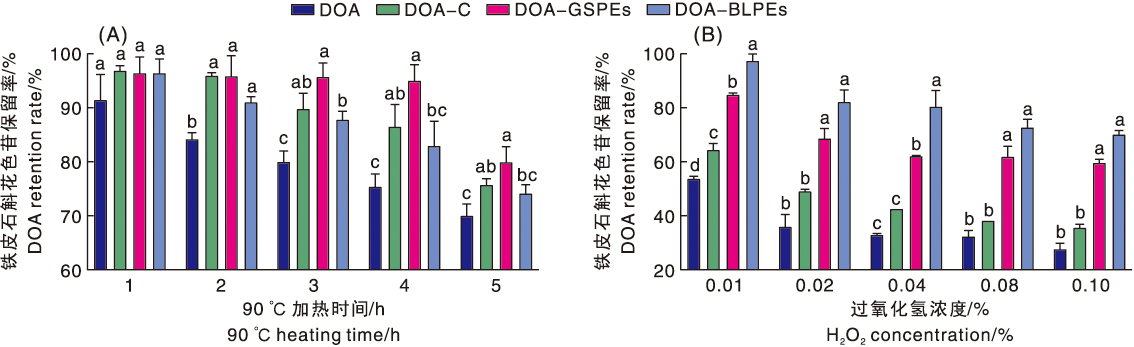
图1 DOA稳定性分析 柱上无相同小写字母表示在同一加热时间(A)或同一H2O2浓度(B)下,不同样品组间差异显著(p<0.05)。
Fig.1 DOA stability analysis Bars with different lowercase letters indicate significant (p<0.05) differences among different sample groups within the same heating time (A) or H2O2 concentration (B).
| 处理 Treatment | Ea/(kJ·mol-1) | R2 | T/K | K/h-1 | t1/2/h | ΔH/(kJ·mol-1) | ΔG/(kJ·mol-1) | ΔS/(J·mol-1) |
|---|---|---|---|---|---|---|---|---|
| DOA | 29.964±1.873 d | 0.991 | 313.15 | 0.034±0.002 hi | 20.39±1.20 fg | 27.360±1.873 d | 88.108±0.153 m | -193.989±6.009 d |
| 323.15 | 0.045±0.003 g | 15.40±1.03 ghi | 27.277±1.873 d | 89.790±0.179 k | -193.447±5.825 d | |||
| 333.15 | 0.061±0.004 e | 11.36±0.74 ijk | 27.194±1.873 d | 91.687±0.182 gh | -193.583±5.650 d | |||
| 343.15 | 0.078±0.005 c | 8.89±0.57 ijk | 27.111±1.873 d | 93.771±0.183 d | -194.260±5.486 d | |||
| 353.15 | 0.098±0.006 a | 7.07±0.43 k | 27.028±1.873 d | 95.848±0.180 a | -194.875±5.329 d | |||
| DOA-C | 35.713±2.156 c | 0.990 | 313.15 | 0.018±0.001 lm | 38.51±2.14 c | 33.109±2.156 c | 87.223±0.145 n | -172.805±6.905 c |
| 323.15 | 0.024±0.002 jk | 28.88±2.41 de | 33.026±2.156 c | 89.335±0.224 l | -174.249±6.712 c | |||
| 333.15 | 0.037±0.002 h | 18.73±1.01 fgh | 32.943±2.156 c | 91.053±0.150 i | -174.426±6.500 c | |||
| 343.15 | 0.055±0.004 f | 12.60±0.92 hijk | 32.860±2.156 c | 92.737±0.208 f | -174.493±6.325 c | |||
| 353.15 | 0.086±0.005 b | 8.06±0.47 jk | 32.777±2.156 c | 94.180±0.171 c | -173.873±6.135 c | |||
| DOA-GSPEs | 53.195±2.487 b | 0.994 | 313.15 | 0.007±0.001 n | 99.02±14.15 a | 50.591±2.487 b | 89.815±0.372 k | -125.255±8.074 b |
| 323.15 | 0.014±0.001 m | 49.51±3.54 b | 50.508±2.487 b | 90.808±0.192 ij | -124.710±7.724 b | |||
| 333.15 | 0.026±0.002 jk | 26.66±2.05 e | 50.425±2.487 b | 92.019±0.213 g | -124.849±7.508 b | |||
| 343.15 | 0.047±0.003 g | 14.75±0.94 ghij | 50.342±2.487 b | 93.183±0.182 e | -124.847±7.283 b | |||
| 353.15 | 0.067±0.005 d | 10.35±0.77 ijk | 50.259±2.487 b | 94.932±0.219 b | -126.499±7.093 b | |||
| DOA-BLPEs | 65.058±3.012 a | 0.992 | 313.15 | 0.013±0.001 m | 53.32±4.10 b | 62.454±3.012 a | 89.933±0.200 k | -87.747±9.664 a |
| 323.15 | 0.021±0.001 kl | 33.01±1.57 cd | 62.371±3.012 a | 90.520±0.128 j | -87.106±9.347 a | |||
| 333.15 | 0.029±0.002 ij | 23.90±1.65 ef | 62.288±3.012 a | 91.450±0.191 h | -87.534±9.085 a | |||
| 343.15 | 0.038±0.003 h | 18.24±1.44 fgh | 62.205±3.012 a | 92.008±0.225 g | -86.852±8.838 a | |||
| 353.15 | 0.049±0.004 g | 14.14±1.15 ghij | 62.122±3.012 a | 93.621±0.240 d | -89.195±8.599 a |
表2 降解动力学及热力学参数
Table 2 Degradation kinetics and thermodynamic parameters
| 处理 Treatment | Ea/(kJ·mol-1) | R2 | T/K | K/h-1 | t1/2/h | ΔH/(kJ·mol-1) | ΔG/(kJ·mol-1) | ΔS/(J·mol-1) |
|---|---|---|---|---|---|---|---|---|
| DOA | 29.964±1.873 d | 0.991 | 313.15 | 0.034±0.002 hi | 20.39±1.20 fg | 27.360±1.873 d | 88.108±0.153 m | -193.989±6.009 d |
| 323.15 | 0.045±0.003 g | 15.40±1.03 ghi | 27.277±1.873 d | 89.790±0.179 k | -193.447±5.825 d | |||
| 333.15 | 0.061±0.004 e | 11.36±0.74 ijk | 27.194±1.873 d | 91.687±0.182 gh | -193.583±5.650 d | |||
| 343.15 | 0.078±0.005 c | 8.89±0.57 ijk | 27.111±1.873 d | 93.771±0.183 d | -194.260±5.486 d | |||
| 353.15 | 0.098±0.006 a | 7.07±0.43 k | 27.028±1.873 d | 95.848±0.180 a | -194.875±5.329 d | |||
| DOA-C | 35.713±2.156 c | 0.990 | 313.15 | 0.018±0.001 lm | 38.51±2.14 c | 33.109±2.156 c | 87.223±0.145 n | -172.805±6.905 c |
| 323.15 | 0.024±0.002 jk | 28.88±2.41 de | 33.026±2.156 c | 89.335±0.224 l | -174.249±6.712 c | |||
| 333.15 | 0.037±0.002 h | 18.73±1.01 fgh | 32.943±2.156 c | 91.053±0.150 i | -174.426±6.500 c | |||
| 343.15 | 0.055±0.004 f | 12.60±0.92 hijk | 32.860±2.156 c | 92.737±0.208 f | -174.493±6.325 c | |||
| 353.15 | 0.086±0.005 b | 8.06±0.47 jk | 32.777±2.156 c | 94.180±0.171 c | -173.873±6.135 c | |||
| DOA-GSPEs | 53.195±2.487 b | 0.994 | 313.15 | 0.007±0.001 n | 99.02±14.15 a | 50.591±2.487 b | 89.815±0.372 k | -125.255±8.074 b |
| 323.15 | 0.014±0.001 m | 49.51±3.54 b | 50.508±2.487 b | 90.808±0.192 ij | -124.710±7.724 b | |||
| 333.15 | 0.026±0.002 jk | 26.66±2.05 e | 50.425±2.487 b | 92.019±0.213 g | -124.849±7.508 b | |||
| 343.15 | 0.047±0.003 g | 14.75±0.94 ghij | 50.342±2.487 b | 93.183±0.182 e | -124.847±7.283 b | |||
| 353.15 | 0.067±0.005 d | 10.35±0.77 ijk | 50.259±2.487 b | 94.932±0.219 b | -126.499±7.093 b | |||
| DOA-BLPEs | 65.058±3.012 a | 0.992 | 313.15 | 0.013±0.001 m | 53.32±4.10 b | 62.454±3.012 a | 89.933±0.200 k | -87.747±9.664 a |
| 323.15 | 0.021±0.001 kl | 33.01±1.57 cd | 62.371±3.012 a | 90.520±0.128 j | -87.106±9.347 a | |||
| 333.15 | 0.029±0.002 ij | 23.90±1.65 ef | 62.288±3.012 a | 91.450±0.191 h | -87.534±9.085 a | |||
| 343.15 | 0.038±0.003 h | 18.24±1.44 fgh | 62.205±3.012 a | 92.008±0.225 g | -86.852±8.838 a | |||
| 353.15 | 0.049±0.004 g | 14.14±1.15 ghij | 62.122±3.012 a | 93.621±0.240 d | -89.195±8.599 a |
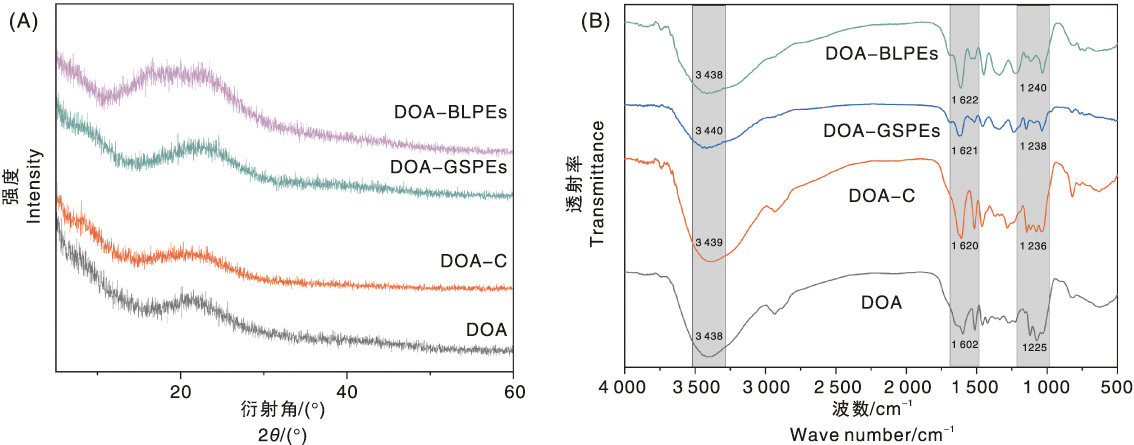
图2 DOA与辅色素的表征分析 A,X射线衍射分析;B,傅里叶变换红外光谱分析。
Fig.2 Characterization of DOA and copigments A, X-ray diffraction (XRD) analysis; B, Fourier transform infrared spectroscopy (FT-IR) analysis.
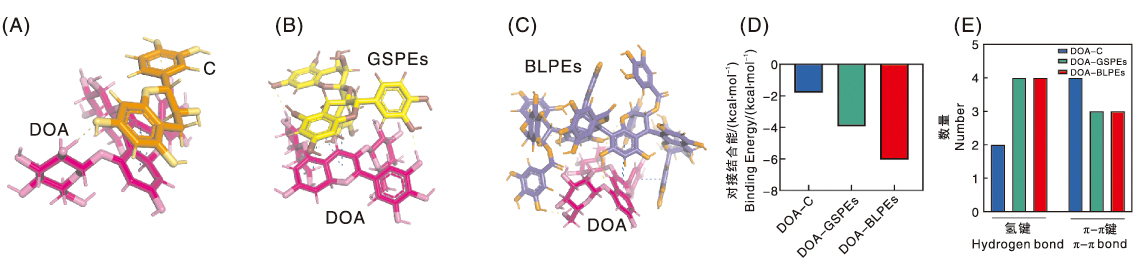
图3 DOA与辅色素的分子对接数据 A,DOA-C;B,DOA-GSPEs;C,DOA-BLPEs;D,对接结合能;E,氢键和π-π数量。
Fig.3 Molecular docking data of DOA and copigments A, DOA-C; B, DOA-GSPEs; C, DOA-BLPEs; D, Binding energy; E, Numbers of hydrogen bonds and π-π interactions.
| [1] | SADOWSKA-BARTOSZ I, BARTOSZ G. Antioxidant activity of anthocyanins and anthocyanidins: a critical review[J]. International Journal of Molecular Sciences, 2024, 25(22): 12001. |
| [2] | LI F, LI H J, LI S B, et al. A review of Lycium ruthenicum Murray: geographic distribution tracing, bioactive components, and functional properties[J]. Heliyon, 2024, 10(21): e39566. |
| [3] | ENARU B, DRECANU G, POP T D, et al. Anthocyanins: factors affecting their stability and degradation[J]. Antioxidants, 2021, 10(12): 1967. |
| [4] | FAN L L, WANG Y, XIE P J, et al. Copigmentation effects of phenolics on color enhancement and stability of blackberry wine residue anthocyanins: chromaticity, kinetics and structural simulation[J]. Food Chemistry, 2019, 275: 299-308. |
| [5] | TROUILLAS P, SANCHO-GARCÍA J C, DE FREITAS V, et al. Stabilizing and modulating color by copigmentation: insights from theory and experiment[J]. Chemical Reviews, 2016, 116(9): 4937-4982. |
| [6] | GENÇDAǦ E, ÖZDEMIR E E, DEMIRCI K, et al. Copigmentation and stabilization of anthocyanins using organic molecules and encapsulation techniques[J]. Current Plant Biology, 2022, 29: 100238. |
| [7] | ZHANG B, WANG Q, ZHOU P P, et al. Copigmentation evidence of oenin with phenolic compounds: a comparative study of spectrographic, thermodynamic and theoretical data[J]. Food Chemistry, 2020, 313: 126163. |
| [8] | YU K J, SONG Y S, LIN J X, et al. The complexities of proanthocyanidin biosynthesis and its regulation in plants[J]. Plant Communications, 2023, 4(2): 100498. |
| [9] | LI L Q, ZHANG Y, SUN B G, et al. The neuroprotective effects of Chinese bayberry leaves proanthocyanidins[J]. Journal of Functional Foods, 2018, 40: 554-563. |
| [10] | YI F X, HOU F Y, ZHAN S Q, et al. Preparation, characterization and application of pH-responsive smart film based on chitosan/zein and red radish anthocyanin[J]. International Journal of Biological Macromolecules, 2023, 253: 127037. |
| [11] | REN Z Y, QIU F N, WANG Y J, et al. Network analysis of transcriptome and LC-MS reveals a possible biosynthesis pathway of anthocyanins in Dendrobium officinale[J]. BioMed Research International, 2020, 2020: 6512895. |
| [12] | ZHANG Y, ZHOU X Z, TAO W Y, et al. Antioxidant and antiproliferative activities of proanthocyanidins from Chinese bayberry (Myrica rubra Sieb. et Zucc.) leaves[J]. Journal of Functional Foods, 2016, 27: 645-654. |
| [13] | HALGREN T A, NACHBAR R B. Merck molecular force field IV: conformational energies and geometries for MMFF94[J]. Journal of Computational Chemistry, 1996, 17(5/6): 587-615. |
| [14] | SEERAM N P, BOURQUIN L D, NAIR M G. Degradation products of cyanidin glycosides from tart cherries and their bioactivities[J]. Journal of Agricultural and Food Chemistry, 2001, 49(10): 4924-4929. |
| [15] | RUENROENGKLIN N, YANG B, LIN H T, et al. Degradation of anthocyanin from Litchi fruit pericarp by H2O2and hydroxyl radical[J]. Food Chemistry, 2009, 116(4): 995-998. |
| [16] | FAVARO L, BALCÃO V, ROCHA L, et al. Physicochemical characterization of a crude anthocyanin extract from the fruits of Jussara(Euterpe edulis Martius): potential for food and pharmaceutical applications[J]. Journal of the Brazilian Chemical Society, 2018, 29(10): 2072-2088. |
| [17] | LYU J H, LI J M, JIANG W G, et al. Copigmentation effects of different phenolics on color stability of three basic anthocyanins in wines: chromaticity, thermodynamics and molecular dynamics simulation[J]. Food Chemistry, 2025, 476: 143499. |
| [18] | ZHANG L L, WANG W B, YUE X Y, et al. Gallic acid as a copigment enhance anthocyanin stabilities and color characteristics in blueberry juice[J]. Journal of Food Science and Technology, 2020, 57(4): 1405-1414. |
| [19] | WANG J D, ZHAO Y Q, SUN B, et al. The structure of anthocyanins and the copigmentation by common micromolecular copigments: a review[J]. Food Research International, 2024, 176: 113837. |
| [20] | NIE M, WANG L, LU S M, et al. Protective effect of amino acids on the stability of bayberry anthocyanins and the interaction mechanism between l-methionine and cyanidin-3-O-glycoside[J]. Food Chemistry, 2022, 396: 133689. |
| [21] | MERCALI G D, JAESCHKE D P, TESSARO I C, et al. Degradation kinetics of anthocyanins in acerola pulp: comparison between ohmic and conventional heat treatment[J]. Food Chemistry, 2013, 136(2): 853-857. |
| [22] | SOUSA D, BASÍLIO N, OLIVEIRA J, et al. A new insight into the degradation of anthocyanins: reversible versus the irreversible chemical processes[J]. Journal of Agricultural and Food Chemistry, 2022, 70(2): 656-668. |
| [23] | MOSHFEGH N, NIAKOUSARY M, HOSSEINI S M H, et al. Effect of maltodextrin and Persian gum as wall materials and tannic acid as copigment on some properties of encapsulated sour cherry anthocyanin microcapsules[J]. Food Chemistry, 2025, 463: 141165. |
| [24] | SERRANO C, LAMAS B, OLIVEIRA M C, et al. Exploring the potential of anthocyanin-based edible coatings in confectionery: temperature stability, pH, and biocapacity[J]. Foods, 2024, 13(15): 2450. |
| [25] | CAI W H, TREFS J L, HUGEL T, et al. Anisotropy of π-π stacking as basis for superlubricity[J]. ACS Materials Letters, 2023, 5(1): 172-179. |
| [26] | ZHANG B, HE F, ZHOU P P, et al. Copigmentation between malvidin-3-O-glucoside and hydroxycinnamic acids in red wine model solutions: investigations with experimental and theoretical methods[J]. Food Research International, 2015, 78: 313-320. |
| [1] | 康颖, 叶滔, 白雪莹, 张雪娇. 融合魏斯氏菌协同发酵制备双蛋白酸奶及其稳定性研究[J]. 浙江农业学报, 2026, 38(6): 1099-1111. |
| [2] | 石其伟, 伍少福, 陶娟花, 吴良欢, 马庆旭, 刘秀, 韩科峰. 外源有机物料长期施用对黄泥田团聚体稳定性和有机碳氮积累的影响[J]. 浙江农业学报, 2026, 38(4): 720-730. |
| [3] | 曹永庆, 姚小华, 王开良, 任华东. 普通油茶主要性状的年际稳定性[J]. 浙江农业学报, 2025, 37(8): 1624-1633. |
| [4] | 任晋东, 陈红林, 牛宝龙, 许晓军, 楼宝. 基于转录组分析挖掘罗氏沼虾新内参基因[J]. 浙江农业学报, 2025, 37(7): 1424-1429. |
| [5] | 孙凤婷, 王旭, 韩新雨, 许振岚, 吴声敢, 黄浩, 汤涛, 盛清, 王强, 沈国强, 赵学平. 复硝酚钠对铁皮石斛中黄酮含量和抗氧化活性的影响[J]. 浙江农业学报, 2025, 37(4): 934-942. |
| [6] | 乔慧茹, 房祥军, 吴伟杰, 刘瑞玲, 陈杭君, 邓尚贵, 沙浩, 郜海燕. 蓝莓与铁皮石斛叶复合乳酸菌发酵饮料工艺优化与品质分析[J]. 浙江农业学报, 2025, 37(3): 654-666. |
| [7] | 黄浩, 汤涛, 许振岚, 赵学平. 吡唑醚菌酯对铁皮石斛中多糖和黄酮的影响研究[J]. 浙江农业学报, 2025, 37(1): 115-125. |
| [8] | 杨贵仁, 穆宏磊, 吴伟杰, 房祥军, 陈慧芝, 牛犇, 陈杭君, 郜海燕. 酪蛋白对杨梅汁中花色苷的工艺优化及保持研究[J]. 浙江农业学报, 2025, 37(1): 178-188. |
| [9] | 张妮, 陶文扬, 罗梦帆, 周万怡, 郑晓杰, 李彦坡, 金火喜, 杨颖. 酶解辅助提取对铁皮石斛多糖结构和菌群调节功能的影响[J]. 浙江农业学报, 2024, 36(9): 2099-2109. |
| [10] | 赵小亮, 鲁雲, 康兴兴, 龙则宇, 郑晓杰. 雁荡山铁皮石斛多糖的提取、结构表征与体外抗氧化活性[J]. 浙江农业学报, 2024, 36(8): 1898-1908. |
| [11] | 诸燕, 丁兰, 陈忆乾, 黄秀静, 姜伟伟, 陈东红. 铁皮石斛CLE基因家族鉴定与功能分析[J]. 浙江农业学报, 2024, 36(7): 1583-1590. |
| [12] | 王晓梅, 骆玉琴, 赵学平, 陆兰菲, 方楠, 王祥云, 蒋金花, 何红梅, 张昌朋, 王强. 氟吡菌酰胺在铁皮石斛中的残留与膳食风险[J]. 浙江农业学报, 2024, 36(7): 1666-1676. |
| [13] | 熊瑞, 欧阳宁, 欧茜, 钟康裕, 周文涛, 王泓睿, 龙攀, 徐莹, 傅志强. 秸秆还田与耕作方式对双季稻土壤团聚体及碳氮含量的影响[J]. 浙江农业学报, 2024, 36(6): 1347-1356. |
| [14] | 李亚萍, 金福来, 黄宗贵, 张涛, 段晓婧, 姜武, 陶正明, 陈家栋. 铁皮石斛糖苷水解酶GH3基因家族鉴定及表达模式分析[J]. 浙江农业学报, 2024, 36(4): 790-799. |
| [15] | 韩延超, 陈慧芝, 牛犇, 张小栓, 韩树人, 王晓艳, 王冠楠, 刘瑞玲, 郜海燕. 振动胁迫对蓝莓花色苷代谢及相关基因表达的影响[J]. 浙江农业学报, 2024, 36(3): 622-633. |
| 阅读次数 | ||||||
|
全文 |
|
|||||
|
摘要 |
|
|||||

