浙江农业学报 ›› 2026, Vol. 38 ›› Issue (8): 1598-1609.DOI: 10.3969/j.issn.1004-1524.20250609
斑地锦EmPAL基因克隆、表达模式和酶活性分析
吴晴阳1( ), 桂明明2, 宋美玲1, 郭三保3, 张志高4, 黄胜和2,*()
- 1
抚州医药学院 医学基础部 江西 抚州 344000
2抚州医药学院 江西省教育厅建昌帮中药研究重点实验室 江西 抚州 344000
3抚州医药学院 药学系 江西 抚州 344000
4江西省烟草公司抚州市公司 江西 抚州 344000
-
收稿日期:2025-09-18出版日期:2026-08-25发布日期:2026-09-14 -
作者简介:吴晴阳,从事植物基因和生理学研究。E-mail:825166405@qq.com -
通讯作者:*黄胜和,E-mail:hsh712@163.com -
基金资助:江西省教育厅科学技术研究项目(GJJ2205908);江西中医药高等专科学校科研项目(2024XJKY01)
Cloning, expression pattern, and enzyme activity analysis of the phenylalanine ammonia-lyase gene (EmPAL) in Euphorbia maculata
WU Qingyang1(), GUI Mingming2, SONG Meiling1, GUO Sanbao3, ZHANG Zhigao4, HUANG Shenghe2,*()
- 1
Department of Basic Medicine ,Fuzhou Medical College Fuzhou 344000, Jiangxi, China
2Key Laboratory of Jianchangbang Traditional Chinese Medicine Research of Jiangxi Education Institutes ,Fuzhou Medical College Fuzhou 344000,Jiangxi, China
3Department of Pharmacy ,Fuzhou Medical College Fuzhou 344000,Jiangxi, China
4Fuzhou Branch of Jiangxi Tobacco Company Fuzhou 344000,Jiangxi, China
-
Received:2025-09-18Published:2026-08-25Online:2026-09-14

摘要:
为解析药用植物斑地锦(Euphorbia maculata)药效成分黄酮类化合物生物合成途径结构基因苯丙氨酸解氨酶(phenylalanine ammonia-lyase,EmPAL)基因结构和蛋白质功能,为后续深入研究EmPAL提供参考,以斑地锦为材料,基于转录组数据结合cDNA 3'末端快速扩增(3'-RACE)和交错式热不对称PCR(Tail-PCR),克隆了EmPAL的开放阅读框(open reading frame, ORF)和启动子序列。采用生物信息学工具分析了EmPAL的理化性质、结构及系统发育关系。通过实时荧光定量PCR(RT-qPCR)检测EmPAL在不同组织中的表达模式。此外,还进行了原核表达并通过体外酶活性试验验证了其催化功能。结果表明,EmPAL基因ORF长度2 160 bp,编码719个氨基酸,其启动子含有光反应、胁迫应答元件和苯丙烷类元件等顺式作用元件。组织表达分析显示,EmPAL基因在斑地锦生殖生长期的根中表达量最高。EmPAL蛋白分子量为78.17 ku,等电点(pI)6.34,二级结构以α螺旋为主,三级结构为典型的“海马”状,四级结构为四聚体。原核表达与体外酶活性试验证实,EmPAL可催化苯丙氨酸生成反式肉桂酸,最适温度为60 ℃。本研究为深入解析EmPAL基因功能及其调控斑地锦中黄酮类化合物的生物合成提供了理论依据。
中图分类号:
引用本文
吴晴阳, 桂明明, 宋美玲, 郭三保, 张志高, 黄胜和. 斑地锦EmPAL基因克隆、表达模式和酶活性分析[J]. 浙江农业学报, 2026, 38(8): 1598-1609.
WU Qingyang, GUI Mingming, SONG Meiling, GUO Sanbao, ZHANG Zhigao, HUANG Shenghe. Cloning, expression pattern, and enzyme activity analysis of the phenylalanine ammonia-lyase gene (EmPAL) in Euphorbia maculata[J]. Acta Agriculturae Zhejiangensis, 2026, 38(8): 1598-1609.
| 引物用途 Primer purpose | 引物名称 Primer name | 引物序列(5'→3') Primer sequence(5'→3') |
|---|---|---|
| cDNA合成cDNA synthesis | FZL | AAGCAGTGGTATCAACGCAGAGTTTTTTTTTTTTTTTTTTVN |
| cDNA 3'末端快速扩增 | EmPAL-XF | ATCCGAGTTGAGCTGGCTG |
| 3'-rapid amplification of cDNA ends,3'-RACE | EmPAL-RF | AGCAGTGGTATCAACGCAGAG |
| 交错式热不对称PCR | EmPAL-SR1 | AAGCTCTTTTTGCAAAGCACCACCTTGT |
| Thermal asymmetric interlaced polymerase chain reaction, Tail-PCR | EmPAL-SR2 | ACGATGGACTCCAGTCCGGCCTTGCAAAGCACCACCTTG- TTTAGTTCTTCTATGA |
| EmPAL-SR3 | AGTTCTTCTATGAGAAGTGGCACCAAAACCAGTAG | |
| EmPAL-SR4 | CCATCTCTGAGAAGAACCCAGATGG | |
| EmPAL-SR5 | ACGATGGACTCCAGTCCGGCCTTGCAAAGCACCACCTTG- TTTAGTTCTTCTATGA | |
| EmPAL-SR6 | AGTTCTTCTATGAGAAGTGGCACCAAAACCAGTAG | |
| ADF1 | ACGATGGACTCCAGAGCGGCCGCVNVNNNGGAA | |
| ADF2 | ACGATGGACTCCAGAGCGGCCGCBNBNNNGGTT | |
| ADF3 | ACGATGGACTCCAGAGCGGCCGCVVNVNNNCCAA | |
| ADF6 | ACGATGGACTCCAGAGCGGCCGCVNVNNCCTT | |
| ADF0 | ACGATGGACTCCAGAG | |
| ORF区克隆 | EmPAL-OF | CAAACCAAGCTTTCCATTAATTCAGAT |
| ORF clone | EmPAL-OR | CAAAAGCTCACATATCTAATGCACAAAC |
| 启动子克隆 | EmPAL-PF | GTTGGATGAAGTCAAAACATAGGGAG |
| Promoter clone | EmPAL-PR | GCCGTTTTGGTGGATGGATTC |
| 实时荧光定量PCR | EmPAL-qF | CGGGTTGCCTTCAAATCTAACG |
| RT-qPCR | EmPAL-qR | GTCAACCGACTCTTGTGTCTTTC |
| EmGDI1-qF | TCTAGGTCCCGTTGACGAGT | |
| EmGDI1-qR | TCGAGAGCCTTCCCAGTGAT | |
| 异源表达 | EmPAL-proF | CGAGCTCATGGAATCCATCCACCAAAACG |
| Heterologous expression | EmPAL-proR | CCCAAGCTTACAAATAGGAAGAGGAGCACCATTC |
表1 引物序列
Table 1 Primer sequences
| 引物用途 Primer purpose | 引物名称 Primer name | 引物序列(5'→3') Primer sequence(5'→3') |
|---|---|---|
| cDNA合成cDNA synthesis | FZL | AAGCAGTGGTATCAACGCAGAGTTTTTTTTTTTTTTTTTTVN |
| cDNA 3'末端快速扩增 | EmPAL-XF | ATCCGAGTTGAGCTGGCTG |
| 3'-rapid amplification of cDNA ends,3'-RACE | EmPAL-RF | AGCAGTGGTATCAACGCAGAG |
| 交错式热不对称PCR | EmPAL-SR1 | AAGCTCTTTTTGCAAAGCACCACCTTGT |
| Thermal asymmetric interlaced polymerase chain reaction, Tail-PCR | EmPAL-SR2 | ACGATGGACTCCAGTCCGGCCTTGCAAAGCACCACCTTG- TTTAGTTCTTCTATGA |
| EmPAL-SR3 | AGTTCTTCTATGAGAAGTGGCACCAAAACCAGTAG | |
| EmPAL-SR4 | CCATCTCTGAGAAGAACCCAGATGG | |
| EmPAL-SR5 | ACGATGGACTCCAGTCCGGCCTTGCAAAGCACCACCTTG- TTTAGTTCTTCTATGA | |
| EmPAL-SR6 | AGTTCTTCTATGAGAAGTGGCACCAAAACCAGTAG | |
| ADF1 | ACGATGGACTCCAGAGCGGCCGCVNVNNNGGAA | |
| ADF2 | ACGATGGACTCCAGAGCGGCCGCBNBNNNGGTT | |
| ADF3 | ACGATGGACTCCAGAGCGGCCGCVVNVNNNCCAA | |
| ADF6 | ACGATGGACTCCAGAGCGGCCGCVNVNNCCTT | |
| ADF0 | ACGATGGACTCCAGAG | |
| ORF区克隆 | EmPAL-OF | CAAACCAAGCTTTCCATTAATTCAGAT |
| ORF clone | EmPAL-OR | CAAAAGCTCACATATCTAATGCACAAAC |
| 启动子克隆 | EmPAL-PF | GTTGGATGAAGTCAAAACATAGGGAG |
| Promoter clone | EmPAL-PR | GCCGTTTTGGTGGATGGATTC |
| 实时荧光定量PCR | EmPAL-qF | CGGGTTGCCTTCAAATCTAACG |
| RT-qPCR | EmPAL-qR | GTCAACCGACTCTTGTGTCTTTC |
| EmGDI1-qF | TCTAGGTCCCGTTGACGAGT | |
| EmGDI1-qR | TCGAGAGCCTTCCCAGTGAT | |
| 异源表达 | EmPAL-proF | CGAGCTCATGGAATCCATCCACCAAAACG |
| Heterologous expression | EmPAL-proR | CCCAAGCTTACAAATAGGAAGAGGAGCACCATTC |
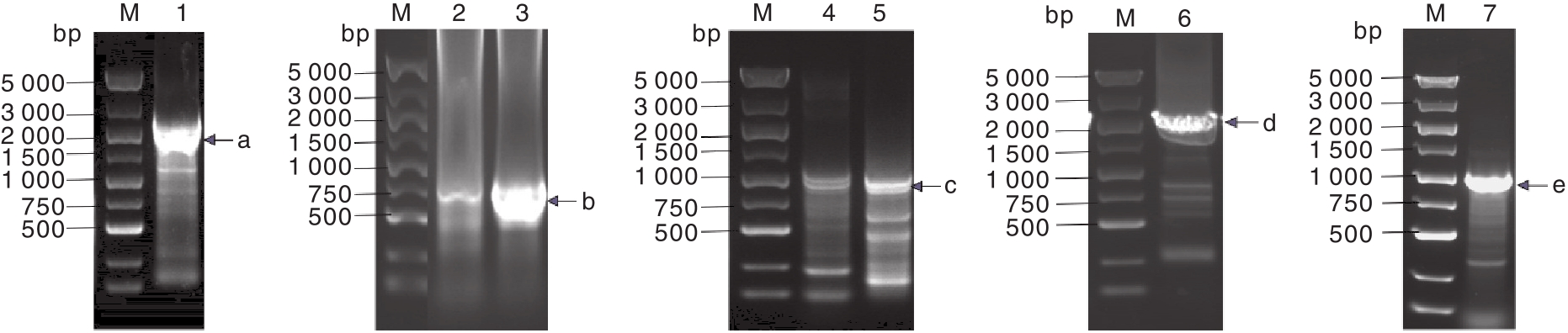
图1 EmPAL基因ORF及其启动子的克隆 M,DL 5 000;1,3'-RACE产物;2,第一次Tail-PCR第二轮产物;3,第一次Tail-PCR第三轮产物;4,第二次Tail-PCR第二轮产物;5,第二次Tail-PCR第三轮产物;6,EmPAL ORF序列PCR产物;7,EmPAL启动子序列PCR产物。
Fig.1 Cloning of EmPAL ORF and promoter M, DL 5 000; 1, PCR product of 3'-RACE; 2, Second round product of the first Tail PCR; 3, Third round product of the first Tail PCR; 4, Second round product of the second Tail PCR; 5, Third round product of the second Tail PCR; 6, PCR product of EmPAL ORF; 7, PCR product of EmPAL promoter.
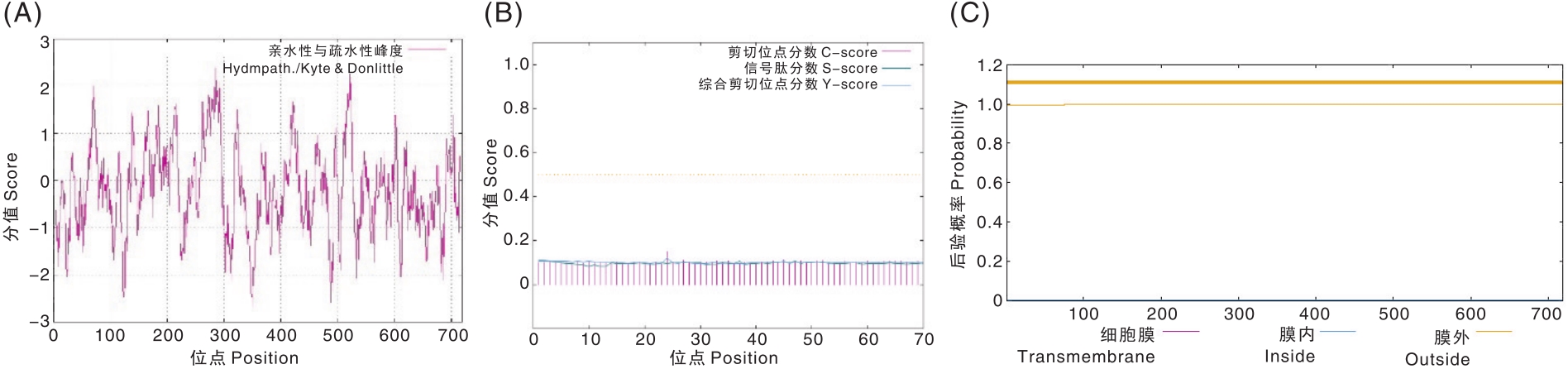
图2 EmPAL蛋白的理化性质 A,EmPAL蛋白亲/疏水性预测;B,EmPAL蛋白的信号肽预测;C,EmPAL蛋白的跨膜域预测。
Fig.2 The physicochemical properties of EmPAL protein A, Hydrophobicity or hydrophilia prediction of EmPAL protein; B, Signal peptide prediction of EmPAL protein; C, Transmembrane domain prediction of EmPAL protein.
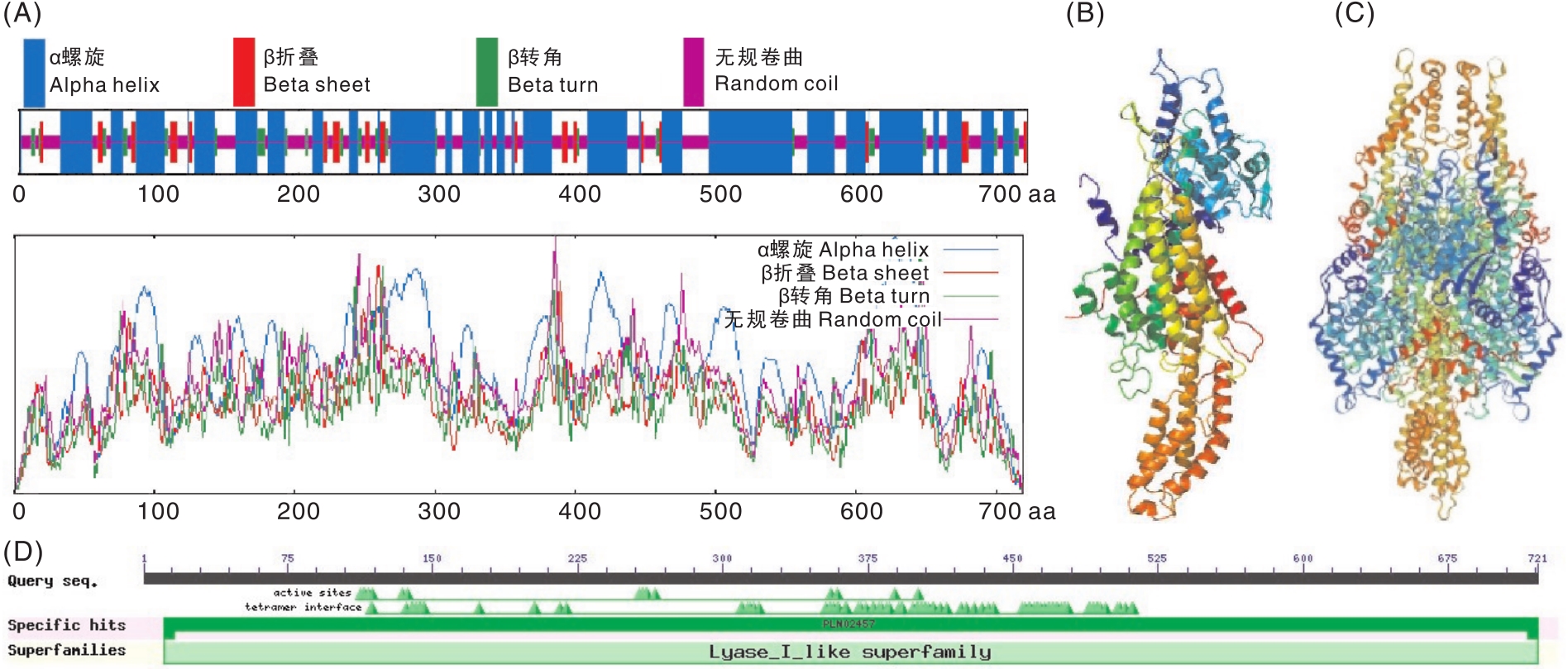
图3 EmPAL蛋白的结构 A,EmPAL蛋白的二级结构;B,EmPAL蛋白预测单体;C,EmPAL蛋白预测同型四聚体;D,EmPAL蛋白超家族。
Fig.3 Structure of EmPAL protein A, The secondary structure of EmPAL; B, Monomer of EmPAL protein prediction; C, Homotetramer of EmPAL protein prediction; D, EmPAL protein superfamily.
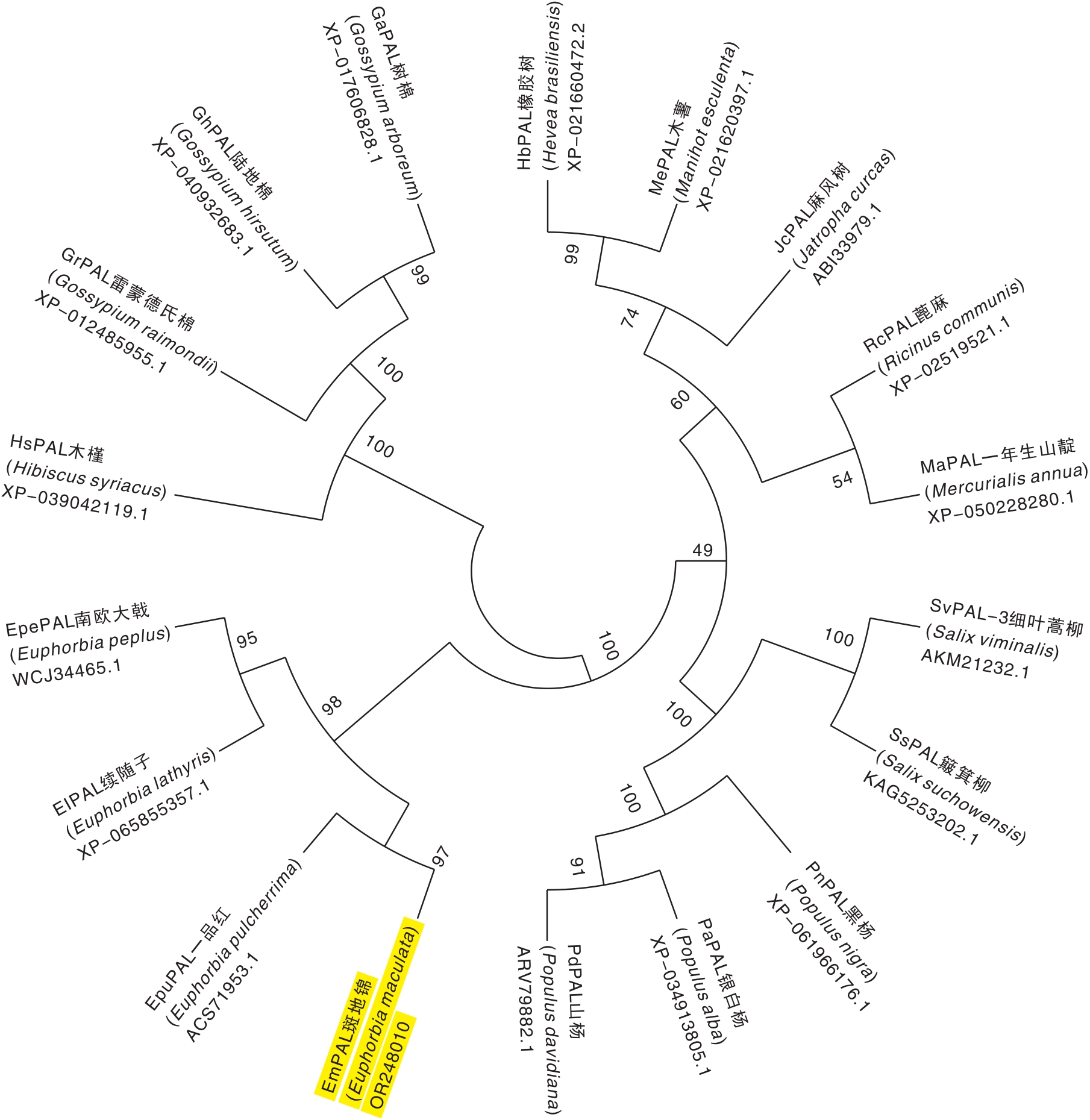
图4 EmPAL和其他不同植物PAL蛋白的系统发育树
Fig.4 Phylogenetic tree of EmPAL and other PAL proteins from different plants
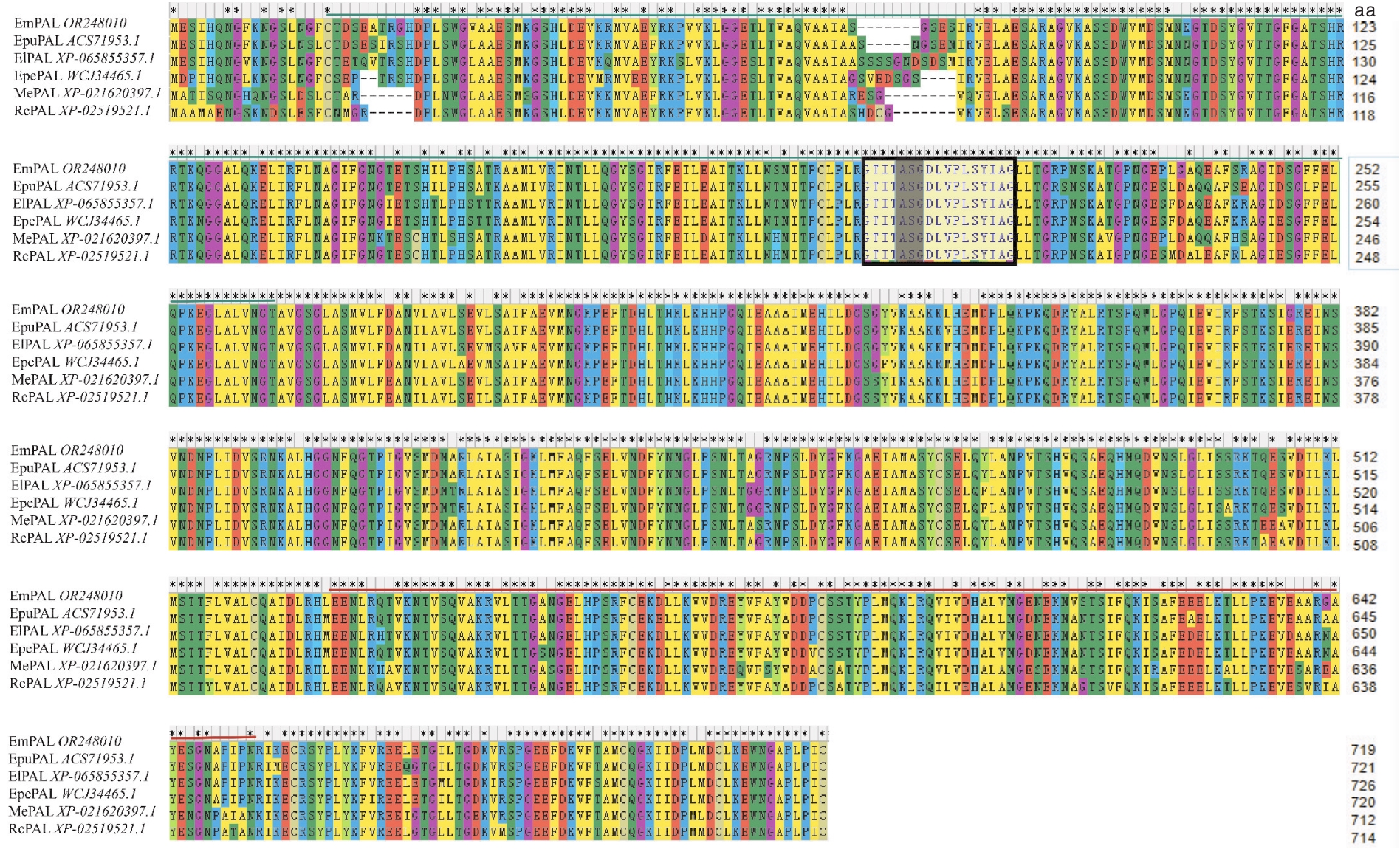
图5 EmPAL蛋白与其他大戟科植物中同源蛋白的多序列比对 绿色横线,N端域;红色横线,C端嵌入的屏蔽域;黑色方框,活性位点;黑色星号,同源序列。
Fig.5 Multiple sequence alignment of EmPAL protein and its homologues from other Euphorbiaceae plants Green line, N-terminal; Red line, C-terminal embedded shielding domain; Black box, Active site; Black asterisks, Conserved sequence.
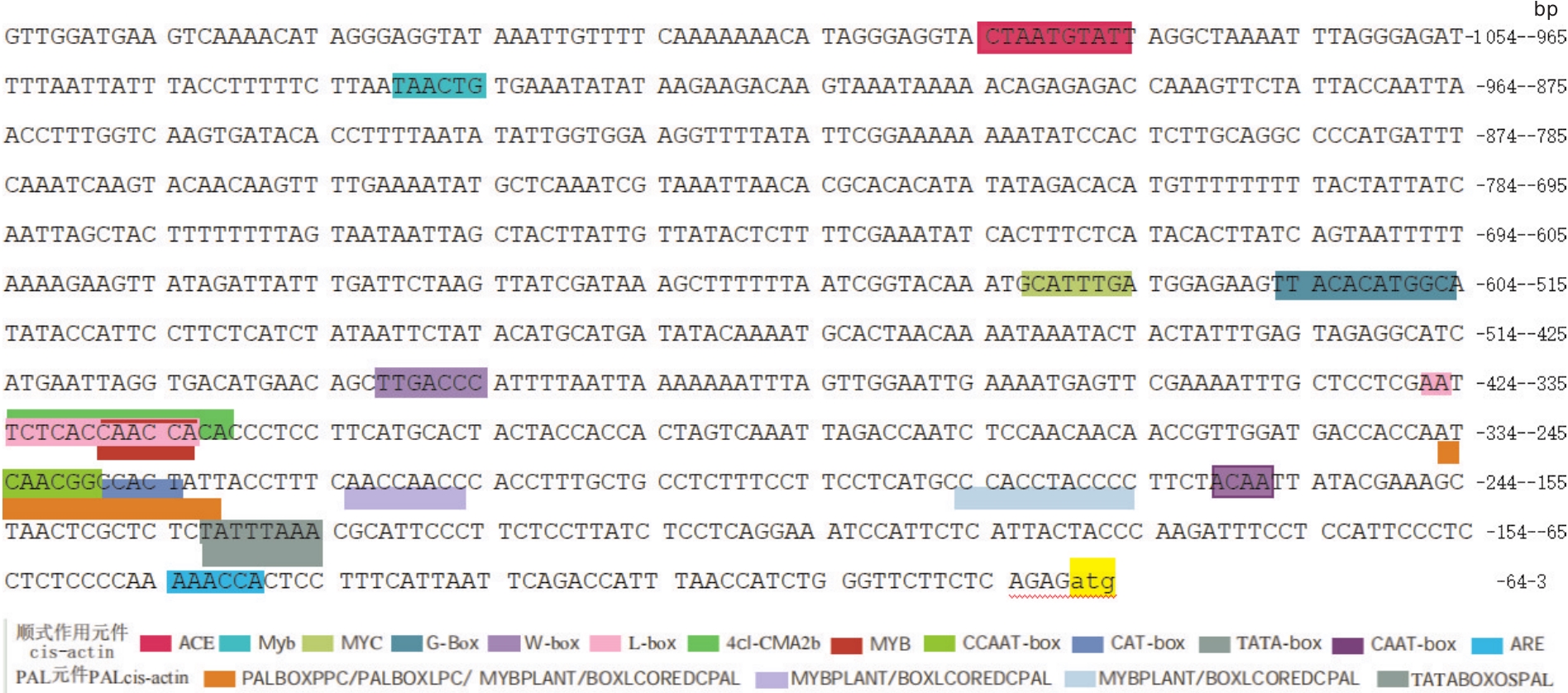
图6 EmPAL启动子的顺式作用元件
Fig.6 The cis-acting elements in the promoter of EmPAL
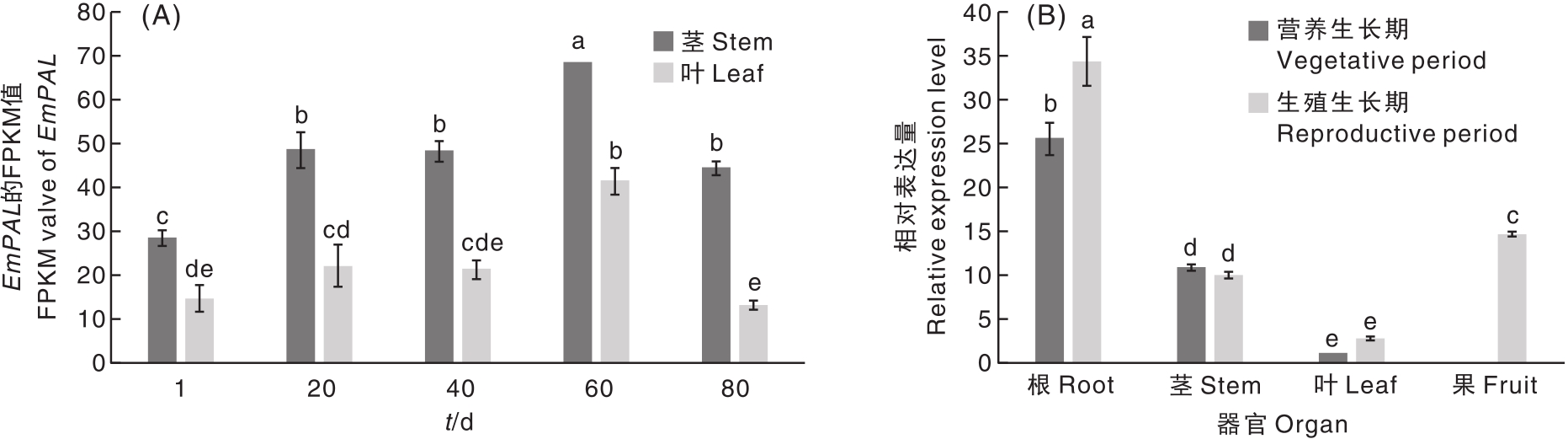
图7 EmPAL的表达模式 A,EmPAL在不同时期转录组的FPKM;B,EmPAL在不同时期的相对表达量。柱上无相同小写字母表示差异显著(p<0.05),图8同。
Fig.7 Expression pattern of EmPAL in Euphorbia maculata A, FPKM of EmPAL transcriptome at different periods; B, Relative expression of EmPAL at different developmental periods. The absence of identical lowercase letters on the column indicates significant (p<0.05) differences, as shown in Figure 8.
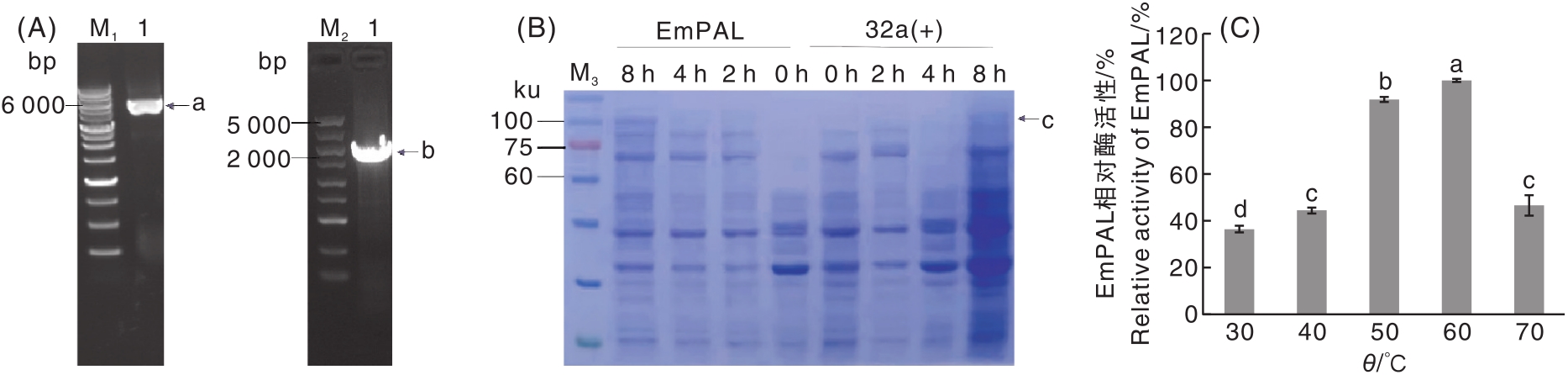
图8 EmPAL原核表达和不同温度下的相对酶活性 A,EmPAL原核表达载体构建,M1、M2为DNA Marker(DL10 k),1为pET32a(+)质粒泳道,2为pET32a(+)-EmPAL单克隆菌液PCR,a为pET32a(+)质粒特异性条带,b为EmPAL的特异性条带;B,EmPAL在大肠埃希菌 BL21(DE3) 中诱导表达SDS-PAGE,c为重组蛋白;C,EmPAL在不同温度下的相对酶活性。
Fig.8 Prokaryotic expression and relative enzyme activity at different temperatures of EmPAL A, Construction of EmPAL prokaryotic expression vector, M1 and M2 are DNA markers (DL10 k), Lane 1 is the pET32a(+) plasmid, Lane 2 is the PCR of pET32a(+)-EmPAL monoclonal bacterial culture, a is the specific band of pET32a(+), and b is the specific band of EmPAL; B, EmPAL induced expression of SDS-PAGE in Escherichia coli BL21(DE3), c is a recombinant protein; C, Relative activity of EmPAL at different temperatures.
| [1] | 国家药典委员会. 中华人民共和国药典:一部[M]. 2020年版. 北京: 中国医药科技出版社, 2020. |
| [2] | 刘海松, 曲悦, 冀翔宇, 等. 基于UHPLC-Q-TOF-MS技术的斑地锦化学成分分析[J]. 中药材, 2021, 44(6): 1409-1414. |
| Liu H S, Qu Y, Ji X Y, et al. Analysis of chemical constituents of Parthenocissus tricuspidata based on UHPLC-Q-TOF-MS technology[J]. Journal of Chinese Medicinal Materials, 2021, 44(6): 1409-1414. | |
| [3] | 余德发, 孙新琪, 于肖辉, 等. GC-MS/MS法检测肠炎宁片及其药材中禁用农药残留[J]. 药品评价, 2023, 20(9): 1064-1069. |
| Yu D F, Sun X Q, Yu X H, et al. Determination of banned pesticide residues in Changyanning tablets and its medicinal materials by GC-MS/MS method[J]. Drug Evaluation, 2023, 20(9): 1064-1069. | |
| [4] | 邱晓旭, 王帅, 李天娇, 等. 地锦草抗肝癌药效部位提取纯化工艺研究[J]. 时珍国医国药, 2025, 36(14): 2674-2680. |
| Qiu X X, Wang S, Li T J, et al. Study on the extraction and purification technology and anti-hepatocellular carcinoma medicinal parts of Euphorbiae humifusae[J]. Journal of Li-Shizhen Traditional Chinese Medicine, 2025, 36(14): 2674-2680. | |
| [5] | 宁艳梅, 任远, 吴国泰, 等. 基于代谢组学技术探讨鳖血柴胡“清肝退热”作用的“物质—效应”机制[J]. 中草药, 2022, 53(24): 7763-7773. |
| Ning Y M, Ren Y, Wu G T, et al. “Substance-effect” mechanism of Bupleuri Radix processed with Trionyx’s blood on “liver-clearing and fever-relieving” based on metabolomics[J]. Chinese Traditional and Herbal Drugs, 2022, 53(24): 7763-7773. | |
| [6] | Ge W J, Xin J P, Tian R N. Phenylpropanoid pathway in plants and its role in response to heavy metal stress: a review[J]. Chinese Journal of Biotechnology, 2023, 39(2): 425-445. |
| [7] | Barros J, Dixon R A. Plant phenylalanine/tyrosine ammonia-lyases[J]. Trends in Plant Science, 2020, 25(1): 66-79. |
| [8] | 戢强强, 陈伟达, 陈敬东, 等. 青蒿苯丙氨酸解氨酶(AaPAL)基因家族鉴定及光调控分析[J]. 分子植物育种, 2023, 21(11): 3544-3551. |
| Ji Q Q, Chen W D, Chen J D, et al. Family identification and photoregulation analysis of phenylalanine ammonia lyase (AaPAL) gene of Artemisia annua[J]. Molecular Plant Breeding, 2023, 21(11): 3544-3551. | |
| [9] | 赵咏洋, 陈维嘉, 丁静峰, 等. 决明苯丙氨酸解氨酶(PAL)基因家族的全基因组分析[J]. 湖北农业科学, 2023, 62(6): 181-187. |
| Zhao Y Y, Chen W J, Ding J F, et al. Genome wide analysis of the phenylalanine ammonia lyase (PAL)gene family from Senna tora[J]. Hubei Agricultural Sciences, 2023, 62(6): 181-187. | |
| [10] | 刘俊频, 李胜立, 袁元, 等. 膜荚黄芪3个苯丙氨酸解氨酶基因的克隆与表达分析[J]. 中草药, 2019, 50(7): 1669-1675. |
| Liu J P, Li S L, Yuan Y, et al. Cloning and expression of three PAL genes in Astragalus membranaceus[J]. Chinese Traditional and Herbal Drugs, 2019, 50(7): 1669-1675. | |
| [11] | Huang J L, Gu M, Lai Z B, et al. Functional analysis of the Arabidopsis PAL gene family in plant growth, development, and response to environmental stress[J]. Plant Physiology, 2010, 153(4): 1526-1538. |
| [12] | Hsieh L S, Hsieh Y L, Yeh C S, et al. Molecular characterization of a phenylalanine ammonia-lyase gene (BoPAL1) from Bambusa oldhamii[J]. Molecular Biology Reports, 2011, 38(1): 283-290. |
| [13] | Jun S Y, Sattler S A, Cortez G S, et al. Biochemical and structural analysis of substrate specificity of a phenylalanine ammonia-lyase[J]. Plant Physiology, 2018, 176(2): 1452-1468. |
| [14] | Ren Y, Liu J M, He L P, et al. Effect of salicylic acid treatment on disease resistance to Coleosporium zanthoxyli in Chinese pepper (Zanthoxylum armatum)[J]. Plant Disease, 2024, 108(4): 960-970. |
| [15] | Zhao Q Z, Dong M Y, Li M F, et al. Light-induced flavonoid biosynthesis in Sinopodophyllum hexandrum with high-altitude adaptation[J]. Plants, 2023, 12(3): 575. |
| [16] | Peng X, Wu H, Chen H J, et al. Transcriptome profiling reveals candidate flavonol-related genes of Tetrastigma hemsleyanum under cold stress[J]. BMC Genomics, 2019, 20(1):687. |
| [17] | Liu Y G, Chen Y L. High-efficiency thermal asymmetric interlaced PCR for amplification of unknown flanking sequences[J]. BioTechniques, 2007, 43(5): 649-656. |
| [18] | 钟小菊, 吴晴阳, 张永康, 等. 斑地锦黄烷酮-3-羟化酶基因及启动子的克隆与分析[J]. 西北植物学报, 2021, 41(9): 1475-1481. |
| Zhong X J, Wu Q Y, Zhang Y K, et al. Cloning and analysis of flavanone 3-hydroxylase gene and its promoter from Euphorbia maculata L[J]. Acta Botanica Boreali-Occidentalia Sinica, 2021, 41(9): 1475-1481. | |
| [19] | Makgoo L, Mosebi S, Mbita Z. In silico analysis of s-DAPK-1: from structure to function and regulation[J]. Current Issues in Molecular Biology, 2025, 47(6): 416. |
| [20] | Ma H R, Yuan H L, Bu W X, et al. Identification and bioinformatics analysis of the HSP20 family in the peony[J]. Genes, 2025, 16(7): 742. |
| [21] | Segura-Alabart N, Serratosa F, Gómez S, et al. Nonunique UPGMA clusterings of microsatellite markers[J]. Briefings in Bioinformatics, 2022, 23(5): bbac312. |
| [22] | Wei Y X, Song Y H, Khan M A, et al. GhTPPA_2 enhancement of tobacco sugar accumulation and drought tolerance[J]. Gene, 2024, 894: 147969. |
| [23] | 许建丰, 桂明明, 张永康, 等. 基于转录组测序的斑地锦内参基因筛选及验证[J]. 热带作物学报, 2023, 44(11): 2273-2280. |
| Xu J F, Gui M M, Zhang Y K, et al. Selection and verification of the reference genes of Euphorbia maculata based on transcriptome sequencing[J]. Chinese Journal of Tropical Crops, 2023, 44(11): 2273-2280. | |
| [24] | 罗才林, 李林, 陈立, 等. 白及苯丙氨酸解氨酶基因的克隆、序列特征及激素响应表达分析[J]. 中草药, 2019, 50(3): 694-701. |
| Luo C L, Li L, Chen L, et al. Cloning, sequence characterization, expression profiling of hormones response of phenylalanine ammonia-lyase gene in Bletilla striata[J]. Chinese Traditional and Herbal Drugs, 2019, 50(3): 694-701. | |
| [25] | 何潇, 刘兴, 辛正琦, 等. 半夏PtPAL基因的克隆、表达与酶动力学分析[J]. 作物学报, 2021, 47(10): 1941-1952. |
| He X, Liu X, Xin Z Q, et al. Molecular cloning, expression, and enzyme kinetic analysis of a phenylalanine ammonia-lyase gene in Pinellia ternate[J]. Acta Agronomica Sinica, 2021, 47(10): 1941-1952. | |
| [26] | 张玉, 杨文静, 刘璇, 等. 马铃薯细胞壁蔗糖转化酶基因StCWIN1启动子克隆与表达及其在干旱胁迫下的作用分析[J]. 作物杂志, 2024(2): 54-61. |
| Zhang Y, Yang W J, Liu X, et al. Cloning and expression analysis of potato StCWIN1 gene promoter and its role under drought stress[J]. Crops, 2024(2): 54-61. | |
| [27] | Campos R, Nonogaki H, Suslow T, et al. Isolation and characterization of a wound inducible phenylalanine ammonia-lyase gene (LsPAL1) from Romaine lettuce leaves[J]. Physiologia Plantarum, 2004, 121(3): 429-438. |
| [28] | Khakdan F, Alizadeh H, Ranjbar M. Molecular cloning, functional characterization and expression of a drought inducible phenylalanine ammonia-lyase gene (ObPAL) from Ocimum basilicum L[J]. Plant Physiology and Biochemistry, 2018, 130: 464-472. |
| [29] | Sablowski R W, Moyano E, Culianez-Macia F A, et al. A flower-specific Myb protein activates transcription of phenylpropanoid biosynthetic genes[J]. The EMBO Journal, 1994, 13(1): 128-137. |
| [30] | Maeda K, Kimura S, Demura T, et al. DcMYB1 acts as a transcriptional activator of the carrot phenylalanine ammonia-lyase gene (DcPAL1) in response to elicitor treatment, UV-B irradiation and the dilution effect[J]. Plant Molecular Biology, 2005, 59(5): 739-752. |
| [31] | Logemann E, Parniske M, Hahlbrock K. Modes of expression and common structural features of the complete phenylalanine ammonia-lyase gene family in parsley[J]. Proceedings of the National Academy of Sciences of the United States of America, 1995, 92(13): 5905-5909. |
| [32] | Zhu Q, Ordiz M I, Dabi T, et al. Rice TATA binding protein interacts functionally with transcription factor IIB and the RF2a bZIP transcriptional activator in an enhanced plant in vitro transcription system[J]. The Plant Cell, 2002, 14(4): 795-803. |
| [33] | Sui Z W, Luo J, Yao R L, et al. Functional characterization and correlation analysis of phenylalanine ammonia-lyase (PAL) in coumarin biosynthesis from Peucedanum praeruptorum Dunn[J]. Phytochemistry, 2019, 158: 35-45. |
| [34] | Takshak S, Agrawal S B. Secondary metabolites and phenylpropanoid pathway enzymes as influenced under supplemental ultraviolet-B radiation in Withania somnifera, an indigenous medicinal plant[J]. Journal of Photochemistry and Photobiology B: Biology, 2014, 140: 332-343. |
| [35] | Xu F, Cai R, Cheng S Y, et al. Molecular cloning, characterization and expression of phenylalanine ammonia-lyase gene from Ginkgo biloba[J]. African Journal of Biotechnology, 2008, 7(6): 721-729. |
| [36] | Zhu Q L, Xie X R, Lin H X, et al. Isolation and functional characterization of a phenylalanine ammonia-lyase gene (SsPAL1) from Coleus(Solenostemon scutellarioides(L.) Codd)[J]. Molecules, 2015, 20(9): 16833-16851. |
| [37] | 张晨, 臧颖, 许倩, 等. 毛果杨苯丙氨酸解氨酶活性比较及肉桂酸制备[J]. 南京林业大学学报(自然科学版), 2020, 44(1): 97-104. |
| Zhang C, Zang Y, Xu Q, et al. Comparison on activities of phenylalanine ammonia-lyase from Populus trichocarpa and its application in trans-cinnamic acid production[J]. Journal of Nanjing Forestry University(Natural Sciences Edition), 2020, 44(1): 97-104. | |
| [38] | Phimchan P, Chanthai S, Bosland P W, et al. Enzymatic changes in phenylalanine ammonia-lyase, cinnamic-4-hydroxylase, capsaicin synthase, and peroxidase activities in Capsicum under drought stress[J]. Journal of Agricultural and Food Chemistry, 2014, 62(29): 7057-7062. |
| [1] | 汪瑶, 史林永, 张恒, 邹桂花, 朱英. 高粱粒重研究进展[J]. 浙江农业学报, 2026, 38(8): 1717-1728. |
| [2] | 王蓉丽, 徐子歆, 张镇武, 吴慧欣, 邢承华. 减氮配施生物炭对南方红壤紫花苜蓿生长及土壤酶活性的影响[J]. 浙江农业学报, 2026, 38(6): 1236-1245. |
| [3] | 吕勇杰, 孙万春, 马军伟, 朱晓芳, 叶静, 俞巧钢, 王强, 陈照明, 陈正道, 周俊, 何新华, 王峰. 南方红黄壤耕地酸化特征及其对土壤肥力与酶活性的影响——以缙云县酸化治理示范区为例[J]. 浙江农业学报, 2026, 38(5): 965-978. |
| [4] | 代雪艳, 肖鹏, 符雪珍, 胡洁, 常宇昕, 赵伟, 廖敏. 与传染性支气管炎病毒核衣壳蛋白互作的宿主RNA结合蛋白的鉴定[J]. 浙江农业学报, 2026, 38(4): 632-642. |
| [5] | 郭冉冉, 徐珂, 李正鹏, 严清彪, 李蓉, 韩梅. 绿肥还田对土壤无机磷组分及小麦磷吸收的影响[J]. 浙江农业学报, 2026, 38(1): 114-125. |
| [6] | 缪百灵, 陈娟娟, 李亮杰, 楚宗丽, 董向向. 浙江红花油茶CchABCG5基因的功能[J]. 浙江农业学报, 2025, 37(7): 1407-1416. |
| [7] | 陈梦微, 梁徐, 张成磊, 梁璟, 许樱子, 项丹丹, 杨照渠, 谢永东. 微生物菌肥对东魁杨梅土壤性状和叶片营养的影响[J]. 浙江农业学报, 2025, 37(5): 1130-1138. |
| [8] | 杜颂, 汤涛, 程曦, 赵学平, 张春荣, 梁晓宇, 王萌, 张震, 李永成, 章程辉. 砜吡草唑及其主要代谢物在土壤中的消解和对土壤酶活性的影响研究[J]. 浙江农业学报, 2025, 37(4): 847-857. |
| [9] | 张美莹, 莫倩, 齐秀双, 佟宁宁, 孔凡, 刘政安, 吕长平, 彭丽平. 牡丹PoLPAT2基因的克隆及表达分析[J]. 浙江农业学报, 2025, 37(2): 321-328. |
| [10] | 谈荣想, 斯广杰, 孙海涛, 许婷. 十足目虹彩病毒1和虾肝肠胞虫双重荧光定量PCR检测方法的建立[J]. 浙江农业学报, 2025, 37(12): 2468-2478. |
| [11] | 李杏, 刘燕, 高健洲. 三种芍药属植物FLOWERING LOCUS T(FT)同源基因的克隆与表达分析[J]. 浙江农业学报, 2025, 37(1): 90-102. |
| [12] | 沈峥嵘, 戴远兴, 郭留明, 汪芷瑶, 张恒木. 中国小麦花叶病毒(CWMV)外壳蛋白(CP)特异性抗体的制备与应用[J]. 浙江农业学报, 2024, 36(9): 2042-2050. |
| [13] | 孙培媛, 冉彬, 王佳蕊, 李洪有. 苦荞FtDELLA基因的克隆与表达分析[J]. 浙江农业学报, 2024, 36(8): 1709-1718. |
| [14] | 朱贵爽, 李艳肖, 张安宁, 孙浩楠, 徐兴源, 李志刚, 向殿军. 蓖麻GeBP转录因子的全基因组鉴定与GeBP2基因的克隆、表达分析[J]. 浙江农业学报, 2024, 36(8): 1731-1740. |
| [15] | 蒋文骏, 舒红锁, 陈正满, 任典挺, 杨党, 田荣江, 杜照奎. 秋茄KoWRKY43基因克隆、表达与生物信息学分析[J]. 浙江农业学报, 2024, 36(8): 1832-1843. |
| 阅读次数 | ||||||
|
全文 |
|
|||||
|
摘要 |
|
|||||

