浙江农业学报 ›› 2025, Vol. 37 ›› Issue (12): 2504-2515.DOI: 10.3969/j.issn.1004-1524.20240770
鱼蛋白水解物对番茄幼苗生长及光合特性的影响
肖毓淼1( ), 马巧梅2, 张思法3, 何勇1,*(), 赵振卿2
- 1.浙江农林大学 园艺科学学院,浙江 杭州 311300
2.浙江省农业科学院 蔬菜研究所,浙江 杭州 310021
3.杭州鲁瑞农业开发有限公司,浙江 杭州 311519
-
收稿日期:2024-08-30出版日期:2025-12-25发布日期:2026-01-09 -
作者简介:肖毓淼(2000—),男,浙江杭州人,硕士,研究方向为蔬菜栽培与生理生态研究。E-mail: 954382195@qq.com -
通讯作者:*何勇,E-mail: heyong@zafu.edu.cn -
基金资助:国家自然科学基金(32302644);浙江省农业重大技术协同推广计划(2023ZDXT05)
Effects of fish protein hydrolysate on the growth and photosynthetic characteristics of tomato seedlings
XIAO Yumiao1(), MA Qiaomei2, ZHANG Sifa3, HE Yong1,*(), ZHAO Zhenqing2
- 1. College of Horticultural Science, Zhejiang A&F University, Hangzhou 311300, China
2. Institute of Vegetables, Zhejiang Academy of Agricultural Sciences, Hangzhou 310021, China
3. Hangzhou Lurui Agricultural Development Co., Ltd., Hangzhou 311519, China
-
Received:2024-08-30Online:2025-12-25Published:2026-01-09

摘要: 为研究鱼蛋白水解物对番茄幼苗生长及光合特性的影响,以番茄CR(Solanum lycopersicum var. cerasiforme)品种为试验材料,设置5种不同浓度的鱼蛋白水解物处理,测定番茄幼苗株高、根长、生物量、根系活力、营养指标、抗氧化酶活性、光合指标、叶绿素含量和叶绿素荧光参数,以期明确适宜番茄幼苗生长的鱼蛋白水解物浓度。结果表明,与对照相比,T1、T2、T3、T4(鱼蛋白水解物稀释2 000、1 600、1 200、800倍)处理促进了番茄幼苗生长。其中T3(稀释1 200倍)处理促进番茄幼苗生长效果最佳,其株高、茎粗、根长、地上部鲜重、地下部鲜重和根系活力显著(p<0.05)高于其他处理和对照,可溶性糖和可溶性蛋白含量也较对照显著提升。T3处理下番茄幼苗过氧化物酶(POD)、超氧化物歧化酶(SOD)活性显著提升,丙二醛(MDA)含量显著降低,抗氧化、抗逆能力增强。与对照相比,T3处理下番茄幼苗叶绿素总含量和净光合速率分别增加了22.16%和23.57%。同时,T3处理显著提高了番茄幼苗PSⅡ最大光化学效率(Fv/Fm)、PSⅡ实际光化学效率(ΦPSⅡ)、非光化学猝灭系数(NPQ)。因此,鱼蛋白水解物稀释1 200倍处理能显著促进番茄幼苗生长,增强其光合特性。本研究为番茄育苗提供了一种高效、可持续的施肥方法,具有一定的应用价值和推广前景,为鱼蛋白水解物在蔬菜育苗中的应用提供了理论依据。
中图分类号:
引用本文
肖毓淼, 马巧梅, 张思法, 何勇, 赵振卿. 鱼蛋白水解物对番茄幼苗生长及光合特性的影响[J]. 浙江农业学报, 2025, 37(12): 2504-2515.
XIAO Yumiao, MA Qiaomei, ZHANG Sifa, HE Yong, ZHAO Zhenqing. Effects of fish protein hydrolysate on the growth and photosynthetic characteristics of tomato seedlings[J]. Acta Agriculturae Zhejiangensis, 2025, 37(12): 2504-2515.
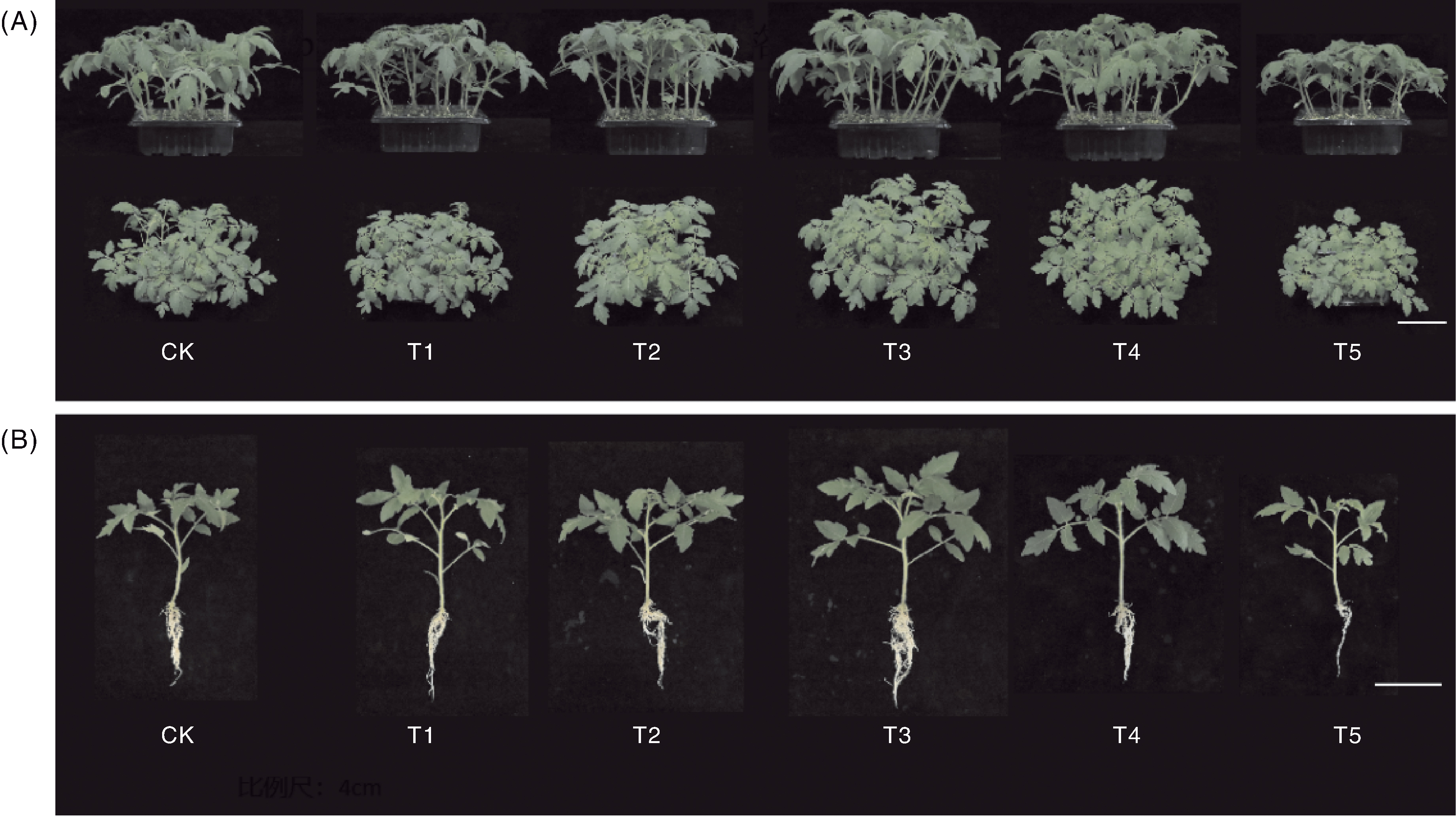
图1 不同处理下番茄幼苗的表型 图A为整体番茄幼苗正视与俯视表型图,图B为单株番茄幼苗正视表型图,比例尺=4 cm。T1、T2、T3、T4、T5分别为鱼蛋白水解物稀释2 000、1 600、1 200、800、400倍处理,CK为不添加鱼蛋白水解物。图2~7同。
Fig.1 Phenotype of tomato seedlings under different treatments Figure A shows the front and top phenotype maps of overall tomato seedlings, figure B shows the front phenotype map of single tomato seedlings, with a scale of 4 cm. T1, T2, T3, T4, and T5 were treated with fish protein hydrolysate diluted 2 000, 1 600, 1 200, 800, and 400 times, respectively. CK was treated without adding fish protein hydrolysate. The same as Figures 2 to 7.
| 处理 Treatment | 株高 Plant height/cm | 茎粗 Stem diameter/cm | 根长 Root length/cm | 地上部鲜重 Fresh weight of aboveground/g | 地下部鲜重 Fresh weight of underground/g | 根冠比 Root-to-shoot ratio |
|---|---|---|---|---|---|---|
| CK | 11.63±0.82 d | 0.423±0.022 d | 9.64±0.51 e | 3.53±0.33 c | 0.81±0.11 e | 0.230±0.033 c |
| T1 | 12.55±0.33 bc | 0.443±0.016 c | 11.24±0.61 c | 3.39±0.31 c | 0.92±0.14 d | 0.270±0.034 b |
| T2 | 12.21±0.41 c | 0.482±0.016 b | 10.50±0.79 d | 4.11±0.27 b | 1.48±0.16 b | 0.291±0.041 ab |
| T3 | 13.53±0.32 a | 0.534±0.024 a | 13.18±0.65 a | 5.43±0.16 a | 1.75±0.16 a | 0.322±0.030 a |
| T4 | 12.77±0.55 b | 0.484±0.019 b | 11.81±0.65 b | 4.00±0.28 b | 1.19±0.09 c | 0.299±0.031 ab |
| T5 | 7.87±0.41 e | 0.380±0.017 e | 9.89±0.62 e | 1.76±0.29 d | 0.54±0.08 f | 0.316±0.079 a |
表1 不同处理下番茄幼苗的生长指标
Table 1 Growth indexes of tomato seedlings under different treatments
| 处理 Treatment | 株高 Plant height/cm | 茎粗 Stem diameter/cm | 根长 Root length/cm | 地上部鲜重 Fresh weight of aboveground/g | 地下部鲜重 Fresh weight of underground/g | 根冠比 Root-to-shoot ratio |
|---|---|---|---|---|---|---|
| CK | 11.63±0.82 d | 0.423±0.022 d | 9.64±0.51 e | 3.53±0.33 c | 0.81±0.11 e | 0.230±0.033 c |
| T1 | 12.55±0.33 bc | 0.443±0.016 c | 11.24±0.61 c | 3.39±0.31 c | 0.92±0.14 d | 0.270±0.034 b |
| T2 | 12.21±0.41 c | 0.482±0.016 b | 10.50±0.79 d | 4.11±0.27 b | 1.48±0.16 b | 0.291±0.041 ab |
| T3 | 13.53±0.32 a | 0.534±0.024 a | 13.18±0.65 a | 5.43±0.16 a | 1.75±0.16 a | 0.322±0.030 a |
| T4 | 12.77±0.55 b | 0.484±0.019 b | 11.81±0.65 b | 4.00±0.28 b | 1.19±0.09 c | 0.299±0.031 ab |
| T5 | 7.87±0.41 e | 0.380±0.017 e | 9.89±0.62 e | 1.76±0.29 d | 0.54±0.08 f | 0.316±0.079 a |
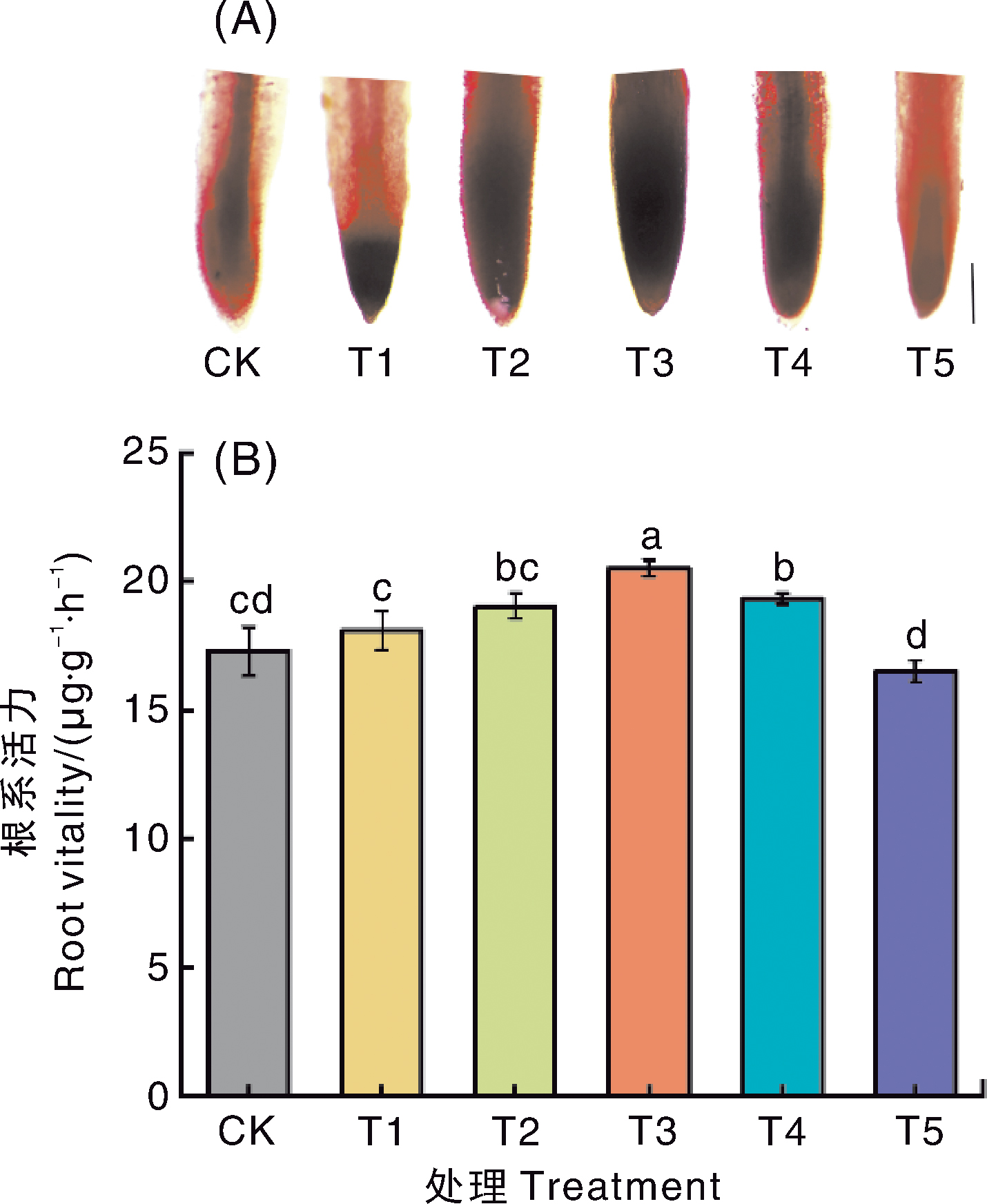
图2 不同处理下番茄的根系活力 图A为显微镜下番茄根尖染色情况,比例尺=1 mm;图B为番茄根系活力。同组柱上无相同小写字母表示不同处理间差异显著(p<0.05),图3~7同。
Fig.2 Root vitality of tomato under different treatments Figure A shows the staining of tomato root tips under a microscope, with a scale of 1 mm; Figure B shows the root vitality of tomato. The absence of identical lowercase letters above columns in the same group indicates significant (p<0.05) differences between treatments, the same as shown in Figures 3-7.
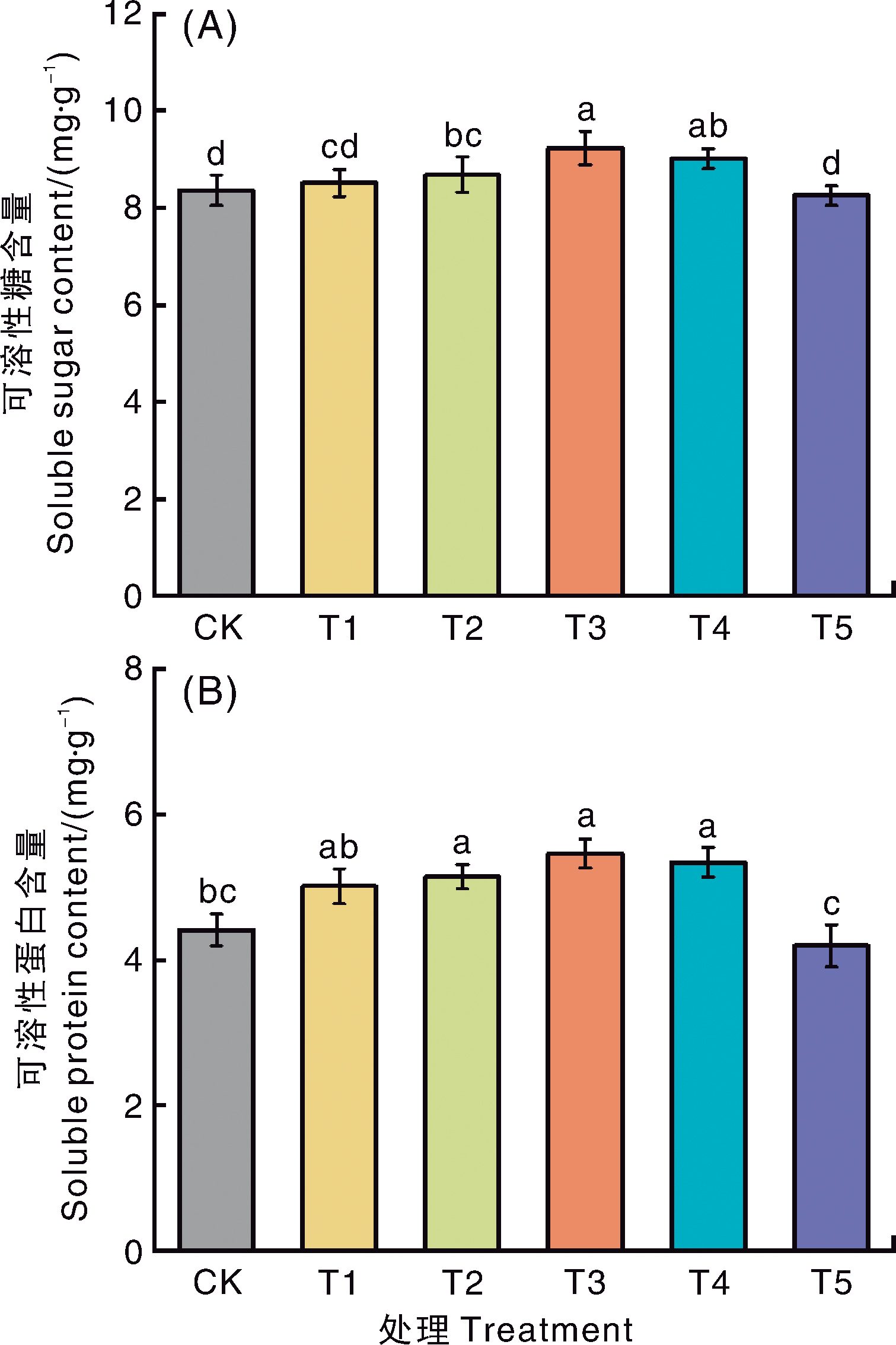
图3 不同处理下番茄幼苗叶片营养指标
Fig.3 Nutritional indicators of tomato seedlings under different treatments
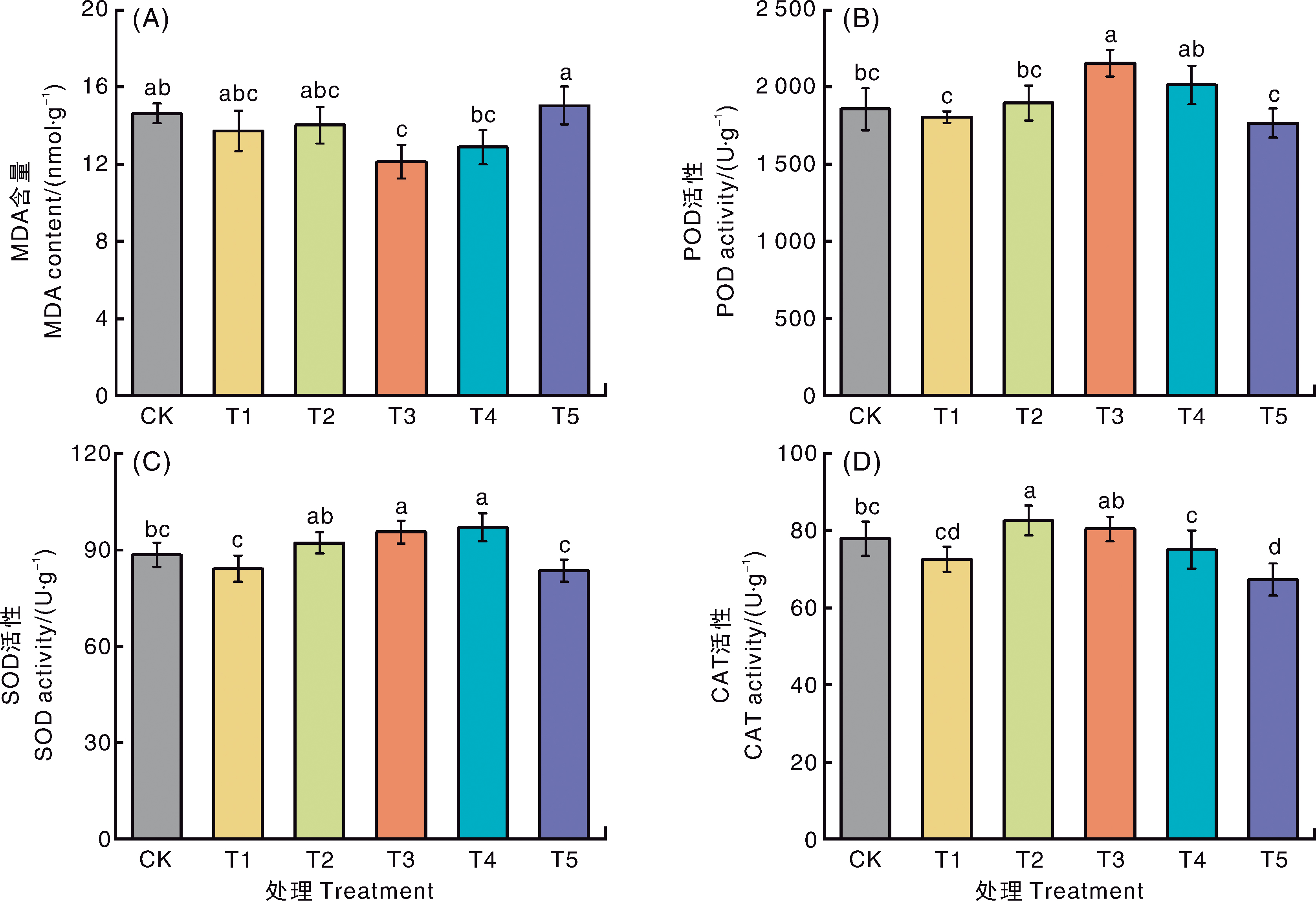
图4 不同处理下番茄幼苗的抗氧化指标
Fig.4 Antioxidant system of tomato seedlings under different treatments
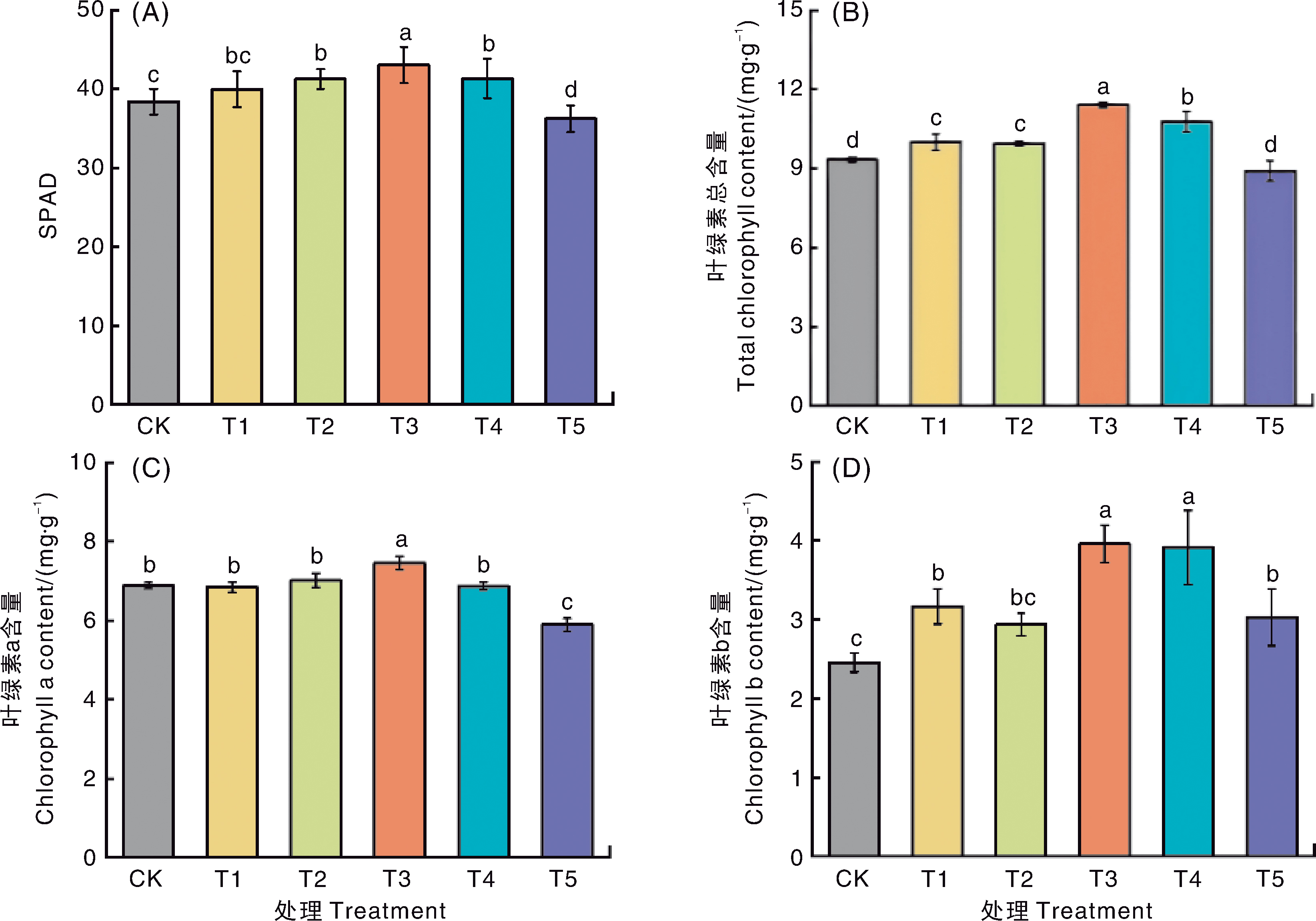
图5 不同处理下番茄幼苗叶绿素含量
Fig.5 Chlorophyll contents of tomato seedlings under different treatments
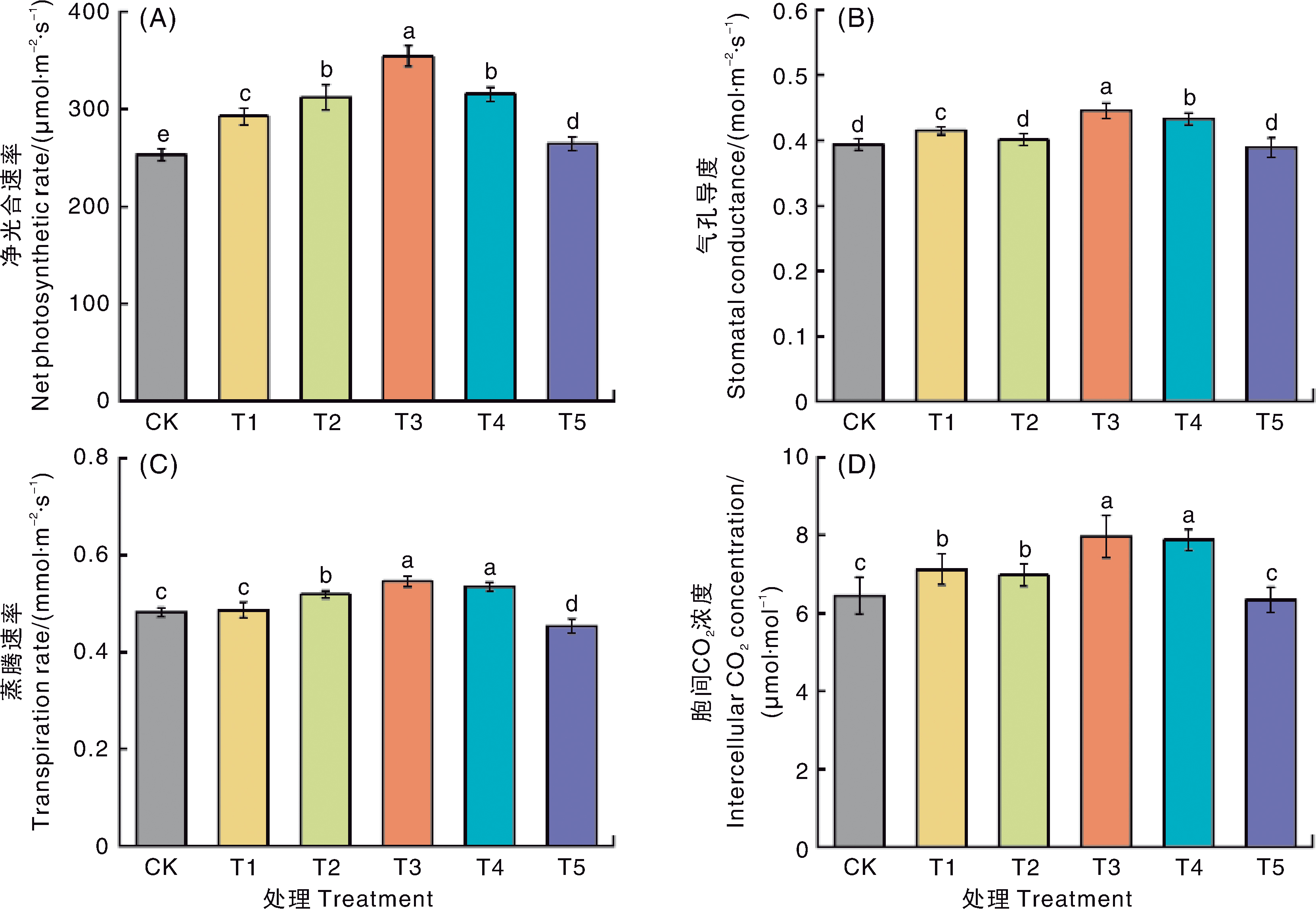
图6 不同处理下番茄幼苗光合指标
Fig.6 Photosynthetic indicators of tomato seedlings under different treatments
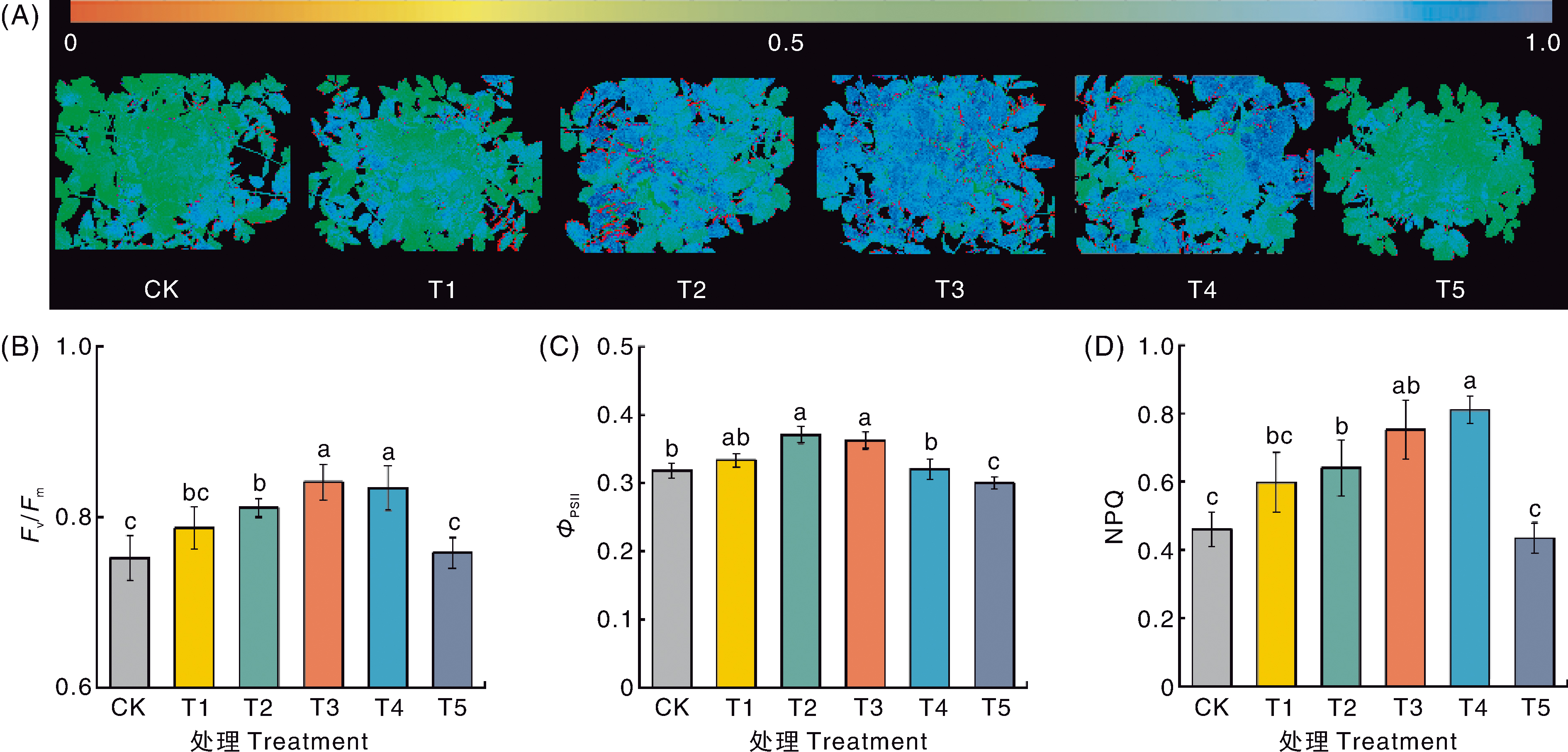
图7 不同处理下番茄幼苗叶绿素荧光参数 图A为PSⅡ最大光化学效率(Fv/Fm)成像图,颜色越接近深蓝,其数值越大;图B为PSⅡ最大光化学效率(Fv/Fm);图C为实际光化学效率(ΦPSⅡ);图D为非光化学猝灭系数(NPQ)。
Fig.7 Chlorophyll fluorescence parameters of tomato seedlings under different treatments Figure A shows the imaging of the PSⅡ maximum photochemical efficiency(Fv/Fm), with values increasing as the color approaches deep blue; Figure B shows the PSⅡ maximum photochemical efficiency(Fv/Fm); Figure C shows the actual photochemical efficiency parameter (ΦPSⅡ); Figure D shows the non-photochemical quenching coefficient (NPQ).
| [1] | 谭乐增, 杨晓东, 李夕进, 等. 育苗基质添加不同调节剂对番茄幼苗生长发育的影响[J]. 园艺与种苗, 2023, 43(9): 1-3. |
| TAN L Z, YANG X D, LI X J, et al. Effects of different regulators added to seedling substrate on growth and development of tomato seedlings[J]. Horticulture & Seed, 2023, 43(9): 1-3. (in Chinese with English abstract) | |
| [2] | 宋天宇, 张璐. 腐熟花生壳和腐植酸复合园林废弃物堆肥对紫苏出苗的影响[J]. 浙江农林大学学报, 2023, 40(2): 304-313. |
| SONG T Y, ZHANG L. Effect of green waste compost combined decomposed peanut shells and humic acid on seedling emergence of Perilla frutescens[J]. Journal of Zhejiang A&F University, 2023, 40(2): 304-313. (in Chinese with English abstract) | |
| [3] | 徐昱松, 宫彬彬, 吴晓蕾, 等. 育苗基质喷施海藻肥对番茄幼苗生长的影响[J]. 河北农业大学学报, 2022, 45(4): 32-36. |
| XU Y S, GONG B B, WU X L, et al. Effects of spraying seaweed fertilizer on the growth of tomato seedings aying seaweed fertilizer on the growth of tomato seedlings[J]. Journal of Agricultural University of Hebei, 2022, 45(4): 32-36. (in Chinese with English abstract) | |
| [4] | 魏修利, 雷平, 石伟勇. 鱼蛋白有机液肥对小粉土酶活性和微生物生物量碳、氮的影响[J]. 应用生态学报, 2010, 21(8): 2086-2091. |
| WEI X L, LEI P, SHI W Y. Effects of organic fish protein liquid fertilizer on enzyme activities and microbial biomass C and N in a silt soil[J]. Chinese Journal of Applied Ecology, 2010, 21(8): 2086-2091. (in Chinese with English abstract) | |
| [5] | 卢运艳, 张广忠, 徐勤政, 等. 矿源黄腐酸钾与鱼蛋白配施在番茄上的应用效果[J]. 腐植酸, 2023(3): 46-50. |
| LU Y Y, ZHANG G Z, XU Q Z, et al. Application effect of mineral based potassium fulvate combined with fish protein on tomato[J]. Humic Acid, 2023(3): 46-50. (in Chinese with English abstract) | |
| [6] | 潘烨, 谢贞清, 金娟. 鱼蛋白有机肥料对番茄果实甜度及风味的影响[J]. 农业工程技术, 2021, 41(10): 62-64. |
| PAN Y, XIE Z Q, JIN J. Effect of fish protein organic fertilizer on sweetness and flavor of tomato fruit[J]. Applied Engineering Technology, 2021, 41(10): 62-64. (in Chinese) | |
| [7] | 洪迪. 鱼蛋白水解物促进番茄果实糖酸积累的研究[D]. 沈阳: 沈阳农业大学, 2023. |
| HONG D. Study on the promotion of sugar and acid accumulation in tomato fruits by fish protein hydrolysates[D]. Shenyang: Shenyang Agricultural University, 2023. (in Chinese with English abstract) | |
| [8] | 李婷, 张静, 曲明山, 等. 喷施鱼蛋白对网纹甜瓜生长发育及果实品质的影响[J]. 中国瓜菜, 2023, 36(6): 58-63. |
| LI T, ZHANG J, QU M S, et al. Effects of spraying fish protein on growth and fruit quality of netted melon[J]. China Cucurbits and Vegetables, 2023, 36(6): 58-63. (in Chinese with English abstract) | |
| [9] | 杨志莹, 张海良, 王胜, 等. 盐胁迫下丁香叶绿素含量与SPAD值相关性分析[J]. 山东农业科学, 2021, 53(9): 8-12. |
| YANG Z Y, ZHANG H L, WANG S, et al. Correlation analysis between chlorophyll content and SPAD value of Syringa under salt stress[J]. Shandong Agricultural Sciences, 2021, 53(9): 8-12. (in Chinese with English abstract) | |
| [10] | 王学奎. 植物生理生化实验原理和技术[M]. 2版. 北京: 高等教育出版社, 2006. |
| [11] | 李合生. 植物生理生化实验原理和技术[M]. 北京: 高等教育出版社, 2000: 192-260. |
| [12] | 高俊凤. 植物生理学实验指导[M]. 北京: 高等教育出版社, 2006: 210-211. |
| [13] | GONG H J, ZHU X Y, CHEN K M, et al. Silicon alleviates oxidative damage of wheat plants in pots under drought[J]. Plant Science, 2005, 169(2): 313-321. |
| [14] | CAKMAK I, MARSCHNER H. Magnesium deficiency and high light intensity enhance activities of superoxide dismutase, ascorbate peroxidase, and glutathione reductase in bean leaves[J]. Plant Physiology, 1992, 98(4): 1222-1227. |
| [15] | TAN W, LIU J, DAI T, et al. Alterations in photosynthesis and antioxidant enzyme activity in winter wheat subjected to post-anthesis water-logging[J]. Photosynthetica, 2008, 46(1): 21-27. |
| [16] | SHI X P, JIANG F L, WEN J Q, et al. Overexpression of Solanum habrochaites microRNA319d (Sha-miR319d) confers chilling and heat stress tolerance in tomato (S. lycopersicum)[J]. BMC Plant Biology, 2019, 19(1): 214. |
| [17] | MA Q M, HU Z J, MAO Z, et al. The novel leucine-rich repeat receptor-like kinase MRK1 regulates resistance to multiple stresses in tomato[J]. Horticulture Research, 2022, 9: uhab088. |
| [18] | COLLA G, ROUPHAEL Y, CANAGUIER R, et al. Biostimulant action of a plant-derived protein hydrolysate produced through enzymatic hydrolysis[J]. Frontiers in Plant Science, 2014, 5: 448. |
| [19] | 郑剑超, 李明, 史芳芳, 等. 化肥减量配施有机肥和微生物肥对番茄光合特性和肥料利用率的影响[J]. 中国瓜菜, 2024, 37(2): 74-79. |
| ZHENG J C, LI M, SHI F F, et al. Effects of chemical fertilizer reduction combined with organic fertilizer and microbial fertilizer on photosynthetic characteristics and fertilizer utilization rate of tomato[J]. China Cucurbits and Vegetables, 2024, 37(2): 74-79. (in Chinese with English abstract) | |
| [20] | 李云飞, 王冰华, 王铁臣. 化肥减量配施鱼蛋白有机液肥对番茄产量和品质的影响[J]. 蔬菜, 2024(1): 35-39. |
| LI Y F, WANG B H, WANG T C. Effects of reducing chemical fertilizer combined with fish protein organic liquid fertilizer on tomato yield and quality[J]. Vegetables, 2024(1): 35-39. (in Chinese with English abstract) | |
| [21] | 唐宇. 化肥减施条件下配施生物有机肥对番茄生长及其土壤的影响[D]. 乌鲁木齐: 新疆大学, 2019. |
| TANG Y. Effects of applying bio-organic fertilizer on tomato growth and soil under reduced fertilizer application[D]. Urumqi: Xinjiang University, 2019. (in Chinese with English abstract) | |
| [22] | 祁瑞雪, 马慧, 林薇, 等. 鱼蛋白水解物对黄瓜幼苗促生和基质养分活化的效果[J]. 江苏农业学报, 2022, 38(1): 172-180. |
| QI R X, MA H, LIN W, et al. Effects of fish protein hydrolysates on growth promotion and substrate nu-trient activation of cucumber seedlings[J]. Jiangsu Journal of Agricultural Sciences, 2022, 38(1): 172-180. (in Chinese with English abstract) | |
| [23] | 刘希港, 季托, 李卓孟, 等. 不同生物刺激剂对茄子幼苗质量的影响[J]. 中国蔬菜, 2023(4): 79-86. |
| LIU X G, JI T, LI Z M, et al. Effects of different bio-stimulants on quality of eggplant seedlings[J]. China Vegetables, 2023(4): 79-86. (in Chinese with English abstract) | |
| [24] | 严小龙, 廖红, 戈振扬, 等. 植物根构型特性与磷吸收效率[J]. 植物学通报, 2000, 17(6): 511-519. |
| YAN X L, LIAO H, GE Z Y, et al. Root architectural characteristics and phosphorus acquisition efficiency in plants[J]. Chinese Bulietin of Botany, 2000, 17(6): 511-519. (in Chinese with English abstract) | |
| [25] | 武良, 汤洁. 我国生物刺激素产业发展现状及趋势[J]. 中国农技推广, 2016, 32(12): 9-12. |
| WU L, TANG J. Development status and trend of biostimulant industry in China[J]. China Agricultural Technology Extension, 2016, 32(12): 9-12. (in Chinese with English abstract) | |
| [26] | DEWANG S P, USHA DEVI C. Efficacy of organic biostimulant (fish protein hydrolyzate) on the growth and yield of tomato (Solanum lycopersicum)[J]. Agricultural Science Digest-A Research Journal, 2021: 20-25. |
| [27] | 闫梅, 姚彦东, 牟开萍, 等. 脱落酸通过提高抗氧化酶活性与基因表达参与富氢水增强番茄幼苗抗旱性[J]. 浙江农业学报, 2022, 34(9): 1901-1910. |
| YAN M, YAO Y D, MOU K P, et al. Involvement of abscisic acid in hydrogen gas-enhanced drought resistance by improving an-tioxidant enzyme activity and gene expression in tomato seedlings[J]. Acta Agriculturae Zhejiangensis, 2022, 34(9): 1901-1910. (in Chinese with English abstract) | |
| [28] | 孙建磊, 吕晓惠, 赵西, 等. 椰糠与蛭石不同配比对番茄穴盘苗生长的影响[J]. 中国蔬菜, 2016(5): 45-48. |
| SUN J L, LYU X H, ZHAO X, et al. Effect of different coconut coir and vermiculite substrate ratio on growth indexes of tomato plug seedlings[J]. China Vegetables, 2016(5): 45-48. (in Chinese with English abstract) | |
| [29] | GAO F C, LI H J, MU X G, et al. Effects of organic fertilizer application on tomato yield and quality: a meta-analysis[J]. Applied Sciences, 2023, 13(4): 2184. |
| [30] | 赵自超, 赵时锋, 张宏启, 等. 菌渣还田对设施瓜菜产量、品质和土壤肥力的影响[J]. 中国农学通报, 2021, 37(19): 112-118. |
| ZHAO Z C, ZHAO S F, ZHANG H Q, et al. Effect of mushroom residue on cucumber and melon yield and quality and soil fertility in greenhouse[J]. Chinese Agricultural Science Bulletin, 2021, 37(19): 112-118. (in Chinese with English abstract) | |
| [31] | 黄娜, 柳建良, 马路凯, 等. 鱼蛋白多肽水溶肥对韭菜品质和土壤微生物的影响[J]. 江苏农业科学, 2024, 52(8): 209-218. |
| HUANG N, LIU J L, MA L K, et al. Effects of fish protein polypeptide water-soluble fertilizer on leek quality and soil microorganisms[J]. Jiangsu Agricultural Sciences, 2024, 52(8): 209-218. (in Chinese with English abstract) | |
| [32] | KANAZAWA S, SANO S, KOSHIBA T, et al. Changes in antioxidative enzymes in cucumber cotyledons during natural senescence: comparison with those during dark-induced senescence[J]. Physiologia Plantarum, 2000, 109(2): 211-216. |
| [33] | 徐佳宁, 刘钢, 张利云, 等. 高温胁迫对不同番茄品种叶片抗氧化系统的影响[J]. 山东农业科学, 2016, 48(10): 27-31. |
| XU J N, LIU G, ZHANG L Y, et al. Effects of high temperature stress on antioxidant system in leaves of different tomato varieties[J]. Shandong Agricultural Sciences, 2016, 48(10): 27-31. (in Chinese with English abstract) | |
| [34] | BEERS R F, SIZER I W. A spectrophotometric method for measuring the breakdown of hydrogen peroxide by catalase[J]. Journal of Biological Chemistry, 1952, 195(1): 133-140. |
| [35] | 韩冰, 高文瑞, 孙艳军, 等. 哈茨木霉菌不同接种方法对番茄种子萌发和幼苗生长生理的影响[J]. 江苏农业科学, 2024, 52(5): 165-169. |
| HAN B, GAO Wenrui, SUN Yanjun, et al. Influences of different inoculation methods of Trichoderma harzianum on seed germination and seedling growth physiology of tomato[J]. Jiangsu Agricultural Sciences, 2024, 52(5): 165-169. (in Chinese with English abstract) | |
| [36] | 曹彩红, 张敬锁, 田雅楠, 等. 促生菌剂对番茄幼苗生长的影响[J]. 中国农学通报, 2024, 40(1): 33-37. |
| CAO C H, ZHANG J S, TIAN Y N, et al. Effects of growth promoting microbes on the growth of tomato seedlings[J]. Chinese Agricultural Science Bulletin, 2024, 40(1): 33-37. (in Chinese with English abstract) | |
| [37] | 闻婧, 杨其长, 魏灵玲, 等. 不同红蓝LED组合光源对叶用莴苣光合特性和品质的影响及节能评价[J]. 园艺学报, 2011, 38(4): 761-769. |
| WEN J, YANG Q C, WEI L L, et al. Influence of combined lighting with different red and blue LED on photosynthetic characteristics and quality of lettuce and evaluation of energy consumption[J]. Acta Horticulturae Sinica, 2011, 38(4): 761-769. (in Chinese with English abstract) | |
| [38] | GUO L L, YU H W, KHARBACH M, et al. The response of nutrient uptake, photosynthesis and yield of tomato to biochar addition under reduced nitrogen application[J]. Agronomy, 2021, 11(8): 1598. |
| [39] | 闫萌萌, 王铭伦, 王洪波, 等. 光质对花生幼苗叶片光合色素含量及光合特性的影响[J]. 应用生态学报, 2014, 25(2): 483-487. |
| YAN M M, WANG M L, WANG H B, et al. Effects of light quality on photosynthetic pigment contents and photosynthetic characteristics of peanut seedling leaves[J]. Chinese Journal of Applied Ecology, 2014, 25(2): 483-487. (in Chinese with English abstract) | |
| [40] | BETTINI P P, LAZZARA L, MASSI L, et al. Effect of far-red light exposure on photosynthesis and photoprotection in tomato plants transgenic for the Agrobacterium rhizogenes rolB gene[J]. Journal of Plant Physiology, 2020, 245: 153095. |
| [41] | MAXWELL K, JOHNSON G N. Chlorophyll fluorescence: a practical guide[J]. Journal of Experimental Botany, 2000, 51(345): 659-668. |
| [42] | XING X G, BRIGGS N, BOSS E, et al. Improved correction for non-photochemical quenching of in situ chlorophyll fluorescence based on a synchronous irradiance profile[J]. Optics Express, 2018, 26(19): 24734-24751. |
| [1] | 贺世雄, 杨蕾, 齐安民, 程籍, 王敏, 李英奎, 洪林. 中间砧对3种杂柑叶片光合特性、理化指标和果实品质的影响[J]. 浙江农业学报, 2025, 37(8): 1680-1693. |
| [2] | 张若楠, 门小明, 秦凯鹏, 王彬彬, 吴杰, 丁向彬, 徐子伟, 齐珂珂. 绿嘉黑猪的不同杂交组合生长性能、胴体品质、产肉性能和收益比较研究[J]. 浙江农业学报, 2025, 37(6): 1203-1211. |
| [3] | 邹俊燕, 王筠竹, 赵婉秋, 尹志浩, 杜建科, 孙崇波. 兰科植物原球茎和类原球茎研究进展[J]. 浙江农业学报, 2025, 37(6): 1372-1389. |
| [4] | 苏扬, 商小兰, 钱忠明, 吴林根, 黄佳琦, 庄海峰, 赵宇飞, 党洪阳, 徐立军. 腐熟剂与生物炭协同强化秸秆还田对土壤质量和水稻生长的影响[J]. 浙江农业学报, 2025, 37(5): 1139-1148. |
| [5] | 胡心柔, 王梅, 张雅芬, 蔡为明, 金群力. 非生物胁迫对灵芝生长发育及其响应机制的影响[J]. 浙江农业学报, 2025, 37(5): 1182-1190. |
| [6] | 李艳翠, 李福强, 周波. 不同生育期亏缺灌溉对蒙古黄芪光合特性、产量与品质的影响[J]. 浙江农业学报, 2025, 37(4): 779-789. |
| [7] | 秦宇坤, 陈俊英, 王玉萍, 张丽娟. 减氮增碳对长江流域棉花生产和氮素吸收利用的影响[J]. 浙江农业学报, 2025, 37(4): 869-879. |
| [8] | 任安琪, 黄依然, 万映伶, 刘燕. 生长素对芍药花茎表型和解剖结构的影响[J]. 浙江农业学报, 2025, 37(3): 591-602. |
| [9] | 任元龙, 马蓉, 王晓卓, 张雪艳. 叶面喷施褪黑素对甘蓝幼苗干旱胁迫的缓解作用[J]. 浙江农业学报, 2025, 37(2): 338-348. |
| [10] | 刘雅丽, 杨福生, 宋榜桂, 杜雪, 俞奇力, 陈菲, 陈国宏. 甜菊糖苷对黄羽肉鸡生长的影响[J]. 浙江农业学报, 2025, 37(10): 2049-2056. |
| [11] | 李文杨, 刘洋, 李勇, 邱雯雯, 王辉. 光质和补光时间对南方红豆杉生长发育的影响[J]. 浙江农业学报, 2025, 37(10): 2077-2086. |
| [12] | 陈宇眺, 闫川, 洪晓富, 宋佳谕. 分蘖期淹水对常规粳稻生长特性、产量形成与钾素吸收的影响[J]. 浙江农业学报, 2024, 36(9): 1990-1999. |
| [13] | 闵江艳, 唐卓磊, 杨雪, 黄小燕, 黄凯丰, 何佩云. 不同干旱-复水模式对苦荞生长与产量的影响[J]. 浙江农业学报, 2024, 36(9): 2000-2009. |
| [14] | 李紫薇, 张雅文, 宋斌, 侯凤香, 金俊杰, 赵燕, 卢立志. 温州红鸡生长曲线拟合与最佳上市周龄分析[J]. 浙江农业学报, 2024, 36(8): 1741-1752. |
| [15] | 高国际, 龙玲, 宋晓云, 李彦彤, 刘高强, 丁功涛. 亮斑扁角水虻幼虫代替豆粕对北京鸭生长发育和血清生化指标的影响[J]. 浙江农业学报, 2024, 36(8): 1764-1772. |
| 阅读次数 | ||||||
|
全文 |
|
|||||
|
摘要 |
|
|||||

