Acta Agriculturae Zhejiangensis ›› 2026, Vol. 38 ›› Issue (8): 1610-1619.DOI: 10.3969/j.issn.1004-1524.20250520
• Horticultural Science • Previous Articles Next Articles
Effects of rotation patterns on growth, quality and rhizosphere soil environment of Chrysanthemum morifolium Ramat. cv. Hangbaiju
SUN Jian1,2( ), YE Lingzhen3, WANG Chuanbao1, CAI Long1, YU Guoliang1, SUN Yuefang4, ZHOU Jiansong4, WANG Yin2,*()
- 1
Zhejiang Institute of Chinese Materia Medica Co. ,Ltd. Hangzhou 310023, China
2Key Laboratory of Creative Agriculture ,Ministry of Agriculture and Rural Affairs, Institute of Rural Development, Zhejiang Academy of Agricultural Sciences Hangzhou 310021, China
3Institute of Crop Science ,Zhejiang University Hangzhou 310058, China
4Tongxiang Institute of Agricultural Sciences ,Jiaxing Academy of Agricultural Sciences Tongxiang 314500, Zhejiang, China
-
Received:2025-07-31Online:2026-08-25Published:2026-09-14

CLC Number:
Cite this article
SUN Jian, YE Lingzhen, WANG Chuanbao, CAI Long, YU Guoliang, SUN Yuefang, ZHOU Jiansong, WANG Yin. Effects of rotation patterns on growth, quality and rhizosphere soil environment of Chrysanthemum morifolium Ramat. cv. Hangbaiju[J]. Acta Agriculturae Zhejiangensis, 2026, 38(8): 1610-1619.
share this article
Add to citation manager EndNote|Ris|BibTeX
URL: http://www.zjnyxb.cn/EN/10.3969/j.issn.1004-1524.20250520
| 处理 Treatment | 成活率/% Survival rate/% | 总分枝数 Total number of branches | 单株开花数 Number of flowers per plant | 单株花苞数 Number of flower buds per plant | 单丛总花数 Total number of single cluster flowers | 花序直径/mm Inflorescence diameter/mm |
|---|---|---|---|---|---|---|
| CK | 95.63±2.22 a | 23.66±1.57 a | 441.33±8.76 b | 369.33±14.56 a | 808.54±22.15 a | 43.98±0.88 a |
| QCJH | 96.74±1.58 a | 22.33±1.86 a | 432.00±9.95 b | 366.33±10.07 a | 794.48±23.71 a | 44.77±0.59 a |
| DMJH | 95.43±1.12 a | 23.33±2.71 a | 460.09±6.25 a | 359.00±13.27 a | 821.35±19.16 a | 45.98±0.84 a |
| XMJH | 80.63±3.54 b | 18.66±1.24 b | 362.50±23.56 c | 324.59±8.94 b | 689.52±24.55 b | 44.89±0.97 a |
| 处理 Treatment | 花芯直径/mm Diameter of the flower core/mm | 舌状花数 Number of petals | 10朵花鲜重/g Fresh weight of 10 flowers/g | 10朵花干重/g Dry weight of 10 flowers/g | 折干率/% Drying rate/% | |
| CK | 11.78±0.63 a | 226.33±5.43 c | 20.96±0.56 a | 2.80±0.07 c | 13.37±0.11 b | |
| QCJH | 11.76±0.65 a | 222.67±8.21 c | 20.23±0.57 a | 2.68±0.10 c | 13.25±0.11 b | |
| DMJH | 11.65±0.52 a | 245.00±7.65 a | 22.15±0.47 a | 3.07±0.04 a | 13.86±0.08 a | |
| XMJH | 11.67±0.61 a | 234.67±6.47 b | 21.23±0.51 a | 2.94±0.02 b | 13.84±0.05 a |
Table 1 Phenotypic and yield characteristics of Chrysanthemum morifolium Ramat. cv. Hangbaiju under different rotation patterns
| 处理 Treatment | 成活率/% Survival rate/% | 总分枝数 Total number of branches | 单株开花数 Number of flowers per plant | 单株花苞数 Number of flower buds per plant | 单丛总花数 Total number of single cluster flowers | 花序直径/mm Inflorescence diameter/mm |
|---|---|---|---|---|---|---|
| CK | 95.63±2.22 a | 23.66±1.57 a | 441.33±8.76 b | 369.33±14.56 a | 808.54±22.15 a | 43.98±0.88 a |
| QCJH | 96.74±1.58 a | 22.33±1.86 a | 432.00±9.95 b | 366.33±10.07 a | 794.48±23.71 a | 44.77±0.59 a |
| DMJH | 95.43±1.12 a | 23.33±2.71 a | 460.09±6.25 a | 359.00±13.27 a | 821.35±19.16 a | 45.98±0.84 a |
| XMJH | 80.63±3.54 b | 18.66±1.24 b | 362.50±23.56 c | 324.59±8.94 b | 689.52±24.55 b | 44.89±0.97 a |
| 处理 Treatment | 花芯直径/mm Diameter of the flower core/mm | 舌状花数 Number of petals | 10朵花鲜重/g Fresh weight of 10 flowers/g | 10朵花干重/g Dry weight of 10 flowers/g | 折干率/% Drying rate/% | |
| CK | 11.78±0.63 a | 226.33±5.43 c | 20.96±0.56 a | 2.80±0.07 c | 13.37±0.11 b | |
| QCJH | 11.76±0.65 a | 222.67±8.21 c | 20.23±0.57 a | 2.68±0.10 c | 13.25±0.11 b | |
| DMJH | 11.65±0.52 a | 245.00±7.65 a | 22.15±0.47 a | 3.07±0.04 a | 13.86±0.08 a | |
| XMJH | 11.67±0.61 a | 234.67±6.47 b | 21.23±0.51 a | 2.94±0.02 b | 13.84±0.05 a |
| 处理 Treatment | 绿原酸含量 Chlorogenic acid content | 木犀草苷含量 Luteolin-7-O-glucoside content | 3,5-O-二咖啡酰基奎宁酸含量 3,5-O-dicaffeoylquinic acid content |
|---|---|---|---|
| CK | 4.82±0.23 a | 2.35±0.13 a | 7.96±0.32 a |
| QCJH | 4.74±0.26 a | 2.21±0.15 a | 7.51±0.27 a |
| DMJH | 4.47±0.58 a | 2.16±0.14 a | 8.25±0.23 a |
| XMJH | 4.55±0.17 a | 2.13±0.22 a | 8.17±0.19 a |
Table 2 Contents of active ingredients in Chrysanthemum morifolium Ramat. cv. Hangbaiju under different rotation patterns Unit: mg·g-1
| 处理 Treatment | 绿原酸含量 Chlorogenic acid content | 木犀草苷含量 Luteolin-7-O-glucoside content | 3,5-O-二咖啡酰基奎宁酸含量 3,5-O-dicaffeoylquinic acid content |
|---|---|---|---|
| CK | 4.82±0.23 a | 2.35±0.13 a | 7.96±0.32 a |
| QCJH | 4.74±0.26 a | 2.21±0.15 a | 7.51±0.27 a |
| DMJH | 4.47±0.58 a | 2.16±0.14 a | 8.25±0.23 a |
| XMJH | 4.55±0.17 a | 2.13±0.22 a | 8.17±0.19 a |
| 处理 Treatment | 全氮含量/ (mg·kg-1) Total N content/ (mg·kg-1) | 有效磷含量/ (mg·kg-1) Available P content/ (mg·kg-1) | 速效钾含量/ (mg·kg-1) Available K content/ (mg·kg-1) | 铵态氮含量/ (mg·kg-1) N (mg·kg-1) | 有机质含量/ (g·kg-1) Organic matter content/ (g·kg-1) | pH值 pH value |
|---|---|---|---|---|---|---|
| CK | 1 440.23±8.97 b | 35.09±0.87 b | 125.78±0.77 b | 41.42±0.56 b | 27.37±1.22 b | 7.57±0.08 a |
| QCJH | 1 430.35±10.53 b | 35.18±0.66 b | 125.88±0.68 b | 41.83±2.35 b | 26.71±1.54 b | 7.35±0.12 a |
| DMJH | 1 550.67±9.96 a | 36.82±0.97 a | 124.91±0.75 b | 48.23±1.79 a | 30.71±1.76 a | 7.35±0.10 a |
| XMJH | 1 588.09±8.98 a | 36.57±1.08 a | 126.71±0.15 a | 49.67±2.08 a | 30.36±1.43 a | 7.43±0.05 a |
Table 3 Soil nutrient content in post-cropping of different plants after Chrysanthemum morifolium Ramat. cv. Hangbaiju
| 处理 Treatment | 全氮含量/ (mg·kg-1) Total N content/ (mg·kg-1) | 有效磷含量/ (mg·kg-1) Available P content/ (mg·kg-1) | 速效钾含量/ (mg·kg-1) Available K content/ (mg·kg-1) | 铵态氮含量/ (mg·kg-1) N (mg·kg-1) | 有机质含量/ (g·kg-1) Organic matter content/ (g·kg-1) | pH值 pH value |
|---|---|---|---|---|---|---|
| CK | 1 440.23±8.97 b | 35.09±0.87 b | 125.78±0.77 b | 41.42±0.56 b | 27.37±1.22 b | 7.57±0.08 a |
| QCJH | 1 430.35±10.53 b | 35.18±0.66 b | 125.88±0.68 b | 41.83±2.35 b | 26.71±1.54 b | 7.35±0.12 a |
| DMJH | 1 550.67±9.96 a | 36.82±0.97 a | 124.91±0.75 b | 48.23±1.79 a | 30.71±1.76 a | 7.35±0.10 a |
| XMJH | 1 588.09±8.98 a | 36.57±1.08 a | 126.71±0.15 a | 49.67±2.08 a | 30.36±1.43 a | 7.43±0.05 a |
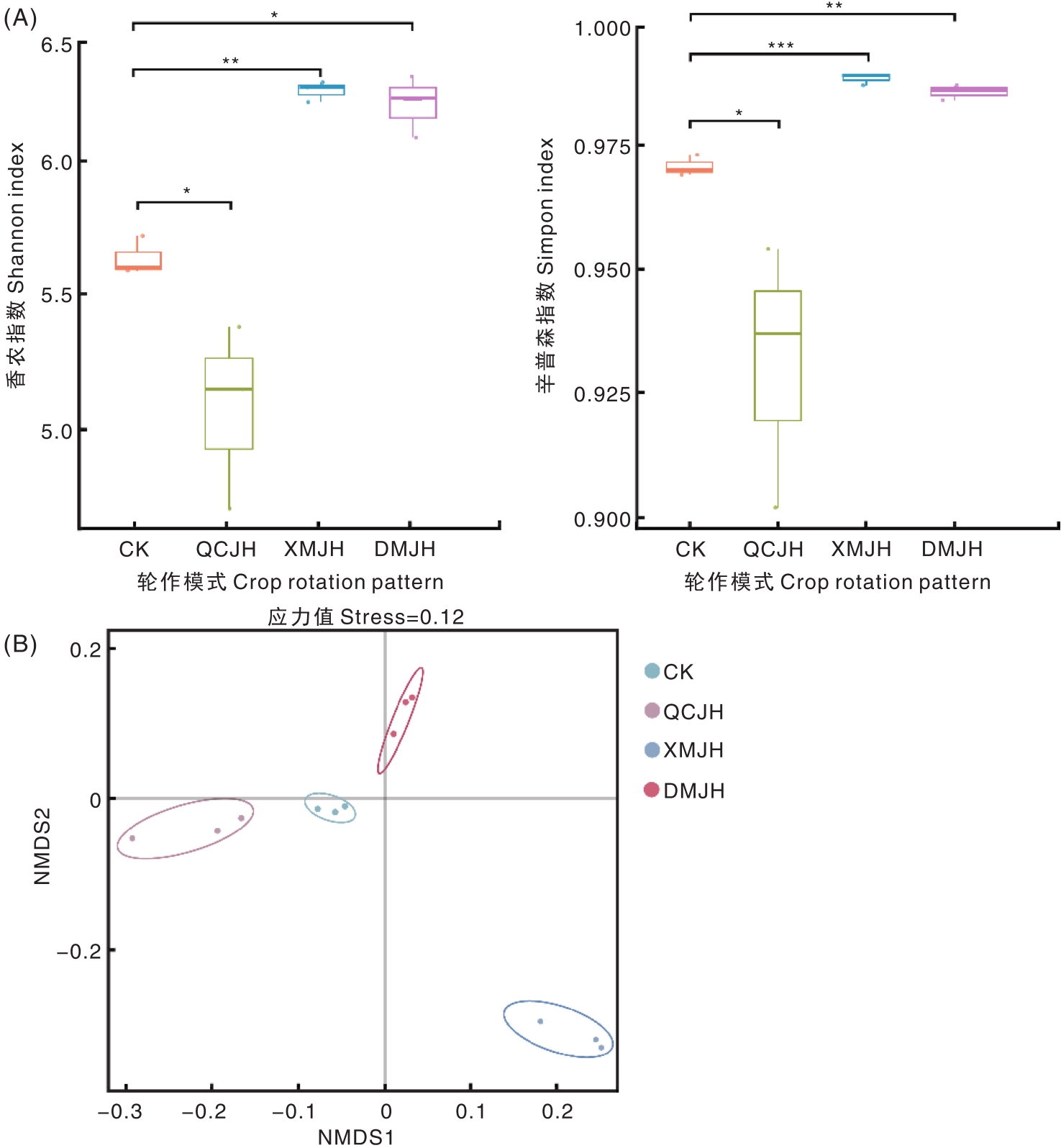
Fig.1 Diversity and structural differences of bacterial communities in the rhizosphere of different plants after rotation with Chrysanthemum morifolium Ramat. cv. Hangbaiju *, ** and *** indicate p<0.05, p<0.01 and p<0.001, respectively.
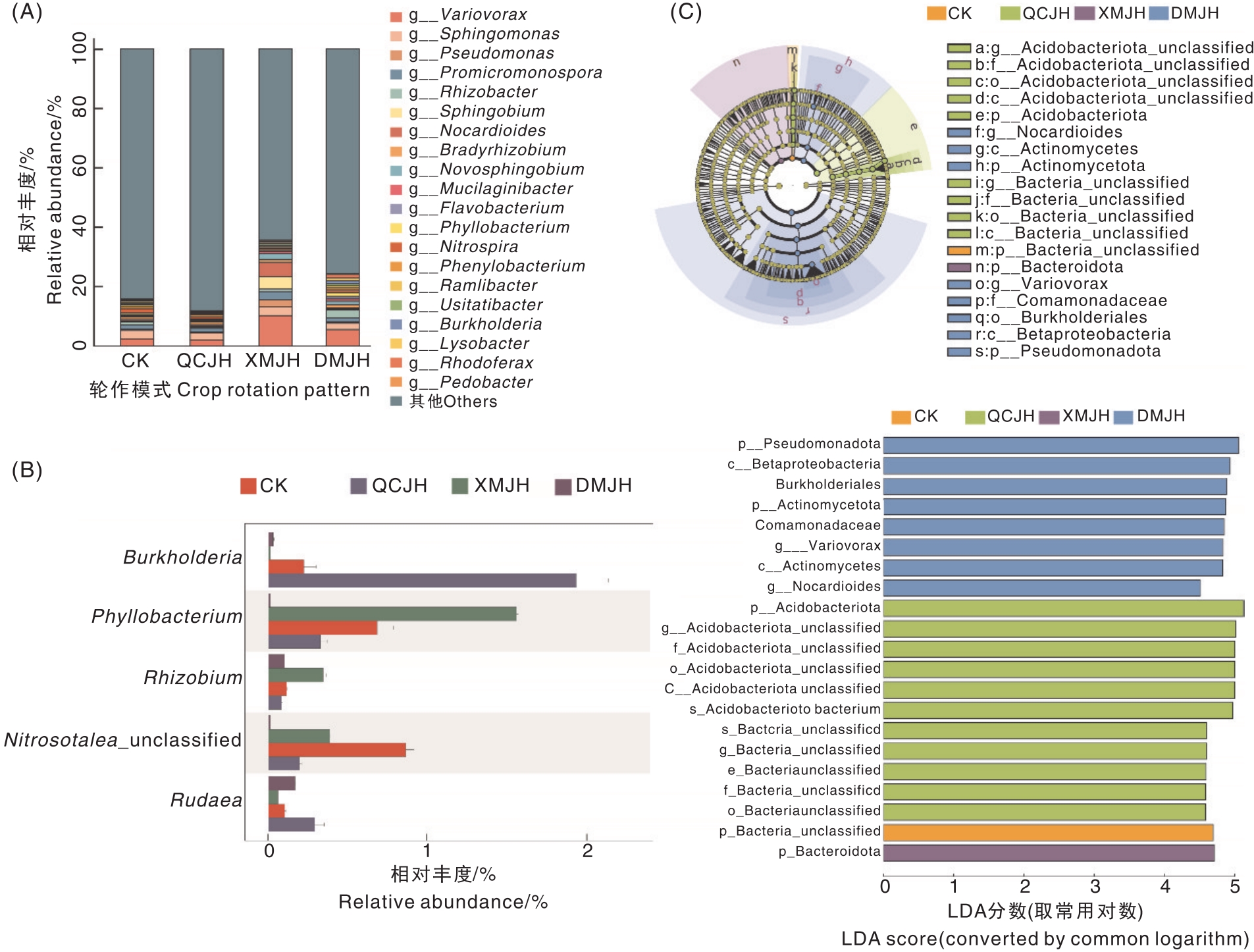
Fig.2 Analysis of dominant genera and differential bacterial communities in the rhizosphere of different plants after rotation with Chrysanthemum morifolium Ramat. cv. Hangbaiju A, Distribution of dominant genera; B, Abundance of differential genera; C, Evolutionary branch diagram and distribution histogram based on the LEfSe method.
| [1] | Cardinale B J, Duffy J E, Gonzalez A, et al. Biodiversity loss and its impact on humanity[J]. Nature, 2012, 486(7401): 59-67. |
| [2] | Liu Q, Zhao Y X, Li T, et al. Changes in soil microbial biomass, diversity, and activity with crop rotation in cropping systems: a global synthesis[J]. Applied Soil Ecology, 2023, 186: 104815. |
| [3] | Banerjee S, Walder F, Büchi L, et al. Agricultural intensification reduces microbial network complexity and the abundance of keystone taxa in roots[J]. The ISME Journal, 2019, 13(7): 1722-1736. |
| [4] | Jing J Y, Cong W F, Bezemer T M. Legacies at work: plant-soil-microbiome interactions underpinning agricultural sustainability[J]. Trends in Plant Science, 2022, 27(8): 781-792. |
| [5] | Zhao J, Yang Y D, Zhang K, et al. Does crop rotation yield more in China? A meta-analysis[J]. Field Crops Research, 2020, 245: 107659. |
| [6] | 刘智赫, 李冰圳, 张倩倩, 等. 不同轮作方式对北沙参生长及药材质量的影响[J]. 中药材, 2023, 46(2): 272-278. |
| Liu Z H, Li B Z, Zhang Q Q, et al. Effects of different crop rotation methods on the growth and quality of Glehnia littoralis[J]. Journal of Chinese Medicinal Materials, 2023, 46(2): 272-278. | |
| [7] | 周丹, 韦雪娇, 李开阳, 等. 紫苏轮作对半夏连作根际土壤微生物群落结构、功能及理化性质的影响[J]. 江苏农业科学, 2025, 53(12): 235-249. |
| Zhou D, Wei X J, Li K Y, et al. Effects of Perilla rotation on microbial community structure, function and physicochemical properties of rhizosphere soil in Pinellia ternata continuous cropping[J]. Jiangsu Agricultural Sciences, 2025, 53(12): 235-249. | |
| [8] | Zhou X G, Zhang J Y, Khashi u Rahman M, et al. Interspecific plant interaction via root exudates structures the disease suppressiveness of rhizosphere microbiomes[J]. Molecular Plant, 2023, 16(5): 849-864. |
| [9] | 檀国印, 杨志玲, 袁志林, 等. 药用植物连作障碍及其防治途径研究进展[J]. 西北农林科技大学学报(自然科学版), 2012, 40(4): 197-204. |
| Tan G Y, Yang Z L, Yuan Z L, et al. Research advances in continuous cropping obstacle in medicinal plants and its management[J]. Journal of Northwest A & F University(Natural Science Edition), 2012, 40(4): 197-204. | |
| [10] | 张敏, 谈献和, 张瑜, 等. 中药材连作障碍[J]. 现代中药研究与实践, 2012, 26(1): 83-85. |
| Zhang M, Tan X H, Zhang Y, et al. Continuous cropping obstacles of Chinese medicinal materials[J]. Research and Practice on Chinese Medicines, 2012, 26(1): 83-85. | |
| [11] | 张冬琳. 中药材与农林生物的间套轮作等复合种植模式[J]. 农业与技术, 2016, 36(16): 2. |
| Zhang D L. Compound planting patterns such as intercropping, relay cropping and rotation of Chinese medicinal materials with agricultural and forestry organisms[J]. Agriculture and Technology, 2016, 36(16): 2. | |
| [12] | Lin S, Huangqu J J, Chen T, et al. Effects of different cropping patterns on the physiology and quality of Pseudostellariae heterophylla[J]. International Journal of Agriculture and Biology, 2014, 16(5): 981-985. |
| [13] | 陈冬梅, 陈祥旭, 孙红艳, 等. 麦类作物化感作用种质资源筛选与评价[J]. 福建农林大学学报(自然科学版), 2008, 37(1): 13-17. |
| Chen D M, Chen X X, Sun H Y, et al. Screening and evaluation of allelopathic potential in triticeae crops germplasms[J]. Journal of Fujian Agriculture and Forestry University(Natural Science Edition), 2008, 37(1): 13-17. | |
| [14] | 方彦杰, 徐银萍. 不同栽培模式对大麦生育期间土壤水分及产量的影响[J]. 干旱地区农业研究, 2015, 33(3): 190-195. |
| Fang Y J, Xu Y P. Effects of different cultivation patterns on soil moisture and yield during the barley growth period[J]. Agricultural Research in the Arid Areas, 2015, 33(3): 190-195. | |
| [15] | 杨忠义, 段国锋, 马金虎, 等. 黄土丘陵区菊花种植模式的生态及经济效益分析[J]. 中国农学通报, 2014, 30(4): 195-199. |
| Yang Z Y, Duan G F, Ma J H, et al. Analysis on the ecological and economic benefits of cultivation patterns of Chrysanthemum morifolium Ramat. in hilly loess region[J]. Chinese Agricultural Science Bulletin, 2014, 30(4): 195-199. | |
| [16] | Wu H, Pratley J, Lemerle D, et al. Allelopathy in wheat (Triticum aestivum)[J]. Annals of Applied Biology, 2001, 139(1): 1-9. |
| [17] | Mehri S, Vahid R S, H Torabi Sirchisup M. Allelopathic appraisal effects of straw extract wheat varieties on the growth of corn[J]. African Journal of Biotechnology, 2010, 9(48): 8154-8160. |
| [18] | Matthiessen J N, Kirkegaard J A. Biofumigation and enhanced biodegradation: opportunity and challenge in soilborne pest and disease management[J]. Critical Reviews in Plant Sciences, 2006, 25(3): 235-265. |
| [19] | Chen S L, Yu H, Luo H M, et al. Conservation and sustainable use of medicinal plants: problems, progress, and prospects[J]. Chinese Medicine, 2016, 11: 37. |
| [20] | Yang L, Wen K S, Ruan X, et al. Response of plant secondary metabolites to environmental factors[J]. Molecules, 2018, 23(4): 762. |
| [21] | 王籽懿, 黄修梅, 杨玉荣, 等. 不同轮作模式对东北黑土地影响的研究进展[J]. 江苏农业科学, 2024, 52(11): 27-34. |
| Wang Z Y, Huang X M, Yang Y R, et al. Research progress on effects of different rotation patterns on black soil in Northeast China[J]. Jiangsu Agricultural Sciences, 2024, 52(11): 27-34. | |
| [22] | 焦旭升, 魏春雷, 杨春, 等. 中药材轮作栽培的机理及模式研究进展[J]. 寒旱农业科学, 2024(5): 405-409. |
| Jiao X S, Wei C L, Yang C, et al. Research progress on the mechanisms and models of the rotation cultivation in Chinese traditional medicinal crops[J]. Journal of Cold-Arid Agricultural Sciences, 2024(5): 405-409. | |
| [23] | 李冉, 李精华, 林生威, 等. 稻豆轮作对土壤理化性质及微生物群落的影响[J]. 热带生物学报, 2024, 15(2): 157-164. |
| Li R, Li J H, Lin S W, et al. Effects of rice-soybean-rice rotation on soil physicochemical properties and microbial community[J]. Journal of Tropical Biology, 2024, 15(2): 157-164. | |
| [24] | Tiemann L K, Grandy A S, Atkinson E E, et al. Crop rotational diversity enhances belowground communities and functions in an agroecosystem[J]. Ecology Letters, 2015, 18(8): 761-771. |
| [25] | 刘彦伶, 李渝, 张雅蓉, 等. 长期不同轮作下黄壤微生物量碳季节变化特征与差异[J]. 环境科学, 2025, 46(12): 8062-8070. |
| Liu Y L, Li Y, Zhang Y R, et al. Seasonal variation and differences in microbial biomass carbon in yellow soil under different long-term crop rotation patterns[J]. Environmental Science, 2025, 46(12): 8062-8070. | |
| [26] | Kumar A, Dubey A. Rhizosphere microbiome: Engineering bacterial competitiveness for enhancing crop production[J]. Journal of Advanced Research, 2020, 24: 337-352. |
| [27] | Estrada-De Los Santos P, Bustillos-Cristales R, Caballero-Mellado J. Burkholderia, a genus rich in plant-associated nitrogen fixers with wide environmental and geographic distribution[J]. Applied and Environmental Microbiology, 2001, 67(6): 2790-2798. |
| [28] | Contesto C, Milesi S, Mantelin S, et al. The auxin-signaling pathway is required for the lateral root response of Arabidopsis to the rhizobacterium Phyllobacterium brassicacearum[J]. Planta, 2010, 232(6): 1455-1470. |
| [29] | Venter Z S, Jacobs K, Hawkins H J. The impact of crop rotation on soil microbial diversity: a meta-analysis[J]. Pedobiologia, 2016, 59(4): 215-223. |
| [30] | Barka E A, Vatsa P, Sanchez L, et al. Taxonomy, physiology, and natural products of Actinobacteria[J]. Microbiology and Molecular Biology Reviews, 2016, 80(1): 1-43. |
| [31] | 丁亚茹, 陈玉蓝, 林正全, 等. 不同发病率烟田根际土壤微生物群落组成研究[J]. 中国烟草科学, 2020, 41(1): 67-73. |
| Ding Y R, Chen Y L, Lin Z Q, et al. Study on microbial community composition in rhizosphere soil of tobacco fields with different disease incidence rates[J]. Chinese Tobacco Science, 2020, 41(1): 67-73. | |
| [32] | Kielak A M, Barreto C C, Kowalchuk G A, et al. The ecology of Acidobacteria: moving beyond genes and genomes[J]. Frontiers in Microbiology, 2016, 7: 744. |
| [1] | WEN Mingxia, LI Yongjie, HUANG Bei. Regulatory effects of different green manure management modes on soil physicochemical properties and bacterial communities in citrus orchards [J]. Acta Agriculturae Zhejiangensis, 2026, 38(7): 1432-1442. |
| [2] | LI Yang, LIU Zhanqun, HE Runping, ZHAO Fei, XING Kun, YANG Cundi, PU Xiulan. Effects of microbial fertilizer on soil nutrients, melon quality, pest and disease control efficacy [J]. Acta Agriculturae Zhejiangensis, 2026, 38(5): 909-918. |
| [3] | MAO Xiaomei, JU Xinghui, ZHU Lijing, YANG Jian. Effects of crop rotation and microbial agent application on the rhizosphere soil microbial community of protected tomato [J]. Acta Agriculturae Zhejiangensis, 2026, 38(5): 979-990. |
| [4] | LIU Jiaming, WANG Nan, MA Zhimei, LYU Weiguang, ZHENG Xianqing, SONG Ke, ZHANG Hanlin, ZHANG Haiyun, ZHANG Yue, ZHANG Juanqin. Effect and mechanisms of remediation on salinized greenhouse soil by earthworm-straw [J]. Acta Agriculturae Zhejiangensis, 2026, 38(2): 327-338. |
| [5] | LI Chuanzhe, DONG Qingjun, JI Li, WANG Jidong, CHEN Chuan, ZHANG Ankang, ZHANG Yongchun, SHAO Wenqi. Effects of new-type fertilizers on soil nutrients, microbial community, and yield of rice and wheat in the typical ancient course area of Yellow River, China [J]. Acta Agriculturae Zhejiangensis, 2026, 38(1): 136-147. |
| [6] | ZHANG Zhi, HE Haohao, YU Miao, XU Jianfeng. Effects of chemical fertilizer reduction combined with soil conditioner on soil acidity, soil nutrients and rice yield [J]. Acta Agriculturae Zhejiangensis, 2025, 37(6): 1301-1308. |
| [7] | WEI Xinhang, ZHOU Quan, LI Yani, CHEN Weiliang, MAO Bizeng. Effect of bio-organic fertilizer on microbial community structure in rhizosphere of Curcuma wenyujin [J]. Acta Agriculturae Zhejiangensis, 2025, 37(4): 892-900. |
| [8] | HU Tiejun. Effects of chemical fertilizer reduction combined with microbial fertilizer application on yield, quality, and soil properties of broccoli [J]. Acta Agriculturae Zhejiangensis, 2024, 36(7): 1657-1665. |
| [9] | YUE Zongwei, LI Jiaxiao, SUN Xiangyang, LIU Guoliang, LI Suyan, WANG Chenchen, ZHA Guichao, WEI Ningxian. Effects of chemical fertilizer combined with organic fertilizer on soil properties, cherry fruit quality and yield [J]. Acta Agriculturae Zhejiangensis, 2023, 35(9): 2192-2201. |
| [10] | LI Xiaoxia, LI Dan, LI Wanxing, JIN Kunpeng, LIU Yongzhong, HAN Wenqing, HUANG Xuefang, LIU Xin, TIAN Gang, CAO Jinjun. Effects of different rotation patterns on physiological characteristics, yield and quality of foxtail millet during grain filling stage [J]. Acta Agriculturae Zhejiangensis, 2023, 35(7): 1499-1510. |
| [11] | WU Chuanmei, HE Ji, WU Wenshan, CAI Jun, XIANG Yangzhou. Effects of intercropping on stoichiometric characteristics and nutrients contribution rate of soil aggregates in Rosa roxbunghii Tratt. orchard [J]. Acta Agriculturae Zhejiangensis, 2023, 35(5): 1132-1143. |
| [12] | LU Shuai, LUO Xiaogang, LIU Quanwei, ZHANG Yi, MENG Yanghao, LI Jie, ZHANG Jinglai. Effect of organic-inorganic compound fertilizer on wheat growth, nutrients and heavy metal content of soil and wheat [J]. Acta Agriculturae Zhejiangensis, 2023, 35(4): 922-930. |
| [13] | ZHU Shijun, WANG Lili, JIN Shuquan, ZHOU Jinbo, WANG Feng, LU Xiaohong. Effects of different soil disinfection methods on soil fungal diversity and community structure [J]. Acta Agriculturae Zhejiangensis, 2023, 35(3): 639-646. |
| [14] | GAO Feng, WEN Shizhi, WEI Shuoxing, OU Hanbiao, WANG Zhihui. Effet of vegetation restoration models on soil physiochemical properties, enzymes activities and fungal diversity in rocky desertification area of northwest Guangxi, China [J]. Acta Agriculturae Zhejiangensis, 2023, 35(10): 2425-2435. |
| [15] | YANG Shengzhu, LI Xiang, LI Chaowen, CHEN Hainian, LIU Li, LU Yingang, CAO Zhuoyang. Characteristics of soil nutrients and enzyme activities in rhizosphere of tobacco affected by bacterial wilt in Guizhou Province, China [J]. Acta Agriculturae Zhejiangensis, 2023, 35(1): 146-155. |
| Viewed | ||||||
|
Full text |
|
|||||
|
Abstract |
|
|||||

